Summary
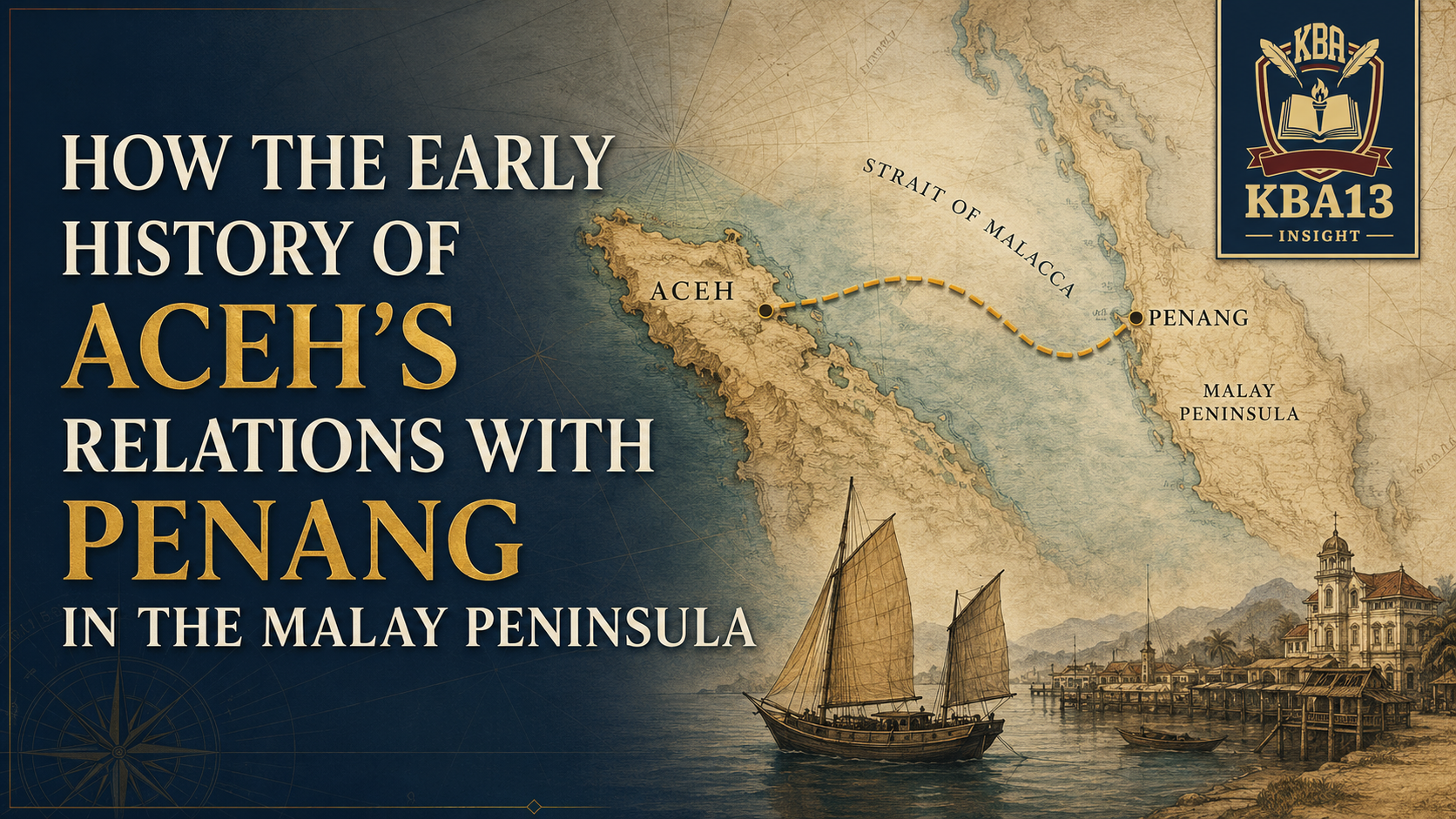
The historical relationship between Aceh and Penang developed through maritime trade, migration, religious networks, and political interaction across the Strait of Malacca. Long before modern national borders separated Indonesia and Malaysia, merchants, scholars, pilgrims, political figures, and ordinary families moved between northern Sumatra and the Malay Peninsula. This article examines how those early connections shaped the social, economic, and intellectual history of both regions and established Penang as an important point of encounter for Acehnese communities.
Keywords
- Aceh
- Aceh History
- Aceh–Penang relations
- Acehnese migration
- British Malaya
- colonial Penang
- Indian Ocean World
- Indonesia–Malaysia relations
- Islamic networks
- KBA13 Insight
This essay examines the relationship between Aceh and Pinang as part of the history of relations between Indonesia and Malaysia before and after the two countries became independent. Besides, this study seeks to explain how the history of the relationship began when Francis Light provided a significant opportunity for the people of Aceh to develop Pulau Pinang.
In addition to referring to previous studies, this study also puts forward oral history, namely looking at the still-developing stories about the two countries' history. The reviewer made observations in several villages in Aceh that gave the impression of a relationship with Pulau Pinang.
Several previous studies have examined the relationship between the two countries. However, it seems that no study looks at how the meeting of the two countries has given such an impression on the construction of Malay identity. Aceh has an essential role in fostering Malay identity.
However, it rarely connects it with Pulau Pinang because it relates to Aceh's relations with Melaka. This study shows several historical phases of Aceh's relationship with Pulau Pinang.
This historical phase is closely related to when Aceh re-Malayed the Malay Peninsula after establishing the Malay Kingdom of Melaka. It also defended the Malay Peninsula from the Portuguese attempts to occupy the region in the 15th and 16th centuries AD.
Meanwhile, in the 17th century, Aceh contributed to the standardization of Malayness on the Peninsula. Meanwhile, in the 18th century, Aceh played a role in constructing Malay identity in Pulau Pinang. The early history of Seyyed Hussain al-Aidid in Pulau Pinang; Aceh's relationship with Pulau Pinang when Aceh was about to be colonized by the Dutch; the arrival of several Acehnese families in Pulau Pinang helped spread the wings of Acehnese identity in Malay, as seen in the role of P. Ramlee.
So far, many scholars have conducted studies on Pulau Pinang, particularly regarding the island's founding by Francis Light. The study of Aceh in the 18th century AD reveals an era of internal conflict within the kingdom of Aceh Darussalam and European attempts to interfere in Aceh's internal affairs. These two studies have established a solid historical link between Pulau Pinang and Aceh, encompassing not only later discussions about Pulau Pinang and the Kingdom of Aceh Darussalam but also the history of migration, religion, and trade.
For example, Anthony Reid's study, which describes the history of the war between Aceh and the Netherlands, cannot deny the diplomatic contribution made by the Acehnese in Pulau Pinang. In addition, many scholars have conducted studies on Malay identity. Of course, in this study, the perception of Malay identity becomes particularly interesting to observe when it is associated with the history of the Malays in Sumatra and the Malay Peninsula.
However, studies on Malay identity between Pulau Pinang and Aceh in the 18th and 19th centuries AD have not been widely conducted because both regions experienced European intervention during those centuries. Aceh fought against the Dutch, while Pulau Pinang was controlled by the British. Aceh's contribution to Malays was more highlighted in the 16th and 17th centuries AD, when Aceh was at its peak of glory. Before the 18th century, Pinang was still an area that had not received serious attention from the Malay kingdoms in the Malay Peninsula, apart from being considered part of the Kingdom of Kedah. In addition, the colonizers from Europe targeted Melaka as a place to carry out trade actions.
The history of Aceh, when it experienced turmoil, saw its contribution wane in Malay history. At the same time, Pulau Pinang seems to be a "gateway" for the Acehnese to carry out trade and religious activities. However, Pulau Pinang can still be considered a new country since it was opened in 1786. Aceh's relationship with Pulau Pinang can be seen in the relationship between Francis Light and Seyyed Hussain al-Aidid.
The arrival of the Acehnese to Pulau Pinang has been happening for a long time, even before the arrival of Francis Light to the island. They came as traders selling in Teluk Jelutung, now known as Kampung Pulau, Jalan Perak. The Acehnese have also made Pinang a place to lobby during the war and "transit" when they want to perform Hajj. Another factor is the island's geographical proximity to Aceh, particularly to areas such as Lhokseumawe, Idi, Simpang Ulim, and Tamiang. This factor then triggered trade activities between Pulau Pinang and Aceh to be very widespread.
This study aims to show when the Acehnese kingdom began to decline; in fact, activities outside the palace were carried out very intensively on Pulau Pinang. This study is a social history study focusing on the era from the establishment of Pulau Pinang to the last few decades, with a relationship to Aceh.
This study also explores data from Pulau Pinang and Aceh, particularly in the East Coast region of Aceh. In addition to the historical approach, ethnographic studies were conducted in several locations, both in Aceh and Pulau Pinang.
Studies on Malay identity have rarely addressed Aceh's relationship with Pulau Pinang, which may be due to the absence of a Malay kingdom on Pulau Pinang. This series aims to answer whether the phases of Aceh's relationship with Pulau Pinang are closely related to the construction of Malay identity.
In 1794, it was stated that there were two types of Malays in Pulau Pinang. First, the Malays can grow rice, sugarcane, and fruits. That being said, they are straightforward to set up. Second, the Malays became the captain of the ship. Light described them as "a bad description of people, addicted to smoking opium, gaming, and other vices; to rob and assassinate is only shameful when they fail to succeed." Pulau Pinang had become the residence of various ethnic groups, namely Javanese, Minangkabau, Bugis, Indians, Chinese, Burmese, Sri Lankans, Japanese, and Europeans.
Regarding the Malays, Wazir Jahan Karim said that "the original Malays of Penang, or 'Melayu jati' are Kedah Malays who pioneered fishing villages and rice farms all along with the coastal areas of the island."

Meanwhile, in Aceh, the Malays at that time were constantly reminded of the conquest of Melaka and Johor by the Kingdom of Aceh. Several thousand Malays had been captured and brought to Aceh as prisoners of war, who later became known as the Lamiet Bangsa (Slave Nation). Although, among these prisoners, some became royal officials. The Acehnese perception of the Malays cannot be trusted because it is easy to cooperate with the colonialists.
Let us explore the city of Penang today. We can see several historical heritage sites that prove how Malay identity is. However, the depiction of the city of Georgetown shows the meaning of Malay in the 18th century AD, when the British occupied the Malay Peninsula. At the very least, examining the meaning of Malay in the Pulau Pinang era, according to Milner, is a phase of experiencing colonialism and the making of the Malay Nation. Here, the role of Europeans in dividing the territory of the Malay Kingdom was very dominant.
Meanwhile, Malaysia and Singapore were under British influence. In this context, Milner wrote: “Only Aceh in the very north, which was never to identify as 'Malay', continued to resist Dutch expansion.” Elsewhere, Marcinkowski mentions that after the fall of Melaka, “Aceh in Sumatra took over the role of leading Muslim power of the Malay-Indonesian world.” According to Andaya, "during Aceh's dominance as the center of the Malay world in the seventeenth century, its form of the Malay language became the prestigious version, though it created difficulties in comprehension in parts of the wider Malay-speaking world."
The term Malay is examined; Aceh cannot be associated with the history of this identity because the term Malay can indicate the identity of a person or group. However, the perception of the Malay concept depends on the historical trajectory in the Archipelago of Southeast Asia.
Aceh does not seem to have been identified as Malay in the two statements above. Aceh took on the role of a Muslim power after the fall of Melaka to the Portuguese in 1511, implying that Aceh is an identity that represents an anti-colonial spirit and that Malay can be said to be an identity. Very cooperative with the invaders. These two things are, of course, closely related to the construction of Malay identity in the Malay Peninsula, especially in the context of colonialization.
As for the spirit of the Acehnese in conquering the Malays so that the Portuguese would not dominate the Straits of Melaka, it is seen in the Hikayat Malem Dagang. In this saga, it is told about how Sultan Iskandar Muda mobilized the people to join the war in the Malay Land.
The historical chronicle states that in 1613, Johor was conquered by the Sultan of Aceh. However, it was later returned to his country. One of the reasons for the attack, according to Djajadiningrat, was that "they held negotiations with the Portuguese so that Iskandar Muda was angry" and "then [Sultan] Al ad-Din had to be taken prisoner and brought back by the Acehnese."
Aceh was aggressively attacking several kingdoms in the Malay Peninsula. Siak and Aru caused them to help the Portuguese. In addition, the Portuguese were aware of this advantage, especially since they did not want Aceh to control the Melaka Straits, which led Johor to form an intimate relationship with the Portuguese.
How to Cite
Ahmad, Kamaruzzaman Bustamam. (2026). How the Early History of Aceh's Relations with Penang in the Malay Peninsula. Banda Aceh: KBA13 Insight.
https://www.kba13.com/how-the-early-history-of-acehs-relations-with-penang-in-the-malay-peninsula/
Professor of Anthropology of Religion at UIN Ar-Raniry Banda Aceh. He writes on geopolitics, Southeast Asian security and governance, Islam in the Malay world, and the future of knowledge.