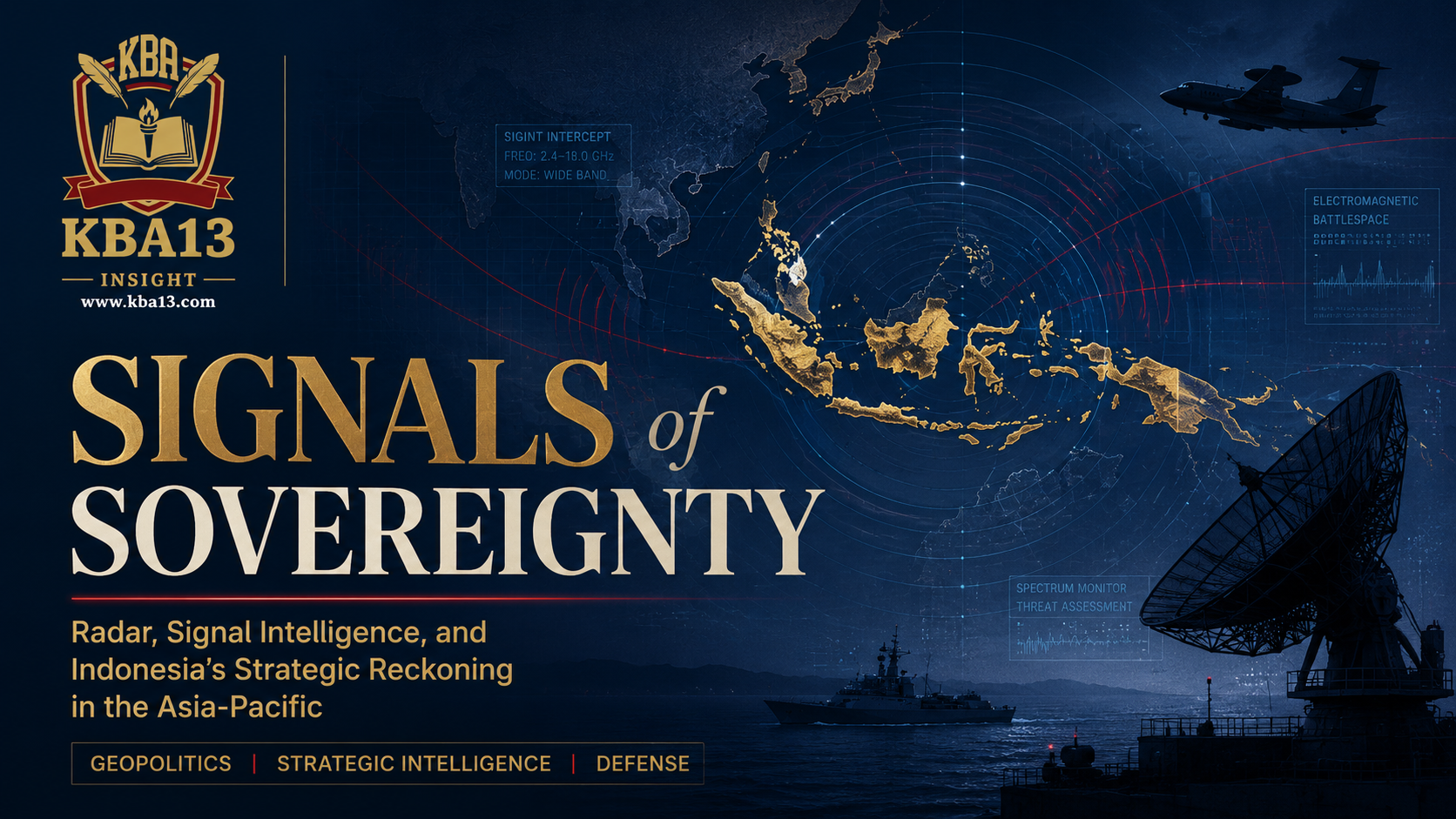
Radar and signal intelligence shaping Indonesia’s sovereignty in the Asia-Pacific electromagnetic battlespace
Executive Summary
The Asia-Pacific security landscape is defined not only by naval tonnage, missile ranges, and aircraft carrier strike groups, but increasingly by an invisible contest waged across the electromagnetic spectrum. This study presents a comprehensive analysis of the interdependence between radar systems and Signal Intelligence (SIGINT) in the Asia-Pacific region, examining its implications for regional stability and its specific consequences for Indonesian sovereignty. The central finding is both technically grounded and philosophically unsettling: the very systems that a state deploys to detect threats simultaneously betray that state’s presence, intentions, and capabilities to adversaries equipped with electronic intelligence platforms. This paradox has driven an intense technology race in electronic warfare (EW) across the region, reshaping the strategic calculus of all major actors. China has built an extensive SIGINT architecture integrated with its Anti-Access/Area Denial (A2/AD) doctrine. The United States and its Five Eyes partners — particularly Australia — have deployed a global network of interception facilities, including installations expressly targeting Indonesian communications. Japan has invested in advanced radar systems to counter Chinese probing of its airspace boundaries. For Indonesia — an archipelagic nation whose maritime domain encompasses some of the most strategically significant waterways on Earth — this electromagnetic competition presents critical vulnerabilities that cannot be addressed through hardware procurement alone. This study argues that Indonesia faces a structural gap between its ambitions for physical defense modernization and its doctrine, human capital, and regulatory preparedness to operate effectively in an information-contested environment. A holistic national security strategy that elevates signals intelligence, electronic warfare capacity, and electromagnetic sovereignty to the center of defense policy is not merely advisable — it is existentially necessary.
Introduction: The Invisible War That Determines the Visible One
There is a foundational assumption embedded in conventional strategic thinking that remains largely unquestioned: that the primary contest in military competition is physical — the number of ships, the range of missiles, the payload capacity of bombers. This assumption, comfortable in its tangibility, is becoming dangerously obsolete. The most consequential battles of the contemporary era are being fought not on the surface of the ocean or across contested skies, but across the electromagnetic spectrum — invisibly, continuously, and in peacetime as much as in war.
Signal Intelligence, or SIGINT, has existed as a discipline since the early days of radio communication, its significance demonstrated conclusively during the Second World War when Allied codebreakers at Bletchley Park arguably shortened the war by years. Yet what is unfolding in the Asia-Pacific today represents something qualitatively different from historical precedent. The proliferation of advanced sensor systems, artificial intelligence-assisted data processing, networked surveillance architectures, and stealth-enabled collection platforms has transformed SIGINT from a specialized intelligence tool into the central nervous system of modern military power. Who is listening, what they are hearing, and how swiftly they can act on what they know has become the defining strategic question of the region (Federation of American Scientists [FAS], n.d.a).
The relationship between radar and SIGINT creates a strategic paradox of the highest order. Radar systems are, by design, active emitters — they broadcast energy into the environment in order to detect what lies within it. An air defense radar protecting an airbase, a ship’s fire-control system tracking an incoming missile, or a coastal surveillance installation scanning territorial waters all perform their functions by revealing themselves. Every radar emission is simultaneously a detection capability and a vulnerability — a signal broadcast to any adversary sophisticated enough to receive it. This is not a design flaw. It is an inherent property of active sensor systems, and it has given rise to an entire discipline of military competition centered on exploiting this inescapable physics (CRFS, n.d.; National Security Agency [NSA], n.d.).
In the Asia-Pacific, where the strategic competition between China and the United States shapes the security environment for every state in the region, this electromagnetic contest has become central to great-power rivalry in ways that are rarely acknowledged in public discourse. China’s SIGINT network spans dozens of ground stations, intelligence-gathering ships, and satellite constellations. The United States and its Five Eyes alliance — anchored in the Asia-Pacific by Australia’s Pine Gap facility and the Shoal Bay Receiving Station near Darwin — maintains a surveillance architecture of extraordinary reach and sophistication. Japan has invested in advanced radar systems as both a deterrent and a tripwire in contested airspace. And in this ambient environment of perpetual electronic observation, Indonesia — the world’s largest archipelagic state, occupying a geographic position of singular strategic importance — finds itself increasingly exposed to surveillance it neither authorized nor fully comprehends.
The intellectual challenge of this paper is not merely technical. It is philosophical. To understand the electromagnetic contest in the Asia-Pacific is to confront questions about the nature of sovereignty itself in the information age. Can a state genuinely claim sovereign control over its territory if the communications, radar emissions, and military signals originating from that territory are continuously intercepted and analyzed by foreign intelligence services? Can a foreign policy of non-alignment provide meaningful strategic independence when the electromagnetic environment respects neither political declarations nor maritime boundaries? These questions have no comfortable answers. But they are the questions that Indonesian policymakers must confront with honesty if the country’s defense strategy is to be calibrated to the actual threat environment rather than to a more reassuring fiction of electromagnetic immunity.
This study proceeds in four parts. The first establishes the technical and strategic foundation of the electromagnetic contest, explaining how radar systems work, how SIGINT exploits them, and how Electronic Warfare has emerged as the defining response to the transparent battlefield. The second part profiles the major regional actors and their SIGINT capabilities. The third examines the specific implications for Indonesia, analyzing the country’s strategic vulnerabilities with the candor that effective policy requires. The fourth offers strategic recommendations grounded in a realistic assessment of Indonesia’s capabilities, constraints, and long-term interests. The conclusion argues that electromagnetic sovereignty — control over one’s own electromagnetic environment and the protection of sensitive signal emissions from foreign collection — must be recognized as a core attribute of national sovereignty in the twenty-first century, as fundamental as territorial integrity and as urgent as any conventional defense priority.
Part I: The Technical and Strategic Foundation of the Electromagnetic Contest
1.1 The Paradox of Detection: When the Act of Seeing Becomes the Act of Being Seen
The word “radar” is an acronym, derived from the phrase Radio Detection and Ranging, and it encapsulates in its very etymology both the function and the fundamental vulnerability of the technology it describes (National Oceanic and Atmospheric Administration [NOAA], n.d.). A radar system operates by transmitting radio waves into its surrounding environment and then analyzing the energy reflected back from objects in that environment. By measuring the time elapsed between transmission and reception, the system calculates distance. By analyzing the Doppler shift — the change in frequency of the reflected wave caused by a moving target — it determines velocity. The WSR-88D weather radar, to take one widely understood example, uses exactly this principle, detecting the phase shift of returning waves to measure the speed of precipitation moving toward or away from the antenna (NOAA, n.d.).
In military applications, the principles remain identical but the stakes are profoundly different. Air defense radars must track dozens of targets simultaneously, identifying friend from foe in milliseconds. Naval fire-control radars must lock onto fast-moving anti-ship missiles with extreme precision. Airborne early warning systems must build a comprehensive picture of the aerial environment across hundreds of kilometers. In each case, the radar’s effectiveness is directly proportional to the energy it emits — and the energy it emits is directly proportional to the intelligence it provides to any adversary with the sophistication to receive and analyze it.
This is the central paradox of radar in the age of SIGINT: the systems designed to protect a state’s sovereignty by detecting threats simultaneously reveal that state’s capabilities, deployment patterns, readiness posture, and technological limitations to any adversary with the equipment and expertise to collect and analyze radar emissions. A radar system that goes silent to avoid detection becomes, in that moment of silence, operationally blind. A radar system that operates at full capacity provides optimal coverage — but also optimal intelligence to the enemy. There is no resolution to this dilemma. There is only its management through doctrine, deception, and countermeasures.
The philosophical implications of this paradox extend beyond the technical into the epistemological foundations of modern statecraft. A state’s ability to “know” its security environment — to detect threats, track movements, and anticipate challenges — is constitutively linked to a corresponding vulnerability in the very act of that knowing. The more comprehensive a state’s surveillance architecture, the more valuable the intelligence it inadvertently broadcasts to those positioned to collect it. This is not merely a military problem. It is a political one, touching on questions of sovereignty, the nature of deterrence, and the fundamental challenge of maintaining strategic ambiguity in an era of ubiquitous electronic surveillance. A state that cannot protect the electromagnetic emissions of its own military systems cannot fully protect the operational security those systems are designed to serve.
1.2 The Symbiotic Relationship: How Radar Emissions Become Intelligence Currency
Signal Intelligence, in its most encompassing definition, is the collection of intelligence derived from the interception of signals — whether those signals are communications between human beings or electronic emissions from machines (BAE Systems, n.d.; Wikipedia, n.d.a). Within this broad category, two primary sub-disciplines are most relevant to the radar-centric contest of Asia-Pacific competition. Communications Intelligence, or COMINT, targets the content and metadata of human communications — radio transmissions, encrypted messages, voice communications. Electronic Intelligence, or ELINT, targets the emissions of electronic systems not primarily designed for communication — most importantly, the emissions of radar systems and weapons guidance electronics (FAS, n.d.a; American Military University [AMU], n.d.).
It is ELINT that creates the most direct and operationally consequential relationship with radar. An ELINT system, operating passively and without revealing its own presence, collects radar emissions and subjects them to exhaustive analysis. From the raw signal, trained analysts — increasingly aided by AI-powered pattern recognition systems — can extract an extraordinary range of intelligence: the operating frequency of the radar, which indicates the types of targets it is designed to detect; the pulse repetition interval, which reveals the radar’s range and the tradeoffs embedded in its design; the scan rate, which exposes how rapidly and efficiently the system builds its picture of the surrounding environment; and the modulation patterns, which can identify the specific hardware variant and, by extension, expose the software characteristics running it (CRFS, n.d.; NSA, n.d.).
This body of technical intelligence is divided by practitioners into two categories that reflect different analytical purposes. Technical ELINT, or TechELINT, focuses on precisely characterizing the signal parameters of an adversary’s radar — building what intelligence professionals call an electronic “fingerprint” of the system, which can be used to develop tailored jamming waveforms, radar warning receivers, and countermeasures specifically optimized against that radar’s characteristics. Operational ELINT, or OpELINT, focuses on geolocating the sources of radar emissions and understanding the operational patterns of the systems — when they go active, when they are silent, how they respond to stimulation, and what their deployment patterns reveal about military intentions and readiness (NSA, n.d.). The distinction matters enormously for how the collected intelligence is used: TechELINT feeds weapons and systems development cycles measured in years, while OpELINT feeds operational planning measured in days or hours.
The operational implications of comprehensive ELINT collection are not merely academic. A military force that has built a detailed technical library of an adversary’s radar systems can program its jamming systems to blind those radars at the precise frequencies they operate on. It can develop stealth aircraft whose radar cross-sections are specifically minimized against the known detection parameters of those systems. It can plan attack routes that navigate around the radar coverage gaps that ELINT has revealed. In modern contested environments, ELINT is not a passive intelligence-gathering activity occurring on the margins of military competition; it is a core enabler of military dominance, feeding directly into the design, doctrine, and operational planning of every major force capability.
Contemporary SIGINT operations draw on networked collections from multiple platform types operating simultaneously across different domains. Ground-based SIGINT stations provide persistent coverage of fixed geographic areas. Maritime intelligence-gathering vessels — variously described in official euphemism as “comprehensive survey ships” or “oceanographic research vessels” — operate in international waters to intercept emissions from naval exercises and coastal systems. Aircraft platforms, ranging from dedicated turboprop reconnaissance aircraft to high-altitude unmanned aerial vehicles, provide flexible collection against targets of opportunity. And signals intelligence satellites orbit above, providing continuous global coverage while remaining beyond the reach of any defensive action short of counterspace weapons (Wikipedia, n.d.b). The integration of AI and machine learning has transformed the processing capacity of these networked architectures, enabling near-real-time analysis of signals that would previously have required weeks or months of manual exploitation (MarketsandMarkets, n.d.). In a domain where the speed of analysis directly determines the operational value of collected intelligence, this AI-enabled acceleration represents a qualitative transformation in the nature of SIGINT competition.
1.3 The Transparent Battlefield and the Strategic Logic of Electronic Warfare
The convergence of proliferating sensor systems, AI-assisted analysis, and networked surveillance has produced what military theorists have described as the “transparent battlefield” — a combat environment in which the traditional fog of war is lifted to a degree unprecedented in military history, and in which the concealment of military forces becomes extraordinarily difficult to achieve and maintain (The Transparent Battlefield, n.d.; TDHJ.org, n.d.). The transparent battlefield is not merely a metaphor. It describes a genuine operational condition in which modern forces — with their radar emissions, communications signatures, thermal profiles, and acoustic footprints — are continuously visible to adversaries possessing sufficient collection capability.
The strategic implications of this transparency are profound and extend well beyond immediate tactical circumstances. A force that cannot conceal its positions, intentions, or movements is a force that can be targeted, disrupted, and potentially destroyed before it can bring its capabilities to bear. The traditional military advantages of surprise, maneuver, and the concentration of force are all compromised in a transparent battlefield. This reality has driven the rapid development and operational deployment of Electronic Warfare as a fundamental component of modern military power — not a specialized niche capability, but a core dimension of every major military operation (Wikipedia, n.d.c).
Electronic Warfare is defined by practitioners as the military use of the electromagnetic spectrum to attack the enemy or to impede the enemy’s use of the spectrum, while retaining friendly forces’ own freedom of action within it (U.S. Army, 2023). Its three component disciplines address the challenge of the transparent battlefield from complementary angles. Electronic Attack encompasses offensive EW actions — jamming enemy communications and radar systems, broadcasting false signals to deceive enemy sensors, and deploying expendable decoys to draw fire from precision-guided munitions. Electronic Protection addresses the defensive dimension — designing systems resistant to jamming, developing frequency-hopping protocols that make communications harder to intercept, and training operators to recognize and respond to enemy EW attacks. Electronic Warfare Support encompasses the real-time collection and analysis function — the passive monitoring of enemy emissions that enables both the offensive and defensive components to be calibrated against the specific systems in play (Wikipedia, n.d.c).
What EW represents, at its strategic core, is the recognition that information dominance — the ability to see clearly while denying clarity to the adversary — has become the decisive factor in modern military competition. A force that achieves electromagnetic superiority over its adversary has achieved something more consequential than numerical advantage in any particular weapons category: it has degraded the adversary’s ability to coordinate, to target, to respond, and ultimately to fight effectively. This insight, grasped by all major military powers and reflected in their rapidly growing EW investment programs, is what makes the Asia-Pacific’s electromagnetic contest so strategically significant — and why Indonesia’s relative underdevelopment in this domain constitutes a vulnerability of the first order.
The deeper philosophical point bears stating explicitly: in an era of electromagnetic transparency, the state that invests in the capacity to remain opaque — to protect its own emissions while collecting those of adversaries—is investing not merely in a weapons capability but in the precondition for all other capabilities. A surface fleet whose radar parameters have been fully characterized by an adversary’s ELINT program is a fleet whose survivability in a contested environment has been materially compromised, regardless of how advanced its hull design or weapons systems may be. The electromagnetic dimension of military power is foundational in a way that no other domain can claim, because it determines the operational effectiveness of every other domain simultaneously.
Part II: The Regional SIGINT Architecture — Actors, Capabilities, and Strategic Logics
2.1 China’s Surveillance Empire: SIGINT as the Spine of Area Denial
China’s investment in signal intelligence capabilities represents one of the most consequential defense modernization programs of the twenty-first century, yet it receives comparatively little attention in mainstream strategic analysis compared with more visible programs such as aircraft carrier construction or hypersonic missile development. This analytical imbalance reflects a broader tendency to privilege the visible and the physically imposing in security discourse — a tendency that systematically underweights the significance of the invisible infrastructure of intelligence collection that ultimately determines the operational effectiveness of every visible capability. The aircraft carrier is a symbol; the SIGINT network is the nervous system.
China’s SIGINT establishment, concentrated within the People’s Liberation Army Strategic Support Force’s Network Systems Department, operates one of the most extensive ground-based SIGINT collection networks in the world (FAS, n.d.b). Dozens of ground stations positioned across the Chinese mainland are oriented toward monitoring the signals of China’s near neighbors: Russian military communications in the north, Taiwanese air defense and communications networks across the strait, Japanese naval and air operations in the East China Sea, South Korean military systems on the peninsula, Indian military communications in the west, and — of particular relevance to Indonesia — the full spectrum of Southeast Asian military and governmental signals emanating from the south (FAS, n.d.b). The facility complex on Hainan Island occupies a position of singular importance in this network, specifically positioned to intercept American naval and air communications in the South China Sea — a mission that has produced numerous incidents, including the 2001 EP-3 collision in which a Chinese pilot died and an American crew was detained and its intelligence-laden aircraft captured.
Beyond its ground-based architecture, China has developed maritime intelligence collection assets that extend its surveillance reach deep into the waters it contests and seeks to control. Intelligence-gathering vessels of the Type 815 class — officially described in the deliberate opacity of Chinese military nomenclature as “comprehensive survey ships” — operate across the Indo-Pacific, collecting signals intelligence from naval exercises, port approaches, and chokepoint waters (FAS, n.d.b). These vessels do not need to operate in territorial waters to be operationally effective; the physics of radio propagation and the sensitivity of modern collection equipment mean that international waters offer more than sufficient proximity to collect the signals of coastal defense systems, port communications, and aircraft operating in adjacent airspace.
Perhaps most relevant to the immediate security concerns of Southeast Asian states, including Indonesia, is China’s development of an unmanned sensor network in the South China Sea (Centre for Joint Warfare Studies [CENJOWS], 2020). This network, progressively extended between Hainan Island and the Paracel and Spratly island chains, represents the physical infrastructure of persistent area surveillance — underwater acoustic sensors monitoring submarine movements, surface-deployed radar systems tracking maritime traffic, and communications relays connecting the entire architecture to command nodes capable of building a comprehensive maritime operational picture across contested waters. For Indonesia, whose Exclusive Economic Zone in the Natuna Sea directly intersects with China’s maximalist claims, this surveillance network is not a theoretical concern or a distant possibility. It is a present operational reality, collecting data on Indonesian naval patrols, fishing operations, and Coast Guard activities in waters that Indonesia’s own Constitution identifies as sovereign territory (CENJOWS, 2020).
The strategic logic that animates China’s investment in SIGINT is inseparable from its overarching military doctrine of Anti-Access/Area Denial, commonly abbreviated as A2/AD (ResearchGate, 2022; Wikipedia, n.d.d). This doctrine, developed over decades as China’s asymmetric response to American conventional military superiority in the western Pacific, is fundamentally about information — specifically, about denying American forces the information they need to operate effectively in China’s near waters while ensuring that Chinese forces maintain comprehensive situational awareness of those same waters. SIGINT feeds this doctrine at every level: strategic SIGINT on American naval movements enables operational planning; tactical ELINT on American radar and communications systems enables jamming and deception operations; and the persistent surveillance of regional actors’ military activities enables precise assessment of what forces can and cannot do in a crisis (Indian Strategic Studies, 2025; U.S.-China Economic and Security Review Commission, 2024).
The implication for regional states — and for Indonesia in particular — is critically important to grasp with full analytical honesty. China’s SIGINT investment is not primarily about collecting intelligence on the United States, though it certainly does that. It is about building the comprehensive electromagnetic awareness that is the precondition for effective military action in the South China Sea and the broader western Pacific. Every Indonesian naval patrol in the Natuna Sea, every Air Force sortie from Ranai airbase, every communications exchange between Indonesian Coast Guard vessels operating in the northern reaches of Indonesia’s claimed waters, is at minimum potentially observable by Chinese SIGINT systems. This is not a hypothetical risk management scenario; it is the operational environment in which Indonesia’s military forces operate every day, and it must shape — in ways it demonstrably does not yet shape — every aspect of Indonesian defense planning.
2.2 The Five Eyes and Australia’s Southern Anchor: The Paradox of Partnership Intelligence
The Five Eyes alliance — comprising the United States, United Kingdom, Canada, Australia, and New Zealand — represents the most extensive and sophisticated signals intelligence sharing arrangement in human history (Australian Signals Directorate [ASD], n.d.). Born in the signals intelligence cooperation of the Second World War and institutionalized through the UKUSA Agreement of 1946, the alliance has evolved over eight decades into a seamlessly integrated global surveillance architecture, within which each member state maintains designated geographic areas of collection responsibility while sharing intelligence products and technical capabilities with its partners. For Australia, membership in Five Eyes provides access to collection capabilities, analytical expertise, and technical resources that would be impossible to develop or sustain independently — a force multiplier whose value cannot be easily quantified but whose strategic significance is self-evident (ASD, n.d.). The quid pro quo is Australia’s geographic position at the southern node of the Indo-Pacific, with the ability to monitor communications and electronic emissions that no other Five Eyes member can access from its own territory.
The centerpiece of Australia’s Five Eyes contribution is Pine Gap, a joint Australian-American facility located near Alice Springs in the Northern Territory, whose physical remoteness has done little to diminish its extraordinary strategic significance (Nautilus Institute, n.d.a; Wikipedia, n.d.e). Pine Gap functions primarily as a ground control and processing station for a constellation of American intelligence satellites in geostationary orbit over the Eastern Hemisphere. These satellites carry SIGINT collection packages oriented toward Asia, the Middle East, and the Indo-Pacific, collecting signals across a vast range of frequencies from ground-based transmitters, aircraft, and communications systems. The intelligence collected by Pine Gap’s satellite architecture includes intercepts of missile test telemetry — enabling assessment of the performance parameters of adversary ballistic missiles — as well as the full spectrum of electronic communications intelligence from the region (Nautilus Institute, n.d.a; Wikipedia, n.d.e). In any future contingency involving ballistic missiles in the Indo-Pacific — whether from North Korea, China, or any other state — Pine Gap’s role in providing the warning and characterization intelligence necessary for effective response is irreplaceable.
The Kojarena station in Western Australia complements Pine Gap’s satellite-derived collection with a different and equally significant capability: the interception of communications carried on civilian and governmental communications satellites serving the Asia-Pacific region (Wikipedia, n.d.f). The signals collected at Kojarena include communications of governments, militaries, and corporations transmitted through satellite systems serving Russia, China, Japan, India, Pakistan, and Southeast Asia. The station’s collection posture reflects the basic operational logic of satellite communications: signals transmitted to and from satellites are, by physical necessity, radiated in patterns that extend beyond their intended recipients, and a sufficiently sensitive ground station positioned within the satellite’s footprint can receive the same transmissions. In the language of intelligence professionals, satellite communications represent a vast and continuously renewed opportunity for collection that requires no active intrusion into an adversary’s systems and leaves no detectable trace.
It is the Shoal Bay Receiving Station, however, that presents the most direct and strategically consequential challenge to Indonesia’s conception of its security relationships and the adequacy of its existing diplomatic posture (Nautilus Institute, n.d.b). Located near Darwin in Australia’s Northern Territory — geographically proximate to Indonesia and to the critical maritime chokepoints of the Lombok and Sunda Straits — Shoal Bay’s documented collection posture includes the specific monitoring of Indonesia’s Palapa domestic communications satellites and Indonesian military radio communications. During the crisis over East Timor’s independence in 1999, Shoal Bay intercepts of communications between Indonesian military units and their headquarters in Bali provided intelligence of direct operational relevance to Australian and international decision-making — intelligence whose collection Indonesia had no reason to expect from a country presenting itself as a partner and neighbor (Nautilus Institute, n.d.b).
The Shoal Bay case is not merely a historical anecdote suitable for academic footnoting. It is a structural feature of the intelligence relationship between Australia and Indonesia that illuminates a broader truth about the political economy of alliance intelligence: states do not cease collecting intelligence on their partners; they simply do not discuss it. The diplomatic fiction of friendly relations has never historically prevented the systematic collection of intelligence against friends, and the Asia-Pacific in 2025 offers no reason to expect that this structural feature of statecraft has changed. Indonesia’s Palapa satellite network, designed to provide communications connectivity to a vast archipelagic nation, has simultaneously served as a collection target for Australian intelligence operations conducted in service of Five Eyes priorities and Australian national interests. The elegant irony is complete: the more Indonesia invested in national communications infrastructure, the more valuable an ELINT target that infrastructure became.
Australia’s airborne intelligence collection capabilities reinforce the reach of its ground-based architecture in ways that deserve specific attention. The Royal Australian Air Force’s EA-18G Growler electronic attack aircraft — one of the most sophisticated EW platforms in operational service anywhere in the world — provides both offensive electronic attack capability and passive ELINT collection capability that directly contributes to the Five Eyes shared intelligence picture (Boeing Australia, n.d.; Royal Australian Air Force [RAAF], n.d.b). The Growler’s collection systems can intercept, characterize, and geolocate radar and communications emitters across a wide frequency range while operating in the contested electromagnetic environments that would deny collection access to less capable platforms. Its operational routines in the Asia-Pacific contribute to the continuous refinement of the regional Electronic Order of Battle that informs both American and Australian operational planning. Australia’s F-35A Lightning II fleet, equipped with the AN/APG-81 active electronically scanned array radar and the Distributed Aperture System’s passive sensor suite, further extends Australia’s ability to collect electronic intelligence in the course of what appear externally to be routine air operations (RAAF, n.d.a).
The AUKUS arrangement — announced in September 2021 and representing a fundamental elevation of the Australia-United Kingdom-United States trilateral defense relationship — will substantially amplify Australia’s intelligence collection capability when its submarine acquisition program reaches operational reality (Council on Foreign Relations [CFR], n.d.; Wikipedia, n.d.g). Nuclear-powered submarines of the type Australia will acquire under AUKUS Pillar I offer collection capabilities qualitatively different from those available to conventional diesel-electric submarines. Their unlimited submerged endurance enables persistent positioning in collection areas without the surfacing cycles that expose conventional submarines to detection. Their superior acoustic signature performance enables approaches to collection targets that would compromise conventional boats. And their networking capabilities enable real-time sharing of collected intelligence with allied analysis centers. For Indonesia, whose maritime approaches and undersea communication cables represent collection targets of obvious intelligence value, the introduction of Australian nuclear-powered submarines into the Indo-Pacific’s underwater surveillance competition adds a significant new dimension to an already complex and asymmetric electromagnetic environment.
The larger strategic lesson embedded in the Five Eyes-Australia relationship is one that Indonesian policymakers must internalize without the comfort of moral outrage that it might initially provoke. The collection of intelligence against partners is not a betrayal of the norms of international relations; it is a constitutive feature of how states actually behave in a competitive international system, and has been so since the birth of the modern state system. The appropriate response to this reality is not diplomatic protest or appeals to partnership solidarity. It is the development of the indigenous collection and counterintelligence capabilities that allow a state to understand what it is being collected against, protect what it most needs to protect, and engage in intelligence partnerships from a position of informed awareness rather than naive dependency.
2.3 Japan and the Regional Ecosystem: Probing, Response, and the Grammar of Electronic Intimidation
Japan’s position in the Asia-Pacific’s electromagnetic competition reflects the fundamental asymmetry of its strategic situation: a sophisticated, technologically advanced state with a constitutionally constrained military posture, ringed by nuclear-armed neighbors with revisionist ambitions, maintaining only one formal ally whose commitment — while historically reliable — can no longer be assumed unconditionally in an era of strategic flux. Japan’s response has been a systematic investment in the technical dimensions of security that its constitutional limitations do not prohibit: advanced radar systems, signals intelligence capabilities, and the integrated air defense architecture that connects detection, warning, and response into a coherent system calibrated to the actual threat environment (BEHorizon, 2025).
The acquisition of the Lockheed Martin SPY-7 radar system represents Japan’s most consequential recent investment in this domain (Lockheed Martin, n.d.). The SPY-7, a derivative of the Long Range Discrimination Radar technology developed for American missile defense programs, offers detection and tracking capabilities against ballistic missile threats of a sophistication not previously available in the region outside of American systems. Its ability to discriminate actual warheads from decoys and countermeasures at extended ranges addresses a critical vulnerability in Japan’s defense posture against North Korean — and potentially Chinese — ballistic missile programs. The deployment of SPY-7 in the context of Japan’s Aegis Ashore replacement program reflects a broader strategic recognition that modern deterrence in the Asia-Pacific requires not merely the ability to retaliate, but the ability to survive an initial strike long enough to retaliate — which in turn requires early warning infrastructure of exceptional sensitivity and reliability.
The Thales Ground Master 200 radar systems complement the strategic early warning function of SPY-7 with tactical surveillance coverage in the shorter-range, lower-altitude bands where small, fast, and maneuverable threats operate (Thales Group, n.d.a, n.d.b). The Ground Master 200’s ability to detect small, fast targets at extended ranges addresses the specific threat environment posed by the proliferation of precision cruise missiles, armed drones, and low-observable aircraft in the region — capabilities that have been demonstrated in operational use in multiple recent conflicts and that are now proliferating rapidly among regional military forces. That Indonesia’s own military has also acquired Thales radar systems makes both countries customers of the same vendor — an observation that raises interesting questions about technology dependency and the potential for equipment-level technical vulnerabilities that neither country’s procurement process is designed to detect.
The incident in which a Chinese Shaanxi Y-9 electronic intelligence aircraft made an unprecedented incursion into Japanese territorial airspace repays analytical attention, because it illustrates with unusual clarity the tactical logic of electronic intelligence collection in the Asia-Pacific context (The War Zone, n.d.). The Y-9 is a maritime patrol and electronic intelligence collection aircraft whose entire operational purpose is the collection of signals intelligence. Its violation of Japanese airspace, whatever its political dimensions, served an intelligence purpose of direct operational value: by triggering Japan’s air defense network to respond at full activation, the Chinese aircraft created an opportunity to collect the full range of signals emitted by Japanese air defense radars and communications systems operating in their highest-readiness posture. A radar in its peacetime standby configuration emits differently from a radar responding to an actual air defense alert; the parameters of the alert-configuration emission are operationally more valuable, because it is in the alert configuration that the system would operate in a real contingency. The incursion thus served, simultaneously, as a political provocation and a carefully designed intelligence collection operation — and Japan’s rapid response with F-15 interceptors, while tactically correct, provided the Chinese aircraft exactly the collection opportunity it was sent to exploit.
This dynamic — in which every reasonable defensive response feeds the adversary’s collection mission — encapsulates a fundamental challenge of operating military systems in a SIGINT-contested environment that has no fully satisfactory solution. Japan’s experience represents a preview of what any state with significant radar infrastructure and limited ELINT countermeasure capability will face in the contemporary electromagnetic environment. Indonesia, whose coastal radar network is known, whose operational patterns are observable, and whose countermeasure capabilities are underdeveloped, faces an analogous challenge without Japan’s sophisticated electronic warfare capabilities, its alliance-provided intelligence support, or its decades of institutional experience managing the electromagnetic dimension of its security.
2.4 Comparative Overview: Regional SIGINT Capabilities
| Actor | Primary SIGINT/ELINT Assets | Geographic and Strategic Focus | Additional Capabilities |
|---|---|---|---|
| China | Ground stations (Hainan), intelligence vessels (Type 815), unmanned sensor network (South China Sea) | Southeast Asia, Taiwan, western Pacific; A2/AD strategy | Cyber warfare, C4ISR integration, EW at scale |
| US & Australia | Pine Gap, Kojarena Station, Shoal Bay Receiving Station | Indo-Pacific, Eastern Hemisphere; ballistic missile warning, satellite communications interception | EA-18G Growler, F-35A Lightning II, nuclear-powered submarines (AUKUS) |
| Japan | SPY-7 radar (ballistic missile defense), Ground Master 200 (tactical surveillance) | East China Sea, Taiwan Strait; missile warning, airspace monitoring | US alliance integration, advanced air defense network |
| Indonesia | Thales GM200 radar (limited coverage), basic coastal surveillance | Archipelagic maritime zones; limited active SIGINT capability | DEFEND ID program (nascent); significant capability gaps in EW and counter-SIGINT |
Part III: Indonesia in the Crosshairs — Sovereignty, Vulnerability, and the Electromagnetic Frontier
3.1 The Geopolitical Stakes: Information Dominance and the Stability Paradox
The competitive dynamics described in the preceding sections — the intensifying SIGINT competition among major powers, the doctrine-driven integration of signals intelligence into every dimension of military planning, and the rapid evolution of electronic warfare capabilities across the region — have produced a regional security environment that defies the neat categories of conventional strategic analysis. The Asia-Pacific of 2025 is characterized by a stability paradox: formal interstate peace coexisting with continuous, intensive competition across domains — economic, cyber, informational, and electromagnetic — that traditional arms control frameworks were not designed to address and that diplomatic engagement has not yet developed adequate tools to manage (International Institute for Strategic Studies [IISS], 2024; BEHorizon, 2025).
The acceleration of this competition carries structural destabilization risks that are frequently understated in policy discourse but that deserve explicit analytical attention. As multiple states simultaneously invest in SIGINT and electronic warfare capabilities, the threshold for miscalculation decreases in ways that are difficult to model and dangerous to underestimate. A collection flight that crosses into contested airspace, a SIGINT vessel that operates too close to a sensitive installation, or an electronic warfare exercise misinterpreted as the opening phase of a hostile operation can trigger crisis escalation under time pressure insufficient for deliberate decision-making. The Japan-China Y-9 incident demonstrates this dynamic with uncomfortable clarity: what intelligence professionals understand as a calibrated collection operation is simultaneously, from a different analytical frame, an act of deliberate provocation whose response is constrained by the same institutional reflexes that make it a successful collection operation.
For Indonesia, the geopolitical implications of this environment operate through a distinctive mechanism. Indonesia is not a party to the great-power competition at the center of the Asia-Pacific’s electromagnetic contest, and it does not aspire to be one. But it occupies geographic space whose strategic significance guarantees that the competition will be conducted within, above, and around its sovereign territory regardless of its own preferences. The Strait of Malacca, the Lombok Strait, the Sunda Strait — the maritime chokepoints that define Indonesia’s geopolitical significance — are permanent collection targets for every major SIGINT architecture operating in the region, because they are the passages through which the ships, aircraft, and communications of every significant regional actor transit (Lowy Institute, n.d.). Indonesia cannot opt out of being strategically significant. It can only determine whether it understands and effectively manages that significance, or remains passively unaware of its implications.
Initiatives like AUKUS, designed to strengthen deterrence and enhance the credibility of alliance commitments in the Indo-Pacific, carry their own embedded destabilization risks that complicate Indonesia’s strategic environment (CFR, n.d.; Wikipedia, n.d.g). The introduction of nuclear-powered submarines into Australia’s force structure — submarines whose capabilities are directly relevant to undersea collection and maritime surveillance — is perceived by China not as a defensive hedging measure but as a qualitative enhancement of the Anglo-American surveillance architecture in China’s near waters. Beijing’s response to AUKUS has been characteristically multidimensional: diplomatic protests in public, accelerated expansion of its own submarine fleet and undersea collection capabilities in private. The result is a strategic action-reaction cycle with no natural equilibrium point — each side’s defensive investments justifying and accelerating the other’s offensive-leaning enhancements — and Indonesia sits at the geographic center of this dynamic, simultaneously of interest to all parties and formally committed to none.
3.2 Indonesia’s Maritime and Aerial Sovereignty Under Surveillance
Indonesia’s strategic geography is simultaneously its greatest asset and its most acute security challenge. The archipelago of over 17,000 islands, stretching across nearly two million square kilometers of maritime territory, encompasses the Strait of Malacca — through which approximately 30% of global trade transits — along with the Lombok Strait, the Sunda Strait, and numerous other passages of critical strategic importance (Lowy Institute, n.d.). Control of these chokepoints has historically been a defining interest of every major power with significant interests in the Indian Ocean and the western Pacific, and their surveillance — in the full electromagnetic sense — is a permanent feature of the regional security environment that no political declaration can alter.
Indonesia cannot assume that its Exclusive Economic Zone, its communications networks, or its military operations within its own territory and surrounding waters are unobserved by external intelligence services. The evidence to the contrary is simply too clear and too well documented to be dismissed. The collection activities of Australia’s Shoal Bay Receiving Station against Indonesian Palapa satellite communications and military radio transmissions establish beyond reasonable dispute that Indonesia has been — and continues to be — a target of Western SIGINT collection (Nautilus Institute, n.d.b). The extension of China’s unmanned sensor network into the South China Sea, in waters that include Indonesia’s Natuna EEZ, establishes a parallel surveillance architecture with different but equally consequential implications (CENJOWS, 2020). Japan’s and the United States’ extensive maritime surveillance programs in the region, while primarily oriented toward Chinese naval activities, inevitably collect Indonesian signals as a byproduct of their comprehensive collection posture. Indonesia is, in the precise technical sense of the term, a collection target for every major intelligence service operating in the Asia-Pacific.
The political implications of this surveillance reality are uncomfortable, but intellectual honesty requires their direct acknowledgment. Indonesia’s foundational foreign policy doctrine of bebas aktif — “free and active,” reflecting the country’s historic commitment to independence from great-power blocs — was formulated in a strategic environment fundamentally different from today’s. In the Cold War era, non-alignment provided genuine insulation from the most intense forms of superpower rivalry. In the contemporary electromagnetic environment, non-alignment does not prevent surveillance; it merely removes from the non-aligned state the intelligence-sharing benefits that alliance membership would provide in exchange for that exposure to surveillance. Indonesia is collected against by multiple major powers simultaneously, derives no intelligence benefit from those collections, and has limited capability to detect, characterize, or respond to the surveillance directed at it. This is not a policy of strategic independence. It is a posture of strategic exposure, dressed in the language of principled neutrality.
The most immediately consequential dimension of Indonesia’s electromagnetic vulnerability is in the maritime domain. The Indonesian Navy and Coast Guard — responsible for monitoring and enforcing sovereignty across a maritime zone of enormous geographic extent — depend on communications systems, radar installations, and navigational infrastructure that are known collection targets for regional SIGINT services. The practical operational implications are significant and concrete: patterns of Indonesian naval patrol that can be inferred from radio traffic analysis; the locations and operational characteristics of coastal surveillance radar systems that can be derived from ELINT collection; the communications security practices of Indonesian military units that can be assessed from the analysis of message traffic — all of this intelligence is available to any state with the collection capability to acquire it and the analytical capacity to exploit it. The asymmetry between Indonesia’s collection vulnerability and its collection capability, in practical terms, constitutes a permanent information deficit in every security contingency involving major external powers.
The aerial dimension of this vulnerability is equally significant and perhaps even less well appreciated in Indonesian defense planning. Every time an Indonesian Air Force aircraft operates its radar system, it contributes to the ELINT library of every major SIGINT service operating in the region. The specific radar signatures of Indonesian Air Force aircraft — their emission frequencies, pulse characteristics, and operational patterns—are known to adversaries in a detail that far exceeds Indonesia’s knowledge of the corresponding signatures of those adversaries’ aircraft. This asymmetric knowledge gap is not merely an abstract intelligence disadvantage; it has concrete operational implications for every scenario in which Indonesian aircraft might operate in a contested electromagnetic environment. An adversary that knows exactly what Indonesian radars look like — and has programmed that knowledge into electronic countermeasures and jamming systems — holds a decisive operational advantage over Indonesian forces even before the first physical engagement.
3.3 The Anatomy of Indonesia’s Strategic Gaps
Indonesia’s defense modernization trajectory over the past decade has been characterized by genuine ambition and achievement in hardware acquisition, accompanied by persistent and inadequately acknowledged gaps in doctrine, regulatory frameworks, and human capital necessary to translate that hardware into effective operational capability in an information-contested environment. This disparity — between the visibility of platform acquisition and the invisibility of the institutional development necessary to employ those platforms effectively — is not unique to Indonesia, but it is especially consequential for a state in Indonesia’s geographic position and strategic circumstances.
The regulatory gap is perhaps the most straightforwardly addressable of Indonesia’s vulnerabilities, yet it remains conspicuously unaddressed. The institutional entities responsible for signals intelligence and cyber intelligence — the State Intelligence Agency (Badan Intelijen Negara, BIN) and the Strategic Intelligence Agency of the Indonesian Armed Forces (Badan Intelijen Strategis TNI, BAIS) — operate within a legal framework that does not adequately define their authorities, responsibilities, or the mechanisms of oversight necessary to ensure both their effectiveness and their accountability (Andini et al., 2022). The absence of a comprehensive legal framework for intelligence operations in the cyber and electromagnetic domains is not a minor administrative deficiency; it is a structural impediment that limits what these organizations can do, constrains their ability to develop coherent doctrine and operational procedures, and creates legal ambiguities that risk either operational paralysis — in which agencies hesitate to act without clear authority — or, in the other direction, unaccountable action outside any defined legal framework (Andini et al., 2022). Neither outcome serves Indonesian national security.
The human capital deficit represents a challenge of equal gravity but with a considerably longer time horizon to address — and that longer horizon makes it, paradoxically, the most urgent in terms of when action must begin. The disciplines of SIGINT and electronic warfare are technically demanding in ways that require sustained investment in education, training, and career development across timescales measured in decades, not procurement cycles. Signals analysts must develop expertise in mathematics, physics, electrical engineering, and linguistics simultaneously; electronic warfare officers must combine mastery of technical systems with the tactical judgment to employ their capabilities effectively in dynamic operational environments; intelligence managers must integrate technical collection with operational requirements and national policy objectives in real time. The infrastructure for developing this expertise — specialized educational programs, training facilities, realistic exercise frameworks, and professional development pathways that can compete with the private sector for the technically skilled graduates who have multiple career options — requires substantial investment and sustained institutional commitment that has not characterized Indonesia’s approach to the human dimensions of defense modernization (Andini et al., 2022).
Indonesia’s technological dependency on foreign vendors represents the third major dimension of its structural vulnerability, and it may be the most philosophically troubling of the three. The reliance on Thales — a French defense electronics company — for radar systems, electronic warfare systems, and naval combat management systems (Thales Group, n.d.c) creates dependencies that extend well beyond the initial procurement transaction. Foreign-supplied systems require foreign maintenance support, foreign software updates, foreign technical training, and in many cases foreign spare parts subject to export control regimes that can be modified by political decisions in the supplier’s capital without any input from, or even notification to, the recipient country. The Danish firm Terma’s provision of naval electronic warfare systems to Indonesia (Naval News, 2021) adds a further layer of foreign dependency in precisely the capability area — electronic warfare — where operational sovereignty is most consequential and where dependency is most dangerous.
More fundamentally, reliance on foreign-supplied SIGINT and EW systems creates an epistemological vulnerability that hardware inventories do not capture: the question of what those systems do that their operators cannot see, interrogate, or verify. Intelligence services with access to the design processes of systems exported to target countries have historically exploited that access to embed collection capabilities that serve the exporter’s intelligence interests alongside the platform’s ostensible defensive function. Indonesia’s ability to detect, verify, or defend against such capabilities embedded in foreign-supplied systems is, by definition, limited — and this limitation applies regardless of the supplier and regardless of the warmth of the bilateral relationship at the time of procurement. Trust is a diplomatic concept. Verification is an intelligence imperative. Indonesia’s procurement posture reflects the former while neglecting the latter.
These three gaps — regulatory, human capital, and technological sovereignty — are not independent problems amenable to independent solutions. They are interdependent elements of a single systemic deficiency: the absence of an indigenous, doctrine-driven, institutionally grounded approach to the electromagnetic and intelligence dimensions of national security. Without regulatory clarity, agencies cannot operate effectively. Without human capital investment, regulations cannot be implemented even if enacted. Without indigenous technological capability, human capital cannot be applied to systems whose operating parameters are controlled from abroad. The reform required is systemic and sequenced, not piecemeal and opportunistic.
Part IV: Strategic Recommendations for Indonesia
4.1 Integrated and Autonomous Defense Modernization: Beyond Hardware Procurement
The most fundamental shift required in Indonesia’s defense modernization strategy is conceptual rather than material. The current procurement-centric approach — acquiring platforms and systems without comparable investment in the doctrine, infrastructure, and human capital necessary to employ them effectively in a SIGINT-contested environment — reflects an industrial-age conception of military power that the information-age strategic environment has rendered insufficient. The reform required is not a change in what Indonesia buys; it is a change in how it understands defense and which capabilities are most consequential in the threat environment it actually faces.
An integrated approach to defense modernization must establish electronic warfare and SIGINT capability development as primary objectives, allocating resources and institutional priority commensurate with the operational significance of these capabilities. This means developing an indigenous Electronic Order of Battle database — a systematic record of the radar frequencies, pulse characteristics, and electronic signatures of systems operated by potentially adversarial states in the region — that enables Indonesian EW systems to be optimized against actual rather than hypothetical threat parameters. It means developing jamming capabilities and radar countermeasure systems whose effectiveness has been validated against collected intelligence on the specific systems they are intended to defeat. And it means integrating these capabilities into joint operational concepts that address the actual contingencies Indonesian forces might face — including scenarios in which Indonesia’s own electromagnetic systems are the primary target of collection or jamming by sophisticated adversaries (Examining the Sociotechnical Determinants, n.d.).
The program framework offered by DEFEND ID — Indonesia’s defense industry development initiative — provides a relevant vehicle for the essential strategy of technology transfer and localization that distinguishes sustainable capability development from dependency-deepening procurement (Thales Group, n.d.c). Agreements that condition access to the Indonesian market on the meaningful transfer of technical knowledge, engineering expertise, and, eventually, production capability represent a qualitatively different approach to defense industry development from straightforward equipment purchases. The radar maintenance and repair cooperation with Thales represents a beginning; the ambition must extend to design competence in the critical subsystems — signal processing, frequency management, electronic protection — that determine operational effectiveness in contested electromagnetic environments. A state that can maintain its radar systems is dependent. A state that can design and build them is sovereign.
4.2 Building Human Capital and Intelligence Doctrine
The development of effective signals intelligence and electronic warfare capabilities is ultimately a human enterprise, and the time horizons for human capital development are substantially longer than those for hardware acquisition. A radar system can be delivered and declared operationally capable within a few years of a procurement decision. The signals intelligence analyst who understands the full exploitation potential of that system’s passive collection capabilities, or the electronic warfare officer who can integrate its jamming capabilities with ground-based EW systems in a dynamic tactical environment, requires a decade or more of education, training, and operational experience before they can perform at the level that the threat environment demands. Indonesia’s investment in the human dimensions of this capability must begin now and be sustained consistently across political cycles whose time horizons are far shorter than the development cycles of the expertise national security requires.
The institutional architecture for this investment requires development on multiple simultaneous tracks. At the foundational level, university programs in electrical engineering, signal processing, mathematics, and cybersecurity must be expanded and upgraded to produce the technical talent pool from which to recruit intelligence and EW specialists. At the professional development level, military and intelligence service career pathways in SIGINT and EW must offer compensation, advancement opportunities, and professional recognition sufficient to compete with the private sector for technically skilled graduates with the most employment options. At the operational level, exercises and training programs that expose Indonesian analysts and operators to realistic SIGINT and EW environments must be institutionalized as permanent features of the defense training cycle—including, where possible, programs conducted jointly with regional partners who can provide exposure to collection capabilities and threat systems that Indonesia cannot replicate independently.
The doctrinal development dimension of this recommendation deserves particular emphasis. Indonesia does not currently possess a coherent, written doctrine for signals intelligence operations, electronic warfare integration, or the management of its electromagnetic environment in crisis and conflict conditions. The absence of doctrine is not merely an operational gap; it is a command and control vulnerability because it means that in a contingency requiring rapid decisions about electromagnetic operations—when to activate radar systems, when to impose radio silence, how to respond to apparent jamming—commanders will make decisions based on individual judgment rather than analyzed and validated institutional principles. Doctrine encodes institutional learning; its absence means each crisis is approached without the benefit of predecessors’ experience, and its lessons dissipate when the officers who learned them are transferred or retire.
4.3 Constructing a Comprehensive Regulatory Framework
The legal architecture governing Indonesia’s intelligence activities in the cyber and electromagnetic domains must be reconstructed from its current inadequate foundation into a framework that provides clear authority, explicit accountability mechanisms, and the institutional independence necessary for effective operation in a sophisticated and contested intelligence environment (Andini et al., 2022). This requires explicit legislative action at the parliamentary level—not administrative regulation alone — to establish the statutory basis for signals intelligence collection, analysis, and sharing, along with the oversight mechanisms that prevent those authorities from being abused while ensuring they can be used effectively when national security demands.
The regulatory framework must address several specific dimensions that the current law leaves inadequate. It must define the authorities of BIN and BAIS TNI to conduct electronic collection operations against foreign targets within Indonesia’s geographic reach—a function that all serious intelligence agencies perform, but that Indonesia’s agencies cannot exercise with confidence under the current ambiguous statutory provisions. It must establish the criteria and procedures for sharing intelligence with foreign partners, creating a framework that enables productive cooperation with allied intelligence services while protecting sources and methods from inappropriate disclosure. It must create oversight mechanisms — whether parliamentary, judicial, or independent — that provide accountability for intelligence activities without compromising operational security. And it must establish data protection provisions ensuring that signals collected under intelligence authorities are handled in ways consistent with Indonesia’s obligations under international law.
The urgency of this regulatory development is not merely a matter of institutional good governance. It is a prerequisite for effective intelligence cooperation with partner countries. Intelligence agencies from partner states will not share sensitive SIGINT products — products derived from collection activities that involve significant technical investment and operational risk — with counterpart agencies that lack reliable legal frameworks to protect collected intelligence from compromise. Indonesia’s regulatory inadequacy directly limits the intelligence cooperation it can engage in, constraining not only its independent collection capability but also its access to the intelligence products of more capable partners. The regulatory reform is, in this sense, a force multiplier: its benefits extend far beyond what Indonesia can collect independently.
4.4 Calibrated Diplomatic Engagement: Sovereign Realism Beyond Bebas Aktif
Indonesia’s diplomatic posture in the context of the regional SIGINT competition requires a clear-eyed reassessment of the assumptions embedded in the bebas aktif framework — not an abandonment of the framework’s core principles, but a rigorous updating of those principles to address a strategic environment that has changed fundamentally since the framework was formulated. Non-alignment as a political posture — maintaining independence from formal military alliances and avoiding entanglement in the bloc confrontations of great-power competition — remains a sound and defensible strategic choice for Indonesia. What is no longer defensible is the implicit assumption that this posture provides effective insulation from the most consequential forms of great-power competition, including intelligence collection.
Diplomatic engagement with the full range of states that are acting against Indonesian interests must operate on two simultaneous levels. At the formal level, Indonesia should pursue bilateral arrangements with major intelligence powers — including Australia, the United States, and potentially other Five Eyes members — that establish agreed norms for intelligence collection activities in relation to Indonesia. These arrangements need not take the form of formal alliance commitments that would compromise Indonesia’s non-aligned posture. They can instead take the form of signals intelligence restraint agreements, analogous to arrangements the United States has made with close partners that stop short of formal alliance membership. The precedent for such arrangements exists; Indonesia’s diplomatic capital and strategic position — as the largest Southeast Asian state, controlling critical maritime chokepoints, and maintaining influence across a region of enormous strategic importance — are sufficient to pursue them seriously and from a position of genuine leverage.
At the operational level, Indonesia must develop the technical and institutional capability to detect when it is being collected against — not to prevent collection, which is generally impossible with current and foreseeable technology, but to understand the intelligence environment in which its decisions are being made. A state that does not know it is being surveilled cannot negotiate effectively about the terms of that surveillance, cannot take informed countermeasures against it, and cannot calibrate its own communications and operational security practices to the actual collection threats it faces. The operational intelligence requirement is, in this sense, the precondition for the diplomatic strategy: Indonesia cannot negotiate from strength in the electromagnetic domain if it does not know what is happening there.
Conclusion: Sovereignty in the Age of the Electromagnetic Battlefield
The competition unfolding across the electromagnetic spectrum in the Asia-Pacific region represents, in its deepest strategic logic, a contest over the most fundamental precondition of modern military power: the ability to know the security environment clearly while denying that clarity to adversaries. This competition does not pause for diplomatic courtesies, is not constrained by national boundaries, and does not exempt states that prefer not to participate. It is continuous, technically sophisticated, and increasingly decisive in determining the outcomes of the contingencies it precedes — because the state that enters a crisis with superior intelligence about its adversary’s dispositions, capabilities, and intentions has already won a significant portion of the contest before any conventional capability is employed.
For Indonesia, the implications of this reality are not comfortable, and comfort-seeking analysis that softens them does a disservice to the country’s policymakers. Indonesia occupies a geographic position of extraordinary strategic significance, controls waters and airspace of global economic importance, and maintains a foreign policy tradition that has served it well in navigating great-power competition without formal alliance commitments. But the electromagnetic environment does not recognize the strategic elegance of bebas aktif. It recognizes only collection targets and collection capabilities — and Indonesia, in its current state of institutional development, regulatory adequacy, and human capital investment in the signals intelligence domain, presents as primarily the former rather than the latter.
The deepest philosophical challenge embedded in this analysis is not technical but political: persuading decision-makers to invest in capabilities whose effects are invisible, whose returns are long-term, and whose operational significance cannot be demonstrated in the dramatic ways hardware acquisitions can be showcased. A new radar installation or a new fighter aircraft can be displayed at a ceremony; a graduate of a decade of signals intelligence training, analyzing intercepted emissions in a secure facility, cannot. The political economy of defense modernization systematically disadvantages the invisible capabilities that information-age security most demands. Overcoming this bias requires not only policy commitment but also intellectual courage — the willingness to acknowledge that the most consequential security investments are precisely those that cannot be seen.
The choice confronting Indonesian policymakers is, in its essential logic, straightforward even if its implementation is complex: invest systematically in the doctrinal, regulatory, human capital, and technological foundations of electromagnetic sovereignty, or accept indefinitely a condition in which the country’s military operations, governmental communications, and strategic decision-making are potentially transparent to external intelligence services whose interests do not always align with Indonesia’s own. This is not a comfortable choice, and it carries real costs — in resources, in diplomatic complications, and in the political will required to prioritize invisible capabilities over visible platforms. But sovereignty, in the information age, has a price. The question facing Indonesia is not whether it can afford to pay that price. It is whether, in the absence of payment, it can afford the strategic exposure that the alternative represents.
The electromagnetic domain does not wait. The collection continues. And the gap between Indonesia’s ambitions and its capabilities grows wider with every year that passes without systematic, sequenced, and sustained reform. The invisible war has already begun. Indonesia’s task is to recognize that it is already a participant — and to begin, at last, to compete.
References
American Military University. (n.d.). What is signals intelligence? Understanding SIGINT. https://www.amu.apus.edu/area-of-study/intelligence/resources/what-is-signals-intelligence/
Andini, R., Hakim, M. L., & Setiadi, D. (2022). Identify cyber intelligence threats in Indonesia. International Journal of Humanities, Education and Social Sciences, 3(2). https://ijhess.com/index.php/ijhess/article/download/426/515
Australian Signals Directorate. (n.d.). Intelligence partnerships. https://www.asd.gov.au/about/history/asd-stories/2022-03-16-intelligence-partnerships
BAE Systems. (n.d.). What is signals intelligence? https://www.baesystems.com/en-us/definition/what-is-signals-intelligence
BEHorizon. (2025). Indo-Pacific security dynamics and Taiwan conflict readiness 2025. https://behorizon.org/emerging-security-dynamics-in-the-indo-pacific/
Boeing Australia. (n.d.). EA-18G Growler. https://www.boeing.com.au/products-services/defence-space-security/growler
Centre for Joint Warfare Studies. (2020). China’s unmanned ocean network in South China Sea. https://cenjows.in/wp-content/uploads/2022/05/Chinas-Unmanned-Ocean-Network-in-South-China-Sea-08-Jul-2020.pdf
Council on Foreign Relations. (n.d.). AUKUS explained: How will the trilateral pact shape Indo-Pacific security? https://www.cfr.org/in-brief/aukus-explained-how-will-trilateral-pact-shape-indo-pacific-security
CRFS. (n.d.). Gaining ELINT by intercepting and analyzing RF radar signals. https://www.crfs.com/blog/gaining-electronic-intelligence-by-intercepting-and-analyzing-rf-radar-signals
Examining the sociotechnical determinants of revolution in military affairs on electronic warfare capability development. (n.d.). Military Research, Malque Publishing. https://malque.pub/ojs/index.php/mr/article/download/6484/3431/45363
Federation of American Scientists. (n.d.a). Signals intelligence. https://irp.fas.org/program/collect/vpu-001.htm
Federation of American Scientists. (n.d.b). SIGINT — Signals intelligence programs and activities: Chinese intelligence agencies. https://irp.fas.org/world/china/program/sigint.htm
Indian Strategic Studies. (2025). China’s cyber playbook for the Indo-Pacific. https://www.strategicstudyindia.com/2025/08/chinas-cyber-playbook-for-indo-pacific.html
International Institute for Strategic Studies. (2024). Asia-Pacific regional security assessment 2024. https://www.iiss.org/globalassets/media-library—content–migration/files/publications—free-files/aprsa-2024/asia-pacific-regional-security-assessment-2024.pdf
KBV Research. (n.d.). Asia Pacific signals intelligence (SIGINT) market size, 2028. https://www.kbvresearch.com/asia-pacific-signals-intelligence-market/
Lockheed Martin. (n.d.). SPY-7. https://www.lockheedmartin.com/en-us/products/spy-7.html
Lowy Institute. (n.d.). Indonesia and Australia: Defence cooperation under Prabowo. https://www.lowyinstitute.org/the-interpreter/indonesia-australia-defence-cooperation-under-prabowo
MarketsandMarkets. (n.d.). AI impact analysis on defense electronics industry. https://www.marketsandmarkets.com/ResearchInsight/ai-impact-analysis-on-defense-electronics-industry.asp
National Oceanic and Atmospheric Administration. (n.d.). How radar works. https://www.noaa.gov/jetstream/doppler/how-radar-works
National Security Agency. (n.d.). Electronic intelligence (ELINT) at NSA. https://www.nsa.gov/portals/75/documents/about/cryptologic-heritage/historical-figures-publications/publications/misc/elint.pdf
Nautilus Institute for Security and Sustainability. (n.d.a). Pine Gap: An introduction. https://nautilus.org/publications/books/australian-forces-abroad/defence-facilities/pine-gap/pine-gap-intro/
Nautilus Institute for Security and Sustainability. (n.d.b). Shoal Bay Receiving Station. https://nautilus.org/publications/books/australian-forces-abroad/defence-facilities/shoal-bay/shoal-bay-receiving-station/
Naval News. (2021, October). Terma signs 2 new naval electronic warfare contracts in Indonesia. https://www.navalnews.com/naval-news/2021/10/terma-signs-2-new-naval-electronic-warfare-contracts-in-indonesia/
ResearchGate. (2022). Development of the Chinese A2/AD system in the context of US–China relations. https://www.researchgate.net/publication/364022503_Development_of_the_Chinese_A2AD_System_in_the_Context_of_US-China_Relations
Royal Australian Air Force. (n.d.a). F-35A Lightning II. https://www.airforce.gov.au/aircraft/f-35a-lightning-ii
Royal Australian Air Force. (n.d.b). EA-18G Growler. https://www.airforce.gov.au/aircraft/ea-18g-growler
TDHJ.org. (n.d.). Hider-finder competition, deception, and ground manoeuvre on the “transparent battlefield.” https://tdhj.org/blog/post/deception-transparent-battlefield/
Thales Group. (n.d.a). Ground Master 200 MM/C. https://www.thalesgroup.com/en/markets/defence-and-security/air-forces/ground-master-200-mmc
Thales Group. (n.d.b). Ground Master 200. https://www.thalesgroup.com/en/markets/defence-and-security/air-forces/airspace-protection/mid-range-radars/ground-master-200
Thales Group. (n.d.c). Thales in Indonesia. https://www.thalesgroup.com/en/countries/asia-pacific/thales-indonesia
The transparent battlefield [Podcast episode]. (n.d.). The Irregular Warfare Podcast. https://podcasts.apple.com/us/podcast/the-transparent-battlefield-w-tradoc-g2-e38/id1660058003?i=1000692458127
The War Zone. (n.d.). Chinese electronic intelligence plane makes unprecedented incursion into Japanese airspace. https://www.twz.com/air/chinese-electronic-intelligence-plane-makes-unprecedented-incursion-into-japanese-airspace
U.S. Army. (2023, June). Harnessing SIGINT and EW for tactical dominance: A guide for combat arms leaders. https://www.army.mil/article/286341/harnessing_sigint_and_ew_for_tactical_dominance_a_guide_for_combat_arms_leaders
U.S. Naval Intelligence. (n.d.). National intelligence community partners. https://www.oni.gov.au/national-intelligence-community/about-the-NIC/partners
U.S.-China Economic and Security Review Commission. (2024). China’s evolving counter-intervention capabilities and the role of Indo-Pacific allies (Chapter 8). https://www.uscc.gov/sites/default/files/2024-11/Chapter_8–Chinas_Evolving_Counter-Intervention_Capabilities.pdf
Wikipedia. (n.d.a). Signals intelligence. https://en.wikipedia.org/wiki/Signals_intelligence
Wikipedia. (n.d.b). Signals intelligence operational platforms by nation. https://en.wikipedia.org/wiki/Signals_intelligence_operational_platforms_by_nation
Wikipedia. (n.d.c). Electronic warfare. https://en.wikipedia.org/wiki/Electronic_warfare
Wikipedia. (n.d.d). Anti-access/area denial. https://en.wikipedia.org/wiki/Anti-access/area_denial
Wikipedia. (n.d.e). Pine Gap. https://en.wikipedia.org/wiki/Pine_Gap
Wikipedia. (n.d.f). Australian Defence Satellite Communications Station. https://en.wikipedia.org/wiki/Australian_Defence_Satellite_Communications_Station
Wikipedia. (n.d.g). AUKUS. https://en.wikipedia.org/wiki/AUKUS
Wikipedia. (n.d.h). US signals intelligence in the Cold War. https://en.wikipedia.org/wiki/US_signals_intelligence_in_the_Cold_War