
KBA13 Insight · Security & Intelligence · Security Studies
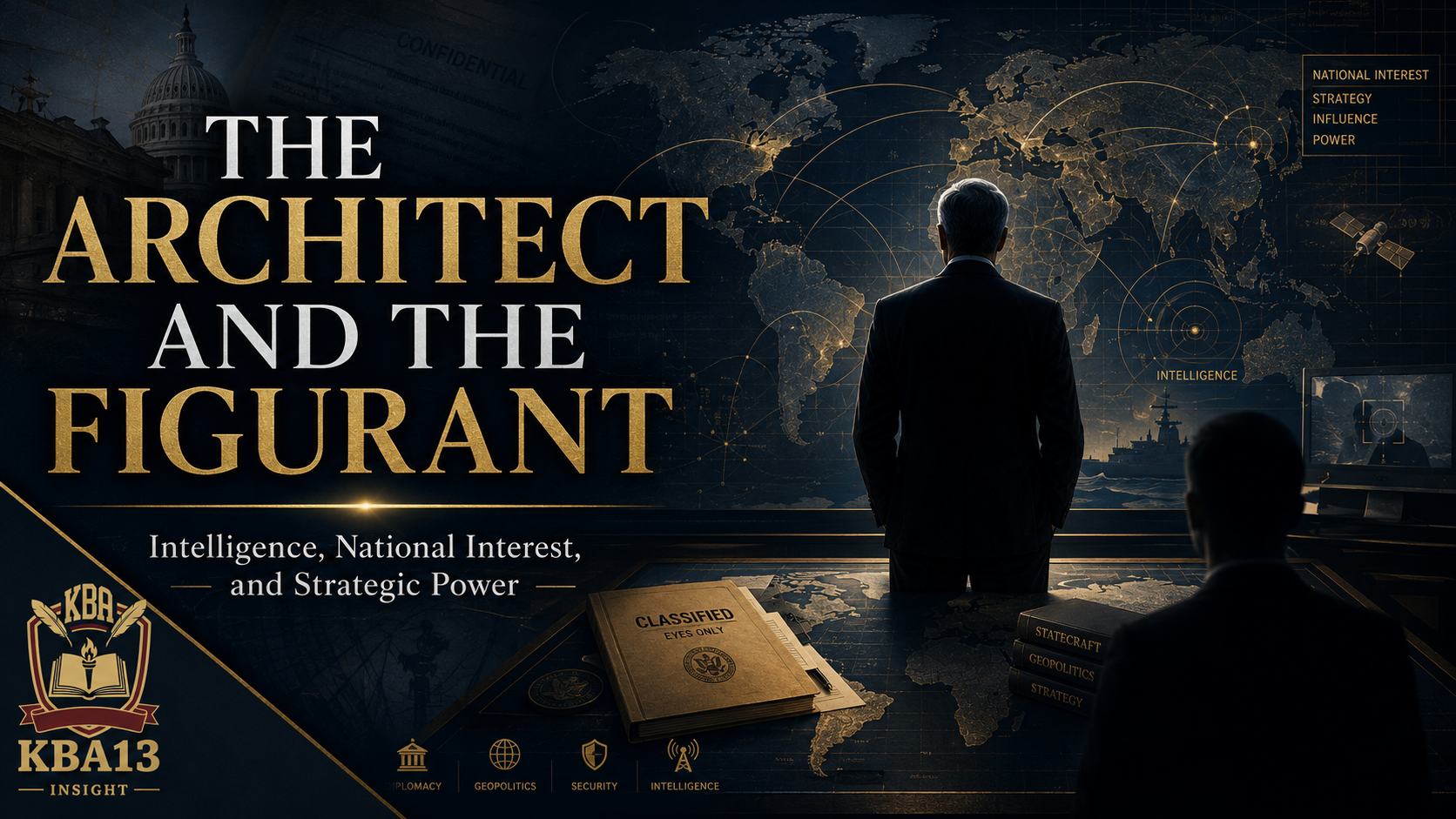
The Architect and the Figurant:Intelligence, National Interest, and the Grammar of Strategic Power
This essay examines intelligence as the hidden architecture of strategic power. It argues that intelligence is not merely a technical apparatus for collecting secrets, but the sovereign mechanism through which a state defines national interest, reads threats, anticipates crises, and shapes geopolitical reality. Through the cases of the United States, China, Russia, Israel, Singapore, and…
Summary
This essay examines intelligence as the hidden architecture of strategic power. It argues that intelligence is not merely a technical apparatus for collecting secrets, but the sovereign mechanism through which a state defines national interest, reads threats, anticipates crises, and shapes geopolitical reality. Through the cases of the United States, China, Russia, Israel, Singapore, and Indonesia, the article shows that every intelligence system reflects the strategic personality of the state behind it. Some nations use intelligence defensively, reacting to danger after danger becomes visible. Others use it architecturally, constructing the conditions through which power, influence, and sovereignty are secured before rivals understand the terrain. The central question is therefore not whether a state possesses intelligence agencies, but whether intelligence has become the cognitive infrastructure of national decision-making. In global politics, nations either write their own history or become characters in someone else’s strategic script.
Keywords
- active measures Rusia
- adaptasi intelijen
- analisis intelijen
- arsitek geopolitik
- BAIS TNI
- Belt and Road Initiative
- BIN Indonesia
- comprehensive national security
- diplomasi intelijen.
- espionase industri
The Language Spoken Behind Closed Doors
There is a language that states speak to themselves — not the language of public declarations or diplomatic communiqués, but a private tongue built from surveillance reports, agent assessments, intercepted signals, and the cold arithmetic of strategic risk. In three decades of moving through the circles where this language is spoken, I have come to understand something that most outsiders never grasp: every significant decision in foreign policy, defense, and economic statecraft passes through a room where intelligence sits at the head of the table. The politicians in front of the cameras may believe they are in command. The generals with their campaign maps may feel they are the architects of outcomes. But behind every consequential decision — every alliance forged, every adversary pressured, every crisis managed or created — there is a prior conversation that happened in a room most people will never enter.
For the uninitiated, intelligence evokes a specific and largely fictional world: dead drops in European cities, agents with multiple passports, operations named after mythological figures. These images are not entirely false, but they are profoundly incomplete. They mistake the tradecraft for the substance. The deeper reality of intelligence — the function that actually shapes the fate of nations — is neither romantic nor cinematic. It is the systematic process by which a state translates its vision of its own interests into actionable knowledge about a world that never cooperates with that vision. It is, at its most fundamental, how a state knows what it needs to know to survive and prevail in an environment that is simultaneously opaque and dangerous.
The relationship between intelligence and national interest is not incidental. It is constitutive. Intelligence does not exist independently of the national interest it serves, and national interest cannot be operationalized without the intelligence that defines it and protects it. This is the central insight that distinguishes states that truly master the instrument of power from those that merely possess it. A state can have the largest intelligence apparatus in the world — the most satellites, the most analysts, the most covert operatives—and still be strategically blind, if the relationship between what it collects and what it decides is broken. Conversely, a small state with limited collection capabilities but a sophisticated understanding of how to integrate intelligence into the core of national decision-making can punch far above its weight in the global competition for strategic advantage.
In thirty years of moving between the corridors where these decisions are made and the academic institutions where they are eventually studied, I have observed a pattern that never changes: the nations that master the grammar of power are the nations that master the grammar of intelligence. The two are not merely related. They are, at the deepest structural level, the same thing.
National Interest as the Sovereign Compass
Intelligence is an instrument, not an actor. It does not move of its own will, generate its own objectives, or pursue its own agenda—at least not in systems that have not been catastrophically corrupted. It is directed, shaped, and prioritized by the definition of national interest agreed upon by the political and security elite of a state, whether through formal documentation or informal consensus. Understanding how intelligence actually operates, therefore, requires, as a prior question, understanding how a state defines what it is for—what it is willing to fight, sacrifice, and deceive for. The answer to that prior question is the answer to what intelligence actually does.
National interest is not a fixed philosophical category. It is a political construction, born from the collision and compromise of ideological forces, economic constituencies, historical traumas, and geographic imperatives. In some states — the large, institutionally confident ones — this construction is formalized in publicly available strategy documents: national security strategies, military doctrines, intelligence directives. In others, particularly those with more closed political systems or less institutionalized state structures, the national interest is defined by informal consensus among a small ruling circle, leaving no public record and sometimes no written record at all. In both cases, however, the definition of national interest performs the same function: it tells the intelligence apparatus what to look for, what to protect, and what to destroy.
The United States offers the most extensively documented case of how this relationship works and how dramatically it can shift. After the Soviet Union’s collapse, the American national interest calculus underwent a fundamental reorientation. The primary threat that had organized the entire Cold War intelligence enterprise — the Soviet nuclear arsenal, the KGB’s global network, the ideological competition with communism — had disappeared, and with it the organizing principle of American intelligence. For a decade, the intelligence community struggled with what scholars of strategic studies call the “peace dividend problem”: how to justify and organize a vast, expensive apparatus without a clear and present danger that gives it coherence. The answer, as it turned out, was forced on Washington rather than chosen by it. The attacks of September 11, 2001, did not merely create a new mission for American intelligence; they restructured it from the ground up. Thousands of analysts were transferred from desks focused on Russia, China, and proliferation to desks focused on al-Qaeda and associated movements. Budgets were reallocated, authorities were expanded, and operational postures were transformed. The shift from SIGINT-heavy operations against state-to-state communications to the human and digital surveillance needed to penetrate stateless terrorist networks required not just new tools but new mindsets — a transformation that, by most serious assessments, remained incomplete a decade later. Then, with the publication of the 2017 National Security Strategy under the Trump administration, the pendulum swung again. China and Russia were re-identified as the central strategic competitors, and the intelligence community was once more compelled to reorient — standing up new mission centers, reviving counterintelligence operations against state actors, and rebuilding analytic depth in areas that had atrophied during two decades of counterterrorism focus.
What makes the American case instructive is not its particulars but its demonstration of a principle: when the definition of national interest changes, the entire intelligence machinery changes with it. Not just at the margins — not just in which targets get surveilled or which regions get more analysts — but in doctrine, in culture, in the fundamental assumptions about what kind of knowledge is valuable and what kind of action is legitimate. The intelligence apparatus is, in this sense, a perfect mirror of the state’s self-understanding. Its distortions are the state’s distortions. Its blind spots are the state’s. Its obsessions are the state’s obsessions.
China presents a different and in some ways more rigorous case. The Comprehensive National Security Concept that Xi Jinping formalized and elevated beginning in 2014 did not represent a new invention so much as an explicit articulation of what had long been the implicit operating principle of Chinese strategic intelligence: that security is indivisible and that any vulnerability in any domain — ideological, economic, technological, informational, territorial — is a potential vector for existential threat to the political system. This expansion of the security perimeter beyond the military and territorial domains to encompass the full spectrum of national capabilities was, in effect, a mandate for the intelligence apparatus to correspondingly expand its operational scope. The Ministry of State Security’s activities in Western research institutions and technology companies are not aberrations from Chinese policy; they are its direct expression. The People’s Liberation Army Strategic Support Force’s operations in the cyber and space domains are not supplementary to China’s national interest; they are its cutting edge. The discipline that Chinese intelligence demonstrates — the willingness to operate on decade-long timelines, to plant collection assets years before their value will be realized, to pursue strategic goals through commercial and academic channels that Western counterintelligence is structurally ill-equipped to monitor — is a direct product of a national interest definition that is itself disciplined, long-term, and comprehensive.
Israel’s case is philosophically the most clarifying because it eliminates ambiguity. A state whose founding experience was an attempted genocide, whose geographic neighborhood has at various points included multiple adversaries committed to its destruction, and whose strategic depth is measured in miles rather than thousands of miles, cannot afford the luxury of diffuse national interest definitions or slowly adapted intelligence architectures. For Israel, national interest has a single non-negotiable core: the prevention of any threat that could threaten the state’s survival or its ability to defend itself. Everything else — diplomatic relations, economic interests, regional influence — is instrumental to that core. The entire intelligence architecture of the state — Mossad for external operations, Shin Bet for internal security, Aman for military intelligence, Unit 8200 for signals intelligence and cyber operations — is organized around that single imperative with a precision that other states find both admirable and slightly alarming. When a Mossad officer told me in 2016 that Israel does not wait for enemies to knock on the door but decides whether they will have a door to knock on, he was not being theatrical. He was describing, with characteristic Israeli directness, the logical endpoint of a definition of national interest that tolerates no ambiguity about existential stakes.
Indonesia represents the most interesting and, in some ways, the most instructive case for developing states navigating great-power competition. The national interest that guides Indonesia’s intelligence architecture is not formally articulated as the United States’ National Security Strategy is, nor is it explicitly ideological as China’s is. But it is legible from the operational patterns of BIN, BAIS TNI, and the intelligence arms of the police: the primary focus on domestic stability — on the management of separatist movements, ideological radicalism, and the internal cohesions that hold together an extraordinarily diverse archipelagic state—reflects a foundational assumption that external threats can only succeed through internal vulnerabilities. This is, as a doctrine, not unreasonable. But it creates a structural orientation toward the defensive and the reactive that, when operating in an environment of sophisticated external pressure, produces a critical strategic gap: a state that is focused on guarding its internal room has difficulty tracking what is being said about it in the hallways.
The pattern I have observed across these decades is consistent and dispiriting in its regularity: the definition of national interest that drives intelligence is almost always a product of the last major crisis rather than an anticipation of the next one. States define what they are for in response to what has happened to them, and their intelligence architecture is built to prevent the past from repeating itself. This is understandable psychologically and politically. But it is strategically dangerous because the adversary studying your intelligence architecture can predict your blind spots based on your history. The states that break this pattern — that define national interest not just as the protection of what they have but as the active creation of what they want — are the states whose intelligence becomes genuinely strategic rather than merely defensive.
Five Models of Strategic Intelligence: Power’s Mirror
If you want to understand how a state sees the world — not as it presents itself in official communications, but as it actually perceives threats, opportunities, and possibilities — you do not read its constitution or transcripts of its foreign minister’s speeches. You study how it builds, directs, and operates its intelligence apparatus. The intelligence model a state adopts is not an administrative choice; it is a strategic self-portrait, revealing the state’s deepest assumptions about where danger comes from, what leverage means, and how power actually works.
The American model is the expression of a state that genuinely believes it has global interests requiring global protection. The seventeen agencies of the United States Intelligence Community, coordinated under the Director of National Intelligence since the post-9/11 reforms, constitute the largest, most technically sophisticated, and most expensive intelligence enterprise in human history. Its satellites observe every contested territory on earth. Its SIGINT networks, anchored by the National Security Agency, are capable of intercepting an estimated proportion of global communications traffic that has never been officially disclosed but that internal government documents suggest is breathtaking in scope. Its HUMINT networks, built through CIA stations in embassies, consulates, and unofficial facilities worldwide, are supplemented by the intelligence assets of military combatant commands, the Defense Intelligence Agency, and a dozen other specialized collection entities. The philosophical foundation of this apparatus is the Wilsonian proposition, never fully abandoned even by administrations that formally rejected it, that what happens anywhere in the world is eventually of consequence to American interests — that no theater is truly peripheral, no development truly irrelevant.
The consequence of this global scope is both the system’s great strength and its most persistent vulnerability. An intelligence community that tries to cover everything inevitably develops depth unevenly, and the areas where analytical depth is thin are precisely the areas where strategic surprises originate. The failure to predict the Soviet Union’s collapse with precision — a community that spent forty years studying the Soviet Union missed the signs of its terminal decline — is one of the most instructive such failures. The more catastrophic failure to correctly assess Iraq’s weapons of mass destruction programs before the 2003 invasion revealed a different pathology: not the failure to collect, but the failure to analyze independently of political pressure. The WMD assessment did not fail primarily because the intelligence was bad, though some of it was. It failed because the question being asked—does Iraq have WMD?—had already been answered politically before the intelligence process began, and the analytical community, subject to institutional pressures that no bureaucracy can entirely resist, produced assessments that confirmed rather than challenged the preferred conclusion. This is the politicization trap, and it is the most dangerous systemic vulnerability in any intelligence system: the moment intelligence becomes a service industry for political clients rather than an independent assessment function, it ceases to be intelligence and becomes something closer to propaganda directed inward.
The Chinese model is the manifestation of a fundamentally different national philosophy: the conviction that strategic competition is a long game played with patience, discipline, and the willingness to operate through indirect and institutional channels that bypass the adversary’s defenses. The Ministry of State Security, restructured and empowered under Xi Jinping’s centralization agenda, operates with a sophistication that Western counterintelligence agencies have repeatedly underestimated. Its HUMINT operations in Western research institutions, diaspora communities, and corporate environments are not simply about stealing specific pieces of information — though they do that. They are about building structural access: relationships, positions, and channels that can be activated across multiple intelligence cycles and multiple objectives. The Thousand Talents Program — a state-sponsored initiative to recruit overseas Chinese academics and researchers into collaborative arrangements that create both intelligence access and technology transfer channels — is the kind of operation that takes a decade to appreciate fully and another decade to counter effectively. By the time Western governments recognized its intelligence dimension, it had been operational for years.
The People’s Liberation Army Strategic Support Force represents the operational embodiment of China’s understanding that the most decisive competition in the twenty-first century will be fought in domains — cyber, space, electronic warfare, and cognitive influence — where the advantages of established military power are least applicable and most easily negated. The PLASSF does not compete with the United States Air Force by building more fighters; it competes by building the capacity to blind American satellite constellations, disrupt American command-and-control networks, and degrade the informational infrastructure upon which American military supremacy depends. This is intelligence serving a doctrine, and the doctrine is built on a clear-eyed assessment of where the adversary is most vulnerable — precisely the function that intelligence, properly integrated into national strategy, is supposed to perform.
Russia’s model is the most philosophically confrontational, built on the premise that intelligence is not merely a tool for understanding the world but an instrument for reshaping it. The tradition of aktivnye meropriyatiya — active measures, the Soviet-era term for operations designed to manipulate the political environments of target states — predates the current Russian state and has been inherited, refined, and massively expanded by the FSB, SVR, and GRU in the post-Soviet era. What makes the Russian approach distinctive is its integration of intelligence operations into a comprehensive theory of conflict that does not acknowledge a clear boundary between war and peace. The Gerasimov doctrine, named for the Russian Chief of the General Staff who articulated it most explicitly, though he himself has resisted the attribution, describes a mode of conflict in which military operations are merely the final, kinetic phase of a struggle that is conducted primarily through non-military means: economic pressure, political subversion, information operations, cyberattacks, and the cultivation of internal division within target states. In this framework, intelligence is not a support function for policy; it is the primary instrument of statecraft, conducting the actual contest while diplomatic and economic relationships maintain a facade of normalcy.
Russia’s 2016 operation against the American electoral process — combining social media influence, email compromise and disclosure, and direct contact with political campaigns — is best understood not as an intelligence operation in the narrow technical sense but as a demonstration of this comprehensive theory of conflict. It did not require Moscow to deploy troops or launch missiles. It required the SVR’s ability to penetrate digital infrastructure, the GRU’s willingness to release damaging information through channels that provided plausible deniability, and the Internet Research Agency’s capacity to conduct industrial-scale cognitive influence operations across multiple social media platforms simultaneously. The sophistication of the operation lay not in any single technical capability but in the integration of multiple intelligence functions into a coherent strategic operation aimed at a specific political outcome. That it succeeded — not in installing a preferred candidate, but in deepening American political division and creating a crisis of democratic legitimacy that continues to reverberate — is a measure of what intelligence can achieve when it is genuinely integrated into strategic vision rather than subordinated to political preferences.
Israel’s model, as I have argued, is the most philosophically pure, because it is built on the clearest possible national interest definition. When a state faces threats that are genuinely existential — not metaphorically existential in the way great powers describe the rise of competitors, but actually existential in the sense that its physical destruction is contemplated and pursued by actors with some capacity to achieve it — intelligence becomes the first line of defense rather than a support function for a defense that can tolerate strategic surprise. The Mossad’s operations against Iranian nuclear scientists between 2010 and 2012 — assassinations conducted inside Iran’s most security-conscious environment by agents who were never identified or prosecuted — are not simply impressive intelligence tradecraft. They are the logical expression of a doctrine that does not permit adversaries the time to develop threatening capabilities because the cost of allowing that development is considered existential. Operation Stuxnet, the cyberweapon deployed against Iran’s uranium enrichment centrifuges at Natanz, took this logic into the digital domain with effects that were both tactically precise and strategically communicative: it destroyed specific centrifuges while demonstrating to Iran, to the region, and to the world that Israel possessed capabilities for covert action that redefined what “covert” and “action” mean in the twenty-first century. The operation required multi-year coordination between Israeli and American intelligence agencies, infiltration of the physical facility to install the virus on air-gapped systems, and sustained SIGINT coverage to monitor its effects — a testament to what intelligence can achieve when it is resourced, directed, and integrated into strategy with genuine coherence.
Singapore’s model deserves particular attention because it demonstrates most clearly what a small state with limited resources but sophisticated institutional design can achieve. The Internal Security Department’s disruption of the Jemaah Islamiyah network in Singapore in the early 2000s — conducted before the network could execute planned attacks and, crucially, before the broader regional and international community had fully grasped the extent of JI’s organizational reach — was not primarily a success of collection. Singapore’s collection capabilities are constrained by its size and resources in ways that are obvious. It was a success of analysis: the ability to take information from multiple sources, integrate it into a coherent threat picture, and act on that picture at precisely the moment when action was most consequential. Singapore has built its comparative advantage in intelligence not in collection but in the fusion center model — bringing together information from disparate sources, including its Five Eyes partnerships, and extracting analytical value disproportionate to its collection inputs. It has, in effect, built a strategic intelligence capability on a foundation of analytical excellence rather than collection primacy, which is a lesson that many larger states with far greater collection resources have failed to apply.
The lesson that connects all five models is one that my years of observation have made inescapable: the form intelligence takes is the form the state’s self-understanding takes. The American model is global because American ambitions are global. The Chinese model is patient and structural because the Chinese strategy is so. The Russian model is confrontational and reality-distorting because Russian strategy seeks to reshape the environment rather than operate within it. The Israeli model is existentially focused because the Israeli national interest is defined existentially. And Singapore’s model is analytically precise because, in the absence of mass, precision is the only available multiplier. Intelligence is not a generic toolkit applied to different problems; it is the operationalized strategic personality of the state.
Intelligence as Policy Constitution, Not Policy Instrument
There is a distinction — subtle in the language, fundamental in the reality — between intelligence as a policy instrument and intelligence as a policy constitution. The instrument model is familiar and widely accepted: policymakers set objectives, intelligence agencies collect and analyze information relevant to those objectives, and the outputs of that analysis inform specific decisions. In this model, intelligence is subordinate to policy in a clean hierarchy: policy leads, intelligence follows. The constitution model is more radical and more accurate as a description of how intelligence actually functions in states that use it effectively: intelligence does not merely inform decisions, it constitutes the framework within which decisions become possible. It determines what options are on the table, which threats are taken seriously, which opportunities are recognized, and ultimately, which version of reality the policymaker inhabits.
The distinction has enormous practical consequences. A policymaker who uses intelligence as an instrument evaluates options already generated by political logic. A policymaker who understands intelligence as a constitutional function has their option set fundamentally shaped by what intelligence makes thinkable. The first is operating with better information. The second is operating within a different epistemological framework altogether.
Consider how this played out in one of the most consequential intelligence relationships of the twentieth century: the relationship between DCI George Tenet and the Bush administration in the run-up to the 2003 Iraq invasion. The evidence accumulated since — through the Senate Intelligence Committee reports, the Chilcot Inquiry in the United Kingdom, and the subsequent testimony and memoirs of intelligence officers involved — suggests that the intelligence on Iraq’s weapons programs was not merely used as an instrument to inform a decision that had not yet been made. It was selectively curated, emphasized, and in some cases pressured toward assessments that supported a decision the political leadership had already reached. The famous “slam dunk” assessment attributed to Tenet — that the intelligence case for Iraqi WMD was unambiguous — was not the output of an independent analytical process informing an open decision. It was the product of a system in which intelligence had been reduced from a constitutional function to a rhetorical instrument. The result was not merely an intelligence failure. It was a strategic catastrophe that killed hundreds of thousands of people, destabilized an entire region, and cost the United States its most consequential strategic asset: the credibility of its intelligence assessments.
What this case demonstrates — and what the more sophisticated students of intelligence have understood for decades — is that the politicization of intelligence is not a marginal pathology confined to specific corrupt administrations. It is a structural temptation inherent in the relationship between intelligence and power. Political leaders are selected precisely because they have strong convictions about what is true and what should be done. Intelligence analysts are trained to maintain calibrated uncertainty about a world that resists confident prediction. These two epistemological cultures are in permanent tension, and the resolution of that tension almost always favors the political culture—because political leaders control budgets, appointments, and access. The intelligence official who consistently delivers assessments that contradict the preferred political narrative will, over time, find their access reduced, their assessments discounted, and their career truncated.
The states that have most successfully managed this structural tension have done so through institutional design rather than individual virtue. The independence of the American Director of National Intelligence, the statutory protection of the British Joint Intelligence Committee’s analytical independence, the Israeli system in which Aman’s assessments are specifically designed to survive political pressure by being produced through a process that explicitly incorporates devil’s advocacy — these are not guarantees against politicization, but they are structural resistance to it. The states that have not made such institutional investments — those in which intelligence chiefs serve at the pleasure of political leaders and are expected to produce assessments that support rather than challenge the leader’s worldview — have intelligence organizations that are expensive, well-equipped, and strategically useless. They know a great deal; they understand very little.
The second dimension in which intelligence constitutes, rather than merely informs, policy is the anticipatory function. Policy, as conventionally understood, is reactive: it responds to events, conditions, and pressures that have already materialized. Intelligence, properly understood and integrated, is constitutively anticipatory: it identifies events, conditions, and pressures before they materialize and creates policy space that would not otherwise exist. The difference between a state that responds to crises and a state that shapes conditions before crises emerge is, in substantial part, the difference between a state with reactive intelligence and a state with anticipatory intelligence. Reactive intelligence tells you what happened and why. Anticipatory intelligence tells you what is going to happen and gives you the option of ensuring it doesn’t.
The Chinese concept of weiji — the ideogram combining the characters for “crisis” and “opportunity” — captures something that Western strategic culture has historically undervalued: that crises, from the perspective of the state that sees them coming, are not purely negative events but moments of maximum opportunity. The state that has intelligence anticipating a crisis can position itself to benefit from the disruption it causes to others. The state, surprised by the same crisis, is focused entirely on damage limitation. Over decades and centuries of strategic competition, the cumulative advantage of the anticipatory state over the reactive one is the difference between writing history and being written by it.
The Shifting Cartography of Threat: Intelligence in a Multipolar World
In the three decades during which I have observed intelligence systems at close range, the cartography of threat has undergone two fundamental transformations, each of which has forced a corresponding transformation in intelligence doctrine and practice—transformations that the most agile intelligence organizations have navigated successfully, while others are still struggling to absorb.
The first transformation was the collapse of the state-centric threat model after the Cold War. For forty years, intelligence communities worldwide were organized around the assumption that threats were fundamentally state-generated: the Soviet Union, its allies, and its proxies constituted a defined and stable threat environment that could be addressed through collection against state targets — military installations, government communications, diplomatic channels, scientific facilities. The end of the Cold War did not eliminate state-based threats, but it elevated a different category of threat — transnational, networked, non-state — to primacy in the threat assessments of most Western intelligence services. The adaptation required was not merely operational. It was epistemological. The methodologies developed over decades for understanding state adversaries — the reconstruction of organizational hierarchies, the mapping of decision-making processes, the analysis of procurement patterns, the interception of official communications — were simply inapplicable to organizations that had no fixed hierarchies, no procurement patterns, no official communications, and no physical infrastructure that traditional surveillance could locate. The failure to adapt rapidly enough to this new threat environment contributed directly to the catastrophe of September 2001.
The second transformation—currently underway and still incompletely absorbed—is the return of state competition as the dominant strategic reality, but in a form that is qualitatively different from its Cold War predecessor. The United States and the Soviet Union competed in a bipolar world organized around military deterrence, in which the primary intelligence task was to maintain accurate assessment of each other’s military capabilities and intentions. The competition between the United States and China — supplemented by the more immediately disruptive competition with Russia — is occurring in a multipolar world organized around economic interdependence, technological dominance, informational control, and institutional influence, in which military deterrence is present but far from the whole story. An intelligence community built for Cold War state competition was poorly adapted for the counterterrorism challenge of the 1990s and 2000s. An intelligence community rebuilt for counterterrorism is now discovering that it is poorly adapted for the comprehensive strategic competition with China, which requires deep expertise in economics, technology, supply chains, academic institutions, and the subtle mechanisms through which political influence is purchased and exercised in democratic societies.
What this successive adaptation challenge reveals is a structural problem in how intelligence organizations are built: they are optimized for the threat environment that existed when they were last reformed, not the threat environment that will challenge them in the future. The most important question for any intelligence organization is not “what are we good at?” but “what will the threat look like in ten years, and are we building the capacity to understand it?” The states that answer this question correctly — that maintain the institutional flexibility to retool their intelligence apparatus before necessity forces it rather than in response to catastrophic surprise — are the states that maintain strategic initiative. The states that answer it incorrectly — that allow yesterday’s threat model to persist because it has bureaucratic constituency, institutional inertia, and the comfort of familiar expertise — will inevitably be surprised by the threat they were not organized to see.
The technological dimension of this adaptation challenge deserves particular attention because it is creating a structural shift in the intelligence landscape that is without historical precedent. For most of intelligence history, the collection of information was the primary barrier to understanding: the question was how to acquire information that adversaries were determined to conceal. In the current environment, the barrier has inverted. The amount of information potentially relevant to intelligence assessment — available through open sources, digital surveillance, commercial satellite imagery, social media analysis, and the passive collection of data generated by the connected devices that pervade modern life — exceeds by orders of magnitude the capacity of any human analytical community to process and interpret it. The intelligence challenge of the twenty-first century is not collection; it is sense-making. The organizations that deploy artificial intelligence, machine learning, and advanced data analytics most effectively to find signal in the overwhelming noise of available data will have a decisive advantage over those that do not.
This technological transformation also has a democratizing dimension that states have been slow to fully reckon with. For most of intelligence history, the capacity to collect and process strategic intelligence was confined to states — because the satellites, signals intercept networks, and analytical bureaucracies required were beyond the resources of any non-state actor. That exclusivity is ending. Commercial satellite companies now provide imagery resolution previously available only to the most advanced military intelligence agencies. Open-source intelligence methodologies, deployed by organizations like Bellingcat using publicly available data, have repeatedly produced intelligence assessments — about the downing of flight MH17, about the movements of Russian military equipment in Ukraine, about the identities of intelligence officers involved in the Skripal poisoning — that matched or exceeded the classified assessments of professional intelligence agencies. The monopoly on strategic intelligence that states have exercised for centuries is being eroded by the same digital revolution that has transformed every other domain of human activity, and the implications of this erosion for how power works — who has it, who claims it, and who can challenge it — are only beginning to be understood.
The Invisible Hand That Reshapes Reality
There is a threshold in the evolution of intelligence capability beyond which the organization stops reading maps and begins drawing them. This is not a metaphor. It describes a specific and historically demonstrable shift in the relationship between intelligence and geopolitical reality — a shift in which intelligence transitions from the analytical function of describing what is to the architectural function of determining what will be. The states that have crossed this threshold are not simply better informed than their competitors. They are operating in a different strategic register altogether, one in which the environment they are competing in has been, to a significant degree, shaped by their own prior intelligence operations.
The American case is the most extensively documented, not because American intelligence has been the most architecturally ambitious, but because the United States is a democratic society in which significant portions of previously classified operational histories have been released for public review, litigation, and academic study. The CIA’s 1953 Operation Ajax — the joint American-British operation that overthrew the democratically elected Iranian Prime Minister Mohammed Mossadegh and restored the Shah to the Peacock Throne — is the canonical early example of what intelligence as architecture looks like in practice. The operation did not simply collect information about Iranian politics; it manufactured political reality. It organized and funded the popular demonstrations that created the appearance of public rejection of Mossadegh. It turned elements of the Iranian military and security services against the government. It managed the international media coverage of the events in ways that presented a coup as a popular uprising. The outcome was not a conclusion that flowed from preexisting conditions; it was a condition that American intelligence created, then presented to the world as historical inevitability. The strategic consequences of that manufactured reality — including the Islamic Revolution of 1979 and the four decades of hostility it inaugurated — are perhaps the most consequential demonstration in modern history of the law of unintended consequences in intelligence operations, but they do not diminish the analytical clarity of what was attempted or what was achieved in the short term.
In the contemporary period, the architectural function of intelligence operates less through the direct manipulation of political events and more through the control of the informational environment in which political events are perceived, interpreted, and responded to. The American campaign to shape global perceptions of China’s Belt and Road Initiative — a campaign conducted through intelligence-informed diplomatic communications, the strategic release of information about debt-trap dynamics and labor and environmental practices, and the cultivation of alternative frameworks offered by the Blue Dot Network and the G7’s Build Back Better World initiative — is a current example of how intelligence capability translates into narrative architecture. The objective is not to prevent Chinese infrastructure investment but to ensure that the conceptual framework within which that investment is assessed — by recipient governments, international financial institutions, civil society organizations, and the populations of target countries — serves American rather than Chinese strategic interests. This is intelligence as environmental management: not operating on specific targets but shaping the conditions within which all targets operate.
China’s approach to intelligence architecture operates on a longer timeline and through more structural channels. The deliberate cultivation of economic and technological dependency — through Belt and Road infrastructure projects that are financed in ways that create debt obligations, through technology exports that establish Chinese standards and require Chinese maintenance, through academic and research partnerships that create intellectual relationships that can be leveraged for access and influence — is intelligence architecture in the broadest sense. It does not require covert operations in the traditional sense. It requires sustained strategic patience, the willingness to invest in relationships whose returns will not materialize for a decade or more, and the analytical sophistication to identify precisely where dependency can be created most efficiently. When a country discovers that its critical telecommunications infrastructure depends on Huawei equipment, that its national debt is substantially held by Chinese state banks, and that its senior officials have built personal relationships with Chinese counterparts over years of state visits and bilateral forums, it has already been architecturally shaped — regardless of whether it was ever aware that an architectural process was underway.
Russia’s approach is more immediate and confrontational but equally architectural in its intent. The operations against Ukraine beginning in 2014 — the annexation of Crimea, the destabilization of Donbas, the information operations that shaped both Russian and international perception of the conflict — were not spontaneous responses to political events. They were the execution of a strategic vision for the post-Soviet space that had been developing in Russian intelligence planning for years, deployed at a moment when Ukrainian political dynamics created an opportunity. Before a single Russian soldier entered Crimea without insignia, the information environment had been prepared: the narrative that the Kiev government was illegitimate, that Russian-speaking populations in eastern Ukraine were endangered, and that Russian intervention would be welcomed by a significant portion of the Ukrainian population had been seeded through state media, social media operations, and the cultivation of political actors within Ukraine who would publicly articulate Moscow-aligned positions. The physical operation succeeded in part because the information operation had already run. This is intelligence architecture: the construction of a reality in which the desired outcome appears not as aggression but as a response, not as a choice but as a necessity.
What all of these cases have in common is that they illustrate a principle that the most sophisticated intelligence practitioners understand, but that rarely appears in public discourse: the most powerful form of intelligence is not collection or analysis but narrative control. The state that controls the interpretive framework within which its adversaries understand their situation has already won a strategic advantage that no collection success can replicate, because it shapes not just what is known but how it is understood. In a world saturated with information but starved of interpretation, the power to define what events mean is more consequential than the power to observe what events occur.
The Anatomy of Strategic Blindness
In every region of the world, there are states that possess intelligence organizations — agencies with buildings, budgets, officers, and analytical products — that do not, in any meaningful sense, have strategic intelligence. They have tactical intelligence: the ability to monitor domestic opposition, track criminal networks, and identify threats to specific individuals or facilities. But they lack the capacity to integrate intelligence into the core of national decision-making in ways that shape strategic outcomes. They are, in the language I have used throughout, figurants — present on the stage of geopolitical competition but playing roles written by others.
The condition of strategic blindness has several distinct anatomical features, each of which is damaging in its own right and, in combination, devastating. The first is what intelligence professionals call mirror-imaging: the tendency of analysts to assume that adversaries think about problems the same way they do. This is the most pervasive and most dangerous analytical failure mode because it is virtually invisible to those committing it. An analyst who has internalized the assumptions of their own strategic culture — its preferences, its risk tolerances, its definitions of rationality — will systematically misread the intentions of adversaries who operate within a different strategic culture. The American intelligence community’s consistent underestimation of Chinese strategic patience — the failure to recognize that Beijing was willing to operate on timelines measured in decades rather than election cycles — is a form of mirror-imaging. The inability of many Western intelligence analysts to take seriously the possibility that Russian leadership would launch a full-scale invasion of Ukraine in 2022 — because the expected costs were so obviously enormous from a Western analytical perspective — was a catastrophic mirror-imaging failure. The states whose analysts are trained only within the conceptual frameworks of their own strategic culture, without deep immersion in the strategic cultures they are analyzing, will commit mirror-imaging errors so regularly that they effectively cannot understand the adversaries that matter most.
The second feature of strategic blindness is temporal parochialism — the domination of intelligence tasking by short-term, current-intelligence demands at the expense of long-term, strategic analytical capacity. Policy consumers in any system have an almost irresistible preference for current intelligence — the answer to “what happened last night?” rather than “where will this trend be in five years?” — because current intelligence is actionable in the immediate term, fits the natural rhythms of political decision-making, and can be evaluated quickly. Long-range assessment is difficult to produce, difficult to evaluate, and almost impossible to attribute to a specific decision when it eventually proves useful. The result, in intelligence systems that have not explicitly protected long-range analytical capacity through institutional design and cultural commitment, is that current-intelligence production consistently crowds out strategic analysis. Over time, the organization builds extraordinary situational awareness and steadily diminishing strategic vision. It knows everything that is happening and understands progressively less about why it is happening and where it will lead.
The third and most structurally consequential feature of strategic blindness in many developing states is dependency on foreign intelligence for strategic analysis. This is the diplomatic dimension of the figurant condition. A state that lacks the indigenous analytical capacity to assess the strategic environment from its own perspective — that relies on its intelligence partners’ products to understand what is happening in its own region — has, in effect, outsourced a core function of sovereignty. The dependence is rarely acknowledged openly, because it is embarrassing and because the partner states providing the intelligence have strong incentives to present their analytical products as objective assessments rather than as strategic communications serving their own interests. But the structural reality is inescapable: intelligence provided by foreign partners is intelligence shaped by foreign interests. It highlights the threats that the providing state wants the recipient to prioritize. It frames issues in ways that predispose the recipient toward the conclusions the providing state has already reached. It creates, over time, an analytical culture in the recipient that mirrors the provider’s — including its blind spots, assumptions, and definitions of what constitutes a threat worth worrying about.
I have observed this dynamic repeatedly in Southeast Asia and across the developing world. States that have built their strategic analytical capacity on a foundation of foreign intelligence partnerships find themselves, over time, perceiving the world through frameworks that do not necessarily serve their own interests. They may believe they are exercising independent strategic judgment; in reality, they are replaying, with a slight lag, the strategic judgment of the states whose intelligence products they have been consuming for decades. This is not a conspiracy. It is the organic consequence of intellectual dependency, operating through the same mechanisms that shape any situation in which one party controls another’s information environment.
The Transformation Imperative: From Figurante to Architect
The distance between the figurant and the architect is not primarily a matter of resources, technology, or even intelligence tradecraft. It is a matter of strategic philosophy — of how a state understands the relationship between what it knows and what it does, between the information it possesses and the future it can shape. The transformation from one to the other is therefore not primarily an organizational reform. It is a conceptual revolution that must precede and drive any organizational change.
The first dimension of this revolution is the reorientation of intelligence from a security function to a governance foundation. In states where intelligence is understood primarily as a security instrument — the apparatus that catches spies, disrupts terrorist networks, and protects officials — it will inevitably be organized, resourced, and culturally shaped by the logic of security: risk aversion, defensive posture, reactive operation. These are not worthless orientations, but they are insufficient for strategic intelligence. The reorientation required is toward intelligence as the infrastructure of national decision-making — the epistemological foundation without which policy choices are made in the dark. This requires that intelligence officers be present in policy conversations not as briefers who present information after decisions have already been made, but as participants in the deliberation that produces decisions. It requires that National Intelligence Directives be integrated with National Security Strategies, Economic Development Plans, and Technology Roadmaps in ways that create genuine coherence between what the state wants and what it is designed to understand. It requires, ultimately, a cultural transformation in which “strategic intelligence” is understood not as a capability that security professionals exercise but as the cognitive infrastructure of the entire state.
The second dimension of the transformation is the expansion of the intelligence mandate to match the actual contours of twenty-first-century strategic competition. The threat environment that most consequentially challenges developing states in the current period does not arrive in uniform, armed with weapons that can be identified and intercepted. It arrives in the form of strategic investment that creates economic dependency, technological partnerships that transfer standards and vulnerabilities along with capabilities, academic exchange programs that build intellectual relationships that can be activated for access and influence, and information operations that shape domestic political environments in ways that advance foreign interests. The state whose intelligence architecture is focused primarily on military threats and domestic security — the two traditional intelligence priorities — is defenseless against these non-military forms of strategic competition, because the agencies tasked with understanding them do not exist, and the policymakers who need to respond to them are unaware they are occurring.
Building the multidimensional intelligence capacity that this environment requires — economic intelligence that tracks strategic investment patterns; technology intelligence that identifies supply chain vulnerabilities and foreign dependency risks; information environment intelligence that monitors influence operations and foreign interference in domestic political discourse — is not a matter of simply adding new capabilities to existing structures. It requires a fundamental reconfiguration of what intelligence means institutionally: who does it, who consumes it, how it is classified and shared, and how its outputs connect to decisions in domains that have not traditionally been considered national security concerns.
The third dimension of the transformation is the development of what I would call strategic information sovereignty — the capacity to operate in the global information environment not merely as a consumer or a target but as a shaper. This does not require that every state become a superpower of narrative manipulation. It requires that every state understand that the stories told about it — in international media, in multilateral institutions, in the discourse of regional partners and global audiences — are not neutral descriptions of reality but strategic communications that serve specific interests, and that a state which does not actively manage its information environment will find that environment managed for it. Building this capacity requires investment in strategic communication capabilities, diplomatic narrative management, and the intelligence function of understanding what stories are being told about the state and by whom, before those stories crystallize into the settled international opinion that shapes how the state is treated in every institutional arena.
The regulatory and legal dimension of intelligence reform deserves direct acknowledgment because it is the dimension most likely to be neglected by states that focus on capability building without addressing the institutional framework within which capability is exercised. An intelligence organization that operates without clear statutory authority, defined accountability mechanisms, and robust oversight is an organization that cannot build the trust with partner agencies that effective intelligence cooperation requires, cannot attract the quality of professional talent that effective intelligence demands, and cannot defend itself from the accusation that it is simply an instrument of political control rather than a genuine national security function. The investment in institutional design — the effort to create intelligence organizations that are simultaneously effective and accountable — is not a constraint on strategic capability. It is a prerequisite for it.
The Nation That Writes Its Own History
In geopolitics, the most consequential form of power is not the power to destroy but the power to define — to determine the frameworks within which events are understood, interests are assessed, and options are conceived. The states that possess this power are not simply the states with the largest militaries or the wealthiest economies. They are the states that have mastered the integration of intelligence into the core of national strategy — that understand intelligence not as an instrument for knowing what is but as an instrument for shaping what will be.
Across thirty years of observation, the pattern that has convinced me of this most deeply is not the dramatic operations — the coups, the assassinations, the cyberattacks — but the quiet, structural, long-term operations through which states build the environments they want rather than simply navigating the environments they find. The American construction of a global institutional order — the Bretton Woods institutions, the United Nations, the security alliance networks — in the aftermath of the Second World War was the greatest intelligence-informed architectural achievement in modern history. Not because intelligence services planned the architecture, but because the intelligence of American leadership recognized a window of opportunity created by the unique conditions of 1945 and deployed every instrument of national power — including its intelligence apparatus — to build a world order that would compound American advantages for generations. The result was not merely a military or economic victory. It was the inscription of American strategic assumptions into the operating system of international order.
China is attempting an analogous inscription now — through the Belt and Road Initiative’s physical infrastructure, through the Digital Silk Road’s technological infrastructure, through the steady cultivation of relationships in international institutions, and through the patient accumulation of economic leverage that changes the cost-benefit calculation of states considering positions on issues that matter to Beijing. Whether this attempt succeeds depends on many factors, including the coherence of the American response. But it is, unmistakably, an intelligent, sustained, strategically sophisticated effort to write a portion of the international order’s next chapter in Chinese strategic assumptions rather than American ones.
For states that are not great powers — for the majority of the world’s nations, including Indonesia — the lesson is not that they should attempt to replicate what the great powers do. It is that they should understand clearly what is being done to them and around them, and develop the indigenous intelligence capacity to engage with it on terms that reflect their own interests rather than those of the states that are currently writing the scripts. The choice between being an architect and a figurant is not determined by the size of one’s military budget or the extent of one’s territory. It is determined by the degree to which a state’s intelligence apparatus is genuinely integrated into national strategy, genuinely capable of independent analysis, and genuinely organized to shape outcomes rather than merely observe them.
History is not made by the states with the largest armies. It is made by the states with the clearest vision of what they want and the most sophisticated understanding of how to achieve it. Intelligence — properly conceived, properly resourced, and properly integrated into the core of national decision-making — is the instrument through which that vision is translated into strategic reality. The nations that understand this will write their own chapters. The nations that do not will find their chapters already written when they arrive to add their voice.
The question that confronts every state is ultimately simple, even if the answer is not. Do you intend to be among those who write, or among those who are written about? In the competition that is already underway—quiet, technical, persistent, and profoundly consequential — the answer to that question will determine more about the next century than any election, any treaty, or any military campaign. Intelligence is the hidden architecture of power. The nation that masters it masters the future. The nation that neglects it becomes a character in someone else’s story — and in geopolitics, the author always decides how the character ends.
How to Cite
Ahmad, Kamaruzzaman Bustamam. (2025). The Architect and the Figurant: Intelligence, National Interest, and the Grammar of Strategic Power. Banda Aceh: KBA13 Insight.
https://www.kba13.com/intelijen-dan-kepentingan-nasional/
Professor of Anthropology of Religion at UIN Ar-Raniry Banda Aceh. He writes on geopolitics, Southeast Asian security and governance, Islam in the Malay world, and the future of knowledge.
About The Author

Rekomendasi Bacaan KBA13 INSIGHT
Jika tulisan ini bermanfaat, dukung jurnal ini dengan mencari bukunya melalui tautan berikut:
- Buku-buku Kamaruzzaman Bustamam Ahmad di Periplus
- Koleksi Islamic Studies di Periplus
- Koleksi Geopolitics & Politik Internasional di Periplus
- Cari buku & perangkat baca di Shopee
- Cari di Blibli
Daftar lengkap: Rekomendasi Buku, Alat Tulis & Layanan. Tautan di atas adalah tautan afiliasi — KBA13 INSIGHT dapat memperoleh komisi kecil tanpa biaya tambahan bagi Anda.
Artikel Terkait
 Inside the Shadow State: CIA, Mole Hunting, and the Hidden War Within Intelligence Systems
 Perang Kognitif & Disinformasi: Operasi Psikologis, AI, dan Deepfake dalam Perebutan Persepsi Global
 Signals of Sovereignty: Radar, Signal Intelligence, and Indonesia’s Strategic Reckoning in the Asia-Pacific Electromagnetic Battlespace
 Global Intelligence Briefing (7–12 July 2026): Iran War, US–China Rivalry, Ukraine, South China Sea, and Global Security Risks
 Indonesia Strategic Intelligence Report (7–12 July 2026): Political Crisis, Papua Conflict, BrahMos Deal, Economy, and National Security
Leave a Reply