
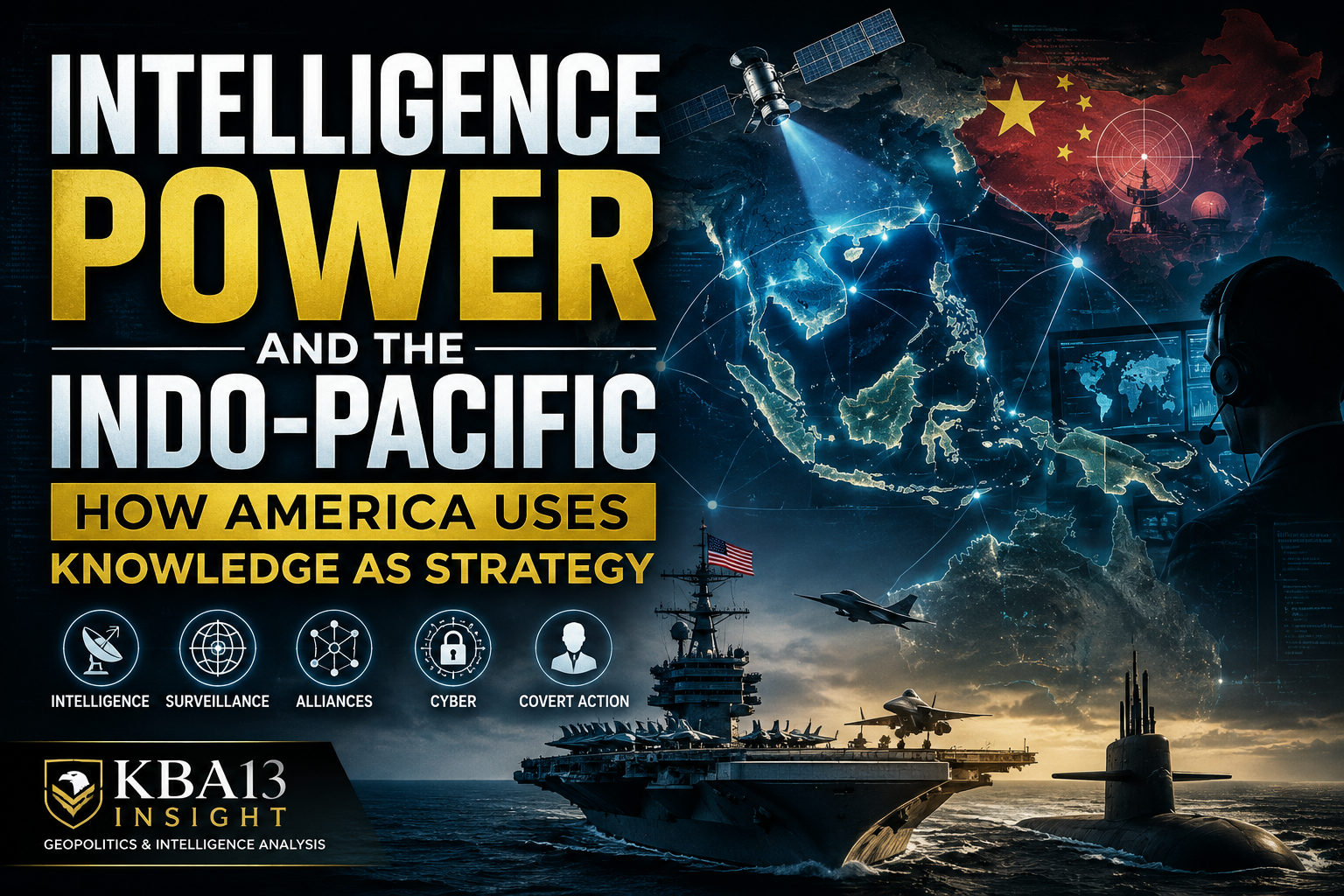
Introduction: The Indo-Pacific as a Testing Ground for Intelligence Theory
The Indo-Pacific does not begin in Washington’s strategic documents. It begins with a geographical fact: roughly 60% of the world’s maritime trade passes through the Strait of Malacca and the South China Sea, and the countries bordering the Indian Ocean produce nearly 40% of global GDP. When Nicholas Spykman argued in the 1940s that whoever controls the rimland controls Eurasia, he was describing a structural logic that has only deepened with the rise of China. The Indo-Pacific is that rimland, updated and contested. For any power that wants to shape the twenty-first century rather than merely respond to it, this is where the argument must be won.
America’s relationship with the Indo-Pacific has never been purely military. Since the end of World War II, Washington has understood that forward presence alone does not produce strategic advantage. What produces advantage is the capacity to know — to know what adversaries are building, planning, and deciding before those decisions are made irreversible. This is why the real competition in the Indo-Pacific is not primarily a competition of warships or missiles. It is a competition of intelligence architectures: who has the better information, who can process it faster, and who can translate it into decisions that matter. The military dimension is the visible surface of a much deeper contest.
China’s rise has compressed the timeline on that competition. Between 2014 and 2024, Beijing reclaimed roughly 3,200 acres of territory in the South China Sea, constructing seven artificial islands equipped with runways, hangars, radar installations, and missile systems. Each island is simultaneously a military installation and an intelligence platform — positioned to monitor maritime traffic, track aircraft movements, and extend China’s sensor coverage across the first and second island chains. These are not acts of territorial aggression alone. They are acts of deliberate intelligence positioning, designed to shrink the operational space available to American ISR assets in a region Washington has patrolled since 1945.
The theoretical lens that best explains what is happening here is not balance-of-power theory in its conventional form. It is what practitioners call intelligence-driven deterrence: the idea that the most effective deterrent is not the weapon itself but the adversary’s certainty that you will see the weapon coming. This concept has roots in Cold War nuclear doctrine — mutual assured destruction worked partly because both sides could verify the other’s capabilities through satellite reconnaissance — but it has evolved into something more sophisticated in the digital era. Today, deterrence operates through the adversary’s perception of your situational awareness, not just your firepower. If Beijing cannot be confident that its military movements go undetected, it must factor that uncertainty into every operational decision.
Spykman’s rimland logic, combined with the intelligence-driven deterrence doctrine, explains why INDOPACOM’s annual posture statements consistently frame the Indo-Pacific not merely as a geographic theater but as an information environment. Admiral Samuel Paparo’s 2025 posture statement before the House Armed Services Committee was explicit: the command’s strategic effectiveness depends not on offensive capacity alone but on C5ISR — command, control, communications, computers, cyber, intelligence, surveillance, and reconnaissance — integrated as a single operational system. This is a bureaucratic formulation, but it reflects a genuine strategic priority. The Indo-Pacific cannot be held through presence alone. It can only be held through knowledge.
What makes the Indo-Pacific a uniquely demanding environment for intelligence theory is the combination of geographic scale, political heterogeneity, and technological contestation. The theater spans from the coast of East Africa to the western shores of the Americas — roughly half the earth’s surface. It contains democracies, authoritarian states, and hybrid systems at every stage of economic development. It is crisscrossed by subsea cables that carry ninety-five percent of the world’s internet traffic, by satellite constellations competing for orbital advantage, and by undersea environments where Chinese and American submarines conduct persistent, unacknowledged surveillance operations. No single intelligence discipline is sufficient to understand this space. Every discipline must work simultaneously.
This essay argues that America’s Indo-Pacific strategy is, at its core, an intelligence strategy. The military assets — carrier strike groups, forward bases, rotational deployments — are the visible components of a system whose decisive logic runs through data collection, analysis, and exploitation. Understanding that logic requires examining each layer of the American intelligence architecture: how the CIA, DIA, NSA, and INDOPACOM relate to one another; how ISR, liaison, and information warfare operate in Southeast Asia; how alliances like AUKUS and the Quad function as collective intelligence structures; how technology is transforming the practice; how covert action extends the strategy into domains below the threshold of open conflict. The objective is not to catalog capabilities. It is to understand the theory behind the practice — and to ask whether that theory is adequate to the challenge it faces.
America’s Intelligence Architecture: CIA, DIA, NSA, and INDOPACOM
The United States Intelligence Community is not a single organization. It is seventeen distinct agencies, united by a 2004 reform that created the Office of the Director of National Intelligence, but still marked by the bureaucratic rivalries, jurisdictional tensions, and institutional cultures that defined them before that reform. Understanding how the CIA, DIA, NSA, and INDOPACOM each operate in the Indo-Pacific — and how they are supposed to work together — is not a matter of organizational detail. It is essential context for understanding why American intelligence sometimes produces brilliant results and sometimes fails completely.
The CIA’s primary contribution to Indo-Pacific strategy is human intelligence. HUMINT remains irreplaceable for a specific reason: it produces what technical collection cannot, which is insight into intent. Satellite imagery can tell you that China is deploying a new class of submarine. Communications intercepts can tell you the timeline. But only a human source inside the decision-making apparatus can tell you whether Beijing has made the political commitment to use that submarine offensively, and under what conditions. CIA operations in the Indo-Pacific focus on penetrating the political and military elite of adversarial states, cultivating relationships across Southeast Asian governments, and running clandestine networks that provide warning of destabilizing developments before they become crises. The record is mixed — the CIA famously failed to anticipate India’s 1998 nuclear tests and was slow to track the pace of China’s South China Sea construction — but the function itself is indispensable.
The Defense Intelligence Agency occupies the gap between strategic intelligence and battlefield knowledge. Its signature discipline, measurement and signatures intelligence (MASINT), tracks the physical characteristics of weapons systems — the acoustic profile of a submarine’s propeller, the thermal signature of a missile during boost phase, the radar cross-section of a new fighter aircraft. For Indo-Pacific strategy, MASINT is particularly important because China’s military modernization is moving faster than any external observer initially projected. The PLA’s DF-21D and DF-26 anti-ship ballistic missiles, designed specifically to threaten American carrier strike groups, were assessed by DIA as early as 2009. The DF-17 hypersonic glide vehicle, which travels at speeds exceeding Mach 5 with a maneuverable warhead that can defeat existing missile defense architectures, was assessed as operationally deployed by 2019. These assessments drive American force structure decisions and shape the specific capabilities that INDOPACOM requests from the Pentagon in its annual budgets.
The NSA’s role in the Indo-Pacific is both broader and more contested than either the CIA’s or the DIA’s. SIGINT collection — intercepting communications, exploiting electronic emissions, penetrating digital networks — provides the volume of intelligence that human sources and technical sensors cannot. The NSA operates a global architecture of collection stations, satellite receivers, and undersea cable taps. In the Indo-Pacific context, Pine Gap in Australia, the listening post at Camp Hansen in Okinawa, and signals facilities at Misawa Air Base in Japan form the backbone of a regional SIGINT network that monitors Chinese military communications, tracks PLA Navy movements, and intercepts diplomatic traffic across the region. When China’s 2019 defence white paper described a new “integrated strategic deterrence” doctrine combining nuclear, conventional, and information capabilities, NSA analysts had already been reading the internal debates that produced that doctrine for years.
INDOPACOM is not an intelligence agency. It is a combatant command — responsible for planning and executing military operations across the Indo-Pacific — but its operational effectiveness depends entirely on intelligence. The command’s doctrine of Joint All-Domain Command and Control (JADC2) is explicitly designed to integrate outputs from all intelligence disciplines into a single common operational picture, enabling commanders to make decisions in near-real time. In practice, this means that a P-8 Poseidon maritime patrol aircraft tracking a Chinese submarine in the South China Sea is feeding data simultaneously to INDOPACOM’s intelligence directorate, to NSA analysts, to DIA’s all-source analysis centers, and to the crews of naval vessels within communication range. The system is more integrated than any comparable architecture China currently operates — but integration creates its own vulnerabilities, particularly to cyber penetration.
The relationship between these four organizations matters because the Indo-Pacific’s intelligence challenges require coordination that does not come naturally to bureaucracies. The CIA and DIA have historically competed for primacy in all-source analysis. The NSA has been protective of collection methods to the point where it has sometimes withheld raw intelligence from analysts who needed it. INDOPACOM’s requirement for tactical intelligence often conflicts with the CIA’s need to protect sources by limiting distribution. These tensions are not unique to the Indo-Pacific, but they are more consequential there because the stakes are higher and the decision timelines in a potential Taiwan contingency are shorter. A 2023 assessment by the RAND Corporation found that the greatest single vulnerability in American Indo-Pacific strategy is not a weapons gap but an integration gap — the lag between collection and actionable analysis.
What the architecture reveals, when examined whole, is a theory of power that is distinctly American: the belief that knowledge advantage can substitute for forward mass. Rather than permanently stationing overwhelming force throughout the Indo-Pacific — which would be fiscally impossible and politically unsustainable — Washington bets that superior situational awareness will allow it to move the right forces to the right place at the right time. This is a sound theory under stable conditions. It becomes fragile when adversaries can degrade the sensors, jam the communications, or blind the satellites that the entire system depends on. China’s counter-space program, its electronic warfare capabilities, and its demonstrated willingness to deploy laser systems to dazzle American reconnaissance satellites are all direct challenges to this foundational bet. The architecture is formidable. Its vulnerability is that it assumes the network will survive long enough to matter.
Strategy in Southeast Asia: ISR, Liaison, and Information Warfare
Southeast Asia is where American intelligence theory meets its most difficult practical test. The region is not a coherent strategic unit. It is ten ASEAN states with divergent interests, asymmetric relationships with both Washington and Beijing, and deep institutional caution about being drawn into great-power competition. Vietnam fought both France and the United States and still remembers that history when calculating alignment. Indonesia’s constitutional commitment to bebas-aktif — free and active—foreign policy makes formal intelligence cooperation politically sensitive regardless of which Indonesian government is in power. Malaysia maintains economic ties with China, which make its government reluctant to take positions Beijing would read as hostile. This is the environment in which American ISR, liaison, and information warfare must operate. It is far messier than the clean diagrams in INDOPACOM planning documents suggest.
ISR in Southeast Asia is extensive and largely unacknowledged. The United States flies persistent surveillance missions over the South China Sea using P-8 Poseidon maritime patrol aircraft, RQ-4 Global Hawk drones, and EP-3 Aries signals intelligence aircraft. The 2001 EP-3 incident — in which a Chinese fighter jet collided with an American reconnaissance aircraft over the South China Sea and the crew was detained on Hainan Island — was a reminder that these missions are not passive. They are contested, sometimes at the edge of confrontation. More recent operations have included MQ-9 Reaper drones conducting surveillance from bases in the Philippines under the expanded Enhanced Defense Cooperation Agreement signed in 2023, which gave American forces access to four additional Philippine military installations specifically chosen for their ISR utility in monitoring Chinese activity in the South China Sea and the Taiwan Strait.
The liaison dimension of American strategy in Southeast Asia is where intelligence theory becomes diplomacy. The United States runs formal intelligence-sharing relationships with the Philippines, Singapore, Thailand, and — with increasing intensity since 2016 — Vietnam. These are not equivalent arrangements. Singapore’s intelligence service is highly capable and shares signals intelligence with the Five Eyes network under an informal arrangement that has never been publicly acknowledged. The Philippines’ arrangement, formalized by a 2024 General Security of Military Information Agreement, allows real-time sharing of classified intelligence that previously had to be routed through Honolulu. Vietnam’s relationship with American intelligence is newer and more politically sensitive — Hanoi needs American intelligence on Chinese naval movements but cannot afford to be seen as a US intelligence partner in Beijing’s eyes — so the information flow tends to move through unofficial channels and third parties.
Information warfare is perhaps the most contested component of American strategy in Southeast Asia. China has invested heavily in what its doctrine calls “the three warfares” — public opinion warfare, psychological warfare, and legal warfare — and deploys these capabilities persistently across the region’s media ecosystems. Chinese state media’s Mandarin and English-language programming reaches hundreds of millions of viewers across Southeast Asia. WeChat, with over a billion users globally, functions simultaneously as a social platform and a data collection instrument accessible to Chinese state security services. TikTok’s algorithm, which several American intelligence officials have described in congressional testimony as a potential vector for influence operations, has penetrated the media consumption habits of every Southeast Asian country. Against this, the NSA runs information operations through the Global Engagement Center and through INDOPACOM’s psychological operations units, working to counter Chinese narratives about the South China Sea, Taiwan, and the credibility of American commitments.
The South China Sea itself represents the most concentrated zone of ISR competition in the world. China has deployed radar and electronic warfare systems on all seven of its artificial island installations — Fiery Cross Reef, Subi Reef, and Mischief Reef among the most significant — giving the PLA a permanent sensor network across the Spratly Islands that tracks maritime and air traffic continuously. The United States has responded by intensifying freedom-of-navigation operations and ISR flight tracks, challenging China’s claimed twelve-nautical-mile territorial limits around features that UNCLOS does not recognize as islands capable of generating maritime zones. Each FONOP is partly a legal statement and partly an intelligence collection mission: the Chinese response — radar lock-ons, radio challenges, fighter intercepts — tells American analysts something about the command and control systems, the rules of engagement, and the reaction times of PLA Southern Theater Command.
What American strategy has not yet solved in Southeast Asia is the legitimacy problem. ISR and liaison operations require basing, access, and political cover. All of these depend on host-nation governments that are simultaneously calculating their relationship with Beijing. When Indonesia’s then-President Prabowo Subianto visited Beijing in November 2024 and signed agreements on investment and economic cooperation, Jakarta was not signaling strategic alignment with China. It was doing what Indonesian foreign policy has always done: keeping multiple options open. But the political cost of openly hosting American intelligence infrastructure rises with the depth of those economic relationships, and Washington cannot simply assume that access arrangements signed in one political moment will survive the next election cycle. The theory of liaison assumes a stable counterpart. Southeast Asian politics rarely offers that.
The deepest limitation of American information warfare in Southeast Asia is cultural. China has demographic and linguistic assets in the region that the United States cannot replicate: over thirty million ethnic Chinese form communities across Malaysia, Indonesia, Thailand, and Vietnam, maintaining ties to Chinese-language media and cultural institutions that Beijing can leverage. American public diplomacy and counter-narrative operations work primarily in English, with some Bahasa and Tagalog capacity, but they cannot penetrate the Mandarin-language information space where a significant portion of the region’s commercial and political elite consumes its news. This is not simply a resources problem. It reflects a structural asymmetry in cultural presence that intelligence operations cannot overcome by themselves. ISR can track what China is building. It cannot by itself determine what Southeast Asian publics believe about who is the region’s most important partner.
Strategic Alliances and the Theory of Collective Intelligence
The Quad — the security dialogue grouping the United States, Japan, India, and Australia — was described by its critics when it relaunched in 2017 as an “alliance of democracies” that lacked the institutional coherence to function as a meaningful strategic arrangement. Those critics were not wrong about the lack of coherence. They were wrong about the direction of travel. By 2023, the Quad had developed working-level intelligence-sharing arrangements across multiple domains, joint maritime domain awareness architecture covering the Indo-Pacific from the Persian Gulf to the Pacific, and a shared information-fusion infrastructure that positions it as something more than a consultative forum. It is not NATO. But it is a functioning collective intelligence architecture built around a shared assessment of Chinese strategic intent.
The intelligence contribution each Quad member makes is distinct and genuinely complementary. Japan’s signals intelligence capabilities, particularly its ability to intercept and analyze PLA communications from facilities in Okinawa and the Ryukyu Islands, cover angles of the Chinese military that American systems cannot reach as effectively from farther distances. Australia’s Pine Gap facility is one of the most significant SIGINT collection platforms in the southern hemisphere, operated jointly by the NSA and the Australian Signals Directorate and providing critical coverage of Chinese satellite communications, ballistic missile telemetry, and electronic emissions across the Indo-Pacific. India contributes human intelligence assets in the Himalayan border region, where its sustained confrontation with China since the 2020 Galwan Valley clash has made New Delhi a sophisticated consumer and producer of intelligence on PLA ground and air force dispositions. Each of these contributions fills gaps the others cannot.
AUKUS, announced in September 2021, is a more intensive arrangement than the Quad, involving three countries rather than four but committing them to a depth of technology and intelligence sharing that goes beyond anything in the Quad framework. The submarine component — helping Australia acquire nuclear-powered submarines built partly in Adelaide with American and British technology — is the headline story. But the AUKUS Pillar Two arrangements, covering advanced capabilities including artificial intelligence, quantum computing, undersea warfare, and hypersonics, represent a different kind of integration: one that links the three countries’ defense industrial bases and, critically, their intelligence-relevant research and development programs. When Australian, British, and American engineers work on the same quantum sensing system, the intelligence derived from that system is inherently shared.
The theory of collective intelligence that underlies both the Quad and AUKUS is straightforward: no single country has full-spectrum coverage of the Indo-Pacific. The geographic scale is too large, the domains too numerous, and the resources required for comprehensive collection too vast. Collective architecture distributes the collection burden and multiplies the analytical base. But this theory carries a hidden assumption: that the political commitment of each member to share genuinely sensitive intelligence — the kind that reveals sources and methods — will remain stable across election cycles, strategic shocks, and bilateral irritants between member states. The Five Eyes partnership has sustained that commitment since 1946, partly because it is institutionalized at a level that makes it resilient to individual political relationships. Neither the Quad nor AUKUS has that depth yet.
The practical limits of alliance intelligence-sharing became visible during the COVID-19 period, when the Five Eyes publicly attributed the origin of the pandemic’s data suppression to Chinese state decisions — a moment of collective intelligence diplomacy that simultaneously demonstrated the alliance’s reach and exposed the political risks of using intelligence assessments as public weapons. In the Indo-Pacific context, collective attribution of Chinese cyber operations has become an increasingly common tool, with the Five Eyes, Japan, and the European Union jointly naming Chinese state-sponsored actors behind specific intrusions. This is a form of information warfare conducted through intelligence transparency: the goal is not just to inform publics but to raise the reputational cost of China’s operations and demonstrate that Beijing’s activities cannot be concealed. Whether this deters Chinese behavior or merely intensifies it remains genuinely contested among practitioners.
What AUKUS represents in theoretical terms is an attempt to create a technological alliance that precedes — and shapes — the political alliances that grow around it. The logic is similar to what the US-UK Special Relationship has always been: when you share the most sensitive secrets, when your intelligence architectures are genuinely interoperable, and when your defense industries are jointly producing the systems that make intelligence collection possible, the political relationship acquires a stickiness that diplomatic language alone cannot produce. Australia’s commitment under AUKUS to host American Virginia-class submarines at HMAS Stirling near Perth is not only a basing arrangement. It is a statement that Australia has accepted a degree of strategic integration with the United States that makes genuine neutrality in any serious US-China conflict effectively impossible. That is the real significance of the arrangement, and Beijing reads it that way.
The limitation of alliance-based intelligence theory is its assumption that all members share the same threat assessment. Japan and the United States share a near-identical assessment of Chinese intentions in the East China Sea and around Taiwan. India and the United States share significant concerns about Chinese military posture on the Himalayan frontier. But India has also maintained arms purchases from Russia despite sustained American pressure, conducted dialogue with Beijing through the BRICS framework, and avoided explicit endorsement of American positions on Taiwan. New Delhi is not an adversary. It is a genuine strategic partner with genuine strategic differences. The Quad functions because those differences have not yet required India to choose. They will require a choice if the Taiwan contingency ever moves from theoretical planning to operational reality, and at that point, the theory of collective intelligence will face its most demanding test.
Technology and the Evolution of Intelligence Theory
In February 2024, a Chinese balloon carrying what American intelligence officials described as a sophisticated signals collection payload crossed the continental United States at high altitude before being shot down by an F-22 off the coast of South Carolina. The incident was a reminder of something that tends to get lost in discussions of AI and algorithmic intelligence: collection platforms remain competitive across multiple technological generations. But it also illustrated the principle that defines the current moment in intelligence technology — that the boundaries between collection, analysis, and action are collapsing. The balloon carried sensors. The sensors transmitted data in near-real time. The exploitation of that data began before the platform was neutralized. This is the logic of modern intelligence: constant collection, automated processing, rapid exploitation, and decisive action compressed into a single operational sequence.
Artificial intelligence has not replaced human analysis in intelligence work. What it has done is change the scale problem. INDOPACOM’s area of responsibility covers approximately half the earth’s surface and involves monitoring the activities of twenty-seven nations, multiple non-state actors, and an adversary — China — that is deploying sensors, satellites, and maritime assets faster than any previous external assessment predicted. The volume of data generated by this environment exceeds what human analysts can process using traditional methods. The NSA’s XKEYSCORE system — which indexes metadata from approximately 700 database servers at 150 global collection sites, covering email addresses, IP addresses, web searches, and communications patterns — processes a volume of data that would require a city of human analysts to handle manually. AI enables pattern recognition at that scale: identifying anomalies, flagging priority targets, and surfacing intelligence leads that would otherwise be buried in noise.
Geospatial intelligence has undergone the most visible transformation. In 2007, when China conducted its first anti-satellite test — destroying a defunct weather satellite with a direct-ascent kinetic kill vehicle and generating thousands of pieces of tracked debris — the assessment of Chinese counter-space capabilities was derived primarily from classified satellite imagery analyzed by National Geospatial-Intelligence Agency specialists. By 2024, commercial satellite companies like Planet Labs, Maxar, and BlackSky were providing daily or sub-daily imaging of virtually every significant military installation in the Indo-Pacific. The construction timelines of Chinese artificial island fortifications in the Spratlys, the deployment of HQ-9 surface-to-air missile batteries on Woody Island, the expansion of the Yulin submarine base on Hainan — all of these were documented in open-source commercial imagery before official government assessments were publicly acknowledged. GEOINT’s democratization has been a net benefit to American strategy, but it has also eliminated the classified exclusivity that once gave American assessments unquestioned authority.
The domain that matters most for the next decade of Indo-Pacific competition is not satellites or drones. It is the undersea environment. Approximately ninety-five percent of the world’s intercontinental internet traffic travels through subsea fiber-optic cables. The South China Sea and the waters around Taiwan are particularly dense nodes in this global network, with multiple critical cable routes passing through choke points that China could theoretically interdict or tap in a crisis. American and Chinese submarines are engaged in a persistent, unacknowledged competition for acoustic advantage in these waters — mapping each other’s patrol patterns, testing each other’s detection thresholds, and positioning assets for potential offensive action. The technological edge in this competition belongs to the United States for now: American submarines are quieter, their sensors are more sophisticated, and their crews are more experienced in deep-water operations. But China has been closing the gap faster than any previous assessment predicted, and undersea superiority is not a fixed condition.
Quantum technologies represent the next discontinuity. Quantum sensors can detect submarine signatures that evade conventional acoustic detection. Quantum computing, if it reaches sufficient scale, could theoretically break the encryption standards that currently protect classified communications and intelligence databases. Quantum key distribution could provide communication channels that are mathematically impossible to intercept. None of these capabilities are fully operational today — the engineering challenges remain formidable — but both the United States and China are investing at a scale that suggests both sides believe the transition will happen within the decade. AUKUS Pillar Two includes a specific trilateral program on quantum technologies precisely because Washington, London, and Canberra assess that whichever side achieves quantum advantage first will have a window of decisive intelligence superiority. The outcome of that race will shape the Indo-Pacific for decades.
The integration of AI and machine learning into the targeting chain has created a new theoretical problem that intelligence doctrine has not fully resolved: the question of attribution speed and error. When an AI system identifies a pattern consistent with a Chinese submarine approaching a carrier strike group, the decision cycle for a commander response has shortened to minutes or seconds. But AI systems make errors, particularly when confronted with data that falls outside their training distributions — and in a crisis with China, both sides would be operating under deliberate deception, spoofing, and electronic countermeasures designed to produce exactly those errors. The technical integration of AI into ISR chains has outpaced the doctrinal development of protocols for managing AI-generated false positives in high-stakes tactical situations. This is not an abstract concern. It is the most likely pathway to an accidental escalation in a Taiwan contingency that neither side intends.
The larger argument about technology and intelligence theory is this: the revolution in collection and processing capacity has changed what is knowable about adversary behavior, but it has not changed what is decisive about intelligence work. Strategic surprise — the kind that shapes political outcomes — still depends on understanding intent, not just capability. The United States knew, in early 2022, that Russia was massing forces on Ukraine’s borders. American intelligence was specific and detailed, and the Biden administration made the unusual decision to declassify and publicize the intelligence precisely to prevent the attack by removing Moscow’s element of surprise. The intelligence was right. The attack happened anyway. Knowing what an adversary will do, and being able to prevent it, are not the same problem. Technology makes the first problem more tractable. It does not solve the second at all.
Covert Action and Its Place in the Indo-Pacific
Covert action is the category of intelligence work that political discourse most systematically misunderstands. It is not primarily an assassination. It is not primarily sabotage, though sabotage can be a component. Covert action, as defined in the American legal framework established by the National Security Act of 1947 and refined through subsequent executive orders and congressional oversight legislation, is any government activity designed to influence political, economic, or military conditions abroad, where it is intended that the role of the United States government will not be apparent. This definition is broader than most public discussions acknowledge, and it covers activities that range from funding civil society organizations to running influence campaigns to providing covert military assistance to friendly armed groups. In the Indo-Pacific, all of these forms are in use.
The clearest recent example of covert action shaping Indo-Pacific politics is the sustained effort to build resilience against Chinese political interference in partner countries. Australia discovered in 2017 that Chinese-linked donors had funded political figures across multiple parties, leading to a major overhaul of Australian foreign interference laws and the expulsion of several individuals connected to Chinese United Front work activities. Similar operations have been documented in New Zealand, Papua New Guinea, and across Pacific island nations where Beijing has been offering infrastructure financing in exchange for political alignment. American covert action in response has included funding civil society organizations capable of providing independent analysis, supporting investigative journalism outlets, and working through intelligence liaison channels to help partner governments identify and counter Chinese penetration of their political systems. None of this appears in official statements. All of it is real.
The cyber domain has become the primary arena for covert action in the Indo-Pacific, and the boundary between intelligence collection and covert action in cyberspace is frequently indistinct. When the NSA penetrates a Chinese defense contractor’s network to collect technical intelligence on a new weapons system, that is collection. When it plants a logical bomb in that network designed to corrupt the contractor’s production systems, that is covert action — specifically, the kind of economic sabotage that falls within the covert action legal framework if authorized by a presidential finding. Chinese authorities have alleged — in a CGTN report from October 2025 — that American intelligence deployed forty-two specialized cyber weapons against China’s National Time Service Center between August 2023 and June 2024, including forged digital certificates and strong encryption algorithms designed to erase traces of the intrusion. Whether or not that specific account is accurate, the practice of using cyber intrusions for both intelligence collection and infrastructure disruption is well-documented on both sides of the competition.
Covert action in the Indo-Pacific also operates through economic channels. The United States has used its position in international financial institutions, its control over dollar-clearing mechanisms, and its ability to trigger secondary sanctions to shape the behavior of governments and companies whose alignment matters to American strategy. When Washington blacklisted specific Chinese telecommunications companies — Huawei, ZTE, and subsequently others — from accessing American semiconductor technology, the effect extended far beyond American borders, compelling partner countries to choose between American financial market access and Chinese technology infrastructure. This was not announced as covert action, and technically it was not: it was regulatory policy. But its strategic function — shaping the technological alignment of the Indo-Pacific’s telecommunications infrastructure — is precisely what covert action is designed to achieve, operating through the economic domain rather than the clandestine one.
The theory of covert action in deterrence strategy holds that below-threshold operations — activities that fall short of the armed conflict threshold recognized in international law — can impose cumulative costs on an adversary that constrain its behavior without triggering the escalation dynamics that overt military operations would produce. This is sometimes called “gray zone” strategy, a term that has become overused to the point of losing analytical precision. What matters is the underlying logic: that there exists a spectrum of competitive activities between normal diplomacy and armed conflict, and that state actors who can operate effectively in that spectrum can shape outcomes that neither pure diplomacy nor military force could achieve alone. American covert action in the Indo-Pacific is premised on this logic, as is Chinese counter-covert action aimed at disrupting American alliances, penetrating American defense industrial networks, and shaping political opinion in key partner countries.
The ethical and legal complications of covert action are neither trivial nor merely hypothetical. The United States operates under a constitutional framework that requires presidential authorization for covert action, congressional notification, and legal finding that the operation serves American national security interests. This framework was designed for a Cold War environment in which covert actions were discrete, episodic, and distinguishable from the normal conduct of foreign policy. It is poorly suited to an environment in which cyber operations, influence campaigns, and economic measures shade continuously into one another, where the distinction between intelligence collection and covert effect is technically and legally murky, and where the adversary operates without equivalent institutional constraints. American intelligence lawyers spend considerable professional energy trying to apply 1947 statutory categories to twenty-first-century operations. The result is not always coherent.
The deepest limitation of covert action theory in the Indo-Pacific is that covert influence has defined limits in societies with high media literacy, strong civil institutions, and genuine strategic interests that diverge from American preferences. American covert influence campaigns have been most effective where they reinforced existing preferences — helping anti-corruption journalists in Vietnam expose Chinese-linked construction fraud, for example, where the underlying sentiment was already there. They have been least effective where they attempted to create preferences that the target society does not share — attempting to build resistance to Chinese infrastructure investment in Pacific island states whose governments are genuinely choosing Beijing’s money over Washington’s promises. Covert action can amplify existing political forces. It cannot manufacture them from nothing. This is a lesson that American strategy has had to relearn multiple times in the post-Cold War era, and the Indo-Pacific is no exception.
Conclusion: Theory and Practice in the Indo-Pacific Contest
There is a question that most academic treatments of American Indo-Pacific strategy avoid, because it is uncomfortable. The question is: Is the strategy working? Not in the sense of whether the institutions are functioning, or whether the alliances are maintained, or whether the intelligence collection is technically impressive — all of which are true. The question is whether American strategy is achieving its core objective: preventing the emergence of a regional order in which China exercises preponderant influence over the political choices of Indo-Pacific states. Measured against that objective, the record since 2010 is mixed at best. China controls the Spratly Islands’ military infrastructure. China is the primary trading partner of every ASEAN member state. China’s BRI financing has shaped infrastructure decisions from the Mekong to the Maldives. Intelligence superiority has not translated into political preponderance.
This is not an argument against American intelligence investment or alliance-building in the Indo-Pacific. It is an argument for precision about what intelligence can and cannot achieve. Intelligence can give decision-makers warning, options, and leverage. It cannot substitute for the material incentives — trade access, development finance, infrastructure investment — through which China has built genuine political influence in the region. The United States has the world’s most capable intelligence architecture. It lacks a competitive equivalent to the Belt and Road Initiative. INDOPACOM can track every Chinese ship in the South China Sea. It cannot reverse the fact that China-ASEAN trade reached $911 billion in 2023, making Beijing the overwhelmingly dominant economic partner for every country American military planners are counting on in a crisis scenario. Intelligence is a tool of strategy. It is not a substitute for strategy.
The Taiwan question is where the gap between intelligence capacity and political outcomes becomes most consequential. American intelligence has been tracking the development of PLA capabilities for a Taiwan contingency with considerable precision: the amphibious lift capacity, the missile salvo calculations, the logistics vulnerabilities, the command and control dependencies. The 2027 timeline — frequently cited as the date by which PLA modernization goals are targeted to make a Taiwan operation feasible — has been absorbed into American planning cycles and drives specific capability development programs. But intelligence about military capability is not the same as intelligence about political decision-making. The decisive question — whether and when Xi Jinping would authorize a Taiwan operation — depends on political variables, risk perceptions, domestic political pressures, and leadership psychology that no technical collection system can reliably capture. This is the enduring gap in intelligence theory: the harder the analytical problem, the less that technical collection helps.
The argument about information warfare and narrative competition in Southeast Asia also requires honest accounting. American counter-narrative operations have had genuine successes — the public attribution of Chinese cyber operations has raised the reputational cost of some activities, and American diplomatic communication about Chinese South China Sea behavior has helped maintain a regional legal consensus around UNCLOS that Beijing would prefer to dissolve. But the structural conditions of information competition favor China in Southeast Asia in ways that operational adaptation cannot easily reverse. China’s economic presence gives its narratives material credibility. Its demographic presence in overseas Chinese communities gives its messaging distribution that American public diplomacy cannot match. And the simple fact that American military presence in the region is itself a source of concern for publics whose historical experience with great-power competition includes American interventions, not just Chinese pressure, creates a credibility deficit that intelligence and information operations cannot address.
What AUKUS and the Quad represent — in their most honest form, stripped of the diplomatic language — is a bet that technological depth can compensate for political breadth. If the three AUKUS partners and the four Quad members can maintain genuine intelligence integration, develop sufficient undersea warfare capacity, and field AI-enabled targeting and decision systems faster than China can develop countermeasures, then the military balance in the Indo-Pacific can be held even as China’s economic influence grows. This is a defensible strategic choice given the alternatives available. It is also an inherently unstable one, because it depends on sustaining political consensus across governments in multiple countries over a timeline measured in decades, while the underlying economic relationships that create political pressure to accommodate Beijing continue to deepen. Alliances built on shared threat perception are durable when the threat is acute and visible. They are fragile when the threat is long-term and the costs of maintaining the alliance are felt concretely in trade relationships, investment flows, and employment.
Intelligence history offers one consistent lesson about great-power competition: the side that makes the better strategic decisions, consistently and over time, tends to prevail, regardless of which side has the more capable intelligence collection system at any given moment. The Soviet Union had formidable intelligence assets — including, in the 1940s and 1950s, penetrations of the Manhattan Project, the British Foreign Office, and the American atomic weapons program that went undiscovered for years. It lost the Cold War not because American intelligence was better at collection but because American strategy — the combination of military deterrence, economic pressure, alliance maintenance, and democratic appeal — was better at sustaining a coalition capable of outlasting Soviet overextension. The comparable question for the Indo-Pacific is whether American strategy has the same systemic coherence, or whether it is primarily an intelligence strategy in search of a political one.
The Indo-Pacific will determine the shape of the international order for the rest of this century. That is not an overstatement — it is the conclusion that follows from the geography, the economic weight, and the military investments that every relevant actor is making. American intelligence strategy in the region is serious, technically impressive, and undergirded by genuine theoretical sophistication. Its limitation is not in the quality of the knowledge it produces. Its limitation is in the gap between knowledge and action — between knowing what China is doing, what its allies need, and what its adversaries intend, and being able to translate that knowledge into a sustainable political order that the region’s states will actually choose. Closing that gap is not primarily an intelligence problem. It is a political one, and it requires a set of tools that no combination of HUMINT, SIGINT, GEOINT, MASINT, and OSINT can supply on its own. Intelligence is where the contest is understood. Politics is where it is decided.
About The Author

Rekomendasi Bacaan KBA13 INSIGHT
Jika tulisan ini bermanfaat, dukung jurnal ini dengan mencari bukunya melalui tautan berikut:
- Buku-buku Kamaruzzaman Bustamam Ahmad di Periplus
- Koleksi Islamic Studies di Periplus
- Koleksi Geopolitics & Politik Internasional di Periplus
- Cari buku & perangkat baca di Shopee
- Cari di Blibli
Daftar lengkap: Rekomendasi Buku, Alat Tulis & Layanan. Tautan di atas adalah tautan afiliasi — KBA13 INSIGHT dapat memperoleh komisi kecil tanpa biaya tambahan bagi Anda.
Artikel Terkait
 Inside the Shadow State: CIA, Mole Hunting, and the Hidden War Within Intelligence Systems
 Signals of Sovereignty: Radar, Signal Intelligence, and Indonesia’s Strategic Reckoning in the Asia-Pacific Electromagnetic Battlespace
 The Architect and the Figurant: Intelligence, National Interest, and the Grammar of Strategic Power
 Australia dan Jepang: Trauma, Diplomasi, dan Pertarungan Moral Demokrasi Asia-Pasifik
 Transisi Demokrasi di Asia Tenggara: Ancaman dan Strategi Ketahanan Nasional
Leave a Reply