
Abstract
Between 2020 and mid-2026, the Strait of Malacca hardened into one of the most heavily used narcotics corridors on earth — not as a source, not as a market, but as a crossing. Methamphetamine manufactured in the industrial laboratories of Myanmar’s Shan State moves south through Thailand and Malaysia, and then across roughly forty nautical miles of shallow, crowded, jurisdictionally contested water into Sumatra. From Sumatra, it feeds the Indonesian domestic market, and — in a distinct and more lucrative traffic — it moves onward toward Australia, where the same kilogram is worth between one hundred and three hundred times what it costs to make.
This report assembles a documented case ledger of maritime and coastal interdictions in and around the Strait across that period. It names the agencies and, where they are on the record, the officers. It tracks what happened to those officers afterward. It maps the syndicate architecture upstream of the crossing and the distribution markets downstream. And it examines, with a deliberately restrictive evidentiary standard, the two categories of human being who actually appear in the courtrooms of Idi, Lhokseumawe, Batam, and Bengkalis: the fishermen who carry the sacks, and the officials who — in a documented and growing number of cases — protect the people who fill them.
Three findings organize everything that follows.
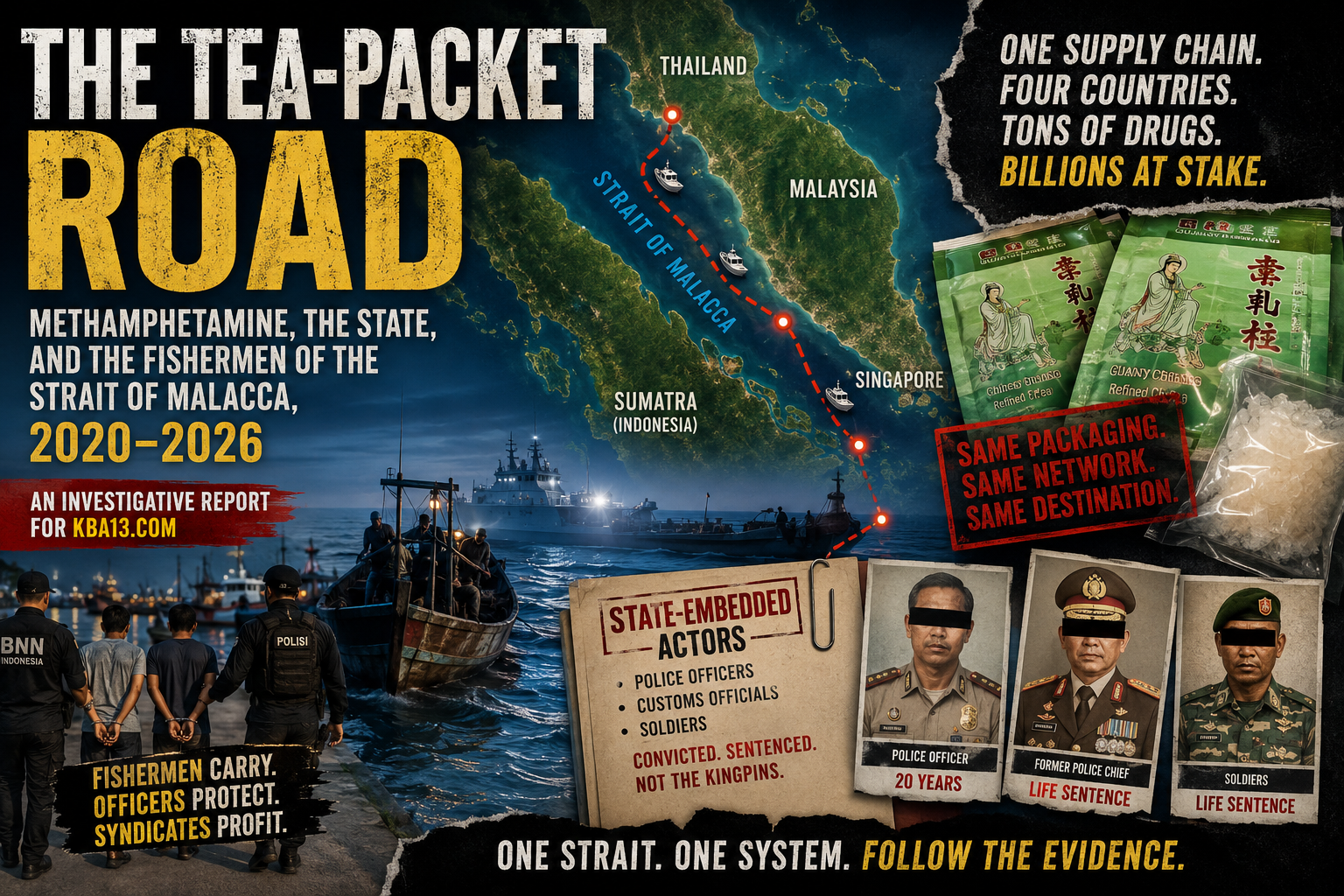
First, the packaging is proof of a single supply chain. A Chinese green-tea brand — rendered variously in Indonesian and Malaysian reporting as Guanyinwang or Guan Yin Wang — appears as the outer wrapper of methamphetamine consignments seized in Aceh (100 kg, 2021; 150 kg, 2022; 325 kg, 2026), in North Sumatra (25 kg, 2025), off Karimun in the Riau Islands (106 kg, 2024; approximately two tonnes, 2025), and in Malaysian waters off Perlis (10 kg, 2022) and Langkawi (56.5 kg, 2020). Indonesia’s National Narcotics Agency (Badan Narkotika Nasional, BNN) attributes the packaging directly to Golden Triangle syndicates (BNN, 2025). Four jurisdictions, six years, one wrapper. That is not a coincidence of retail choice; it is a logistics culture, and it is visible to anyone willing to look at the evidence table.
Second, the people who are executed and imprisoned are, with near-total consistency, not the people who own the drugs. In the largest seizure in Indonesian history — approximately two tonnes of crystal methamphetamine taken from the vessel Sea Dragon off Karimun Anak in May 2025 — prosecutors demanded the death penalty for all six crew members (Kompas, 2026). Two received life. One, a young engine-room hand named Fandi Ramadhan who had been aboard for three days, was ultimately given five years, the court having declined to accept the state’s own theory of his role (Dandapala, 2026). The man both Indonesian and Thai authorities identify as the principal — “Mr Tan,” alias “Tansen” — has never been arrested. The same pattern recurs in every large case in this ledger. The boat is caught. The boat’s owner is not.
Third, the state is not merely failing to stop the trade; parts of it are inside the trade. This is not an allegation. It is a matter of court record. A serving Indonesian police officer, Fajar Amrinal, was convicted in the 135-kilogram Lhokseumawe case; two Acehnese fishermen convicted alongside him received life imprisonment, while he received twenty years, reduced to fifteen on appeal (AJNN, 2025b). A former provincial police chief, Inspector General Teddy Minahasa Putra, was sentenced to life for replacing part of a 41.4-kilogram methamphetamine seizure with alum (tawas) and selling the difference (Kompas, 2023a). Two soldiers were sentenced to life for moving 75 kilograms of methamphetamine and 40,000 ecstasy tablets from Tanjung Balai to Medan (Kompas.id, 2023). The Global Initiative Against Transnational Organized Crime rates Indonesia at 8.00 out of 10 for “state-embedded actors” — its highest score in the entire criminal-actors category — compared with a government transparency and accountability score of 3.00 (GI-TOC, 2025a).
The Strait of Malacca is not a hole in the wall. It is a door, and a documented number of the people holding the keys are being paid.
1. Method, Sources, and the Limits of What Can Be Said
1.1 Evidentiary standard
This report was commissioned for publication. It therefore operates under a restrictive rule, applied without exception:
A named individual appears in this report only where there exists (a) a court verdict, (b) a formal charge or indictment, (c) an official disciplinary action taken by the individual’s own institution, or (d) an on-the-record public statement by a named official or the individual’s own agency.
Where reporting exists but does not meet that bar, the substance is described structurally — as a pattern, a typology, or an unresolved question — and explicitly flagged as unverified. Where two credible sources conflict, both figures are given and the conflict is named. Where a claim that circulates widely could not be substantiated, it is listed in Section 13 as a claim this report declines to make.
This is not squeamishness. It is the only standard under which an investigation into official complicity can survive contact with the people it names. The trade’s most reliable defense has always been that its accusers overreach.
1.2 Naming conventions
Indonesian police and press routinely release the identities of arrested suspects as initials only (e.g., “JM (38),” “IF (22)”). Where a name has entered the public record through a court verdict, it is given in full. Where it has not, the initials are reproduced as published. This is a legal convention in the source jurisdiction and not an editorial choice by this report.
Indonesian, Malaysian and Thai ranks and institutional titles are given in the original where the original is the form used in the source record: Kapolda (provincial police chief), Kapolri (national police chief), Dirresnarkoba (director of narcotics investigation, provincial), Dittipidnarkoba (narcotics crime directorate, national), Danlantamal (naval base commander), Ketua Pengarah (director-general), Pengarah Maritim Negeri (state maritime director).
1.3 The problem of weight
Seizure weights in this ledger frequently change between the initial press announcement and the official re-weighing at handover to prosecutors. This is not, in itself, evidence of theft — evidence samples are lawfully withdrawn for laboratory analysis, packaging is stripped, and initial figures are often gross rather than net. But the discrepancies are large enough, and the documented history of evidence-theft by police officers is serious enough, that this report gives both figures wherever the sources differ, and treats the discrepancy itself as reportable.
The Sea Dragon case is the sharpest illustration: announced at approximately 2,115,130 grams, stated in court as 1,995 kilograms (detikNews, 2025; Batamnews, 2026). The Aungtoetoe 99 case was announced as 705 kg of methamphetamine plus 1,200 kg of cocaine and re-weighed at handover to 2,061,293 grams in total (ANTARA Bengkulu, 2025). In the February 2025 Bengkalis case, the initial announcement of 90 kilograms was formally recorded as 87.68 kilograms, a discrepancy the provincial narcotics director, Senior Commissioner Putu Yhuda Prawira, addressed publicly (KlikMX, 2025).
1.4 What this report is not
It is not a claim that any specific named officer is corrupt absent a finding to that effect. Several officers in this ledger appear only because they successfully interdicted large consignments and were quoted doing so. Their presence here is a record of their work, not an insinuation about it. Where an officer’s career trajectory is tracked, the tracking is exactly that: a public record of appointments and transfers, with no causal claim attached unless a source makes one.
2. The Geography of a Crossing
2.1 Why the Strait
The Strait of Malacca is roughly 800 kilometres long and, at its narrowest — the Phillip Channel near Singapore — approximately 2.8 kilometres wide. Around a quarter of the world’s traded goods pass through it. On any given night, several thousand vessels are in or near the shipping lanes: container ships, tankers, bulk carriers, ferries, tugs, barges, and — critically — tens of thousands of small wooden and fibreglass fishing craft belonging to communities on both shores.
For a trafficking network, this produces a specific and almost unimprovable set of conditions:
Density as camouflage. A wooden boat carrying 180 kilograms of methamphetamine is visually indistinguishable from the thousands of wooden boats that are not. Radar cannot resolve intent. The Indonesian Navy has stated publicly that couriers operate berkedok nelayan — “under the guise of fishermen” (ANTARA, 2026a). Indonesian narcotics investigators have described the tell that separates the two: the courier boat carries no nets and no lines, only extra fuel.
Shortness of hop. From Malaysia’s west coast — from the estuaries of Perak, Selangor and Johor, and from the Perlis–Kedah shore facing Thailand — the crossing to Sumatra can be measured in hours. From Bantan and Bandar Laksamana on Bengkalis, the Malaysian coast is closer than the nearest Indonesian provincial capital. Police in Riau have described the Bengkalis coast bluntly as a known smuggling shore (Riauin, 2026).
Shallow water as sanctuary. Both Malaysian and Thai authorities have documented the same adaptation: syndicates deliberately shifting from fast fibreglass craft to shallow-draft, pole-engine wooden boats specifically so that they can moor and run in water too shallow for enforcement vessels to follow. The Malaysian Maritime Enforcement Agency (Agensi Penguatkuasaan Maritim Malaysia, APMM) recorded this switch explicitly in its Perlis operations (MMEA, 2022). Thai investigators describe smugglers mooring among mangroves that large police patrol vessels physically cannot enter (Bangkok Post, 2021).
Jurisdictional seam. The Strait is bordered by three states with different legal regimes, different maritime enforcement architectures, and — as Section 11 documents — different tolerances for internal corruption. The seams between them are where the trade lives. In June 2026, defence counsel in the Sea Dragon case took the jurisdictional question directly to Indonesia’s Supreme Court, arguing that the interception occurred within Indonesian Archipelagic Sea Lane I-A and that no court had ever conducted the UNCLOS 1982 / Government Regulation 37/2002 jurisdiction test that boarding a foreign-flagged vessel there would require (Batamnews, 2026). If that argument succeeds, it reaches every at-sea interdiction in this ledger.
2.2 Two traffics, opposite directions
A finding that the case record makes unavoidable, and that most commentary misses: the Strait carries drugs in both directions, and the agencies say so on the record.
- Inbound (north). The Aceh and North Sumatra landings are receipts. Product originating in the Golden Triangle is transferred at sea — in the June 2026 Lhokseumawe case, by ship-to-ship transfer at approximately 120 nautical miles, on the Indonesia–Thailand maritime boundary — and run into the Acehnese coast (Polri Mediahub, 2026).
- Outbound (south and east). The Johor cases are exports. On 1 July 2026, APMM intercepted a fibreglass boat approximately 3.5 nautical miles off the Johor coast carrying 88.2 kilograms of methamphetamine and 30,000 ecstasy tablets, outbound to Indonesia; the two men aboard, brothers aged 26 and 40, were described as transporters and had been paid RM17,000 (Bernama, 2026a; Utusan, 2026).
- Transit. The September 2020 Langkawi case was neither: a Thai Class-A wooden fishing boat carrying 56.5 kilograms of methamphetamine in fifty-one Chinese-tea packets, moving through Malaysian waters from Thailand toward Indonesia (MMEA, 2020).
The Strait is therefore not a border being violated. It is a road being used.
3. Upstream: The Economics of Shan State
3.1 The scale, in the only numbers that exist
The United Nations Office on Drugs and Crime publishes an annual regional assessment, Synthetic Drugs in East and Southeast Asia. Its methamphetamine seizure series is the closest thing the region has to a common instrument:
| Year | Regional methamphetamine seized (East + Southeast Asia) |
| 2021 | ~172 tonnes; >1 billion tablets for the first time |
| 2022 | ~151 tonnes |
| 2023 | 190 tonnes |
| 2024 | 236 tonnes (+24%); Southeast Asia = 85% of the total |
| 2025 | 349 tonnes (+48%; more than five times the level of a decade earlier) |
Sources: UNODC (2022, 2023, 2024, 2025a, 2026).
Ketamine has run alongside it and, in 2025, overtook it in rate of growth: 52.5 tonnes seized regionally, an increase of 185% over 2024 and a regional record (UNODC, 2026). The Republic of Korea, which seized on average about one kilogram of ketamine per year between 2015 and 2021, seized 140 kilograms in 2025.
3.2 The price collapse is the story
Seizure totals alone are a trap. They measure enforcement effort at least as much as they measure supply. The number that cannot be gamed is the price — and the price has collapsed while purity has held.
- Wholesale crystal methamphetamine has been recorded in production areas at as low as US$400 per kilogram (UNODC, 2025a, as reported in New Lines Institute, 2025).
- In Thailand, a kilogram of crystal methamphetamine fell from US$8,000–13,000 in 2019 to US$2,700–5,400 in 2023. Two thousand tablets fell from US$820–1,147 to US$240–680 over the same period.
- In Myanmar, a single yaba tablet went from roughly US$2.50 in 2020 to about US$1 in 2022 to US$0.60 in 2024.
- In the Philippines, the per-gram retail price of crystal methamphetamine has fallen roughly 30% since 2022.
Purity, meanwhile, is stable or rising.
Falling price with rising purity and rising seizures has exactly one coherent interpretation: supply is expanding faster than enforcement can remove it, and input costs are falling. Every tonne seized in the tables above is a tonne the industry could afford to lose.
3.3 Who makes it
Production is concentrated in Shan State, Myanmar, and UNODC’s assessment since 2025 has been that it has “significantly increased since 2021” — driven, in a formulation worth sitting with, by both conflict and stability: enough war to destroy enforcement, enough territorial control in the production zones to run factories at industrial scale (UNODC, 2025a).
The armed groups documented in the production and protection economy include:
- The United Wa State Army (UWSA), designated by the United States as a drug-trafficking organisation and the dominant methamphetamine actor, with most operations east of the Salween. Thai authorities have described armed groups coordinating with criminal networks to build “super labs,” naming the UWSA (Crisis Group, 2019).
- Border Guard Forces (BGFs) operating under Myanmar military protection, whose leaders have been granted latitude in narcotics, gambling and cross-border crime in exchange for loyalty. Militias around Kutkai, Lashio and Namkham are heavily implicated.
- The National Democratic Alliance Army (Mong La), the Shan State Progress Party, the Shan State Army–South, and the Myanmar National Democratic Alliance Army, in varying combinations of ownership and rent-extraction (Meehan, 2022).
- The Arakan Army, reported to have plugged into Shan State narcotics networks for revenue, and which took full control of the Myanmar side of the Bangladesh border at Maungdaw on 8 December 2024 — reshaping the yaba flow into Bangladesh.
A structural detail from the seizure data deserves to be carried forward into the Strait analysis. Tablet trafficking is fragmenting — brands proliferate, per-case quantities grow slowly. Crystal methamphetamine is consolidating: per-case quantities have roughly quadrupled since the 2021 coup, against a doubling for tablets. Crystal is concentrating among fewer, more sophisticated exporters.
Crystal is the segment that reaches the Strait. The Strait is therefore not touched by the fragmenting, chaotic end of the industry. It is touched by the consolidating end.
3.4 Sam Gor, and what a kingpin’s arrest actually changes
The syndicate variously called Sam Gor (“Brother Number Three”) or “The Company” is the most-documented transnational structure in the regional trade. It is not a single organisation in the mafia-family sense; it is a consortium, composed of members of five triads — 14K, Sun Yee On, Wo Shing Wo, the Bamboo Union (Taiwan) and the Big Circle Boys — that brokered peace among previously hostile groups in order to industrialise distribution (Allard et al., 2019). UNODC’s 2019 estimate put its methamphetamine revenue at between US$8 billion and US$17.7 billion annually, controlling perhaps 40–70% of the Asia-Pacific methamphetamine market.
Two of its innovations define the modern architecture of the trade and explain a great deal of what happens in the Strait:
Guaranteed delivery. Seized loads are replaced free of charge. Interdiction is not a catastrophe; it is a line item. This is why a two-tonne seizure produces no measurable price movement.
Distribution partnership rather than distribution ownership. Sam Gor sells to Yakuza networks in Japan, to outlaw motorcycle gangs in Australia (notably the Comanchero), and to established local structures elsewhere. It does not need to own the last mile. It needs only to own the crossing.
Tse Chi Lop, the Chinese-Canadian identified by Reuters and by regional law enforcement as the head of Sam Gor, was arrested at Amsterdam Schiphol on 22 January 2021, extradited to Australia on 22 December 2022, and — after a guilty plea — sentenced in Melbourne on 4 December 2025 to sixteen years’ imprisonment with a ten-year non-parole period, making him eligible for parole in January 2031 (ABC News, 2025). The charge scope was narrow: conspiracy to traffic commercial quantities of methamphetamine into Australia during 2012–2013 only. The presiding judge noted an unusual extradition undertaking by the then Australian Attorney-General capping the maximum sentence at twenty-five years.
UNODC’s assessment at the time of his arrest was that it would change little. Five years later, the regional seizure total has doubled. The assessment was correct. This is the single most important thing to understand about the architecture: it is not a hierarchy with a head that can be removed. It is a market with entry points that can be occupied.
4. The Corridor: Down the Thai Peninsula
4.1 The route
Product leaves Shan State by three principal corridors. The fastest-growing, per UNODC’s 2025 assessment, runs Shan State → Laos → Cambodia. A second runs directly into China. The third — the one that matters for this report — runs into northern Thailand at Chiang Rai, Mae Sai and Mae Fa Luang, and then the length of the Thai peninsula to the southern border provinces.
The Laos corridor deserves a paragraph even though it does not feed the Strait directly, because it demonstrates what protection looks like when it is complete. The Golden Triangle Special Economic Zone in Bokeo, Laos, and its Kings Romans casino, are controlled by Zhao Wei. The United States Treasury designated the Zhao Wei transnational criminal organisation in January 2018, stating that it “facilitates the storage and distribution of heroin, methamphetamine and other narcotics… including for the United Wa State Army” (U.S. Department of the Treasury, 2018). The United Kingdom sanctioned him in 2023. He has never been prosecuted. He continues to operate.
4.2 The southern staging grounds
In Thailand’s south, the product is stored before it crosses. The documented staging is in Songkhla, Satun and Hat Yai, and the volumes are not small:
- 1.2 tonnes of crystal methamphetamine stored in a house in Na Mom, Songkhla, awaiting transfer to Malaysia (Bangkok Post, 2023).
- 100 kilograms intercepted in the roof cavity of a tour van at the Khuan Meed checkpoint in Chana district, Songkhla, destined for network agents in Sungai Kolok, Narathiwat (Bangkok Post, 2025).
- 519 kilograms seized in southern Thailand in May 2026 (Khaosod English, 2026).
Thai authorities describe the operational method for the sea leg with unusual specificity: drugs are moved to Satun by car or by train, then out on small and medium fishing boats to the maritime border, where they moor in shallow mangrove water that patrol vessels cannot reach (Bangkok Post, 2021).
4.3 The tea packet, again
In one Chiang Rai case, a courier was arrested preparing to move crystal methamphetamine to Satun hidden in tea bags.
Hold that against the Karimun two-tonne load, packed as Chinese tea. Against the Aceh 325-kilogram load, packed as Chinese tea. Against the Perlis 10-kilogram load, ten Chinese-tea packets. Against the Langkawi 56.5-kilogram load, fifty-one Chinese-tea packets.
This is the same concealment grammar, executed by different crews, in different countries, over six years. It is the strongest single piece of evidence in the open record that the Strait traffic is not a collection of independent local ventures but the tail end of one integrated logistics system.
4.4 The Thai maritime case: ONCB, December 2024
The most instructive Thai case in the period began on 4 December 2024, when a suspect known as “Ekawit” was caught as drugs were being transferred from a pickup truck onto a vessel at a dock in Bang Pakong, Chachoengsao: one tonne of crystal methamphetamine and 1.2 tonnes of ketamine.
The follow-on investigation — publicised by Thailand’s Office of the Narcotics Control Board (ONCB) under the operational title “Swooping the Pirates: Suppressing the Seas EP.3” — established that the network had bought a tugboat from Indonesia in January of that year, intended for outbound smuggling, and had sent it for repairs at a dock in Songkhla. When the vessel was searched, the chief engineer, his assistant and five crew were aboard, along with two 9mm firearms and ammunition. A ship’s captain, “Mr Somkid,” was arrested at Thepha pier in Songkhla on organised-crime and drug-trafficking charges. In total, eighteen people were arrested and assets exceeding 170 million baht were seized (Thaiger, 2024; Thai Newsroom, 2024).
ONCB stated the network’s routes as the Andaman Sea and the Gulf of Thailand, with end-destinations in international waters near Taiwan and the Philippines.
Note what this case establishes and what it does not. It establishes, from the Thai side, that a southern-Thai maritime network was purchasing Indonesian vessels, staging them in Songkhla, and moving multi-tonne loads to sea. It does not, on the available record, tie that specific network to any specific Indonesian landing. The connection is structural, not evidential — and this report will not pretend otherwise.
5. The Malaysian West Coast
5.1 The land border, and what it lets through
Product crosses from Thailand into Malaysia at Bukit Kayu Hitam, Padang Besar and Rantau Panjang, and along the unofficial crossings between them. Malaysia’s National Anti-Drugs Agency (Agensi Antidadah Kebangsaan, AADK) maintains dedicated Anti-Drugs Border Units (Unit Anti-Dadah Sempadan, UAS) in Kedah, Perlis and Kelantan (AADK, n.d.). Between 2024 and 31 March 2026, AADK recorded 3,625 border screenings producing 1,084 positive drug cases; methamphetamine was the leading substance (Bernama, 2026b).
The volume that clears the border can be inferred from what Malaysian police take off the street. In 2025, the Royal Malaysia Police dismantled 270 drug syndicates, arrested 737 members, and seized drugs valued at RM3.19 billion — an eightfold increase on 2024’s RM388 million (Free Malaysia Today, 2026a).
5.2 The single largest seizure in Malaysian history
On 25 January 2025, at Westport on Pulau Indah, Port Klang — on the Strait of Malacca itself — the Bukit Aman Narcotics Criminal Investigation Department (NCID), working with the Australian Federal Police, seized a consignment concealed in 166 blue barrels labelled “paraffin wax” inside two forty-foot containers, bound for Australia. The Royal Malaysia Police announced it as 33.2 tonnes of methamphetamine, valued at RM1.06 billion at Australian street prices (Bernama, 2025).
That figure requires a qualification that Malaysian reporting largely omitted. The AFP’s own account describes the seizure as approximately 32 tonnes of “methamphetamine-laced wax,” with the actual methamphetamine content subject to forensic analysis by the RMP (AFP, 2025). This is methamphetamine dissolved in paraffin wax, not thirty-three tonnes of crystal. The two agencies also differ on origin: the RMP described the containers as having transited Malaysia from Central Asia; the AFP, working with Dubai Police under Operation Tiger-Milang, traced the consignment to Iran. Both accounts are reproduced here; neither has been reconciled publicly.
What is not in dispute is the shape of the thing. It was in transit. It was not for Malaysia and it was not for Indonesia. Port Klang was a node, not a market — and the load was very large, whatever its final assayed purity. The Strait’s role in the global architecture is that it is where the world’s shipping already goes.
The seizure was disclosed publicly only about two months later, to allow the AFP to work the Australian end. The Malaysia–Australia enforcement channel that produced it had been formalised in November 2024 by an agreement between Inspector-General of Police Tan Sri Razarudin Husain and AFP Commissioner Reece Kershaw.
It also establishes something the Golden Triangle framing tends to obscure: the Iranian/Golden Crescent supply line and the Southeast Asian one converge in the same port, on the same water.
5.3 The maritime cases: APMM on the record
The Malaysian Maritime Enforcement Agency’s own published statements constitute one of the most useful evidentiary series in this report, because APMM names its officers and describes its adversaries’ adaptations in near-real time.
25 September 2020 — Tanjung Kemarong, Langkawi. An APMM fast patrol boat from the Kedah/Perlis command intercepted a Thai Class-A wooden fishing boat carrying two black bags containing fifty-one Chinese-tea packets: 56.5 kilograms of methamphetamine, RM11.3 million. Two suspected foreign nationals jumped into rough seas and were not recovered.
The named officer is First Admiral (Maritime) Mohd Zawawi Abdullah, State Maritime Director for Kedah/Perlis, and what he said on the record is the most analytically valuable statement any official made in this period. He stated that the drugs were being moved from Thailand to Indonesia via Langkawi waters, by boat-to-boat transfer, and that this was the first time small Class-A wooden boats had been detected on the route — a deliberate change of method after three earlier APMM interdictions (MMEA, 2020; Bernama, 2020).
An enforcement agency, in 2020, publicly documented the exact modus operandi — Thai origin, Indonesian destination, Malaysian transit water, ship-to-ship transfer, wooden fishing boats — that Indonesian agencies would spend the next six years intercepting.
1 November 2022 — 14 nautical miles north-west of Kuala Perlis. A boat running dark, without registration numbers, entering Perlis waters from Thailand. APMM’s Kuala Perlis Zone, working with intelligence units from Kuala Perlis and Kuala Kedah, headquarters intelligence, and the Maritime Crime Investigation Division’s detective unit, seized one white sack containing ten Chinese-tea packets — 10 kilograms of methamphetamine — and, notably, a pistol and a magazine with five live rounds. Two Thai nationals were arrested and charged under section 39B of the Dangerous Drugs Act 1952 and the Firearms (Increased Penalties) Act 1971 (MMEA, 2022).
APMM’s assessment of the weapon was that it was the smugglers’ “insurance.” Its assessment of the boat was that the syndicate had switched to pole-engine wooden craft to exploit shallow water.
Johor, west coast. APMM has documented a distinct outbound traffic: 30 kilograms of methamphetamine (RM4.2 million) at the Parit Jawa river mouth, Batu Pahat, with investigators stating they would establish whether the load was bound for Indonesia; 300 kilograms abandoned in a boat at Sungai Ayam, Batu Pahat (20 May 2025); two Indonesian men detained off Forest City in October 2025 with 1,993 grams of methamphetamine and 499 packets of “mushroom vape” liquid, in an operation named by Acting State Maritime Director of Johor, Maritime Captain Kama Azri bin Kamil (MMEA, 2025; Kosmo, 2025).
And the July 2026 case already noted: 88.2 kilograms of methamphetamine plus 30,000 ecstasy tablets, outbound to Indonesia, two brothers, RM17,000.
5.4 The “Datuk” case
In June 2026, in an NCID operation running 17–21 June, 291 people were arrested, among them a man in his mid-forties holding the honorific title “Datuk,” described as the head of a secret society and the mastermind of a syndicate active in Perak, the Klang Valley and Johor since mid-2024. Nine named syndicate members were among those held. The seizure included heroin, MDMA, ketamine, ecstasy, Erimin-5, cannabis and precursor chemicals, valued at RM6.26 million (New Straits Times, 2026a; The Star, 2026a).
This matters for a reason beyond its size. It is the closest thing in the documented record to the “Datuk-level syndicate” that circulates constantly in Malaysian and Indonesian rumour. It is real, it is charged, and it is nine people and one title — not a shadow government. Reporting that inflates it beyond that does the story a disservice.
6. The Crossing, Part I: Aceh
6.1 Why Aceh
The Global Initiative Against Transnational Organized Crime’s 2025 assessment of Indonesia states it plainly: “Transnational drug traffickers continue to use Indonesia’s Aceh province as their main entry point” (GI-TOC, 2025a).
The reasons are not mysterious. Aceh’s eastern coast — Idi Rayeuk, Peureulak, Langsa, Kuala Simpang Ulim, Jambo Aye, Lhokseumawe — faces directly onto the northern approaches of the Strait and the southern Andaman. It is the closest Indonesian landfall to southern Thailand. It has a large, poor, boat-owning fishing population whose fisheries never fully recovered after the 2004 tsunami (Mongabay, 2019). It has a long post-conflict history of weak formal economic opportunity. And its coastline is functionally unpoliceable: hundreds of kilometres of river mouths, beaches and unofficial jetties.
6.2 The Aceh case ledger, 2020–2026
10 April 2021 — Pantai Lambada, Aceh Besar. 808 kg. Landed from a wooden fishing vessel of the oskadon class at around 22:50. A joint Customs (Direktorat Jenderal Bea dan Cukai) and Police operation branded “Operasi Gabungan Dewa Ruci 2021.” 808 kilograms of methamphetamine in eighty-one sacks recovered at the beach; total operation yield reported at 1.278 tonnes, with follow-up arrests in West Jakarta on 22 April. The network was described in official material as a Middle East–Malaysia–Aceh syndicate. The Customs press release for this case is no longer live; named officers could not be verified from a current source.
17 April 2021 — Idi Rayeuk, Aceh Timur. 80 kg. Customs and BNN (Aceh Standar, 2021).
August 2021 — Aceh Timur. 100 kg. BNN. Packaged as Chinese tea (Waspada Aceh, 2021).
20 January 2022, 00:15 — Jambo Aye waters, Aceh Utara. 150 kg. The narcotics directorate of the Aceh regional police (Ditresnarkoba Polda Aceh) with the East Aceh district narcotics unit, supported by a Customs patrol boat from the Riau Islands. Twelve sacks, 150 kilograms, three suspects, one vessel seized (Waspada, 2022; AJNN, 2022).
14 March 2022 — East Aceh waters. 203.99 kg. A fishing boat of the oskadon class. Lead agency reported as BNN.
10 October 2022 (announced) — Peureulak, Aceh Timur. 179 kg. Picked up mid-sea (dijemput di tengah laut) and landed at Peureulak; the suspect was arrested driving a car at Desa Beusa Seberang. A joint operation of Bareskrim Polri, Polda Aceh and Bea Cukai. Four gunny sacks and three bags — 179 kilograms, origin Malaysia. The arrestee, “F,” 31, of Gampong Blang Balok, Peureulak, was the penjemput — the sea pick-up man. Charged under Articles 114 and 112 of Law 35/2009; maximum penalty, death (Tribratanews Polri, 2022; Serambinews, 2022).
12 March 2023, 18:35 — Pantai Ujong Batee, Lhokseumawe. 36 kg. A wooden fishing boat approached the beach and threw two sacks onto an illegal jetty. The interdiction was made by a joint team from Lantamal I Belawan and Lanal Lhokseumawe, including Kopaska (naval special forces) intelligence personnel. Thirty-six packages, thirty-six kilograms, valued at Rp36 billion; two arrests.
The named commander was Rear Admiral (Lower Half) Johanes Djanarko Wibowo, Danlantamal I Belawan. And here the career record becomes documented rather than inferential: the long-haired Kopaska intelligence operator credited with the interdiction received a rank promotion in 2024, and the Danlantamal publicly awarded commendations to the Lanal Lhokseumawe personnel involved (VIVA, 2023; Mabes Bharindo, 2023).
12 July 2023 — Aceh. 57 kg, five arrests. Polda Aceh (Kompas.id, 2023b).
15 June 2024, 01:00 — Peureulak waters, Aceh Timur. 180 kg. Brought across the Strait from Malaysian waters. The boat had sailed from Kuala Simpang Ulim to Malaysian waters to load. Ditresnarkoba and Ditintelkam Polda Aceh with Customs. Nine sacks, 180 packages, 180 kilograms; the fishing boat seized. Three crew jumped overboard. The skipper — the tekong — and an onshore controller were arrested (ANTARA, 2024; Kompas, 2024; detikSumut, 2024).
8 September 2024 — Kuala Idi, Aceh Timur. 29.25 kg. Customs, BNN and Polda Aceh. Six suspects. Described as a Thai international network (VIVA, 2024; ANTARA, 2024b).
23 June 2026 — Blang Mangat, Lhokseumawe. 325 kg. The best-documented case in the ledger.
This is the case that shows the machine. The investigation had been running since early May 2026. On 23 June, a black Honda HR-V was blocked at Blang Mangat, Lhokseumawe. Inside were 325 packets — 325 kilograms — of methamphetamine, packed in Chinese-tea packaging, in thirteen sacks. Value: Rp585 billion.
The load had been collected by ship-to-ship transfer from a foreign vessel at approximately 120 nautical miles, on the Indonesia–Thailand maritime boundary, using an oskadon-class Acehnese fishing boat, and run into the coast.
The agencies: Sub-directorate IV of the Narcotics Crime Directorate of Bareskrim Polri (Dittipidnarkoba); Team 1 of the NIC Task Force; the Aceh Regional Customs Office; and Customs Lhokseumawe.
The named officer: Brigadier General Eko Hadi Santoso, Director of Narcotics Crime, Bareskrim Polri (JPNN, 2026; Polri Mediahub, 2026).
The arrestees: Jufri (the tekong) and Zulfahmi (land transport). Jufri had been promised approximately Rp400 million for thirteen sacks (Suara, 2026).
The controllers, named in interrogation: Muhammad Jabbar and Mahlul. Both at large.
The syndicate used military-grade encrypted messaging (Suara, 2026).
6.3 What the Aceh ledger shows
Read as a series rather than as a run of headlines, the Aceh cases establish four things.
The boat class does not change. The same wooden Acehnese fishing hull — described in Indonesian police statements and local coverage as the oskadon class, a term used in the source reporting and reproduced here as such — appears in 2021, in 2022, and in 2026. Across five years and multiple syndicates, the vessel of choice is the boat that was already there.
The packaging does not change. Chinese tea in 2021 (100 kg), 2022 (150 kg), and 2026 (325 kg).
The volume is climbing. 29 kg in September 2024; 180 kg in June 2024; 325 kg in June 2026 — the last with a transfer point 120 nautical miles offshore, on an international maritime boundary, with encrypted comms.
The controllers are never in the dock. In the 2026 case, Jufri and Zulfahmi are in custody. Muhammad Jabbar and Mahlul are not. In the 185-kilogram case tried at the Idi District Court in March 2025, three men were sentenced to death — and the court record explicitly notes that one alleged principal remains a fugitive (Kompas, 2025a).
Meanwhile, the baseline: Polda Aceh recorded 1,113 narcotics cases and 1,572 suspects in 2024, and 552 cases with 805 suspects in the first half of 2025 (Waspada, 2025).
7. The Crossing, Part II: Riau, the Riau Islands, and the Ton-Scale Ships
7.1 Bengkalis and Dumai: the shortest hop
The Riau mainland coast — Bengkalis, Rupat, Dumai, Bantan, Bandar Laksamana — is the closest Indonesian territory to the Malaysian west coast. The traffic here is high-frequency and, until recently, mid-volume.
11 February 2025 — Pantai Sepahat, Bandar Laksamana, Bengkalis. 87.68 kg + 51,882 ecstasy tablets. Brought by speedboat from Parit Amad, Malaysia. There was a night-time sea chase (Liputan6, 2025). Initially announced as 90 kilograms, formally recorded as 87.68 kilograms plus 51,882 ecstasy tablets.
The arrestees: JM, 38, and IF, 22, both from Bengkalis. Seven people were rolled up in total. Local police used the term becak laut — “sea pedicabs” — for the courier crews who collect from the Malaysian coast (Riau Government Media Center, 2025).
Two facts from this case go to the heart of the report. The courier had made three previous runs to Malaysia at Rp100 million a trip. And the operation was controlled from inside a prison (Nadariau, 2025).
The named officers: Inspector General Mohammad Iqbal, Kapolda Riau, who led the press conference and issued a public shoot-on-sight order against drug offenders who endanger officers (Kompas, 2025b); Senior Commissioner Putu Yhuda Prawira, Dirresnarkoba Polda Riau, who explained the weight discrepancy; Brigadier General Robinson DP Siregar, head of BNN Riau; and Senior Commissioner Anom Karibianto, Polda Riau public affairs chief.
Other Riau maritime cases:
| Date | Quantity | Location / unit |
| 24 Jul 2025 | 38 kg + tens of thousands of ecstasy tablets | Dumai — Customs Narcotics Interdiction Directorate + Customs Dumai + Polri |
| Jul 2025 | 27 kg | Pantai Penurun, Desa Muntai, Bantan, Bengkalis — Customs Bengkalis |
| Nov 2025 | 50 kg (Rp100 billion) | Landing via Pulau Rupat, Bengkalis — Customs Dumai + Navy |
| 26 Nov 2025 | interdiction at Roro Terminal Tanjung Kapal, Rupat | Polres Bengkalis + Customs Bengkalis |
| Dec 2025 | 8 kg | Pinggir, Bengkalis — Customs Interdiction Directorate + Bareskrim |
| 2 May 2026 | 27 kg, international network | Polres Meranti; Deputy Kapolda Riau led the press conference |
| 17 Jun 2026 | 32 kg from Malaysia | Dumai — four arrested |
| 10 Jul 2026 | 8 kg from Malaysia via Bantan | Polres Bengkalis; the Kapolres described Bantan on the record as a known smuggling coast |
7.2 The two ships: May 2025
In the space of seven days in May 2025, in the same stretch of water off the Riau Islands, Indonesian forces boarded two vessels carrying, between them, well over three tonnes of narcotics. These are the anchor cases of the entire period.
Aungtoetoe 99 — 14 May 2025, Selat Durian
Intelligence was received on 13 May. The vessel — a Thai-flagged foreign fishing vessel named Aungtoetoe 99 (rendered in some reporting as Deaung Toe Toe) — was located on the evening of Wednesday 14 May in the Selat Durian, off Tanjung Balai Karimun, and boarded at around 01:00.
The unit: the Fleet One Quick Response (F1QR) team of the Indonesian Navy, Lanal Tanjung Balai Karimun, under Lantamal IV.
The seizure: 705 kilograms of methamphetamine and 1,200 kilograms of cocaine. On official re-weighing at handover, the total narcotics weight was recorded at 2,061,293 grams.
The crew: five — four Myanmar nationals and one Thai national.
The named officer: Rear Admiral (Lower Half) Berkat Widjanarko, Danlantamal IV, who explained the re-weighing at handover (ANTARA Bengkulu, 2025; Tempo, 2025a).
BNN identified the vessel’s owner as “Kokau,” a Myanmar national, and said it would seek an international wanted notice. He has not been arrested.
The Navy handed the case to BNN. The Panglima TNI (Commander of the Indonesian National Armed Forces) subsequently awarded commendations to the personnel who broke the case (ANTARA Babel, 2025).
The cocaine matters and has been under-reported. 1.2 tonnes of cocaine on a Thai-flagged fishing vessel in the Strait of Malacca is not part of the Golden Triangle methamphetamine story. It is evidence of a second, South American, supply line reaching into Southeast Asian waters — what BNN has begun calling the “Golden Peacock” vector, alongside the Golden Triangle and the Golden Crescent (ANTARA, 2026b).
Sea Dragon — 21 May 2025, Karimun Anak. Indonesia’s largest seizure, ever.
There are two incompatible accounts of how Indonesia knew this ship was coming, and both are on the record. This report gives both, because the divergence is itself a finding — see Section 21.3.
Account one — the press conference. BNN stated it had been analysing the target for five months; that on Wednesday 20 May 2025 the vessel was assessed to be sailing from the Andaman Sea toward the waters of the Riau Islands; and that the joint force moved out at around 23:00 on Thursday 21 May and took the ship off Karimun Anak. The head of BNN said publicly that he had been “pessimistic” about the operation (detikNews, 2025a; BNN, 2025a; KompasTV, 2025).
Account two — the prosecution’s own trial narrative at Batam District Court. The ship took on the sixty-seven boxes from a Thai fishing vessel near Phuket, threw its Thai flag into the sea, and days later was detected off Karimun Anak flying no flag at all — and it was the absence of a flag that “memicu kecurigaan aparat,” triggered the officers’ suspicion (Batamnews, 2026).
One of those is a months-long intelligence operation. The other is an opportunistic stop of an unflagged ship. They cannot both be the whole truth, and no one has been asked to reconcile them.
The joint force: BNN RI (lead); the Directorate General of Customs and Excise (two vessels); the Indonesian Navy / Lantamal IV Batam (two combat boats); Polda Kepri; and BAIS TNI (military intelligence). The vessel was taken to the Customs jetty at Tanjung Uncang.
The seizure: sixty-seven cardboard boxes containing 2,000 packets—initially announced at approximately 2,115,130 grams, stated in court as 1,995 kilograms — of crystal methamphetamine, packed as “Guanyinwang” Chinese tea, hidden in side and forward compartments and in the fuel tanks. BNN identified the packaging as typical of Golden Triangle syndicates.
The crew: six — four Indonesians (Hasiholan Samosir, Leo Candra Samosir, Fandi Ramadhan, Richard Halomoan Tambunan) and two Thais (Weerapat Phongwan, Teerapong Lekpradub).
The named officer: Commissioner General Marthinus Hukom, Head of BNN RI, who gave the Batam press conference on 26 May 2025.
The principal, identified jointly with the U.S. Drug Enforcement Administration, the Narcotics Suppression Bureau of the Royal Thai Police, and the Thai ONCB as “Mr Tan,” alias “Tansen,” was described as a Thai police fugitive. BNN said it would issue an international wanted notice.
He has never been arrested.
BNN’s framing: the seizure prevented approximately Rp5 trillion in drug money and potential supply to some eight million users. It was, and remains, the largest in Indonesian history (BNN, 2025; detikNews, 2025; UNODC, 2025b).
The Sea Dragon trial: what the state asked for, and what the court gave
Prosecutors established at trial that the ship had sailed from Thailand in mid-May 2025, received the sixty-seven boxes from a Thai-flagged fishing boat off Phuket, then thrown its Thai flag into the sea — and was running with no national flag at all when it was detected off Karimun Anak. It was the absence of a flag that triggered the boarding.
- 5 February 2026 — the Batam Prosecutor’s Office demanded the death penalty for all six crew.
- 5 March 2026 — Fandi Ramadhan (engine-room crew): five years.
- 6 March 2026 — Weerapat Phongwan: life. Teerapong Lekpradub: seventeen years.
- 9 March 2026 — Hasiholan Samosir (captain): life. Richard Halomoan Tambunan (chief officer): life. Leo Candra Samosir (helmsman): fifteen years.
Both sides appealed. As of 23 June 2026, defence counsel Dominikus Aliando had taken the two Thai crew to cassation before the Supreme Court, arguing that the interception in ALKI I-A — an Indonesian archipelagic sea lane — required a UNCLOS 1982 and Government Regulation 37/2002 jurisdiction test that the lower courts never conducted, and that no court had examined the arrest coordinates, the GPS or AIS data, the logbook, or the maritime-zone status of the interception point (Batamnews, 2026; ANTARA, 2026c).
Mr Tan remains at large.
The one exception: Dewi Astutik
On Monday 1 December 2025, in Sihanoukville, Cambodia, BNN — working with the Cambodian National Police, the Indonesian Embassy in Phnom Penh, the Indonesian Defence Attaché, and BAIS TNI — arrested Dewi Astutik, alias “Mami”: an Interpol-listed fugitive, also wanted by South Korea whom BNN named as the intellectual actor behind the two-tonne Sea Dragon load, and as part of the Golden Triangle network (ANTARA, 2025b).
The arrest was announced under the new head of BNN, Commissioner General Suyudi Ario Seto.
She is, on the record assembled here, the only principal in any large Strait of Malacca case in the 2020–2026 period to have been captured.
7.3 Two more Riau Islands cases worth the ledger
13 July 2024 — Pongkar waters, Karimun. 106 kg. The landing craft transport Legend Aquarius, sailing from Malaysia through Indonesian waters en route to Brisbane, Australia — 106 packets of methamphetamine, packaged as Chinese tea, hidden in false compartments inside the fuel tanks. Customs, BNN RI and BNN Riau Islands.
On how they knew: BNN’s own published account says the operation began from informasi dari masyarakat — an unattributed public tip. The physical find is credited to a Customs sniffer dog named Joany, which alerted on the fuel tank (Kompas.id, 2024b; Teras Batam, 2024). (An earlier version of this report attributed the tip to merchant-ship crew. That attribution could not be confirmed in any named source and has been withdrawn.)
And here is the anomaly. There were thirteen people aboard. Only the three Indian nationals — Raju Muthukumaran, Govindhasamy Vimalkandhan and Selvadurai Dinakaran, all Singapore permanent residents — were charged. The ten Indonesian crew, including the captain, were declared not involved. Prosecutors sought death for all three Indians. The shipowner sued BNN civilly over the seizure and lost (BNN, 2024).
Read that route again: Malaysia → Indonesian waters → Brisbane. The Strait is on the road to Australia.
February 2018 — MV Sunrise Glory, Phillip Channel off Batam. 1 tonne. Outside the study window, but the template for everything above: one tonne of crystal methamphetamine in forty-one rice sacks, aboard a vessel flying a false Singapore flag that was in fact the Kaohsiung-registered Shun De Man No. 66, with four Taiwanese crew (ANTARA, 2018).
The false flag in 2018. The discarded flag in 2025. The method is seven years old and it still works.
8. Singapore: The Case That Isn’t
A finding that must be stated because its absence is itself information.
Across 2020–2026, this report found no documented case of a bulk maritime narcotics interdiction by Singapore’s Central Narcotics Bureau (CNB) in the Strait of Malacca or the Singapore Strait.
Singapore’s documented drug-import enforcement in this window is overwhelmingly at the land checkpoints — Woodlands and Tuas — against Malaysian couriers in cars and on motorcycles, in gram and low-kilogram quantities:
- 23 June 2025 — a 46-year-old Malaysian woman, Woodlands, on a Malaysian-registered motorcycle: approximately 1,057 g of cannabis and 973 g of crystal methamphetamine.
- 31 July 2025 — a 33-year-old Malaysian man, Malaysian-registered car: approximately 414 g of crystal methamphetamine.
- 4–8 August 2025 — an island-wide operation: 79 arrested; 3,457 g of heroin and 909 g of crystal methamphetamine, plus cannabis, ecstasy, Erimin-5 and GHB. Four of the five suspected traffickers were Malaysian.
- 17 March 2026 — a 29-year-old Malaysian at Tuas Checkpoint with approximately 14 kilograms of heroin.
(CNB, 2025; CNB, 2026; ICA, 2025; Malay Mail, 2026.)
Any claim that Singapore made a large at-sea Strait of Malacca seizure in this period is unverified and should not be repeated.
What this tells us is not that Singapore is uninvolved. It is that Singapore’s role in the architecture is different. It is a market and a financial node, reached overland from Johor, not a transit shore. And — as Section 12 will show — it is the jurisdiction that executes the people who carry the drugs there.
9. Downstream: Where It Goes, and What It Is Worth
9.1 The arbitrage that explains everything
| Market | Wholesale price per kilogram of crystal methamphetamine |
| Production areas (Shan State) | ~US$400 |
| Yangon | ~A$3,000–5,000 |
| Thailand (2023) | US$2,700–5,400 |
| Malaysia | ~RM33,000 (~US$7,000) |
| Australia | A$115,000–180,000 (~US$75,000–118,000) |
| New Zealand | NZD180,000–300,000 |
Sources: UNODC (2025a); ACIC (n.d.); Bernama (2025); New Lines Institute (2025).
That is a spread of roughly one hundred to three hundred times between the factory gate in Shan State and the wholesale price in Australia.
Every structural feature of the trade follows from that number. It is why interdiction does not move the price. It is why a two-tonne seizure is affordable. It is why a fisherman in Peureulak can be paid Rp10 million to carry 25 kilograms — about Rp400,000 per kilogram, a rounding error — and why the syndicate does not care if he is caught. And it is why the crossing of the Strait, the cheapest and lowest-technology link in the entire chain, is performed by the poorest people in it.
9.2 The destination markets
Australia. Consumes the second-highest quantity of methamphetamine per capita in the world, most of it from the Golden Triangle. The Australian Criminal Intelligence Commission’s wastewater analysis showed an increase of roughly 1.5 tonnes in national consumption in 2023 alone (ACIC, n.d.). The 33.2-tonne Port Klang container was bound for Australia. The Legend Aquarius was bound for Brisbane. Australia is not a footnote to the Strait; Australia is one of the reasons the Strait is busy.
New Zealand. Wholesale prices between NZD180,000 and NZD300,000 per kilogram sustain a distinct and lucrative flow.
Japan and the Republic of Korea. Historically the highest retail markets in the region — UNODC’s 2017 retail figures put Japan at roughly US$560 per gram and South Korea at roughly US$390 (CNN, 2019). Both are now being targeted for ketamine market expansion “where high retail prices make them attractive” (UNODC, 2026). Distribution in Japan runs through Yakuza structures.
The Philippines. A major maritime destination in its own right — in June 2025, 1.5 tonnes were seized from a fishing vessel, valued at approximately US$175 million. Retail per-gram prices have fallen roughly 30% since 2022, the signature of oversupply.
Indonesia. Both destination and transit. The domestic market is fed principally from the Strait, and the Indonesian police have named the corridor on the record: Aceh → Medan. After seizing 56 kilograms from a courier, North Sumatra police described the lintas Aceh–Medan — the Aceh–Medan run — as the syndicates’ favourite (Tempo, 2025b). Polda Sumut has publicly named the east-coast sea route as the dominant corridor from Malaysia, with entry points at Tanjungbalai, Batubara and Labuhanbatu Utara, and logged approximately 1.6 tonnes of methamphetamine through 2025 (FBI News, 2026; Indopos, 2025).
Bangladesh. Yaba seizures rose from 22.8 million to 43.5 million tablets between 2024 and 2025 — an increase of roughly 90%. Bangladeshi reporting now describes yaba as a “narco-currency” for Myanmar’s armed groups (The Daily Star, 2025).
9.3 The other supply lines
The 1.2 tonnes of cocaine aboard the Aungtoetoe 99 is the most important anomaly in this entire ledger, and it has been almost entirely ignored.
Indonesia’s BNN now frames the threat as converging on the country from three regions: the Golden Triangle (Southeast Asia), the Golden Crescent (Afghanistan/Iran/Pakistan), and what it calls the “Golden Peacock” (South America) (ANTARA, 2026b).
The Golden Crescent connection to Indonesia is documented in prosecutions, not merely asserted: in April 2021, an Indonesian court sentenced thirteen people to death — three Iranians, one Pakistani and nine Indonesians — over approximately 400 kilograms of methamphetamine (Al Arabiya, 2021). The U.S. State Department has assessed that a significant portion of the methamphetamine trafficked into Indonesia originates in Iran, and that the majority of heroin originates in the Golden Crescent (U.S. Department of State, 2014).
However: this report found no clean, current, sourced case of Golden Crescent heroin landing specifically in Aceh. The link is plausible and structurally likely. It is not proven. It is therefore not asserted here.
10. The Fishermen
10.1 The people in the dock
This is the section that most reporting on the Strait skips, and it is the one that determines whether the reporting is honest.
Isherman Ishak and Muhadar — described by the court reporting as “dua nelayan asal Aceh,” two Acehnese fishermen — were sentenced to life imprisonment by the Lhokseumawe District Court in September 2025 in the 135-kilogram case. A co-defendant, Fajar Amrinal, a serving Indonesian police officer, received twenty years, reduced to fifteen on appeal by the Banda Aceh High Court in October 2025. A third defendant, Muhammad Ishak, received ten years, increased to fifteen on appeal. Prosecutors had sought death for all of them.
And a detail from the evidence disposition in the same proceedings: the boat was returned to a witness, not forfeited from the defendants. The vessel on which 135 kilograms of methamphetamine crossed the Strait did not belong to the men the court sent to prison for life (AJNN, 2025a; AJNN, 2025b; Dandapala, 2025).
Sayed Fackrul, Muzakir (alias Him) and Ilyas Amren were sentenced to death by the Idi District Court on 6 March 2025, for 185 kilograms landed through Ujung Peureulak. Sayed Fackrul is described in the indictment as a fisherman, and he ran the operation from inside Banda Aceh Class IIA Prison, where he was already serving a death sentence in a separate case. Ilyas Amren’s role was to collect the drugs by boat. One alleged principal remains a fugitive (Kompas, 2025a; CNN Indonesia, 2025; Komparatif, 2025).
Husni Mubarak and Muslim Usman, both from Bireuen, Aceh: death, Tanjungkarang District Court, Lampung, 17 December 2025, for 15 kilograms (Radar Lampung, 2025).
“Uncle Jay” and “Padi”: death, Bengkalis District Court, Riau, for 10 kilograms moved by sea (Indragirione, 2026).
Sofian: life, for 199 kilograms in Aceh (AJNN, 2023).
Four defendants: death, Bireuen District Court, June 2022 (Serambinews, 2022b).
Fandi Ramadhan — the Sea Dragon deckhand. Three days aboard. Freshly out of maritime vocational training. He helped move sixty-seven boxes transhipped from a Thai fishing vessel. The state demanded his execution. The chair of Commission XIII of Indonesia’s House of Representatives, Habiburokhman, publicly called the demand impossible to reconcile with common sense for “workers at the lowest position in the case.” The court gave him five years — that is, the court itself rejected the prosecution’s theory of who he was (Project Multatuli, 2026; Dandapala, 2026; inews, 2026).
10.2 What they were paid
These are on-record figures — police statements and reported admissions, not estimates:
| Courier | Load | Fee | Effective rate |
| MI, Perlak, Aceh Timur, unemployed | 25 kg | Rp10 million | ~Rp400,000/kg |
| Three women, Asahan | 9 kg | Rp22 million | ~Rp2.4m/kg |
| MS | (Penang run) | Rp25 million | — |
| RN, Karimun (4 successful prior runs) | body-strapped | Rp30 million | — |
| AK, 67, fisherman, Karimun | ~1 kg | Rp40 million | — |
| Courier, Aceh Timur | 40 kg | Rp100 million | ~Rp2.5m/kg |
| JM, Bengkalis | ~90 kg | Rp100 million per trip (3 prior runs) | ~Rp1.1m/kg |
| Two couriers, Aceh | 10 kg | Rp300 million | Rp30m/kg |
| Jufri, Lhokseumawe | 325 kg (13 sacks) | ~Rp400 million | ~Rp1.2m/kg |
| Two brothers, Johor (outbound) | 88.2 kg + 30,000 pills | RM17,000 | — |
Sources: Tempo (2025c); Merdeka (2023); Batam Pos (2025); Tribun Batam (2024); BitvOnline (2025); Kompas Medan (2025); KlikMX (2025); Suara (2026); Utusan (2026).
Note the perversity of the top row. MI, an unemployed man from Perlak, was promised Rp10 million — about US$620 — to collect twenty-five kilograms of methamphetamine whose wholesale value in Australia would exceed two million US dollars. That is a labour cost of roughly 0.03% of the destination value. He faces the death penalty.
Note also that in several of these cases the money was promised, not paid — the courier was arrested before the transaction completed. They are prosecuted for a wage they never received.
10.3 The structure of recruitment: what the record proves and what it doesn’t
Proven from the case record:
Boat ownership is separate from courier labour. In one Aceh case, MS was paid Rp25 million to pilot a boat owned by NA. In the 135-kilogram Lhokseumawe case, the court returned the boat to a witness — not to the men it sentenced to life. The vessel-owner is a distinct node in the network, and he is not the one at sea.
“Fisherman” is simultaneously a real occupation and a cover. The Indonesian Navy has stated on the record that couriers operate berkedok nelayan (ANTARA, 2026a). But the men in the dock in Idi and Lhokseumawe are described by the courts as fishermen. Both things are true, and that is precisely the difficulty: the syndicate does not need to insert an operative into the fishing community, because the fishing community already owns the boats, knows the water, and needs the money.
The prison is inside the recruitment chain, not outside it. The Idi 185-kilogram network was run from Banda Aceh prison. The Bengkalis 87-kilogram network was run from a prison. This is not a story about prisoners phoning out; it is a story about the correctional system functioning as a node of the network.
The economic vacuum is real and documented. Aceh’s post-tsunami fisheries recovery was inconsistent and incomplete, marked by improper resource utilisation and a lack of official accountability (Mongabay, 2019). The academic literature on the political economy is unambiguous about the mechanism in general terms: Belhabib, Le Billon and Wrathall (2020), analysing 292 interdictions between 2010 and 2017, found that the value of drugs moved on fishing vessels tripled in eight years and now constitutes roughly 15% of global illicit drug retail value; that trafficking systematically favours small artisanal boats over industrial vessels; and — the finding that governs this entire section — that small-scale fishers turn to the drug trade as an economic buffer against poverty, particularly amid declining fish stocks.
Not proven, and therefore not asserted here:
The toke/pangkalan system — the patron–client credit relationship between landing-station owners and fishermen that structures the Indonesian artisanal fishery — is widely assumed to be the recruitment mechanism. It is a compelling hypothesis. The boat-owner/courier split documented above is consistent with it. But no published source establishes the link evidentially, and this report will not manufacture one. It is the single most valuable piece of original fieldwork available to any journalist working in Idi or Peureulak, and it remains undone.
10.4 The Malaysian and Thai side
Malaysia. APMM has documented the syndicate’s deliberate switch to Class-A wooden fishing boats to evade authorities (MMEA, 2020), and has detained fishing boats for licence breaches whose crews subsequently tested positive for drugs. Malaysian media has reported on smugglers posing as fishermen (Sinar Harian, 2021). However — no named conviction of a Malaysian fisherman under section 39B of the Dangerous Drugs Act in Perlis, Kedah, Penang or Perak could be verified for this report. The absence is worth noting rather than papering over.
Thailand. A ship’s captain, “Mr Somkid,” was arrested at Thepha pier, Songkhla, on organised-crime and drug-trafficking charges in the follow-on to the December 2024 Bang Pakong seizure (Thai Newsroom, 2024).
Indonesia. The largest bust in the country’s history was made on a fishing boat, with a crew of six — four Indonesians and two Thais (CBS News, 2025; UNODC, 2025b).
10.5 The migration overlap — stated carefully
Aceh receives more Rohingya boat arrivals than any other Indonesian province: forty-five boats between 2009 and 2025 (Lowy Institute, 2025; Human Rights Watch, 2025). The Andaman corridor that carries those boats is the same corridor that carries crystal methamphetamine into Aceh. GI-TOC’s 2025 Indonesia profile states that “Sabah and Aceh serve as major transit zones for human smuggling” and, separately, that Aceh is the main drug entry point (GI-TOC, 2025a).
The Index treats these as co-located markets, not as a single network. So does this report. Route co-location is documented. An operational merger of Rohingya-smuggling and drug-trafficking syndicates is not documented, and any publication claiming it should be asked for its evidence.
10.6 Who dies
The Harm Reduction International Global Overview 2024 records the following (HRI, 2025):
| Drug executions, 2024 | Drug death sentences, 2024 | Death row (drug share) | |
| Indonesia | 0 | 73+ (86% of all sentences) | 360 (63% drug) |
| Malaysia | 0 | 10+ (55%) | 700+ in 2023 (55%) |
| Singapore | 8 — 89% of ALL Singaporean executions | 5+ (100%) | 48 (96% drug) |
Globally, 2024 saw 615 drug executions — the deadliest year since 2015, a 32% rise on 2023 and a 1,950% rise on 2020.
Indonesia has not executed anyone since 2016 but continues to sentence at volume — its courts handed down the great majority of the death sentences documented in Section 10.1. Malaysia has not executed since 2017 and, in a reform of real substance, abolished the mandatory death penalty (Act 846, in force 4 July 2023), allowing judges to impose thirty to forty years and caning in the alternative; the Federal Court concluded its review of 936 people on death row on 29 October 2024 (Human Rights Watch, 2023; Amnesty International, 2024). Drug death sentences in Malaysia fell from 20+ in 2023 to 10+ in 2024.
Singapore executes. Its 2025 total across all offences reached seventeen — the highest since 2003 (Bangkok Post, 2025). The names, from Singapore’s own Central Narcotics Bureau press releases: Mohammad Reduan bin Mustaffar (9 April 2025); Datchinamurthy a/l Kataiah (25 September 2025); two men aged 64 and 50 (15 October 2025); Mohammad Rizwan bin Akbar Husain and Saminathan Selvaraju (27 November 2025).
Before them: Nagaenthran K. Dharmalingam, a Malaysian, hanged at Changi on 27 April 2022 at the age of 33, for trafficking 42.72 grams of heroin strapped to his thigh at Woodlands Checkpoint in 2009. His lawyers asserted an IQ of 69. And Tangaraju Suppiah, a Singaporean, hanged on 26 April 2023 for abetting the trafficking of about a kilogram of cannabis — he never touched the drugs; he was linked to them by two phone numbers found on other men’s phones. Amnesty International called the execution “arbitrary and unlawful” (Amnesty International, 2023).
Set that record beside the record in Section 7. Singapore hangs a man for 42.72 grams. “Mr Tan” moved two tonnes and is free.
11. The Officers: A Career Ledger
The reader asked what happened to the people who made these arrests. The answer is documented, and it is more interesting than a simple story of reward.
11.1 Indonesia — BNN
| Officer | Move | Date |
| Comm. Gen. Petrus Reinhard Golose | Retired as Head of BNN | 1 Dec 2023 |
| Comm. Gen. Marthinus Hukom | Sworn in as 13th Head of BNN by President Joko Widodo (Keppres 182/TPA/2023). Previously head of Densus 88 counter-terrorism since 2020. | 8 Dec 2023 |
| Comm. Gen. Marthinus Hukom | Replaced as Head of BNN by President Prabowo Subianto (Keppres 118/TPA/2025) | 25 Aug 2025 |
| Comm. Gen. Suyudi Ario Seto | Installed as Head of BNN. Career: Deputy Kapolda Metro Jaya 2023–24 → Kapolda Banten 2024–25 → BNN, promoted to three-star. | 25 Aug 2025 |
Sources: BNN (2023, 2025b); Setneg (2023); CNN Indonesia (2025b); ANTARA (2025b).
This is the sequence that will be the most quoted line in this report, and it must be handled with precision.
Marthinus Hukom fronted the press conference announcing the largest drug seizure in Indonesian history on 26 May 2025. He was replaced as head of BNN on 25 August 2025 — three months later. The change drew what Indonesian media described as sorotan tajam, sharp scrutiny, with open speculation about friction inside the national police (Fajar, 2025). His farewell line was widely quoted: “Genderang perang itu saya hentikan hari ini” — “I stop that war drum today” (Lentera Maluku, 2025).
No source states a causal link between the seizure and the removal. This report does not state one either. What it states is that the sequence is documented, the timing is three months, and the scrutiny was contemporaneous and public. That is a fact pattern, and a reader is entitled to it. It is not a finding of cause, and anyone who converts it into one is going beyond the evidence.
Under his successor, BNN made the Sihanoukville arrest of Dewi Astutik on 1 December 2025 — the one principal captured in this entire ledger.
11.2 Indonesia — Bareskrim narcotics directorate
| Officer | Move | Date |
| Insp. Gen. Mukti Juharsa | Out as Director of Narcotics Crime, Bareskrim | Apr 2025 |
| Brig. Gen. Eko Hadi Santoso | Sworn in as Director of Narcotics Crime, Bareskrim Polri, by Kabareskrim Comm. Gen. Wahyu Widada. Akpol 1999; a counter-terrorism detective by background. | 9 Apr 2025 |
Indonesian outlets explicitly framed Eko Hadi Santoso’s appointment as an attempt to clean up a narcotics directorate hit by ethics violations — and subsequently reported that he exposed a Rp2.8 billion bribe involving a serving senior officer, AKBP Didik Putra (detikNews, 2025b; Mata News, 2025; Tribun Timur, 2026).
He is the officer who fronted the 325-kilogram Aceh case in June 2026.
Note the pattern across both agencies: the two men appointed to run Indonesia’s drug enforcement in this period — Hukom at BNN, Eko Hadi at Bareskrim — are both counter-terrorism officers, brought in from outside the narcotics establishment. That is not an accident. It is what a state does when it does not trust its own drug police.
11.3 Indonesia — regional police
| Officer | Move | Date |
| Insp. Gen. Achmad Kartiko, Kapolda Aceh | Transferred out to Pati Bareskrim (Kep/1186/VIII/2025) — one of seven Kapolda moved that month | 5 Aug 2025 |
| Brig. Gen. Marzuki Ali Basyah | Appointed Kapolda Aceh. Pidie-born. Immediately prior: seconded to BNN; before that, Head of BNN Aceh Province from April 2024 | 5 Aug 2025 |
| Sr. Comm. Yemi Mandagi → Sr. Comm. Jean Calvijn Simanjuntak | Handover of Dirresnarkoba Polda Sumut; Simanjuntak credited with 191 kg in his first fortnight | early 2025 |
| Insp. Gen. Mohammad Iqbal, Kapolda Riau | Replaced by Insp. Gen. Herry Heryawan | 2025 |
| Insp. Gen. Whisnu Hermawan Februanto | Kapolda Sumut through 2025–26; fronted the 191 kg and 25 kg cases | — |
Sources: Kompas (2025c); ANTARA (2025c); Serambinews (2025); detikSumut (2025); ANTARA Riau (2025).
The Aceh appointment repays attention. Marzuki Ali Basyah ran BNN’s Aceh provincial operation from April 2024 — through the peak of the Aceh sea-landing years — and was then made chief of the Aceh police in August 2025. The man who watched the coast for BNN now polices it for Polri. That is either the single smartest personnel decision in the ledger or a consolidation of institutional knowledge in one pair of hands. The record does not tell us which, and this report does not guess.
11.4 Indonesia — the Navy
- Rear Adm. Johanes Djanarko Wibowo, Danlantamal I Belawan at the 36-kilogram Lhokseumawe interdiction (March 2023). The Kopaska intelligence operator credited with that interdiction received a rank promotion in 2024, and Lanal Lhokseumawe personnel received commendations from the Danlantamal (VIVA, 2023).
- Rear Adm. Berkat Widjanarko, Danlantamal IV, in post during the Aungtoetoe 99 / Sea Dragon fortnight of May 2025. The Panglima TNI awarded commendations to the personnel who broke the two-tonne case (ANTARA Babel, 2025).
- Subsequent career moves for both admirals: not verified.
Bakamla. Despite its mandate, this report found no verified major narcotics interdiction credited to Indonesia’s Maritime Security Agency (Bakamla RI) in Strait of Malacca waters between 2020 and 2026. Bakamla’s documented enforcement in this theatre in this period is illegal fuel transfers, foreign fishing vessels, and joint patrols with APMM. The narcotics interdictions are being made by BNN, Customs, the Navy, and the police. Any claim of a major “Bakamla drug bust” in the Strait should be treated as unverified until a source is produced.
11.5 Malaysia — PDRM and APMM
| Officer | Move | Date |
| Datuk Seri (now Tan Sri) Ayob Khan Mydin Pitchay | Director, Bukit Aman NCID (from Dec 2021) → Director, Bukit Aman CID (March 2023) → Deputy Inspector-General of Police (23 June 2023) | Dec 2021 – Jun 2023 |
| Datuk Hussein Omar Khan | Appointed Director, Bukit Aman NCID | 21 Jul 2025 |
| SAC Datuk Mohd Zaki Ashar | Transferred out as NCID Deputy Director in a six-officer reshuffle; replaced by SAC Zairulnizam Mohd Zainuddin | 9 Feb 2026 |
| IGP Tan Sri Razarudin Husain | 14th IGP, 23 Jun 2023 – 22 Jun 2025. Signed the November 2024 AFP cooperation agreement that produced the Port Klang seizure. Retired 22 June 2025 after 42 years’ service. | Jun 2023 – Jun 2025 |
| IGP Datuk Seri Mohd Khalid Ismail | 15th IGP from 23 June 2025, two-year contract to 22 June 2027; previously Special Branch director. | 23 Jun 2025 |
| — | Nineteen senior officers reshuffled nationwide | 6 May 2026 |
| Laksamana Maritim Datuk Mohd Rosli bin Abdullah | Appointed 7th Director-General of APMM; promoted to full Admiral (Maritime) in December 2024. Still DG as of 11 June 2026. | 17 Sep 2024 |
| Laksamana Pertama Maritim Mohd Zawawi Abdullah | State Maritime Director, Kedah/Perlis, at the 56.5 kg Langkawi seizure. Subsequent career not verified. | Sept 2020 |
Sources: Malaysiakini (2021); Malay Mail (2025, 2026a); The Star (2026b); Bernama (2025); Harian Metro (2024a, 2024b).
Ayob Khan Mydin Pitchay’s trajectory is the one most often cited as proof that a narcotics directorship is a route upward — and the record requires a correction. He ran the national drug bureau from December 2021, but he moved to the Criminal Investigation Department in March 2023 and was promoted to Deputy Inspector-General of Police on 23 June 2023 from the CID post, not from NCID. The narcotics job was a step on the path, not the springboard. The distinction matters, because the “drug bust as promotion ladder” thesis is asserted far more often than it is evidenced, and in the clearest case anyone cites, it does not quite hold.
On 11 June 2026, Malaysia’s Home Minister Datuk Seri Saifuddin Nasution Ismail and the APMM Director-General jointly designated the Strait of Malacca a top maritime-security priority within Malaysia’s 556,000 km² maritime zone (MMEA, 2026).
12. State-Embedded Actors: The Documented Record
This section applies the report’s evidentiary rule with maximum strictness. Every case below resulted in a conviction, a formal charge, or an official disciplinary action by the individual’s own institution. Nothing here is rumour.
12.1 The index numbers
The Global Initiative Against Transnational Organized Crime’s Organized Crime Index for 2025 (scale 1–10; higher is worse for criminality, higher is better for resilience):
| Indonesia | Malaysia | Thailand | |
| State-embedded actors | 8.00 | 7.00 (▲ +1.00) | 7.00 (▲ +0.50) |
| Criminal networks | 7.50 | 6.00 (▲ +0.50) | 6.00 |
| Synthetic drug trade | 7.00 | 7.50 | 9.00 |
| Criminality (overall) | 6.85 — 24th of 193 | 6.53 — 35th | 6.37 — 39th |
| Resilience | 4.29 — 121st of 193 | 5.71 — 43rd | 4.96 — 89th |
| — Govt. transparency & accountability | 3.00 (▼ −0.50) | 5.50 | 4.50 |
| — Judicial system & detention | 3.50 | 5.00 (▼ −0.50) | 4.00 |
| — Law enforcement | 4.00 | 5.50 | 5.50 |
Source: GI-TOC (2025a, 2025b, 2025c).
Indonesia scores 8.00 on state-embedded actors — its joint-highest score in the criminal-actors category, tied with private-sector actors — while scoring 3.00 on government transparency and accountability and ranking 121st of 193 countries on resilience. Malaysia’s state-embedded actors score rose a full point in the latest cycle.
GI-TOC’s Indonesia text is not ambiguous: “Law enforcement officials have at times been linked to narcotics networks… border control officers and prison staff have supported criminal activities” (GI-TOC, 2025a).
12.2 Indonesia — police officers convicted or dismissed
Inspector General Teddy Minahasa Putra, former Kapolda of West Sumatra. Approximately five kilograms of a 41.4-kilogram methamphetamine seizure made by Bukittinggi police in May 2022 were replaced with alum (tawas) and the methamphetamine sold, with a civilian named Linda and a serving officer, AKBP Dody Prawiranegara. Prosecutors demanded death. The West Jakarta District Court sentenced him to life imprisonment on 9 May 2023, and he was dishonourably dismissed from the police. The Supreme Court rejected his cassation appeal on 27 October 2023; the life sentence stands (Kompas, 2023a; CNN Indonesia, 2023). (Counsel indicated an intention to seek judicial review; no ruling on any such petition could be verified as of July 2026, and this report makes no claim about one.)
Fajar Amrinal, serving Polri officer — the 135-kilogram Lhokseumawe case. Twenty years at first instance (September 2025), reduced to fifteen on appeal (Banda Aceh High Court, October 2025). Prosecutors are seeking cassation. The two fishermen convicted with him received life (AJNN, 2025b).
AKBP Aji Purwanto and Aipda Samsuardi, Polda Aceh. Convicted of narcotics abuse (penyalahgunaan narkotika) — that is, drug use, not trafficking. Prosecutors sought twelve years each. The Banda Aceh District Court, on 25 September 2024, gave Aji Purwanto eighteen months and Samsuardi two years. The court’s own aggravating finding was that they were law-enforcement officers who should have been fighting narcotics rather than abusing them (AJNN, 2024).
Two civilian co-defendants in the same proceedings, Suwandi and Murdani, received six and four years respectively — but Suwandi’s conviction was for a transaction involving 1,003.81 grams of methamphetamine, a materially more serious offence than the one the officers were convicted of. The sentences are therefore not directly comparable, and this report declines to present them as evidence of protective leniency. They are included because they are the only documented narcotics convictions of serving Polda Aceh officers in the period, and because a lieutenant colonel in the provincial police using methamphetamine is, by itself, a fact about the institution policing the busiest drug-landing coast in Indonesia.
Three officers of the Aceh police narcotics directorate, plus a civilian recidivist — Muhammad Akbal, Mukhsin, Tegar Aulia Akbar, Kiki Syahputra — four years each, Banda Aceh District Court, 1 April 2026 (AJNN, 2026).
Aipda ES, narcotics directorate, Polda Sumut. Sold one kilogram of seized-evidence methamphetamine. Exposed when Binjai police arrested three dealers who named him. He in turn named Ipda JN and Brigadier A, both also of the Polda Sumut narcotics directorate — both fled. ES was dishonourably dismissed (PTDH), confirmed on the record by AKBP Siti Rohani Tampubolon, Polda Sumut public affairs chief, on 3 November 2025 (detikSumut, 2025b; Waspada, 2025b).
Kompol Dedi Kurniawan, Polda Sumut. A viral video; a vape cartridge; a claim of undercover work that Polda could not substantiate because no task order and no investigation report existed. Laboratory testing on 30 April 2026 returned positive for MDMA, methamphetamine and etomidate. Dishonourably dismissed by an ethics tribunal chaired by Kombes Pol Philemon Ginting on 6 May 2026. He is appealing (Kompas Medan, 2026; CNN Indonesia, 2026; Tempo, 2026).
Twenty-three officers in North Sumatra dismissed in a single reporting period, narcotics being the largest category (JPNN, 2024).
Aceh regional dismissals: three officers of the West Aceh district police; two officers of the Gayo Lues district police (Brigadier Aldian Mudesya Desky and Brigadier Jon Kennedy, now serving sentences in Aceh Tenggara prison); one each at the Pidie and Aceh Singkil district police (JPNN, 2023; Dialeksis, 2024; AJNN, 2025c).
An officer in Padang Panjang: twenty years for 141.7 kilograms of cannabis (detikSumut, 2024b).
12.3 Indonesia — BNN officers convicted
MH, a BNN officer, with two other BNN members, S and AM: sold kilogram quantities of methamphetamine, repeatedly, from 2019. His apartment was raided by Jakarta Metro police on 9 October 2019. Sentenced to fourteen years, reduced to eleven by the Jakarta High Court (detikNews, 2021).
Hino Mangiring Pasaribu, BNN Pematangsiantar, narcotics section: convicted of accepting a Rp5 million bribe in a narcotics case; one year and a Rp50 million fine (Kompas Medan, 2022).
12.4 Indonesia — the military
Sergeant Yalpin Tarzun and Private Rian Hermawan. Arrested on 5 December 2022 carrying 75 kilograms of methamphetamine and 40,000 ecstasy tablets from Tanjung Balai to Medan. Military Court I/02 Medan, 29 May 2023, presided over by Colonel Asril Siagian: life imprisonment and dismissal from the armed forces.
The military prosecutor sought death. The presiding judge agreed with death and was outvoted two to one — a dissent that is on the record (Kompas.id, 2023a; KompasTV, 2023).
A second TNI member received twenty years and dismissal from the Medan military court for methamphetamine distribution (detikSumut, 2026).
12.5 Indonesia — the prisons
This is the most systemically damaging finding in the report, and it is fully documented.
- December 2024: fourteen personnel — from the head of a detention centre down to warders — suspended over drug distribution run from inside a prison (Kompas, 2024b).
- Five prison officers in North Sumatra tested positive for narcotics — confirmed by the Directorate General of Corrections itself (Ditjen PAS, n.d.).
- An officer at Labuhan Bilik Class III Prison, North Sumatra, secured in a trafficking network; approximately 250 grams of methamphetamine and ten bottles of etomidate vape liquid recovered. Charged under Article 114(2) of Law 35/2009.
- The head of Kerobokan Prison removed following a narcotics find (detikBali, 2026).
- The Idi 185-kilogram network was run from Banda Aceh prison. The Bengkalis 87-kilogram network was run from a prison.
GI-TOC’s assessment: “systemic corruption among prison officers allow drug trafficking networks to operate from within prison walls” (GI-TOC, 2025a).
12.6 Indonesia — the judiciary
Two judges of the Rangkasbitung District Court, Yudi Rozadinata and Danu Arman, together with a court clerk, were arrested by BNN for methamphetamine use; paraphernalia was found in a judge’s desk drawer (Tempo, 2024).
12.7 Indonesia — Customs: a documented hole
This report could not verify a single named conviction of an Indonesian Customs (Bea Cukai) officer for drug trafficking in the study period.
What exists is Customs’ own public “zero tolerance” policy statement on employee involvement — which is a policy, not an admission — and GI-TOC’s general finding that “border control officers… have supported criminal activities.”
Customs appears throughout this ledger as an interdicting agency, and by volume it is one of the most effective in Indonesia. But given the position it occupies, the total absence of a single prosecuted case in six years is itself a finding, and it is the most obvious target for a freedom-of-information request to the Attorney-General’s Office. This report states the absence rather than filling it.
12.8 Malaysia
Malaysia’s documented complicity cases cluster in immigration and customs rather than in narcotics enforcement — a distinction that matters and that this report will not blur.
Op Selat (MACC, November 2020). An immigration corruption operation, not a drug one. Between 16 and 30 November 2020, sixty-six people were arrested — thirty-nine Immigration Department officers, seventeen syndicate agents, and ten civilians. RM15,785,611.07 in cash and assets was forfeited. A Deputy Director of Immigration was among twenty detained (SPRM, 2020).
The KLIA human-trafficking syndicate (MACC, September 2024). Fifty enforcement officers arrested — forty-nine from Immigration, one police officer; thirty-seven investigation papers opened. A senior immigration officer identified as the alleged mastermind was to be charged; another “influential” officer absconded. Officers were paid RM500–3,500 per migrant waved through. Over RM1 million was seized (Free Malaysia Today, 2024a, 2024b).
Port Klang customs, the “flying container” case (MACC, June 2024). Eleven customs officers arrested; RM4.4 million in cash seized from them, believed to be bribes. The syndicate is estimated to have cost the state approximately RM3.5 billion in evaded tax over a decade. MACC is pursuing a Singaporean national as the alleged mastermind (Free Malaysia Today, 2024c; New Straits Times, 2024).
Op Celio (MACC, April 2026). False import declarations at Port Klang; RM160 million frozen; a company owner remanded. Investigators state on the record that the syndicate bribed enforcement officers. Customs duty fraud losses estimated at RM1.5 billion over five years (New Straits Times, 2026b; The Star, 2026c).
Police drug-protection rackets — arrests, not yet convictions: – Pahang: three senior police officers, one retired, allegedly took approximately RM110,000 to protect drug and ketum distribution, in a conspiracy alleged to run 2022–2024; one suspect allegedly received RM4,000–5,000 monthly by bank transfer and distributed it to the others (Malaysiakini, 2023a). – Kelantan: four police officers at a district headquarters allegedly took approximately RM12,000 not to act against a man carrying ketum (Sinar Harian, 2023). – Three police sergeants detained by MACC for soliciting bribes from drug users and dealers (April 2023) (Berita Harian, 2023). – A senior MACC officer was himself arrested by police for possession of drugs and firearms (September 2021) (Sinar Harian, 2021b). – July 2026: eleven immigration officers placed on leave in a fresh MACC graft probe (Free Malaysia Today, 2026b).
No MACC case against APMM officers could be verified, and this report does not imply one.
GI-TOC’s institutional finding for Malaysia is nonetheless stark: corrupt officials enable smuggling through bribery and falsified documents; several MACC investigations fail to lead to convictions; and Malaysia’s specialised police organised-crime units have been disbanded, leaving no comprehensive body responsible (GI-TOC, 2025b).
12.9 Thailand
Police Colonel Thitisan Utthanaphon, “Joe Ferrari.” The most notorious case in the region, and one that is routinely mis-described. On 5 August 2021, he and subordinates tortured a 24-year-old narcotics suspect, Jirapong Thanapat, to death by wrapping seven plastic bags over his head — while attempting to extort approximately US$60,000 from him. Leaked CCTV triggered national outrage. On 8 June 2022, the Bangkok Central Criminal Court for Corruption and Misconduct Cases sentenced him to death, immediately commuted to life. Five subordinates also received life. He was later found hanged in his cell; the Department of Corrections and an autopsy ruled it suicide (France 24, 2022; Bangkok Post, 2025b).
State the case accurately or not at all: this is drug-enforcement-adjacent extortion and murder by a police officer. It is not drug trafficking by that officer. The distinction is not exculpatory — it is arguably worse — but it is the distinction the record supports.
Loei, June 2026. A police lieutenant colonel was arrested with nine others in a year-long investigation, alleged to have leaked classified state intelligence to a trafficking network and to have helped suspects evade prosecution. Assets exceeding 16 million baht were seized or frozen. The investigation traced back to a 529-kilogram ketamine seizure in Chiang Rai. The operation was launched under Prime Minister Anutin Charnvirakul’s drug policy, explicitly targeting state officials aiding trafficking networks (Bangkok Post, 2026; Thai Examiner, 2026).
This report found no verified 2024 Royal Thai Police “purge” driven by drug trafficking. The 2024 RTP crisis was principally a gambling-network and internal-factional story. The genuine drug-official arrests in Thailand are 2025–2026. Conflating the two is a common error and this report declines to make it.
GI-TOC’s Thailand analysis provides the frame: state-embedded actors run “from low-level officers who enable the movement of illicit goods through corrupt payments, to senior members of state institutions and political elites who provide protection to criminal actors and may also have financial stakes in criminal enterprises.” It names the Chao Pho provincial boss system — operating through the offices of kamnan and phu yai ban — as functioning as criminal organisations with influence over the military, the police and politics (GI-TOC, 2025c).
12.10 Singapore
Thin, as expected — but not zero, and the cases come from Singapore’s own Corrupt Practices Investigation Bureau:
- Three CNB officers — Staff Sergeant Abdul Rahman bin Kadir, Sergeant Muhammad Zuhairi bin Zainuri, and Staff Sergeant Mohamed Hafiz bin Lan — jailed for obstruction of justice: they conspired to tamper with the urine sample of a drug-consumption suspect at Woodlands Checkpoint in 2018 (CPIB, 2022).
- Corporal Yong Swee Fatt, formerly of CNB: convicted of corruption — took S$1,000 and entertainment from a drug offender in exchange for “settling” his bail-jumping case (CPIB, n.d.).
(A 2011 case against a former CNB director involved procurement and sexual gratification, not drugs, and ended in acquittal. It does not belong in this ledger and is noted here only to prevent its misuse.)
Singapore also publicises the counter-example — a CNB officer who rejected a bribe of more than S$13,000 (CNB, n.d.). That is worth citing precisely because it shows what the state chooses to make visible.
13. Is It One Kingdom? Counting the Networks
The commissioning question for this report asked whether the Strait’s trade constitutes a single empire — one kerajaan besar — of Southeast Asian narcotics.
The answer the evidence supports is: no, and something more durable.
13.1 The actual counts
The only hard numbers come from national agencies, and they are worth reproducing exactly, because they are routinely garbled in circulation.
BNN, year-end 2024 (23 December 2024, then-head Marthinus Hukom): fourteen international syndicates and thirteen national syndicates dismantled in 2024; 985 suspects from 620 cases (ANTARA, 2024d). (A competing figure of “27 international networks in 2024” circulates in Indonesian media. This report uses BNN’s own primary quotation: 14 + 13.)
BNN, year-end 2025 (19 December 2025): 746 cases; forty-two organised networks dismantled — thirty-three national and nine international; 1,174 suspects; Rp144.19 billion in assets seized across six money-laundering cases; sixteen fugitives captured, including Dewi Astutik (BNN, 2025c).
Malaysia, 2025: 270 drug syndicates dismantled, 737 members arrested, RM3.19 billion seized (Free Malaysia Today, 2026a).
UNODC publishes no count of syndicates. It characterises the ecosystem qualitatively. Any claim that “UNODC says there are X syndicates in Southeast Asia” is fabricated, and this report flags it as such.
13.2 What the numbers mean
Malaysia dismantled 270 syndicates in a single year. Indonesia dismantled 42 networks in a single year. If these were nodes being cut off a single organism, the organism would be dead. It is not: regional seizures rose 48% in 2025 and prices fell.
The correct model is not a kingdom with a king. It is a market with a monopoly at one end and near-perfect competition at the other.
- Upstream — concentrated. Production is geographically concentrated in Shan State, protected by a small number of armed groups (UWSA, BGFs, and their peers), and the crystal segment is consolidating: per-case quantities have quadrupled since 2021. A handful of consortia — Sam Gor pre-eminent among them — control wholesale distribution across the Asia-Pacific.
- Midstream — a logistics standard. This is where the “one kingdom” intuition is actually correct, but not in the way people mean. There is no single boss of the Strait. There is a shared operating system: the same tea-packet concealment, the same oskadon hull class, the same GPS-beacon sea-drop protocol, the same ship-to-ship transfer at the maritime boundary, the same guaranteed-delivery insurance, the same encrypted comms. Different crews, different financiers, different nationalities — running the same playbook, because the playbook works and the playbook is cheap.
- Downstream — fragmented. Hundreds of local distribution networks, disposable, replaceable, mutually competitive.
That is why the arrest of Tse Chi Lop changed nothing. He was not the kingdom. He was the most successful firm in a market whose barriers to entry are low and whose margins are absurd.
13.3 The interlock
The networks are interconnected, and the connections are documented:
- The same Thai-flagged fishing fleet appears in the Aungtoetoe 99 case (Selat Durian), in the Sea Dragon transhipment off Phuket, and in the Langkawi Class-A boat case.
- The same prisons control operations in Aceh and in Bengkalis.
- The same packaging appears in Chiang Rai, Langkawi, Perlis, Karimun, Aceh and Medan.
- Fredy Pratama’s network reaches fourteen Indonesian provinces including North Sumatra and Riau — both Strait-facing — while he directs from Thailand.
- And the newest and most important convergence, from UNODC’s 2026 assessment: industrial methamphetamine laboratories in Myanmar and cyber-scam compounds are now operating side by side, sharing “protection, logistics, and financial networks” (UNODC, 2026).
That last finding changes the shape of the problem. The drug economy of the Strait is no longer separable from the scam economy of the Mekong. The same protection, the same money laundering, the same corrupted officials, the same Chinese-speaking capital. Anyone investigating one is investigating the other.
13.4 Fredy Pratama: the fugitive as system
Fredy Pratama — born Banjarmasin, 25 June 1985; married to a Thai national; on Indonesia’s most-wanted list since 2014 — directs an Indonesian methamphetamine and ecstasy network from Thailand. His reach covers fourteen provinces, including North Sumatra and Riau. Indonesian police say he controls distribution in Indonesia and Malaysia. The Financial Transaction Reports and Analysis Centre (PPATK) has valued his network’s transactions at approximately Rp51 trillion between 2013 and 2023 (some reports say Rp56 trillion).
An October 2023 takedown produced thirty-nine arrests, 520 kilograms of methamphetamine, 280,973 ecstasy tablets and Rp22 billion in cash. Bareskrim has separately foiled 135 kilograms attributed to his network from Thailand, and 136 kilograms attributed to it in Aceh. On 18 June 2026, his financial controller, Frans Antony (also rendered “Frans Antoni”), was arrested in Kuala Lumpur after three years as a fugitive, and repatriated.
He remains at large. Indonesian reporting alleges that his father-in-law is a Thai cartel figure and cites this as the reason he has not been taken; police say he has changed his name and is believed to be in Thai border and forest areas. In December 2025, BNN reached an agreement with Thai authorities to intensify the hunt. As of February 2026, both BNN and Polri were still searching (Kompas, 2024c; Tempo, 2024b; ANTARA, 2026d).
Twelve years. Fourteen provinces. Rp51 trillion. A known location. He is still free.
That single sentence is a more complete description of the political economy of the Strait than any organisational chart could be.
13.5 The others
| Name | Role | Status |
| Tse Chi Lop | Head, Sam Gor | Sentenced Melbourne, 4 Dec 2025 — 16 years, parole eligible Jan 2031 |
| Lee Chung Chak | Sam Gor co-founder | Arrested Thailand, extradited to Australia 2022 |
| Zhao Wei | Kings Romans / Golden Triangle SEZ, Laos | OFAC-sanctioned 2018; UK-sanctioned 2023. Never prosecuted. Still operating. |
| “Mr Tan” / “Tansen” | Principal, Sea Dragon (2 t) | At large. Identified as a Thai police fugitive. |
| “Kokau” | Owner, Aungtoetoe 99 (2 t) | At large. Myanmar national. |
| Muhammad Jabbar; Mahlul | Controllers, Thailand–Aceh 325 kg | At large. |
| Fredy Pratama | Indonesian kingpin | At large since 2014. |
| Ong Gim Wah | Malaysian; Golden Triangle sourcing across Thailand, Malaysia, China, Singapore, Laos; onward to Taiwan and Australia | Sentenced to death by a Thai court (2025) after a 998 kg Ratchaburi seizure. Arrested in Laos, deported to Thailand Jan 2024. |
| Dewi Astutik (“Mami”) | Intellectual actor, Sea Dragon | Arrested, Sihanoukville, 1 Dec 2025. |
Eight principals. One arrested in the period. One convicted abroad. One sanctioned and untouched. Five at large.
14. Behind Each Arrest: What the Pattern Actually Says
The commission asked for what lies behind each seizure. Six things do, and every one of them is evidenced above.
1. The seizure is priced in. Sam Gor’s guaranteed-delivery model replaces seized loads free of charge. Record seizures in 2024 and 2025 coincided with record-low prices and stable purity. Interdiction is a cost of goods sold. A seizure is not a disruption; it is a receipt.
2. The man in the boat is not the man who owns the drugs — and everyone in the courtroom knows it. This is not inference. The Idi court noted that the alleged principal was a fugitive. The Batam court rejected the prosecution’s own characterisation of Fandi Ramadhan and gave him five years against a demand for death. A member of the Indonesian parliament called the death demand incompatible with common sense. The system prosecutes the labour and loses the capital, and it does so knowingly.
3. The load was almost certainly not the first. JM in Bengkalis had made three prior runs at Rp100 million each. RN in Karimun had made four successful runs, defeating X-ray screening by strapping product to his body. AK, aged 67, was paid Rp40 million for a prior run. What we are looking at, in every case, is the one that failed. The base rate of successful crossings is unknown and is certainly very large.
4. In a significant number of cases, the order came from inside a prison. Idi (185 kg). Bengkalis (87.68 kg). Fourteen prison staff suspended in a single December 2024 action. Five prison officers in North Sumatra testing positive. The correctional system is not the end of the network; in Indonesia it is part of it.
5. Where an officer is a co-defendant on the same facts, the officer does better than the fisherman. The cleanest documented instance is the 135-kilogram Lhokseumawe case: the two Acehnese fishermen received life imprisonment; the serving police officer, Fajar Amrinal, received twenty years, reduced to fifteen on appeal. Same case, same court, same consignment. That is one case, not a pattern — but it is a case in which the disparity cannot be explained by a difference in the offence charged, and it is the only one in this ledger where a serving officer and the boat crew stood trial together.
6. The prosecution asks for death and the court refuses — and then the state executes someone else entirely. Indonesia demanded death for six Sea Dragon crew and has executed no one since 2016. Singapore, which made no comparable maritime seizure in this period, executed eight people for drugs in 2024 — 89% of all its executions — and hanged a man for 42.72 grams. The death penalty in the Strait is not falling on the trade. It is falling on the poorest people the trade employs, and it is falling hardest in the jurisdiction that intercepts the least.
15. Conclusion
The Strait of Malacca is the cheapest link in the most expensive supply chain in Asia.
Methamphetamine leaves a factory in Shan State at four hundred United States dollars a kilogram. It arrives in Australia worth between seventy-five and one hundred and eighteen thousand. Somewhere in the middle of that hundredfold escalation, it spends a few hours in an open wooden boat, in shallow water, in the hands of a man from Peureulak or Bengkalis who is being paid four hundred thousand rupiah a kilogram and who will, if he is caught, be sentenced to die.
That asymmetry is not a flaw in the system. It is the system. The crossing is performed by the poorest people available precisely because they are the cheapest component and the most disposable. The syndicate does not lose money when the boat is caught; the boat was insured, the load was replaced, the courier was never going to be paid anyway. What the syndicate loses is a man it did not know the name of.
Against this, the states of the Strait have deployed real capability. The seizures documented here are not theatre: two tonnes off Karimun, some thirty tonnes of methamphetamine-laced wax at Port Klang, three hundred and twenty-five kilograms off Lhokseumawe recovered from a transfer conducted a hundred and twenty nautical miles offshore, on an international boundary, by men using encrypted military-grade communications. Officers have died, and officers have been decorated, and one Kopaska operator got a promotion for it.
But look at what the same six years produced on the other side of the ledger. A provincial police chief sentenced to life for selling seized methamphetamine. Two soldiers sentenced to life for running seventy-five kilograms to Medan. A serving police officer convicted alongside two fishermen on the same consignment, and given a lighter sentence than they were. Fourteen prison staff suspended in one action, and two of the largest trafficking networks in the ledger run from inside prisons. Fifty enforcement officers arrested in one Malaysian operation. Eleven customs officers arrested at Port Klang with four and a half million ringgit in cash. Eight point zero out of ten, in Indonesia, for state-embedded actors.
And on the third side of the ledger: eight known principals, five of them at large, one of them — Fredy Pratama — a fugitive for twelve years, in a country his police can fly to, with a network turning over an estimated fifty-one trillion rupiah.
The honest conclusion is not that the war on drugs in the Strait is being lost. It is that the war is not being fought where the money is. It is being fought against fishermen, on beaches, with rifles and death sentences, while the capital moves through ports, banks, prisons, and — in a documented and non-trivial number of instances — through the pockets of the people paid to stop it.
The tea packet is still on the shelf.
16. Claims This Report Declines to Make
In the interest of the reader’s trust, the following circulate in reporting or rumour and are not supported by the evidence assembled here:
- A major Bakamla narcotics interdiction in the Strait, 2020–2026. Not verified. Bakamla’s Strait enforcement in this period is fuel and fisheries.
- A Malaysian anti-corruption operation named “Op Copper.” No evidence it exists.
- Any named Indonesian Customs officer convicted of drug trafficking. Not verified in six years of record.
- Any MACC case against APMM officers. Not verified.
- A named Malaysian fisherman convicted under s.39B in Perlis, Kedah, Penang or Perak. Not verified.
- A 2024 Royal Thai Police purge driven by drug trafficking. The 2024 RTP crisis was a gambling and factional story. The drug-official arrests are 2025–2026.
- An operational merger of Rohingya-smuggling and drug-trafficking networks. Route co-location is documented. Shared syndicates are not.
- The toke/pangkalan debt-patronage system as a proven courier-recruitment mechanism. A strong hypothesis, consistent with the boat-owner/courier split in the record, but not evidentially established.
- A causal link between the Sea Dragon seizure (26 May 2025) and the removal of Marthinus Hukom as head of BNN (25 August 2025). The sequence is documented. The cause is not.
- A UNODC count of the number of syndicates in Southeast Asia. UNODC publishes no such count.
- A “Golden Crescent heroin → Aceh” landing case. Structurally plausible; not documented in the study period.
- A drug network called “Ayah.” No documented network of that name exists in the regional record.
- That the 33.2-tonne Port Klang seizure was 33.2 tonnes of crystal methamphetamine. The AFP describes it as methamphetamine-laced wax with the meth content pending forensic assay. The commonly repeated headline figure is a gross weight, not a drug weight.
- That AKBP Aji Purwanto and Aipda Samsuardi trafficked drugs. They were convicted of narcotics abuse — use — not trafficking. Their sentences are not evidence of protective leniency in a trafficking case, and this report does not present them as such.
- That a narcotics directorship is a documented promotion ladder. The case most often cited (Ayob Khan Mydin Pitchay) does not support it: he was promoted from the CID post, not from NCID.
17. Open Investigative Leads
For any newsroom continuing this work:
- The Bea Cukai hole. Six years, no prosecuted officer. File with the Attorney-General’s Office (Kejaksaan Agung).
- The toke link. Original fieldwork in Idi Rayeuk and Peureulak on boat-ownership and credit structures. This is the missing evidential link in the entire fishermen story.
- The Sea Dragon cassation. If the Supreme Court accepts the ALKI I-A jurisdiction argument, every at-sea interdiction in this ledger is exposed.
- The cocaine. 1.2 tonnes on a Thai-flagged fishing boat in the Strait of Malacca is unexplained. Where did it come from, and where was it going?
- The tea supplier. “Guanyinwang” packaging appears across four countries. Someone sources it in bulk.
- The three-month gap. What actually happened between 26 May and 25 August 2025 at BNN.
- Frans Antoni. Fredy Pratama’s financial controller, arrested in Malaysia in June 2026 and repatriated. His statements are the closest anyone has come to the Rp51 trillion.
- BNN’s per-province seizure data. Request the Jurnal Data Puslitdatin year-end datasets for Strait-facing provinces.
18. The Route in Motion: A Trend Analysis, Thailand → Strait of Malacca, 2020–2026
The single most important thing to understand about this corridor is that it did not simply grow. It migrated — outward, upward, and offshore. Six years of case data describe a route that has been continuously re-engineered in response to enforcement, and the direction of travel is unmistakable.
18.1 The headline movement
| Dimension | 2020–2021 | 2025–2026 |
| Primary mode | Land freight down the peninsula; short cross-border sea hops | Deep-sea rendezvous with commercial vessels |
| Transfer point | 0–15 nm; island channels; near-shore drops | 107–120 nm, on or near international maritime boundaries |
| Carrier vessel | Small boats, fishing trawlers, single-operator craft | Thai-flagged tankers, coastal freighters, cargo ships |
| Consignment (ship leg) | ~1–2 t (exceptional) | 1.5–2.1 t (routine) |
| Consignment (feeder leg) | 10–60 kg | 180–325 kg |
| Coordination | Phone, radio; deliberate avoidance of both | GPS-beaconed floating drops; AES-256 encrypted apps |
| Flag | False flag (Singapore, 2018) | No flag at all (2025) |
| Concealment | Chinese tea packets | Chinese tea packets |
The last row is the point. Everything about the route has been re-engineered except the wrapper.
18.2 2021: the pivot to the sea, and who said so
The displacement from land to sea has an origin document, and it is unusually explicit.
On 2 August 2021, Thailand’s Central Investigation Bureau commissioner, Police Lieutenant General Torsak Sukwimol, told the Bangkok Post that trafficking networks were “opting to transport drugs by sea in recent months to evade authorities. The highways and roads are unappealing given the presence of road blocks” (Bangkok Post, 2021). The roadblocks were Covid-19 health checkpoints. The syndicates’ response was to load onto boats and shuttle the product to points close to the Malaysian border, where local agents collected it for onward export.
In the same interview, Torsak disclosed the operational detail that defines the modern corridor: Satun was the preferred transit province; drugs reached it by car or train; they left it on small and medium fishing boats; the boats moored in shallow mangrove water that large police patrol vessels cannot reach; loading frequently took place at Ban Klong Yaek in Palian district, Trang — chosen specifically because there is no mobile phone signal there; and the peak season for Andaman deliveries was June to September.
He also said something that no one had said before: it was the first time police had found drug consignments fitted with GPS tracking devices.
UNODC’s own maritime crime programme confirmed the shift and, crucially, called it permanent. Writing in January 2023, Dr Asyura Salleh of the UNODC Global Maritime Crime Programme observed that regional distribution had “traditionally followed land transportation corridors,” with maritime routes carrying only limited volumes — but that “the curtailment of land and air transfers during the pandemic led syndicate networks to rely on maritime trafficking as a primary modus operandi,” reviving the old “Western Maritime Route.” And: “Even as COVID-19 restrictions end, such routes are likely to persist now that international syndicates are increasingly embedded within the region’s maritime space” (Salleh, 2023).
She was right. Five years on, the sea route is not an adaptation. It is the route.
18.3 The transfer point is moving offshore — the clearest trend line in the data
This is the one dimension where the trajectory can be measured, and it is the most consequential finding in this chapter.
| Date | Case | Transfer point |
| 27 Jul 2021 | Trawler Kor Niyomsin, 30 kg | Thai–Malaysian sea border, in the channel between Tarutao and Langkawi — a short cross-border hop, at or inside territorial limits |
| 21 Aug 2021 | 650 kg recovered floating | Drops at 13 and 15 nm from Koh Rok; tip-off placed the origin ~40 nm off Trang. Sacks lashed to barrels used as buoys |
| 8 Sep 2024 | 29.25 kg, Kuala Idi, Aceh | Collected from a Thai-speaking contact around Adang Island waters (Satun) — an island-anchorage hand-off |
| 13 May 2025 | Aungtoetoe 99, 705 kg meth + 1.2 t cocaine | Intercepted in the Selat Durian — the load had already run the entire length of the Strait from the Andaman |
| 21 May 2025 | Sea Dragon, ~2 t | Loaded from a Thai fishing boat off Phuket, in the Andaman, then sailed south through the Strait |
| 11 Feb 2026 | Kamal Bangkok (Thai-flagged oil tanker) + Sail Fish 09 (Indonesian cargo ship), 1.57 t | Ship-to-ship transfer ~107 nautical miles north-east of Kuantan. Malaysia’s largest-ever maritime drug seizure; 18 Thai and Indonesian suspects |
| 23 Jun 2026 | 325 kg, Lhokseumawe | Ship-to-ship transfer at ~120 nautical miles, on the Indonesia–Thailand maritime boundary |
Sources: Bangkok Post (2021b, 2021c); ANTARA (2024b); Khaosod English (2025); The Jakarta Post (2025); Bernama (2026c); Jakarta Globe (2026).
Read down that right-hand column. In 2021 the hand-off happened in a channel between two islands, within sight of land. In 2026 it happens a hundred and twenty nautical miles out, on an international boundary line, in water where no single state has clean jurisdiction.
That is not an accident of logistics. It is a legal strategy. Beyond twelve nautical miles the territorial sea ends. On a maritime boundary, two states’ claims meet and neither is unambiguous. The Sea Dragon defence team is currently arguing precisely this before Indonesia’s Supreme Court — that the boarding took place in Archipelagic Sea Lane I-A without any UNCLOS jurisdiction test having been performed. The syndicates found the seam in the law before the lawyers did, and they moved their meeting point into it.
18.4 The Kamal Bangkok case — and what it says about displacement
On 11 February 2026, Malaysian authorities intercepted a ship-to-ship transaction 107 nautical miles north-east of Kuantan involving a Thai-flagged oil tanker, the Kamal Bangkok, and an Indonesian cargo ship, the Sail Fish 09: 1.57 tonnes of methamphetamine, eighteen Thai and Indonesian suspects, and Malaysia’s largest maritime narcotics seizure on record (Bernama, 2026c).
Kuantan is on Malaysia’s east coast — in the South China Sea, not the Strait.
This is the most important single data point on the question of route displacement, and it points to an answer that is uncomfortable for the “the traffic is moving to Sabah” thesis. The same Thai-linked networks, using the same ship-to-ship method, at the same offshore distances, with the same Thai–Indonesian crew composition, are working both sides of the peninsula simultaneously. They have not moved from the Strait to the South China Sea. They have added the South China Sea.
UNODC’s 2026 assessment supports this reading: 2025 saw record maritime seizures in Thailand, Malaysia, Myanmar and the Philippines — simultaneously (UNODC, 2026). The Sabah/Sulu corridor is growing and the Andaman/Malacca corridor is growing. What has changed on the Malacca side is modality, not volume.
18.5 The vessel, and the two-tier architecture
The vessel trend is not “boats got bigger.” It is that the traffic split into two tiers, and the tiers have moved in opposite directions.
- The carrier tier went up. From the false-flagged Sunrise Glory (1 tonne, 2018), to the Aungtoetoe 99 (2.06 tonnes, 2025), to the Sea Dragon (2 tonnes, 2025), to the Kamal Bangkok (1.57 tonnes, 2026). These are commercial vessels: freighters, tankers, cargo ships. UNODC’s 2026 formulation is that traffickers now use “a diversity of watercraft, including foreign tankers and cargo ships, fishing vessels, tourist vessels, and ferry-linked domestic transport” (UNODC, 2026) — a list that in September 2025 came to include a double-decker dive-tourism boat in Chalong Bay, Phuket, carrying roughly 500 kilograms.
- The feeder tier stayed small — deliberately. The wooden Acehnese boat that takes 180 or 325 kilograms off a ship at 120 nautical miles and runs it onto a beach at Peureulak is the same class of boat that was doing it in 2021. It has not been upgraded, because it is not supposed to be. It is supposed to be invisible and disposable.
The 2020 outlier proves the architecture. In December 2020, Malaysia made what was then its largest-ever seizure — 2,118 kilograms of methamphetamine, packed in Chinese tea packets, aboard a single 12.5-metre boat operated by one man, who jumped overboard. Two tonnes on a small boat with one crewman is an absurd concentration of risk. It has not been repeated. The tonnage did not shrink; it moved onto ships, and the small boat was demoted from carrier to shuttle.
18.6 Technology: what arrived, and when
| Technology | First documented in this corridor |
| False flag | Feb 2018 — Sunrise Glory flying a Singapore flag; actually the Taiwanese Shun De Man No. 66 |
| GPS beacons on the consignment | 2 August 2021 — the CIB stated it was the first time police had found drug loads fitted with GPS tracking |
| Deliberate comms blackout | Aug 2021 — loading sited at Ban Klong Yaek, Trang, because there is no mobile signal there; “the gangs rarely use mobile phones or radio transmitters” |
| GPS-located floating dead drops | 20–21 August 2021 — 650 kg recovered from barrels and buoys after a GPS location alert |
| No flag at all | 21 May 2025 — the Sea Dragon was boarded because it was flying no flag, having thrown its Thai colours into the sea |
| Registry fraud | May 2025 — Thai-MECC checked its vessel database and held no record of the “Thai-flagged” Aungtoetoe 99; the Thai government publicly disputed that Indonesia’s record haul was on a genuinely Thai vessel |
| Strong encryption | June 2026 — the Aceh 325 kg couriers were directed via the Zangi messaging app (AES-256, no server-side message retention) by a handler using the username “B” |
Sources: Bangkok Post (2021b); Mothership (2018); VOI (2025); Bangkok Post (2025d); Suara (2026); Tribunnews (2026).
A note on precision, because this claim is being repeated carelessly. Indonesian coverage described the June 2026 network as using “military-grade encryption.” What the police actually said was that couriers used Zangi. It is a commercially available app. The phrase “military-grade” is the Indonesian press’s, not the encryption’s. This report uses the app name.
And a second note: this report has found no verified case of AIS spoofing in this corridor. What is documented is false flagging (2018), registry fraud (2025) and flag abandonment (2025). Those are three different things, and “AIS spoofing” is not among them. Anyone who writes it should be asked for the case.
18.7 Concealment: the constant
| First documented | Method |
| Feb 2018 | Bulk, in rice sacks |
| Dec 2020 | Chinese tea packets — c. 1 kg each, matching licit tea packaging weights |
| Aug 2021 | Fertiliser sacks lashed to barrels, floated as a sea drop |
| 2023–24 | Tea bags; coffee packaging; heroin packed in powdered tea (UNODC typology) |
| Jul 2024 | Purpose-built deck void and fuel container, cargo ship (Legend Aquarius) |
| Oct 2024 | False roof compartment, tour van (land route, Songkhla) |
| May 2025 | Hidden hull compartments fore and amidships; 2,000 packets of “Guanyinwang” green tea (Sea Dragon) |
| Jun 2026 | Chinese tea packets — 325 packages in 13 sacks (Aceh) |
Six years. The carrier changed completely. The wrapper did not change at all.
That is the strongest available evidence that the Strait’s traffic is not a set of independent local ventures but the terminal segment of a single, continuously operating supply chain. The people who pack it in Shan State are still packing it the same way.
18.8 What the Thai side is doing about it — and whether it works
The pattern is one of displacement, not suppression, and the record shows it twice.
2021. Roadblocks went up on land. The traffic went to sea. Thailand’s own CIB commissioner said so, in terms, in a national newspaper.
2025–2026. Prime Minister Anutin Charnvirakul revived a “war on drugs,” chairing the Narcotics Control Board personally and launching “Operation 90 Days.” Thailand’s maritime enforcement command, Thai-MECC, was given independent funding and a full maritime mandate; ONCB branded its 2026 public campaign “Operation IN SEA.” Thai seizure figures reflect the effort: FY2569 (2026, to March) recorded 142,699 cases and 148,442 persons, against 117,545 cases in FY2568 — and more than 20,000 kilograms of crystal methamphetamine as the single largest drug type seized (Thai PBS, 2026).
And on 3 July 2026 the Narcotics Control Board approved six new measures against outbound smuggling — outbound X-ray and canine screening, crew baggage rules, a Passenger Information Unit for advance passenger records, database linkage between Customs, the airports authority and the police (Nation Thailand, 2026).
Every one of those six measures is about airports.
They were triggered by a Thai Airways cabin-crew case bound for Australia. They are, in themselves, sensible. But set them against the trend line in Section 18.3 — a transfer point that has moved from fifteen nautical miles to a hundred and twenty over the same period — and the mismatch is the story. The state is hardening the terminal while the cargo is leaving by sea.
A caution this report will observe, and asks its readers to observe. No official source states that the 2025–2026 crackdown pushed traffic offshore. The 2021 Covid-checkpoint-to-sea displacement is directly asserted by the Thai CIB and can be reported as such. For 2025–2026, the honest formulation is: enforcement intensified on land and in the air, while offshore transfer distances and vessel sizes increased. That is a correlation with a plausible mechanism. It is not an attributed causal claim, and this report does not make it one.
18.9 The corridor, named
For any newsroom drawing a map, these are the route architectures that actually appear in official and institutional sources:
- The “Western Maritime Route” (UNODC / Global Maritime Crime Programme): Myanmar’s southern and western coast → Andaman Sea → Strait of Malacca → regional markets, with tributaries west across the Naaf River into Bangladesh and east into the Natuna Sea. Named entry and exit nodes: Aceh (Indonesia), Ranong (Thailand), Cox’s Bazar (Bangladesh).
- BNN’s ten priority entry areas (Marthinus Hukom, 5 May 2025): including Aceh and North Sumatra, with the stated pattern being coastal landing in Aceh followed by an overland run to Medan. Favoured small ports: Tanjung Balai Asahan, Bengkalis, Dumai (Kompas, 2025d).
- The Riau–Johor “rat ports.” A peer-reviewed study published in July 2026 identifies at least thirty unofficial pelabuhan tikus — rat ports — along the Riau–Johor interface, and describes “highly adaptive smuggling routes that exploit surveillance gaps” (Prayuda & Sary, 2026).
Thirty unofficial ports, on one stretch of one strait. That is the number that should end any conversation about sealing the border.
18.10 The trend, stated plainly
- The route moved to sea in 2021, because of Covid roadblocks, and it never moved back. This is asserted on the record by the Thai police and confirmed by UNODC.
- The transfer point has moved from ~15 nautical miles to ~120 nautical miles in five years. This is a jurisdictional strategy, not a navigational one.
- The carrier is now a commercial ship; the fisherman is now a shuttle. The architecture split in two, and the fisherman was assigned the leg with the beach, the arrest and the death sentence.
- The networks are working both coasts of the peninsula at once. The February 2026 Kuantan case is Thai tanker plus Indonesian cargo ship, 107 nautical miles out — the Strait method, transplanted to the South China Sea.
- Enforcement records keep breaking, and prices keep falling. Malaysia’s record seizure was broken in February 2026. Indonesia’s was broken in May 2025. Thailand passed 100 tonnes in 2024. Regional seizures rose 48% in 2025. And a kilogram of methamphetamine still costs less than it did in 2019.
- Nothing about the concealment has changed. It is still tea.
19. Expanded Career Ledger: The Officers Who Made the Cases
The commissioning brief asked what became of the officers who made these arrests. This section answers it in full. Every entry is a publicly reported appointment, promotion, decoration or retirement. No causal link between any seizure and any career move is asserted anywhere in this section, and readers should not infer one.
19.1 Indonesia — the two men who ran the drug war
Komjen Pol Dr Marthinus Hukom — Head of BNN, 8 December 2023 – 25 August 2025
Born 30 January 1969 in Negeri Ameth, Nusalaut, Central Maluku. Akpol class of 1991 — the same class as the current national police chief, Listyo Sigit Prabowo. PTIK 1999–2001; Sespimpol 2005; intelligence analyst and major-case management training in the Philippines, 2008; Lemhannas 2016; a master’s from Universitas Indonesia; doctoral study in the philosophy of terrorism at STF Driyarkara.
He is not, by formation, a drug policeman. He is a counter-terrorism officer. Director of Intelligence at Densus 88 from 2010; Deputy Commander from 2015 and again from 2020; Commander of Densus 88 from 2021 until 7 December 2023. He was part of the teams that took Ali Imron, Dr Azahari and Noordin M. Top. He received three extraordinary promotions (kenaikan pangkat luar biasa) in his career — to Kompol in 2002, AKBP in 2005, and Kombes in 2010 — and his third star on appointment to BNN.
His headline case was the two-tonne Sea Dragon seizure. He announced it on 26 May 2025. He was replaced on 25 August 2025 by Presidential Decree 118/TPA/2025. No misconduct finding was published, and none is alleged here. His farewell line was: “Genderang perang yang saya tabuh sejak 8 Desember 2023, hari ini 25 Agustus 2025, saya hentikan” — “The war drum I began beating on 8 December 2023, I stop today, 25 August 2025.”
As of mid-2026 he holds a non-structural Pati Mabes Polri post; the exact designation has not been published. In July 2026 Indonesian commentary began floating him as a candidate to succeed the national police chief. That is commentary, not an appointment, and this report treats it as such.
Komjen Pol Suyudi Ario Seto — Head of BNN from 25 August 2025
Born 14 July 1973 in Jakarta. Akpol 1994. Sespimti 2018.
A career reserse — criminal investigation — officer, not a narcotics or counter-terrorism specialist. Kanit Resmob Polda Metro Jaya; Kapolsek Pasar Minggu; head of criminal investigation at three Jakarta metropolitan police commands; Kasubdit Ranmor; Kapolsek Tanah Abang; Kapolres Majalengka (2014), Kapolres Bogor (2015), Kapolresta Bogor Kota (2016), Kapolres Metro Jakarta Pusat (2017); Director of General Criminal Investigation, Polda Metro Jaya (2019); deputy director of the economic-crimes and then cyber-crimes directorates at Bareskrim (2020); Deputy Kapolda Metro Jaya, 27 March 2023; Kapolda Banten, 26 June 2024; moved to a Bareskrim holding post on 5 August 2025; Head of BNN on 25 August 2025.
Promoted to Komjen — three stars — on 12 September 2025, at a korps raport ceremony at national police headquarters led by the Kapolri.
Under him, BNN made the Sihanoukville arrest of Dewi Astutik on 1 December 2025.
Komjen Pol (Ret.) Prof. Dr Petrus Reinhard Golose — Head of BNN, 23 December 2020 – 27 November 2023
Born 27 November 1965 in Manado. Akpol 1988. Doctorate in police science, 2008, on the investigation of hacking. UN peacekeeping service in Cambodia (UNTAC, 1993) and Bosnia (2000–01). Head of the cybercrime unit at Bareskrim from 2006; part of the November 2005 team that killed Dr Azahari; Director of Enforcement at the counter-terrorism agency BNPT; Kapolda Bali, 12 December 2016 – 16 November 2020 — the longest-serving Bali police chief of the post-Reformasi era.
Inaugurated as a full professor of police science at STIK/PTIK on 24 July 2023 — the first sitting head of BNN to hold the chair.
He retired on reaching the mandatory age, on his 58th birthday, 27 November 2023.
Note the pattern across all three. Golose: cybercrime and counter-terrorism. Hukom: counter-terrorism. Suyudi: general criminal investigation. Not one of the three heads of Indonesia’s national narcotics agency across this six-year period came up through narcotics. That is not an oversight. It is what a state does when it does not trust its own drug police — and Section 12 of this report explains why it might not.
19.2 Indonesia — the narcotics directorate at Bareskrim
Brigjen Pol Eko Hadi Santoso — Director of Narcotics Crime, Bareskrim, from 9 April 2025
SMA Taruna Nusantara, class of 1996. Akpol 1999 — reportedly the first of his class to reach general officer rank. Another counter-terrorism officer by formation. Kapolres of the Port of Tanjung Priok (2018); head of operational analysis at Bareskrim (August 2020); brigadier general in 2022, in the police IT division; appointed to the narcotics directorate by telegram of 12 March 2025 and installed by the head of Bareskrim, Komjen Wahyu Widada, on 9 April 2025.
Indonesian coverage framed the appointment openly as an attempt to clean up a directorate damaged by ethics violations. What he did next is the reason his name belongs in this report.
On 20 February 2026, his directorate announced that AKBP Didik Putra Kuncoro, a former district police chief, had received Rp2.8 billion from narcotics crime — money traced from a methamphetamine kingpin, Koko Erwin, arrested in Tanjung Balai, and routed through a former head of the district narcotics unit. Didik was charged under provisions carrying exposure to the death penalty, plus money laundering, and was dishonourably dismissed following an ethics hearing on 19 February 2026. The directorate’s own findings were that he had been using narcotics since 2019.
Eko Hadi is the officer who fronted the 325-kilogram Aceh case in June 2026. He remains a brigadier general; no promotion has been reported.
Irjen Pol Mukti Juharsa — Director of Narcotics Crime until March 2025
His exit is worth stating precisely, because it is easy to get wrong in both directions.
He built his reputation on international narcotics networks and drove the Teddy Minahasa prosecution. He was removed from the directorate by telegram of 12 March 2025 and reassigned as a senior instructor at the police staff college — a post outside the operational line. And on 30 March 2025 he was promoted to inspector general, two stars.
Separately, and this is a matter of court record rather than allegation: his name was raised in the PT Timah corruption trial at the Jakarta anti-corruption court on 22 August 2024, where a witness testified that he had administered a WhatsApp group used to coordinate the state tin company with private smelters. He was never summoned or examined in that case, and no finding was made against him.
A promotion into a teaching billet, three days after that reporting cycle matured, is not a demotion and this report will not call it one. It is a sideways move with a star on it, and it is the kind of move that a newsroom should ask questions about rather than assume the answer to.
19.3 Indonesia — the provincial commanders
Irjen Pol Achmad Kartiko — Kapolda Aceh, 26 September 2023 – August 2025. Born 20 March 1968. Akpol 1991. An intelligence officer; before Aceh he was a deputy at the migrant workers’ protection agency. Decorated with the Bintang Bhayangkara Pratama on 30 June 2023. Moved on 5 August 2025 to a Bareskrim post designated penugasan luar struktur — secondment outside the police structure. The receiving institution was not named in the telegram.
Irjen Pol Marzuki Ali Basyah — Kapolda Aceh, 19 August 2025 – 20 June 2026. Born 20 June 1968 in Pidie, Aceh — a putra daerah, a son of the province he was sent to police. Akpol 1991. A human-resources and audit officer by background, with a long Aceh service record: head of HR at Polda Aceh (2016), inspector of the Aceh police (2020).
And then the two postings that matter: Head of BNN Gorontalo Province (19 October 2023), and Head of BNN Aceh Province from 3 April 2024.
He ran BNN’s Aceh operation through the peak of the Aceh sea-landing years, and was then made chief of the Aceh police. Promoted to inspector general on 12 September 2025 — the same ceremony at which Suyudi received his third star.
He retired on 20 June 2026, his 58th birthday. His successor, appointed 25 June 2026, is Brigjen Pol Ruddi Setiawan — and Ruddi’s résumé is, if anything, even more pointed: former Director of Narcotics Investigation at Polda Aceh (2021); Director of Intelligence at BNN (2022); Director of Narcotics at BNN headquarters (2024).
Two consecutive chiefs of the Aceh police, both drawn directly from the national narcotics agency. Jakarta has decided what Aceh’s policing problem is, and it has staffed accordingly.
Irjen Pol Mohammad Iqbal — Kapolda Riau, 17 December 2021 – March 2025. Born 4 July 1970 in Palembang. Akpol 1991. Head of Public Relations for the national police from 9 November 2018; Kapolda of West Nusa Tenggara (2020); Kapolda Riau (2021). He is the officer who issued the shoot-on-sight order at the February 2025 Bengkalis press conference.
Removed from Riau in March 2025. Since 19 May 2025 he has been Secretary-General of Indonesia’s Regional Representative Council (DPD RI) — a civilian post in the national legislature. Indonesian coverage routinely refers to him as the country’s wealthiest former provincial police chief, on the basis of his asset declarations.
Irjen Pol Dr Herry Heryawan — Kapolda Riau from March 2025, incumbent. Born 23 February 1972. Akpol 1996; doctorate in police science, 2024. Director of Narcotics Investigation at Polda Metro Jaya (2019); Director of Investigation at Densus 88 (2020); special adviser to the Home Affairs Minister. Another narcotics-and-counter-terrorism officer, sent to the province with the shortest sea crossing to Malaysia.
Irjen Pol Whisnu Hermawan Februanto — Kapolda North Sumatra, 25 June 2024, still in post July 2026. Born 16 February 1972 in Bandung. Akpol 1994. Director of Special Economic Crimes at Bareskrim, 2021–2024, then North Sumatra. Awarded the Bintang Bhayangkara Pratama on 11 November 2025; his command received the presidential Nugraha Sakanti unit honour on 1 July 2026.
Kombes Pol Dr Jean Calvijn Simanjuntak — Director of Narcotics, Polda North Sumatra, March–September 2025. Akpol 1999. Credited with 191 kilograms of narcotics in his first fortnight in the post. Promoted out of it on 19 September 2025 to Kapolrestabes Medan — chief of police of the city that is the destination of the entire Aceh corridor. He remains there.
His predecessor, Kombes Pol Yemi Mandagi (Akpol 1997, director from February 2023), was moved in March 2025 to a policy-adviser post at national headquarters — out of the operational line.
Kombes Pol Putu Yudha Prawira — Director of Narcotics, Polda Riau, from 9 January 2025. Born 1979 in Denpasar. Akpol 2000. Previously Director of Special Criminal Investigation at Polda Kepri. He is the officer who explained the 90-kilogram/87.68-kilogram discrepancy in the Bengkalis case. On taking office he told reporters: “Bandar segera pergi atau kena gas” — dealers should leave now or get hit. His current posting could not be verified.
19.4 Indonesia — the Navy, and the sergeant
Laksma TNI Johanes Djanarko Wibowo — Commander, Lantamal I Belawan. Took the post on 31 January 2022 as a colonel and was promoted to rear admiral (lower half) in February 2022 while holding it. He commanded during the 36-kilogram Lhokseumawe interdiction of March 2023. Moved in November 2023 to Dankorsis at the Armed Forces Staff College, and again on 31 January 2025 to Director of Evaluation and Development there. He remains a one-star officer.
Laksma TNI Berkat Widjanarko — Commander, Lantamal IV Batam. Naval Academy class of 1993. Took command at Batam on 3 January 2025 and was therefore in post for the extraordinary fortnight of May 2025 in which both the Aungtoetoe 99 and the Sea Dragon were taken. In August 2025 the command was restructured and he became Commander of Naval Area IV (Dankodaeral IV) — a two-star billet. Whether he has yet received the second star could not be verified.
And then there is Sertu Saiful Anwar.
He is a Kopaska operator — Indonesian naval special forces — attached to Lantamal I Belawan. He was part of the team that took the 36 kilograms of methamphetamine off the beach at Ujong Batee, Lhokseumawe, on 12 March 2023.
On 29 January 2024 he received an extraordinary promotion to Sersan Kepala, pinned on the parade ground at Lantamal I Belawan by the base commander, Rear Admiral Dores Afrianto Ardi. He went viral in Indonesia for turning up to the ceremony with long, tied-back hair and a red beret.
He is a sergeant. He is, in this entire ledger — across every general, every admiral, every commissioner, every director — the only individual officer whose promotion is directly and publicly attributed to a specific drug interdiction in the Strait of Malacca.
Everyone else moved for other reasons, or for reasons that were never given.
19.5 Malaysia
Tan Sri Ayob Khan bin Mydin Pitchay — Deputy Inspector-General of Police, incumbent. Born 27 July 1966 in Kota Setar, Kedah; joined the police in 1993 at the age of 27. Head of the Special Branch’s counter-terrorism division (E8), 2013–2019 — the ISIS and Abu Sayyaf years. Johor police chief, 6 February 2020. Director of the Bukit Aman narcotics department (NCID) from January 2022. Director of the Criminal Investigation Department, 28 March 2023. Deputy Inspector-General of Police, 23 June 2023. Made Tan Sri in the King’s birthday honours of 2 June 2025.
He was, by wide public expectation, the next Inspector-General. In June 2025 he was passed over. Razarudin Husain retired on 22 June 2025 after 42 years; Datuk Seri Mohd Khalid Ismail, the Special Branch director, became the 15th IGP on 23 June 2025, on a two-year contract running to 22 June 2027. The decision drew visible public criticism. Ayob Khan remains Deputy IGP and remains publicly active — including on police integrity, in June 2026.
He turns 60 on 27 July 2026, the compulsory retirement age. Any claim about what happens next is speculation, and this report offers none.
Datuk Hussein Omar Khan — Director, Bukit Aman NCID, from 21 July 2025. Previously deputy director of the CID, then Selangor police chief from 13 March 2023. His Selangor record, cited on his elevation: a 12% fall in the crime index and more than ten tonnes of drugs seized in 2023–24, worth roughly RM300 million. It is Hussein Omar Khan who, in December 2025, publicly described the three principal smuggling methods Malaysian police were seeing — deep-sea routes with fishing vessels taking loads from “mother ships” in international waters, drug mules, and port container services — and named Perlis, Kedah and Kelantan as the priority states.
Laksamana Maritim Datuk Haji Mohd Rosli bin Abdullah — Director-General, Malaysian Maritime Enforcement Agency (7th), from 17 September 2024. Around thirty years in maritime enforcement, with a career built specifically on transnational crime — undocumented migrants, drug and contraband smuggling, piracy. Previously State Maritime Director of Selangor, then Director of Maritime Intelligence, then Director of Strategic Planning, then State Maritime Director of Sabah and Labuan. Promoted to full Admiral (Maritime) with effect from 12 December 2024. Still Director-General as of mid-2026, and co-author of the June 2026 declaration designating the Strait of Malacca a top maritime-security priority.
Laksamana Pertama Maritim Mohd Zawawi bin Abdullah — the State Maritime Director of Kedah and Perlis whose September 2020 statement on the Langkawi seizure gave this report its clearest early description of the corridor. He subsequently became Director of Maritime Intelligence at MMEA headquarters, and has been promoted to act in the rank of Laksamana Muda Maritim — rear admiral — and listed as Acting Deputy Director-General for Operations. Exact dates could not be verified from MMEA’s published record.
The man who described the route in 2020 now runs the intelligence directorate that watches it.
19.6 What the career ledger actually shows
Four things, and none of them is the thing people expect.
One: there is no promotion ladder. The “big drug bust makes your career” thesis does not survive the record. The head of BNN who made the largest seizure in Indonesian history was moved out three months later. The narcotics directorate chief at Bareskrim has not been promoted. The Malaysian officer most often cited as proof of the ladder — Ayob Khan — was promoted from the criminal investigation post, not the narcotics one, and was then passed over for the top job. The only person in this report whose promotion is publicly and directly attributed to a Strait drug seizure is a sergeant in the naval special forces.
Two: Jakarta has decided the problem is Aceh, and it is staffing accordingly. Two consecutive Aceh police chiefs drawn from the national narcotics agency. The provincial narcotics director in Riau brought in from Kepri. The Kapolda of Riau a former narcotics director from Jakarta and a former Densus 88 investigator. This is not drift. It is a deployment.
Three: the drug agencies are being run by outsiders. Three consecutive heads of BNN — none from narcotics. The Bareskrim narcotics director — counter-terrorism. Read Section 12, and the reason for this is not mysterious.
Four: the exits are quiet, and they are worth watching. A narcotics director promoted to two stars and moved to a teaching post. A provincial chief seconded “outside the structure,” to an institution the telegram did not name. A BNN chief replaced three months after his largest case, with no reason given, saying on his way out that he was stopping the war drum.
None of that is evidence of anything. All of it is a question that has not been asked.
20. The Four-Country Career Ledger: Thailand, Singapore, and the Malaysian Gaps
Section 19 tracked the Indonesian and senior Malaysian officers. This section completes the picture across all four littoral states, because the question the commission asked — what became of the people who made the arrests — cannot be answered in one country.
20.1 Thailand: the drug czars
Thailand’s narcotics agency, the Office of the Narcotics Control Board (ONCB), has had three Secretaries-General across this period, and the pattern of their exits is worth stating first: not one of them was removed. Two retired at the mandatory age. The third is still in post. Thailand’s drug leadership is, by the standards of this report, unusually stable.
Wichai Chaimongkol — Secretary-General, 1 October 2020 – 30 September 2023. A career ONCB civil servant, previously the agency’s adviser on drug prevention and suppression. Appointed by cabinet resolution of 1 September 2020. Left on mandatory retirement, end of September 2023.
Pol Gen Phanurat Lakboon (“Big Luang”) — Secretary-General, October 2023 – 30 September 2025. Born 1 July 1965. Unlike his predecessor, a police officer rather than an ONCB careerist: Commissioner of Provincial Police Region 3, then Assistant Commissioner-General of the Royal Thai Police. His appointment — a transfer out of the police into the Justice Ministry — was made during a caretaker government period by the then deputy prime minister, and Bangkok Post noted at the time that he was a friend of the politician Thamanat Prompow. Left on mandatory retirement at 60, September 2025.
Pol Maj Suriya Singhakamol — Secretary-General from 1 October 2025, incumbent. His career is the interesting one. Director of Thailand’s Central Institute of Forensic Science; then Director-General of the Department of Special Investigation (DSI) from 18 January 2023 — and then abruptly transferred out of DSI late that same year, a move that prompted a parliamentary demand for an explanation. He resurfaced as Deputy Secretary-General of ONCB, then Director-General of the Department of Probation, and then took ONCB.
He is the man running Prime Minister Anutin Charnvirakul’s drug war, including — and this matters for Section 12 of this report — the operations against state officials aiding traffickers. He has said investigators are pursuing corrupt officials “with the same intensity as traffickers.”
Correction, offered because it is circulating: Pol Gen Permpoon Chidchob was never Secretary-General of ONCB. He was Education Minister. Anyone who tells you otherwise is wrong.
20.2 Thailand: the police, and the war inside it
This is where Thailand stops looking stable.
The Royal Thai Police had four chiefs in six years: Pol Gen Suwat Jangyodsuk (1 October 2020 – 30 September 2022, retired); Pol Gen Damrongsak Kittiprapas (2022–2023); Pol Gen Torsak Sukvimol (1 October 2023 – 1 October 2024); and Pol Gen Kitrat Panphet, acting from 1 October 2024 and confirmed as 15th chief — still in post in mid-July 2026, retiring in September. His successor has not been chosen; Prime Minister Anutin convened the Police Commission for 22 July 2026 to select one from four eligible deputies.
Torsak Sukvimol is the officer this report has already quoted — he is the Central Investigation Bureau commissioner who told the Bangkok Post on 2 August 2021 that traffickers had gone to sea to escape Covid roadblocks, and who disclosed the first documented use of GPS beacons on drug consignments. That statement is the founding document of Section 18 of this report.
His career: Commander of the Police Royal Guards 904 Division (2018); Deputy Commissioner of the CIB (2019); Commissioner of the CIB from October 2020 — the post he held when he gave that interview; Assistant Commissioner-General (2021); Deputy (2022); Commissioner-General on 1 October 2023. Thai commentary described the rise as unorthodox and noted that his brother is the King’s private secretary and Grand Chamberlain.
And then it collapsed. On 20 March 2024, Prime Minister Srettha Thavisin moved both Torsak and his deputy, Pol Gen Surachate “Big Joke” Hakparn, to inactive posts amid an open factional war. Surachate was suspended over the BNK Master online gambling network; Torsak was reinstated in June 2024, with the investigating panel finding entrenched factionalism and stating that Surachate had been unfairly stood down. Surachate was dismissed from the force by royal command published on 18 August 2024, retroactive to April. The Supreme Administrative Court upheld the dismissal.
Torsak retired on 1 October 2024. On 16 December 2024, Thailand’s National Anti-Corruption Commission opened a bribery investigation into him. No outcome has been reported. Surachate, as of June 2026, faces criminal proceedings over the gambling network and a separate gold-bribery case in which an independent committee proposed charges against him, a sitting anti-corruption commissioner, and two associates, over 246 baht-weight of gold bars allegedly delivered to the commissioner overseeing his case. Supreme Court hearings are scheduled for August 2026.
Nothing about that is a drug case. State it accurately or not at all. But it is the command structure sitting on top of the agency that co-identified “Mr Tan” for the Indonesians in the Sea Dragon investigation — and it spent 2024 tearing itself apart over gambling money.
The Narcotics Suppression Bureau (NSB) — the unit that actually does the drug work, and one of the agencies credited in the Sea Dragon intelligence chain — had five commanders in six years: Pol Lt Gen Chinnapat Sarasin (c. 2019–2020); Pol Lt Gen Sarayuth Sanguanpokhai (to September 2023); Pol Lt Gen Kirisak Tantinawachai (16 October 2023 – December 2024); Pol Lt Gen Santi Chainiramai (19 December 2024 – September 2025) — born in Songkhla, the province at the centre of this report’s Thai chapter, and moved on to command Provincial Police Region 4; and Pol Lt Gen Achayon Kraithong (“Golf”) from October 2025, previously the national police spokesman for three years, who has set out an explicit vision of internationalising narcotics suppression.
Thai-MECC, the maritime enforcement command that Anutin has funded up, is not headed by a police officer at all: the Prime Minister is its Director and the Navy Commander-in-Chief is its Deputy Director and effective commander — currently Admiral Pairoj Fuangchan, from 1 October 2025.
And on decorations: this report searched for any Thai officer publicly promoted or decorated for a maritime drug seizure in Songkhla, Satun or the Andaman between 2020 and 2026. It found none. Thai honours are gazetted, and tying a name to a seizure would require a direct Royal Gazette search. What exists in the public record is operational credit to units, not honours to individuals.
20.3 Singapore: the quietest career ladder in the Strait
Singapore’s is the only drug-enforcement leadership in the four countries with no scandal, no purge, and no unexplained exit in this period. Its officers move on schedule, and — this is the striking part — they move upward and sideways into the rest of the state.
Ng Ser Song — Director, Central Narcotics Bureau, 1 February 2012 – 6 November 2022. Police from 1987; Commander of the Airport Police Division; Deputy Director of CID; Director of Police Intelligence. Retired at 60 after more than a decade running CNB, and stayed on as Senior Adviser to the Home Team.
Sam Tee (Tee Chong Fui) — Director, CNB, 6 November 2022 – 31 August 2024. Police from 1994. Deputy Commander of Clementi Police Division; Deputy Commander of the Police Coast Guard — note that, in a report about a strait; Commander of the Airport Police Division; Commander of Traffic Police; Senior Director of the Joint Operations Group at the Home Affairs Ministry.
He was promoted out of CNB to become Director of the Corrupt Practices Investigation Bureau on 1 September 2024.
Read that once more. Singapore moved the head of its drug bureau to run its anti-corruption bureau. Whatever else one thinks of Singapore’s drug policy — and Section 10 of this report is not kind to it — that is a state that understands the two problems are the same problem.
Leon Chan Liang Hua — Acting Director, 1 September 2024 – 1 August 2025. Formerly Deputy Director (Operations) from June 2021 and Commander of Woodlands Police Division — the checkpoint through which almost all of Singapore’s drug imports and death-row couriers pass. Returned to the police as Director of the Operations Department.
Sebastian Tan Say Hwee — Director, CNB, from 1 August 2025, incumbent. Forty-nine at appointment; twenty-three years in the Home Team. Deputy Director (Operations), Director of Intelligence, and Director of Enforcement at CNB; then Senior Director for International Cooperation at the ministry — where he secured Singapore’s first-ever seat on the UN Commission on Narcotic Drugs (2024–2027) and prepared the country’s Financial Action Task Force evaluation.
Immigration and Checkpoints Authority: Marvin Sim (Commissioner, 3 September 2018 – 15 September 2025) — and note his prior post: Deputy Director of CNB. He was succeeded by Lian Ghim Hua (from 15 September 2025), previously Deputy Commissioner of Police for Operations.
No CNB officer’s promotion is publicly tied to any specific seizure. Officers received Commendation, Efficiency and Long Service medals at the November 2025 investiture, with generic citations. Singapore does not do the press-conference-and-promotion cycle. It just moves people.
20.4 Malaysia: the gaps closed
Bukit Aman NCID — the drug directorship, in sequence:
| Director | Dates |
| Datuk Seri Razarudin Husain | From 9 September 2020 — later Deputy IGP, then IGP (2023–June 2025) |
| Datuk Seri Ayob Khan Mydin Pitchay | Announced 24 December 2021; left April 2023 for Federal CID |
| Comm Datuk Seri Khaw Kok Chin | May 2023 – mandatory retirement, 16 March 2025 |
| DCP Mat Zani @ Mohd Salahuddin Che Ali | Acting, from ~14 March 2025 |
| Datuk Hussein Omar Khan | 21 July 2025 – present |
This changes the finding in Section 19.6, and the correction is worth making loudly. Razarudin Husain ran the narcotics department from September 2020, and became Inspector-General of Police in June 2023. Ayob Khan ran it from December 2021 and became Deputy IGP in June 2023 — though, as established, he was promoted from the CID post rather than directly from narcotics.
So the Malaysian narcotics directorship is a route to the top — for two men, in the same year. Where the ladder failed was at the last rung: Ayob Khan, the popular expectation for IGP, was passed over in June 2025 in favour of the Special Branch director, Mohd Khalid Ismail. Malaysia promotes its drug police. It just does not give them the top job.
Royal Malaysian Customs (JKDM), Director-General: Datuk Seri Abdul Latif Abdul Kadir (5 June 2020 – 24 March 2022); Datuk Zazuli Johan (12 July 2022 – September 2023); Datuk Anis Rizana Mohd Zainudin (25 September 2023 – early 2026) — the first woman to hold the post, who moved on to be Secretary-General of the Ministry of Natural Resources. This is the agency at the centre of the Port Klang cases in Section 12.8.
National Anti-Drugs Agency (AADK), Director-General: Datuk Sutekno Ahmad Belon (until 26 April 2024); the post then sat vacant for nearly five months; Datuk Ruslin Jusoh from 17 September 2024, previously Director-General of Immigration — the department that produced the KLIA corruption scandal documented in Section 12.8.
A five-month vacancy at the head of the national anti-drugs agency, in the year Malaysia seized RM3.19 billion of narcotics. That is not an accusation. It is a fact about how seriously the post is treated.
21. The Anomaly Audit: Which Arrests Look Too Convenient?
The commission asked whether, behind each seizure, something else is going on — whether some arrests are serba kebetulan, too neatly coincidental.
This section answers that question with the same discipline as the rest of the report: it reports only documented anomalies, and labels each one by what kind of evidence supports it. Where a suspicion is widely held but unevidenced, it says so, and refuses to launder it into a finding. Several of the most tempting theories fail that test, and they are listed at the end as theories this report will not print.
21.1 The Supreme Court has already answered the question
Start here, because everything else is downstream of it.
Indonesian Supreme Court, Decision No. 401 K/Pid.Sus/2012:
“Sudah menjadi notoire feiten bahwa dalam pemberantasan narkotika polisi seringkali melakukan penjebakan/rekayasa terhadap barang bukti seolah-olah milik terdakwa.”
“It has become a matter of common judicial knowledge that in narcotics enforcement the police frequently carry out entrapment and fabricate evidence so that it appears to belong to the defendant.”
That is not an NGO. It is not a defence lawyer. It is Indonesia’s Supreme Court, in a published judgment, taking judicial notice that police routinely fabricate narcotics evidence. (Status: COURT-PROVEN.)
Three further Supreme Court decisions define the boundary: No. 10 K/Pid.Sus/2015 holds that undercover buys and controlled deliveries sit on a thin border with prohibited entrapment, and are lawful only where the accused had prior knowledge and criminal intent; No. 363 K/Pid.Sus/2015 holds that a police-directed informant may be set aside as a witness for lack of neutrality; and No. 454 K/Pid.Sus/2011 acquitted a man who had no drugs in his wallet at the roadside and one packet of methamphetamine in it at the police station.
And here is the fact that makes all of this unanswerable in practice. The Institute for Criminal Justice Reform records that LBH Masyarakat filed a freedom-of-information request for BNN’s internal rules governing undercover buys and controlled deliveries — and was refused. The rules are classified. (Status: OFFICIALLY ACTED ON.)
There is therefore no published standard against which any controlled delivery in the Strait of Malacca can be tested. Not by a journalist, not by a defence lawyer, not by a judge. ICJR’s conclusion is exact: “pelaksanaan kewenangan ini hanya diserahkan kepada penyidik secara sepihak dan tidak ada standar pelaksanaan” — the exercise of this power is left entirely to the investigator’s discretion, and there is no operating standard.
Every case in this report’s ledger was made under rules the public is not allowed to see.
21.2 The evidence itself is not safe
Kompolnas — the National Police Commission, Indonesia’s own oversight body — said this on the record on 26 February 2026. Its Secretary, Arief Wicaksono, at a forum on narcotics abuse by police personnel:
“Bayangkan, barang bukti yang disalahgunakan oleh para petugas, aparat penegak hukum, itu bisa diselewengkan, disisihkan, digelapkan dengan harga yang fantastis.”
Imagine — evidence misused by officers, by law enforcement, can be diverted, skimmed, embezzled, at fantastic prices. He named the mechanism: weak supervision, especially in regions without incinerators or forensic laboratories, where evidence must be transported to another city — opening a window both for syndicate interception and for skimming by officers. And he named the hole: there is no firm sanction when seized goods go missing or shrink. (Status: OFFICIAL BODY, ON RECORD.)
That is the state of Indonesia’s evidence chain, described by the body that oversees it. Now the cases:
- Teddy Minahasa — an inspector general, then chief of the West Sumatra police, who took roughly five kilograms from a seizure, replaced it with alum, and had it resold. Life imprisonment. (COURT-PROVEN.) The institutional consequence is itself the tell: Bareskrim issued a new evidence-management regulation because of this case, and assigned the professional standards division to supervise narcotics destruction.
- Tanjungbalai, North Sumatra — and this is the one that belongs in this report above all others. The former head of the Tanjungbalai district narcotics unit, Aiptu Waryono, the marine-police (Polair) boat commander Brigpol Tuharno, and a third officer, Bripka Agung Sugiarto Putra, were tried — alongside nine other Tanjungbalai officers — for embezzling and selling seized methamphetamine to dealers. The underlying seizure was 76 kilograms taken in the Sei Kepayang/Asahan waters near the Indonesia–Malaysia border, of which 19 kilograms was skimmed. On 10 February 2022, the Tanjungbalai District Court sentenced all three to death. (COURT-PROVEN — convicted and sentenced to death.) Tanjungbalai is a primary Strait of Malacca landing point. The boat commander of the maritime unit at one of the corridor’s main entry points was sentenced to death for selling the drugs his own unit seized.
- Aipda ES, Polda Sumut narcotics directorate — dismissed October 2025 for selling one kilogram of evidence; prosecutors sought seventeen years. She named two other narcotics officers of the same directorate as her source. Both fled. Neither has been arrested. (OFFICIALLY ACTED ON.)
- Polda Kaltara, June 2025 — two officers of the evidence directorate detained over an alleged substitution of twelve kilograms of methamphetamine with alum and rock sugar. The provincial police publicly denied substitution occurred, re-characterising it as an attempted theft, and charged criminal damage and theft rather than evidence substitution. (OFFICIALLY ACTED ON — with an official denial that changes the offence label.) The downward re-labelling is the anomaly.
On weight discrepancies specifically — the honest finding. This report searched for a documented Strait case in which the announced weight and the court weight diverged materially and this was adjudicated. It found none. What it found is that the mechanism is documented (evidence samples lawfully withdrawn; gross versus net), that the stakes are documented (below five grams, the offence reclassifies from trafficking to use), and that Kompolnas has conceded on the record that shrinkage is unpoliced.
There is no audit. No Supreme Audit Agency audit, no Ombudsman audit, no Kompolnas audit of narcotics evidence weight exists in the public record. That absence is itself the story, and it is the single most obvious thing for an Indonesian newsroom to demand.
21.3 The tip-off problem: how did they know?
Interdiction in the Strait is, by the enforcers’ own admission, tip-dependent. First Admiral Romli Mustafa, the Malaysian maritime enforcement chief for Kedah and Perlis, told the South China Morning Post in June 2026, aboard the KM Tenggol:
“The biggest challenge is fast boats moving in the dark. Without any information, the chances of us intercepting them are very slim.”
Langkawi sits eight kilometres from Thailand’s Koh Tarutao. The boats run without navigation lights and without transponders. If interception depends on information, then the provenance of the information is the load-bearing question in every case in this report. And in the two biggest cases, it does not hold up cleanly.
The Sea Dragon — two incompatible accounts. BNN’s press conference: five months of analysis, a joint intelligence triumph, the head of the agency admitting he had been “pessimistic.” The prosecution’s own trial narrative at Batam District Court: the ship threw its Thai flag into the sea, was later spotted flying no flag at all, and it was the absence of a flag that triggered the suspicion. (Status: OFFICIAL FRAMING vs COURT RECORD — both on the record, unreconciled.)
One of those is a five-month intelligence operation. The other is a lucky stop. This report does not know which is true. It observes that the state has told both stories, in public, about the largest drug seizure in Indonesian history, and that nobody has asked it to choose.
The Legend Aquarius. BNN’s account: the operation began from informasi dari masyarakat — an unattributed public tip. The find is credited to a sniffer dog. Thirteen people were aboard. Only the three Indian nationals were charged. The ten Indonesian crew, including the captain, were declared not involved. (Status: OFFICIAL/REPORTED.)
A cargo ship carrying 106 kilograms of methamphetamine in a purpose-built void inside a fuel tank, sailing from Johor to Brisbane, and the entire Indonesian crew — including the man commanding the vessel — was found to have known nothing.
That may be true. It is also exactly what it would look like if it were not.
21.4 The couriers who jump
A pattern runs through this ledger that is impossible to miss once seen. The drugs are recovered. The men are not.
- Langkawi, 25 September 2020. A Thai fishing boat, 56.5 kilograms, RM11.3 million — Malaysia’s largest maritime seizure that year. The boat rammed the maritime agency’s patrol craft repeatedly during a forty-minute chase. Both men then jumped. Search and rescue was launched. Both remain unfound. Result: a full seizure, a boat, and zero prosecutable human beings.
- Perlis, March 2025. Customs seize RM11.6 million of methamphetamine as the smugglers abandon the boat. Cargo secured; crew gone.
- Bireuen, Aceh. A wooden boat carrying 343 kilograms found drifting, with nobody aboard.
- Aceh, 98 kilograms. The tekong jumped into the river during the interdiction.
- Peureulak, 15 June 2024. Three crew jumped overboard.
- Pulau Rupat, Riau. A courier pushed a customs officer into the water, jumped, and was later found floating dead by fishermen.
- A Malaysian smuggling-boat captain jumped into the sea while handcuffed, went missing, and was found dead three days later.
(Status: PATTERN ONLY — each incident individually official.)
And here is the discipline this report will hold to. The pattern is real, repeatable, and documented across four jurisdictions and six years. No one — not a prosecutor, not a judge, not an NGO, not a journalist — has alleged on the record that any of these escapes was facilitated. This report therefore reports the pattern and refuses the inference. If a newsroom wants to close that gap, the way to do it is not speculation. It is to ask, case by case, who was on the patrol boat.
21.5 The suspects who are shot
On 18 February 2025, at the press conference displaying 87.68 kilograms of methamphetamine and 51,882 ecstasy tablets seized at Bengkalis — a Strait district — the Kapolda Riau, Inspector General Mohammad Iqbal, said his officers would not hesitate to take stern action “including shoot-on-sight” against drug offenders who endanger officers or the public. (Status: OFFICIAL STATEMENT, VERIFIED.)
Amnesty International Indonesia’s position, stated over an analogous order: such directives violate National Police Regulations 1/2009 and 8/2009, which permit firearms only as a last resort, proportionate and necessary, to incapacitate rather than kill, and only after clear warning. They risk extrajudicial killing and destroy the presumption of innocence.
KontraS data, from its Catatan Hari Bhayangkara 2026 (1 July 2026, covering July 2025–June 2026): 561 incidents of police violence, 1,047 injured, 35 dead. Shooting is the single most common form. In earlier reporting, KontraS logged 45 extrajudicial-killing events with 47 victims — of whom 24 were killed although they were not resisting. It also logged 69 incidents of police personnel involved in drug cases in a single year.
Individual Strait cases exist: an Acehnese courier, Muhammad Jailani, 22, shot dead in Medan carrying one kilogram; a suspect who died in a 60-kilogram Aceh case in 2020, cause unspecified in the reporting.
But here is the limit, and this report states it plainly rather than reaching past it. Neither KontraS, nor Amnesty, nor the Indonesian police publish a count of drug suspects shot dead in Strait-area arrests, 2020–2026. That number does not exist in the public record. And nobody credible has argued on the record that killing suspects is used to sever the chain of testimony. It is an obvious thought. It is not a documented finding, and this report will not present it as one.
21.6 The prison, and the accountability that never arrives
Two of the largest networks in this ledger were run from inside prisons. That is not an aside; it is a structural fact, and the accountability record around it is brutally one-sided.
Lapas Narkotika Langkat, North Sumatra. An inmate, Sayed Abdillah, 27, ran an eleven-kilogram methamphetamine operation by mobile phone from inside the narcotics prison. He was sentenced to death at Medan District Court on 28 November 2024.
The Ombudsman of the Republic of Indonesia — through its acting North Sumatra head, James Marihot Panggabean — said on 18 October 2024:
“Jika napi mengendalikan peredaran narkoba dari dalam penjara menggunakan handphone, artinya ada hal yang belum maksimal pada Lapas Narkotika Langkat dalam melakukan pengawasan.”
He demanded the ministry evaluate the prison governor and his staff, and prosecute any officer who had facilitated it. The prison’s own security chief responded that he had been in post for one month and did not know the inmate — who had in any case been transferred to another prison two months earlier. (Status: OFFICIAL STATEMENT.)
The inmate was sentenced to death. No prison officer was reported charged.
And the scale of what runs out of prisons is not marginal. Hendra Sabarudin — originally sentenced to death by Tarakan District Court in 2018, later commuted to life on cassation and reduced again on judicial review — ran a network from inside Tarakan prison between 2017 and 2024, responsible, per Bareskrim, for smuggling seven tonnes of methamphetamine from Malaysia and laundering Rp2.1 trillion. Assets seized ran to Rp221 billion — twenty-one cars, four ships, forty-four plots of land. (COURT-PROVEN + OFFICIALLY ACTED ON.)
Seven tonnes. From a prison cell. By a man the state had once sentenced to die.
21.7 Command-level capture, and the mutation that followed
AKBP Didik Putra Kuncoro, former chief of the Bima Kota district police, was dismissed after an ethics board found he had solicited and received Rp2.8 billion in setoran — protection payments — from a dealer, routed through the head of his own narcotics unit. He used the money, among other things, for a family pilgrimage, and asked the dealer for a Toyota Alphard. Kompas’s analysis of the case noted that it exposes subordinate-to-superior setoran as routine.
And then: after being dishonourably dismissed, he was mutated to another post within the police. (Status: OFFICIALLY ACTED ON — and the mutation is on the record.)
The dealer who paid him, “Ko Erwin,” was a fugitive, and was arrested in North Sumatra — the Strait province.
IPW’s Sugeng Teguh Santoso put the structural argument on the record in February 2026: officers using narcotics are not victims but “targets of the deliberate weakening of law enforcement” — syndicates, he argues, systematically recruit officers posted at the front line of drug enforcement, in order to hollow out the units policing them. He dismissed the standard defence — it was for an undercover operation — as baseless without written authorisation and unit documentation.
That is exactly the defence Kompol Dedi Kurniawan offered in North Sumatra, and exactly why it failed: Polda found no task order and no investigation report existed.
21.8 Malaysia’s “Mr A” — the anomaly that closed itself
In May 2026, Bukit Aman opened an investigation into an alleged drug network masterminded by a serving police officer, known publicly only as “Mr A,” smuggling narcotics from Thailand into Langkawi and onward to the Klang Valley. Large-scale operations ran from 10 to 15 April 2026. The officer was transferred to another department pending the probe.
Within three weeks, Kedah police announced that no evidence had been found against Mr A.
A syndicate member who had fled was arrested — carrying no drugs. He tested positive for use and will be charged only with use.
(Status: REPORTED ALLEGATION, officially closed.)
This report makes no finding about Mr A, who has been cleared and whose name has never been published. It records the shape of the thing: a police officer publicly investigated as the head of a Strait drug syndicate, transferred, and cleared inside three weeks — in the corridor where, by the maritime agency’s own admission, interception is impossible without information.
21.9 The timing question — and why this report refuses to answer it
The commission asked whether seizures are announced at convenient moments. The honest answer has two halves, and the second half is more damning than the first.
Half one: the police say it themselves. This is not a critics’ framing. It is the police’s own published language. “Kado HUT Bhayangkara ke-80, Bareskrim Polri Bongkar Jaringan Internasional Pemasok 325 Kg Sabu” — a gift for the 80th anniversary of the police. “Jelang HUT Bhayangkara ke-79, Polda Sumut Ungkap 414 Kasus Narkoba” — published on the North Sumatra police’s own official news service. In October 2025, President Prabowo personally led the destruction of 214.84 tonnes of narcotics, valued at Rp29.37 trillion, in a set-piece explicitly framed around the government’s first year.
Half two — and this is where the report stops. This investigation searched for a single named NGO, lawyer, academic or outlet alleging that a specific Strait seizure was staged or timed for publicity. It found none. Not ICJR, not LBH Masyarakat, not KontraS, not IJRS. The suspicion is widely held in Indonesian commentary. It is not evidenced against any named case, and this report will not be the first to pretend otherwise.
What is documented is the thing next door to it. LBH Masyarakat’s study Framing Pemberitaan Narkotika di Media Arus Utama Indonesia (January 2026), analysing Kompas.com, Detik.com and Tribunnews.com, found that Indonesian narcotics coverage is dominated by arrest-and-detention narratives in a punitive frame — effectively reproducing police press-conference output.
That is the defensible version of the theory, and it is quite bad enough. Not “the seizures are staged.” “The coverage is stenography.”
This report is aware that it is, itself, built substantially on that same coverage. Section 22 is the accounting.
21.10 The gap that indicts everything: the death demand and the five-year sentence
If a reader takes one thing from this section, take this.
Fandi Ramadhan. A deckhand from Belawan. Three days into the job. He said he had no idea what was in the cargo. He had received an advance of Rp8,244,250 — about US$500.
The Batam prosecutor demanded the death penalty. The stated grounds: that he “remained on the ship” and “followed the captain’s orders without objecting.”
On 5 March 2026, Batam District Court sentenced him to five years, holding that his role was not that of a principal in an international network, and invoking the new criminal code’s corrective paradigm: “pemidanaan bukan semata pembalasan” — punishment is not merely retribution. The Supreme Court’s own news service carried the verdict.
The state asked for his execution. The court gave him five years.
That is a gap of nineteen years and a human life, between what the prosecution said he was and what the judge found him to be. It is the most citable, court-adjudicated indictment of courier-targeting in the entire record, and it happened in the largest drug case in Indonesian history.
His counsel, Hotman Paris Hutapea, said the death demand had “tak ada logikanya” — no logic to it. Komisi III of the Indonesian parliament held a hearing with the crew’s families, who had prostrated themselves in the chamber. NU Online asked the question in its headline: “Benarkah hukum tajam ke bawah?” — is the law sharp only downwards?
And the Waspada newspaper of Medan, in an editorial titled “Wak Alang Sembunyi, Kurir Dihukum Mati” — the boss hides, the courier is sentenced to death — opened with the sentence that should close this section:
“Penegakan hukum kita sering kehilangan daya saat menembus dinding tebal kekuasaan yang melindungi aktor-aktor besar.”
Our law enforcement often loses its force when it tries to penetrate the thick wall of power that protects the big actors.
21.11 What this report will not print
The following are widely believed. None of them is evidenced, and this report declines to assert any of them:
- That any specific Strait seizure was staged or timed for publicity. No named source alleges it about any named case.
- That any courier escape was facilitated. The pattern is robust; the allegation does not exist on the record.
- That suspects are shot to sever the chain of testimony. Nobody credible has said this. It is a hypothesis, and it stays one.
- That the Sea Dragon seizure was anything other than what the state says it was. Two official accounts conflict. That is a question, not an accusation.
- That any Malaysian or Thai agency has lost or resold seized narcotics. No such case was found in either country, 2020–2026. That is an absence of evidence, not evidence of absence — but it is where the record stands.
22. The Full Chain: From the Shan State Lab to the Packet in a Medan Alley
The commission asked to see the whole traffic — jalurnya dari Thailand sampai ke pengedar — every stage from the factory to the street dealer, and how much money runs through it. This is that chapter. It follows a single kilogram of crystal methamphetamine down the entire ladder, names each tier in the language the Indonesian courts and police actually use, and attaches a price to every rung.
22.1 The ladder, in its own words
Indonesian trafficking has a precise internal vocabulary, and understanding it is the difference between reporting the trade and reporting the press release.
| Tier | Indonesian term | What they do |
| Kingpin / financier | bandar besar / gembong / bos besar / bandar kelas kakap | Owns and finances the load. Almost always offshore or a fugitive. Fredy Pratama is the type specimen. |
| Controller | pengendali | Runs the operation and the money — frequently from inside a prison. |
| Boat skipper | tekong | Captains the vessel that collects the load at sea. |
| Sea pick-up crew | kurir laut / penjemput / “becak laut” | Retrieves the drugs ship-to-ship and brings them ashore. |
| Land courier | kurir darat | Moves the load inland by car, bus or courier service. |
| Warehouse keeper | penyimpan / penjaga gudang | Stores and repackages at a safehouse. |
| Wholesaler | bandar | Buys kilograms, breaks them into ounces and grams. |
| Street dealer | pengecer / pengedar | Sells retail packets. |
| User | pemakai / penyalahguna / pecandu | The end of the line. |
Every one of these roles appears, by name, in the cases already documented in this report. In the June 2024 East Aceh 180-kilogram case, the police identified “AL/Ilyas” as the tekong, “M” as the pengendali, and “IL” as the kurir — the whole hierarchy, in a single boat crew (VIVA, 2024b).
A caution, because precision is the point of this report. The slang “becak laut” / “becak darat” — sea pedicab, land pedicab, for the pick-up couriers — is genuine but regional (Aceh/Riau) and thinly sourced. And the Malaysian term “along” that circulates in some accounts as a trafficking tier is a misattribution: in Malaysia along means a loan shark, not a drug runner. This report flags both rather than repeat them as established.
22.2 The price ladder — one kilogram, all the way up
This is the number that explains the entire architecture of the Strait. Every figure below is a real quoted price from a named source; the ascent is the story.
| Stage | Price (per kg unless noted) | Source |
| Shan State factory gate | ~US$400 (≈ Rp6.4 million) | UNODC, 2025a |
| Thai wholesale | US$2,700–5,400 (2023) | UNODC / Thai Enquirer, 2023 |
| Malaysian wholesale (“syabu”) | ~RM33,000–50,000 (≈ Rp115–175 million) | Juice, 2025; Malaysian seizure valuations |
| Landed in Aceh, to the first bandar | ~Rp150 million | Merdeka (Banda Aceh case) |
| Wholesale, Medan | Rp225–300 million | Tribunnews (Medan undercover buys, 2024) |
| Wholesale, Java / Jakarta | Rp500 million – Rp1 billion; street-packaged ~Rp1.5 billion | ANTARA, 2023 |
| Wholesale, outside Java (Sulawesi) | up to Rp2 billion | IDN Times Sulsel |
| Street retail, per gram | Rp350,000 (low) – Rp1.5–2 million (Jakarta high) | BNN (March 2023); Kombes Donald Simanjuntak, Polda Metro Jaya, Nov 2024 |
| “Paket hemat” (retail micro-packet) | from Rp100,000 | Kombes Komarudin, Polres Jakpus, June 2023 |
Read the two ends of that table together. A kilogram of crystal methamphetamine leaves a laboratory in Shan State worth about six million rupiah. Broken into grams and sold in Jakarta at Rp1.5 million each, the same kilogram is worth one and a half billion rupiah — before the “paket hemat” markup that squeezes the last margin out of the poorest users.
The Indonesian police put the compression plainly. In November 2024 the head of narcotics investigation at the Jakarta Metropolitan Police, Kombes Donald Simanjuntak, said methamphetamine bought abroad at roughly Rp75 million a kilogram sells inside Indonesia at Rp1.5–2 billion — a twenty-fold jump across the border and down the ladder. That multiple is the reason the Strait exists. The crossing is where a cheap commodity becomes an expensive one, and the fisherman who carries it across is paid in the currency of the cheap end.
22.3 How the handoff actually works, stage by stage
At sea. A mothership transfers the load to a fishing boat or speedboat mid-ocean — in the 325-kilogram June 2026 case, at roughly 120 nautical miles, from a flagless brown steel ship, onto a pink oskadon-class boat, coordinated by encrypted app. Increasingly the drop is a floating package fitted with a GPS beacon; coordinates are sent to the pick-up crew, who carry no nets, only fuel.
At the shore. Aceh’s coastline is threaded with pelabuhan tikus — “rat ports” — informal landing points from Pidie to Aceh Tamiang. Indonesian Customs stopped 10.6 tonnes of drugs nationally through 31 August 2025; half of it, 5.3 tonnes, in Aceh alone.
Inland. The load moves to Medan and onward by private car with hidden compartments, by bus, and — repeatedly documented — by ordinary courier and freight companies (ekspedisi), camouflaged in green-tea and coffee packaging, Indian rice sacks, bird-feed, and snack wrappers.
The gudang. At a safehouse, the kilograms are broken down. In one Medan bust, police found a house equipped with a vacuum-press machine and hundreds of empty coffee packets — an industrial repackaging line turning kilos into grams into micro-packets.
The street — and this is the modern part. Retail increasingly runs on the sistem tempel or sistem ranjau — a dead-drop system. The dealer hides the packet at a prearranged spot, sends the buyer a digital PIN via WhatsApp, and accepts payment via instant bank transfer or e-wallet. Buyer and seller never meet. In one Cianjur operation, fifty-eight dealers were rolled up working this single method. Orders are marketed on Instagram and Telegram; the most security-conscious networks use Zangi, the same encrypted app that appeared in the 325-kilogram Aceh case. Payment at the wholesale level moves by cryptocurrency, money-changer, and — in the Fredy Pratama network — S$1,000 banknotes physically carried to Thailand roughly 168 times over seven years, at least a billion rupiah a trip.
The retail endpoints are entrenched and old: Jakarta’s kampung drug markets — Kampung Bahari, Kampung Ambon, Kampung Boncos — where a major BNN and Brimob raid in November 2025 was met with armed resistance.
22.4 Who the pengedar actually is
From police data, the street dealer is young, poor, and very often a user himself. The abuse cohort concentrates between fifteen and thirty-five; police note that many dealers “selain menjual… merupakan penikmat narkoba” — they sell to fund their own use. Recidivism is structural. Economic pressure and unemployment are the recurring recruitment drivers. Minors are increasingly used — 150 were among the 2025 suspects — and BNN has flagged the deliberate recruitment of women and “emak-emak,” mothers, precisely because they attract less suspicion.
The pay tells the whole story. A street pengecer on the sistem tempel might earn Rp1 million for distributing ten grams, or a margin of Rp200,000–350,000 per gram. A sea courier earns Rp20–30 million a kilogram; a tekong around Rp400 million a voyage. And at the top, offshore and untouchable, sits a network turning over trillions.
That is the chain the death penalty falls on at the bottom, and never reaches at the top.
23. How Big Is It? Transactions, Users, Money, and Prisons
23.1 The users
Indonesia’s hard number is the 2023 national survey: a prevalence of 1.73%, or 3.3 million users aged 15–64 (BNN, 2025d). The provinces at the top of that table map directly onto this report’s geography: North Sumatra, at 6.5%, South Sumatra 5.0%, Jakarta, 3.3%. North Sumatra — the destination of the entire Aceh corridor — leads the country.
A caution to the report: BNN’s chief cited a figure of 4.8–4.9 million for 2025, but the formal 2025 prevalence study was still being processed as of November 2025. The solid, published number is 3.3 million. The higher figure is a projection, and this report treats it as one.
Across the Strait: Malaysia recorded 191,832 users and addicts in 2025 (AADK); Thailand has roughly 1.5 million methamphetamine users (ONCB).
23.2 The cases
The volume of prosecution is itself a form of evidence — evidence of how much is getting through, since every case is a fraction of the flow.
- Indonesia (Polri), 2024: roughly 43,580 drug cases, 56,929 suspects, seized evidence valued at Rp8.6 trillion.
- Indonesia (Polri), Jan–Oct 2025: 38,934 cases, 51,753 suspects — including 150 minors — and 197.71 tonnes of drugs seized.
- BNN’s separate 2025 tally: 746 cases, 42 organised networks dismantled, 1,174 suspects, and Rp144.19 billion in laundered assets seized across six money-laundering cases.
- Thailand, a single six-month FY2026 crackdown: 145,541 drug cases, roughly 700 million methamphetamine pills, and about 6 billion baht in frozen assets.
- Malaysia, 2025: 270 syndicates dismantled, 737 members arrested, RM3.19 billion seized.
23.3 The prisons — where the volume becomes visible
This is the number that makes the whole system legible. As of 8 July 2026, Indonesian prisons held 274,761 people against a capacity of 152,514 — roughly 80% over capacity. Of them, 147,849 — 53.81% — were narcotics cases (Ditjen PAS, 2026).
More than half of everyone in an Indonesian prison is there for drugs.
And who are they? Roughly 85% of the imprisoned drug users were caught with less than one gram, an average of 0.4 to 0.5 grams. The prisons are not full of kingpins. They are full of pemakai and pengecer — users and street dealers — caught with fractions of a gram, while the bandar besar directs the trade from Thailand, or from a cell inside the same overcrowded system.
That is the death penalty’s demographic, and the prison system’s, stated in one line: sub-gram offenders by the hundred thousand, and the men who own the tonnes almost nowhere among them.
23.4 The money
The scale of the money is the part that never reaches a courtroom.
BNN estimates the potential annual spend on illicit drugs in Indonesia at around Rp524 trillion — close to 14% of the entire 2025 national budget. Whatever the precise figure, the order of magnitude is a national-scale economy running entirely off the books.
Against that, what the state actually catches: PPATK, Indonesia’s financial intelligence unit, traced Rp9.75 trillion in narcotics-linked flows in 2024, and forwarded Rp4.79 trillion in suspicious-transaction analyses to investigators in 2025. Narcotics and corruption are the two largest predicate crimes for money laundering in the country.
The methods are documented: nominee bank accounts and e-wallets, cryptocurrency (which PPATK flagged as a rising modus in late 2024), shell companies, money-changers, underground banking, property, gold, luxury goods, and cash mules. The two flagship networks show the scale:
- Fredy Pratama: Rp51 trillion in circulation over 2013–2023 per PPATK (a combined Fredy-plus-associate figure of Rp59.2 trillion has also been cited); roughly Rp10.5 trillion in assets seized. His financial controller ran an illegal money-changing network, converting rupiah into Singapore thousand-dollar notes and physically carrying them into Thailand.
- Hendra Sabarudin: Rp2.1 trillion; ran from a prison cell; Rp221 billion in assets seized.
Regionally, UNODC has valued the East and Southeast Asian methamphetamine market at roughly US$80 billion a year.
Set the two numbers side by side and the report’s central argument closes. A market worth tens of billions of dollars a year, moving through a corridor crossed by fishermen paid four hundred thousand rupiah a kilogram, prosecuted overwhelmingly at the level of the half-gram packet, with the trillions laundered through money-changers and crypto that the financial-intelligence unit can only watch. The volume at the bottom is enormous and visible. The money at the top is enormous and gone.
References
ABC News. (2025, December 4). Tse Chi Lop sentenced over drug syndicate. https://www.abc.net.au/news/2025-12-04/tse-chi-lop-sentence-drug-syndicate-leader/106100496
Agensi Antidadah Kebangsaan. (n.d.). Anti-Drugs Border Unit (UAS) directory. https://www.aadk.gov.my/en/anti-drugs-border-unit-uas-directory/
Australian Federal Police. (2025). Operation Tiger-Milang: Methamphetamine-laced wax seizure, Malaysia. https://www.afp.gov.au/news-centre
AJNN. (2022). Polda Aceh tangkap satu unit kapal bermuatan 150 kg sabu. https://www.ajnn.net/news/polda-aceh-tangkap-satu-unit-kapal-bermuatan-150-kg-sabu/index.html
AJNN. (2023). Sofian divonis penjara seumur hidup terkait perkara 199 kilogram sabu. https://www.ajnn.net/news/sofian-divonis-penjara-seumur-hidup-terkait-perkara-199-kilogram-sabu/index.html
AJNN. (2024, September 25). Terlibat kasus narkoba, dua oknum Polda Aceh divonis hukuman berbeda. https://www.ajnn.net/news/terlibat-kasus-narkoba-dua-oknum-polda-aceh-divonis-hukuman-berbeda/index.html
AJNN. (2025a). Hakim vonis Muhadar penjara seumur hidup terkait penyelundupan sabu 135 kilogram. https://www.ajnn.net/news/hakim-vonis-muhadar-penjara-seumur-hidup-terkait-penyelundupan-sabu-135-kilogram/index.html
AJNN. (2025b, October 27). Pengadilan Tinggi kurangi pidana penjara oknum polisi terlibat sabu 135 kilogram. https://www.ajnn.net/news/pengadilan-tinggi-kurangi-pidana-penjara-oknum-polisi-terlibat-sabu-135-kilogram/index.html
AJNN. (2025c). Terlibat narkoba, satu personel Polres Aceh Singkil dipecat. https://www.ajnn.net/news/terlibat-narkoba-satu-personel-polres-aceh-singkil-dipecat/index.html
AJNN. (2026, April 1). Tiga oknum polisi dan residivis narkoba divonis empat tahun penjara. https://www.ajnn.net/news/tiga-oknum-polisi-dan-residivis-narkoba-divonis-empat-tahun-penjara/index.html
Al Arabiya. (2021, April 7). Indonesia sentences Iranian-led drugs gang to death by firing squad. https://english.alarabiya.net/News/world/2021/04/07/Indonesia-sentences-Iranian-led-drugs-gang-of-12-to-death-by-firing-squad
Allard, T., Sipalan, J., & Kanupriya, K. (2019, October 14). The hunt for Asia’s El Chapo. Reuters. https://www.reuters.com/investigates/special-report/meth-syndicate/
Amnesty International. (2023, April 26). Singapore: Unlawfully executes national for drug offences. https://www.amnesty.org/en/latest/news/2023/04/singapore-unlawfully-executes-national-for-drug-offences/
Amnesty International. (2024). Malaysia: One year since repeal of the mandatory death penalty (ACT 50/8248/2024). https://www.amnesty.org/en/wp-content/uploads/2024/07/ACT5082482024ENGLISH.pdf
ANTARA. (2018, February 20). Indonesian Navy nabs MV Sunrise Glory carrying a ton of methamphetamine. https://en.antaranews.com/news/114585/indonesian-navy-nabs-mv-sunrise-glory-carrying-a-ton-of-methamphetamine
ANTARA. (2024a, June 15). Polda Aceh gagalkan penyeludupan 180 kg sabu-sabu. https://www.antaranews.com/berita/4169280/polda-aceh-gagalkan-penyeludupan-180-kg-sabu-sabu
ANTARA. (2024b, September 8). BNN RI gagalkan penyeludupan 29,25 kg sabu-sabu di Aceh. https://www.antaranews.com/berita/4339011/bnn-ri-gagalkan-penyeludupan-2925-kg-sabu-sabu-di-aceh
ANTARA. (2024c, July 17). Bea Cukai dan BNN ungkap upaya penyelundupan sabu di perairan Kepri. https://www.antaranews.com/berita/4202154/sigap-tindak-lanjuti-laporan-kru-kapal-niaga-bea-cukai-dan-bnn-ungkap-upaya-penyelundupan-sabu-di-perairan-kepri
ANTARA. (2024d, December 23). BNN ungkap 14 sindikat narkotika jaringan internasional selama 2024. https://www.antaranews.com/berita/4546638/bnn-ungkap-14-sindikat-narkotika-jaringan-internasional-selama-2024
ANTARA. (2025b, December). Profil Komjen Suyudi Ario Seto, Kepala BNN penangkap buronan Interpol. https://www.antaranews.com/berita/5309269/profil-komjen-suyudi-ario-seto-kepala-bnn-penangkap-buronan-interpol
ANTARA. (2025c, August 5). Daftar lengkap 7 Kapolda yang dimutasi Kapolri Agustus 2025. https://www.antaranews.com/berita/5020089/daftar-lengkap-7-kapolda-yang-dimutasi-kapolri-agustus-2025
ANTARA. (2026a). TNI AL sebut kurir berkedok nelayan edarkan narkoba dari Malaysia. https://www.antaranews.com/berita/5605804/tni-al-sebut-kurir-berkedok-nelayan-edarkan-narkoba-dari-malaysia
ANTARA. (2026b). BNN: Sindikat narkotika internasional tiga kawasan ancam peradaban. https://www.antaranews.com/berita/5054421/bnn-sindikat-narkotika-internasional-tiga-kawasan-ancam-peradaban
ANTARA. (2026c). PN Batam vonis 3 ABK kapal Sea Dragon kasus sabu hampir 2 ton. https://www.antaranews.com/berita/5463151/pn-batam-vonis-3-abk-kapal-sea-dragon-kasus-sabu-hampir-2-ton
ANTARA. (2026d, June). Polri tangkap pengendali keuangan jaringan narkoba Fredy Pratama. https://www.antaranews.com/berita/5614736/polri-tangkap-pengendali-keuangan-jaringan-narkoba-fredy-pratama
ANTARA Babel. (2025). Panglima beri penghargaan anggota yang bongkar kasus 2 ton narkoba. https://babel.antaranews.com/berita/490361/panglima-beri-penghargaan-anggota-yang-bongkar-kasus-2-ton-narkoba
ANTARA Bengkulu. (2025, May 16). TNI AL ungkap 2 ton narkoba diselundupkan via kapal berbendera Thailand di Selat Durian Kepri. https://bengkulu.antaranews.com/berita/413713/
Australian Criminal Intelligence Commission. (n.d.). Media statement: Methylamphetamine in Australia. https://www.acic.gov.au/media-centre/media-releases-and-statements/media-statement-methylamphetamine-australia
Badan Narkotika Nasional. (2023, December 8). Presiden RI resmi melantik Irjen Pol Marthinus Hukom sebagai Kepala BNN RI. https://bnn.go.id/presiden-ri-resmi-melantik-irjen-pol-marthinus-hukom-sebagai-kepala-bnn-ri/
Badan Narkotika Nasional. (2025a, May 26). Dua ton sabu disita: BNN RI, Polda Kepri, Bea dan Cukai, TNI AL gagalkan upaya penyelundupan sabu terbesar sepanjang sejarah. https://bnn.go.id/dua-ton-sabu-disita-bnn-ri-polda-kepri-bea-dan-cukai-tni-al-gagalkan-upaya-penyelundupan-sabu-terbesar-sepanjang-sejarah/
Badan Narkotika Nasional. (2025b, August 25). Presiden Prabowo Subianto resmi melantik Suyudi Ario Seto sebagai Kepala BNN RI. https://bnn.go.id/presiden-prabowo-subianto-resmi-melantik-suyudi-ario-seto-sebagai-kepala-bnn-ri/
Badan Narkotika Nasional. (2025c, December 19). BNN gelar konferensi pers akhir tahun 2025. https://bnn.go.id/bnn-gelar-konferensi-pers-akhir-tahun-2025-gelorakan-war-on-drugs-for-humanity/
Bangkok Post. (2021). Drug smugglers head to sea to avoid Covid roadblocks. https://www.bangkokpost.com/thailand/general/2158307/
Bangkok Post. (2023). 1.2 tonnes of crystal meth seized in Songkhla. https://www.bangkokpost.com/thailand/general/2580736/
Bangkok Post. (2024). Nine nabbed loading 1.6 tonnes of meth onto boat. https://www.bangkokpost.com/thailand/general/2570285/
Bangkok Post. (2025a). Crystal meth found hidden in tour van bound for Malaysia. https://www.bangkokpost.com/thailand/general/2889491/
Bangkok Post. (2025b). “Joe Ferrari” death ruled a suicide after autopsy. https://www.bangkokpost.com/thailand/general/3006467/
Bangkok Post. (2025c). Singapore executions touch 22-year high on drug, murder offences. https://www.bangkokpost.com/world/3148513/
Bangkok Post. (2026, June 29). Cop nabbed in crackdown. https://www.bangkokpost.com/thailand/general/3279202/cop-nabbed-in-crackdown
Batamnews. (2026, June 23). Dua awak Sea Dragon divonis berat, kuasa hukum bawa kasus 2 ton sabu ke kasasi dan soroti yurisdiksi laut internasional. https://www.batamnews.co.id/berita-128267-.html
Batam Pos. (2024, July 17). BNN dan Bea Cukai gagalkan penyelundupan 106 kilogram sabu di perairan Pongkar Karimun. https://batampos.jawapos.com/hukum-kriminal/2424874362/
Batam Pos. (2025). Kurir narkoba berusia 67 tahun ditangkap di perairan Karimun bawa 1 kg sabu dari Malaysia. https://kepri.batampos.co.id/
Belhabib, D., Le Billon, P., & Wrathall, D. J. (2020). Narco-fish: Global fisheries and drug trafficking. Fish and Fisheries, 21(5), 992–1007. https://doi.org/10.1111/faf.12483
Berita Harian. (2023, April). 3 sarjan polis ditahan SPRM minta rasuah dari penagih, pengedar dadah. https://www.bharian.com.my/berita/nasional/2023/04/1087153/
Bernama. (2020, September 27). Maritim negeri Kedah dan Perlis gagalkan cubaan seludup RM11.3 juta syabu. https://www.bernama.com/bm/news.php?id=1883983
Bernama. (2025). Malaysia’s largest meth seizure: 33.2 tonnes at Port Klang. https://www.bernama.com/en/news.php/crime_courts/world/news.php?id=2491519
Bernama. (2026a, July 1). Dua beradik ditahan cuba seludup dadah RM7 juta ke negara jiran. https://www.bernama.com/bm/wilayah/news.php?id=2575229
Bernama. (2026b). AADK border screening statistics. https://bernama.com/en/news.php?id=2555228
Bernama. (2026c, February 13). Malaysia busts largest-ever maritime drug trafficking ring. https://en.vietnamplus.vn/malaysia-busts-largest-ever-maritime-drug-trafficking-ring-post337843.vnp
Jakarta Globe. (2026, June 28). Police uncover $32.7 million meth shipment through maritime border in Aceh. https://jakartaglobe.id/news/police-uncover-327-million-meth-shipment-through-maritime-border-in-aceh
Malay Mail. (2025, December 20). Sea routes, social media and shipping containers: Bukit Aman reveals top drug smuggling tricks. https://www.malaymail.com/news/malaysia/2025/12/20/202642
Nation Thailand. (2026, July 3). Narcotics Control Board approves six measures against outbound drug smuggling. https://www.nationthailand.com/news/general/40068226
Prayuda, R., & Sary, D. V. (2026). Smuggling routes and surveillance gaps in the Riau–Johor maritime interface. Frontiers in Political Science. https://doi.org/10.3389/fpos.2026.1806344
Salleh, A. (2023, January 31). Illicit maritime drug trafficking as an evolving threat to Southeast Asia’s maritime security. Asia Maritime Transparency Initiative, CSIS. https://amti.csis.org/illicit-maritime-drug-trafficking-as-an-evolving-threat-to-southeast-asias-maritime-security/
Thai PBS. (2026, March 22). ONCB reports FY2569 narcotics figures. https://www.thaipbs.or.th/news/content/503646
The Diplomat. (2026, June). Asian synthetic drug seizures surged to record highs in 2025, UN says. https://thediplomat.com/2026/06/asian-synthetic-drug-seizures-surged-to-record-highs-in-2025-un-says/
BitvOnline. (2025). Polda Sumut gagalkan penyelundupan 40 kg sabu di Aceh Timur, kurir dijanjikan Rp100 juta. https://www.bitvonline.com/hukum-dan-kriminal/36684/
CBS News. (2025, May). Indonesia’s biggest drug bust: 2 tonnes of meth on fishing boat. https://www.cbsnews.com/news/indonesia-meth-fishing-boat-biggest-drug-bust/
Central Narcotics Bureau. (n.d.). CNB officer rejected bribe of more than S$13,000. https://www.cnb.gov.sg/NewsAndEvents/News/Index/
Central Narcotics Bureau. (2025). CNB annual statistics report 2025. https://isomer-user-content.by.gov.sg/266/
Central Narcotics Bureau. (2025b, October 15). Execution of two convicted drug traffickers. https://www.cnb.gov.sg/mediaroom/news/execution-of-two-convicted-drug-traffickers—15-oct-2025/
CNN. (2019, July 18). Asia’s meth trade is worth up to $61 billion a year. https://edition.cnn.com/2019/07/18/asia/asia-methamphetamine-intl-hnk/index.html
CNN Indonesia. (2023). Fakta-fakta vonis seumur hidup Teddy Minahasa. https://www.cnnindonesia.com/nasional/20230510065454-12-947516/
CNN Indonesia. (2025a, March 6). 3 penyelundup sabu 180 kg jaringan Indonesia-Malaysia divonis mati. https://www.cnnindonesia.com/nasional/20250306223839-12-1205924/
CNN Indonesia. (2025b, August 25). Prabowo lantik Irjen Suyudi jadi Kepala BNN gantikan Marthinus Hukom. https://www.cnnindonesia.com/nasional/20250825101015-12-1266010/
CNN Indonesia. (2026, May 7). Perwira Polda Sumut Kompol Dedi dipecat usai viral kasus narkoba. https://www.cnnindonesia.com/nasional/20260507091515-12-1356029/
Amnesty International Indonesia. (2026, May). Cabut perintah tembak di tempat yang mengabaikan proses hukum. https://www.amnesty.id/kabar-terbaru/siaran-pers/cabut-perintah-tembak-di-tempat-yang-mengabaikan-proses-hukum/05/2026/
Badan Narkotika Nasional. (2024). BNN menangkan gugatan perdata atas penyitaan kapal LCT Legend Aquarius di Tanjung Balai Karimun. https://bnn.go.id/bnn-menangkan-gugatan-perdata-atas-penyitaan-kapal-lct-legend-aquarius-di-tanjung-balai-karimun/
Institute for Criminal Justice Reform. (2022, April 22). Penjebakan terjadi lagi: Aparat kepolisian yang terlibat penjebakan dalam kasus narkotika harus diproses pidana. https://icjr.or.id/penjebakan-terjadi-lagi-aparat-kepolisian-yang-terlibat-penjebakan-dalam-kasus-narkotika-harus-diproses-pidana/
Kompas.id. (2024b). Anjing pelacak Joany, si mungil yang piawai mengendus sabu. https://www.kompas.id/artikel/en-anjing-pelacak-joany-si-mungil-yang-piawai-mengendus-sabu
Kompas.id. (2026b). Kasus narkoba eks Kapolres Bima dan retaknya integritas aparat. https://www.kompas.id/artikel/en-kasus-narkoba-eks-kapolres-bima-dan-retaknya-integritas-aparat
KontraS. (2026, July 1). Catatan Hari Bhayangkara 2026. https://kontras.org/
LBH Masyarakat. (2026, January 21). Framing pemberitaan narkotika di media arus utama Indonesia: Dominasi narasi represif dan minimnya perspektif kesehatan. https://lbhmasyarakat.org/konsep-otoframing-pemberitaan-narkotika-media-arus-utama/
Mahkamah Agung Republik Indonesia. (2012). Putusan No. 401 K/Pid.Sus/2012.
Mahkamah Agung Republik Indonesia. (2026, March 5). PN Batam vonis 5 tahun Fandi, ABK pembawa 2 ton narkoba. Marinews. https://marinews.mahkamahagung.go.id/berita/pn-batam-vonis-5-tahun-fandi-abk-pembawa-2-ton-narkoba-0WT
Ombudsman Republik Indonesia. (2024, October 18). Ombudsman soal napi Lapas Langkat kendalikan narkoba dari penjara: Pengawasan tidak maksimal. ANTARA Sumut. https://sumut.antaranews.com/berita/595409/
South China Morning Post. (2026, June). How Malaysia’s Langkawi became a paradise for smugglers. https://www.scmp.com/week-asia/health-environment/article/3356122/
Suara Surabaya. (2026, February 26). Kompolnas soroti barang bukti narkoba dijual oknum polisi hingga miliaran rupiah. https://www.suarasurabaya.net/kelanakota/2026/
Teras Batam. (2024). Kapal cargo berbendera Singapura pembawa narkoba tujuan ke Australia dicegat di Karimun. https://www.terasbatam.id/kapal-cargo-berbendera-singapura-pembawa-narkoba-tujuan-ke-australia-dicegat-di-karimun/
Waspada. (2026). Wak Alang sembunyi, kurir dihukum mati [Editorial]. https://www.waspada.id/artikel/wak-alang-sembunyi-kurir-dihukum-mati
Badan Narkotika Nasional. (2025d). Hasil survei prevalensi penyalahgunaan narkoba 2023. https://nasional.kompas.com/read/2025/05/05/10510261/
Direktorat Jenderal Pemasyarakatan. (2026, July 8). Data hunian lapas dan rutan. RRI. https://rri.co.id/nasional/2554998/
PPATK. (2025). Hasil analisis transaksi mencurigakan terkait narkotika. https://ntbsatu.com/2025/04/23/
Corrupt Practices Investigation Bureau. (2022, November 24). Three CNB officers jailed for obstruction of justice. https://www.cpib.gov.sg/press-room/press-releases/241122-three-cnb/
Crisis Group. (2019). Fire and ice: Conflict and drugs in Myanmar’s Shan State (Asia Report No. 299). https://www.crisisgroup.org/asia/south-east-asia/myanmar/299-fire-and-ice-conflict-and-drugs-myanmars-shan-state
Dandapala. (2025). PN Lhokseumawe Aceh hukum seumur hidup perkara sabu 135 kg jaringan internasional. https://dandapala.com/article/detail/
Dandapala. (2026). ABK Fandi lolos hukuman mati, divonis 5 tahun kasus sabu 2 ton. https://dandapala.com/article/detail/abk-fandi-lolos-hukuman-mati-divonis-5-tahun-kasus-sabu-2-ton
detikNews. (2021, April). PT Jakarta sunat hukuman oknum BNN yang jualan sabu jadi 11 tahun bui. https://news.detik.com/berita/d-5490814/
detikNews. (2025a, May). Kronologi penyelundupan 2 ton sabu di laut Kepri terbongkar. https://news.detik.com/berita/d-7933840/
detikNews. (2025b, April 9). Brigjen Eko Hadi Santoso resmi dilantik jadi Dirtipidnarkoba Polri. https://news.detik.com/berita/d-7860835/
Ditjen PAS. (n.d.). Lima petugas lapas di Sumut positif gunakan narkoba. https://www.ditjenpas.go.id/lima-petugas-lapas-di-sumut-positif-gunakan-narkoba
Fajar. (2025, August 25). Pergantian Kepala BNN dapat sorotan tajam: Apakah ada konflik di tubuh Polri? https://fajar.co.id/2025/08/25/
France 24. (2022, June 8). Thailand’s “Joe Ferrari” cop jailed for life over death of suspect. https://www.france24.com/en/live-news/20220608-
Free Malaysia Today. (2024a, September 18). Senior immigration officer to be charged over KLIA syndicate. https://www.freemalaysiatoday.com/category/nation/2024/09/18/
Free Malaysia Today. (2024c, June 13). 11 customs officers nabbed in MACC probe of Port Klang smuggling group. https://www.freemalaysiatoday.com/category/nation/2024/06/13/
Free Malaysia Today. (2026a, January 27). 270 drug syndicates busted, 737 members nabbed in 2025. https://www.freemalaysiatoday.com/category/nation/2026/01/27/
Free Malaysia Today. (2026b, July 10). Immigration graft probe: 11 officers put on leave. https://www.freemalaysiatoday.com/category/nation/2026/07/10/
Global Initiative Against Transnational Organized Crime. (2025a). Organized Crime Index 2025: Indonesia. https://ocindex.net/country/indonesia
Global Initiative Against Transnational Organized Crime. (2025b). Organized Crime Index 2025: Malaysia. https://ocindex.net/country/malaysia
Global Initiative Against Transnational Organized Crime. (2025c). Organized Crime Index 2025: Thailand. https://ocindex.net/country/thailand
Harian Metro. (2024a, September). Mohd Rosli dilantik Ketua Pengarah APMM. https://www.hmetro.com.my/mutakhir/2024/09/1135215/
Harm Reduction International. (2025). The death penalty for drug offences: Global overview 2024. https://hri.global/wp-content/uploads/2025/03/HRI-GlobalOverview-2024-FINAL.pdf
Human Rights Watch. (2023, April 11). Malaysia repeals mandatory death penalty. https://www.hrw.org/news/2023/04/11/malaysia-repeals-mandatory-death-penalty
Human Rights Watch. (2025, May 26). 10 years of Rohingya refugees stranded at sea. https://www.hrw.org/news/2025/05/26/
JPNN. (2024). 23 polisi di Sumut kena PTDH, banyak yang terlibat narkoba. https://m.jpnn.com/news/
JPNN. (2026, June 28). Penjelasan Polri soal penyelundupan sabu-sabu 325 kg senilai Rp585 M di Aceh. https://www.jpnn.com/news/
Khaosod English. (2026, May 13). Police seize 519kg of crystal meth in south Thailand. https://www.khaosodenglish.com/news/2026/05/13/
KlikMX. (2025, February 18). Kurir 90 kg sabu sudah tiga kali jemput ke Malaysia dengan upah Rp100 juta. https://klikmx.com/hukum–kriminal/18/02/2025/
Kompas. (2023a, October 27). Kasasi ditolak, Teddy Minahasa tetap divonis penjara seumur hidup. https://megapolitan.kompas.com/read/2023/10/27/17074581/
Kompas. (2024b, December 6). Kepala rutan hingga sipir dinonaktifkan buntut peredaran narkoba dari lapas. https://nasional.kompas.com/read/2024/12/06/11122971/
Kompas. (2024c, June 3). Bareskrim kirim tim ke Thailand buru gembong narkoba Fredy Pratama. https://nasional.kompas.com/read/2024/06/03/14521941/
Kompas. (2025a, March 6). Jaringan narkoba internasional 185 kg di Aceh divonis mati, satu masih buron. https://regional.kompas.com/read/2025/03/06/162733578/
Kompas. (2025b, February 18). Kapolda Riau perintahkan tembak di tempat pelaku narkoba yang membahayakan. https://regional.kompas.com/read/2025/02/18/164201478/
Kompas. (2025c, August 5). Kapolda Aceh Irjen Achmad Kartiko dimutasi, digantikan Brigjen Marzuki Ali. https://regional.kompas.com/read/2025/08/05/200618778/
Kompas. (2026, February 25). Tuntutan mati yang menghantui ABK Sea Dragon, tetapi sang dalang masih… https://nasional.kompas.com/read/2026/02/25/05334971/
Kompas.id. (2023a, May 29). Terlibat peredaran 75 kg sabu, dua anggota TNI penjara seumur hidup dan dipecat. https://www.kompas.id/baca/nusantara/2023/05/29/
Kompas Medan. (2025, August 15). Upah Rp300 juta menanti dua kurir sabu 10 kg dari Aceh. https://medan.kompas.com/read/2025/08/15/064950078/
Kompas Medan. (2026, May 6). Perwira Polda Sumut Kompol Dedi Kurniawan dipecat, terseret kasus vape narkoba. https://medan.kompas.com/read/2026/05/06/212145178/
Lowy Institute. (2025). Rohingya: Boats out of mind, still coming. https://www.lowyinstitute.org/the-interpreter/rohingya-boats-out-mind-still-coming
Malay Mail. (2026, March 21). Two men arrested at Singapore checkpoints over separate drug smuggling attempts. https://www.malaymail.com/amp/news/singapore/2026/03/21/
Malaysian Maritime Enforcement Agency. (2020, September 27). Maritim negeri Kedah dan Perlis gagalkan cubaan seludup RM11.3 juta syabu. https://www.mmea.gov.my/eng/index.php/ms/allcategories-ms-my/12-berita-utama/562-
Malaysian Maritime Enforcement Agency. (2022, November). Maritim Malaysia gagalkan penyeludupan syabu dan senjata api di perairan Perlis. https://www.mmea.gov.my/eng/index.php/ms/terkini2/berita-utama/1133-
Malaysian Maritime Enforcement Agency. (2025, October 16). Maritim Malaysia tahan dua warga Indonesia disyaki terlibat penyeludupan dadah di perairan Forest City. https://www.mmea.gov.my/eng/index.php/en/allcategories-en/12-berita-utama/3052-
Malaysian Maritime Enforcement Agency. (2026, June 11). Tiada kompromi terhadap ancaman di perairan negara. https://www.mmea.gov.my/eng/index.php/ms/allcategories-ms-my/32-aktiviti-mmea/3429-
Meehan, P. (2022). Brokered rule: Militias, drugs, and borderland governance in the Myanmar–China borderlands. Journal of Contemporary Asia, 52(4). https://doi.org/10.1080/00472336.2022.2064327
Mongabay. (2019, September). 15 years after tsunami, Aceh reckons with an inconsistent fisheries recovery. https://news.mongabay.com/2019/09/
New Lines Institute. (2025, August 25). The Golden Triangle’s methamphetamine crisis and strategic implications for the Indo-Pacific. https://newlinesinstitute.org/global-security-mil-priorities/
New Straits Times. (2026a, June 27). “Datuk” gang leader among 291 arrested in RM6.26mil drug bust. https://www.nst.com.my/news/nation/2026/06/1473441/
Project Multatuli. (2026). Hukum Indonesia tidak adil: ABK dituntut pidana mati. https://projectmultatuli.org/hukum-indonesia-tidak-adil-abk-dituntut-pidana-mati/
Riau Government Media Center. (2025, February). Selat Malaka mencekam: Polisi lepaskan tembakan. https://mediacenter.riau.go.id/read/90037/
Serambinews. (2022). Polda Aceh gagalkan penyelundupan sabu-sabu 179 kg via laut libatkan sindikat dari Malaysia. https://aceh.tribunnews.com/2022/10/10/
Sinar Harian. (2021). Penyeludup dadah menyamar nelayan. https://www.sinarharian.com.my/article/128204/
Suara. (2026, June 29). Penyelundup 325 kg sabu Thailand gunakan chat enkripsi militer ditangkap Bareskrim. https://www.suara.com/news/2026/06/29/095826/
Suruhanjaya Pencegahan Rasuah Malaysia. (2020, November). Op Selat. https://www.sprm.gov.my/
Tempo. (2025a, May 16). TNI AL tangkap kapal ikan Thailand membawa sabu dan kokain 1,9 ton di perairan Kepri. https://www.tempo.co/hukum/
Tempo. (2025b). Tangkap kurir pembawa 56 kg sabu dari Aceh, Polda Sumut: Lintas Aceh–Medan favorit sindikat narkoba. https://www.tempo.co/hukum/
Tempo. (2025c). Cerita tersangka kurir narkoba asal Aceh yang ditangkap BNN: Tergiur upah 10 juta. https://www.tempo.co/hukum/
Thai Newsroom. (2024, December 18). Tugboat seized and captain arrested in major international drug bust. https://thainewsroom.com/2024/12/18/
The Daily Star. (2025). Yaba being used as narco-currency. https://www.thedailystar.net/news/crime-justice/news/yaba-being-used-narco-currency-4209966
The Star. (2026a, June 27). Datuk among 300 nabbed in drug blitz. https://www.thestar.com.my/news/nation/2026/06/27/
United Nations Office on Drugs and Crime. (2019, July). Transnational organized crime in Southeast Asia: Evolution, growth and impact. https://www.unodc.org/roseap/en/2019/07/transnational-organised-crime-southeast-asia-report-launch/story.html
United Nations Office on Drugs and Crime. (2022, June). Over one billion methamphetamine tablets seized in East and Southeast Asia in 2021. https://www.unodc.org/unodc/en/frontpage/2022/June/
United Nations Office on Drugs and Crime. (2024, May). Regional synthetic drugs report launch. https://www.unodc.org/roseap/en/2024/05/regional-synthetic-drugs-report-launch/story.html
United Nations Office on Drugs and Crime. (2025a). Synthetic drugs in East and Southeast Asia: Latest developments and challenges 2025. https://www.unodc.org/roseap/uploads/documents/Publications/2025/Synthetic_Drugs_in_East_and_Southeast_Asia_2025.pdf
United Nations Office on Drugs and Crime. (2025b, June). Law enforcement cooperation leads to Indonesia’s largest drug seizure. https://www.unodc.org/unodc/frontpage/2025/June/law-enforcement-cooperation-leads-to-indonesias-largest-drug-seizure.html
United Nations Office on Drugs and Crime. (2026, June 12). Regional synthetic drugs report launch 2026. https://www.unodc.org/roseap/en/2026/06/regional-synthetic-drugs-report-launch/story.html
U.S. Department of State. (2014). International narcotics control strategy report: Indonesia. https://2009-2017.state.gov/j/inl/rls/nrcrpt/2014/vol1/222906.htm
U.S. Department of the Treasury. (2018, January 30). Treasury sanctions the Zhao Wei transnational criminal organization. https://home.treasury.gov/news/press-releases/sm0272
Utusan. (2026, July 1). Dua beradik dapat upah RM17,000 seludup dadah. https://www.utusan.com.my/nasional/2026/07/
VIVA. (2023). Intel Kopaska berambut gondrong ini naik pangkat gegara gagalkan penyelundupan 36 kg sabu di Aceh. https://www.viva.co.id/militer/militer-indonesia/1682218/
Waspada. (2022). Polda Aceh dan BC tangkap kapal bermuatan 150 kg sabu. https://www.waspada.id/aceh/
Waspada. (2025). Kapolda Aceh pimpin pemusnahan 25 kg kokain, 108 kg sabu dan 640 kg ganja. https://www.waspada.id/aceh/
Prepared for publication at www.kba13.com. All named individuals appear on the basis of court verdicts, formal charges, official disciplinary actions, or on-the-record statements by named officials. Allegations that do not meet that standard have been excluded and are listed in Section 16.
About The Author

Rekomendasi Bacaan KBA13 INSIGHT
Jika tulisan ini bermanfaat, dukung jurnal ini dengan mencari bukunya melalui tautan berikut:
- Buku-buku Kamaruzzaman Bustamam Ahmad di Periplus
- Koleksi Islamic Studies di Periplus
- Koleksi Geopolitics & Politik Internasional di Periplus
- Cari buku & perangkat baca di Shopee
- Cari di Blibli
Daftar lengkap: Rekomendasi Buku, Alat Tulis & Layanan. Tautan di atas adalah tautan afiliasi — KBA13 INSIGHT dapat memperoleh komisi kecil tanpa biaya tambahan bagi Anda.
Artikel Terkait
 Tinjauan Buku-Buku Signifikan Global Tahun 2025
 Keluarga Muslim, Perubahan Sosial, dan Konflik Gender
 Persoalan Keluarga di Aceh dalam Perspektif Etnografi Antropologis
 Asia’s Cauldron: Laut Cina Selatan, Perebutan Hegemoni, dan Masa Depan Asia-Pasifik
 Kekuatan Intelijen Singapura: Struktur, Aliansi, dan Teknologi 10 Tahun Terakhir
Leave a Reply