
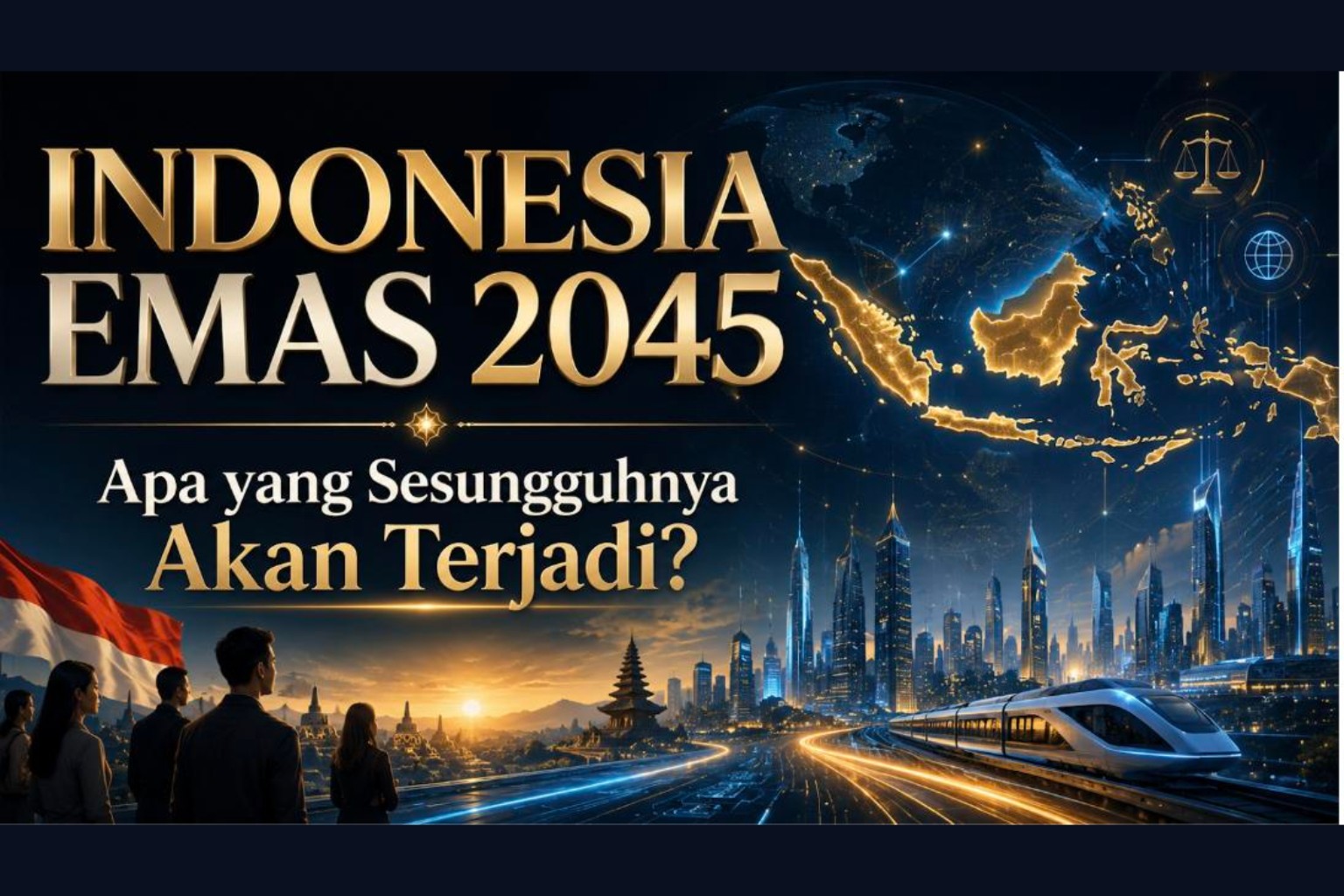
AI, geopolitics, climate, and identity will determine Indonesia’s fate in 2045.
Every nation needs a dream. And Indonesia’s dream is the year 2045 — exactly one century of independence, with the promise of becoming a developed, prosperous, and sovereign nation amid a world order changing faster than we ever imagined.
But there is one question that is rarely answered with genuine honesty: what will really happen in 2045?
Not the official version written in the 2025–2045 National Long-Term Development Plan. Not the optimistic figures from Bappenas. But the real conditions our grandchildren will face — children who today are still learning to walk, who will live out their adult lives in the midst of a storm of technological, geopolitical, and climate change unlike anything any generation in human history has experienced.
I write this as someone from Generation X — a generation that still remembers how historic the 1998 reformation was, that witnessed the rise of the internet and the smartphone, and that now watches artificial intelligence reshape the world.
Indonesia 2045 in the Official Narrative — Where Are the Gaps?
The official vision is dazzling. By 2045, Indonesia is projected to be among the world’s five largest economies. Extreme poverty is expected to be a memory. The Human Development Index is projected to rise dramatically.
All of this sounds beautiful. And indeed, there are foundations that can be defended as arguments. Indonesia will have around 309 million people in 2045, the majority of productive age. The demographic dividend now reaching its peak offers an opportunity that will never come again. Ever-expanding digital infrastructure opens access to every corner of the archipelago.
But as a researcher who has studied civilizational change for more than two decades — including firsthand experience in Japan, Malaysia, England, and the Middle East — I see a vast gap between the official narrative and the reality taking shape on the horizon.
The Golden Indonesia vision is designed on the assumption of linear growth in a stable world. Meanwhile the real world moves exponentially, disruptively, and ever more unpredictably. This is not a flaw of intent — it is a flaw of imagination.
Three Waves That Will Shake Indonesia Before 2045
The First Wave: The Disruption of Artificial Intelligence
Various international institutions estimate that 60–70% of job types in developing countries have significant automation potential over the next two decades. Indonesia, with an economic structure still heavily reliant on the informal sector and labor-intensive manufacturing, faces a real risk that has not yet been seriously addressed in our national planning documents.
The Second Wave: The Global Geopolitical Shift
The world of 2045 is not a unipolar world under a single hegemony. We are moving toward a multipolar order — in which China, India, and other emerging powers form a global architecture entirely different from anything that has existed since the end of the Cold War.
Indonesia, as the country with the world’s largest Muslim population, a G20 member, and sitting at a strategic maritime crossroads, will stand at an increasingly sharp intersection of interests. Every strategic choice made today — in technology, defense, education systems, and economic partnerships — will determine whether Indonesia becomes a player or merely an object of others’ contestation.
The Third Wave: Climate Crisis and Planetary Limits
Climate is no longer the domain of NGOs and green activists. It is a determining variable in economic calculation, social stability, and even national security. Indonesia needs to take this seriously in its 2045 roadmap — not as a footnote, but as one of the main pillars.
What Does This Mean for the Indonesian People in 2045?
Allow me to speak not of macroeconomic figures, but of real life.
Imagine a child born today — whether in Banda Aceh, Makassar, Kupang, or Merauke. In 2045, they will be around 20 years old. They will enter the world of work, build a family, and live out their adulthood in a world utterly transformed from the one we know.
It is very likely they will not apply for a job to a human manager, but to an AI system that will evaluate their competence in a matter of seconds and compare them with millions of other applicants from around the world. It is very likely they will consult an AI diagnostic system that holds more medical knowledge than any doctor could accumulate in a lifetime. What is measurable will become abundant; what cannot be measured yet matters far more will become the true battleground.
The Two Most Likely Scenarios
Based on the cross-disciplinary study I have conducted over many years, I see two most likely scenarios for Indonesia in 2045.
Scenario One: Indonesia as a Player, Not a Spectator
Indonesia succeeds in harnessing its demographic dividend through massive, structured investment in technology-based education — not merely introducing tablets into schools, but fundamentally transforming how people think, work, and innovate. A generation of young Indonesians emerges who are not merely consumers of AI, but who help develop AI-based solutions for unique local contexts: regional languages, local wisdom, the specific needs of an island society.
A moderate and inclusive Islamic identity, along with a living spirit of diversity, becomes the soft power that gives Indonesia a unique and irreplaceable position on the global stage. In this scenario, Golden Indonesia 2045 is not a slogan but a lived reality.
Scenario Two: Trapped as a Technology Consumer
Indonesia fails to move fast enough. The demographic dividend turns into a demographic burden. Its young generation becomes a market for foreign technology rather than its creator. A user, not a creator. In this scenario, Golden Indonesia 2045 becomes merely a political slogan that ends as a sad footnote in the history of nations that missed their historic moment.
Which scenario will come to pass? My honest answer: nothing is destined. Everything depends on the choices we make now — in classrooms, in policy rooms, in family rooms, and in rooms of conversation like the one we are having here.
Closing: A Civilizational Wager
Golden Indonesia 2045 is possible. But it will not arrive on its own because history happens to be kind. It requires the courage to look at the future with open eyes — not with blind optimism that refuses to see risk, nor with paralyzing pessimism that keeps us silent.
It requires leaders and a society who understand that the true contest is not only on the economic field, but on the field of knowledge, the field of technology, and the field of identity.
If I could send one short message to the future, it would be: “INDONESIA 2045: WHAT WILL HAPPEN?”
To my grandchildren who may one day read this, in 2045 or after: we tried. With all our limitations, failures, and hopes — we truly tried.
💬 A Question for Discussion: In your view, what is the single most urgent thing Indonesia must do now to ensure the 2045 vision is not merely a beautiful dream? Share your thoughts in the comments — I read them all.
About the Author: Kamaruzzaman Bustamam Ahmad (KBA) is an academic, researcher, and writer from Banda Aceh, Indonesia. He has researched social change, geopolitics, and civilization across various countries including Indonesia, Malaysia, Japan, and England. The Project2045 blog is his space for reflection on human life in 2045 and beyond. His other works are available at www.kba13.com.
About The Author

Artikel Terkait
 Human Mornings in 2045: AI, the Digital Body, and the Struggle to Remain Human
 Fenomena Muslim Jawa Kontemporer: Dakwah, Kewalian, dan Karisma di Era Media Sosial
 Aceh, Nation-State, dan Komparasi Global: Bali, Yogyakarta, Brunei, Singapura, dan Israel dalam Dialektika Demokrasi dan Agama
 Demokrasi Aceh: Antara Tradisi Lokal, Agama, dan Tantangan Negara-Bangsa
 Islam, Violence, and Acehnese Identity: A Socio-Historical Reading of Conflict, Faith, and the Idea of Musoh
Leave a Reply