
INTRODUCTION
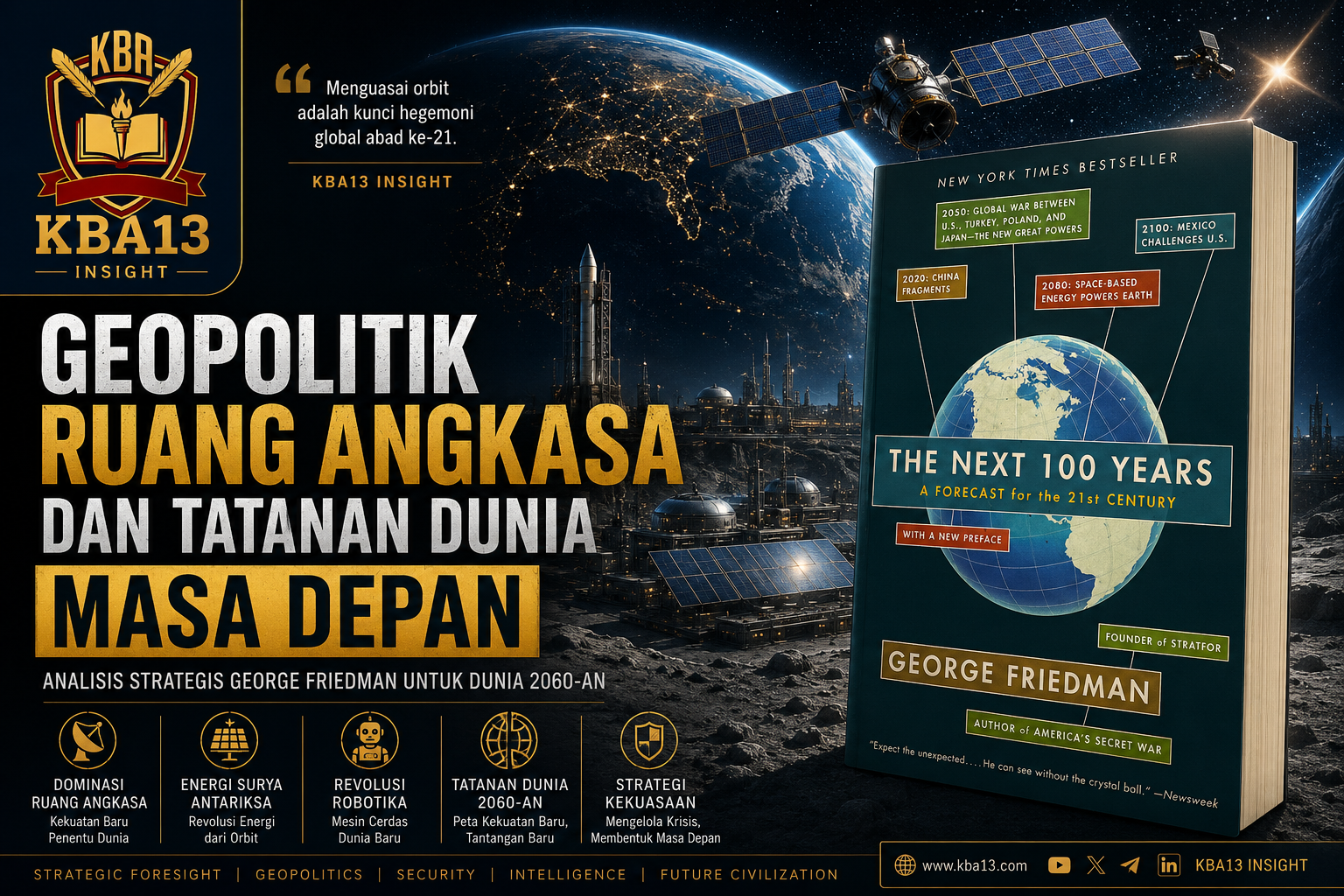
This essay is based on George Friedman’s work in his book The Next 100 Years: A Forecast for the 21st Century. Friedman opens one of his studies in Chapter 12 with a claim that leaves no room for bargaining: the outcome of the mid-century war will affirm, incontrovertibly, America’s position as the most dominant international power in the world, and North America’s position as the center of gravity of the international system. He is not speculating. He is establishing the starting point from which his entire analysis of the 2060s is built. Before speaking of energy, economics, or technology, Friedman erects this axiom of victory as an unshakable foundation. From there he moves.
That victory, according to Friedman, produces a strategic achievement that goes far beyond ordinary military triumph: America succeeds in consolidating command of space, and from that command of space, control over the international sea lanes. These two things are not mentioned together by accident. For Friedman, control of the sea and control of space are expressions of one and the same logic in two different eras — whoever masters the domain in which the projection of global power is most effectively carried out determines the rules for everyone else. Nineteenth-century Britain ruled the seas. Twenty-first-century America rules the orbit. The consequence in both cases is identical: all other nations are forced to play within a system whose basic rules are written by the hegemon.
Yet victory in war does not automatically convert itself into a stable order. Friedman understands this, which is why he immediately turns to the most important instrument of the 2060s: the treaty. That peace treaty, according to Friedman, formally grants America the exclusive right to militarize space. Other powers may use space for non-military purposes, but only under American supervision. This is no ordinary diplomatic provision. It is the legal encoding of a hierarchy that already exists in fact — a formal acknowledgment that space is not a global commons but a domain managed by a single power on behalf of the entire international system.
Friedman does not stop there. He notes that the treaty also limits the number and type of hypersonic aircraft that Turkey and Japan may possess — and then, with an almost startling honesty, he adds that this clause is essentially unenforceable. He calls it the “gratuitous humiliation victors enjoy imposing on the vanquished” — a pointless humiliation the winners indulge in to satisfy the appetite of victory, not for any real strategic purpose. This is a rare moment in which Friedman shows the most honest side of his analysis: that the instruments of post-war international law are often no more than theater of power dressing reality in the language of legitimacy. The treaty is not a system — it is a performance of a system. And that performance remains useful only as long as the power enforcing it is still strong enough to make it appear credible.
POLAND: THE PARADOX OF THE BETRAYED VICTOR
Friedman builds one of the most nuanced arguments in this chapter when he discusses Poland’s position after the war. Poland, according to Friedman, is a great victor — but the most wounded, the most bitter, and the most astonished by what happens after that victory. Its territory is immediately invaded by Germany and Turkey. Its casualties number in the tens of thousands — the result of house-to-house fighting in which armored infantry is safer than civilians. Its infrastructure is destroyed. Its economy is shattered.
Yet Poland also reaps the most dramatic territorial gains: controlling Belarus directly, building a confederal system of governance over its former allies, taking the port of Rijeka on the Adriatic, maintaining bases in Western Greece to prevent Turkish aggression at the gateway to the Adriatic. In a single breath, Poland reclaims the empire it once held in the 17th century — and adds to it. This is no opportunistic expansion. In Friedman’s logic, this is geopolitical logic working with its own consistency: the nation that takes the greatest risk and pays the greatest cost will claim the largest share of the order born of that victory.
But then Friedman shows how the logic of hegemony works differently from the logic of reward. America, which won the war alongside Poland, becomes the party most uncomfortable with Poland after the war. Not because America betrays it in a moral sense — but because Poland, having restored its 17th-century empire and added to it, is a Poland too strong to be managed within the European order America wants. A nation too strong in one region is always a potential threat to the global hegemon, regardless of whether it was once an ally. This is what Friedman calls the principle America has already learned: that managing a situation so that a battle need not be fought, or is fought by others, is a far better solution than plunging directly into the battlefield.
So America does something that, through Polish eyes, feels like betrayal, but through Washington’s eyes is a supremely rational policy: it encourages Britain to form a new alliance resembling the NATO of the 20th century, its principal task being to rehabilitate Western Europe and block Poland’s expansion westward — into Germany, Austria, and Italy. America does not join that alliance but rather encourages it. At the same time, America begins to repair its relationship with Turkey.
Friedman explains the logic behind the American-Turkish rapprochement by quoting an old English adage he considers the most honest description of how nations operate: there are no permanent friends, no permanent enemies, only permanent interests. Turkey has been defeated. A defeated Turkey is a Turkey weaker than the newly victorious Poland. In the calculus of the balance of power, supporting the weaker against the stronger is the most logical move to preserve a dominant position — because no one can challenge you if there is no other power large enough to do so. Turkey, understanding the long-term implications of a consolidating Poland’s strength, gladly accepts a closer relationship with Washington as a guarantee of its survival.
The most painful thing for Poland, according to Friedman, is that America places Poland on the list of nations forbidden to use space for military purposes — without making any exception at all. A nation that has just fought alongside America, that has paid the highest price in blood, is shut out of the strategic domain most decisive for the century to come. Friedman does not use the word betrayal, but the structure of his argument lets the reader draw that conclusion for themselves: that in a hegemonic order, an ally’s loyalty is relevant only as long as that ally remains useful and has not become too strong.
THE SHIFT OF POWER TO EASTERN EUROPE AND THE RISE OF BRITAIN AS BALANCER
From the Poland scenario, Friedman leaps to an argument about the structural shift in the map of European power that he considers one of the most important consequences of that war. The defeat of France and Germany by Poland will decisively move the center of gravity of European power eastward. This is not a cultural or demographic shift — it is a shift of real power, reflected in the control of territory, military capacity, and the ability to project influence. The eclipse of Atlantic Europe that began in 1945 — when America and the Soviet Union divided Europe into two zones of influence, both of which diminished the autonomous power of Western Europe — will reach its logical conclusion in the 2050s: not in a peaceful reunification, but in the military victory of one part of Europe over another.
Friedman assigns a special role to Britain in this scenario, and that role surprises no one who understands the geopolitics of island nations. Britain, according to Friedman, will throw its weight decisively into the war on the side of America and Poland. But after the war, America encourages Britain to take the lead in constraining Poland — not through military confrontation, but through the formation of a European alliance whose task is to keep Poland from moving too far west. This is a role well suited to Britain’s tradition in its foreign policy across the centuries: the balance of power — ensuring that no single continental power becomes dominant enough to threaten Britain’s own position or the interests of the outside power it backs.
This situation, according to Friedman, also produces an analytically interesting dynamic: that a Western Europe demographically and economically in what he calls a state of “shambles” — a deep disarray — will become a space waiting to be filled. Poland wants to fill it toward the west. America does not want that. Britain is willing to lead a coalition that prevents it. And the result is a new European balance of power that, in its structure, is not so different from the old NATO — a bloc whose task is to rehabilitate Western Europe while blocking the expansion of an overly ambitious eastern power.
THE POST-WAR ECONOMY: WHY WAR WILL NOT HALT AMERICAN GROWTH
One of Friedman’s most counterintuitive claims in this chapter — and the one most in need of careful analysis, because it rests on a specific historical premise — is that the American economic expansion beginning in the 2040s will not be disrupted by the mid-century war. On the contrary: that war will accelerate and speed up the expansion.
His argument rests on two distinct but mutually reinforcing mechanisms. First, America fights that war using technology — and a technology-based war against other nations always increases government spending on research and development. What in a peacetime economy would take years to develop and test will be completed in a matter of months because the urgency of war forces that acceleration. Friedman explicitly cites the destruction of America’s space forces by an enemy strike as the most powerful psychological trigger: the fear of an unexpected attack — exactly like Pearl Harbor in 1941 — will drive defense spending far beyond what would be possible in peacetime conditions.
Second, and this is the more fundamental argument, America has historically always profited from the great wars it has won. Friedman states this not as a moral claim but as an empirical observation: America is in the fifty-year cycle of its power, about twenty years after it began, which means the war occurs at a point when America is internally at its strongest. Its population problem — the labor crisis from the aging of the baby boomers that we have already analyzed in the essay on the 2030 crisis — is not as severe as in other nations, because immigration and the deaths of the boomer generation have begun to balance out that pressure. The balance between the availability of capital and the demand for products is still maintained, and both are growing.
The result, according to Friedman, is that the mid- to late 2050s — the period immediately following the war — will become a jackpot period, much like the 1950s after the Second World War. And he identifies one mechanistic similarity between the two eras: in both cases, a war occurring at the start or middle of the fifty-year cycle accelerates that cycle into overdrive, because the economy must adjust to the direct impact of the war before then exploding in growth. Fifteen years after the war, according to Friedman, will become a golden age of economics and technology for America.
THE SPACE OBSESSION: FROM PEARL HARBOR TO ORBIT
Friedman then builds an argument he regards as one of the most important psychological lessons America will carry out of that war. When Japan attacked Pearl Harbor in 1941, that attack created a national conviction — especially among the military — that a devastating strike could come at any time and from the most unexpected direction. For fifty years that conviction shaped America’s entire nuclear strategy: a fear that never truly subsided of a sudden attack that could destroy before there was time to respond.
The attack on America’s space forces in the 2050s — which Friedman describes as a psychologically and strategically shattering moment — will create exactly the same effect, but in a different domain. No longer a fear of attack from the air or the sea, but a fear of attack from orbit. That fear, according to Friedman, will become a national obsession driving military and civilian expenditure into space on a scale never seen before. America will build a massive space infrastructure: from satellites in low Earth orbit to crewed space stations in geosynchronous orbit, to installations on the Moon and satellites orbiting the Moon.
Friedman gives this argument precision by explaining that most of that system will be maintained robotically or even consist entirely of robots. The advances in robotics over the preceding half-century — which developed separately across various industrial and military domains — will find their point of convergence in space. There, the need for systems that can operate without a continuous human presence, in an environment hostile to human biology, will drive the maturation of robotic technology that has long been developing but has never truly been integrated.
The purpose of all this activity, according to Friedman, is threefold. First: to ensure sufficient resilience in America’s space system so that no power can ever again disrupt that capability — which means layered redundancy, defense in depth, and the ability to absorb an initial blow without losing critical function. Second: to be positioned to block any effort by another nation to gain a foothold in space contrary to America’s wishes. Third: to possess massive resources in space — including space-based weapons, from missiles to high-energy weapons — to control events on the surface of the Earth. America understands that not all threats, such as terrorism or the formation of coalitions, can be controlled from space. But it will ensure that no other nation can mount an effective operation against it.
THE ENERGY REVOLUTION: WHEN MILITARY SPENDING FINANCES CIVILIZATION
This is the part of Friedman’s argument that most rarely receives the analysis it deserves, and that is geopolitically the most transformative: that America’s obsession with space will intersect with the problem of energy, and from that intersection will be born a revolution that changes the foundations of the world order more fundamentally than any military victory.
During the war, according to Friedman, America will invest a great deal of money to solve the problem of delivering power to the battlefield from space. That solution is economically inefficient, technologically still primitive, and environmentally wasteful — but it works. It succeeds in delivering electricity to Allied forces in Poland facing the Turkish-German invasion. From that operational success, the military begins to see space-based power generation not as a fantasy but as a proven solution — one that only needs to be scaled up and made cheaper for civilian use.
Friedman identifies two historical analogs he considers highly instructive. The first is the American interstate highway system built by Eisenhower starting in 1956. Eisenhower, while still a junior officer, once led a convoy across the entire United States, and it took months. In the Second World War, he witnessed how Germany moved an entire army from the Eastern Front to the West using its Autobahn in an extraordinarily short time to launch the Battle of the Bulge. The military rationale for building an interstate highway system was very strong. But its civilian impact — unplanned and unpredicted — transformed the entire economic geography of America: McDonald’s, suburban malls, the distribution of industry to the outskirts, the massive decentralization that redefined the way Americans live, work, and shop.
The second is the internet. When DARPA — the Defense Advanced Research Projects Agency — funded the creation of ARPANET, its purpose was very specific and militaristic: to build a computer network that could send data and files between research centers in different locations, faster than a courier or the postal service could — because at that time there was no FedEx. No one designed ARPANET to become a platform for global commerce or a social network connecting billions of people. It was designed to solve a very specific problem of information logistics in a military context. But its basic architecture — developed and managed by the Department of Defense and its contractors well into the 1990s — was then inherited by the civilian world and produced everything we call the digital economy.
Friedman uses these two analogies to build the following argument: just as the initially military interstate highways gave birth to unforeseen suburbanization, and the initially military ARPANET gave birth to the unforeseen internet — America’s military investment in space in the 2050s and 2060s will give birth to an “energy highway” whose basic cost has already been borne by the military, so that when it is opened for civilian use, the energy produced will be dramatically cheaper than any competing energy source. And cheap energy on that scale will make energy-intensive activities that were previously not economically viable become viable — exactly like the highways that lowered land prices in the suburbs and thereby drove suburbanization, and like the internet that lowered the cost of information transactions and thereby drove Amazon and iTunes.
The concrete technology Friedman describes is Space Solar Power — space-based solar electricity generation. NASA has in fact been researching this concept since the 1970s. Large quantities of photovoltaic cells are designed to be placed in geostationary orbit or on the lunar surface. That electricity is converted into microwaves, beamed to Earth, converted back into electricity, and distributed through the existing grid. The number of cells needed can be reduced by focusing sunlight using mirrors. The receivers must be installed in isolated areas on Earth because the concentrated microwave radiation would be very intense at the landing site — but the risk is far smaller than a nuclear reactor or the environmental impact of hydrocarbons.
Friedman makes one very sharp point about the comparative advantage of space as a location for energy generation: space has unlimited room. What on Earth would feel like an unacceptable intrusion — for example, covering an area the size of New Mexico with solar panels — is absorbed in space by its infinitude. In addition, there are no clouds, and sunlight is available continuously without interruption. The collectors can be positioned to receive uninterrupted solar light.
THE MILITARY PROGRAM THAT DRIVES DOWN COMMERCIAL COSTS: THE MECHANISM FRIEDMAN EXPLAINS
Friedman provides a very detailed mechanistic explanation of how the military space program will concretely lower the cost of commercializing space solar energy — and this is the part of his argument most often skipped over by impatient readers.
The military space program, according to Friedman, will drive down the cost of the commercial project by piggybacking on top of it. Advances in commercial launch into space will reduce the cost of lifting payloads, but they will never have the capacity to handle a project as large as the development of space-based solar power generation. The military program of the 2050s and 2060s will solve this problem in two ways. First, one of the most important parts of that program is reducing the cost per kilogram of payload sent to orbit. America will put a great deal of material into space and will need to lower launch prices dramatically — partly through new technology, partly through large volume — and launch costs will begin to fall dramatically, even below the commercial vehicles developed earlier.
Second, there will be surplus capacity built into that system. One of the lessons of the war is that not having reserve space-force capacity left America overwhelmed by the initial attack. That will not be allowed to happen again. The private sector’s utilization of this project’s surplus capacity will be essential to reducing costs. When military surplus capacity is opened to the private sector, commercial costs fall drastically — and from there the same dynamic as the interstate highways and the internet begins to work: unforeseen entrepreneurs will find new ways to exploit that infrastructure.
FROM SAUDI ARABIA TO OUTER SPACE: THE PARADIGM SHIFT IN THE GEOPOLITICS OF ENERGY
Friedman crowns his energy argument with a claim that is the most paradigmatic and the most consequential for the world order as a whole. America, he says, will become the largest energy producer in the world — with its energy fields protected from attack. Japan, China, and most other nations will become energy importers. Because the economics of energy shift — as other energy sources, including hydrocarbons, become less economically attractive — other nations will not have the military capability to build their own space-based systems. First, they do not have a military that has already paid the basic cost of such a system. Second, no nation has the appetite to challenge America at that moment. An attack on American facilities would become unthinkable given the now-vast imbalance of power. America’s ability to supply far cheaper solar energy will create additional leverage for the superpower to increase its international dominance.
Then Friedman utters the most definitive sentence of the entire chapter — the one that must be read with all its consequences: “We will see here a fundamental paradigm shift in geopolitical realities.” Since the dawn of the Industrial Revolution, industry has required energy, and that energy has been distributed unevenly across the world. The Arabian Peninsula, which otherwise held no interest, became enormously important because of its oil fields. With the transition to a space-based system, industry will produce energy instead of merely consuming it. The journey to space will become a result of industrialization, and an industrialized nation will produce energy at the same time as it powers its industry. Space will become more important than Saudi Arabia ever was, and America controls it.
That sentence must truly be sat with for a moment as one reads it. That the entire geopolitical architecture built upon the strategic value of Persian Gulf oil — which has driven wars, formed alliances, defined American foreign policy for seven decades, and served as the basis for the strategic position of nations such as Saudi Arabia, Iran, and Iraq — will become irrelevant. Not because of a political revolution or a diplomatic agreement, but because of a technological change that moves the base of energy production from the geography of Earth to orbit.
ROBOTS AND THE NEW CULTURAL WAVE THAT CANNOT BE REFUSED
Friedman closes this chapter with two arguments he combines into a single narrative about how America redefines not only the order of power but also the way human beings live and work globally. The first is robots. In a world that no longer has adequate population growth — and this is a consequence of the demographic crisis he has already analyzed at length in earlier chapters — robots become the engine of productivity. With a space-based energy system supplying cheap electricity in large quantities, the operating cost of robots falls significantly. Robots that were previously not economically competitive against cheap human labor suddenly become competitive — and no longer only in high-wage countries, but globally.
Friedman calls the robot “the computer’s logical and dramatic conclusion.” The computer changed the way humans process information. The robot takes that change and extends it into the physical environment — into factories, into households, into transport systems, into the entire material infrastructure of modern life. This is not a prediction about humanoid robots replacing particular jobs. It is an argument about a structural change in the way production is organized: that in a world that can no longer rely on population growth as a source of new labor, cheap-energy-based robots will become the engine of economic growth for the next generation.
The second is what Friedman calls a new American cultural wave that will sweep across the world. He defines culture not as art alone, but in a broader sense: the way human beings live their lives. The computer is the most effective introduction of American culture to the entire world — far more profound than film or television — because it does not merely bring entertainment but also changes the way people work, communicate, and organize knowledge. The robot is a direct continuation of that: it brings in ways of living within which certain values about efficiency, productivity, and the relationship between humans and machines are embedded.
Friedman specifically notes that robots will be widely adopted, especially in the advanced industrial world facing a population peak or even population decline — and will become a catalyst for nations approaching the first tier and facing similar pressures. This is Friedman’s way of saying, without saying, that robots are not solely an American phenomenon: they are a technological response to a demographic crisis that is global in nature, one that America happens to be in the most advantageous position to lead because its cheap energy from space is already available first.
STABILITY AND THE SEEDS OF INSTABILITY: WHAT FRIEDMAN DOES NOT SAY BUT POINTS TOWARD
Friedman closes this chapter with an admission he rarely makes explicitly: that in geopolitics there is no permanent solution. In the 2060s — as in the 1920s and the 1990s — it will appear as if America faces no serious challenge, or at least none that threatens it directly. America will learn that security is an illusion, but for a while it will enjoy that illusion.
The two powers that, according to Friedman, have already begun thinking about space by the late 2060s are Poland and Mexico. Poland is still busy consolidating its empire and is still bitter over its post-war treatment — not yet ready for a challenge. Mexico is a different and more interesting case: it emerges as one of the top economic powers in the world, begins to see itself as a rival to America, and begins to set foot on the continental and global stage — but has not yet formulated a coherent national strategy and is still afraid to challenge American power too far.
There are also other nations that will emerge as major economic powers as their populations stabilize and the pressures of population growth ease: Brazil is one of them, a generation behind Mexico in terms of population stability but moving quickly in that direction, and considering a regional economic alliance with Argentina, Chile, and Uruguay. Israel, India, Korea, and Iran will have limited space programs — but none will have the resources or the motivation to claim a substantial presence in space, let alone attempt to defy American space hegemony.
The result, according to Friedman, is that America will have an open, uncontested opportunity — and will take it. America will live in a golden moment, one that lasts at least until around 2070.
WHAT FRIEDMAN DOES NOT ASK: THE QUESTION THE NON-WESTERN READER MUST RAISE
The entire edifice of Friedman’s argument in this chapter is internally consistent, analytically coherent, and rooted in verifiable historical patterns. But internal consistency is not the same as completeness. There is one question Friedman never asks — and the absence of that question is not an oversight but a reflection of the epistemological position from which this text is produced.
The question is this: if space solar energy becomes the world’s dominant energy source in the 2060s, and if America is the only nation that controls that infrastructure, then what happens to the entire global economic order built upon a relatively distributed exchange of energy? The nations that today hold geopolitical value because of their oil or gas reserves — including most of the Muslim-populated countries of the Gulf — will lose their sole basis of international leverage. And they lose it not because they made a policy mistake, but because of a technological change driven by American military decisions over the preceding twenty years.
That is how geopolitics works in reality: not through conspiracy, but through the accumulation of decisions each of which appears rational in its own context, but which collectively produce a new order that benefits those at the center of the change and marginalizes those at the periphery. To read Friedman seriously means to understand that mechanism — and then to ask the question he does not ask: from what position do we stand in the map he is drawing, and what can we still do today to ensure that position is not the least advantageous one when that order arrives.
About The Author

Rekomendasi Bacaan KBA13 INSIGHT
Jika tulisan ini bermanfaat, dukung jurnal ini dengan mencari bukunya melalui tautan berikut:
- Buku-buku Kamaruzzaman Bustamam Ahmad di Periplus
- Koleksi Islamic Studies di Periplus
- Koleksi Geopolitics & Politik Internasional di Periplus
- Cari buku & perangkat baca di Shopee
- Cari di Blibli
Daftar lengkap: Rekomendasi Buku, Alat Tulis & Layanan. Tautan di atas adalah tautan afiliasi — KBA13 INSIGHT dapat memperoleh komisi kecil tanpa biaya tambahan bagi Anda.
Artikel Terkait
 Siklus Kekuasaan Amerika dan Krisis 2030: Membaca George Friedman dalam Perspektif Intelijen Strategis
 China vs Amerika Serikat: Rivalitas Geopolitik dan Arah Tatanan Dunia Baru 2025
 Geografi Iran dan Ilusi Penaklukan: Mengapa Amerika dan Israel Sulit Menang Perang
 Dari Tim Kaine ke Donald Trump: Krisis Grand Strategy Amerika dan Konflik Iran–Israel
 Singapura di Selat Melaka: Konsentrasi Fungsi, Asimetri Kekuasaan, dan Risiko Eskalasi Kawasan
Leave a Reply