KBA13 Insight · KBA13 Insight Update National · Strategic Analysis
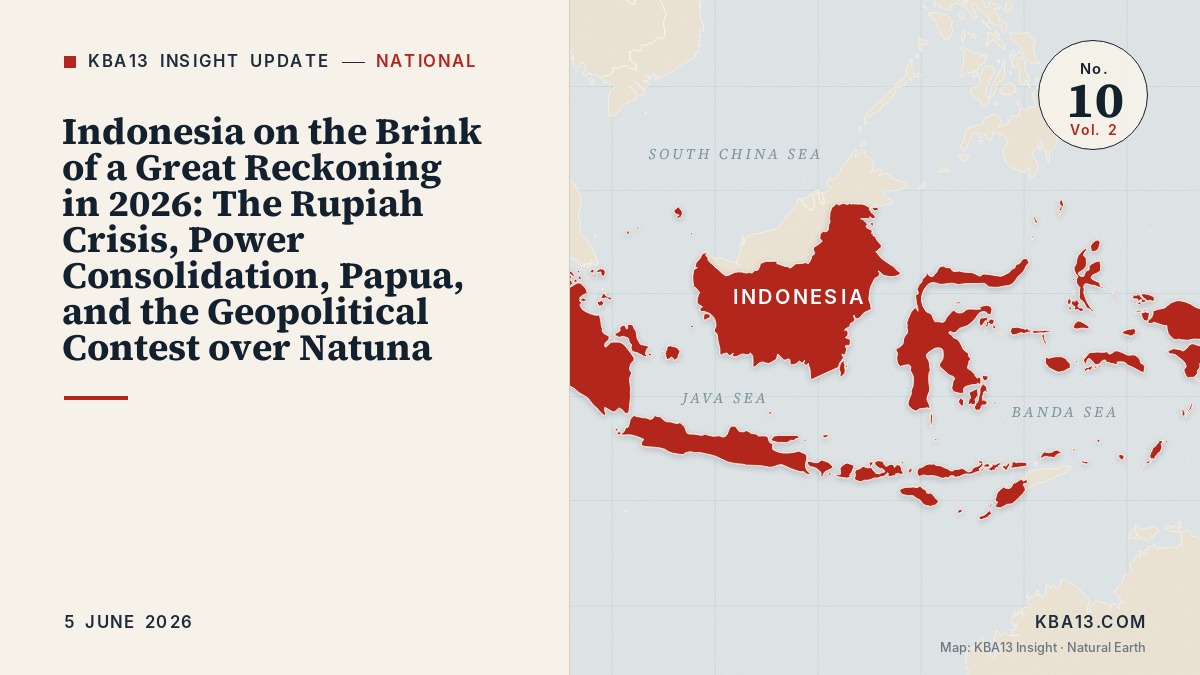
Indonesia on the Brink of a Great Reckoning in 2026:The Rupiah Crisis, Power Consolidation, Papua, and the Geopolitical Contest over Natuna
Indonesia enters its most decisive phase in 2026. The rupiah’s slide toward Rp18,000 to the US dollar, mounting fiscal pressure, a governance scandal at the heart of a flagship program, an unresolved conflict in Papua, a restructuring of the security apparatus, and rising geopolitical rivalry in the North Natuna Sea all show that Indonesia is not facing a single crisis. KBA13 National Update…
Summary
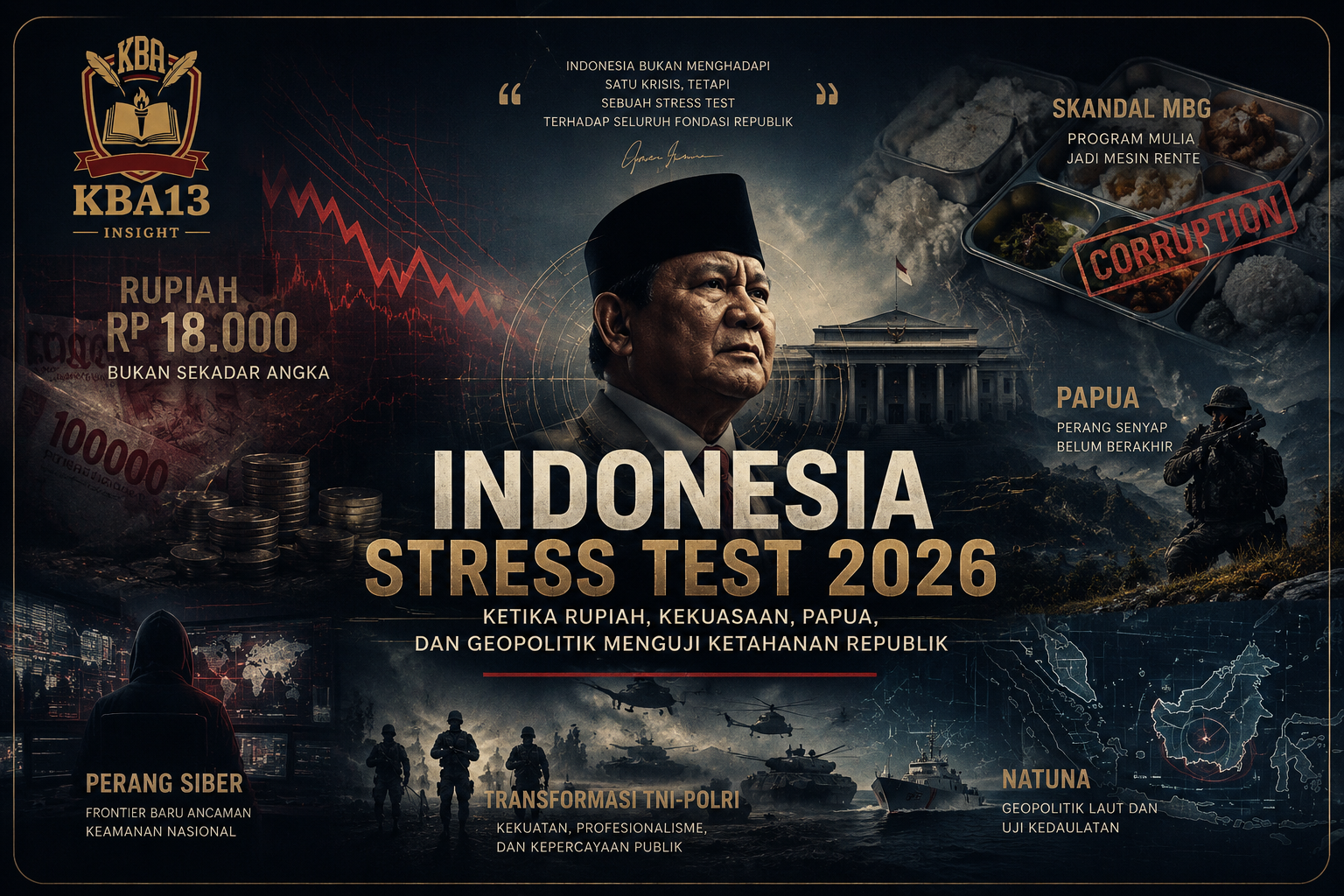
Indonesia enters its most decisive phase in 2026. The rupiah’s slide toward Rp18,000 to the US dollar, mounting fiscal pressure, a governance scandal at the heart of a flagship program, an unresolved conflict in Papua, a restructuring of the security apparatus, and rising geopolitical rivalry in the North Natuna Sea all show that Indonesia is not facing a single crisis. KBA13 National Update reads this moment as a stress test of the state’s capacity, a test of the economy, of political leadership, of the security institutions, and of Indonesia’s ability to hold its strategic position amid a shifting world. Drawing on a strategic-intelligence and geopolitical lens, this report analyzes how the Prabowo administration confronts the great dilemma between speed of command, the need for institutional reform, and the demands of modern governance. The biggest question is not whether Indonesia can survive, but whether Indonesia can turn pressure into national transformation.
Keywords
- Analisis Geopolitik
- BIN Indonesia
- BSSN
- China Indonesia Relations
- cyber security Indonesia
- Indonesia 2026
- Indonesia Incorporated
- intelijen strategis
- KBA13 National Update
- ketahanan nasional
Indonesia entered the first week of June 2026 amid a run of simultaneous, mutually reinforcing pressures: the rupiah breaking through Rp18,000, corruption at the heart of the president’s priority program, a silent war in the mountains of Papua, tectonic shifts within the Palace’s circle of power, and unrelenting geopolitical friction in the North Natuna Sea. This Thursday edition of the KBA13 National Update presents ten field-grade assessments spanning every dimension of national resilience, from the battle lines of Central Papua to the courtrooms of the Attorney General’s Office, from a trembling stock exchange floor to the corridors of power at the Merdeka Palace. As this author has argued before, in the essay ‘Indonesia Strategic Outlook 2026’ (May 2026), Indonesia is not facing a single crisis but a synchronized stress test bearing down on every foundation of the Republic.
THE COLLAPSE OF THE RUPIAH
| ECONOMY & MONETARY SECURITY |
On the morning of 4 June 2026, the rupiah exchange rate broke through the psychological threshold of Rp18,000 to the US dollar, a figure that, in this nation’s collective memory, has always marked the boundary between anxiety and panic. That number did not appear out of a vacuum. It is the accumulation of a series of pressures this author already warned of in the essay ‘The Rupiah at the Precipice’ (May 2026): a swelling fiscal deficit, aggressive capital outflow, and a collapse of institutional investors’ confidence in the governance of policy. The latest data from Trading Economics show that over the past two years the rupiah has lost nearly 15 percent of its value, from Rp15,400 at the end of 2023 to Rp17,500 by mid-May 2026, then racing to Rp17,966 on 3 June, and now nearing Rp18,000. Each of these jumps leaves a mark on the cost of living: imported goods grow more expensive, manufacturing production costs surge, and energy prices threaten to climb. The most vulnerable are precisely the lower-income groups whose purchasing power has already been eroded by inflation. Bank Indonesia, under Governor Perry Warjiyo, responded by raising interest rates by 50 basis points in May 2026, its most aggressive move in years. Yet a rate hike is a bitter medicine that heals one wound while opening another: the cost of credit spikes, businesses rein in investment, and economic growth risks stalling. The central bank is caught in the classic dilemma between defending the exchange rate and preserving growth momentum. May 2026 inflation came in at 3.08 percent year-on-year, still within Bank Indonesia’s target band, but its upward trend bears watching. The Consumer Price Index (CPI) rose from 111.09 in April to 111.40 in May. More worrying still, Indonesia’s Manufacturing PMI only returned to the neutral level of 50.0 in May after contracting to 49.1 in April, a sign that the industrial sector remains fragile amid raw-material cost pressures and global supply-chain disruptions. Behind these macroeconomic figures lies a deeper structural problem: Indonesia’s tax-to-GDP ratio, chronically stuck below 11 percent. No currency can hold up sustainably when the state’s fiscal foundation is this weak. The Free Nutritious Meals (MBG) program alone consumes trillions of rupiah, and, as was exposed this week, even a sum that large is not immune to leakage through corruption. This is a painful irony. The rupiah’s instability also reflects foreign investors’ unease about the trajectory of Indonesian policy in general. Antara News reported that the April 2026 trade surplus narrowed to its lowest level in six years, as imports slightly outpaced exports. That signals that Indonesia’s ability to earn foreign exchange from exports is under strain, precisely as its need to import energy and industrial raw materials rises amid Middle East geopolitical tensions. Global geopolitical sentiment plays no less important a role. The unresolved Iran–US tensions, the conflict in the Middle East that keeps pushing up world oil prices, and the fragmentation of global trade wrought by the Trump-era tariff wars, all of these are gale-force winds battering the hull of Indonesia’s economic ship. Even a skilled navigator would struggle against a storm coming from every direction at once. The government’s response so far remains reactive and defensive: tightening foreign-exchange retention rules for exporters, issuing high-yield global bonds, and rolling out partial fiscal stimulus. What has yet to appear is a coherent economic grand strategy, a single policy narrative that convinces markets Indonesia has a long-term plan that amounts to more than merely surviving from one wave to the next. This author notes that Indonesia’s economic growth of 5.6 percent in the first quarter of 2026, the highest in four years, paradoxically failed to attract inflows of foreign investment. Foreign investors in fact recorded net sales of roughly USD 2.8 billion in the domestic stock market over the course of the year. This is not merely a matter of growth figures; it is a matter of confidence. And confidence, once shattered, takes far longer to rebuild than it takes to tear down.
MBG CORRUPTION: WHEN A NOBLE PROGRAM BECOMES A RENT-SEEKING MACHINE
| GOVERNANCE & LAW ENFORCEMENT |
The National Nutrition Agency (BGN) scandal that erupted on 2–3 June 2026 is an event that is at once embarrassing and revealing, embarrassing because the corruption occurred at the heart of the Prabowo administration’s most ambitious social program, and revealing because it lays bare just how systematic the predation of state funds has become, even within a newly formed institution. In under 24 hours, President Prabowo Subianto dismissed BGN Chief Dadan Hindayana and his two deputies, Sony Sonjaya and Lodewyk Pusung, before all three were promptly named suspects by the Attorney General’s Office. The modus operandi that came to light was highly systematic: the appointment of Nutrition Fulfillment Service Unit (SPPG) partner foundations that did not meet requirements but were affiliated with the suspects. These foundations received billions of rupiah in incentives every day from running the ‘MBG Kitchens.’ Jampidsus Director of Investigations Syarief Sulaeman Nahdi said state losses could potentially reach trillions of rupiah. Procurement markups became the primary instrument for plundering public funds. From an intelligence and state-governance perspective, several points deserve close scrutiny. First, how long had the warning signals been present before action was taken? Presidential Chief of Staff Dudung Abdurachman confirmed that President Prabowo had ‘long been hearing information, observing, analyzing, and evaluating various sources’ before he acted. That means the malfeasance was not something newly discovered, there was a lag between the information and the action that ought to be accounted for. Second, Dadan Hindayana’s dismissal came at a dramatic moment: just as he had returned from performing the hajj. This precedent, dismissed and immediately made a suspect, sends a very strong signal to the bureaucracy: no post is safe enough to cover up wrongdoing. Prabowo, who in this author’s essays on the dynamics of power has been described as a leader who ‘relies on personal loyalty,’ now displays another dimension: a willingness to sacrifice a trusted figure for the sake of an anti-corruption image. Third, the public reaction to the dismissal was largely positive, seven flower wreaths were sent to the BGN office as a token of appreciation. This is an expression of long-suppressed anger at corruption that preys on social programs. Yet public applause must not obscure the more important question: how could BGN’s internal oversight system fail so completely that corruption on a trillion-rupiah scale could unfold without earlier detection? The MBG program itself is Prabowo’s flagship, treated as a mirror of his leadership. Its ambition is vast: to provide free nutritious meals to students from preschool through high school, to pregnant and nursing mothers, and to toddlers, with the aim of reducing stunting and improving the quality of human capital. The program’s budget is massive, reaching Rp335 trillion, nearly 9 percent of the state budget. A budget of that scale is a magnet for rent-seeking predators within Indonesia’s bureaucratic ecosystem. The BGN scandal also raises questions about the governance model for large-scale social programs in Indonesia. When the state distributes money through a network of unstandardized foundations and intermediary bodies, the door to misappropriation swings wide open. The success of a social program is determined not by the size of its budget but by the thickness of the layers of oversight and accountability that surround it. Indonesia continues to struggle at exactly this point. On the legal side, the naming of Dadan Hindayana and others as suspects rests on Articles 603 and 604 in conjunction with Article 20 of Law No. 1 of 2023 (the Criminal Code), along with the Anti-Corruption Law, carrying the threat of decades in prison plus fines and restitution. The Attorney General’s Office also immediately searched the BGN office. The speed and firmness of this law enforcement deserve appreciation, though the public still waits to see whether the legal net will reach the actors behind the scenes more broadly. Most relevant to the narrative of Prabowo’s power: this scandal strengthens the position of Dudung Abdurachman as the new Presidential Chief of Staff. Dudung, sworn in on 27 April 2026, has stepped straight into the role of engine for overseeing the president’s priority programs. This is a signal that a militaristic approach to civilian program governance is now a hallmark of the Red-and-White Cabinet: rapid execution, zero tolerance for corruption, with a direct reporting line to the president.
PRABOWO’S ARCHITECTURE OF POWER: RESHUFFLE, LOYALTY, AND THE LOGIC OF CONTROL
| POLITICS & ELITE DYNAMICS |
The 27 April 2026 cabinet reshuffle was no mere change of faces. It is a manifestation of the logic of control characteristic of Prabowo Subianto, placing figures rooted in military culture into strategic civilian positions that guarantee a direct line of coordination to the president. The appointment of General (Ret.) Dudung Abdurachman as Presidential Chief of Staff, replacing the technocrat-politician Muhammad Qodari, is the sharpest signal of this shift. Prabowo and Dudung’s relationship is rooted in shared field experience dating back to the East Timor era. When Prabowo chose Dudung, not an academic, not a politician, not a technocrat, to shepherd his priority programs, he was sending a message about the operating mode of his administration: personal trust trumps institutional competence. This is a pattern this author has already analyzed in the context of the ‘bloated cabinet’, in which loyalty becomes the primary calculus in filling posts. The April 2026 reshuffle also unveiled another new face: Jumhur Hidayat as Minister of Environment, a figure known as a labor activist and a critic of Jokowi’s labor policies. Placing Jumhur in this position is intriguing to analyze: is it a political reward to the activist network that has long supported Prabowo, or a signal that environmental policy will accommodate the interests of industry and labor more than before? From the standpoint of coalition dynamics, Prabowo continues to navigate a complex labyrinth of interests. The Red-and-White Coalition, which places nearly all major parties inside the government, creates political stability in parliament but also produces a cabinet ‘bloat’ that allows competing interests to hide behind a facade of solidarity. The analysis by Airlangga University observers that this author cited earlier, concerning ‘institutional problems, conflicts of interest, and structural challenges’, remains relevant ten months after the cabinet was installed. One intriguing phenomenon worth observing is the move of Muhammad Qodari from the Presidential Staff Office to the position of Head of the Government Communications Agency. Qodari is a figure close to a data- and survey-driven political communications narrative. His placement at the government communications body shows that Prabowo treats the war of narratives as a dimension of power no less important than the war of policy. On the other hand, Dudung’s entry into the Palace brings a change of tone in program coordination. As a former Army Chief of Staff famous for his firm style and direct command, Dudung brings military culture into the machinery of civilian coordination. This was evident in the BGN case: the speed of response from detecting the malfeasance to the dismissal and naming of suspects displayed a command-chain efficiency that usually exists only in military operations, not in civilian bureaucracy. Yet the unanswered question is how sustainable this militarization of governance is over the long term. Military command efficiency works well in crisis situations, but modern statecraft requires consultation, deliberation, and checks and balances, which run counter to the top-down logic of the military. There is a risk that this model will narrow the space for internal criticism and differences of view within the cabinet. In the domestic geopolitical context, Prabowo’s position after the April reshuffle appears more solid than before. With Dudung guarding program execution inside the Palace, Agus Subiyanto atop the armed forces, and Listyo Sigit Prabowo at the National Police, the President enjoys a strong structural alignment between the civilian-Palace circle and the state security apparatus. This is a condition that theoretically enables rapid, integrated decision-making. Yet this structural strength also carries potential vulnerability: when the entire chain of command is centered on a single figure, every policy failure, such as the BGN scandal, directly affects the president’s personal credibility. Prabowo cannot delegate failure to a minister or an agency without indirectly calling into question the quality of his own judgment in appointing people. This is the paradox of centralized power.
MILITARY ROTATION: READING THE TNI’S BALANCE OF POWER UNDER COMMANDER AGUS SUBIYANTO
| DEFENSE & MILITARY REFORM |
The rotations and reassignments within the Indonesian Armed Forces (TNI) throughout March–April 2026, executed by Commander General Agus Subiyanto, cannot be read as mere routine ‘career development.’ Behind the hundreds of reshuffled posts, including 414 senior officers in the August 2025 wave and further rotations in March–April 2026, lies a logic of force arrangement that reflects the Commander’s strategic orientation and the President’s will. One striking pattern is the placement of Kopassus officers in intelligence and operational command posts. The new TNI spokesman, Brigadier General Aulia Dwi Nasrullah, who comes from that corps, has become a more aggressive public face for the military. This is no accident, the choice of Kopassus officers for positions that intersect directly with public narrative reflects a preference for professionals trained to think operationally rather than bureaucratically. In the Army, General Maruli Simanjuntak as Chief of Staff handed over duties to three regional military commanders and the head of the Army Health Center on 8 April 2026. In remarks this author studied, Maruli stressed ‘a deep mastery of the problem as the essential precondition for finding effective solutions’, a diction that departs from the usual ceremonial rhetoric. Maruli also touched on the Army’s role in disaster response and development, signaling that its unitary-state doctrine is now expanding into non-combat functions. In Central Papua, the rotation of command in the Habema Task Force and the Damai Cartenz 2026 Task Force has direct implications for the escalation or de-escalation of armed conflict. The 21 April 2026 incident in Kemburu, Puncak, reported to have killed 12 civilians in a firefight between the Habema Task Force and the OPM, pushed the House of Representatives to demand the formation of an independent investigation team. Rotating unit commanders in conflict zones is not only about career development but about operational accountability. Another trend worth watching is the ‘stockpiling’ of senior officers in Army Chief of Staff Special Staff positions, a practice that, in this author’s earlier analysis, functions as a kind of ‘temporary parking’ for generals awaiting definitive placement or undergoing evaluation. In February 2026, 13 Army generals were shifted to Special Staff posts, following 38 in the August 2025 wave. This phenomenon reflects the tension between the need for regeneration and resistance to the culture of seniority within the TNI. From a civil-military standpoint, what is interesting to observe is the rising number of active officers involved in the government’s civilian programs. The Army has been involved in handling the West Sumatra floods, in food-security programs, and in escorting the MBG program in the regions. This is an expansion of the military’s function into the civilian sphere that risks contradicting the spirit of post-1998 TNI reform, which emphasized pure professionalism. In the Navy, the dynamics in the North Natuna Sea have driven increased patrols and combat readiness for the fleet. The deployment of KRI John Lie-358, KRI Sutedi Senoputra-378, and additional patrol vessels is a response to the activity of Chinese ships in Indonesia’s Exclusive Economic Zone. Rotating the commanders of the naval task groups in this area is not merely administrative, it is a message of deterrence with a tactical character. The relationship between Commander Agus Subiyanto and President Prabowo runs within a corridor of close mutual understanding, both are four-star generals with Kopassus backgrounds and closely aligned strategic outlooks. This closeness delivers efficiency in defense coordination, but it also risks creating an ‘echo chamber’ in which critical input from the military ranks toward government policy becomes harder to convey. On the whole, the military rotations of March–April 2026 show a TNI consolidating itself under leadership aligned with Prabowo’s vision: a military strong in operational terms, engaged in national development, yet still holding centralized command as its foremost principle. The open question is whether this consolidation will produce a more professional and accountable institution, or instead a military that is more centralized and less transparent.
THE PAPUA CONFLICT: ANATOMY OF A WAR THAT NEVER ENDS
| INTERNAL SECURITY & ARMED CONFLICT |
Papua is an open wound on the body of the Republic that keeps bleeding despite the many formulas tried to treat it. The incident in Kemburu, Puncak, Central Papua on 21 April 2026, when the Habema Task Force conducted an operation against the OPM and was reported to have killed 12 civilians, once again places a fundamental question before the public: can the military-dominant approach applied all this time bring peace, or does it instead prolong the cycle of violence? From reports by Detikcom and various national media, the picture of the 2026 Papua conflict reveals several consistent patterns: the OPM/TPNPB launches attacks against civilians, gold panners, and security personnel in Yahukimo, Dogiyai, Intan Jaya, and Puncak. The Cartenz 2026 Task Force responds with counterinsurgency operations that have killed several OPM commanders, including Jeki Murib and Lau Gwijangge in Nduga, and captured OPM officials such as the deputy battalion commander of HSSBI, Kodap XVI Yahukimo. The change in the TNI’s official terminology from ‘KKB’ (armed criminal group) to ‘OPM’ last year was not merely a semantic shift. It is a change of operational framing that allows the TNI to take a larger share in handling the conflict, because the OPM as an ‘armed separatist organization’ falls within the military’s core mandate, whereas the KKB as ‘armed criminals’ falls more within the police’s domain. ALDP Director Latifah Hanum Siregar has already warned of the implication: an intensifying militarization of the response to Papua. This author notes that the Papua conflict has three layers that are often conflated in analysis: a security layer (armed attacks by pro-independence groups), a political layer (aspirations for self-determination that remain inadequately answered), and a development layer (economic inequality and the structural marginalization of indigenous Papuans). All three layers must be addressed simultaneously; prioritizing one while neglecting the others yields only a partial, unsustainable solution. Operation Damai Cartenz 2026 is the umbrella security framework that combines TNI and police forces in Papua. The Habema Task Force is the TNI component operating in Papua’s central highlands. Throughout 2026, both succeeded in neutralizing a number of OPM leaders and seizing weapons and ammunition at various sites. Yet every OPM commander shot dead is replaced by a new one, a sign that the movement’s ideological and organizational dimensions remain strong. The Kemburu incident of April 2026, which killed civilians, with conflicting versions of events between the TNI and sources in Papua, pushed the House, through Commission I and member TB Hasanuddin, to demand an independent inquiry. This is a positive signal from the mechanisms of civilian oversight, though its implementation in a conflict zone like Papua always faces obstacles of access and information verification. What often escapes coverage is the conflict’s impact on public services in Papua. Schools close, medical workers abandon remote areas, infrastructure projects stall, and investors avoid the conflict zone. This creates a paradoxical ‘poverty trap’ cycle: the conflict prevents the very development that would reduce the grievances that fuel the conflict. This cycle can only be broken through meaningful negotiations involving genuine representatives of the Papuan people. The geopolitics of Papua also has an international dimension that cannot be ignored. Pacific nations, including Vanuatu, Tuvalu, and the Solomon Islands, consistently raise the Papua issue in international forums, including the UN General Assembly and the Pacific Islands Forum. Meanwhile, the Melanesian Spearhead Group remains an advocacy platform for Papuan pro-independence groups. Jakarta must treat this Pacific-diplomacy dimension as an integral part of its Papua strategy, not merely as an external ‘nuisance.’ A sustainable solution for Papua requires political courage that goes beyond the internal pressure to preserve the status quo. This author has stated repeatedly: there is no permanent military victory over a conflict rooted in historical injustice and structural inequality. The road to peace in Papua runs through sincere dialogue, recognition of the basic rights of indigenous Papuans, and a development commitment that does not reduce Papua to a mere object of natural-resource exploitation.
NATUNA AND THE SOUTH CHINA SEA: THE GEOPOLITICS OF WATERS ON THE EDGE OF AMBIGUITY
| GEOPOLITICS & MARITIME DEFENSE |
The North Natuna Sea has once again become a geopolitical hotspot that demands a fresh strategic assessment. China has never recognized Indonesia’s claim to the exclusive economic zone north of the Natuna Islands, it insists that those waters fall within its historical ‘nine-dash line’ claim, a claim with no basis in UNCLOS yet maintained with full consistency through the presence of coast guard vessels, fishing boats, and occasionally military fleets. Throughout 2026, the Indonesian Navy has deployed additional warships to Natuna waters in response to rising activity by foreign vessels, particularly from China. The deployment of KRI John Lie-358, KRI Sutedi Senoputra-378, and additional patrol vessels reflects Jakarta’s resolve to maintain a physical presence in the territory it claims. This is the language of deterrence understood at every strategic level. In the essay ‘Southeast Asia Strategic Outlook 2026’ (June 2026), published by KBA13, this author mapped how tensions in the South China Sea cannot be separated from the broader US–China rivalry. Indonesia, as a non-claimant state whose EEZ overlaps with China’s claim, is in a unique position: not formally in dispute, yet in reality facing repeated violations. Indonesia’s ‘free and active’ posture is precisely what this geopolitical ambiguity puts to the test. What is striking about the Natuna dynamics of 2026 is how China plays its ‘grey zone’ strategy with high precision: refraining from open military provocation that would justify a collective defense response, yet consistently building facts on the ground through the presence of ships crossing Indonesia’s EEZ. This pattern, which this author calls maritime ‘slow salami tactics’, is designed to shift perceptions of the norm, not to trigger confrontation. Indonesia wins the international legal battle: UNCLOS provides an incontestable foundation for Indonesia’s EEZ claim over Natuna. But international law is only effective when there is the capacity and the will to enforce it. Herein lies the real challenge: Indonesia’s defense budget, still below 1 percent of GDP, limits its ability to build a military presence massive enough to consistently deter the activity of Chinese vessels. Prabowo’s move to join BRICS (announced by Cabinet Secretary Teddy Indra Wijaya as a diplomatic achievement) while maintaining a strategic partnership with the US through the MDCP (Major Defense Cooperation Partnership) creates an intriguing geopolitical acrobatics, but also a risky one. Beijing reads these moves closely. There is a risk that Beijing will respond by intensifying activity in Natuna as a reminder of the ‘cost’ of Jakarta’s closeness to Washington. From a national-security perspective, Bakamla (the Maritime Security Agency), Indonesia’s coast guard, still lacks vessels and equipment compared with the China Coast Guard operating in the region. This is a real asymmetry of capability. Long-term investment in maritime domain awareness (MDA) capabilities, including coastal radar systems, maritime drones, and reconnaissance satellites, has become an urgent strategic need. ASEAN’s stance on the South China Sea remains a complication of its own. Internal divisions between member states with close economic ties to China (such as Cambodia and Laos) and those with direct claims (the Philippines, Vietnam) prevent ASEAN from speaking with a single voice. Indonesia, as ASEAN’s economic powerhouse, ought to lead the consolidation of the region’s position, yet China’s investment interests in Indonesia (through Danantara and various infrastructure projects) create an implicit conflict of interest. This author’s strategic conclusion: Natuna is an existential test of Indonesia’s ‘free and active’ doctrine. A half-hearted posture, drawing closer to the US through the MDCP while still courting Chinese investment through BRICS and various bilateral schemes, will continue to be exploited by Beijing as a sign of ambivalence that permits grey-zone activity in Indonesia’s EEZ. Jakarta needs to take a firmer position, not confrontational, but consistent and predictable.
INTELLIGENCE AND DIGITAL SURVEILLANCE: STATE SECURITY IN THE CYBER ERA
| INTELLIGENCE & CYBERSECURITY |
Indonesia’s security threats in 2026 can no longer be mapped through conventional geographic coordinates alone. The cyber dimension has become a new battlefield that is just as, and sometimes more, dangerous than physical threats. The Coordinating Ministry for Economic Affairs recently held the ‘Indonesia Digital Leap’ National Forum, one focus of which was accelerating cybersecurity as a component of national economic resilience. The forum marked the soft launch of the DTI Series 2026 and the Cyber Resilience & Defense Conference 2026 (CRD-CX), to be held this coming August. BSSN (the National Cyber and Crypto Agency) holds a key role in the architecture of Indonesia’s cyber defense. Yet the biggest challenge lies not in the institutional aspect but in the ecosystem. Indonesia has more than 200 million active internet users, a rapidly growing digital infrastructure, but uneven security, as well as a private sector that still views cybersecurity investment as an expense rather than an investment. This combination creates an enormous attack surface. From an intelligence perspective, social-media movements in Indonesia have become an increasingly sophisticated field for influence operations. Anti-government narratives, hoaxes about strategic policies, and disinformation surrounding the Papua conflict or Natuna security are spread through a fragmented, hard-to-verify digital ecosystem. Indonesia’s ability to detect, analyze, and respond to such influence operations remains far from adequate. Cases of the government blocking and monitoring digital platforms continue to raise tension between national security and civil liberties. The still-controversial ITE Law regime becomes an instrument that can be used to silence criticism, not only to protect digital security. The grey area between legitimate surveillance in the name of national security and repressive surveillance in the name of political interests is one of the most pressing challenges for Indonesia’s digital democracy. The threat of terrorism and digital radicalism keeps evolving. Although there has been no major attack in 2026 so far, networks affiliated with extremist ideologies remain active in online recruitment, propaganda dissemination, and digital fundraising through cryptocurrency. Densus 88 and the BNPT continue to make preventive arrests, but a criminal-law approach alone is not enough, a more comprehensive, evidence-based deradicalization program is needed. In the maritime-security context, maritime surveillance intelligence has become a strategic asset of rising value amid the Natuna tensions. Indonesia’s ability to monitor the movement of foreign vessels in its EEZ in real time remains limited, heavily dependent on the physical patrols of Bakamla and Navy vessels rather than on a comprehensive electronic surveillance system. Collaboration with the US through the MDCP includes a maritime-intelligence sharing component that could potentially close this gap. A phenomenon worth noting is the rise of civil-society digital activism and data-based investigative journalism capable of exposing malfeasance before official agencies act. The BGN scandal largely circulated on social media and digital platforms long before the Attorney General’s Office announced suspects. This shows that Indonesia’s digital ecosystem also functions as an informal but effective anti-corruption early-warning system. Going forward, Indonesia needs to treat cybersecurity not as a technical niche but as a core component of national security. That means a larger BSSN budget, stricter data-security regulation for the private and public sectors, the formation of a national cyber reserve, and, most important, a culture of digital security at every level of the state apparatus. Digital vulnerability is national-security vulnerability: in this era, there is no partition separating the two.
POLICE DYNAMICS: ROTATION, REFORM, AND THE SHADOW OF POLITICIZATION
| DOMESTIC SECURITY & POLICE REFORM |
National Police Chief General Listyo Sigit Prabowo leads an institution that continues to grapple with a profound paradox: the police are law enforcers that are also the object of demands for legal reform. After the major wave of rotations affecting 108 officers in early 2026, which this author analyzed in the May National Update edition, the unresolved question is: do these rotations reflect a logic of professional career development, or are they a mechanism for distributing political power within the police? In the broader political context, the position of the police chief under Prabowo’s regime carries a significance of its own. Listyo Sigit, appointed in the Jokowi era and retaining his post in the Prabowo era, creates a subtle dynamic of dual loyalty: formally answerable to President Prabowo, yet possessing a structural network formed in the previous era. This is a transitional condition that produces institutional tension often invisible on the surface. One of the most controversial issues in police reform is the question of civil-police relations, particularly in handling demonstrations and freedom of expression. In 2026 the police face a dual pressure: from above, to maintain the security stability that supports the investment climate, and from below (civil society), to respect citizens’ democratic rights. Balancing these two pressures becomes the true measure of police professionalism. In conflict areas such as Papua, the police’s position grows more complex. The Damai Cartenz 2026 Task Force places the police in joint operations alongside the TNI, a format that has historically always raised questions about accountability and the chain of command. When incidents occur, such as in Kemburu in April 2026, it is not always publicly clear which unit is responsible and what accountability mechanism applies. The police are also increasingly active in the cyber dimension. The Criminal Investigation Agency and the Cyber Directorate actively handle digital-crime cases, from online fraud to content deemed to threaten state security. Yet the boundary between legitimate cyber law enforcement and the silencing of digital expression critical of the government continues to be an unresolved debate. Several controversial applications of the ITE Law in 2025–2026 still cast a chilling-effect shadow over freedom of expression. Police reform, championed since the 1998 Reformasi era, continues to face the same cultural obstacles: an internal culture of impunity, a recruitment and promotion system vulnerable to corruption, collusion, and nepotism, and a service orientation still more strongly geared toward power than toward the people’s interests. Structural change without cultural change is mere decoration, not transformation. This is a conclusion this author has delivered repeatedly in essays on security-sector reform in Indonesia. What is intriguing to observe as mid-2026 approaches are the signals surrounding a change of police chief. Listyo Sigit Prabowo, appointed in 2021, has already exceeded the ideal four-year tenure, though no formal time limit binds him. Speculation about his successor is already circulating among observers: the names that emerge generally come from younger cohorts closer to Prabowo’s network. A change of police chief, if it happens, would be one of the most significant moments in shaping the domestic-security architecture of the Prabowo era. From a domestic-intelligence perspective, the police, through their Security Intelligence branch, hold a strategic role in mapping the potential for social conflict across the country. Agrarian tensions in various regions, from plantation land disputes in Sumatra to mining conflicts in Kalimantan, require accurate early warning so they do not escalate into open conflict. Security Intelligence’s ability to respond to these dynamics is one of the police’s most underrated yet most vital functions. This author’s conclusion: the police in 2026 are an institution at a crossroads. They can choose the path toward genuine professionalism, with transparent accountability, non-discriminatory law enforcement, and public service truly centered on citizens. Or they can remain trapped in the old pattern: enforcers strong against the weak, yet soft toward the powerful. Which path is taken will be determined largely by the police chief’s leadership and by the President’s genuine commitment to police reform.
REGIONAL CONFLICTS: FROM MALUKU TO KALIMANTAN, EMBERS BENEATH THE ASH
| REGIONAL SECURITY & HORIZONTAL CONFLICT |
Beyond Papua, which always draws the primary spotlight, Indonesia harbors the potential for other regional conflicts that often escape the attention of national policy analysts. Small escalations that are poorly managed can turn into major crises when socioeconomic conditions worsen and state oversight weakens. This is what this author calls ‘embers beneath the ash’, unseen, yet ready to burn. In Maluku and North Maluku, the legacy of horizontal communal conflict from the 1999–2002 era still leaves a residue of intercommunal distrust that has not fully healed. Although there has been no outbreak of open conflict in recent years, various potential triggers, land disputes over nickel and energy projects, tensions between newcomers and local communities, and the politicization of identity ahead of regional head elections, remain present as latent risks. In Kalimantan, particularly in areas bordering directly on the Nusantara Capital (IKN) project and the expansion of palm-oil plantations, agrarian conflict remains an unresolved issue. Thousands of hectares of Dayak customary land and local-community land overlap with corporate concessions and government projects. The existing conflict-resolution mechanisms often fail to reach the root of the matter: the recognition of customary (ulayat) rights that lack a firm legal basis in Indonesia’s formal legal system. Central Sulawesi, particularly Poso, remains an area requiring extra vigilance in the context of radicalism and terrorism. Although the MIT (East Indonesia Mujahideen) network has weakened significantly after various enforcement operations, small networks affiliated with a similar ideology still operate in the interior. Unaddressed socioeconomic dimensions, unemployment, inequality, marginalization, continue to serve as an incubator for recruitment. In West Sumatra and Aceh, the dimension of conflict that bears watching is more ideological-political in nature. The revival of local-identity narratives that intersect with the implementation of Islamic sharia and demands for broader autonomy is an issue that could potentially spark friction with the central government. This author, based in Banda Aceh, has firsthand observation that Aceh’s local political dynamics in 2026 are colored by a contest of interests among former GAM factions, traditional ulama, and a new generation with differing orientations. A factor often overlooked in the analysis of regional conflict is the role of social media as a trigger of tension. A small incident that historically would have had only local impact can now go viral within hours, drawing comments from people who have no grasp of the context and sparking responses that inflame the situation. The police and regional governments must have protocols for managing digital narratives in situations of social tension. Natural-resource conflict is the most widespread vector of conflict across all of Indonesia. From coal mining in Kalimantan, nickel in Sulawesi and Maluku, and gold in Papua, to palm-oil plantations in Sumatra, every large-scale extractive project carries with it the potential for conflict with local communities that often do not receive a proportionate share of the wealth extracted from their land. This is the legacy of a resource-based development model that has been inadequate in managing the dimension of distributive justice. Uneven decentralization between strong and weak regional governments also contributes to the differentiation of conflict-management capacity. Regions with adequate fiscal resources and competent local leadership are able to manage conflict preventively through dialogue and mediation. Fiscally and institutionally weak regions tend to rely on a reactive security approach. This capacity gap is a structural challenge of Indonesia’s decentralization. This author recommends that the central government, through the Coordinating Ministry for Political, Legal, and Security Affairs and the National Counterterrorism Agency (BNPT), build an integrated national conflict-mapping system that is updated periodically, not merely to respond to crises when they erupt, but to identify and address conflict triggers before they reach a critical point. Conflict prevention is far cheaper than the cost of post-conflict recovery, in economic, social, and political terms.
INDONESIA AT A HISTORICAL CROSSROADS
| COMPREHENSIVE STRATEGIC ASSESSMENT |
Indonesia on 4 June 2026 is a nation standing at a genuine historical crossroads, not in a rhetorical sense, but in a technical geopolitical one. Every major policy choice made over the next 12–18 months will determine the trajectory of the coming decade: whether Indonesia will consolidate itself as a stable and credible middle power, or will slide into a recurring cycle of crises that erodes the state’s capacity from within. Of the ten headings this author has presented in this National Update edition, the common thread linking them all is one: the tension between the centralization of power that characterizes the Prabowo administration and the demands of modern governance, which require the distribution of power, transparency, and accountability. The BGN scandal is a symptom of a system that relies too heavily on personal loyalty rather than on strong systems and procedures. The rupiah crisis is a symptom of fiscal policy that lacks a clear strategic anchor. In the essay ‘Southeast Asia Strategic Outlook 2026,’ which this author published on KBA13 early this June, I underscored how Prabowo’s economic doctrine, which I call ‘Indonesia Incorporated’, has authentic ambition, but requires a far stronger institutional foundation than currently exists in order to succeed. Placing retired generals in strategic civilian posts can deliver rapid execution in the short term, but can create a deficit of techno-bureaucratic capacity in the medium term. Indonesia’s geopolitics in 2026 is marked by diplomatic acrobatics that demand high precision. BRICS gives Indonesia access to an economic ecosystem not dependent on the dominance of the US dollar, a real benefit amid the rupiah’s volatility. The MDCP gives Indonesia access to defense technology and intelligence sharing with the US, an invaluable strategic asset. Yet maintaining both relationships at once, amid an increasingly zero-sum US–China rivalry, requires a high order of diplomatic artistry that cannot afford a misstep. Papua remains the most honest mirror of the idea of Indonesia as a just nation. There is no real progress in Papuan peace so long as structural violence, in the form of development inequality, restrictions on freedom of expression, and the absence of a mechanism for sincere dialogue, continues to operate in parallel with military operations. This author has written about this for years: Papua is not a security problem that can be solved by security means alone. The massive military and police rotations of 2025–2026 reflect Prabowo’s effort to build a security structure that can truly execute his vision. This is the President’s prerogative as Supreme Commander. But the question that must not be ignored is: are these institutions, after all the rotations and reassignments, becoming more professional, more accountable, and more devoted to serving the people? Or merely more loyal to a single figure? Indonesia’s current economic-security condition reminds this author of a concept discussed in the essay on ‘Satan’s Strategy’ (Freedman) published by KBA13: there are times when the greatest strength of a system is its ability to endure conditions that are objectively disadvantageous, rather than its ability to win convincingly. Indonesia in 2026 shows extraordinary resilience amid layered pressures, the rupiah weakens yet the economy grows 5.6 percent, the Papua conflict persists yet the unitary state stands firm, corruption gnaws away yet the law-enforcement mechanism still works. But resilience is not progress. Enduring in chronic, suboptimal conditions is not something to be celebrated, it is a sign of a system that has yet to find a way to transform itself. What Indonesia needs is not merely resilience, but the capacity for transformation, the ability to turn pressure into momentum, crisis into reform, and structural weakness into new strength. This KBA13 National Update edition of Thursday, 4 June 2026, closes with a premise this author continues to hold: Indonesia is a country of potential that has never been fully realized, not for lack of resources or people, but for lack of a system that can consistently and fairly turn potential into performance. Prabowo has a historic opportunity to become the president who begins the transformation of that system. But historic opportunity does not wait. It arrives, and if it is not seized with sufficient courage and intelligence, it passes, and the nation bears the cost of the opportunity missed.
Related analysis:
2026 political crisis scenarios
.
How to Cite
Ahmad, Kamaruzzaman Bustamam. (2026). Indonesia on the Brink of a Great Reckoning in 2026: The Rupiah Crisis, Power Consolidation, Papua, and the Geopolitical Contest over Natuna. Banda Aceh: KBA13 Insight.
https://www.kba13.com/indonesia-stress-test-2026-rupiah-prabowo-papua-natuna/
Professor of Anthropology of Religion at UIN Ar-Raniry Banda Aceh. He writes on geopolitics, Southeast Asian security and governance, Islam in the Malay world, and the future of knowledge.
About The Author

- Series · Seri
- KBA13 Insight Update, National Edition
- Volume · Number
- Vol. 2, No. 10 (June 2026)
- Cumulative issue · Edisi ke-
- 22
- Reference · Nomor rujukan
KBA13-IU-2026-02-010- Author · Penulis
- Kamaruzzaman Bustamam Ahmad
- Published · Terbit
- 5 June 2026 · updated 20 October 2026
- Section · Rubrik
- KBA13 Insight Update National, Premium, Strategic Analysis
- Keywords · Kata kunci
- Analisis Geopolitik, BIN Indonesia, BSSN, China Indonesia Relations, cyber security Indonesia, Indonesia 2026, Indonesia Incorporated, intelijen strategis, KBA13 National Update, ketahanan nasional
- Language · Bahasa
- English
- Length · Panjang
- 7,194 words · ±33 min read
- Publisher · Penerbit
- KBA13 Insight, Banda Aceh, Indonesia
- Permalink
- www.kba13.com/indonesia-stress-test-2026-rupiah-prabowo-papua-natuna/
- How to cite · Cara mengutip
- Kamaruzzaman Bustamam Ahmad. (2026, June 5). Indonesia on the Brink of a Great Reckoning in 2026: The Rupiah Crisis, Power Consolidation, Papua, and the Geopolitical Contest over Natuna. KBA13 Insight Update, 2(10). https://www.kba13.com/indonesia-stress-test-2026-rupiah-prabowo-papua-natuna/
- Rights · Hak cipta
- © 2026 KBA13 Insight. Quotation permitted with full attribution and link.
Artikel Terkait
 Indonesia at the Crossroads 2026: Rupiah Crisis, Prabowo’s Power Architecture, Papua Conflict, and the Future of the Republic
 Indonesia Strategic Outlook 2026: Rupiah Crisis, Danantara Risk, TNI Expansion, Papua Conflict, and Natuna Tensions
 Indonesia Strategic Intelligence Report (7–12 July 2026): Political Crisis, Papua Conflict, BrahMos Deal, Economy, and National Security
 KBA13 Insight National Update: Krisis Rupiah, Politik Prabowo, Papua, dan Geopolitik Indonesia 2026
 The Architect and the Figurant: Intelligence, National Interest, and the Grammar of Strategic Power
Leave a Reply