
KBA13 Insight · AI & Technology · Digital Society & AI
The Age of Compute Power:How AI, Semiconductor Geopolitics, and Chip Wars Are Reshaping Global Power
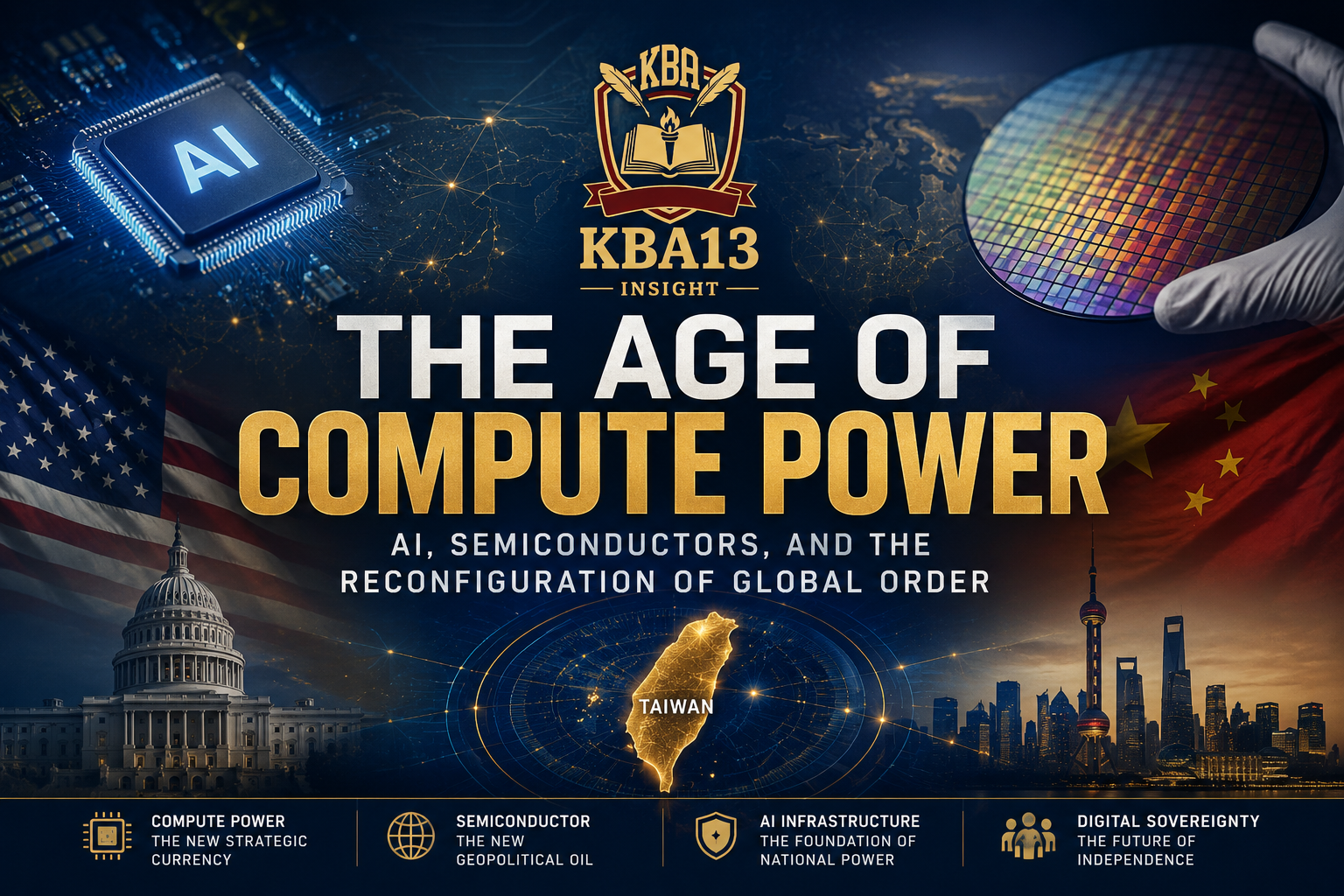
The twenty-first century is entering a new geopolitical era defined not only by military power, energy resources, or economic size, but by the capacity to compute intelligence at scale. Artificial intelligence has transformed from a technological product into the foundational infrastructure of global civilization. This essay introduces the concept of the Compute-Power Doctrine: the idea that…
Summary
The twenty-first century is entering a new geopolitical era defined not only by military power, energy resources, or economic size, but by the capacity to compute intelligence at scale. Artificial intelligence has transformed from a technological product into the foundational infrastructure of global civilization. This essay introduces the concept of the Compute-Power Doctrine: the idea that control over AI infrastructure, semiconductor production, data centers, and advanced chips now determines national power. From Taiwan’s semiconductor dominance and the US-China technology rivalry to the strategic vulnerabilities of the Global South, the AI revolution is creating a new hierarchy of nations. For Indonesia and ASEAN, the central question is no longer whether they will adopt AI, but whether they will become architects of the AI age or remain dependent consumers within a new digital world-system. A strategic analysis by KBA13 Insight on technology, geopolitics, and the future of civilization.
Keywords
- AI Geopolitics
- AI governance
- AI Infrastructure
- Artificial Intelligence
- ASEAN Digital Economy
- Chip War
- Compute Power
- Data Centers
- Digital Sovereignty
- Fourth Industrial Revolution
I. The Question That Changes Everything
Every age carries a foundational question—the answer to which determines who leads, who follows, and who disappears from the stage of history. In the age of coal and steam, it was: who controls the means of industrial production? In the age of oil and nuclear deterrence, it was: who controls energy and the capacity for strategic annihilation? Today, as we move through the opening decades of the twenty-first century, the foundational question has changed once more — and its answer is restructuring the entire architecture of global power.
The question now is: who controls the capacity to compute intelligence at scale?
This is not a technical question. It is a political, civilizational, and deeply moral one. In earlier work published on this platform — particularly in my essay “From WEIRD Society to FACE RIP Society: AI, Human Agency, and the Crisis of Civilization” (2026) — I argued that artificial intelligence is not merely a technological revolution but a civilizational force that is transforming how human beings understand freedom, accountability, connection, economics, reality, intelligence, and power. That essay was concerned with the civilizational interior of the AI revolution: what it does to human agency, moral life, and collective meaning. This essay addresses the civilizational exterior: what it does to the distribution of power among nations, to the architecture of global order, and to the strategic position of states that are neither the United States nor China.
The argument I advance here is threefold. First, that the world has entered a new phase of geopolitical competition in which compute power — the capacity to manufacture, deploy, and sustain artificial intelligence at scale — has become the primary currency of national strategic strength, surpassing oil, manufacturing mass, and conventional military force as the central determinant of systemic power. Second, that this new competition is uniquely structured around a set of physical chokepoints — above all, the semiconductor ecosystem concentrated in Taiwan — whose disruption would cascade through the entire global economy in ways that no previous single-point dependency has matched. Third, that this situation places the Global South, including Indonesia and the broader Muslim world, at a critical juncture where passive consumption of AI technology is not merely a missed opportunity but a structural form of subordination — a digital dependency that replicates, at a higher layer of abstraction, the resource extraction logics of earlier colonial orders.
These three arguments are contested, and I will engage seriously with the strongest versions of each challenge. A credible intellectual essay is not a monologue; it is a dialogue with the best objections available. But the weight of evidence, I will argue, sustains the thesis that the age of compute power is not a metaphor. It is the defining political reality of our moment.
From Commodity to Infrastructure: The Ontological Shift of AI
To understand why artificial intelligence has become a geopolitical force rather than merely an industrial sector, one must first understand what has happened to AI’s ontological status. For most of the last decade, AI was understood — correctly, at that stage — as a product. It was something that companies built and sold, something that users adopted or rejected, something that competed in markets against other products.
That understanding is now obsolete. Artificial intelligence has undergone what economists call an infrastructural transition — the process by which a general-purpose technology migrates from a specialized industrial output to a generalized substrate on which other economic activity depends. Electricity underwent this transition between roughly 1880 and 1930. The internet underwent it between roughly 1990 and 2010. AI is undergoing it now, and the speed of the transition is historically unprecedented (Brynjolfsson & McElheran, 2024).
The evidence for this claim is structural, not merely rhetorical. The International Energy Agency’s 2026 report on energy and AI found that electricity consumption by AI-focused data centers grew by 50 percent in 2025 alone — far outpacing global electricity demand growth of 3 percent (IEA, 2026). The capital expenditure of five leading technology companies surged to more than USD 400 billion in 2025 and is projected to increase by a further 75 percent in 2026. According to RAND Corporation research, global AI data center power demand grew from 0.4 gigawatts in 2020 to approximately 21 gigawatts in 2025 — a more than fiftyfold increase in five years (Pilz et al., 2025). Global electricity consumption from data centers is projected to nearly double from 415 terawatt-hours in 2024 to 945 terawatt-hours by 2030 (IEA, 2025).
These are not the numbers of a product sector. They are the numbers of a new industrial civilization.
What they reveal is that AI has entered the phase that the Center for International Relations and Sustainable Development (CIRSD, 2026) calls the “infrastructure build-out” — the moment when the leading technology of an era stops being primarily about innovation and starts being primarily about construction. The first railroads were about engineering novelty; the railroad age was about who owned the tracks. The first telegraph was about scientific discovery; the telegraph age was about who controlled the cables. The first AI models were about algorithmic ingenuity; the AI age is about who controls the compute infrastructure on which all models run.
This infrastructural transition fundamentally changes the political economy of AI. Infrastructure is not like products: it has high fixed costs, strong path dependencies, significant network effects, and enormous political consequences. Whoever builds the infrastructure shapes the rules. Whoever controls the chokepoints controls the system. And in the AI age, the most consequential chokepoint is not a cable or a railway junction. It is a semiconductor fabrication facility in Taiwan.
The Silicon Shield and Its Double Edge: Taiwan in the New Geopolitical Architecture
Taiwan produces more than 90 percent of the world’s most advanced semiconductor chips through the Taiwan Semiconductor Manufacturing Company (TSMC) — a concentration of critical industrial capacity with no historical parallel in the modern global economy (Shrivastava, 2025). The nearest analogies — Middle Eastern oil concentration in the 1970s, Soviet grain dependency in the Cold War — are imprecise because those commodities had substitutes, even if costly. Advanced semiconductors at the 2-nanometer and 3-nanometer node, which AI infrastructure requires, have no current substitute. They can only be produced at TSMC’s facilities in Taiwan and, to a lesser extent, in allied partner fabs, still one generation behind (CIRSD, 2026).
This creates what analysts call the “Silicon Shield” — a theory that Taiwan’s indispensability to global technology supply chains serves as a deterrent against Chinese military action. If China invaded Taiwan, the immediate disruption to global semiconductor supply would be catastrophic. According to the Hague Center for Strategic Studies, Taiwan contributes over 60 percent of advanced chips that drive artificial intelligence, 5G, and advanced military weaponry — making a Taiwan supply disruption a global economic event of the first order (Wang, 2025). The Geopolitical Monitor assessed that AI, smartphones, modern vehicles, cloud computing, and defense systems would all be simultaneously disrupted by a serious shock to Taiwan’s production capacity (Geopolitical Monitor, 2026).
But the Silicon Shield argument has a structural vulnerability that deserves serious analytical attention, and this is where I depart from optimistic readings. A RAND Corporation analysis published in 2025 noted that as China accelerates its domestic semiconductor investment in response to US export controls, and as Beijing’s civil-military fusion strategy deepens the integration of AI into its defence apparatus, the strategic calculus shifts. If China successfully develops sufficient domestic chip production to be less dependent on Taiwanese output — even for legacy chips powering its own military — then the deterrent value of the Silicon Shield diminishes (Geopolitical Monitor, 2026). Taiwan’s indispensability to others provides protection only so long as that indispensability is not replicated internally by the would-be aggressor.
The US response to this vulnerability has been aggressive and consequential. The CHIPS and Science Act directed approximately USD 52 billion toward domestic semiconductor manufacturing and research, with TSMC committing USD 40 billion to construct two fabrication plants in Arizona — the first producing 4-nanometer chips beginning in 2024, the second targeting 3-nanometer production from 2026 (CIRSD, 2026). The Trump administration’s Stargate Project announced combined public-private investment of USD 500 billion in domestic AI infrastructure (Chatham House, 2026). Additionally, a “Chip 4 Alliance” between the United States, Taiwan, Japan, and South Korea has emerged as the institutional framework for coordinating semiconductor supply-chain security among democratic powers (Maksakova, 2025).
China’s response has been equally determined. Under the Made in China 2025 initiative and subsequent policies, Beijing has invested heavily in domestic semiconductor capability. As of 2025, China accounts for approximately 28 percent of global production of semiconductors at 28-nanometer and larger nodes, with forecasts suggesting a rise to 39 percent by 2027 (CNTR Monitor, 2025). Chinese technology giants — Alibaba, Tencent, Huawei — have collectively committed tens of billions of dollars to AI infrastructure. The asymmetry is real: China remains multiple generations behind at the leading edge, but its strength in legacy chips gives it leverage over supply chains for older military and industrial systems.
The result is a bifurcating world semiconductor order: a US-led bloc attempting to maintain leading-edge superiority and restrict China’s access to its most advanced capabilities through export controls, and a Chinese bloc attempting to achieve self-sufficiency through forced innovation and state-directed investment. A Journal of Politics and Democratization analysis found that by the close of 2025, trade data indicated a 78 percent decline in the export of dual-use semiconductor manufacturing equipment to non-aligned nations — contrasted with a 200 percent surge in intra-bloc technology transfers among Chip 4 alliance members (Chintamani, 2026). This is not a market correction. It is the statistical signature of a deliberate containment strategy.
What does this mean for the Global South? I will return to this question in the final section. For now, the structural point stands: the semiconductor geography of the world is being reorganized around strategic blocs, and the countries that are not inside those blocs face a growing structural exclusion from the foundational infrastructure of the AI economy.
Compute Power as the New Measure of National Strength
The recognition that compute power constitutes a new form of national strategic resource is now explicit in the strategic doctrines of the great powers, and this represents a conceptual shift of considerable historical significance. For centuries, national power was measured through combinations of military capability, economic output, geographic position, and demographic scale. In the twentieth century, energy resources — particularly oil — became a primary measure of strategic standing. Theories of geopolitics from Halford Mackinder to Nicholas Spykman were organized around control of the physical resources that powered industrial civilization.
What is emerging today is a new theory of geopolitical power organized around control of cognitive resources — the capacity to build, train, deploy, and sustain artificial intelligence systems at frontier capability. The Atlantic Council’s analysis of eight ways AI will shape geopolitics in 2026 found that the United States is explicitly framing its AI infrastructure strategy as a national security imperative, with the Trump administration’s National Security Strategy stating that “US technology and US standards — particularly in AI, biotech, and quantum computing — must drive the world forward” (Atlantic Council, 2026). The Center for a New American Security concluded that global compute — the physical infrastructure of AI — has become a primary instrument of geopolitical competition (CNAS, 2025).
Three indicators make this concrete.
The first is the weaponization of export controls. The United States has imposed successive rounds of restrictions on the export of advanced AI chips to China, treating high-performance graphics processing units (GPUs) as strategic munitions rather than commercial commodities. The Journal of Politics and Democratization analysis describes this as the emergence of “Techno-Nationalism” as the dominant paradigm of state technology policy, in which “safeguarding domestic manufacturing capabilities and creating resilient supply chains are national priorities” not only for the US and China but increasingly for all strategically aware states (Maksakova, 2025). This is a profound reversal of the globalizing logic that dominated technology policy from the 1990s to the 2010s.
The second indicator is the explicit linkage of AI infrastructure to sovereignty discourse. China’s interim measures for governing AI explicitly state the importance of “placing equal emphasis on development and security” — meaning AI capability and regime security are understood as inseparable (Chatham House, 2026). The Chatham House analysis of middle powers found that virtually all states with strategic ambitions are now investing in “sovereign AI” — domestic AI capabilities that cannot be shut down by external actors (Chatham House, 2026). The very concept of sovereignty is being extended upward into the digital stack.
The third indicator is the energy-compute nexus as a new dimension of strategic competition. RAND’s research found that AI data centre power demand could reach 68 gigawatts by 2027 — approaching the total power capacity of California (Pilz et al., 2025). A study published in the journal arXiv found that electricity consumption by the six leading AI firms is projected to increase from roughly 118 terawatt-hours in 2024 to between 239 and 295 terawatt-hours by 2030 — equivalent to approximately 1 percent of global power demand (arXiv, 2026). The IEA’s World Energy Outlook 2025 found that the AI race is already contributing to record energy consumption across coal, natural gas, and nuclear, with data centre investment hitting USD 580 billion globally (IEA, 2025). The geopolitics of energy — previously organized around oil and gas — now has a new and rapidly growing dimension organized around the electricity that powers intelligence.
What this produces, at the theoretical level, is what I propose to call the Compute-Power Doctrine: the emerging strategic principle that a state’s capacity to produce, secure, and deploy AI at frontier scale is as significant to its strategic position as its military capability or its energy reserves. This doctrine is not yet codified in international law or formal strategic theory, but it is clearly operative in the behavior of the great powers. It is the implicit logic behind the CHIPS Act, the Stargate Project, China’s Made in China 2025, and the formation of the Chip 4 Alliance.
The Compute-Power Doctrine has a further implication that is rarely stated directly: it creates a new form of strategic leverage between states that is neither military nor economic in the traditional sense, but infrastructural. When the United States restricts chip exports to China, it is exercising infrastructural leverage — the capacity to constrain a competitor’s access to the physical substrate of AI capability. When China restricts exports of rare earth minerals, it is exercising the same form of leverage in reverse. These are not trade disputes in the conventional sense. They are struggles for position in a new form of structural power.
The Pro-AI-Hegemony Argument and Its Limits
Before proceeding to the critical synthesis, intellectual honesty requires a serious engagement with the strongest positive argument for the current trajectory of AI geopolitics — the argument that the concentration of AI capability in democratic states under US leadership is strategically beneficial for the global order and that the Global South should welcome, or at minimum not resist, this concentration.
This argument takes several forms. The most sophisticated version runs as follows. Advanced AI systems developed under democratic governance frameworks are subject to accountability mechanisms, civil society oversight, and legal constraints that AI developed under authoritarian conditions is not. A world in which the leading AI infrastructure is American — or at minimum, democratic — is more likely to produce AI systems that respect human rights, limit mass surveillance, and preserve political pluralism than a world in which Chinese AI dominates. The Atlantic Council analysis explicitly frames the US-China AI competition in these terms: US AI “exports” an associated governance logic, while Chinese AI exports an associated surveillance logic (Atlantic Council, 2026). From this perspective, the Chip 4 Alliance is not merely a cartel protecting industrial advantage but a coalition defending a particular vision of what AI should do to human societies.
There is something important in this argument. The evidence that Chinese AI infrastructure serves regime stability and social control is not fabricated — it is documented in the design of Huawei’s smart city systems, in the facial recognition deployments across Xinjiang, and in the explicit state ownership of data generated by Chinese AI platforms. If the world is going to be restructured around AI infrastructure, the political values embedded in that infrastructure matter enormously. The WEIRD Society critique I advanced in my earlier essay applies here: the values encoded in AI systems are not neutral.
But the argument has three significant weaknesses that prevent it from carrying the weight its proponents assign it.
The first weakness is empirical. The claim that US-developed AI respects rights more reliably than Chinese-developed AI is contested by the track record. American AI platforms — Meta, Google, Amazon — have been documented instruments of surveillance capitalism, algorithmic manipulation, and data extraction with consequences for political behavior in dozens of countries. The Cambridge Analytica scandal, the role of social media algorithms in political polarization, and the use of facial recognition by US law enforcement agencies are not minor footnotes. The difference between American and Chinese AI in terms of rights implications is real, but it is a difference of degree and legal constraint, not a categorical distinction between freedom and oppression.
The second weakness is structural. The argument that concentrated AI capability in democratic states is beneficial for global order assumes that democratic states will exercise that advantage in ways that serve global rather than narrowly national interests. But the Chip 4 Alliance’s 78 percent decline in semiconductor equipment exports to non-aligned nations reveals that the actual policy is not to uplift the world through democratic AI but to maintain strategic advantage through selective exclusion. This is not an AI-for-humanity strategy. It is a hegemony-maintenance strategy using AI as the instrument.
The third weakness is economic. A Digital Hegemony analysis published in 2026 argues that the current trajectory will effectively “sever the Global South from the foundational machinery of the future economy” — creating a new technological stratification of nations in which those without advanced AI capability are permanently relegated to consuming AI products designed, priced, and governed by others (Chintamani, 2026). This is not a theoretical projection. The UNCTAD 2025 report on the digital divide found that the gap between high-income and low-income countries in AI readiness is widening faster than any comparable technology gap in previous decades.
The pro-AI-hegemony argument is therefore not simply wrong — it captures something real about the governance stakes. But it cannot serve as a complete framework for thinking about AI geopolitics because it systematically underweights the interests and agency of the majority of the world’s people, who live outside the Chip 4 bloc.
The Anti-Determinism Position: Against the Inevitability of AI Power Concentration
The most serious intellectual challenge to the thesis advanced in this essay comes not from those who celebrate AI hegemony but from those who question whether computational power concentration is as structurally durable as the Compute-Power Doctrine implies. This is what I will call the anti-determinism position, and it deserves a thorough response.
The Anti-Determinism position argues, in its strongest form, that the history of technology is a history of diffusion — that whatever capability advantages the early leaders in a new technology enjoy erode as the technology matures, becomes cheaper, and spreads through imitation, open-source release, and market competition. The internet began as a US military and academic project and ended as a planetary utility. Nuclear technology began as an American monopoly and ended as a multipolar reality. Why should AI be different?
This argument has real historical credibility. The emergence of open-source AI models — particularly those released by Chinese firms, Meta, and others — has significantly democratized access to capable language models in ways that neither the US nor the Chinese government fully controls. The Chatham House analysis noted that China’s lead in open-source AI models “could prove to be the winning formula for capturing global market share with free models and deployment-ready technologies” — suggesting that the frontier-model dominance of US firms may be partially undermined by the open-source diffusion of capable models (Chatham House, 2026). If AI models become commodities, then compute infrastructure matters less.
But the Anti-Determinism position fails at the critical juncture where compute infrastructure and frontier capability intersect. The reason is that open-source models, however impressive, are not a substitute for the compute infrastructure required to train them at the leading edge and to serve them at planetary scale. The leading open-source models released today were trained on exactly the kind of high-end GPU clusters that export controls are designed to restrict. A country that cannot access those GPUs cannot train the next generation of leading models, regardless of whether the current generation’s weights are publicly available. The diffusion of AI capability is therefore real but bounded — it extends the frontier for all nations, but it does not eliminate the compound advantage of those who can continuously advance that frontier through compute-intensive training.
The semiconductor industry itself provides the starkest evidence against AI determinism. Seventy-six percent of all wafer fabrication is performed in East Asia, and the leading-edge capability — the 2nm to 3nm nodes required for frontier AI — is concentrated within a few specific facilities in Taiwan, supplemented by emergent capacity in South Korea and, at lower technology nodes, in Arizona (ScienceDirect, 2025). Despite decades of investment, Europe lacks sufficient infrastructure for manufacturing AI chips at the leading edge (CNTR Monitor, 2025). Despite billions invested, China remains multiple generations behind at the frontier. The reason is that semiconductor manufacturing is not a knowledge problem that can be solved by reading more papers or releasing open-source designs. It is a manufacturing problem involving unique physical processes, skilled labor accumulated over decades, supply chains of extraordinary complexity, and equipment — particularly the ASML extreme ultraviolet lithography machines, the only supplier of which is Dutch — that cannot be replicated through imitation alone.
The Anti-Determinism position, in short, correctly identifies the tendency toward diffusion in software but fails to account for the persistence of physical concentration in semiconductor manufacturing. AI is not only software. Its frontier depends on hardware, and hardware is governed by the laws of physics and manufacturing complexity, not merely the laws of information dissemination.
Theoretical Synthesis: The Layered-Dependency Model of AI Power
Having examined the dominant arguments for and against the concentration thesis, I want to propose a theoretical synthesis that draws on the analytical traditions most relevant to this problem: structural realism in international relations theory, world-systems theory in political economy, and my own ongoing work on the civilizational implications of AI.
The Layered-Dependency Model holds that AI power in the current period is structured into three interdependent layers, each creating a distinct form of dependency and strategic leverage.
Layer One: the Physical Substrate — semiconductors, manufacturing equipment, rare earth materials, and the energy infrastructure that powers compute. This layer is the most physically concentrated, the most difficult to replicate, and the most consequential for long-run strategic position. It is where the United States, Taiwan, South Korea, Japan, and the Netherlands currently hold a structural advantage. It is also the layer where Chinese investment and American export controls are most directly in conflict.
Layer Two: the Compute Infrastructure — data centers, cloud platforms, GPU clusters, and the networks that connect them. This layer is more widely distributed than Layer One but still heavily concentrated in North America, Western Europe, and East Asia. The arXiv study on AI-energy coupling found that these three regions together account for more than 90 percent of projected global compute capacity through 2030 (arXiv, 2026). Control of Layer Two gives states and corporations the capacity to set prices, terms of access, and governance conditions for AI deployment globally.
Layer Three: The Application and Governance Layer — AI models, platforms, regulatory frameworks, and the social norms that govern how AI is used. This layer is the most widely distributed — through open-source models, regulatory competition, and the diffusion of AI applications across all sectors and societies. It is also the layer where the Global South has the most immediate engagement with AI, as consumer rather than producer.
The Layered-Dependency Model predicts that states and regions will experience very different forms of AI dependency depending on their position in this three-layer structure. States with strong positions in Layer One — the physical substrate — will have the most durable structural power in the AI age. States with positions only in Layer Three — the application layer — will experience AI dependency that resembles earlier forms of technological dependency: access to the outputs of a system whose terms are set elsewhere, on conditions that can be changed by others.
This is where I connect the argument to the tradition of world-systems analysis. Immanuel Wallerstein’s distinction between core, semi-peripheral, and peripheral positions in the global capitalist system captures something about the geography of AI power, but it requires modification for the AI age. The AI world-system is organized not primarily around the extraction of raw materials — though rare earth dependencies remain significant — but around the extraction of data and the deployment of compute in ways that generate value accruing primarily to the states and corporations that control Layers One and Two. A country that provides user data to AI platforms without retaining any governance or economic stake in the infrastructure that processes that data is occupying a peripheral position in the AI world-system, regardless of its GDP or its size.
From the perspective of an Indonesian intellectual working within the Malay-Islamic tradition of critical engagement with global power — the tradition that produced thinkers from Tan Malaka to Syed Naquib al-Attas — this analysis carries a particular weight. The Islamic intellectual tradition has long recognized that knowledge is not neutral: it is always organized within systems of power, and those who do not produce knowledge are, in important senses, controlled by those who do. Ibn Khaldun’s analysis of the rise and fall of civilizations rested on the recognition that cultural vitality and productive capacity — what he called ‘asabiyya — are inseparable from civilizational standing. A civilization that consumes the cognitive products of others without generating its own is in a condition of structural dependency that cannot be overcome by political assertion alone.
The AI age poses this challenge with a new acuteness. The question for Indonesia, for the broader Muslim world, and for the Global South is not merely whether they will adopt AI. They will, inevitably. The question is whether they will engage AI as agents — contributing to its governance, shaping its values, and building portions of its infrastructure — or as subjects, whose data, labor, and markets enrich others’ AI systems.
The Indonesia Question: Between Market and Agency
Indonesia illustrates both the opportunity and the danger of the current AI configuration with particular clarity, and it is here that the argument from global strategic theory connects to the regional and national frame that KBA13 Insight has consistently maintained.
Indonesia possesses structural assets that are genuinely relevant to the AI age: a population of 280 million that constitutes a major digital market; significant energy resources including geothermal and hydropower that could power AI infrastructure with lower carbon intensity than coal-dependent alternatives; a growing cadre of technology talent; a strategic geography at the intersection of the world’s major maritime chokepoints; and substantial deposits of nickel, cobalt, and bauxite that are inputs into the battery and electronics supply chains that support AI hardware.
President Prabowo Subianto’s Pancasila Day address on 1 June 2026 signaled, as I analyzed in this week’s Southeast Asia Strategic Brief, a turn toward resource nationalism and downstream industrialization. The explicit framing — that Indonesia’s natural wealth has had its prices “determined by others and set abroad for too long” — is precisely the kind of structural diagnosis that the Layered-Dependency Model supports. But resource nationalism without a corresponding technology strategy reproduces the same structural position at a higher layer of the value chain. Indonesia can own its nickel and still be a peripheral player in the AI economy if it continues to export raw materials rather than processed components integrated into AI hardware supply chains.
The Compute-Power Doctrine has a specific implication for Indonesia: the country must decide, as a strategic matter, at which layer of the AI world-system it intends to compete. A realistic assessment suggests that Layer One — frontier semiconductor manufacturing — is beyond Indonesia’s near-term reach. It requires decades of accumulated industrial and institutional capacity that Taiwan and South Korea built through deliberate state-led development over multiple generations. But Layer Two — compute infrastructure, data center development, and regional AI cloud services — is within a realistic development horizon, particularly if Indonesia leverages its energy assets and geothermal resources to offer competitive data center power costs. And Layer Three — AI governance, application development, and the cultural shaping of how AI is deployed in Islamic and Southeast Asian contexts — is immediately available as a domain of agency.
The ASEAN Digital Economy Framework Agreement (DEFA), whose negotiations concluded in Manila on 27-29 May 2026 and which is targeted for signature at the 49th ASEAN Summit in November 2026, represents precisely the kind of regional institutional mechanism through which Indonesia and its ASEAN partners could collectively negotiate better positions in the AI world-system. The Chatham House analysis noted that middle powers that coordinate their AI governance — sharing standards, pooling regulatory capacity, and creating regional AI infrastructure — can reduce their dependency on either US or Chinese AI stacks more effectively than any single country acting alone (Chatham House, 2026). ASEAN’s 680-million-person market, if unified behind coherent digital governance, constitutes a regulatory jurisdiction large enough to shape the terms on which global AI platforms operate in the region.
But — and this is the critical qualification — DEFA’s value depends entirely on implementation. As I noted in the SEA Strategic Outlook essay I published recently on this site, ASEAN’s institutional track record on economic integration implementation is uneven, and the gap between aspirational frameworks and operational reality has been a chronic weakness of the bloc’s governance. The DEFA framework could become a genuine instrument of regional digital sovereignty, or it could become another aspirational document awaiting a generation of capacity-building.
The Energy Reckoning: AI’s Hidden Cost
No serious analysis of AI geopolitics can ignore the energy dimension, and it is here that the optimistic narratives of the AI boom most clearly collide with physical constraints. The IEA’s April 2026 report found that electricity demand from data centres soared by 17 percent in 2025, with AI-focused data centres growing at 50 percent — well outpacing global electricity demand growth of 3 percent (IEA, 2026). A 70 percent surge in gas turbine orders in 2025 highlighted chokepoints in energy technology supply chains, and data centres have begun to be targeted in conflict zones — underscoring their role as critical infrastructure subject to the same vulnerabilities as power grids, pipelines, and communications networks.
The RAND Corporation’s analysis projected that AI data centres could need 68 gigawatts of power capacity by 2027, equivalent to the current total power capacity of California — an extraordinary concentration of energy demand in a sector that, a decade ago, consumed a fraction of that amount (Pilz et al., 2025). The IEA’s World Energy Outlook 2025 found that data centre investment hit USD 580 billion globally, and that the AI race is contributing to record consumption of oil, natural gas, coal, and nuclear energy, exacerbating geopolitical tensions and contributing to the climate crisis (IEA, 2025).
This creates what I call the AI Energy Paradox: the technology that many environmental advocates hope will accelerate the transition to renewable energy is simultaneously the technology creating the greatest new demand for fossil fuels in the short-to-medium term. Nuclear power has experienced a renaissance in part because of AI data centre demand — the only low-carbon baseload energy source capable of providing the reliable, high-density power that large GPU clusters require. This creates a new strategic dimension in which countries with established nuclear capacity — France, the United States, South Korea — have an AI infrastructure advantage that extends beyond their semiconductor position.
For Indonesia, this energy-compute nexus is simultaneously a constraint and an opportunity. Indonesia’s dependence on coal — still the dominant source of electricity generation — limits its ability to attract AI infrastructure investment from companies under pressure to demonstrate environmental accountability. But Indonesia’s extraordinary geothermal resources — the world’s largest untapped reserves, estimated at 40 percent of the global total — represent a structural competitive advantage for low-carbon AI infrastructure if the policy and investment frameworks are aligned. A data center powered by Sumatra’s geothermal energy is not a fantasy; it is a strategic possibility that the current government’s downstream industrialization agenda could — if it extends its logic from minerals to energy and then to computing—plausibly pursue.
Conclusion: The Stakes of the Age We Are Entering
I began this essay with a question: Who controls the capacity to compute intelligence at scale? I have argued that this question is now the central political question of our age—more consequential for the long-run distribution of global power than any specific military conflict, any single trade dispute, or any particular election outcome. The Compute-Power Doctrine is not a technocratic refinement of geopolitical theory. It is the recognition that the substrate of civilizational capacity has changed and that the political economy of that substrate is being vigorously contested.
The conclusions of the Layered-Dependency Model are sobering for states outside the Chip 4 bloc. Physical concentration in semiconductor manufacturing — the most consequential layer — is extraordinarily difficult to replicate and is being actively protected by export control regimes designed to prevent diffusion to non-aligned states. The energy demands of frontier AI create new forms of infrastructure dependency that disadvantage energy-poor states. The governance of AI — the rules, values, and standards embedded in its development — is being set primarily by states and corporations in the US-led bloc, with significant Chinese counter-pressure but limited input from the rest of the world.
But I reject the fatalism that sometimes accompanies structural analysis. The history of technology is not only a history of concentration; it is also a history of creative institutional responses to concentration. OPEC was an institutional response to oil concentration. The Non-Aligned Movement was an institutional response to Cold War bipolarity. The ASEAN DEFA is an institutional response to digital dependency — imperfect, incomplete, but genuine in its ambition. The question for Indonesia, for ASEAN, and for the broader Muslim world is not whether they can replicate Taiwan’s semiconductor dominance. They cannot, in the near term. The question is whether they can build sufficient institutional, educational, and infrastructure capacity to occupy meaningful positions in the AI world-system rather than purely peripheral ones.
In my earlier essay on WEIRD Society and the FACE RIP transformation, I argued that the civilizational challenge of AI ultimately hinges on whether human beings can preserve agency, meaning, democratic legitimacy, and genuine relationships in a world increasingly mediated by intelligent machines. That argument was about the interior of civilization — the moral and psychological dimensions of the AI age. This essay has addressed the exterior: the political and structural dimensions. The two arguments converge on the same conclusion.
Whether at the civilizational interior or the geopolitical exterior, the AI age poses the same fundamental question: will we be agents or subjects of the intelligence we have created? For individuals, that question is about preserving human agency against algorithmic mediation. For nations, it is about preserving strategic capacity in the face of infrastructural dependency. The stakes in both cases are not merely economic. They are about the kind of civilization we will inhabit and the kind of human beings we will remain in the century that is already unfolding around us.
The age of computing power has begun. Whether the Global South — and whether Indonesia, as its most strategically positioned archipelagic democracy, will enter that age as builders or merely as users is not yet determined. But the window in which strategic choices can still shape structural outcomes is narrowing. That is the urgency of the moment, and it is why this analysis cannot remain confined to academic journals or intelligence briefings. It must enter the public discourse of societies that have everything to gain — or to lose — from how this age is navigated.
References
Atlantic Council. (2026, January 15). Eight ways AI will shape geopolitics in 2026. https://www.atlanticcouncil.org/dispatches/eight-ways-ai-will-shape-geopolitics-in-2026/
Brynjolfsson, E., & McElheran, K. (2024). The rapid adoption of data-driven decision-making. American Economic Review, 114(2), 343–370. https://doi.org/10.1257/aer.20220927
Bustamam-Ahmad, K. (2026, June 1). From WEIRD Society to FACE RIP Society: AI, human agency, and the crisis of civilization. KBA13 Insight. https://www.kba13.com/weird-society-face-rip-society-ai-civilization/
Center for a New American Security (CNAS). (2025, August). Global compute and national security. https://www.cnas.org/publications/reports/global-compute-and-national-security
Centre for International Relations and Sustainable Development (CIRSD). (2026, February 2). The geopolitics of AI chips will define the future of AI. Horizons. https://cirsd.org/horizon-article/the-geopolitics-of-ai-chips-will-define-the-future-of-ai/
Chatham House. (2026, February). How middle powers can weather US and Chinese AI dominance. Royal Institute of International Affairs. https://www.chathamhouse.org/2026/02/how-middle-powers-can-weather-us-and-chinese-ai-dominance
Chintamani, P. (2026, February 5). Digital hegemony: Artificial intelligence as a new instrument of global economic dominance. Journal of Politics and Democratization. https://journal.gipa.ge/2026/02/05/digital-hegemony-artificial-intelligence-as-a-new-instrument-of-global-economic-dominance
CNTR Monitor. (2025). Artificial intelligence, semiconductors, and the chip wars: Reviewing the geopolitics of AI in the military and in international security. Centre for Arms Control and Non-Proliferation Technology Review. https://monitor.cntrarmscontrol.org/en/2025/artificial-intelligence-semiconductors-and-the-chip-wars-reviewing-the-geopolitics-of-ai-in-the-military-and-in-international-security/
Geopolitical Monitor. (2026, January 29). East Asia semiconductors will decide the next US-China arms race. https://www.geopoliticalmonitor.com/east-asia-semiconductors-will-decide-the-next-us-china-arms-race/
International Energy Agency (IEA). (2025). Energy and AI. IEA. https://www.iea.org/reports/energy-and-ai
International Energy Agency (IEA). (2025). World Energy Outlook 2025. IEA. https://www.iea.org/reports/world-energy-outlook-2025
International Energy Agency (IEA). (2026, April). Key questions on energy and AI: Executive summary. IEA. https://www.iea.org/reports/key-questions-on-energy-and-ai/executive-summary
Maksakova, A. (2025). Semiconductors are a new weapon of geopolitics [Master’s thesis, Central European University]. https://www.etd.ceu.edu/2025/maksakova_anastasia.pdf
Moktadir, A., & Ren, J. (2024). From vulnerabilities to resilience: Taiwan’s semiconductor industry and geopolitical challenges. Telecommunications Policy, 49(3), Article 102915. https://doi.org/10.1016/j.telpol.2025.102915
Pilz, K. F., Mahmood, Y., & Heim, L. (2025). AI’s power requirements under exponential growth: Extrapolating AI data center power demand and assessing its potential impact on U.S. competitiveness (RAND Research Report RR-A3572-1). RAND Corporation. https://www.rand.org/pubs/research_reports/RRA3572-1.html
Schaub, T., Sreedharan, V., & Zhang, H. (2024). How artificial intelligence is shaping global power dynamics: The geopolitics of the AI-relevant semiconductor supply chain. Graduate Institute of International and Development Studies. https://www.graduateinstitute.ch/sites/internet/files/2024-09/SchaubSreedharanZhang_THE-GEOPOLITICS-OF-THE-AI-RELEVANT-SEMICONDUCTOR-SUPPLY-CHAIN_FinalReport.pdf
Shrivastava, M. (2025). China’s semiconductor conundrum: Understanding US export controls and their efficacy. Cogent Social Sciences, 11(1), Article 2528450. https://doi.org/10.1080/23311886.2025.2528450
Wang, J.-C. (2025, February). The U.S.-China technology war and Taiwan’s semiconductor role in geopolitics. Hague Centre for Strategic Studies. https://hcss.nl/report/the-u-s-china-technology-war-and-taiwans-semiconductor-role-in-geopolitics/
Zheng, Y., Liao, X., & Kumar, P. (2026). Concentrated siting of AI data centers drives regional power-system stress under rising global compute demand. arXiv preprint, arXiv:2604.06198. https://arxiv.org/pdf/2604.06198
How to Cite
Ahmad, Kamaruzzaman Bustamam. (2026). The Age of Compute Power: How AI, Semiconductor Geopolitics, and Chip Wars Are Reshaping Global Power. Banda Aceh: KBA13 Insight.
https://www.kba13.com/ai-semiconductor-geopolitics-compute-power-global-order/
Professor of Anthropology of Religion at UIN Ar-Raniry Banda Aceh. He writes on geopolitics, Southeast Asian security and governance, Islam in the Malay world, and the future of knowledge.
About The Author

Rekomendasi Bacaan KBA13 INSIGHT
Jika tulisan ini bermanfaat, dukung jurnal ini dengan mencari bukunya melalui tautan berikut:
- Buku-buku Kamaruzzaman Bustamam Ahmad di Periplus
- Koleksi Islamic Studies di Periplus
- Koleksi Geopolitics & Politik Internasional di Periplus
- Cari buku & perangkat baca di Shopee
- Cari di Blibli
Daftar lengkap: Rekomendasi Buku, Alat Tulis & Layanan. Tautan di atas adalah tautan afiliasi — KBA13 INSIGHT dapat memperoleh komisi kecil tanpa biaya tambahan bagi Anda.
Artikel Terkait
 Artificial Intelligence and the World Order of 2040: A Strategic Essay on AI, Extraterrestrial Intelligence, and the Future of Humanity
 One World in the Planetary Era: Kishore Mahbubani, Global Convergence, and the Future of Civilization
 The Future of Cooperation between Humans and Aliens
 From WEIRD Society to FACE RIP Society: AI, Human Agency, and the Crisis of Civilization
 Global Intelligence Briefing : US–Iran Re-escalation, Ukraine’s Refinery War, Africa’s Security Collapse, and the Top Global Threats
Leave a Reply