

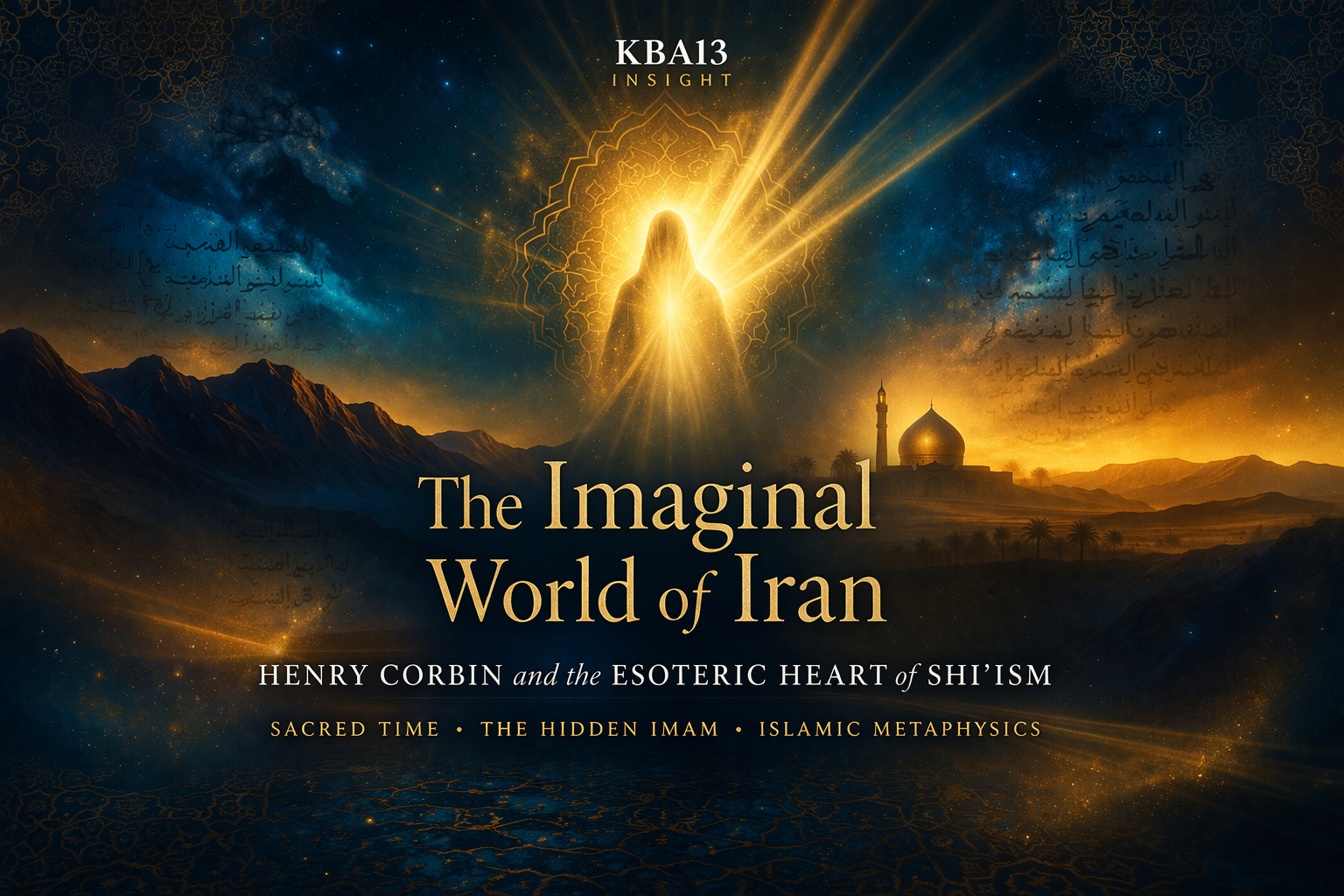
Beyond Imagination: The Ontological Reality of the Imaginal
Modern consciousness has inherited a crippling binary: the real is that which is measurable, while the unreal is relegated to imagination. Between these two domains, no legitimate ontological space is granted. As a result, everything that does not submit to empirical verification is either dismissed as illusion or reduced to metaphor. Within such a framework, religious experience is tolerated only insofar as it can be translated into psychological or symbolic language. What disappears is not simply a category of thought, but an entire dimension of reality.
It is precisely this lost dimension that Henry Corbin sought to restore. In his reading of Islamic philosophy—particularly through the works of Suhrawardi—Corbin articulated the existence of a third ontological domain: the mundus imaginalis. This is not a compromise between matter and intellect, nor a poetic extension of either. It is a world in its own right, governed by its own laws of perception and presence. To call it “imaginal” is not to weaken its reality but to protect it from confusion with the merely imaginary.
The imaginal world is the realm in which spiritual forms become visible without becoming material. It is the domain where meaning assumes shape, where symbols are not representations but presences. In this world, an angel is not a metaphor for psychological states, nor is a vision reducible to subjective projection. Rather, both belong to a mode of being that is as structured and coherent as the physical world, though operating at a different degree of subtlety. To deny this realm is not to clarify reality but to amputate it.
Within Shi’ite metaphysics, the necessity of the imaginal becomes unmistakable. The doctrine of the Hidden Imam cannot be sustained within a purely material ontology. If presence is limited to visibility, then occultation becomes absence in the most literal sense. Yet Shi’ite thought insists otherwise: the Imam is hidden, not nonexistent. His presence is mediated through a realm that escapes empirical detection but remains ontologically real. The imaginal world thus becomes the condition of possibility for sacred continuity.
This is why Corbin insisted that imagination must be rehabilitated—not as fantasy, but as an organ of perception. Just as the eye perceives the sensible and the intellect grasps the intelligible, the imaginal faculty perceives the forms of the intermediate world. Without this faculty, religious symbols collapse into abstraction. With it, they regain their density. Revelation ceases to be a distant event and becomes an accessible presence, unfolding within the very structure of consciousness.
The crisis of modernity, therefore, is not simply a loss of belief but a loss of vision. By confining reality to the measurable, it has rendered itself incapable of perceiving the imaginal. The result is a flattened world in which symbols are emptied of power and transcendence becomes unintelligible. To recover the imaginal is not to retreat into mysticism, but to restore a dimension of being without which neither philosophy nor religion can fully speak. In the Iranian Shi’ite tradition, this dimension has never entirely disappeared. It remains—quietly but persistently—the space where light takes form and meaning becomes visible.
The Imam as Axis of Sacred History
In much of modern discourse, religious authority is interpreted through categories of power—succession, legitimacy, and institutional control. Within such a framework, the figure of the Imam appears as a historical claimant, a political heir in a contested lineage. Yet this reading, however widespread, fails to penetrate the inner structure of Shi’ite thought. For in Shi’ism, the Imam is not merely a successor to authority; he is the axis around which meaning itself is organized.
To speak of the Imam as an axis is to move from history to ontology. The Imam does not simply interpret revelation; he embodies its interior continuity. The Qur’an, left to textuality alone, risks becoming static—subject to interpretation without limit. The Imam anchors interpretation, not by restricting it, but by orienting it toward its source. He is the living guarantee that revelation remains a presence rather than a relic.
This axis becomes even more profound when considered in light of occultation. The Twelfth Imam, Muhammad al-Mahdi, is not accessible within ordinary perception. Yet his absence does not dissolve his centrality. On the contrary, it intensifies it. The axis is no longer visible, but it remains operative. Meaning continues to radiate from a center that cannot be empirically located. Sacred history, therefore, is not interrupted—it is deepened.
Such a structure radically transforms the nature of time. Without an axis, time disperses into succession—events follow one another without intrinsic orientation. With the Imam, time becomes directional. It is drawn toward a point of return, structured by anticipation. The present is no longer self-contained; it is suspended between memory and fulfillment. The Imam, though hidden, sustains this tension, preventing history from collapsing into mere chronology.
The believer’s relationship to the Imam is therefore not external allegiance but existential alignment. To recognize the Imam is to orient one’s perception toward a hidden center. This orientation does not eliminate uncertainty; it gives it form. Faith becomes a movement toward what cannot be fully grasped, yet cannot be denied. The Imam, in this sense, is not simply known—he is awaited.
What emerges from this structure is a conception of authority that resists both absolutism and relativism. The Imam does not dominate as a political sovereign, nor does he dissolve into interpretive plurality. He remains the silent center that holds meaning together. In a world where authority is often fragmented or imposed, Shi’ite metaphysics offers a different possibility: authority as luminous presence, invisible yet indispensable, sustaining the coherence of sacred history.
Karbala: The Ontology of Light and Sacrifice
There are events in history that can be recorded, analyzed, and ultimately contained within the past. And there are events that resist containment—events that refuse to become mere memory because they continue to generate meaning beyond themselves. Karbala belongs to the latter. To approach it as a political tragedy or a failed uprising is to misunderstand its nature entirely. For within Shi’ite consciousness, Karbala is not simply what happened—it is what continues to happen.
The martyrdom of Husayn ibn Ali marks the point at which truth is no longer articulated through discourse, but through being itself. Husayn does not argue for truth; he embodies it. In refusing allegiance to falsehood, he transforms existence into testimony. This is why martyrdom in Shi’ism cannot be reduced to sacrifice in the conventional sense. It is not loss—it is disclosure. Something becomes visible in Karbala that cannot be seen elsewhere.
What becomes visible is the structure of reality as confrontation. The world is not neutral. It is not a space in which values are negotiated or meanings constructed at will. It is a field in which truth and distortion are irreducibly opposed. Karbala reveals this opposition without mediation. There is no ambiguity, no compromise, and no gradual transition. There is only fidelity or betrayal. In this clarity, the event acquires an ontological weight that exceeds historical description.
This is why Karbala cannot be confined to the seventh century. Each act of remembrance is not repetition but re-entry. The believer does not recall Husayn from a distance; he stands again within the field of decision. Sacred time collapses the interval between past and present, not by erasing history, but by intensifying it. Karbala remains because the structure it reveals remains.
At the same time, Karbala introduces a paradox that lies at the heart of Shi’ite metaphysics: defeat as victory, absence as presence. Husayn is killed, yet his truth becomes indestructible. His body is destroyed, yet his meaning expands. This inversion is not symbolic—it is ontological. It reveals that power and truth do not coincide, that visibility does not guarantee reality. What appears defeated may in fact be the very locus of light.
In this sense, Karbala prepares the ground for occultation. The disappearance of the Imam is not an anomaly but a continuation of the same structure. Just as Husayn’s martyrdom revealed presence within apparent defeat, the Hidden Imam reveals presence within concealment. The drama of light does not end—it changes form. Karbala is not the conclusion of sacred history; it is its irreversible intensification.
From Ancient Iran to Shi’ite Metaphysics
Every serious engagement with Iranian Shi’ism must confront a delicate question: how does one speak of continuity without falling into reduction? To claim that Shi’ism simply inherits pre-Islamic Iranian ideas is to betray both traditions. Yet to deny any deeper resonance is equally inadequate. What is required is a different category altogether—one that Henry Corbin himself insisted upon: not survival, but transfiguration.
Ancient Iranian spirituality, as articulated in the teachings of Zoroaster, was structured by a dramatic ontology of light. Reality unfolded as a tension between truth and distortion, illumination and obscurity. Time was not neutral duration but a field of expectation, oriented toward restoration. Mediation was necessary, for the divine did not act without intermediaries. These elements formed a grammar—a way of perceiving reality—rather than a fixed set of doctrines.
With the advent of Islam, this grammar did not simply persist beneath the surface. It was reconfigured within a radically new horizon: revelation. The Qur’an did not confirm Iranian cosmology; it transformed the very conditions under which such intuitions could be articulated. Unity of God displaced all forms of dualism. Prophecy replaced mythic narration. What had been cosmic opposition became moral and spiritual confrontation grounded in divine command.
It is within Shi’ism that this transformation reaches its most intricate articulation. The Imam emerges as the locus where the Iranian intuition of mediation is recast within the prophetic lineage. No longer a figure within a cosmic hierarchy, the mediator becomes a historical presence, designated through the Prophet. Yet the structural necessity of mediation remains. Without the Imam, revelation risks becoming external; with him, it retains interior depth.
Similarly, the Iranian sense of sacred time undergoes transfiguration. The expectation of restoration does not disappear—it is reoriented. The Hidden Imam replaces earlier figures of eschatological hope, not as repetition, but as fulfillment within an Islamic framework. Time remains charged with anticipation, but its meaning is now anchored in revelation rather than cosmological myth.
What this reveals is not a continuity of content, but a continuity of orientation. Iran provides a receptivity—a capacity to recognize the world as structured by light, mediation, and eschatological tension. Islam enters this horizon not as an external imposition, but as a decisive rearticulation. The result is neither synthesis nor substitution, but transformation at the level of ontology.
Understanding this process means moving beyond the language of influence and inheritance. What is at stake is deeper: the capacity of a tradition to receive revelation without losing its metaphysical depth. In Shi’ite Iran, this capacity found its most profound expression. The ancient grammar of light was not preserved—it was transfigured, and in that transfiguration, it achieved a new and irreversible clarity.
Ta’wil: The Ascent Through Meaning
Interpretation, in modern thought, is often understood as a technical operation—a method applied to texts in order to extract meaning. It presupposes distance between the reader and the object, between the subject and the content. Meaning is something to be decoded, clarified, and stabilized. Within such a framework, interpretation remains horizontal: it moves across language, context, and structure, but rarely penetrates beyond them. Shi’ite hermeneutics begins from a radically different premise.
Ta’wil does not signify interpretation in this limited sense. It signifies return—return to origin, return to source, return to the hidden depth from which meaning emerges. The Qur’an is not a surface awaiting explanation; it is a vertical reality that unfolds through levels. The outward (zahir) is not false, but it is incomplete. Beneath it lies the inward (batin), and beneath that, further depths still. Meaning is not exhausted; it is ascended.
This ascent is not arbitrary. It is guided. Without orientation, the movement from surface to depth becomes dispersion. This is why ta’wil is inseparable from the Imam. The Imam does not impose meaning upon the text; he reveals the path by which meaning is approached. He is not an interpreter among others, but the axis of hermeneutic legitimacy. Through him, interpretation becomes fidelity rather than invention.
In this structure, knowledge ceases to be accumulated. It becomes a transformation. To understand a verse is not simply to grasp its semantic content, but to be reoriented by it. Each level of meaning corresponds to a level of being. The ascent through meaning is therefore an ascent through existence. The text is not an object; it is a path. To read is to move.
This is where ta’wil intersects with the imaginal world. The deeper meanings of revelation are not abstract propositions; they assume form within the intermediate realm. Vision becomes the completion of interpretation. What is understood inwardly becomes seen imaginally. The Qur’an, in this sense, is not only read—it is encountered. Its meaning is not only known—it is witnessed.
The modern reduction of interpretation to method reflects a deeper loss: the loss of verticality. When meaning is confined to what can be historically reconstructed or linguistically analyzed, its ontological dimension disappears. Ta’wil restores that dimension. It affirms that meaning originates beyond the text and returns to that origin through disciplined ascent. In this movement, interpretation becomes not explanation, but illumination.
The Crisis of Modernity
Modernity does not begin as a rejection of religion; it begins as a reconfiguration of reality. Its most decisive move is not disbelief, but reduction. What cannot be measured is gradually excluded from the domain of the real. What cannot be verified is relegated to subjectivity. In this quiet but radical shift, the world is not denied—it is diminished. Entire dimensions of being are rendered unintelligible, not because they have disappeared, but because the criteria of recognition have changed.
Within this transformed horizon, religion is permitted to survive only under certain conditions. It may function as ethics, as identity, or as historical memory, but not as ontology. Its symbols are tolerated so long as they are interpreted as metaphors. Its narratives are accepted insofar as they are understood psychologically or sociologically. What is no longer acceptable is the claim that these symbols refer to realities that exist beyond empirical verification.
It is precisely here that Shi’ite metaphysics, as interpreted by Henry Corbin, becomes unintelligible to the modern mind. The Hidden Imam cannot be accommodated within a world that equates presence with visibility. The imaginal realm cannot be admitted into a reality defined by material extension. Ta’wil becomes unnecessary where meaning is confined to historical context. The entire structure collapses—not because it is false, but because the world in which it makes sense has been forgotten.
This forgetting produces a peculiar form of alienation. Modern consciousness finds itself surrounded by symbols it no longer knows how to read. Ritual becomes repetition without depth. Scripture becomes text without ascent. History becomes sequence without meaning. The sacred is not attacked—it is emptied. What remains is form without substance, memory without presence.
Yet this crisis is not absolute. It reveals its own limits. For even within modernity, the need for meaning persists. The desire for depth, for orientation, for something that exceeds surface, continues to assert itself. The very persistence of religious traditions—despite reduction—testifies to an unextinguished intuition: that reality cannot be exhausted by what is measurable.
The task, therefore, is not to reject modernity, but to expose its incompleteness. Shi’ite Iran offers not an alternative system in opposition, but a different mode of seeing. It reintroduces verticality into a flattened world. It restores the possibility that time may be sacred, that meaning may be layered, that presence may exceed visibility. In doing so, it does not negate the modern—it interrupts it, opening a space in which another ontology can once again become thinkable.
Conclusion: A Return to Light
At the end of this inquiry, we are left not with a conclusion in the conventional sense, but with a reorientation. What has been uncovered is not a doctrine to be accepted or rejected, but a way of seeing that modern consciousness has largely forgotten. The imaginal world, the Hidden Imam, sacred time—these are not isolated concepts. They form a coherent horizon within which reality itself appears differently.
To speak of a “return” is therefore not to suggest regression. It is not a call to abandon critical thought or retreat into pre-modern certainties. Rather, it is an invitation to recover a dimension of experience that has been excluded by the narrowing of the real. The return is not backward—it is inward and upward. It is a movement toward depth, toward a reality that cannot be exhausted by surface.
In this horizon, light is no longer a metaphor. It becomes the very principle of intelligibility. To know is not merely to analyze, but to be illuminated. The Iranian Shi’ite tradition preserves this intuition with remarkable clarity. Through its doctrine of the Imam, it affirms that truth is mediated rather than abstract. Through its understanding of sacred time, it insists that history is oriented rather than neutral. Through its commitment to ta’wil, it demonstrates that meaning is ascended, not constructed.
The figure of Henry Corbin remains central to this recovery. Not because he invented these ideas, but because he recognized their philosophical seriousness at a moment when they were in danger of being dismissed. He refused to translate them into categories that would render them harmless. Instead, he allowed them to challenge the very framework of modern thought.
What emerges from this encounter is not a solution, but a possibility. A possibility that reality may be richer than we have allowed it to be. That presence may exist without visibility. That time may carry meaning beyond sequence. That interpretation may be a path rather than a technique. These are not conclusions to be proven—they are horizons to be entered.
The esoteric heart of Shi’ism continues to beat within this horizon. It does not impose itself; it invites. It does not demand belief; it calls for perception. In a world increasingly dominated by immediacy and surface, such depth may appear distant. Yet it remains available, waiting not to be invented, but to be seen.
To return to light, then, is not to change the world, but to see it otherwise. And in that altered vision, what once appeared hidden may reveal itself as the very center around which everything has always turned.




Leave a Reply