
Bottom Line Up Front
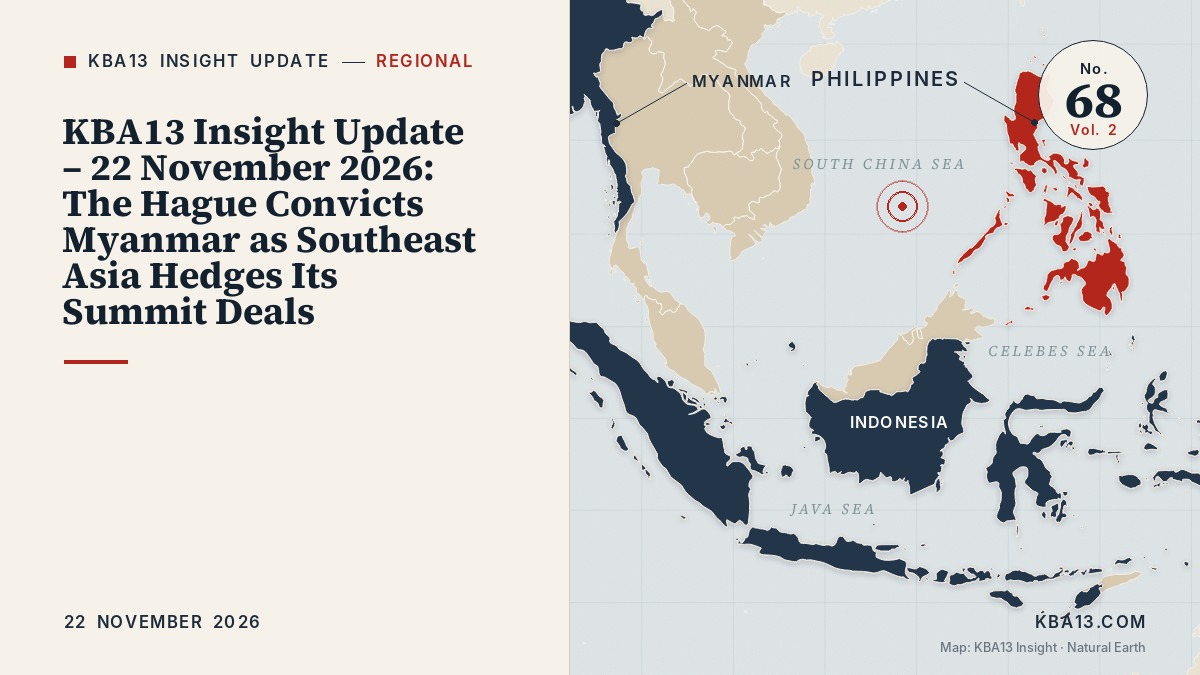
The three days from 06:00 WIB on 19 November to dawn on 22 November turned Southeast Asia from a region hosting summits into a region absorbing their consequences. The single most consequential development was legal rather than diplomatic: on 19 November the International Court of Justice found, by nine votes to six, that Myanmar committed genocide against the Rohingya, the first time the court has held a state responsible for the crime, as RFA and OPB/NPR reported. The verdict landed one day after Naypyidaw threatened to review its relationship with ASEAN, and it now forces every member government to choose between legal consistency and the transactional engagement most of them had quietly resumed. We judge it almost certain (high confidence) that ASEAN will not adopt any collective measure against Myanmar in response, and likely (moderate confidence) that the ruling will instead fragment the bloc’s Myanmar policy further, with the Philippines and Indonesia’s parliament leaning toward compliance language and Thailand openly prioritising national interest.
The second trend is the conversion of summit diplomacy into contested economic claims. Washington, Beijing and Brussels each left the Manila and Shenzhen summits with headline numbers, and Southeast Asian capitals spent the window correcting, qualifying or ratifying them. Indonesia signed its long-delayed comprehensive economic partnership with the European Union on 21 November, Singapore opened talks to upgrade its free trade agreement with China, and Manila found itself publicly qualifying a US presidential claim that it had agreed to source all of its farm and energy imports from the United States. The pattern is not alignment but hedging under pressure: governments are signing with everyone while disputing the terms each partner advertises. We assess with moderate confidence that this widening gap between announced and actual commitments will become the main source of friction in US relations with the Philippines and Thailand over the coming quarter.
The third trend is that security risk is migrating inward, into institutions. Malaysia’s discovery that air force officers allegedly used military aviation facilities to move methamphetamine, fresh US sanctions on Karen militia commanders and a Cambodian scam financier, and the steady pressure of youth-led protest in Bangkok all point to states whose principal vulnerabilities are corruption, criminal penetration and legitimacy rather than external attack.
ASEAN Architecture and Regional Diplomacy
ASEAN enters the post-Manila period with a weakened centre and a busy periphery. The Philippine chairmanship formally passed to Singapore, as regional media reported, and Singapore takes on a 2027 agenda already crowded with unfinished business: a South China Sea Code of Conduct still described by Philippine officials as roughly 80 to 90 percent complete, a Myanmar file that has just become legally radioactive, and a transboundary haze regime that Singapore has signalled it wants to strengthen during its year in the chair.
The ICJ ruling sits at the heart of that problem. ASEAN’s Five-Point Consensus was designed to manage a coup, not a judicial finding of genocide by the world’s highest court. Responses within the bloc diverged within hours. The Philippine foreign ministry said it accepted and backed the ruling, framing its position around commitment to international law, while members of Indonesia’s House Commission I urged ASEAN to take a firm stance and monitor implementation. Thailand’s Prime Minister Anutin Charnvirakul, by contrast, said ties with Myanmar would continue and that national interest would guide Bangkok’s approach.
Myanmar’s own posture compounds the dilemma. The regime rejected the judgment as unfair and stressed that it was not unanimous, according to The Irrawaddy and Reuters-sourced reports, while a military-council spokesperson said Myanmar would act “in line with international law,” as Eleven Myanmar reported. On the same day as the verdict, Myanmar Now reported that the junta leader welcomed a diplomatic role for Myanmar in the regional bloc, which sits awkwardly beside his 18 November statement to parliament that the government would review its future relations with ASEAN, noted in our previous update. We read this as deliberate ambiguity rather than confusion: Naypyidaw is signalling that it can raise the cost of exclusion for ASEAN while keeping the door open to normalisation through bilateral channels, particularly with Bangkok and Beijing. We judge formal withdrawal from ASEAN unlikely in the next six months (moderate confidence), but reduced participation and selective boycotts of ASEAN-led mechanisms are a roughly even chance.
Outside the Myanmar file, the region’s parliamentary track continued to widen. The ASEAN Inter-Parliamentary Assembly admitted Timor-Leste’s National Parliament as its newest member, completing the institutional integration that began with Dili’s accession to ASEAN in October 2025. The Philippine Department of Justice, meanwhile, said it is counting on an ASEAN extradition treaty to narrow the safe havens available to fugitives, a sign that transnational crime is now one of the few areas where member states see a shared interest strong enough to justify binding legal cooperation; Indonesia’s national police likewise sent a team to the Philippines to pursue online gambling operators targeting Indonesians.
External partners filled the space ASEAN left. India proposed free e-visas for ASEAN tourists and scheduled an ASEAN-India maritime conclave in Visakhapatnam for 23 to 24 November, China convened the eighth China-ASEAN Legal Cooperation Forum in Chongqing, and the White House advertised roughly US$17 billion in Southeast Asian deals for US firms, according to Business Insider Africa. Partners are more active than ever while the bloc’s capacity to speak with one voice erodes.
Security, Conflict and Transnational Threats
The ICJ verdict reshapes the international security environment around Myanmar more than it changes conditions on the ground. The court found that the only reasonable inference from the 2017 clearance operations was an intent to destroy a substantial part of the Rohingya group, citing evidence of some 10,000 killings and the flight of more than 730,000 people to Bangladesh, according to RFA. The United Kingdom moved fastest: Foreign Secretary Ed Miliband said London would expel Myanmar’s defence attaché and ask the UN Security Council to take up the judgment. France has reportedly sought a Security Council meeting after Myanmar’s rejection of the ruling, while the United States was reported to be studying the judgment and warning against its politicisation, and China objected to what it called jurisdictional overreach, according to Al Jazeera and Lianhe Zaobao reporting. That configuration all but guarantees that the Council will not enforce the ruling; we judge a binding Security Council resolution on Myanmar remote (high confidence). The practical consequences will instead run through national measures: attaché expulsions, targeted sanctions, refugee policy and the willingness of governments to host Myanmar’s leadership. As International Crisis Group’s Richard Horsey put it to RFA, governments receiving Myanmar’s leader will find it harder to present such visits as business as usual.
Refugee policy is the first place the verdict will bite in Southeast Asia. Malaysia, which hosts one of the region’s largest Rohingya populations, reportedly removed an online post announcing a plan for Rohingya repatriation involving Turkey, and Malaysian civil-society voices are now arguing that repatriations to Myanmar must stop. We assess it likely (moderate confidence) that at least one ASEAN government will pause or publicly reconsider Rohingya removals within the next month.
The criminal economy along Myanmar’s borders remains the region’s most acute transnational threat. On 19 November the US Treasury sanctioned the commander-in-chief of the Democratic Karen Benevolent Army, General Saw Shwe Wah, and Colonel Saw A One, who oversees security at Three Pagodas Pass on the Thai border, together with Cambodian national Zhao Hui and two companies he chairs, for alleged links to scam compounds targeting Americans and Europeans, according to Reuters via GV Wire. Treasury said Zhao had leased a scam centre from Prince Group and paid protection fees to its leader, Chen Zhi. The designations reinforce a trend visible all year: Washington is treating scam compounds as a national-security problem and is now reaching into the command structures of armed groups allied to Naypyidaw. Separately, Karen News reported that a Karen armed group detained 29 undocumented foreign nationals in a border town, and a UN expert described the junta and its backers in unusually blunt terms, as The Daily Star reported. Scam operations are adapting, not disappearing; we judge it likely (moderate confidence) that further US or allied designations targeting Cambodian and Myanmar facilitators will follow before year-end.
Narcotics trafficking produced the window’s most striking institutional story. Malaysian police said on 19 November that five Royal Malaysian Air Force officers were among 11 people arrested on 17 November in the Klang Valley and Labuan for allegedly exploiting military aviation facilities to move 96.64 kg of methamphetamine, worth about RM4.83 million, from the peninsula to Sabah and onward to the Philippines and Indonesia, according to The Star. Prime Minister Anwar Ibrahim publicly confirmed the involvement of air force personnel, as reported by the New Straits Times. Within the same window Thai authorities reported foiling an attempt to move more than 700 kg of methamphetamine into Malaysia, and Indonesian customs said it had stopped attempts to smuggle 25.8 kg of gold to Malaysia this month, as The Star reported. Coming after an army-linked smuggling scandal in 2025, the case suggests criminal penetration of Malaysia’s security services is systemic; and the Sulu and Celebes Sea corridor the syndicate allegedly used is the same space in which kidnapping, arms and people-smuggling networks have long overlapped, which makes this a regional rather than purely Malaysian problem.
South China Sea and Maritime Security
The maritime picture in this window was defined by de-escalatory rhetoric layered over continuing militarisation. After meeting Foreign Minister Wang Yi on the sidelines of the APEC meetings in Shenzhen, President Ferdinand Marcos Jr said they discussed lowering tensions in the West Philippine Sea and that China was also keen to finalise the Code of Conduct, which he described as about 80 percent done, as the Manila Bulletin and ABS-CBN reported. The Star had earlier reported that ASEAN and China reached provisional agreement on 80 percent of the text. The remaining fifth is where the substance lies: legal status, geographic scope and limits on new construction. Nothing in the window suggests Beijing has moved on those points, and satellite evidence of a new runway at Antelope Reef in the Paracels, discussed in our previous update, points the other way. We judge it unlikely (moderate confidence) that a Code with binding restraints on militarisation will be concluded during Singapore’s chairmanship; a politically binding text that codifies existing practices is more plausible.
Indonesia’s position drew the most attention. After President Prabowo Subianto met Xi Jinping at Kylin Villa in Shenzhen on 20 November, Jakarta said the two sides were coordinating several forms of cooperation in the South China Sea and had discussed potential areas for joint development, according to ANTARA. Indonesia has long insisted that it is not a claimant state and that the waters around Natuna lie within its exclusive economic zone. Any joint development arrangement that does not explicitly rest on UNCLOS would be read in Manila and Hanoi as tacit acceptance of overlapping Chinese claims. The language remains exploratory, and Indonesian officials have previously clarified that no joint development areas have been designated; we therefore treat this as a signal of political intent rather than a legal shift (moderate confidence).
Manila, for its part, is building capability while talking down tension. The Armed Forces of the Philippines said it would deploy Indian-made missiles in exercises, a reference to the BrahMos systems acquired from India, and the national security adviser floated a security plan for the Philippine Sea on the country’s eastern seaboard, according to the Inquirer. Malaysia, meanwhile, is reportedly exploring recruitment of gamers for military drone roles to expand surveillance over its South China Sea areas, as The Economic Times reported.
The US-China layer remained ambiguous. The two powers held maritime security talks in parallel with the leaders’ meetings in Shenzhen, according to the South China Morning Post, while President Donald Trump used defence commitments as trade leverage in public remarks about the Philippines, a combination that raises the prospect of great-power guardrails negotiated over the heads of claimants.
Country Watch
Indonesia. Jakarta had the most consequential economic window of any ASEAN member. On 21 November Coordinating Minister for Economic Affairs Airlangga Hartarto and European Trade Commissioner Maroš Šefčovič signed the Indonesia-EU Comprehensive Economic Partnership Agreement together with an Investment Protection Agreement, after roughly a decade of negotiation, according to ANTARA. Under the deal, 90.4 percent of Indonesian tariff lines will enter the EU duty-free, with another 8.37 percent liberalised over three to 15 years or managed through quotas; entry into force is expected in 2027 after ratification, and DW noted the agreement’s reach from palm oil to pharmaceuticals. This came days after Indonesia and China agreed four strategic partnerships worth about US$71.8 billion in Shenzhen on 18 November, including roughly US$50 billion for ten “future smart city” sites led by a Danantara subsidiary and a Shaanxi-led consortium, according to the Cabinet Secretariat, and Xinhua reported the launch of China-Indonesia comprehensive economic partnership negotiations. Prabowo is thus simultaneously locking in European market access and Chinese capital. The domestic political calendar is equally important: following Gibran Rakabuming Raka’s resignation, the MPR set 25 November as the deadline for the president to submit two vice-presidential candidates, with the vote now scheduled for 9 December, according to MPR Chairman Ahmad Muzani’s statement. We judge it likely (moderate confidence) that Prabowo’s nominees will be chosen to consolidate Gerindra control rather than to broaden the coalition. Financial fragility remains the binding constraint: the rupiah stayed near record lows after Bank Indonesia’s 25 basis-point hike to 6 percent on 18 November.
The Philippines. Manila spent the window managing the afterglow of its chairmanship and the fallout of Trump’s claims. Trump said the Philippines had agreed to buy all of its farm and energy imports from the United States, prompting Marcos to clarify the scope of what had been discussed, as the Inquirer reported; earlier, Ambassador Jose Manuel Romualdez answered “None” when asked whether anything had been signed, according to Outlook India. Trump also touted around US$2 billion in US arms financing for the Philippines. Marcos returned from China with P41.1 billion in investment pledges, a hedge that will not go unnoticed in Washington. Markets are uneasy: the main index fell to a new six-and-a-half-year low of 5,477.91 on 19 November amid concerns over inflation, peso depreciation and slowing growth, according to the Inquirer. The impeachment trial of Vice President Sara Duterte continues in the Senate and may run through December, according to Senate President Sherwin Gatchalian, keeping domestic politics polarised ahead of the 2028 cycle.
Malaysia. Anwar’s diplomacy and his domestic security problem moved on separate tracks. He met Xi in Shenzhen for their fourth bilateral talks and said Malaysia would not bow to external pressure in deepening ties with China, while the RMAF drug case exposed vulnerabilities in the security apparatus that his government will have to address before external partners raise them. Malaysia’s October inflation picked up slightly, as The Edge reported, and economists expect another quarter of growth above 5 percent on strong exports.
Singapore. Singapore used the window to entrench its role as the region’s most consistent hedger. Prime Minister Lawrence Wong met Xi in Shenzhen on 20 November, where the two sides launched negotiations to further upgrade their free trade agreement, according to CNA, and then met Premier Li Qiang in Beijing, saying more than 20 agreements and initiatives would be concluded at the annual Joint Council for Bilateral Cooperation. Vice-Premier Ding Xuexiang is due in Singapore on 22 to 23 November to co-chair that meeting with Deputy Prime Minister Gan Kim Yong. Wong said some degree of US-China technological bifurcation may be inevitable but that Singapore still has room to manoeuvre. The city-state also concluded commemorations of fifty years of defence relations with Brunei, as MINDEF announced.
Thailand. Bangkok faces simultaneous pressure from the street, from Washington and from its rivers. Youth-led groups rallied at Democracy Monument on 20 November, with the Politika Run Club and Studem Network mobilising around education rights, accountability and the influence of entrenched interests, according to Khaosod English; the Education Minister instructed schools not to punish students for joining peaceful demonstrations, and Anutin said he saw no escalation in the rallies. We judge large-scale unrest unlikely in the next month (moderate confidence), but the movement’s novelty lies in its decentralised, social-media-driven style, which makes it harder to negotiate with or to suppress. On trade, Commerce Minister Suphajee Suthumpun had already contradicted Trump’s claim that Thailand would eliminate all tariffs on US goods, according to The Star, and Anutin reportedly warned that Thai exports could face tariffs of up to 50 percent if talks fail, as Nation Thailand reported. Thailand also unveiled a six-point plan on arsenic contamination in northern rivers ahead of 24 November talks with China and Myanmar, after Xi promised Chinese expertise. Cambodia’s decision to raise the border dispute at international fora, including the Francophonie summit it hosted, continues to irritate Bangkok ahead of the next maritime conciliation round.
Vietnam. Hanoi is positioning itself for its 2027 APEC year. General Secretary and President To Lam made his first visit to Yunnan since taking the dual role, proposing five initiatives to connect Vietnam’s development strategy with south-west China, according to the Vietnam News Agency, and he hosted Azerbaijan’s President Ilham Aliyev, with the two sides issuing a joint statement on their strategic partnership, as VOV reported. Economic policy remains expansionary: a new land law accelerating expropriation for development projects drew criticism from church groups, the government proposed special electricity tariffs for data centres, and a Trungnam-led consortium signed a gas turbine supply deal for the Ca Na LNG plant.
Myanmar. Myanmar’s internal war continues with little sign that the regime’s promised peace conference in February will change its trajectory. The convergence of a genocide finding, new US sanctions on allied militia commanders and intensifying pressure on refugee host states means the regime’s international position has deteriorated sharply in a single week, even as China, Russia and parts of ASEAN keep channels open. We judge it likely (moderate confidence) that Naypyidaw will respond by deepening reliance on Beijing and Moscow rather than by making concessions on Rakhine.
Cambodia. Phnom Penh’s economic diplomacy continued on a modernising track, with the National Bank exploring tokenised bonds to cut borrowing costs and signing a QR payment connectivity memorandum with Visa. Hun Manet said the agricultural sector had proved resilient despite border closures with Thailand, and asked for a study on reserving certain industries for Cambodian investors.
Laos. Vientiane’s priorities were financial survival and connectivity. Laos is prioritising strategic financing ahead of its graduation from least-developed-country status, as The Star reported, while the China-Laos Railway reached about 300,000 cross-border passengers this year and Deutsche Welle highlighted a wind power boom. The EU delegation also warned of fake job advertisements luring foreigners from Laos into Russia’s army, a new strand of labour trafficking in the region.
Brunei. Brunei’s window was quiet and positive, consistent with a GDELT media tone of +2.4 in the monitor. Royal Brunei Airlines placed an eight-engine Rolls-Royce Trent 1000 XE order for its Boeing 787-9 fleet and a regional forum flagged El Niño risks.
Timor-Leste. Dili’s formal entry into AIPA deepened its integration into ASEAN institutions; the more immediate concern is the 21 November Banda Sea earthquake, discussed below.
Economy, Energy, Trade and Markets
The window’s economic story is one of competitive deal-making against a backdrop of weak currencies and nervous equity markets. The monitor’s latest exchange rates, per USD from ExchangeRate-API, stood at 18,262 rupiah, 4.113 ringgit, 1.291 Singapore dollars, 33.94 baht, 63.76 pesos, 25,730 dong, 2,099.6 kyat, 4,066.6 riel, 22,368.7 kip and 1.291 Brunei dollars, with the yuan at 6.692. The feed showed no change from the previous day, which most likely reflects weekend data rather than genuine stability, and these figures should be read as indicative levels. The rupiah’s proximity to record lows, despite Bank Indonesia’s cumulative 125 basis points of tightening in 2026, and the peso’s approach to 64 per dollar are the two signals that matter most; both point to capital-account stress that trade agreements cannot relieve in the short term.
Trade policy is diverging into three tracks. The European track is the most rules-based: the Indonesia-EU agreement eliminates duties on the large majority of tariff lines and includes an investment protection agreement, and it will likely intensify pressure on Malaysia, Thailand and the Philippines to accelerate their own negotiations with Brussels (moderate confidence). The Chinese track is capital-led: the US$71.8 billion Indonesian package, Singapore’s FTA upgrade talks, Marcos’s P41.1 billion in pledges and Thailand’s discussions on rail links toward Malaysia and Singapore all expand Chinese financing and supply-chain integration. The American track is the most transactional and the least defined. Trump’s claims about Philippine purchasing commitments and Thai tariff elimination have been qualified by both governments, and the US Supreme Court’s earlier decision striking down the reciprocal tariff framework, noted by Outlook India, adds legal uncertainty to the political kind. For exporters, the risk is not a single tariff level but the volatility of the announcements themselves.
Energy security remains a background concern after this year’s Gulf disruption. Cambodian petrol prices are now only about 16 percent above pre-Iran-war levels as global prices ease and government support continues, according to Cambodia Investment Review, and Japan’s proposal for an Asian oil security mechanism, floated at the summit, continues to attract analysis as the region debates whether it wants a regional energy agency. Vietnam’s Ca Na LNG project and Laos’s wind sector show that the region’s energy transition is being financed project by project rather than through a coherent regional plan.
Disasters and Environmental Risk
The most significant hazard event was a magnitude 6.8 earthquake at 16:42 WIB on 21 November, about 105 km north-east of Lospalos in Timor-Leste at a depth of roughly 132 km, according to USGS data in the monitor. The UN-EU GDACS system rated it a green alert, estimating around 70,000 people exposed to moderate shaking, and tremors were felt in Dili and Darwin. Some agencies initially reported a magnitude of 7.2; the event’s depth limited surface damage and no tsunami warning was issued. It was the second major Banda Sea event in five days, following a magnitude 6.6 quake on 16 to 17 November, a sequence that regional commentators have noted is felt repeatedly in Darwin. We judge further moderate aftershocks likely and a damaging shallow event in the same zone unlikely but not negligible (low confidence), given the complexity of the Banda arc.
Indonesia’s disaster agency BNPB expanded weather modification operations to mitigate floods in Aceh and warned of recurring November floods in West Kalimantan. Southern Thailand faced flood warnings for Songkhla through 22 November. On haze, the wetter and windier year-end reduces but does not eliminate transboundary risk, according to Singapore’s meteorological outlook, while The Straits Times examined Singaporean links to Indonesian companies implicated in fires, a line of inquiry that will feed Singapore’s planned tightening of its haze law during its chairmanship.
Indicators and Warnings for the Next 72 Hours
The first signpost is the international follow-through on the ICJ judgment. A formal request for a Security Council meeting by France or the United Kingdom, the content of any ASEAN chair or foreign ministers’ statement, and announcements by individual member states on Rohingya repatriation will show whether the verdict produces measures or merely statements. Any Myanmar announcement curtailing participation in ASEAN mechanisms, or a high-profile bilateral visit by its leader to Bangkok or Beijing, would confirm our judgement that Naypyidaw will answer legal isolation with diplomatic defiance.
The second is the conversion of summit claims into texts. Watch for published US-Philippine and US-Thai trade documents, statements by Philippine Trade Secretary Cristina Roque on tariff lines and purchase commitments, and the outcomes of the Singapore-China Joint Council meeting with Vice-Premier Ding Xuexiang on 22 to 23 November, which Singapore says will produce more than 20 deliverables. Indonesian ratification steps on the EU agreement and the first formal round of China-Indonesia CEPA talks would confirm the trend toward multi-directional hedging.
The third is Indonesia’s vice-presidential succession. Prabowo’s two nominees are due by 25 November, ahead of the MPR vote on 9 December. The names will indicate whether he intends to concentrate power in Gerindra or reward coalition partners, and market reaction in the rupiah will test whether investors read the choice as stabilising.
The fourth is the maritime and security tempo. The ASEAN-India maritime conclave in Visakhapatnam on 23 to 24 November, Chinese coast guard activity around Second Thomas and Scarborough Shoals after the summit-season lull, Philippine missile exercises and any new imagery of Paracels construction will indicate whether the Code of Conduct optimism has any operational counterpart. In Malaysia, the remand of the five RMAF officers expires on 24 November, and charges or further arrests would show how deep the investigation goes.
The fifth is mainland diplomacy and protest. The Thailand-China-Myanmar talks on river pollution on 24 November and the Thai-Cambodian maritime conciliation round scheduled for 24 to 27 November in Kuala Lumpur will test Bangkok’s capacity to manage several neighbours at once, while any new youth rallies in Bangkok, especially if police tactics harden, would mark an escalation.
Method and Sources
This update covers the 72 hours from 06:00 WIB on 19 November to 06:00 WIB on 22 November 2026. It draws on 4,000 signals from 1,023 sources collected by the KBA13 ASEAN Intelligence Monitor, filtered by country and theme, with the most consequential items verified against original publisher reporting; items that could not be confirmed are labelled as reported, and recycled archival stories that resurfaced in news feeds were excluded.
About The Author

- Series · Seri
- KBA13 Insight Update, Regional Edition
- Volume · Number
- Vol. 2, No. 68 (November 2026)
- Cumulative issue · Edisi ke-
- 80
- Reference · Nomor rujukan
KBA13-IU-2026-02-068- Author · Penulis
- KBA13 Insight Research Team
- Published · Terbit
- 22 November 2026
- Section · Rubrik
- KBA13 Insight Update, KBA13 Insight Update Regional
- Keywords · Kata kunci
- ASEAN, ASEAN Code of Conduct, geopolitics Southeast Asia, IEU-CEPA, International Court of Justice, KBA13 Insight Update, Myanmar, Rohingya crisis, South China Sea
- Language · Bahasa
- English
- Length · Panjang
- 4,171 words · ±19 min read
- Publisher · Penerbit
- KBA13 Insight, Banda Aceh, Indonesia
- Permalink
- www.kba13.com/kba13-insight-update-2026-11-22-0600/
- How to cite · Cara mengutip
- KBA13 Insight Research Team. (2026, November 22). KBA13 Insight Update – 22 November 2026: The Hague Convicts Myanmar as Southeast Asia Hedges Its Summit Deals. KBA13 Insight Update, 2(68). https://www.kba13.com/kba13-insight-update-2026-11-22-0600/
- Rights · Hak cipta
- © 2026 KBA13 Insight. Quotation permitted with full attribution and link.
Artikel Terkait
 KBA13 Insight Update – 19 November 2026: Manila Closes Without a Sea Code as Myanmar Threatens to Walk Away from ASEAN
KBA13 Insight Update – 13 November 2026: Southeast Asia – Gibran’s Exit Opens a 60-Day Succession Race as Manila Hosts ASEAN
 Southeast Asia Strategic Outlook 2026: ASEAN, Indonesia, Myanmar, and South China Sea Tensions
 KBA13 Insight Regional Update: Southeast Asia Under Pressure (Hormuz Shock, ASEAN Crisis, Myanmar, Indonesia, and the South China Sea in 2026)
 KBA13 Insight Update – 16 November 2026: Manila Hands the Sea Code to Singapore as Minilateral Security Fills the Gap
Leave a Reply