
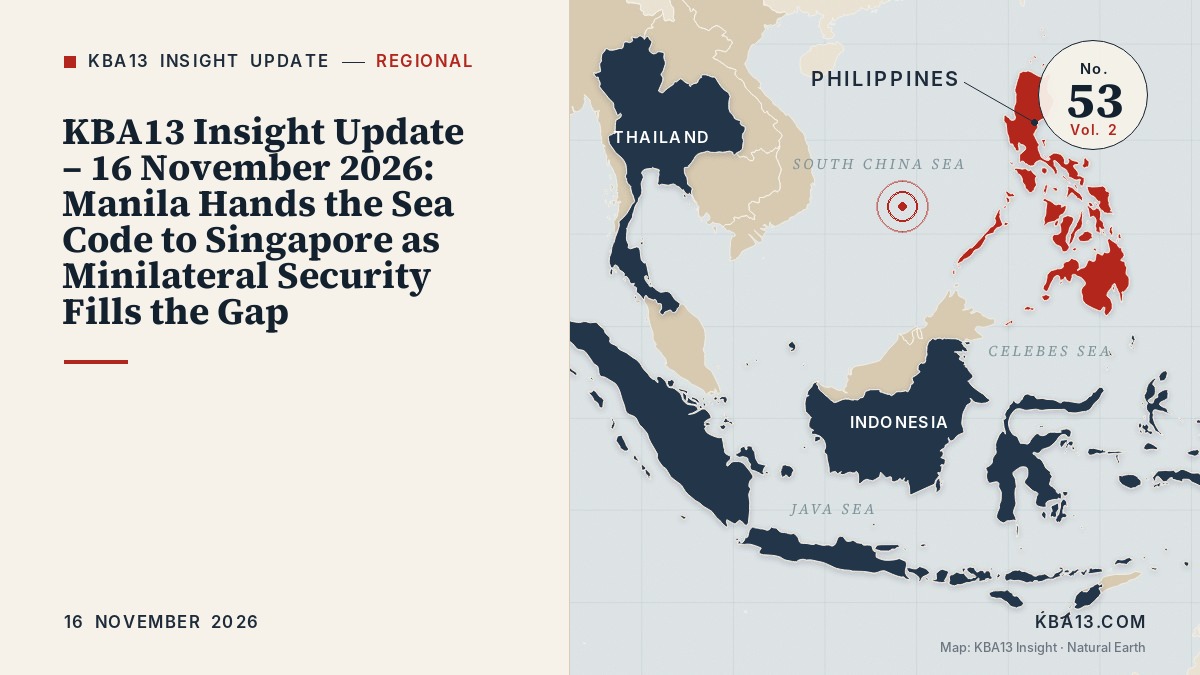
Manila Hands the Sea Code to Singapore as Minilateral Security Fills the Gap
KBA13 Insight Update, 16 November 2026, 06:00 WIB. Coverage window: 06:00 WIB 13 November to 06:00 WIB 16 November 2026. Live signal base: KBA13 ASEAN Intelligence Monitor.
Bottom Line Up Front
The 49th ASEAN Summit in Manila has confirmed a pattern that was visible in the run-up but has now hardened into fact: the region’s formal, consensus-bound instruments are moving slowly, while the real momentum in security and energy is being generated in smaller coalitions and bilateral arrangements running alongside them. The Philippines will end its chairmanship without the legally binding South China Sea Code of Conduct it had made the signature goal of its year, and Foreign Secretary Theresa Lazaro has said the draft, roughly 77 to 80 percent agreed at the level of paragraphs, now passes to Singapore as the 2027 chair, according to Philstar and Bernama. On the same opening day Manila and Canberra signed an updated Defence Cooperation Agreement designed to cut red tape for joint exercises, procurement and disaster response, reported by GMA News. We judge with high confidence that the code will not be concluded before the second half of 2027 at the earliest, and with moderate confidence that the gap will be filled by a thickening web of minilateral defence ties that Beijing will portray as a challenge to ASEAN centrality.
Three other developments define the 72 hours. First, ASEAN held its line on Myanmar, extending the bar on the country’s leader and foreign minister while sketching a conditional path to “gradual restoration” of representation, as reported by the Associated Press. That firmness is being eroded from outside by Washington’s direct engagement with Naypyidaw. Second, the energy shock that has dominated the second half of 2026 is producing concrete, if small, regional plumbing: emergency oil-access arrangements for the Philippines in Indonesia and Thailand, a Japanese-backed joint stockpiling initiative, and fuel-price protests in Bangkok. Third, domestic politics in the two largest maritime members turned sharply: Indonesia is entering a vice-presidential succession after Gibran Rakabuming Raka’s resignation, and Malaysia’s ruling coalition was routed in the Melaka state election. Indonesian President Prabowo Subianto’s apology to Singapore and Malaysia over transboundary haze was the most notable act of de-escalation in the window, though mixed messaging from Jakarta limits its value. What intensified: maritime minilateralism, energy-security improvisation and street protest in Manila and Bangkok. What eased: the haze dispute at the level of rhetoric. What is new: the formal handover of the code file to Singapore and the date-certain arrival of US President Donald Trump.
ASEAN Architecture and Regional Diplomacy
The Manila summit was staged as a celebration of an enlarged community. ASEAN unveiled an updated emblem with eleven rice stalks to mark Timor-Leste’s full membership, and members confirmed that Dili will chair the bloc in 2029, keeping strictly to alphabetical rotation rather than accommodating Myanmar, whose turn was skipped, according to Malay Mail. Indonesia publicly backed the Timorese chairmanship, as reported by ANTARA. It shows that the bloc will not reward Myanmar’s military-led government with symbolic status, and it places a still-developing state at the helm three years from now, which will test the ASEAN Secretariat’s capacity to carry a chair with limited administrative depth. We assess with moderate confidence that Singapore and Indonesia will quietly pre-position support for Dili’s chairmanship over 2027 and 2028.
The most tangible economic deliverable was the signing on 14 November of the ASEAN Digital Economy Framework Agreement, the bloc’s first standalone, legally binding digital economy treaty, which sets common rules on digital trade, cross-border data flows, electronic payments, cybersecurity and artificial intelligence and will replace the 2019 e-commerce agreement, according to The Star. It enters into force 180 days after signature, around mid-2027. Prabowo told the summit that the agreement could help lift the regional digital economy towards US$2 trillion, as reported by ANTARA, a figure that sits well above the more conservative projection of above US$1 trillion by 2035 cited by Singapore’s trade ministry in the same Star report. Alongside it, four ASEAN central banks signed a memorandum to expand local-currency settlement, reported by The Star, which continues the slow drift away from dollar intermediation in intra-regional trade.
External partners used Manila to advance their own trade agendas. Canada announced the substantial conclusion of free trade negotiations with both the Philippines and ASEAN, with Prime Minister Mark Carney describing the deals as a way to diversify away from dependence on the United States, according to Global News; Indonesia’s separate comprehensive agreement with Canada is due to take effect on 1 December, reported by the Jakarta Globe. Brazil’s President Luiz Inácio Lula da Silva made a visit to Manila focused on energy and agriculture, reported by the Philippine News Agency, and Indian Prime Minister Narendra Modi was scheduled to arrive for the ASEAN-India and East Asia Summits on 16 and 17 November, according to Moneycontrol. The common thread is hedging against an unpredictable US trade policy. With Trump’s Philippine visit now reported for 18 and 19 November by the Philippine envoy in Washington, according to the Philippine Canadian Inquirer, the last two days of the summit cycle will be dominated by tariff diplomacy. We judge it likely that individual ASEAN states will seek bilateral tariff relief rather than a collective position, which is consistent with the pattern of the past year.
Singapore is already shaping its 2027 chairmanship around integration and openness. Prime Minister Lawrence Wong urged leaders to deepen integration in an uncertain world and proposed a regional platform to manage the haze issue, reported by The Straits Times. Indonesia, for its part, used the meeting to campaign for mutual support among members for United Nations posts, including its own Security Council candidacy, according to ANTARA.
Security, Conflict and Transnational Threats
Myanmar remains the region’s deadliest conflict, and the 72-hour window brought fresh evidence that the military is intensifying air operations even as it seeks diplomatic rehabilitation. A military air strike on a displacement camp in Rakhine State killed 12 people, including a child, according to reporting carried by Al Jazeera. Arakanese outlets reported the military destroying bridges across Rakhine and using naval artillery that set homes ablaze, which, if accurate, points to a deliberate effort to slow the Arakan Army’s movement towards the south of the state, as reported by Narinjara News and labelled here as reported and not independently confirmed. The leaders’ statement in Manila demanded that all parties, especially the armed forces, stop targeted attacks on civilians and civilian infrastructure, and it kept Myanmar’s leader and foreign minister out of summit-level meetings until there is “meaningful progress” on the Five-Point Consensus, according to the Associated Press. India’s ANI characterised the outcome as a phased return tied to progress, which captures the ambiguity: ASEAN has kept the door shut while showing where the handle is.
The bloc’s leverage is being diluted from outside. The United States has reopened direct talks with Min Aung Hlaing’s government, with senior officials meeting Myanmar’s leaders in Naypyidaw and Tokyo, and a State Department document citing access to rare earths and countering Chinese influence as goals, according to ABC News. We judge with moderate confidence that ASEAN’s restrictions will remain formally intact through Singapore’s chairmanship, but that their practical effect will decline as Washington, Beijing and some neighbours deal directly with Naypyidaw.
Transnational crime was a parallel security thread. ASEAN adopted a new policy framework on migrant workers framed explicitly against the scam-compound crisis, according to Inquirer.net, and Malaysia’s foreign minister said the region should not be the epicentre of transnational crime. Myanmar state media reported continued demolition of scam facilities at Shwe Kokko, reported by the Global New Light of Myanmar, while Cambodia and Vietnam signed a security pact that includes cooperation against cyber scams, according to Khmer Times, and Thai police arrested two Chinese nationals over an alleged US$92 million crypto fraud scheme, reported by Bloomingbit. These measures are real but uneven. Enforcement in the Myanmar-Thailand border zone has tended to displace operations rather than end them, and we assess with moderate confidence that scam networks will continue to relocate into Cambodia’s and Laos’s weaker jurisdictions and onto cross-border digital rails.
Export-control enforcement on advanced chips has become a Southeast Asian security issue in its own right. Singapore charged a fifth person on 13 November with 41 counts of money laundering linked to the alleged fraudulent purchase of 917 servers, in a probe that began after a tip that servers possibly containing Nvidia chips were being exported to Malaysia, according to Malay Mail. Malaysia’s home minister said police had been investigating alleged chip diversion since April 2025, reported by Free Malaysia Today. For the region, the point is that Kuala Lumpur and Singapore are now under sustained pressure to prove that their data-centre booms are not conduits for restricted technology. We judge it likely that further prosecutions and tighter end-use checks will follow in both jurisdictions over the coming months.
On mainland Southeast Asia, the Thailand-Cambodia border dispute resurfaced in diplomatic form. Opening the Francophonie Summit in Phnom Penh, Prime Minister Hun Manet called for peace, respect for international law and resumption of border demarcation, as reported by Bernama, and he insisted that Cambodia did not initiate the 2025 clashes, according to Khmer Times. The Thai army accused Cambodia of politicising a border temple exhibition, reported by Nation Thailand, while a Thai official reaffirmed commitment to the ceasefire. French President Emmanuel Macron offered support for a peaceful resolution, reported by Khmer Times. Phnom Penh’s strategy is to internationalise the dispute through multilateral forums, which Bangkok resists. We assess the risk of renewed armed clashes in the next 72 hours as unlikely, with moderate confidence, but the rhetoric indicates that the political settlement remains thin.
South China Sea and Maritime Security
The headline judgement of this period is that the Code of Conduct timetable has slipped again. The Philippines had made conclusion in 2026 the centrepiece of its chairmanship; instead, Lazaro reported provisional agreement on about 80 percent of the draft’s paragraphs, with only one of four major outstanding issues settled, namely how the code relates to the 2002 Declaration on the Conduct of Parties, according to Philstar. She told reporters the Philippines needed more time, reported by The Manila Times, and that the file is now in Singapore’s hands. Malaysia’s foreign minister had put completion closer to 90 percent and urged a deal this year, according to Malay Mail. The divergence between 77, 80 and 90 percent reflects different ways of counting, not real progress; the hard questions that have dogged earlier rounds, such as the legal status of the code, its geographic scope and the place of non-claimant powers, are precisely the ones that remain open.
We judge with high confidence that a binding code acceptable to the Philippines, which has said it will accept only a text grounded in UNCLOS, is unlikely in 2027 as well. Beijing gains from an open-ended process that signals diplomatic engagement while it continues to consolidate its presence at sea. The Philippines gains from documenting Chinese conduct and building coalitions. Singapore, as a non-claimant with strong ties to both Washington and Beijing, is well placed to keep the process alive, but it has no greater power to bridge the substantive gap. The more realistic near-term outcome is a set of practical confidence-building measures, possibly including the new ASEAN Maritime Center to be based in the Philippines, reported by Inquirer.net, rather than a binding legal instrument.
The Philippine-Australian Defence Cooperation Agreement, signed by Defence Secretary Gilberto Teodoro and Australian Ambassador Marc Innes-Brown, is designed to streamline coordination on exercises, procurement and disaster response, according to GMA News and Euronews. GMA also reported that the Philippines, the United States, Japan and Australia will establish a Combined Coordination Center in Manila to improve domain awareness and interoperability. India reassured Manila of continued BrahMos missile supply ahead of the summit, reported by Defence.in, and New Delhi’s envoy to ASEAN publicly backed freedom of navigation. Together these steps amount to a layered deterrence network with Washington at its core. Chinese state media framed the summit’s “parallel security agenda” critically, and we assess with moderate confidence that Beijing will respond with diplomatic protest and continued coast guard and maritime militia pressure around Second Thomas Shoal and Scarborough Shoal rather than with escalation during the summit week.
Elsewhere, Malaysia selected Turkey’s Roketsan ATMACA anti-ship missile to replace the Naval Strike Missile on its Littoral Combat Ships, reported by Naval News, a decision that both diversifies suppliers and reflects the troubled history of the LCS programme. Vietnam lost six soldiers when a BMP-1 infantry fighting vehicle sank during combat readiness training in Bac Ninh province, according to The Star, an accident that underlines the age of Hanoi’s legacy Soviet equipment as it pursues modernisation with Japan and others.
Country Watch
Indonesia. The country is entering a constitutionally prescribed succession for the vice-presidency. Gibran Rakabuming Raka resigned last Thursday, handing his letter to the leaders of the People’s Consultative Assembly, and Prabowo said he would decide on candidates only after the ASEAN and APEC summits, according to ANTARA. Under Article 8 of the Constitution, the assembly must convene within 60 days and elect a replacement from two candidates proposed by the president, drawn from the parties that backed the 2024 ticket; related ANTARA reporting indicated an assembly vote on 2 December. ANTARA’s daily round-up reported support for Gerindra’s Sufmi Dasco Ahmad as a vice-presidential pick, according to ANTARA, which we treat as an early signal rather than a decision. We judge with moderate confidence that Prabowo will favour a loyalist from within his coalition who strengthens presidential control rather than an independent figure, and that the choice will be read by markets primarily through the lens of fiscal discipline, a concern reflected in a Bloomberg opinion piece warning against political infighting. Policy signals in the window were assertive: Prabowo ordered a greater share of mining benefits for the state, reported by Mining.com, and told the summit that Indonesia is preparing a B50 biodiesel mandate and 100 gigawatts of solar capacity, reported by Mawartanews. Our previous assessment of the succession is in the 13 November KBA13 Insight Update.
On haze, Prabowo apologised to Singapore and Malaysia for “any impact” of Indonesian forest fires and said his government is preparing a new body to strengthen fire prevention, according to Reuters and the South China Morning Post. Yet a headline in Kompas rendered his remarks as saying that smoke reaching the two neighbours was “not our fault”, a framing that suggests the apology was aimed at diplomatic temperature rather than an acceptance of responsibility. We assess with moderate confidence that the dispute will cool through the rainy season but return with the next dry season unless the new prevention body acquires real enforcement powers against concession holders.
The Philippines. As host, Manila achieved its procedural goals, more than 100 outcomes according to its own count, but missed its strategic one on the sea code. The domestic environment is tense. Protesters opposing Trump’s visit and the US-led Pax Silica technology initiative clashed with police near Liwasang Bonifacio, with groups reporting two injured and around nine arrests, according to the Daily Tribune, which noted that most details came from protest groups. More than 20 journalists covering the protests reported police harassment, according to Inquirer.net. Organisers have promised larger mobilisations as Trump arrives. We judge it likely that protests will grow during 18 and 19 November but remain contained by a heavy security perimeter; the reputational cost to the government will depend on whether policing produces serious injuries.
Malaysia. The Barisan Nasional and Perikatan Nasional alliance won 24 of 28 seats in the Melaka state election, with BN taking 21, PN three and Pakatan Harapan reduced to four urban DAP seats, according to Malay Mail; CNA described it as another setback for Prime Minister Anwar Ibrahim. The result shows that Malay voters are consolidating behind UMNO-led formations, and Anwar’s insistence during the campaign period that he will not “play the Malay-dominance game” exposes the central tension in his coalition. We judge with moderate confidence that the federal government is not at immediate risk, because UMNO remains inside it, but that Anwar’s room for reform on subsidies and race-based policy will narrow further ahead of the next general election.
Singapore. Singapore’s focus is on preparing its 2027 chairmanship and managing the chip-diversion cases discussed above. Deputy Prime Minister Gan Kim Yong said the city-state would keep ASEAN “open for business” and seek expanded trade ties. The combination of chair responsibilities and export-control scrutiny gives Singapore an incentive to demonstrate regulatory credibility early in its term.
Thailand. Prime Minister Anutin Charnvirakul faces a protest movement near Government House led by Mano Khrueakaew, a Krabi village headman, demanding a 10-baht-per-litre cut in fuel prices and tougher action against drugs; Anutin met the protesters late on 13 November but did not commit to the cut, according to Nation Thailand, and the Bangkok Post framed it as a test of his authority. Abroad, Anutin pushed proposals on artificial intelligence, energy security and trade in Manila, reported by Nation Thailand, and called for stronger unity at home, according to the Bangkok Post. The central bank governor publicly defended his reform record, reported by the Bangkok Post, which suggests renewed political pressure on monetary policy as the energy shock bites. We judge it likely that the government will offer targeted fuel relief rather than the full cut, and that the protest will persist at low intensity.
Vietnam. Hanoi’s diplomacy in the window was outward-looking and infrastructure-focused. Prime Minister Le Minh Hung proposed a list of strategic infrastructure priorities for ASEAN to 2040, while General Secretary and President To Lam attended the Francophonie Summit in Phnom Penh and met Hun Sen, and the two countries signed a security pact on cyber scams. The State Bank of Vietnam injected nearly 50 trillion dong through a six-month foreign exchange swap, reported by JournalArta, a sign of liquidity management under currency pressure.
Myanmar. Beyond the ASEAN decision and the Rakhine air strike, the military is pressing ahead with by-elections to bolster the legitimacy of its post-election order, and its foreign minister was received in Manila as a lower-level representative. The US opening and Indian border-security concerns over arms trafficking from Myanmar into Manipur indicate that the conflict’s spillover is widening regionally even as Naypyidaw’s isolation softens.
Cambodia. Phnom Penh is enjoying a diplomatic moment as host and now president of the Francophonie, signing 29 agreements with France across economic and defence sectors. It is using the platform to internationalise the Thai border dispute and to accelerate reforms ahead of its planned 2029 graduation from least-developed-country status, reported by Khmer Times. The risk is that a confrontational narrative on the border undermines the trust needed for trilateral border trade with Vietnam and Laos, which the three governments are trying to expand, according to Khmer Times.
Laos. Laos was relatively quiet in the window. Prime Minister Saleumxay Kommasith attended the summit, and commentary on China’s expanding military footprint in the country, where a joint facility opened in October, continued. Interest in Lao and Vietnamese heavy rare earths, highlighted by Rare Earth Exchanges, links the country to the same US-China resource competition now visible in Myanmar. Laos’s fiscal fragility remains the main structural risk.
Brunei. Sultan Hassanal Bolkiah attended the summit; media tone for Brunei measured by GDELT was mildly positive at 2.4, and no significant security or political developments were recorded.
Timor-Leste. Prime Minister Xanana Gusmão attended his first summit as head of a full member, and the bloc’s confirmation of Dili’s 2029 chairmanship is the most important development for the country since accession. Reporting noted that its economic integration remains incomplete, which will shape the support it needs from larger members.
Economy, Energy, Trade and Markets
Energy security was the main economic theme of the summit. The Philippines signed letters of intent to explore emergency access to oil stocks held in Indonesia and Thailand, according to Nikkei Asia and Philstar, and Japan offered to help ASEAN jointly stockpile oil products, reported by the Philippine News Agency. The Star argued that the small oil-sharing project could become a model for practical cooperation. These are modest steps compared with the scale of the supply shock caused by the Middle East conflict, but they are the first concrete ASEAN-level mechanisms for shared energy reserves. We judge with moderate confidence that they will be expanded into a formal regional framework under Singapore’s chairmanship, with Japanese financing.
Currency markets were stable through the window. According to the monitor’s data, which gives rates per USD from ExchangeRate-API, the rupiah stood at about 18,229 per dollar, the ringgit at 4.086, the Singapore dollar at 1.2875, the baht at 33.88, the peso at 63.84, the dong at 25,729, the kyat at 2,102, the riel at 4,068, the kip at 22,424, the Brunei dollar at 1.2876 and the yuan at 6.690. Daily changes were negligible, all within about a tenth of a percent: the regional currencies firmed very slightly against the dollar, while the kip, riel, kyat and yuan eased marginally. The rupiah’s level above 18,000 is the more important fact. It reflects a sustained depreciation tied to fiscal and political uncertainty and the oil-import bill, and it raises the stakes of the vice-presidential choice for investor confidence.
Trade policy continued to diversify away from the United States. Beyond the Canadian agreements, Thailand reported record border and transit trade, according to Borneo Bulletin, and Chinese and Thai leaders advanced investment and high-speed rail talks. We assess with moderate confidence that Trump’s visit will produce bilateral announcements on tariffs, critical minerals and possibly the Pax Silica technology framework, rather than a region-wide trade deal.
Disasters and Environmental Risk
Indonesia’s 2026 fire season has been the most severe in more than a decade. Monitoring by Nusantara Atlas estimated that fires burned about 2.88 million hectares this year, reported by The Jakarta Post, and a scientific attribution study found that El Niño and the climate crisis were the main drivers, according to Phys.org.
Climate risk is shifting towards flooding on the mainland. Bangkok officials warned that a strong El Niño pattern could bring severe flooding to the capital, reported by the Bangkok Post. Seismic activity was elevated but not destructive. The US Geological Survey recorded a magnitude 5.5 earthquake 9 km east of Union in the Philippines at 20:41 WIB on 15 November, followed by a magnitude 4.6 aftershock nearby (USGS), as well as a magnitude 5.2 shallow event off the west coast of northern Sumatra on 14 November (USGS), and deep magnitude 5.0 to 5.1 quakes south-southeast of Ambon and northwest of Gorontalo (USGS, USGS). No major damage was reported in the signals reviewed.
Indicators and Warnings for the Next 72 Hours
The most important signpost is the content and tone of Trump’s meetings in Manila on 18 and 19 November. Watch for bilateral tariff announcements with Vietnam, Thailand, Malaysia and Indonesia, any expansion of the Pax Silica framework, and whether Trump raises Myanmar or rare earths publicly. A US statement endorsing a binding Code of Conduct would be significant, while silence would suggest that maritime issues are secondary to trade in his agenda. In parallel, the scale and policing of protests in Manila will indicate whether domestic opposition to the US alignment is growing beyond its traditional base.
In the South China Sea, the key indicator is China’s operational response to the Philippine-Australian agreement and the Combined Coordination Center. Watch for coast guard or maritime militia activity around Second Thomas Shoal, Scarborough Shoal and Sabina Shoal, and for Chinese Foreign Ministry statements on “external interference”. A rotation or resupply incident during the summit week would indicate Beijing is willing to impose costs even while ASEAN negotiations continue. Singapore’s first statements as incoming chair on the code process and timeline will set expectations for 2027.
In Indonesia, watch for Prabowo naming his two vice-presidential candidates after APEC, any reaction from coalition partners, and market moves in the rupiah and bond yields. An unexpected choice outside the coalition core would indicate a different governing strategy. In Thailand, watch whether the fuel protest grows or obtains concessions; a government relief package would indicate concern, while confrontation at Government House would raise the risk to Anutin’s coalition. In Myanmar, watch for further air strikes in Rakhine and Sagaing, any announcement of US-Myanmar meetings, and how Naypyidaw responds to ASEAN’s statement. On the Thai-Cambodian border, rhetoric is likely to remain sharp, but troop movements or ceasefire violations would be the signal of real escalation.
Method and Sources
This update covers the 72 hours from 06:00 WIB on 13 November to 06:00 WIB on 16 November 2026. It draws on 4,000 signals from 737 sources collected by the KBA13 ASEAN Intelligence Monitor, reduced to about 3,100 unique headlines; because the monitor’s digests are capped, the most recent 40 hours are most densely represented. Key facts were checked against original publisher reports and, where possible, a second independent source; items that could not be independently confirmed are labelled as reported. Exchange rates are per USD from ExchangeRate-API, seismic data are from the USGS, and media-tone data are from GDELT.
About The Author

- Series · Seri
- KBA13 Insight Update, Regional Edition
- Volume · Number
- Vol. 2, No. 53 (November 2026)
- Cumulative issue · Edisi ke-
- 65
- Reference · Nomor rujukan
KBA13-IU-2026-02-053- Author · Penulis
- KBA13 Insight Research Team
- Published · Terbit
- 16 November 2026
- Section · Rubrik
- KBA13 Insight Update, KBA13 Insight Update Regional
- Keywords · Kata kunci
- ASEAN, ASEAN Code of Conduct, ASEAN DEFA, ASEAN Summit 2026, energy security, Myanmar Crisis, Philippines, South China Sea, Southeast Asia
- Language · Bahasa
- English
- Length · Panjang
- 4,114 words · ±19 min read
- Publisher · Penerbit
- KBA13 Insight, Banda Aceh, Indonesia
- Permalink
- www.kba13.com/kba13-insight-update-2026-11-16-0600/
- How to cite · Cara mengutip
- KBA13 Insight Research Team. (2026, November 16). KBA13 Insight Update – 16 November 2026: Manila Hands the Sea Code to Singapore as Minilateral Security Fills the Gap. KBA13 Insight Update, 2(53). https://www.kba13.com/kba13-insight-update-2026-11-16-0600/
- Rights · Hak cipta
- © 2026 KBA13 Insight. Quotation permitted with full attribution and link.
Artikel Terkait
 Southeast Asia Strategic Outlook 2026: ASEAN, Indonesia, Myanmar, and South China Sea Tensions
 Southeast Asia Strategic Update: ASEAN, South China Sea, Myanmar, Trade and Regional Risks, 14–21 July 2026
 KBA13 Insight Update, 10 November 2026: Manila Lowers Its Voice and Raises Its Guard on the Eve of the ASEAN Summit
 KBA13 Insight Update, 11 November 2026, Southeast Asia: Jakarta’s Vice-Presidency in Suspense as Manila Seals the Summit City
 Southeast Asia Intelligence Brief: ASEAN, Myanmar & South China Sea
Leave a Reply