
1. Executive Summary
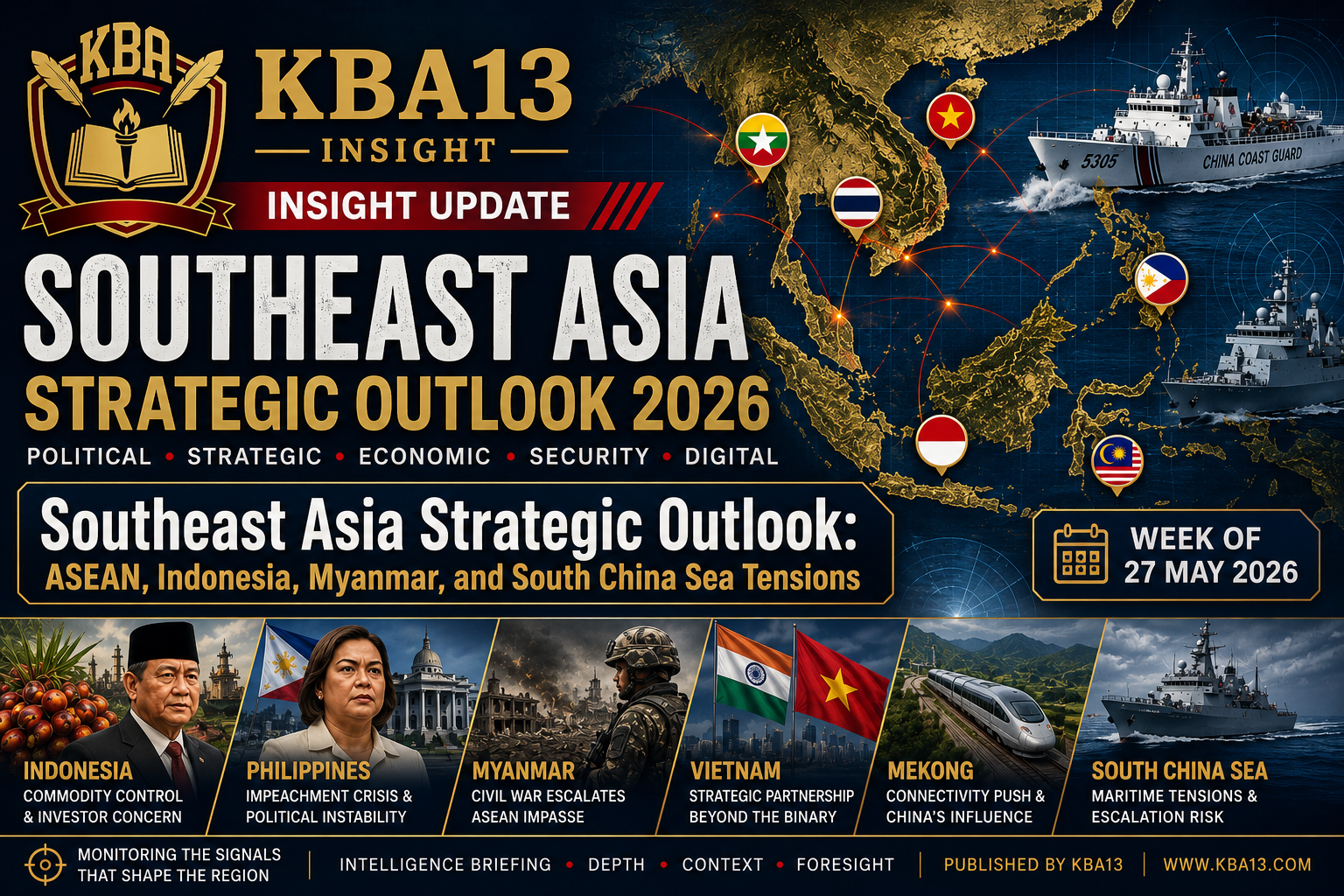
Southeast Asia enters the final days of May 2026 under compounding strategic pressure. The 48th ASEAN Summit in Cebu, convened on 7–8 May under the Philippines’ chairmanship, was defined less by regional ambition than by external shock. The Iran crisis and its energy market consequences dominated closed-door sessions, overshadowing the bloc’s stated priorities of food security and maritime governance. Leaders emerged with a Chair’s Statement long on reassurance and short on mechanism, reflecting the bloc’s structural difficulty in translating convening power into decisive action.
Indonesia’s strategic trajectory is the region’s single most consequential variable this week. President Prabowo Subianto’s announcement on 20 May that his government will assume direct state control over palm oil, thermal coal, and nickel exports has shaken investor confidence and reignited concern about policy predictability under his administration. The move arrives alongside an ambitious 2027 budget address projecting 5.8–6.5 percent growth, but markets have responded with skepticism: Bloomberg’s assessment on 20 May was stark, characterizing Prabowo’s economic approach as steering Indonesia toward ‘currency instability and political chaos.’
In the Philippines, the political crisis between the Marcos and Duterte families has entered its most acute institutional phase. The Senate formally launched the impeachment trial of Vice President Sara Duterte on 18 May, as her father, Rodrigo Duterte, faces confirmation of crimes against humanity charges at the International Criminal Court in The Hague. The crisis has paralyzed sections of the Philippine legislature and injected uncertainty into Manila’s capacity to sustain its ASEAN chairmanship agenda.
The South China Sea remains a zone of managed friction punctuated by deliberate escalation. A Chinese research vessel, the Xiang Yang Hong 33, triggered a fresh exchange of warnings between Beijing and Manila on 8 May after the Philippine Coast Guard conducted aerial surveillance near Iroquois Reef. The incident illustrates Beijing’s continued use of so-called scientific operations to project its presence in contested waters, while the Philippines maintains that such activity constitutes harassment within its exclusive economic zone.
Myanmar’s civil war shows no signs of resolution. ACLED data confirms an upward trajectory in airstrike lethality through April and into May 2026. The Myanmar National Democratic Alliance Army’s seizure of Kutkai from the Ta’ang National Liberation Army in April has reshuffled alliance dynamics in the northeast, while the junta continues to employ paramotor attacks and artillery bombardment against civilian infrastructure in Sagaing and Kachin. ASEAN leaders in Cebu expressed frustration with the Five-Point Consensus’s complete failure to deliver progress after five years.
The US–China trade architecture continues to shape regional economic choices in ways that defy simple framing. A US Supreme Court ruling struck down tariffs imposed under the International Emergency Economic Powers Act earlier this year, but the administration moved immediately to reconstruct its tariff wall through alternative statutory mechanisms, preserving chronic uncertainty for Southeast Asian exporters. A US trade investigation into alleged excess industrial capacity was launched on 11 March against sixteen major partners, including Indonesia, Malaysia, Thailand, and Vietnam.
Vietnam’s diplomatic posture has been active and purposeful. President To Lam’s state visit to New Delhi in early May, which led to an upgrade to an ‘Enhanced Complete Strategic Partnership’ and a bilateral trade target of USD 25 billion by 2030, reflects Hanoi’s ongoing efforts to build strategic depth outside the US–China binary. Vietnam’s semiconductor exports to the United States have continued to surge, reinforcing its position as a critical node in the region’s electronics supply chain.
Mainland Southeast Asia is experiencing significant investment in connectivity. On 12 May, Laos, Vietnam, Cambodia, Thailand, Myanmar, and China announced the Mekong-Lancang Heritage Rail Network, an ambitious cross-border infrastructure project that deepens China’s physical integration with the mainland. The Mekong River Commission simultaneously recorded the signing of a Laos–Thailand MOU on navigation safety and pollution prevention, signaling incremental regulatory progress amid broader water-governance tensions.
Thailand’s domestic security continues to generate diplomatic noise. The arrest of four police officers and a civilian in Sa Kaeo province for allegedly kidnapping and extorting five Chinese nationals has exposed cross-border criminal networks operating through organized law enforcement. The case has been escalated to the national level, with investigators tracing communications to affiliates across the Myanmar border — a pattern consistent with scam compound operations that have drawn regional and international scrutiny.
The strategic outlook for the week ahead centers on three variables: the pace of Indonesia’s commodities policy rollout and its effect on foreign investment flows; the trajectory of the Philippine Senate’s impeachment proceedings and their knock-on effect on Manila’s ASEAN chairmanship credibility; and any further escalation in the South China Sea following the Iroquois Reef research vessel incident. All three carry second-order effects that extend well beyond national borders.
2. ASEAN Architecture and Regional Governance
The 48th ASEAN Summit, held in Cebu on 7–8 May 2026, was the first major leadership convening under the Philippines’ chairmanship, which carries the theme ‘Navigating Our Future, Together.’ The summit was deliberately scaled back from its originally planned format, with Philippine President Ferdinand Marcos Jr. ordering a reduction in non-essential activities and shifting approximately 650 preparatory meetings to virtual formats. The rationale was partly financial and partly strategic: Manila chose to concentrate diplomatic bandwidth on the issues most likely to produce visible outcomes.
Energy security dominated the summit’s substantive agenda, a direct consequence of the Middle East crisis and its effects on global oil and gas markets. Leaders expressed concern over supply disruptions affecting fuel prices across the region, with the Chair’s Statement calling for ‘expedited ratification’ of the ASEAN Framework Agreement on Petroleum Security. The agreement has been in negotiation for years; the crisis has given it renewed political urgency, though the institutional machinery for ratification remains slow.
ASEAN Secretary-General Dr. Kao Kim Hourn, in his post-summit briefing to the Jakarta diplomatic corps, highlighted three principal outcomes: alignment on energy resilience measures, a reaffirmation of the bloc’s commitment to the Code of Conduct process in the South China Sea, and the adoption of new food security protocols amid supply chain stress from the Iran conflict. Each represents a political signal rather than a binding mechanism, consistent with ASEAN’s preference for consensus-based gradualism.
Myanmar’s status within the bloc remains the most acute governance failure on the ASEAN agenda. The Five-Point Consensus, adopted in April 2021 as a framework for de-escalation, has produced no material change in the junta’s conduct. At Cebu, Marcos acknowledged that ‘many members aired their frustration about the lack of progress,’ while simultaneously noting that ‘Myanmar is part of the ASEAN family.’ The language reflects ASEAN’s structural bind: it lacks the coercive tools to compel compliance but is unwilling to expel a member state.
Thailand’s reported advocacy at Cebu for Myanmar’s normalization — including the use of Aung San Suu Kyi’s transfer from prison to house arrest as diplomatic ballast—illustrates how individual member states continue to pursue divergent Myanmar policies within the ASEAN framework. This internal incoherence has been a persistent obstacle to collective leverage. Four member states — Laos, the Philippines, Thailand, and Vietnam — reportedly sent observers to Myanmar’s contested electoral process earlier this year, despite ASEAN’s refusal to do so as an institution.
The 2026 chairmanship coincides with two significant ASEAN anniversaries: the five-year mark of the Five-Point Consensus and the ten-year anniversary of the 2016 South China Sea arbitral tribunal ruling. Both carry political weight that Beijing is acutely aware of. The Philippines’ decision to publicly push for a conclusion of the Code of Conduct negotiations by year-end — articulated by Foreign Secretary Maria Theresa Lazaro at the ASEAN retreat in Cebu — has been assessed by Chinese analysts as structurally non-viable. China’s leading South China Sea scholar Wu Shicun stated publicly in March that a signed COC under Philippine chairmanship was ‘100 percent not likely.’
The ASEAN-China Comprehensive Strategic Partnership, now five years old, is due for a formal stocktaking review in 2026. This exercise will take place against a backdrop of heightened maritime friction, Philippine assertiveness over the arbitral ruling, and ongoing questions about the bloc’s strategic autonomy. The review is unlikely to produce a dramatic change in formal partnership architecture, but it will serve as an indicator of how member states collectively manage their relationship with China when its terms are explicitly on the table.
ASEAN’s institutional design—unanimous consensus, non-interference, and bloc-level convening rather than bloc-level enforcement—continues to define its ceiling as a security actor. Analysts at the ISEAS-Yusof Ishak Institute have consistently noted that the gap between the bloc’s convening power and its collective risk-management capacity is not a temporary political failure but a structural feature. The 2026 chairmanship has not changed this calculus; it has instead highlighted it through the juxtaposition of Manila’s ambitious agenda and the modest outcomes of the Cebu summit.
Timor-Leste, which formally joined ASEAN on 26 October 2025 as its eleventh member, has participated in its first full chairmanship cycle this year. Dili’s integration into ASEAN decision-making remains in its early stages, and the new member has maintained a low profile at the institutional level. Its entry nevertheless marks a geopolitically meaningful expansion of the bloc’s geographic reach into the western Pacific periphery, and Timor-Leste’s hydrocarbon interests in the Timor Sea add a new dimension to ASEAN’s energy governance agenda.
The 49th ASEAN Summit, scheduled for November 2026 under continued Philippine chairmanship, will be the year’s second major leadership convening. By November, the contours of the COC negotiation’s trajectory under Manila’s watch will be clearer, and the effects of Indonesia’s shift in commodity policy — and its diplomatic reverberations — will be more legible. The November summit also arrives in proximity to Malaysia’s election cycle, which is expected to begin positioning in late 2026 or early 2027, adding another layer of internal political flux to the bloc’s diplomatic management.
3. Energy, Economics, and Trade
The Middle East crisis — specifically the conflict involving Iran — has been the most disruptive exogenous shock to Southeast Asia’s economic environment in 2026. Regional leaders gathered in Cebu not to discuss their own economies in isolation, but to manage the downstream effects of a conflict in which none of them is a direct party. Energy price volatility has affected inflation, household purchasing power, and government fiscal projections across the bloc, with fuel importers among ASEAN’s lower-income members most acutely exposed.
The US trade environment remains in flux, but with a distinctive regional dynamic. Reciprocal tariffs imposed under the International Emergency Economic Powers Act were struck down by the US Supreme Court, but the administration has moved swiftly to reconstruct its tariff architecture through alternative legal instruments. A US trade investigation into alleged excess industrial capacity was launched on 11 March against sixteen partners, including four major ASEAN economies: Indonesia, Malaysia, Thailand, and Vietnam. The investigation targets suspected transshipment of Chinese goods through Southeast Asian supply chains.
Southeast Asia’s export resilience has nonetheless been notable. Data through early 2026 indicate that the region has absorbed and even benefited from US–China trade decoupling, with American import demand for electronics, textiles, and machinery from Vietnam, Malaysia, and Thailand remaining robust. Vietnam’s rise as a major semiconductor exporter to the United States reflects genuine supply chain repositioning, not merely transshipment arbitrage. However, the structural vulnerability of this position — dependent on US political tolerance—remains a latent risk.
Indonesia’s announcement on 20 May that the government will take direct state control over exports of palm oil, thermal coal, and nickel products has become the week’s most consequential economic development. Bloomberg described the move as a ‘sweeping and sudden assertion of power,’ evoking Indonesia’s past statist economic episodes. The policy, framed by Prabowo as a mechanism to prevent Indonesia from becoming trapped as a middle-income nation, has alarmed foreign investors and prompted concerns about regulatory predictability. Indonesia dominates global markets in all three commodities.
The commodities control announcement has been interpreted in Jakarta’s business community as an extension of Prabowo’s broader ambition to lift annual growth to eight percent — a target that most independent analysts regard as aspirational rather than near-term achievable. In the 2027 budget framework presented to the House of Representatives on 20 May, Prabowo projected growth of 5.8–6.5 percent for 2027, with the fiscal deficit maintained within a range of 1.8–2.4 percent of GDP. These figures represent a downward revision from the 8% aspiration, suggesting some calibration in response to market pressure.
The Lowy Institute’s assessment of the region’s broader trade resilience characterizes Southeast Asia as ‘navigating today’s trade and geoeconomic turbulence while continuing to prosper,’ noting that exports to the United States have grown as Southeast Asian goods have displaced Chinese goods in the American market. The second China shock—defined as the surge of competitively priced Chinese goods into Southeast Asian markets—has been ‘mostly growth-enhancing’ by providing cheaper intermediate inputs, even as it disrupts some local producers. This is a structurally ambivalent position.
Vietnam’s semiconductor trajectory is a standout within the regional economic picture. US imports of Vietnamese electrical machinery and equipment rose 35 percent year-on-year in May 2025, and the trend has continued into 2026. President To Lam’s visit to India, which set a bilateral trade target of USD 25 billion by 2030, reflects Hanoi’s active work to diversify its export destination mix. Vietnam currently sends approximately 50 percent of its exports to either China or the United States — a concentration that officials have privately acknowledged as a strategic vulnerability.
The ASEAN Economic Community’s 2026–2030 Strategic Plan, announced earlier this year, aims to deepen integration across digital transformation, supply-chain security, and uneven development. Progress on implementation has been slow, constrained by the same domestic political pressures that have complicated ASEAN’s collective governance. Malaysia, which is navigating its own election positioning cycle under Prime Minister Anwar Ibrahim, has been particularly focused on domestic economic management rather than regional integration leadership.
Thailand exited a 25-year-old joint offshore energy exploration agreement with Cambodia on 5 May, following last year’s armed conflict between the two countries. The termination leaves unresolved overlapping territorial claims in the Gulf of Thailand, which Cambodia has indicated it will now seek to address through international legal channels. The hydrocarbons in the disputed zone are commercially significant, and their inaccessibility continues to impose real economic costs on both countries. The dispute’s resolution timeline is now uncertain.
Digital economy investment continues to flow into the region at scale. Malaysia and Thailand remain leading destinations for data center construction, driven by demand for AI infrastructure and competitive energy pricing. Analysts have begun describing 2026 as the inflection year when artificial intelligence shifts from experimentation to operational infrastructure across Southeast Asia. This dynamic intensifies competition for digital sovereignty — particularly over where data is stored and who controls it — and places significant additional strain on regional electricity grids at a moment when energy security is already under pressure.
4. Myanmar Crisis Watch
Myanmar has now entered its sixth year of civil war. As of late May 2026, the conflict has killed between 89,200 and 96,000 people according to ACLED data compiled through the start of this year, while between 3.2 million and 3.5 million people remain internally displaced. The humanitarian infrastructure inside the country has been systematically degraded by five years of military targeting of hospitals, schools, and food supply routes. No credible ceasefire framework exists between the principal belligerents.
The military’s tactical posture in 2026 reflects a calculated strategy of attrition. The Tatmadaw has continued to rely on airstrikes, artillery bombardment, and paramotor attacks against civilian areas, with over 135 paramotor attacks recorded since December 2024. These attacks—using motorized paragliders against civilian gatherings—have been assessed by Human Rights Watch as a deliberate tactic to drive wedges between resistance forces and the rural population. In Cebu, several ASEAN members expressed frustration at the continuing civilian toll, though no new mechanism was proposed.
The balance of armed forces in northeastern Myanmar shifted significantly in April 2026 when the Myanmar National Democratic Alliance Army seized the town of Kutkai from the Ta’ang National Liberation Army. ACLED assessed this as reflecting ‘shifting strategic dynamics’ in northern Shan State. The MNDAA, a Kokang Chinese-aligned force, had previously been subject to Chinese-imposed ceasefires; its renewed offensive activity suggests either a relaxation of Chinese restraint or an independent decision to escalate by the group’s leadership.
China’s role in Myanmar’s conflict management remains the most consequential external variable. Beijing maintains relationships with multiple armed actors, including several ethnic forces that operate in border areas important to China’s economic connectivity—such as rare earth mining, the Muse–Lashio road, and cross-border trade corridors. The key question in 2026 is whether the Tatmadaw can secure the road from Lashio to Muse without triggering a Chinese reaction that re-imposes ceasefires on allied forces. That tension has not been resolved.
Rare earths have become a distinct strategic flashpoint within the Myanmar conflict. Myanmar is an increasingly significant upstream source of rare earth elements, but production is concentrated in areas where ethnic armed groups exert fragmented control. As the global critical-minerals contest intensifies—particularly given US dependence on China for rare-earth processing—Myanmar’s extractive geography has become a subject of active strategic interest to multiple external parties, none of which have clean hands in the conflict.
The junta’s nominal election process, announced for 2026 in phases beginning in January, has been widely dismissed by regional and international observers as lacking credibility or inclusivity. The National Unity Government — the civilian administration formed in opposition to the coup — has rejected the process entirely. Four ASEAN member states reportedly sent observers despite the bloc’s institutional refusal to participate, an incoherence that has further undermined whatever residual diplomatic pressure ASEAN might apply.
Thailand’s position on Myanmar normalization has been the most active among ASEAN members, partly driven by the permeability of its border and the direct security costs it incurs from the conflict’s spillover. Bangkok has used the reported transfer of Aung San Suu Kyi from prison to house arrest as a basis for advocating Myanmar’s reintegration into ASEAN processes. This position has been resisted by other members — particularly Malaysia and Indonesia — who have conditioned normalisation on demonstrable political progress rather than symbolic gestures.
The humanitarian access situation has worsened through 2026. UN-coordinated relief operations face systematic obstruction from the junta, which treats external aid as a potential resource for resistance forces. Cross-border humanitarian corridors through Thailand and China remain the primary access routes, both of which are subject to political conditions that limit scale. The UN estimates that 18.6 million people require humanitarian assistance inside Myanmar — a figure that has grown every year since the coup.
The Arakan Army’s consolidation of Rakhine State remains one of the conflict’s most consequential developments. Having secured Maungdaw in December 2024, the AA now controls the majority of Rakhine State’s territory and has established parallel governance structures. Its relationship with the Rohingya population — historically fraught — remains contested, with reports of both accommodation and exclusion. The AA’s control of the Bangladesh border has complicated humanitarian access and created new border tensions with Dhaka.
ASEAN’s Five-Point Consensus, five years after its adoption, has produced no material outcome by any credible metric. The junta has ignored it; the resistance has rejected it as legitimizing the coup; and ASEAN member states have disagreed on how to enforce, adapt, or abandon it. The 48th Summit’s inability to offer a revised framework suggests the bloc will carry this failure into the second half of 2026 without a strategic reset. The Myanmar crisis is, at its core, a test of whether ASEAN’s non-interference doctrine has any practical utility when a member state is actively destroying itself.
Philippines Political Dynamics
The Philippines is simultaneously hosting the ASEAN chairmanship and managing one of the most severe constitutional crises in its post-Marcos-era democratic history. The impeachment trial of Vice President Sara Duterte, formally launched in the Senate on 18 May, and the ongoing ICC proceedings against her father, former President Rodrigo Duterte, have together created an environment of institutional turbulence that is consuming significant political capital in Manila. The Marcos administration’s capacity to maintain strategic focus on its regional leadership role is being tested.
Sara Duterte was impeached by the House of Representatives for the second time in May 2026, following a complex sequence of legal maneuvers. A first impeachment in February 2025 was transmitted to the Senate but was remanded to the House; the Supreme Court later declared the impeachment unconstitutional, triggering a one-year ban. New complaints were filed in February 2026 and formally initiated on 23 February, resulting in a unanimous vote of 53–0 by the House Committee on Justice to find probable cause for impeachment. The House then voted to endorse the articles to the Senate.
The Senate’s convening as an impeachment court has been accompanied by significant institutional turbulence of its own. Duterte allies staged a leadership coup in the Senate to wrest control of the chamber’s direction, with the objective of influencing the composition of the panel of senators-judges. The dramatic appearance of Senator Ronald ‘Bato’ dela Rosa — a former national police chief and ICC co-conspiracy target who had been in hiding since November 2025 — to cast a decisive vote on Senate leadership before immediately returning to concealment encapsulates the surreal quality of Philippine politics at this moment.
Rodrigo Duterte’s ICC proceedings have continued through May 2026. On 22 April, the court ruled on an appeal by Duterte’s lawyers challenging the Pre-Trial Chamber’s October 2025 affirmation of the ICC’s jurisdiction. His lawyers had requested termination of all proceedings and his immediate unconditional release. The court’s decision on that appeal and the subsequent confirmation-of-charges process will determine the timeline for a full trial. Duterte faces three counts of crimes against humanity linked to killings conducted between November 2011 and March 2016.
Testimony before the House Committee on Justice in April 2026 introduced significant new allegations into the public record. Ramil Madriaga, who claimed to have served as Sara Duterte’s ‘bagman,’ testified that he delivered 125 million pesos in cash within 24 hours on her instructions and alleged that campaign funds were sourced from illegal offshore gaming and drug trafficking operations. He also alleged that Rodrigo Duterte had plotted to assassinate or stage a coup against President Marcos. Sara Duterte has declined to appear before the committee and has sought a Supreme Court injunction to halt proceedings.
President Marcos has sought to publicly distance himself from the impeachment process, characterizing it as a legislative matter. This posture is constitutionally accurate but politically convenient: the Marcos camp has benefited from the Duterte family’s legal exposure while maintaining the appearance of institutional neutrality. The impeachment’s outcome — whether conviction, acquittal, or procedural collapse—will significantly shape the 2028 presidential race, in which Sara Duterte had been positioning herself as a leading contender. A conviction would impose a lifetime ban on public office.
The Marcos–Duterte feud traces its origins to the political alliance formed for the 2022 elections and its subsequent collapse. The elder Duterte’s arrest on an ICC warrant—facilitated in part by Marcos’s government — is the clearest expression of the rupture. The Duterte family retains a formidable political base in Mindanao and in communities where the anti-drug campaign was popular. The political war between the families is therefore not merely a Manila elite contest; it maps onto geographic and class cleavages that will be activated in any future national election.
The implications of Philippine domestic politics for the South China Sea are significant. The Duterte-era policy of accommodating China in the South China Sea in exchange for investment and diplomatic warmth was one of the clearest foreign policy differentiators between the two families. A Duterte political comeback — even by Sara rather than Rodrigo — would carry questions about whether Manila’s current assertiveness in the South China Sea would be sustained. This dimension of the political crisis has not gone unnoticed in Beijing, Washington, or among ASEAN partners.
The Philippine economy presents a more stable picture than the political environment might suggest. The Marcos administration’s economic management has broadly maintained investor confidence through its fiscal and monetary institutions, even as the political crisis generates noise. However, the impeachment proceedings and the legislative gridlock they cause have slowed the passage of key economic legislation, and the uncertainty premium associated with political risk has begun to show up in some market indicators. Business confidence surveys conducted in May show a modest deterioration.
The week ahead for the Philippines is dominated by the Senate proceedings. The impeachment trial’s pace, the question of whether additional witnesses with Madriaga-level allegations will testify, and the Supreme Court’s handling of Sara Duterte’s petition for a temporary restraining order are the three variables most likely to determine whether the crisis deepens or stabilises. In the background, the Philippines will continue to manage its ASEAN chairmanship responsibilities — hosting working groups, advancing the COC discussion, and navigating the Myanmar impasse — with whatever political bandwidth Manila can spare.
6. Indonesia Strategic Affairs
Indonesia has entered a period of heightened strategic uncertainty under President Prabowo Subianto, whose administration has in the past week made its most consequential and controversial economic policy decision to date. The announcement on 20 May that the state will take direct control of exports of palm oil, thermal coal, and nickel — three sectors in which Indonesia holds dominant global positions — has been characterized by Bloomberg as a move that ‘evokes the country’s past authoritarianism and state grip on the economy.’ ‘ The policy’s practical implementation details remain unclear, amplifying investor anxiety.
Prabowo’s statist economic instincts have been apparent since he assumed office, but the commodities control announcement represents a qualitative escalation. The stated rationale—preventing Indonesia from becoming ‘stuck as a middle-income nation’—recognizes a genuine and long-standing structural challenge, but the chosen mechanism runs counter to the investment liberalization and regulatory predictability that most development economists identify as preconditions for sustained high growth. The rupiah and Indonesian equity markets responded with increased volatility in the days following the announcement.
The 2027 State Budget Macroeconomic Framework, presented to the House of Representatives on 20 May, projects growth of 5.8–6.5 percent with a fiscal deficit of 1.8–2.4 percent of GDP. These targets are considerably more modest than the eight percent growth goal that defined Prabowo’s original economic vision. The IMF designated Indonesia a ‘global bright spot’ in January 2026, attributing this to sustained five percent annual growth, low debt-to-GDP ratios, and well-anchored inflation. That assessment was issued just days before Indonesian equity markets suffered two consecutive trading halts amid a seven percent decline.
The structural tension in Indonesia’s economic position is clear. Net export growth remains strong, and Indonesia’s commodity endowments provide genuine strategic leverage in a world increasingly attentive to critical minerals and energy security. But foreign direct investment has weakened, the rupiah has come under pressure, and the interest payment burden on state debt is projected to consume 19 percent of budgeted revenue in 2026 — up from 17 percent in 2024. The trajectory of debt service costs constrains the fiscal room available for social spending and infrastructure investment.
The Makan Bergizi Gratis program — a universal school meals initiative projected to cost IDR 300–330 trillion — is Prabowo’s flagship social policy and has been politically insulated from budget-efficiency drives that have affected other programs. Its political protection imposes costs elsewhere. Social registries are being tightened, eligibility criteria narrowed, and transfers to local governments reduced from 25 percent of total spending to 18 percent — a significant recentralisation of fiscal authority that has generated friction with regional administrators.
Indonesia’s political consolidation under Prabowo is proceeding through multiple channels simultaneously. A proposed bill to eliminate direct elections for provincial governors and other regional leaders remains in circulation, which critics identify as a mechanism to concentrate political power at the center. Pressure on press organizations has been noted by media freedom watchdogs. A struggle over police positions within the civil service reflects intra-elite competition for institutional control. Each of these might be manageable individually; collectively, they outline democratic backsliding.
Indonesia’s relationship with the United States remains in active negotiation. Trade discussions that were reportedly near conclusion in late December 2025 have continued into 2026, with major outstanding issues around intellectual property, digital economy access, and non-tariff barriers. The commodities control announcement has complicated the trade-negotiation landscape, as American businesses with interests in Indonesian palm oil, coal, and nickel supply chains now face an additional layer of regulatory uncertainty.
Indonesia’s position in the South China Sea is structurally different from the Philippines’: Jakarta does not claim features in the Spratlys and has historically preferred a posture of principled neutrality on the nine-dash line while protecting its own EEZ around the Natuna Islands. That posture has become more difficult to maintain as Chinese fishing fleets and coast guard vessels have become more active in the Natuna area. Indonesia’s military has conducted a series of assertive responses over the past two years, and this posture is expected to continue under Prabowo, whose defense background makes him comfortable with forward deterrence.
Prabowo’s first year in office has been characterized by an unusual combination of diplomatic ambition — he has maintained active engagement with both Washington and Beijing — and domestic economic disruption. His foreign policy posture has been broadly consistent with Indonesia’s strategic tradition of autonomous balancing, but the accumulation of domestic economic concern has begun to frame his international credibility. A leader who cannot stabilize his own economy is a less effective strategic interlocutor, and Indonesia’s partners are beginning to calculate accordingly.
The week ahead in Indonesian strategic affairs is dominated by market reaction to the commodities control policy. Business and investor communities will be watching closely for any clarification, modification, or rollback of the announcement’s most alarming provisions. The Prabowo administration’s track record of sudden, sweeping policy declarations followed by partial implementation suggests that the policy’s final shape may differ from its initial framing. But the uncertainty itself imposes costs that accumulate regardless of what the final regulatory framework looks like.
7. South China Sea and Maritime Security
The South China Sea produced a fresh incident in early May when the Chinese research vessel Xiang Yang Hong 33 operated near Iroquois Reef — a feature well within the Philippines’ exclusive economic zone—while conducting what Beijing described as a ‘legitimate marine ecological survey.’The Philippine Coast Guard dispatched an Islander aircraft that conducted aerial surveillance of the vessel, which the China Coast Guard described as ‘deliberate harassment.’ Both sides issued formal warnings of ‘further countermeasures,’ marking another iteration in an action-reaction cycle that has intensified over the past two years.
The use of research vessels as instruments of maritime presence assertion is a well-documented element of China’s South China Sea strategy. By deploying vessels under a scientific activity designation, Beijing can generate strategic facts on the water — mapping seabed topography, conducting acoustic surveys, and establishing operational familiarity — while minimising the legal and diplomatic exposure associated with overt military deployments. The Philippines has consistently challenged this framing, arguing that the presence of state-affiliated research vessels in its EEZ without consent constitutes a violation of international law.
Earlier in April, satellite imagery obtained by Reuters showed China deploying fishing boats, a coast guard vessel, and a new floating barrier across the entrance to Scarborough Shoal. The move continued a pattern of incremental physical changes at Scarborough that have progressively restricted Filipino fishermen’s access to traditional fishing grounds inside the shoal’s lagoon. The Philippines dispatched its own vessels in response. The shoal has been under de facto Chinese control since 2012, and Beijing’s infrastructure improvements there represent a long-term consolidation of that control.
The United States, Australia, and the Philippines concluded four days of joint maritime drills in the South China Sea in mid-April, deploying warships, fighter aircraft, and surveillance assets. These exercises preceded the annual Balikatan war games beginning 20 April, which this year featured Japan as a full participant for the first time. Japan’s inclusion in Balikatan marks a significant expansion of the trilateral security architecture among Washington, Manila, and Tokyo, with direct implications for Beijing’s calculus of the costs of a South China Sea escalation.
More than a dozen additional partner countries participated in the April exercises alongside the core US–Philippines–Australia–Japan grouping. This multilateralisation of South China Sea maritime security engagement is a deliberate US strategy to raise the diplomatic and operational costs of Chinese coercive action. It complicates Beijing’s preferred framing of the dispute as a bilateral territorial matter between China and individual ASEAN claimants, by visibly internationalizing the response architecture.
The Code of Conduct negotiation continues in parallel to the maritime friction, producing a diplomatic paradox: Manila is simultaneously prosecuting the most assertive Philippine posture in the South China Sea in a generation and championing the COC process as ASEAN chair. Foreign Secretary Lazaro’s call at the ASEAN Foreign Ministers’ Retreat in January for a COC conclusion by year-end was assessed by Chinese analysts as structurally unrealistic. Wu Shicun, founding president of China’s National Institute for South China Sea Studies, stated publicly that a signed COC under Philippine chairmanship was categorically impossible, citing Manila’s insistence on incorporating the 2016 arbitral ruling.
Vietnam has maintained a parallel but quieter assertiveness in the South China Sea throughout 2026. Hanoi has continued construction of infrastructure on features it occupies in the Spratly Islands, with analysts expecting completion of an expanded network of facilities by late 2026. Vietnam’s approach — build quietly, avoid public confrontation, maintain Chinese economic relations — reflects a different strategic logic from Manila’s public assertiveness, but points toward the same objective of consolidating physical presence before any eventual governance framework is agreed upon.
Indonesia’s position in the Natuna Islands adds a distinct dimension to the South China Sea picture. Unlike the Philippines, Indonesia does not assert territorial claims in the Spratlys, but it does possess an EEZ around the Natuna Islands that overlaps with China’s nine-dash line claim. Indonesian naval and coast guard responses to incursions by Chinese fishing vessels in the Natuna area have become more assertive under Prabowo. The distinction between Indonesia’s posture and the Philippines’ is one of diplomatic framing — Jakarta avoids characterizing the issue as a sovereignty dispute — but the operational reality is converging.
The broader architecture of maritime security in the South China Sea reflects a fundamental structural tension: the US military presence provides a deterrent against Chinese military action, but it does not and cannot prevent the incremental non-military tools — fishing fleets, coast guard deployments, research vessels, floating barriers — that China uses to generate facts on the water. This gap between deterrence and coercion management is the central operational challenge facing claimant states, and ASEAN’s COC process has not produced a mechanism adequate to address it.
The week ahead is likely to see continued diplomatic exchanges over the Xiang Yang Hong 33 incident. Both China and the Philippines have indicated further responses, and the pattern of escalation management at Iroquois Reef will be closely watched by regional partners, who will assess whether the Cebu summit’s energy-focused consensus has translated into any reduction in bilateral maritime friction. There is no current indication that it has.
8. Mainland Southeast Asia: Thailand, Vietnam, Mekong
Vietnam’s diplomatic activity in May 2026 has been its most consequential since To Lam’s re-election as president. His state visit to New Delhi — the first such visit of his presidency — produced an upgrade of bilateral ties to an ‘Enhanced Complete Strategic Partnership’ and the signing of 13 cooperation agreements. The bilateral trade target of USD 25 billion by 2030, up from approximately USD 16 billion today, reflects mutual interest in building commercial depth that gives both sides strategic flexibility. Vietnam’s deepening relationship with India is part of a deliberate diversification strategy away from dependence on either Washington or Beijing.
Vietnam’s semiconductor and electronics export performance has continued to attract strategic attention. As a major supplier of chips and electronics to the US market, Hanoi holds a position of genuine supply-chain significance that gives it leverage in trade negotiations. The US investigation into alleged industrial overcapacity and transshipment, launched in March, includes Vietnam — a signal that Washington’s tolerance for Vietnamese export surpluses, regardless of their origin, has limits. Hanoi has been managing this exposure through continued diplomatic engagement and increased purchases of US defence equipment.
Thailand’s political trajectory remains unsettled. The country’s general election, scheduled for 8 February 2026, proceeded amid ongoing civil-military tensions and constitutional debate. The election’s outcome and its implications for government formation have been the subject of regional analysis, with Thailand’s positioning on Myanmar — where Bangkok favours normalisation — closely watched. Thailand’s border economy is deeply enmeshed with the dynamics of the Myanmar conflict, including the cross-border scam compound networks that have drawn US and Chinese concern.
A security incident in Sa Kaeo province has escalated to the national level after four Thai police officers and a civilian were arrested for allegedly kidnapping and extorting five Chinese nationals. The case has exposed operational networks linking corrupt law enforcement personnel to criminal organisations that span the Thai-Myanmar border. National police spokesman Pol Lt Gen Trairong Phiwphan confirmed that investigators have traced phone records, financial transactions, and vehicle movements pointing to cross-border affiliates. The arrested officers worked across multiple units, complicating the institutional response.
Thailand’s rice export market is experiencing a modest correction. Thai five percent broken white rice, currently priced at approximately USD 429 per tonne FOB, faces limited price recovery prospects, with analysts estimating a ceiling of USD 10–15 per tonne in any near-term rebound. The Philippines, as a major importer, is absorbing roughly 300,000 tonnes of Vietnamese rice per month — a volume that reflects Vietnam’s continuing competitive advantage in price and logistics, and that limits Thailand’s room to recover market share without a significant shift in either currency rates or production costs.
The Mekong River Commission recorded a significant milestone on 12 May with the signing of a Memorandum of Understanding between Laos and Thailand on harmonised regulations for navigation safety and pollution prevention on the Mekong River in Bangkok. The MOU represents incremental progress in the governance of a river system under significant pressure from upstream Chinese dam construction and reduced water flows. The Xayaboury Dam in Laos and the Yunnan dam cascade in China have measurably reduced the Mekong’s flow in critical stretches, affecting fisheries and agriculture across the lower basin.
The Mekong-Lancang Heritage Rail Network, announced on 12 May, is the most architecturally significant connectivity development in the region this week. The network, which involves Laos, Vietnam, Cambodia, Thailand, Myanmar, and China, builds on the Laos–China Railway opened in 2021 and extends its integration logic across the entirety of mainland Southeast Asia. The branding as a ‘heritage’ network reflects a deliberate framing that positions Chinese infrastructure investment as culturally consonant with the Mekong region’s identity, rather than as external imposition.
The rail network announcement arrives in a context where China’s physical infrastructure presence in mainland Southeast Asia has become structurally embedded. Roads, railways, ports, and special economic zones financed or constructed by Chinese entities have given Beijing substantial leverage over the economic geography of Laos, Cambodia, and Myanmar in particular. The new network deepens this integration without dramatically changing its character — but the scale and cross-border ambition of the announcement indicates that China’s mainland connectivity strategy is accelerating rather than plateauing.
Cambodia is managing a delicate diplomatic transition following its armed conflict with Thailand last year. The termination of the joint offshore energy exploration agreement — a 25-year framework covering overlapping territorial claims in the Gulf of Thailand — has removed a longstanding mechanism for managing the bilateral economic relationship over disputed maritime zones. Phnom Penh has indicated it will now pursue resolution through the United Nations framework, a path that offers legal clarity in principle but adds years of uncertainty to any commercially viable development of the contested hydrocarbons.
Laos continues to occupy the structural position of a landlocked state caught between its Chinese economic patron and its need for functional relationships with Thailand and Vietnam. Its debt burden to China, incurred through the railway and hydropower projects, constrains fiscal autonomy. The navigation MOU with Thailand signals that Vientiane is proactively managing its bilateral relationships with Mekong neighbors, but the fundamental strategic fact of Laos’ economic dependence on China has not changed. Its participation in the Heritage Rail Network further deepens that integration.
9. Strategic Outlook: Signals to Watch
The most immediate signal to monitor in the week of 27 May is the trajectory of Indonesia’s commodity export control policy. Markets, investors, and trading partners will be watching for clarification, modification, or tactical retreat. Prabowo’s track record suggests the final regulatory architecture will differ from the most extreme implications of the initial announcement. But the signal the announcement sends — about the administration’s instincts, its tolerance for investor concern, and its theory of economic development — is itself the strategic fact. Even a softened implementation will leave a residue of policy risk premium attached to Indonesian assets.
The Philippine Senate’s impeachment trial of Sara Duterte will continue to generate political turbulence. The specific signal to watch is whether the Supreme Court grants the injunction she has requested to halt proceedings. If granted, the trial collapses for procedural reasons and the political crisis enters a new and potentially more volatile phase, with the Duterte camp claiming vindication. If denied, the trial proceeds and the senator-judges will eventually reach a verdict that determines her political fate. Either outcome reshapes the 2028 presidential race and, by extension, the question of whether Manila’s current South China Sea assertiveness is durable.
The situation at Iroquois Reef in the South China Sea warrants close tracking throughout the week. China’s indicated ‘further countermeasures’ following the Xiang Yang Hong 33 incident could take several forms: additional research vessel deployments, a coast guard response to Philippine surveillance, or a diplomatic escalation through formal protest channels. The Philippines, as ASEAN chair, is constrained in how aggressively it escalates bilateral friction while maintaining the posture of a neutral broker in the COC negotiations. Beijing may calculate that this constraint creates an exploitable space.
The US trade investigation launched in March against Indonesia, Malaysia, Thailand, and Vietnam enters a more consequential phase as preliminary findings take shape. The signal to watch is whether Washington moves toward formal tariff action against any ASEAN economy based on transshipment or excess-capacity findings. Any such action would trigger a significant diplomatic response from the targeted state and test the resilience of the bilateral trade agreements negotiated with Cambodia and Malaysia in late 2025. Vietnam is the highest-risk target given the scale of its surge in electronics exports.
Myanmar’s resistance infighting — marked in the weeks prior to this report by the MNDAA’s seizure of Kutkai from the TNLA — will continue to evolve. The strategic signal to watch is whether China intervenes diplomatically or operationally to re-impose ceasefires between the ethnic forces it has previously managed. Beijing’s calculus involves competing interests: it wants stability on its border and continued access to rare earth extraction, but it also wants to avoid committing resources to Myanmar’s internal stabilization when other priorities demand its attention. If Beijing stays passive, resistance fragmentation will likely deepen.
Vietnam’s diplomatic posture toward India, following To Lam’s state visit, warrants monitoring to assess follow-through. The ‘Enhanced Complete Strategic Partnership’ is a formal upgrade, but its content—which agreements are implemented, at what pace, and with what resource commitment—will determine whether it constitutes a genuine strategic deepening or a diplomatic gesture. India has been courting Southeast Asian states as part of its own Act East Policy; Vietnam is the most strategically consequential partner available, and its willingness to accept Indian investment in sensitive sectors like defence and technology will be the test.
Thailand’s internal political situation following the February election and its implications for Bangkok’s Myanmar policy remain an active signal. If the new government—whatever its composition — shifts toward greater pressure on the junta rather than accommodation, it would alter ASEAN’s internal balance on the Myanmar question and potentially open space for a revised engagement framework. Conversely, continued Thai support for normalization would further entrench the bloc’s inability to present a unified position. Bangkok’s calculation is driven primarily by border economics and security, not by principled commitment to democratic governance.
The Mekong governance environment will produce signals worth tracking as the Laos–China railway enters its second full year of operation and economic data begin to emerge. The key question is whether the anticipated economic development benefits for Laos — through freight revenue, tourism, and logistics positioning — are materializing at the scale projected, or whether the railway continues to generate debt service obligations that outpace its commercial returns. If the latter, it constitutes a data point in the broader regional debate about the terms of Chinese infrastructure investment and its long-term governance implications.
ASEAN’s internal coherence on South China Sea governance will be tested before the November summit. The Philippines’ push for a COC conclusion this year is running into structural resistance from Beijing and the skepticism of ASEAN states less directly exposed to Chinese maritime pressure. A meaningful signal will be whether Manila can secure, at minimum, a substantive interim document — a progress report, a set of agreed principles, or a tighter negotiating timeline — that allows it to claim momentum on the COC chairmanship without having achieved the conclusion it sought.
The broader strategic environment in which Southeast Asia operates has been shaped by a fundamental shift in US–China dynamics that neither accommodation nor confrontation has yet resolved. The ‘G2 flux,’ characterized by analysts — in which neither Washington nor Beijing holds uncontested primacy — creates a structural opportunity for regional states to exercise autonomous agency, but also a vulnerability to being instrumentalized in a contest they did not initiate. The signal that matters most in the weeks ahead is not any individual event but the cumulative direction of the region’s hedging: toward greater strategic autonomy and regional solidarity, or toward increasing alignment with one of the two poles. The evidence of May 2026 is mixed, and that ambiguity is itself the signal.
About The Author

Rekomendasi Bacaan KBA13 INSIGHT
Jika tulisan ini bermanfaat, dukung jurnal ini dengan mencari bukunya melalui tautan berikut:
- Buku-buku Kamaruzzaman Bustamam Ahmad di Periplus
- Koleksi Islamic Studies di Periplus
- Koleksi Geopolitics & Politik Internasional di Periplus
- Cari buku & perangkat baca di Shopee
- Cari di Blibli
Daftar lengkap: Rekomendasi Buku, Alat Tulis & Layanan. Tautan di atas adalah tautan afiliasi — KBA13 INSIGHT dapat memperoleh komisi kecil tanpa biaya tambahan bagi Anda.
Artikel Terkait
 KBA13 Insight Regional Update: Southeast Asia Under Pressure (Hormuz Shock, ASEAN Crisis, Myanmar, Indonesia, and the South China Sea in 2026)
 Southeast Asia Strategic Intelligence Update July 2026: Indonesia, Myanmar, South China Sea, and ASEAN Under Pressure
 Southeast Asia Strategic Outlook 2026: ASEAN, South China Sea Tensions, Prabowo’s Economic Doctrine, and the Future of Regional Order
 Southeast Asia Strategic Outlook 2026: South China Sea, Indonesia’s Economy, Myanmar Crisis, and ASEAN Energy Security
 Global Intelligence Briefing (7–12 July 2026): Iran War, US–China Rivalry, Ukraine, South China Sea, and Global Security Risks
Leave a Reply