KBA13 Insight · Book Review · Security & Intelligence
When the Mind Becomes a Battlefield:Annie Jacobsen, the CIA, the Nazis, and the History of Cognitive Warfare
The history of war is not only a history of weapons, armies, and technology. Behind every strategic decision lies a far more complex terrain: the human mind. Through Phenomena, Annie Jacobsen uncovers the hidden history of how the Nazis, British intelligence, the CIA, and the world’s great powers sought to understand humanity’s deepest territory: consciousness, belief, and perception. From Rudolf…
Summary
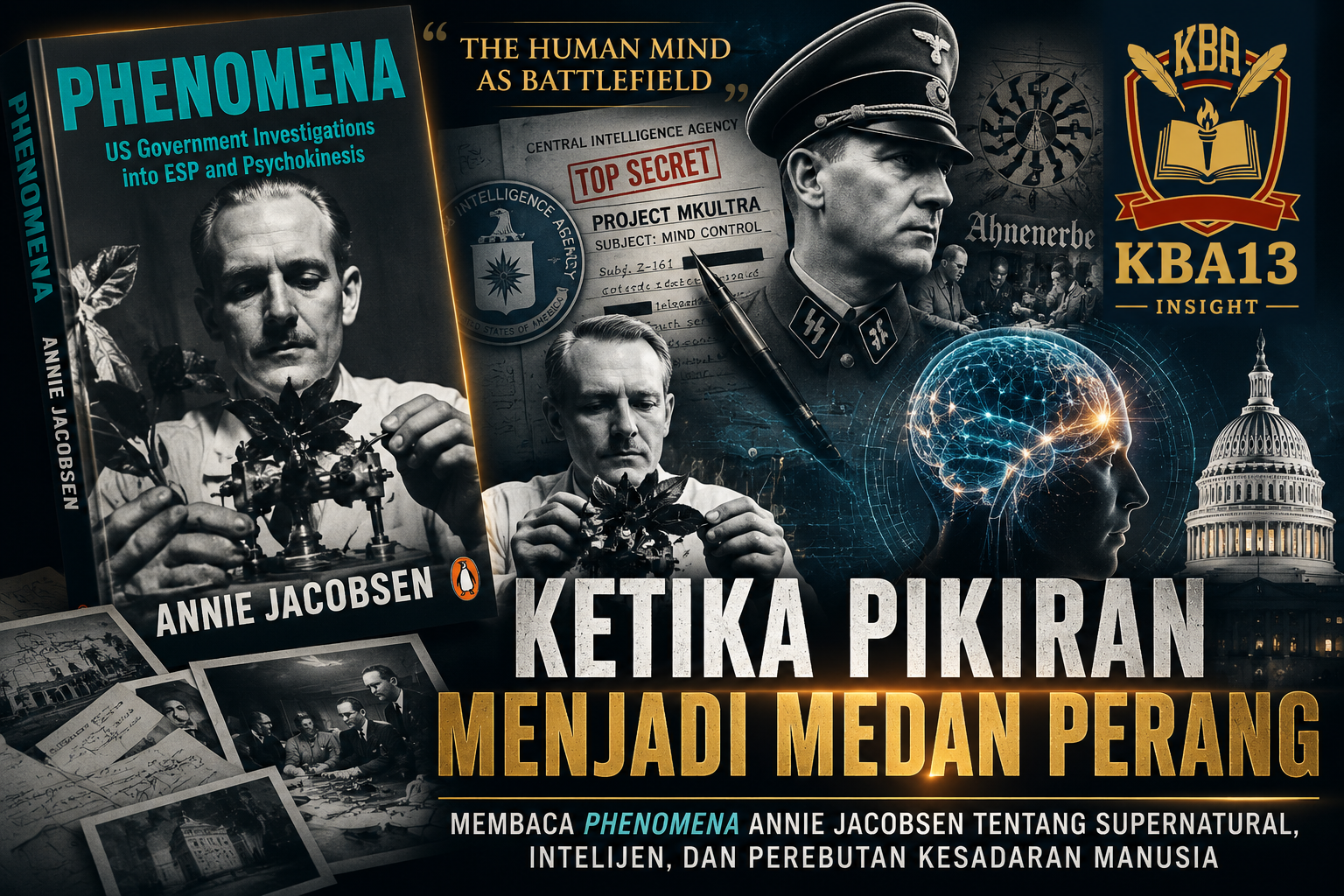
The history of war is not only a history of weapons, armies, and technology. Behind every strategic decision lies a far more complex terrain: the human mind. Through Phenomena, Annie Jacobsen uncovers the hidden history of how the Nazis, British intelligence, the CIA, and the world’s great powers sought to understand humanity’s deepest territory: consciousness, belief, and perception. From Rudolf Hess’s mysterious flight to Scotland, to Heinrich Himmler’s mystical experiments through the SS Ahnenerbe, to secret CIA projects such as Bluebird, Artichoke, and MKULTRA, one great pattern emerges: power always seeks to read human beings. This article examines how the search for the supernatural turned into intelligence study, how psychological warfare evolved into cognitive warfare, and why, in the age of artificial intelligence, the human mind has become the most important strategic battlefield of the twenty-first century.
Keywords
- Ahnenerbe
- Annie Jacobsen
- Artificial Intelligence
- CIA
- cognitive warfare
- Cold War Intelligence
- Future Warfare
- Heinrich Himmler
- Human Intelligence
- intelligence studies
Rudolf Hess and the Nazi War of the Mind
The history of intelligence carries one lesson that is often forgotten: states are not driven by weapons, classified documents, economies, or bureaucratic machinery alone. In the end, states are driven by human beings. And human beings carry something far more complicated than rational calculation: beliefs, fears, imagination, ambition, trauma, and their own way of reading the world. This is the gray zone Annie Jacobsen opens up in Phenomena as she traces the relationship between the supernatural, intelligence operations, and the struggle to control the human mind.
On 10 May 1941, Rudolf Hess carried out one of the most baffling acts in the history of World War II. As Deputy Führer of Nazi Germany, Hess was no peripheral figure. His position was extremely close to Adolf Hitler. Yet his decision to fly a plane alone to Scotland showed that even the very center of modern power could be swayed by factors lying far outside conventional military analysis.
Jacobsen shows that Hess’s flight took place within a psychological environment saturated with fascination for astrology, cosmic signs, and supernatural interpretation. For part of the Nazi elite, symbols and mythology were not merely stories from the past but were treated as a way of understanding history, national destiny, and the political future. The modern world and the mystical world ran side by side within the same corridors of power.
But the intelligence question was never whether the astrology itself was true or false. The far more important question was this: why would someone with access to a state’s strategic information allow a belief system to shape his political decisions? In security analysis, a person’s beliefs often become the entry point for understanding his behavior.
This is the difference between reading a person as an administrative object and reading a person as an intelligence object. Administration sees a person’s title. Intelligence reads a person’s mindset. For a leader does not act on the basis of reality alone, but on the basis of his interpretation of that reality.
When Hess landed in Scotland, his hope of opening secret political communication with Britain collapsed. Rather than becoming a bridge to peace, the flight turned into a propaganda crisis for the Nazis. Hitler subsequently sought to distance himself from Hess’s action, portraying it as a private decision that did not represent the state.
For the intelligence community, however, the Hess case produced a much larger lesson. If a belief could drive the actions of a member of the elite, then that belief could be studied as a strategic weakness. The human mind became an operational space: observed, analyzed, and, under certain conditions, manipulated.
The Hess case reveals that the wars of the modern age are not won solely by whoever holds the most powerful weapons. Wars are also won by whoever best understands how human beings think. Because before a decision appears in the political arena, that decision is first born in a hidden battlefield called the mind.
Astrology as an Intelligence Weapon
In modern warfare, victory is not always decided by the ability to destroy an enemy’s physical strength. Sometimes victory begins when one state manages to understand how its enemy sees the world. In Phenomena, Annie Jacobsen reveals a dimension rarely discussed in the history of World War II: how the world of symbols, astrology, and supernatural belief became part of intelligence operations and psychological warfare.
The Rudolf Hess case offered an important lesson to British intelligence. They observed that some actors within the Nazi circle were drawn to the mystical world and to symbolism. To an intelligence analyst, this was not merely a cultural oddity. It was strategic information. Any belief capable of influencing a person’s behavior can become an entry point for an operation.
This is where the figure of Louis de Wohl emerges, a Hungarian-German-born astrologer who later worked within the orbit of British intelligence operations. Publicly, de Wohl was known as an astrologer who wrote predictions and read the movements of the stars. In the context of war, however, his role was far more complex. Astrology was no longer merely a personal practice; it had turned into an instrument of propaganda.
British intelligence grasped one basic principle of perception warfare: to influence someone, you must enter through the language that target understands. If part of the Nazi elite believed in astrological symbols, then a message packaged in the language of astrology stood a chance of entering their psychological space. Operations of this kind did not aim to prove astrology, but to exploit the psychological effect of belief in astrology.
Jacobsen shows how the boundary between information, manipulation, and covert operation became razor-thin. Predictions, articles, and astrological messages could be designed as part of a propaganda war. Information was fed to a particular figure and then reflected back through the media so that it appeared to be an independent phenomenon. In the world of intelligence, perception is often more decisive than objective fact.
This strategy illustrates an old law of espionage: a person’s greatest weakness often stems from whatever he trusts most. When someone is too certain about a system of interpretation, that system can become a vulnerability. The enemy does not have to destroy that belief. The enemy only needs to understand how the belief works and steer it.
This phenomenon marks the beginning of what is now called cognitive warfare. The battlefield is no longer merely a geographic territory but also a territory of perception. Its ultimate goal is not simply to change the information a person holds, but to change the way a person understands that information.
The lesson of the astrology operations in World War II is not about supernatural power. Its greatest lesson is about the power of narrative. A state capable of reading its opponent’s psychology gains the ability to enter the most hidden space in war: not the bunker, not the military headquarters, but the human mind.
Himmler and the SS Mystical Machine
If Rudolf Hess showed how the personal belief of a single member of the elite could become a strategic problem, Heinrich Himmler revealed a far larger phenomenon: how a modern state could attempt to turn myth into an ideological machine. In Phenomena, Annie Jacobsen leads the reader into another side of Nazi Germany, one often hidden behind the conventional narrative of war. The Nazis did not build their strength through military industry, political propaganda, and security organizations alone. Within part of its power structure lay an effort to build legitimacy through an alternative history, ancient symbols, and a search for the mystical roots of the Aryan race.
Himmler, as leader of the SS, held a deep fascination with the symbolic world and ancient Germanic heritage. In his mind, Nazi glory could not be adequately explained through Adolf Hitler’s political triumphs or the military power of the Wehrmacht alone. What was needed was a grand mythology capable of creating the impression that the Nazi project was the continuation of a nation’s long historical journey as a chosen people. Power requires a story. A state requires a narrative. Totalitarian regimes understand that human beings do not merely obey rules; human beings also move because of the myths that give meaning to their existence.
From this arose an institution called the Ahnenerbe, an SS research body established to search for, interpret, and often force a connection between the Nazis and ancient Germanic heritage. Formally, the Ahnenerbe presented itself as a research organization. It had expeditions, scientists, archives, and academic projects. Yet the core problem lay in the direction of that search. The ideological conclusions were often already present before the research was even carried out. Knowledge was no longer used to seek truth but was steered to justify a political belief.
Jacobsen shows how the boundary between science and pseudo-science becomes blurred once power begins to dictate the results of knowledge. In an environment like this, ancient symbols, legends, artifacts, and even claims of supernatural ability did not stand as neutral objects of research. They all became part of a grand construction meant to reinforce the idea of Nazi racial superiority. This is one of the greatest dangers when the state controls the production of knowledge: research shifts from a search for reality into a tool for producing ideology.
One figure who reveals the depth of the mystical world within Himmler’s circle is Karl Maria Wiligut. Jacobsen describes Wiligut as a figure believed to possess an understanding of ancient symbols and Germanic tradition. Setting aside the enormous controversy surrounding his claims, his presence shows how the power elite sometimes seek legitimacy not from data but from a figure thought capable of connecting politics with something greater than politics itself: destiny, sacred history, and civilizational identity.
From the perspective of strategic intelligence, the Himmler phenomenon is not merely a story about the Nazi fascination with the mystical. It is a study of how power constructs reality. A regime can create a system of symbols so powerful that millions of people come to see the world through the same framework. At a certain point, propaganda produced continuously does not merely change public opinion. Propaganda can change human beings’ perception of who they are, who their enemies are, and what is regarded as truth.
The most striking aspect of Jacobsen’s discussion is how the Nazis, a regime that wielded modern military technology, rockets, industry, and a highly systematic bureaucracy, at the same time still made room for mythology and the supernatural world. This reveals a great paradox of the modern age. Technological progress does not automatically erase mythological ways of thinking. On the contrary, modern technology can become far more dangerous when combined with extreme political myth.
The Ahnenerbe ultimately became a symbol of how science, power, and belief can form an extremely dangerous combination. When a state uses science without ethics, and when myth is used to justify domination, the result is not enlightenment but destruction. The greatest lesson of the Nazi mystical experiment is not about the search for a supernatural world. The real lesson is about the human capacity to create stories so powerful that they can drive history toward war.
From the Nazis to the Cold War
The defeat of Nazi Germany in 1945 did not immediately end the scramble over the intellectual legacy, technology, and secret experiments built up during World War II. On the contrary, once Berlin fell, a new race began. The United States and the Soviet Union competed not only to seize territory or acquire weapons. They competed for something considered far more valuable: the knowledge stored in Nazi laboratories, archives, scientists, and hidden projects.
In Phenomena, Annie Jacobsen shows that the end of World War II became the beginning of a new phase in the history of intelligence. What had once been the secrets of the Third Reich now became the object of a struggle between the world’s two great powers. Rocket technology, weapons research, medical experiments, and various strange projects lying in the territory between science and pseudo-science began to be studied anew. The strategic question that arose was no longer merely: how do we defeat the enemy? But rather: how do we ensure the next enemy does not first master knowledge that could shift the balance of the world?
One important operation in this phase was Operation Alsos. Its mission was to find, secure, and understand German scientific capability before it fell into Soviet hands. In the logic of the emerging Cold War, a research document or a single scientist could carry the same value as a military base. Information turned into a weapon. Knowledge turned into a battlefield.
Jacobsen describes how the Alsos team uncovered traces of various Nazi projects, including institutions such as the Ahnenerbe that had previously operated within Himmler’s circle. Some Nazi research was indeed grounded in real technology and science. But other parts moved in far murkier territory: experiments on human capability, perception, extreme mental states, and the hidden limits of the human mind. For the intelligence world after 1945, even research that seemed bizarre could not be dismissed out of hand.
Here emerged the characteristic psychology of the Cold War: the fear that the other side might know something not yet known. America feared the Soviets would discover a new capability. The Soviets feared America was moving faster. As a result, both sides entered a race not only to create more powerful weapons, but also to discover the hidden possibilities within human beings themselves. The human body and the human mind began to be treated as domains of strategic exploration.
A great shift occurred in how states understood power. In classical warfare, power meant controlling land, ports, natural resources, and trade routes. But after World War II, power moved increasingly toward the invisible: information, perception, psychology, and the ability to influence human decisions. The world entered an era in which the human mind began to be regarded as a strategic asset.
The most complex legacy of this period was the disappearance of any clear boundary between scientific research, national security needs, and geopolitical ambition. When a state believes its very survival is at stake, many experiments once thought impossible begin to be justified in the name of security. The sentence that recurs throughout the history of intelligence is: if we do not do this, the enemy will do it first.
From the ruins of the Nazis to the dawn of the Cold War, one great pattern began to emerge. The wars of the future would not be only about who possessed the largest bomb or the greatest number of troops. The wars of the future would be about who could understand, predict, and perhaps control human behavior. This was the long road that would eventually lead the world toward the next secret projects: when intelligence agencies began to enter the deepest laboratory of all, the human mind.
The CIA and Experiments on the Human Mind
After World War II ended, the world entered an era in which the greatest threat was no longer imagined to come only from bombs, tanks, or missiles. A new fear arose from a far more abstract question: could the human mind be penetrated, manipulated, or even controlled? In Phenomena, Annie Jacobsen brings the reader into the phase when the American intelligence community began to realize that human beings had become a new strategic domain in global conflict.
The Cold War created an atmosphere of fear different from that of earlier wars. The United States and the Soviet Union not only suspected each other’s military capabilities. They also suspected that the other side might be developing secret technology to seize control of the human mind. The fear of a “hidden weapon” became the engine driving a wide range of experiments. In the intelligence world, ignorance is often more frightening than a known threat.
From that atmosphere emerged projects such as Bluebird, Artichoke, and later MKULTRA. These programs were born from fundamental questions that continued to haunt the security community: could a person be made to speak unknowingly? Could memories be modified? Could a person’s loyalty be broken? Could human identity be dismantled and rebuilt? These questions led intelligence into the most sensitive region of human existence: consciousness.
Jacobsen shows that the search for a “truth serum” or a method to extract hidden information was not merely a laboratory experiment. It was an expression of an era’s strategic obsession. In intelligence warfare, information is power. If a person’s mind is regarded as the repository of the most secret information, then the ability to open that mind is regarded as the highest form of power.
One important figure in this period was Morse Allen, a CIA official involved in exploring interrogation techniques and the control of human behavior. His focus was not only on how to obtain answers from a person, but on how to understand the mechanisms that make human beings think, choose, resist, or comply. In other words, intelligence began to move from reading human actions toward reading the deepest structures that produce those actions.
This journey, however, also opened a great dilemma in the history of modern security. When a state possesses the technological capability and vast resources to study human beings, who decides the limits? Can national security become the justification for entering the most private domain of a human being: the mind, memory, and identity? This question would later become one of the greatest criticisms of the Cold War’s secret experiments.
It is at this point that Phenomena becomes more than a story about secret government programs. The book actually opens a broader discussion about the relationship between power and human beings. Every security regime has a tendency to search for the perfect prediction. The state wants to know who the next threat is, when a person will act, and how a decision can be influenced before it happens.
From the Nazis to the CIA of the Cold War, one can see the same historical line: the struggle over human beings as the center of conflict. Weapons may evolve from the sword to the nuclear bomb, from the aircraft to artificial intelligence. But the core of war does not change. As long as human beings remain the decision-makers, the human mind will remain the strategic domain that every great power most wants to understand.
6. Science, Myth, and State Secrets
One of the most fascinating parts of Annie Jacobsen’s Phenomena is how the book reveals the gray zone between science, belief, and the demands of national security. The history of intelligence does not always move within a tidy space between right and wrong. Many strategic decisions in fact arise out of uncertainty. States often undertake exploration not because something has been proven true, but because a fear emerges that the enemy may be researching something not yet understood.
In the logic of the Cold War, even the smallest possibility could turn into a great threat. If the Soviets were rumored to be researching extrasensory perception (ESP), telepathy, or psychological phenomena not yet fully explainable, then America could not simply ignore it. For the intelligence community, the central question was no longer: is the phenomenon real? The more strategic question was: what if the enemy discovers something first?
This way of thinking created a very distinctive security paradigm: the fear of falling behind. Just like the nuclear race and the space race, a hidden race also emerged to understand the limits of human capability. Laboratories were used not only to create new technology but also to explore hidden possibilities within human consciousness. The mind turned into the final frontier in geopolitical competition.
Jacobsen leads the reader to see how the American government explored phenomena such as remote viewing, unconventional perception, and human abilities lying beyond mainstream scientific understanding. Some of these experiments later became controversial because they stood between scientific curiosity, intelligence needs, and the limitations of research methodology. Yet it is precisely in this gray zone that the history of security so often moves.
For the strategic analyst, the most important lesson does not lie in whether these experiments succeeded or failed. The larger lesson is how a state makes decisions when confronted with something uncertain. Many security policies are born not from certainty but from scenarios of possibility. The intelligence world lives within the question: “What if?” A failure to imagine possibilities is often considered more dangerous than pursuing a possibility not yet proven.
Yet the search for hidden human capabilities also raised very serious ethical problems. When human beings are made the objects of experiment in the name of national security, the line between protecting the state and violating the individual can become extremely thin. History shows that an obsession with threats can lead a state into territory once thought untouchable.
It is here that Phenomena is really speaking about something deeper than the paranormal or secret experiments. The book examines the fundamental nature of power. Power always wants to know more, to see further, and to predict faster. Every great state shares the same strategic dream: to reduce the uncertainty of the future.
But there is a great paradox in this entire journey. The more human beings try to master the mind, the more it becomes clear that the human being is itself an extraordinarily complex creature. Consciousness, belief, imagination, and perception cannot easily be reduced to mere data. From the Nazis, to the CIA, to the era of modern technology, one question endures: can human beings truly master the minds of other human beings, or is the human mind the final territory that forever surpasses the ambitions of power?
Cognitive Warfare in the 21st Century
The greatest legacy of the long journey Annie Jacobsen traces in Phenomena is not merely a tale about the Nazis, the CIA, secret experiments, or the search for hidden human abilities. The deepest core of that entire history is a single question that continues to follow the development of civilization: who is able to understand and influence the human mind? From Nazi astrology to the intelligence laboratories of the Cold War, from traditional propaganda to digital algorithms, the center of the struggle always returns to the same object: human consciousness.
Entering the twenty-first century, that battlefield underwent a profound transformation. If in the past the state required secret operations, intelligence agents, and closed laboratories to understand human behavior, today human beings voluntarily leave their psychological traces every single day through the digital world. Every search, choice, comment, location, interaction, and consumption pattern becomes a small fragment that describes the structure of human behavior. Data becomes a new form of intelligence observation.
This is a fundamental change in the history of power. The experiments of the past sought ways to read the human mind through limited methods. The modern world does something different: it reads human beings through patterns. Artificial intelligence, big data, and predictive algorithms do not need to know the entire contents of a person’s mind. The system only needs to recognize enough of a pattern to estimate the next action. Prediction becomes a new form of power.
From the perspective of cognitive warfare, the primary target is no longer merely the information a person holds. The deeper target is the mechanism by which a person understands that information. If old propaganda sought to change what human beings believed, modern cognitive warfare seeks to shape how human beings determine what is considered true, important, and relevant.
It is here that Phenomena becomes compelling to reread in the present context. What once appeared as extreme experiments in the Cold War era in fact reflects an old ambition of power: to reduce the uncertainty of human behavior. States, technology companies, security institutions, and various global actors all face the same challenge: how to understand human beings on a massive scale.
Yet there is a great difference between the past and the present. In earlier eras, operations to influence the mind were carried out in a limited way against specific individuals. In the digital era, perception operations can be conducted against millions or even billions of human beings simultaneously. A narrative can travel across nations in a matter of seconds. A piece of false information can shape opinion before the truth has time to catch up.
The greatest lesson from Annie Jacobsen is not that the supernatural world has controlled history. The more important message is that human beings have always sought ways to break through the limits of understanding other human beings. Sometimes that search produces science. Sometimes it produces manipulation. Sometimes it produces experiments that are morally questionable. The history of intelligence is a history of the thin line between protection and domination.
In the end, the journey from Rudolf Hess, Himmler, and the CIA to artificial intelligence reveals one great pattern: technology changes, but the strategic question stays the same. Whoever is able to read human beings will hold an advantage over other human beings. In the world of the future, the greatest war may no longer be a struggle over territory but a struggle over reality. Because when the human mind becomes the final battlefield, the ability to preserve one’s own consciousness becomes the most fundamental form of security in modern civilization.
How to Cite
Ahmad, Kamaruzzaman Bustamam. (2026). When the Mind Becomes a Battlefield: Annie Jacobsen, the CIA, the Nazis, and the History of Cognitive Warfare. Banda Aceh: KBA13 Insight.
https://www.kba13.com/ketika-pikiran-menjadi-medan-perang-annie-jacobsen-cia-nazi-dan-sejarah-perang-kognitif/
Professor of Anthropology of Religion at UIN Ar-Raniry Banda Aceh. He writes on geopolitics, Southeast Asian security and governance, Islam in the Malay world, and the future of knowledge.
About The Author

- Series · Seri
- KBA13 Insight
- Volume · Number
- Vol. 6, No. 109 (June 2026)
- Cumulative issue · Edisi ke-
- 548
- Reference · Nomor rujukan
KBA13-KI-2026-06-109- Author · Penulis
- Kamaruzzaman Bustamam Ahmad
- Published · Terbit
- 16 June 2026 · updated 20 October 2026
- Section · Rubrik
- Book Review, Premium, Security & Intelligence
- Keywords · Kata kunci
- Ahnenerbe, Annie Jacobsen, Artificial Intelligence, CIA, cognitive warfare, Cold War Intelligence, Future Warfare, Heinrich Himmler, Human Intelligence, intelligence studies
- Language · Bahasa
- English
- Length · Panjang
- 4,499 words · ±20 min read
- Publisher · Penerbit
- KBA13 Insight, Banda Aceh, Indonesia
- Permalink
- www.kba13.com/ketika-pikiran-menjadi-medan-perang-annie-jacobsen-cia-nazi-dan-sejarah-perang-kognitif/
- How to cite · Cara mengutip
- Kamaruzzaman Bustamam Ahmad. (2026, June 16). When the Mind Becomes a Battlefield: Annie Jacobsen, the CIA, the Nazis, and the History of Cognitive Warfare. KBA13 Insight, 6(109). https://www.kba13.com/ketika-pikiran-menjadi-medan-perang-annie-jacobsen-cia-nazi-dan-sejarah-perang-kognitif/
- Rights · Hak cipta
- © 2026 KBA13 Insight. Quotation permitted with full attribution and link.
Artikel Terkait
 Inside the Shadow State: CIA, Mole Hunting, and the Hidden War Within Intelligence Systems
 The Craft of Intelligence: Membaca Dunia Intelijen dari Kacamata Allen W. Dulles
 Operation Paperclip: Program Rahasia Amerika Merekrut Ilmuwan Nazi
 One World in the Planetary Era: Kishore Mahbubani, Global Convergence, and the Future of Civilization
 The Cartography of the Human: Multi-Lens Intelligence Profiling, Cognitive Warfare, and the Strategic Art of Reading Power

Leave a Reply