
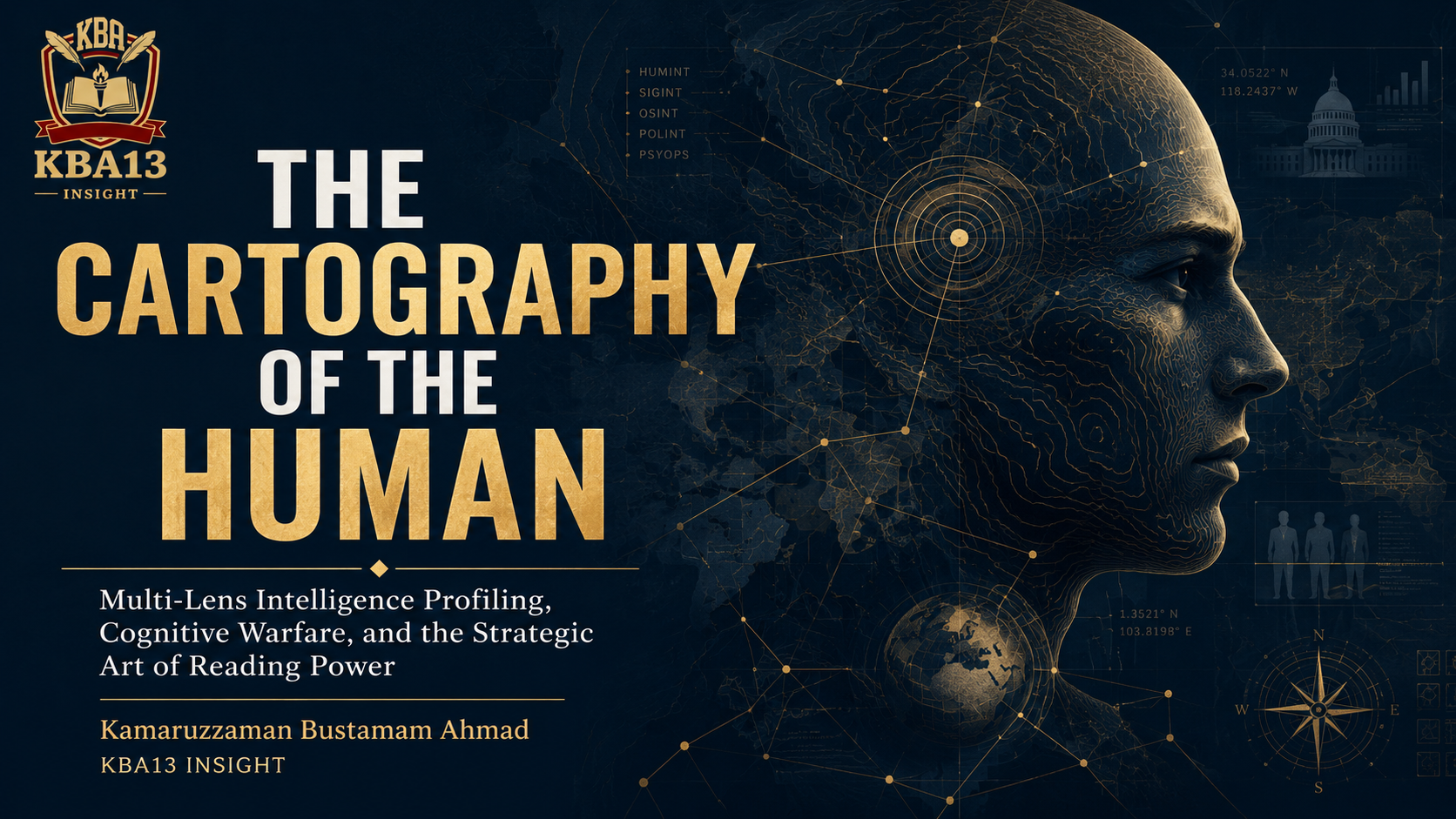
The Human as Strategic Terrain
Long before satellite constellations mapped every square meter of the earth’s surface, before SIGINT networks swept the electromagnetic spectrum for whispered secrets, before algorithmic surveillance converted digital exhaust into behavioral profiles, intelligence had a single, irreducible instrument: the capacity to read another human being. Every intelligence methodology that has followed — every technical collection system, every analytical framework, every operational doctrine — is ultimately an elaboration of this foundational act. The oldest intelligence question ever asked was not where is the enemy? It was what will the enemy do? And answering that question has always required, at its core, the capacity to inhabit another mind — to understand not just what a person knows but how they think, what they fear, what they want, and how they will behave when their interests and their survival collide.
In three decades of moving through the landscapes where intelligence is practiced rather than theorized, I have returned repeatedly to a single observation: the most consequential failures in the history of intelligence — the surprises that changed the course of nations, the recruited agents who turned, the operations that collapsed without warning — were not primarily failures of collection. They were failures of human reading. The signals were often there. The information existed. What failed was the capacity to correctly interpret the human being at the center of the operation: to understand what that person truly wanted, how they processed risk, what their loyalty actually meant, and at what point the calculus of their self-interest would shift in a direction that no handler had anticipated.
This is not a comfortable observation for intelligence communities that have invested heavily in technical collection. The seductive logic of SIGINT is that it removes the unreliability of human sources from the analytical equation: circuits do not lie, frequencies do not have conflicting loyalties, satellite imagery cannot be deceived. But this logic contains a fundamental misapprehension about what intelligence is for. Intelligence is not primarily an information-gathering enterprise; it is a prediction enterprise. Its purpose is not to know what has happened but to anticipate what will happen — and specifically what human beings with competing interests and the capacity for strategic deception will choose to do. No satellite can predict human choice. No intercepted communication can reveal the moment when a recruited agent decides that the operational relationship has become more dangerous than the alternatives. Only the disciplined, systematic, methodologically rigorous reading of human behavior — what I will call intelligence profiling in its full multilens construction — can hope to penetrate to the level of prediction that operational security and strategic advantage require.
Modern warfare has sharpened this imperative to a cutting edge that previous generations would not have recognized. The concept of cognitive warfare — the systematic use of information, psychological operations, and influence techniques to shape the beliefs, decisions, and behaviors of adversaries — has transformed the human mind from a source of intelligence into a primary theater of conflict. In cognitive warfare, the target is not a military installation or a communications network; it is the cognitive architecture of specific individuals whose decisions shape the course of events. The policymaker who must decide whether to escalate or de-escalate a border crisis, the military commander who must assess an ambiguous intelligence report under time pressure, the political leader whose public statement will either stabilize or inflame a volatile situation — these individuals, and specifically their cognitive vulnerabilities, their processing habits, their emotional triggers, and their decision-making styles, are the objectives of cognitive warfare operations. Understanding them — profiling them, in the fullest and most disciplined sense of that word — is therefore not simply an intelligence function. It is a strategic function of the highest order.
The framework I develop in this essay — what I call the multilens approach to intelligence profiling — is not a theoretical construction developed from a distance. It is the distillation of methodologies that have been developed, tested, refined, and applied in operational contexts across decades of intelligence practice. It draws on Behavioural Intelligence Analysis, Discourse Analysis, Cognitive Style Profiling, strategic communication pattern mapping, and Intelligence Tradecraft Adaptation — five disciplinary lenses that, when focused simultaneously on a single human subject, produce an analytical image of extraordinary depth and operational utility. What follows is an account of each of these lenses, how they interact, what they reveal, and why their integration is essential in a strategic environment where the human mind has become the most contested terrain in the geopolitical competition of our time.
Why One Lens Is Never Enough: The Architecture of the Multilens Framework
The history of intelligence profiling failures is, in substantial part, a history of analytical monoculture — the reliance on a single disciplinary lens to understand what can only be understood through multiple, simultaneous perspectives. The psychiatrist who profiles a target based on clinical psychology alone misses the strategic communication patterns that reveal deliberate deception. The signals analyst who maps communication frequency and network structure misses the cognitive style dimensions that explain why a particular individual makes choices that appear irrational from an external perspective. The HUMINT officer who reads behavioral signals through the framework of their own cultural assumptions commits the cardinal sin of mirror-imaging — projecting their own cognitive architecture onto a subject whose mental map of the world is fundamentally different.
Each disciplinary lens in the multilens framework captures a distinct dimension of the human subject. Behavioral Intelligence Analysis reads the patterns encoded in action — what a person does, when they do it, in what sequence, and what the deviations from established patterns reveal about changing internal states. Discourse Analysis reads the structure of language — not just what is said but how it is constructed, what is conspicuously absent, how the speaker positions themselves relative to different audiences, and what the evolution of linguistic patterns over time reveals about shifting strategic intent. Cognitive Style Profiling maps the architecture of individual information processing — how the subject organizes complexity, where their analytical strengths and vulnerabilities lie, and what their characteristic decision-making process looks like under different levels of stress and uncertainty. Strategic Communication Pattern Mapping traces the architecture of interaction — the rhythms, priorities, and structural features of how the subject communicates across different contexts and relationships, revealing both conscious strategy and unconscious habit. And Intelligence Tradecraft Adaptation synthesizes all of these analytical outputs into an operational assessment — a profile that can be translated into specific recommendations about how to approach, engage, develop, and manage the subject in service of defined strategic objectives.
The power of the framework lies not in any individual lens but in their integration. The analytical image produced by a single lens is necessarily partial and potentially misleading. The behavioural analyst who observes that a target consistently seeks verification of information before acting might conclude that the target is cautious, epistemologically rigorous, and difficult to deceive. The discourse analyst examining the same subject’s language might identify rhetorical patterns that suggest a deeper motivational structure: the need for intellectual superiority, the fear of being exposed as ignorant, or the compulsion to validate a particular self-image as a rigorous thinker. The cognitive style analyst might add that this subject is a holistic processor who needs conceptual coherence before accepting factual claims — which means that presenting well-sourced individual facts without a compelling overarching narrative will be systematically ineffective. The communication pattern analyst might observe that the subject accelerates their decision-making process under conditions of intellectual excitement, when they feel they are encountering genuinely novel analysis, and decelerates dramatically when they sense they are being led through familiar territory. The tradecraft analyst who receives all of these inputs simultaneously does not simply know more; they understand the subject at a qualitatively different level — one that makes prediction possible and strategic engagement plannable.
Behavioral Intelligence Analysis: Reading the Grammar of Action
Every human being operates according to behavioral grammars — consistent patterns of action, response, and decision-making that reflect stable underlying preferences, values, risk tolerances, and information-processing habits. These grammars are not identical to conscious intentions, which is what makes them analytically valuable. A person can choose what to say; they cannot easily control the behavioral patterns that encode what they actually believe and how they actually function. The skilled behavioural analyst reads these patterns the way a linguist reads a language: not word by word, but as a system — looking for structure, consistency, and the deviations from established patterns that are as revealing as the patterns themselves.
The first analytical question in behavioural intelligence analysis is deceptively simple: what does this person consistently do, and in what sequence? The answer establishes the behavioral baseline against which anomalies can be identified. In operational contexts, baselines matter enormously. A case officer who has not established a behavioral baseline for a recruited agent cannot recognize the early warning signs of psychological stress, divided loyalty, or operational compromise. The baseline is the reference frame against which change becomes visible — and in intelligence operations, it is change that carries the most critical information.
The second analytical question is more nuanced: what do the boundaries of the behavioral pattern reveal? Every behavioral grammar has a characteristic range — the space within which the subject typically operates — and its boundaries are as informative as its center. A subject who consistently demands extraordinary depth of analysis before accepting conclusions and is conspicuously uncomfortable with ambiguous or provisional assessments is demonstrating a behavioral boundary that has significant operational implications. Such a subject is likely to be difficult to manipulate through the standard technique of presenting selectively verified information that leads toward a pre-determined conclusion — because the selectivity of the verification will itself be noticed and flagged. Simultaneously, this behavioral signature suggests a subject whose engagement can be deepened by providing exactly what they demand: genuinely rigorous, genuinely sourced, genuinely comprehensive analysis. The subject’s behavioral rigidity, properly read, becomes both a constraint on certain manipulation techniques and a guide to the engagement approach most likely to succeed.
The third dimension of behavioural analysis focuses on the signature of change. Behavioral patterns shift in response to internal state changes — increases in stress, shifts in motivation, changes in the operational situation — and these shifts, when detected early, can provide critical intelligence about what is happening inside the subject’s world that external observation alone cannot reveal. A subject who normally responds to questions within a predictable time frame and suddenly begins to delay, who normally initiates contact on a consistent schedule and abruptly goes silent, who characteristically engages with high energy and enthusiasm and begins to seem flat and mechanically compliant — these behavioral changes are not simply interesting. In an operational context, they may be the earliest detectable signal of a crisis that, if not addressed, will compromise the operation entirely.
The HUMINT tradition has always understood this instinctively, but the formalization of behavioural intelligence analysis as a discipline has brought methodological rigor to what was previously largely an art practiced through intuition. The development of structured behavioral assessment instruments — systematic frameworks for documenting, categorizing, and analyzing behavioral data collected through agent interactions — has made it possible to distinguish genuine behavioral anomalies from noise, to build behavioral profiles that are comparable across subjects, and to train analysts in pattern recognition that does not depend entirely on individual intuitive gift. The challenge that remains, and that no formalization has fully resolved, is the fundamental problem of behavioral intelligence: human beings are not passive subjects. They are strategic actors who, when sophisticated enough, observe and respond to the observation of their behavior. The subject who is aware that their behavioral patterns are being analyzed can modulate those patterns — suppressing the signals that would reveal their true state, performing behavioral signatures that correspond to the image they wish to project. This possibility is what makes the multilens approach essential: a subject who successfully manages their behavioral signals cannot simultaneously manage their linguistic patterns, their cognitive processing style, their communication architecture, and their response to tradecraft-calibrated engagement. One or more lenses will penetrate the performance.
Discourse Analysis: Language as Strategic Mirror and Strategic Weapon
Language is simultaneously the most transparent and the most opaque medium of human communication. It is transparent because it conveys content — it tells us what people say about themselves, their intentions, and their understanding of the world. It is opaque because what people say is not identical to what they mean, what they believe, or what they intend to do — and the gap between surface content and deeper structure is precisely where the most valuable intelligence resides. Discourse analysis, as an intelligence discipline, is the systematic method for reading that gap.
The foundations of discourse analysis as applied to intelligence contexts rest on a fundamental linguistic insight: the structure of utterance is itself meaningful, independently of the propositional content it carries. How a person chooses to organize their claims — what they foreground and what they background, what they assert and what they presuppose, how they position themselves relative to other speakers and other knowledge sources, how they manage the transition between formal and informal registers — reveals strategic intentions and psychological states that the propositional content of speech may actively conceal.
Consider the phenomenon of presupposition in strategic communication. A diplomat who says “when we resolve the current difficulties around the territorial question” is not merely expressing hope or confidence; they are presupposing that the difficulties will be resolved and that the territorial question is the relevant framing — both of which are contested positions that the statement treats as settled premises. A skilled discourse analyst reading a transcript of diplomatic exchanges will notice these presuppositional moves not as rhetorical flourishes but as signals of negotiating position: what the speaker is treating as non-negotiable given, and therefore not available for open discussion. This is the kind of intelligence that does not appear in the propositional content of statements — the kind that is invisible unless one is specifically looking for the architecture of the utterance rather than its surface meaning.
In operational HUMINT contexts, discourse analysis provides a complementary perspective to behavioral observation that can both confirm and complicate the behavioral reading. A subject who behaves calmly and without apparent stress may nonetheless reveal in the structure of their language — through increased use of hedging devices, through subtle shifts in the complexity of their sentence construction, through the appearance of repetitive thematic material that was not previously present — that they are managing a level of internal stress that their behavioral self-regulation is successfully concealing from surface observation. The language may tell a different story than the behavior, and when the two conflict, the conflict itself is the most informative data point of all.
The forensic linguistic dimension of discourse analysis has been extensively documented in research on deception detection. While the popular conception of lie detection focuses on physiological responses — the Polygraph’s measurement of arousal — forensic linguistics has established that deceptive speech has characteristic structural signatures that, under appropriate analytical conditions, can be reliably identified. These include increased use of distancing language (passive constructions, third-person references, abstract nominalization), reduction in sensory and contextual detail in descriptions of events that the speaker claims to have experienced, and characteristic asymmetries in the temporal and spatial structure of narratives (Coulthard & Johnson, 2007). These structural markers do not constitute proof of deception in any individual instance — the individual variation in linguistic style is too great for that — but they constitute probabilistic indicators that, when combined with the other lenses of the multilens framework, contribute to a substantially more reliable overall assessment than any single indicator could provide.
The digital environment has both expanded the domain of discourse analysis and complicated its application. The volume of textual data now available for analysis — social media posts, messaging application records, email archives, public speeches, published writings — provides a depth of observational material that was previously unavailable to intelligence analysts working with limited interaction records. But the diversity of contextual registers in digital communication introduces analytical complexities that must be navigated carefully. The same individual may communicate in dramatically different registers across digital platforms — more formal on professional platforms, more revealing on personal platforms, and more strategic in certain network relationships than in others. The discourse analyst working with digital data must therefore be sensitive not just to the linguistic patterns within a given corpus but to the contextual specifics of each platform, relationship, and interaction type that generated it.
Cognitive Style Profiling: The Cartography of How Power Thinks
Of all the dimensions captured by the multilens framework, cognitive style profiling is perhaps the most philosophically significant — because it attempts to map not what a person does or says but the underlying architecture of how they process reality itself. Cognitive style, in the technical sense used in applied cognitive psychology, refers to the consistent patterns in an individual’s approach to information processing — how they organize complexity, how they make decisions under uncertainty, how they balance the demands of systematic analysis against the pressure of rapid judgment, and how they respond to conditions that challenge their existing understanding.
The theoretical foundation for cognitive style analysis in intelligence profiling draws on several decades of research in educational psychology, organizational behavior, and applied cognitive science. The fundamental distinction drawn by Riding and Rayner (1998) between holistic and analytic cognitive styles — between those who process information by first constructing a gestalt and then populating it with detail, versus those who process information by building from data points toward conclusions through sequential, linear analysis — has direct and powerful operational implications for intelligence practitioners.
A holistic thinker who is a target of intelligence engagement will respond poorly to information presented as an accumulation of isolated facts, however well-documented those facts may be. What they require — and what will unlock their engagement and potentially their trust — is a compelling framework that situates the facts within a larger pattern that makes intuitive sense. The analysis that resonates with a holistic thinker is the analysis that says “here is what is really happening at the level of strategic dynamics, and here is how the specific facts we are presenting to you are expressions of that deeper pattern.” The analysis that will frustrate them, and potentially generate resistance and suspicion, is the analysis that presents a sequence of verified data points and leaves the framework construction to them — because this feels, to the holistic thinker, like an invitation to impose their own pattern on someone else’s data, which makes them uncomfortable about the reliability of their conclusions.
A sequential or serialist thinker, by contrast, requires precisely what frustrates the holist. They need the data first, a clearly specified verification pathway, and the conclusion derived step by step from the evidence, with the logical chain at each step transparent and inspectable. A presentation that begins with the conclusion — “what is happening here is X” — and then offers supporting evidence will seem to them like advocacy rather than analysis, will trigger their resistance to being led, and may generate a more critical and suspicious posture than a purely data-first presentation would. The same analytical content, delivered in different formats to these two cognitive styles, will produce dramatically different responses — and in an operational context, the difference between a receptive and a resistant response may be the difference between a successful and a failed approach.
Beyond the holistic-serialist dimension, cognitive style profiling in intelligence contexts addresses several additional dimensions with direct operational relevance. The subject’s characteristic tolerance for ambiguity — their ability to function effectively under conditions of incomplete or contradictory information — directly predicts how they will behave in crisis situations where the intelligence picture is unclear. Those with high ambiguity tolerance will tend to maintain analytical flexibility under pressure, weighing competing interpretations and delaying firm conclusions until the evidence warrants them. Those with low ambiguity tolerance will tend to resolve uncertainty through premature closure — adopting a confident interpretation of ambiguous evidence and then becoming resistant to information that contradicts it. This dimension is critically important in assessing how a target will behave when facing a manufactured crisis — a common tool in influence operations — because the subject’s response to ambiguity will determine how rapidly and how firmly they adopt the interpretation that the influence operation has prepared for them.
The subject’s characteristic response to intellectual challenge is a related but distinct dimension. Some individuals experience challenge to their existing understanding as threatening and respond defensively, seeking to protect their current position rather than genuinely engage with the challenging information. Others experience the same challenge as invigorating — as an invitation to deeper analysis that they welcome rather than resist. Understanding which pattern characterizes the target determines which engagement strategy will be most effective. A target who responds defensively to challenge requires an approach that does not frontally contradict their existing understanding but gradually introduces information that creates cognitive dissonance — a sense of internal tension that motivates the target to resolve the contradiction by moving toward the analyst’s preferred conclusion. A target who responds positively to challenge can be engaged more directly with material that explicitly questions their current positions, because the challenge itself becomes the mechanism of engagement rather than a barrier to it.
Stress-induced cognitive narrowing deserves particular attention as a phenomenon with major operational implications. Research in applied cognitive psychology has consistently found that cognitively complex information processing degrades under high stress, with subjects reverting to simpler, more automatic decision-making heuristics and becoming less capable of integrating multiple information streams simultaneously. This creates a fundamental intelligence opportunity: the subject who is analytically sophisticated and difficult to manipulate under normal conditions becomes substantially more vulnerable when operating under extreme stress or time pressure. Influence operations that are designed to operate on targets in high-stress conditions — when they are exhausted, when they are facing political or professional crisis, when their available time for reflection is compressed — exploit this stress-induced regression to simpler cognitive processing. The multilens profile that includes an accurate map of the target’s cognitive architecture under both normal and stressed conditions provides the intelligence necessary to determine both the optimal timing and the optimal complexity level for engagement operations.
Strategic Communication Pattern Mapping: The Architecture and Rhythm of Influence
Human communication is not simply the transmission of content from one mind to another. It is the performance of relationships, the management of identity, the exercise of influence, and the ongoing negotiation of shared reality — all conducted simultaneously through language and behavior. Strategic communication pattern mapping treats the interaction between an intelligence subject and their various communication environments as a system whose structural properties — its rhythms, its asymmetries, its consistencies, and its deviations — encode intelligence about the subject’s strategic intentions, psychological state, and operational vulnerabilities that the content of their communications may entirely conceal.
The most fundamental unit of analysis in communication pattern mapping is not the individual message but the interaction sequence — the back-and-forth dynamics of specific communicative relationships over time. The subject who consistently controls the framing of conversations — who reliably takes the initiative in defining what is and is not worth discussing, who routinely redirects conversations that are moving in directions they find uncomfortable — is demonstrating a communication signature that speaks to their need for narrative control. This is not simply a personality trait; it is an operational variable. A subject whose communication pattern reveals a strong drive to control the framing of interaction will be resistant to standard elicitation techniques that depend on the interviewer’s ability to direct the conversation, and will require approaches that allow the subject to feel they are setting the agenda even while the analyst is directing its content.
The temporal dimension of communication patterns carries information that is often overlooked in standard intelligence analysis. The rhythm at which a subject initiates communication, responds to contact, accelerates and decelerates their engagement — this temporal signature is as individually characteristic as a fingerprint, and deviations from the established rhythm are among the earliest and most reliable indicators of operational stress or situational change. In prolonged HUMINT operations, experienced case officers develop an almost intuitive sensitivity to the rhythm of their assets’ communication—detecting the subtle shifts in timing that precede a crisis long before any explicit signal is received. The formalization of this intuition into a systematic communication pattern mapping brings analytical rigor to an observational skill that has always been part of the tradecraft but has rarely been explicitly theorized.
The elicitation dimension of communication pattern analysis is particularly significant in operational contexts. Elicitation — the technique of gathering information from a source without the source’s awareness that they are providing it — depends critically on the analyst’s ability to insert themselves into the subject’s existing communication patterns in a way that appears natural rather than directed. This requires, first, a detailed map of those patterns: which conversational moves the subject characteristically makes, what they respond to positively, what generates resistance, which topics they find irresistible, and which communicative dynamics they find most engaging. The analyst who has this map can configure the interaction to appear to follow the subject’s own preferences and patterns while in fact directing the content of the exchange toward specifically targeted information objectives. This is not manipulation in the colloquial sense—it is the highly skilled professional practice of creating the conditions under which a subject will share information they would not share in a differently configured interaction.
The digital dimension of communication pattern mapping has transformed both the scope and the methodology of the discipline. The structured data generated by digital communication platforms — message timing, network relationships, posting frequency, engagement patterns, platform preferences — provides a behavioral trace of extraordinary richness that previous generations of intelligence analysts had no access to. Research programs such as DARPA’s Social Media in Strategic Communication project have developed computational methods for detecting, characterizing, and tracking communication patterns at scale — identifying influence network structures, detecting coordinated inauthentic behavior, and mapping the propagation patterns of specific narratives through social networks. At the individual level, digital communication traces provide a longitudinal record of the subject’s communicative behavior that allows pattern mapping with a historical depth that human relationship-based observation alone cannot achieve.
The critical challenge in digital communication pattern analysis is the rapidly evolving sophistication of the targets. State and non-state actors who are aware that their digital communication traces are subject to intelligence analysis are increasingly employing technical countermeasures — encrypted platforms, operational security protocols, account compartmentalization — that reduce the signal available for pattern analysis. This creates an asymmetric dynamic in which the analytical tools available to intelligence practitioners improve continuously, while the operational security practices of sophisticated targets also improve, maintaining a gap that technical capability alone cannot close. The intelligence analyst who relies solely on digital communication pattern data is in an ongoing race against countermeasure development. The multilens analyst who combines digital pattern data with behavioral observation, discourse analysis, and cognitive style assessment is working with a redundant analytical system that is far more resilient to the degradation of any single data stream.
Intelligence Tradecraft Adaptation: From Profile to Operation
The analytical outputs of the multilens profiling framework are not ends in themselves. They are inputs into what is, in the final analysis, the only intelligence product that matters operationally: the assessment that tells a case officer, a policy analyst, or a strategic planner how to engage with a specific human being in order to achieve a specific objective. This is what intelligence tradecraft adaptation means in the multilens context: the synthesis of everything the framework has revealed into a plan for human engagement calibrated to the specific individual’s cognitive architecture, rather than to a generic template for how human beings respond to generic approaches.
The foundational concept in this synthesis is what the intelligence community calls the MICE taxonomy — Money, Ideology, Coercion, Ego — the four primary categories of motivational driver that have historically been used to understand why individuals agree to cooperate with foreign intelligence services. In classical HUMINT training, this taxonomy is taught as a simple prioritization question: which of these four drivers is most operative for the specific individual being assessed? The answer is supposed to guide the approach: if the primary driver is financial, the recruitment approach centers on compensation; if ideological, on shared values; if coercive, on leverage; if ego-driven, on recognition and validation.
The multilens framework reveals why this simple taxonomy is operationally insufficient and sometimes dangerous. Human motivation is not monovariate. It is a complex system in which multiple drivers interact, reinforce, and in some circumstances directly contradict each other. A subject who appears primarily financially motivated may simultaneously hold ideological commitments that function as absolute constraints — domains within which no amount of financial incentive will produce cooperation. A subject who appears primarily ego-driven may be manageable through recognition and validation in routine circumstances but may revert to other motivational logics under extreme stress. The analyst who has profiled the subject across all five multilens dimensions — who knows not just the apparent primary motivator but the cognitive architecture within which all motivators operate, the communication patterns that reveal how motivational priorities shift across different contexts, the behavioral signatures that indicate when motivational calculations are under stress — is in a qualitatively different analytical position from the analyst who has simply identified the dominant MICE category.
The asset assessment that emerges from multilens profiling is also more nuanced in its treatment of what intelligence professionals call the “operational style” dimension — the characteristic way in which a subject functions within the actual mechanics of an intelligence relationship. Some subjects are naturally proactive, anticipating what information will be useful and providing it without direct prompting. Others are reactive, responsive to specific requests but unlikely to volunteer information that has not been specifically asked for. Still others are adaptive — able to shift between proactive and reactive modes depending on what the relationship requires, but they require careful management to ensure they receive the signals that indicate which mode is currently expected.
This operational style dimension interacts critically with the cognitive style profile in ways that directly affect how the intelligence relationship is managed over time. A subject who is cognitively holistic and operationally proactive will tend to provide voluminous contextual information in response to specific requests, offering the larger pattern they see around the requested data point. This is potentially extremely valuable, but it creates a management challenge: the holistic-proactive subject may also volunteer analytical conclusions that are colored by their own strategic perspective, requiring the receiving analyst to carefully separate the empirical content of their reporting from the interpretive framework the subject has imposed on it. A subject who is cognitively serialist and operationally reactive will provide precisely what is asked, structured exactly as requested, but may not flag information the handler considers critical yet has not specifically requested, because it was not within the scope of the question. Managing this subject requires the handler to develop a comprehensive understanding of the information that may exist in the subject’s access environment and to ask specifically and carefully for each category of it.
The most consequential dimension of tradecraft adaptation is the assessment of operational vulnerabilities — the cognitive, behavioral, and motivational characteristics that, if exploited by a hostile counterintelligence service, could compromise the subject’s loyalty, their operational security, or the integrity of the intelligence they provide. Every characteristic that makes a subject valuable as an intelligence asset simultaneously creates a potential vulnerability. The subject’s high tolerance for ambiguity makes them valuable in complex operational environments—but it also makes them potentially susceptible to an adversary who presents a carefully constructed ambiguous situation designed to be resolved in the adversary’s preferred direction. The subject’s proactive operational style makes them a valuable source of unsolicited intelligence — but it also means they are likely to take actions not authorized by their handler when their own assessment suggests those actions are warranted, creating operational control problems and potential compromise risks.
Historical operational failures validate the importance of this vulnerability assessment with sobering clarity. The CIA’s relationship with Aldrich Ames — who provided critical intelligence to the Soviet Union for nearly a decade before being identified — failed in part because the behavioral and motivational signals that in retrospect clearly indicated his compromise were not being read through a framework sufficiently nuanced to distinguish genuine operational stress from the indicators of divided loyalty. Ames’s financial difficulties, his improved lifestyle, his defensive response to counterintelligence inquiries, his subtle shifts in communication patterns—these were individually explicable through innocent interpretations, but read together through a multilens framework calibrated to his specific cognitive and behavioral architecture, they constitute a pattern that should have been detected far earlier than it was.
The Adversarial Dimension: When the Target Knows the Method
The multilens profiling framework assumes an asymmetry that, in sophisticated operational environments, cannot be taken for granted: the analyst is observing, and the subject is being observed, without awareness. This assumption is increasingly unreliable when the target is a sophisticated state actor, an experienced intelligence professional, or any individual trained in the principles of intelligence profiling, who knows what signals they are broadcasting and can attempt to modulate them deliberately.
The sophisticated target who knows they may be subject to behavioral observation can suppress or manufacture behavioral signals. The sophisticated communicator who knows their discourse is being analyzed can construct linguistic performances that project false cognitive signatures. The intelligence professional who understands cognitive style profiling can present information-processing patterns that do not accurately reflect their actual decision-making architecture. This is what is called strategic deception at the human level — the deliberate performance of a false cognitive and behavioral self designed to mislead analysts attempting to build an accurate profile.
The multilens framework’s resistance to this kind of strategic deception depends on the cognitive complexity of maintaining a comprehensive false performance across multiple simultaneous dimensions. Behavioral modulation requires conscious attention. Linguistic performance requires conscious control. Maintaining a consistent yet false cognitive-style presentation requires sustained mental effort. And the consistent maintenance of all of these false performances simultaneously, across multiple interaction contexts and over extended time periods, exceeds the cognitive bandwidth of virtually any human operator. Even highly trained intelligence professionals who have been specifically prepared for counterprofile operations will show cracks — moments of cognitive overload in which the managed performance degrades and authentic signals emerge across one or more of the analytical lenses.
This is one of the reasons the multilens framework is operationally superior to single-lens approaches when dealing with sophisticated targets: the redundancy of the analytical system means that a subject who successfully manages one dimension is unlikely to manage all five simultaneously. The behavioral performance that masks internal stress will not prevent the corresponding linguistic shift toward simplified syntax and increased hedging. The false cognitive style presentation will not prevent the communication pattern changes that indicate that the subject is operating in a different psychological register from their baseline. The analyst who reads all five lenses simultaneously will detect inconsistencies between managed and unmanaged signals — inconsistencies that are, in fact, more diagnostic than the signals themselves, because they reveal precisely where the subject’s self-management is succeeding and where it is breaking down.
The adversarial dimension extends beyond the question of individual subjects managing their signals to the broader challenge of intelligence operations in environments where counterintelligence services actively attempt to feed false profiles into analytical systems. The deliberate creation of convincing behavioral and communication profiles for “legend” identities — the tradecraft term for the false identities used by intelligence officers operating under cover — is a standard element of sophisticated intelligence operations. The multilens analyst operating in a controlled environment must maintain constant awareness that what appears to be a genuine human subject may be a performance constructed by an adversary counterintelligence operation specifically designed to exploit the multilens framework’s known analytical parameters.
This adversarial dimension ultimately reveals the deepest philosophical challenge in intelligence profiling: the problem of radical epistemic uncertainty about the relationship between observed signals and internal states. The behavioral and linguistic signals that profiling reads are never the mental states themselves; they are traces of mental states, mediated by the subject’s deliberate choices about what signals to emit and which to suppress. The analyst’s inferential leap from observed signal to inferred state is always subject to defeat by a sufficiently motivated and competent subject who chooses to emit signals that differ from those their actual state would naturally generate. The multilens approach does not eliminate this uncertainty; it reduces it, by making the consistent management of false signals across all dimensions simultaneously more difficult and more cognitively costly. But it does not reduce it to zero. The epistemic limit of intelligence profiling — the irreducible gap between observed performance and true internal state — is permanent, and the intelligence practitioner who forgets this limit is operating with a false confidence that sophisticated adversaries will inevitably exploit.
The Digital Transformation of Profiling: Big Data, AI, and the Crisis of Human Judgment
The emergence of big data analytics and artificial intelligence as tools available to intelligence practitioners has both expanded the domain of profiling and created a new category of methodological vulnerability that the field is only beginning to fully reckon with. The expansion is real and significant: the volume of behavioral and communicative data now available for analysis exceeds by orders of magnitude what was available to any previous generation of intelligence practitioners, and the computational tools for extracting patterns from that data are improving at a pace that would have seemed implausible two decades ago. The vulnerability is equally real: the automation of pattern detection creates a systematic risk of analytical conclusions that are technically well supported by computational metrics yet fundamentally misaligned with operational reality.
The specific failure mode that AI-assisted profiling is most prone to is what researchers in machine learning call distribution shift — the degradation in predictive accuracy that occurs when a model trained on historical data encounters a situation that differs in important ways from the training distribution. An AI profiling system trained on behavioral and communicative data from a single cultural context, historical period, or subject category will produce unreliable profiles when applied to subjects whose cultural, historical, or situational context differs significantly from the training data. The system’s pattern recognition mechanisms will identify patterns that are real in the data — correlations between specific observables and specific outcomes — but whose apparent validity depends on contextual assumptions that do not hold in the new environment. The intelligence analyst who relies on these computationally confident but contextually invalid patterns is, in the most dangerous possible way, systematically wrong in ways they cannot detect.
The black box problem in AI-assisted profiling is a related and equally serious challenge. Many of the most powerful machine learning systems currently available for pattern recognition — deep neural networks, ensemble methods, and their variants — operate via mathematical processes whose internal logic is not interpretable to human analysts, even to the analysts who designed them. The system produces a classification, a risk score, or a pattern identification without providing a comprehensible account of why it has reached that conclusion. In a scientific research context, this interpretability gap is a methodological inconvenience. In an intelligence-profiling context, where the conclusion will be used to justify specific operational decisions with potentially irreversible human consequences, it poses a profound ethical and practical problem. The intelligence professional who acts on a profile generated by an uninterpretable system is, in the deepest sense, acting without understanding — relying on a judgment whose basis they cannot examine, cannot challenge, and cannot defend.
The disinformation environment creates a third dimension of challenge for digital profiling. The targeted production of synthetic behavioral and communicative data — deepfake video and audio, computationally generated text, algorithmically constructed social media histories — has reached a level of sophistication that makes the automated verification of the authenticity of digital behavioral traces genuinely difficult. An intelligence profiling system that ingests synthetic data constructed by an adversary’s influence operation will produce profiles that are internally consistent and analytically compelling, but that reflect a reality fabricated by the adversary rather than a reality that corresponds to an actual human subject or community. The cross-validation between digital data and human-source observation — between what digital trace analysis suggests and what case officers can observe in direct interaction — is the critical safeguard against this form of systematic misleading. But maintaining this cross-validation requires exactly the kind of human analytical judgment that organizations under pressure to process larger volumes of data more efficiently are most tempted to automate away.
The appropriate response to these technological challenges is not the rejection of AI and big data analytics as profiling tools — their genuine value is too significant to forgo — but their integration into the multilens framework in a way that preserves the human analytical judgment that is the framework’s essential safeguard against systematic error. AI can process volumes of behavioral and linguistic data that no human analyst can handle; it can identify weak statistical patterns that human observers would miss; it can flag anomalies that might escape attention across large datasets. But the interpretation of these computational outputs — the determination of whether they reflect genuine signal or artifacts of training data bias, whether they represent the actual cognitive architecture of a real subject or the performance of a sophisticated deceptive target — requires the kind of contextual, culturally informed, epistemologically self-aware human judgment that no current AI system can replicate.
The Irreducible Ethical Dimension
Any serious treatment of intelligence profiling as a methodology must engage directly with the ethical dimension that pervades its application — not as a formality but as a substantive analytical concern whose resolution shapes the practical parameters within which the methodology can be legitimately deployed. The profiling of human beings for intelligence purposes involves the systematic collection and analysis of personal information, the inference of private psychological states from observable behavior, and the application of those inferences to operational decisions that may fundamentally affect the subject’s life, freedom, and safety. These are not trivial interventions in human affairs, and the intelligence professional who treats them as technically interesting puzzles divorced from their human consequences is operating within an ethical framework that both professional and broader societal standards should reject.
The ethical legitimacy of profiling operations rests on several foundations that must be simultaneously present. The first is proportionality: the intrusion into the subject’s private cognitive and behavioral world must be proportionate to the security objective being served. Profiling an intelligence officer of a hostile state who is conducting active operations against national security interests is different from profiling a political figure or a civil society leader who disagrees with government policy. The same methodology, applied in these two contexts, carries entirely different ethical weight. The second foundation is authorization: intelligence profiling operations must occur within clearly defined legal and institutional frameworks that establish the conditions under which they are legitimate and the oversight mechanisms that ensure those conditions are met. The intelligence professional who profiles without authorization is not simply operating outside institutional norms; they are operating in a way that the society whose interests they claim to serve has not sanctioned.
The third ethical foundation is accuracy — the commitment to producing assessments that honestly reflect the evidence, including its uncertainties, rather than assessments that serve predetermined political or operational objectives. The history of intelligence profiling contains cases in which the methodology’s power was deployed not to discover what is true about a subject but to construct a plausible-seeming case for a conclusion that had been reached in advance. This is the profiling equivalent of the WMD intelligence failure: not analytical failure but analytical corruption, in which the discipline is weaponized against the purpose it was designed to serve. The multilens framework’s internal redundancy — the requirement that conclusions be supported across multiple independent analytical lenses — provides structural resistance to this form of corruption, but no methodological safeguard eliminates the need for the ethical commitment to honest inquiry that is the foundation of any genuinely professional analytical practice.
The Human at the Center of the Battlefield
The argument of this essay converges on a single, irreducible claim: in an era of cognitive warfare, the human being — their cognitive architecture, behavioral grammar, motivational structure, and communicative patterns — has become the primary terrain of strategic competition. States, organizations, and individuals compete not only for territory, resources, and institutional control but also for the ability to shape how specific human beings perceive the world, process information, assess risk, and ultimately make decisions. The intelligence professional who cannot read this terrain — who cannot map the cognitive architecture of the specific individuals whose decisions matter — is operating blind in the domain that is most consequential for strategic outcomes.
The multilens profiling framework developed in this essay is not a claim to infallibility. It is a claim to methodology — to the disciplined, integrative, cross-validated approach to human assessment that produces, under conditions of epistemic humility about its inherent limitations, the most reliable analytical outputs available to practitioners working with the irreducibly complex material of human behavior. The behavioral analyst, the discourse analyst, the cognitive style profiler, the communication pattern mapper, and the tradecraft adaptation specialist are not five separate practitioners working in parallel; they are five analytical disciplines that, integrated into a single professional practice, produce an understanding of the human subject that none of them can achieve alone.
The adversarial environment in which this practice operates demands continuous methodological evolution. As sophisticated targets develop greater awareness of profiling methodologies and greater capacity to manage their behavioral and communicative signals, the framework must adapt — incorporating new analytical tools, developing new cross-validation mechanisms, and maintaining the epistemological humility to acknowledge when a subject’s strategic management of their signals has exceeded the framework’s ability to penetrate it. The acknowledgment of this limit is not a concession of defeat; it is the honest recognition that the competition between reader and read — between the analyst who tries to understand and the subject who tries to remain opaque — is a permanent feature of the intelligence landscape, and that the analyst who believes they have definitively solved the problem of the opaque subject has simply stopped seeing the problem clearly.
What remains permanent across all the methodological evolution and all the technological transformation is the centrality of human judgment — the capacity of the experienced, trained, epistemologically honest intelligence analyst to integrate multiple streams of evidence into an assessment that is both analytically rigorous and operationally useful. This is the judgment that no algorithm can replicate and that no technical system can replace. It is the judgment that makes intelligence, in the end, a human enterprise rather than a computational one — a discipline in which the most advanced tool remains the cultivated mind of the practitioner, reading other minds across the contested terrain of strategic competition, in service of the interests of states whose security depends on how well that reading is done.
The human terrain has never been more strategically significant. And the art of reading it has never been more essential.
References
Coulthard, M., & Johnson, A. (2007). An introduction to forensic linguistics: Language in evidence. Routledge.
Riding, R., & Rayner, S. (1998). Cognitive styles and learning strategies: Understanding style differences in learning and behavior. David Fulton Publishers.
US Army. (2006). Psychological Operations Field Manual (FM 3-05.30). Department of the Army.
DARPA. (2011). Social media in strategic communication (SMISC) program. Defense Advanced Research Projects Agency.
Ekman, P. (2003). Emotions revealed: Recognizing faces and feelings to improve communication and emotional life. Times Books.
Heuer, R. J., Jr. (1999). Psychology of intelligence analysis. Center for the Study of Intelligence, CIA.
Cialdini, R. B. (2006). Influence: The psychology of persuasion (rev. ed.). Harper Business.
Johnson, L. K. (2007). Strategic intelligence: Windows into a secret world — An anthology. Roxbury Publishing.
Shulsky, A. N., & Schmitt, G. J. (2002). Silent warfare: Understanding the world of intelligence (3rd ed.). Brassey’s.
About The Author

Rekomendasi Bacaan KBA13 INSIGHT
Jika tulisan ini bermanfaat, dukung jurnal ini dengan mencari bukunya melalui tautan berikut:
- Buku-buku Kamaruzzaman Bustamam Ahmad di Periplus
- Koleksi Islamic Studies di Periplus
- Koleksi Geopolitics & Politik Internasional di Periplus
- Cari buku & perangkat baca di Shopee
- Cari di Blibli
Daftar lengkap: Rekomendasi Buku, Alat Tulis & Layanan. Tautan di atas adalah tautan afiliasi — KBA13 INSIGHT dapat memperoleh komisi kecil tanpa biaya tambahan bagi Anda.
Artikel Terkait
 Membaca Manusia sebagai Medan Operasi: Profiling Intelijen Multilensa dalam Era Perang Kognitif
 Signals of Sovereignty: Radar, Signal Intelligence, and Indonesia’s Strategic Reckoning in the Asia-Pacific Electromagnetic Battlespace
 When the Mind Becomes a Battlefield: Annie Jacobsen, the CIA, the Nazis, and the History of Cognitive Warfare
 Inside the Shadow State: CIA, Mole Hunting, and the Hidden War Within Intelligence Systems
 One World in the Planetary Era: Kishore Mahbubani, Global Convergence, and the Future of Civilization
Leave a Reply