
Bottom Line Up Front
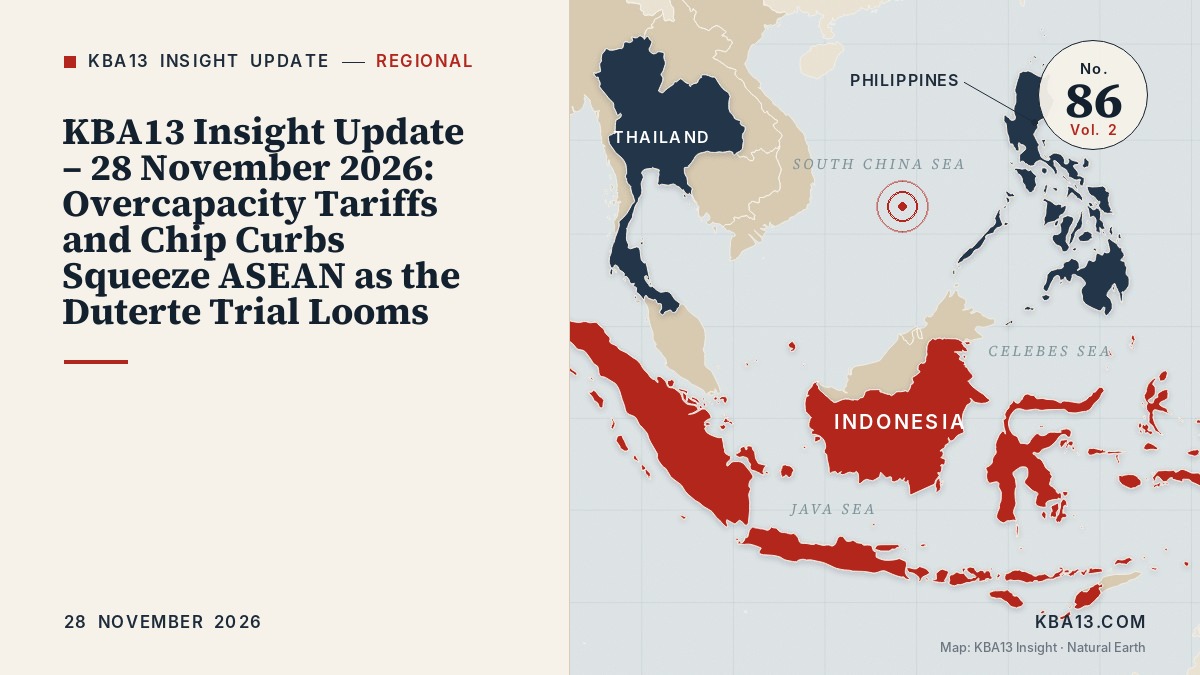
The defining development of the past 72 hours is that Washington has turned two separate instruments, a Section 301 “structural overcapacity” finding and a new licensing regime for advanced AI chips, into a single squeeze on Southeast Asia’s growth model. On 25 November the US Trade Representative released findings proposing tariffs of up to 18 percent on Indonesia, Malaysia, Thailand and Cambodia, 20 percent on Singapore and up to 35 percent on Vietnam, according to Indonesia’s foreign ministry and ANTARA. Within a day, reports that Nvidia had paused AI server shipments to four Southeast Asian states, following a 16 November US Bureau of Industry and Security rule requiring licences for AI chips and servers sent to Indonesia, Malaysia, Singapore and Thailand, pushed Jakarta to announce a three-track response. The combined effect is almost certainly the most serious external economic shock to the region since the 2025 reciprocal-tariff episode, and it lands precisely on the two sectors, electronics and data centres, that have carried ASEAN export growth this year (high confidence).
Three further trends shaped the window. First, the region’s governments responded to tariff pressure by hedging rather than retaliating, since the rates are bilateral and designed to invite separate deals: Indonesia secured entry into the CPTPP accession process, Vietnam won a Moody’s upgrade, and every capital opted for dialogue with Washington. Second, legal and quasi-legal mechanisms are carrying more of the region’s conflict management than diplomacy alone: the Thailand-Cambodia UNCLOS conciliation produced its first concrete agreement, Myanmar openly refused to comply fully with the International Court of Justice genocide judgment, and Rodrigo Duterte’s trial at the International Criminal Court opens on Monday, 30 November. Third, insider-enabled crime inside security institutions, exposed by Malaysia’s air force methamphetamine case and Indonesia’s police treason affair, is emerging as a regional governance problem in its own right. Over the next 72 hours, the most likely sources of volatility are the Duterte trial opening, Indonesian domestic politics around the vice-presidential succession and fuel subsidies, and further corporate fallout from US chip controls.
ASEAN Architecture and Regional Diplomacy
ASEAN’s institutional calendar has moved past the 49th Summit in Manila, which closed in mid-November without a South China Sea Code of Conduct and with no new deadline set, but the summit’s unfinished business has dominated the past three days. Singapore, which assumes the chair on 1 January 2027 under the theme “Deeper Integration, Wider Partnerships”, spent the window framing its year as an answer to economic nationalism. Its ministers argued that the association must respond to tariff walls with deeper internal integration and wider external partnerships, and the ASEAN Secretary-General announced a working visit to Singapore to prepare the handover. It is likely that member states will negotiate individually through the first quarter of 2027, and unlikely that ASEAN issues anything stronger than a general statement of concern (moderate confidence).
The more consequential diplomatic signal is the CPTPP decision. Coordinating Economic Minister Airlangga Hartarto said on 27 November that the CPTPP Commission had approved Indonesia’s entry into the accession process by creating an Accession Working Group, and that Jakarta aims to complete accession within two years. Taken together with the Indonesia-EU Comprehensive Economic Partnership Agreement signed on 21 November and Prabowo Subianto’s push for OECD membership, which he discussed with the OECD Secretary-General in Jakarta, the move is almost certainly a deliberate diversification strategy designed to reduce dependence on a US market that has become less predictable (high confidence). The sub-regional track was also active. Leaders of Cambodia, Laos and Myanmar arrived in Hanoi on 27 November for the 12th CLMV and 11th ACMECS summits, which Vietnam convenes today; Vietnam’s foreign minister heads the organising committee. The summit gives Myanmar’s military-backed leadership a rare multilateral platform barely a week after the ICJ judgment, and Hanoi’s hosting choice indicates that mainland states will continue to treat Naypyitaw as a working partner on connectivity and border management regardless of the court’s findings (moderate confidence).
China used the window to press its narrative that outside powers are the source of instability. Beijing’s defence ministry publicly urged Japan to stop “stirring up” South China Sea disputes, and Chinese officials warned that the Australia-Philippines defence agreement signed on 15 November would fuel tensions; the pact is designed to facilitate joint patrols and deterrence. Simultaneously, it advertised its own security partnerships: a China-Vietnam joint coast guard patrol in the Gulf of Tonkin, a China-Vietnam counter-terrorism exercise in Hanoi, and the Golden Dragon 2026 exercise in Cambodia. Beijing is contrasting “external interference” in maritime Southeast Asia with an alternative model of bilateral security cooperation on the mainland, and it is likely to intensify this messaging as Singapore takes the chair and resumes Code of Conduct talks (moderate confidence).
Security, Conflict and Transnational Threats
The most significant new transnational security signal is the scale of the drug-trafficking network that penetrated the Royal Malaysian Air Force. Home Minister Saifuddin Nasution Ismail told Parliament that a syndicate used air force assets 21 times to move about three tonnes of methamphetamine worth RM156 million, through a Tawau cell that made seven runs and a Labuan cell that made fourteen, after police intelligence work that began in January and a bust on 17 November; at Subang Air Base alone investigators seized 96.64 kilogrammes of the drug, VnExpress reported. On 27 November three air force officers and three civilians were charged with trafficking, an offence that can carry the death penalty, and police are hunting the syndicate’s mastermind. It is likely that further arrests follow and that Malaysia extends anti-narcotics screening to all military entry points, a step the cabinet has already signalled; it is also likely that the case accelerates intelligence exchanges with the Philippines and Indonesia on Borneo-based routes (moderate confidence).
Indonesia is fighting the same threat with far more theatre. President Prabowo presided over the destruction of narcotics that officials valued at US$3.36 billion, praised police for detaining 812 suspected kingpins, and on 27 November declared a war on drugs. The language should be read alongside the treason case against former National Police chief Listyo Sigit Prabowo, who failed to appear at an ethics hearing this week; the commission has ordered prosecutors to bring him to a second hearing on 30 November and will rule in his absence if he does not attend. The president is almost certainly using the anti-drug campaign to rehabilitate the police institution publicly while the internal purge continues behind it (high confidence).
The scam-compound economy continued to export its consequences. Indian police in New Delhi rescued 72 Malaysians and dozens of Indonesians from a forced cyber-fraud operation, Philippine authorities arrested 141 Indonesians over alleged online scam operations, and eleven Filipinos detained in Cambodian scam hubs were returned to Manila. A bill passed by the US House of Representatives targeting scam centres, which analysts told CamboJA could raise pressure on Phnom Penh, adds an American enforcement dimension. The geographical dispersal from the Mekong to South Asia and the Philippines indicates that crackdowns in Myanmar and Cambodia are displacing rather than dismantling these networks (high confidence). In Myanmar itself, armed conflict intensified. Reports republished by the Euro-Burma Office say more than 40 people were killed when a military airstrike hit a school in Sinbaungwe Township, Magway Region, where students had gathered to rehearse a performance; the toll has not been independently confirmed and should be treated as reported. Narinjara also reported an Arakan Army ambush on an army column near an air-defence base in Rakhine.
South China Sea and Maritime Security
Maritime pressure on the Philippines eased slightly in visible incidents but rose in political intensity. After the AFP counted 48 Chinese vessels in the West Philippine Sea for the week following the summit, the main event of this window was in the air: a Chinese H-6 bomber flew near Luzon, which military officials described as a show of force. Defence Secretary Gilberto Teodoro said Manila should raise the flight with Beijing, adding that “perhaps they are testing whether we can detect them,” The Manila Times reported. China’s criticism of the Australian pact then drew a sharp reply from the Department of National Defense, which said the Philippines does not need Beijing’s permission to choose its defence partners, a line echoed by the foreign ministry, which said China has “no right, moral basis” to dictate Manila’s cooperation. The trajectory is clear: the Philippines is thickening a network of non-US partners (Australia, Japan, India, Canada and France) to complement the alliance, and Beijing is shifting from contesting individual deployments to contesting the legitimacy of the network itself. It is likely that the next weekly AFP count stays in the 40 to 60 range and roughly even that China stages another air or naval demonstration near Luzon or the Batanes within a week (moderate confidence).
Indonesia’s maritime posture produced two notable signals. Prabowo told the Bank Indonesia annual meeting that Indonesia’s straits are as strategic as the Strait of Hormuz, asking: “If the Strait of Hormuz can cause trouble for the global economy, what about the straits in Indonesian waters?” ANTARA reported. On the same day the National Police launched a “Blue Policing” programme in Batam and three other provinces, targeting narcotics smuggling, illegal resource exports and illegal imports, according to ANTARA, while Indonesia took delivery of its first missile-capable KSR X33 unmanned surface vessel. Meanwhile, the foreign ministry said it is still studying a scheme for joint development with China in overlapping maritime areas agreed in principle by Prabowo and Xi Jinping, insisting that any arrangement will follow international law. Joint development with China remains the most sensitive item, because any arrangement that implies recognition of overlapping claims near the Natuna Islands would contradict Indonesia’s long-standing legal position. It is unlikely that a concrete scheme is announced within the next month (moderate confidence).
In the Gulf of Thailand, the region’s most dangerous bilateral dispute produced its best news of the year. At the third session of the UNCLOS compulsory conciliation in Kuala Lumpur from 24 to 27 November, Cambodia and Thailand agreed to allow the commission a site visit to disputed islands and coastal areas and to form a joint technical group of experts from both sides and the commission, CamboJA News reported; the commission chair called the results a “positive step,” and Xinhua carried the same outcome. The overlapping claims cover about 26,000 square kilometres, from which Thailand’s energy ministry estimates future revenue at about US$300 billion. The agreement is genuine progress, but it is technical rather than political: the outcome of conciliation is not binding, and Bangkok has said as much. The maritime track is therefore likely to remain insulated from the land border, where tensions persist (moderate confidence).
Country Watch
Indonesia. Indonesia generated the largest share of signals and the densest cluster of risk. Politically, the succession to former Vice President Gibran Rakabuming Raka, who resigned on 12 November, is following a compressed timetable: both nominees, Agriculture Minister Andi Amran Sulaiman and Foreign Minister Sugiono, underwent health tests on 26 November, the MPR verification team is expected to announce results on 1 December, and the plenary vote is scheduled for 11 December, according to a timetable attributed to the team’s acting chair; the MPR has formally received both names. It remains almost certain that one of the two loyalists is elected. Economically, Prabowo celebrated third-quarter growth of 5.47 percent and said procurement leakages could cost the state US$21 billion, while Bank Indonesia projected growth of about 6 percent in 2027 and pledged to reinforce policy to guard the rupiah and inflation. The most consequential leak of the window was a Reuters report that the government is considering the first subsidised fuel price increase in five years in early 2027, with the energy subsidy bill expected to reach about Rp500 trillion, 30 percent above allocation, and the deficit estimated at 2.85 percent of GDP against a 3 percent legal cap, The Jakarta Post reported; the government says no presidential directive has been issued. Taken together, a tariff shock, chip restrictions, fiscal strain and a weakening rupiah create the conditions in which a fuel decision becomes politically explosive. It is likely that the government defers any announcement until after the vice-presidential vote, and roughly even that a price adjustment is confirmed in the first quarter of 2027 (moderate confidence).
The Philippines. Manila enters the most politically charged week of its year. The ICC confirmed months ago that Rodrigo Duterte’s trial for crimes against humanity opens on 30 November, and coverage this week, from Rappler’s live tracker to CNA’s reckoning with the drug war’s legacy, shows how the trial is reshaping domestic politics. The defence previewed its argument that the killings were not crimes against humanity, and Vice President Sara Duterte said she did not expect a fair trial for her father while ruling her own resignation “out of the question” as her Senate impeachment trial, now narrowed to an unexplained-wealth charge, continues with new witnesses scheduled to testify. The convergence of the two trials almost certainly marks the high-water mark of polarisation ahead of the 2028 election cycle (high confidence). Large-scale unrest is unlikely, but localised rallies in Davao and Manila on 30 November are likely.
Malaysia. Beyond the air force drug case, Kuala Lumpur’s week was defined by technology and trade exposure. After the US added two Malaysian firms to its Entity List last week, the cabinet told Malaysian companies not to deal with US-blacklisted entities, and Prime Minister Anwar Ibrahim, launching a new national security policy, said Malaysia will prioritise diplomacy in the South China Sea while keeping the navy ready, giving cybersecurity a distinct place in the policy. Malaysia also said it would keep negotiating with Washington into the first quarter of 2027 and seek to hold tariffs at the 19 percent ceiling agreed in its 2025 deal. Kuala Lumpur is therefore attempting a precise balance: visible compliance with US export controls to protect its data-centre pipeline, and rhetorical distance from Washington on maritime and tariff questions. This is likely to hold, but it is fragile if US enforcement escalates to secondary measures against Malaysian data-centre operators (moderate confidence).
Singapore. Singapore faces the highest proposed rate among the region’s open economies, 20 percent, and its ministers pushed back publicly, with Deputy Prime Minister Gan Kim Yong rejecting the US argument that the Central Provident Fund suppresses consumption and Foreign Minister Vivian Balakrishnan saying the economy had been “mischaracterised.” On chips, Gan said there was no confirmation that Nvidia had halted shipments and that Singapore would work with the US to preserve local firms’ access to high-end chips. It is likely that Singapore negotiates a tailored enforcement arrangement with Washington before it assumes the ASEAN chair (moderate confidence).
Thailand. Thailand delivered the window’s strongest economic data and its most constructive diplomacy. October exports rose 27.5 percent year on year to US$36.86 billion, the fastest pace in over five years, while imports surged 53.2 percent, leaving a monthly deficit of US$12.34 billion, Xinhua reported from commerce ministry data. Yet the government had to defend its handling of the 18 percent proposal as executives warned about the effect on exports. The land border with Cambodia remains tense even as the maritime track improves: Cambodia lodged a formal protest over Thai road expansion in Oddar Meanchey, and the two militaries held talks to protect a fragile ceasefire. Thailand also moved to identify the source of arsenic pollution in rivers flowing from Myanmar’s mining areas, an issue that ties environmental security directly to the Myanmar conflict economy.
Vietnam. Vietnam faces the steepest proposed tariff, up to 35 percent, but also received the window’s most significant vote of confidence: Moody’s raised the sovereign rating from Ba2 to Ba1 with a stable outlook, citing governance reforms, higher-value growth and deeper capital markets, The Star reported. Prime Minister Le Minh Hung said the final US tariff would be well below 35 percent, and Hanoi is seeking a trade deal to protect clothing and footwear exports. The rating upgrade and the tariff threat point in opposite directions, which captures Vietnam’s position precisely: structurally improving, but more exposed than any neighbour to US trade policy. It is likely that Hanoi concludes a bilateral arrangement that brings its effective rate closer to its neighbours’ (moderate confidence).
Myanmar. The regime’s response to the ICJ judgment of 19 November, which found Myanmar responsible for genocide against the Rohingya, hardened during the window: its leader said Myanmar will not comply with “inappropriate” parts of the ruling, and The Irrawaddy reported that Beijing is shielding the regime while Naypyitaw seeks Chinese energy investment. The economic consequences are accumulating: garment producers brace for EU measures, more multinationals are exiting, and the kyat is under severe pressure on informal markets according to The Irrawaddy, even though the official ExchangeRate-API rate remained flat at about 2,099 per dollar. It is almost certain that the regime treats the judgment as a sovereignty question and leans further on China and the mainland CLMV framework (high confidence).
Cambodia. Phnom Penh combined legal engagement on the maritime dispute with a visible deepening of military ties with China. During Golden Dragon 2026, a Chinese Type 071 amphibious ship offloaded tanks on foreign soil for the first time, the South China Morning Post reported, and Cambodia announced a joint naval exercise with China and urged a temporary suspension of sea activities in the drill area. Facing a proposed 18 percent US tariff, Prime Minister Hun Manet reaffirmed the 2029 target for graduation from least-developed-country status, which the EU welcomed. The demonstration of Chinese amphibious logistics at a time of unresolved border friction with Thailand is the more strategically significant fact, and it will reinforce Thai and Vietnamese concern about the use of Ream (moderate confidence).
Laos, Brunei and Timor-Leste. Lao Prime Minister Saleumxay Kommasith began an official visit to Vietnam alongside the regional summits, reaffirming Vientiane’s reliance on Hanoi as a political counterweight to its economic dependence on China; the kip was the strongest-performing regional currency on the day, firming 0.28 percent against the dollar. Brunei’s signal flow was light and largely domestic, with GDELT media tone at a mildly positive 2.4. Timor-Leste recorded its most important economic milestone in years: Finder Energy and state oil company TIMOR GAP reached a final investment decision on the Kuda Tasi and Jahal oil fields, a project Tatoli reported at about US$583 million. For a new ASEAN member whose Petroleum Fund faces depletion and whose Greater Sunrise project remains stalled, the decision is a modest but real fiscal reprieve (moderate confidence).
Economy, Energy, Trade and Markets
The overcapacity tariffs differ from earlier US measures in their logic. The USTR findings cite weak labour enforcement, insufficient action on excess capacity and, in Indonesia’s case, its industrial downstreaming policy, which means they target development strategies rather than bilateral balances alone. Analysts quoted by CNA read the move as leverage to extract deals, while China said it reserves the right to take measures. Indonesia’s government even argued that the proposal could be an opportunity for manufacturers, since its rate matches Thailand’s and Malaysia’s and undercuts Vietnam’s and China’s. That relative-rate reasoning is correct in the short term, but it misses the policy signal: by naming downstreaming as a grievance, Washington has placed Indonesia’s nickel-centred industrial strategy itself under pressure (high confidence), a shift traced in earlier KBA13 Insight analysis of the new tariff front from Brasília to Jakarta.
The chip restrictions compound the problem. Distributors in Thailand played down the Nvidia pause, and Indonesia urged its data-centre operators to apply “Know Your Customer” and “Know Your Customer’s Workload” principles while seeking clarification from US authorities. Thailand’s 53 percent import surge and the Philippines’ record trade deficit, reported by Bloomberg as driven by a 50 percent rise in October imports, are consistent with front-loading of AI hardware ahead of licensing, although the composition of imports has not been confirmed for either country. If that interpretation is right, the region’s apparent trade boom partly reflects pre-emptive stockpiling that will reverse as licences tighten, which would make the first quarter of 2027 weaker than current forecasts assume (low confidence).
Currency markets priced the stress unevenly. According to ExchangeRate-API data, per US dollar, the rupiah stood at 18,350, 0.22 percent weaker on the day and roughly 0.85 percent weaker than the 18,195 recorded in the previous update three days ago, making it the region’s principal currency vulnerability. The Philippine peso traded at 63.78, down 0.18 percent, consistent with the record trade gap. Other currencies firmed slightly: the ringgit at 4.117, the Singapore dollar at 1.290, the baht at 34.04, the dong at 25,813, the riel at 4,068, the Brunei dollar at 1.290 and the yuan at 6.675. Equity markets in Kuala Lumpur and Singapore rallied at the end of the week alongside a surge in Chinese stocks on Beijing’s pledge of stronger market support, which suggests investors are treating the tariff schedule as a negotiating opening rather than a final outcome. Energy remains the second pressure point: high global oil prices are driving Indonesia’s subsidy debate, and Jakarta deepened energy-security cooperation with Kuwait and the International Energy Agency.
Disasters and Environmental Risk
Seismic activity was moderate and caused no reported casualties. USGS recorded a magnitude 5.5 earthquake 204 kilometres south of Taliwang, Sumbawa, on 26 November at a shallow 15 kilometres, preceded by a magnitude 4.8 event in the same zone, a magnitude 5.0 quake near Luwuk, Central Sulawesi, on 25 November, and a magnitude 4.6 event off Halmahera on 27 November; in the Philippines a magnitude 4.7 quake near Cabatuan struck on 25 November and a magnitude 5.3 event occurred in the Luzon Strait off southern Taiwan. The shallow Sumbawa pair warrants monitoring for aftershocks, but none of these events indicates elevated tsunami risk.
Hydro-meteorological risk is shifting south. Heavy rain at peak tide left roads in Ho Chi Minh City under half a metre of water, after forecasters warned of a low-pressure trough bringing up to 100 millimetres of rain in the middle of the dry season, with the Mekong Delta next in line. Thailand’s meteorological authorities issued heavy-rain warnings for 13 southern provinces, while 650,000 flood-hit households still await relief funds from earlier flooding, a governance failure that carries political cost. In Indonesia, the government raised fuel stocks against extreme-weather disruption, and Prabowo said police and prosecutors are investigating hundreds of corporations over forest and land fires, specifically plantation and mining concessions that failed to prevent burning. The transboundary dimension is most acute on the Thailand-Myanmar frontier, where arsenic linked to mining, including rare-earth extraction, in conflict-held areas is contaminating rivers; because the mines sit beyond Naypyitaw’s effective control, it is unlikely that Bangkok’s diplomatic pressure produces remediation soon (moderate confidence).
Indicators and Warnings for the Next 72 Hours
On trade and technology, the key signposts are the formal US comment and hearing schedule for the Section 301 proposals, any confirmation by Nvidia, Dell or Supermicro of the scope and duration of the server pause, and whether additional Southeast Asian firms are added to the Entity List. In Indonesia, watch for the 30 November ethics hearing for former police chief Listyo Sigit Prabowo and any new suspects in the treason case, the 1 December MPR announcement on the vice-presidential nominees, any official denial or confirmation of a 2027 fuel price adjustment, and the rupiah’s behaviour around the 18,400 level, which would signal that markets are pricing fiscal risk rather than tariff noise.
In the Philippines, the opening of the Duterte trial on 30 November is the dominant event; signposts include the size of rallies in Davao and Manila, statements by the vice president, the pace of testimony in her impeachment trial, and any disinformation surges, which fact-checkers have already flagged. At sea, the next AFP weekly count of Chinese vessels (above 60 would mark escalation), Chinese air activity near Luzon and the Batanes, and any further Chinese statements against the Australian or Japanese partnerships are the indicators to track. In the Gulf of Thailand, the setting of a date for the conciliation commission’s site visit would confirm momentum, while new construction or patrol incidents along the Oddar Meanchey and Preah Vihear sectors of the land border would be early warnings. On the mainland, the outcome documents of today’s CLMV and ACMECS summits in Hanoi, any further Western sanctions on Myanmar after the ICJ judgment, and casualty reporting from Magway and Rakhine will show whether the regime’s isolation is deepening or easing. In Malaysia, further arrests in the air force drug case, particularly of senior officers or officials in Sabah and Labuan, would indicate that the network extends beyond the units already identified.
Method and Sources
This update covers the 72 hours from 06:00 WIB on 25 November to 06:00 WIB on 28 November 2026. It draws on the KBA13 ASEAN Intelligence Monitor, which reported 4,000 signals from 994 sources for the window; after country and theme digests were merged and duplicates removed, 3,234 unique items were reviewed. Because the monitor’s digest is capped, the earliest part of the window was reconstructed from the previous update and from original publisher reporting. Key facts were checked against original articles, official statements, USGS event data and ExchangeRate-API rates, and items that could not be verified were excluded or labelled as reported.
About The Author

- Series · Seri
- KBA13 Insight Update, Regional Edition
- Volume · Number
- Vol. 2, No. 86 (November 2026)
- Cumulative issue · Edisi ke-
- 98
- Reference · Nomor rujukan
KBA13-IU-2026-02-086- Author · Penulis
- KBA13 Insight Research Team
- Published · Terbit
- 28 November 2026
- Section · Rubrik
- KBA13 Insight Update, KBA13 Insight Update Regional
- Keywords · Kata kunci
- AI Chip Export Controls, ASEAN, CPTPP, Duterte ICC Trial, Myanmar ICJ Ruling, Sara Duterte, Section 301 Tariffs, South China Sea, Thailand-Cambodia Maritime Dispute
- Language · Bahasa
- English
- Length · Panjang
- 4,097 words · ±19 min read
- Publisher · Penerbit
- KBA13 Insight, Banda Aceh, Indonesia
- Permalink
- www.kba13.com/kba13-insight-update-2026-11-28-0600/
- How to cite · Cara mengutip
- KBA13 Insight Research Team. (2026, November 28). KBA13 Insight Update – 28 November 2026: Overcapacity Tariffs and Chip Curbs Squeeze ASEAN as the Duterte Trial Looms. KBA13 Insight Update, 2(86). https://www.kba13.com/kba13-insight-update-2026-11-28-0600/
- Rights · Hak cipta
- © 2026 KBA13 Insight. Quotation permitted with full attribution and link.
Artikel Terkait
 Southeast Asia Intelligence Brief: ASEAN, Myanmar & South China Sea
 KBA13 Insight Update – 16 November 2026: Manila Hands the Sea Code to Singapore as Minilateral Security Fills the Gap
 KBA13 Insight Update – 19 November 2026: Manila Closes Without a Sea Code as Myanmar Threatens to Walk Away from ASEAN
 KBA13 Insight Update – 22 November 2026: The Hague Convicts Myanmar as Southeast Asia Hedges Its Summit Deals
KBA13 Insight Update – 25 November 2026: Jakarta Purges Its Security Elite as Chinese Ships Return to the West Philippine Sea
Leave a Reply