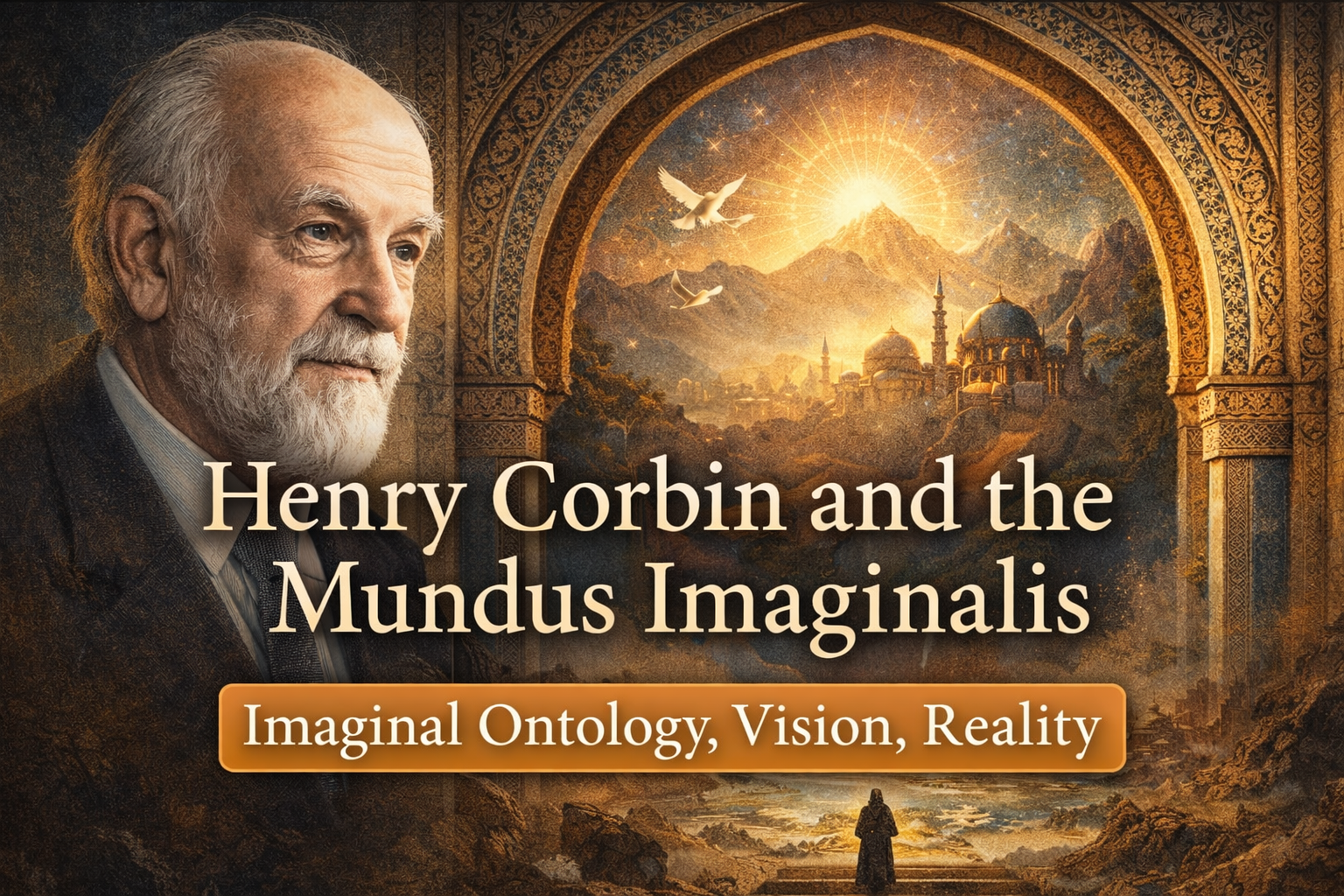
Mundus Imaginalis: Henry Corbin and the Recovery of a Forgotten Reality
One of the most persistent misunderstandings in modern intellectual life concerns imagination. It is either celebrated as creativity or dismissed as fantasy. Rarely is it taken seriously as a mode of access to reality itself. Yet for Henry Corbin, imagination—properly understood—belongs not to illusion but to ontology.
At the center of Corbin’s thought stands a concept that continues to unsettle modern habits of thinking: mundus imaginalis. Often mistranslated as “the imaginary world,” it is in fact the opposite. The imaginal world is not unreal. It is a domain of being that modern epistemology has forgotten how to recognize.
This forgetting is not accidental. It follows from a dominant binary that governs modern thought: either something is empirically observable, or it is subjectively imagined. Between these two poles, there is assumed to be nothing real. Corbin’s work is a sustained refusal of this assumption.
The Loss of the Intermediate
Classical Islamic metaphysics, particularly in its Iranian and Shi‘i intellectual traditions, never accepted a flat ontology. Reality was understood as layered, articulated through degrees of presence. Between the sensible world and the intelligible world lies an intermediate domain—a world of forms, visions, and figures that are neither material objects nor abstract concepts.
Corbin names this domain mundus imaginalis. It is not a metaphor. It is a world with its own consistency, topography, and laws of manifestation. To deny this world is not merely to reject a metaphysical hypothesis; it is to impoverish the structure of reality itself.
Modern philosophy, however, eliminated this intermediate. Vision was reduced to perception, symbol to sign, and imagination to subjective projection. As a result, all visionary knowledge was psychologized, and all symbolic meaning was rendered optional or decorative. Corbin’s intervention begins precisely here.
Imaginal Reality and Objective Vision
For Corbin, the imaginal is real because it appears—not to the physical eye, nor to abstract reason, but to what he calls the active imagination. This imagination is not a faculty of invention. It is an organ of perception attuned to a specific mode of being.
The imaginal world is populated by forms that are objective without being material. These forms are not “inside the mind,” yet they are not located in physical space. They are encountered, not constructed. They appear with insistence, coherence, and meaning.
This is why Corbin insists on distinguishing the imaginal from the imaginary. The imaginary is arbitrary and private. The imaginal is structured and shareable within a tradition of vision. It demands discipline, not spontaneity.
Vision Beyond Representation
At stake in Corbin’s work is a fundamental critique of representational thinking. Modern epistemology assumes that knowledge consists in representing objects. What cannot be represented is often treated as unknowable or unreal. The imaginal resists representation precisely because it is presence before concept.
Vision, in the imaginal sense, is not a mental image standing in for something else. It is an event of manifestation. Meaning does not arrive as an idea but as a figure. Knowledge is not possessed; it is encountered.
This has profound consequences. Once representation ceases to be the sole criterion of knowledge, ontology itself must be rethought. Being is no longer what can be stabilized and controlled, but what can appear meaningfully.
Time, History, and the Imaginal
Corbin’s analysis of imaginal reality also transforms our understanding of time. In his studies of Ismaili and Shi‘i thought, time is not merely a matter of chronological succession. It is archetypal and cyclical, structured by spiritual events rather than neutral measurement.
History, in this view, is not exhausted by empirical causality. It unfolds within a larger imaginal horizon where symbols, figures, and spiritual meanings recur across epochs. Without the imaginal, such recurrence appears irrational. With it, history becomes intelligible as a field of manifestation.
Why the Imaginal Matters Today
The relevance of mundus imaginalis is not confined to historical theology or Islamic philosophy. It addresses a deeper crisis of modern thought: the flattening of reality. When being is reduced to what can be measured or formalized, meaning survives only as interpretation, not as presence.
Corbin offers neither nostalgia nor mysticism. He offers an ontological correction. The imaginal restores a dimension in which meaning can be real without becoming dogma, and vision can be objective without becoming literalism.
This restoration also has ethical implications. The imaginal calls for attentiveness rather than control, fidelity rather than consumption. It forms a subject who responds to meaning instead of mastering it.
A Continuing Philosophical Task
Engaging Corbin seriously means accepting that philosophy cannot close itself into systems without loss. The imaginal resists totalization. It remains real only where thought practices restraint, patience, and humility before appearance.
This is why Corbin continues to attract serious readers across disciplines. He articulates a reality many sense but lack the language to name. His work does not comfort; it demands reorientation.
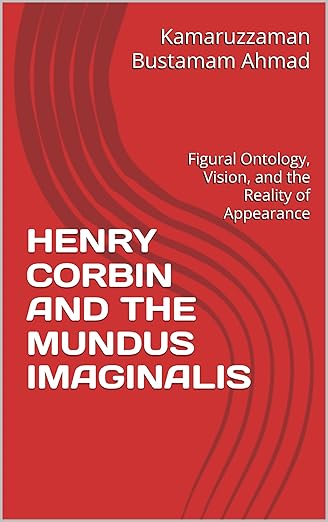
For readers interested in a sustained philosophical engagement with mundus imaginalis, figural ontology, and the critique of modern metaphysics, I have developed these themes further in my recent book, available internationally on Amazon. The book continues this inquiry beyond the introduction, focusing on the ontological status of the imaginal and its implications for contemporary philosophy of religion and metaphysics.
Corbin reminds us of something modern thought has nearly forgotten: not all reality appears as object, and not all truth arrives as concept. Some realities appear only to those willing to see without reducing what they see.
About The Author

Artikel Terkait
 Henry Corbin and Suhrawardi: Reclaiming Light, Vision, and the Reality of Being
 From Clearing to Imaginal Depth: Rethinking Ontology After the End of Metaphysics
 The Imaginal World of Iran: Henry Corbin and the Esoteric Heart of Shi’ism
 Metaphysics and the Making of Islam Nusantara | Corbin, Taylor, al-Attas
 Henry Corbin and the Future of Illumination | Imaginal Philosophy & Spiritual Futures