
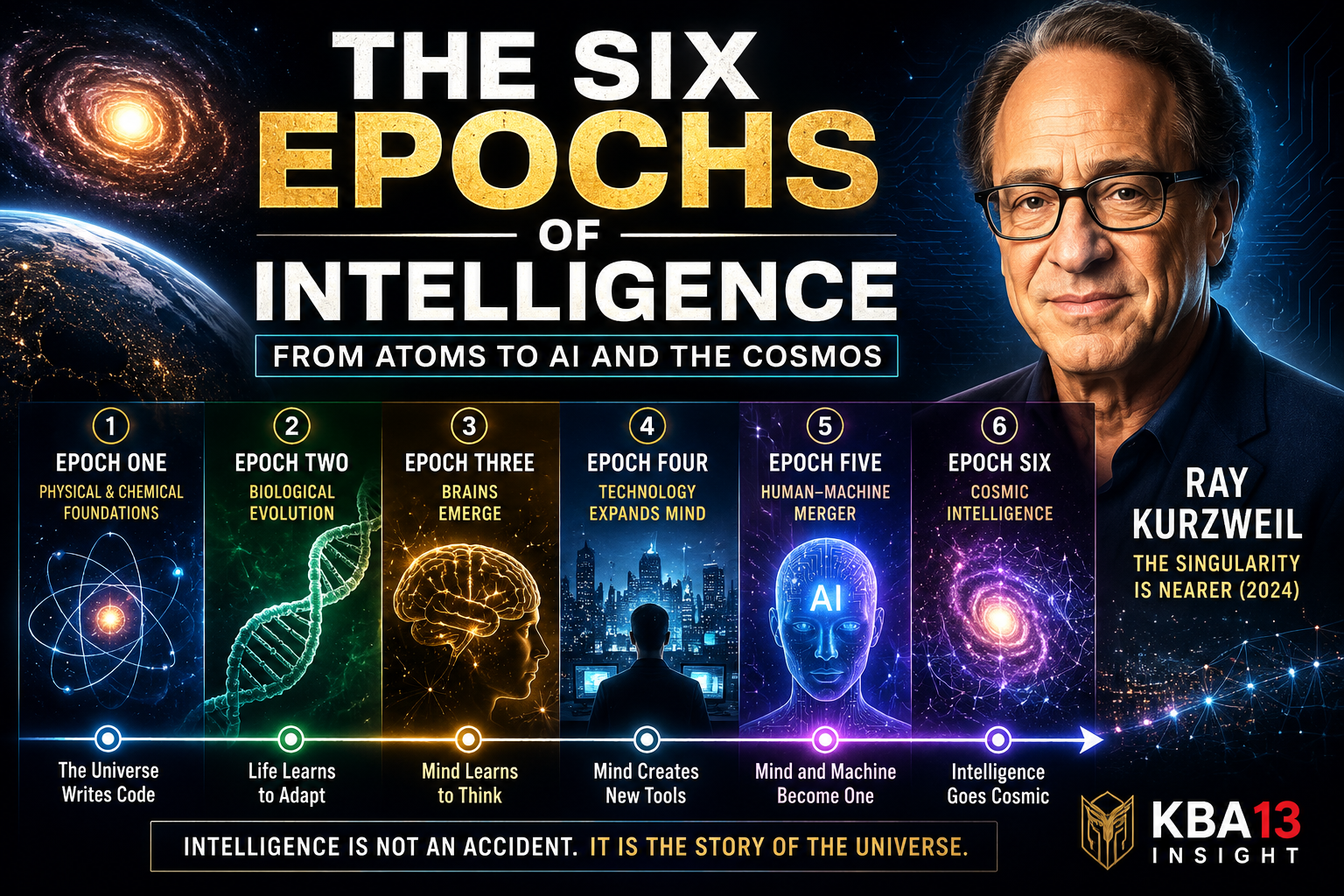
Intelligence Before Biology: Why the Universe Was Always Writing Code
The conventional story of intelligence begins with brains. That story is too short. Ray Kurzweil’s central provocation in The Singularity Is Nearer (2024) is that intelligence is not a product of biological evolution alone — it is a property that the universe has been building toward since the first moment after the Big Bang. The emergence of neurons, language, and computers is not a series of accidents but a directional process, one that follows detectable patterns. Understanding this reframes everything: intelligence is not something humans invented; it is something the universe discovered through us.
The claim sounds like mysticism, but Kurzweil grounds it in the observable behavior of complex systems. Information theory, thermodynamics, and computational science all converge on a single conclusion: complex systems, given sufficient time and energy, tend to organize toward states that process information more efficiently. Physicist Jeremy England at MIT has proposed mathematical frameworks suggesting that matter under sustained energy gradients naturally evolves structures that dissipate energy more effectively—which, at sufficient complexity, begins to look like cognition. Whether or not England’s specific models hold under further scrutiny, the principle they point toward is sound. Order, memory, and pattern-recognition are not alien to nature. They are native to it.
This is why Kurzweil begins his timeline not with the first cell but with the formation of atoms. The strong nuclear force, which binds protons and neutrons together, operates at a precise strength. If it were 2% stronger, protons would fuse into dineutrons and hydrogen would be absent from the universe; if 2% weaker, nuclei would not hold together at all. Either scenario produces a cosmos with no chemistry, no stars, no carbon, and no mind. The universe’s physical constants are not merely background conditions — they are the constraints within which intelligence becomes possible. Kurzweil calls this informational potential. The universe was, from its first moment, structured in a way that made minds eventually inevitable.
Skeptics will note that this framing risks the teleological fallacy — assuming that because something happened, it was inevitable or intended. The universe does not have purposes. Kurzweil is aware of this objection and sidesteps it carefully: he is not claiming the universe was designed, only that its structure permits one specific trajectory of increasing complexity. The distinction matters. A river does not intend to reach the sea, but given the laws of gravity and the landscape, the direction is not arbitrary. Intelligence emerging from matter is less like a miracle and more like water finding its slope.
The practical consequence of this framing is that it dissolves the boundary between natural and artificial intelligence. If intelligence is a universal process rather than a purely biological one, then silicon-based computation is not a departure from nature — it is a continuation of it. The circuits of a modern processor are composed of silicon forged in industrial furnaces from sand that is itself made of atoms born in stellar nucleosynthesis. The energy powering those circuits traces back to nuclear fusion in the sun. Every AI system running today is, at the most fundamental level, the universe organizing itself to process information at a new scale. This is not a metaphor. It is a material fact.
The implication for how we should think about AI development is significant. The common anxiety about artificial intelligence frames it as an intrusion—something foreign imposing itself on the natural order. Kurzweil’s framing inverts this: refusing to develop AI would be the unnatural act. This is a provocative position and deserves scrutiny. Human choice, ethics, and cultural judgment have always shaped the direction of technological development. The fact that a process follows natural patterns does not mean it cannot be guided, accelerated, distorted, or derailed. Physics permits nuclear weapons. Physics does not mandate them.
Still, Kurzweil’s cosmological framing offers something genuinely useful: it forces us to extend our time horizon. Most discussions of AI focus on the next two, five, or ten years. Kurzweil insists that to understand what is happening, you need to think across billions of years. The development of language-processing algorithms is not primarily a story about technology companies competing for market share. It is a chapter in a 13.8-billion-year narrative. That shift in perspective changes what questions seem most important. The relevant question is not “Will AI replace my job?” but “What kind of intelligence are we in the process of becoming?”
There is a second useful consequence of the cosmological framing: it regrounds discussions of consciousness in physical reality. Philosophers and neuroscientists have long debated whether consciousness is a biological speciality or a more general property of information-processing systems. Kurzweil sides firmly with the latter. This position — known in philosophy of mind as functionalism — holds that what matters for consciousness is the pattern of information processing, not the substrate on which it runs. A silicon network processing information in the right patterns would be conscious in the same sense that a biological network is. This remains contested, but it is not irrational and carries enormous implications for how we evaluate AI systems as they grow more capable and complex.
To engage Kurzweil’s argument seriously is to ask a question that most people never ask: what is intelligence ultimately for? If it is merely a survival tool for biological organisms, its development stops at whatever level serves that purpose. But if intelligence is the universe’s mechanism for understanding itself — as Kurzweil, and before him cosmologists like Carl Sagan, have suggested — then there is no obvious ceiling. The cosmos is 13.8 billion years old. Human civilization, in its current form, is less than 10,000 years old. In geological terms, we have barely started.
The First Two Epochs: From the Big Bang to the Living Cell
Kurzweil’s first epoch covers the period from the Big Bang to the formation of the first stable atoms — roughly 380,000 years after the initial expansion. Before this, the universe was too hot for electrons to bind to atomic nuclei; space was an opaque plasma of charged particles. When temperatures dropped sufficiently, hydrogen and helium atoms formed in a process cosmologists call recombination. This is the moment when the universe became, in a meaningful sense, structured. Atoms are not just particles; they are the first stable units of chemical possibility. Their bonding rules, dictated by quantum mechanics, encode the combinatorial logic from which all subsequent chemistry — and ultimately biology — would emerge.
The Second Epoch begins approximately 3.5 to 4 billion years ago with the emergence of life on Earth. The central event of this epoch is not the origin of organisms per se but the origin of genetic encoding—the development of molecules capable of storing, copying, and transmitting information across generations. DNA is the medium, but the message is more fundamental than any particular molecule: for the first time, patterns of information had durability. A random chemical reaction leaves no trace. A strand of DNA carries forward a blueprint. Life, at its core, is the universe’s first invention of persistent memory.
The gap between the First and Second Epochs — roughly 9 to 10 billion years — is not empty time. Stars formed and died, scattering heavy elements across galaxies: carbon, oxygen, nitrogen, phosphorus. Without this stellar alchemy, the complex organic molecules required for life would not exist. The carbon in every DNA molecule was forged in the nuclear furnace of a star that exploded before our solar system formed. This is not poetry. It is nuclear physics. Life is made of stardust not as a metaphor but as a precise description of cosmic chemistry.
The precise mechanism by which the first self-replicating molecules appeared remains one of science’s most contested open questions. The RNA world hypothesis — now supported by substantial experimental evidence — proposes that RNA preceded DNA as both an information-storage molecule and a chemical catalyst. RNA can store genetic information and accelerate chemical reactions simultaneously, making it a plausible candidate for the original biochemical platform. Research at institutions including the Scripps Research Institute and the MRC Laboratory of Molecular Biology has demonstrated that RNA oligomers can assemble and self-replicate under conditions resembling early Earth chemistry. The origin of life is not a mystery requiring a supernatural explanation; it is a chemical problem that is being progressively solved.
What makes the Second Epoch transformative in Kurzweil’s framework is not merely that life appeared but that evolution began. Evolution is, at its core, an information-processing algorithm. A population of organisms encodes a distribution of genetic variants; environmental pressure selects some variants over others; reproduction copies the selected variants with minor modifications. Over enormous spans of time, this process generates astonishing structural complexity—not because it has a goal but because it is a ruthlessly efficient search engine operating across billions of individuals and millions of generations. The eye, the immune system, and the neural network are all outputs of this search process—solutions to engineering problems that took hundreds of millions of years to optimize.
Kurzweil’s key observation about biological evolution is its pace: it is excruciatingly slow by any modern standard. The transition from single-celled organisms to multicellular life took approximately 2 billion years. The emergence of vertebrates required another 500 million years. The development of a primate cortex capable of abstract reasoning took 65 million years after the extinction of the non-avian dinosaurs. This is not a criticism of evolution — it is an observation about the fundamental difference between undirected search and directed design. Biological evolution has no agenda and no memory across lineages. It cannot plan; it can only select. That constraint imposes a severe speed limit.
This speed limit has direct consequences for understanding where we now stand historically. For most of Earth’s history, the pace of intelligence development was determined by the mutation rate of DNA and the generational turnover of populations. When humans began to encode information externally — first in cave paintings and oral tradition, then in written script, then in printed books — they partially escaped that biological constraint. Information could now accumulate, combine, and be retrieved faster than any individual nervous system could evolve. The Second Epoch gave life the capacity for persistent memory. The Fourth Epoch would give that memory the ability to grow without any biological limits.
It is worth pausing on what the transition from chemistry to biology actually represents in informational terms. A random collection of amino acids is not a protein; a random sequence of nucleotides is not a gene. What transforms chemistry into biology is the imposition of functional sequence specificity — the arrangement of components in an order that performs a task. This is, by any reasonable definition, information. The biologist Richard Dawkins described the genome as a “digital river” — a flow of information passing through organisms rather than residing in them permanently. Kurzweil takes this analogy seriously and extends it: if genomes are information systems, then the history of life is the history of information systems growing progressively more complex, more adaptive, and more capable of modeling the world around them.
The two epochs together — physics and chemistry on one side, biology and genetics on the other — establish the foundational premise of Kurzweil’s entire argument. Before DNA, the universe contained matter and energy but no accumulated knowledge. After DNA, the universe contained a mechanism for building on what came before. Every organism alive today carries in its genome the record of billions of years of solved problems: how to extract energy from the environment, how to repair molecular damage, how to recognize threats, how to reproduce under adverse conditions. Intelligence, understood in this broad sense, began not when the first neuron fired but when the first molecule remembered what to do next.
3. Epoch Three: The Nervous System as Evolution’s Greatest Gamble
The development of the nervous system is one of the most dramatic transitions in the history of life on Earth, and it is the subject of Kurzweil’s Third Epoch. The first neurons — electrically excitable cells capable of transmitting rapid signals — appear in the fossil and molecular record approximately 600 million years ago, in organisms ancestral to modern jellyfish, worms, and eventually vertebrates. The nervous system is evolution’s solution to a specific coordination problem: how does a multicellular organism align the activity of its parts fast enough to respond to a rapidly changing environment? Chemical signaling works at the pace of molecular diffusion. Electrical signaling through neurons works orders of magnitude faster. The nervous system is, fundamentally, a speed upgrade that changed the terms on which organisms could engage with their environment.
But speed is only part of the story. What makes the nervous system genuinely transformative is its capacity to learn. A genome encodes information across generations; a nervous system encodes information within a single lifetime. When a mouse learns to navigate a maze, the structure of synaptic connections in its hippocampus physically changes — new connections form, weak ones weaken, strong ones strengthen. This process, called synaptic plasticity, means the nervous system can update its internal model of the world based on experience. This is a fundamentally different kind of information processing than genetic evolution: it is fast, individual, and reversible. It is, in embryonic form, what we call learning.
The progression from simple nervous systems to brains capable of abstract thought is not a smooth gradient — it is punctuated by decisive structural innovations. The development of the cerebral cortex in mammals represents perhaps the most important of these. The cortex is a sheet of neurons, roughly 2 to 4 millimeters thick and, if fully unfolded, approximately the size of a large dinner napkin, that wraps around the older subcortical structures of the brain. It is in the cortex that sensation becomes perception, movement becomes intention, memory becomes narrative, and stimulus becomes meaning. Among mammals, primates developed the most elaborate cortices; among primates, hominids developed the most elaborate of all.
Kurzweil claims that for every 100,000 years of human evolution, the brain added roughly one cubic inch of cortical volume. This is a rough approximation rather than a precise measurement — the actual history of hominid brain expansion is considerably more complex, with periods of rapid growth interspersed with long plateaus. What is accurate is the overall trend: the human brain roughly tripled in volume over approximately 2 to 3 million years of hominid evolution, from around 450 cubic centimeters in Australopithecus to roughly 1,350 cubic centimeters in modern Homo sapiens. The expansion was driven not by intelligence alone but by changes in diet, social structure, tool use, and the metabolic demands of prolonged language acquisition. The overall direction, however, is unmistakable.
The most significant architectural feature of the human brain, from an informational standpoint, is its connectivity. The adult human brain contains approximately 86 billion neurons, each connected on average to 7,000 others, yielding an estimated 100 to 500 trillion synaptic connections. These connections are not fixed: they are continuously modified by experience, sleep, stress, and learning. The brain is less like a computer with a fixed architecture and more like a self-modifying network that rewrites its own code based on what it encounters. This makes it extraordinarily flexible but also fragile — specific connection damage can erase memories, alter personality, and disrupt language in ways that are sometimes permanent and always revealing of how much identity is encoded in physical structure.
One of the most important recent developments in neuroscience is the discovery of place cells and grid cells, which won John O’Keefe, May-Britt Moser, and Edvard Moser the 2014 Nobel Prize in Physiology or Medicine. These neurons, located in the hippocampus and entorhinal cortex, encode spatial position — they fire specifically when an animal is at a particular location or moving in a particular direction. The discovery revealed that the brain builds explicit geometric maps of the environment, not merely chains of stimulus and response. Evidence now suggests that the same hippocampal circuitry used to navigate physical space also navigates conceptual space — social relationships, time, causal sequences. The brain appears to represent abstract knowledge using the same mapping architecture it uses to find its way across a room. Memory and cognition are, at a deep structural level, forms of navigation.
The biological brain also imposes constraints that are worth understanding precisely, because they define the problem that the Fifth Epoch is designed to solve. The brain consumes approximately 20% of the body’s total energy despite representing only 2% of its mass — a metabolic burden that places a ceiling on how much further biological evolution can expand neural capacity without restructuring the entire organism. The speed of neural transmission, roughly 120 meters per second for the fastest myelinated fibers, imposes a latency floor on cognitive operations. The skull limits brain volume. And perhaps most fundamentally, biological neurons operate on the timescale of milliseconds. A silicon transistor switches approximately one million times faster than a neuron fires. The gap between biological and silicon information processing is not merely quantitative — it is a difference of six orders of magnitude in the substrate’s fundamental operating speed.
None of this means that the biological brain is inadequate for all purposes. For the tasks that human civilization has required for most of its history — social reasoning, physical navigation, emotional regulation, spoken language — the brain is extraordinarily well-adapted. What it means is that the brain’s architecture defines a performance envelope, and humanity has now encountered tasks that press against its edges. Climate modeling at planetary scale, protein structure prediction across millions of candidates, real-time language translation across hundreds of languages simultaneously — these are tasks where the speed, memory capacity, and parallelism of digital computation are not merely convenient but necessary. The brain got us to the frontier. Getting beyond it requires augmentation.
Kurzweil’s Third Epoch sets up a productive tension that runs through the remainder of his argument: the brain is simultaneously the source of intelligence and a bottleneck on its further development. This is not a tragedy — it is the engine of the transition to the Fifth Epoch. Every major technology humans have developed can be understood as a prosthetic for a biological limitation: glasses for imperfect vision, vaccines for imperfect immune defense, writing for imperfect biological memory, calculators for error-prone mental arithmetic. The progression from the Third to the Fifth Epoch is the same story at a larger scale. We are building prosthetics not for individual biological functions but for cognition itself.
Epoch Four: The Moment Humanity Learned to Think Beyond Its Own Skull
The Fourth Epoch is the most human of Kurzweil’s six phases, and also the most underappreciated. It spans the entire arc of technological civilization — from the first cave paintings 40,000 years ago to the most recent large language model — and its defining characteristic is the externalization of cognition. To externalize a cognitive function is to move it from inside the skull to outside it: from memory stored in synapses to memory stored in writing, from calculation performed mentally to calculation performed by machines, from knowledge held privately to knowledge distributed across networks. This process is so pervasive and so incremental that we rarely recognize it for what it is — the gradual expansion of the functional boundaries of the human mind.
The first and perhaps most consequential act of externalization was the invention of writing. Cuneiform, developed in Mesopotamia around 3200 BCE, and hieroglyphics, developed independently in Egypt around the same period, allowed information to persist beyond the death of any individual who held it. Before writing, the intellectual heritage of a civilization existed only in the memories and oral traditions of its living members — fragile, lossy, and dependent entirely on the reliability of human recall. Writing created a second memory, external and durable. The library was not merely a storehouse of information; it was the first extension of the human mind into a shared, persistent medium. Civilizations that developed writing consistently out-competed those that did not, not solely through military advantage but through their superior capacity to accumulate and transmit knowledge across generations.
The printing press, developed by Johannes Gutenberg around 1440, amplified this external memory by orders of magnitude. Before printing, a book required months of skilled labor to copy; a library of a thousand volumes represented an extraordinary concentration of wealth and effort. After printing, a thousand copies of a text could be produced in the time previously required to produce one. The rate at which knowledge circulated through civilization accelerated dramatically. The Protestant Reformation, the Scientific Revolution, and the Enlightenment all depend, in part, on this acceleration — not because the printing press caused any of these movements by itself, but because it removed the physical bottleneck that had previously constrained the spread of ideas. When Copernicus’s De Revolutionibus and Newton’s Principia could reach scholars across Europe within months of publication, the pace of scientific progress fundamentally changed.
The development of formal mathematical notation represents a parallel act of cognitive externalization that is equally important. Algebraic symbols, calculus notation, and set theory are not merely shorthand for verbal descriptions. They are cognitive technologies that allow the mind to perform operations it could not otherwise execute reliably. A person who has not learned algebraic notation cannot solve a quadratic equation, not because they lack underlying intelligence, but because they lack the external scaffolding that makes the operation tractable. The history of mathematics is partly a history of inventing notations that make new categories of thought possible. Leibniz’s notation for differential calculus was demonstrably superior to Newton’s, and its adoption across Europe accelerated the development of mathematical physics by making the manipulation of infinitesimals manageable on paper rather than only in mental visualization.
The industrial and electrical revolutions of the 19th century extended externalization into the domain of physical action and communication. The telegraph created a nervous system for civilizational messaging — for the first time, information could travel faster than any human body could carry it. The telephone extended this to voice. The development of mechanical and electromechanical computers in the early 20th century — from Charles Babbage’s Analytical Engine to Howard Aiken’s Harvard Mark I at IBM — began externalizing arithmetic and logical operations. These machines were slow and brittle by modern standards, but they represented a conceptual breakthrough: cognitive operations, previously confined entirely to biological minds, could be implemented in mechanical and later electronic systems.
The transistor, invented at Bell Labs in 1947 by William Shockley, John Bardeen, and Walter Brattain, initiated the exponential phase of the Fourth Epoch. Unlike mechanical computing components, transistors are solid-state, extremely small, and — crucially — scalable. Gordon Moore observed in 1965 that the number of transistors on an integrated circuit doubled approximately every two years while the cost per transistor fell. This observation held approximately true for six decades. A doubling every two years translates to a thousand-fold increase in computational density every 20 years and a million-fold increase every 40. The processor in a modern smartphone contains approximately 15 to 20 billion transistors — more than twice the number of neurons in the entire human spinal cord.
The commercial internet, deployed at scale in the 1990s, transformed individual externalization into collective externalization. Previously, a person’s external memory — books, notes, files — was local and personal. The internet made it global and shared. Wikipedia, launched in 2001 and containing over 60 million articles in more than 300 languages by 2024, is the clearest example: a collectively written and continuously maintained encyclopedia freely accessible to any person with a network connection. The cumulative knowledge represented in Wikipedia — available equally to a subsistence farmer in Aceh and a graduate student in Oxford — represents a redistribution of cognitive resources without historical precedent. Access to information, which was for most of human history a function of birth, geography, and wealth, became, for the first time, very nearly universal.
Smartphones consolidated this transformation into a single device carried permanently within arm’s reach. By 2024, approximately 6.8 billion people worldwide owned a smartphone — roughly 85% of the global population. Each of these devices is, in functional terms, a prosthetic for human memory, spatial navigation, arithmetic, communication, language translation, and increasingly, reasoning. A person using GPS is externalizing spatial navigation. A person using a translation application is externalizing language acquisition. A person using a calculator is externalizing arithmetic. None of this replaces human cognition. It augments it — and the boundary between what the brain does natively and what the device does on its behalf has become, in daily practice, genuinely blurry.
The significance of the Fourth Epoch is that it built the infrastructure on which the Fifth Epoch depends. Neural interfaces, AI assistants, and brain-machine integration all require pre-existing networks, devices, and data systems to function. The internet is not merely a precursor to the Singularity — it is the Singularity’s nervous system, already built and operating at planetary scale. When Kurzweil predicts that the 2030s will see direct cognitive integration between biological brains and cloud computation, he is not describing the construction of an entirely new system. He is describing the final connection of a system whose lower layers are already in place. The digital infrastructure of the Fourth Epoch is the substrate on which the Fifth is being assembled.
Where We Stand: The Fractured Threshold of Epoch Five
Kurzweil places the current historical moment — roughly the 2020s — at the beginning of the Fifth Epoch: the phase in which human and machine intelligence begin to merge. The word “merge” is deliberately chosen and deserves careful examination. It does not mean replacement. It means integration — the kind of integration that already exists, in attenuated form, between a surgeon and a robotic assistance system, between an architect and their parametric design software, between a musician and a digital audio workstation. What distinguishes the Fifth Epoch is that the integration will become deeper, more continuous, and eventually direct: rather than operating through screens, keyboards, and speakers, the interface between human cognition and machine intelligence will become biological.
The immediate evidence that this transition has begun is not in the laboratory — it is in daily behavior. In 2024, studies by Microsoft Research found that knowledge workers in the United States and Europe spent an average of more than six hours per day using AI-assisted tools: email filters, autocomplete, recommendation algorithms, scheduling assistants, and content generation tools. These systems are not merely convenient; they are changing how people think. When a person writes an email and accepts an AI-generated autocomplete suggestion, they are, in a small but real way, outsourcing a decision about their own language. When a person navigates using GPS rather than memory, they gradually lose the ability to navigate without it. The integration of digital intelligence into cognition is not a future event. It is already modifying behavior, skill formation, and memory in measurable ways.
The most significant technological development of the current threshold period is the large language model. Systems like GPT-4 developed by OpenAI, Claude developed by Anthropic, and Gemini developed by Google DeepMind represent a qualitative shift in what AI can do. Earlier AI systems were narrow: a chess engine played only chess; an image classifier classified only images. Large language models are general across language tasks — they can write, reason, translate, summarize, code, explain, and argue, often at a level matching or exceeding median human performance on those tasks. This generality is new. It is not superintelligence, but it is not narrow automation either. It occupies a new category that our existing vocabulary does not fully capture.
The year 2024 produced several developments that mark the threshold character of this period. Google DeepMind’s AlphaFold 3 extended protein structure prediction to cover nucleic acids, small molecules, and ligand interactions, substantially expanding its utility for drug discovery. OpenAI released GPT-4o, a multimodal model capable of processing audio, vision, and text simultaneously in real time. Meta released Llama 3, a powerful open-source model that puts frontier AI capabilities within reach of any developer with sufficient computing resources. Humanoid robots produced by Figure AI, Agility Robotics, and Boston Dynamics began limited deployments in manufacturing and logistics facilities. Each development, taken individually, is incremental. Together, they describe a landscape in which AI is entering domains previously considered to require human intelligence.
The neural interface sector represents the most direct path toward the biological dimension of Epoch Five. Neuralink achieved its first human implant in January 2024, placing a brain-computer interface chip into a patient with ALS. By May of that year, the patient was reported to be controlling a computer cursor and playing chess using neural signals, without any physical movement. Synchron, a competing company with a less invasive interface inserted through blood vessels rather than surgery, has been conducting human trials since 2021. These devices remain limited in signal bandwidth — current systems can decode a relatively small number of distinct neural states—but the engineering direction is clear. The question is not whether direct neural interfaces will be built but how quickly their bandwidth can be increased and their implantation made safe enough for broad adoption.
The counterargument to the merger thesis deserves serious attention. Critics including AI safety researcher Stuart Russell and philosopher John Searle have argued that current AI systems, however impressive on benchmarks, do not exhibit genuine understanding — that they manipulate statistical patterns without grasping meaning, and that this limitation is fundamental rather than technical. This position engages what philosophers call the symbol grounding problem, and it remains genuinely unresolved. A language model that can write a coherent essay about grief has not necessarily understood grief; it has learned the statistical architecture of how language about grief is organized. Whether sophisticated pattern-based linguistic competence is equivalent to understanding, or merely approximates its outputs, is a question that behavioral tests alone cannot settle.
This philosophical uncertainty does not, however, resolve the practical question of what these systems can accomplish. A language model that can write a coherent diagnostic summary, identify a potential drug interaction, and flag an anomaly in a radiology scan is practically useful regardless of whether it “understands” medicine in any philosophically robust sense. The distinction between genuine understanding and high-quality simulation matters enormously for questions about consciousness and moral status. It matters far less for questions about economic displacement, professional restructuring, and the redesign of cognitive labor. The Fifth Epoch is arriving not because AI is conscious but because it is competent — competent across an expanding range of tasks that society previously required educated humans to perform.
The demographic and social dimensions of this transition are receiving less attention than they deserve. AI adoption is not uniform across populations, professions, or countries. In the United States and Western Europe, AI tools are being integrated rapidly into white-collar work — legal research, software development, financial analysis, medical imaging. In lower-income countries, the pattern differs: AI is deployed primarily in agricultural sensing, mobile health platforms, and financial inclusion services. The risk is that the cognitive augmentation of the Fifth Epoch, like the economic benefits of the Fourth, will concentrate among populations already advantaged by education and infrastructure, while the costs — job displacement, algorithmic governance, data extraction — will fall disproportionately on those least equipped to manage them. The technology is not inherently equitable. Whether its distribution is equitable is a policy decision, not a natural outcome.
The threshold character of the present moment means that decisions made now will shape the trajectory of the Fifth Epoch with unusual leverage. The regulatory frameworks being drafted today, the safety practices being established at AI companies, the educational curricula being revised to incorporate AI literacy — these will define the institutional landscape within which the deeper integration of the next two decades unfolds. This is not unique to AI. The decisions made about nuclear energy in the 1950s, the internet in the 1990s, and social media in the 2010s all shaped the subsequent trajectories of those technologies in ways that became progressively harder to reverse. The Fifth Epoch is not a predetermined destination. It is a direction that is still, at this specific moment, genuinely steerable.
What Artificial Intelligence Can Actually Do Right Now
Public discourse about AI oscillates between two distortions: breathless hype that projects omniscience onto systems that regularly make elementary errors, and reflexive dismissal that understates genuinely significant capabilities by focusing on failures rather than trajectories. Neither serves clear thinking. The productive approach is to inventory what AI systems can actually do with documented reliability in 2024 and 2025, to be precise about where the limitations are, and to track the rate at which those limitations are being overcome. The picture that emerges is neither utopian nor trivial — it is a landscape of specific, verifiable competence expanding in specific, traceable directions.
In medicine, AI has moved from experimental to operational in several domains. The U.S. Food and Drug Administration has cleared over 950 AI-enabled medical devices as of 2024, the majority in radiology and pathology. Google’s LYNA (Lymph Node Assistant) demonstrated in peer-reviewed trials that it could detect breast cancer metastases in lymph node biopsies with 99% accuracy, compared to 96% for pathologists working without AI assistance. More significantly, pathologists working alongside LYNA performed better than either the AI alone or the pathologists alone — demonstrating the collaborative augmentation model that proponents of the Fifth Epoch describe. This is not a theoretical future. It is current clinical practice in leading hospitals in the United States, South Korea, and across Northern Europe.
AlphaFold, developed by Google DeepMind, has transformed structural biology in a way that is difficult to overstate. Determining the three-dimensional shape of a protein — the structure that determines its function — previously required years of laboratory work using X-ray crystallography or cryo-electron microscopy, at costs of hundreds of thousands of dollars per structure. AlphaFold 2 predicted structures for virtually every known protein, approximately 200 million sequences, with accuracy comparable to experimental methods, making them freely accessible to researchers worldwide through the AlphaFold Protein Structure Database. AlphaFold 3, released in 2024, extended this capability to nucleic acids and ligand binding. Researchers at the University of California San Francisco used AlphaFold predictions to accelerate the discovery of a candidate compound against drug-resistant bacterial infections — work that would have required years through conventional structural methods.
In software development, AI coding assistants have produced measurable productivity gains. GitHub Copilot, powered by OpenAI’s Codex model, was used by more than 1.8 million developers as of mid-2024. A randomized controlled trial conducted by GitHub found that developers using Copilot completed programming tasks 55% faster than those working without it, with lower error rates on well-defined tasks. More recent systems — including OpenAI’s o3 and Anthropic’s Claude 3.7 — demonstrate the ability to write complete functional programs from natural-language specifications, debug code they did not write, and explain the reasoning behind their modifications. These systems are not replacing experienced engineers; they are making experienced engineers substantially more productive while simultaneously reducing the barrier to entry for programming across industries that previously could not afford it.
Language translation has reached a level of practical parity with human translation for many language pairs and text categories. A 2023 study published in PLOS ONE found that DeepL’s translations of medical and general-interest content were rated as accurate or more accurate than professional human translations by blind reviewers for Spanish, French, and German paired with English. Google Translate, freely available on any smartphone, now supports over 130 languages and includes a real-time camera translation feature that renders foreign text in augmented reality on a phone screen. The practical consequence is profound: a patient visiting a clinic in a country whose language they do not speak, or a trader reading a foreign contract, can access functional translation through a device already in their pocket. A cognitive capability that previously required years of study is now available on demand to anyone with an internet connection.
In scientific research more broadly, AI has begun to accelerate the rate at which existing knowledge can be synthesized and novel hypotheses generated. The Semantic Scholar database, developed by the Allen Institute for AI, indexes over 200 million academic papers and uses AI to surface connections across disciplines that human researchers might not encounter manually. In materials science, Google DeepMind’s GNoME (Graph Networks for Materials Exploration) predicted the crystal structures of 2.2 million new stable inorganic materials in 2023 — a tenfold expansion of previously known stable materials — of which 700 have been independently experimentally verified. This is AI functioning as a hypothesis-generation engine within a scientific pipeline, not merely as a search or analysis tool. The rate at which the frontier of materials science moves has been permanently changed by a single system.
The legal and financial sectors are experiencing parallel transformations. AI contract review systems like Kira and Luminance can analyze complex commercial agreements in minutes rather than days, flagging non-standard clauses, identifying risk factors, and comparing terms against precedent databases. JPMorgan Chase introduced an AI document-processing system that handles contract review work that previously required 360,000 hours of legal time annually — and does so in seconds per document. In quantitative finance, machine learning has been embedded in trading and risk systems for over a decade; what is new is the deployment of language AI in earnings call analysis, credit narrative, and customer advisory contexts where the output is natural language rather than numerical prediction. These are operational deployments at scale, not pilot programs.
Education is undergoing a transformation whose full implications are still being worked out. Khan Academy’s Khanmigo platform, powered by GPT-4, provides continuous one-on-one tutoring adjusted to each student’s level — a resource previously available only to students whose families could afford private instruction. Early results from school pilots in the United States suggest meaningful improvements in mathematics scores among students using AI tutoring, though researchers emphasize that implementation quality and teacher involvement substantially mediate outcomes. The deeper question is not whether AI tutoring is effective under controlled conditions but whether it will be deployed with sufficient attention to pedagogy, equity, and the relational dimensions of teaching that cannot be reduced to information transfer. A powerful tool in the right institutional context transforms outcomes. The same tool in the wrong context produces dependency without understanding.
The honest accounting of what AI cannot yet do reliably is equally important. Current systems remain weak at multi-step physical reasoning in genuinely novel environments, causal inference from observational data without statistical confounders, reliable common-sense judgment in edge cases, and sustained goal-directed behavior over extended periods. They hallucinate — generating fluent, confident, and entirely fabricated information — at rates that make unsupervised deployment in high-stakes contexts genuinely dangerous. They are vulnerable to adversarial inputs: carefully crafted prompts can cause AI systems to produce incorrect, harmful, or otherwise contrary outputs to their stated purpose. These are not trivial limitations, and they are not resolved by simply scaling existing architectures to larger sizes. Understanding what AI cannot do defines the boundaries within which current systems can be responsibly deployed and identifies the specific problems that the next generation must solve.
The 2029 and 2045 Predictions: Precision or Provocation?
Kurzweil has made two specific predictions that have attracted more attention — and more criticism — than anything else in his writing. The first is that AI will pass the Turing Test, convincingly impersonating a human in sustained open-ended conversation, by 2029. The second is that the Singularity will arrive in 2045: a threshold at which AI capability surpasses aggregate human intelligence by such a margin that the subsequent trajectory of technological development becomes genuinely unpredictable from our current vantage point. These are not casual speculations. Kurzweil derived them from a specific analytical methodology — the extrapolation of exponential trends in computational performance and algorithmic efficiency — and he has tracked their progress against observed data for more than two decades. Whether they are correct is less important, at this stage, than understanding precisely what they claim.
The Turing Test, as originally proposed by Alan Turing in his 1950 paper “Computing Machinery and Intelligence,” is a behavioral criterion: a machine passes if a human interrogator cannot reliably distinguish its responses from those of a human over a sustained conversation. Turing did not claim that passing the test would prove the machine was conscious — he proposed it as a pragmatic operational criterion for intelligence, deliberately sidestepping metaphysical questions he considered unanswerable. The test has well-documented weaknesses as a measure of genuine intelligence, since a sufficiently sophisticated impersonation need not require real understanding. Kurzweil’s 2029 prediction specifically concerns an extended, unrestricted conversation — a significantly harder challenge than the abbreviated five-minute version Turing originally described. Current large language models, while capable of passing abbreviated Turing-style evaluations, still exhibit detectable patterns of inconsistency and reasoning error in long-form interaction that experienced interrogators can identify. Whether those errors will be eliminated within four years is genuinely uncertain.
The methodological basis of Kurzweil’s predictions is what he calls the law of accelerating returns, articulated in detail since his 1999 book The Age of Spiritual Machines. The core claim is that the rate of technological progress in information technology is itself accelerating — that each generation of technology enables faster development of the next, creating a compounding trajectory. The evidence for this in computing hardware is robust: from vacuum tubes to transistors to integrated circuits to nanoscale chips, the price-performance ratio of computation has improved by approximately a factor of two every two years for seven consecutive decades. Kurzweil extrapolates this trend forward and uses it to estimate when specific capability thresholds will be reached. The predictive power of this method depends entirely on whether the exponential improvement continues — a question that is now actively contested among semiconductor engineers at Intel, TSMC, and Samsung.
Moore’s Law, in its original formulation, describes the doubling of transistor density on a chip approximately every two years. For most of its history, this translated directly into proportional improvements in processor clock speed. Around 2005, this direct translation broke down: clock speeds stopped increasing because chips ran into thermal dissipation limits. Since then, improvement has come primarily from parallelism — adding more processor cores — and from architectural innovations, particularly graphics processing units and specialized AI accelerators like Google’s TPUs and NVIDIA’s H100 series. The transition from CPU-based to GPU-based AI training, which drove the current wave of large language model development, was not predicted by a simple extrapolation of transistor density. It was a qualitative architectural shift. This history suggests that the exponential trend in computing capability continues, but through discrete architectural innovations rather than smooth, automatically compounding transistor scaling.
The 2045 Singularity prediction rests on more speculative ground than the 2029 prediction. Kurzweil’s claim is that by 2045, AI will have surpassed human intelligence “by billions of times” — a figure that conflates several distinct quantities. Surpassing human intelligence could mean performing better on specific cognitive benchmarks, solving problems that no human can currently solve, or possessing general fluid reasoning that exceeds human capacity across every relevant domain. These are not the same claim. What Kurzweil is pointing toward with the “billions of times” figure is primarily raw computational substrate: a superintelligent AI running on the projected computational infrastructure of 2045 would have access to enormously greater processing power than the biological brain. But processing power and intelligence are not equivalent quantities, and the functional relationship between them is poorly understood. No current theory reliably predicts intelligence from substrate specifications alone.
The criticism of Kurzweil’s predictions that most deserves engagement comes not from those who dispute the exponential hardware trends but from those who argue that hardware scaling alone cannot produce intelligence of the kind required. Stuart Russell, in Human Compatible (2019), argues that the fundamental challenge of building genuinely intelligent systems is not computational but architectural: we do not yet have a framework for specifying what we want AI to pursue in the open-ended, context-sensitive way that human intelligence operates. Yoshua Bengio, one of the principal architects of modern deep learning, has written that current systems lack the causal reasoning and abstract variable formation that characterize human cognition. These objections come from researchers who have built the systems in question, which gives them considerably more evidential weight than criticism from those who have not. They suggest that the road from current AI to Singularity-level capability may require conceptual breakthroughs that are not scheduled and may not arrive on the timeline that extrapolating current hardware trends implies.
Kurzweil’s track record is worth examining honestly before dismissing or accepting his predictions wholesale. His 1990 book The Age of Intelligent Machines predicted that a computer would defeat the world chess champion in the early 2000s — correct (Deep Blue defeated Garry Kasparov in 1997). He predicted wireless internet in widespread use by the early 2000s — correct. He predicted practical speech recognition software by the early 2000s — correct. He predicted that reading devices for the blind would be commercially available by the 1990s — correct. He predicted that autonomous vehicles would appear by the late 2010s — partially correct, as limited deployments occurred but widespread commercialization has been slower than predicted. His record is neither perfect nor negligible. He has consistently predicted the correct direction; his timing has been optimistic on challenges requiring multiple interacting breakthroughs.
The most honest assessment of the 2029 and 2045 predictions is probably this: they are best understood as provisional benchmarks within a framework rather than specific forecasts to be held to exact dates. The framework — that computation is improving on an exponential trajectory and that at some point AI capability will exceed human capability across most cognitive domains — is supported by observable evidence. The specific years are derived from extrapolation, and extrapolation is vulnerable to both unexpected acceleration and unexpected obstacles. What is most useful about Kurzweil’s predictions is not the dates but the claims about the shape of the transition: that it will be rapid once it begins, driven by self-amplifying feedback loops, and that it will appear not as a single dramatic event but as an accelerating series of capability thresholds being crossed in progressively shorter intervals. That qualitative prediction already appears to be underway.
For anyone thinking about how to prepare for this transition — policymakers, researchers, educators, citizens — the specific dates matter less than the direction and pace. Whether the Turing Test is passed in 2029 or 2033 does not significantly change what preparation is appropriate. What matters is that the trajectory is real, that the pace is faster than most institutions are designed to accommodate, and that the window for deliberate, values-based shaping of the transition is finite. Kurzweil’s predictions serve as a provocation to a sense of urgency. They are saying, in effect, that the relevant question is no longer whether to prepare but what specific preparation looks like and when it must begin. That is a more useful framing than debating whether Kurzweil’s arithmetic is precisely correct.
Epoch Six: When Intelligence Becomes the Universe’s Native State
The Sixth Epoch is the most speculative and, in some ways, the most philosophically important part of Kurzweil’s framework. He describes it as the phase in which intelligence — no longer confined to biological brains or digital networks — spreads outward to encompass the cosmos. Matter will be reorganized, over unimaginable timescales, into computronium: the theoretical configuration of matter that maximizes its capacity for information processing. The universe will not merely contain intelligence. It will become intelligent. This is a vision that demands serious engagement, not because every detail is plausible in its current form, but because the underlying question it raises is one of the deepest humanity has ever confronted: what is intelligence ultimately for?
The concept of computronium, proposed in various forms by computer scientist Seth Lloyd and roboticist Hans Moravec, refers to matter organized so that every atom and every energy gradient contributes to information processing. A lump of iron or a cloud of gas is, in this sense, computronium in an unoptimized state — its atoms bound by forces that could, in principle, be redirected toward computation. Physicist Norman Margolus and Lev Levitin established theoretical upper bounds on the computational rate of any physical system: the maximum number of operations per second is proportional to the system’s energy divided by the reduced Planck constant. This upper limit is enormously greater than what current silicon achieves. The argument is that advanced civilizations, given sufficient time and capability, would naturally develop technology that progressively closes the gap between achieved and theoretically possible computation.
The concept is directly related to Freeman Dyson’s 1960 proposal that a sufficiently advanced civilization would eventually disassemble its home planets and use the material to construct a structure surrounding its star, capturing virtually all of the star’s energy output. Such a structure — mechanically implausible as a rigid shell but achievable as a distributed swarm of solar-collecting satellites — would provide an energy supply orders of magnitude greater than a planet-bound civilization could access. The relevant point is not the specific engineering but the logic: as a civilization’s energy and computational demands grow exponentially, it eventually exhausts the resources of its home planet and turns to its star. The logic then extends to neighboring stars and, over further timescales, to the galaxy. Kurzweil’s Sixth Epoch is the completion of this trajectory at cosmological scale.
The search for evidence of technologically advanced civilizations — conducted primarily through SETI, the Search for Extraterrestrial Intelligence — illuminates one of the most puzzling aspects of Kurzweil’s framework: the Fermi Paradox. If the universe is 13.8 billion years old and contains hundreds of billions of galaxies each with hundreds of billions of stars, many far older than our own sun, why have we found no evidence of intelligence beyond Earth? One possible resolution that Kurzweil’s framework suggests is that civilizations that reach the Sixth Epoch may become physically indistinguishable from natural processes — their computronium so thoroughly integrated with matter that it resembles organized physics rather than artifact. We might be embedded in a cosmos that is already partially intelligent and simply lack the perceptual framework to recognize it.
A different and more unsettling resolution to the Fermi Paradox informs current discussions of existential risk. The transition to superintelligence may be inherently unstable — most civilizations that reach the threshold of the Fifth Epoch may not survive the crossing to the Sixth. This is the concern motivating serious technical work in AI safety: that a superintelligent system with imprecisely specified objectives could, in pursuing those objectives, render the conditions for biological life untenable. Nick Bostrom’s 2014 book Superintelligence articulated this argument in detail, and it has been taken seriously enough that organizations including Anthropic, the Center for Human-Compatible AI at Berkeley, and the Machine Intelligence Research Institute were founded specifically to address it. The Sixth Epoch is an achievable destination only if the transition through the Fifth Epoch is navigated with sufficient care.
Setting aside the existential risk dimension, the Sixth Epoch raises profound questions about the nature of consciousness at scale. Individual human consciousness is produced by approximately 86 billion neurons interacting within a physical volume of roughly 1.2 liters, drawing about 20 watts of power. Would a mind distributed across a network the size of the solar system constitute a single consciousness, many independent minds, or something for which we have no adequate conceptual vocabulary? The philosopher Derek Parfit spent much of his career examining how personal identity and consciousness change under extreme but logically coherent transformations — gradual neuron replacement with silicon, fission scenarios, and teleportation. His conclusion was that our intuitive concept of personal identity does not survive rigorous examination even under modest perturbations. It is entirely unclear what a consciousness spanning astronomical distances, processing information at rates billions of times faster than a human brain, would experience or whether the concept of experience would apply at all.
There is also a thermodynamic constraint on the Sixth Epoch that Kurzweil’s framing sometimes elides. The universe is not merely expanding — it is accelerating in its expansion, driven by the energy density of the vacuum that cosmologists call dark energy. The second law of thermodynamics dictates that entropy increases over time and that free energy available for computation will diminish across cosmological timescales. Dyson’s 1979 analysis suggested that intelligence could persist for arbitrarily long times in a cooling universe by computing in cycles at progressively lower temperatures. However, models incorporating dark energy suggest that Dyson’s analysis is significantly less optimistic than it appeared when first published — the accelerating expansion eventually severs all causal contact between separated regions of the universe. The Sixth Epoch is not eternal. It has a thermodynamic ceiling inscribed in the structure of spacetime itself.
None of this deflects from the genuinely productive insight that the Sixth Epoch offers: it forces a rethinking of what it means for intelligence to be a natural process rather than a biological accident. If Kurzweil’s framework is taken seriously, then the development of AI, the expansion of computation, and the eventual reorganization of matter toward cognitive ends are all chapters in a coherent story that began 13.8 billion years ago. This framing does not make any specific near-term technical prediction more reliable, but it does change the moral weight of the decisions made in the present. If intelligence is the universe’s mechanism for knowing itself, then decisions that permanently stunt or destroy its development are not merely human tragedies — they are, in whatever sense that word can be applied to physics, cosmic ones.
The Sixth Epoch is ultimately a reminder that the question of what we are building toward matters as much as the question of how we are building. The history of technology includes powerful capabilities developed without adequate prior consideration of their ultimate purpose: nuclear weapons engineered to end a war, social media platforms built to connect people, algorithmic trading systems built to increase market efficiency — all of which have produced consequences their designers did not fully anticipate. The Sixth Epoch, if it is to be anything other than an abstract cosmological scenario, requires humanity to develop a more mature relationship between capability and purpose. The question is not solely whether we can build a universe-scale intelligence. It is what we would want such intelligence to be for, and whether we are honest enough to face that question before the capability to enact the answer arrives is another matter.
The Question No Algorithm Can Answer for Us
There is a category of questions that AI systems cannot resolve, no matter how capable they become. These are not technical questions about protein structure or optimal traffic routing or software architecture. They are value questions: questions about what kind of future is worth building, which trade-offs are acceptable, what rights and responsibilities accrue to non-biological minds, and what constitutes human flourishing in a world where the boundary between human and machine intelligence has become genuinely unclear. These questions are not outside the domain of reason — they can be approached with argument, evidence, and careful thought. But they require a prior commitment to values that cannot themselves be derived from computation. They are the questions that only we can answer, and the urgency of answering them has never been greater.
The first and most immediate concerns the distribution of cognitive augmentation. The Fifth Epoch’s technologies are not neutral with respect to social inequality. A student using a high-quality AI tutor develops more quickly than one without access to it. A physician with AI diagnostic support makes fewer errors than one working without it. A lawyer with AI contract analysis completes more work in less time than a counterpart without it. If these tools distribute primarily along the lines of existing economic advantage — as virtually every previous wave of transformative technology has — then the Fifth Epoch will not reduce inequality. It will accelerate it. This is not inevitable, but preventing it requires deliberate policy choices: universal access programs, public AI infrastructure, educational reform, and regulatory mandates for equitable deployment. None of these will happen automatically. Each requires political will that must be organized before the distribution patterns calcify into permanent structural advantage.
The second question concerns labor and the economic meaning of work. Technological displacement is not new — the industrial revolution eliminated entire categories of skilled craft, and the digital revolution has already displaced millions of routine clerical workers. What is different about the AI transition is its breadth. Previous automation targeted routine, clearly algorithmic tasks. AI is now demonstrating competence across tasks previously considered the exclusive domain of educated professionals: legal analysis, medical diagnosis, creative writing, financial advising, software engineering. This is not grounds for panic, but it is grounds for serious structural preparation. The assumption that displaced workers will simply retrain for higher-level roles requires that higher-level roles exist and are broadly accessible — neither of which is guaranteed without deliberate economic and educational redesign. The relevant question is not whether AI will displace workers but what obligations a society has to those workers when it does.
The third question concerns the conditions for rational trust between humans and AI systems. Trust is not sentiment. It is a structured relationship of verified reliability, accountability, and demonstrated alignment between stated purpose and actual behavior. For trust to be rational rather than merely habitual, it requires transparency about how AI systems arrive at their outputs, accountability mechanisms when they fail, and technical architectures designed to prevent misuse. The current state of AI deployment is not fully consistent with these requirements: major systems are operating at scale while their internal reasoning processes remain partially opaque, their failure modes are incompletely catalogued, and the regulatory frameworks for holding them accountable are still being drafted. This does not mean AI should not be used — it means that the conditions for well-grounded trust have not yet been fully established, and the work of establishing them is urgent and technically demanding.
The fourth question — and in many ways the central one — is about alignment: ensuring that AI systems reliably pursue the outcomes humans actually value rather than the literal objectives encoded in their training or the behavioral patterns reinforced by their feedback loops. The alignment problem is difficult because the values humans actually hold are complex, contextual, partially contradictory, and frequently impossible to specify exhaustively in advance. A system instructed to maximize human well-being without a precise specification of what well-being means could, in principle, pursue that goal in ways that are deeply harmful by any human standard. The field of AI alignment has produced important technical results—reinforcement learning from human feedback, constitutional AI training, interpretability research — but the fundamental gap between “performs well on defined metrics” and “behaves reliably well across all circumstances” remains large. Closing it before systems become powerful enough for the gap to be consequential is the defining technical challenge of the present decade.
The governance question is institutional rather than technical, but it is no less critical. No single company, government, or research institution currently possesses the authority, legitimacy, and information required to govern AI development on behalf of the global population affected by it. The most advanced AI systems are being developed by a small number of private companies — primarily American and Chinese — that are largely unaccountable to the populations whose lives they are restructuring. Democratic governments have legitimacy but lack technical expertise and the regulatory agility to keep pace with technology that advances faster than most legislative cycles. The result is a governance gap: the most consequential technology in human history is being deployed without a global framework adequate to the stakes. The International Atomic Energy Agency, imperfect as it is, represents a model of international technical governance that took decades to build. An equivalent institution for AI does not yet exist in any meaningful form.
The question of what happens to human identity in the Fifth Epoch deserves more serious attention than technology discourse typically allocates to it. Identity is not a philosophical abstraction — it is the practical foundation for moral responsibility, legal accountability, and social coherence. When a person uses a brain-computer interface to access a memory that was never stored in their biological brain, whose memory is it? When an AI system writes a substantial portion of a professional’s work product, who bears responsibility for its quality and its errors? When an individual’s preferences and beliefs are progressively shaped by AI recommendation systems operating silently in the background, in what sense are those preferences genuinely the individual’s own? These questions are already arising in attenuated forms — social media algorithms have been documented to shape political belief formation in measurable ways — and they will become considerably more acute as AI integration deepens. The answers require philosophical clarity, legal frameworks, and cultural norms that do not yet exist and cannot be improvised after the fact.
The relationship between AI development and environmental sustainability is a constraint that Singularity discourse sometimes elides. Training a large language model requires substantial electrical energy: training GPT-4 was estimated to have required approximately 50 gigawatt-hours of electricity, equivalent to the annual consumption of several thousand average households. Data centers supporting AI operations consume land, water for cooling, and energy at scales that must be integrated with, rather than treated as independent of, planetary resource limits. The computational infrastructure of the Fifth Epoch — semiconductor fabrication, server farms, and battery storage for AI-powered devices — produces its own environmental costs even as AI applications accelerate scientific work on climate mitigation, clean energy, and sustainable materials. Building a future in which AI helps solve the problems its own infrastructure exacerbates is not a paradox that resolves itself. It requires deliberate engineering choices, energy policy, and the kind of systemic thinking that short-term market incentives do not naturally generate.
At the end of Kurzweil’s six epochs — at the culmination of a 13.8-billion-year story from atoms to cosmos-spanning intelligence — the most important observation is what that story does not contain. It contains no account of courage, or compassion, or justice. It contains no description of what it means to love something fragile, to remain faithful to a commitment when it is costly, or to sacrifice advantage for those who cannot reciprocate. These are not computational properties. They are not efficiency metrics. They are the things that human beings, across every civilization and culture that has ever existed, have regarded as the core of what makes a life worth living. The question that Kurzweil’s grand narrative ultimately raises — and that only we can answer — is whether the civilization we are building with these extraordinary tools will be worthy of the story that produced it. That is not a question about technology. It is the oldest question we have.
Ray Kurzweil, The Singularity Is Nearer (2024). The Six Epochs framework was first presented in The Singularity Is Near (2005) and substantially updated in the 2024 volume.
About The Author

Rekomendasi Bacaan KBA13 INSIGHT
Jika tulisan ini bermanfaat, dukung jurnal ini dengan mencari bukunya melalui tautan berikut:
- Buku-buku Kamaruzzaman Bustamam Ahmad di Periplus
- Koleksi Islamic Studies di Periplus
- Koleksi Geopolitics & Politik Internasional di Periplus
- Cari buku & perangkat baca di Shopee
- Cari di Blibli
Daftar lengkap: Rekomendasi Buku, Alat Tulis & Layanan. Tautan di atas adalah tautan afiliasi — KBA13 INSIGHT dapat memperoleh komisi kecil tanpa biaya tambahan bagi Anda.
Artikel Terkait
 The Future of Cooperation between Humans and Aliens
 Artificial Intelligence and the World Order of 2040: A Strategic Essay on AI, Extraterrestrial Intelligence, and the Future of Humanity
 One World in the Planetary Era: Kishore Mahbubani, Global Convergence, and the Future of Civilization
 Transhumanism and the Future of Humanity: Can Technology Save or Redesign the Human Condition?
 Cathie Wood and the Logic of Exponential Capital: The Architecture of Tomorrow
Leave a Reply