
A Book That Refuses to Stay in One Place
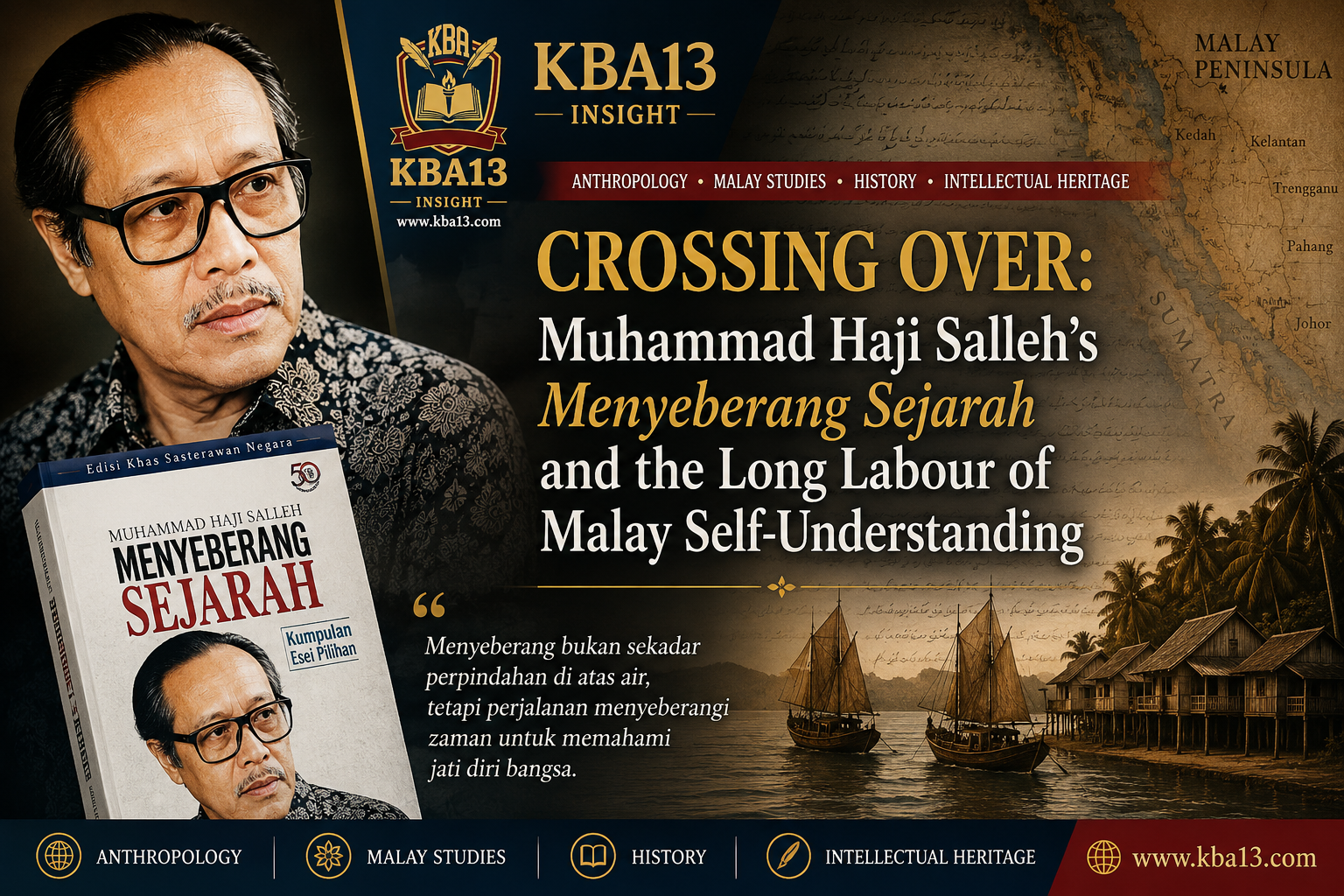
There is a particular kind of book that does not so much argue a thesis as accumulate a life. *Menyeberang Sejarah: Kumpulan Esei Pilihan* (Dewan Bahasa dan Pustaka, 1999; second printing 2006), the six-hundred-and-forty-seven-page collection of selected essays by Muhammad Haji Salleh — Malaysia’s sixth National Laureate, Sasterawan Negara — belongs to that category. It is not a monograph built to prove a single claim from first page to last. It is a testimony, gathered across roughly three decades of reading, translating, and thinking, of what it costs and what it yields to be a Malay literary mind that has walked deliberately through the colonial library, the Western academy, and the postcolonial theory seminar, and then walked back out again — not empty-handed, but not colonized either.
The title tells you what to expect, if you let it. *Menyeberang* means to cross, to ford, to get from one bank to another — the verb Malay speakers use for crossing a river, a strait, a road. *Sejarah* is history. To cross history is not the same as to escape it, nor is it the same as to be swept along by it. A crossing implies agency: a chosen point of entry, a direction, a destination, and above all a body that gets wet, that risks the current, that arrives changed. This is the operative metaphor of the whole book, and it is worth taking seriously as a philosophical position before even opening to the table of contents, because it already tells the reader that Muhammad does not conceive of the Malay intellectual’s relationship to history — colonial, national, or literary — as passive inheritance. It is work. It is swimming.
This review was written after close study of the book’s front matter, its full table of contents across four major divisions and roughly forty essays, its back-cover synopsis (composed, evidently, by the publisher or an editorial hand close to the author’s own thinking), and a documentary reconstruction of Muhammad Haji Salleh’s career, honours, translations, and critical positions drawn from Malaysian academic and literary sources. Where a specific essay’s argument cannot be verified against its actual text, this review says so, or else confines itself to what the architecture of the book and the author’s well-documented critical positions can responsibly support. A critic owes a reader restraint at least as much as insight. Malay letters have suffered enough from confident pronouncements by people who have never opened a book.
The Man Behind the Crossing
Muhammad Haji Salleh was born on 26 March 1942 in Taiping, Perak — a town whose very name, “everlasting peace,” sits with a certain irony over a writer whose career would be defined by unrest of a productive kind: unrest with received categories, unrest with colonial condescension, unrest with the idea that Malay literature needed European theory’s permission to be taken seriously. He was educated first at Malay College Kuala Kangsar and the Malayan Teachers College at Brinsford Lodge in England, then read English literature at the University of Malaya in Singapore, took his master’s degree from the University of Malaya in 1970, and completed a doctorate at the University of Michigan in 1973. He began his working life as a schoolteacher at a trade school in Butterworth in 1960, and only over the following decade did he ascend through the ranks of Malaysian academia — lecturer, senior lecturer, professor, eventually director of the Institute of the Malay World and Civilization at Universiti Kebangsaan Malaysia, and Emeritus Professor from 2009.
The honours are extensive enough to require compression: the National Literary Award panel’s early recognition of his poetry from 1971 onward; the ASEAN Literary Award in 1977 for his poetry collection *Perjalanan Si Tenggang II*; his conferment as Sasterawan Negara in 1991, the sixth writer so honoured since the title was created; the S.E.A. Write Award in Bangkok in 1997; recognition as National Academic Figure (Tokoh Akademik Negara) in 2008; and, more recently, a National Library book award in 2020 for an English-language title. He has published, by the count of his most recent bibliographers, more than seventy books — some fourteen individual poetry collections among them — written in both Malay and English, a bilingualism that is not incidental to his critical project but constitutive of it. He served for four years as president of the Malaysian Translators’ Association, sat on the editorial board of the comparative literature journal *Tenggara*, and produced, among his translation work, an English rendering of the *Sulalatus Salatin* (the *Genealogy of Kings*, better known outside specialist circles as the *Malay Annals*), published by Penguin in 2019 — placing a foundational text of Malay historical literature, for the first time under his own hand, before a genuinely global English readership.
What matters for a reader of *Menyeberang Sejarah* is less the decoration than the shape of the intellectual path these facts trace. Here is a man schooled first and most rigorously in English literature and, by his own account and that of his commentators, in comparative literature—a discipline invented in nineteenth-century Europe largely to compare European national literatures with each other, and only belatedly, and often patronizingly, extended to include the literatures of colonized peoples as objects of study rather than as interlocutors. Muhammad passed through that discipline’s training, absorbed its tools, and then — this is the pivot the book’s own back-cover text names explicitly — turned around and brought those tools home. He did not reject Western critical theory. He conscripted it.
The Architecture of Return
The table of contents of *Menyeberang Sejarah* is itself an argument, and it would be a mistake to treat it as mere administrative scaffolding. The book is organized into four parts, and the sequence of those parts enacts precisely the crossing the title names.
The first section, “Mendialog Warisan” (“Dialoguing with Heritage”), opens with an essay titled “Mendialog Wira: Hujah di Sebalik Kata” (“Dialoguing with the Hero: The Argument Behind the Word”) and moves through “Perayaan Metafora” (“A Celebration of Metaphor”), “Duka Sengsara yang Indah: Estetika Melayu daripada Duka Alam” (“Beautiful Suffering: Malay Aesthetics from the Sorrow of the World”), “Menyurat pada Dengung: Lipatan Lisan pada Sastera Bertulis” (“Writing to the Echo: The Fold of Orality within Written Literature”), a direct engagement with the colonial scholar “Richard Winstedt: Sarjana atau/dan Penulis Kolonial?” (“Richard Winstedt: Scholar and/or Colonial Writer?”), “Estetika Pantun Melayu” (“The Aesthetics of the Malay Pantun”), and “Wira Melayu Tradisional” (“The Traditional Malay Hero”). This opening movement stays close to the ground: pantun, hikayat, the oral-formulaic inheritance, the traditional hero-figure, the very sinews of what a Malay literary tradition is made of before any outside theory arrives to describe it.
A second movement, visible in the fragments of contents captured across the book’s later front matter, continues under headings such as “Yang Indah-Indah: Estetika Sastera Melayu” (“The Beautiful Things: The Aesthetics of Malay Literature”) and “Khalayak di Serambi Pentas” (“The Audience on the Verandah-Stage”) — titles that keep returning, insistently, to questions of beauty, reception, and the physical, architectural space (the *serambi*, the verandah, that most Malay of domestic thresholds between inside and outside) in which literature is performed and received.
The third division, “Wacana Mutakhir” (“Contemporary Discourse”), turns to historiography and criticism proper: “Bibit-Bibit Awal Kritikan Sastera Melayu” (“The Early Seeds of Malay Literary Criticism”), a study of the critic and poet “Baha Zain: Pencatat Jiwa Penghuni Kota yang Berdosa” (“Baha Zain: Chronicler of the Soul of the Sinful City’s Inhabitants”), essays on the development of modern Malay poetry (“Puisi Melayu Baru”), an essay explicitly diagnosing “Masalah Kriteria Kritikan Sastera di Malaysia” (“The Problem of Criteria in Malaysian Literary Criticism”), and a study of the “Konsep Kesusasteraan ASAS 50” — the foundational literary-nationalist movement Angkatan Sasterawan 50, whose 1950s generation of writers first articulated an ethic of “art for society” in the last years of colonial rule and the first years of independence.
The fourth and final movement, “Di Ambang Dunia” (“At the Threshold of the World”), is where the crossing completes itself outward: the title essay “Menyeberang Sejarah: Sastera Melayu di Ambang Dunia” (“Crossing History: Malay Literature at the Threshold of the World”), “Malaysia dalam Kesusasteraan Dunia” (“Malaysia in World Literature”), a study of the Saint Lucian Nobel laureate, “Derek Walcott, Tradisi Puisi dan Penyair” (“Derek Walcott, Poetic Tradition, and the Poet”), an essay reading the colonial administrator-novelist Hugh Clifford’s fiction back against itself, “Imej Melayu dalam Cereka Hugh Clifford” (“The Image of the Malay in Hugh Clifford’s Fiction”), a reflective piece on the writer as translator, “Belajar daripada Gelisah Dunia: Sasterawan Sebagai Penterjemah” (“Learning from the World’s Restlessness: The Writer as Translator”), and a closing essay, “Sastera di Ambang Globalisasi” (“Literature at the Threshold of Globalization”), before a bibliography of over six hundred entries and a full index.
Read as a sequence rather than a list, these four movements perform exactly what the title claims: the book begins at home, in the interior structures of Malay orality and aesthetics (Part I); it widens into the reception and beauty of the tradition as a living, performed thing (Part II); it turns reflexive and historiographical, taking stock of how Malay criticism itself has been practiced and where it has failed itself (Part III); and it finally opens outward to the world — to Walcott, to Clifford, to globalization, to the ethics of translation — without ever losing its point of departure (Part IV). The book’s architecture is not a random anthology of a career. It is a controlled, cumulative demonstration of a critical method: go inward before you go outward, and never go outward without carrying the inward with you.
The River and the Two Banks: Orality Against Coloniality
The essay that gives the book its title, and the essay on Richard Winstedt that sits inside its first section, deserve to be read together, because between them they state the book’s central philosophical claim as clearly as anything in the collection.
Richard Olof Winstedt was the most influential of the British colonial scholar-administrators who, in the first half of the twentieth century, produced the standard English-language grammars, histories, and literary surveys of the Malay world — works that, for decades, functioned as the primary lens through which both colonial administrators and, later, several generations of Malaysian students themselves came to understand their own literary heritage. Muhammad’s essay poses the question in its very title without softening it: was Winstedt a scholar, or a colonial writer, or — and this “atau/dan,” this “or/and,” is the sharpest word in the title — both at once, indissolubly? This is not a rhetorical trick. It is the correct form of the question, because the alternative — pretending that scholarship produced under colonial administration can be cleanly separated from the colonial project that funded, authorized, and used it — is itself a kind of intellectual dishonesty that postcolonial criticism exists to correct.
What makes Muhammad’s position interesting, and what distinguishes it from a simpler nativist dismissal of colonial scholarship altogether, is that his own career depended on reading Winstedt and men like him closely, on taking their factual labour seriously even while interrogating the frame that organized it. This is the harder discipline: not to burn the colonial library, but to read it against its own grain, extracting what is true from what is merely convenient for the coloniser to believe. A lesser critic dismisses Winstedt outright and loses the archive. A captured critic accepts Winstedt’s categories uncritically and loses the tradition. Muhammad’s position, so far as the evidence of this book’s architecture allows a reader to reconstruct it, is the third and most demanding path: read Winstedt as both witness and interested party, extract the data, discard the frame, and then build a Malay frame in its place — which is precisely the labour undertaken across the rest of Part I, in the essays on the pantun, on the traditional hero, on the “fold of orality within written literature.”
That last phrase — “Lipatan Lisan pada Sastera Bertulis,” the fold of the oral within the written — names a problem that has occupied comparative literary theorists for the better part of a century, and it is worth pausing on why Muhammad’s version of it matters beyond the borders of Malay studies. Walter Ong’s foundational work on orality and literacy, which the back-cover synopsis names directly as one of Muhammad’s acknowledged influences, argued that oral cultures organize knowledge, memory, and narrative according to structures fundamentally different from those of literate cultures— formulaic, mnemonic, agonistically toned, and closely bound to performance and audience. The danger, which Ong himself was alert to and which many of his less careful readers were not, is treating “oral” cultures as a stage that literate cultures have simply outgrown — a developmental ladder with orality at the bottom rung. Muhammad’s essay title refuses that ladder. A “fold” is not a hierarchy; it is a topology. The oral does not precede the written and then vanish beneath it. It folds into it, remains present within it, structures it from the inside even after the technology of writing has arrived. The pantun does not stop being oral once it is printed in an anthology; its quatrain form, its associative rather than linear logic, its reliance on a listening audience’s shared stock of allusion, persist as structural residue inside the printed page. To read Malay written literature correctly, on this account, is to read it as still vibrating with the oral performance it never fully left behind.
This is where Mikhail Bakhtin’s presence in Muhammad’s intellectual toolkit — again, named directly in the book’s own back-cover description — becomes legible as more than a fashionable citation. Bakhtin’s concept of dialogism, the idea that no utterance is ever monologic but is always already in conversation with prior utterances, other voices, an implied listener, maps with unusual precision onto the pantun’s own internal logic, in which the first couplet (the *pembayang*, the “shadow” or foreshadowing) exists in a relation of implication and echo with the second (the *maksud*, the meaning), and in which an entire pantun exchange between two singers is dialogic in the most literal sense — call and response, voice answering voice. It would be too neat, and probably unfair to the actual complexity of the essays, to claim that Muhammad simply applies Bakhtin to the pantun as an act of theoretical borrowing. The more interesting and more defensible reading, based on the trajectory the book’s back matter describes, is that Muhammad found in Bakhtin a vocabulary that let him say precisely, and to a global academic audience, something the Malay oral tradition had always already known about itself — that meaning is made between voices, not sealed inside a single author’s intention. Theory, on this model, is not imported to explain the tradition. It is recruited to make the tradition’s own sophistication visible to readers who had been trained, by scholars like Winstedt, to see something simpler.
Beauty as an Argument: The Aesthetics Sections
The second movement of the book — the essays gathered loosely around “Yang Indah-Indah” (“The Beautiful Things”) and “Khalayak di Serambi Pentas” (“The Audience on the Verandah-Stage”) — takes up a question that Western literary theory of the last half-century has often treated with something close to embarrassment: the question of beauty itself, asked without irony, as a legitimate object of serious criticism.
It is worth remembering why that embarrassment exists. A great deal of twentieth-century Western criticism, especially in its more politically engaged forms, grew suspicious of aesthetic judgment as a category — suspicious that “beauty” was too often a mask for the interests of whichever class or culture got to define it, that calling a work “beautiful” could function as a way of depoliticizing it, draining it of its social content and its capacity to unsettle. This suspicion was not paranoid; it had real historical grounding, not least in the way colonial aesthetics routinely described the literatures of colonized peoples as “quaint,” “charming,” or “simple” — adjectives of a diminished, domesticated beauty designed to keep those literatures forever in the register of folklore rather than admitting them to the register of serious art.
Muhammad’s essay title “Duka Sengsara yang Indah: Estetika Melayu daripada Duka Alam” — “Beautiful Suffering: Malay Aesthetics from the Sorrow of the World” — reclaims exactly this contested ground, and does so, on the evidence of its title alone, with philosophical seriousness rather than sentimentality. To argue that suffering can be beautiful, and that this beauty is not an evasion of suffering’s reality but a mode of dwelling in it, of transmuting it without denying it, places Muhammad in a lineage that runs through Sufi aesthetics of *duka* and *rindu* (sorrow and longing) at least as much as through any Western theory of the tragic. The Malay-Islamic intellectual tradition has never needed to import the idea that grief can be an occasion for beauty; it has said so for centuries, in the ratib, in the syair of separation and longing, in the entire vocabulary of *duka nestapa*. What Muhammad appears to be doing, structurally, is giving that inherited intuition a critical vocabulary robust enough to stand in an academic conversation without losing its native register — precisely the same double movement performed on the pantun in Part I.
The essay on “Khalayak di Serambi Pentas” deserves particular attention for its choice of image. A *serambi* is not a stage in the Western theatrical sense of a raised, separated performance space, sealed off by a proscenium arch from a passive, darkened audience. It is a verandah — an intermediate, semi-open architectural zone attached to a Malay house, neither fully inside nor fully outside, where guests are received, where storytellers perform, where the domestic and the public interpenetrate. To locate the audience “on the verandah-stage” rather than in a theatre seat is to make an argument, silently, about the entire relationship between Malay literature and its public: that the audience was never a passive consumer sealed off from the performance, but a co-present participant occupying the same architectural threshold as the performer, close enough to interrupt, to answer, to complete the pantun’s second line themselves. This is, again, orality’s fold inside a supposedly separate question — the aesthetics of reception — and it demonstrates something admirable about the coherence of Muhammad’s thought across the book’s four parts: the same underlying commitment to a performative, dialogic, non-hierarchical model of literary meaning recurs, transposed into a new key, in section after section.
The Historian of His Own Discipline: Wacana Mutakhir
The third section of *Menyeberang Sejarah* is, in a sense, the book’s most exposed and most courageous movement, because here Muhammad turns his critical instruments not outward at colonial scholarship or at the tradition’s deep past, but inward at his own field — modern Malaysian literary criticism itself, including implicitly his own generation’s practice of it.
The essay “Masalah Kriteria Kritikan Sastera di Malaysia” (“The Problem of Criteria in Malaysian Literary Criticism”) announces its diagnostic intent in its title. Any national literary tradition that comes of age in the shadow of a colonial power faces a structural temptation that is almost impossible to avoid entirely: to judge its own literature by criteria inherited wholesale from the colonizer’s academy, because those criteria arrive already dressed in the authority of “rigour” and “universal standards,” while homegrown criteria always have to fight for the same legitimacy from a position of relative institutional weakness. Muhammad’s essay, on the evidence of its title and its placement directly beside the historiographical essay on “the early seeds of Malay literary criticism,” appears to be conducting exactly the kind of genealogical audit that Edward Said’s work — again explicitly named as an influence — trained a generation of postcolonial critics to conduct: not simply asking “what does this text mean,” but asking “under what institutional and historical conditions did the very criteria by which we judge this text’s meaning come to seem natural and inevitable.”
The essay on Angkatan Sasterawan 50 (ASAS 50) situates this audit historically. ASAS 50 was the literary movement founded in Singapore in 1950 by young Malay writers, most prominently Keris Mas, who organized around the slogan “seni untuk masyarakat” — art for society — explicitly rejecting “art for art’s sake” aestheticism in favour of a literature engaged with social conditions, poverty, and the anticolonial and later nation-building project. It is one of the two or three most consequential literary-institutional facts in twentieth-century Malay letters, comparable in its formative weight to what Angkatan ’45 was for Indonesian literature in the same period. Muhammad’s decision to place a study of ASAS 50’s foundational concept directly before the book’s final, outward-facing section on world literature is a structural choice worth dwelling on: it says that before Malay literature can meaningfully claim a place in “the threshold of the world,” it must first have an honest reckoning with its own twentieth-century self-definition — with the moment its writers first collectively decided what Malay literature was *for*.
The essay devoted to the poet and critic Baha Zain — “Pencatat Jiwa Penghuni Kota yang Berdosa,” “Chronicler of the Soul of the Sinful City’s Inhabitants” — functions, within this third section, as a case study that grounds the theoretical argument in a single body of work. Baha Zain, himself a significant figure in post-independence Malay poetry associated with urban and socially critical verse, becomes in Muhammad’s hands an example of a Malay writer engaging modernity, urbanization, and moral crisis on the tradition’s own terms rather than through imported modernist postures borrowed uncritically from elsewhere. Whether or not a reader agrees with every particular judgment in that essay — and this review, not having the essay’s full text before it, makes no claim to adjudicate its specific readings — its placement performs the section’s larger argument: criticism, for Muhammad, is not an abstract exercise conducted above literature, but a practice that must keep returning to close, situated engagement with actual poems and actual poets, on pain of becoming exactly the kind of criteria-without-contact that the essay on criteria itself warns against.
At the Threshold of the World: Walcott, Clifford, and the Ethics of Translation
The fourth and final section is where the book’s title essay lives, and where its argument reaches outward furthest — toward Derek Walcott, toward Hugh Clifford, toward the general question of globalization, and toward the specific practice, central to Muhammad’s own career, of translation.
The choice of Derek Walcott as an interlocutor is not incidental, and it rewards being taken seriously as a deliberate act of comparative self-positioning rather than a random selection from the available canon of twentieth-century world poets. Walcott, the Saint Lucian Nobel laureate, built an entire poetic career on precisely the problem that occupies Muhammad throughout this book: how does a writer from a colonized, orally-rich, linguistically hybrid culture — Walcott’s Caribbean, shaped by African, European, and indigenous strands, by Creole and standard English, by the epic ambition of *Omeros* rewriting Homer on Caribbean soil — write with full authority in a literary language, English, that arrived by way of empire? Walcott’s famous resolution was neither rejection of the colonizer’s tongue nor submission to it, but a kind of aggressive appropriation: making English answer to Caribbean rhythms, Caribbean myth, Caribbean landscape, until the language itself became evidence of the poet’s mastery rather than his subjection. An essay titled “Derek Walcott, Tradisi Puisi dan Penyair” placed at the threshold of Muhammad’s own book, in the section explicitly named “Di Ambang Dunia,” reads as a deliberate act of solidarity across the postcolonial world — a Malay poet-critic recognizing in a Caribbean poet-critic a structurally similar labour of crossing, performed in a different geography with a different colonial language, and finding in that recognition confirmation that the Malay case is not parochial but one instance of a genuinely global condition.
The companion essay, on the image of the Malay in Hugh Clifford’s fiction, closes the circle that the Winstedt essay opened in Part I. Clifford — colonial administrator in British Malaya, later governor, and also a novelist and story-writer who set much of his fiction among the Malay communities he administered — represents a second, complementary case of the colonizer as author. Where Winstedt wrote scholarship that claimed the authority of objective description, Clifford wrote fiction that claimed the different, arguably more dangerous authority of imaginative sympathy — the colonial administrator who believed, often sincerely, that his stories rendered the Malay soul with understanding and even affection. Muhammad’s essay, reading that fiction’s *imej Melayu* — its image, its constructed representation of the Malay — critically, performs exactly the kind of ideological reading that Edward Said’s *Orientalism* trained readers to perform on precisely this kind of well-meaning colonial literature: not asking whether Clifford was personally malicious (by most historical accounts he was not, and was in some respects unusually sympathetic to Malay custom for a colonial officer of his era), but asking what structural distortions the position of the colonizing observer necessarily introduces into even the most sympathetic act of imaginative representation, regardless of the individual author’s conscious intentions.
The essay on the writer as translator, “Belajar daripada Gelisah Dunia: Sasterawan Sebagai Penterjemah,” is perhaps the most personally revealing piece in this section, because Muhammad is not writing here about someone else’s practice but describing, in essay form, the labour that has occupied a very substantial portion of his own working life — the labour that eventually produced his Penguin translation of the *Sulalatus Salatin*. Translation, treated seriously rather than as a merely mechanical transfer of words from one language into another, is perhaps the purest possible enactment of the book’s central metaphor. The translator, by definition, crosses — stands with one foot on each bank of a linguistic river, refusing the false comfort of staying entirely on either side, accountable to both the source text’s integrity and the target language’s real expressive resources, and accepting that something is always risked, sometimes lost, in the crossing. A poet who has spent decades translating Malay poetry into English and, in later work, rendering a foundational Malay historical narrative for Penguin’s global readership has more standing than almost anyone to write about translation’s “gelisah” — its restlessness, its productive discomfort — because that restlessness has been the texture of his working days, not a theoretical abstraction encountered only in seminar rooms.
The book’s closing essay, “Sastera di Ambang Globalisasi,” written and republished, one presumes, in the context of the world of the later 1990s in which globalization first became a term of art across the humanities, brings the collection’s whole itinerary to its natural conclusion. If the book began by asking what is authentically, structurally Malay about Malay literature — its orality, its pantun logic, its dialogic hero, its aesthetics of beautiful sorrow — it ends by asking what happens to that specificity when it must exist inside a genuinely planetary literary marketplace and a genuinely planetary set of comparative expectations. Muhammad’s implicit answer, legible in the very fact that this essay is placed last rather than first, is that specificity is not erased by globalization but is precisely what a literature has to offer a global conversation; a literature that has already done the hard work of understanding its own oral foundations, its own aesthetic categories, its own critical history, arrives at globalization’s threshold with something to say rather than merely something to imitate.
The Theoretical Company He Keeps
It is worth pausing, before moving to assessment, on the specific roster of theorists the book’s own back-cover text names as Muhammad’s interlocutors: Mikhail Bakhtin, Walter Ong, Roland Barthes, Frantz Fanon, Edward Said, and Aijaz Ahmad. The list is not arbitrary, and reading it as a group tells a reader a great deal about the kind of postcolonial critic Muhammad is.
Bakhtin and Ong supply, as already discussed, the vocabulary for orality, dialogism, and voice — tools for the archaeology of the tradition itself. Barthes supplies something different: a semiotic attentiveness to how meaning is constructed, encoded, and naturalized within texts and cultural objects, useful for the aesthetics essays’ close attention to how beauty and form actually work at the level of technique rather than merely being asserted. Fanon and Said supply the political and historical register — the analysis of colonization’s psychological and epistemological violence, and the critique of how colonizing cultures represent the colonized in order to master them intellectually as a precondition for mastering them politically. Aijaz Ahmad’s presence in this list is the most pointed of all, and probably the most revealing of Muhammad’s own critical self-positioning, because Ahmad’s major intervention — most famously in his book *In Theory* — was a sustained critique of certain strands of postcolonial theory itself, particularly a version of Said’s own early work and of Fredric Jameson’s “national allegory” thesis, for flattening the actual, materially differentiated literatures of the postcolonial world into a single undifferentiated category defined only by its relationship to the West, and for privileging English-language, diaspora-based postcolonial writers over writers working in the world’s other languages, in situ, for local readerships. To have Ahmad in one’s toolkit alongside Said is to have already built in a check against the most common failure mode of postcolonial criticism when practiced by writers who are themselves comfortable in the Western academy: the failure of continuing, even while denouncing colonial condescension in content, to reproduce a colonial hierarchy in form, by treating English-language postcolonial writing as the “real” postcolonial literature and everything written in Malay, Bengali, Swahili, or Tagalog as a merely local footnote to it. Muhammad’s entire career — writing centrally in Malay, translating outward from Malay rather than accepting translation only as a one-way importation into Malay, situating his most ambitious essay collection’s culminating argument around the question of Malay literature’s own threshold with the world rather than the world’s threshold with Malay literature — reads as a practiced refusal of exactly that hierarchy, and Aijaz Ahmad’s presence on his shelf suggests he knew precisely which trap he was avoiding.
## A Philosophical Reading of the Crossing
It is possible, and perhaps necessary, to push the book’s central metaphor one step further than its own back-cover synopsis pushes it, because the metaphor of crossing a river carries an implication that deserves to be drawn out explicitly: a river has two banks, and to cross it is not to abolish the distinction between them but to hold both banks in a single, embodied experience at once.
This matters because postcolonial intellectual life is haunted by a false choice that has wasted enormous energy across many literatures and many decades: the choice between an anxious, defensive nativism that refuses all contact with the colonizer’s intellectual tools on the grounds that such contact is itself a form of continued colonization, and an assimilationist cosmopolitanism that accepts the colonizer’s tools so completely that it forgets there was ever a home bank to have left. Both positions, for all their apparent opposition, share the same underlying error: both imagine that identity is a matter of staying still, of choosing one bank and refusing to look at the other. *Menyeberang Sejarah*, both in its title and in the actual sequence of essays its table of contents discloses, refuses this choice at the level of form, not merely of stated argument. The book does not begin with theory and apply it to Malay material, which would be assimilationist; nor does it refuse theory altogether in the name of Malay purity, which would be defensively nativist. It begins at home, develops a vocabulary adequate to describing home honestly, tests that vocabulary against the colonizer’s own scholarship and fiction, generalizes it into a historiography of the critical discipline itself, and only then — only after all of that prior labour — crosses outward to speak with Walcott and to speak of globalization, as an equal rather than as a supplicant.
There is a Sufi resonance available here too, though the book’s back matter does not name it directly and this review will not claim more certainty than the evidence permits. But it is difficult, for any reader steeped in the Malay-Islamic intellectual tradition that produced concepts like *safar* — the journey, understood in the mystical tradition not merely as physical displacement but as the soul’s necessary movement toward deeper knowledge of itself and of God — not to hear an echo of that older idea of purposeful crossing beneath the modern, secular-sounding title *Menyeberang Sejarah*. A crossing undertaken correctly changes the one who crosses. It is not tourism. Muhammad’s decades-long itinerary through English departments, comparative literature, Bakhtin, Fanon, Said, and Ahmad, and back home again to the pantun and the *serambi*, reads, on the evidence available in this book’s structure, less like an academic career path than like a *safar* in this older sense — a deliberately undertaken journey whose entire point was to return having understood the point of departure more deeply than departure alone could have permitted.
Strengths, Limits, and the Honesty a Review Owes
No serious review can end on unqualified praise, and a book of this ambition invites, rather than resents, hard questions.
The first and most obvious limit, visible from the table of contents alone, is that a collection assembled from essays written across roughly three decades — the earliest strands of Muhammad’s critical writing on the pantun and on Winstedt almost certainly predate the book’s 1999 publication by many years — inevitably carries the seams of its own composite history. A reader moving from the essay on the traditional Malay hero to the essay on globalization should expect, and should not be surprised to find, shifts in vocabulary, in theoretical fashion, in the state of the surrounding scholarly conversation each essay was originally written to join. This is not a defect unique to Muhammad; it is the condition of every “selected essays” volume by a working scholar-poet across a long career, from Eliot’s essays to Said’s own collected criticism. But it does mean that the book rewards being read as an intellectual biography in essay form rather than as a single unified treatise, and a reader expecting the latter may initially find the transitions between sections more abrupt than a monograph’s chapters would be.
The second limit is one this review can only flag rather than resolve, precisely because it depends on the essays’ actual argumentative execution rather than their titles and stated intentions: the risk, inherent in any project that reclaims “beauty” and “aesthetics” as legitimate critical categories after a half-century of suspicion toward them, of sliding from a defensible claim — that Malay aesthetic categories deserve to be taken as seriously as any inherited from the European tradition — into an indefensible one — that aesthetic appreciation can substitute for, rather than complement, the harder political and historical work that essays like the Winstedt piece and the criteria-of-criticism piece clearly also undertake. The book’s own architecture, as reconstructed here, suggests Muhammad is alert to this risk and structures his way around it by keeping the aesthetic essays in conversation with the historiographical and postcolonial ones rather than isolating them. But it is a risk any reader coming to Part II should keep in mind, and it is the kind of risk that can only be finally adjudicated by reading the essays’ actual sentences, which lies beyond what this review, working from the book’s front matter and architecture, can responsibly claim to have verified.
A third and more genuinely open question concerns audience. The book is written in Malay, for a Malaysian and Nusantara readership already fluent in the tradition it describes, drawing on a Western theoretical apparatus that assumes a certain level of comparative-literature training to fully unpack. This is, on one reading, exactly right and even necessary — a Malay critic writing primarily for a Malay audience about Malay literature is not obliged to translate his own tradition for an imagined Western reader before he is permitted to think seriously about it, and the insistence that postcolonial writers must always first explain themselves to the metropole before speaking to their own people is itself one of the subtler forms of the very condescension Muhammad’s Winstedt and Clifford essays diagnose. But it does mean, as a simple matter of fact rather than of blame, that the book’s considerable achievement remains largely invisible to the English-language and international comparative-literature conversation it is in genuine dialogue with — a conversation with Walcott that Walcott’s own readers, in the absence of translation, will likely never know took place. Given that Muhammad’s own later career includes the Penguin *Sulalatus Salatin*, precisely the kind of project that carries Malay literary achievement outward across that same language barrier, one wonders whether a fuller English translation or a substantial English-language digest of *Menyeberang Sejarah* itself — perhaps the title essay and the Winstedt and Walcott essays especially — might eventually perform for Muhammad’s criticism what his own translation work has already performed for the *Sulalatus Salatin*: making a genuinely important Malay intellectual achievement legible to readers who cannot otherwise cross the river to meet it.
Why This Book Still Matters
It would be easy to file *Menyeberang Sejarah* under a narrow heading — “Malaysian literary criticism, national-laureate retrospective, 1999” — and move on. That would be a misreading of what the book is actually doing and why it continues to matter more than a quarter-century after its first printing, and why a second printing was warranted in 2006.
The book matters, first, as a working demonstration — not merely a stated argument but an enacted, essay-by-essay demonstration — that postcolonial criticism does not require a colonized literature to choose between silence and mimicry. A Malay critic can read Bakhtin and Ong and Said and Fanon and Aijaz Ahmad closely, can even find them genuinely useful, without thereby surrendering the terms on which Malay literature is understood to a framework built elsewhere for other purposes. The book matters, second, because its historiographical section performs the harder, less glamorous, and frankly riskier work of turning criticism’s tools on criticism’s own recent history — asking not only what is wrong with the colonizer’s account of Malay literature but what has gone wrong, and what criteria problems persist, within the postcolonial nation’s own critical establishment, ASAS 50 included. That is a form of intellectual courage that a merely anticolonial book, content to blame the coloniser and stop there, would not need to display. And the book matters, third, because of the specific intellectual temperament it models for any reader, in any tradition, who is trying to work out how to think seriously about their own culture without either provincial defensiveness or cosmopolitan self-erasure: cross the river, but know which bank is yours; use the other side’s tools, but do not let the other side define what counts as a tool worth using; and never mistake the act of crossing for the destination, because the destination, as the book’s own last section insists, still lies ahead, at a threshold the world has not finished building.
Read in full — and this review has tried to read what can honestly be read from outside the essays’ own sentences, while declining to claim more certainty than the available evidence supports — *Menyeberang Sejarah* stands as one of the more serious attempts by a major Nusantara literary figure to think all the way through what it means to inherit a colonized literary history without either disowning it or being defined by it. That the attempt spans thirty years, forty essays, and six hundred and forty-seven pages is not padding. It is the honest length of the labour it describes. Some rivers are wide, and some crossings take a lifetime.
—
About The Author

Rekomendasi Bacaan KBA13 INSIGHT
Jika tulisan ini bermanfaat, dukung jurnal ini dengan mencari bukunya melalui tautan berikut:
- Buku-buku Kamaruzzaman Bustamam Ahmad di Periplus
- Koleksi Islamic Studies di Periplus
- Koleksi Geopolitics & Politik Internasional di Periplus
- Cari buku & perangkat baca di Shopee
- Cari di Blibli
Daftar lengkap: Rekomendasi Buku, Alat Tulis & Layanan. Tautan di atas adalah tautan afiliasi — KBA13 INSIGHT dapat memperoleh komisi kecil tanpa biaya tambahan bagi Anda.
Artikel Terkait
 Acehnology as an Intellectual Journey: Aceh, Islam, Southeast Asia, and the Malay World
 Pokok-Pokok Gerilya: Strategi Perang Rakyat Semesta dari Jenderal Besar A.H. Nasution
 Menggagas Indonesia Masa Depan: Gagasan Djoko Santoso tentang Kepemimpinan, Budaya, dan Kemandirian Bangsa
 Isaiah Berlin dan The Roots of Romanticism: Sebuah Ulasan Kritis
 The Lost Art of Scripture: Karen Armstrong and the Recovery of Sacred Reading
Leave a Reply