
KBA13 Insight · Southeast Asian Studies
Why Thailand Is Becoming Southeast Asia’s Leading Study Destination
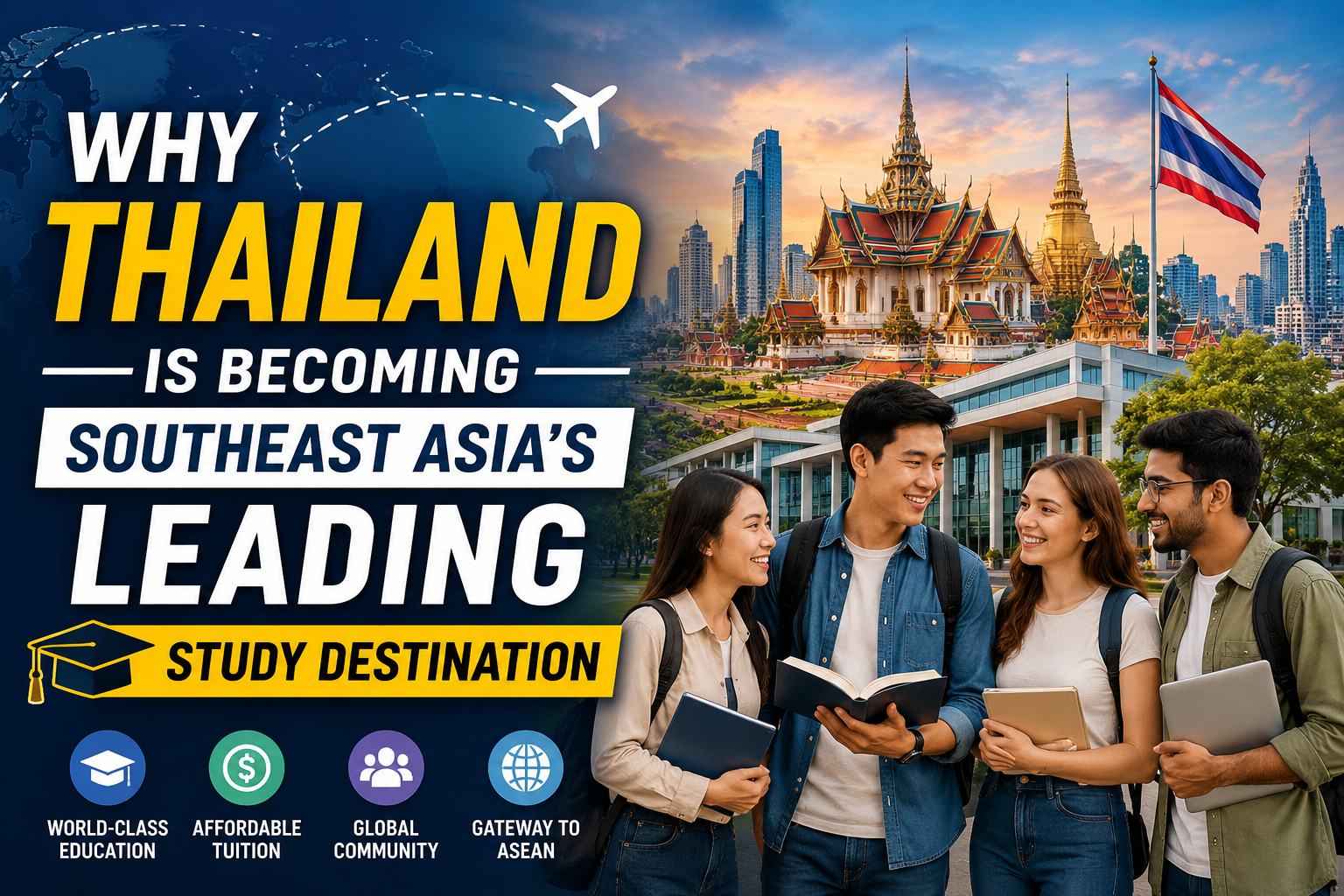
Thailand has rapidly transformed into one of Southeast Asia’s most competitive destinations for international higher education. Combining internationally recognised universities, affordable tuition, strong research ecosystems, multicultural campuses, and strategic regional connectivity, Thailand is redefining the future of global education.
Summary
Thailand has rapidly transformed into one of Southeast Asia’s most competitive destinations for international higher education. Combining internationally recognised universities, affordable tuition, strong research ecosystems, multicultural campuses, and strategic regional connectivity, Thailand is redefining the future of global education.
Keywords
- Academic Excellence
- Academic Research
- Affordable Education
- ASEAN
- ASEAN Education
- Education Hub
- Education Policy
- English Medium Programs
- Global Education
- Global Knowledge Economy
Introduction: Thailand’s Emergence as Southeast Asia’s Academic Crossroads
For decades, Thailand was primarily recognized through the lenses of tourism, hospitality, cultural heritage, and economic resilience. The country became synonymous with bustling Bangkok, the ancient temples of Ayutthaya, the mountains of Chiang Mai, and the tropical coastlines that attracted millions of visitors each year. Yet beneath this internationally celebrated image, another transformation has quietly unfolded, one that has received considerably less attention despite its profound regional significance. Thailand has steadily evolved into one of Southeast Asia’s most dynamic centres of higher education, attracting an increasingly diverse community of international students, researchers, academics, and professionals. This transition reflects not a temporary educational trend but a long-term national strategy that positions knowledge, innovation, and international collaboration as pillars of Thailand’s future development.
The rise of Thailand as an educational destination mirrors broader shifts in the global higher education landscape. Student mobility has expanded dramatically over the past two decades as technological connectivity, economic integration, and international labour markets have reshaped educational aspirations. While traditional destinations such as the United Kingdom, the United States, Australia, and Canada continue to attract substantial numbers of international students, rising tuition fees, escalating living costs, restrictive immigration policies, and increasing geopolitical uncertainties have encouraged students to explore alternative destinations capable of offering comparable academic quality within a more accessible financial framework. Thailand has emerged as one of the most compelling beneficiaries of this structural shift, providing internationally recognised education without imposing the financial barriers commonly associated with Western universities.
What distinguishes Thailand is not simply affordability but the emergence of a higher education ecosystem that integrates academic quality, internationalization, technological modernization, and cultural diversity. Universities throughout the country have systematically expanded English-medium programmes, strengthened research collaborations with globally recognised institutions, invested in advanced scientific laboratories, embraced digital learning environments, and cultivated multicultural campuses that reflect the increasingly interconnected nature of contemporary knowledge production. Consequently, studying in Thailand is no longer perceived merely as a means of obtaining an overseas degree. It has become an opportunity to participate in an intellectual environment where regional expertise, global perspectives, and intercultural engagement intersect within one of Asia’s most strategically positioned societies.
Thailand’s geographical location significantly reinforces this transformation. Situated at the heart of mainland Southeast Asia, the country functions as a natural bridge connecting East Asia, South Asia, and the wider ASEAN region. This strategic position enables universities to develop academic programmes that transcend national boundaries while addressing regional issues such as economic integration, public health, environmental sustainability, digital transformation, migration, food security, and geopolitical competition. For international students, education in Thailand therefore extends beyond classroom instruction. It offers direct exposure to one of the world’s fastest-changing regions, where economic dynamism, cultural diversity, and political complexity create an exceptional environment for intellectual development and professional preparation.
Equally significant is Thailand’s recognition that higher education has become an instrument of national competitiveness and international influence. In the twenty-first century, universities are no longer evaluated solely by their capacity to produce graduates. They are expected to generate scientific innovation, influence public policy, strengthen diplomatic relationships, foster entrepreneurship, and contribute to sustainable development. Thailand has increasingly embraced this broader understanding of higher education by encouraging universities to expand global partnerships, attract distinguished scholars, internationalize curricula, and actively participate in global research networks. International students are therefore regarded not simply as temporary visitors but as long-term contributors to academic excellence, economic development, and Thailand’s expanding role within the global knowledge economy.
This article argues that Thailand’s emergence as a leading destination for international students represents one of the most important yet underappreciated developments in Southeast Asian higher education. The country’s success is not the product of inexpensive tuition fees alone, nor can it be explained solely through international university rankings. Rather, it reflects a comprehensive transformation in which educational policy, institutional innovation, regional integration, and cultural openness have converged to create an academic environment that is increasingly competitive on the global stage. Understanding this transformation provides valuable insights not only for prospective international students but also for policymakers, university leaders, and scholars seeking to understand how middle-income countries can strategically position higher education as a driver of national development, regional leadership, and international soft power.
The Strategic Transformation of Thailand’s Higher Education System
Thailand’s emergence as a regional education hub has been neither spontaneous nor accidental. It is the outcome of a long-term national vision that recognizes higher education as a strategic investment in economic competitiveness, scientific innovation, and international influence. Over the past two decades, successive governments have implemented reforms aimed at modernising universities, improving quality assurance, strengthening institutional autonomy, and expanding global partnerships. Rather than measuring success solely through enrolment numbers, Thailand has increasingly viewed universities as engines of knowledge production capable of driving industrial transformation, technological advancement, and sustainable national development. This strategic orientation has fundamentally altered the country’s educational landscape, transforming higher education from a domestic public service into an internationally competitive sector that actively contributes to Thailand’s global positioning.
One of the most significant pillars of this transformation has been the comprehensive internationalisation of Thai universities. Institutions that once served primarily domestic populations now compete within an increasingly interconnected academic marketplace. English-medium degree programmes have expanded rapidly across undergraduate, master’s, and doctoral levels, enabling students from diverse linguistic backgrounds to pursue internationally recognised qualifications without first acquiring advanced proficiency in Thai. Simultaneously, universities have intensified collaboration with academic institutions across Europe, North America, East Asia, Australia, and the Middle East through joint research initiatives, student exchange programmes, dual-degree arrangements, and international faculty recruitment. These developments have strengthened the global visibility of Thai higher education while embedding universities within broader networks of international scholarship and scientific cooperation.
Research capacity has likewise become central to Thailand’s educational ambitions. Universities are no longer evaluated solely on teaching performance but increasingly on their ability to generate impactful research that addresses both national priorities and global challenges. Significant investment has therefore been directed towards scientific laboratories, digital research infrastructure, innovation centres, interdisciplinary institutes, and collaborative research ecosystems. Particular emphasis has been placed upon fields such as biotechnology, artificial intelligence, renewable energy, tropical medicine, environmental sustainability, food security, digital economies, and public health, areas that align closely with Thailand’s long-term development strategies while simultaneously contributing to international scientific discourse. By strengthening research excellence, Thai universities seek not merely to improve global rankings but to establish themselves as influential contributors to worldwide knowledge production.
The relationship between universities and industry has also undergone profound transformation. Contemporary higher education increasingly demands that academic institutions produce graduates equipped not only with theoretical knowledge but also with practical competencies relevant to rapidly changing labour markets. Recognising this reality, Thai universities have cultivated extensive partnerships with multinational corporations, technology firms, manufacturing industries, hospitals, financial institutions, government agencies, and entrepreneurial ecosystems. Internship programmes, cooperative education, industry-sponsored research, and innovation incubators now constitute integral components of many academic programmes. Such collaboration enables students to bridge the traditional divide between classroom learning and professional practice while ensuring that university curricula remain responsive to emerging economic and technological trends.
Equally important has been Thailand’s commitment to improving the overall international student experience. Successful internationalisation extends beyond academic quality; it requires universities to cultivate inclusive environments in which students from diverse cultural, linguistic, and religious backgrounds can flourish. International offices, language support services, counselling centres, cultural orientation programmes, student organisations, and comprehensive welfare systems have therefore become increasingly sophisticated across major Thai universities. These initiatives recognise that educational success depends not only upon intellectual achievement but also upon psychological well-being, social integration, intercultural competence, and personal development. By investing in these support structures, Thailand has strengthened its reputation as an educational destination where academic excellence is complemented by a genuinely welcoming and multicultural campus environment.
Ultimately, Thailand’s higher education reforms reflect a broader understanding of knowledge as a strategic national asset. In an era defined by digital transformation, geopolitical competition, demographic change, and accelerating technological innovation, countries that can attract talented students and researchers gain advantages that extend far beyond university campuses. International graduates become ambassadors, research collaborators, business leaders, entrepreneurs, and policymakers whose professional networks strengthen long-term diplomatic, economic, and intellectual relationships. Thailand’s investment in higher education therefore represents not merely an educational policy but a sophisticated exercise in nation-building and international engagement. As competition for global talent intensifies throughout the twenty-first century, the strategic transformation of Thailand’s university system positions the country not simply as an alternative study destination but as an increasingly influential centre within the evolving global knowledge economy.
Why International Students Are Choosing Thailand Over Traditional Study Destinations
The geography of international higher education is undergoing a profound transformation. For much of the twentieth century, the dominant destinations for overseas study were concentrated in North America, Western Europe, and Australia. These countries established reputations for academic excellence, scientific innovation, and globally recognised qualifications that attracted millions of students from every continent. Today, however, the dynamics of international student mobility are becoming considerably more diversified. Rising tuition fees, escalating living expenses, stricter immigration regulations, housing shortages, and increasing geopolitical uncertainty have encouraged students to reconsider long-established educational pathways. Within this evolving landscape, Thailand has emerged as one of the most attractive alternatives, not because it seeks to imitate Western educational systems, but because it offers a distinctive combination of academic quality, affordability, regional relevance, and an exceptional quality of life that addresses many of the challenges confronting international students today.
Affordability remains one of Thailand’s most compelling comparative advantages, yet reducing the country’s appeal solely to lower educational costs would significantly underestimate the sophistication of its higher education ecosystem. Tuition fees at many internationally recognised Thai universities remain substantially lower than those of comparable institutions in the United Kingdom, the United States, Canada, or Australia, while living expenses, including accommodation, transportation, healthcare, and daily necessities, are generally more manageable for students from both developed and developing economies. More importantly, these financial advantages do not require students to compromise academic quality. Modern lecture theatres, advanced research facilities, internationally accredited curricula, digital learning technologies, and highly qualified academic staff ensure that affordability is accompanied by educational standards capable of preparing graduates for increasingly competitive global labour markets.
Another factor distinguishing Thailand from many traditional study destinations is the country’s multicultural academic environment. International students entering Thai universities become members of genuinely diverse learning communities that bring together individuals from across Southeast Asia, South Asia, East Asia, the Middle East, Africa, Europe, and North America. This diversity extends beyond demographic representation; it fundamentally reshapes classroom discussions, collaborative research, and everyday student interactions. Exposure to multiple cultural perspectives encourages critical thinking, intercultural communication, and intellectual flexibility, competencies that have become indispensable within contemporary international organisations, multinational corporations, diplomatic institutions, and global research networks. Education in Thailand therefore provides not only disciplinary expertise but also practical experience of living and working within culturally diverse environments that increasingly characterise twenty-first-century professional life.
The educational experience in Thailand is equally distinguished by its integration of academic learning with broader social and cultural engagement. Unlike highly urbanised educational systems where students may remain largely confined to campus environments, Thailand offers continuous opportunities to encounter one of Asia’s richest civilisational landscapes. Ancient Buddhist heritage, Islamic communities in the southern provinces, vibrant Chinese commercial traditions, indigenous cultural practices, and rapidly modernising metropolitan centres coexist within a remarkably dynamic national context. Students therefore acquire forms of knowledge that cannot be obtained solely through lectures or textbooks. Daily interaction with Thai society deepens cultural literacy, enhances regional understanding, and cultivates empathy towards different historical experiences, religious traditions, and social values. Experiential learning is increasingly one of the defining characteristics of internationally competitive higher education.
Professional development constitutes another important consideration influencing students’ educational decisions. Employers worldwide increasingly value graduates who can operate confidently in multicultural, multilingual, and interdisciplinary environments. Thai universities have responded to these changing expectations by strengthening partnerships with industry, expanding internship opportunities, encouraging entrepreneurship, and integrating practical experience into academic curricula. Students frequently engage with multinational corporations, technology companies, hospitals, governmental institutions, tourism industries, and non-governmental organisations throughout their studies. These experiences enable graduates to develop professional competencies alongside academic knowledge and establish international networks that often prove decisive in shaping future career opportunities. Consequently, education in Thailand increasingly functions not merely as a pathway towards obtaining a degree but as an investment in long-term global employability.
Ultimately, international students are choosing Thailand because the country offers something that many traditional educational destinations increasingly struggle to provide: balance. Thailand combines internationally recognized academic standards with financial accessibility, cultural diversity, social hospitality, regional relevance, technological modernization, and a high quality of everyday life. Rather than forcing students to choose between affordability and excellence, or between academic achievement and personal well-being, Thailand demonstrates that these objectives can reinforce one another within a thoughtfully designed higher education system. As global student mobility continues to evolve, the country’s growing attractiveness reflects not simply changing economic calculations but a broader redefinition of what constitutes a meaningful international education. Increasingly, students seek experiences that prepare them intellectually, professionally, culturally, and personally for an interconnected world, and Thailand has positioned itself as one of the most compelling destinations to fulfill these aspirations.
Beyond the Classroom: Living, Learning, and Building Global Networks in Thailand
Higher education is no longer defined solely by lectures, examinations, or the acquisition of disciplinary knowledge. In the twenty-first century, universities are increasingly evaluated on their ability to cultivate globally competent graduates who possess intellectual agility, intercultural awareness, leadership capacity, and the resilience needed to navigate complex international environments. Consequently, the educational value of studying abroad extends far beyond academic achievement. It encompasses the broader experiences through which students learn to communicate across cultures, negotiate unfamiliar social contexts, build international professional networks, and develop a deeper understanding of an increasingly interconnected world. Thailand has emerged as a particularly compelling environment for this holistic model of higher education because learning occurs not only within university campuses but also through continuous engagement with one of Asia’s most culturally diverse and economically dynamic societies.
For many international students, daily life in Thailand becomes an education in itself. The country presents a remarkable convergence of historical continuity and contemporary modernisation, where centuries-old temples coexist alongside digital innovation districts, traditional markets operate within rapidly expanding metropolitan economies, and local cultural practices continue to flourish despite accelerating globalisation. Students quickly discover that understanding Thailand requires moving beyond conventional tourist experiences towards genuine participation in everyday social life. Learning the basics of the Thai language, observing cultural etiquette, participating in local festivals, volunteering in surrounding communities, and interacting with classmates from diverse regional backgrounds gradually transform academic study into an immersive intercultural experience. Such encounters cultivate cultural intelligence, empathy, and adaptability, qualities increasingly regarded as essential attributes of future global leaders.
University campuses themselves have become important spaces for international dialogue and cross-cultural collaboration. Academic projects, laboratory research, student associations, entrepreneurial competitions, cultural exchange programmes, and community engagement initiatives bring together students from multiple continents who often possess profoundly different educational traditions, political perspectives, religious backgrounds, and professional aspirations. Rather than creating barriers, this diversity encourages meaningful intellectual exchange by exposing students to alternative approaches to problem-solving and critical inquiry. Collaborative learning, therefore, becomes an exercise in diplomacy as much as in education, requiring participants to negotiate differences respectfully while developing shared solutions to increasingly complex global challenges. In this environment, friendships frequently evolve into enduring professional relationships that continue to shape careers long after graduation.
Thailand’s geographical position further enhances the educational experience by providing students with unparalleled access to Southeast Asia as a living laboratory. The country’s extensive connectivity enables students to explore neighbouring ASEAN member states, observe regional economic integration firsthand, and develop practical understanding of one of the world’s fastest-growing geopolitical and commercial regions. Students studying international relations can examine regional diplomacy directly; those specialising in business gain exposure to ASEAN markets; environmental scientists observe diverse ecological systems; while public health researchers encounter real-world challenges requiring transnational cooperation. Consequently, Thailand offers an educational platform where theoretical learning is consistently reinforced through direct regional engagement. This proximity to contemporary political, economic, and social transformations distinguishes the Thai educational experience from that of more geographically isolated study destinations.
Professional networking represents another defining advantage of studying in Thailand. Universities increasingly recognise that graduate success depends not only upon academic credentials but also upon meaningful engagement with employers, researchers, entrepreneurs, policymakers, and international organisations. Career development centres, internship programmes, industry partnerships, alumni networks, international conferences, and collaborative research initiatives therefore play increasingly prominent roles within university life. Students regularly interact with multinational corporations operating across Southeast Asia, regional development agencies, technology companies, healthcare institutions, and global non-governmental organisations. These interactions enable them to develop professional competencies while simultaneously constructing international networks that frequently become decisive assets in securing employment, postgraduate opportunities, research collaborations, and entrepreneurial ventures. Education in Thailand thus becomes an investment in long-term professional capital rather than merely an academic qualification.
Ultimately, the greatest strength of studying in Thailand lies in the country’s ability to integrate intellectual development with personal transformation. Students graduate not only with degrees but with broader perspectives, stronger intercultural competencies, lifelong friendships, expanded professional networks, and a nuanced understanding of one of the world’s most strategically important regions. They learn to operate confidently within multicultural environments, appreciate cultural complexity without sacrificing critical analysis, and recognise that genuine education extends beyond institutional boundaries into the societies within which universities exist. In an era where global employers increasingly value adaptability, intercultural communication, collaborative leadership, and international experience alongside technical expertise, Thailand offers an educational environment that prepares graduates not simply for employment but for meaningful participation within an interconnected global knowledge economy. It is precisely this combination of academic excellence, cultural immersion, and international networking that explains why Thailand is no longer viewed merely as an alternative destination for overseas study but as one of Southeast Asia’s emerging centres of educational excellence.
Challenges, Global Competition, and the Future of Thailand as an International Education Hub
The remarkable progress achieved by Thailand’s higher education sector should not obscure the significant challenges that accompany its growing international reputation. Higher education today operates within one of the most competitive global environments in modern history, where universities compete not only for talented students but also for distinguished academics, research funding, international partnerships, technological innovation, and institutional prestige. The emergence of new educational hubs across Asia, including Singapore, Malaysia, China, South Korea, and the United Arab Emirates, has fundamentally reshaped the landscape of international student mobility. Consequently, Thailand’s future success will depend not simply upon sustaining current achievements but upon continuously adapting to the rapidly changing expectations of students, employers, governments, and global research communities.
One of the most pressing challenges concerns research competitiveness. While Thailand has made impressive progress in expanding scientific output and international collaboration, research excellence has become the principal benchmark through which universities establish global influence. International university rankings increasingly emphasise research productivity, citation impact, innovation capacity, international faculty recruitment, and interdisciplinary collaboration. To remain competitive, Thai universities must continue investing in advanced research infrastructure, doctoral education, high-impact publications, digital laboratories, and collaborative research centres capable of addressing complex global issues such as artificial intelligence, climate change, biotechnology, cybersecurity, public health, renewable energy, and sustainable urban development. The next phase of Thailand’s educational transformation will therefore depend not only upon attracting international students but also upon producing internationally recognized knowledge that contributes meaningfully to global scientific and policy debates.
Technological disruption represents another defining challenge. Artificial intelligence, machine learning, quantum computing, immersive virtual learning environments, and rapidly evolving digital platforms are transforming the nature of higher education itself. Universities can no longer rely exclusively upon traditional classroom instruction or static curricula designed for previous generations of students. Instead, educational institutions must cultivate graduates capable of continuous learning within economies characterized by constant technological change. Thailand has already demonstrated significant progress through expanding digital campuses, smart classrooms, hybrid learning systems, and technology-enabled research environments. Nevertheless, maintaining international competitiveness will require sustained investment in educational innovation while ensuring that technological advancement complements rather than replaces the critical thinking, ethical reasoning, creativity, and human-centered leadership that remain fundamental objectives of higher education.
Equally important is the challenge of strengthening Thailand’s global academic brand. Although the country enjoys an excellent international reputation for tourism, hospitality, healthcare, and cultural heritage, its universities remain comparatively underrepresented within global public consciousness. Many prospective students continue to associate international higher education primarily with Western institutions despite the rapid improvement of universities throughout Asia. Building stronger international visibility therefore requires coordinated national strategies involving academic diplomacy, research collaboration, international marketing, alumni engagement, and participation in global policy discussions. Universities must increasingly communicate not only the affordability of studying in Thailand but also their distinctive intellectual contributions to international scholarship, regional problem-solving, and interdisciplinary innovation. Reputation in contemporary higher education is built on sustained academic excellence rather than on promotional campaigns alone.
At the same time, Thailand possesses several structural advantages that position it favorably for the coming decades. Demographic changes across Asia, accelerating economic integration within ASEAN, growing demand for internationally educated professionals, and the continued expansion of the global middle class are likely to increase demand for accessible, high-quality educational destinations. Thailand’s strategic location at the center of mainland Southeast Asia, combined with its political importance, advanced healthcare system, established transportation infrastructure, multicultural society, and relatively affordable cost of living, creates a combination of advantages that few competing educational destinations can replicate simultaneously. These characteristics position the country to become not merely a regional educational provider but a significant contributor to the evolving architecture of global higher education.
Ultimately, Thailand’s future as an international education hub will be determined by its ability to view universities not merely as institutions that award degrees but as strategic national assets that shape economic development, scientific innovation, diplomatic influence, and societal resilience. The countries that lead the knowledge economy during the twenty-first century will be those capable of attracting exceptional talent, fostering interdisciplinary research, generating technological innovation, and cultivating graduates equipped to address increasingly complex global challenges. Thailand has already laid many of the institutional foundations required to pursue this vision. If current reforms continue with strategic consistency and sustained investment, the country is well positioned to emerge as one of the Global South’s most influential centers of higher education. Its success will ultimately be measured not only by the number of international students who choose to study there, but by the quality of ideas, research, leadership, and international cooperation that those students carry with them long after they leave Thai university campuses.
Conclusion: Thailand’s Expanding Role in the Global Knowledge Economy
The story of Thailand’s emergence as an international education destination is, at its core, a story of strategic national transformation. It demonstrates how higher education can evolve from a domestic public service into a powerful instrument of economic development, scientific innovation, cultural diplomacy, and international influence. Over the past two decades, Thailand has deliberately repositioned its universities within an increasingly competitive global landscape, recognizing that the future prosperity of nations will depend not only upon natural resources or industrial production but also upon their capacity to generate knowledge, cultivate talent, and participate meaningfully in international intellectual networks. In this respect, Thailand has moved beyond the traditional perception of being merely a tourism powerhouse and has begun establishing itself as one of Southeast Asia’s most promising centers of academic excellence.
This transformation reflects a broader shift in the global geography of higher education. International students today are no longer guided exclusively by historical prestige or institutional reputation. They increasingly evaluate educational destinations according to a broader set of considerations, including affordability, academic quality, employability, technological readiness, cultural diversity, quality of life, and opportunities for international networking. Thailand has responded effectively to these evolving expectations by creating an educational ecosystem that balances accessibility with excellence, regional relevance with global engagement, and academic rigour with human development. Such a balanced model has enabled the country to attract students from diverse geographical, cultural, and socioeconomic backgrounds while simultaneously strengthening its international academic profile.
The significance of this development extends well beyond university campuses. International students contribute not only through tuition fees or local economic activity but also through the exchange of ideas, the creation of transnational professional networks, and the cultivation of long-term diplomatic relationships. Graduates who spend formative years studying in Thailand frequently become future academics, policymakers, entrepreneurs, diplomats, healthcare professionals, engineers, and business leaders whose understanding of Thai society continues to shape international cooperation decades after graduation. In this sense, higher education functions as a subtle yet remarkably effective instrument of soft power, enabling Thailand to expand its global influence through intellectual engagement rather than political coercion or economic dominance. Few investments generate returns that are simultaneously educational, economic, cultural, and diplomatic in nature.
Looking ahead, the opportunities available to Thailand are likely to become even more significant as the global knowledge economy continues to expand. Artificial intelligence, digital transformation, climate adaptation, biotechnology, cybersecurity, renewable energy, demographic transition, and public health resilience are reshaping both labour markets and educational priorities across every region of the world. Universities capable of integrating interdisciplinary research, technological innovation, international collaboration, and socially relevant scholarship will become increasingly influential within this new global order. Thailand possesses many of the structural advantages required to participate actively in this transformation, including strategic geographic connectivity, an increasingly international university sector, competitive living costs, cultural openness, and a growing commitment to research excellence. Sustaining these strengths through continuous institutional reform will determine whether the country can move from regional prominence to global academic leadership.
Nevertheless, maintaining this trajectory will require strategic consistency rather than complacency. Competition among international education destinations will intensify as governments worldwide recognise universities as critical components of national competitiveness. Thailand must therefore continue strengthening research capacity, expanding global academic partnerships, improving institutional governance, investing in digital infrastructure, attracting internationally recognised scholars, and cultivating educational environments that encourage creativity, critical inquiry, ethical leadership, and interdisciplinary innovation. Equally important will be preserving the distinctive characteristics that have made Thailand attractive in the first place: its cultural hospitality, social inclusiveness, regional accessibility, and capacity to integrate intellectual development with meaningful intercultural experience. Sustainable success will depend upon balancing international competitiveness with national identity, ensuring that educational internationalization enriches rather than diminishes Thailand’s unique civilizational heritage.
Ultimately, Thailand’s growing prominence within international higher education represents more than an educational success story; it offers an instructive model of how middle-income countries can leverage universities as catalysts for national transformation and global engagement. The country’s experience demonstrates that academic excellence is not determined exclusively by historical prestige or financial resources but also by strategic vision, institutional adaptability, sustained investment, and openness to international collaboration. As global student mobility continues to diversify beyond its traditional centers, Thailand is increasingly positioned not as an alternative destination but as a destination of first choice for students seeking an education that combines intellectual rigor, cultural richness, regional expertise, and international opportunity. The future of higher education will be shaped by those nations capable of transforming knowledge into influence, innovation into prosperity, and education into enduring international partnerships. Thailand has already embarked on that journey, and its ongoing evolution will be closely watched by scholars, policymakers, and educational leaders worldwide.
Policy Implications: What Can Other Countries Learn from Thailand?
Thailand’s experience offers an important lesson for governments seeking to strengthen their higher education sectors without possessing the financial resources of the world’s largest economies. The country’s progress demonstrates that international competitiveness is not determined solely by institutional age, historical prestige, or national wealth. Rather, sustainable educational transformation depends upon coherent public policy, long-term investment, institutional adaptability, and a willingness to embrace international collaboration while preserving national identity.
For many developing countries, higher education remains largely domestically oriented, with universities primarily serving national labour markets and public-sector employment. Thailand has gradually adopted a broader vision by positioning universities as global institutions capable of attracting international talent, generating internationally recognised research, supporting innovation ecosystems, and contributing to national soft power. This strategic shift illustrates how universities can become instruments of economic diplomacy, scientific advancement, and international engagement rather than functioning exclusively as educational providers.
The Thai model also highlights the importance of balancing accessibility with excellence. Excessively commercial approaches to international education risk reducing universities to service industries, while overly protectionist policies may limit international competitiveness. Thailand has attempted to navigate this tension by expanding English-language programmes, strengthening quality assurance mechanisms, improving research capacity, and cultivating multicultural campuses without abandoning its cultural heritage. Although challenges remain, this balanced approach offers valuable insights for countries pursuing educational internationalisation under conditions of limited financial resources.
Equally instructive is Thailand’s emphasis on regional integration. Rather than competing directly with long-established educational powers solely on the basis of institutional prestige, Thai universities increasingly position themselves as gateways to Southeast Asia. Their comparative advantage lies in combining global academic standards with deep regional expertise, enabling students to understand one of the world’s most economically dynamic and geopolitically significant regions through direct experience. This regional orientation creates an educational niche that cannot easily be replicated elsewhere.
Looking forward, policymakers should recognise that future competitiveness will depend increasingly upon interdisciplinary education, digital transformation, artificial intelligence, sustainability research, and international scientific collaboration. Universities capable of integrating these dimensions while maintaining strong links with industry, government, and civil society will become increasingly influential within the global knowledge economy. Thailand has already established many of these foundations, providing a platform uponhich future reforms can coild.
Ultimately, Thailand’s educational transformation demonstrates that higher education should be understood not merely as a mechanism for producing graduates but as a strategic national ecosystem that generates knowledge, cultivates leadership, strengthens diplomacy, and enhances long-term competitiveness. Countries that successfully invest in this broader vision are likely to occupy increasingly influential positions within the evolving architecture of global higher education.
How to Cite
Kamaruzzaman, Qaishar. (2026). Why Thailand Is Becoming Southeast Asia’s Leading Study Destination. Banda Aceh: KBA13 Insight.
https://www.kba13.com/why-international-students-choose-thailand/
Qaishar Kamaruzzaman adalah siswa kelas XII SMA Labschool Banda Aceh yang dikenal kritis, penuh rasa ingin tahu, dan suka mempertanyakan segala hal. Selain fokus belajar, ia pernah mondok di Ma’had Darut Tahfidh, pengalaman yang membentuk kedisiplinan serta spiritualitasnya.
KBA13 Insight · Studi Asia Tenggara
Mengapa Thailand Menjadi Tujuan Studi Terdepan di Asia Tenggara
Thailand dengan cepat bertransformasi menjadi salah satu tujuan pendidikan tinggi internasional paling kompetitif di Asia Tenggara. Dengan memadukan universitas yang diakui secara internasional, biaya kuliah yang terjangkau, ekosistem riset yang kuat, kampus multikultural, dan konektivitas regional yang strategis, Thailand sedang mendefinisikan ulang masa depan pendidikan global.
Ringkasan
Thailand dengan cepat bertransformasi menjadi salah satu tujuan pendidikan tinggi internasional paling kompetitif di Asia Tenggara. Dengan memadukan universitas yang diakui secara internasional, biaya kuliah yang terjangkau, ekosistem riset yang kuat, kampus multikultural, dan konektivitas regional yang strategis, Thailand sedang mendefinisikan ulang masa depan pendidikan global.
Kata Kunci
- Keunggulan Akademik
- Riset Akademik
- Pendidikan Terjangkau
- ASEAN
- Pendidikan ASEAN
- Pusat Pendidikan
- Kebijakan Pendidikan
- Program Berbahasa Inggris
- Pendidikan Global
- Ekonomi Pengetahuan Global
Pendahuluan: Kemunculan Thailand sebagai Persimpangan Akademik Asia Tenggara
Selama puluhan tahun, Thailand terutama dikenal melalui lensa pariwisata, keramahtamahan, warisan budaya, dan ketahanan ekonomi. Negara ini identik dengan hiruk pikuk Bangkok, kuil-kuil kuno Ayutthaya, pegunungan Chiang Mai, serta garis pantai tropis yang menarik jutaan pengunjung setiap tahun. Namun, di balik citra yang dirayakan secara internasional itu, transformasi lain telah berlangsung secara diam-diam, dan transformasi ini jauh kurang mendapat perhatian meskipun memiliki arti regional yang mendalam. Thailand terus berkembang menjadi salah satu pusat pendidikan tinggi paling dinamis di Asia Tenggara, menarik komunitas mahasiswa, peneliti, akademisi, dan profesional internasional yang semakin beragam. Peralihan ini tidak mencerminkan tren pendidikan sesaat, melainkan strategi nasional jangka panjang yang menempatkan pengetahuan, inovasi, dan kolaborasi internasional sebagai pilar pembangunan Thailand di masa depan.
Kebangkitan Thailand sebagai tujuan pendidikan mencerminkan pergeseran yang lebih luas dalam lanskap pendidikan tinggi global. Mobilitas mahasiswa meningkat drastis selama dua dekade terakhir seiring konektivitas teknologi, integrasi ekonomi, dan pasar tenaga kerja internasional yang membentuk ulang aspirasi pendidikan. Meskipun tujuan tradisional seperti Inggris, Amerika Serikat, Australia, dan Kanada tetap menarik banyak mahasiswa internasional, kenaikan biaya kuliah, melonjaknya biaya hidup, kebijakan imigrasi yang ketat, dan meningkatnya ketidakpastian geopolitik mendorong mahasiswa menjajaki tujuan alternatif yang mampu menawarkan mutu akademik setara dalam kerangka biaya yang lebih terjangkau. Thailand muncul sebagai salah satu penerima manfaat paling menonjol dari pergeseran struktural ini, dengan menyediakan pendidikan yang diakui secara internasional tanpa hambatan finansial yang lazim melekat pada universitas Barat.
Hal yang membedakan Thailand bukan sekadar keterjangkauan, melainkan tumbuhnya ekosistem pendidikan tinggi yang memadukan mutu akademik, internasionalisasi, modernisasi teknologi, dan keragaman budaya. Universitas di seluruh negeri secara sistematis memperluas program berbahasa Inggris, memperkuat kolaborasi riset dengan lembaga-lembaga ternama dunia, berinvestasi pada laboratorium ilmiah mutakhir, merangkul lingkungan belajar digital, serta membangun kampus multikultural yang mencerminkan sifat produksi pengetahuan kontemporer yang kian saling terhubung. Karena itu, kuliah di Thailand tidak lagi dipandang hanya sebagai cara memperoleh gelar luar negeri. Kuliah di sana telah menjadi kesempatan untuk terlibat dalam lingkungan intelektual tempat keahlian regional, perspektif global, dan keterlibatan lintas budaya bertemu di salah satu masyarakat dengan posisi paling strategis di Asia.
Letak geografis Thailand sangat memperkuat transformasi ini. Berada di jantung daratan Asia Tenggara, negara ini berfungsi sebagai jembatan alami yang menghubungkan Asia Timur, Asia Selatan, dan kawasan ASEAN yang lebih luas. Posisi strategis ini memungkinkan universitas mengembangkan program akademik yang melampaui batas negara sekaligus menjawab isu-isu regional seperti integrasi ekonomi, kesehatan masyarakat, keberlanjutan lingkungan, transformasi digital, migrasi, ketahanan pangan, dan persaingan geopolitik. Bagi mahasiswa internasional, pendidikan di Thailand dengan demikian melampaui pengajaran di kelas. Pendidikan ini menawarkan paparan langsung terhadap salah satu kawasan yang paling cepat berubah di dunia, tempat dinamisme ekonomi, keragaman budaya, dan kompleksitas politik menciptakan lingkungan luar biasa bagi perkembangan intelektual dan persiapan profesional.
Tidak kalah penting adalah kesadaran Thailand bahwa pendidikan tinggi telah menjadi instrumen daya saing nasional dan pengaruh internasional. Pada abad kedua puluh satu, universitas tidak lagi dinilai semata dari kemampuannya menghasilkan lulusan. Universitas diharapkan melahirkan inovasi ilmiah, memengaruhi kebijakan publik, memperkuat hubungan diplomatik, menumbuhkan kewirausahaan, dan berkontribusi pada pembangunan berkelanjutan. Thailand semakin merangkul pemahaman yang lebih luas tentang pendidikan tinggi ini dengan mendorong universitas memperluas kemitraan global, menarik akademisi terkemuka, menginternasionalisasi kurikulum, dan berpartisipasi aktif dalam jejaring riset global. Mahasiswa internasional karena itu tidak dipandang sekadar sebagai tamu sementara, tetapi sebagai kontributor jangka panjang bagi keunggulan akademik, pembangunan ekonomi, dan peran Thailand yang kian meluas dalam ekonomi pengetahuan global.
Artikel ini berargumen bahwa kemunculan Thailand sebagai tujuan utama mahasiswa internasional merupakan salah satu perkembangan terpenting namun kurang dihargai dalam pendidikan tinggi Asia Tenggara. Keberhasilan negara ini bukan semata hasil biaya kuliah yang murah, dan tidak pula dapat dijelaskan hanya melalui peringkat universitas internasional. Sebaliknya, keberhasilan itu mencerminkan transformasi menyeluruh ketika kebijakan pendidikan, inovasi kelembagaan, integrasi regional, dan keterbukaan budaya bertemu untuk menciptakan lingkungan akademik yang semakin kompetitif di panggung global. Memahami transformasi ini memberikan wawasan berharga tidak hanya bagi calon mahasiswa internasional, tetapi juga bagi pembuat kebijakan, pemimpin universitas, dan akademisi yang ingin memahami bagaimana negara berpendapatan menengah dapat secara strategis menempatkan pendidikan tinggi sebagai penggerak pembangunan nasional, kepemimpinan regional, dan kekuatan lunak internasional.
Transformasi Strategis Sistem Pendidikan Tinggi Thailand
Kemunculan Thailand sebagai pusat pendidikan regional bukanlah sesuatu yang spontan ataupun kebetulan. Hal ini merupakan hasil visi nasional jangka panjang yang memandang pendidikan tinggi sebagai investasi strategis bagi daya saing ekonomi, inovasi ilmiah, dan pengaruh internasional. Selama dua dekade terakhir, pemerintahan demi pemerintahan menjalankan reformasi untuk memodernisasi universitas, meningkatkan penjaminan mutu, memperkuat otonomi kelembagaan, dan memperluas kemitraan global. Alih-alih mengukur keberhasilan semata dari jumlah mahasiswa, Thailand semakin memandang universitas sebagai mesin produksi pengetahuan yang mampu mendorong transformasi industri, kemajuan teknologi, dan pembangunan nasional berkelanjutan. Orientasi strategis ini secara mendasar mengubah lanskap pendidikan negara tersebut, mengubah pendidikan tinggi dari layanan publik domestik menjadi sektor yang kompetitif secara internasional dan aktif berkontribusi pada posisi global Thailand.
Salah satu pilar terpenting transformasi ini adalah internasionalisasi menyeluruh universitas-universitas Thailand. Lembaga yang dahulu terutama melayani penduduk dalam negeri kini bersaing di pasar akademik yang kian saling terhubung. Program gelar berbahasa Inggris berkembang pesat pada jenjang sarjana, magister, dan doktoral, sehingga mahasiswa dari beragam latar belakang bahasa dapat menempuh kualifikasi yang diakui secara internasional tanpa harus terlebih dahulu menguasai bahasa Thai secara mahir. Pada saat yang sama, universitas mengintensifkan kolaborasi dengan lembaga akademik di Eropa, Amerika Utara, Asia Timur, Australia, dan Timur Tengah melalui prakarsa riset bersama, program pertukaran mahasiswa, skema gelar ganda, dan perekrutan dosen internasional. Perkembangan ini memperkuat visibilitas global pendidikan tinggi Thailand sekaligus menanamkan universitas dalam jejaring keilmuan dan kerja sama ilmiah internasional yang lebih luas.
Kapasitas riset juga menjadi inti ambisi pendidikan Thailand. Universitas tidak lagi dinilai hanya dari kinerja pengajaran, tetapi semakin dari kemampuannya menghasilkan riset berdampak yang menjawab prioritas nasional sekaligus tantangan global. Karena itu, investasi besar diarahkan pada laboratorium ilmiah, infrastruktur riset digital, pusat inovasi, institut interdisipliner, dan ekosistem riset kolaboratif. Penekanan khusus diberikan pada bidang seperti bioteknologi, kecerdasan buatan, energi terbarukan, kedokteran tropis, keberlanjutan lingkungan, ketahanan pangan, ekonomi digital, dan kesehatan masyarakat, bidang-bidang yang selaras dengan strategi pembangunan jangka panjang Thailand sekaligus berkontribusi pada wacana ilmiah internasional. Dengan memperkuat keunggulan riset, universitas Thailand tidak sekadar ingin memperbaiki peringkat global, tetapi juga menegaskan diri sebagai kontributor berpengaruh bagi produksi pengetahuan dunia.
Hubungan antara universitas dan industri juga mengalami transformasi mendalam. Pendidikan tinggi kontemporer semakin menuntut lembaga akademik menghasilkan lulusan yang tidak hanya menguasai pengetahuan teoretis, tetapi juga memiliki kompetensi praktis yang relevan dengan pasar kerja yang cepat berubah. Menyadari kenyataan ini, universitas Thailand membangun kemitraan luas dengan perusahaan multinasional, perusahaan teknologi, industri manufaktur, rumah sakit, lembaga keuangan, instansi pemerintah, dan ekosistem kewirausahaan. Program magang, pendidikan kooperatif, riset yang didanai industri, dan inkubator inovasi kini menjadi komponen integral banyak program akademik. Kolaborasi semacam ini memungkinkan mahasiswa menjembatani jurang tradisional antara pembelajaran di kelas dan praktik profesional, sekaligus memastikan kurikulum universitas tetap tanggap terhadap tren ekonomi dan teknologi yang muncul.
Tidak kalah penting adalah komitmen Thailand untuk meningkatkan pengalaman mahasiswa internasional secara keseluruhan. Internasionalisasi yang berhasil melampaui mutu akademik; ia menuntut universitas membangun lingkungan inklusif tempat mahasiswa dari beragam latar belakang budaya, bahasa, dan agama dapat berkembang. Kantor urusan internasional, layanan dukungan bahasa, pusat konseling, program orientasi budaya, organisasi mahasiswa, dan sistem kesejahteraan yang menyeluruh karena itu semakin canggih di universitas-universitas besar Thailand. Prakarsa ini menyadari bahwa keberhasilan pendidikan tidak hanya bergantung pada pencapaian intelektual, tetapi juga pada kesejahteraan psikologis, integrasi sosial, kompetensi lintas budaya, dan pengembangan diri. Dengan berinvestasi pada struktur pendukung ini, Thailand memperkuat reputasinya sebagai tujuan pendidikan tempat keunggulan akademik dilengkapi oleh lingkungan kampus yang sungguh ramah dan multikultural.
Pada akhirnya, reformasi pendidikan tinggi Thailand mencerminkan pemahaman yang lebih luas tentang pengetahuan sebagai aset strategis nasional. Di era yang ditandai transformasi digital, persaingan geopolitik, perubahan demografis, dan inovasi teknologi yang kian cepat, negara yang mampu menarik mahasiswa dan peneliti berbakat memperoleh keunggulan yang jauh melampaui kampus universitas. Lulusan internasional menjadi duta, mitra riset, pemimpin bisnis, wirausahawan, dan pembuat kebijakan yang jejaring profesionalnya memperkuat hubungan diplomatik, ekonomi, dan intelektual jangka panjang. Investasi Thailand dalam pendidikan tinggi karena itu bukan sekadar kebijakan pendidikan, melainkan upaya canggih dalam pembangunan bangsa dan keterlibatan internasional. Seiring persaingan memperebutkan talenta global yang kian ketat sepanjang abad kedua puluh satu, transformasi strategis sistem universitas Thailand menempatkan negara ini bukan sekadar sebagai tujuan studi alternatif, melainkan sebagai pusat yang semakin berpengaruh dalam ekonomi pengetahuan global yang terus berkembang.
Mengapa Mahasiswa Internasional Memilih Thailand Dibanding Tujuan Studi Tradisional
Geografi pendidikan tinggi internasional sedang mengalami transformasi mendalam. Sepanjang sebagian besar abad kedua puluh, tujuan utama studi ke luar negeri terpusat di Amerika Utara, Eropa Barat, dan Australia. Negara-negara ini membangun reputasi keunggulan akademik, inovasi ilmiah, dan kualifikasi yang diakui secara global, yang menarik jutaan mahasiswa dari setiap benua. Namun kini, dinamika mobilitas mahasiswa internasional menjadi jauh lebih beragam. Kenaikan biaya kuliah, melonjaknya biaya hidup, aturan imigrasi yang lebih ketat, kelangkaan hunian, dan meningkatnya ketidakpastian geopolitik mendorong mahasiswa meninjau ulang jalur pendidikan yang telah lama mapan. Dalam lanskap yang terus berubah ini, Thailand muncul sebagai salah satu alternatif paling menarik, bukan karena berusaha meniru sistem pendidikan Barat, melainkan karena menawarkan perpaduan khas antara mutu akademik, keterjangkauan, relevansi regional, dan kualitas hidup yang luar biasa, yang menjawab banyak tantangan yang dihadapi mahasiswa internasional saat ini.
Keterjangkauan tetap menjadi salah satu keunggulan komparatif Thailand yang paling meyakinkan, tetapi menyederhanakan daya tarik negara ini hanya pada biaya pendidikan yang lebih rendah akan sangat meremehkan kecanggihan ekosistem pendidikan tingginya. Biaya kuliah di banyak universitas Thailand yang diakui secara internasional tetap jauh lebih rendah dibanding lembaga sepadan di Inggris, Amerika Serikat, Kanada, atau Australia, sementara biaya hidup, termasuk akomodasi, transportasi, layanan kesehatan, dan kebutuhan sehari-hari, umumnya lebih terkelola bagi mahasiswa dari negara maju maupun berkembang. Lebih penting lagi, keunggulan finansial ini tidak menuntut mahasiswa mengorbankan mutu akademik. Ruang kuliah modern, fasilitas riset mutakhir, kurikulum terakreditasi internasional, teknologi pembelajaran digital, dan staf akademik berkualifikasi tinggi memastikan bahwa keterjangkauan disertai standar pendidikan yang mampu menyiapkan lulusan untuk pasar kerja global yang semakin kompetitif.
Faktor lain yang membedakan Thailand dari banyak tujuan studi tradisional adalah lingkungan akademiknya yang multikultural. Mahasiswa internasional yang masuk ke universitas Thailand menjadi bagian dari komunitas belajar yang sungguh beragam, mempertemukan individu dari seluruh Asia Tenggara, Asia Selatan, Asia Timur, Timur Tengah, Afrika, Eropa, dan Amerika Utara. Keragaman ini melampaui representasi demografis; ia secara mendasar membentuk ulang diskusi kelas, riset kolaboratif, dan interaksi mahasiswa sehari-hari. Paparan terhadap beragam perspektif budaya mendorong pemikiran kritis, komunikasi lintas budaya, dan kelenturan intelektual, kompetensi yang kini sangat diperlukan di organisasi internasional, perusahaan multinasional, lembaga diplomatik, dan jejaring riset global masa kini. Pendidikan di Thailand dengan demikian tidak hanya memberikan keahlian disiplin ilmu, tetapi juga pengalaman nyata hidup dan bekerja dalam lingkungan beragam budaya yang semakin mewarnai kehidupan profesional abad kedua puluh satu.
Pengalaman pendidikan di Thailand juga menonjol karena memadukan pembelajaran akademik dengan keterlibatan sosial dan budaya yang lebih luas. Berbeda dengan sistem pendidikan yang sangat urban, tempat mahasiswa mungkin lebih banyak terkurung di lingkungan kampus, Thailand menawarkan kesempatan terus-menerus untuk bersentuhan dengan salah satu lanskap peradaban terkaya di Asia. Warisan Buddha kuno, komunitas Muslim di provinsi-provinsi selatan, tradisi niaga Tionghoa yang hidup, praktik budaya masyarakat adat, dan pusat-pusat metropolitan yang cepat termodernisasi hidup berdampingan dalam konteks nasional yang sangat dinamis. Mahasiswa karena itu memperoleh bentuk pengetahuan yang tidak dapat diraih hanya melalui kuliah atau buku teks. Interaksi sehari-hari dengan masyarakat Thailand memperdalam literasi budaya, meningkatkan pemahaman regional, dan menumbuhkan empati terhadap pengalaman sejarah, tradisi keagamaan, dan nilai sosial yang berbeda. Pembelajaran berbasis pengalaman kian menjadi salah satu ciri khas pendidikan tinggi yang kompetitif secara internasional.
Pengembangan profesional merupakan pertimbangan penting lain yang memengaruhi keputusan pendidikan mahasiswa. Pemberi kerja di seluruh dunia semakin menghargai lulusan yang mampu bekerja dengan percaya diri di lingkungan multikultural, multibahasa, dan interdisipliner. Universitas Thailand menanggapi ekspektasi yang berubah ini dengan memperkuat kemitraan industri, memperluas kesempatan magang, mendorong kewirausahaan, dan memadukan pengalaman praktis ke dalam kurikulum akademik. Mahasiswa kerap terlibat dengan perusahaan multinasional, perusahaan teknologi, rumah sakit, lembaga pemerintah, industri pariwisata, dan organisasi nonpemerintah selama masa studi. Pengalaman ini memungkinkan lulusan mengembangkan kompetensi profesional seiring pengetahuan akademik serta membangun jejaring internasional yang sering kali menentukan peluang karier di masa depan. Karena itu, pendidikan di Thailand semakin berfungsi bukan sekadar sebagai jalan meraih gelar, tetapi sebagai investasi bagi daya kerja global jangka panjang.
Pada akhirnya, mahasiswa internasional memilih Thailand karena negara ini menawarkan sesuatu yang semakin sulit disediakan banyak tujuan pendidikan tradisional: keseimbangan. Thailand memadukan standar akademik yang diakui secara internasional dengan keterjangkauan finansial, keragaman budaya, keramahan sosial, relevansi regional, modernisasi teknologi, dan kualitas hidup sehari-hari yang tinggi. Alih-alih memaksa mahasiswa memilih antara keterjangkauan dan keunggulan, atau antara prestasi akademik dan kesejahteraan pribadi, Thailand menunjukkan bahwa tujuan-tujuan ini dapat saling menguatkan dalam sistem pendidikan tinggi yang dirancang dengan cermat. Seiring mobilitas mahasiswa global terus berkembang, daya tarik negara ini yang kian besar tidak sekadar mencerminkan perhitungan ekonomi yang berubah, tetapi juga pendefinisian ulang yang lebih luas tentang makna pendidikan internasional yang bermakna. Mahasiswa semakin mencari pengalaman yang menyiapkan mereka secara intelektual, profesional, budaya, dan pribadi untuk dunia yang saling terhubung, dan Thailand telah memosisikan diri sebagai salah satu tujuan paling menarik untuk mewujudkan aspirasi tersebut.
Di Luar Ruang Kelas: Hidup, Belajar, dan Membangun Jejaring Global di Thailand
Pendidikan tinggi tidak lagi ditentukan semata oleh kuliah, ujian, atau penguasaan pengetahuan disiplin ilmu. Pada abad kedua puluh satu, universitas semakin dinilai dari kemampuannya membentuk lulusan berdaya saing global yang memiliki kelincahan intelektual, kesadaran lintas budaya, kapasitas kepemimpinan, dan ketangguhan untuk menghadapi lingkungan internasional yang kompleks. Karena itu, nilai pendidikan dari studi di luar negeri jauh melampaui prestasi akademik. Nilai itu mencakup pengalaman yang lebih luas, tempat mahasiswa belajar berkomunikasi lintas budaya, menyesuaikan diri dengan konteks sosial yang asing, membangun jejaring profesional internasional, dan memahami lebih dalam dunia yang semakin saling terhubung. Thailand muncul sebagai lingkungan yang sangat menarik bagi model pendidikan tinggi holistik ini karena pembelajaran tidak hanya terjadi di dalam kampus, tetapi juga melalui keterlibatan terus-menerus dengan salah satu masyarakat paling beragam budaya dan paling dinamis secara ekonomi di Asia.
Bagi banyak mahasiswa internasional, kehidupan sehari-hari di Thailand menjadi pendidikan tersendiri. Negara ini menghadirkan pertemuan luar biasa antara kesinambungan sejarah dan modernisasi masa kini, tempat kuil berusia berabad-abad berdampingan dengan kawasan inovasi digital, pasar tradisional beroperasi di tengah ekonomi metropolitan yang berkembang pesat, dan praktik budaya lokal tetap tumbuh meskipun globalisasi kian cepat. Mahasiswa segera menyadari bahwa memahami Thailand menuntut mereka melampaui pengalaman wisata biasa menuju partisipasi nyata dalam kehidupan sosial sehari-hari. Mempelajari dasar-dasar bahasa Thai, memperhatikan etiket budaya, ikut serta dalam festival lokal, menjadi relawan di komunitas sekitar, dan berinteraksi dengan teman sekelas dari beragam latar belakang regional perlahan mengubah studi akademik menjadi pengalaman lintas budaya yang imersif. Perjumpaan semacam ini menumbuhkan kecerdasan budaya, empati, dan daya adaptasi, kualitas yang semakin dipandang sebagai sifat penting para pemimpin global masa depan.
Kampus universitas sendiri telah menjadi ruang penting bagi dialog internasional dan kolaborasi lintas budaya. Proyek akademik, riset laboratorium, perkumpulan mahasiswa, kompetisi kewirausahaan, program pertukaran budaya, dan prakarsa pengabdian masyarakat mempertemukan mahasiswa dari berbagai benua yang kerap memiliki tradisi pendidikan, perspektif politik, latar belakang agama, dan aspirasi profesional yang sangat berbeda. Alih-alih menciptakan sekat, keragaman ini mendorong pertukaran intelektual yang bermakna dengan memperkenalkan mahasiswa pada pendekatan alternatif dalam pemecahan masalah dan penyelidikan kritis. Pembelajaran kolaboratif dengan demikian menjadi latihan diplomasi sekaligus pendidikan, menuntut para peserta menegosiasikan perbedaan dengan saling menghormati sembari mengembangkan solusi bersama untuk tantangan global yang semakin kompleks. Dalam lingkungan ini, persahabatan sering berkembang menjadi hubungan profesional yang langgeng dan terus membentuk karier lama setelah kelulusan.
Posisi geografis Thailand semakin memperkaya pengalaman pendidikan dengan memberikan mahasiswa akses tak tertandingi ke Asia Tenggara sebagai laboratorium hidup. Konektivitas negara yang luas memungkinkan mahasiswa menjelajahi negara-negara anggota ASEAN di sekitarnya, menyaksikan langsung integrasi ekonomi regional, dan membangun pemahaman praktis tentang salah satu kawasan geopolitik dan perdagangan dengan pertumbuhan tercepat di dunia. Mahasiswa hubungan internasional dapat mengkaji diplomasi regional secara langsung; mahasiswa bisnis mendapat paparan terhadap pasar ASEAN; ilmuwan lingkungan mengamati beragam sistem ekologi; sementara peneliti kesehatan masyarakat berhadapan dengan tantangan nyata yang menuntut kerja sama lintas negara. Karena itu, Thailand menawarkan wadah pendidikan tempat pembelajaran teoretis terus diperkuat melalui keterlibatan regional secara langsung. Kedekatan dengan transformasi politik, ekonomi, dan sosial masa kini inilah yang membedakan pengalaman pendidikan di Thailand dari tujuan studi yang lebih terisolasi secara geografis.
Jejaring profesional merupakan keunggulan penting lain dari studi di Thailand. Universitas semakin menyadari bahwa keberhasilan lulusan tidak hanya bergantung pada kredensial akademik, tetapi juga pada keterlibatan bermakna dengan pemberi kerja, peneliti, wirausahawan, pembuat kebijakan, dan organisasi internasional. Pusat pengembangan karier, program magang, kemitraan industri, jejaring alumni, konferensi internasional, dan prakarsa riset kolaboratif karena itu memainkan peran yang kian menonjol dalam kehidupan kampus. Mahasiswa rutin berinteraksi dengan perusahaan multinasional yang beroperasi di seluruh Asia Tenggara, lembaga pembangunan regional, perusahaan teknologi, institusi kesehatan, dan organisasi nonpemerintah global. Interaksi ini memungkinkan mereka mengembangkan kompetensi profesional sekaligus membangun jejaring internasional yang sering menjadi aset penentu dalam memperoleh pekerjaan, peluang pascasarjana, kolaborasi riset, dan usaha rintisan. Pendidikan di Thailand dengan demikian menjadi investasi modal profesional jangka panjang, bukan sekadar kualifikasi akademik.
Pada akhirnya, kekuatan terbesar studi di Thailand terletak pada kemampuan negara ini memadukan perkembangan intelektual dengan transformasi pribadi. Mahasiswa lulus tidak hanya dengan gelar, tetapi juga dengan wawasan yang lebih luas, kompetensi lintas budaya yang lebih kuat, persahabatan seumur hidup, jejaring profesional yang lebih luas, dan pemahaman mendalam tentang salah satu kawasan paling strategis di dunia. Mereka belajar bekerja dengan percaya diri di lingkungan multikultural, menghargai kompleksitas budaya tanpa mengorbankan analisis kritis, dan menyadari bahwa pendidikan sejati melampaui batas kelembagaan hingga ke masyarakat tempat universitas berada. Di era ketika pemberi kerja global semakin menghargai daya adaptasi, komunikasi lintas budaya, kepemimpinan kolaboratif, dan pengalaman internasional di samping keahlian teknis, Thailand menawarkan lingkungan pendidikan yang menyiapkan lulusan bukan sekadar untuk bekerja, tetapi untuk berperan bermakna dalam ekonomi pengetahuan global yang saling terhubung. Perpaduan keunggulan akademik, imersi budaya, dan jejaring internasional inilah yang menjelaskan mengapa Thailand tidak lagi dipandang hanya sebagai tujuan alternatif studi luar negeri, melainkan sebagai salah satu pusat keunggulan pendidikan yang sedang tumbuh di Asia Tenggara.
Tantangan, Persaingan Global, dan Masa Depan Thailand sebagai Pusat Pendidikan Internasional
Kemajuan luar biasa sektor pendidikan tinggi Thailand tidak boleh mengaburkan tantangan besar yang menyertai reputasi internasionalnya yang kian tumbuh. Pendidikan tinggi saat ini berada dalam salah satu lingkungan global paling kompetitif dalam sejarah modern, tempat universitas bersaing tidak hanya memperebutkan mahasiswa berbakat, tetapi juga akademisi terkemuka, dana riset, kemitraan internasional, inovasi teknologi, dan prestise kelembagaan. Munculnya pusat-pusat pendidikan baru di Asia, termasuk Singapura, Malaysia, Tiongkok, Korea Selatan, dan Uni Emirat Arab, secara mendasar telah membentuk ulang lanskap mobilitas mahasiswa internasional. Karena itu, keberhasilan Thailand di masa depan tidak hanya bergantung pada upaya mempertahankan capaian saat ini, tetapi juga pada kemampuan terus beradaptasi dengan ekspektasi mahasiswa, pemberi kerja, pemerintah, dan komunitas riset global yang cepat berubah.
Salah satu tantangan paling mendesak menyangkut daya saing riset. Meskipun Thailand telah membuat kemajuan mengesankan dalam meningkatkan luaran ilmiah dan kolaborasi internasional, keunggulan riset kini menjadi tolok ukur utama bagi universitas untuk membangun pengaruh global. Peringkat universitas internasional semakin menekankan produktivitas riset, dampak sitasi, kapasitas inovasi, perekrutan dosen internasional, dan kolaborasi interdisipliner. Agar tetap kompetitif, universitas Thailand harus terus berinvestasi pada infrastruktur riset mutakhir, pendidikan doktoral, publikasi berdampak tinggi, laboratorium digital, dan pusat riset kolaboratif yang mampu menjawab isu global kompleks seperti kecerdasan buatan, perubahan iklim, bioteknologi, keamanan siber, kesehatan masyarakat, energi terbarukan, dan pembangunan perkotaan berkelanjutan. Tahap berikutnya dari transformasi pendidikan Thailand karena itu tidak hanya bergantung pada kemampuan menarik mahasiswa internasional, tetapi juga pada kemampuan menghasilkan pengetahuan yang diakui secara internasional dan berkontribusi bermakna bagi perdebatan ilmiah dan kebijakan global.
Disrupsi teknologi merupakan tantangan penting lainnya. Kecerdasan buatan, pembelajaran mesin, komputasi kuantum, lingkungan belajar virtual yang imersif, dan platform digital yang terus berkembang sedang mengubah hakikat pendidikan tinggi itu sendiri. Universitas tidak bisa lagi semata mengandalkan pengajaran kelas tradisional atau kurikulum statis yang dirancang untuk generasi mahasiswa sebelumnya. Sebaliknya, lembaga pendidikan harus membentuk lulusan yang mampu belajar terus-menerus di tengah ekonomi yang ditandai perubahan teknologi tanpa henti. Thailand telah menunjukkan kemajuan berarti melalui perluasan kampus digital, ruang kelas pintar, sistem pembelajaran hibrida, dan lingkungan riset berbasis teknologi. Meski demikian, menjaga daya saing internasional akan menuntut investasi berkelanjutan dalam inovasi pendidikan sambil memastikan bahwa kemajuan teknologi melengkapi, bukan menggantikan, pemikiran kritis, penalaran etis, kreativitas, dan kepemimpinan berpusat pada manusia yang tetap menjadi tujuan mendasar pendidikan tinggi.
Tidak kalah penting adalah tantangan memperkuat citra akademik global Thailand. Meskipun negara ini menikmati reputasi internasional yang sangat baik di bidang pariwisata, perhotelan, layanan kesehatan, dan warisan budaya, universitas-universitasnya masih relatif kurang dikenal dalam kesadaran publik global. Banyak calon mahasiswa masih mengaitkan pendidikan tinggi internasional terutama dengan lembaga Barat, padahal universitas di seluruh Asia berkembang pesat. Membangun visibilitas internasional yang lebih kuat karena itu memerlukan strategi nasional terkoordinasi yang melibatkan diplomasi akademik, kolaborasi riset, pemasaran internasional, keterlibatan alumni, dan partisipasi dalam diskusi kebijakan global. Universitas semakin perlu menyampaikan tidak hanya keterjangkauan studi di Thailand, tetapi juga kontribusi intelektual khasnya bagi keilmuan internasional, pemecahan masalah regional, dan inovasi interdisipliner. Reputasi dalam pendidikan tinggi masa kini dibangun di atas keunggulan akademik yang berkelanjutan, bukan semata kampanye promosi.
Pada saat yang sama, Thailand memiliki sejumlah keunggulan struktural yang menempatkannya pada posisi menguntungkan untuk dekade-dekade mendatang. Perubahan demografis di seluruh Asia, integrasi ekonomi ASEAN yang kian cepat, meningkatnya permintaan akan tenaga profesional berpendidikan internasional, dan terus tumbuhnya kelas menengah global kemungkinan besar akan meningkatkan permintaan terhadap tujuan pendidikan yang terjangkau dan bermutu tinggi. Letak strategis Thailand di pusat daratan Asia Tenggara, ditambah arti pentingnya secara politik, sistem layanan kesehatan yang maju, infrastruktur transportasi yang mapan, masyarakat multikultural, dan biaya hidup yang relatif terjangkau, menciptakan perpaduan keunggulan yang sulit ditiru secara bersamaan oleh tujuan pendidikan pesaing. Karakteristik ini menempatkan negara tersebut untuk menjadi bukan sekadar penyedia pendidikan regional, tetapi kontributor penting bagi arsitektur pendidikan tinggi global yang terus berkembang.
Pada akhirnya, masa depan Thailand sebagai pusat pendidikan internasional akan ditentukan oleh kemampuannya memandang universitas bukan sekadar lembaga pemberi gelar, melainkan aset strategis nasional yang membentuk pembangunan ekonomi, inovasi ilmiah, pengaruh diplomatik, dan ketahanan masyarakat. Negara-negara yang memimpin ekonomi pengetahuan pada abad kedua puluh satu adalah negara yang mampu menarik talenta luar biasa, menumbuhkan riset interdisipliner, menghasilkan inovasi teknologi, dan membentuk lulusan yang siap menghadapi tantangan global yang semakin kompleks. Thailand telah meletakkan banyak fondasi kelembagaan yang dibutuhkan untuk mewujudkan visi ini. Jika reformasi saat ini berlanjut dengan konsistensi strategis dan investasi berkelanjutan, negara ini berpeluang besar muncul sebagai salah satu pusat pendidikan tinggi paling berpengaruh di Global South. Keberhasilannya pada akhirnya tidak hanya diukur dari jumlah mahasiswa internasional yang memilih belajar di sana, tetapi dari mutu gagasan, riset, kepemimpinan, dan kerja sama internasional yang dibawa para mahasiswa itu jauh setelah mereka meninggalkan kampus-kampus Thailand.
Kesimpulan: Peran Thailand yang Kian Meluas dalam Ekonomi Pengetahuan Global
Kisah kemunculan Thailand sebagai tujuan pendidikan internasional, pada intinya, adalah kisah transformasi nasional yang strategis. Kisah ini menunjukkan bagaimana pendidikan tinggi dapat berkembang dari layanan publik domestik menjadi instrumen ampuh bagi pembangunan ekonomi, inovasi ilmiah, diplomasi budaya, dan pengaruh internasional. Selama dua dekade terakhir, Thailand dengan sengaja memosisikan ulang universitas-universitasnya dalam lanskap global yang semakin kompetitif, dengan menyadari bahwa kemakmuran bangsa di masa depan tidak hanya bergantung pada sumber daya alam atau produksi industri, tetapi juga pada kemampuan menghasilkan pengetahuan, membina talenta, dan berpartisipasi secara bermakna dalam jejaring intelektual internasional. Dalam hal ini, Thailand telah melampaui persepsi tradisional sebagai kekuatan pariwisata semata dan mulai menegaskan diri sebagai salah satu pusat keunggulan akademik paling menjanjikan di Asia Tenggara.
Transformasi ini mencerminkan pergeseran yang lebih luas dalam geografi pendidikan tinggi global. Mahasiswa internasional saat ini tidak lagi semata berpedoman pada prestise historis atau reputasi kelembagaan. Mereka semakin menilai tujuan pendidikan berdasarkan pertimbangan yang lebih luas, termasuk keterjangkauan, mutu akademik, daya kerja lulusan, kesiapan teknologi, keragaman budaya, kualitas hidup, dan peluang jejaring internasional. Thailand menanggapi ekspektasi yang terus berkembang ini secara efektif dengan menciptakan ekosistem pendidikan yang menyeimbangkan aksesibilitas dengan keunggulan, relevansi regional dengan keterlibatan global, serta ketelitian akademik dengan pengembangan manusia. Model yang seimbang ini memungkinkan negara tersebut menarik mahasiswa dari beragam latar belakang geografis, budaya, dan sosial ekonomi sekaligus memperkuat profil akademik internasionalnya.
Arti penting perkembangan ini jauh melampaui kampus universitas. Mahasiswa internasional berkontribusi tidak hanya melalui biaya kuliah atau kegiatan ekonomi lokal, tetapi juga melalui pertukaran gagasan, terbentuknya jejaring profesional lintas negara, dan terbinanya hubungan diplomatik jangka panjang. Lulusan yang menghabiskan tahun-tahun pembentukan diri dengan belajar di Thailand kerap menjadi akademisi, pembuat kebijakan, wirausahawan, diplomat, tenaga kesehatan, insinyur, dan pemimpin bisnis masa depan, yang pemahamannya tentang masyarakat Thailand terus membentuk kerja sama internasional puluhan tahun setelah kelulusan. Dalam pengertian ini, pendidikan tinggi berfungsi sebagai instrumen kekuatan lunak yang halus namun sangat efektif, memungkinkan Thailand memperluas pengaruh globalnya melalui keterlibatan intelektual, bukan melalui paksaan politik atau dominasi ekonomi. Hanya sedikit investasi yang menghasilkan imbal balik sekaligus bersifat pendidikan, ekonomi, budaya, dan diplomatik.
Ke depan, peluang yang tersedia bagi Thailand kemungkinan akan semakin besar seiring ekonomi pengetahuan global yang terus meluas. Kecerdasan buatan, transformasi digital, adaptasi iklim, bioteknologi, keamanan siber, energi terbarukan, transisi demografis, dan ketahanan kesehatan masyarakat sedang membentuk ulang pasar kerja sekaligus prioritas pendidikan di setiap kawasan dunia. Universitas yang mampu memadukan riset interdisipliner, inovasi teknologi, kolaborasi internasional, dan keilmuan yang relevan secara sosial akan semakin berpengaruh dalam tatanan global baru ini. Thailand memiliki banyak keunggulan struktural yang diperlukan untuk berperan aktif dalam transformasi ini, termasuk konektivitas geografis yang strategis, sektor universitas yang semakin internasional, biaya hidup yang kompetitif, keterbukaan budaya, dan komitmen yang terus tumbuh terhadap keunggulan riset. Mempertahankan kekuatan ini melalui reformasi kelembagaan yang berkelanjutan akan menentukan apakah negara ini dapat beranjak dari keunggulan regional menuju kepemimpinan akademik global.
Meski demikian, mempertahankan arah ini menuntut konsistensi strategis, bukan rasa puas diri. Persaingan antartujuan pendidikan internasional akan semakin ketat seiring pemerintah di seluruh dunia mengakui universitas sebagai komponen penting daya saing nasional. Karena itu, Thailand harus terus memperkuat kapasitas riset, memperluas kemitraan akademik global, memperbaiki tata kelola kelembagaan, berinvestasi pada infrastruktur digital, menarik akademisi yang diakui secara internasional, dan membina lingkungan pendidikan yang mendorong kreativitas, penyelidikan kritis, kepemimpinan etis, dan inovasi interdisipliner. Tidak kalah penting adalah menjaga ciri khas yang sejak awal membuat Thailand menarik: keramahan budaya, inklusivitas sosial, aksesibilitas regional, dan kemampuan memadukan perkembangan intelektual dengan pengalaman lintas budaya yang bermakna. Keberhasilan yang berkelanjutan akan bergantung pada keseimbangan antara daya saing internasional dan identitas nasional, sehingga internasionalisasi pendidikan memperkaya, bukan mengikis, warisan peradaban Thailand yang unik.
Pada akhirnya, menonjolnya Thailand dalam pendidikan tinggi internasional bukan sekadar kisah sukses pendidikan; ia menawarkan model yang instruktif tentang bagaimana negara berpendapatan menengah dapat memanfaatkan universitas sebagai katalis transformasi nasional dan keterlibatan global. Pengalaman negara ini menunjukkan bahwa keunggulan akademik tidak semata ditentukan oleh prestise historis atau sumber daya finansial, tetapi juga oleh visi strategis, daya adaptasi kelembagaan, investasi berkelanjutan, dan keterbukaan terhadap kolaborasi internasional. Seiring mobilitas mahasiswa global terus menyebar melampaui pusat-pusat tradisionalnya, Thailand semakin diposisikan bukan sebagai tujuan alternatif, melainkan sebagai tujuan pilihan pertama bagi mahasiswa yang mencari pendidikan yang memadukan ketelitian intelektual, kekayaan budaya, keahlian regional, dan peluang internasional. Masa depan pendidikan tinggi akan dibentuk oleh bangsa-bangsa yang mampu mengubah pengetahuan menjadi pengaruh, inovasi menjadi kemakmuran, dan pendidikan menjadi kemitraan internasional yang langgeng. Thailand telah memulai perjalanan itu, dan perkembangannya akan terus diamati dengan saksama oleh akademisi, pembuat kebijakan, dan pemimpin pendidikan di seluruh dunia.
Implikasi Kebijakan: Apa yang Dapat Dipelajari Negara Lain dari Thailand?
Pengalaman Thailand menawarkan pelajaran penting bagi pemerintah yang ingin memperkuat sektor pendidikan tingginya tanpa memiliki sumber daya finansial sebesar negara-negara ekonomi terbesar dunia. Kemajuan negara ini menunjukkan bahwa daya saing internasional tidak semata ditentukan oleh usia kelembagaan, prestise historis, atau kekayaan nasional. Sebaliknya, transformasi pendidikan yang berkelanjutan bergantung pada kebijakan publik yang koheren, investasi jangka panjang, daya adaptasi kelembagaan, dan kesediaan merangkul kolaborasi internasional sambil tetap menjaga identitas nasional.
Di banyak negara berkembang, pendidikan tinggi masih sebagian besar berorientasi domestik, dengan universitas terutama melayani pasar kerja nasional dan lapangan kerja sektor publik. Thailand secara bertahap mengadopsi visi yang lebih luas dengan memosisikan universitas sebagai lembaga global yang mampu menarik talenta internasional, menghasilkan riset yang diakui secara internasional, mendukung ekosistem inovasi, dan berkontribusi pada kekuatan lunak nasional. Pergeseran strategis ini memperlihatkan bagaimana universitas dapat menjadi instrumen diplomasi ekonomi, kemajuan ilmiah, dan keterlibatan internasional, alih-alih hanya berfungsi sebagai penyedia pendidikan.
Model Thailand juga menegaskan pentingnya menyeimbangkan aksesibilitas dengan keunggulan. Pendekatan yang terlalu komersial terhadap pendidikan internasional berisiko mereduksi universitas menjadi industri jasa, sementara kebijakan yang terlalu protektif dapat membatasi daya saing internasional. Thailand berupaya menavigasi ketegangan ini dengan memperluas program berbahasa Inggris, memperkuat mekanisme penjaminan mutu, meningkatkan kapasitas riset, dan membina kampus multikultural tanpa meninggalkan warisan budayanya. Meskipun tantangan masih ada, pendekatan yang seimbang ini memberikan wawasan berharga bagi negara-negara yang menjalankan internasionalisasi pendidikan dengan sumber daya finansial terbatas.
Tidak kalah instruktif adalah penekanan Thailand pada integrasi regional. Alih-alih bersaing langsung dengan kekuatan pendidikan yang telah lama mapan semata berdasarkan prestise kelembagaan, universitas Thailand semakin memosisikan diri sebagai gerbang menuju Asia Tenggara. Keunggulan komparatif mereka terletak pada perpaduan standar akademik global dengan keahlian regional yang mendalam, sehingga mahasiswa dapat memahami salah satu kawasan paling dinamis secara ekonomi dan paling penting secara geopolitik di dunia melalui pengalaman langsung. Orientasi regional ini menciptakan ceruk pendidikan yang tidak mudah ditiru di tempat lain.
Ke depan, pembuat kebijakan perlu menyadari bahwa daya saing masa depan akan semakin bergantung pada pendidikan interdisipliner, transformasi digital, kecerdasan buatan, riset keberlanjutan, dan kolaborasi ilmiah internasional. Universitas yang mampu memadukan dimensi-dimensi ini sambil menjaga hubungan erat dengan industri, pemerintah, dan masyarakat sipil akan semakin berpengaruh dalam ekonomi pengetahuan global. Thailand telah membangun banyak fondasi tersebut, sehingga tersedia landasan bagi reformasi di masa depan.
Pada akhirnya, transformasi pendidikan Thailand menunjukkan bahwa pendidikan tinggi semestinya dipahami bukan sekadar mekanisme untuk menghasilkan lulusan, melainkan sebagai ekosistem nasional strategis yang menghasilkan pengetahuan, membina kepemimpinan, memperkuat diplomasi, dan meningkatkan daya saing jangka panjang. Negara-negara yang berhasil berinvestasi dalam visi yang lebih luas ini kemungkinan besar akan menempati posisi yang semakin berpengaruh dalam arsitektur pendidikan tinggi global yang terus berkembang.
Cara Mengutip
Kamaruzzaman, Qaishar. (2026). Mengapa Thailand Menjadi Tujuan Studi Terdepan di Asia Tenggara. Banda Aceh: KBA13 Insight.
https://www.kba13.com/why-international-students-choose-thailand/
Qaishar Kamaruzzaman adalah siswa kelas XII SMA Labschool Banda Aceh yang dikenal kritis, penuh rasa ingin tahu, dan suka mempertanyakan segala hal. Selain fokus belajar, ia pernah mondok di Ma’had Darut Tahfidh, pengalaman yang membentuk kedisiplinan serta spiritualitasnya.
About The Author

- Series · Seri
- KBA13 Insight
- Volume · Number
- Vol. 6, No. 149 (July 2026)
- Cumulative issue · Edisi ke-
- 588
- Reference · Nomor rujukan
KBA13-KI-2026-06-149- Author · Penulis
- Qaishar Kamaruzzaman
- Published · Terbit
- 31 July 2026 · updated 30 October 2026
- Section · Rubrik
- Premium, Southeast Asian Studies
- Keywords · Kata kunci
- Academic Excellence, Academic Research, Affordable Education, ASEAN, ASEAN Education, Education Hub, Education Policy, English Medium Programs, Global Education, Global Knowledge Economy
- Language · Bahasa
- English
- Length · Panjang
- 10,719 words · ±49 min read
- Publisher · Penerbit
- KBA13 Insight, Banda Aceh, Indonesia
- Permalink
- www.kba13.com/why-international-students-choose-thailand/
- How to cite · Cara mengutip
- Qaishar Kamaruzzaman. (2026, July 31). Why Thailand Is Becoming Southeast Asia’s Leading Study Destination. KBA13 Insight, 6(149). https://www.kba13.com/why-international-students-choose-thailand/
- Rights · Hak cipta
- © 2026 KBA13 Insight. Quotation permitted with full attribution and link.
Artikel Terkait
 ASEAN di Bawah Tekanan Tarif Trump: Dari Perang Dagang ke Perang Pengaruh
 Southeast Asia Strategic Intelligence Update July 2026: Indonesia, Myanmar, South China Sea, and ASEAN Under Pressure
 Has China Won? Kishore Mahbubani on America’s Strategic Dilemma in the 21st Century
 Southeast Asia Strategic Outlook 2026: South China Sea, Indonesia’s Economy, Myanmar Crisis, and ASEAN Energy Security
 Southeast Asia Intelligence Brief: ASEAN, Myanmar & South China Sea


Leave a Reply