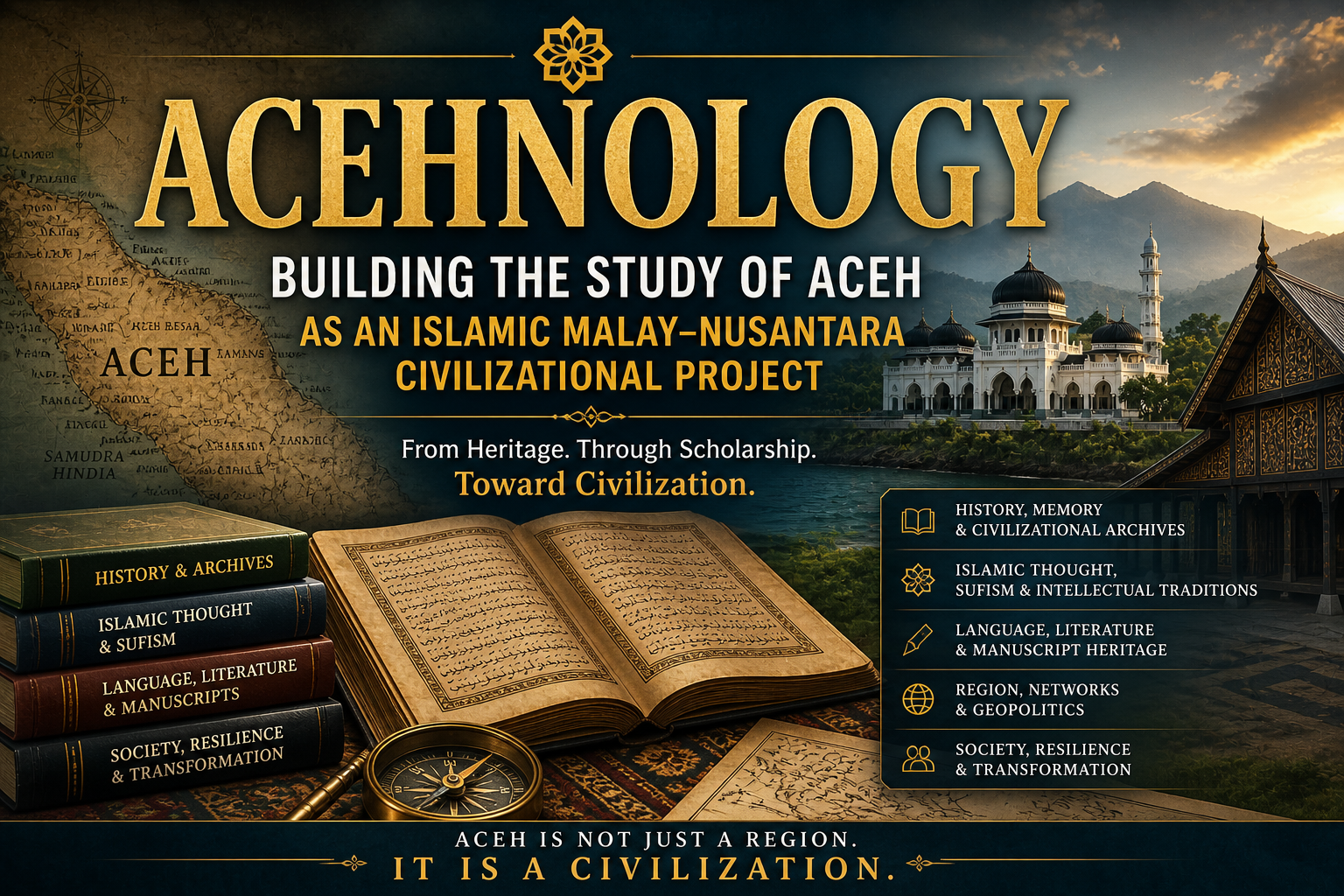
Acehnology is a refined intellectual journey into Aceh’s civilizational memory, where history, Islam, language, literature, and scholarship converge to illuminate one of the great cultural landscapes of the Malay-Nusantara world.
Knowledge about Aceh is not merely a historical record preserved in dusty archives — it is the living breath of a civilization that demands each generation to read it anew, with fresh eyes and an open, disciplined mind.
The Beginning of an Intellectual Dream
From a student dormitory in Yogyakarta, a grand project takes its first steps
Many have questioned why I never wrote a single book about Aceh, despite the fact that my writings about Aceh are, by any measure, numerous. The question is fair and deserves a serious answer — not merely a defensive one. Before explaining how I chose to insert Aceh into an academic career, it is important to recount where this project truly began: not in a prestigious research institute, not at an international conference, but in the quiet rooms of student life in Yogyakarta, where a young man from Aceh grew increasingly restless about something he could not yet fully name.
The year was 2000. I was a student at UIN Sunan Kalijaga, one of Indonesia’s most storied Islamic universities, located in Yogyakarta — a city long regarded as the intellectual and cultural heart of Java. Surrounded by books, discussions, and the energy of academic life, I became acutely aware of a troubling absence: the voices of Acehnese intellectuals were almost entirely missing from the national stage. Writers and scholars affiliated with IAIN Ar-Raniry, Aceh’s leading Islamic institution, were producing serious, thoughtful work — yet that work barely circulated beyond the borders of Aceh itself.
This was a paradox that I found both painful and urgent. Here was a body of knowledge — rooted in one of the richest intellectual traditions in Southeast Asia — effectively trapped within a narrow geographic and cultural boundary. The problem was not quality; the problem was access, visibility, and the structural asymmetry that consistently favored scholars from Java over those from the periphery. I decided, with the limited means of a student, to do something about it.
My first strategy was to approach publishers in Yogyakarta — which at that time was the epicenter of academic Islamic publishing in Indonesia — and persuade them that the works of Acehnese writers were worthy of national publication. This was not a straightforward task. Publishers operated according to market logic, and the market was not yet accustomed to voices from Aceh. I had to argue for the quality of these works, sometimes act as their editor, and make the case that a national readership would find them both relevant and illuminating.
The editorial work I took on was far more than proofreading. It involved ensuring that the arguments in each manuscript were clearly structured, the prose accessible to a broader readership, and the scholarly apparatus sufficiently rigorous to withstand scrutiny. In doing this, I served as a kind of intellectual bridge — translating not language but register: from the idiom of a regional academic community into that of the national one. This bridging work was invisible by design, and I chose to keep it that way.
Throughout this process, I deliberately chose not to add my name or any indication of my involvement to the works I helped bring to press. The books were published under the names of the Acehnese writers alone, without editorial acknowledgment, without footnotes marking my contribution. This was not false modesty; it was a principled choice. What mattered was that the ideas reached their audience — not that I received credit for helping them get there. The work of facilitating knowledge is its own reward.
The results were, in retrospect, genuinely gratifying. Within a few years, dozens of books by Acehnese writers were published by reputable Javanese publishers and distributed nationally. Several were reprinted; others were reviewed in major national newspapers. What was perhaps most ironic — and most instructive — was that some of these books were then brought back to Aceh and used as references and discussion materials there. Works that originated in Aceh had to travel to Java and back before they were fully recognized at home. That is the nature of intellectual geography in a centralized nation.
Alongside this publishing work, I also opened doors for Acehnese writers to publish in national academic journals. This required a different set of skills: understanding the submission guidelines of various journals, knowing the networks of editors and reviewers, and coaching writers through the often-opaque processes of academic peer review. I also undertook the translation of a significant work on Aceh — Hasbi Amiruddin’s study of the role of the ulama in Acehnese society — which required not only linguistic fluency but also a deep sensitivity to context, so that meaning was carried intact across languages.
From this early, modest project, I drew a lesson that has guided every subsequent step of my intellectual work: knowledge does not fulfill its potential if it circulates only among those who already know it. It must move — across disciplines, across regions, across communities of readers who would not otherwise have encountered it. A genuine intellectual project is not about building one’s own reputation. It is about building roads so that ideas can travel farther and reach more people than they otherwise would. That conviction, formed in a student room in Yogyakarta, has never left me.
Building the Aceh–Malaysia Intellectual Bridge
Cross-border scholarship that deepened the ties of a shared civilization
The intellectual journey of a serious scholar does not stop at the gates of one’s own campus. It must be carried by the currents of inquiry into unfamiliar environments, into different academic cultures, and into conversations that force one to see familiar things from unexpected angles. When I continued my postgraduate studies in Malaysia, the commitment to making Acehnese scholarship more visible did not stay behind in Yogyakarta. I carried it across the Strait of Malacca — and it was there that it found dimensions richer and more consequential than I had initially imagined.
Malaysia, particularly through Universiti Kebangsaan Malaysia (UKM), offered an academic ecosystem that was both rigorous and deeply invested in documenting Malay-Nusantara civilization. UKM was — and remains — a serious institution, with strong editorial standards and a genuine commitment to preserving and extending the intellectual heritage of the Malay world. Within that environment, I saw an opportunity: to introduce the voice of Aceh into a discourse long dominated by Malaysian, Bruneian, and certain Western Indonesian perspectives.
I brought several manuscripts by Acehnese writers to UKM’s publisher. The process was demanding. University presses operate according to strict selection criteria, and the editorial journey from manuscript to published book is long and sometimes uncertain. But I believed in the quality of the work I had brought, and I was prepared to advocate for it with patience and persistence. What was required was not only confidence in the material but also the ability to explain its significance to editors who were not necessarily familiar with the Acehnese intellectual tradition.
One of the most memorable experiences of this period was being invited to “defend” these manuscripts before the editorial board of UKM’s publisher. I was not the author of these works, yet I appeared as their academic advocate — making the case for their scholarly value and their place within the broader Malay intellectual tradition. It was an unusual role, but one I embraced fully. In the end, several manuscripts were accepted and eventually published as part of the Meukuta Alam series, a publication devoted to the heritage of Acehnese civilization.
The name Meukuta Alam is itself deeply symbolic. It refers to the title borne by Sultan Iskandar Muda — the greatest and most celebrated ruler in Acehnese history, under whose reign the Sultanate of Aceh Darussalam reached the height of its power and influence in the early seventeenth century. Publishing works about Aceh under that name in Malaysia was not merely an act of academic publishing; it was an act of civilizational dialogue — a recognition that Aceh and Malaysia share intellectual and cultural roots that run far deeper than any modern political boundary.
This effort undeniably strengthened the intellectual relationship between Aceh and Malaysia. The two territories have been bound together for centuries by trade, the spread of Islam, shared literary traditions, and the movement of scholars and clerics across their maritime space. Reinvigorating that intellectual bond in a contemporary academic context was a way of reconnecting threads of history that had been partly severed by the administrative logic of modern nation-states — a logic that tends to treat borders as barriers rather than as membranes through which ideas and people naturally flow.
Beyond facilitating the work of others, I also succeeded during this period in publishing my own work in prestigious Malaysian journals and magazines, including Pemikir and Usuluddin — two publications that carry significant weight in the Islamic academic world of this region. This was meaningful not only as a personal milestone but as a demonstration that an Acehnese scholarly voice could stand alongside the most recognized voices in the broader Malay intellectual community. One did not have to apologize for coming from Aceh; one could arrive and be taken seriously on merit.
My time in Malaysia also involved a research program of comparative scope that proved enormously formative. I conducted comparative studies between Aceh and Kelantan, and between Aceh and the Sri Petaling community — research that positioned Aceh not as an isolated object of study, but as one node in a wider network of Islamic Malay communities, each with its own character, history, and social logic, yet all connected by shared traditions of faith, language, and cultural practice. Comparison, I learned, is one of the most powerful tools for understanding what makes a place distinctive.
The years in Malaysia were, in sum, a period of profound intellectual formation. I came to understand more clearly that knowledge about Aceh would only achieve its fullest resonance if it were placed in the context of the wider Malay-Nusantara world, the wider Southeast Asian world, and the wider world of Islamic civilization. Without that contextualization, Acehnese studies risked becoming narrow and nostalgic — absorbed in the romance of past glory without contributing meaningfully to understanding the world as it actually is and as it is becoming.
Returning to Aceh: Tending a Field Long Uncultivated
The year 2006 and the beginning of a new, more ambitious chapter
Returning to Aceh in 2006 was a decision that carried the weight of history. The Aceh I returned to was a land in the midst of two simultaneous transformations of extraordinary magnitude. Just two years earlier, the catastrophic tsunami of December 2004 had obliterated much of the coastline, claimed more than two hundred thousand lives, and destroyed in minutes what communities had built over generations. At the same time, Aceh was emerging from a peace process that had brought to a close nearly three decades of armed conflict between separatist forces and the Indonesian military. It was an Aceh in the process of rediscovering and remaking itself.
In that context, the return of a researcher committed to the intellectual and cultural dimensions of Aceh felt both timely and necessary. The urgency of physical reconstruction — rebuilding homes, roads, schools, and hospitals — was undeniable and rightly took priority in the immediate aftermath of the disaster. But intellectual reconstruction is no less important in the longer arc of a society’s recovery. A community that loses its narrative becomes vulnerable to distortions of identity, to manipulation by external narratives, and to the forgetting of the values and traditions that give it coherence and direction.
A decade away from Aceh — studying in Yogyakarta, pursuing graduate work in Malaysia, conducting comparative research across the region — had given me a vantage point that I could not have acquired by staying. I had learned to see Aceh from the outside: to understand how the international academic world perceived it, how it was positioned within various global discourses, and what aspects of Acehnese civilization were most misunderstood, most romanticized, or most simply unknown to the wider scholarly community. That double perspective — insider and outsider simultaneously — became one of the most valuable assets I brought back with me.
Upon returning, I began framing knowledge about Aceh more systematically — an effort I came to call the Acehnology project. Acehnology is not merely a label designed to sound academic. It is a commitment: a declaration that Aceh deserves to be studied seriously, comprehensively, and with methodological rigor; that it is not merely a backdrop for stories about conflict and disaster; and that its civilization — with its long history, deep intellectual traditions, and complex social fabric — presents genuine challenges and genuine rewards for the scholar willing to engage with it on its own terms.
During this period, Aceh also began to attract serious attention as an object of master’s, doctoral, and postdoctoral research at institutions around the world. This was in some ways an unexpected consequence of the tsunami and the peace process, both of which brought international researchers, journalists, and humanitarian workers into direct contact with Acehnese society in unprecedented numbers. But the most serious scholars who came were drawn by something deeper: the recognition that Aceh offered a living laboratory for some of the most pressing questions in contemporary social science — about the relationship between religion and governance, about post-conflict reconstruction, about Muslim identity in the modern world.
Among the international institutions most diligently engaged with the study of Aceh in this period was the Asia Research Institute (ARI) at the National University of Singapore. ARI produced a steady stream of high-quality publications about Aceh, spanning history, culture, politics, and the conditions of post-conflict and post-tsunami society. The involvement of an institution of ARI’s stature in the study of Aceh was a signal to the wider academic community that Aceh mattered — not only to Indonesia, but to the broader understanding of Southeast Asia and the Islamic world.
Throughout this period, I continued to write about Aceh from a variety of angles. Among the topics I explored were the experience of Acehnese pilgrims undertaking the Hajj — a window into the deep spiritual geography of Acehnese life — the largely neglected history of Shia presence in Aceh, and the role of traditional Islamic education in shaping the development of Islamic studies across Southeast Asia. Each of these subjects opened a different door into the complexity of Acehnese civilization, revealing dimensions that neither the conflict narrative nor the tsunami narrative had managed to illuminate.
A particularly significant milestone came in 2012, when I was recognized as a Young Indonesian Researcher. The research that earned me that recognition was itself deeply rooted in Acehnese concerns — touching on the interconnected themes of Acehnese society, the role of the ulama, and the dynamics of the separatist movement. That recognition was not merely a personal achievement; it was an affirmation that scholarly work on Aceh had relevance and resonance at the national level, and that the questions raised by Acehnese history and society were questions that Indonesia as a whole could not afford to ignore.
Returning to Aceh in 2006 was a homecoming that far exceeded any physical return. It was an act of intellectual commitment — a reaffirmation that the knowledge produced about Aceh must not be allowed to remain scattered and fragmentary, but must be gathered, systematized, and built into a body of scholarship solid enough to serve as a genuine foundation for future generations of researchers, educators, and policymakers. From that commitment, Acehnology as a coherent intellectual project began to take its full shape.
The Founders of Acehnology: From Snouck to Reid
The Western intellectual heritage that brought Acehnese studies to a global audience
No intellectual edifice stands without the foundations laid by those who came before. When we speak of Acehnese studies in its modern scholarly form, it is impossible to begin anywhere other than with Christiaan Snouck Hurgronje, the Dutch orientalist who conducted extensive research on Acehnese society and culture during the colonial period in the late nineteenth century. Snouck Hurgronje’s work — however compromised by its colonial context, and however legitimately it can be subjected to postcolonial critique — remains one of the richest and most detailed bodies of documentation about Acehnese life at a particular historical moment. To engage with Acehnology seriously is, at some point, to reckon with Snouck Hurgronje.
In the modern era, however, no figure has been more central to the map of Acehnology than Anthony Reid. Reid is an Australian historian who has dedicated much of his distinguished career to the study of Southeast Asian history, with Aceh as one of the subjects he has most consistently and deeply engaged with. His works on Aceh touch on a remarkable range of dimensions: the history of trade and commerce, the structures of political power, the dynamics of religion, and the formation of cultural identity across the longue durée. Reid’s ability to combine local sources with a regional comparative perspective has ensured that his work remains relevant and frequently cited decades after its initial publication.
What makes Reid particularly significant is that his engagement with Aceh extends well beyond the conventional boundaries of academic scholarship. While affiliated with ARI in Singapore, he made regular visits to Aceh, serving as an advisor to several research and development institutions there, including the Aceh Institute (AI), the Aceh Research Training Institute (ARTI), and ICAIOS. This sustained, direct involvement reflects a conviction that genuine scholarship about a place cannot be fully separated from a sense of responsibility toward that place — a conviction that I have always found deeply admirable and instructive.
After Reid, the Acehnologist who has attracted the most international attention is Edward Aspinall, a scholar trained under Harold Crouch who approaches Aceh primarily through the lens of political science. Aspinall’s writings on Aceh have focused on the dynamics of the separatist movement, the peace process, and the political transformations of the post-conflict period. His perspective differs significantly from Reid’s — he is less concerned with the deep history of Acehnese culture and more with the immediate politics of the late twentieth and early twenty-first centuries — but his contribution to understanding contemporary Aceh is substantial and cannot be overlooked.
Beyond these prominent figures, several other researchers have brought important new perspectives to the study of Aceh in recent years. Antje Misbach and Paul Zechola have opened dimensions of Acehnese life that had received insufficient scholarly attention. Dina Afrianty — a researcher born in Padang and a student of J. Siapno — has introduced gender as a central analytical framework for understanding Acehnese society, a contribution of great importance, given how consistently women’s roles and experiences have been obscured by dominant narratives about the ulama, warfare, and political conflict.
Daniel Andrew Birchok represents a different but equally valuable strand of Acehnology: the intensive study of a specific locality. His completed fieldwork in the Nagan Raya area offers a granular, richly textured portrait of a community that differs in significant ways from Banda Aceh and northern coastal communities, which have tended to dominate the scholarly literature. Research of this kind serves as a necessary corrective to the temptation to treat “Aceh” as a uniform entity, reminding us that what we call Aceh is, in fact, a mosaic of communities, local histories, and distinct cultural traditions that cannot be collapsed into a single narrative.
John R. Bowen occupies a unique and important position in the landscape of Acehnology. He is a researcher who has devoted much of his scholarly life to the study of Gayo society — the ethnic community that inhabits the highland interior of Aceh — using the combined tools of history and anthropology to analyze the particular complexity and richness of that community. Through Bowen’s work, the Gayo people have become accessible to an international scholarly audience as a community with its own distinctive identity, traditions, and social logic. Bowen has also mentored young researchers in Banda Aceh, extending his intellectual influence through direct personal engagement.
Denys Lombard is another figure whose name recurs throughout the literature of Acehnology, and for good reason. The French historian’s work on the Sultanate of Aceh under Sultan Iskandar Muda opened one of the most important historical episodes in Acehnese history to serious scholarly scrutiny, illuminating the ordering principles of the Acehnese state at the height of its power and influence. For anyone who wishes to understand the political, economic, and cultural achievements of Aceh at its zenith, Lombard’s work remains indispensable — a foundational text that no serious student of Acehnese history can afford to bypass.
From Snouck Hurgronje to the generation of Birchok, Afrianty, and their contemporaries, the history of Acehnese studies is a layered and intellectually diverse body of work. Each era has brought scholars with different backgrounds, different methodologies, and different questions. But all have converged on a common impulse: the desire to understand Aceh more deeply, more honestly, and more fully. This is the inheritance that every contemporary Acehnologist receives and is obligated to enrich. It is not a burden; it is a privilege — and it comes with the responsibility to add something of genuine value to what has already been built.
Literature, Sufism, and Language in Acehnology
Beyond politics and history: finding the soul of Aceh in word and spirit
An Acehnology worthy of its name cannot be bound by the study of political history or contemporary social dynamics alone. It must also penetrate the deeper, subtler dimensions of Acehnese civilization: the world of classical literature, the tradition of Sufism, and the structure of the language that serves as the most fundamental medium of cultural expression. It is in these domains that the work of scholars such as Braginsky, Syed Muhammad Naquib al-Attas, and Mark Durie is essential to the completeness of the Acehnological project.
Braginsky is a scholar working in the French tradition of Malay studies, and his sustained attention to the history of Malay literature and Sufism has led him inevitably to Aceh. Although he positions himself broadly within the framework of Malay studies, several of his most important contributions cannot be understood without reference to a single towering figure: Hamzah Fansuri. Hamzah Fansuri was a Sufi poet from Aceh who flourished in the sixteenth century and is widely regarded as the greatest poet in the classical Malay literary tradition and as the most profound expression of Sufi thought in the Malay-Nusantara world.
Hamzah Fansuri is a figure who transcends the geographic boundaries of Aceh. He is the intellectual bridge between Aceh and the Sufi traditions of Persia and the Arab world; between the civilization of the Middle East and the Malay-Nusantara world; between the universal and the local. His poems, written in classical Malay suffused with Arabic and Persian elements, reflect a cosmopolitanism of thought and sensibility that demands we see Aceh not as a peripheral outpost of Islamic civilization, but as one of its most creative and dynamic nodes. To understand Hamzah Fansuri is to understand Aceh as a center, not a margin.
Where Hamzah Fansuri is mentioned, the name of Syed Muhammad Naquib al-Attas cannot be far behind. Al-Attas is the Malaysian philosopher and Islamicist who has spent much of his distinguished career investigating and interpreting Hamzah Fansuri’s thought within the framework of Islamic philosophy. His work on Hamzah Fansuri is not literary criticism in any conventional sense; it is a sustained philosophical inquiry into the epistemology and ontology of Islam as conceived and expressed by an Acehnese thinker of the first order. Al-Attas demonstrates, with meticulous scholarship, that embedded within Hamzah Fansuri’s verses is a philosophical system of remarkable sophistication and originality.
The contribution of al-Attas to Acehnology — though he has never defined himself as an Acehnologist — lies in the repositioning of Aceh within the intellectual history of Islam. He shows that Aceh was not merely a recipient of Islamic civilization, passively absorbing what it received from Arabia, Persia, and India. It was also a producer of Islamic thought — original, rigorous, and fully engaged with the most demanding philosophical questions of the tradition. This is a reposition of enormous consequence, one that has direct implications for how we understand the intellectual history of Islam in Southeast Asia more broadly.
Mark Durie approaches Aceh from a perspective quite different from all of the above: linguistics. Durie conducted systematic research on the Acehnese language from a grammatical standpoint, and his findings revealed typological features that are genuinely distinctive and deeply illuminating about the cognitive and cultural world of the Acehnese people. Language is culture at its most fundamental level — a crystallization of the ways in which a community perceives, categorizes, and relates to the world. Through Durie’s work, we gain access to dimensions of Acehnese consciousness that neither historical nor sociological analysis can fully reach.
Durie’s contributions to Acehnese linguistics inspired the development of a new educational paradigm: the Fricatifization Paradigm of Science, which has become one of the conceptual foundations of educational development at UIN Ar-Raniry. In linguistic terms, fricatification refers to a process of sound change involving friction; in epistemological terms, it refers to a productive transformation in ways of thinking — a willingness to allow different intellectual traditions to rub against each other and, through that friction, generate new knowledge. The paradigm seeks to bridge the traditions of Acehnese scholarship and Western scholarship not by suppressing one in favor of the other, but by fostering a genuine synthesis.
The dimensions of literature, Sufism, and language in Acehnology remind us that a civilization cannot be understood solely through the analysis of its power structures or its social conflicts. It must also be approached through an appreciation of its expressive culture — its poetry, its spiritual practices, its linguistic conventions. These are the domains in which a civilization reveals its deepest assumptions about what it means to be human, what it owes to God, and how it understands its place in the cosmos. To neglect them is to produce an Acehnology that is structurally sound but spiritually hollow.
An Acehnology that takes the full range of Acehnese civilization seriously must therefore be genuinely interdisciplinary. It cannot rely on any single methodological approach, however sophisticated. It must orchestrate history, anthropology, literary criticism, linguistics, sociology, philosophy, and theology into a coherent and mutually enriching ensemble — each approach illuminating dimensions that the others cannot reach, each testing and refining the conclusions of the others. That is the methodological vision that must continue to guide the development of Acehnese studies in the years and decades ahead.
Acehnology as an Ongoing Civilizational Project
Gathering scattered fragments of knowledge into a living, coherent whole
One of the most persistent and consequential challenges in the study of Aceh is the fragmentation of the existing literature. Works about Aceh are scattered across an extraordinary range of repositories: the archives of the Leiden University library, the pages of obscure academic journals in Malaysia and the Netherlands, unpublished research reports that circulated in limited photocopied form, and the fading oral memories of elders whose knowledge of the past has never been transcribed. This dispersal is the enemy of comprehensive understanding. Knowledge that exists but cannot be found, or that exists in forms accessible only to specialists, has not yet fully become the property of the community it concerns.
A scholarly organization in the Netherlands made a commendable early effort to address this fragmentation by creating a website that aggregated studies about Aceh, from the era of Snouck Hurgronje through the Acehnese works of the 1980s. The existence of hundreds of books and articles in that single collection was itself a revelation — a demonstration of just how much serious intellectual labor had already been invested in understanding Aceh over more than a century. But the work of gathering and systematizing this literature cannot stop there. It must be continually extended, updated, and connected to the work being produced today.
This is where academic institutions within Aceh itself bear a heavy and unavoidable responsibility. UIN Ar-Raniry, Universitas Syiah Kuala, and the various research institutes established in Aceh since the peace process are not merely educational facilities; they are — or should be — custodians of Acehnese intellectual heritage and engines of its continued development. Their task is not only to gather what already exists but also to generate what does not yet exist: research into aspects of Acehnese life, history, and culture that have not yet been adequately investigated.
The Acehnology I envision is not only a formal academic discipline with rigorous standards and institutional structures. It is also a living cultural movement — a form of sustained intellectual engagement with Acehnese civilization that reaches beyond the university and into the classroom, the newsroom, the artist’s studio, and the community hall. Knowledge about Aceh must be made accessible and meaningful to teachers, journalists, artists, activists, and ordinary citizens. For this to happen, the production of knowledge must be paired with a serious and sustained effort to disseminate it through channels that reach different audiences.
Digital platforms, in this context, play a genuinely important role. In an era when information travels at a speed and with a reach unprecedented in human history, a website like kba13.com is not a supplement to serious scholarship — it is one of its most important vehicles. It ensures that knowledge about Aceh is not confined to library stacks visited by a handful of specialists, but is available to anyone, anywhere in the world, who wants to understand Aceh more deeply. The democratization of access to knowledge is one of the great intellectual opportunities of our time, and Acehnology should seize it fully.
It is equally important to insist that Acehnology is not only about the past. The great civilizational achievements of Aceh under Sultan Iskandar Muda, the philosophical depth of Hamzah Fansuri, the structural sophistication of traditional Acehnese governance — these are not museum exhibits. They are living resources for addressing contemporary challenges. The questions that Aceh faces today — the implementation of Islamic law, the management of special autonomy, the dynamics of economic development, the pressures of climate change on coastal communities — all of these require a deep and honest understanding of the historical and cultural context within which Acehnese society operates.
Acehnology must also function as a critical mirror for Acehnese society itself. Scholarship that does nothing but celebrate the glories of the past, without also having the intellectual courage to raise difficult questions about the present, is scholarship that has abdicated one of its most important responsibilities. A healthy Acehnology must encourage Acehnese society to assess itself honestly — to ask what has been preserved from the great inheritance of Acehnese civilization, what has been lost or distorted, and what must be recovered, rethought, or rebuilt in order to serve the needs and aspirations of contemporary Acehnese people.
Throughout this long journey, I have been asked on numerous occasions how to maintain consistency in social research over many years and across many different institutional and geographic contexts. The answer I have always given is simple but demanding: read more. Reading is not merely a means of gathering information; it is a discipline for training the mind to think systematically, to perceive relationships between ideas and phenomena that would otherwise seem unconnected, and to sustain the intellectual curiosity that is the engine of all genuine scholarship. Research is never too old to continue. No aspect of Aceh is too small or too obscure to deserve serious attention.
Acehnology, finally, is a project that will never be completed — and that is precisely as it should be. It will grow with the arrival of new researchers bringing new perspectives; it will be transformed by the development of new methodologies; it will be continually challenged and enriched by the changes occurring within Acehnese society itself. The imperative is not to finish the project, but to ensure that the flame of intellectual curiosity about Aceh is never extinguished — that there are always people willing to sit with the questions, read the evidence, think with rigor and care, and write with both honesty and love about one of the most extraordinary civilizations in the history of the Malay world.
Passing the Torch to the Next Generation
Intellectual responsibility is a duty that outlasts any single life or career
Every generation of scholars carries a double responsibility: to build on the work of those who came before, and to lay foundations strong enough to support the work of those who will come after. This is not a comfortable responsibility. It demands the humility to acknowledge that no single scholar — however prolific, however gifted — can fully understand Aceh alone, as well as the courage to keep working in full knowledge that one’s own contributions will eventually be absorbed, critiqued, revised, and superseded. The acceptance of that condition is the mark of a mature intellectual vocation.
One of the most gratifying outcomes of the efforts described in this essay has been the emergence of what might be called a “harvest of doctors” and a “harvest of professors” at UIN Ar-Raniry and in the Acehnese academic environment more broadly. Many of the scholars who now publish regularly at the national level — who hold respected positions in Indonesia’s academic community — are individuals whose earliest work I once helped edit, publish, or place in journals. Watching them grow into independent, productive scholars has been one of the deepest satisfactions of this long project.
But this “harvest” also carries within it a challenge that must be named directly. When many people hold doctorates and professorships, the question that must always be asked is whether the quality of the work is genuinely rising. Academic titles are instruments, not ends. They are too easily mistaken for the goal itself, with the result that the genuine spirit of inquiry — the restless curiosity, the willingness to ask uncomfortable questions, the commitment to intellectual honesty — withers once the degree is conferred and the promotion is secured. The cultivation of a research culture requires more than the multiplication of credentials.
This is why the mentoring of young researchers cannot be limited to formal supervision within degree programs. It must extend into the informal spaces where intellectual culture is actually formed: reading groups, discussion forums, working seminars, and the willingness of senior scholars to read and respond seriously to the work of junior colleagues. John R. Bowen provides an instructive model in this regard. Though not based in Aceh, he has made regular visits to Banda Aceh specifically to spend time with young researchers there — an investment of time and attention that can have an impact far exceeding anything that a formal lecture or a published article alone can achieve.
There remain vast stretches of Acehnese history, culture, and society that have not yet received the scholarly attention they deserve. The economic history of Aceh beyond the familiar narratives of the pepper trade. The transformation of traditional Acehnese performing arts amid modernization and Islamization. The changing religious landscape of Aceh since the implementation of special autonomy. The lived experiences of the Acehnese diaspora across Malaysia, the Middle East, and further afield. The relationship between indigenous communities in the Acehnese interior and the forces of modern development. These are open fields, inviting scholars willing to take up the challenge.
The next generation of Acehnese researchers must also be prepared to leverage the methodological advances that have transformed the social sciences and humanities over the past two decades. Digital methods — text mining, social network analysis, geospatial mapping, and the analysis of large digital archives — open possibilities for Acehnese studies that simply did not exist when the foundational work of scholars like Reid, Lombard, and Bowen was being produced. These tools must be embraced and deployed while ensuring they complement, rather than displace, the depth of understanding that can only come from sustained, direct engagement with the communities and archives one is studying.
The international networks that have been built around the study of Aceh over these past decades — connecting researchers in Malaysia, the Netherlands, Australia, the United States, France, and Singapore — represent an asset of extraordinary value. Every node in that network is a potential source of collaboration, of critical feedback, of access to resources and audiences that would otherwise be beyond reach. These relationships must be cultivated with care, reciprocity, and a long-term view. Intellectual networks, like all networks, require maintenance and investment to remain alive and productive.
This entire experience — academic, personal, and institutional — has gradually shaped what I call the study of Acehnology. Without fully realizing it at each step of the journey, the converging interests of Islam, Southeast Asia, and the social sciences and humanities were steadily pointing toward a single destination: a systematic, interdisciplinary, scientifically grounded study of Acehnese civilization. The estuary of that long intellectual river is Acehnology — not a finished discipline, but a continuously developing field that draws on two decades of study, fieldwork, collaboration, and reflection.
This small account of an intellectual journey is offered in the spirit it was undertaken: not as a monument to personal achievement, but as an invitation and an encouragement to those who will carry this work forward. The history and culture of Aceh remain, in large part, untouched by previous studies. The questions that remain open are more numerous and more interesting than the questions that have been answered. The task ahead is large. But for those with the patience to read widely, the curiosity to ask new questions, and the commitment to follow those questions wherever they lead, Acehnology offers one of the richest and most rewarding intellectual pursuits available to a scholar of Southeast Asian civilization.
About The Author

Artikel Terkait
 Sultan Iskandar Muda and the Architecture of Power: A Strategic Analysis of Aceh through Denys Lombard
 Aceh, Nation-State, dan Komparasi Global: Bali, Yogyakarta, Brunei, Singapura, dan Israel dalam Dialektika Demokrasi dan Agama
 Demokrasi Aceh: Antara Tradisi Lokal, Agama, dan Tantangan Negara-Bangsa
 Acehnology: Menyelami Kembali Kosmos Pengetahuan dari Tanah Aceh
 Artificial Intelligence and the World Order of 2040: A Strategic Essay on AI, Extraterrestrial Intelligence, and the Future of Humanity