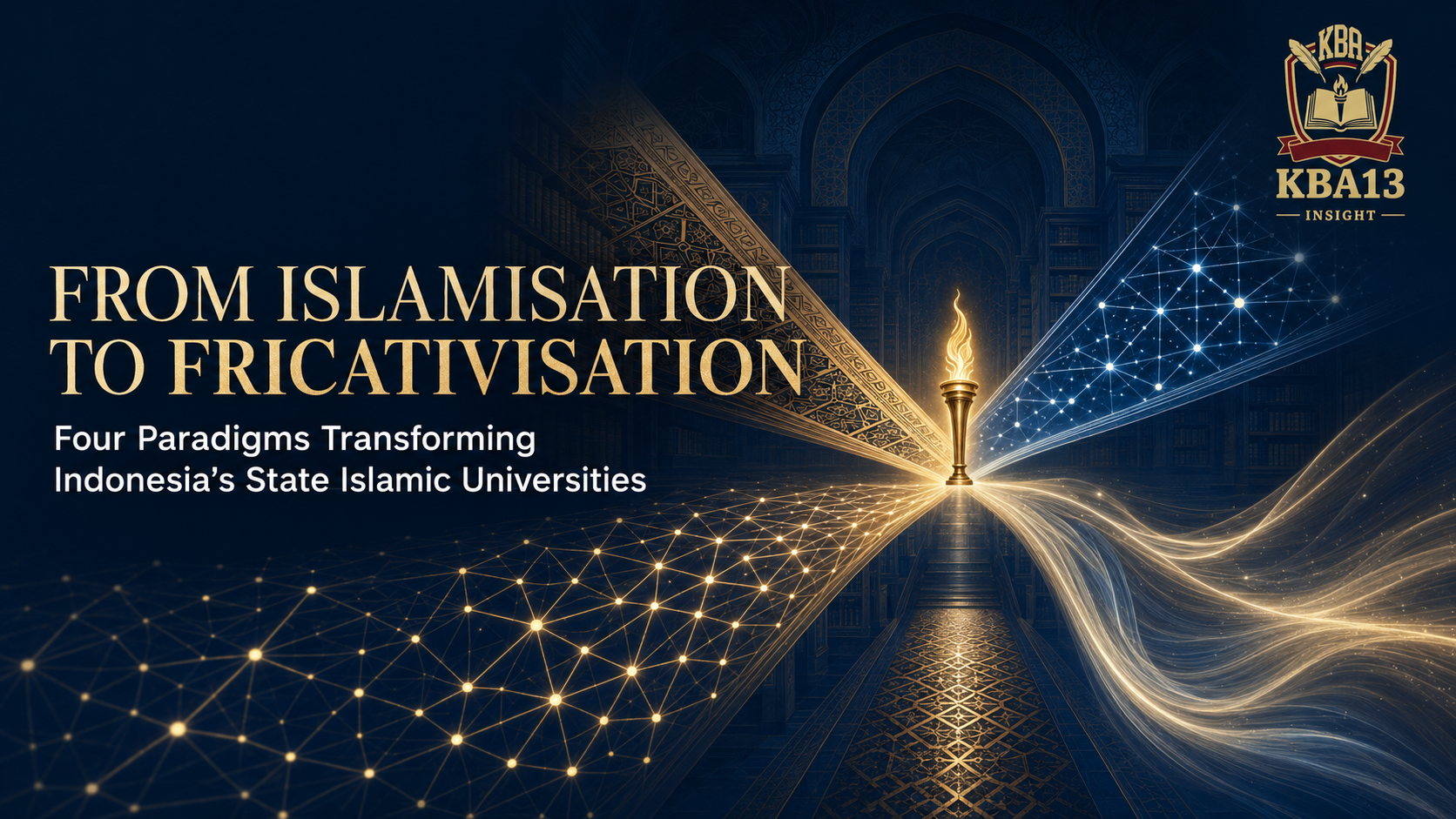
Introduction Since their establishment, Indonesia’s State Islamic Higher Education Institutions (PTKIN) have undergone a pronounced evolution in their paradigms of knowledge. By a paradigm of knowledge, I mean the fundamental framework of thought and inquiry through which learning is pursued within PTKIN—above all, the manner in which the Islamic religious sciences engage the modern disciplines. Over the past several decades, a discernible shift has taken place: away from a traditional normative-theological posture and towards the integration of the religious sciences with the modern natural sciences and with the social sciences and humanities. This movement has been marked by the emergence of a succession of new formulations—among them the Islamisation of Knowledge, the Integration of Knowledge, the Interconnection of Knowledge, and, most recently, the Fricativisation of Knowledge. Each arose in response to the pressures of intellectual change and the needs of the ummah, and each advances a distinct conception of the relationship between Islam and science. The scholarly trajectory of Indonesia’s State Islamic Higher Education Institutions (PTKIN) is inseparable from their institutional metamorphosis from the State Institute for Islamic Studies (IAIN) into the State Islamic University (UIN)[1]. Far from a mere change of nomenclature, this transformation registered a deeper reorientation of vision: what had once been an institution devoted to the traditional study of religion was recast as a comprehensive university embracing the full spectrum of disciplines within an Islamic horizon[2]. Such a reorientation demanded a thoroughgoing reconstruction of the conceptual architecture of knowledge: the religious sciences could no longer be pursued dogmatically in isolation but were obliged to enter into dialogue with the social sciences, the humanities, the natural sciences, and technology. It is for precisely this reason that mapping and analysing the scholarly paradigms now emerging across PTKIN becomes essential to discerning the future course of Islamic higher education.
Artikel ini tersedia untuk pelanggan. Silakan berlangganan untuk membaca selengkapnya.
 Acehnology: Menyelami Kembali Kosmos Pengetahuan dari Tanah Aceh
 Religio-Anthropological Approach: Membaca Ulang Agama, Antropologi, dan Sejarah dalam Pemikiran Ugo Bianchi
 The Search for Digital Anthropology: A Case of What Were Doing
 The Future of Digital Culture: What Comes Next?
 The Evolution of Islamic Thought in the Malay World: Adaptation, Reform, and Political Awakening
Leave a Reply