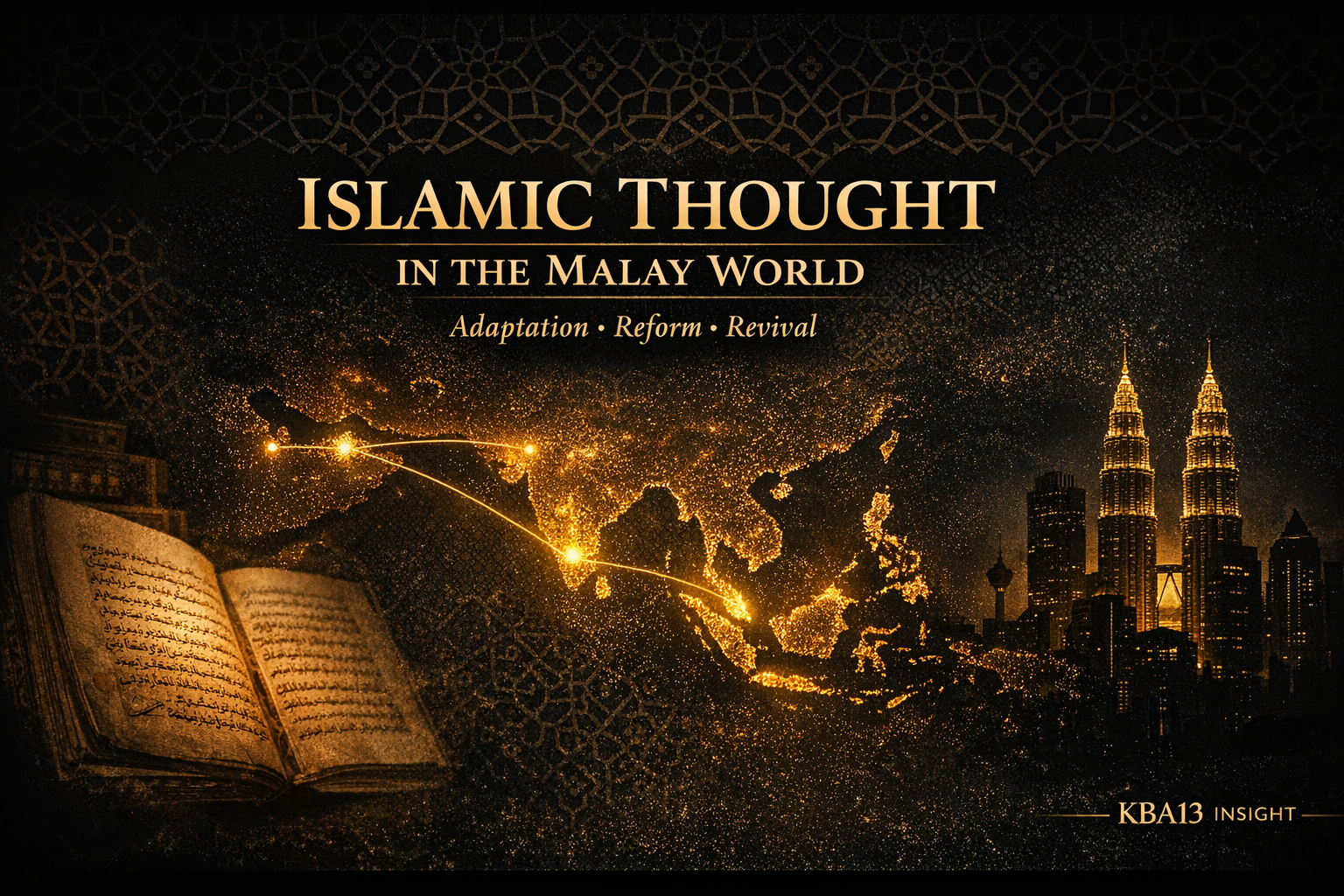
The Malay world is not a periphery of Islamic civilization, but a strategic intellectual frontier shaped by adaptation, reform, and revival.
Introduction
In this essay, I will explore the formative stages of Islamic thought in the Malay World, examining its evolution and enduring significance. Renowned scholar Azyumardi Azra, in his influential article on the Islamic Awakening among the Malays (Azra, 1996: 19), highlights the region’s pivotal role in the broader narrative of Islamic revivalism. My central argument is that the trajectory of Islamic thought in the Malay world has been characterized by a unique pattern of adaptation, negotiation, and innovation, shaped by both external influences and local dynamics across historical phases. I contend that understanding this evolving intellectual landscape is crucial to appreciating the distinctive contributions of the Malay world to global Islamic discourses, as well as to grasping the implications for contemporary Islamic identity and reform in the region. This essay seeks to illuminate the unique potential of the Malay world within the ongoing discourse on Islamic resurgence, emphasizing its historical contributions and the factors that have shaped its intellectual landscape.
Admittedly, since the 1970s, the rise of Islam in Southeast Asia, especially in
Malaysia and Indonesia have been very much affected.
Admittedly, since the 1970s, the rise of Islam in Southeast Asia, especially in
Malaysia and Indonesia have been very much affected.
The First Phase: Early Influences and Local Adaptation
However, the color of Islam in the Malay Region is quite different from other Islamic regions. Therefore, every discourse of the Islamic revival, especially those related to thought, always involves the aspect of locality (local) in every agenda of Muslims. The history of Islamic thought in Malay has undergone several phases since Islam first came to this area. The Middle East strongly influenced the first phase, notably from the seventeenth to the twentieth century. Islamic thought at the time was divided into several categories. First, some aimed to discuss tajdîd, islâh, and neo-Sufism (Fathurahman, 2004: 371-377). Scholars from the Malay region “succeeded” in connecting Haramayn (Mecca and Medina) with the archipelago. Their works responded to Muslim problems of that era. Islamic governments also supported the ulama’s activities to produce useful ideas. Yet, conflicts appeared, such as the case of Nurdin Ar-Raniry and Hamzah Fansuri in Aceh (Bustamam-Ahmad, 2002: 317-19; Fathurahman, 1999). Sultanah Keumalat ad-Din had to resign due to a fatwa from Mecca (Azra, 1999: 29; Bustamam-Ahmad, 2002: 263).
Local adaptation played a crucial role in shaping Islamic thought in the Malay world. The fusion of pre-existing spiritual traditions, indigenous customs (adat), and local political structures with Islamic teachings led to a distinctive form of Islam that was both recognizably Malay and global. For instance, syncretic practices that blended Islam with earlier Hindu-Buddhist influences persisted in local rituals and religious ceremonies. Political factors also contributed to the local adaptation of Islam, as sultans and other rulers often incorporated Islamic law to reinforce their legitimacy while accommodating indigenous power structures. The importance of harmony and social cohesion, valued in the Malay context, fostered negotiation between Islamic jurisprudence and local customs, giving rise to unique legal and societal frameworks. These processes of adaptation and negotiation not only differentiated Islam in the Malay world from its Middle Eastern counterparts but also ensured its enduring relevance and resilience within local societies.
The Second Phase: Reformism and Print Culture
The second phase of Islamic thought in the Malay region was profoundly shaped by ongoing intellectual currents from the Middle East, particularly through reformist movements that sought to reinterpret and modernize Islamic practices. Distinguished thinkers such as Muhammad Abduh, Rashid Ridha, and Jamaluddin al-Afghani—alongside the influence of the Wahhabi movement—played pivotal roles in shaping the ideological landscape of the Malay world during this period (Othman, 2004: 257-274). A remarkable hallmark of this era was the proliferation of publications and journals spearheaded by Islamic reformers, many of whom drew inspiration directly from the Middle Eastern reformist discourse. Notable newspapers and periodicals emerged, including al-Imam, Neracha, al-Ikhwan, Bahtra, Idaran Zaman, among others (Azra, 2002; Hamzah, 1991), serving as influential platforms for disseminating reformist ideas and stimulating intellectual debate.
According to Mohammad Redzuan Othman, these publications became crucial vehicles for articulating the agenda of islâh (reform), urging Malay Muslims to adopt a more progressive and dynamic approach in confronting the multifaceted challenges facing the ummah (Othman, 1994, 2005). In Indonesia, a similar phenomenon unfolded, with reformist journals and newspapers such as al-Munir, Berita Islam, Adil, Pantjaran Amal, al-Chair, Pembela Islam, al-Fatawa, and Soal Jawab gaining prominence. These periodicals not only championed the cause of Islamic awakening in Indonesia but also played a vital role in fostering discourse on nationalism, social reform, and the evolving identity of the Muslim community within the broader context of colonial resistance and modernity.
During the second phase of Islamic intellectual development in the Malay world, Malay-Indonesian students emerged as dynamic agents of change, wielding considerable influence within both the local and transnational Islamic spheres. Their academic pursuits in Egypt, particularly at renowned institutions such as Al-Azhar University, exposed them to the vibrant intellectual and political ferment that characterized the Middle East at the time (Abaza, 1994, 2003a, 2003b). This exposure significantly broadened their perspectives, enabling them to engage with contemporary debates on Islamic reform, political activism, and modernity. As one prominent observation noted, “In Mecca, one could study religion only; in Cairo, politics as well” (W. Roff, 1970: 74), reflecting the critical role that Cairo played in shaping not only religious scholarship but also political consciousness among Malay-Indonesian students. The cosmopolitan atmosphere of Cairo brought about significant and lasting changes, influencing not only their religious outlook but also their social attitudes, lifestyle choices, and engagement with global Islamic currents (Burhanuddin, 2004: 183).
One notable manifestation of this intellectual awakening was the publication of Seruan Al-Azhar, a newspaper established and managed by Malay-Indonesian students. This publication served as a collaborative forum for students from Malaya, including figures such as Djanan Thaib, Muhammad Idris Marbawi, Abdul Wahab Abdullah, Mahmud Junus, Raden Fathu-l-Rahman, and Othman Abdullah (W. Roff, 1970: 76). Seruan Al-Azhar became a platform for articulating reformist ideas, fostering debate on pressing religious and political issues, and galvanizing support for the broader Islamic reform movement. The magazine not only stirred political spirit among its readership but also played a critical role in connecting the intellectual energies of the Malay-Indonesian diaspora with the reformist momentum emerging from Egypt (Azra, 1999: xii-xxxi).
More than that, there are groups of young people who want to reform
the values of Islamic society’s life. In this context, Farish A.
Noor (2004:9) writes:
the values of Islamic society’s life. In this context, Farish A.
Noor (2004:9) writes:
In one way, to try to identify the origins and roots of the progressive Islamist project in the Malay archipelago, it should begin with this generation of modernist-reformist thinkers, activists, and ‘ulama.’ For it was here, during the period of intense political, discursive, and at times physical conflict between the Kaum Muda reformists and the Kaum Tua traditionalists, that we find the terms pembaharuan (renewal), Nahda (rebirth, renaissance), and modernism (modernity) being introduced into the discursive economy of normative Islam for the first time.
The Third Phase: Political Awakening and Nationhood
The confrontation between reformist and traditionalist groups marked a critical turning point in the evolution of Islamic thought in the Malay world. This ideological clash generated persistent challenges from older generations intent on preserving established religious and social norms. Despite this resistance, the intellectual landscape of Islam in the region became increasingly enmeshed with the rise of nationalist sentiments and the complex interplay with secularism and modernist ideologies emanating from the West. Similar tensions between reformists (often inspired by modernist and rationalist ideas) and traditionalists have shaped Islamic thought elsewhere, notably in the Middle East—with conflicts among Salafis, Sufis, and traditional religious establishments—and in South Asia, as seen in debates among the Deobandi, Barelvi, and Aligarh movements. While these regions all experienced disputes over authority, ritual practice, and engagement with modernity, the Malay context stands out for how these disputes were refracted through issues of nationhood and the quest to harmonize Islamic values with local cultural and political realities. Influential models such as the “Turkish experience,” which demonstrated the possibility of reconciling Islamic principles with modern governance, and the controversial thesis of ‘Ali Abdur Raziq, who advocated for the separation of religion and state, profoundly shaped debates and reformist aspirations in the Malay world, particularly in Indonesia.
The third phase of Islamic thought in the Malay region was notably characterized by a greater intertwining of religious discourse and political aspirations, particularly during the struggle for national independence in both Malaysia and Indonesia. During this period, Islamic thought underwent a significant shift, as its orientation was no longer confined to influences from the Middle East but also began to draw on political and intellectual trends from the West. In Malaysia, the rise of political parties such as PAS (Parti Islam Se-Malaysia) and UMNO (United Malays National Organization) reflected divergent interpretations and applications of Islam within the political sphere, each shaping the nation’s evolving identity. Similarly, in Indonesia, the emergence of the Masyumi Party marked a crucial moment in which Islamic modernism became a central theme in the nation’s post-independence political and social development (Mahendra, 1999). This phase thus witnessed a dynamic interplay between religion, politics, and modernity, as Muslim communities sought to redefine the role of Islam in their rapidly changing societies.
A significant challenge facing Muslims in Malaysia and Indonesia concerns the extent to which Islam should be integrated into the legal and institutional framework of the state, particularly regarding the establishment of an Islamic State and the implementation of Islamic Shari’a. In Malaysia, aspirations for an Islamic state and the enforcement of Islamic law have been championed since the era of the Hizb’ul Muslim Party, which later evolved into the PAS (Parti Islam Se-Malaysia). These ambitions continue to resonate among segments of the Muslim population, reflecting a persistent desire for greater alignment between state policies and Islamic principles. Notably, prominent Islamist movements such as PAS, ABIM (Angkatan Belia Islam Malaysia), and Darul Arqam have become increasingly vocal in advocating for the creation of an Islamic state and the formal application of Shari’a law within the Malaysian context (Noor, 2004: 13).
A significant challenge facing Muslims in Malaysia and Indonesia concerns the extent to which Islam should be integrated into the legal and institutional framework of the state, particularly regarding the establishment of an Islamic State and the implementation of Islamic Shari’a. In Malaysia, aspirations for an Islamic state and the enforcement of Islamic law have been championed since the era of the Hizb’ul Muslim Party, which later evolved into the PAS (Parti Islam Se-Malaysia). These ambitions continue to resonate among segments of the Muslim population, reflecting a persistent desire for greater alignment between state policies and Islamic principles. Notably, prominent Islamist movements such as PAS, ABIM (Angkatan Belia Islam Malaysia), and Darul Arqam have become increasingly vocal in advocating for the creation of an Islamic state and the formal application of Shari’a law within the Malaysian context (Noor, 2004: 13).
The core of this ongoing debate in the Malay world revolves around a fundamental question: how should Islam be situated within the framework of nationhood? This issue underscores the complexities and tensions inherent in balancing religious identity with the demands of modern state-building, and continues to shape the trajectory of Islamic thought and political discourse in Malaysia and Indonesia.
The Fourth Phase: Islamic Revivalism and Modern Society
The fourth phase of Islamic thought in the Malay world emerged in tandem with the sweeping Islamic revival of the 1970s, marking a pivotal era of transformation and diversification. During this period, Islamic thought expanded beyond its previous boundaries and was characterized by the emergence of various groups and movements, each espousing distinct visions for Islam’s role in society. According to Mohd. Redzuan Othman (1998), this era witnessed a profound resurgence of Islamic consciousness in Malaysia, as Muslims increasingly aspired to integrate Islamic principles into every aspect of life—not only in worship, but also in economics, politics, education, and social affairs. The influence of the global Islamic resurgence, along with local developments, galvanized a generation of Muslims to pursue a holistic understanding and implementation of Islam. As a result, this period became a catalyst for renewed efforts to reclaim and revitalize Islamic identity, values, and institutions within the rapidly modernizing context of Malaysian society. Importantly, the legacies of this revivalism phase continue to shape present-day Islamic discourse and policy. Contemporary debates on the role of Islam in governance, education, and public life are often rooted in the ideas and activist energy that emerged in the 1970s. The influence of revivalist movements remains visible in the ongoing emphasis on Islamic values in legislation, the expansion of Islamic finance, and the enduring relevance of Islamic NGOs and political parties. Thus, the revivalism initiated during this phase persists as a driving force in the negotiation of Islamic identity and reforms in Malaysia and the broader Malay world.
Scholars broadly concur on the distinct phases of Islamic revivalism in Malaysia, each characterized by unique sociopolitical developments and shifts in religious consciousness. The first phase, emerging in the early 1970s, was characterized by an increasing number of Malaysian Muslim youths pursuing studies abroad, often amid political turbulence in the wider Muslim world. These experiences fostered new perspectives and a heightened sense of Islamic identity among returning students. The second phase was defined by the strategic alliance between ABIM (Angkatan Belia Islam Malaysia) and PAS (Parti Islam Se-Malaysia), coupled with the transformative influence of the Iranian Revolution, which energized local Islamist movements and inspired calls for social and political change (Baharuddin, 1983: 399-404). The third phase commenced with Anwar Ibrahim’s entry into UMNO (United Malays National Organization), signaling a shift in the political landscape, while PAS underwent significant leadership reforms that contributed to the evolving dynamics of Islamic activism in Malaysia (Jomo & Shabery, 1992: 79).
About The Author

Artikel Terkait
 China’s Economic Statecraft in ASEAN: Trade, BRI, and Strategic Leverage
 Terrorism in Southeast Asia: Networks, Field Research, and New Updates 2025
 Islam in Political Affairs: Islamic Thought, Intellectual Movements, and Government Policy in Indonesia and Malaysia
 Ali Asghar Engineer: Islam, Ethics, and the Courage to Disturb Power
 The Six Epochs of Intelligence: Ray Kurzweil, AI, and the Cosmic Future of Mind