
KBA13 Insight · Intellectual Essays · Religion, Philosophy & Culture
How John Locke Explains the Origin of Simple Ideas:A Close Reading of An Essay Concerning Human Understanding
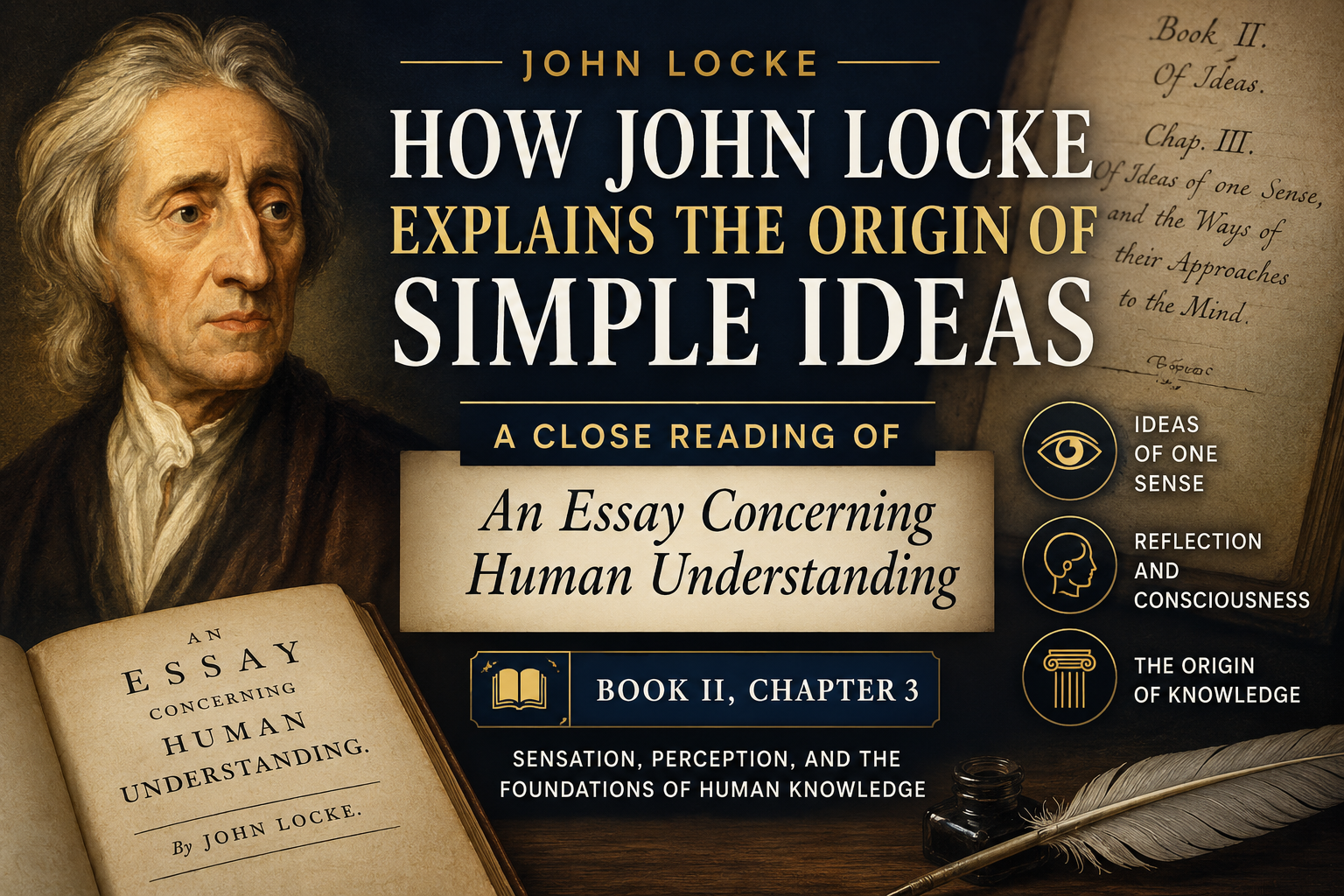
John Locke’s theory of simple ideas marks one of the decisive turning points in the history of modern philosophy. In Book II, Chapter 3 of An Essay Concerning Human Understanding, Locke argues that every simple idea enters the human mind through specific channels of sensation and reflection, rejecting innate knowledge in favor of an empirical account of cognition. This essay offers a close…
Summary
John Locke’s theory of simple ideas marks one of the decisive turning points in the history of modern philosophy. In Book II, Chapter 3 of An Essay Concerning Human Understanding, Locke argues that every simple idea enters the human mind through specific channels of sensation and reflection, rejecting innate knowledge in favor of an empirical account of cognition. This essay offers a close philosophical reading of the chapter, examining Locke’s classification of ideas, the relationship between perception and the senses, and the epistemological consequences of grounding human understanding in experience. By situating this seemingly brief chapter within the wider architecture of Locke’s philosophy, the essay demonstrates why the origin of simple ideas remains fundamental to contemporary debates on knowledge, consciousness, and the philosophy of mind.
Keywords
- An Essay Concerning Human Understanding
- British Philosophy
- consciousness
- Empiricism
- epistemology
- History of Ideas
- Human Understanding
- Ideas of One Sense
- intellectual history
- John Locke
I. Why Locke Classifies Ideas by the Route They Take
Chapter 3 opens with a statement of purpose that tells us what kind of inquiry Locke thinks he is conducting. The better to conceive the ideas we receive from sensation, he writes, it may not be amiss to consider them in reference to the different ways whereby they make their approaches to our minds and make themselves perceivable by us. Everything in the chapter follows from that sentence, so it is worth taking apart slowly.
The first thing to observe is what Locke does not propose. He does not propose to sort ideas by the objects they represent, which would require him to have settled what those objects are. He does not sort them by their degree of clarity, nor by their importance, nor by whether they are true. He sorts them by the way they approach the mind. The principle of division is the pathway, not the cargo.
This is consistent with the position he has already staked out in the opening chapters of Book II. Having denied in Book I that the mind comes stocked with any characters of its own, he must account for the entire contents of the understanding by describing how those contents arrived. If nothing is innate, then the question of origin is not one question among others. It is the only question, and every idea must be given a documented route.
Locke also stipulates a second thing in that opening sentence: the ideas must not only approach the mind, they must make themselves perceivable by us. Approach alone is insufficient. An idea that arrives at the mind without being perceived would, for Locke, not be an idea at all, since he treats being perceived as constitutive of an idea’s existence. This condition becomes load-bearing later in the paragraph when he considers what happens if the organs fail.
Notice too that he restricts himself here to ideas received from sensation. That is the announced subject. Yet the classification he immediately gives has four branches, two of which involve reflection. This is a small untidiness in the text, and it tells us something: Locke wants a complete map of routes, and the sensation-only frame cannot contain it. The chapter’s stated topic is narrower than the classification it introduces.
The phrase “it may not be amiss” is characteristic and characteristically disarming. Locke presents the classification as a convenience for the reader rather than as a doctrine. Throughout the Essay he insists he is following what he calls the historical, plain method — reporting what he finds when he observes his own mind at work, not deducing what must be the case. The classification is offered in that register: here is how things appear to arrive.
But the classification does far more than organise the exposition. It determines what will count as a simple idea, which in turn determines what Locke will allow as a legitimate constituent of any complex idea, which in turn determines the limits he will place on knowledge in Book IV. A chapter presented as a convenience is in fact laying the inventory rules for the entire system.
Finally, the plural in “the different ways” should be registered. Locke is committed to there being genuinely several routes, not one. That commitment is what makes the chapter necessary at all. If all ideas entered by a single undifferentiated channel, there would be nothing to classify, and the chapter would not exist. The differences between the routes will do explanatory work.
II. The Fourfold Division Stated Exactly
Locke sets out four branches, and it is worth reproducing his sequence and emphasis, because the order is not arbitrary. First, then, he says, there are some ideas that come into our minds by one sense only. Secondly, there are others that convey themselves into the mind by more than one sense. Thirdly, others that are obtained only from reflection. Fourthly, there are some that make their way and are suggested to the mind by all the ways of sensation and reflection.
The first branch is defined by exclusivity. What marks these ideas is not that a particular sense happens to deliver them but that no other sense can. Locke reinforces this in the next paragraph with the phrase “have admittance only through one sense”, and adds that the sense in question is peculiarly adapted to receive them. The adaptation is on the side of the organ: the eye is built for light and colour, and nothing else is.
The second branch is defined by convergence rather than exclusivity. Locke’s wording is that these ideas are conveyed to the mind through more than one sense. He does not itemize them here, reserving them for the following chapters, but the Essay makes clear which they are: space or extension, figure, rest, and motion. These reach us through both sight and touch, and the same idea arrives by two independent doors.
The third branch removes the external senses altogether. Ideas had from reflection only are those the mind acquires by observing its own operations — the thinking, doubting, believing, reasoning, knowing and willing that Locke enumerates in Book II Chapter 1. Reflection for Locke is not a metaphor. He treats it as a genuine source of ideas, parallel in standing to sensation, and he is explicit that it furnishes materials the senses could never supply.
The fourth branch is the most peculiar, and Locke gives it the least explanation here. These ideas are suggested to the mind by all the ways of sensation and reflection alike. The verb matters. Suggestion is weaker than conveyance: these ideas are not carried in by a channel but arise alongside whatever is carried in, by any channel whatsoever. Elsewhere in Book II the members of this class turn out to be pleasure and pain, power, existence, unity, and succession.
Two structural features of the division deserve comment. It is exhaustive by construction — one sense, more than one sense, reflection alone, all routes together — and it is drawn along a single dimension, breadth of access. Branch one has the narrowest access, branch four the widest, with two and three between. The whole taxonomy is a scale of how many doors an idea can use.
Locke then makes a procedural promise: we shall consider them apart under these several heads. He is announcing a programme spanning several chapters, of which Chapter 3 discharges only the first item. This is why the chapter is short. It is not a self-contained essay but the first instalment of a serial exposition, and its brevity reflects the fact that ideas of one sense are the easiest case.
It is also worth noticing what the division presupposes about ideas themselves. Each idea must be assignable to exactly one branch, which means each must have a determinate route or set of routes. Locke does not entertain ideas of mixed or uncertain provenance, nor ideas that might reach different people by different routes. The classification assumes that origin is a fixed and discoverable property of every idea. That assumption is nowhere defended.
III. The First Branch: Which Ideas Belong to Which Organ
Turning to the first branch, Locke offers what amounts to a census. There are some ideas, he says, which have admittance only through one sense, which is peculiarly adapted to receive them. He then goes organ by organ, and the details of the list repay attention because they are more carefully chosen than a casual reading suggests.
For sight: light and colours, as white, red, yellow, blue, with their several degrees or shades and mixtures, as green, scarlet, purple, sea-green, and the rest, come in only by the eyes. Three things are being distinguished here. Light is listed separately from colors. The named colours are given as simple cases. And then there are degrees, shades, and mixtures, which Locke treats as belonging to the same class rather than as compounds.
That last point deserves emphasis because it is easy to misread. One might expect Locke to say that green is a complex idea assembled from simpler ones. He says the opposite. Green, scarlet, purple and sea-green are listed as shades and mixtures, yet they enter by the same single door and stand in the same class. For Locke, simplicity is not a matter of a colour looking uncompounded to a theorist; it is a matter of the idea being received whole and undivided by the mind, and every shade is received that way.
For hearing: all kinds of noises, sounds and tones, only by the ears. Again there is an internal ordering. Noises, sounds, and tones are three grades, running from the unstructured to the musically determinate, and all three are assigned to the one organ without further comment. Locke is not interested in whether a tone is more complex than a noise. He is interested only in the fact that no ear, no tone.
For smell and taste: the several tastes and smells, by the nose and palate. Locke pairs these two organs in a single clause, which is unusual in a list that otherwise separates faculties carefully. He does not say that smells come by the nose and tastes by the palate, though that is presumably his meaning. The compression will matter in the second paragraph, where smell and taste are treated together as the two domains where our vocabulary is thinnest.
For touch he says something slightly different in form. The most considerable of those belonging to the touch are heat and cold, and solidity. The phrase “most considerable” concedes that the list is not exhaustive and that a judgment of importance is being made. He does not say “most considerable” of sight or hearing. Touch is the one modality where he acknowledges selecting.
What the census establishes is a strict one-to-one correspondence between a class of ideas and a bodily organ. This is the operative sense of “peculiarly adapted”: the organ is fitted to its ideas as a lock to a key, and the fit is exclusive in both directions. No other organ can supply these ideas, and this organ supplies no others of this first kind.
The exclusivity claim is doing more work than it might appear. It is what makes ideas of one sense the clearest possible case of Locke’s general thesis that all materials of thought come from experience. If an idea can enter by only one door, and that door can be shown to be a bodily organ, then the dependence of thought on the body is not an inference but something close to a demonstration. Chapter 3 handles the easy case first because it is also the most probative.
IV. Conduits, Audience, Presence-Room: Locke’s Mechanism of Delivery
The remainder of the first paragraph gives Locke’s account of how the delivery actually occurs, and it is compressed to the point of density. The organs and the nerves, he says, are the conduits to convey the ideas from without to their audience in the brain — the mind’s presence-room, as he may so call it.
Three distinct components are named. There are the organs, which receive. There are the nerves, which he calls conduits, and which convey. And there is a destination in the brain, which he calls both an audience and a presence-room. Locke describes a chain with a beginning, a middle, and an end, assigning each part a specific function.
The word conduit is chosen with care. A conduit is a channel that carries something without altering it or contributing anything of its own. Locke’s nerves are not interpreters or processors. They are plumbing. Whatever makes an idea what it is has already happened before the nerve receives it, and nothing further happens on the way.
The destination is where Locke’s language becomes ceremonial. Audience here means a formal reception, being received in the manner of a court; a presence-room is the chamber in which such reception occurs. The ideas do not merely arrive somewhere in the brain. They are received. The picture is one of presentation to something that attends, and Locke’s own hesitation — “as I may so call it” — registers that he knows he is reaching for an image rather than a description.
He then makes the crucial move of the paragraph: arguing from privation. If any of these organs or the nerves are so disordered as not to perform their functions, the ideas have no postern to be admitted by, no other way to bring themselves into view and be perceived by the understanding. A postern is a back gate. Locke’s claim is that there is no back gate.
This negative argument is the strongest in the chapter and the reason it exists. The positive claim — that colours come by the eyes — could be dismissed as a truism. The negative claim is substantive and testable: block the channel and the idea is not merely delayed or degraded but permanently unobtainable. A man born without sight has no route to the idea of scarlet, and no ingenuity of mind can compensate, because there is no other door.
Note precisely what Locke says is lost. The ideas have no way to bring themselves into view, and no way to be perceived by the understanding. He carefully distinguishes two things that fail together: the idea does not become available, and it is not perceived. This is consistent with his position elsewhere that an unperceived idea in the mind is a contradiction. Failure of the conduit is not a case of ideas piling up unread. It is a case of there being no ideas.
The whole mechanism, then, is designed to support one conclusion: the contents of the understanding are strictly limited by the contents of the body’s channels. Locke does not argue this abstractly. He argues it by pointing at a blocked nerve and asking what follows. The presence-room can only receive what the conduits deliver, and the conduits deliver only what the organs admit.
V. The Ideas of Touch: Heat, Cold, Solidity, and the Rest
Locke’s treatment of touch is the most detailed of the organ-by-organ census, and it is also the passage in which his underlying physical commitments come nearest the surface. The most considerable of those belonging to the touch, he says, are heat and cold, and solidity. He then explains what he means by “all the rest”, and the explanation is precise.
All the rest, he continues, consist almost wholly in the sensible configuration, as smooth and rough, or else in the more or less firm adhesion of the parts, as hard and soft, tough and brittle. Two explanatory principles are being offered for the entire remaining field of tactile ideas, and both refer to the arrangement of parts in the object rather than to anything in the perceiver.
The first principle is sensible configuration, and it accounts for smooth and rough. A surface is rough because its parts are arranged in one way and smooth because they are arranged in another. The idea we receive tracks a geometrical fact about the object. Locke is not saying that roughness is a mere feeling; he is saying that the feeling corresponds to a structure.
The second principle is firm adhesion of the parts, admitting of more and less, and it accounts for hard and soft, tough and brittle. Here the relevant fact about the object is not the arrangement of its parts but how strongly they cohere. Hardness is strong cohesion resisting indentation; brittleness is cohesion that fails suddenly. Locke gives four terms and one underlying variable.
This is a significant compression that shows how Locke’s mind works. Faced with a large and untidy vocabulary of tactile qualities, he reduces it to two generative principles — how the parts are arranged, and how firmly they hold together. Everything except heat, cold and solidity is derived from those two. He closes the passage by saying that these are obvious enough, which is his way of declining to argue for a reduction he regards as evident.
But observe what happens to heat and cold in this scheme. They are named as most considerable, and they are conspicuously not explained by configuration or adhesion. Locke leaves them unreduced. Solidity is likewise held back, and for a different reason: he announces that he will treat it separately. So the touch group divides into items he explains here, an item he defers, and two items he simply lists.
The deferral of solidity is not casual. Locke says he will treat of it in the next chapter, and Chapter 4 is indeed given over entirely to it. In the second paragraph he gives his reason: solidity is very frequently an ingredient of our complex ideas and yet is seldom taken notice of. It earns a chapter because it does heavy work downstream while attracting little attention.
The significance of the whole passage is that it shows Locke’s classification is not purely phenomenological. He is not merely reporting how things feel. In explaining the tactile field by configuration and adhesion, he is already reaching toward an account of what in the object produces the idea — the account he will develop fully when he takes up the qualities of bodies later in Book II. Chapter 3 is where that account first shows itself, almost in passing.
One further point of precision. Locke’s phrase is that the rest consist almost wholly in configuration or adhesion. The hedge is deliberate and he does not remove it. He is claiming a strong tendency, not a complete reduction, and he does not tell us what falls outside. It is a small reminder that the chapter is a survey and not a demonstration.
VI. Why Our Ideas Outrun Our Names
The second paragraph changes subject. Locke announces that it will be needless to enumerate all the particular simple ideas belonging to each sense, and then adds something stronger: nor indeed is it possible if we would, there being a great many more of them belonging to most of the senses than we have names for. The claim is not that enumeration would be tedious. The claim is that it cannot be done.
The reason is a mismatch between two inventories. On one side stands the set of simple ideas the senses actually deliver. On the other stands the set of names our language provides. Locke asserts that the first is substantially larger than the second, and that the shortfall is not marginal but systematic across most of the senses.
Smell is his primary case. The variety of smells, he says, which are almost as many, if not more, than there are species of bodies in the world, do most of them want names. He is making a quantitative claim: distinct odours are roughly as numerous as kinds of body, since each kind of body has its own. Against that, our stock of smell words is negligible.
He then examines the few words we do have and finds them defective in a specific way. Sweet and stinking commonly serve our turn for these ideas, which in effect is little more than to call them pleasing or displeasing. The defect is that these terms do not name the ideas at all. They record our reaction to the ideas. A vocabulary of two evaluative terms is being made to stand in for a vocabulary of thousands of descriptive ones.
His proof that this is a genuine failure rather than a harmless economy is the rose and the violet. The smell of a rose and the smell of a violet are both called sweet, yet they are, as he says, certainly very distinct ideas. Two ideas that any person can tell apart immediately are given the same name. The name therefore fails to individuate, and a language of such names cannot enumerate what it cannot distinguish.
Taste receives the same treatment and Locke says the different tastes are not much better provided with names. Sweet, bitter, sour, harsh and salt are almost all the epithets we have, and he sets them against the numberless variety of relishes to be found — a variety that appears, he notes, not only in almost every sort of creature but in the different parts of the same plant, fruit, or animal.
That last detail is the sharpest observation in the paragraph. Locke points out that the mismatch is worse than a per-species count would suggest, because a single plant does not have a single taste. Root, stem, leaf and fruit differ, and each difference is a distinct simple idea for which no name exists. The gap between ideas and names widens at every level of division.
He then generalizes: the same may be said of colors and sounds. So the shortfall claimed for smell and taste extends to two further senses. Read against the first paragraph, this is a considerable statement. In Chapter 3 Locke has just assigned colours to the eyes and sounds to the ears with apparent completeness. Now he tells us that most of what those organs deliver has never been named, and that his own lists of white, red, yellow, blue, of noises, sounds and tones, were samples rather than inventories.
VII. Locke’s Principle of Selection and the Passage to Solidity
Having established that a complete enumeration is impossible, Locke has to say what he will do instead, and the closing sentences of the chapter give his rule. He will content himself, in the account of simple ideas he is giving, to set down only such as are most material to his present purpose, or are in themselves less apt to be taken notice of.
The rule has two clauses and they operate on different grounds. The first is a criterion of relevance: an idea earns discussion if it matters to the argument being built. The second is a criterion of neglect: an idea earns discussion if it tends to escape attention. Neither clause has anything to do with how common or how vivid an idea is. Locke is explicitly not writing a catalogue.
This is a candid piece of methodological housekeeping, and it should change how the surrounding chapters are read. When Locke devotes a chapter to one simple idea and a sentence to another, the disparity carries no implication about their standing as ideas. It reflects only their usefulness to his argument and their likelihood of being overlooked. The Essay is not a survey of the mind’s contents in proportion to their frequency.
He then applies the rule to a specific case, and the application is the last thing the chapter does. Some ideas, he says, are very frequently the ingredients of our complex ideas, and among these he places solidity — which, he therefore concludes, he may well account material to his present purpose and will treat of in the next chapter.
Notice how both clauses of the rule converge on solidity. It is material because it enters constantly into complex ideas, and it is apt to be overlooked precisely because it is so constant. Anything that is present in nearly every idea of body becomes invisible for that very reason. Solidity qualifies twice over, which is why it receives a full chapter while heat and cold receive a clause.
The phrase “ingredients of our complex ideas” is worth pausing on, because it states the architecture of Book II in three words. Simple ideas are ingredients. Complex ideas are compounded from them. The mind cannot invent an ingredient, and can only combine, compare, and abstract what the senses and reflection have supplied. Chapter 3 has been an inventory of where the ingredients come in; Chapter 4 begins the examination of a particular ingredient.
Taken as a whole, the chapter has a clean structure. It states a principle of classification by route of entry, gives a fourfold division on that principle, discharges the first branch by naming which ideas belong to which organ, explains the mechanism by which they arrive and what follows if it fails, concedes that the enumeration can never be completed, and finally states a rule for choosing what to discuss instead.
What Locke has established, in two paragraphs, is narrow but firm. Certain ideas depend on certain organs and on nothing else. The dependence is absolute, since there is no alternative route. The mind’s stock is therefore bounded by the body’s channels. And our language is a poor index of that stock, so the boundary cannot be surveyed by listing words. Everything Locke goes on to build in Book II rests on these four claims, and he has stated them before the reader has quite noticed the chapter beginning.
How to Cite
Ahmad, Kamaruzzaman Bustamam. (2026). How John Locke Explains the Origin of Simple Ideas: A Close Reading of An Essay Concerning Human Understanding. Banda Aceh: KBA13 Insight.
https://www.kba13.com/how-john-locke-explains-the-origin-of-simple-ideas-a-close-reading-of-an-essay-concerning-human-understanding/
Professor of Anthropology of Religion at UIN Ar-Raniry Banda Aceh. He writes on geopolitics, Southeast Asian security and governance, Islam in the Malay world, and the future of knowledge.
About The Author

Rekomendasi Bacaan KBA13 INSIGHT
Jika tulisan ini bermanfaat, dukung jurnal ini dengan mencari bukunya melalui tautan berikut:
- Buku-buku Kamaruzzaman Bustamam Ahmad di Periplus
- Koleksi Islamic Studies di Periplus
- Koleksi Geopolitics & Politik Internasional di Periplus
- Cari buku & perangkat baca di Shopee
- Cari di Blibli
Daftar lengkap: Rekomendasi Buku, Alat Tulis & Layanan. Tautan di atas adalah tautan afiliasi — KBA13 INSIGHT dapat memperoleh komisi kecil tanpa biaya tambahan bagi Anda.
Artikel Terkait
 David Hume and the Origin of Ideas: How Experience Shapes the Human Mind
 Isaiah Berlin Through the Archive: Reconstructing an Intellectual Life from the Bodleian Papers
 The Tragedy of Certainty Isaiah Berlin Karl Marx
 Nietzsche and Human, All Too Human: The Human Journey to Break Free from the Illusion of Values
 Isaiah Berlin and the Politics of Pluralism: Liberty, Nationalism, and Political Judgment
Leave a Reply