
01 GREAT POWER COMPETITION
The United States and China agreed in principle to include agricultural products in a framework for reciprocal tariff reductions, with indicative targets to expand two-way agricultural trade — a development confirmed by China’s Ministry of Commerce just days after Wang Yi and Marco Rubio held a phone call to build a constructive relationship of strategic stability. This agreement, narrow as it is, represents the latest in a series of managed calibrations between Washington and Beijing rather than any fundamental resolution of systemic rivalry. The pattern that has emerged since the May 2025 trade truce is one of institutionalized brinkmanship: both sides make incremental concessions calibrated precisely to prevent outright rupture while preserving maximum leverage for future negotiations. The liberal international trading order, already hollowed out by a decade of weaponized interdependence, is now being replaced not by a clean decoupling but by a bifurcated architecture of selectively permeable borders.
On July 3, the US lifted restrictions on chip design software and ethane exports to China as a de-escalation measure, while on July 4, the Trump administration announced plans to restrict AI chip shipments to Thailand and Malaysia due to concerns about smuggling into China. This dual movement—simultaneous liberalisation and new restriction in adjacent sectors — reveals the structural logic of the technology war: every relaxation is instrumentalised as a concession to extract a corresponding concession, while the underlying architecture of export controls continues to tighten across the broader ecosystem. The semiconductor supply chain has become the primary battlefield in great-power competition, replacing the tariff schedule as the most consequential instrument of strategic coercion. Nations that were once passive beneficiaries of globalized production are now being forced to choose lanes in a bifurcating technological order.
A prevailing narrative has emerged that China, having called the US bluff during the tariff escalation cycle, emerged victorious — a view shared by Xi Jinping himself, who told party members that China had demonstrated ‘the resolve, integrity, and confidence of the Chinese people’ and won the respect of the international community. This self-assessment carries geopolitical weight beyond domestic propaganda: it signals that Beijing intends to press its perceived advantage in the next phase of negotiations, anchoring its opening position on the assumption that Washington’s domestic political calendar constrains its willingness to sustain confrontation. The midterm electoral cycle in the United States is already shaping the bandwidth available to the Trump administration for sustained economic warfare, giving Beijing a structural window it will seek to exploit. The question is no longer whether the US and China will decouple entirely — they will not — but which technologies, sectors, and geographic spheres each will cede to the other’s dominance.
The Trump–Xi summit held in Beijing on 14–15 May was intended as a critical step to restabilise bilateral trade relations, yet the outcome offered only limited clarity regarding the future direction of the world’s most consequential bilateral relationship. The communiqué’s language of ‘constructive strategic stability’ papers over what remains a fundamentally adversarial relationship organised around incompatible visions of regional and global order. Beijing’s Fifteenth Five-Year Plan, formally adopted in March, articulates a comprehensive industrial strategy aimed at eliminating remaining dependencies on American technology in semiconductors, aerospace, and biotechnology within five years. This is not merely an economic programme; it is a strategic decoupling timeline dressed in the language of national development.
China has established deep security ties with Russia, particularly since the full-scale invasion of Ukraine in 2022, sustaining the Russian economy with increased trade volumes, supplying dual-use goods for the war effort, and acting in diplomatic unity with Moscow across multilateral settings. This Sino-Russian alignment is the structural context within which all bilateral US-China diplomacy must be understood: every negotiation between Washington and Beijing takes place in the shadow of a de facto anti-hegemonic coalition whose cohesion, while tactical rather than ideological, creates a durable counterweight to American-led international order. Survey data shows that virtually all experts assume Russia would provide political and diplomatic support to Beijing if China were to act militarily over Taiwan, and 84 percent believe Russia would provide economic support. The great power competition of 2026 is therefore not a bilateral contest but a triangular one.
The domestic political dimensions of great power competition are increasingly determinative. The February 2026 Supreme Court ruling that the President cannot use the International Emergency Economic Powers Act to impose tariffs forced the administration to shift to a Section 122 global tariff framework — a ruling that constrains executive flexibility precisely when economic statecraft requires maximum agility. The International Trade Commission opened an investigation in February 2026 to examine the impact of revoking China’s permanent normal trade relations status, while simultaneously opening a separate investigation into Chinese state support and pricing practices in biotechnology. These institutional processes, operating on timelines of months and years, are systematically hardening the legal architecture of economic containment regardless of whatever diplomatic thaw the executive branch negotiates at summits.
The endgame of the US-China competition is assessed by leading analysts as selective decoupling, designed to eliminate chokepoints in rare earths, batteries, drones, ships, and pharmaceuticals, with bilateral trade projected to decline by over 50 percent through 2030 as anything with national security implications is home-shored. This is a structural transformation of the global economy on a scale not seen since the post-war Bretton Woods construction — and it is proceeding without any equivalent institutional architecture to manage its consequences. The nations most exposed are those in the middle: ASEAN economies, Gulf states, and Southeast Asian manufacturing hubs that built their developmental models on the assumption of an open, integrated global trading system.
Washington’s National Security Strategy acknowledges that ‘a mutually beneficial trade relationship with China must be accompanied by a robust focus on deterrence’ — language that reveals the administration’s understanding that commerce and coercion are now inseparable instruments. Beijing’s counter-strategy is to accelerate its own technological self-sufficiency while exploiting the political windows afforded by American electoral cycles. For Aceh and the Indonesian archipelago, the reconfiguration of supply chains through the Indo-Pacific carries direct implications for port infrastructure, energy transit, and the strategic value of the Malacca chokepoint — making great-power competition a domestic economic question as much as a geopolitical abstraction.
The US-China competition has entered a phase of structured coexistence organised around permanent rivalry: both powers are simultaneously managing the relationship and preparing for its potential collapse, and the institutional, technological, and military preparations for the latter are advancing faster than the diplomatic ones for the former.
02 ACTIVE CONFLICT ZONES
Based on data from Ukraine’s DeepState OSINT group, Russian forces achieved a net gain of 31 square miles of Ukrainian territory in the four-week period from June 9 to July 7, 2026 — slightly larger than the area of Manhattan Island — a significant acceleration compared to the prior four-week period in which Russia lost a net of one square mile. This acceleration is analytically significant not simply for its territorial dimension but for what it reveals about the changing operational balance on the front. The Russian Spring-Summer 2026 offensive has demonstrated renewed momentum in the Kostyantynivka-Druzhkivka axis — a sector whose fall would fundamentally compromise Ukraine’s Donbas fortress belt, the defensive architecture on which Kyiv has staked its ability to hold the east. The grinding arithmetic of attrition is shifting in Moscow’s favour in ways that aggregate territorial statistics alone do not capture.
Ukrainian armed forces running out of missiles for their US-made Patriot air defence systems intercepted only 14 of 54 ballistic missiles fired by Russia in June, and failed to intercept any of the 23 Russian ballistic missiles that struck the Kyiv area in the early hours of July 6, according to Wall Street Journal reporting. The collapse of Ukraine’s strategic air defence umbrella represents a qualitative shift in the conflict’s character. For the first two years of the war, Kyiv’s ability to defend its capital and major urban centres served as a psychological and operational anchor for Ukrainian resistance; the progressive erosion of that capacity — through munitions depletion, platform attrition, and the pace of Western resupply — transforms Russia’s missile campaign from a weapon of harassment into a weapon of strategic coercion.
Russian forces have begun deploying Molniya fixed-wing loitering munitions equipped with artificial intelligence en masse in Zaporizhia Oblast, with Ukrainian drone defence experts confirming that existing drone detectors are ineffective against these systems. The battlefield introduction of AI-guided loitering munitions represents a qualitative escalation in the drone war that has characterised this conflict since 2023. What began as improvised FPV drone operations has evolved into a mature autonomous weapons ecosystem in which machine learning algorithms are now performing targeting decisions at speeds and scales that outpace human reaction. Ukraine has been a remarkable technological innovator in this domain, but Russia’s industrial production capacity for drone systems now substantially exceeds the capacity of Ukraine and its Western partners to supply countermeasures.
A security source from an unspecified Baltic state told The Telegraph that Moscow is discussing plans for a possible provocation against the Baltic states or Poland, with European security sources indicating that Russia prefers Poland as the target, potentially staging the operation to appear as if Ukraine had conducted it. This intelligence, corroborated by ISW’s long-standing assessment of Russia’s Phase Zero campaign, suggests that the conflict is no longer bounded by the Ukrainian front. Russia’s hybrid warfare architecture — encompassing drone incursions, electronic warfare interference, sabotage operations, and disinformation — is systematically probing NATO’s eastern flank not to trigger Article 5 but to erode the political will of Alliance members through accumulated sub-threshold provocations.
Cumulative Russian military casualties have reached approximately one million killed and wounded since February 2022 according to Western official estimates, while Ukrainian casualties stand at 250,000 to 300,000 killed and wounded. Russia’s willingness to sustain casualties at this scale reflects a structural feature of the Putin system that Western policymakers consistently underestimate: the regime’s capacity to absorb losses is not limited by the kind of democratic accountability mechanisms that make Western democracies sensitive to casualties. The asymmetry of pain tolerance is not a temporary condition — it is a structural feature of the war.
In the Middle East, the kinetic situation between the United States, Israel, and Iran is experiencing its most dangerous phase since the ceasefire agreement collapsed. US forces struck 90 targets along Iran’s coastline overnight on July 8–9, while Iran’s Revolutionary Guards responded by targeting US military bases in Kuwait and Bahrain, with sirens sounding at least three times in Bahrain — home to the US Navy’s 5th Fleet headquarters — and missiles also targeting Kuwait, Qatar, and Jordan. The Strait of Hormuz remains the central flashpoint, with Iran continuing to assert control over sections of the waterway. A senior US official confirmed that safe passage through the strait is a precondition for any resumption of meaningful nuclear negotiations.
Trump declared the ceasefire ‘over’ on July 8 while simultaneously stating he would allow negotiations to continue, describing negotiators as ‘wasting their time.’ This combination of bellicose signalling and diplomatic openness is characteristic of the administration’s negotiating style, but in the context of an active military conflict with a state that has already suffered the assassination of its supreme leader, the margin for miscalculation is dangerously thin. The funeral ceremonies for the late Supreme Leader Ali Khamenei in Mashhad, attended by tens of thousands of mourners, are providing the new supreme leader Mojtaba Khamenei with the political context to project strength — context that makes concession on the Strait question domestically untenable in the near term.
The simultaneity of diplomatic contact and kinetic exchange — Trump confirmed talks would continue even as strikes were launched — reveals the paradoxical nature of coercive diplomacy as currently practised. The back-and-forth attacks of July 8–9 appeared bigger than prior exchanges, with sirens sounding multiple times across Gulf capitals and Iranian state media reporting strikes near the Bushehr nuclear power plant. Pakistan and Qatar are working to bring the two countries back to the negotiating table, but both mediators are operating without clear mandates from either principal. The transition of the conflict from war to post-war coercive bargaining is proving harder to manage than either the war itself or any previous Middle Eastern ceasefire.
Both the Ukraine and Iran conflicts are approaching structural inflection points simultaneously: Ukraine’s air defence crisis and Russia’s renewed offensive tempo test Western political will, while the US-Iran confrontation has crossed the threshold from coercive diplomacy into active though limited warfare — and both trajectories will worsen before they stabilise.
03 NUCLEAR AND WMD WATCH
The Islamabad Memorandum, signed remotely by Trump and Iranian President Masoud Pezeshkian on June 17, includes as Paragraph 8 a formal Iranian commitment that Iran will not possess a nuclear weapon, and establishes a three-stage process for negotiating final terms, including what Trump described as limiting Iran to enriching uranium at levels that ‘could never be used by the military.’ The memorandum represents the most comprehensive formal constraint on Iran’s nuclear programme since the collapse of the 2015 Joint Comprehensive Plan of Action — and it was achieved through military coercion rather than diplomatic negotiation, which is both its signal achievement and its most significant vulnerability.
In December 2024, the IAEA reported that Iran was enriching uranium to levels approaching weapons-grade and had accumulated an unprecedented stockpile of highly enriched uranium without credible civilian purpose, giving it the capacity to produce enough fissile material for multiple nuclear bombs on short notice. The strikes of February 28, 2026 — Operation Epic Fury — targeted Iran’s nuclear and ballistic missile programme with the explicit objective of setting back the timeline by years. CIA Director John Ratcliffe confirmed that new information indicated severe damage to nuclear facilities that would take years to rebuild. However, the durability of this setback depends on the success of negotiations: if the diplomatic track collapses and Iran retains a latent programme under its surviving technical cadres, the timeline delay purchased by military force will prove finite.
The Strait of Hormuz has emerged as the central sticking point in nuclear negotiations, with a senior US official confirming that without safe passage assured in the strait, the two sides will ‘never’ move on to nuclear weapons discussions. A senior US official described the power struggle within Iran playing out in real time — with the new supreme leader and the elected president holding divergent positions on the memorandum. The internal dynamics of the Iranian state are now determinative for the nuclear question. Mojtaba Khamenei, though initially acquiescent to the memorandum, has hardened his position as US strikes continued after the ceasefire declaration. The Revolutionary Guard Corps, whose institutional identity and budget are tied to the deterrence mission of the missile programme, constitutes a powerful bureaucratic constituency against any agreement that fundamentally constrains Iran’s strategic capabilities.
Trump indicated that a final agreement would limit Iran to enriching uranium for ‘nonmilitary purposes’ and expressed willingness to allow Iran to maintain ballistic missiles in ‘relative proportion’ to neighbouring Gulf states — a significant retreat from the administration’s initial demand for complete dismantlement of Iran’s ballistic missile programme. This moderation of US demands reflects the operational reality that the strikes, while devastating, did not eliminate Iran’s missile infrastructure entirely. The Gulf Cooperation Council states, particularly Saudi Arabia and the UAE, are watching these negotiations with acute anxiety: any arrangement that leaves Iran with a residual enrichment capability and a proportionate missile arsenal effectively legitimises Iranian deterrence capacity at a level that the Gulf monarchies regard as existential. Riyadh has already signalled through back channels that a nuclear-capable Iran will trigger Saudi pursuit of equivalent capabilities.
The North Korea dimension of the global nuclear watch remains structurally unchanged but operationally concerning. Pyongyang’s role as a supplier of artillery ammunition and ballistic missiles to Russia’s war effort in Ukraine has provided Kim Jong-un with hard currency, operational feedback on his weapons systems, and unprecedented access to Russian military technology — a transaction that materially advances North Korea’s own WMD programme while sustaining Russia’s. The trilateral relationship between Moscow, Beijing, and Pyongyang represents a de facto axis of nuclear and conventional proliferation that operates largely outside the international non-proliferation architecture. No credible mechanism exists at present to constrain North Korean programme advancement.
US forces struck near the perimeter of Iran’s Bushehr nuclear power plant on July 9, according to regional officials cited by state media, though Central Command’s press releases made no mention of the nuclear facility — a discrepancy that highlights the deliberate ambiguity Washington is maintaining about the precise targeting of nuclear-adjacent infrastructure. The deliberate proximity of strikes to nuclear facilities introduces the risk of radiological contamination into a conflict already generating catastrophic humanitarian consequences. The IAEA’s ability to monitor Bushehr’s status is constrained by the conflict environment. Russia’s Rosatom, which operates the plant, began returning employees to Iran in the days following the strikes — a signal from Moscow that it intends to maintain its nuclear energy footprint in Iran regardless of US military pressure.
The broader global non-proliferation architecture is under unprecedented strain. The Islamabad Memorandum, if it holds, would represent a significant achievement — but it was achieved outside the NPT framework, through bilateral military coercion, with Pakistan as mediator. The institutional mechanisms of non-proliferation — the NPT review process, IAEA safeguards, UN Security Council resolutions — played no determinative role in constraining Iran’s programme. What eventually halted Iranian nuclear advancement was not the architecture of international law but American and Israeli military force. The lesson that other aspiring nuclear states draw from this precedent — that deterrence through actual possession provides the only reliable security guarantee — is deeply corrosive to global non-proliferation norms.
Beyond Iran and North Korea, the nuclear environment is shaped by the progressive erosion of arms control architecture that has governed great power nuclear competition since the Cold War. The New START Treaty has expired without replacement. The Intermediate-Range Nuclear Forces Treaty collapsed in 2019. The Open Skies Treaty is defunct. Each of these agreements, individually imperfect, collectively provided transparency measures that reduced miscalculation risk during a period of US-Russia rivalry whose intensity was far lower than today’s. The structural conditions for nuclear miscalculation are today more acute than at any point since the 1962 Cuban Missile Crisis, and the institutional mechanisms designed to prevent that miscalculation are systematically weaker.
The Iranian nuclear question has been temporarily transformed from a proliferation problem into a coercive bargaining chip, but the structural drivers of Iranian interest in nuclear deterrence — American military reach, Israeli existential threat perception, and Gulf state rivalry — have not been resolved by strikes alone, making the current moment a window of opportunity that will close rapidly if the diplomatic track collapses.
04 INTELLIGENCE AND ESPIONAGE
Russia’s Federal Security Service claimed in June 2026 that it uncovered a large-scale foreign espionage campaign in which malware infected the smartphones of senior Russian government officials, enabling attackers to steal data, intercept communications, and conduct covert audio and video surveillance — though the FSB provided no technical evidence and declined to publicly attribute the operation to a specific country. The FSB’s public disclosure of this operation serves a domestic political function as much as an intelligence one: it reinforces the siege mentality that the Kremlin cultivates among its bureaucratic class and provides cover for the aggressive counterintelligence purges that have accompanied the wartime mobilisation. Intelligence services routinely reveal the existence of penetrations they have already remediated while concealing the ones they have not.
The Office of the Director of National Intelligence, under acting director Bill Pulte — who has no prior intelligence experience — has asked federal intelligence agencies to turn over the names of foreign intelligence targets, potential recruits, and individuals suspected of being foreign spies. This centralisation of sensitive compartmented intelligence under a politically appointed official with no professional intelligence background has generated significant concern among career officers, who worry that the consolidation of what amounts to a master list of human intelligence assets could create catastrophic vulnerabilities if mishandled. The professional culture of intelligence services depends on the principle that sources and methods are protected from political interference, and the perception that this principle has been compromised is itself damaging to recruitment and operations.
The CIA has created a new division focused on cybersecurity and advanced data integration to accelerate the agency’s use of artificial intelligence, while the Department of Defense has launched ‘Agent Networks’ — AI-enabled battle management and targeting tools designed to compress the decision cycle from intelligence collection to operational action. The institutionalisation of AI within the intelligence-to-kill chain represents a fundamental transformation of targeting epistemology: decisions that previously required hours or days of human analysis and legal review are being compressed into operational tempo measured in minutes. The ethical and legal frameworks governing this transformation have not kept pace with the technological implementation, creating a gap between capability and accountability that will produce operational consequences before it produces regulatory ones.
Singapore’s Cyber Security Agency revealed in February 2026 that a China-linked group designated UNC3886 breached all four of the country’s major telecommunications providers. The penetration of Singapore’s entire telecommunications infrastructure by a state-linked Chinese threat actor is a strategic intelligence event of the first order: Singapore is a critical node in global financial flows, hosts major Western corporate headquarters for Asia-Pacific operations, and serves as a trusted interlocutor between East and West. The telecommunications sector is the most consequential target for nation-state intelligence collection because it provides access to metadata patterns that reveal the movement, communication, and relationships of entire populations. UNC3886’s dwell times are measured in years — a duration that fundamentally compromises the information security assumptions of allied governments across the region.
The evolution of dead drop tradecraft into cyber operations — documented in academic literature as encoding the logic of physical dead drops into digital protocols that eliminate observable contact between source and handler — represents a maturation of state espionage methodology that is making counterintelligence increasingly difficult. Traditional counterintelligence relies on patterns of human behaviour: the recognition of unusual travel, unexplained wealth, or suspicious contacts. When the entire intelligence relationship between a recruited asset and a foreign intelligence service is conducted through encrypted digital channels with no physical meeting, the observable signatures that counterintelligence depends on become invisible. This shift advantages offensive intelligence collection against counterintelligence defence, potentially for a generation.
Google’s GTIG, the FBI, Lumen, and Shadowserver jointly disrupted NetNut/Popa, a residential proxy botnet controlling approximately two million compromised devices that served 316 distinct threat clusters in a single week, spanning both cybercriminal and espionage operations — with the FBI seizing the netnut.com domain. The scale of this operation reveals the degree to which the infrastructure of espionage and the infrastructure of organised cybercrime have become functionally indistinguishable: the same botnet, the same proxy network, and the same technical toolset serve both intelligence collection and criminal financial operations. This convergence is not accidental; it is a deliberate strategic choice by state actors that provides deniability, generates revenue, and creates attribution complexity that constrains Western legal and diplomatic responses.
Iranian APT groups including APT34, APT35, APT39, and APT42 are actively targeting entities holding large individual-level datasets, including internet service providers, medical systems, and telecommunications providers, with the assessed intent of identifying and locating regime dissidents in the diaspora. The use of nation-state cyber capabilities for transnational repression represents the intersection of intelligence operations and human rights violation. As the Iranian regime reconstitutes itself under new supreme leader Mojtaba Khamenei following the death of Khamenei Senior, the intelligence priority for Tehran’s services has shifted from external deterrence to internal consolidation: identifying, surveilling, and in some cases eliminating regime opponents who were emboldened by the January 2026 protests.
India’s Tata Electronics suffered a cyberattack in June 2026 in which hackers allegedly stole and leaked thousands of confidential files, including sensitive information related to Apple and Tesla. The Tata breach illustrates how supply chain cyber vulnerabilities extend directly into the most sensitive commercial relationships of major Western technology companies. Rather than attacking Apple or Tesla directly — both of which have formidable cybersecurity programmes — the attacker targeted their Indian manufacturing and engineering partner, whose cybersecurity posture reflected commercial rather than national security standards. As Western technology companies diversify supply chains toward India and Southeast Asia, the cybersecurity vulnerabilities of those new supply chain nodes become the primary attack surface for state-sponsored intelligence collection.
The intelligence environment of mid-2026 is characterised by the systematic erosion of the institutional, ethical, and operational frameworks that Western intelligence services spent the Cold War constructing — from AI compression of the kill chain to political interference in source protection — while adversary services operate with structural advantages of scale, deniability, and domestic political cover.
05 TERRORISM AND EXTREMISM
On June 18, gunmen attacked Niamey’s international airport in Niger, an attack subsequently claimed by JNIM — Jama’at Nusrat al-Islam wal-Muslimin — with Nigerien authorities reporting eleven members of the armed forces and two civilians killed, while security forces killed twenty-two assailants. The targeting of Niamey’s international airport is a strategic escalation of the first order: airports are not simply transportation infrastructure but nodes of economic connectivity, international presence, and sovereign legitimacy. The ability of JNIM to mount a coordinated assault on the capital’s primary international gateway signals that the group has achieved a level of operational reach into urban centres that fundamentally challenges the junta government’s narrative of security improvement. Niger’s post-coup leadership expelled French forces and Western partners precisely on the promise that an indigenous security architecture could do better; the airport attack is a direct and devastating refutation of that claim.
The coordinated attacks in Mali on April 25 targeted critical military and government installations across multiple locations simultaneously, including the capital Bamako and the military garrison at Kati, the northern strongholds of Gao and Kidal, and the central city of Séveré — a scale and simultaneity of attack unprecedented in recent Malian history. The April attacks revealed both the growing sophistication of the insurgent coalition and the fragility of the Mali junta’s security architecture. What made the attacks analytically distinctive was the evidence of coordination between JNIM’s al-Qaeda-affiliated jihadists and Tuareg separatist factions — adversaries who have historically competed for territory and recruits. The death of Defence Minister General Sadio Camara in a suicide attack at his residence simultaneously decapitated the security apparatus and disrupted the Russia-Mali security partnership at its most critical moment.
ACLED recorded that nearly 80 percent of all Islamic State activity during the first eleven months of 2025 occurred in Africa — a 50 percent increase from the previous year — with the Islamic State West Africa Province serving as a hub for intelligence gathering and logistical coordination among Islamic State branches across the continent. The concentration of Islamic State global activity in Africa is a strategic intelligence finding that reshapes the threat matrix: the organisation that Western counterterrorism infrastructure spent two decades and trillions of dollars fighting in Iraq and Syria has effectively reconstituted itself as an African insurgency, operating in environments where Western military access, intelligence collection, and partner capacity are at their weakest.
The scale of jihadist expansion toward coastal West Africa is illustrated starkly by data showing violent acts attributed to jihadist groups in Benin, Togo, and Côte d’Ivoire rising from five incidents in 2020 to 160 in 2024 — a 3,100 percent increase in four years. The geographic southward movement of the Sahelian insurgency toward the Gulf of Guinea carries strategic implications that extend well beyond West Africa. Coastal states like Benin, Togo, Ghana, and Côte d’Ivoire are home to major ports through which global commodity flows transit; the destabilisation of these economies would disrupt supply chains for cocoa, gold, and other commodities. The criminal-terror nexus that characterises the expanding insurgency — with JNIM affiliates functioning simultaneously as tax collectors, drug transit facilitators, and ideological warriors — creates a hybrid actor whose defeat requires tools that neither military operations nor development assistance alone can provide.
Burkina Faso continues to experience the highest levels of militant Islamist violence in the Sahel, accounting for 50 percent of all militant Islamist-linked fatalities in the region, while fatalities in Niger have increased to 17 percent of the Sahelian total — a sharp increase from 7 percent in 2023. The acceleration of violence in Niger post-coup directly falsifies the central claim of the junta’s political legitimacy, which was that sovereign security control would produce better outcomes than French-led counterterrorism. The expulsion of MINUSMA, the exclusion of Western partners, and the embrace of Russian Africa Corps personnel have produced a security environment that is measurably worse by every quantitative metric.
Al-Shabaab deaths linked to the group over the past year represent a 93 percent increase from the previous year, with 8,813 fatalities recorded. Somalia’s extension of President Hassan Sheikh Mohamud’s term without elections triggered fighting in Mogadishu while simultaneously al-Shabaab violence surged across multiple states. Al-Shabaab’s ability to sustain and intensify its campaign despite years of African Union Mission forces, US drone strikes, and Somali National Army operations reflects the group’s deep embeddedness in the Somali political economy: it governs territory, taxes commerce, provides dispute resolution, and recruits from populations that have no viable alternative source of governance.
The UN Security Council is scheduled to hold an open briefing in July on West Africa and the Sahel, with UNOWAS Special Representative Leonardo Santos Simão expected to brief, against a backdrop where the Council extended the UNOWAS mandate through January 2029. The institutional response of the Security Council to the Sahelian crisis — briefings, mandate extensions, and strategic reviews — is systematically disproportionate to the scale of the human and security catastrophe unfolding. The political paralysis produced by Russian and Chinese blocking of meaningful Security Council action on the Sahel mirrors the dysfunction that has characterised Council response to Ukraine and the Middle East.
The CSIS Global Terrorism Threat Assessment 2026 identifies terrorism in Africa as ‘the greatest uncertainty’ in the global threat environment, noting that unlike Middle Eastern terrorist organisations, most African terrorist groups are ‘unquestionably ascendant’ — with larger fighting forces, greater financial resources, and growing capability to exploit unmanned aerial systems and artificial intelligence. ISWAP has also recently benefited from external support in the form of trainers deployed by the international Islamic State organisation to increase capabilities in UAS operations, advanced explosive assembly, and military tactics. The institutional lag in Western counterterrorism reorientation is measured in years — and African insurgencies are exploiting that lag with lethal effectiveness.
The terrorism and extremism landscape of mid-2026 is defined by geographic consolidation rather than ideological fragmentation: African jihadist networks are achieving territorial depth, operational sophistication, and criminal-political integration at a pace that outstrips the collective capacity of existing counterterrorism architectures to respond.
06 ECONOMIC WARFARE AND SANCTIONS
The US BIOSECURE Act, passed through the NDAA 2026 in December, restricts Chinese biotechnology companies — including WuXi AppTec, recently added to the list — from entering into federal contracts for biotechnology equipment or services. The expansion of the BIOSECURE Act’s entity list represents the operationalisation of a strategic insight that took the US intelligence community years to articulate: that biological data, genomic information, and pharmaceutical supply chains are as strategically sensitive as semiconductor supply chains. China’s response — characterising the move as a violation of consensus reached at the Beijing summit and threatening ‘resolute and forceful retaliation’ — reveals Beijing’s acute sensitivity to the biotechnology dimension of the competition. The field of biopharmaceuticals is one where Chinese companies have achieved genuine competitive parity with Western incumbents, making exclusion from the US market a genuine economic cost rather than a symbolic gesture.
The weaponisation of China’s rare earth export controls has emerged as perhaps the most consequential instrument of Chinese economic statecraft in the current competition. China’s decision in early 2026 to block helium exports — described by the Associated Press as squeezing supply already stressed by the Iran war — illustrates the cascading dependencies that developed-world high-technology manufacturing has on Chinese-controlled materials. Helium is essential for semiconductor fabrication, MRI scanners, rocket propulsion, and scientific research; its restriction causes cascading disruptions through supply chains whose geography most Western policymakers only recently discovered they did not understand. The Iran war’s disruption of energy markets created the context in which China’s helium restriction could deliver maximum impact.
The Trump administration announced a preliminary trade pact with Vietnam on July 2 that includes a 20 percent tariff — a deal framed as rewarding Hanoi’s willingness to cooperate with US supply chain restructuring efforts. The emerging pattern of US bilateral deals with Southeast Asian nations contains explicit anti-China provisions — the so-called ‘poison pill clauses’ that discourage third-country economic engagement with Beijing. Beijing has developed a growing set of regulatory instruments to address these provisions, including anti-discrimination laws, export control frameworks, and unreliable entity lists, enabling more coordinated and timely deployment of countermeasures. The Southeast Asian nations caught between these competing frameworks are experiencing the economic equivalent of being asked to choose sides in a great power competition that their development models were built to transcend.
On June 9, the US added Alibaba, Baidu, and BYD to its list of Chinese military companies. The designation of China’s most prominent commercial technology firms as military companies is an act of economic warfare with cascading consequences for global capital markets. These companies are components of major global equity indices; their military designation triggers mandatory divestiture requirements for US pension funds, sovereign wealth funds operating in the US market, and financial institutions with US regulatory exposure. The financial decoupling that these designations enforce is occurring faster than the political frameworks governing it can be updated.
The sanctions architecture constructed around Iran during the conflict has demonstrated both the power and the limits of economic coercion as a strategic instrument. The Strait of Hormuz closure produced fuel shortages in parts of Asia and rippling global economic effects that exceeded the direct damage of any single military operation. Among the provisions of the Islamabad Memorandum was a waiver of US sanctions on Iranian oil and a 60-day negotiating period on a final nuclear agreement. The offer of sanctions relief as an inducement to Iranian negotiation reflects the administration’s recognition that economic coercion can create the conditions for negotiation but cannot substitute for it.
The Americas Counter Cartel Coalition — Shield of the Americas — established on March 7, 2026, bringing together 17 Latin American nations through agreements providing for the use of lethal military force, intelligence exchange including biometric data on suspects, and joint task forces — explicitly excluded Mexico, Brazil, Venezuela, and Colombia from membership. The exclusion of these four nations from the coalition reveals the structural tension at the heart of hemispheric counternarcotics strategy: the countries with the greatest cartel penetration and the most consequential role in drug trafficking networks are precisely those most resistant to American-led multilateral security frameworks.
The Global South’s growing resistance to US sanctions architecture — manifested in the acceleration of de-dollarisation initiatives, BRICS currency discussions, and the proliferation of bilateral payment systems outside SWIFT — is systematically eroding the coercive capacity of American financial statecraft. Sanctions work because the dollar’s global reserve currency status creates chokepoints through which US authorities can interdict adversary financial flows; as the proportion of global trade settled outside dollar-denominated systems grows, the leverage those chokepoints provide diminishes. This erosion is gradual, not sudden, but it is structural and directional.
The US Supreme Court’s February 2026 ruling that the President cannot use IEEPA to impose tariffs — forcing the administration to shift to a Section 122 global tariff framework — represents a constitutional constraint on executive economic statecraft whose long-term implications extend well beyond the current trade war. The ruling creates a precedent that limits the president’s unilateral authority to impose emergency tariffs, requiring either congressional authorisation or reliance on narrower statutory authorities. As the administration navigates this constraint while simultaneously managing trade wars with China, Europe, and a dozen other trading partners, the legal architecture of American economic statecraft is being redesigned in real time — with unpredictable consequences for the coherence and credibility of US economic foreign policy.
Economic warfare in 2026 has reached a complexity threshold at which individual instruments — tariffs, entity lists, rare earth controls, sanctions — are no longer analytically separable from the broader strategic competition that animates them, and their cumulative effects are producing global supply chain restructuring on a scale that will define the economic geography of the next decade.
07 INDO-PACIFIC SECURITY
Exercise Balikatan 2026 held its largest edition to date, with 17,000 troops from seven nations, featuring Japan deploying combat troops for the first time and conducting a Type 88 surface-to-ship missile live-fire on Philippine soil — a historic first that Beijing has characterised as a direct military provocation. The Japanese live-fire on Philippine territory is a watershed event in the evolution of the Indo-Pacific security architecture: it operationalises the Japan-Philippines Reciprocal Access Agreement that entered into force in September 2025 and signals that Tokyo is prepared to project military capability along the First Island Chain in ways that go beyond the rhetorical commitments of previous administrations. The deployment of Japan’s Type 88 anti-ship missiles — whose range covers approaches to Taiwan and the Philippine Sea — is not simply an exercise in bilateral security cooperation but a strategic signal about the geographic scope of Japan’s defence perimeter.
China’s Coast Guard raised its flag on Sandy Cay in late April 2026, prompting a Philippine coast guard response, while Beijing subsequently claimed that five Philippine personnel had landed ‘illegally’ on the cay — an accusation Manila rejected. The contest over Sandy Cay illustrates the granular character of the South China Sea competition: it is not a single dramatic confrontation but a sustained campaign of incremental presence assertion, where each resupply run, flag-raising, and research vessel deployment constitutes a sovereignty claim in the grammar of maritime law. China’s PLAN Task Force 107 ran drills east of Luzon under the Type 055 destroyer Zunyi while the Liaoning carrier group operated nearby, and China tightened its presence around Scarborough Shoal with a 352-metre barrier while maintaining operations at Sabina Shoal and Second Thomas Shoal.
Wu Shicun, founding president of China’s National Institute for South China Sea Studies, stated it was ‘100 percent not likely’ that a Code of Conduct would be signed in 2026 under the Philippines’ ASEAN chairmanship, predicting that Manila would inevitably reference the 2016 arbitral ruling — which Beijing rejects. The Code of Conduct process has become the South China Sea’s most consequential diplomatic fiction: a framework that both sides invoke as evidence of commitment to peaceful resolution while neither takes the steps necessary to make it operative. The Philippines as ASEAN chair has the rhetorical opportunity to elevate the CoC, but the structural power asymmetry between Manila and Beijing constrains how far Marcos is willing to push in practice.
China barred Philippine Defence Secretary Gilberto Teodoro and his family from entering China, while satellite imagery showed Vietnam building military infrastructure at 27 sites across 18 reefs in the disputed Spratly Islands. The personal sanctioning of the Philippine defence secretary represents an escalation of Chinese coercive diplomacy into the domain of individual targeting — a tactic borrowed from Western sanctions playbooks and applied to Southeast Asian officials who have been insufficiently accommodating of Beijing’s maritime claims. Vietnam’s construction of military infrastructure on 27 reefs, largely unremarked in Western media, represents the second-largest maritime militarisation project in the South China Sea after China’s own island-building campaign.
The US and the Philippines completed an Alliance Readiness Action Plan and created Task Force Philippines, announced jointly by Secretary Hegseth and Secretary Teodoro at the ASEAN Defence Ministers’ Meeting Plus — the most operationally specific US-Philippine defence commitment since the Mutual Defence Treaty of 1951. The creation of a named task force with an explicit readiness plan transforms the US-Philippine alliance from a political commitment into an operational architecture — a distinction that matters enormously for deterrence. An adversary considering grey-zone escalation must now calculate against a specific named force with assigned capabilities and a documented readiness framework.
Taiwan remains the most consequential potential flashpoint in the Indo-Pacific, though the current focus on the Strait of Hormuz and the South China Sea has temporarily reduced the visibility of cross-strait tensions. Approximately 43 percent of experts surveyed by CSIS’s ChinaPower Project identified the South China Sea as the most likely hotspot for Chinese military escalation, followed by 33 percent citing the Taiwan Strait. The expert preference for the South China Sea as the more likely escalation zone reflects the assessment that China views the Philippines as a more manageable military target than Taiwan while achieving comparable strategic objectives without triggering the maximum-stakes scenario of a Taiwan contingency that could produce direct US military involvement.
The United States will hold over 500 military exercises with Philippine counterparts in 2026 — one roughly every eighteen hours — making American military involvement in any South China Sea incident the default expectation rather than a contingent outcome. The challenge is that grey-zone operations by the Chinese Coast Guard — water cannons, blocking manoeuvres, laser targeting — operate in a legal and operational space where military exercises provide limited deterrent purchase. The most dangerous confrontation is one where China’s grey-zone tools and America’s military tools are calibrated for entirely different conflict thresholds.
The Japan-Philippines Acquisition and Cross-Servicing Agreement, in force since January 2026, followed by the Reciprocal Access Agreement, has created a legally grounded framework for Japanese logistical and operational support to Philippine security operations that did not exist twelve months ago. Philippine FM Theresa Lazaro has stated that Manila and Japan increasingly view the East China Sea and South China Sea as a single connected security theatre — a conceptual integration that, if operationalised, would create a continuous arc of allied military presence from the Japanese Home Islands through the Philippine archipelago that Beijing’s strategic planners regard as an emerging containment architecture. China’s response — accelerating PLAN exercises in the region and deploying carrier strike groups near the First Island Chain — suggests it has drawn precisely that conclusion.
The Indo-Pacific security architecture is consolidating rapidly around an explicit anti-China deterrence framework — Japan’s combat deployments, US task forces, and Philippine-centric alliance expansion — but the very success of this consolidation is generating Chinese responses that push the competition toward flashpoints the deterrence architecture was not designed to manage.
08 AFRICA AND THE SAHEL
The April 25 coordinated attacks in Mali targeted critical military and government installations across multiple locations simultaneously — including Bamako, Kati, Gao, Kidal, and Séveré — in what the Stimson Center described as a carefully planned attack on various fronts that exposed significant vulnerabilities within the Malian government and signalled an alarming shift in armed group tactics. The most analytically significant element of the April Mali attacks is not their geographic scope but their organisational character: the coordination between JNIM and Tuareg separatist factions represents a pragmatic convergence between ideologically incompatible actors united by a shared immediate objective — the defeat of the junta government and its Russian partners. Such tactical alliances between jihadist and secular separatist movements are inherently unstable, but they are also inherently difficult to counter through conventional security operations.
The death of Defence Minister General Sadio Camara in a suicide attack at his residence was a double blow for the junta: Camara was simultaneously the architect of Mali’s security strategy and the principal channel between Bamako and Moscow, and his elimination both decapitated the security apparatus and disrupted the Russia-Mali security partnership at its most critical moment. The Russian Africa Corps deployment in Mali has failed to demonstrate the operational effectiveness that justified its massive political and diplomatic costs to the junta. The images of Russian personnel withdrawing from contested areas under negotiated agreements — documented and widely circulated on social media — have fundamentally undermined the psychological value that the Russian security guarantee was supposed to provide.
The Security Council identified as a key structural challenge the growing operational capabilities of terrorist groups — their increasing use of advanced weaponry, ability to conduct coordinated attacks against strategic military and civilian targets, and capacity to contest and hold territory — alongside the limitations of existing regional security arrangements including the Alliance of Sahel States. The AES has failed to produce the security improvements its member governments promised. Coordinated air strikes by AES members against suspected terrorist positions in Mali represent the alliance’s most visible military action, but air power without ground presence, intelligence collection, and population engagement cannot dislodge groups that govern territory.
As of 2025, more than 3 million people are internally displaced across the central Sahel — Mali, Burkina Faso, and Niger — with Burkina Faso alone hosting over 2 million IDPs. This displacement figure represents one of the world’s most severe humanitarian emergencies, yet it receives a fraction of the international attention and resources directed at crises in Ukraine or the Middle East. Each year of continued displacement deepens the structural conditions that generated the crisis, making eventual recovery incrementally more difficult. The Burkina Faso junta’s documented practice of preventing communities from fleeing in order to present contested areas as stable adds an additional layer of information suppression to an already opaque operational environment.
All warring parties in Mali have committed serious abuses against civilians since fighting escalated in April 2026, according to Human Rights Watch, while in Nigeria, armed men killed at least fifteen people in a farming community in Zamfara state in what local lawmakers characterised as a terrorist attack. Burkina Faso’s military government cut diplomatic ties with France over accusations that Paris harbours ‘neo-colonial ambitions and provides active support for subversive networks.’ The French-Burkinabe rupture is a manifestation of the broader delegitimation of the French security presence across West Africa. France’s post-colonial security architecture was built on the assumption that African governments would accept a dependent security relationship in exchange for protection. The wave of anti-French juntas has comprehensively invalidated that assumption.
The Congo Basin dimension of African security deserves sustained analytical attention that it rarely receives. The ADF — Allied Democratic Forces — has ramped up violence in Ituri province amid an Ebola outbreak, exploiting the humanitarian crisis to extend its territorial reach and recruitment base. The coincidence of epidemic and insurgency is not accidental: the ADF and its Islamic State-affiliated networks have learned to time offensive operations to coincide with public health crises that divert security force attention and weaken civilian community resilience. The eastern DRC has become a laboratory for the intersection of armed conflict, humanitarian catastrophe, and great power proxy competition.
The Somalia extension of President Hassan Sheikh Mohamud’s term triggered fighting in Mogadishu, while al-Shabaab violence recorded a 93 percent increase in fatalities over the prior year. Al-Shabaab’s ability to sustain and intensify its campaign reflects the group’s deep embeddedness in the Somali political economy: it governs territory, taxes commerce, provides dispute resolution, and recruits from populations that have no viable alternative source of governance. The African Union Transition Mission in Somalia faces a funding crisis and a mandate ambiguity that leaves it without the resources to sustain the operational tempo that the threat environment requires.
CSIS’s Global Terrorism Threat Assessment 2026 identifies terrorism in Africa as ‘the greatest uncertainty’ in the global threat environment. Western nations are pursuing an ‘over-the-horizon’ approach, maintaining counterterrorism partnerships with coastal West African states like Ivory Coast, Ghana, and Benin to prevent jihadist expansion southward. However, over-the-horizon counterterrorism — air strikes and intelligence collection from distant bases without persistent ground presence — has a documented historical record of degrading specific targets while failing to alter underlying conditions. It is a strategy that manages symptoms while the structural disease advances, and it is the best available option in a region that has expelled the alternative.
Africa’s security trajectory in mid-2026 is defined by the simultaneous failure of three categories of security governance — post-colonial Western frameworks, junta-led nationalist alternatives, and multilateral institutional mechanisms — leaving populations exposed to the most sustained jihadist expansion the continent has experienced since the colonial era.
09 LATIN AMERICA AND NARCO-STATE DYNAMICS
On February 22, 2026, Mexican Army Special Forces launched a pre-dawn raid on a compound in Tapalpa, Jalisco, guided by a multi-year intelligence effort — killing Nemesio Oseguera Cervantes, known as El Mencho, the founder and supreme commander of the Jalisco New Generation Cartel, after a firefight in which a Mexican Army helicopter was struck by CJNG gunfire and forced to make an emergency landing. The elimination of El Mencho — Mexico’s most wanted man, with a $15 million US bounty — is operationally significant as the culmination of years of intelligence work and US-Mexico security cooperation, but its strategic significance is ambiguous at best. The history of cartel leadership decapitation in Mexico is a history of violent succession, market fragmentation, and intensified competition for trafficking routes — processes that reliably produce more violence, not less, in the months following a high-value target removal.
CJNG’s retaliatory response to El Mencho’s death encompassed more than 250 roadblocks across approximately 20 to 22 Mexican states, demonstrating a level of organisational capacity that few non-state actors in Latin America can match. The narcoblockade response pattern reveals the CJNG’s strategic sophistication: the organisation did not respond by attacking security forces in set-piece confrontations it would lose, but by demonstrating its ability to impose costs on the entire civilian population — closing airports, suspending transportation, and generating televised chaos that communicates to the Mexican state that cartel power is not eliminated by eliminating a leader. This is counter-state messaging: the cartel demonstrating that it can punish the population for government actions.
President Claudia Sheinbaum subsequently visited Guadalajara — a 2026 FIFA World Cup host city — to announce that up to 100,000 security personnel would be deployed during the tournament, while FIFA President Infantino expressed full confidence in Mexico’s ability to guarantee security. The convergence of the World Cup with the post-El Mencho succession crisis in the CJNG creates a security environment of extraordinary complexity. Mexico has approximately two dozen cities hosting matches, spread across states with varying degrees of cartel penetration, and the National Guard’s institutional capacity for coordinated urban security operations was built for a different threat environment than the one CJNG retaliation and succession violence is generating.
The Americas Counter Cartel Coalition — formally established March 7 — authorises the use of lethal military force including missiles, intelligence operations emphasising biometric data exchange, and joint task forces between US agencies and local security teams, with membership including 17 nations but explicitly excluding Mexico, Brazil, Venezuela, and Colombia. The coalition’s exclusion of Mexico is a strategic contradiction that undermines its operational utility: the Sinaloa Cartel and CJNG are Mexican-headquartered organisations whose supply chains, financial networks, and command structures are rooted in Mexican territory. A counter-cartel coalition that cannot operate in Mexico is structurally analogous to a counter-terrorism coalition that cannot operate in Afghanistan.
The expansion of Mexican cartels across Latin America now encompasses Argentina, Brazil, Chile, Colombia, Ecuador, Paraguay, and Peru, with the Sinaloa Cartel and CJNG embedding themselves into regional criminal ecosystems through alliances with local armed groups, control of port infrastructure, and diversification into arms trafficking, human trafficking, and money laundering. The most consequential development in this regional expansion is the deepening relationship between Mexican cartel networks and FARC dissident factions in Colombia, and the exploitation of Ecuador’s port infrastructure — particularly Guayaquil — as a transshipment hub. Ecuador has experienced a dramatic security deterioration over the past three years precisely because it became an attractive operational environment for cartel networks.
The traditional dominance of the Sinaloa Cartel has been eroded by leadership succession failures and internal fragmentation, with the CJNG filling the competitive void — while smaller independent cartels have also emerged as significant actors, and Brazil’s First Command of the Capital has benefited from shifting drug routes as US counter-narcotics pressure disrupted traditional trafficking corridors. The fragmentation of the Mexican cartel landscape — the simultaneous weakening of the Sinaloa Cartel and the post-El Mencho succession crisis within CJNG — is producing a period of increased violence that paradoxically makes the threat harder to address. A market dominated by a single large organisation with established territorial control is more amenable to law enforcement pressure than one fragmented among dozens of competitive actors.
Venezuela’s Cartel of the Suns — the narco-state structure operating through and within the Maduro government — remains the most institutionally embedded criminal organisation in the hemisphere, because it is not merely infiltrating the state but constitutes the state. US pressure on Venezuela has failed to dislodge this structure through sanctions, diplomatic isolation, or support for opposition movements. The Maduro regime’s survival strategy — generating sufficient revenue through drug trafficking to sustain military loyalty while suppressing domestic opposition through comprehensive surveillance and violence — is proving more durable than any external pressure applied against it.
Between February 2025 and January 2026, 93 high-ranking cartel figures serving sentences in Mexican jails were sent to the United States outside formal deportation procedures — a measure that reflects the extraordinary depth of bilateral security cooperation achieved under pressure from Washington. Mexico’s cooperation with Trump administration demands has been conducted with prudence and discretion but has been well received by the US, reducing the likelihood of unilateral American military operations on Mexican soil. The 2026 World Cup provides a structural deadline for this cooperation: both governments have strong incentives to ensure the tournament proceeds without incident, creating a temporary alignment of interests that will likely sustain security cooperation through the summer regardless of underlying tensions.
Latin America’s narco-security crisis in 2026 has crossed a threshold from national to continental: Mexican cartel networks are now the dominant criminal governance architecture across the hemisphere, operating at a scale and sophistication that overwhelms national law enforcement, corrupts democratic institutions, and generates security externalities that extend from Washington to Buenos Aires.
10 TECHNOLOGY AND INFORMATION WARFARE
AI-generated synthetic media campaigns were confirmed across six platforms in three languages during the 2026 World Cup, with one fabricated image reaching three million views before debunking — illustrating what researchers describe as the ‘amplification gap’ that cognitive warfare operations are designed to exploit. The World Cup’s provision of a globally unified audience — simultaneously engaged with the same events, identities, and emotional stakes — makes it the ideal operational environment for influence operations: fabricated content about match results, player conduct, or stadium security can achieve viral spread through legitimate fan networks before any fact-checking mechanism can intervene. In a media environment where most people’s information about contested events comes through social feeds rather than primary sources, this asymmetry favours the attacker indefinitely.
EUvsDisinfo documented Russia’s use of FPV drones as dual-use instruments delivering both explosives and propaganda leaflets simultaneously into frontline Ukrainian communities, integrating kinetic and cognitive warfare in a single technological vector — with Kherson as the primary documented case study. The concept of a single platform delivering simultaneous physical and psychological effects is a doctrinal innovation that the Russian military has operationalised at scale. The leaflet-dropping drone simultaneously kills and persuades, disrupts and demoralises — compressing the traditional distinction between fires and information operations into a single sortie. As this doctrine diffuses beyond Russia to other conflict actors, the character of urban warfare will be transformed in ways that current military doctrine has not yet fully conceptualised.
PRC-linked cyber operations are structured for disruptive activation during a specific geopolitical trigger — most probably a Taiwan contingency — with initial access to critical infrastructure networks treated as a long-term asset built quietly, held patiently, and activated when geopolitical conditions demand it. The pre-positioning doctrine represents a fundamental shift in the strategic logic of cyber operations: from reactive espionage and opportunistic disruption toward deliberate preparation of future battlefields. American critical infrastructure — power grids, water systems, financial networks, telecommunications — contains Chinese access that was installed years ago and has not yet been activated. The question for American defence planners is not whether this access exists but whether it can be found and removed before the geopolitical trigger that would activate it is reached.
The Department of Defense launched ‘Agent Networks’ — AI-enabled tools designed to compress the timeline from intelligence collection to informed options for commanders, transforming battle management, decision support, and targeting. The compression of the intelligence-to-action cycle through AI represents a paradigm shift whose strategic implications extend far beyond individual targeting decisions. When the decision cycle for lethal action shrinks from hours to minutes, the space for human judgement — and for the legal review that constrains that judgement — shrinks proportionally. The laws of armed conflict were developed around human cognitive timescales; they assume that a commander has time to assess proportionality, distinguish combatants from civilians, and consider alternatives. AI battle management systems operating at machine speed are structurally incompatible with legal frameworks designed for human decision speed.
India’s Tata Electronics suffered a cyberattack in June 2026 in which hackers allegedly stole and leaked thousands of confidential files, including sensitive information related to Apple and Tesla — a breach that illustrates how supply chain cyber vulnerabilities extend directly into the most sensitive commercial relationships of major Western technology companies. Rather than attacking Apple or Tesla directly, the attacker targeted their Indian manufacturing and engineering partner, whose cybersecurity posture reflected commercial rather than national security standards. As Western technology companies continue to diversify supply chains toward India, Vietnam, and Southeast Asia, the cybersecurity vulnerabilities of those new supply chain nodes become the primary attack surface for state-sponsored intelligence collection.
HAARP conspiracy theories surged from 16,200 to 134,000 social media mentions in one week as Venezuelan earthquakes killed at least 1,450 people and a European heatwave killed hundreds, with viral posts falsely attributing both to US ionospheric weaponisation — a claim directly refuted by HAARP’s director and incompatible with seismic data. The HAARP conspiracy surge illustrates a consistent pattern in information warfare: natural disasters and extreme weather events are systematically exploited by state-linked influence operations to amplify anti-American narratives at moments of maximum public attention and emotional vulnerability. The strategic utility of this narrative for Russia and China is not that it makes audiences believe in weather weapons, but that it deepens ambient distrust of US institutions and scientific consensus.
The evolution of Russia-aligned hacktivist actors into groups capable of targeting operational technology and Internet of Things environments has changed the threat model for European critical infrastructure, with Dutch intelligence agencies AIVD and MIVD assessing that Russia is intensifying hybrid operations across Europe through cyberattacks, sabotage, disinformation, and covert influence operations — and warning that direct military confrontation with NATO is no longer unthinkable. The Dutch assessment’s language — ‘no longer unthinkable’ — is graduated diplomatic understatement for a threat that operational analysts regard as increasingly concrete. Russia’s hybrid warfare against European infrastructure is not preliminary to some future conflict; it is the conflict, operating beneath the threshold that would trigger Article 5 while systematically degrading European resilience, cohesion, and will.
The disruption of the NetNut/Popa botnet — controlling two million compromised devices across 316 threat clusters — by a coalition of Google, FBI, Lumen, and Shadowserver reveals the degree to which the infrastructure of espionage and organised cybercrime have become functionally indistinguishable. China blocked helium exports in July 2026, illustrating how economic warfare and technological competition intersect: helium is essential for semiconductor fabrication, and its restriction by China simultaneously damages Western chip-making capacity and signals Beijing’s willingness to use supply chain dependencies as coercive instruments. The intersection of physical supply chain control and digital infrastructure vulnerability represents the most dangerous convergence point in the technology competition of 2026.
The technology and information warfare landscape of mid-2026 is defined by the convergence of four simultaneous revolutions — AI-accelerated decision cycles, synthetic media proliferation, pre-positioned critical infrastructure access, and drone-enabled cognitive-kinetic integration — each of which individually strains existing governance frameworks and collectively renders those frameworks inadequate.
11 ANALYST ASSESSMENT: TOP 3 STRATEGIC THREATS
Threat 1 — The Iran War’s Potential for Catastrophic Escalation
The resumption of US-Iran kinetic exchanges following Trump’s July 8 declaration that the ceasefire is ‘over’ represents the single most acute near-term threat to global stability. The United States prefers a diplomatic solution but ‘stands ready to hold Iran to account,’ while Iran’s new supreme leader Mojtaba Khamenei holds positions divergent from those of elected President Pezeshkian — with the power struggle within Iran playing out visibly in real time. The structural danger is that neither principal in the conflict is fully in control of the escalation dynamics. The United States cannot fully control Israel’s targeting choices; Iran cannot fully control the Revolutionary Guard’s operational decisions; and the nuclear facilities that both sides treat as red lines are physically proximate to ongoing strike packages.
The second-order consequences of the Iran conflict have already demonstrated their systemic reach. The Strait of Hormuz closure produced fuel shortages across Asia, drove global energy price spikes that compounded inflationary pressure in emerging markets, and triggered China’s helium export restriction as an opportunistic economic warfare measure. A renewed sustained closure would be categorically more damaging to the global economy than the initial episode, arriving in a context where supply chains have already been stressed by the Iran war’s first phase. The humanitarian consequences inside Iran, Lebanon, and Gaza — all simultaneously experiencing active conflict or its immediate aftermath — constitute a moral catastrophe of historic proportions.
Threat 2 — Ukraine’s Air Defence Collapse and Strategic Implications
Ukrainian armed forces running out of Patriot missiles intercepted only 14 of 54 Russian ballistic missiles in June, and failed to intercept any of the 23 missiles that struck Kyiv on July 6. The progressive degradation of Ukraine’s strategic air defence capability represents a threat to the psychological and political foundations of Ukrainian resistance. A capital city that cannot defend itself against missile strikes transmits to its population and its Western partners a signal of vulnerability that is strategically more damaging than the loss of any individual territory. The political will to sustain resistance is ultimately a function of the belief that resistance can succeed; air defence failure attacks that belief directly.
Russia has found the most cost-effective tool for converting military attrition into political coercion: cheap ballistic missiles used to exhaust expensive interceptor stocks. The production economics of this asymmetry — Russia produces ballistic missiles at a fraction of the cost of Patriot interceptors — favour Moscow indefinitely. Western resupply of interceptors has not kept pace with Russian production and consumption rates, and the strategic logic of the current trajectory is that Ukraine’s air defence umbrella will continue to thin regardless of diplomatic resolutions. If this trajectory continues through the winter heating season, the convergence of infrastructure strikes and civilian exposure could produce humanitarian and political conditions that fundamentally change the conflict’s character.
Threat 3 — Africa’s Ungoverned Space as a Permanent Security Condition
The CSIS assessment that African terrorist groups are ‘unquestionably ascendant’ — with larger forces, more resources, and growing technological sophistication — combined with the near-total collapse of Western counterterrorism access in the Sahel, constitutes a structural threat that is accumulating below the threshold of urgent Western attention. The Sahel’s transformation into a permanent ungoverned space — controlled in varying proportions by jihadist networks, junta governments, Russian mercenaries, and criminal organisations — is not a regional crisis; it is the construction of a global security externality generator. Migration corridors from the Sahel to North Africa to Europe carry both human flows and extremist networks. Criminal-terrorist financing channels move value from West African cocaine transit routes to global jihadist networks.
The near-absence of international counterterrorism capacity in the region — AFRICOM’s drastically reduced access, France’s expulsion, MINUSMA’s termination, and the AES’s demonstrated inability to provide security — means that this threat is growing in an environment of near-zero containment. Over-the-horizon counterterrorism has a documented historical record of degrading specific targets while failing to alter underlying conditions. It is a strategy that manages symptoms while the structural disease advances. Western nations are maintaining counterterrorism partnerships with coastal West African states, but the distance between these partnerships and the actual insurgency epicentres in Mali, Burkina Faso, and Niger is measured not only in kilometres but in institutional capacity.
The three threats share a common characteristic: they are each the consequence of the collapse of the post-Cold War institutional architecture — the US-led security order in the Middle East, the NATO-backed deterrence of Russian revisionism, and the Western-led counterterrorism framework in Africa — and they are converging simultaneously in a system that lacks the institutional bandwidth to address any of them adequately.
12 SIGNALS TO WATCH NEXT WEEK
The most immediate signal to monitor is the outcome of Pakistan and Qatar’s mediation efforts to bring the United States and Iran back to the negotiating table following the July 8–9 exchange of strikes. Trump confirmed that talks would continue despite declaring the ceasefire over, but set the Strait of Hormuz reopening as the precondition for advancing to nuclear discussions. Analysts should watch for whether Iran issues a public declaration on safe passage through the Strait — which the US has demanded as a visible signal of Iranian commitment — or whether the pattern of limited exchange followed by diplomatic contact continues to iterate without resolution. The appointment of any new Iranian negotiating team following Khamenei’s funeral would indicate whether the new supreme leader intends to pursue or abandon the Islamabad Memorandum framework.
The Ukrainian front will require close attention to whether the Russian offensive maintains its acceleration around Kostyantynivka or whether Ukrainian defensive repositioning slows the advance. The July 6 Kyiv strikes demonstrated Russia’s willingness to conduct high-visibility attacks on the capital during periods when Western political attention is engaged elsewhere. Whether the coming week produces new commitments on Patriot interceptor resupply from NATO allies will be the most consequential supply-side development to watch. A delayed or inadequate response will confirm the structural trajectory of Ukrainian air defence degradation and begin to shift political calculations in Kyiv about the sustainability of the current operational posture.
In the South China Sea, the Philippines’ ASEAN chairmanship creates a platform for Manila to either elevate or downplay the Code of Conduct negotiations. The July ASEAN-related meetings — including any consultations between the Philippines and China on the coast guard MOU update — will reveal whether Beijing’s accommodationist diplomatic signals are matched by any restraint in operational behaviour around Sandy Cay, Scarborough Shoal, and Second Thomas Shoal. A new Chinese Coast Guard incident — which the operational tempo of recent months makes statistically likely — could derail diplomatic progress and force Manila into a more adversarial posture precisely when it is trying to demonstrate ASEAN chairmanship leadership.
The succession dynamics within the CJNG in Mexico deserve granular monitoring: whether a single successor to El Mencho consolidates authority quickly or whether the organisation fractures into competing factions will directly shape the security environment for the World Cup. The trajectory of CJNG fragmentation is the most consequential near-term security variable in the Western Hemisphere, determining not only the character of violence in Mexico but the cohesion of cartel supply chains across the region. Any new violence in Guadalajara, Monterrey, or Mexico City — the principal match venues — will be immediately internationalised and will generate significant political pressure on the Sheinbaum government.
The UN Security Council’s open briefing on West Africa and the Sahel, scheduled for July, will provide a formal diplomatic gauge of Council members’ positions following the Niamey airport attack and the April attacks in Mali. Whether member states can agree on language strong enough to register the scale of the crisis — or whether Russian and Chinese blocking produces another anodyne communiqué — will signal the Council’s residual utility as a security governance mechanism for the region. Any movement on the UNOWAS strategic review mandate, due September 30, will indicate whether the institutional reform process can keep pace with the operational deterioration it is supposed to address.
In the technology domain, the disruption of the NetNut/Popa botnet will generate counterintelligence consequences as the 316 threat clusters that relied on the network reconfigure their infrastructure. The weeks following a major botnet takedown typically produce a surge in attribution-probing activity as threat actors test whether their alternative infrastructure has been similarly compromised. Organisations in telecommunications, energy, and financial services that were targeted by clusters operating through NetNut/Popa should expect elevated probe activity in the coming fortnight. The Iranian APT groups — APT34, APT35, APT39, APT42 — will simultaneously be intensifying diaspora surveillance operations as the new supreme leader consolidates power and identifies political opponents.
The broader trajectory of the US-China relationship will be tested by the impending Section 301 tariff decisions on Chinese semiconductors and shipping that USTR delayed as a goodwill gesture during trade truce negotiations. The decision window for these tariffs closes in late July; whether Trump delays again, implements them, or uses them as leverage in a new round of negotiations will be the clearest available signal of the administration’s actual trade strategy with Beijing. A delayed implementation would suggest the diplomatic track is producing sufficient results to justify continued restraint; an implementation would signal that the truce has served its political purpose and the structural competition is resuming its prior trajectory.
Finally, the UN Security Council meeting on Iran scheduled for July 10, addressed by Deputy US Representative Tammy Bruce, will crystallize the international community’s response to the resumption of hostilities. Whether the Council can agree on any statement — or whether Russia and China block even a procedural response — will determine whether multilateral diplomacy retains any utility in the current phase of the conflict. The UK House of Commons debate on Iran, scheduled for July 8, will surface European positions on whether to endorse continued American military action or press for an immediate return to negotiations. The divergence between American and European threat assessments of the Iranian nuclear program — always present, now acute — will be the defining diplomatic fault line of the coming week.
The week ahead is one in which the fragility of every major diplomatic arrangement currently holding the global security system together will be stress-tested simultaneously, and the cascading interdependence of these arrangements means that failure in any single theatre will produce resonance effects across all others.
About The Author

Rekomendasi Bacaan KBA13 INSIGHT
Jika tulisan ini bermanfaat, dukung jurnal ini dengan mencari bukunya melalui tautan berikut:
- Buku-buku Kamaruzzaman Bustamam Ahmad di Periplus
- Koleksi Islamic Studies di Periplus
- Koleksi Geopolitics & Politik Internasional di Periplus
- Cari buku & perangkat baca di Shopee
- Cari di Blibli
Daftar lengkap: Rekomendasi Buku, Alat Tulis & Layanan. Tautan di atas adalah tautan afiliasi — KBA13 INSIGHT dapat memperoleh komisi kecil tanpa biaya tambahan bagi Anda.
Artikel Terkait
 KBA13 Insight Update Internaional: Iran War, Trump-Xi Summit, Ukraine Ceasefire, Taiwan Risk, and the Collapse of Strategic Order
 Global Intelligence Briefing : US–Iran Re-escalation, Ukraine’s Refinery War, Africa’s Security Collapse, and the Top Global Threats
 Southeast Asia Strategic Outlook 2026: ASEAN, Indonesia, Myanmar, and South China Sea Tensions
 Southeast Asia Strategic Outlook 2026: ASEAN, South China Sea Tensions, Prabowo’s Economic Doctrine, and the Future of Regional Order
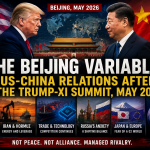 The Beijing Variable: A Geopolitical Analysis of US-China Relations After the Trump-Xi Summit, May 2026
Leave a Reply