
Bottom Line Up Front
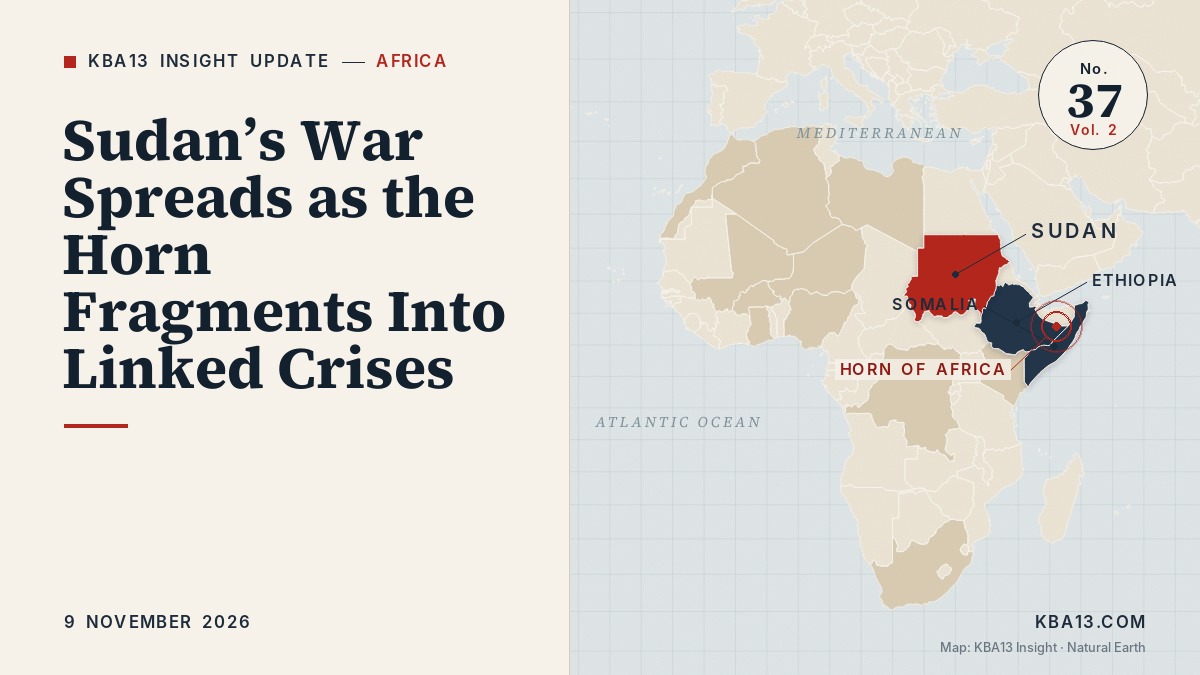
Africa’s week of 2 to 9 November 2026 confirmed that the continent’s most dangerous conflicts no longer run on separate tracks. Sudan’s war, Ethiopia’s renewed civil war, Somalia’s constitutional rupture and the contest for the Red Sea coast now feed one another through shared borders, refugee flows, fighters who cross from one war to the next, and foreign patrons who back rival sides in several theatres at once. In Sudan the army pressed its Kordofan offensive and downed what it said was its fourth drone in a week, while the Rapid Support Forces (RSF) opened a pressure front in Blue Nile on the Ethiopian border. In Ethiopia, federal forces fought Tigrayan, Amhara and possibly Eritrean units in the north while massacres of Orthodox Christians continued in Oromia’s Arsi zone and a Somali-Oromo war over Moyale drove tens of thousands into Kenya. In Somalia the Supreme Court declared the president’s mandate expired, the executive rejected the ruling and deployed troops around the court, all as Uganda began withdrawing the force that has anchored the anti-al-Shabaab effort since 2007. Our central judgement is that the Horn and the Nile Valley are entering a phase of linked state weakness in which no single mediation track can contain escalation (high confidence).
Beyond the Horn, the week brought two political shocks with structural consequences. South Africa’s African National Congress (ANC) fell to about 30.8 per cent in the 4 November municipal elections, its worst result since 1994, just two days after Washington announced that South Africa and Rwanda would lose duty-free access under the African Growth and Opportunity Act (AGOA) from 1 January 2027. Together these events weaken the continent’s most important economic democracy at home and abroad (high confidence). In Nigeria, 30 state legislatures have endorsed a constitutional path to state police as bandit massacres and pre-2027 campaign violence intensify. In North Africa, Egypt reopened its Tripoli embassy after twelve years, and reports that the United Nations mission in Western Sahara is ending signal a shift in the Maghreb’s security balance. The overall direction is toward more fragmentation, more external involvement and less multilateral capacity, as peacekeeping budgets, US aid and trade preferences are all withdrawn simultaneously (moderate confidence).
The Week Through the Monitor
The Africa Intelligence Monitor collected 3,000 items from 747 distinct sources in its 72-hour window from 6 November at 14:04 WIB to 9 November at 14:04 WIB, with the last collection at 12:39 WIB. Country tagging was dominated by Nigeria (908 items), South Africa (474), Kenya (355) and Ghana (318), followed by Sudan (190), Morocco (188), Ethiopia (182), Somalia (149), Libya (147), the Democratic Republic of Congo (79), Algeria (69), Burkina Faso (59), Mali (48) and Niger (28). Of the themed items, politics led with 405, followed by security (344), economy (315), disaster (70) and maritime (48). Volume peaked on 8 November with 1,503 items, against 767 and 730 on the partial days either side, driven largely by the South African results announcement and the Sudanese arrest of Ahmed Haroun. The raw country counts mislead in two ways. Nigeria’s and Ghana’s totals are inflated by sheer media density and football coverage, and some 37 Ethiopian items concerned the deportation of an Indian gangster from Addis Ababa, a story of no strategic consequence.
A sharper picture appears when the security theme is read by country. Nigeria still leads with 100 security items, but Sudan (66) and Ethiopia (53) follow closely, well ahead of Somalia (34), Kenya (28) and the DRC (18). Relative to total coverage, Sudan and Ethiopia are the most security-saturated countries in the dataset: roughly a third of all Sudanese items and nearly three in ten Ethiopian items carried a security tag, compared with about one in nine for Nigeria. Libya registered the second-highest maritime count (9) after Nigeria (12), reflecting the Egyptian-Turkish dispute over Libyan sea boundaries, while Somalia’s seven maritime items centred on Red Sea governance and piracy. Keyword clusters confirm the week’s stories: the ANC appeared in 202 headlines, Tripoli in 37, Ebola in 26, Haroun in 22, Moyale in 21 and Somalia’s Supreme Court in 13. The monitor’s GDELT media-tone readings were negative for Kenya (minus 1.54) and Ethiopia (minus 1.07), and mildly positive for South Africa (plus 0.78) despite the ANC’s losses, which suggests that South African coverage treated the result as a democratic transition rather than a crisis.
Market data in the monitor added a warning signal. The Sudanese pound was recorded at about 459 per US dollar with a day-on-day move of more than 10 per cent, by far the largest of any African currency tracked; given the multiple exchange rates prevailing in Sudan, this may partly reflect a source revision, but it is consistent with reporting that soldiers control a parallel fuel market in Wad Madani amid soaring prices (low confidence on the precise magnitude). The Congolese franc moved almost 2 per cent, while the Nigerian naira (about 1,346), the Kenyan shilling (about 130) and the South African rand (about 16.53) were stable. The rand’s resilience after the ANC result, noted by FXLeaders, indicates that investors had priced in coalition politics. The USGS feed recorded three moderate earthquakes, none in populated African areas, and GDACS alerts were limited to seasonal savannah fires across the Sahel and southern Africa.
Sudan: The Kordofan Offensive, the Blue Nile Front and the Haroun Affair
Sudan’s war entered its fourth winter with the army on the offensive in the centre and the RSF probing the periphery. The army reported that it had downed its fourth drone in a week while advancing against the RSF in West Kordofan, according to Anadolu Agency, after Sudan Tribune reported that the army and allied forces had taken ground and brought down a third drone a day earlier, and Middle East Monitor described the capture of a key area in the state. These gains extend an offensive that, as Al Jazeera reported in early October, aimed to connect army-held North Kordofan to West Kordofan, an RSF stronghold, after the RSF’s capture of El Fasher in October 2025 had left the paramilitary in control of almost all of Darfur. The pattern of drone interceptions is significant in itself: it shows that both sides are now fighting a war of standoff weapons in which control of the air, supplied by foreign patrons, matters as much as control of roads. Our judgement is that the army can make incremental gains in Kordofan but lacks the capacity to retake Darfur before the rainy season of 2027 (moderate confidence).
The RSF’s response has been to shift pressure to the southeast. Asharq Al-Awsat reported RSF claims of new gains in Blue Nile, including the capture of Makja, while the army’s 4th Infantry Division said it held Bakori and Sali and repelled attacks. Radio Tamazuj described growing fear in Ed Damazin, the state capital, as clashes intensified, and Sudan Tribune reported that the army had replaced the 4th Division’s commander, a change that suggests dissatisfaction with the defence of the state. Blue Nile matters disproportionately because it borders Ethiopia’s Benishangul-Gumuz region. In August, Radio Dabanga cited a Sudanese military analyst alleging that RSF logistics were arriving through Assosa in Ethiopia, a claim that remains unconfirmed. The Blue Nile front therefore links Sudan’s war directly to Ethiopia’s, and it gives Addis Ababa and Cairo opposing stakes in the outcome (moderate confidence).
The most politically revealing event was the army’s detention of Ahmed Haroun, chairman of the former ruling National Congress Party and a fugitive wanted by the International Criminal Court for crimes in Darfur. Reuters, via Daily Nation, reported the detention citing two party officials, AP quoted his lawyers, and Sudan Tribune reported that the arrest followed a podcast appearance. Haroun had walked free from prison in Khartoum in the chaos of April 2023, as Egypt Independent reported at the time, and his re-detention shows that the army leadership under General Abdel Fattah al-Burhan is attempting to discipline the Islamist networks that have provided fighters and political cover for its war effort. We assess that the arrest is primarily a signal to Western and Gulf partners that the army is not captive to the Islamists, and secondarily a move to contain an Islamist current that wants a political return after the war (moderate confidence). It is unlikely to lead to a transfer to The Hague, since Port Sudan has shown no willingness to surrender suspects to the ICC (high confidence). The timing coincided with new external pressure: Radio Dabanga reported that Australia had sanctioned both al-Burhan and RSF commander Mohamed Hamdan Dagalo (Hemedti) over the war and human rights abuses.
Port Sudan is also diversifying its foreign backers. Radio Pakistan reported on 6 November that Pakistan and Sudan had agreed to enhance cooperation in security and counter-terrorism, and Arab News Pakistan added cybercrime and police training to the package, while Pakistan Today reported a visa-free travel agreement. EU Today framed the visit as bringing Pakistani support for al-Burhan back to the fore. Because Pakistan is simultaneously close to Saudi Arabia, which backs the Sudanese army and is at war with the Houthis, and to Türkiye, whose drones the Sudanese army reportedly operates, the Islamabad channel fits a broader Saudi, Egyptian and Turkish alignment behind the army. Egypt’s own border is a further friction point: Asharq Al-Awsat described the security risks of illegal gold mining along the Egypt-Sudan frontier, and The Arab Weekly reported that an Egyptian crackdown there left two officers dead.
The humanitarian situation continues to deteriorate beyond the reach of diplomacy. The International Organization for Migration reported that more than 2,500 people fled five villages in North Darfur in a single episode, according to Bernama, and The Bubble warned of looming famine. In May, the IPC hunger monitor estimated that about 19.5 million Sudanese faced acute hunger and that 14 areas were at risk of famine, as summarised by Al Jazeera. The UN peacekeeping chief’s warning that deadly drone strikes in Abyei constitute a “new and concerning” threat shows that the war’s technology is now spilling into the disputed Sudan-South Sudan border zone. Reporting by Indonesian outlets citing the IMF that Sudan now has the world’s highest government debt ratio underlines how little fiscal room any post-war authority will have. We judge that without a ceasefire in Kordofan by early 2027, famine conditions will spread from Darfur to parts of Kordofan and Blue Nile (moderate confidence).
Ethiopia and the Eritrean Shadow: A State at War on Three Fronts
Ethiopia is again a country at war with itself, and the week showed the conflict widening rather than resolving. According to ACLED, fighting between Tigrayan and federal forces resumed on 1 August 2026 after the Tigray People’s Liberation Front (TPLF) reinstated its pre-2020 regional government, and on 23 September Tigrayan forces seized the airports of Mekelle, Aksum and Shire in a single day, while a seven-member opposition alliance including Amhara Fano militias emerged against Prime Minister Abiy Ahmed. Federal forces have since regained ground: the Critical Threats Project reported the capture of Shire on 8 October and the appointment on 16 October of a caretaker regional council. Its 3 November review recorded fighting near Bizet, west of Adigrat, and around Sheraro, as well as unverified claims of clashes between Ethiopian and Eritrean forces south of Tserona. Reports of a drone strike that killed 12 civilians collecting grain in Tigray indicate that the federal air campaign is imposing a growing civilian cost.
The Amhara front has become as dangerous as the Tigrayan one. The same Critical Threats review recorded repeated clashes between the Amhara Fano National Movement and the army around Ambassel, Werebabo and Wuchale between 30 October and 2 November, cutting sections of the A2 highway between Dessie and Woldia, the artery linking Addis Ababa to the north; it also noted a joint video statement on 31 October in which Fano leader Zemene Kassie and TPLF chairman Debretsion Gebremichael reaffirmed their aim of overthrowing the federal government. Eritrea is the shadow behind this coalition. In October, Abiy accused Asmara of backing rebel groups and threatened “extremely severe consequences”, while Eritrea’s UN envoy accused Addis Ababa of seeking to annex Eritrean territory on the Red Sea, according to the Critical Threats Project. This week, Shabelle Media reported an Ethiopian ambassador accusing Eritrea of violating Ethiopian sovereignty. We judge that a direct interstate war between Ethiopia and Eritrea in the next three months is possible but not yet the most likely outcome, because both governments currently prefer proxy pressure (moderate confidence).
In the south, communal and insurgent violence is eroding state authority. The Ethiopian Orthodox Church said that at least 60 faithful were killed in an overnight attack in Shirka district of Arsi in late October, which authorities attributed to a rebel coalition, as reported by Vatican News. This week, DNE Africa reported at least 35 Christians killed in a further attack in Arsi, and later described a third massacre in three weeks with more than 50 Orthodox Christians dead, a toll we could not independently verify. Borkena reported more than 52 killed in an attack in Benishangul-Gumuz, also unverified. At Moyale on the Kenyan border, forces of the Somali and Oromia regional states have fought since 18 October over a town both administer; Africanews reported that local authorities estimate about 50,000 people crossed into Kenya and that UNHCR counted at least 11,000 displaced in temporary sites. Britain advised against non-essential travel to the area, according to Hiiraan Online, and the UN allocated Sh387 million for Ethiopian refugees at Moyale, according to the Daily Nation.
Ethiopia’s external posture compounds its internal fragility. On 2 November Egypt and Sudan held a “2+2” consultation reaffirming their claims under the 1959 Nile Waters Agreement, which Ethiopia never signed, according to the Critical Threats Project, and Ahram Online reported that the two states will form a joint committee to assess damages from the Grand Ethiopian Renaissance Dam and seek compensation. Ethiopia’s water minister replied that Egypt’s “conspiracy” over the Abay River and the Red Sea was “no longer workable”, according to ENA, while Kulu Media reported that Addis Ababa has linked Nile negotiations to Egyptian acceptance of Ethiopian sea access. Reports that Tigrayan fighters and other Ethiopians have been recruited into Sudan’s war, and analysis of rising Sudan-Ethiopia tensions, point to a regional war system in which each government hosts the other’s enemies. A US statement reaffirming support for Ethiopian stability suggests that Washington still sees Abiy as the least bad option. Our judgement is that Ethiopia’s simultaneous insistence on Red Sea access and its domestic military overstretch make it the single most likely trigger of a wider regional war in 2027 (moderate confidence).
Somalia: Constitutional Rupture During a Security Handover
Somalia’s political crisis turned into a direct confrontation between the executive and the judiciary. On 5 November, five judges of the Supreme Court’s constitutional division ruled that the mandates of parliament and the federal government had expired on 14 April 2026 and the president’s on 15 May 2026, reduced the government to caretaker status and ordered the parties to agree an electoral model within 30 days and hold elections within 90 days, according to Dawan Africa. The day before, President Hassan Sheikh Mohamud had announced the dismissal of Chief Justice Bashe Yusuf Ahmed, as Arab News reported, and the Attorney General’s office declared on 6 November that the ruling had “no legal effect”. Hiiraan Online then reported that troops had deployed around the court and that the chief justice had been ordered to leave, and he later said he felt unsafe in Mogadishu. The executive’s argument rests on constitutional amendments passed in March, which most of the opposition boycotted, and which would allow nationwide elections in April and May 2027, according to Arab News.
The ruling has given the opposition a legal basis to contest the government’s legitimacy, and the street has already turned violent. Hiiraan Online reported that security forces killed three protesters in Mogadishu, in unrest that Horseed Media linked to home demolitions, and a former prime minister condemned the killings as clan tensions mounted in the central regions. In Hiiraan, local leaders warned of consequences if federal troops attacked the region, after the president offered the HirShabelle state capital to Hiiraan in an effort to defuse the dispute. Former Prime Minister Hassan Ali Khaire accused the government of removing 10,000 soldiers from the payroll, an allegation that, if true, would suggest a politicised purge within the army. Our judgement is that the federal government will refuse to implement the 90-day timetable and that the dispute will be settled, if at all, through an elite bargain mediated by external partners rather than through the courts (high confidence). The principal risk is that rival security units align with competing political factions in Mogadishu, as occurred in April 2021 (moderate confidence).
The crisis comes at the worst possible moment for the security transition. Uganda’s army chief announced on 29 October that the withdrawal of Ugandan forces had begun, citing financial constraints on the African Union Support and Stabilization Mission in Somalia (AUSSOM), the United States’ July notice that it would not support renewal of the mission’s UN mandate in December, and a 25 per cent cut by the UN support office, according to Daily Monitor. About 4,500 Ugandan troops serve with AUSSOM and 2,000 more under bilateral arrangements, and all are expected to leave by the end of 2027, according to The Defense Post. The African Union and European Union warned at their 17th consultative meeting that funding shortfalls could undermine security gains, and Washington told Somalia’s defence minister that its financial contribution to the mission would end in December, according to AllAfrica. Somalia’s deputy police chief warned of a security vacuum, and Garowe Online reported fears that al-Shabaab would occupy positions vacated by Ugandan troops. An ambush near Leego, reported by Garowe Online, and reports that bodies of Somali soldiers were left unburied ten days after an al-Shabaab clash illustrate how thin the national army remains.
The intelligence picture is equally worrying. Somali Guardian reported that a senior commander of the National Intelligence and Security Agency (NISA) defected to al-Shabaab, raising fears of a compromise of informant networks and operational plans. Somali officials also warned that the Houthis are training al-Shabaab members to use drones, a claim we treat as unverified but plausible given that US Africa Command said in October that the Houthis were seeking to extend their reach into Somalia and might provide drone expertise to al-Shabaab, as reported by Stars and Stripes. The same report noted that the Pentagon is moving MQ-9 drones out of Somalia, reducing surveillance just as the threat increases. Türkiye is filling part of the gap: FTL Somalia reported that another Gorgor brigade completed training in Türkiye. Our judgement is that al-Shabaab will exploit the combination of the Ugandan drawdown, the NISA defection and Mogadishu’s political paralysis to mount high-profile attacks in the capital region before the AUSSOM mandate expires (high confidence).
The Northern Arc: Red Sea Littoral, Egypt’s Libyan Return and the Post-MINURSO Maghreb
The Red Sea is being reorganised by coastal states determined to exclude outsiders, above all Ethiopia. Egypt, Somalia and Djibouti met to reaffirm the “exclusive role” of Red Sea states in securing the waterway, according to Hiiraan Online, following Egyptian Foreign Minister Badr Abdelatty’s statement on 15 October that Egypt “will not accept military access to the Red Sea” by non-littoral countries, as Egyptian Streets reported. Cairo is coordinating with Riyadh to activate an initiative built on the eight-member Council of Arab and African States Bordering the Red Sea and the Gulf of Aden, which excludes Ethiopia. Against this, Türkiye is building its own position in Somalia, including a spaceport that Nordic Monitor linked to long-range missile ambitions, a claim from a source critical of Ankara that we could not verify. Israel’s reported presentation of ambassadorial credentials in Somaliland, noted by Goa Chronicle, would add another external actor to the Gulf of Aden if confirmed. Meanwhile the Indian Navy freed the fishing vessel Azini from armed pirates off Somalia, and the EU announced support to strengthen Kenya’s maritime security. Our judgement is that the Red Sea’s governance is shifting from a Western-led maritime security model toward rival regional blocs, Egyptian-Saudi on one side and Ethiopian-Emirati on the other, with Türkiye straddling both (moderate confidence).
This regional realignment is tied to the Saudi-Houthi war that has been under way since July 2026 and to the broader confrontation with Iran. Sudan’s army, backed by Riyadh and Cairo, controls the Sudanese coast at Port Sudan, which makes Sudan a strategic component of the Saudi effort to deny the Houthis a western flank. Reports of Houthi links with al-Shabaab, and Somalia’s appeals for help, explain why Egypt is deepening its military role in Somalia, a partnership that FTL Somalia characterised as one of shared interests and shared risks. The economic cost of the Iran war is reaching East Africa directly: Business Daily reported that Kenya-Iran trade fell by 58 per cent as war risks deepened. For Southeast Asia, and Indonesia in particular, the implication is that the Bab el-Mandeb route linking Asian exporters to Europe and to East African markets will remain exposed to Houthi, pirate and al-Shabaab risk well into 2027, keeping freight and insurance costs high; Jakarta, as a major Muslim-majority state with growing trade links to Egypt, Kenya and South Africa, has an interest in supporting Red Sea de-escalation through the Organisation of Islamic Cooperation and in protecting Indonesian crews on vessels transiting the Gulf of Aden (moderate confidence).
Egypt’s other strategic move this week was its return to western Libya. Abdelatty reopened Egypt’s embassy in Tripoli after a twelve-year closure, according to Arab News, and used the visit to raise concerns about the maritime memorandum between Türkiye and the Tripoli government, while the Libya Observer reported that the two states will discuss their own maritime boundary. Reuters, as carried by Asharq Al-Awsat, reported that Cairo is seeking faster progress on Libyan gas, refining and power projects, reflecting what The Arab Weekly described as a gas supply squeeze. The move signals that Cairo, long the principal backer of Khalifa Haftar’s eastern authorities, now wants a working relationship with Tripoli to secure energy, migrant labour and leverage against Ankara. Libya’s own fragility persists: the Libya Herald reported that inflation reached 16 per cent in September, and the Central Bank completed a governor handover. We judge that Egypt’s re-engagement in Tripoli reduces the risk of a new east-west war in Libya in the short term, but it intensifies Egyptian-Turkish competition over eastern Mediterranean maritime boundaries (moderate confidence).
In the Maghreb, reports that the UN Mission for the Referendum in Western Sahara (MINURSO) is coming to an end after 35 years would mark the most consequential change in the conflict since 1991. ThisDay reported that Morocco welcomed the end of the mission, and a former MINURSO chief publicly backed closure and Morocco’s autonomy plan; we were unable to verify the precise UN decision and timetable, and readers should treat the closure as reported rather than confirmed. Yabiladi analysed the new security equation between Morocco and Algeria that would follow, and Algerian media continued to publicise seizures of cannabis smuggled from Morocco. Morocco is consolidating its southern flank through military cooperation with Mauritania, while Hespress reported that Spain is seeking secret intelligence files on Moroccan warnings before the Ceuta migration crisis. Our judgement is that the end of the UN presence, if confirmed, raises the medium-term risk of incidents along the berm between Moroccan forces and the Polisario Front, and that Algeria will respond diplomatically rather than militarily in the near term (moderate confidence).
South Sudan, the Great Lakes and Kenya’s Exposed Flank
South Sudan is approaching elections scheduled for December in a state of rising insecurity. Clashes killed 23 people, according to Al Arabiya and Yeni Safak, and Eye Radio reported that security fears and movement restrictions threaten political participation. The African Union nevertheless backed the election roadmap, while Ugandan President Yoweri Museveni urged inclusive dialogue. Drone strikes in Abyei, the oil-rich territory contested with Sudan, show that the Sudanese war can now reach South Sudan’s border regions directly. Our judgement is that the December vote will be postponed or held only in part, and that any vote held will entrench the incumbent rather than resolve the country’s political divisions (moderate confidence). A more immediate danger is that Sudanese factions recruit South Sudanese fighters, or that the war cuts the oil pipeline to Port Sudan on which Juba’s revenues depend.
In the eastern Democratic Republic of Congo, the convergence of war and epidemic continues. Africa CDC condemned an attack on 5 November in Cantine-Aloya in North Kivu, attributed to the Allied Democratic Forces (ADF), in which health facilities were attacked and patients, including hundreds of confirmed or suspected Ebola cases, fled; the agency warned that the disruption undermines contact tracing and surveillance. Modern Ghana reported dozens dead in the attack. The outbreak, of the Bundibugyo strain, was declared on 15 May 2026, as bdnews24 reported in June. In Kinshasa, a military court sentenced 66 soldiers to death, according to Anadolu Agency, a sign that the Tshisekedi government is still attempting to enforce discipline through exemplary punishment after successive battlefield collapses against M23. Scrolla.Africa reported accusations that former President Joseph Kabila betrayed South Africa through links to Congolese rebels. We judge that the ADF’s targeting of health facilities, combined with AFC/M23’s continued control of Goma and Bukavu, seized in early 2025 as the Brussels Times recalled, makes cross-border Ebola transmission into Uganda and Rwanda a significant risk over the next three months (moderate confidence).
Kenya sits at the intersection of these crises. It is absorbing refugees from Moyale, its northern counties are protesting insecurity, with Turkana residents blocking the Kitale-Lodwar highway over insecurity and police brutality, and al-Shabaab has reportedly named Christians in Kenya as targets. The Daily Nation reported that a Sh3.6 billion drug haul in Kwale exposed Kenyan links to global trafficking networks, consistent with the Indian Ocean heroin and cocaine routes that run from the Makran coast to East Africa. Politically, the country is entering the 2027 campaign: President William Ruto warned voters against electing the opposition, the police chief warned officers against taking political sides, and the World Bank called for strong political leadership against rising corruption. Kenya also reported 2.6 billion cyber threat events in three months. Our judgement is that Kenya will remain stable but increasingly stretched, and that the combination of refugee pressure, al-Shabaab threats and election politics will push Nairobi to seek greater Western and Gulf security assistance (moderate confidence).
Nigeria and the Sahel: State Police, Election Violence and the Jihadist Frontier
Nigeria’s security debate reached a constitutional turning point. According to a Premium Times editorial, 30 state Houses of Assembly have approved the creation of state police, exceeding the 24 needed, which paves the way for the National Assembly to amend Section 214 of the 1999 Constitution; the amendment has not yet been enacted. RFI captured the dilemma: state police raise hopes of better local security but also fears of abuse by governors. The violence that drives the reform did not abate. The Defence Headquarters reported that troops killed more than 55 militants, arrested 60 and rescued 33 kidnap victims between 30 October and 5 November, losing one officer and one soldier, according to Leadership via AllAfrica. In Zamfara, bandits burned members of a single family to death in their home; AllAfrica gave the toll as eleven and a local official quoted by AFP via Macau Business as twelve. A national risk assessment reported by The Guardian Nigeria warned that 31 states and the Federal Capital Territory face elevated security risks.
The 2027 elections are already shaping the security environment. Premium Times reported a death at a rally in Asaba, and a lawyer warned in Sahara Reporters that the 2027 elections may be Nigeria’s bloodiest. Opposition leader Peter Obi said Nigerians are among the most terrorised and poverty-stricken people in the world, according to The Guardian Nigeria. The Air Force redeployed 67 senior officers, and the Navy reported that it had destroyed 168 illegal refineries and arrested 259 suspects over the past year. A security briefing heard that South Africans are entering Nigeria to help cartels traffic drugs, according to Daily Maverick. Our judgement is that the state police reform, if completed before the 2027 vote, will be used by some governors to build politically loyal forces, increasing the risk of localised electoral violence even as it improves response capacity in some states (moderate confidence).
Across the Sahel, the jihadist frontier is moving south toward the coastal states. RANE analysed how the Sahel’s demographic surge is feeding jihadist recruitment, and Niger’s military was reported to be mobilising for a large-scale operation against armed groups. President Bola Tinubu sent condolences to Niger’s military leader, General Abdourahamane Tiani, a small gesture of continued engagement with the junta despite Niger’s withdrawal from ECOWAS. Leadership argued that the Multinational Joint Task Force against Boko Haram now operates without diplomatic cover after the Sahelian juntas’ exit. On Ghana’s northern border, the Ghana Immigration Service led peace talks in Hamile after a deadly border clash, and Guinea arrested more than 1,200 people over illegal gold mining while Burkina Faso announced the return of over 8,000 artisanal miners from Guinea. Illegal gold mining is the economic glue that links the Sahelian insurgencies to the coastal states, and we judge that the next phase of jihadist expansion will follow the gold and cattle corridors into northern Ghana, Togo and Benin (moderate confidence).
South Africa: The ANC’s Collapse and the AGOA Shock
South Africa’s 4 November municipal elections ended the era of ANC dominance at local level. The ANC received 30.76 per cent of the vote according to official results reported by TradingView, down from about 46 per cent in the 2021 local elections and just over 40 per cent in the 2024 national poll, as Africanews noted. With 80 per cent of votes counted, the Democratic Alliance (DA) had just over 24 per cent and uMkhonto weSizwe (MK) just over 9 per cent, and turnout was estimated at 54.5 per cent, up from 46 per cent in 2021, according to the same report. Briefly News reported that 69 of the first 100 decided councils were hung, with the DA leading on partial counts in Johannesburg, Tshwane and Ekurhuleni and MK leading in eThekwini. The Electoral Commission declared the elections free and fair, but the ANC condemned more than 20 political killings during the campaign period, a reminder that local power in South Africa is lethally contested.
The result reshapes South African politics before the 2029 general election. Reuters reported that the ANC faces tough coalition talks, and newsday reported discussions between the ANC and ActionSA. MK’s Duduzane Zuma said the party would not rescue parties rejected by voters. A Nova News report that President Cyril Ramaphosa was weighing resignation is unverified, and we assess it as unlikely in the near term (moderate confidence). The more probable outcome is that the ANC’s internal succession struggle accelerates ahead of its 2027 elective conference, with challengers blaming the Government of National Unity for the losses. We judge that the DA has been the principal beneficiary of the GNU, and that the ANC will be tempted to distance itself from the coalition before 2029, increasing policy volatility (moderate confidence).
The external shock compounds the domestic one. On 2 November, US Trade Representative Jamieson Greer announced that South Africa and Rwanda would lose AGOA benefits from 1 January 2027, citing trade barriers, corruption and threats to US national security and foreign policy interests, according to Al Jazeera. The same report noted that South Africa exported about 1.7 billion US dollars to the US under AGOA in 2025, roughly 10 per cent of its exports to the US, mainly vehicles, agricultural products and wine, while EWN linked the move to disputes over land reform, Black economic empowerment and South Africa’s genocide case against Israel. Business Insider Africa reported that the car industry is bracing for job and export losses in 2027, while the Sunday World argued that China’s zero-tariff offer outweighs the US blow. We judge that Pretoria will accelerate trade diversification toward China, the EU and the Gulf, and that the AGOA decision will push South Africa further toward the BRICS camp in foreign policy (high confidence).
Outlook: Scenarios to February 2027
For the Horn and the Nile Valley, we consider three scenarios over the next three months. The most likely, at about 55 per cent, is a grinding escalation in which Sudan’s army makes limited gains in Kordofan, Ethiopia’s federal forces hold Tigray’s towns but lose control of roads in Amhara, and Somalia’s political crisis deepens without collapsing into open warfare in Mogadishu. A second scenario, at about 30 per cent, is a regional rupture in which a significant event, such as an Ethiopian-Eritrean border battle, a major al-Shabaab attack on Mogadishu after the Ugandan drawdown, or the fall of Ed Damazin, triggers wider regional intervention. The least likely scenario, at about 15 per cent, is a negotiated de-escalation in which Gulf and US pressure produces a humanitarian truce in Sudan and a Somali electoral compromise. Our confidence in these estimates is moderate, given the scarcity of independent battlefield verification.
For the rest of the continent, the main trends are clearer. In South Africa, coalition formation will dominate the next two months, with the probability of a stable ANC-DA arrangement in the major metros at about 40 per cent and of fragmented multi-party coalitions at about 60 per cent (moderate confidence). In Nigeria, we estimate a 60 per cent probability that the National Assembly passes the Section 214 amendment before the end of the first quarter of 2027, with implementation unlikely before the elections (low confidence). In North Africa, Egyptian-Libyan energy cooperation is likely to advance, at about 70 per cent, while Egyptian-Turkish maritime competition will intensify. Across the continent, the withdrawal of multilateral and US support, through the end of AUSSOM funding, the AGOA suspensions and cuts to humanitarian aid noted by The Atlantic, will expand the room for Gulf, Turkish, Chinese and Russian actors (high confidence).
Signals to Watch
In the coming fortnight, the critical indicators in the Horn are the Somali federal government’s response to the 30-day deadline for an electoral agreement, which falls in early December; any movement of army units in Mogadishu that suggests factional alignment; al-Shabaab activity around bases vacated by Ugandan forces; and the UN Security Council debate on the AUSSOM mandate in December. In Ethiopia, watch the A2 highway between Dessie and Woldia, any confirmed Ethiopian-Eritrean clashes near Tserona or Zalambessa, the next Arsi casualty reports, and the refugee count at Moyale. In Sudan, the indicators are the fate of Ed Damazin and the army’s 4th Division, the frequency of drone interceptions in Kordofan, Ahmed Haroun’s treatment in detention, and the Sudanese pound’s parallel exchange rate.
Beyond the Horn, watch South Africa’s coalition announcements in Johannesburg, Tshwane, Ekurhuleni and eThekwini, any ANC leadership challenge, and US-South African talks on AGOA before 1 January. In Nigeria, monitor the National Assembly’s handling of the state police amendment and the number of campaign-related killings. In North Africa, watch the UN’s formal handling of MINURSO, Egyptian-Turkish exchanges on Libyan maritime boundaries, and Egyptian security operations on the Sudanese border. In the eastern DRC, track Ebola case counts in North Kivu and ADF attacks on health facilities. For Southeast Asia, the key indicator is the security of shipping through the Bab el-Mandeb and the Gulf of Aden, including incidents involving Houthi drones, Somali pirates and al-Shabaab maritime activity.
Method and Sources
This edition covers developments from 2 to 9 November 2026. It draws on the 72-hour collection of the KBA13 Africa Intelligence Monitor, which gathered 3,000 items from 747 sources between 6 November 14:04 WIB and 9 November 14:04 WIB, as part of the regional monitor network merged in the Global Intelligence Monitor. Country and theme tags are generated by keyword rules and are indicative rather than analytical; we discounted sports, entertainment and duplicate items and noted where single stories inflated country counts. Market data were collected by the monitor from ExchangeRate-API, seismic data from the USGS, disaster alerts from GDACS and media-tone data from GDELT. To cover the full week and verify figures, the monitor material was supplemented by open-source reporting from news agencies, regional outlets and conflict trackers, including ACLED and the Critical Threats Project.
Several claims in this report are labelled as unverified because they rest on a single source, partisan media or social media: the RSF’s territorial claims in Blue Nile, Ethiopian-Eritrean ground clashes, the casualty figures for the latest Arsi and Benishangul-Gumuz attacks, the recruitment of Tigrayan fighters into Sudan’s war, Houthi training of al-Shabaab, the military dimension of Türkiye’s Somali spaceport, Israel’s ambassador in Somaliland, the end of MINURSO, and reports of Ramaphosa’s possible resignation. Analytic judgements carry confidence levels, high, moderate or low, reflecting the quality and consistency of sources, and scenario probabilities are the Research Team’s estimates rather than statistical forecasts. This report was prepared by the KBA13 Insight Research Team.
About The Author

- Series · Seri
- KBA13 Insight Update, Africa Edition
- Volume · Number
- Vol. 2, No. 37 (November 2026)
- Cumulative issue · Edisi ke-
- 49
- Reference · Nomor rujukan
KBA13-IU-2026-02-037- Author · Penulis
- KBA13 Insight Research Team
- Published · Terbit
- 9 November 2026
- Section · Rubrik
- KBA13 Insight Update, KBA13 Insight Update International
- Keywords · Kata kunci
- Africa, AGOA, Ethiopia, Horn of Africa, Libya, Nigeria, Red Sea, Sahel, Somalia, South Africa
- Language · Bahasa
- English
- Length · Panjang
- 6,020 words · ±27 min read
- Publisher · Penerbit
- KBA13 Insight, Banda Aceh, Indonesia
- Permalink
- www.kba13.com/kba13-insight-update-2026-11-09-africa/
- How to cite · Cara mengutip
- KBA13 Insight Research Team. (2026, November 9). KBA13 Insight Update, 9 November 2026, Africa: Sudan’s War Spreads as the Horn Fragments Into Linked Crises. KBA13 Insight Update, 2(37). https://www.kba13.com/kba13-insight-update-2026-11-09-africa/
- Rights · Hak cipta
- © 2026 KBA13 Insight. Quotation permitted with full attribution and link.
Artikel Terkait
 Global Intelligence Briefing (7–12 July 2026): Iran War, US–China Rivalry, Ukraine, South China Sea, and Global Security Risks
 KBA13 Insight Update, 9 November 2026, Global: A World Between Hormuz, Kyiv and the Summit Season
 KBA13 Insight Update, 9 November 2026, South Asia and Indian Ocean: Internal Security Becomes South Asia’s Primary Instrument of Statecraft
 KBA13 Insight Update, 9 November 2026, Middle East: After the Midterms, Coercive Bargaining Replaces War as Peripheral Fronts Burn
 KBA13 Insight Update, 9 November 2026, Central Asia: Security Diplomacy Expands as Russian Oil Routes and Iranian Gas Corridors Falter
Leave a Reply