
Bottom Line Up Front
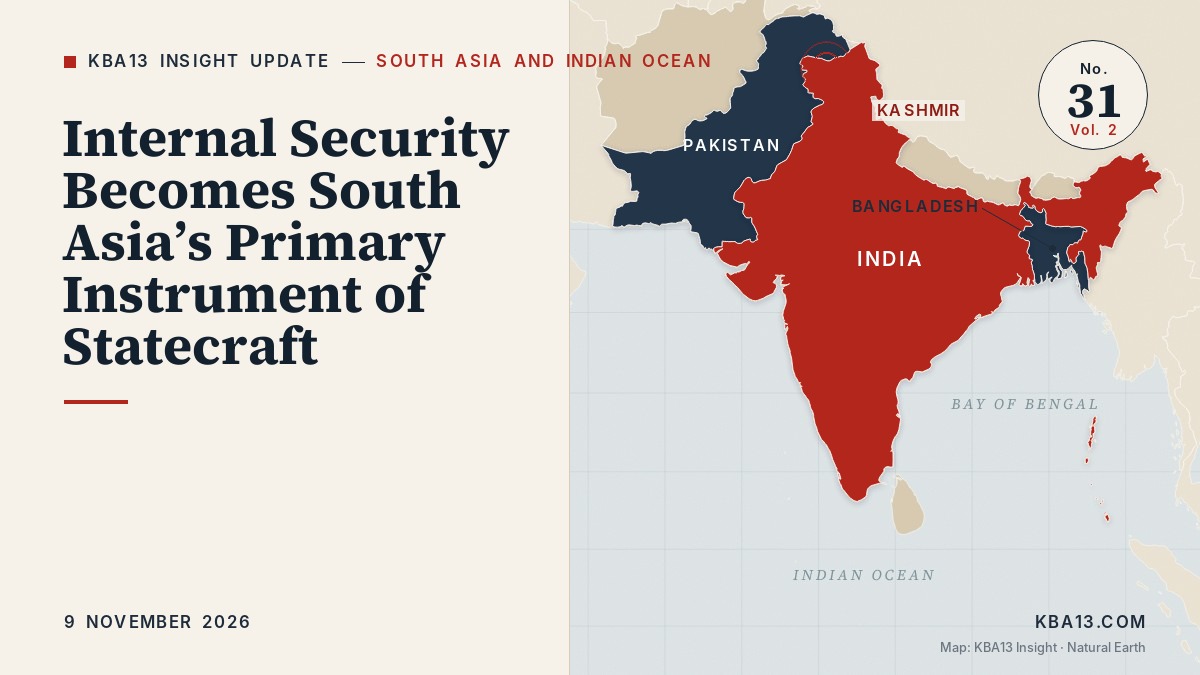
South Asia closed the first week of November 2026 with its governments speaking the language of security more fluently than the language of politics. In India, Prime Minister Narendra Modi used a Diwali visit to Bastar on 8 November to declare the armed Maoist insurgency defeated while warning of “dimagi Naxals”, a new category of intellectual enemy (The Indian Express). In Pakistan, the federal centre now governs Khyber Pakhtunkhwa under governor’s rule and is building a Rs70 billion counter-terrorism apparatus with faceless courts (Dawn), while security forces were accused of killing protesters in Rawalakot in Pakistan-administered Kashmir (ThePrint). In Bangladesh, the exiled former prime minister Sheikh Hasina applied for a new passport in what Reuters called the clearest sign yet of a planned return (Reuters), and the BNP government answered with an extradition demand. Nepal’s reformist government removed its police chief, and Sri Lanka moved to buy Israeli surveillance drones for its exclusive economic zone. Across the Indian Ocean, the Iran war continues to set the terms of trade: Tehran’s selective Hormuz exemptions favour India but not Pakistan, and Somali piracy has returned. Our central judgement is that internal security has become the primary instrument of statecraft across the region, and that this concentration of coercive capacity is outpacing the political institutions meant to restrain it (moderate confidence).
The week’s most consequential near-term risk is not interstate war between the two nuclear-armed rivals, which remains unlikely in the coming month, but a convergence of three slower pressures: the hardening of Pakistan’s two-front confrontation with the Afghan Taliban and its own periphery, a contested Hasina return that could reopen Bangladesh’s street politics before the January local polls, and energy-driven fiscal stress in import-dependent economies from Colombo to Dhaka. India is the relative beneficiary of the Gulf disorder, gaining Iranian transit privileges and record foreign portfolio inflows, yet its domestic security rhetoric is broadening in ways that will sharpen frictions in Kashmir, West Bengal and the Northeast. We assess with moderate confidence that the region will see no single decisive rupture before the end of November, but a steady accumulation of grievances, coercive responses and diplomatic repositioning that raises the cost of any shock arriving from the Gulf or from a contested domestic event.
The Week Through the Monitor
The South Asia and Indian Ocean Monitor held 3,000 items from 618 distinct sources at the time of collection on 9 November 2026 at 14:00 WIB, within a nominal 72-hour window running from 6 November 14:04 WIB. Because the collection is capped at 3,000 items, the effective span of the data was shorter than the nominal window: the oldest retained item dates from 7 November at 15:47 WIB, so the digest represents roughly 46 hours of reporting, with 1,526 items from 8 November alone. That density is itself a signal. The Diwali weekend generated a large volume of festival and pollution coverage, but it coincided with a cluster of hard security stories that pushed security to the top of the thematic count. India accounted for 1,216 items, followed by Pakistan with 621, Bangladesh with 549, Sri Lanka with 357, Nepal with 301, Afghanistan with 218, the Maldives with 75 and Bhutan with 65. Of all items, 906 carried at least one thematic tag. Security led with 311 tags, followed by economy with 293, politics with 249, disaster with 79 and maritime with 77.
The country-by-theme breakdown is more revealing than the totals. India produced 160 security tags against 143 for economy and 88 for politics, a profile driven by the Bastar declaration, Kashmir arrests and naval announcements. Pakistan showed an unusual parity between security and politics, with 85 tags each, reflecting how thoroughly the two have fused under governor’s rule in Khyber Pakhtunkhwa and the Rawalakot crisis. Bangladesh skewed towards economy (55) and politics (31), with debt, gas and growth data dominating until the Hasina passport story broke on 9 November; that single story generated 45 items in a few hours, the sharpest spike of the window. Afghanistan’s coverage was overwhelmingly security-tagged (38 of 60 tags), while Nepal was the only country where disaster tags (26) exceeded security (23), a residue of the August floods. Media tone data from GDELT, as collected by the monitor, were negative for every measured country, most strongly for India at minus 0.92, followed by Bangladesh at minus 0.44, Pakistan at minus 0.23 and Sri Lanka at minus 0.18. Currency movements were modest, with the rupee at 94.05 to the dollar, the Pakistani rupee at 276.77 and the Sri Lankan rupee at 332.42; the largest daily move was the Afghan afghani, down 0.55 per cent.
India: The Victory Narrative and the Widening Internal Enemy
The defining image of India’s week was the Prime Minister celebrating Diwali with security forces in Bastar, the Chhattisgarh district long synonymous with the Maoist insurgency. Modi described it as the “first Diwali when every district of India is free from Naxalism” (The Star) and told personnel of the Central Reserve Police Force that while armed Naxals had been defeated, “dimagi Naxals” remained a threat (The Indian Express). According to The Hindu, he characterised these as people instigating others against the Constitution. The analytic significance lies less in the claim of victory, which reflects a genuine collapse of armed Maoist capacity over the past two years, than in the political move that accompanied it. By relocating the enemy from the forest to the realm of ideas, the government converts a counter-insurgency success into a mandate for continuing vigilance against civil society, academics and opposition activists. We judge with moderate confidence that this framing will be used to justify sustained surveillance and legal pressure on activists, particularly in states where the ruling party faces organised opposition, and that the declaration of a Naxal-free India will not end the security deployments in central India, which are likely to be repurposed rather than withdrawn.
The broader internal security environment does not support complacency. A Kashmir-linked outfit claimed responsibility for a blast at a police outpost in Ghaziabad, on the edge of the national capital region, and the Uttar Pradesh Anti-Terrorism Squad opened an inquiry into a possible terror angle (The Times of India). If the claim is authenticated, it would mark a worrying geographical spread of Kashmir-related militancy into the Gangetic heartland, although claims of this kind are frequently opportunistic and should be treated with caution (low confidence on attribution). Separately, a civil-liberties dimension emerged when the platform X said a police order demanding the removal of accounts belonging to Indian free-speech groups had been fake (News India Times). The advocacy tracker published by Maktoob recorded 16 Muslims killed by state and non-state actors in three months; this is an activist count rather than an official statistic, but its persistence alongside the official victory narrative captures the dual reality of Indian internal security: shrinking insurgent violence and growing communal and political friction.
West Bengal has become the sharpest theatre of that political friction. Former Chief Election Commissioner S.Y. Quraishi argued publicly that the state’s recent election was not legally valid (The Hindu), an extraordinary statement from a former custodian of the electoral system. Trinamool Congress leader Abhishek Banerjee alleged that “BJP hooligans” had attacked his residence and described it as the seventh attempt on his life in six months (The Hindu), and police then filed a case against him after midnight clashes in Kolkata (India Today). Suvendu Adhikari, who now leads the state’s BJP administration, spent Diwali with border forces, announced a new “Seema Mitra” award for border and police personnel from 2027 (The Hindu), and told security forces that “Bangladeshis” were “lying in wait” at the frontier (NDTV). The fusion of a disputed mandate, retaliatory policing and border securitisation in a state that shares a long, porous boundary with Bangladesh is, in our assessment, the most underappreciated source of India-Bangladesh tension in the coming months (moderate confidence). It also means that Hasina’s possible return, discussed below, will be read in Kolkata as much as in Dhaka.
India’s external military posture continued to project confidence along its northern frontier. The Indian Air Force landed an IL-76MD heavy-lift transport at Nyoma airfield in Ladakh at 4,154 metres, which it described as the highest-altitude landing ever achieved by the aircraft (Dawn); the airfield sits close to the disputed boundary with China and was completed as part of the post-2020 infrastructure build-up. The Indian Army also dismissed as false online claims that Chinese troops had advanced into Arunachal Pradesh, attributing them to Pakistani propaganda (The Times of India). Defence Minister Rajnath Singh warned that warfare was “no longer limited to cross-border firing” (NDTV), while former Army chief V.P. Malik flagged a China-Pakistan military exercise and urged heightened vigilance (Moneycontrol). The information-warfare dimension is now constant: both the Arunachal rumour and the Army’s swift rebuttal show that India treats narrative contestation as part of its border defence. Economically, the post-midterm repricing in Washington worked in India’s favour, with foreign portfolio investors returning Rs38,971 crore to Indian equities in a single week (DD News), and the defence secretary claiming India had become the third-largest arms exporter to Europe (News On AIR).
Kashmir on Both Sides of the Line
Kashmir produced 42 items in the monitor window, and the significant development was the near-simultaneous political fracturing on both sides of the Line of Control. On the Indian side, Aga Syed Ruhullah Mehdi, the Srinagar member of the Lok Sabha, resigned his seat and quit the National Conference on 3 November at a rally in Budgam, accusing the party leadership of abandoning its promise to restore Article 370 and calling Chief Minister Omar Abdullah “incompetent” (The Week). He hinted at a new political vehicle or movement. Commentary in Scroll described the resignation as a loud warning from Kashmir to New Delhi. The departure of a prominent Shia cleric-politician from the region’s main party matters because it removes one of the few elected figures who articulated Valley grievances within the constitutional system. Meanwhile, the security apparatus reported arrests of suspected militants carrying a Chinese pistol and grenades in Kulgam (India Today) and the appearance in Srinagar of a banner naming four wanted militants (The Times of India). We judge with moderate confidence that the hollowing-out of mainstream politics in the Valley, combined with the government’s insistence that militancy is in terminal decline, creates a representational vacuum that is more dangerous over a two-to-three-year horizon than the current level of armed activity.
On the Pakistani side, the crisis was more acute and more violent. On 5 November, Rangers, Frontier Corps personnel and police moved against protest camps of the Jammu and Kashmir Joint Awami Action Committee in Rawalakot, in Poonch district (Outlook India). The committee has been agitating since June over political representation, electricity and wheat prices, services and, centrally, the allocation of 12 assembly seats to Kashmiri refugees resident elsewhere in Pakistan. Casualty figures are contested: local reports cited seven civilians killed, which ThePrint also reported along with protester allegations of attacks by armed drones, while the committee itself cited three dead and 18 injured; police acknowledged injuries on both sides without giving figures and did not address the drone allegations (Outlook India). The drone claims remain unverified. Haider, a former prime minister of the territory, called for an end to the violence (UA.NEWS, citing The Express Tribune). Indian outlets have amplified the story heavily, which should caution against accepting the most severe accounts uncritically. Even so, the use of paramilitary force against a civic movement with economic demands shows that Islamabad now treats dissent in its own Kashmir as a security problem rather than a governance problem (moderate confidence), a mirror image of the logic it criticises across the Line of Control.
Pakistan: Securitised Governance and the Gulf Entanglement
Pakistan’s internal security architecture is being rebuilt around the assumption that the civilian provincial order in Khyber Pakhtunkhwa has failed. The federal government imposed governor’s rule and an emergency in the province on 11 October, citing the PTI-led government’s “deliberate disengagement” from counter-terrorism, and on 8 November officials briefed a plan for faceless anti-terrorism courts and roughly Rs70 billion a year for the Counter-Terrorism Department and police (Dawn). The plan is granular: police surveillance capacity is to rise from 15 to 60 per cent, counter-aerial capacity from 1 to 50 per cent, anti-drone systems are to be installed in Dera Ismail Khan, Lakki Marwat and Bannu, and AI tools are to monitor social media. Officials acknowledged a shortage of more than 10,000 police and cited 1,003 armed forces personnel, 627 police and 808 civilians killed over the past two to three years. The investment addresses real gaps, notably against small armed drones, which militants have adopted rapidly. Yet faceless courts, AI-assisted monitoring and centrally imposed rule together amount to a model of counter-terrorism without political consent in Pakistan’s most militancy-affected province, and we assess that this will deepen PTI’s alienation without durably reducing violence (moderate confidence).
The violence data are ambiguous rather than reassuring. The Pakistan Institute for Conflict and Security Studies recorded 143 militant attacks in October, a 37 per cent fall from 226 in September, with deaths from attacks down 57 per cent to 111; but kidnappings rose 22 per cent to 88, the highest monthly figure in a year (Arab News Pakistan). Balochistan still accounted for 71 attacks and Khyber Pakhtunkhwa, excluding the former tribal districts, for 40. The shift from mass-casualty attacks towards abductions suggests adaptation rather than defeat. The week’s incidents bear this out: a remote-controlled improvised explosive device killed a police bomb disposal officer in the northwest (The Star), and on 9 November attackers killed a police constable and abducted three officers at a checkpost in Hangu (The Kabul Tribune). Rights concerns accumulated in parallel. The Human Rights Commission of Pakistan raised alarm over some 200 police “encounters” in Karachi in ten months (ANI), Amnesty International condemned the use of anti-terror laws against human rights lawyers (The Tribune), and journalist Rabia Ahsan was found shot dead, prompting a murder inquiry (WION). We judge with moderate confidence that the October lull will not hold through winter.
Politically, the ruling coalition consolidated while its critics grew louder. The PML-N retained both the Gujranwala National Assembly seat NA-77 and the Sahiwal provincial seat PP-203 in by-elections, according to unofficial results (Dawn). Defence Minister Khawaja Asif endorsed the creation of up to 12 provinces (UA.NEWS, citing Dawn), a proposal that would redraw the federation and is likely to be read in Sindh and Khyber Pakhtunkhwa as a centralising project. Bilawal Bhutto Zardari, nominally a coalition partner, criticised what he called a hybrid regime and urged it to stop fighting the PTI, Maulana Fazlur Rehman, India and Afghanistan simultaneously (News18). That formulation, from inside the governing system, is a precise description of Pakistan’s strategic overextension: a state simultaneously confronting its largest opposition party, a religious-political bloc, its eastern rival and its western neighbour, while managing a crisis in its own Kashmir. Such breadth of confrontation is sustainable only while the military retains elite cohesion and Gulf financial backing, both of which currently hold (moderate confidence).
The Gulf dimension is where Pakistan’s exposure is greatest. Pakistan’s defence alignment with Saudi Arabia has drawn it towards the Saudi-Houthi war: after the Houthis claimed an attack on a Riyadh financial centre (The Bangladesh Today), Pakistan’s Ahl-e-Hadith organisation condemned the strike and announced a mass conference in defence of the holy mosques (Sabq). Against this, Senate opposition leader Allama Raja Nasir Abbas reminded the government that parliament unanimously resolved in 2015 not to join the Yemen conflict, asking “on whose authority” Pakistan was being made a party to it (Dawn). Reports that Syria is considering joining the Saudi-Turkey-Pakistan defence pact (New Age) and Pakistan’s new security, cybercrime and visa agreements with Sudan’s army-led government (The Express Tribune) show Islamabad monetising its military weight across a widening arc; Business Insider Africa noted that a reported $1.5 billion weapons deal with Sudan had earlier stalled over Saudi Arabia. Energy is the binding constraint. A Qatari LNG carrier bound for Pakistan, the Al Mayeda, was struck near Hormuz on 30 October shortly after reportedly receiving Iranian clearance (Marine Insight), testing Pakistan’s bilateral passage understanding with Tehran (Nikkei Asia). When an Iranian lawmaker later named India, China, Qatar and Iraq as exempt from transit restrictions, Pakistan was not on the list (Al Jazeera).
China remains the anchor of Pakistan’s long-term strategic hedging. A Pakistani delegation was in Beijing to discuss the China-Pakistan Economic Corridor and trade (Balochistan Pulse), a Pakistani astronaut is to join China’s Shenzhou-24 mission (Dawn), and Pakistan tested its indigenous Fa’az air-to-air missile for the JF-17 fighter (Defense Express). A Turkish seismic survey vessel is due this month as Pakistan revives offshore hydrocarbon exploration (Arab News Pakistan), and Dawn reported Pakistani ports seeking to capitalise on shifting trade routes caused by the Middle East conflict. Pakistan’s foreign policy is thus pulled between three poles: Saudi and Gulf security patronage, Chinese industrial and technological partnership, and a residual need for Iranian goodwill to keep energy flowing. We assess with moderate confidence that Islamabad will avoid any formal combat deployment to Yemen, because the domestic and sectarian costs are high and the 2015 precedent is politically potent, but that it will deepen defensive deployments and intelligence cooperation inside Saudi Arabia.
Afghanistan and the Durand Line: A War of Accusations
The Pakistan-Taliban relationship has settled into a pattern of mutual accusation that sustains a low-grade conflict without resolving it. Islamabad again urged the Taliban to act against militant groups operating from Afghan territory (The Kabul Tribune), while a Taliban defence official accused Pakistan of backing armed opposition groups (The Kabul Tribune). The Taliban army chief claimed that armed opponents of the regime were not Afghans at all (Amu TV), and Taliban spokesman Hamdullah Fetrat insisted that no opposition group had any physical presence in the country (TOLOnews). These claims are best read as narrative positioning around the late-September fighting in Nuristan’s Kamdesh district, where Kabul said it killed 41 fighters and captured 62 who had crossed from Pakistan, including alleged Islamic State members, and where Islamabad denied any involvement; neither the figures nor the allegations were independently verified (Arab News Pakistan). The Taliban also detained a former Afghan police commander on charges of links to an armed opposition group (KabulNow), and Afghan outlet 8AM Media, citing unnamed sources, reported that a bodyguard of Interior Minister Sirajuddin Haqqani had been killed in Baghlan (8AM Media). The latter is an unverified claim.
The economic war along the frontier is as significant as the military one. Pakistan has pressured the Taliban by clearing and relocating the Angoor Adda border market in Paktika (8AM Media), and former National Assembly speaker Asad Qaiser criticised the economic damage caused by the continued closure of Afghan crossings (TOLOnews). Pakistan’s Bank Alfalah ended two decades of banking operations in Afghanistan, transferring its business to a local bank (Pajhwok). These measures compound a humanitarian emergency: one report put the number of Afghans in poverty at 28 million amid returns from neighbouring countries, drought and aid cuts (The Kabul Tribune), and DW reported flash floods devastating Nuristan. At the same time, Kabul is seeking regional integration elsewhere. Afghanistan’s participation in an SCO-plus security meeting was discussed on Afghan television (Ariana News), 24 states met in Samarkand on terrorist use of artificial intelligence (Afghanistan International), and Afghan direct investment in Kyrgyzstan reportedly exceeded that of the United States in the first half of 2026 (AKIpress). An analysis noting that none of Uzbekistan’s planned routes to the sea runs through Afghanistan (Modern Diplomacy) underlines the limits of that integration. We judge with moderate confidence that Pakistan’s economic pressure will not change Taliban policy towards the Pakistani Taliban, but will push Kabul further towards Central Asian and Iranian trade alternatives.
Bangladesh: Hasina’s Return Gambit and the BNP State
Bangladesh’s politics turned on a single document. Reuters reported on 9 November that Sheikh Hasina had applied for a new passport in what the agency called the clearest sign yet of a return (Reuters); The Hindu carried the Associated Press account of her appeal. Several outlets linked the request to a planned return in December (London Daily News), after two years of exile in India (Hindustan Times). Dhaka had pre-empted the move: on 5 November, State Minister for Foreign Affairs Humaiun Kobir said Bangladesh would not provide an ordinary passport or travel document and that India must hand her over under the extradition treaty (UNI). On 8 November the law minister called Hasina a “convicted criminal” and said an extradition request had been sent to India (The Hindu), and another minister declared that she would “never return” (Dhaka Tribune). The passport request is therefore less a consular matter than a political test, designed to force the BNP government either to refuse, confirming Awami League claims of persecution, or to engage, conceding her standing as a political actor. We assess with moderate confidence that Dhaka will refuse and that Hasina’s return, if attempted, would be staged to maximise confrontation rather than to secure a legal settlement.
India sits uncomfortably at the centre of this contest. New Delhi has hosted Hasina since her fall, and the BNP government under Prime Minister Tarique Rahman (UNB), who this week vowed a “befitting reply” to conspirators (Daily Sun), appears to be treating her extradition as a test of India’s respect for Bangladeshi sovereignty. The friction is aggravated by the rhetoric from West Bengal described above and by Indian commentary presenting Bangladesh’s textile unrest as an opportunity for Indian manufacturing (The Indian Express). Bangladesh is also diversifying its security partners: a defence publication reported that Dhaka had cleared the purchase of 20 Chinese J-10CE fighters for Bay of Bengal air defence (Defence Security Asia), a claim that should be treated as reported rather than confirmed, and Bangladesh signed a memorandum with China on economic and infrastructure cooperation (The Daily Star) and a trade and investment pact with Russia (Daily Sun), while Gazprom renewed its push for gas in Bhola (The Daily Star). Shama Obaed described the Rohingya crisis as having become a security threat to Bangladesh (bdnews24) and said Dhaka was in contact with Myanmar’s Arakan Army to secure repatriation (Bangladesh Pratidin). Engaging a non-state armed group that controls the Rakhine border is pragmatic, but it formalises a relationship that both Naypyidaw and New Delhi will watch closely (moderate confidence).
The domestic security environment is fragile. A crude bomb exploded inside the headquarters of the Criminal Investigation Department in Dhaka (The Daily Star), and police reported recovering explosives near the capital (News On AIR). Garment workers blocked the Dhaka-Aricha highway after clashing with police in Savar (The Daily Star), and the Awami League’s own outlets accused the police of becoming “a law unto itself” under the BNP (Bangladesh Awami League). Questions also mounted over Bangladeshis drawn into Russia’s war (The Daily Star). The economic backdrop narrows the government’s room for manoeuvre. External debt has reached $113.44 billion according to World Bank data (The Financial Express), discrepancies were reported in Awami League-era GDP figures (The Daily Star), the finance minister floated a sovereign fund of up to $2 billion (The Daily Star), and S&P warned that the country faces a fuel security test despite surplus generating capacity (The Business Standard). The resumption of the Summit LNG terminal eased gas supply (BSS), but the structural dependence on imported energy routed through a disrupted Gulf remains. With the first phase of Union Parishad elections likely on 21 January 2027 (The Daily Star), we judge with moderate confidence that the government will tighten security around any Awami League mobilisation, increasing the risk of clashes in the run-up to local polls.
The Himalayan and Island States: Purges, Debt and Small-State Hedging
Nepal’s government under Prime Minister Balendra Shah, in office since March 2026, continued its reform-by-removal approach. On 4 November the cabinet removed Inspector General of Police Dan Bahadur Karki and appointed Manoj KC in his place; Karki rejected a reassignment as security adviser and challenged the decision in the Supreme Court (The Annapurna Express). The Kathmandu Post described panic in the bureaucracy, police and judiciary amid abrupt dismissals and political pressure, building on the government’s earlier ordinance removing 1,594 political appointees (Ratopati). Two further ordinances were sent to the President for approval (OnlineKhabar), the Supreme Court reopened a dispute over the Nepali Congress leadership’s legitimacy (Ratopati), a Nepali Congress joint general secretary was summoned by the Cyber Bureau (OnlineKhabar), and journalists protested press freedom violations (The Shillong Times). Governing by ordinance, purging senior officials and pressing opposition figures through cyber-crime units is a pattern that reformist governments rarely sustain without institutional backlash. We assess with moderate confidence that the police chief’s legal challenge will become a focal point for opposition to the government’s methods, even among those who support its anti-corruption goals.
Nepal’s foreign policy, by contrast, showed pragmatic correction. Indian Foreign Secretary Vikram Misri met Prime Minister Shah in Kathmandu (News On AIR), a meeting India Today framed as a reversal after months of snubs. Shah is expected to make India his first bilateral foreign visit, possibly around 23 to 25 November, and to seek reconstruction finance (Deccan Chronicle); WION reported Nepal is seeking a $2 billion financial package and new air routes. The need is real: the August floods caused Rs472.66 billion in damage and losses, with reconstruction needs of Rs706.65 billion (The Annapurna Express), and 2,294 Nepalis and 171 foreigners remain listed as missing (Udayavani). Landslides again blocked the Prithvi Highway during the Tihar festival (The Kathmandu Post). Bhutan generated the thinnest coverage of any country, mostly peripheral: Assam formed teams to manage human-elephant conflict along the Bhutan border (India Today NE), a minor earthquake was recorded near Jakar (Volcano Discovery), and India clarified identity-document rules for its citizens travelling to Nepal and Bhutan (Trak.in). The silence is consistent with Bhutan’s low-profile diplomacy rather than evidence of stability or instability.
Sri Lanka balanced fiscal discipline with a quiet expansion of maritime security capacity. On 5 November the government told parliament it would acquire four Israeli unmanned aerial vehicles for Rs4.2 billion through a government-to-government arrangement with BlueBird Aero Systems, partly owned by Israel Aerospace Industries, to monitor the exclusive economic zone, track suspect vessels and support search and rescue, with signing targeted for December (Daily FT; CTech). A former navy chief of staff urged Colombo to assert maritime rights amid a gathering of foreign tankers off its coast (Ceylon Daily News), a US Navy MV-22B Osprey arrived at Katunayake (Daily Mirror), Sri Lanka and Australia discussed defence cooperation (The Island), and Colombo hosted the sixth Bay of Bengal Maritime Dialogue (The Island). Palk Strait fishing tensions escalated with death threats (The Morning), even as Sri Lanka released eight arrested Indian fishermen (News On AIR). Former President Gotabaya Rajapaksa gave a statement to the Colombo Crime Investigation Bureau (Ada Derana), and Buddhist monks continued a protest near Anuradhapura’s Ruwanweli Maha Seya against a religious-site redevelopment despite a court order (Sri Lanka Mirror; The Times of India). Reserves rose 3.4 per cent in October to $7.09 billion (EconomyNext), but foreign investors exited rupee bonds for a third week (EconomyNext), and the President signalled PAYE tax revisions in the 2027 budget (Ada Derana).
Sri Lanka’s economic recovery remains hostage to the Gulf. The Morning argued that relief for the island hinges on the reopening of Hormuz, and the Regional Centre for Strategic Studies warned that the West Asia war had exposed South Asia’s deep dependence on the region (The Sunday Times). Colombo’s response has been to market its ports as alternatives: Hambantota and the Al-Futtaim group explored Gulf vehicle supply chain links (EconomyNext), and the Port City held its first investor forum in India (Daily Mirror). The Maldives, meanwhile, absorbed the political aftershocks of President Mohamed Muizzu’s state visit to Pakistan from 20 to 23 October, during which 20 memoranda of understanding were signed (Asia News Network; Radio Pakistan). Indian media portrayed the visit as raising concerns in New Delhi (Lokmat Times), and it sparked debate inside the Maldives (Social News XYZ). At home, Muizzu announced the scrapping of the utility company Fenaka and a cap on the Aasandha health insurance scheme (Maldives Independent), austerity measures that signal acute fiscal stress. We judge with moderate confidence that Malé will continue to court Pakistan, Turkey and the Gulf as counterweights to India while avoiding any step that would jeopardise Indian financial support.
The Indian Ocean Maritime Picture: Selective Passage, Piracy and Naval Competition
The maritime theatre is where the Iran war’s regional consequences are most concrete. On 3 November an Iranian parliamentarian, Amir Hayat Moqaddam, said ships of India, China, Qatar and Iraq “pass freely” through Hormuz, with Iran collecting transit fees from Indian and Chinese ships and seeking medicine from India and political backing from China in return (Al Jazeera; The Week). In October, China took about 42 per cent and India about 13 per cent of the 10.23 million barrels a day of Gulf crude transiting the strait. The exemptions are ambiguous in scope, have not been accepted by Washington, which maintains its blockade of Iran’s southern ports, and do not guarantee safety, as the strike on the Pakistan-bound Al Mayeda showed (Al Jazeera). For South Asia, the arrangement creates a hierarchy of access: India gains relative advantage, Pakistan depends on case-by-case understandings, and Bangladesh and Sri Lanka have no special standing. The human cost falls on the margins of the economy; Nikkei Asia reported Indian fishermen squeezed by war-driven fuel costs, and India evacuated 19 seafarers stranded in Yemen (The Hindu).
Piracy has returned as a second-order effect of the Gulf crisis. On 2 November an Indian warship, a maritime patrol aircraft and marine commandos, reinforced by commandos airdropped from a C-17, recovered the Iranian fishing vessel Azini, hijacked on 29 October, more than 3,000 kilometres from Mumbai off Puntland; 12 suspected pirates were disarmed and released (OPB, via Associated Press). Somali pirates seized six commercial vessels between April and August and killed five crew of the tanker MT Honour 25 in September. India’s rescue of an Iranian boat is diplomatically pointed, reinforcing its self-image as a first responder that engages all parties, including a state under US blockade. New Delhi also announced the launch of an IOS SAGAR initiative to expand maritime cooperation across the Indian Ocean Region (DD News), with Rajnath Singh stressing secure sea lanes and freedom of navigation (DD News), and said it would hand over command of the Bahrain-based Combined Task Force 154 (PIB), which it had led since February with training involving personnel from 39 countries (Bharat Shakti). One outlet reported a $5.7 billion contract for next-generation corvettes (SSBCrack); we could not independently verify the figure and treat it as an unconfirmed report.
The competitive backdrop is China’s naval growth. NDTV reported that the Chinese navy has expanded beyond 400 ships with an eye on the Indian Ocean, and Indian commentary described the country’s Act East policy as entering “a new security phase” (Deccan Herald). The Philippines reportedly shared a wish list for additional BrahMos missiles, with one report citing an $800 million purchase (Organiser), and India-Australia defence ties were described as deepening amid Chinese assertiveness (Defence.in). A former Sri Lankan navy chief, writing in Chinese state media, argued that outside military involvement brings chaos to the South China Sea (China Daily), a reminder that Beijing actively cultivates South Asian voices against Indo-Pacific security networks. Weather adds a further layer of risk: forecasters flagged a possible new low-pressure system over the Bay of Bengal (Kalinga TV). We assess with high confidence that India will continue to use humanitarian and anti-piracy operations to expand its operational footprint west of the subcontinent, and with moderate confidence that China’s response will be primarily commercial and diplomatic, through port access and arms sales to Bangladesh, Pakistan and Sri Lanka, rather than a visible naval surge in the coming months.
Outlook and Scenarios
Over the next four to six weeks, the most likely trajectory, which we assign a probability of about 55 per cent, is managed tension: Pakistan sustains governor’s rule and intensified operations in Khyber Pakhtunkhwa while militant violence rises modestly into winter; the Rawalakot crisis subsides through negotiation with the Joint Awami Action Committee; Hasina’s passport request is refused and her December return slips or is reduced to a symbolic attempt; Balen Shah’s Delhi visit delivers reconstruction finance; and Hormuz remains partially open under Iran’s selective regime as the Doha talks continue. A second scenario, at roughly 30 per cent, is cascading internal stress: a high-casualty militant attack in Pakistan or an Indian city, renewed deadly unrest in Pakistan-administered Kashmir, or a confrontational Hasina return triggering clashes in Dhaka and accusations against India, producing sharper bilateral hostility without interstate conflict. A third scenario, at around 15 per cent, is an external shock: collapse of the Doha process and renewed US or Israeli strikes on Iran, which would close the remaining Hormuz windows, push LNG and oil prices sharply higher and expose Pakistan, Bangladesh and Sri Lanka to balance-of-payments crises. The probability of a direct India-Pakistan military exchange in this period remains low, below 10 per cent, given both sides’ current incentives (moderate confidence).
For Southeast Asia and Indonesia, the South Asian picture carries three implications. First, India’s westward naval activism and its eastward arms diplomacy, from BrahMos to the Philippines to Act East, are converging on the Malacca approaches, and an Indonesian report this week that India had proposed an investment of Rp1.89 trillion in Sabang port (CWIBC), which we were unable to verify independently, would build on the Sabang-Andaman connectivity agreed when President Prabowo Subianto received Prime Minister Modi in July (Indonesia Business Post); Aceh therefore sits at the hinge of the region’s maritime competition. Second, Bangladesh’s engagement with the Arakan Army and its framing of the Rohingya as a security threat raise the risk of renewed irregular boat movements towards Malaysia and Indonesia if repatriation stalls. Third, the hierarchy of Hormuz access shows how energy-importing states without special arrangements are exposed; Jakarta’s preparations for the ASEAN Summit in Manila on 16 to 18 November and APEC in Shenzhen on 18 to 19 November should treat South Asia’s experience as a warning about reliance on Gulf energy routes.
Signals to Watch
The first signal is the date and content of Balen Shah’s visit to New Delhi, expected in the last week of November. A substantial reconstruction package and progress on connectivity would confirm Nepal’s pragmatic correction towards India; a postponement, or a public dispute over boundary issues, would indicate that domestic nationalist pressures are reasserting themselves. The second is the Bangladeshi and Indian handling of Hasina’s passport request and the extradition demand. Watch for any Indian statement on her travel, for Awami League mobilisation calls in December, and for the security posture around the January Union Parishad polls. The third is the trajectory of violence in Khyber Pakhtunkhwa under governor’s rule, including whether faceless anti-terrorism courts are legislated, whether kidnappings continue to rise, and whether PTI escalates street or legal resistance. The fourth is the state of negotiations between Islamabad, Muzaffarabad and the Joint Awami Action Committee after the Rawalakot deaths, and whether independent investigations into the drone allegations are permitted.
The fifth signal is maritime. Watch for further Iranian statements clarifying the scope of Hormuz exemptions, for any Pakistani bilateral passage arrangement that survives the Al Mayeda incident, for new piracy incidents off Somalia and in the Gulf of Aden, and for the next steps in Sri Lanka’s drone procurement, which requires parliamentary, legal and cabinet approval before the planned December signing. The sixth is the regional summit calendar: Bangladesh’s Prime Minister and Nepal’s Foreign Minister are attending COP31 in Antalya (The Himalayan Times), where Bangladesh will seek a threefold increase in adaptation finance (bdnews24) and Nepali commentators urge a push for climate debt relief (Nepali Times), and the ASEAN and APEC meetings in mid-November will show whether India’s Act East security agenda gains traction. The seventh is Afghanistan: any reopening of the closed Afghan border crossings, any credible confirmation of armed opposition activity inside Afghanistan, and the Taliban’s engagement with the SCO security format would each indicate whether the Durand Line confrontation is stabilising or escalating.
Method and Sources
This update covers developments from 2 to 9 November 2026, with a forward outlook to the end of the year. It is built first on the 72-hour digest of the South Asia and Indian Ocean Monitor maintained by KBA13 Insight, which on 9 November 2026 at 14:00 WIB held 3,000 items from 618 sources tagged to India, Pakistan, Bangladesh, Sri Lanka, Nepal, Afghanistan, the Maldives and Bhutan. Because the digest is capped at 3,000 items, the retained items cover roughly 46 hours, from 7 November at 15:47 WIB, rather than the full nominal window. Thematic tags (security, economy, politics, disaster, maritime) are assigned by keyword rules and are indicative rather than analytic judgements; one item can carry several tags, so tag totals exceed item totals. Media tone figures derive from GDELT and currency rates from the monitor’s exchange-rate feed. The digest’s USGS earthquake field was empty for the window; minor regional tremors cited here come from a third-party seismic aggregator.
Because the monitor holds only one to three days of material, earlier developments in the week, including the Rawalakot operation, the Azini rescue, the Al Mayeda attack, Iran’s Hormuz exemptions, Ruhullah Mehdi’s resignation, the removal of Nepal’s police chief and Sri Lanka’s drone announcement, were verified through open-source reporting and linked to the original outlet. Where only a headline-level report was available, the text reflects only what the headline states. Claims that could not be independently corroborated are labelled as reported or unverified, notably the drone attack allegations in Rawalakot, the killing of a Haqqani bodyguard, the reported Bangladeshi J-10CE purchase, the $5.7 billion Indian corvette contract and the reported Indian investment proposal for Sabang. Casualty figures from conflict zones and advocacy trackers are presented with their source and should not be treated as definitive. Confidence levels follow standard analytic practice: high confidence indicates well-corroborated judgements, moderate confidence indicates credible but incomplete evidence, and low confidence indicates plausible but thinly sourced assessments. Scenario probabilities are the judgement of the KBA13 Insight Research Team and are intended to support planning rather than prediction.
About The Author

- Series · Seri
- KBA13 Insight Update, South Asia and Indian Ocean Edition
- Volume · Number
- Vol. 2, No. 31 (November 2026)
- Cumulative issue · Edisi ke-
- 43
- Reference · Nomor rujukan
KBA13-IU-2026-02-031- Author · Penulis
- KBA13 Insight Research Team
- Published · Terbit
- 9 November 2026
- Section · Rubrik
- KBA13 Insight Update, KBA13 Insight Update International
- Keywords · Kata kunci
- Afghanistan, Bangladesh, India, Indian Ocean, Kashmir, Maldives, Maritime Security, Nepal, Pakistan, South Asia
- Language · Bahasa
- English
- Length · Panjang
- 6,250 words · ±28 min read
- Publisher · Penerbit
- KBA13 Insight, Banda Aceh, Indonesia
- Permalink
- www.kba13.com/kba13-insight-update-2026-11-09-south-asia/
- How to cite · Cara mengutip
- KBA13 Insight Research Team. (2026, November 9). KBA13 Insight Update, 9 November 2026, South Asia and Indian Ocean: Internal Security Becomes South Asia’s Primary Instrument of Statecraft. KBA13 Insight Update, 2(31). https://www.kba13.com/kba13-insight-update-2026-11-09-south-asia/
- Rights · Hak cipta
- © 2026 KBA13 Insight. Quotation permitted with full attribution and link.
Artikel Terkait
 KBA13 Insight Update Internaional: Iran War, Trump-Xi Summit, Ukraine Ceasefire, Taiwan Risk, and the Collapse of Strategic Order
 Southeast Asia Strategic Update: ASEAN, South China Sea, Myanmar, Trade and Regional Risks, 14–21 July 2026
 KBA13 Insight Update, 29 October 2026, Middle East: Diplomacy Against the Clock as Washington Weighs Post-Midterm Strikes on Iran
 KBA13 Insight Update, 9 November 2026, Global: A World Between Hormuz, Kyiv and the Summit Season
 KBA13 Insight Update, 9 November 2026, Middle East: After the Midterms, Coercive Bargaining Replaces War as Peripheral Fronts Burn
Leave a Reply