
Bottom Line Up Front
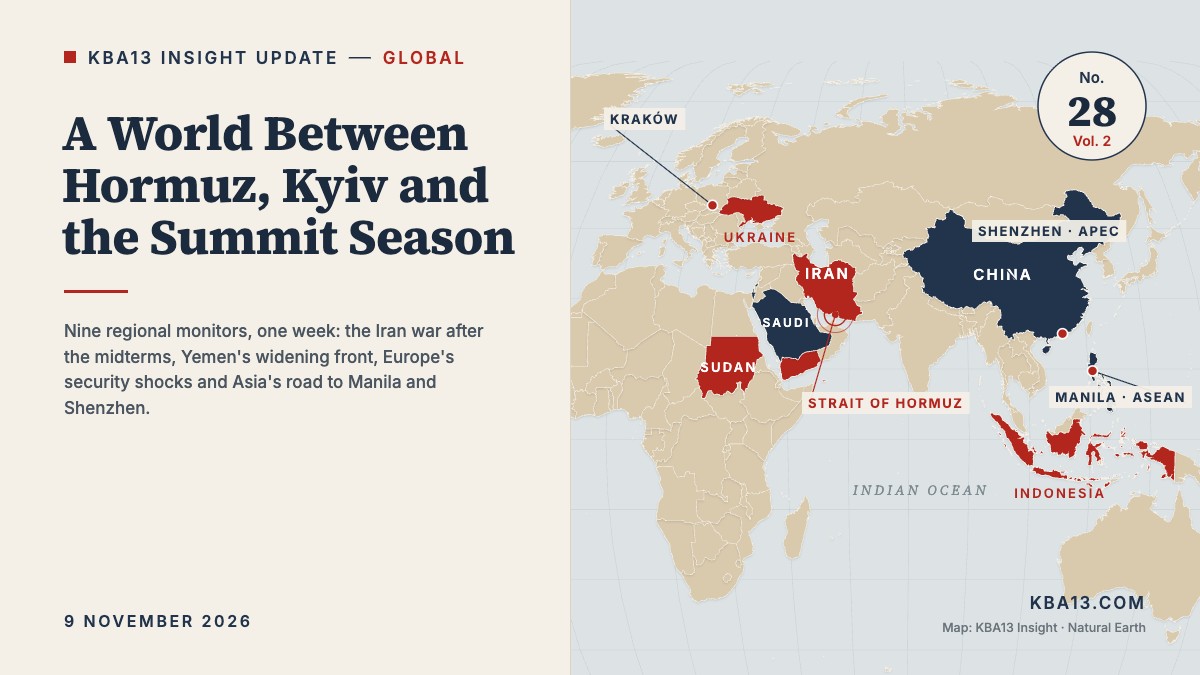
The week of 2 to 9 November 2026 will be remembered less for any single explosion than for a change in the political weather under which every regional crisis now unfolds. On 3 November American voters handed the Democratic Party control of both chambers of Congress, with Outlook India and the law firm K&L Gates both recording a decisive swing that flipped Senate seats and more than thirty House districts. Within hours the vice president was telling the country that the “obvious” reason for the defeat was the war with Iran, as ABC News reported, and by the weekend the president himself was listing the Iran war, petrol prices and a harsh immigration campaign among the causes, according to the BBC and Anadolu. A war that began with the US-Israeli attack on Iran on 28 February, as Reuters has recorded, has now become a domestic liability for the power that started it. Our central judgement is that the coming fortnight will be shaped by Washington’s search for a face-saving exit from the Gulf before the Asia-Pacific summit season, rather than by a decision to escalate, although the military means for renewed escalation remain fully in place (moderate confidence).
The second defining feature of the week is that wars once treated as peripheral have moved to the centre. The Saudi-Houthi conflict produced its most symbolic blow yet when, according to IDNFinancials and The Maritime Executive, Houthi missiles damaged an Aramco building in Riyadh’s financial district, after which Saudi airstrikes on a village east of Sanaa killed at least 33 people according to the Houthi-run health ministry cited by Yemen Online. In Iraqi Kurdistan a drone attack halted production at the Khor Mor gas field and triggered a regional blackout, reported by Al Jazeera English. In Europe, a gunman killed six people in the centre of Kraków in an attack that Polish prosecutors are investigating as terrorism, according to CBS News, while Kyiv suffered power, heat and water outages after a Russian barrage of 36 missiles and 172 drones reported by Latin Times. Taken together, these events confirm a pattern our monitors have tracked since mid-2026: the war system centred on Iran has become a networked conflict in which energy infrastructure, capital cities and civilian services are deliberate targets across several theatres at once.
The third feature is the arrival of the summit season. US President Donald Trump is due in Manila for the 49th ASEAN Summit, scheduled for 16 to 18 November according to Mothership and Reuters via The Star, before travelling to Shenzhen for the APEC leaders’ meeting on 18 and 19 November, where China has confirmed it is in contact with Washington and Moscow about a possible three-way meeting, as reported by Outlook India. A weakened American president negotiating with Xi Jinping and Vladimir Putin over Iran, Ukraine and nuclear arms is the single most consequential diplomatic possibility of the month. For Southeast Asia and Indonesia, the immediate stakes are concrete: fuel prices, energy emergencies, the security of a summit hosted by a frontline state in the South China Sea, and a political crisis in Jakarta in which the former national police chief and three other senior officers stand accused of wiretapping the president.
The Week Through the Monitors
The KBA13 Global Intelligence Monitor, which merges the nine regional monitors maintained by KBA13 Insight, recorded 14,395 signals in the 24 hours to midday on 9 November, drawn from 261 of 267 sources online and spanning 89 active countries. The thematic distribution is itself an assessment of the world’s mood: 2,090 security signals, 1,584 political, 1,466 economic, 582 disaster-related and 497 maritime. Security outweighed every other category by a wide margin, and the largest single regional volume came from the Middle East Intelligence Monitor, which hit its collection ceiling of 3,000 signals within roughly 21 hours, with Iran (607), Israel (494), Egypt (342) and Saudi Arabia (337) leading. Among countries worldwide, Australia (694), India (610) and Iran (607) produced the highest volumes, while the sharpest day-on-day increases were registered in Ukraine (+58 per cent), Australia (+57 per cent), the Philippines (+52 per cent), Canada (+44 per cent), Russia (+42 per cent) and Indonesia (+40 per cent).
Read regionally, the 72-hour digests sharpen the picture. In the Europe Intelligence Monitor, 917 of the categorised signals concerned security, more than two and a half times the political total, driven by the Kraków shooting, the Russian air campaign against Ukraine and the Ukrainian refinery war. The ASEAN Intelligence Monitor collected 4,000 signals in 72 hours, the highest of any region, with politics (636) ahead of economy (466) and security (393), reflecting summit preparations, energy policy and Indonesia’s wiretap affair. The South Asia and Indian Ocean Monitor was led by security (310), the Africa Monitor by politics (405) and security (344), and the Americas Monitor by security (250) and economics (216). The East Asia Monitor was the only large region in which economics (412) clearly led, a reminder that the China-Japan-Korea triangle still processes geopolitical risk primarily through markets, supply chains and technology controls. The Central Asia Monitor recorded its lowest volume in weeks, down 40 per cent, but its content was strategically dense, dominated by the first “SCO Plus” security dialogue and an AI security summit in Astana.
The physical environment added its own pressure. Sixty earthquakes of magnitude 4.5 or above were recorded worldwide in seven days, the strongest a magnitude 6.4 event near Lata in the Solomon Islands on 9 November, followed by two magnitude 6.1 events off Hasaki in Japan and in the Fiji region. In Indonesia, the KBA13 Indonesia Early Warning System Index placed 28 of 38 provinces on Alert, nine on Standby and only one at Normal, with no province at Warning. That distribution describes a country under broad but not acute strain: a nation in which hydrometeorological hazards, fire seasons and political tension coexist without, so far, converging into a single emergency.
Washington After the Midterms: A War Without a Mandate
The midterm result transformed the political economy of American foreign policy within a week. The Democratic majorities that will convene in January have signalled that their first targets are tariffs, Medicaid cuts and the Iran war, according to The Washington Post, and a BigGo Finance digest notes that the trade war with Canada is the first item on that list. The Straits Times, quoted in the monitor, reported that Democrats intend to block the administration’s US$1.9 trillion defence budget (The Straits Times), while the BBC reported that the top House Democrat is a “hard yes” on impeaching Defence Secretary Pete Hegseth (BBC). None of these steps can take effect before the new Congress is seated, but they change the calculus of every foreign government now negotiating with Washington: commitments made in November may not survive January.
President Trump’s own reaction has been revealing. In a 60 Minutes interview he described his deportation policy as “too tough” and acknowledged that it contributed to the defeat (BBC), and he told CNN that renewed war with Iran was “highly unlikely” if talks progressed, a line carried by Reuters via Al-Monitor and many outlets in our feeds. At the same time Secretary of State Marco Rubio defended the war as unpopular but necessary to stop a nuclear threat (Al Jazeera), the Pentagon offered a US$20 million reward for information on Iran’s nuclear programme (The Washington Post), and the US military created a new task force to disrupt land supply routes into Iran (The Copenhagen Post). The pattern is a classic dual track: rhetorical de-escalation for a domestic audience that has just punished the war, combined with quieter instruments of pressure that do not require congressional approval.
There is also a security story inside the United States. An armed Venezuelan man was arrested near the White House after saying he had come to kill the president (TokenPost), and Reuters described a White House in which Stephen Miller is steering policy toward confrontation (Reuters). The Nvidia affair, discussed below under East Asia, has given Congress a bipartisan counter-intelligence issue at the very moment when the administration needs Chinese cooperation on Iran. Our assessment is that Washington enters the summit season with reduced domestic room for manoeuvre and a stronger incentive to present a diplomatic success abroad, which raises the probability of a negotiated pause with Iran before the end of November while lowering the credibility of any long-term American guarantee offered in Manila or Shenzhen (moderate confidence).
Middle East: Hormuz, Yemen and the Geography of a Networked War
The Iran file moved through three phases in a single week. In the days before the vote, Iranian negotiators held several rounds of Qatari-mediated talks in Doha. Foreign Minister Abbas Araghchi said Iran’s proposal could reopen the Strait of Hormuz within two days rather than the seven originally envisaged, according to Asharq Al-Awsat, and the foreign ministry spokesman confirmed that Iran’s seven-step plan had been condensed for faster implementation (The Jerusalem Post). On 2 November, however, US forces struck Qeshm Island at the mouth of the strait. American officials described the operation as defensive and linked it to Iranian fire on US aircraft, according to Nation Thailand, and Trump later confirmed that an anti-aircraft facility had been hit, as reported by News of Bahrain. After the vote, Iran said no vital infrastructure had been damaged (Middle East Eye), warned Washington to accept its war-ending proposal or risk renewed fighting, and its Revolutionary Guard claimed that what it called “oil smuggling” through Hormuz had been completely halted (Middle East Eye).
The analytical point is that Hormuz has become both a bargaining chip and a weapon of attrition. Iran’s offer to reopen the strait quickly is designed to show that the economic damage of the war is reversible on its terms, while the IRGC’s claims of interdiction, mine incidents and attacks on navigation systems remind Gulf states and Asian importers that the damage can also be extended. Iraq has tightened border security and granted its army “exceptional powers” after Washington called for a border closure (Hindustan Times), a measure that fits the new US task force on land routes. The Khor Mor attack in Iraqi Kurdistan, which according to Shafaq News was launched from Saladin province, shows that energy infrastructure outside Iran itself is now part of the battlefield, and that militias with ambiguous chains of command can impose costs on Baghdad, Erbil and the Gulf at very low expense.
The Yemen front has escalated into the most dangerous secondary war in the region. Since the collapse of the Yemeni truce in July, Saudi Arabia has endured repeated Houthi attacks on airports, refineries and Aramco facilities; Euronews recorded that a strike on Riyadh airport in October killed 13 people, the worst attack on Saudi soil since 2015. This week’s damage to an Aramco building in the capital’s financial district carried a political message far beyond its physical effect: the Houthis can reach the symbolic heart of Vision 2030. The Saudi response, air strikes that killed dozens in a village east of Sanaa, has been accompanied by a diplomatic search for allies. The Times of India reported that Riyadh has turned to Syria for help against the Houthis (The Times of India), the Yemeni government accused Iran of deploying 21 foreign experts, including Iranian and Hezbollah personnel, alongside the Houthis (Yemen Online), and a report warned of an emerging Houthi-Shabab logistics corridor across the Red Sea (Yemen Online). Pakistan’s Senate opposition leader urged Islamabad to stay out of the Yemen war (Dawn), a sign that Saudi requests for military support are now debated in partner capitals.
Israel’s politics added a further layer of uncertainty. The 27 October election produced a deadlock in which neither bloc reached a majority; Likud remained the largest party with 27 seats and Gadi Eisenkot’s Yashar won 21, according to JNS. President Isaac Herzog accepted the certified results on 4 November despite Prime Minister Benjamin Netanyahu’s claims of irregularities (Al Jazeera), and in consultations 67 members recommended Eisenkot against 46 for Netanyahu, with Arab-led parties backing the former army chief (Africanews). Herzog must assign the mandate by 11 November, and the new Knesset is due to be sworn in on 10 November, according to The Jerusalem Post. Meanwhile the defence minister insisted that the Iran mission was “not complete”, and Gaza’s civil defence declared a maximum state of emergency as winter flooding hit displaced families (Middle East Eye). In Egypt, a train collision near Giza killed at least seven people and injured more than a hundred (The Statesman).
Our judgement for the region is that the probability of a formal US-Iran arrangement on Hormuz before the Shenzhen summit has risen, perhaps to roughly even odds, because both Washington’s domestic incentives and Tehran’s condensed offer now point in that direction (low to moderate confidence). The Saudi-Houthi war, however, is likely to intensify regardless of any US-Iran understanding, because it has acquired its own logic of retaliation and its own external patrons. The most important variable to watch is whether Gulf capitals treat a US-Iran deal as including Yemen, as Tehran demands, or as excluding it, as Riyadh’s continuing air campaign implies.
Southeast Asia: A Summit Host in an Energy Emergency
The ASEAN Intelligence Monitor placed the Philippines at the top of the regional table this week, with 346 signals in 24 hours and a 52 per cent rise, followed by Vietnam (339) and Indonesia (322). The reason is the convergence of three Philippine stories. First, the government declared a national energy emergency as Asia confronts an energy crisis linked to the Iran war (ABC News), and The Edge Singapore reported that the Philippine economic slump has worsened because of the war and bad weather (The Edge Singapore). Second, Manila is preparing to host the 49th ASEAN Summit, with the national police deploying more than 19,000 personnel (Inquirer.net). Third, the impeachment trial of Vice President Sara Duterte has moved to the defence’s presentation of evidence (Rappler), keeping the country’s most bitter political rivalry in the headlines as foreign leaders arrive.
Manila’s diplomatic posture has softened at the margins. The Philippine government urged its own officials to cool their rhetoric toward China ahead of the summit (Malay Mail), and the US ambassador clarified that there would be no announcement on the proposed “Pax Silica” economic security zone during the summit (The Star). Yet the hard edge of defence cooperation continues: the Philippines has reportedly shared a “wish list” with India for customised BrahMos missiles for island defence (South China Morning Post), and left-wing groups have declared that Trump is “not welcome” in the country. Our assessment is that Manila intends to use the summit to present itself as a stabiliser rather than a frontline provocateur, while quietly deepening its deterrent capacity, and that Beijing will reward the tone with restraint at sea during summit week but will not concede on substance (moderate confidence).
Mainland Southeast Asia shows the social price of the energy shock. In Thailand, police prepared for a convoy of truckers and southern residents travelling to Government House to demand fuel price caps (Bangkok Post; The Star), the National Security Council met to assess readiness (Bangkok Post), and security agencies strengthened cyber defences after attacks in Europe (Nation Thailand). The army outlined new security measures on the Myanmar and Cambodian borders (Nation Thailand). Cambodia announced that it had raided 972 scam sites and deported 23,760 foreigners (Bernama), said it was working with the FBI and Interpol (Kiripost), and the United States sanctioned a scam network as Phnom Penh reported progress (Khmer Times). French President Emmanuel Macron has confirmed a visit to Cambodia with economic and defence agreements on the table (Phnom Penh Post). Yet a former Philippine official estimated that up to 1,500 Filipinos are still trapped in Myanmar’s scam hubs (Khaleej Times), a reminder that the criminal economy of the borderlands has relocated more than it has disappeared.
Myanmar remains the region’s unresolved wound. The ASEAN special envoy’s aid mission drew mixed reactions amid an impasse over the peace plan (CNA), while Asahi Shimbun argued that the civil war is nearing a rare window for talks (Asahi Shimbun). Bangladesh’s state minister said Dhaka is in contact with both the Myanmar government and the Arakan Army on Rohingya repatriation and described the Rohingya crisis as a security threat (bdnews24.com). A report by Intelligence Online that Beijing has helped Myanmar rebels after a junta attack on a Chinese vehicle (Intelligence Online) could not be independently verified and should be treated as an unconfirmed claim, but it fits a long pattern of China managing both sides of the conflict to protect its corridor interests.
Vietnam continued its quiet balancing. General Secretary and President To Lam visited Tokyo, where both sides prioritised economic and energy security (Bloomberg), while the 14th Vietnam-US Defence Policy Dialogue was held in Washington (VietNamNet). Central Vietnam braced for up to 700 millimetres of rain (Tuoi Tre News). Malaysia’s politics were absorbed by the fate of former prime minister Najib Razak, whose transfer to house arrest under a conditional royal pardon was suspended at the last minute by the Attorney-General on 6 November, according to Reuters via the Daily Sun; the dispute pits the pardon power of the King against the legal caution of the Attorney-General’s Chambers, and CNA ran commentary on what the timing says about Malaysian politics. Brunei recorded its largest-ever methamphetamine seizure of 102 kilograms, linked to a Malaysian suspect en route to Sabah (The Vibes), and Singapore police arrested 195 people in vice raids (Asia News Network). Timor-Leste, ASEAN’s newest member, generated only modest signal volumes, but its presence in summit-security planning is a reminder that the organisation’s enlargement is now operational rather than symbolic.
Indonesia: The Wiretap Affair and the Politics of Trust
Indonesia’s week was dominated by the most serious internal security scandal of the Prabowo presidency. On 3 November police named former national police chief and presidential chief of staff Listyo Sigit Prabowo and two other senior generals as suspects in the illegal wiretapping of the president, ministers and others, as reported by Reuters via ThePrint and the Associated Press. On 5 November police named a fourth suspect with the initials SU, a former monitoring chief at the Criminal Investigation Agency whom local media identified as Slamet Uliandi, and said he had approved both the wiretaps and the deletion of interception records (Al Jazeera; The Star). By the weekend, the president had gathered ten former police chiefs (ANTARA), Commission III of the House announced it would summon police chief Suyudi Ario Seto to discuss masterminds and motives (Kompas.com), police denied reports that two further former chiefs had been arrested (Tempo), and the KAHMI alumni association demanded a cybersecurity overhaul (Tempo).
The international framing of the affair matters as much as the domestic one. Reuters presented it as “a new setback for a leader facing challenges on multiple fronts”, linking it to slumping approval ratings, record equity sell-offs and a weakening rupiah, while Al Jazeera framed it as evidence of a deepening rift between President Prabowo and his predecessor Joko Widodo. A report that Indonesia had deployed thousands of troops to Jakarta after the arrests circulated widely abroad (GlobalPost). As our national edition of 4 November argued, the decisive question is no longer whether the interceptions occurred but for whom the intercepted material was collected. Until that question is addressed in an open courtroom, foreign governments and investors will read the affair as a governance risk rather than as proof that the rule of law reaches the top of the security establishment.
The rest of Indonesia’s external picture was shaped by fire, smoke and money. A firefighting helicopter crashed during water-bombing operations, killing a crew member while a New Zealand pilot survived (RNZ); Australian military aircraft joined the effort against forest fires (IDNFinancials); and a Malaysian filmmaker said Indonesian authorities had detained his crew on suspicion of spying while they filmed the haze (Free Malaysia Today). These episodes keep alive the bilateral tensions with Malaysia and Singapore that KBA13 Insight examined in Beyond the Smoke and in our study of the future of confrontation. The rupiah stood at about 18,102 per US dollar on 9 November according to the ASEAN monitor’s currency feed. Our assessment is that the risk of mass unrest in Indonesia over the next two weeks is moderate, concentrated around planned demonstrations on 10 November, while the more durable risk is erosion of elite cohesion inside the governing coalition as the wiretap investigation reaches toward political recipients (moderate confidence).
East Asia: Espionage, Deterrence and the Road to Shenzhen
The East Asia monitor was dominated by a story that blends technology, intimacy and intelligence. Nvidia’s board opened an independent investigation after chief executive Jensen Huang acknowledged an affair with a woman whom US officials reportedly believed was linked to Chinese intelligence (Reuters). The New York Times reported that Secretary Rubio had warned officials about the relationship (The New York Times), and Bloomberg reported that President Trump backed the Nvidia chief (Bloomberg). Whatever its eventual findings, the affair has turned the world’s most strategically important AI chip company into a counter-intelligence case at a time when export controls, Chinese access to advanced semiconductors and Congressional scrutiny are already intense. It also illustrates a broader point: in the competition between the United States and China, the boundary between corporate governance and national security has effectively disappeared.
Military signalling continued in the background. Taiwan received a second batch of F-16V Block 70 fighters (Focus Taiwan) and tracked eight Chinese ships and one military aircraft around the island (Taiwan News), while the South China Morning Post asked whether the People’s Liberation Army is rehearsing operations to keep US forces out of a Taiwan conflict (South China Morning Post). Japan is weighing whether to keep describing China as its “greatest strategic challenge” (Global Times), and Prime Minister Sanae Takaichi is pushing for tougher cybersecurity laws as attacks surge (Nikkei Asia). South Korean military assessments that North Korea has completed three types of submarine-launched ballistic missiles (Asia Economy), Ukraine’s claim that Russia used a North Korean missile in a recent strike (UPI), and warnings that Seoul’s plans for wartime operational control and nuclear-powered submarines may stall during the remainder of Trump’s term (Hankyoreh) together describe a peninsula where deterrence is being rebuilt under uncertainty about American staying power.
Hong Kong added a human-rights dimension to the regional picture. On 5 November a court sentenced activist Joshua Wong to ten more years in prison under the national security law, as reported by the Associated Press via ITV and Asia News Network, triggering a war of words with the United States and Europe (Nikkei Asia). Economic indicators pointed to the Iran war’s reach into China itself: producer prices rose at their fastest pace since 2022 as imported inflation accelerated (South China Morning Post). A high-rise fire in northern China killed 14 people (South China Morning Post), and a magnitude 6.1 earthquake off Hasaki prompted questions about the Hamaoka nuclear plant (Nacionale). Our judgement is that Beijing will use the APEC summit to present itself as the indispensable broker on Iran and Ukraine, and that a weakened Washington will be tempted to accept that framing in exchange for help on Hormuz, which would carry long-term costs for Taiwan, Japan and the Philippines (moderate confidence).
South Asia and the Indian Ocean: Internal Security as Statecraft
India dominated the South Asia monitor with 610 signals in 24 hours. The most politically significant moment was Prime Minister Narendra Modi’s Diwali visit to Bastar, where he declared it the “first Diwali when every district of India is free from Naxalism” (The Star) while warning of “dimagi Naxals”, intellectuals he accused of instigating people against the Constitution. The claim of victory over the Maoist insurgency is significant for India’s domestic security narrative, even if the political language that accompanies it signals a widening of the category of internal enemies. In Jammu and Kashmir, suspected militants were arrested with a Chinese pistol and grenades in Kulgam (India Today), and the Maktoob persecution tracker recorded 16 Muslims killed by state and non-state actors in three months, a figure that should be read as an advocacy count rather than an official statistic.
Pakistan’s week combined counter-terrorism with Gulf exposure. Khyber Pakhtunkhwa plans faceless anti-terrorism courts and spending of Rs70 billion on counter-terrorism and police in one year (Dawn), Islamabad urged the Taliban to act against militant groups in Afghanistan (The Kabul Tribune), and a policeman and a bomb disposal officer were killed in separate attacks in the northwest. The killings of journalist Rabia Ahsan (Arab News Pakistan) and of a television anchor in Rawalpindi (Dawn) underline the dangers facing the country’s media. Pakistan’s deepening defence ties with Sudan’s army (Modern Diplomacy) and the debate over the Yemen war show how far Pakistani security policy is now entangled with the conflicts of the Middle East and the Horn of Africa.
Elsewhere in the region, a crude bomb exploded inside the CID headquarters in Dhaka (The Daily Star), Nepal’s bureaucracy, police and judiciary were described as panicked by abrupt dismissals (Asia News Network), and Sri Lanka moved to acquire four Israeli drones (Israel Defense). In the Indian Ocean, the Iran war continues to reshape maritime trade, with Dawn noting how Pakistani ports are trying to capitalise on shifting routes, and Nikkei Asia reporting that Indian fishermen are squeezed by ambiguous fuel pricing linked to the war (Nikkei Asia). Our assessment is that South Asian states are converting the energy shock into domestic security narratives, which strengthens governments in the short term but narrows space for political opposition and the press (moderate confidence).
Central Asia: Security Dialogues in the Shadow of Energy Routes
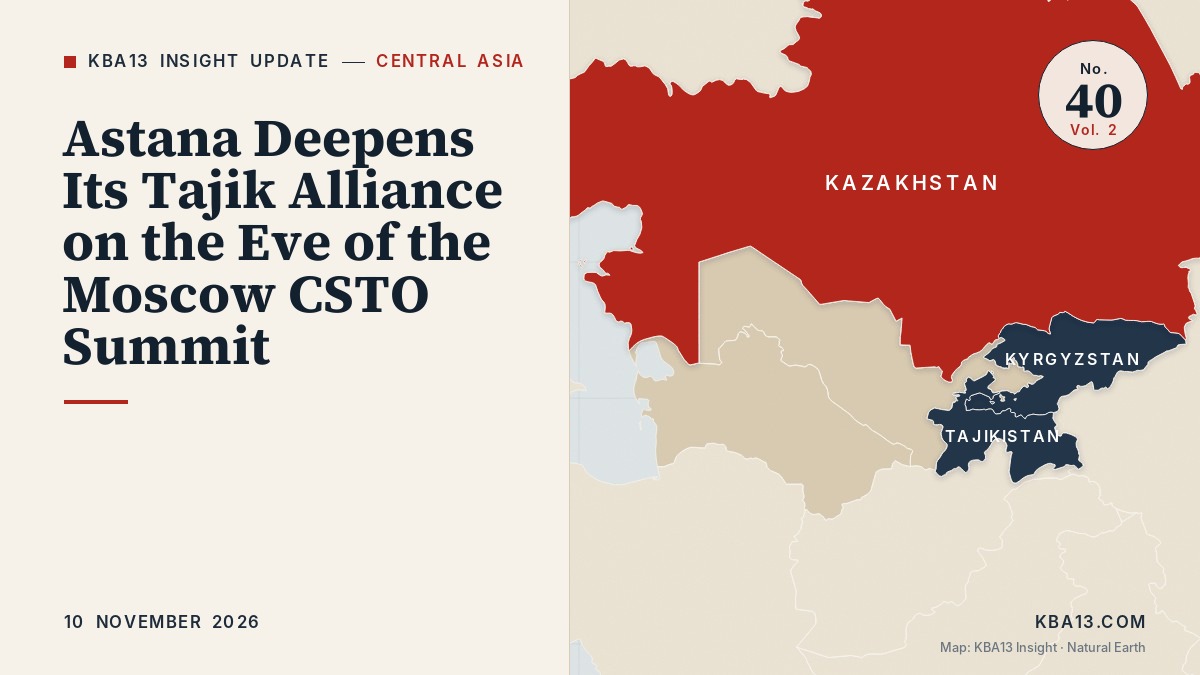
Central Asia’s lower signal volume masked a week of institution-building. Uzbekistan hosted the first “SCO Plus” expert dialogue on security in Samarkand (Sarkaritel), at which President Shavkat Mirziyoyev called for stronger cooperation against AI-enabled terrorism and cyber threats and offered to host a UN counter-terrorism office for Central Asia (UzDaily). Kazakhstan hosted an Aqaba Process summit on AI security in Astana (AKIpress), Kazakhstan’s defence minister discussed cooperation with the US ambassador (Qazinform), and Astana announced support for Tajikistan’s bid for a non-permanent UN Security Council seat in 2028 to 2029 (Qazinform). Pakistan and Tajikistan concluded the Dosti-III counter-terrorism exercise (Arab News Pakistan), and Tajik authorities arrested nine suspects in a drug network linked to Afghanistan (Afghanistan International).
Energy and sanctions defined the region’s vulnerabilities. Türkiye suspended Turkmen gas imports through Iran because US sanctions complicated the arrangement (AzerNews), a direct consequence of the Iran war for the Caspian energy map. Kazakhstan partnered with a Chinese consortium on a new gas plant at Kashagan (Energy Intelligence), even as its oil sector remains exposed to the vulnerability of the Caspian Pipeline Consortium’s Black Sea terminal, which handles most of its exports and has been repeatedly disrupted by drone attacks, as documented by The Times of Central Asia. Kyrgyzstan demanded that Russia return a citizen allegedly tricked into joining the Russian army (Caspian Post) while linking its banks and crypto services to an automated system for blocking sanctioned assets (AKIpress). Our judgement is that Central Asian governments are hedging more actively than at any time since 2022, building multilateral security platforms with China, Russia, Pakistan, Türkiye and the United States simultaneously, precisely because no single patron can guarantee their energy routes (moderate confidence).
Europe: Kraków, Kyiv and the Price of a Deal
Europe’s week was framed by violence at home and diplomacy over Ukraine. In Kraków, a gunman killed six people and wounded fifteen in the city centre; Polish authorities said the suspect held far-right views, prosecutors opened a terrorism investigation and the country declared two days of national mourning (CBS News; Yahoo). Malaysia’s prime minister and embassy publicly condemned the attack, a small but telling example of how quickly European security incidents now enter Southeast Asian political discourse. European Interest reported that Poland faced a wave of disinformation after the massacre, and Lithuania and Poland are trying ten suspects in sabotage cases linked to Russian military intelligence (Politico Europe via UA.News). The United Kingdom announced that it will lead Norway, Sweden and seven other NATO allies against Russian submarine activity after a US-backed operation stopped a suspected plot to damage undersea cables (Business Insider).
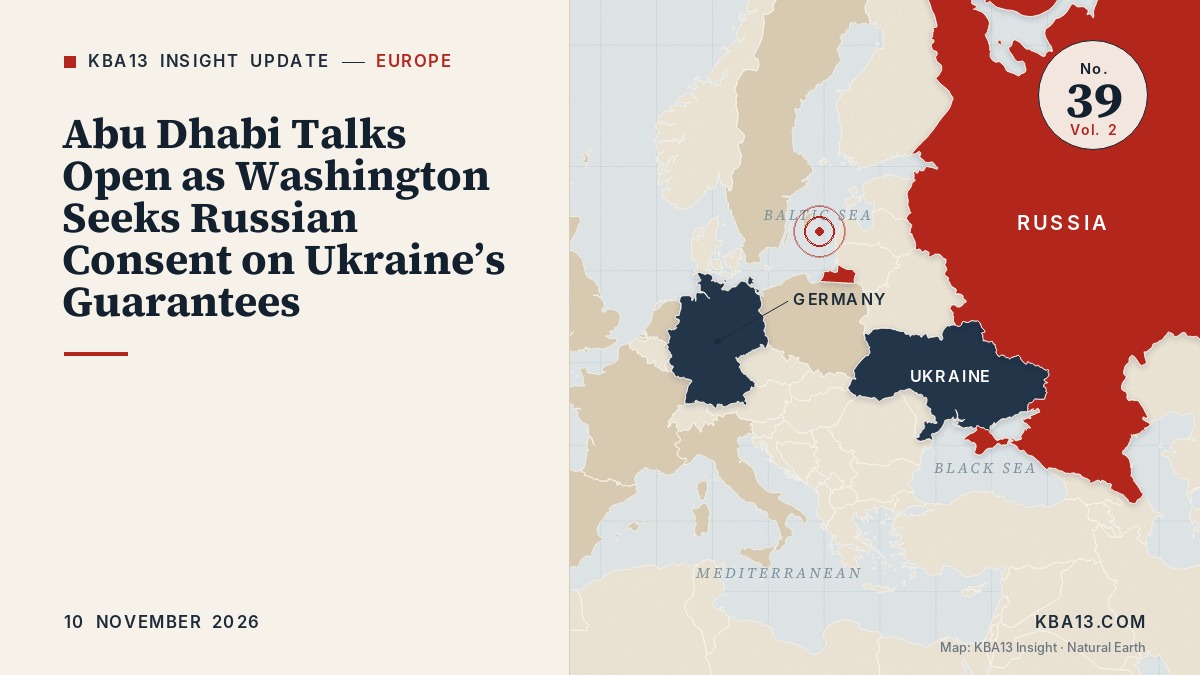
On Ukraine, the G7 foreign ministers met in Paris as Europe sought a greater role in peace talks (DW), and Rubio said progress had been made on a post-war security framework ahead of talks in Abu Dhabi (The Guardian). Jared Kushner floated the idea of a NATO-Russia Council-style body for European security (Ukrainian News Agency), Trump said Ukraine would likely “end up with a little bit different shape” after the war, and a former NATO commander warned that Putin envisions a world split into three spheres of influence. On the battlefield, Ukrainian drones struck the Kirishi refinery, Russia’s second largest (The Kyiv Independent), while Russia’s barrage on Kyiv left the capital without reliable power, heat and water. Germany confirmed that it has no more Patriot missiles to send to Ukraine (Military Watch Magazine), and leaked Russian death records suggested losses of 400,000 to 450,000 people (The Economic Times).
Our assessment is that the diplomatic track has acquired genuine momentum, driven by Washington’s need for a foreign-policy success and Moscow’s interest in locking in territorial gains before the new Congress takes office, but that the terms under discussion are likely to reward Russian occupation and leave European states with the burden of guaranteeing a smaller Ukraine (moderate confidence). The Kraków attack and the cable plot show that Europe’s internal security agenda, from far-right violence to Russian sabotage, is becoming harder to separate from the war itself. For Asian observers, the lesson is that the European theatre is no longer a distant crisis: its energy decisions, cyber incidents and sanctions regimes are transmitted to Southeast Asia within hours.
The Americas: Divided Government, Cartels and the Cuban Question
Beyond Washington, the Americas monitor recorded a hemisphere under multiple stresses. In Paraguay, President Santiago Peña resigned on 5 November as the collapse of the digital bank Ueno froze the savings of roughly half the population, but the lower house impeached him unanimously and the Senate removed him on 6 November, after which prosecutors ordered his arrest and he was placed under house arrest, according to MercoPress, Primicias and the Associated Press via ITV. The speed of the fall shows how quickly a financial failure in a digitised banking system can become a regime-level political crisis, a warning relevant to every emerging economy that is moving savings onto digital platforms.
Security pressures continued across the region. Mexico arrested an alleged leader of a Jalisco New Generation Cartel cell, known as “R2”, in an operation aided by DEA intelligence (Al Jazeera), Michigan National Guard soldiers were assigned to support border protection, and a drone attack on a Colombian military base killed several soldiers, with reported tolls ranging from three to five (İlke Haber). Cuba reportedly prepared for a possible US military intervention (Apa.az), new US sanctions on Chinese firms deepened the confrontation over the island (Latin Times), and Kenya linked the closure of its embassy in Havana to US sanctions (CiberCuba). Brazilian police are investigating allegations that the United States and Israel helped former president Jair Bolsonaro flee (VOI), a claim that remains unverified, and Argentine authorities arrested a man accused of threatening Pope Leo XIV (Informat.ro). Canada, under pressure from US tariffs and sanctions designations against eight Canadian financial firms accused of facilitating Iranian sanctions evasion (Iran News Update), is reportedly considering an independent foreign intelligence agency (Vietnam.vn).
Our judgement is that the Western Hemisphere will see more, not less, American coercive activity in the coming months, focused on Cuba, cartels and sanctions evasion, because these are areas where the executive can act without Congress and where a weakened administration can still demonstrate strength (moderate confidence). For Asian partners, the immediate implication is that US sanctions enforcement against third-country financial institutions, including in Canada, will remain aggressive, raising compliance risks for banks and traders in Southeast Asia that handle Iranian or Russian-linked transactions.
Africa: Sudan’s War Spreads and the Horn Fragments
Africa’s monitor described a continent where several wars are now connected. In Sudan, the army downed its fourth drone in a week while advancing against the Rapid Support Forces in West Kordofan (Anadolu Agency), the RSF claimed new gains in Blue Nile (Asharq Al-Awsat), and the army detained former ruling party chief Ahmed Haroun, who is wanted by the International Criminal Court, after a podcast appearance (Sudan Tribune). Reports that Tigrayan and other Ethiopian fighters have been drawn into Sudan’s war (Citizen Digital) and warnings of rising Sudan-Ethiopia tensions (NTV Uganda) suggest that the Sudanese conflict is pulling in its neighbours. In Ethiopia itself, a militant attack reportedly left more than 50 people dead (AzerNews), following an attack in late October in Oromia that killed 60 people according to the Orthodox Church, as reported by Reuters via The Kathmandu Post.
The Horn of Africa’s security architecture is under visible strain. A senior commander of Somalia’s National Intelligence and Security Agency defected to al-Shabaab, raising fears of an intelligence breach (Somali Guardian), Somali security forces killed three protesters in Mogadishu (Hiiraan Online), and the African Union and European Union warned that funding shortfalls could undermine security gains in Somalia (AllAfrica). Turkey’s spaceport project in Somalia has drawn reporting about its links to long-range missile ambitions (Nordic Monitor). In the Great Lakes, a military court in the Democratic Republic of Congo sentenced 66 soldiers to death (Anadolu via UA.News), Africa CDC issued a statement on an attack in North Kivu (AllAfrica), and clashes in South Sudan killed 23 people (Citizen Digital).
West Africa’s violence remained intense. Nigeria’s military reported neutralising 60 terrorists and rescuing 42 kidnap victims (AllAfrica), while bandits burned eleven members of a family to death in Zamfara (AllAfrica), and opposition leader Peter Obi described Nigerians as among the most terrorised people globally. Kenya’s Sh3.6 billion drug haul in Kwale exposed links to global trafficking networks (Daily Nation), and analysts examined how the Sahel’s demographic surge is feeding jihadist recruitment (RANE). Our assessment is that the Red Sea, the Horn and Sudan now form a single security system connected to the Yemen war through arms flows, mercenaries and logistics corridors, and that this system will attract further involvement by Gulf states, Türkiye, Egypt and Pakistan (moderate confidence).
Australia and the Pacific: AUKUS Under Audit
Australia generated the highest country-level signal volume in the world this week, with a 57 per cent rise, much of it driven by debates about defence. An independent, crowdfunded Public Inquiry into AUKUS, led by commissioners including former minister Peter Garrett and former defence force chief Chris Barrie, recommended that Australia immediately terminate Pillar 1 of the agreement, calling AUKUS “the worst, riskiest and most costly defence decision” in national history, according to CGTN and the inquiry’s media release. The Australian Strategic Policy Institute responded that noisy online opposition does not equal real-world opposition (The Strategist). The government, meanwhile, retreated from a plan to sell historic military sites after public protest, keeping Victoria Barracks in Sydney and Melbourne in public hands (The Guardian), and defence media reported that Australia is to receive second-hand submarines (Australian Defence Magazine).
The Pacific islands remained exposed to both geological and geopolitical shocks. The magnitude 6.4 earthquake near the Solomon Islands was the strongest of the week worldwide, and Fiji is considering a national intelligence overhaul (Fiji Sun) amid a broader campaign against drugs. In Papua New Guinea, an object initially thought to be a wine bottle and suspected to be of Chinese origin turned out to be a military projectile (Kompas.com). Singapore’s Senior Minister Lee Hsien Loong urged Australia to deepen economic and security ties with Southeast Asia (CNA). Our judgement is that the AUKUS debate will not change government policy in the near term, but that the combination of second-hand submarines, delivery doubts and a US administration under domestic pressure will strengthen Australian interest in Southeast Asian partnerships, including with Indonesia, as a hedge (moderate confidence).
Cross-Cutting Threads: Energy, Espionage, Cyber and Illicit Economies
Four threads ran through every regional monitor this week. The first is energy. From the Philippine energy emergency to Thai fuel protests, Indian fishermen’s costs, Chinese producer-price inflation, Turkmen gas routes, Kazakh pipelines and the Khor Mor blackout, the Iran war has become the organising fact of the global energy system. Its effects are not limited to the price of crude: they reach electricity grids, fertiliser, transport, public finances and, ultimately, political stability in import-dependent states. For Southeast Asia, energy security has become a matter of regime security.
The second thread is espionage and the integrity of state institutions. Indonesia’s wiretap affair, the Nvidia investigation, Russian sabotage trials in Poland and Lithuania, the defection of a Somali intelligence commander and Hong Kong’s national security prosecutions all concern the same question: who controls the instruments of surveillance and intelligence, and for whose benefit. In each case, the institutional damage lies less in the intrusion itself than in the loss of public confidence in those charged with protecting secrets.
The third thread is cyber vulnerability. Governments in Thailand, Malaysia, Japan, Hong Kong, the United Arab Emirates, New Zealand and Indonesia all announced new cyber measures this week, many explicitly in response to attacks in Europe, and the G7 foreign ministers were reported to be discussing recent cyber attacks. Malaysia is exploring accelerated migration to quantum-safe encryption, and Indonesia’s cyber agency stressed human oversight of AI security. The convergence suggests that a significant cyber campaign against European targets has shifted threat perceptions across Asia, although public attribution remains limited.
The fourth thread is the illicit economy. Cambodia’s scam crackdown, the trapped Filipinos in Myanmar, Brunei’s record methamphetamine seizure, Tajikistan’s arrests of an Afghan-linked drug network, Kenya’s Kwale haul and Nigeria’s airport seizures show that criminal networks are adapting to enforcement by moving routes rather than shrinking. For Aceh and the Malacca Strait, where KBA13 Insight has documented shifting trafficking patterns, the regional data reinforce the need to treat narcotics, online fraud and human trafficking as a single transnational security problem rather than as separate police files.
Outlook: The Next Fourteen Days
The calendar of the coming fortnight is unusually dense. Israel’s new Knesset is due to be sworn in on 10 November and President Herzog must assign a mandate by 11 November. Indonesia faces planned demonstrations on 10 November and continuing parliamentary scrutiny of the wiretap case. COP31 opens in Antalya, Türkiye, under pressure from war and AI-driven energy demand (CNA). Ukraine talks are expected in Abu Dhabi. The ASEAN Summit convenes in Manila from 16 to 18 November with President Trump attending, and the APEC leaders’ meeting follows in Shenzhen on 18 and 19 November, with a possible Trump-Xi-Putin meeting.
Our base case, which we judge the most likely at around 55 per cent, is a “summit pause”. In this scenario, Washington and Tehran reach at least an informal understanding on Hormuz shipping before or during the APEC meeting, oil prices ease, Ukraine talks produce a framework on security guarantees without a final settlement, and Manila hosts an orderly ASEAN Summit that emphasises economic security and avoids confrontation over the South China Sea. The Saudi-Houthi war continues, and Indonesia’s wiretap case proceeds through police and parliamentary channels without resolving the question of motive. This scenario lowers headline risk but leaves the structural drivers of instability intact.
The alternative scenario, at around 30 per cent, is “escalation by spoilers”. Here, a major attack in the Gulf, such as a mass-casualty strike on Saudi infrastructure, a successful attack on US forces or a serious incident in Hormuz, derails the diplomatic track and prompts renewed US strikes despite the political cost at home. Oil prices spike again, energy emergencies spread in Asia, and the summits are overshadowed by crisis management. A third scenario, at around 15 per cent, is a “grand bargain” at Shenzhen, in which the United States, China and Russia announce a package touching Iran, Ukraine and nuclear arms control. Such an outcome would reduce near-term violence but would likely be read in Tokyo, Taipei, Manila, Kyiv and Warsaw as a great-power settlement over their heads, with long-term consequences for alliance credibility.
Signals to Watch
In the Gulf, watch for an official announcement on shipping through Hormuz, any change in the tempo of IRGC claims against tankers, the activity of the new US task force on land routes, and whether Saudi Arabia and the Houthis accept a ceasefire linked to a US-Iran understanding. A further Houthi strike on Riyadh or the Eastern Province causing mass casualties would sharply raise escalation risk. In Israel, the assignment of the mandate and any sign of a unity government involving Eisenkot will shape decisions on Iran, Lebanon and Gaza.
In Asia, watch the security of the Manila summit, the tone of Chinese maritime activity in the South China Sea during summit week, and whether President Trump and President Marcos make new commitments on defence or economic security. In Indonesia, the key indicators are whether investigators identify recipients of the intercepted material, the outcome of Commission III’s hearing with the police chief, the scale and conduct of the 10 November demonstrations, and the response of markets. In Malaysia, the Najib dispute is a test of the relationship between the palace and the government’s legal officers.
In Europe and the Americas, watch the Abu Dhabi talks on Ukraine, any formal proposal for a new European security body, the progress of the Kraków investigation and Polish counter-extremism measures, and Russian or Ukrainian strikes on energy infrastructure as winter deepens. In Washington, watch congressional moves on war powers, defence spending and tariffs ahead of January, and the trajectory of the Nvidia investigation. In Africa, the indicators are Sudanese and Ethiopian border dynamics, al-Shabaab’s exploitation of the NISA defection, and any sign of Gulf states expanding operations along the Red Sea coast.
Method and Sources
This recap covers developments from 2 to 9 November 2026. It draws on the 24-hour and 72-hour collections of the nine regional monitors maintained by KBA13 Insight, merged in the Global Intelligence Monitor: the ASEAN, East Asia, South Asia and Indian Ocean, Middle East, Central Asia, Australia and Pacific, Europe, Americas and Africa monitors, together with the Indonesia Early Warning System Index. Signal counts refer to the collection as of 9 November 2026 at around 13:00 WIB; country and theme tags are generated by keyword rules and are indicative rather than assessments. Earthquake data come from the USGS, disaster alerts from GDACS and currency rates from ExchangeRate-API, as collected by the monitors.
Key facts were cross-checked against original reporting from the outlets linked in the text, and events earlier in the week that fell outside the monitors’ rolling windows were verified through direct searches of news agencies and national media. Claims made by belligerents, single-source reports and allegations that could not be independently verified are identified as such. Probability estimates and confidence levels express the analytical judgement of the KBA13 Insight Research Team and should be read as structured assessments, not predictions of certainty. Related KBA13 Insight editions include the Middle East update of 29 October, the Southeast Asia update of 29 October and the national edition of 4 November.
About The Author

- Series · Seri
- KBA13 Insight Update, Global Edition
- Volume · Number
- Vol. 2, No. 28 (November 2026)
- Cumulative issue · Edisi ke-
- 40
- Reference · Nomor rujukan
KBA13-IU-2026-02-028- Author · Penulis
- KBA13 Insight Research Team
- Published · Terbit
- 9 November 2026
- Section · Rubrik
- KBA13 Insight Update, KBA13 Insight Update International
- Keywords · Kata kunci
- APEC Shenzhen, ASEAN Summit 2026, AUKUS, geopolitics, Global Intelligence Monitor, Indonesia, Intelligence Briefing, Iran War, Israel, Saudi Arabia
- Language · Bahasa
- English
- Length · Panjang
- 7,107 words · ±32 min read
- Publisher · Penerbit
- KBA13 Insight, Banda Aceh, Indonesia
- Permalink
- www.kba13.com/kba13-insight-update-2026-11-09-global/
- How to cite · Cara mengutip
- KBA13 Insight Research Team. (2026, November 9). KBA13 Insight Update, 9 November 2026, Global: A World Between Hormuz, Kyiv and the Summit Season. KBA13 Insight Update, 2(28). https://www.kba13.com/kba13-insight-update-2026-11-09-global/
- Rights · Hak cipta
- © 2026 KBA13 Insight. Quotation permitted with full attribution and link.
Artikel Terkait
 KBA13 Insight Update, 29 October 2026, Middle East: Diplomacy Against the Clock as Washington Weighs Post-Midterm Strikes on Iran
 KBA13 Insight Update Internaional: Iran War, Trump-Xi Summit, Ukraine Ceasefire, Taiwan Risk, and the Collapse of Strategic Order
 Global Intelligence Briefing (7–12 July 2026): Iran War, US–China Rivalry, Ukraine, South China Sea, and Global Security Risks
 The Beijing Variable: A Geopolitical Analysis of US-China Relations After the Trump-Xi Summit, May 2026
 Southeast Asia Strategic Outlook 2026: ASEAN, Indonesia, Myanmar, and South China Sea Tensions
Leave a Reply