
KBA13 Insight · KBA13 Insight Update
Southeast Asia Intelligence Brief:ASEAN, Myanmar & South China Sea
KBA13 Insight’s weekly intelligence briefing assesses Southeast Asia’s strategic landscape for 25–31 August 2026. This edition examines ASEAN institutional dynamics, Myanmar’s intensifying civil war, political turbulence in the Philippines, Indonesia’s economic and strategic trajectory, rising South China Sea tensions, the fragile Thailand-Cambodia ceasefire, and the region’s evolving economic…
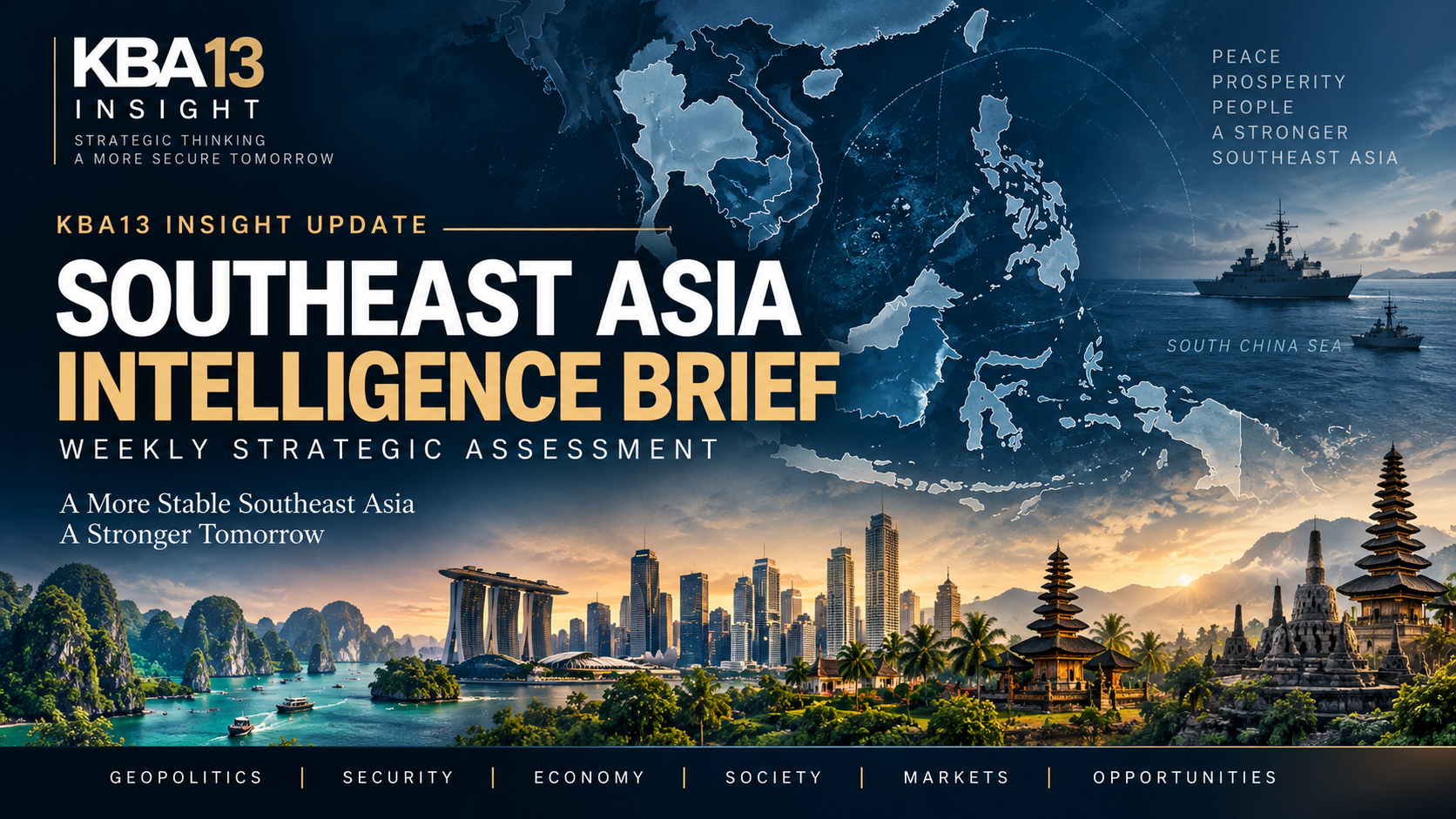
Summary
KBA13 Insight’s weekly intelligence briefing assesses Southeast Asia’s strategic landscape for 25–31 August 2026. This edition examines ASEAN institutional dynamics, Myanmar’s intensifying civil war, political turbulence in the Philippines, Indonesia’s economic and strategic trajectory, rising South China Sea tensions, the fragile Thailand-Cambodia ceasefire, and the region’s evolving economic outlook. It also identifies critical indicators to watch as ASEAN approaches the November summit and the planned signing of the Digital Economy Framework Agreement.
Keywords
- ASEAN
- ASEAN DEFA
- ASEAN Economy
- ASEAN security
- Cambodia
- China Philippines Relations
- Digital Economy Framework Agreement
- Ferdinand Marcos Jr
- geopolitical risk
- Indo-Pacific
1. Executive Summary
Southeast Asia closes the last week of August 2026 under the weight of five converging pressures: a deepening political crisis in Manila, an intensifying and increasingly fragmented civil war in Myanmar, renewed friction in the South China Sea, a resilient but unevenly distributed regional growth story, and a fragile, still-contested truce along the Thai-Cambodian frontier. None of these dynamics is new, but each has hardened over the past seven days in ways that will shape ASEAN’s remaining agenda for the year, including the run-up to the Digital Economy Framework Agreement signing scheduled for the 49th ASEAN Summit in November.
In the Philippines, the impeachment trial of Vice President Sara Duterte entered its ninth week in the Senate, even as President Ferdinand Marcos Jr. continues to manage a severe flooding emergency across Central Luzon and a parallel corruption scandal tied to flood-control infrastructure spending. The convergence of a live impeachment proceeding, a natural-disaster response under a declared state of calamity, and an unresolved graft investigation implicating military and audit officials has placed unusual strain on the country’s institutions during its ASEAN chairmanship handover year.
Myanmar’s junta, led by Min Aung Hlaing, marked the end of August with intensified airstrikes in Kachin State’s Shwegu township and continued blockade operations in Rakhine State, even as it pursued new diplomatic and defence ties with Thailand and Belarus. Timor-Leste, barely ten months into full ASEAN membership, has emerged as an unexpectedly assertive voice on Myanmar accountability, having appointed a prosecutor earlier this year to examine potential war-crimes proceedings against the junta leadership — a first among ASEAN member states.
Maritime tensions between China and the Philippines remain elevated but contained short of direct confrontation. Manila’s formal extended continental shelf submission near Palawan continues to draw sharp rebukes from Beijing, while satellite monitoring points to accelerating Chinese land-reclamation activity at Antelope Reef. In response, the Philippine Defense Department has requested a further increase to its modernization budget, underscoring Manila’s long-horizon hardening posture rather than any near-term de-escalation.
On the economic front, the region’s growth narrative remains constructive. Indonesia recorded its strongest first-half growth in thirteen years and President Prabowo Subianto has set a six percent full-year target; Singapore’s Ministry of Trade and Industry sharply upgraded its 2026 GDP forecast on the back of AI-linked electronics and financial-services strength; and Malaysia’s second-quarter growth surprised to the upside even as its bond market underperformed regional peers on rate-hike concerns. The divergence between real-economy resilience and bond-market caution is one of the week’s more consequential financial signals.
Thailand and Cambodia’s border ceasefire, in place since December 2025, continues to hold in form but not in substance, with sporadic strikes, continued border-crossing closures, and hundreds of thousands of returned migrant workers still weighing on both economies. Vietnam has publicly voiced concern over the standoff, a rare direct intervention from Hanoi in a bilateral dispute between fellow ASEAN members, reflecting anxiety in the Mekong subregion about spillover effects on trade and labour mobility.
Institutionally, ASEAN’s most significant forward-looking development this week is confirmation that the Digital Economy Framework Agreement — the bloc’s first comprehensive region-wide digital economy accord — remains on track for signature at the November summit, following the resolution of outstanding cross-border data flow issues in May. Analysts project the agreement could help expand the region’s digital economy toward two trillion US dollars by 2030, positioning ASEAN as one of the more coherent digital blocs globally at a moment when digital trade rules elsewhere are fragmenting.
Singapore and Malaysia continue to deepen sub-regional integration through the Johor-Singapore Special Economic Zone and the Rapid Transit System Link, both cited this week as on schedule for substantial completion by the end of 2026. This bilateral track, insulated from the region’s more volatile flashpoints, illustrates a parallel and quieter current of ASEAN economic integration proceeding largely independent of the security and political turbulence elsewhere in the bloc.
Taken together, the week reinforces a now-familiar pattern in Southeast Asian affairs: robust macroeconomic fundamentals and accelerating digital-economy integration coexisting with unresolved territorial disputes, fragile ceasefires, and domestic political fragility in several of the bloc’s largest members. The Philippines’ domestic turbulence, Myanmar’s unresolved civil war, and the Thai-Cambodian standoff remain the three variables most likely to disrupt this equilibrium in the near term.
The sections below examine each of these threads in turn, closing with a forward-looking assessment of the signals most likely to define the region’s trajectory through the remainder of the third quarter of 2026, as ASEAN moves toward the November summit and the formal signing of the Digital Economy Framework Agreement under continued external pressure from Washington’s tariff posture and Beijing’s assertiveness at sea.
2. ASEAN Architecture and Regional Governance
ASEAN enters the final third of 2026 managing an unusually crowded institutional agenda: the aftermath of the Philippines’ chairmanship year, Timor-Leste’s first full year of membership, and preparations for the November summit at which the Digital Economy Framework Agreement is expected to be formally signed. The bloc’s consensus-based architecture continues to strain under the weight of member states’ divergent bilateral crises, even as its technical and economic workstreams — digital trade chief among them — continue to advance largely on schedule.
The conclusion of DEFA negotiations in May, after outstanding disagreements over cross-border data flows were resolved at the 57th ASEAN Senior Economic Officials Meeting, represents the bloc’s most concrete institutional achievement of the year. As the first comprehensive region-wide digital economy agreement anywhere, DEFA is intended to harmonise digital trade rules, address artificial intelligence governance, financial technology, and source-code protection, and signal regulatory stability to investors at a moment when global digital trade rules are otherwise fragmenting under US and WTO-level pressure.
Timor-Leste’s integration into ASEAN’s institutional machinery continues at pace. Having acceded formally in October 2025 after National Parliament ratification of twenty-two resolutions covering all three ASEAN Community pillars, Dili has moved quickly from observer status to substantive participation, including its Myanmar accountability initiative earlier this year. Government officials in Dili continue to frame membership as central to the country’s post-oil economic diversification strategy, even as World Bank data continues to show Timor-Leste trailing the ASEAN average on most business-readiness indicators.
Malaysia’s 2025 ASEAN chairmanship legacy — including its facilitation of Timor-Leste’s accession and its stewardship of the Thailand-Cambodia ceasefire framework — continues to inform the bloc’s institutional posture even after the chair rotated to the Philippines. Kuala Lumpur’s diplomatic capital from that period remains a reference point for how the bloc balances its non-interference norm against the practical need to manage active member-state conflicts, a tension made more visible by Vietnam’s unusually direct statement of concern over the Thai-Cambodian border this week.
Singapore’s institutional role this week centres on economic statecraft rather than security diplomacy: the city-state’s upward GDP revision reinforces its position as the bloc’s financial and AI-infrastructure hub, and its continued advocacy for DEFA implementation aligns with its longstanding interest in positioning itself as the region’s digital and data-governance node. Singapore’s bilateral engagement with Timor-Leste, including a recent prime ministerial visit to Dili, also signals a broader ASEAN-5 interest in cultivating the bloc’s newest and smallest member as a genuine participant rather than a symbolic addition.
The Myanmar question continues to test ASEAN’s institutional cohesion more than any other single issue. Min Aung Hlaing’s public criticism of the bloc’s Five-Point Consensus peace plan, delivered in a parliamentary address marking his hundredth day as president after a widely discredited election, has hardened the divide between member states favouring continued engagement with the junta and those, led increasingly by Timor-Leste, pressing for accountability mechanisms. This divide is likely to surface again as the bloc finalises its 2026 chairmanship handover documentation.
ASEAN’s external relations architecture remains active on multiple fronts simultaneously: continued reciprocal tariff negotiations with Washington under the Trump administration’s trade posture, ongoing RCEP implementation review, and parallel digital and AI cooperation dialogues with the European Union and other partners. The layering of these tracks illustrates the bloc’s now-standard approach of pursuing deep economic integration internally while hedging externally across multiple major-power relationships rather than aligning decisively with any single partner.
The bloc’s Socio-Cultural and Political-Security Community pillars continue to advance more slowly than the Economic Community pillar, a pattern reinforced this week by the contrast between the DEFA’s substantive progress and the continued stalemate on a binding Code of Conduct for the South China Sea. Foreign ministry officials across several member states have again called for weekly negotiation sessions to produce a Code of Conduct text, though no firm date has been set for conclusion.
Institutional attention is also turning toward preparations for the 2029 ASEAN Summit, which Timor-Leste has signalled interest in hosting once its conference infrastructure — including the Dili International Conference Centre currently under construction — meets ASEAN MICE standards. This forward planning, while premature relative to the bloc’s more urgent near-term crises, reflects a deliberate effort by the Secretariat to normalise Timor-Leste’s full participation in the rotating institutional calendar rather than treating its membership as provisional.
Overall, ASEAN’s governance architecture this week displays its characteristic duality: measurable, if incremental, progress on economic and digital integration running in parallel with unresolved and in some cases worsening security and political fault lines among individual member states. The bloc’s capacity to sustain the DEFA’s momentum through November while managing the Philippines’ domestic turbulence, Myanmar’s civil war, and the Thai-Cambodian standoff will be the clearest test yet of its institutional resilience this year.
3. Energy, Economics & Trade
Southeast Asia’s growth trajectory strengthened further this week on the back of upgraded forecasts from three of the bloc’s largest economies. Indonesia’s economy grew 5.61 percent in the first quarter and 5.45 percent in the first half of 2026 — its strongest first-half performance in thirteen years — prompting President Prabowo Subianto to reaffirm a six percent full-year growth target in his State of the Nation address, supported by realised investment of roughly 108 billion US dollars in 2025 and over 1.4 million jobs created in the first half of this year alone.
Singapore’s Ministry of Trade and Industry sharply revised its 2026 GDP growth forecast upward to a range of 4.5 to 5.5 percent, from a prior 2 to 4 percent, after second-quarter growth of 5.9 percent year-on-year. The upgrade was driven principally by AI-related demand in electronics and precision engineering, robust wholesale trade in machinery and equipment, and strong credit growth in the banking sector, partially offset by a contraction in food and beverage services linked to rising outbound travel by Singaporean residents.
Malaysia’s economy also outperformed expectations, with second-quarter growth accelerating to 5.8 percent year-on-year from 5.4 percent in the first quarter, prompting at least one investment bank to place its 4.5 percent full-year forecast under review for a possible upgrade. Manufacturing PMI held steady at 50.7 in July, indicating stable footing entering the second half of the year despite softer business confidence and a marginal year-on-year decline in manufacturing employment, both attributed to persistent geopolitical and external-demand uncertainty.
Financial markets are nonetheless sending a more cautious signal than the real-economy data alone would suggest. Malaysian government bonds delivered Southeast Asia’s worst performance in August, with ten-year yields rising sixteen basis points on concerns over long-dated debt supply and the prospect of an interest-rate hike by Bank Negara Malaysia, which has held its benchmark rate at 2.75 percent for more than a year. By contrast, yields in Indonesia and the Philippines declined over the same period, producing the widest divergence in regional bond performance since at least January 2020.
The semiconductor and AI-linked export boom continues to serve as a structural tailwind across the bloc’s more industrialised economies, helping offset the drag from elevated global energy prices tied to the ongoing disruption around the Strait of Hormuz earlier this year. Singapore, Malaysia, and Vietnam in particular continue to benefit from AI-driven demand for electronics and precision-engineering exports, a trend regional central banks are monitoring closely for its implications on capacity utilisation, wage growth, and imported inflation.
On trade policy, ASEAN member states continue to navigate parallel negotiating tracks with Washington under the Trump administration’s reciprocal tariff regime, with Indonesia’s agreement concluded late last year serving as an informal template for ongoing talks by other member states. Analysts note that US Section 301 tariffs are increasingly viewed regionally as a durable floor rather than a temporary negotiating position, given their procedural robustness relative to reciprocal tariffs, prompting several ASEAN trade ministries to prioritise market diversification alongside continued US engagement.
Malaysia’s pre-budget statement for 2026 reiterated a strategy anchored in domestic demand resilience, private investment under the Thirteenth Malaysia Plan, and diversification of export markets, with tourism — supported by the Visit Malaysia 2026 campaign — identified as a significant services-growth contributor. The Johor-Singapore Special Economic Zone continues to be cited by both governments as a flagship vehicle for attracting foreign direct investment into the sub-region, alongside continued progress on the Rapid Transit System Link connecting Johor Bahru and Singapore, targeted for completion by year-end.
Indonesia’s anti-corruption drive, articulated forcefully by Prabowo in his State of the Nation address, has direct economic implications: the president has floated the establishment of a new anti-graft court and has targeted waste across bureaucracies, state-owned enterprises, police, and the military. Investors have registered mixed reactions to Prabowo’s more assertive governing style over the past year, including the replacement of a technocratic finance minister and tensions over central bank independence, even as headline growth and investment figures remain robust.
Energy security remains a live concern across the bloc following the Strait of Hormuz disruption earlier in 2026, which pushed the Philippines into a temporary national energy emergency and prompted Manila to signal openness to restarting joint oil and gas exploration talks with China around Reed Bank — an overture that sits uneasily alongside continued maritime friction elsewhere in the South China Sea. The ASEAN Centre for Energy continues to monitor regional supply resilience as a standing agenda item pending a more durable resolution of Middle East-linked volatility.
Timor-Leste’s economic profile remains the bloc’s outlier: World Bank data places its GDP per capita at roughly 1,332 US dollars, comparable to Myanmar’s and well below Laos’s, with formal labour-market participation near thirty percent, among the lowest in the East Asia and Pacific region. Dili’s post-accession strategy leans heavily on ASEAN’s Initiative for Integration financing mechanisms and a tourism diversification push targeting 200,000 annual visitors by 2030, alongside infrastructure upgrades including a new terminal at Dili’s international airport, as the country seeks to narrow the development gap membership has made more visible.
4. Myanmar Crisis Watch
Myanmar’s military junta closed August with a marked escalation in Kachin State, launching heavy airstrikes on Shwegu township after resistance forces captured a junta vessel, part of a broader pattern of intensified aerial and naval operations across multiple fronts. Independent monitoring groups report that a Myanmar military flotilla, including combat vessels and landing craft, has been advancing toward Kachin State from Mandalay since late in the preceding week, suggesting a sustained rather than episodic escalation in the north.
In Rakhine State, relentless airstrikes and naval bombardment have severely disrupted civilian life in Gwa township, forcing residents into displacement, while the junta has separately stepped up efforts to block trade routes connecting India and Arakan-controlled areas. Human rights monitors report that civil society groups in Nyaungdon have faced intensified crackdowns in the same period, and that ground-level human rights defenders across the country are experiencing significant psychological trauma and physical exhaustion from sustained operating under threat.
Ethnic resistance dynamics continue to evolve unevenly across the country’s periphery. The Chinland Council has positioned itself increasingly as a governance alternative in Chin State, while Mon resistance groups this week marked seventy-nine years of armed struggle with renewed calls for political recognition. The United Nations has separately warned that illegal mining and scam-centre operations are compounding Myanmar’s human rights crisis, adding a criminal-economy dimension to a conflict landscape already fragmented among the junta, People’s Defence Forces, and multiple ethnic armed organisations.
Min Aung Hlaing’s diplomatic activity this week ran on two distinct tracks: a deepening bilateral relationship with Thailand, marked by new memoranda of understanding on defence, friendship, and cooperation between the two militaries, and continued outreach to non-traditional partners, following his return from Belarus earlier this month with an agreement in principle to develop a compact Earth-observation satellite. Both tracks illustrate the junta’s continued search for external legitimacy and technical partnership despite its near-total diplomatic isolation from Western governments.
Timor-Leste’s accountability initiative, launched in February through the appointment of a prosecutor to examine potential war-crimes proceedings against Min Aung Hlaing and other junta officials, remains the most consequential ASEAN-originated pressure point on the regime. Myanmar responded by expelling Timor-Leste’s charge d’affaires in February, and the episode continues to be cited by advocacy groups as the first instance of one ASEAN member state initiating formal accountability proceedings against another, a precedent with implications for the bloc’s non-interference norm.
Min Aung Hlaing has continued to publicly reject ASEAN’s Five-Point Consensus peace framework, using a parliamentary address marking his hundredth day as president following a widely discredited election to outline what he described as the junta’s own roadmap to stability. This posture leaves the bloc’s formal peace mechanism effectively stalled, even as individual member states — Thailand through bilateral engagement, Timor-Leste through accountability pressure — pursue divergent and at times contradictory approaches toward the regime.
Humanitarian conditions continue to deteriorate in tandem with the military escalation. Flood-affected communities in the Ayeyarwady Region, alongside cross-border areas in northern Thailand, have been the focus of fundraising and relief efforts this month, layering natural-disaster response on top of an already acute displacement crisis driven by the conflict itself. Aid access remains heavily constrained by both the security situation and the junta’s continued restrictions on humanitarian corridors in contested areas.
Aung San Suu Kyi’s status remains largely unchanged and difficult to independently verify; her most recent documented contact was a meeting with an International Red Cross representative in Naypyidaw earlier in August, with no meetings with foreign officials or envoys reported since her detention began in 2021. Her continued detention remains a persistent, if increasingly secondary, reference point in international commentary on the junta’s legitimacy, overshadowed in recent weeks by the more immediate military escalation in Kachin and Rakhine states.
Economic pressure on the junta continues to compound its military and diplomatic isolation. Merchants and transport operators report intensified regime efforts to restrict the flow of goods through areas under resistance control, a tactic increasingly used alongside direct military operations to weaken opposition-held territory economically. The compounding effect of blockade, bombardment, and criminal-economy entrenchment suggests the conflict is settling into a protracted, multi-front war of attrition rather than moving toward any near-term resolution.
Taken together, this week’s developments reinforce an assessment that has held for much of 2026: Myanmar’s civil war is intensifying rather than de-escalating, ASEAN’s formal peace mechanism remains effectively inoperative, and the most consequential new pressure on the junta is coming not from the bloc’s traditional consensus process but from individual member-state initiative, chiefly Timor-Leste’s accountability push and Thailand’s parallel bilateral engagement — two approaches that sit in direct tension with one another and illustrate the absence of a unified ASEAN Myanmar policy.
5. Philippines Political Dynamics
The impeachment trial of Vice President Sara Duterte entered its ninth week in the Senate on 1 September, with the House prosecution panel presenting Armed Forces of the Philippines Colonel Manaros Boransing II as a witness regarding the alleged use of confidential funds by the Department of Education during Duterte’s tenure as education secretary. The testimony follows Commission on Audit questions over 112.5 million pesos in confidential funds disbursed in 2023, part of the broader 612.5 million peso confidential-funds allegation at the heart of the trial’s first article of impeachment.
Earlier in the trial, the House prosecution panel presented documentary evidence and testimony from a former Commission on Audit intelligence and confidential-funds auditor, alleging irregularities in the eleven-day disbursement of 125 million pesos to the Office of the Vice President in December 2022. Duterte’s defence counsel has disputed the characterisation of these disbursements as improper, arguing that documentary explanations exist for the timeline, while declining thus far to stipulate to the prosecution’s account of the underlying transactions.
This is Duterte’s second impeachment proceeding: an earlier 2025 impeachment was effectively nullified after the Supreme Court ruled the complaint unconstitutional on procedural grounds tied to a one-year constitutional bar on repeat impeachment complaints. Following the lapse of that bar, the House impeached Duterte a second time on 11 May 2026 by a vote of 257 to 25, with charges spanning betrayal of public trust, culpable violation of the Constitution, graft and corruption, and bribery, formally opening the current Senate trial on 6 July.
In parallel with the impeachment trial, President Marcos has spent much of the past two weeks managing a severe flooding emergency across Central and Northern Luzon. Pampanga has been placed under a formal state of calamity, with more than a million residents affected by flooding linked to the enhanced southwest monsoon and a series of tropical cyclones; Marcos has conducted aerial inspections of flood-affected areas in Bulacan and Pampanga and directed a whole-of-government recovery approach for previously affected communities in Davao Occidental.
The flood-control infrastructure scandal — involving allegations of substandard or ghost flood-control projects funded through the national budget — continues to generate parallel legal proceedings distinct from the Duterte impeachment. Former senator Bong Revilla surrendered to the Philippine National Police earlier this year after the Sandiganbayan issued an arrest warrant against him in connection with the scandal, illustrating the breadth of political figures implicated beyond the vice president’s own confidential-funds case.
The postponement of the 2026 barangay and Sangguniang Kabataan elections to November, enacted through legislation Marcos signed after the Supreme Court dismissed a constitutional challenge, continues to shape the year’s domestic political calendar. The law extends incumbent officials’ terms and adjusts future terms of office from three to four years, a change opposition figures have characterised as an unmandated extension of tenure, even as the courts have twice upheld the postponement against legal challenge.
Legislatively, the House of Representatives under Speaker Faustino ‘Bojie’ Dy III continues to advance a substantial agenda in parallel with the impeachment trial, including the National Cybersecurity and Critical Information Infrastructure Protection Act and measures establishing a Philippine Strategic Petroleum Reserve System intended to buffer the economy against future global oil-supply disruptions of the kind experienced earlier this year during the Strait of Hormuz closure.
On defence policy, Defense Secretary Gilberto Teodoro has requested a 6.3 percent increase in the department’s future budget, including a 50-billion-peso allocation — a 25 percent increase over the current year — specifically earmarked for modernisation programmes, a request directly linked to concerns over Chinese activity at Antelope Reef and continued friction near Scarborough Shoal and Second Thomas Shoal, discussed further in the maritime security section below.
Domestic fuel prices are set to decline modestly this week, with a rollback of up to 3.80 pesos per litre on gasoline, diesel, and kerosene, offering some relief to consumers amid the broader cost-of-living pressures compounded by the flooding emergency. This incremental economic relief arrives against a backdrop of sustained political volatility that continues to dominate the national news cycle across all major outlets.
The cumulative effect of the impeachment trial, the flood-control scandal, the barangay election postponement, and the flooding emergency is a Philippine political environment operating simultaneously across judicial, legislative, and disaster-response tracks with limited institutional bandwidth to spare. Marcos’s administration enters the final third of 2026 having to manage each of these tracks concurrently while continuing to navigate an assertive Chinese posture in the South China Sea, a combination that will test the depth of his governing coalition through year’s end.
6. Indonesia Strategic Affairs
President Prabowo Subianto used his annual State of the Nation address in mid-August to project confidence in Indonesia’s economic trajectory, citing 5.45 percent first-half growth — the strongest in thirteen years — and reaffirming a target of six percent full-year growth despite global uncertainty. Realised investment reached roughly 108 billion US dollars in 2025 and 56 billion US dollars in the first half of 2026 alone, generating more than 1.4 million additional jobs, figures Prabowo cited as evidence that his economic programme is delivering tangible benefits ahead of schedule.
The same address doubled as a nearly two-hour attack on bureaucratic waste and corruption, with Prabowo directing sharp criticism at state-owned enterprises, police, and the military over graft, and floating the establishment of a dedicated anti-corruption court to intensify enforcement. The speech reflects a governing style analysts describe as increasingly personalist and hard-edged, with Prabowo positioning himself as a direct guarantor of resource benefits reaching ordinary Indonesians rather than working primarily through existing institutional channels.
Investor sentiment toward Indonesia remains a mixed picture heading into September. A sense of relative calm has returned after a turbulent stretch earlier in the year during which Prabowo replaced a technocratic finance minister with an appointee more aligned with his populist economic instincts, and a long-serving central bank governor departed amid tensions over the institution’s independence. These personnel changes continue to be watched closely by foreign investors as a leading indicator of how much institutional continuity will be preserved as Prabowo consolidates authority over economic policymaking.
Indonesia’s bond market has outperformed regional peers this month, with yields declining at least ten basis points even as Malaysian yields rose sharply — a divergence market analysts attribute partly to relative confidence in Indonesia’s near-term fiscal and growth trajectory despite the governance uncertainties noted above. This performance gap is notable given Indonesia’s historically higher risk premium relative to Singapore and Malaysia, suggesting investors are, for now, giving Prabowo’s economic team the benefit of the doubt on execution.
Aceh, KBA13’s home province and Indonesia’s westernmost region, continues to navigate its own governance and disaster-recovery agenda under Governor Muzakir Manaf, operating within the broader national context of Prabowo’s anti-corruption and infrastructure priorities. Provincial authorities continue to manage the aftermath of the 2025-2026 hydrometeorological disaster season, with recovery and resilience planning remaining an active policy priority as the province works through post-disaster reconstruction financing and coordination with national disaster management agencies.
Indonesia’s chairmanship-adjacent diplomatic posture within ASEAN continues to emphasise food and energy self-sufficiency as strategic priorities, themes Prabowo reiterated in his State of the Nation address and which align with the bloc-wide concern over energy security exposed by the Strait of Hormuz disruption earlier this year. Jakarta’s pursuit of these goals carries implications for regional agricultural and energy trade patterns, particularly as Indonesia weighs its own role in ASEAN’s energy resilience planning through the ASEAN Centre for Energy.
On foreign and defence policy, Indonesia continues to balance its traditional non-aligned posture against intensifying major-power competition in the wider region, maintaining engagement with both Washington and Beijing while avoiding formal alignment with either. This balancing act is complicated by Indonesia’s own overlapping maritime claims with China in the North Natuna Sea, an issue that, while quieter than the Philippines-China dynamic this week, remains a latent flashpoint requiring continued diplomatic management.
Indonesia’s digital economy continues to expand as the largest single component of ASEAN’s internet economy, a position reinforced by the region’s projected growth toward the 330-billion-dollar-plus range and by Jakarta’s active participation in finalising the Digital Economy Framework Agreement. Indonesian officials have signalled continued support for DEFA’s cross-border data flow provisions, viewing regulatory harmonisation as a net positive for attracting the kind of foreign direct investment Prabowo has prioritised throughout his first two years in office.
Institutionally, the balance of power among Indonesia’s Gerindra-led coalition under Speaker Puan Maharani’s PDI-P presence in the DPR, and Vice President Gibran Rakabuming Raka’s role, continues to define the boundaries of Prabowo’s governing latitude. His sprawling coalition remains intact and continues to give him effective control of parliament, providing the political space needed to pursue his anti-corruption agenda and populist economic programme without the immediate legislative friction that constrains governments elsewhere in the region.
Overall, Indonesia enters September 2026 as the region’s most consequential swing factor: its growth performance underwrites much of ASEAN’s aggregate economic narrative, its anti-corruption drive carries implications for investor confidence well beyond its own borders, and its balancing diplomacy between Washington and Beijing will continue to shape how the bloc’s largest economy navigates the same great-power pressures reshaping the South China Sea and regional trade architecture discussed elsewhere in this briefing.
7. South China Sea & Maritime Security
Tensions between China and the Philippines in the South China Sea remain elevated but have not escalated into direct armed confrontation over the past week, continuing a pattern of sustained friction that has defined much of 2026. The core dispute continues to centre on the Philippines’ extended continental shelf submission near Palawan, which Beijing has characterised as an infringement on Chinese sovereignty, and on continued disputes over access to fishing grounds near Scarborough Shoal, where Chinese Coast Guard vessels have repeatedly used water cannons against Filipino fishing craft over recent months.
Satellite monitoring and open-source intelligence assessments indicate that China’s land-reclamation fleet has continued dredging and construction operations at Antelope Reef and nearby Yagong Island, with a roughly six-kilometre artificial island and a three-kilometre straight coastline already completed by late August — infrastructure external analysts widely interpret as a potential runway. This construction represents one of the more significant physical changes to the disputed waters’ status quo this year and has directly informed the Philippine Defense Department’s push for a substantially larger modernisation budget.
In direct response to the reclamation activity and continued maritime friction, Philippine Defense Secretary Gilberto Teodoro presented Congress with a request for a 6.3 percent increase in the defence budget, including a 50-billion-peso allocation for modernisation programmes — a 25 percent increase over current-year spending. The request reflects a deliberate long-horizon posture: rather than responding to individual incidents, Manila is pursuing a sustained capability build-up intended to alter its position relative to China over a multi-year timeframe.
The United States has continued to publicly back Manila’s position, with the State Department earlier this month characterising Chinese use of environmental and legal pretexts — including a newly designated ‘nature reserve’ status for contested areas — as a unilateral attempt to advance sweeping maritime claims at the expense of neighbouring states. Washington reaffirmed that its posture stands with the Philippines in support of a free and open Indo-Pacific, language consistent with its established Mutual Defense Treaty commitments covering Philippine forces, vessels, and aircraft operating in the South China Sea.
Diplomatic efforts toward a binding Code of Conduct for the South China Sea remain stalled despite repeated calls from Philippine Foreign Affairs officials for weekly negotiation sessions to produce an agreed text. The gap between the pace of on-water incidents — including the Sandy Cay flag-raising dispute and repeated confrontations near Second Thomas Shoal earlier this year — and the pace of diplomatic negotiation continues to widen, reinforcing assessments that a durable Code of Conduct is unlikely to be concluded on any near-term timeline.
Joint military exercises continue to feature prominently in the regional security calendar, following earlier this year’s Balikatan exercise, which marked Japan’s first deployment of combat troops to the drills since 1945 — a historically significant shift in Tokyo’s regional security posture. The Philippines, United States, and Japan have conducted joint maritime activities in the South China Sea more than a dozen times since late 2023, part of an intensifying pattern of trilateral security cooperation explicitly framed around deterring further Chinese assertiveness.
Notably, even amid heightened military posturing, President Marcos has signalled openness to restarting joint oil and gas exploration talks with China around Reed Bank, an overture first floated during the national energy emergency triggered by the Strait of Hormuz closure earlier in 2026. This apparent contradiction — hardening security posture alongside selective economic engagement — illustrates Manila’s continued effort to compartmentalise its relationship with Beijing rather than pursue uniform confrontation or accommodation across every dimension of the bilateral relationship.
Vietnam, Malaysia, and Brunei continue to manage their own overlapping claims in the South China Sea with considerably less public friction than the Philippines, reflecting each country’s distinct bilateral calculus with Beijing. Vietnam in particular continues to pursue a dual-track approach of quiet diplomatic engagement with China alongside continued fortification of its own occupied features, a strategy that has drawn less international attention this year than the more visible Philippines-China confrontations but carries similar long-term strategic significance.
The Second Thomas Shoal standoff, centred on the grounded Philippine vessel BRP Sierra Madre, remains the most persistent flashpoint in the broader dispute, with periodic Chinese interference in Philippine resupply missions continuing to generate diplomatic protests without resulting in a fundamental change to the status quo. This unresolved standoff continues to serve as a bellwether for the broader trajectory of China-Philippines relations, with any significant escalation or de-escalation at Second Thomas Shoal likely to be read as indicative of the wider bilateral relationship’s direction.
Taken as a whole, the maritime security picture this week reflects a now well-established equilibrium of sustained, managed friction rather than acute crisis: China continues incremental physical and administrative consolidation of its claims, the Philippines continues a parallel build-up of its own deterrent capability and international coalition-building, and neither side appears to be pursuing a course toward direct military confrontation in the near term, even as the underlying disputes remain entirely unresolved and the risk of miscalculation at sea persists.
8. Mainland Southeast Asia (Thailand, Vietnam, Mekong)
The Thailand-Cambodia border ceasefire, in place since a joint statement was issued in late December 2025, continues to hold in broad terms but remains punctuated by periodic violations, including mortar strikes and landmine incidents that have resulted in continued casualties on both sides. Thailand has periodically closed border crossings in response to specific incidents, most recently following a landmine explosion that cost a Thai soldier his leg, underscoring that the underlying dispute over border demarcation remains entirely unresolved beneath the surface stability of the truce.
Vietnam issued an unusually direct statement of concern this week regarding the escalation in Thailand-Cambodia tensions, with the Ministry of Foreign Affairs noting that both countries are not only neighbours to Vietnam but fellow ASEAN members, and calling implicitly for restraint. Hanoi’s willingness to comment publicly on a bilateral dispute between two other ASEAN states — a departure from the bloc’s customary non-interference norm — reflects genuine anxiety in Hanoi over spillover effects on regional stability and cross-border trade and labour flows.
The economic toll of the border closures continues to mount, with approximately 786,899 Cambodian migrant workers having returned home through the Poipet crossing alone between late July and the end of August, out of an estimated 1.2 million Cambodians who had been working in Thailand prior to the conflict — historically ninety-three percent of Cambodia’s total outbound labour migration. This reverse migration has disrupted labour markets in both countries and left many returnees without formal notice to their former Thai employers, compounding informal-sector strain in border provinces on both sides.
Cambodia has responded to the continued standoff by deepening security cooperation with Vietnam, with senior defence and public security officials from both countries meeting in Hanoi this month to discuss expanded cooperation and experience-sharing, a move widely read as Phnom Penh diversifying its security partnerships amid continued strain with Bangkok. This deepening Cambodia-Vietnam alignment adds a subregional dimension to the border dispute that extends beyond the strictly bilateral Thailand-Cambodia framework.
Domestic political fallout from the border conflict continues to reverberate in Thailand, where former Prime Minister Paetongtarn Shinawatra remains suspended from office following the leaked phone call controversy involving disparaging remarks about the Thai military made to Cambodia’s former Prime Minister Hun Sen. The episode continues to be cited as a significant factor behind the current government’s cautious approach to further diplomatic engagement with Phnom Penh, given the domestic political sensitivity surrounding any perceived softness toward Cambodia.
Myanmar and Thailand have moved in the opposite direction diplomatically this week, with new memoranda of understanding signed to deepen defence, friendship, and cooperation ties between Naypyidaw and Bangkok, alongside a formal credentialing ceremony for Thailand’s newly appointed ambassador to Myanmar. This warming bilateral relationship, occurring even as Myanmar’s junta escalates military operations domestically, illustrates Thailand’s continued pragmatic engagement with the regime despite broader international isolation of Naypyidaw.
Vietnam’s domestic political and diplomatic calendar continues to emphasise parliamentary and bilateral engagement, including recent exchanges with Indian and Senegalese counterparts, reflecting Hanoi’s continued effort to diversify its international partnerships beyond its immediate ASEAN neighbourhood. This outward-facing diplomatic activity runs in parallel with, rather than in place of, Vietnam’s more immediate regional concerns over the Thailand-Cambodia standoff and its own overlapping South China Sea claims.
Mekong subregion water-security and infrastructure cooperation continues as a lower-profile but persistent policy track, with member states continuing technical dialogue on hydropower coordination and flood management even as political attention remains dominated by the border conflict and Myanmar’s civil war. This lower-tier cooperation track has proven relatively insulated from the region’s more acute political crises, continuing to function through established technical channels even when higher-level diplomatic engagement is constrained.
Cambodia’s post-conflict conscription law, enacted earlier this year in direct response to the border clashes with Thailand, continues to be implemented as the country builds out its military capacity in the aftermath of the fighting. This legislative response, alongside Cambodia’s deepening security ties with Vietnam, signals that Phnom Penh views the current ceasefire as, at best, a pause rather than a durable resolution, and is positioning itself for a longer-term strategic competition with Bangkok over the disputed border territory.
Overall, mainland Southeast Asia’s security picture this week is defined by a ceasefire holding in name but eroding in substance, a humanitarian and economic toll from mass labour repatriation that continues to accumulate, and a widening gap between Thailand’s parallel engagement postures — hardening toward Cambodia while warming toward Myanmar’s junta — that together suggest the Thailand-Cambodia dispute is likely to remain a persistent, low-intensity friction point well into 2027 absent a substantially more robust ASEAN-mediated resolution mechanism.
9. Strategic Outlook: Signals to Watch
The most consequential near-term institutional milestone remains the scheduled signing of the ASEAN Digital Economy Framework Agreement at the 49th ASEAN Summit in November. With negotiations substantively concluded since May, the principal remaining risk is implementation sequencing among member states with widely varying digital infrastructure and regulatory capacity — a gap likely to become more visible as Cambodia, Laos, Myanmar, and Timor-Leste work to align with commitments negotiated primarily among the bloc’s more digitally advanced members.
In the Philippines, the trajectory of the Duterte impeachment trial through September and into the fourth quarter will be a critical signal for the country’s political stability heading into 2027. A conviction would trigger significant realignment within the Marcos coalition and the broader Duterte political network, while an acquittal or prolonged stalemate would likely deepen institutional distrust and could complicate the administration’s capacity to manage the parallel flood-control scandal and disaster-recovery agenda through the remainder of the typhoon season.
Myanmar’s trajectory offers few signals of near-term resolution. Watch for whether the junta’s intensified Kachin and Rakhine operations produce any meaningful territorial shift before the seasonal end of the monsoon-driven fighting window and whether Timor-Leste’s accountability initiative gains additional ASEAN member-state support or remains an isolated gesture. A meaningful test will be whether any other ASEAN government follows Dili’s lead in pursuing formal accountability measures against the junta leadership, which would represent a genuine shift in the bloc’s collective posture toward Myanmar.
In the South China Sea, the pace of Chinese construction activity at Antelope Reef over the coming weeks — specifically whether the reported runway-length infrastructure becomes operational — will be a key indicator of Beijing’s intent regarding force projection in the area. Equally significant will be whether the Philippine Congress approves Secretary Teodoro’s requested defence budget increase in full, which would confirm Manila’s continued commitment to a multi-year deterrence build-up rather than a more conciliatory posture toward Beijing.
On the Thailand-Cambodia border, watch for whether the bilateral border committee talks proposed for Siem Reap materialise and produce any binding demarcation progress, as opposed to further ad hoc incident-management arrangements. A durable improvement would likely require visible political cover in Bangkok, where the Paetongtarn Shinawatra controversy continues to constrain the government’s room for manoeuvre; absent that cover, expect continued low-intensity friction punctuated by periodic incidents rather than either full-scale resumption of conflict or genuine resolution.
Regional monetary policy divergence bears close monitoring heading into the fourth quarter: Bank Negara Malaysia’s response to mounting rate-hike expectations, following the sharpest bond-market underperformance in the region this year, will be a significant test of the central bank’s independence and credibility. A rate hike would mark a departure from over a year of policy stability and could recalibrate investor expectations for the broader ASEAN-5 monetary policy cycle heading into 2027.
Indonesia’s anti-corruption court proposal, floated by Prabowo in his State of the Nation address but not yet formally legislated, is worth tracking closely as a signal of how far the president is prepared to push institutional reform against entrenched bureaucratic, police, and military interests. Its progress — or lack thereof — through the DPR in the coming months will offer a clearer read on the durability of Prabowo’s coalition discipline than the headline growth figures alone can provide.
Timor-Leste’s preparations to potentially host the 2029 ASEAN Summit, alongside its continued build-out of conference and hospitality infrastructure in Dili, will serve as a longer-horizon barometer of how successfully the bloc’s newest and poorest member is being integrated into the full institutional calendar, rather than treated as a symbolic addition. Progress on the Dili International Conference Centre and continued hotel-sector investment are the most concrete near-term indicators to monitor.
US-ASEAN trade relations warrant continued attention as Section 301 tariff structures solidify into what analysts increasingly describe as a durable policy floor rather than a temporary negotiating stance. Member states that have not yet concluded reciprocal tariff arrangements with Washington, following Indonesia’s template from late 2025, will need to weigh the diplomatic and economic costs of prolonged negotiation against the benefits of market diversification toward China, the European Union, and other RCEP partners.
In sum, the coming weeks are likely to be defined less by any single dramatic rupture than by the cumulative direction of several parallel tracks: the Duterte trial’s endgame, the pace of Chinese construction at Antelope Reef, Bank Negara Malaysia’s rate decision, and the durability of the Thailand-Cambodia ceasefire. KBA13 Insight will continue to monitor each of these threads closely, with particular attention to any signal that the region’s underlying economic resilience is beginning to be undermined by its accumulating political and security fault lines.
How to Cite
Ahmad, Kamaruzzaman Bustamam. (2026). Southeast Asia Intelligence Brief: ASEAN, Myanmar & South China Sea. Banda Aceh: KBA13 Insight.
https://www.kba13.com/southeast-asia-intelligence-briefing-august-25-31-2026/
Professor of Anthropology of Religion at UIN Ar-Raniry Banda Aceh. He writes on geopolitics, Southeast Asian security and governance, Islam in the Malay world, and the future of knowledge.
About The Author

Rekomendasi Bacaan KBA13 INSIGHT
Jika tulisan ini bermanfaat, dukung jurnal ini dengan mencari bukunya melalui tautan berikut:
- Buku-buku Kamaruzzaman Bustamam Ahmad di Periplus
- Koleksi Islamic Studies di Periplus
- Koleksi Geopolitics & Politik Internasional di Periplus
- Cari buku & perangkat baca di Shopee
- Cari di Blibli
Daftar lengkap: Rekomendasi Buku, Alat Tulis & Layanan. Tautan di atas adalah tautan afiliasi — KBA13 INSIGHT dapat memperoleh komisi kecil tanpa biaya tambahan bagi Anda.
Artikel Terkait
 Southeast Asia Strategic Outlook 2026: ASEAN, South China Sea Tensions, Prabowo’s Economic Doctrine, and the Future of Regional Order
 Southeast Asia Strategic Intelligence Update July 2026: Indonesia, Myanmar, South China Sea, and ASEAN Under Pressure
 Southeast Asia Strategic Update: ASEAN, South China Sea, Myanmar, Trade and Regional Risks, 14–21 July 2026
 Southeast Asia Strategic Outlook 2026: ASEAN, Indonesia, Myanmar, and South China Sea Tensions
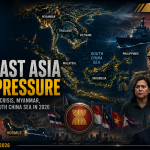 KBA13 Insight Regional Update: Southeast Asia Under Pressure (Hormuz Shock, ASEAN Crisis, Myanmar, Indonesia, and the South China Sea in 2026)
Leave a Reply