

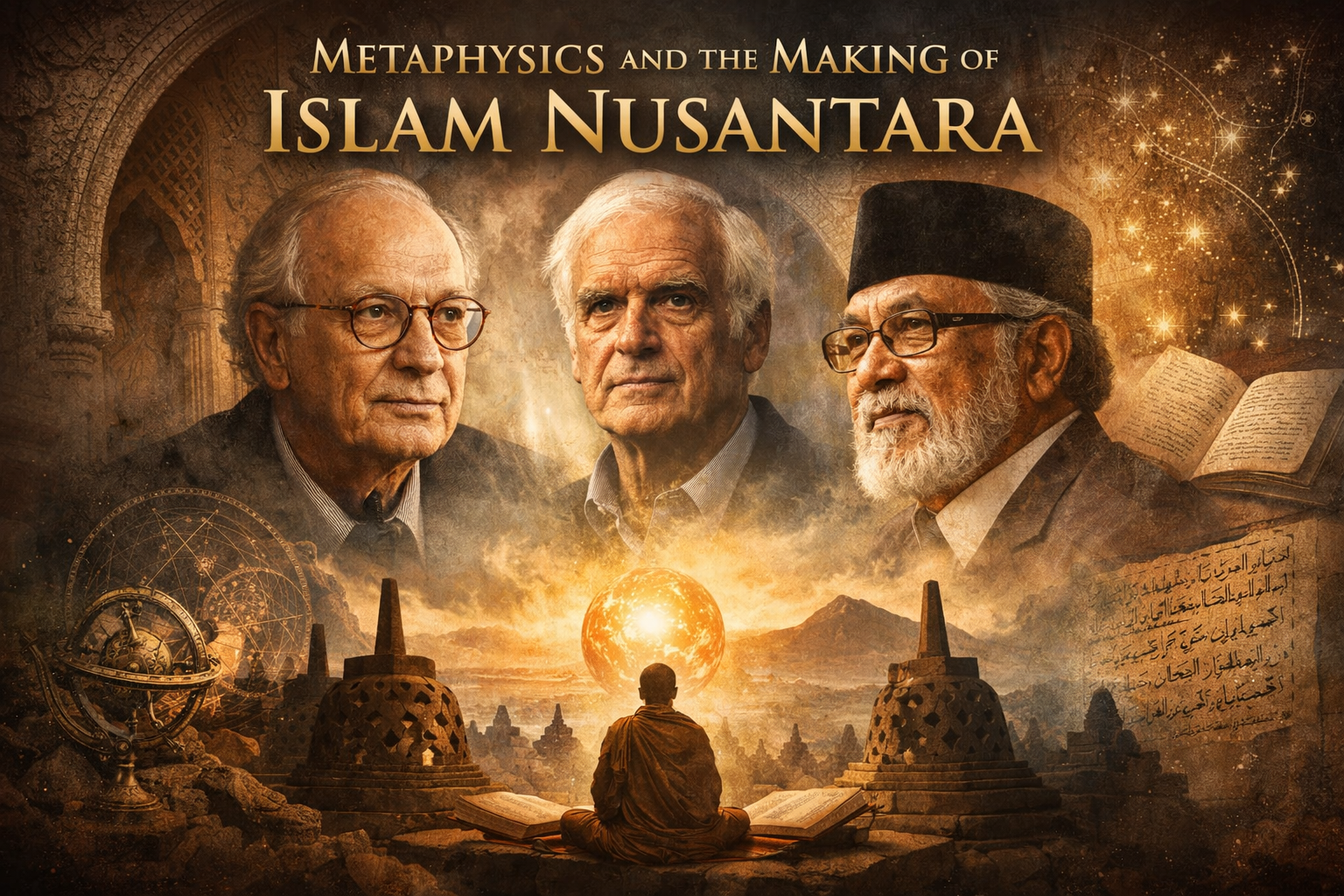
Islam Nusantara as a Metaphysical Problem, Not a Cultural Label
Islam Nusantara has too often been framed as a cultural accommodation or a sociological variation of Islam, a category meant to signal moderation, locality, or historical continuity. Such framings, however well-intentioned, reduce Islam Nusantara to the level of surface phenomena. They treat it as an outcome, not as a question. This book begins from a different premise: Islam Nusantara is not primarily a cultural fact to be described, but a metaphysical problem to be thought. It concerns how reality, meaning, and the sacred are understood and lived within a particular historical horizon.
To approach Islam Nusantara metaphysically is to refuse the temptation of identity politics and instead ask how Islamic thought organizes the relationship between the visible and the invisible, the normative and the lived, the inherited and the interpreted. Metaphysics here does not mean abstraction detached from life; it names the deep grammar that structures how truth, authority, and value are perceived. Islam Nusantara, in this sense, is a configuration of meaning that cannot be exhausted by anthropology or sociology alone.
The book insists that Islam Nusantara emerges through interpretive labor, not passive inheritance. It is produced through continuous engagement with symbols, practices, texts, and ethical intuitions that resist reduction to legalism or ideology. This makes Islam Nusantara neither a dilution of Islam nor a romantic preservation of tradition, but a mode of intellectual and spiritual responsibility—one that takes seriously the question of how Islam thinks in history.
By reframing Islam Nusantara as a metaphysical formation, the book intervenes in a broader crisis of contemporary Islamic discourse, which often oscillates between rigid normativity and uncritical accommodation. Against both tendencies, it proposes depth: a return to questions of being, meaning, and imagination as the conditions under which Islam can remain intelligible and humane in the modern world.
Henry Corbin and the Recovery of the Imaginal Dimension
The engagement with Henry Corbin is not ornamental; it is structurally decisive. Corbin’s insistence on the imaginal (mundus imaginalis) restores a dimension of reality that modern epistemology has systematically marginalized. The imaginal is neither subjective fantasy nor empirical fact; it is an ontological domain where meaning takes form. Without this domain, religious life collapses either into literalism or abstraction.
This book draws on Corbin to argue that Islam Nusantara operates within this imaginal register. Its symbolic practices, narrative forms, and ethical sensibilities presuppose a world in which meaning is not merely conceptual but experienced. Such a world cannot be accessed through positivist reason alone, nor can it be dismissed as pre-modern residue. It requires a different epistemic posture—one attuned to presence, symbol, and interiority.
Corbin’s relevance here lies in his refusal of reduction. By affirming the imaginal as real, he offers a way to think Islam beyond both secular disenchantment and dogmatic closure. Islam Nusantara, read through this lens, appears as a tradition that has preserved the imaginal without formalizing it into rigid doctrine. This preservation is not accidental; it is the result of a long-standing sensitivity to symbolic mediation.
In reclaiming Corbin, the book implicitly challenges contemporary Islamic reformism that equates clarity with literalism and authenticity with juridical rigidity. It suggests instead that the loss of the imaginal is not progress but impoverishment. Islam Nusantara, precisely because it has not fully surrendered this dimension, becomes a site where metaphysical depth remains possible.
Charles Taylor and the Conditions of Modern Meaning
The contribution of Charles Taylor lies in clarifying the modern predicament within which Islam Nusantara must be understood. Taylor’s account of modernity is not a story of simple secularization, but of transformed moral and imaginative conditions. Modern subjects inhabit a world where meaning is no longer given, but contested, fragile, and often internally generated.
This book uses Taylor to situate Islam Nusantara within these conditions, not outside them. Islam Nusantara is not a pre-modern enclave surviving untouched by modernity; it is a response to modernity’s pressures without capitulating to its reductionism. It negotiates the tension between transcendence and immanence, between inherited horizons and individual moral agency.
Taylor’s notion of social imaginaries is especially crucial here. Islam Nusantara is sustained not only by doctrines or institutions, but by shared ways of imagining the good, the sacred, and the communal. These imaginaries operate below explicit theory, shaping ethical intuitions and practices. The book argues that ignoring this level leads to misdiagnosing Islam Nusantara as mere cultural expression rather than as a coherent moral world.
By bringing Taylor into conversation with Islamic metaphysics, the book resists the binary opposition between tradition and modernity. It shows that Islam Nusantara does not survive by rejecting modernity, but by reworking its conditions—reinscribing transcendence within a world that often denies it, and doing so without nostalgia or ressentiment.
Syed Muhammad Naquib al-Attas and the Ordering of Knowledge
The metaphysical coherence of the book is anchored in the thought of Syed Muhammad Naquib al-Attas, whose critique of modern knowledge exposes the deep epistemic disorder of contemporary life. For al-Attas, the crisis of the modern world is not primarily political or economic, but conceptual: knowledge has been severed from its metaphysical and ethical foundations.
This book draws on al-Attas to argue that Islam Nusantara preserves an alternative ordering of knowledge—one in which meaning precedes method, and ethics is inseparable from ontology. Islam Nusantara, in this view, is not anti-intellectual, but intellectually disciplined in a different register. It recognizes hierarchy, purpose, and orientation as essential to knowing.
Al-Attas’s relevance also lies in his resistance to uncritical borrowing. The book emphasizes that Islam Nusantara cannot be understood as a soft version of secular modernity. Its engagement with modern concepts is selective, interpretive, and normatively grounded. This selectivity is not weakness; it is a sign of intellectual maturity.
Through al-Attas, the book articulates a powerful critique of contemporary Islamic discourse that mistakes activism for depth and rhetoric for thought. Islam Nusantara is presented instead as a tradition capable of sustaining meaning because it has not abandoned metaphysics. Without such grounding, the book suggests, Islam risks becoming either ideology or sentiment.
Islam Nusantara as an Intellectual Responsibility
The central claim of Metaphysics and the Making of Islam Nusantara is not celebratory but demanding. Islam Nusantara is not offered as a solution, but as a responsibility—the responsibility to think Islam seriously, beyond slogans and defensive postures. It calls for intellectual courage: the courage to engage metaphysics without abstraction, and modernity without surrender.
This book is therefore not merely descriptive; it is normative in the deepest sense. It argues that the future of Islamic thought depends on recovering its capacity for depth, imagination, and ordered knowledge. Islam Nusantara matters not because it is local, but because it exemplifies how Islam can remain meaningful without becoming rigid.
For Indonesian readers, the book is a call to recognize the intellectual stakes of their own tradition. For global readers, it disrupts the geography of Islamic thought by showing that serious metaphysical reflection is not confined to canonical centers. Indonesia appears not as periphery, but as a site of conceptual productivity.
Ultimately, this book insists that Islam can only endure as a living tradition if it continues to think at the level of first principles. Metaphysics and the Making of Islam Nusantara is an invitation to that work—difficult, slow, and indispensable.




Leave a Reply