
KBA13 Insight · KBA13 Insight Note
Petani, Ingatan September, dan Sistem Peringatan Dini:Membaca Kerentanan Ideologis Kaum Tani dalam Konstelasi Pembangunan Indonesia 2026
Petani Indonesia berada di persimpangan antara reforma agraria, konflik tanah, tekanan pembangunan, dan memori politik September. Kajian strategis ini membaca apakah tekanan struktural di pedesaan dapat berkembang menjadi kerentanan ideologis, sekaligus membedakan antara tuntutan agraria yang konstitusional, kritik struktural, dan ancaman keamanan nyata. Dengan menggunakan Indonesia Early Warning…
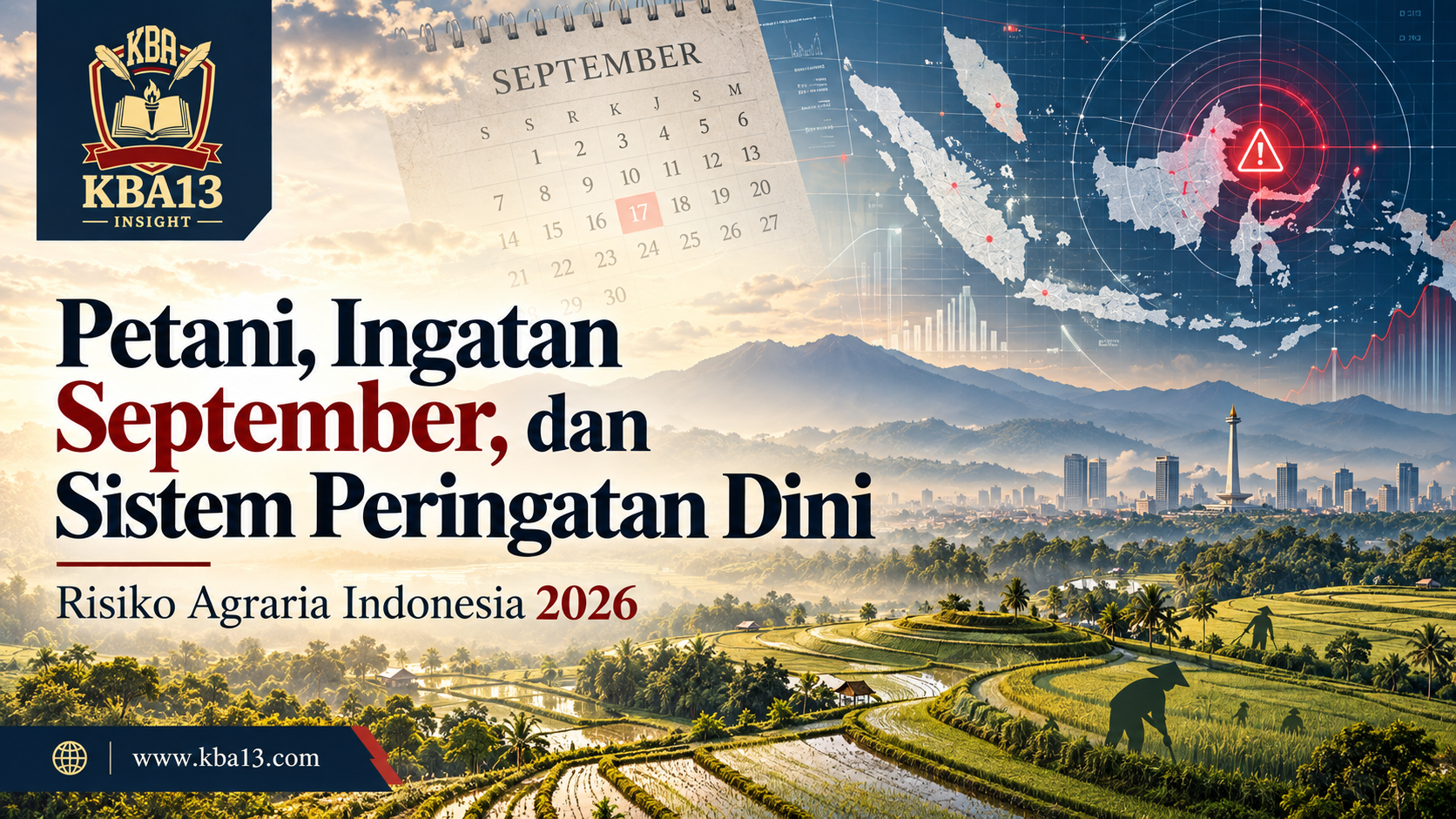
Ringkasan
Petani Indonesia berada di persimpangan antara reforma agraria, konflik tanah, tekanan pembangunan, dan memori politik September. Kajian strategis ini membaca apakah tekanan struktural di pedesaan dapat berkembang menjadi kerentanan ideologis, sekaligus membedakan antara tuntutan agraria yang konstitusional, kritik struktural, dan ancaman keamanan nyata. Dengan menggunakan Indonesia Early Warning System Index KBA13 Insight, analisis memetakan indikator ekonomi, legitimasi, koalisi sosial, keamanan, serta potensi eskalasi dari fase goro-goro menuju krisis yang lebih serius.
Kata Kunci
- 30 September
- early warning system
- G30S
- gerakan tani
- Goro-Goro
- Hari Tani Nasional
- Hari Tani Nasional 2026
- Huru-Hara
- Indonesia 2026
- Indonesia Early Warning System
Ringkasan Eksekutif
Akhir September 2026 menghadirkan tiga lapis waktu yang bertumpuk dalam satu minggu. Pertama, Hari Tani Nasional 24 September, yang tahun ini jatuh dua hari setelah DPR mengesahkan Undang-Undang Pengaturan Reforma Agraria. Kedua, rangkaian “September Hitam” yang digerakkan mahasiswa dan masyarakat sipil untuk mengingat Munir, Semanggi II, dan korban kekerasan dalam demonstrasi Agustus 2025. Ketiga, 30 September, hari ketika bangsa ini mengenang Gerakan 30 September 1965 dan tragedi yang menyertainya.
Penilaian utama tulisan ini dapat diringkas dalam lima butir.
- Kaum tani bukan kelompok yang “mudah disusupi” karena watak ideologisnya. Petani Indonesia secara kultural religius, pragmatis, dan terikat pada tanah. Kerentanannya bersifat struktural: ketika tanah menyempit, konflik menumpuk, dan saluran resmi macet, terbentuk ruang kosong makna yang dapat diisi oleh siapa saja yang menawarkan penjelasan dan organisasi.
- Tidak ada bukti terbuka tentang kebangkitan organisasi komunis di basis tani. Namun kosakata struktural, ketimpangan, perampasan, oligarki, reforma agraria sejati, semakin dominan. Kosakata ini sah secara intelektual dan konstitusional. Ia baru menjadi masalah keamanan bila dipakai untuk mendelegitimasi Pancasila atau menggerakkan kekerasan.
- Risiko keamanan terbesar pekan ini justru ada pada dua ujung: frustrasi agraria yang tidak terjawab, dan pelabelan “PKI” terhadap tuntutan agraria yang sah. Keduanya saling memberi makan. Stigma mendorong gerakan ke pinggir; gerakan yang terpinggirkan lebih mudah dirangkul oleh narasi anti-negara.
- Kebijakan Prabowo untuk petani menunjukkan capaian nyata pada sisi harga dan input, HPP gabah, pupuk, alsintan, pompa, dan Nilai Tukar Petani, yang tertinggi dalam tiga dekade. Paradoksnya terletak pada sisi tanah: letusan konflik agraria 2025 justru tertinggi dalam lima tahun, dengan keterlibatan sektor militer yang melonjak.
- Dengan kerangka Early Warning System Index (EWI) yang saya kembangkan di KBA13 Insight, sektor agraria nasional saya baca berada pada tingkat Watch, dengan kantong-kantong lokal pada tingkat Alert. Jendela 24 September–1 Oktober adalah fase goro-goro Ia bisa naik bila ada pemicu tunggal yang viral, terutama korban jiwa dalam penggusuran atau pengamanan aksi.
Kesimpulan kebijakan saya sederhana namun mendesak: cara paling efektif menutup ruang ideologi terlarang di desa bukan dengan menambah kecurigaan, melainkan dengan mempercepat keadilan agraria dan menjaga agar ingatan 1965 tidak dipakai sebagai senjata dalam konflik hari ini.
1. Tiga Kalender dalam Satu Minggu
Dalam tulisan-tulisan saya di KBA13 Insight sepanjang 2026, terutama proyeksi risiko Agustus untuk 38 provinsi dan seri Goro-Goro menuju Huru-Hara, saya berpegang pada satu metode: krisis jarang datang dari satu sebab. Ia lahir ketika tiga kalender bertemu, kalender sipil yang memberi momentum simbolik, kalender ekonomi yang memberi tekanan, dan kalender legitimasi yang merekam jarak antara janji dan pengalaman warga.
Minggu terakhir September 2026 adalah contoh nyaris sempurna dari pertemuan itu.
Kalender sipil menampilkan tiga tanggal berurutan. Hari Tani Nasional berakar pada pengesahan UUPA No. 5 Tahun 1960 pada 24 September 1960, yang kemudian dikukuhkan melalui Keppres 169 Tahun 1963. Berbeda dengan hari nasional lain yang diisi upacara, tanggal ini sejak lama diisi aksi organisasi tani, karena ia memperingati undang-undang yang pelaksanaannya terus ditagih. Rangkaian September Hitam mengisi pertengahan bulan dengan ingatan kekerasan negara. Lalu 30 September menutup bulan dengan ingatan paling traumatik dalam sejarah politik Indonesia modern.
Kalender ekonomi menghadirkan tekanan yang telah saya petakan dalam proyeksi Agustus: rupiah yang bertahan di atas garis psikologis delapan belas ribu, gelombang PHK di sektor padat karya, dan kegagalan berulang program Makan Bergizi Gratis dalam hal keamanan pangan. Bagi rumah tangga desa, tekanan ini terasa sebagai harga kebutuhan pokok dan menyempitnya lapangan kerja non-pertanian bagi anak-anak mereka.
Kalender legitimasi menghadirkan catatan yang lebih halus namun lebih menentukan. Satu tahun setelah demonstrasi Agustus 2025 dan kematian Affan Kurniawan, proses akuntabilitas dinilai publik belum tuntas. Pada saat yang sama, pengesahan UU Pengaturan Reforma Agraria yang berlangsung sangat cepat melahirkan dua tafsir sekaligus: sebagai “kado” Hari Tani, dan sebagai legislasi kilat yang minim partisipasi.
Ketika tiga kalender ini bertemu, persoalan agraria tidak lagi berdiri sendiri. Ia masuk ke dalam medan makna yang lebih luas, dan di medan itulah pertarungan ideologis sesungguhnya berlangsung.
2. Potret Lapangan: Hari Tani 2026 dan September Hitam
Mari kita mulai dari apa yang benar-benar terjadi, bukan dari apa yang dikhawatirkan.
Pada 22 September 2026, DPR dalam rapat paripurna menyetujui RUU Pengaturan Reforma Agraria menjadi undang-undang. Regulasi ini terdiri atas 14 bab dan 53 pasal, dibahas melalui 596 Daftar Inventarisasi Masalah dan pertemuan dengan 55 pihak. Substansinya penting: penataan, pengendalian, dan pembatasan penguasaan tanah untuk mencegah konsentrasi dan rekonsentrasi; penetapan lokasi prioritas berdasarkan ketimpangan, konflik, tanah terlantar, kemiskinan, tanah absentee, dan penguasaan yang melampaui batas maksimum; perluasan subjek penerima kepada buruh tani, nelayan, masyarakat adat, perempuan, dan warga miskin; perlindungan hukum bagi penerima, pendamping, pelapor, dan saksi; serta mandat pembentukan Lembaga Penyelenggara Reforma Agraria yang berada langsung di bawah Presiden.
Respons masyarakat sipil terbelah, dan pembelahan inilah yang perlu dicermati intelijen. Konsorsium Pembaruan Agraria (KPA) menyambut undang-undang ini sebagai langkah awal. Sekretaris Jenderal KPA, Dewi Kartika, menyebut adanya lembaga khusus sebagai kemajuan penting, “kado yang baik artinya ada lembaga khusus,” katanya. KPA juga menyebut sekitar sepuluh ribu petani berkonsolidasi di Jakarta pada 24 September untuk menyambut sekaligus mengawal implementasinya. Sebaliknya, Aliansi Gerakan Reforma Agraria (AGRA), YLBHI, HuMa, dan sejumlah organisasi lain mengkritik objek redistribusi, desain kelembagaan, pengecualian lokasi tertentu, hingga ketentuan pidana. YLBHI menyebut pembahasannya kurang dari 14 hari, “super kilat.”
Di jalanan, pembelahan itu terlihat jelas. Di depan Gedung DPR, massa serikat tani, mahasiswa, dan organisasi sipil datang dengan long march, menabuh kentongan, dan membawa sayur-mayur serta hasil kebun. BEM KM IPB bersama AGRA dan kampus lain membawa lima tuntutan: reforma agraria di sektor pertanian, kehutanan, dan kelautan; penuntasan konflik dan pemulihan ruang hidup; penghentian represi dan kriminalisasi; prioritas APBN untuk petani dan nelayan; serta kedaulatan pangan tanpa merampas ruang hidup rakyat. Dua minggu sebelumnya, 14 September, lebih dari 1.500 anggota Serikat Petani Indonesia (SPI) telah turun ke DPR untuk mengawal RUU agar tidak menjadi instrumen perlindungan kepentingan korporasi.
Di daerah, pola serupa muncul. Di Bengkulu, Aliansi Rakyat Bersatu yang terdiri atas petani, warga, dan mahasiswa mendatangi kantor gubernur. Di Garut, ratusan petani berkumpul dalam seminar publik Hari Tani di sebuah pesantren ekologi di Tarogong Kidul. Detail terakhir ini penting: basis gerakan tani di Jawa Barat bertemu di pesantren, bukan di sel-sel rahasia. Ini adalah data yang seharusnya meredam, bukan membesarkan, kecemasan tentang infiltrasi komunis.
Pada hari yang sama, buruh mengawal pembahasan RUU Perlindungan Ketenagakerjaan dengan isu kepastian kerja, upah, jaminan sosial, dan hak berserikat. Mahasiswa dan masyarakat sipil memakai momentum September Hitam. Di Kalimantan Selatan, misalnya, rangkaian “Menolak Lupa, Merawat Solidaritas” pada 19–20 September diisi dengan ziarah ke makam korban Jumat Kelabu, pemutaran film, pameran foto, dan Aksi Kamisan, dengan tuntutan pengungkapan pelanggaran HAM, penghentian impunitas, serta proses hukum yang adil bagi mereka yang ditangkap dalam demonstrasi 2026.
Bersamaan dengan itu, di media sosial beredar wacana “Black September” yang dikaitkan dengan kekhawatiran akan aksi besar yang dapat mengguncang stabilitas. Sejumlah pengamat menilai isu ini sengaja digoreng. Saya membaca gejala ini sebagai pola yang sudah saya uraikan dalam kajian demonstrasi Agustus 2025: perang wacana di media sosial sering bergerak lebih cepat dan lebih jauh daripada mobilisasi fisik di lapangan.
Kesimpulan lapangan saya: 24 September 2026 adalah hari konvergensi tuntutan, tani, buruh, mahasiswa, tetapi bukan hari konvergensi ideologi. Tuntutan tani bersifat material dan spesifik. Bahasa yang dipakai adalah bahasa konstitusi dan HAM, bukan bahasa revolusi kelas. Inilah titik berangkat analisis yang jujur.
3. Mengapa Petani Menjadi Ladang Perebutan Ideologi
Pertanyaan dari Kasubdit Analis, apakah kelompok tani mudah disusupi, perlu dijawab dengan hati-hati. Jawaban saya: petani tidak mudah disusupi karena mereka lemah secara ideologis, tetapi mudah diperebutkan karena mereka kuat secara struktural dan lemah secara kelembagaan.
Kuat secara struktural, karena petani adalah basis demografis terbesar di luar kota. Sensus Pertanian 2023 BPS mencatat 27,80 juta petani pengguna lahan. Mereka menguasai rantai pangan, dan dalam tradisi politik mana pun, nasionalis, Islam, sosialis, siapa yang menggerakkan desa menggerakkan republik. Karena itu, sepanjang sejarah Indonesia, petani selalu menjadi objek penggalangan.
Lemah secara kelembagaan, karena dari 27,80 juta petani itu, 17,25 juta adalah petani gurem yang menggarap lahan kurang dari setengah hektare. Menteri ATR/BPN Nusron Wahid pada April 2025 mengakui bahwa dari sekitar 70 juta hektare tanah non-hutan, sekitar 30 juta hektare berada dalam bentuk HGU dan HGB yang dikuasai kurang lebih 3.500 perusahaan, yang terafiliasi dengan sekitar 60 keluarga besar. Angka ini bukan temuan aktivis; ini pengakuan negara.
Dari kombinasi dua kondisi itu lahir apa yang dalam kerangka Layered-Dependency Model saya sebut ketergantungan berlapis. Petani gurem bergantung pada tanah yang tidak sepenuhnya mereka kuasai, pada input yang harganya ditentukan di luar desa, pada tengkulak dan penggilingan, pada kredit, dan pada negara sebagai penentu harga dasar. Setiap lapisan ketergantungan adalah pintu masuk. Siapa pun yang dapat menjelaskan mengapa lapisan-lapisan itu menindih mereka, dan menawarkan organisasi untuk melawannya, akan didengar.
Di sinilah letak kerentanan ideologisnya. Ideologi, dalam pengertian antropologis, adalah peta makna yang menjelaskan penderitaan dan menunjukkan jalan keluar. Ketika negara, partai, dan organisasi keagamaan arus utama tidak lagi menyediakan peta itu secara meyakinkan, peta alternatif akan masuk. Peta itu bisa berwarna merah, bisa berwarna hijau, bisa etno-nasionalis, dan paling sering hanya pragmatis-oportunis: calo politik yang menunggangi konflik untuk pemilu lokal atau untuk kepentingan korporasi pesaing.
Ada empat mekanisme yang membuat petani menjadi ladang perebutan.
Pertama, konflik yang berlarut. KPA mencatat 3.575 konflik agraria sepanjang 2015–2025 dengan luas sekitar 8,33 juta hektare. Konflik yang tidak selesai selama belasan tahun melahirkan generasi petani yang tumbuh dengan pengalaman kalah di pengadilan, digusur, atau dikriminalisasi. Pengalaman itu membentuk kesadaran, dan kesadaran membutuhkan bahasa.
Kedua, pendamping dari luar desa. Hampir setiap konflik agraria yang bertahan lama melibatkan pendamping: LBH, LSM, mahasiswa, ormas keagamaan, partai. Pendamping membawa kerangka analisis. Sebagian membawa kerangka HAM dan konstitusi; sebagian membawa kerangka struktural yang berakar pada tradisi kiri. Ini bukan infiltrasi dalam pengertian konspiratif; ini adalah sirkulasi gagasan yang normal dalam demokrasi.
Ketiga, fusi dengan gerakan lain. Tanggal 24 September 2026 memperlihatkan pertemuan tani, buruh, dan mahasiswa dalam satu hari. Dalam kajian saya tentang demonstrasi Agustus 2025, fusi semacam ini adalah variabel eskalasi terpenting: masing-masing tuntutan sempit, tetapi ketika mereka bertemu di satu ruang simbolik, lahir perasaan kolektif bahwa “sistem” yang bermasalah.
Keempat, kekosongan organisasi keagamaan di basis agraria konflik. NU dan Muhammadiyah memiliki basis besar di pedesaan, tetapi keterlibatan kelembagaan mereka dalam advokasi konflik agraria melawan korporasi dan BUMN masih terbatas dibanding peran mereka dalam pendidikan dan dakwah. Pesantren ekologi di Garut menunjukkan model lain yang mungkin, tetapi model itu belum menjadi arus utama.
4. Konteks Sejarah: Penggalangan Petani sebelum dan sesudah 1965
Tidak mungkin berbicara tentang petani dan komunisme di Indonesia tanpa kembali ke 1960–1965. Sejarah ini perlu dibaca dengan tenang, karena justru ketidaktenangan dalam membacanya yang menjadi sumber risiko hari ini.
UUPA 1960 lahir sebagai kompromi nasional. Ia mengakhiri dualisme hukum agraria kolonial dan menegaskan fungsi sosial hak atas tanah. Bersamaan dengan itu, UU No. 2 Tahun 1960 tentang Perjanjian Bagi Hasil dan PP No. 224 Tahun 1961 tentang redistribusi tanah memberi dasar hukum pembatasan penguasaan dan pembagian lahan kelebihan. Secara normatif, kerangka ini adalah proyek nasional, bukan proyek satu partai. Ia didukung lintas golongan dalam semangat Pasal 33 UUD 1945.
Masalahnya terletak pada pelaksanaan. Redistribusi berjalan lambat, dihambat oleh birokrasi dan oleh kepentingan pemilik tanah besar, termasuk sebagian yang memiliki afiliasi kuat dengan partai-partai nasionalis dan keagamaan di tingkat lokal. PKI, melalui organisasi massa Barisan Tani Indonesia (BTI), membaca kelambanan ini sebagai peluang. BTI tumbuh menjadi salah satu organisasi tani terbesar dengan klaim keanggotaan jutaan orang. Pimpinan PKI merumuskan musuh di desa dalam formula “tujuh setan desa”, tuan tanah jahat, lintah darat, tukang ijon, tengkulak jahat, kapitalis birokrat, bandit desa, dan penguasa jahat. Formula ini brilian secara propaganda: ia memberi nama pada penderitaan yang nyata, sekaligus membagi desa menjadi kawan dan lawan.
Antara 1963 dan 1965, BTI dan PKI menjalankan “aksi sepihak”: penguasaan dan pembagian tanah tanpa menunggu proses resmi, terutama di Jawa Timur, Jawa Tengah, Bali, dan Sumatera Utara. Aksi ini berbenturan langsung dengan pemilik tanah, dan di banyak tempat pemilik tanah itu adalah kiai, haji, tokoh PNI, atau lembaga wakaf dan pesantren. Konflik agraria berubah menjadi konflik ideologis dan keagamaan. Peristiwa Kanigoro di Kediri pada Januari 1965, ketika massa PKI menyerbu kegiatan pelatihan Pelajar Islam Indonesia, dan Peristiwa Bandar Betsy di Simalungun pada Mei 1965, ketika seorang anggota TNI tewas dalam bentrokan di lahan perkebunan negara, menjadi penanda bahwa desa telah menjadi medan tempur sebelum Gerakan 30 September meletus di Jakarta.
Setelah 30 September 1965, ketegangan desa yang menumpuk itu meledak menjadi kekerasan massal pada 1965–1966, dengan korban dalam jumlah sangat besar, sebagian besar di pedesaan Jawa, Bali, dan Sumatera. Tragedi ini melukai semua pihak: keluarga para jenderal yang gugur, keluarga ulama dan santri yang menjadi sasaran aksi sepihak, dan keluarga ratusan ribu warga desa yang terbunuh atau dipenjara tanpa proses hukum. Hingga kini sejarawan masih memperdebatkan banyak aspek peristiwa itu. Namun ada satu pelajaran yang disepakati hampir semua pihak: ketika konflik agraria dibiarkan menjadi konflik ideologis, desa membayar harga tertinggi.
Negara Orde Baru menarik pelajaran yang berbeda. PKI dibubarkan dan ajaran komunisme/Marxisme-Leninisme dilarang melalui TAP MPRS XXV/1966. Semangat redistributif UUPA dibekukan. Petani ditempatkan dalam politik “massa mengambang” dan disalurkan melalui organisasi korporatis tunggal. Stabilitas tercapai, tetapi ketimpangan penguasaan tanah justru melebar, karena tanah dialokasikan kepada konsesi perkebunan, kehutanan, dan pertambangan dalam skala besar. Setiap tuntutan tanah berisiko dicap “PKI” atau “OTB”, organisasi tanpa bentuk. Stigma menjadi instrumen tata kelola agraria.
Reformasi membuka kembali ruang itu. TAP MPR IX/2001 tentang Pembaruan Agraria dan Pengelolaan Sumber Daya Alam, lahirnya serikat-serikat tani independen, program Tanah Objek Reforma Agraria dan Perhutanan Sosial di era sebelumnya, hingga UU Pengaturan Reforma Agraria 2026, semuanya adalah upaya menuntaskan pekerjaan rumah 1960 dengan cara yang konstitusional. Kerangka hukum pidananya juga telah diperbarui. KUHP baru yang berlaku sejak Januari 2026 tetap memidana penyebaran ajaran komunisme/Marxisme-Leninisme yang bertentangan dengan Pancasila, tetapi mengecualikan kajian untuk kepentingan ilmu pengetahuan. Garis hukumnya jelas: yang dilarang adalah penyebaran dan pengorganisasian ideologi untuk mengganti Pancasila, bukan analisis ketimpangan.
Pelajaran sejarah bagi analis hari ini dapat dirumuskan dalam tiga kalimat. Penggalangan petani oleh PKI berhasil karena negara lamban menjalankan undang-undangnya sendiri. Penggalangan itu menjadi berdarah karena konflik agraria dibiarkan berubah menjadi konflik identitas di tingkat desa. Dan stigma pasca-1965 menekan gejala tetapi memperdalam akar, karena ketimpangan tanah justru dibiarkan tumbuh.
5. Sosialisme sebagai Ladang Baru? Membedakan Gagasan, Organisasi, dan Stigma
Apakah ideologi sosialis atau komunis sedang menjadi ladang baru di kalangan petani yang terdesak oleh pembangunan? Jawaban saya perlu dibedakan dalam tiga lapis.
Lapis gagasan. Di sini jawabannya ya, dalam arti terbatas. Kosakata kritik struktural sedang menguat di kalangan aktivis agraria, mahasiswa, dan sebagian akademisi. Istilah seperti “reforma agraria sejati,” “perampasan ruang hidup,” “oligarki tanah,” dan “kedaulatan pangan” dipakai luas. Sebagian kosakata ini berakar pada tradisi pemikiran kiri, sebagian lagi pada gerakan petani internasional dan Deklarasi PBB tentang Hak Asasi Petani (UNDROP), dan sebagian besar, ini yang sering dilupakan, berakar pada Pasal 33 UUD 1945 dan UUPA sendiri. Menguatnya kosakata ini adalah gejala dari kondisi struktural, bukan sebabnya. Bila sepuluh ribu petani berkumpul menuntut pembatasan penguasaan tanah, mereka sedang menuntut pelaksanaan undang-undang yang baru disahkan negara, bukan menjalankan program partai terlarang.
Lapis organisasi. Di sini, berdasarkan sumber terbuka yang saya telaah, tidak terdapat bukti kebangkitan organisasi komunis yang terstruktur di basis tani. Organisasi tani yang aktif, SPI, KPA, AGRA, dan serikat-serikat lokal, bekerja secara terbuka, berbadan hukum, beraudiensi dengan DPR dan kementerian, serta menggunakan jalur konstitusional. Perbedaan ideologis di antara mereka nyata: ada yang lebih moderat-reformis, ada yang lebih radikal dalam analisis. Tetapi radikal dalam analisis tidak sama dengan subversif dalam tindakan. Analis intelijen yang baik harus menjaga pembedaan ini, karena mencampuradukkannya akan mengacaukan penilaian ancaman.
Lapis stigma. Di sini justru terdapat risiko terbesar. Setiap tahun, menjelang 30 September, isu “kebangkitan PKI” diproduksi dan dikonsumsi di ruang digital. Kajian media menunjukkan isu ini memiliki siklus yang berkaitan dengan kontestasi politik, bukan dengan bukti lapangan. Ketika stigma ini ditempelkan pada gerakan agraria, tiga hal terjadi. Tuntutan yang sah kehilangan legitimasi di mata publik. Aparat di lapangan memperoleh pembenaran moral untuk tindakan berlebih. Dan, ini yang paling berbahaya, sebagian aktivis muda yang merasa dizalimi justru tertarik pada identitas yang dituduhkan kepada mereka. Stigma, dalam bahasa kajian radikalisasi, dapat menjadi mekanisme rekrutmen terbalik.
Maka rumusan saya: ideologi kiri bukan ladang baru yang sedang ditanami secara terorganisasi, tetapi ketimpangan agraria adalah lahan yang sedang dibiarkan tidak digarap oleh negara. Lahan yang dibiarkan kosong akan ditumbuhi apa saja. Tugas negara bukan menjaga lahan itu dengan pagar kecurigaan, tetapi menggarapnya lebih dulu dengan keadilan.
Satu catatan tambahan. Dalam tulisan-tulisan saya tentang terorisme dan radikalisasi, saya selalu mengingatkan bahwa kelompok ekstrem kanan berbasis agama juga membaca penderitaan agraria sebagai peluang. Narasi “tanah umat dirampas asing dan aseng” sama efektifnya dengan narasi “tanah rakyat dirampas oligarki.” Sistem peringatan dini yang hanya melihat ke kiri akan buta ke kanan.
6. Kebijakan Prabowo untuk Petani: Capaian dan Paradoks
Keadilan analitis menuntut kita mencatat bahwa pemerintahan Prabowo menempatkan petani di pusat agenda nasional. Swasembada pangan dijadikan agenda strategis, dan Presiden berulang kali menegaskan bahwa ukuran keberhasilan negara adalah kemampuannya memberi makan rakyatnya. Sejumlah kebijakan konkret patut dicatat.
Harga gabah. Pemerintah menaikkan Harga Pembelian Pemerintah (HPP) gabah kering panen dari Rp6.000 menjadi Rp6.500 per kilogram, dengan skema any quality tanpa rafaksi. Bulog ditugaskan menyerap gabah petani untuk Cadangan Beras Pemerintah. Presiden secara terbuka mengancam akan menindak penggilingan besar yang mempermainkan harga. Bagi petani padi, ini adalah jaminan lantai harga yang lama dinantikan.
Pupuk. Kuota pupuk bersubsidi dinaikkan hingga 9,5 juta ton, rantai distribusinya dipangkas, dan harga pupuk diturunkan sekitar 20 persen. Pemerintah mengambil alih kendali distribusi untuk menjamin ketersediaan dan keterjangkauan. Menteri Pertanian Andi Amran Sulaiman menyatakan keluhan petani soal pupuk telah hilang.
Alsintan dan air. Pada 2026, Kementerian Pertanian menyiapkan 38.969 unit alat dan mesin pertanian dengan anggaran sekitar Rp4,19 triliun, dilengkapi kredit berbunga rendah. Lebih dari 150 ribu unit pompa telah beroperasi dengan cakupan sekitar empat juta hektare, ditopang pembangunan embung, dam parit, dan irigasi perpompaan.
Hasil yang diklaim. Nilai Tukar Petani mencapai 127,73 pada Mei 2026 dan 127,84 pada Juli 2026, tertinggi dalam lebih dari tiga dekade. Cadangan beras pemerintah mencapai rekor. Pemerintah menyatakan swasembada telah tercapai untuk delapan komoditas pangan.
Kelembagaan desa dan hilir. Koperasi Desa Merah Putih dan program Makan Bergizi Gratis dirancang sebagai penyerap hasil pertanian lokal, sehingga petani memiliki pasar yang lebih pasti.
Tanah. Pengesahan UU Pengaturan Reforma Agraria pada 22 September 2026, dengan mandat Lembaga Penyelenggara Reforma Agraria di bawah Presiden, adalah langkah hukum paling signifikan di bidang pertanahan sejak TAP MPR IX/2001.
Dari sudut peringatan dini, capaian ini penting karena ia mengurangi tekanan pada lapisan harga dan input. Petani padi yang harganya terjamin dan pupuknya tersedia adalah petani yang lebih sulit digerakkan untuk konfrontasi. Inilah sebabnya aksi Hari Tani 2026 berfokus pada tanah, bukan pada harga.
Namun di sinilah paradoksnya. KPA mencatat 341 letusan konflik agraria sepanjang 2025, mencakup 914.574 hektare dan berdampak pada 123.612 keluarga di 428 desa, naik sekitar 15 persen dari 2024 dan tertinggi dalam lima tahun. Sektor perkebunan dan agribisnis menyumbang 135 letusan, diikuti infrastruktur, kehutanan, pertambangan, dan fasilitas militer. Konflik yang melibatkan sektor militer melonjak dari enam kasus pada 2024 menjadi 24 kasus pada 2025, sebagian terkait operasi yang diklaim mendukung swasembada pangan dan energi, serta operasi penertiban kawasan hutan. Sepanjang 2025, KPA mencatat 736 warga menjadi korban kekerasan dan kriminalisasi di wilayah konflik agraria. KPA sendiri memberi judul catatan tahunannya dengan nada keras: “Tancap Gas di Jalur yang Salah.”
Angka KPA adalah hasil pemantauan masyarakat sipil, bukan statistik resmi tunggal pemerintah, dan harus dibaca dengan kehati-hatian metodologis. Namun arahnya konsisten dengan temuan saya dalam proyeksi risiko Agustus 2026: konflik Rempang di Kepulauan Riau, tujuh konflik agraria dan rencana long march petani di Lampung, food estate Merauke di Papua Selatan, konflik masyarakat adat dengan konsesi di Kalimantan dan Sulawesi Tenggara. Semuanya adalah titik di mana proyek pembangunan, sering berlabel strategis nasional atau swasembada, bertemu dengan klaim tanah warga.
Paradoks inilah yang harus dibaca secara jernih. Pemerintah berhasil di sisi harga, tetapi sebagian proyek pangan dan energinya sendiri melahirkan konflik tanah. Petani yang diuntungkan oleh HPP tinggi bisa jadi adalah petani yang sama yang lahannya terancam oleh ekspansi perkebunan atau food estate. Kebijakan yang pro-petani di satu lapisan dapat menjadi anti-petani di lapisan lain. Dalam bahasa Layered-Dependency Model, pemerintah menurunkan ketergantungan di lapisan input, tetapi menaikkan ketidakpastian di lapisan tanah, dan lapisan tanah adalah lapisan paling eksistensial.
Satu catatan tentang iklim wacana. Pernyataan Presiden pada 18 September 2026 tentang “pakar” yang terlalu pintar hingga menjadi bodoh memicu polemik dengan kalangan akademisi. Saya tidak ingin membesar-besarkannya. Namun dari sudut peringatan dini, relasi negara dengan pengkritiknya adalah variabel legitimasi. Ketika kritik terhadap kebijakan agraria dipersepsikan tidak didengar, kritik itu akan mencari saluran lain. Negara yang kuat adalah negara yang mampu mengubah kritik menjadi koreksi.
7. Membaca dengan Kerangka Early Warning System KBA13
Dalam KBA13 Insight, saya mengembangkan Indonesia Early Warning System Index (EWI) dengan empat tingkat: Normal (di bawah 50), Watch (50–64), Alert (65–79), dan Critical (80 ke atas). Indeks ini bukan peringatan resmi negara, melainkan pembacaan probabilistik atas situasi yang sedang berlangsung, dengan pembagian ke dalam empat lapis: ekonomi, legitimasi, koalisi sosial, dan keamanan. Eskalasinya saya baca melalui idiom wayang yang dipahami masyarakat kita: dari goro-goro, fase gaduh penuh pertanda, menuju huru-hara, kekacauan sesungguhnya. Kebanyakan bulan tidak pernah meninggalkan fase biasa. Sebagian mencapai goro-goro lalu reda. Yang jarang terjadi adalah bulan ketika para punakawan meninggalkan panggung dan badai benar-benar datang.
Untuk sektor agraria pada jendela 24 September hingga 1 Oktober 2026, pembacaan saya adalah sebagai berikut.
Lapis ekonomi, tekanan sedang. Harga gabah dan pupuk relatif terkendali, dan NTP tinggi. Namun tekanan rupiah, PHK di sektor manufaktur yang memulangkan tenaga kerja ke desa, serta kenaikan harga kebutuhan non-pangan tetap membebani rumah tangga tani.
Lapis legitimasi, tekanan sedang hingga tinggi. Pengesahan UU Reforma Agraria menaikkan harapan, tetapi kecepatan pembahasannya menurunkan kepercayaan sebagian gerakan. Harapan yang naik tanpa implementasi cepat adalah resep kekecewaan. Ingatan akuntabilitas demonstrasi Agustus 2025 dan penangkapan dalam aksi 2026 menambah beban.
Lapis koalisi sosial, tekanan sedang. Konvergensi tani, buruh, dan mahasiswa pada 24 September terjadi, tetapi tuntutan tetap terpisah dan bahasanya konstitusional. Tidak ada tanda fusi menjadi gerakan tunggal anti-sistem. Pembelahan di antara organisasi tani sendiri, antara yang menerima UU sebagai langkah awal dan yang menolaknya, justru mengurangi kemungkinan mobilisasi tunggal.
Lapis keamanan, tekanan rendah di tingkat nasional, sedang hingga tinggi di kantong lokal. Aksi Hari Tani berjalan damai di Jakarta dan daerah yang saya pantau. Risiko terkonsentrasi di lokasi konflik aktif, terutama di lokasi yang sedang atau akan mengalami penggusuran atau pengosongan lahan.
Dengan pembacaan itu, sektor agraria nasional saya tempatkan pada tingkat Watch. Kantong-kantong yang saya baca pada tingkat Alert adalah wilayah dengan konflik aktif yang melibatkan proyek strategis, perkebunan skala besar, atau aparat bersenjata, antara lain Rempang di Kepulauan Riau, sejumlah titik di Lampung dan Sumatera Utara, kawasan food estate Merauke, serta konflik perkebunan BUMN di Sulawesi Selatan. Tidak ada wilayah yang saya baca pada tingkat Critical untuk isu agraria semata.
Fase yang sedang berlangsung adalah goro-goro rendah: gaduh di ruang digital, ramai di jalanan, tetapi terkendali. Pertanyaannya adalah apa yang dapat menaikkannya.
Pemicu yang perlu diwaspadai. Berdasarkan pola 2025, pemicu eskalasi jarang berupa tuntutan. Pemicunya hampir selalu berupa peristiwa: satu kematian, satu video kekerasan yang viral, satu penggusuran yang menimpa perempuan atau lansia di depan kamera. Dalam demonstrasi Agustus 2025, bukan tuntutan tentang tunjangan DPR yang mengubah protes menjadi kerusuhan, melainkan kematian seorang pengemudi ojek daring. Dalam konteks agraria, pemicu serupa adalah korban jiwa dalam pengosongan lahan, penangkapan massal petani, atau tindakan represif yang dikaitkan dengan label ideologis.
Pemicu simbolik 30 September. Di sini letak risiko khas pekan ini. Bila dalam rentang 27 September hingga 1 Oktober muncul narasi yang menghubungkan aksi tani atau September Hitam dengan “kebangkitan PKI,” dan narasi itu diikuti tindakan kelompok massa tertentu terhadap aktivis, diskusi, atau pemutaran film, maka akan terjadi benturan horizontal. Pola ini pernah muncul beberapa kali sejak 2016. Benturan horizontal semacam ini lebih berbahaya daripada benturan vertikal antara massa dan aparat, karena ia menghidupkan kembali luka 1965 dalam bentuk yang sulit dikendalikan.
Indikator yang dapat menurunkan tingkat. Pengumuman cepat pembentukan Lembaga Penyelenggara Reforma Agraria, penundaan pengosongan lahan di lokasi konflik aktif, dan pernyataan terbuka pemerintah bahwa tuntutan agraria adalah aspirasi konstitusional, bukan ancaman ideologis.
8. Matriks Indikator Peringatan Dini Sektor Agraria
Untuk kebutuhan operasional, saya menyusun indikator yang dapat dipantau secara berkala. Indikator ini sengaja dirancang untuk membedakan keluhan dari ideologi, dan ideologi dari kekerasan.
Indikator struktural (bulanan). Jumlah letusan konflik agraria baru per provinsi; luas lahan dan jumlah keluarga terdampak; jumlah warga yang dikriminalisasi atau menjadi korban kekerasan; kemajuan redistribusi tanah dan penyelesaian konflik oleh lembaga baru; dan pergerakan NTP serta harga gabah di tingkat petani.
Indikator mobilisasi (mingguan). Frekuensi dan ukuran aksi tani; pertemuan jadwal aksi tani dengan aksi buruh dan mahasiswa pada tanggal yang sama; long march lintas daerah menuju ibu kota provinsi atau Jakarta; serta keterlibatan ormas keagamaan besar sebagai pendamping atau sebaliknya sebagai penentang.
Indikator wacana (harian, digital). Pergeseran bahasa tuntutan dari bahasa konstitusi dan HAM ke bahasa penolakan terhadap dasar negara; munculnya simbol organisasi terlarang dalam aksi atau konten; volume dan sumber konten “kebangkitan PKI” yang menyasar aksi tani; serta ajakan kekerasan terhadap aparat, korporasi, atau kelompok lain.
Indikator kekerasan (seketika). Korban jiwa atau luka berat dalam konflik tanah; penggusuran dengan pengerahan aparat bersenjata; bentrokan antara massa sipil yang saling berhadapan atas dasar label ideologis; serta perusakan fasilitas perusahaan atau negara.
Pembacaan operasionalnya: tingkat Watch bertahan selama indikator struktural tinggi, tetapi indikator wacana dan kekerasan rendah. Tingkat naik ke Alert bila indikator mobilisasi menunjukkan fusi lintas kelompok disertai satu pemicu kekerasan. Tingkat Critical hanya relevan bila indikator wacana menunjukkan pergeseran ke penolakan dasar negara secara terorganisasi dan disertai kekerasan berulang. Sejauh sumber terbuka memperlihatkan, kita masih jauh dari kondisi terakhir ini.
Satu prinsip metodologis perlu ditegaskan: indikator ideologi harus didasarkan pada tindakan dan pernyataan terbuka, bukan pada kosakata analisis. Kata “oligarki” atau “reforma agraria sejati” bukan indikator subversi. Bila kita menjadikannya indikator, sistem peringatan dini akan menghasilkan alarm palsu dalam jumlah besar, dan alarm palsu adalah musuh terbesar intelijen yang baik.
9. Tiga Skenario menuju Akhir September dan Awal Oktober
Skenario dasar: pekan yang biasa (paling mungkin). Rangkaian Hari Tani dan September Hitam berakhir tanpa insiden besar. Peringatan 30 September berlangsung dalam bentuk upacara di Lubang Buaya, diskusi, dan ziarah, dengan riak isu “kebangkitan PKI” di media sosial yang tidak berlanjut ke lapangan. Organisasi tani kembali ke meja advokasi untuk mengawal aturan turunan UU Reforma Agraria. Tingkat tetap Watch. Defisit legitimasi tidak bertambah, tetapi juga tidak berkurang, sampai lembaga baru benar-benar bekerja.
Skenario konvergensi (risiko ekor). Sebuah pemicu, korban jiwa dalam pengosongan lahan di salah satu kantong Alert, atau video kekerasan terhadap petani yang viral, bertemu dengan momentum 30 September. Aktivis tani, mahasiswa, dan buruh bergerak bersama dalam solidaritas. Pada saat yang sama, narasi “PKI gaya baru” disebarkan untuk mendelegitimasi mereka, dan kelompok massa tertentu bergerak membubarkan kegiatan. Hasilnya adalah benturan horizontal di beberapa kota, yang memaksa aparat berada di tengah dua kelompok sipil. Tingkat naik ke Alert di tingkat nasional. Skenario ini tidak paling mungkin, tetapi bahan-bahannya tersedia.
Skenario koreksi (peluang). Pemerintah menggunakan momentum pasca-pengesahan UU untuk langkah cepat yang terlihat: menetapkan kerangka lembaga penyelenggara, mengumumkan penyelesaian beberapa konflik prioritas, dan menunda pengosongan lahan di lokasi sengketa sampai mekanisme baru berjalan. Organisasi tani yang kritis pun memperoleh alasan untuk memilih jalur kelembagaan. Tingkat turun ke arah Normal dalam tiga hingga enam bulan. Ini adalah skenario yang paling bergantung pada kehendak politik, dan karena itu paling layak diperjuangkan.
Perlu saya ingatkan bahwa dalam proyeksi Agustus 2026, saya menandai Oktober–November sebagai jendela kritis berikutnya, ketika musim hujan dan potensi bencana hidrometeorologi dapat mengubah bencana alam menjadi bencana politik bila respons negara dinilai gagal. Akhir September adalah pintu masuk jendela itu. Petani adalah kelompok pertama yang menanggung akibat banjir dan longsor, sebagaimana kita saksikan dalam bencana Sumatera akhir 2025. Maka ketegangan agraria yang tidak diselesaikan pada September dapat berlipat ganda pada November.
10. Rekomendasi Strategis
Rekomendasi berikut saya susun dengan satu prinsip: tajam terhadap masalah, lunak terhadap masyarakat.
Pertama, pisahkan secara tegas analisis ideologi dari tuntutan agraria. Dalam produk intelijen, hindari penggunaan label “komunis,” “PKI,” atau “kiri” terhadap organisasi tani atau individu kecuali terdapat bukti tindakan yang memenuhi unsur Pasal 188 KUHP baru. Kosakata struktural bukan bukti. Pelabelan yang keliru dalam dokumen internal cenderung bocor ke tindakan lapangan dan ruang publik, dan akan dibaca sebagai kembalinya pola Orde Baru.
Kedua, jadikan implementasi UU Reforma Agraria sebagai instrumen keamanan. Pembentukan Lembaga Penyelenggara Reforma Agraria bukan sekadar urusan birokrasi pertanahan; ia merupakan katup pengaman. Semakin cepat lembaga ini berfungsi dan menyelesaikan konflik komunal antara warga dan korporasi atau BUMN, semakin kecil ruang bagi narasi bahwa negara tidak dapat dipercaya. Rekomendasi saya: dorong penetapan kerangka kelembagaan dalam hitungan minggu, bukan bulan, dan umumkan beberapa penyelesaian konflik prioritas sebagai bukti awal.
Ketiga, terapkan jeda pengosongan lahan di lokasi konflik aktif selama jendela sensitif. Hingga pertengahan Oktober, dan idealnya hingga lembaga baru berfungsi, pengosongan lahan dengan pengerahan aparat di lokasi berstatus Alert sebaiknya ditunda. Satu korban jiwa dalam pekan 30 September akan menghapus seluruh modal politik yang dibangun melalui HPP, pupuk, dan UU baru.
Keempat, atur sikap aparat dalam pengamanan aksi dan penanganan konflik. Pengalaman 2025 menunjukkan bahwa variabel terpenting dalam kendali negara adalah pengendalian diri aparatnya sendiri. Keterlibatan unsur militer dalam konflik agraria yang meningkat tajam pada 2025 perlu ditinjau, karena kehadiran aparat bersenjata di konflik tanah mengubah persepsi warga dari sengketa perdata menjadi konfrontasi dengan negara.
Kelima, aktifkan intelijen sosial yang berbasis mendengar. Deteksi dini yang paling efektif di desa bukan penyadapan, melainkan kehadiran. Libatkan ulama, pengasuh pesantren, tokoh adat, penyuluh pertanian, dan kepala desa sebagai sumber pembacaan situasi, bukan sebagai informan. Mereka mengetahui lebih awal siapa yang datang ke desa, apa yang dijanjikan, dan di mana kekecewaan menumpuk.
Keenam, dorong ormas keagamaan besar untuk hadir dalam advokasi agraria. NU dan Muhammadiyah memiliki legitimasi moral dan basis desa yang tidak dimiliki organisasi mana pun. Bila mereka hadir sebagai pendamping petani dalam sengketa tanah, bukan hanya sebagai penyeimbang ideologis, maka tuntutan keadilan agraria akan memiliki bahasa keagamaan dan kebangsaan yang kokoh. Contoh pesantren ekologi di Garut layak dikaji dan direplikasi.
Ketujuh, kelola peringatan 30 September sebagai ingatan bersama, bukan sebagai perburuan. Pesan resmi menjelang 30 September perlu menegaskan dua hal sekaligus: penghormatan kepada para pahlawan revolusi dan korban kekerasan PKI, serta penolakan tegas terhadap main hakim sendiri dan pelabelan sembarangan. Aparat perlu mengantisipasi pembubaran paksa diskusi atau kegiatan masyarakat sipil oleh kelompok massa, karena benturan horizontal adalah skenario paling mahal.
Kedelapan, pantau disinformasi di dua arah. Konten “kebangkitan PKI” yang mengada-ada dan konten yang membesar-besarkan represi negara sama-sama merupakan bahan bakar. Tim pemantau digital perlu memetakan sumber, jaringan, dan pola amplifikasi keduanya, dan merespons dengan klarifikasi faktual yang cepat, bukan dengan kriminalisasi yang justru memperluas jangkauan konten.
Kesembilan, jaga konsistensi narasi kebijakan pangan. Keberhasilan HPP dan pupuk perlu dikomunikasikan, disertai pengakuan jujur bahwa sisi tanah masih menjadi pekerjaan rumah. Narasi keberhasilan yang menafikan konflik agraria akan dibaca petani di lokasi konflik sebagai pengabaian, dan memperlebar jarak antara narasi resmi dan pengalaman warga.
11. Penutup: Menggarap Lahan Makna
Setiap bangsa memiliki bulan yang menguji ingatannya. Bagi Indonesia, bulan itu adalah September. Ia dibuka dengan ingatan tentang kekerasan negara terhadap warganya, dilanjutkan dengan peringatan undang-undang yang menjanjikan tanah bagi penggarapnya, dan ditutup dengan ingatan tentang pengkhianatan terhadap negara dan tragedi yang menyusulnya. Tiga ingatan ini sering dipertentangkan, seakan-akan menghormati yang satu berarti mengkhianati yang lain. Padahal ketiganya adalah bagian dari satu pelajaran yang sama: republik ini paling rentan ketika keadilan ditunda dan kecurigaan dipercepat.
Dalam seluruh tulisan saya tentang sistem peringatan dini, saya berpegang pada satu dalil: medan terpenting bagi sebuah negara bukan wilayahnya, melainkan keyakinan warga bahwa negara mampu mengurus wilayah itu dengan adil. Keyakinan itulah yang pertama kali retak sebelum segala sesuatu lainnya retak. Petani adalah penjaga terakhir keyakinan itu di desa. Mereka tidak membutuhkan ideologi impor untuk memahami ketidakadilan; mereka merasakannya setiap musim tanam. Yang mereka butuhkan adalah bukti bahwa undang-undang yang baru disahkan akan bekerja lebih cepat daripada ekskavator yang datang ke lahan mereka.
Ideologi terlarang hanya dapat tumbuh di lahan yang ditinggalkan negara. Karena itu, strategi kontra-ideologi terbaik di desa bukan pagar kecurigaan, melainkan cangkul keadilan. Bila negara menggarap lahan makna itu lebih dulu, dengan reforma agraria yang nyata, aparat yang menahan diri, dan ingatan sejarah yang tidak dijadikan senjata, maka September tidak perlu menjadi hitam, dan 30 September dapat kembali menjadi hari ketika bangsa ini mengenang tragedinya untuk memastikan tragedi itu tidak terulang.
Nilai sebuah peringatan terletak pada kemungkinannya untuk keliru ke arah yang benar. Bila tanda-tanda dibaca cukup dini dan cukup tepat, badai yang dijanjikan oleh pertanda-pertanda itu dapat dicegah. Itulah tujuan analisis ini.
Rujukan Terpilih
- id, “UU Reforma Agraria Disahkan, KPA Tagih Konflik Tanah Segera Dituntaskan,” 25 September 2026.
- Jabaronline, “Reforma UU Agraria dan Aksi 24 September 2026: RUU Ketenagakerjaan hingga September Hitam,” 24 September 2026.
- id dan Kompas.com, liputan aksi Hari Tani Nasional di depan DPR RI, 24 September 2026.
- Serikat Petani Indonesia, “Rangkaian Peringatan Hari Tani Nasional 2026,” September 2026.
- Kalimantan Post dan Shalokal Indonesia, liputan September Hitam Kalsel 2026.
- id dan Betahita, liputan Catatan Tahunan KPA 2025, Januari 2026.
- com dan RRI, “Daftar Kebijakan Prabowo untuk Kesejahteraan Petani,” Juni 2026.
- Kementerian Pertanian, rilis swasembada delapan komoditas pangan, Juli 2026.
- Badan Pangan Nasional, “Kebijakan HPP Gabah Any Quality,” Januari 2026.
- KBA13 Insight, “Indonesia’s August 2026 Risk Forecast: An Early Warning Assessment of All 38 Provinces,” Juli 2026.
- KBA13 Insight, “Indonesia Early Warning System Index,” 2026.
Cara Mengutip
Ahmad, Kamaruzzaman Bustamam. (2026). Petani, Ingatan September, dan Sistem Peringatan Dini: Membaca Kerentanan Ideologis Kaum Tani dalam Konstelasi Pembangunan Indonesia 2026. Banda Aceh: KBA13 Insight.
https://www.kba13.com/petani-risiko-agraria-indonesia-2026/
Guru Besar Antropologi Agama di UIN Ar-Raniry Banda Aceh. Menulis tentang geopolitik, keamanan dan tata kelola Asia Tenggara, Islam di Dunia Melayu, serta masa depan ilmu pengetahuan.
KBA13 Insight · KBA13 Insight Note
Farmers, the Memory of September, and the Early Warning System:Reading the Ideological Vulnerability of the Peasantry in Indonesia’s 2026 Development Constellation
Indonesia’s farmers stand at the crossroads of agrarian reform, land conflict, development pressure and the political memory of September. This strategic study asks whether structural pressure in the countryside can develop into ideological vulnerability, while distinguishing between constitutional agrarian demands, structural critique and real security threats. Using the Indonesia Early Warning…
Summary
Indonesia’s farmers stand at the crossroads of agrarian reform, land conflict, development pressure and the political memory of September. This strategic study asks whether structural pressure in the countryside can develop into ideological vulnerability, while distinguishing between constitutional agrarian demands, structural critique and real security threats. Using the KBA13 Insight Indonesia Early Warning System Index, the analysis maps economic, legitimacy, social coalition and security indicators, as well as the potential for escalation from the goro-goro phase towards a more serious crisis.
Keywords
- 30 September
- early warning system
- G30S
- peasant movement
- Goro-Goro
- National Farmers’ Day
- National Farmers’ Day 2026
- Huru-Hara
- Indonesia 2026
- Indonesia Early Warning System
Executive Summary
The end of September 2026 brings three layers of time stacked into a single week. First, National Farmers’ Day on 24 September, which this year fell two days after the House of Representatives (DPR) passed the Law on the Regulation of Agrarian Reform. Second, the “Black September” series driven by students and civil society to remember Munir, Semanggi II, and the victims of violence during the August 2025 demonstrations. Third, 30 September, the day the nation remembers the 30 September Movement of 1965 and the tragedy that followed.
The main assessment of this paper can be summarised in five points.
- The peasantry is not a group that is “easily infiltrated” because of its ideological character. Indonesian farmers are culturally religious, pragmatic and bound to the land. Their vulnerability is structural: when land shrinks, conflicts pile up and official channels are blocked, a vacuum of meaning forms that can be filled by anyone offering an explanation and an organisation.
- There is no open evidence of a revival of communist organisation in the farming base. But structural vocabulary, inequality, dispossession, oligarchy, genuine agrarian reform, is increasingly dominant. This vocabulary is intellectually and constitutionally legitimate. It becomes a security problem only when used to delegitimise Pancasila or to mobilise violence.
- The greatest security risk this week lies instead at two extremes: unanswered agrarian frustration, and the labelling of legitimate agrarian demands as “PKI”. The two feed each other. Stigma pushes movements to the margins; marginalised movements are more easily embraced by anti-state narratives.
- Prabowo’s policies for farmers show real achievements on the price and input side, the government purchase price (HPP) for unhusked rice, fertiliser, agricultural machinery, pumps, and the Farmers’ Terms of Trade, the highest in three decades. The paradox lies on the land side: outbreaks of agrarian conflict in 2025 were the highest in five years, with a surge in the involvement of the military sector.
- Using the Early Warning System Index (EWI) framework I have developed at KBA13 Insight, I read the national agrarian sector as being at the Watchlevel, with local pockets at the Alertlevel. The window of 24 September–1 October is a goro-goro phase. It could rise if a single viral trigger occurs, especially loss of life in an eviction or in the policing of a protest.
My policy conclusion is simple but urgent: the most effective way to close the space for banned ideologies in the villages is not to add suspicion, but to accelerate agrarian justice and to ensure that the memory of 1965 is not used as a weapon in today’s conflicts.
1. Three Calendars in One Week
In my writing in KBA13 Insight throughout 2026, especially the August risk forecast for 38 provinces and the series Goro-Goro towards Huru-Hara, I have held to one method: crises rarely come from a single cause. They are born when three calendars meet, the civic calendar that provides symbolic momentum, the economic calendar that provides pressure, and the legitimacy calendar that records the gap between promises and citizens’ experience.
The final week of September 2026 is an almost perfect example of that convergence.
The civic calendar presents three consecutive dates. National Farmers’ Day is rooted in the enactment of the Basic Agrarian Law (UUPA) No. 5 of 1960 on 24 September 1960, later confirmed by Presidential Decree 169 of 1963. Unlike other national days filled with ceremonies, this date has long been marked by actions of farmers’ organisations, because it commemorates a law whose implementation is still being demanded. The Black September series fills the middle of the month with memories of state violence. Then 30 September closes the month with the most traumatic memory in the political history of modern Indonesia.
The economic calendar brings the pressures I mapped in the August forecast: a rupiah holding above the psychological line of eighteen thousand, waves of layoffs in labour-intensive sectors, and repeated food safety failures in the Free Nutritious Meals programme. For rural households, these pressures are felt as the price of basic necessities and the narrowing of non-farm employment for their children.
The legitimacy calendar presents a subtler but more decisive record. One year after the August 2025 demonstrations and the death of Affan Kurniawan, the public judges the accountability process to be incomplete. At the same time, the very rapid passage of the Law on the Regulation of Agrarian Reform has given rise to two readings at once: as a Farmers’ Day “gift”, and as lightning legislation with minimal participation.
When these three calendars meet, the agrarian question no longer stands alone. It enters a wider field of meaning, and it is in that field that the real ideological contest takes place.
2. A Portrait from the Field: Farmers’ Day 2026 and Black September
Let us begin with what actually happened, not with what is feared.
On 22 September 2026, the DPR in plenary session approved the Agrarian Reform Regulation Bill into law. The regulation consists of 14 chapters and 53 articles, discussed through 596 items in the List of Issues and meetings with 55 parties. Its substance is important: the ordering, control and limitation of landholding to prevent concentration and reconcentration; the designation of priority locations based on inequality, conflict, abandoned land, poverty, absentee land and holdings exceeding the maximum limit; the extension of eligible beneficiaries to farm labourers, fishers, indigenous peoples, women and the poor; legal protection for beneficiaries, advocates, whistleblowers and witnesses; and a mandate to establish an Agrarian Reform Implementing Agency directly under the President.
Civil society’s response was divided, and it is this division that intelligence needs to observe closely. The Consortium for Agrarian Reform (KPA) welcomed the law as a first step. KPA Secretary-General Dewi Kartika called the existence of a special agency an important advance: “a good gift means there is a special agency,” she said. KPA also said some ten thousand farmers consolidated in Jakarta on 24 September to welcome the law and to oversee its implementation. By contrast, the Alliance of Agrarian Reform Movements (AGRA), YLBHI, HuMa and a number of other organisations criticised the objects of redistribution, the institutional design, the exemption of certain locations, and even the criminal provisions. YLBHI said the deliberations took less than 14 days, “super lightning”.
On the streets, that division was plain to see. In front of the DPR building, crowds from farmers’ unions, students and civic organisations arrived on a long march, beating kentongan drums and carrying vegetables and garden produce. The IPB student executive (BEM KM IPB), together with AGRA and other campuses, brought five demands: agrarian reform in agriculture, forestry and marine affairs; resolution of conflicts and restoration of living space; an end to repression and criminalisation; budget priority for farmers and fishers; and food sovereignty without seizing the people’s living space. Two weeks earlier, on 14 September, more than 1,500 members of the Indonesian Peasants Union (SPI) had gone to the DPR to ensure the bill would not become an instrument to protect corporate interests.
In the regions, a similar pattern emerged. In Bengkulu, the United People’s Alliance of farmers, residents and students went to the governor’s office. In Garut, hundreds of farmers gathered at a Farmers’ Day public seminar in an ecological pesantren in Tarogong Kidul. This last detail matters: the base of the peasant movement in West Java met in a pesantren, not in secret cells. This is data that should calm, not inflate, anxiety about communist infiltration.
On the same day, workers monitored deliberations on the Labour Protection Bill, raising job security, wages, social security and the right to organise. Students and civil society used the momentum of Black September. In South Kalimantan, for example, the series “Refusing to Forget, Nurturing Solidarity” on 19–20 September included pilgrimages to the graves of victims of Jumat Kelabu (Grey Friday), film screenings, photo exhibitions and the Kamisan vigil, with demands for disclosure of human rights violations, an end to impunity, and fair legal process for those arrested in the 2026 demonstrations.
At the same time, a “Black September” discourse circulated on social media, linked to fears of a large-scale action that could shake stability. A number of observers judged the issue to have been deliberately stoked. I read this phenomenon as a pattern I described in my study of the August 2025 demonstrations: the war of discourse on social media often moves faster and further than physical mobilisation on the ground.
My conclusion from the field: 24 September 2026 was a day of convergence of demands, farmers, workers and students, but not a day of convergence of ideology. Farmers’ demands are material and specific. The language used is the language of the constitution and human rights, not the language of class revolution. This is the starting point for honest analysis.
3. Why Farmers Become Contested Ideological Ground
The question from the Head of the Analysts’ Subdirectorate, whether farmers’ groups are easily infiltrated, needs to be answered carefully. My answer: farmers are not easily infiltrated because they are ideologically weak, but they are readily contested because they are structurally strong and institutionally weak.
Structurally strong, because farmers are the largest demographic base outside the cities. The 2023 Agricultural Census by Statistics Indonesia recorded 27.80 million land-using farmers. They control the food chain, and in any political tradition, nationalist, Islamic or socialist, whoever moves the village moves the republic. That is why, throughout Indonesian history, farmers have always been the object of mobilisation.
Institutionally weak, because of those 27.80 million farmers, 17.25 million are smallholders cultivating less than half a hectare. Minister of Agrarian Affairs and Spatial Planning Nusron Wahid acknowledged in April 2025 that of some 70 million hectares of non-forest land, around 30 million hectares are held as HGU and HGB titles controlled by roughly 3,500 companies affiliated with about 60 large families. This figure is not an activist’s finding; it is the state’s admission.
From the combination of these two conditions arises what, within the framework of the Layered-Dependency Model , I call layered dependency. Smallholders depend on land they do not fully control, on inputs whose prices are set outside the village, on middlemen and rice mills, on credit, and on the state as the setter of floor prices. Each layer of dependency is an entry point. Anyone who can explain why those layers press down on them, and who offers an organisation to resist them, will be heard.
Herein lies their ideological vulnerability. Ideology, in the anthropological sense, is a map of meaning that explains suffering and points to a way out. When the state, parties and mainstream religious organisations no longer provide that map convincingly, alternative maps will move in. That map may be red, it may be green, it may be ethno-nationalist, and most often it is simply pragmatic and opportunistic: political brokers riding conflicts for local elections or for the interests of rival corporations.
There are four mechanisms that make farmers contested ground.
First, protracted conflict. KPA recorded 3,575 agrarian conflicts over 2015–2025, covering some 8.33 million hectares. Conflicts left unresolved for over a decade produce a generation of farmers who grow up with the experience of losing in court, being evicted or being criminalised. That experience shapes consciousness, and consciousness needs a language.
Second, advocates from outside the village. Almost every long-running agrarian conflict involves advocates: legal aid institutes, NGOs, students, religious organisations, parties. Advocates bring analytical frameworks. Some bring a human rights and constitutional framework; some bring a structural framework rooted in the leftist tradition. This is not infiltration in a conspiratorial sense; it is the normal circulation of ideas in a democracy.
Third, fusion with other movements. 24 September 2026 showed farmers, workers and students meeting on a single day. In my study of the August 2025 demonstrations, such fusion is the most important escalation variable: each demand is narrow, but when they meet in a single symbolic space, a collective feeling arises that it is “the system” that is at fault.
Fourth, the absence of religious organisations in the agrarian conflict base. NU and Muhammadiyah have large rural bases, but their institutional involvement in advocacy on agrarian conflicts against corporations and state-owned enterprises remains limited compared with their role in education and preaching. The ecological pesantren in Garut shows another possible model, but that model has not yet become mainstream.
4. Historical Context: Mobilising Farmers before and after 1965
It is impossible to speak of farmers and communism in Indonesia without returning to 1960–1965. This history must be read calmly, because it is precisely the lack of calm in reading it that is a source of risk today.
The 1960 Basic Agrarian Law was born as a national compromise. It ended the dualism of colonial agrarian law and affirmed the social function of land rights. Alongside it, Law No. 2 of 1960 on Sharecropping Agreements and Government Regulation No. 224 of 1961 on land redistribution provided the legal basis for limiting landholdings and distributing surplus land. Normatively, this framework was a national project, not the project of a single party. It was supported across groups in the spirit of Article 33 of the 1945 Constitution.
The problem lay in implementation. Redistribution moved slowly, hampered by bureaucracy and by the interests of large landowners, including some with strong affiliations to nationalist and religious parties at the local level. The PKI, through its mass organisation the Indonesian Peasants’ Front (BTI), read this sluggishness as an opportunity. The BTI grew into one of the largest peasant organisations, claiming millions of members. The PKI leadership defined the enemies in the village with the formula of the “seven village devils”: wicked landlords, moneylenders, ijon crop-buyers, wicked middlemen, bureaucratic capitalists, village bandits and wicked rulers. As propaganda the formula was brilliant: it gave a name to real suffering while dividing the village into friend and foe.
Between 1963 and 1965, the BTI and the PKI carried out “unilateral actions”: seizing and dividing land without waiting for official processes, especially in East Java, Central Java, Bali and North Sumatra. These actions clashed directly with landowners, and in many places those landowners were kiai, hajis, PNI figures, or waqf foundations and pesantren. Agrarian conflict turned into ideological and religious conflict. The Kanigoro Incident in Kediri in January 1965, when a PKI crowd stormed a training event of Pelajar Islam Indonesia, and the Bandar Betsy Incident in Simalungun in May 1965, when a soldier was killed in a clash on a state plantation, became markers that the village had become a battlefield before the 30 September Movement erupted in Jakarta.
After 30 September 1965, that accumulated village tension exploded into mass violence in 1965–1966, with an enormous number of victims, most of them in rural Java, Bali and Sumatra. This tragedy wounded all sides: the families of the fallen generals, the families of ulama and santri targeted by the unilateral actions, and the families of hundreds of thousands of villagers killed or imprisoned without legal process. Historians still debate many aspects of those events. Yet there is one lesson almost everyone agrees on: when agrarian conflict is allowed to become ideological conflict, the village pays the highest price.
The New Order state drew a different lesson. The PKI was dissolved and the teachings of communism/Marxism-Leninism were banned through MPRS Decree XXV/1966. The redistributive spirit of the Basic Agrarian Law was frozen. Farmers were placed within the politics of the “floating mass” and channelled through a single corporatist organisation. Stability was achieved, but inequality in landholding actually widened, because land was allocated to large-scale plantation, forestry and mining concessions. Every land claim risked being branded “PKI” or “OTB”, a formless organisation. Stigma became an instrument of agrarian governance.
Reformasi reopened that space. MPR Decree IX/2001 on Agrarian Reform and Natural Resource Management, the birth of independent peasant unions, the Agrarian Reform Land Objects and Social Forestry programmes of earlier eras, and the Law on the Regulation of Agrarian Reform of 2026, are all efforts to complete the unfinished business of 1960 in a constitutional way. The criminal law framework has also been updated. The new Criminal Code in force since January 2026 still criminalises the dissemination of communism/Marxism-Leninism contrary to Pancasila, but exempts study for scholarly purposes. The legal line is clear: what is prohibited is the dissemination and organisation of an ideology to replace Pancasila, not the analysis of inequality.
The lesson of history for today’s analyst can be put in three sentences. The PKI’s mobilisation of farmers succeeded because the state was slow to implement its own laws. That mobilisation turned bloody because agrarian conflict was allowed to become identity conflict at the village level. And the post-1965 stigma suppressed the symptoms but deepened the roots, because land inequality was left to grow.
5. Socialism as New Ground? Distinguishing Ideas, Organisation and Stigma
Are socialist or communist ideologies becoming new ground among farmers squeezed by development? My answer needs to be distinguished across three layers.
The layer of ideas. Here the answer is yes, in a limited sense. The vocabulary of structural critique is gaining strength among agrarian activists, students and some academics. Terms such as “genuine agrarian reform”, “seizure of living space”, “land oligarchy” and “food sovereignty” are widely used. Some of this vocabulary is rooted in the leftist intellectual tradition, some in the international peasant movement and the UN Declaration on the Rights of Peasants (UNDROP), and most of it, this is often forgotten, in Article 33 of the 1945 Constitution and the Basic Agrarian Law itself. The strengthening of this vocabulary is a symptom of structural conditions, not their cause. When ten thousand farmers gather to demand limits on landholding, they are demanding the implementation of a law the state has just passed, not carrying out the programme of a banned party.
The layer of organisation. Here, on the basis of the open sources I have examined, there is no evidence of a structured communist organisation reviving in the farming base. The active peasant organisations, SPI, KPA, AGRA and local unions, work openly, are legally registered, hold hearings with the DPR and ministries, and use constitutional channels. The ideological differences among them are real: some are more moderate and reformist, others more radical in their analysis. But radical in analysis is not the same as subversive in action. A good intelligence analyst must maintain this distinction, because conflating the two will confuse the threat assessment.
The layer of stigma. Here, in fact, lies the greatest risk. Every year, ahead of 30 September, the issue of a “PKI revival” is produced and consumed in the digital space. Media studies show that the issue has a cycle linked to political contestation, not to evidence on the ground. When this stigma is attached to the agrarian movement, three things happen. Legitimate demands lose legitimacy in the eyes of the public. Officers on the ground gain moral justification for excessive action. And, most dangerously, some young activists who feel wronged are drawn to the very identity they are accused of. Stigma, in the language of radicalisation studies, can become a mechanism of reverse recruitment.
Hence my formulation: leftist ideology is not new ground being planted in an organised way, but agrarian inequality is land the state is leaving uncultivated. Land left empty will grow anything. The state’s task is not to guard that land with a fence of suspicion, but to cultivate it first with justice.
One further note. In my writing on terrorism and radicalisation, I have always warned that religiously based far-right groups also read agrarian suffering as an opportunity. The narrative that “the ummah’s land is being seized by foreigners and the ethnic Chinese” is as effective as the narrative that “the people’s land is being seized by the oligarchy”. An early warning system that looks only to the left will be blind to the right.
6. Prabowo’s Policies for Farmers: Achievements and Paradoxes
Analytical fairness requires us to note that the Prabowo government has placed farmers at the centre of the national agenda. Food self-sufficiency has been made a strategic agenda, and the President has repeatedly stressed that the measure of the state’s success is its ability to feed its people. A number of concrete policies deserve mention.
Rice prices. The government raised the Government Purchase Price (HPP) for freshly harvested unhusked rice from Rp6,000 to Rp6,500 per kilogram, under an any quality scheme without quality deductions. Bulog was tasked with absorbing farmers’ rice for the Government Rice Reserve. The President openly threatened to take action against large mills that manipulate prices. For rice farmers, this is a long-awaited price floor.
Fertiliser. The quota of subsidised fertiliser was raised to 9.5 million tonnes, its distribution chain shortened, and fertiliser prices lowered by around 20 per cent. The government took over control of distribution to guarantee availability and affordability. Agriculture Minister Andi Amran Sulaiman said farmers’ complaints about fertiliser had disappeared.
Machinery and water. In 2026, the Ministry of Agriculture prepared 38,969 units of agricultural machinery and equipment with a budget of around Rp4.19 trillion, complemented by low-interest credit. More than 150,000 pumps are in operation, covering some four million hectares, supported by the construction of small reservoirs, ditch dams and pump irrigation.
Claimed results. The Farmers’ Terms of Trade reached 127.73 in May 2026 and 127.84 in July 2026, the highest in more than three decades. Government rice reserves reached a record. The government declared that self-sufficiency had been achieved for eight food commodities.
Village institutions and downstream. The Red and White Village Cooperatives and the Free Nutritious Meals programme are designed to absorb local agricultural output, giving farmers a more certain market.
Land. The passage of the Law on the Regulation of Agrarian Reform on 22 September 2026, with a mandate for an Agrarian Reform Implementing Agency under the President, is the most significant legal step in land affairs since MPR Decree IX/2001.
From an early warning perspective, these achievements matter because they reduce pressure on the price and input layers. Rice farmers whose prices are guaranteed and whose fertiliser is available are farmers who are harder to mobilise for confrontation. This is why the 2026 Farmers’ Day actions focused on land, not on prices.
Yet here lies the paradox. KPA recorded 341 outbreaks of agrarian conflict in 2025, covering 914,574 hectares and affecting 123,612 families in 428 villages, up about 15 per cent from 2024 and the highest in five years. The plantation and agribusiness sector accounted for 135 outbreaks, followed by infrastructure, forestry, mining and military facilities. Conflicts involving the military sector jumped from six cases in 2024 to 24 cases in 2025, some linked to operations claimed to support food and energy self-sufficiency, and to operations to clear forest areas. Throughout 2025, KPA recorded 736 residents who became victims of violence and criminalisation in agrarian conflict areas. KPA itself gave its annual report a sharp title: “Full Throttle on the Wrong Track.”
KPA’s figures are the product of civil society monitoring, not a single official government statistic, and must be read with methodological caution. But their direction is consistent with my findings in the August 2026 risk forecast: the Rempang conflict in the Riau Islands, seven agrarian conflicts and a planned farmers’ long march in Lampung, the Merauke food estate in South Papua, and conflicts between indigenous communities and concessions in Kalimantan and Southeast Sulawesi. All are points where development projects, often labelled national strategic or self-sufficiency projects, meet residents’ land claims.
It is this paradox that must be read clearly. The government has succeeded on the price side, but some of its own food and energy projects have generated land conflict. The farmers who benefit from a high HPP may be the very farmers whose land is threatened by plantation or food estate expansion. Policy that is pro-farmer in one layer can become anti-farmer in another. In the language of the Layered-Dependency Model, the government has lowered dependency in the input layer but raised uncertainty in the land layer, and the land layer is the most existential of all.
A note on the climate of discourse. The President’s statement on 18 September 2026 about “experts” who are so clever they become stupid sparked a polemic with academics. I do not wish to exaggerate it. But from an early warning perspective, the state’s relationship with its critics is a legitimacy variable. When criticism of agrarian policy is perceived as unheard, it will seek other channels. A strong state is one able to turn criticism into correction.
7. Reading through the KBA13 Early Warning System Framework
In KBA13 Insight, I have developed the Indonesia Early Warning System Index (EWI) with four levels: Normal (below 50), Watch (50–64), Alert (65–79), and Critical (80 and above). This index is not an official state warning but a probabilistic reading of an unfolding situation, divided into four layers: economy, legitimacy, social coalition and security. I read its escalation through a wayang idiom our society understands: from goro-goro, the noisy phase full of omens, towards huru-hara, the real chaos. Most months never leave the ordinary phase. Some reach goro-goro and then subside. What rarely happens is the month when the punakawan clowns leave the stage and the storm truly comes.
For the agrarian sector in the window from 24 September to 1 October 2026, my reading is as follows.
Economic layer, moderate pressure. Rice and fertiliser prices are relatively under control, and the Farmers’ Terms of Trade are high. But pressure on the rupiah, layoffs in manufacturing that send workers back to the villages, and rising prices of non-food necessities continue to weigh on farming households.
Legitimacy layer, moderate to high pressure. The passage of the Agrarian Reform Law raised hopes, but the speed of its deliberation lowered the trust of part of the movement. Rising hopes without rapid implementation are a recipe for disappointment. The memory of accountability for the August 2025 demonstrations and arrests during the 2026 protests add to the burden.
Social coalition layer, moderate pressure. Farmers, workers and students converged on 24 September, but their demands remained separate and their language constitutional. There is no sign of fusion into a single anti-system movement. Divisions among the farmers’ organisations themselves, between those accepting the law as a first step and those rejecting it, actually reduce the likelihood of unified mobilisation.
Security layer, low pressure at the national level, moderate to high in local pockets. Farmers’ Day actions proceeded peacefully in Jakarta and the regions I monitor. Risk is concentrated at sites of active conflict, especially those currently facing or about to face eviction or land clearance.
On that reading, I place the national agrarian sector at the Watchlevel. The pockets I read at the Alert level are areas with active conflicts involving strategic projects, large-scale plantations or armed forces, among them Rempang in the Riau Islands, several points in Lampung and North Sumatra, the Merauke food estate area, and state plantation conflicts in South Sulawesi. No region is read at the Critical level for agrarian issues alone.
The phase under way is a low goro-goro : noisy in the digital space, lively on the streets, but under control. The question is what could raise it.
Triggers to watch. Based on the 2025 pattern, escalation triggers are rarely demands. They are almost always events: a single death, a single viral video of violence, a single eviction involving women or the elderly in front of a camera. In the August 2025 demonstrations, it was not the demand about MPs’ allowances that turned protest into riot, but the death of an online motorcycle-taxi driver. In the agrarian context, comparable triggers are loss of life during land clearance, mass arrests of farmers, or repressive action linked to an ideological label.
The symbolic trigger of 30 September. Here lies the risk peculiar to this week. If between 27 September and 1 October a narrative emerges linking farmers’ actions or Black September to a “PKI revival”, and that narrative is followed by action by certain mass groups against activists, discussions or film screenings, horizontal clashes will occur. This pattern has appeared several times since 2016. Such horizontal clashes are more dangerous than vertical clashes between crowds and security forces, because they revive the wounds of 1965 in a form that is hard to control.
Indicators that could lower the level. A swift announcement of the establishment of the Agrarian Reform Implementing Agency, a postponement of land clearances at active conflict sites, and an open government statement that agrarian demands are constitutional aspirations, not ideological threats.
8. A Matrix of Early Warning Indicators for the Agrarian Sector
For operational purposes, I have compiled indicators that can be monitored periodically. They are deliberately designed to distinguish grievance from ideology, and ideology from violence.
Structural indicators (monthly). The number of new outbreaks of agrarian conflict per province; the area of land and number of families affected; the number of residents criminalised or subjected to violence; progress in land redistribution and conflict resolution by the new agency; and movements in the Farmers’ Terms of Trade and farm-gate rice prices.
Mobilisation indicators (weekly). The frequency and size of farmers’ actions; the coincidence of farmers’ actions with workers’ and students’ actions on the same date; cross-regional long marches to provincial capitals or Jakarta; and the involvement of large religious organisations as advocates or, conversely, as opponents.
Discourse indicators (daily, digital). A shift in the language of demands from that of the constitution and human rights to a rejection of the foundations of the state; the appearance of symbols of banned organisations in actions or content; the volume and sources of “PKI revival” content targeting farmers’ actions; and calls for violence against security forces, corporations or other groups.
Violence indicators (immediate). Deaths or serious injuries in land conflicts; evictions involving the deployment of armed forces; clashes between civilian crowds facing each other on the basis of ideological labels; and the destruction of company or state facilities.
The operational reading: the Watch level holds as long as structural indicators are high but discourse and violence indicators are low. The level rises to Alert if mobilisation indicators show cross-group fusion accompanied by a single violent trigger. The Critical level is relevant only if discourse indicators show an organised shift towards rejecting the foundations of the state, accompanied by repeated violence. As far as open sources show, we are still far from that last condition.
One methodological principle must be stressed: ideological indicators must be based on open actions and statements, not on analytical vocabulary. The words “oligarchy” or “genuine agrarian reform” are not indicators of subversion. If we make them indicators, the early warning system will generate false alarms in large numbers, and false alarms are the greatest enemy of good intelligence.
9. Three Scenarios towards the End of September and Early October
Baseline scenario: an ordinary week (most likely). The Farmers’ Day and Black September series end without major incident. The 30 September commemoration takes the form of a ceremony at Lubang Buaya, discussions and pilgrimages, with ripples of the “PKI revival” issue on social media that do not carry over onto the ground. Farmers’ organisations return to the advocacy table to oversee the implementing regulations of the Agrarian Reform Law. The level remains at Watch. The legitimacy deficit does not grow, but neither does it shrink, until the new agency actually starts working.
Convergence scenario (tail risk). A trigger, loss of life during land clearance in one of the Alert pockets, or a viral video of violence against farmers, meets the momentum of 30 September. Farmer activists, students and workers move together in solidarity. At the same time, a “new-style PKI” narrative is spread to delegitimise them, and certain mass groups move to break up activities. The result is horizontal clashes in several cities, forcing security forces to stand between two civilian groups. The level rises to Alert nationally. This scenario is not the most likely, but its ingredients are available.
Correction scenario (opportunity). The government uses the post-enactment momentum for swift, visible steps: establishing the framework of the implementing agency, announcing the resolution of several priority conflicts, and postponing land clearance at disputed sites until the new mechanism is running. Even critical farmers’ organisations gain a reason to choose the institutional route. The level falls towards Normal within three to six months. This is the scenario most dependent on political will, and therefore the most worth fighting for.
I should recall that in the August 2026 forecast, I flagged October–November as the next critical window, when the rainy season and potential hydrometeorological disasters can turn a natural disaster into a political one if the state’s response is judged to have failed. The end of September is the gateway to that window. Farmers are the first group to bear the consequences of floods and landslides, as we saw in the Sumatra disaster of late 2025. Agrarian tensions left unresolved in September may therefore multiply in November.
10. Strategic Recommendations
I have framed the following recommendations around one principle: sharp on the problem, gentle on society.
First, firmly separate ideological analysis from agrarian demands. In intelligence products, avoid applying the labels “communist”, “PKI” or “leftist” to farmers’ organisations or individuals unless there is evidence of actions meeting the elements of Article 188 of the new Criminal Code. Structural vocabulary is not evidence. Mistaken labelling in internal documents tends to leak into field actions and the public sphere, and will be read as a return of New Order patterns.
Second, make the implementation of the Agrarian Reform Law a security instrument. The establishment of the Agrarian Reform Implementing Agency is not merely a matter of land bureaucracy; it is a safety valve. The sooner this agency functions and resolves communal conflicts between residents and corporations or state-owned enterprises, the smaller the space for the narrative that the state cannot be trusted. My recommendation: push for the institutional framework to be set within weeks, not months, and announce the resolution of several priority conflicts as early proof.
Third, apply a pause on land clearances at active conflict sites during the sensitive window. Until mid-October, and ideally until the new agency is functioning, land clearances involving the deployment of security forces at Alert-level sites should be postponed. A single death in the week of 30 September would wipe out all the political capital built through the HPP, fertiliser and the new law.
Fourth, regulate the conduct of security forces in policing protests and handling conflicts. The experience of 2025 shows that the most important variable in state control is the self-restraint of its own officers. The sharply increased involvement of military elements in agrarian conflicts in 2025 needs to be reviewed, because the presence of armed forces in land conflicts changes residents’ perception from a civil dispute into a confrontation with the state.
Fifth, activate a social intelligence based on listening. The most effective early detection in the village is not surveillance but presence. Involve ulama, pesantren leaders, customary leaders, agricultural extension workers and village heads as sources for reading the situation, not as informants. They know earlier than anyone who comes to the village, what is promised, and where disappointment is accumulating.
Sixth, encourage the large religious organisations to take part in agrarian advocacy. NU and Muhammadiyah have a moral legitimacy and a village base that no other organisation possesses. If they are present as advocates for farmers in land disputes, not merely as an ideological counterweight, then demands for agrarian justice will have a robust religious and national language. The example of the ecological pesantren in Garut deserves study and replication.
Seventh, manage the 30 September commemoration as shared memory, not as a hunt. Official messaging ahead of 30 September needs to affirm two things at once: respect for the heroes of the revolution and the victims of PKI violence, and firm rejection of vigilantism and indiscriminate labelling. Security forces need to anticipate forced dispersals of civil society discussions or activities by mass groups, because horizontal clashes are the costliest scenario.
Eighth, monitor disinformation in both directions. Fabricated “PKI revival” content and content that exaggerates state repression are both fuel. Digital monitoring teams need to map the sources, networks and amplification patterns of both, and respond with swift factual clarification rather than criminalisation, which only extends the reach of the content.
Ninth, maintain a consistent narrative on food policy. The success of the HPP and fertiliser policies needs to be communicated, together with an honest acknowledgement that the land side is still unfinished business. A success narrative that denies agrarian conflict will be read by farmers in conflict areas as neglect, widening the gap between the official narrative and citizens’ experience.
11. Conclusion: Cultivating the Field of Meaning
Every nation has a month that tests its memory. For Indonesia, that month is September. It opens with the memory of state violence against its citizens, continues with the commemoration of a law that promised land to those who till it, and closes with the memory of betrayal of the state and the tragedy that followed. These three memories are often set against one another, as though honouring one means betraying another. Yet all three are part of the same lesson: this republic is most vulnerable when justice is delayed and suspicion is accelerated.
Throughout my writing on early warning systems, I have held to one proposition: the most important terrain for a state is not its territory but citizens’ belief that the state is able to govern that territory justly. That belief is the first thing to crack before everything else cracks. Farmers are the last guardians of that belief in the village. They do not need an imported ideology to understand injustice; they feel it every planting season. What they need is proof that the newly passed law will work faster than the excavators coming to their land.
Banned ideologies can grow only on land the state has abandoned. The best counter-ideology strategy in the village is therefore not a fence of suspicion but the hoe of justice. If the state cultivates that field of meaning first, with real agrarian reform, security forces that exercise restraint, and historical memory that is not turned into a weapon, then September need not be black, and 30 September can once again be a day when the nation remembers its tragedy to ensure it is never repeated.
The value of a warning lies in its capacity to be wrong in the right direction. If the signs are read early enough and accurately enough, the storm those omens promise can be prevented. That is the purpose of this analysis.
Selected References
- id, “UU Reforma Agraria Disahkan, KPA Tagih Konflik Tanah Segera Dituntaskan” [Agrarian Reform Law Passed, KPA Demands Swift Resolution of Land Conflicts], 25 September 2026.
- Jabaronline, “Reforma UU Agraria dan Aksi 24 September 2026: RUU Ketenagakerjaan hingga September Hitam” [The Agrarian Law and the 24 September 2026 Actions: From the Labour Bill to Black September], 24 September 2026.
- id and Kompas.com, coverage of the National Farmers’ Day action in front of the DPR, 24 September 2026.
- Serikat Petani Indonesia, “Rangkaian Peringatan Hari Tani Nasional 2026” [Series of National Farmers’ Day 2026 Commemorations], September 2026.
- Kalimantan Post and Shalokal Indonesia, coverage of Black September in South Kalimantan, 2026.
- id and Betahita, coverage of the KPA Annual Report 2025, January 2026.
- com and RRI, “Daftar Kebijakan Prabowo untuk Kesejahteraan Petani” [A List of Prabowo’s Policies for Farmers’ Welfare], June 2026.
- Ministry of Agriculture, release on self-sufficiency in eight food commodities, July 2026.
- National Food Agency, “Kebijakan HPP Gabah Any Quality” [The Any Quality Rice HPP Policy], January 2026.
- KBA13 Insight, “Indonesia’s August 2026 Risk Forecast: An Early Warning Assessment of All 38 Provinces,” July 2026.
- KBA13 Insight, “Indonesia Early Warning System Index,” 2026.
How to Cite
Ahmad, Kamaruzzaman Bustamam. (2026). Petani, Ingatan September, dan Sistem Peringatan Dini: Membaca Kerentanan Ideologis Kaum Tani dalam Konstelasi Pembangunan Indonesia 2026 [Farmers, the Memory of September, and the Early Warning System: Reading the Ideological Vulnerability of the Peasantry in Indonesia’s 2026 Development Constellation]. Banda Aceh: KBA13 Insight.
https://www.kba13.com/petani-risiko-agraria-indonesia-2026/
Professor of Religious Anthropology at UIN Ar-Raniry Banda Aceh. He writes on geopolitics, security and governance in Southeast Asia, Islam in the Malay World, and the future of knowledge.
About The Author

- Series · Seri
- KBA13 Insight Note
- Volume · Number
- Vol. 3, No. 2 (September 2026)
- Cumulative issue · Edisi ke-
- 49
- Reference · Nomor rujukan
KBA13-NT-2026-03-002- Author · Penulis
- Kamaruzzaman Bustamam Ahmad
- Published · Terbit
- 26 September 2026 · updated 30 October 2026
- Section · Rubrik
- KBA13 Insight Note
- Keywords · Kata kunci
- 30 September, early warning system, G30S, gerakan tani, Goro-Goro, Hari Tani Nasional, Hari Tani Nasional 2026, Huru-Hara, Indonesia 2026, Indonesia Early Warning System
- Language · Bahasa
- Bahasa Indonesia
- Length · Panjang
- 12,510 words · ±57 min read
- Publisher · Penerbit
- KBA13 Insight, Banda Aceh, Indonesia
- Permalink
- www.kba13.com/petani-risiko-agraria-indonesia-2026/
- How to cite · Cara mengutip
- Kamaruzzaman Bustamam Ahmad. (2026, September 26). Petani, Ingatan September, dan Sistem Peringatan Dini: Membaca Kerentanan Ideologis Kaum Tani dalam Konstelasi Pembangunan Indonesia 2026. KBA13 Insight Note, 3(2). https://www.kba13.com/petani-risiko-agraria-indonesia-2026/
- Rights · Hak cipta
- © 2026 KBA13 Insight. Quotation permitted with full attribution and link.
Artikel Terkait
 August 2026: A Prediction of Indonesia’s Political Crisis, Goro-Goro, Huru-Hara, and the Future of Governance
 KBA13 Insight National Update: Krisis Rupiah, Politik Prabowo, Papua, dan Geopolitik Indonesia 2026
 Indonesia’s August 2026 Risk Forecast: An Early Warning Assessment of All 38 Provinces
 Dari Goro-Goro ke Huru-Hara: Audit Prediksi KBA13 tentang Indonesia Menuju 2030
 Katsa, Kidon, dan Sayanim: Anatomi Sistem Rahasia Mossad yang Dibuat Kecil tetapi Mematikan
Leave a Reply