
KBA13 Insight · KBA13 Insight Update National · Social Politics
Indonesia’s August 2026 Risk Forecast:An Early Warning Assessment of All 38 Provinces
Indonesia enters August 2026 amid accumulating economic, political, security, environmental, and institutional pressures. Drawing on the analytical frameworks of the KBA13 Insight National Integrity Warning Calendar and Early Warning System Index, this report assesses the risks confronting all 38 Indonesian provinces—from Aceh’s narcotics and Rohingya corridors to fire and haze across Sumatra and…
Summary
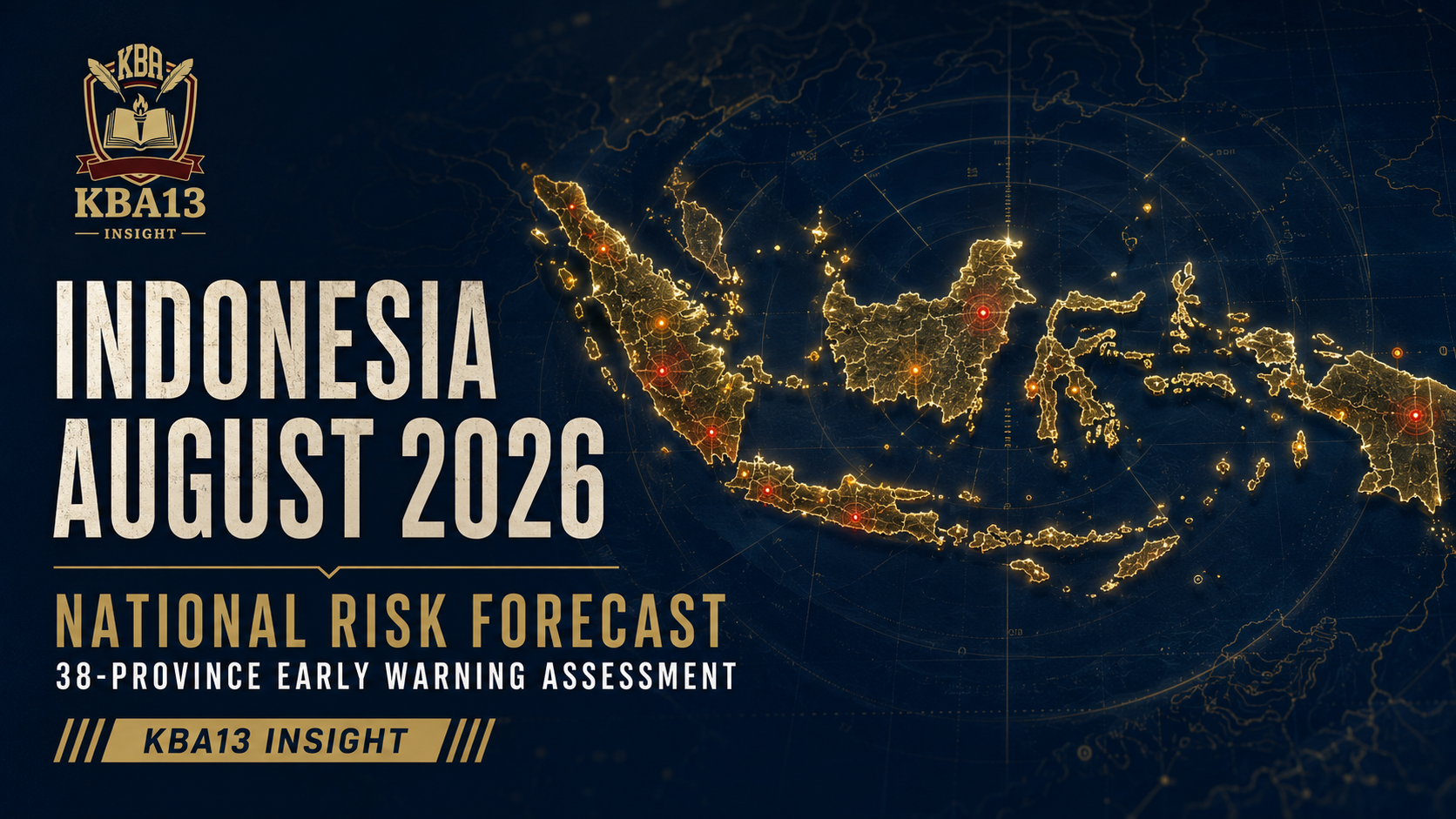
Indonesia enters August 2026 amid accumulating economic, political, security, environmental, and institutional pressures. Drawing on the analytical frameworks of the KBA13 Insight National Integrity Warning Calendar and Early Warning System Index, this report assesses the risks confronting all 38 Indonesian provinces—from Aceh’s narcotics and Rohingya corridors to fire and haze across Sumatra and Kalimantan, industrial and student mobilization in Java, volcanic activity in eastern Indonesia, and armed escalation in Papua. The central assessment identifies August as a period of elevated but still containable turbulence. Independence Day, the presidential address and budget presentation, the anniversary of the August 2025 unrest, rupiah instability, food-program incidents, institutional tensions, and security-force conduct could combine into a wider legitimacy crisis. The report maps three possible scenarios, ranks every province from Normal to Critical, identifies sensitive dates, and establishes leading indicators that could shift Indonesia from a manageable goro-goro phase toward a more dangerous convergence. This is not a deterministic prediction, but a strategic warning designed to support anticipation, preparedness, and crisis prevention.
Keywords
- August 2026 forecast
- Early Warning System Index
- food security
- Goro-Goro
- Huru-Hara
- Indonesia August 2026
- Indonesia crisis forecast
- Indonesia early warning
- Indonesia geopolitical risk
- Indonesia political risk
Executive Summary
Indonesia enters August 2026 the way a tightly wound spring enters its last quarter-turn: still holding, but storing more force than its casing was designed to carry. The months from January to July have not produced a single decisive rupture. They have produced something more dangerous over the medium term — a broad, simultaneous accumulation of stress across the currency, the security apparatus, the food-and-fuel household economy, the resource frontier, and the field of public meaning. What follows is a forecast built on the premise that August is not merely the eighty-first anniversary of the Proclamation. It is the meeting point of Indonesia’s civil calendar, its economic calendar, and its calendar of legitimacy — three layers of time that, when they coincide, press hardest on a state’s capacity to be believed.
The central judgment of this assessment is that August 2026 will be a month of elevated but still-contained turbulence, most likely resolving toward the middle band of our warning scale — the phase our earlier work has named goro-goro, the wayang interval of confusion and portent that precedes either catharsis or huru-hara. The tail risk of a sharper escalation is real and is concentrated in a handful of identifiable places and dates: the Independence Day ceremonies and the President’s mid-August address to the legislature; the one-year anniversary of the August 2025 unrest and the killing of the young courier Affan Kurniawan in the final week of the month; the continuing institutional contest between the National Police and the Attorney General’s Office; and the persistent proximity of the rupiah to the psychologically loaded eighteen-thousand line against the dollar.
Around that national spine, every region carries its own charge. Aceh’s northern coast is now an established landing point for methamphetamine moving down the Malacca Strait and for Rohingya boats whose sailing season is about to open. Riau, South Sumatra and West Kalimantan sit under a dry-season fire risk rated severe. Java’s campuses and industrial belts hold the largest reservoir of mobilizable grievance. Central Sulawesi is recovering from a June earthquake even as its nickel corridor simmers with labor anger. And the highlands of Papua — Intan Jaya, Yahukimo, Puncak, Pegunungan Bintang — remain the one theatre where the state’s writ is contested by force of arms, with a foreign pilot’s death in early July having drawn in Washington’s attention. This report maps each of these, and the quieter provinces besides, on the understanding that a complete picture requires attending to the places where nothing is loudly happening as much as to the places where everything is.
The Method: Reading Time in Layers
Every forecast rests on a theory of how crises arrive. The theory used here holds that states do not collapse in a single afternoon. They fail in a sequence of small breakdowns at shrinking intervals, until the capacity to recover is itself exhausted — and the first terrain on which that failure appears is not the battlefield or the bourse but the field of meaning, the shared belief that the state can still do what a state is supposed to do. A currency can be defended with reserves; a legitimacy deficit cannot be defended with reserves, and it tends to grow faster than any budget deficit.
To track that deficit, this assessment layers three calendars over one another. The civil calendar supplies symbolic momentum: national days, commemorations, the ritual moments when a society takes its own temperature. August is the densest such month in the Indonesian year. The economic calendar supplies the pressure points: the monthly inflation print, the quarterly growth figure, the central bank’s rate decision, the reserves report, the salary and subsidy cycles that determine whether a household feels the month as manageable or as siege. The calendar of legitimacy supplies the slow variable: the accumulating record of scandals, broken promises, disaster responses judged and found wanting, and the widening gap between official narrative and lived experience. When the three coincide — as they do in August — the ordinary friction of governance is amplified into something that can tip.
On top of the calendars sits a simple graduated scale, familiar to readers of the Early Warning System Index. Provinces and issues are read as Normal, Watch, Alert, or Critical, not as precise scores but as a way of ranking where the state’s attention and the observer’s should go first. And the escalation itself is read through the wayang idiom that Indonesian audiences understand in their bones: the movement from goro-goro, the noisy interval of omens and clowning and disorder, toward huru-hara, genuine upheaval. Most months never leave the ordinary. Some months reach goro-goro and subside. The rarer months are the ones where the clowns leave the stage and the storm does not.
A word on what this document is and is not. It is a probabilistic scenario, a reading of a running situation, not a prophecy and not an accusation against any named individual. It draws throughout on the body of analysis published at www.kba13.com over the preceding months — the strategic outlooks on the rupiah and the security apparatus, the flashpoint forecast that first named August as the crisis window, the regional updates on Southeast Asia’s pressures, and the master framework of the National Integrity Warning Calendar. Where those earlier readings made forecasts, this report checks them against the record of January to July and carries them forward into the month ahead.
The National Frame: What the Whole Country Is Standing On
Before the archipelago is read region by region, the ground on which all of it stands must be described, because six national conditions set the baseline for every provincial reading below.
The currency and the household economy. The rupiah’s path across 2026 has been a slow, grinding descent that no single day’s headline captures. It began the year already near seventeen thousand to the dollar, approached that line in mid-January, set successive record lows through the spring, and broke the eighteen-thousand barrier in early June before settling into a band just above it through July. The number matters less as economics than as psychology. For a generation that remembers 1997 and 1998, when the rupiah lost the overwhelming majority of its value and the New Order fell in its wake, the eighteen-thousand level is not a data point but a memory trigger. Foreign reserves have been drawn down defending the line, sitting in the mid-hundred-forties of billions of dollars by mid-year. The equity market has seen its worst foreign selling in a generation, with tens of trillions of rupiah in net outflows. Moody’s moved its outlook to negative in February; other agencies have held their ratings while flagging fiscal strain. Layoffs are running sharply above the prior year, concentrated in textiles, garments and manufacturing. And the government’s flagship free nutritious meals program, intended as a visible dividend of the new administration, has instead generated a running series of mass food-poisoning incidents whose cumulative victim count reached into the tens of thousands by mid-year — converting a symbol of provision into a symbol of carelessness. Each fresh poisoning episode is an immediate, local, emotionally legible trigger of the kind that mobilizes faster than any macroeconomic statistic.
The apparatus turned inward. The most consequential security development of 2026 has not been an external threat but an internal one: an open contest between the two great instruments of law enforcement, the National Police and the Attorney General’s Office, playing out through the corruption case surrounding a former senior prosecutor. This is friction of a density not seen since the earliest Reformasi years, and it matters because it signals that the pressure on the state is now being generated from within the state’s own machinery. A joint special team has been assembled to manage the case, and officials have publicly urged the public to keep faith — the very fact that such reassurance is thought necessary is itself a reading of the temperature. Layered over this is the continued enlargement of the military’s territorial footprint, with new regional commands stood up and more planned, reviving an old national argument about the soldier’s place in civilian life.
The fiscal architecture and the sovereign fund. Underneath the currency sits a fiscal question that has become its own source of anxiety. The government’s flagship investment vehicle — the sovereign wealth fund intended to consolidate state assets and drive a new development model — passed a turbulent first year marked by governance and transparency concerns, and the debate over funding it from the state budget has raised the spectre of a widening deficit and further investor flight. Independent analysis has warned that the fund risks becoming a fiscal liability rather than the growth engine it was sold as, mistaking the machinery of spending for the substance of competitiveness. Layered over a debt-interest burden that consumes a heavy share of tax revenue and a tax-to-output ratio that remains structurally low, the fiscal picture is the slow companion to the currency’s fast one: the currency is the symptom the public watches, but the governance deficit behind it is the condition that drove it there. The budget season of mid-August, when the following year’s fiscal architecture is presented to the legislature, is where this condition becomes a public argument.
The street and the campus. The protest wave that ran through June and into July — students and workers moving in the same weeks across Jakarta, Bandung, Semarang, Yogyakarta, Surabaya and beyond — has established both a repertoire and a set of demands that will carry into August: halt the meals program until it is safe, withdraw the revised police and military laws, reconsider the village-cooperative scheme, deliver price relief, and reform the police. Weekly actions in central Jakarta through mid-July, some framed explicitly as a motion of no confidence, show an escalation logic already in motion. The organizing networks — campus student bodies, labor federations, regional activist alliances — are intact and rehearsed.
The word and the network. The government’s instinct to manage dissent through the courts and the criminal code has repeatedly backfired in the classic pattern of suppression amplifying what it seeks to silence. The warrantless-feeling arrest of a satirical social-media account’s administrator, prosecutions of alleged online provocateurs, and a proposed disinformation instrument widely read as a censorship tool have all fed a narrative of a state more anxious about criticism than about the conditions producing it. Cyberattacks and data breaches have surged. This is the terrain on which the contest for meaning is now largely fought.
The outer ring. Abroad, Indonesia has navigated a finalized but friction-laden trade accord with Washington that cut tariffs while binding Jakarta more tightly; a landmark missile-and-defense relationship with India; fighter and submarine acquisitions; and the aftershocks of a Middle Eastern oil shock that pushed fuel prices up earlier in the year. It sits inside a Southeast Asia where the South China Sea Code of Conduct has again failed to arrive on its notional deadline, where Myanmar’s war grinds on, and where the region’s structural energy dependence remains its quiet vulnerability. Each of these bears on specific provinces — Natuna, the Malacca chokepoint, the Papua theatre — and is picked up in place below.
With that ground described, the archipelago itself.
Sumatra: The Western Threshold
Sumatra is where Indonesia meets the world’s busiest maritime corridor, and in 2026 the island’s risk profile is defined by two elements above all: what moves across the Malacca Strait, and what burns in the dry season. Beneath both runs the long recovery from the catastrophic floods and landslides of late 2025, which carried into 2026 as a mass-casualty operation with a confirmed toll above one thousand two hundred dead across Aceh, North Sumatra and West Sumatra. Permanent housing for the displaced is not scheduled to begin until September, which places August squarely in the widening gap between promises made and shelter delivered — a classic reservoir of localized grievance.
Aceh
Aceh has become, quietly and against the grain of its self-image, one of the most important narcotics gateways in the country. The pattern is now unmistakable. In late June, a joint operation seized three hundred twenty-five kilograms of methamphetamine off the coast at Blang Mangat in Lhokseumawe, a Thailand-to-Aceh network moving product by ship-to-ship transfer near the maritime boundary. In mid-July, developing a separate case, investigators seized a further one hundred thirty kilograms in Simpang Ulim, Aceh Timur, along the Medan–Banda Aceh highway, with couriers traced to Pante Bidari and a coordinator sought in Julok. The significant judgment here is not the tonnage but the corridor shift: Malaysia- and Thailand-sourced meth is now landing directly on the north Acehnese coast — the eastern sub-districts of Aceh Timur and Aceh Utara, the waters off Lhokseumawe — rather than running the older route down the east coast of North Sumatra. This is a structural change in the geography of the trade, and August, with its calmer seas before the monsoon shift, is a high-probability window for further large interdictions and for the armed encounters that sometimes accompany them.
The second Acehnese vector is the Rohingya sailing season. The reports of mass drowning in the Andaman Sea through June and July — with agencies warning of five hundred or more feared dead in successive shipwrecks — are the leading indicator of large departure volumes from the Bangladesh camps and Rakhine. The monsoon transition of late August and September has historically preceded landings on the East Aceh coast, above all around Peureulak, and the pattern of local hostility colliding with humanitarian obligation, compounded by active prosecutions of trafficking networks running through Langsa, makes this a recurring flashpoint the province is not administratively prepared for.
Politically, Aceh sits under the governorship of the former guerrilla commander Muzakir Manaf, and the province’s peculiar architecture — the Wali Nanggroe institution, the continuing enforcement of Islamic criminal bylaws with public canings through the first half of the year, and an undercurrent of anxiety about succession and the durability of the former-combatant consolidation — gives its politics a texture found nowhere else in Indonesia. None of this is at a breaking point, but it is the backdrop against which the drug economy and the refugee question play out.
North Sumatra
North Sumatra’s dominant issue through the first half of 2026 has been disaster recovery, with the worst-hit zone in the Tapanuli districts — Tapanuli Tengah above all — where repeated flash floods struck during the transition from emergency to reconstruction. Governor Bobby Nasution has toured the damage and pledged rebuilding even as he operates under the shadow of anti-corruption scrutiny over provincial road projects, a governance vacuum of exactly the kind that weakens a province’s crisis leadership at the moment it is most needed. Sinabung in Karo has been redesignated a disaster-prone zone and showed rising activity from late May; the region sits on the Sumatran megathrust, and a July advisory from earthquake scientists about accumulating strain has heightened public anxiety. Medan saw repeated student demonstrations through June, several demanding a halt to the meals program after local incidents. The province is also the busiest zone of proposals for new autonomous regions, a live if slow-burning politics of territorial ambition.
West Sumatra
West Sumatra’s signature hazard is volcanic. Marapi, straddling Agam and Tanah Datar, has been in an active eruptive phase throughout 2026 — a first eruption in early January, further episodes through February and March, six eruptions in May with ash columns reaching two kilometers, and continuing activity with lahar warnings in the rains. The province, too, is working through the aftermath of the late-2025 extreme-weather disaster that struck more than a dozen districts. The combination of an active volcano at alert level, a fragile post-flood landscape, and the approach of peak dry season keeps West Sumatra in the Watch band.
Riau and the Fire Belt
Riau is the front line of what may be the most predictable crisis of August 2026: the fire-and-haze season. Burned area in the province had already reached more than fifteen thousand hectares by the end of June — the overwhelming majority peatland — concentrated in Bengkalis, Pelalawan, Indragiri Hilir, Dumai and Rokan Hilir. Regional analysts have rated the transboundary-haze outlook for the season as severe, raising the near-certain prospect of an August episode that closes airports, shutters schools, and reignites diplomatic friction with Malaysia and Singapore precisely when Jakarta is trying to advance maritime cooperation with Kuala Lumpur. Riau’s governance is simultaneously weakened by the corruption trial of its governor, arrested in a late-2025 sting — another province facing its peak-fire month with impaired leadership.
The Riau Islands and the Rempang Fault Line
The Riau Islands carry a different signature: the frictions of a border, free-trade economy and a contested megaproject. The Rempang Eco-City development re-escalated in June, when the Batam authority deployed personnel and heavy equipment to stake land at Pantai Melayu in the Galang sub-district, drawing the condemnation of a residents’ alliance and the formal rejection of more than seven thousand inhabitants of the island’s old villages. With the anniversary of the September 2023 clashes approaching, August carries a real risk of renewed confrontation. Batam is also a major narcotics node — a historic two-ton meth seizure, steady interdictions in its waters, and the co-optation of local fishermen as sea-couriers — and a hub for the smuggling and deportation of migrant workers to and from Malaysia. Off to the northeast, Natuna and Anambas fishermen continue to be squeezed by foreign fishing fleets, keeping the sovereignty question at the archipelago’s edge quietly alive.
Jambi, South Sumatra, Bengkulu, Bangka-Belitung, Lampung
Jambi’s first half was defined by the Kerinci volcano’s reawakening — climbing routes closed from early January, repeated ash emissions — and by January floods that put the Batanghari river into emergency and inundated dozens of villages, alongside the chronic hazard of illegal oil-well fires in Batanghari district. South Sumatra joins Riau in the fire belt: ten districts entered fire-emergency status by peak season, with Ogan Komering Ilir in the red zone and cloud-seeding operations underway; the province is also a transit node on the Aceh-to-Java-and-beyond drug route, as a July seizure of Aceh couriers in Palembang confirmed. Bengkulu was the island’s quietest province, its year defined by a populist governor’s tax-amnesty and social-schooling programs rather than by security events. Bangka-Belitung is living through a crackdown on illegal tin mining, with a presidential order to close a thousand illicit operations and a wave of police sweeps that hit the livelihoods of informal miners — a source of potential local unrest. Lampung’s charge is agrarian: seven active land conflicts, a planned farmers’ long march to Jakarta, and the July arrest by counter-terror police of a suspect running online radical propaganda, a reminder that the province is also a node in the digital-recruitment networks discussed at the national level.
Sumatra, the August reading. The island sits in the Alert band on two counts — the fire-and-haze near-certainty across Riau and South Sumatra, and the established meth corridor on the north Aceh coast — with a rising Rohingya risk, an unresolved Rempang confrontation, active volcanoes in three provinces, and a post-flood grievance window opening exactly as permanent housing lags. The two front-line fire provinces face the month with corruption-impaired leadership.
Java: The Weight of the Center
Java holds the majority of the population, the seat of government, the largest campuses, the densest industrial belts, and therefore the largest reservoir of mobilizable grievance in the country. If August produces a national moment, it will most probably originate or culminate here. The island’s June-to-July protest wave was not an isolated episode but the establishment of a rhythm; the machinery that produced it is intact and entering the most symbolically charged month of the year.
Jakarta
The capital is the stage on which the national drama is performed. Through June and July, the pattern was one of near-weekly demonstrations in the central government district — the Hotel Indonesia roundabout, Monas, the areas around Lapangan Banteng and Gambir — organized by student bodies from a stable roster of universities and by regional activist alliances, with police deployments running from the hundreds into the thousands. A mid-July action carried an explicit motion of no confidence. The demands are consistent: halt the meals program, reject the village-cooperative scheme, withdraw the revised police and military laws, deliver price relief, reform the police. This repertoire is now rehearsed, and it points directly at three August dates: Independence Day on the seventeenth, with its heavy security concentration around the palace and Monas; the President’s address to the legislature in the middle of the month, a natural magnet for counter-programming; and, most sensitively, the final week’s one-year anniversary of the August 2025 unrest and the death of Affan Kurniawan, whose case a fact-finding body concluded was a killing and whose commemoration provides organizers a ready-made date with deep emotional charge.
Jakarta’s physical vulnerabilities run underneath the politics. January flooding inundated dozens of neighborhoods across all five municipalities and cut transit lines; tidal flooding on the northern coast recurs through the dry season around the high tides. The giant sea-wall project is scheduled to break ground in September, which places August in the final consultation-and-land phase of a contested megaproject. Governor Pramono Anung’s first year has drawn criticism over evictions and environmental management even as he advances river normalization and reviews contested houses-of-worship permits — the last a reminder that the capital’s religious-social frictions are managed, not resolved.
West Java
West Java is the island’s second pole of mobilization and carries its own distinctive charge in the person of Governor Dedi Mulyadi, whose signature policy of sending unruly or delinquent students to military-style barracks — extended in May to those arrested in the Bandung May Day riot, some of them minors — is a running national controversy that simultaneously boosts his popularity and inflames his critics. The May Day riot itself, in which public facilities were damaged and most of the initial suspects turned out to be schoolchildren, is a warning about how quickly a labor commemoration can tip into disorder in the province’s capital. West Java is also where counter-terror police made a July arrest in Ciamis, part of a two-node online-propaganda network reaching into Lampung, and where the running series of church closures and the sealing of a minority-sect mosque in Garut keep religious-freedom tensions visible. The Bekasi rail disaster of late April, which killed sixteen people in a women-only carriage, and a July earthquake cluster off the Sukabumi coast, round out a province carrying a broad and varied hazard load.
Central Java and Yogyakarta
Central Java was the province worst hit by the early-2026 floods, with the majority of the two hundred thousand houses inundated nationwide located there, and it lives with recurring tidal flooding along the Semarang–Demak–Pekalongan coast. Its governor, Ahmad Luthfi, drew netizen fury by vanishing from public view during the January disasters — he was on pilgrimage — and enters August with a communication deficit already noted in his first-year evaluations. The province is the industrial heart of the layoff crisis: former workers of the collapsed Sritex textile giant marched on the Semarang court over unpaid severance around the one-year mark of their dismissal, and a garment plant in Jepara is set to close on the first of August with hundreds more losing their jobs — a labor flashpoint landing precisely at the month’s opening. Central Java also carries the country’s densest concentration of anti-corruption stings, with four district heads caught in 2026, and remains the historic heartland of the dissolved Jemaah Islamiyah network around Solo, where the deradicalization of returned members is an unfinished project and where fresh religious-social frictions — a dispersed minority-sect youth camp in Karanganyar, a contested church construction in Surakarta — flared in June.
Yogyakarta is the archetype of Java’s student mobilization. The June demonstration at the Gejayan junction in Sleman — thousands strong, students and ride-hail drivers together, under the banner “The People Are Calling” with an eight-point platform — is the clearest single expression of the season’s grievances, and the “Gejayan Calling” tradition means the city can put a large, disciplined crowd on the street on short notice. Merapi, meanwhile, has been in an active phase through June and July, sending pyroclastic flows up to two kilometers and holding its exclusion zones across Sleman, Magelang, Boyolali and Klaten into August.
East Java and Banten
East Java’s capital, Surabaya, produced the season’s most telling scene of escalation: a June protest at the governor’s residence that began peaceful and tipped into a fence-breach and pursuits, with detentions that swept up bystanders and left two university students bruised amid allegations of excessive force. Semeru in Lumajang has been erupting almost daily through June and July, and the province carries its own corruption shadow over the governor in a provincial-grants case. Banten, at Java’s western end, absorbed hydrometeorological disasters across all its districts in January, sits under the recurring eruptions of Anak Krakatau in the Sunda Strait, and hosts the contested reclamation-and-development frontier of PIK 2 in Tangerang, where the criminalization of resisting residents in the Kohod area and evictions in Cisoka have fused local land conflict with national anti-project campaigning. Banten’s activist networks joined the July Jakarta actions, adding to the capital’s mobilization capacity for August.
Java, the August reading. Java is the island most likely to generate a genuine national moment, sitting in the Alert band on the strength of an intact and rehearsed protest apparatus converging on three charged August dates, a labor crisis landing a major plant closure on the first of the month, and active volcanoes across four provinces. The convergence to watch is the fusion of the Independence Day period, the President’s address, and the late-August anniversary with any fresh trigger — another meals-program mass poisoning, another death in custody, another abrupt price move.
Kalimantan: The Border, the Capital That Is Not Yet a Capital, and the Resource Frontier
Kalimantan’s risk map is organized around three axes: the long land border with Malaysia, the stalled ambition of the new national capital, and the friction between the extractive economy and indigenous land. None of these is at a boil, but each carries a live August charge.
The Border Provinces: West Kalimantan and North Kalimantan
West Kalimantan’s border runs through the crossing points of Entikong, Aruk and Badau, and 2026 has stressed them from two directions. A new Malaysian import regime that took effect on the first of May tightened cross-border goods flow to the point that local reporting described exports through Entikong as paralyzed, throttling the livelihoods of traders in Sanggau and Sambas — and displacing trade toward the informal paths that also carry narcotics, as a June seizure of more than twenty-one kilograms of meth at Entikong illustrated. The province is simultaneously a fire province: an emergency fire-response post was activated in April against a forecast severe dry season, with nearly eight thousand hotspots recorded by the end of March, concentrated in Kubu Raya, Sambas and Ketapang. West Kalimantan thus enters August under the same haze near-certainty as the Sumatran fire belt.
North Kalimantan carries the most acute border-livelihood grievances. The Krayan highlands, reachable in practice only through Malaysian territory, produced emotive July protests — residents pleading not to “die in our own country” — over a ruined border road, an embarrassment sharpened when Malaysian drivers mocked its condition and the sub-district head conceded the point. Nunukan and Sebatik island are the twin engines of a migration-and-narcotics corridor with Tawau: Malaysia’s intensified enforcement pushed more than five hundred deportees through the Nunukan port by February against twenty-four hundred in all of the prior year, straining reception capacity, while steady drug seizures on Sebatik and a standing history of border-police complicity keep the enforcement picture fraught. In the Sebuku interior, the Dayak Tenggalan community’s conflict with an oil-palm and coal concession — damaged sacred swiftlet caves, an unfulfilled smallholding promise, an adat leader named a suspect — escalated to a ritual protest at the Nunukan legislature in June, a slow-building confrontation that could harden into blockades. Offshore, the Ambalat maritime question remains at the negotiation stage under the joint-development framework announced in 2025, with no incident so far in 2026 but a standing potential for a naval or fishing encounter to inflame nationalist sentiment during the Independence period.
The New Capital: East Kalimantan
The most politically legible Kalimantan story of August concerns the Nusantara capital project in East Kalimantan, and specifically an unresolved symbolic question: where the Independence Day ceremony will be held. As of mid-year the palace had not decided between Jakarta, the new capital, or both, and the project’s leadership acknowledged having received no presidential direction — even as the Samarinda legislature lobbied for a ceremony the President would attend. The budget has been cut sharply for 2026, fewer than a couple of thousand civil servants have relocated against modest targets, and international commentary frames the project’s momentum as stalled. The reading is straightforward: a repeat of the prior year’s Jakarta-only ceremony would be received in East Kalimantan as confirmation that the capital has been quietly sidelined, with political and investor-confidence consequences; a secondary ceremony at Nusantara would bring security tightening around the Sepaku sub-district and a burst of progress messaging. Either way the seventeenth of August is the province’s focal point. Beneath it runs the coal economy’s distress: a national production-quota cut of roughly a quarter threatens layoffs across the Kutai coal belt and revenue-sharing disputes with Jakarta, with August a plausible window for announced job cuts.
Central and South Kalimantan
Central Kalimantan’s charge is the food-estate program and the fire season — aerial patrols mapping peatland fire zones through July, academic calls for a moratorium on the estate, and the encirclement of Dayak communities by oil-palm concessions in Seruyan. South Kalimantan is still absorbing the province-wide floods that ran from late December into January and affected more than two hundred thousand people, a disaster that environmental groups attribute to the province’s extraordinary density of extractive permits and that has left a live grievance in the enforcement docket against scores of companies. Both provinces enter August drier but with recovery incomplete and the resource-conflict undercurrent running.
Kalimantan, the August reading. The island sits in the Watch-to-Alert band: a near-certain haze season in the west, a symbolically loaded and unresolved Independence Day question over the new capital, a coal-layoff risk in the east, and a slow-escalating cluster of indigenous land conflicts on the northern border that could produce the region’s sharpest single confrontation.
Sulawesi: The Nickel Corridor and the Fault Lines
Sulawesi’s 2026 risk profile is dominated by two forces that occasionally intersect: the vast nickel-industrial complex that has reshaped its central and southeastern coasts, and the seismic instability of an island laced with active faults.
Central Sulawesi
Central Sulawesi carries the island’s heaviest load. The nickel-industrial park at Morowali, centered on the Bahodopi sub-district, has been the scene of a February tailings landslide that killed a worker and forced the halt of several high-pressure processing plants representing a significant share of national capacity; an April demonstration by thousands of union workers with a ten-point platform; and a May Day mobilization in which seven unions formed a united front and the company’s written reply, in the workers’ account, touched none of their demands. A human-rights study in May documented sharply rising respiratory illness and deforestation across the Morowali zone. With the processing-plant restart window and a national ore-quota cut both bearing on the second half of the year, August carries a real risk of a larger strike or a fresh fatal accident becoming a mobilization trigger.
Layered over the labor picture is a seismic one. A magnitude-6.7 earthquake in mid-June, centered southeast of Palu on a little-studied fault rather than the well-known Palu-Koro system, damaged government buildings, hotels and bridges across Sigi and Parigi Moutong, affected more than six thousand people, and generated over four hundred aftershocks within a day — leaving weakened infrastructure and frayed nerves that any secondary quake or heavy-rain landslide could exploit in August. And in the Poso and Parigi Moutong districts, the mid-May arrest of eight suspects tied to an ISIS-affiliated network demonstrated that the jihadist milieu which once made Poso a byword for insurgency retains a capacity to regenerate, with the Independence Day period a symbolic-date risk window for the Poso Pesisir corridor.
Southeast Sulawesi
Southeast Sulawesi is the nickel frontier’s second front. In Konawe Selatan, residents of Torobulu in the Laeya sub-district have protested a mining operation encroaching to within meters of homes and an elementary school, with displacement and a history of criminalization behind them and allegations the company is operating without an approved 2026 work plan — a confrontation that could turn physical. In Kolaka’s Pomalaa sub-district, the continuing arrival of Chinese workers by air has fed a viral local grievance over jobs, an anti-foreign-labor sentiment that could fuse with any layoff wave into ethnically tinged unrest. Kendari and the surrounding districts absorbed major May floods affecting more than eight thousand people, leaving a recovery grievance. The ore-quota squeeze that threatens the Morowali plants threatens the smelters at Morosi and Pomalaa equally.
The Rest of the Island
South Sulawesi’s capital, Makassar, follows a familiar pattern of demonstrations turning violent — a March clash between student protesters and ride-hail drivers, a June action in which machete-wielding unidentified men charged a crowd — that makes the Pettarani corridor a reliable flashpoint whenever a national issue mobilizes the city’s large student population, with the new academic year in August a natural trigger. The province otherwise runs relatively strong, with growth and cocoa prices supporting rural incomes. Central Sulawesi and Gorontalo have both pivoted from a wet-season flood posture to a dry-season drought-and-fire alert, Gorontalo issuing a formal drought-preparedness order in July after a first half marked by repeated flash floods, including a late-May event in Gorontalo Utara. North Sulawesi manages its exposure through tourism growth and religious-harmony diplomacy, with a maritime edge at Miangas and the Talaud islands where routine but intensifying inspections of Philippine vessels continue and where an illegal-gold economy on Sangihe, now with alleged foreign involvement under investigation, keeps a resource-conflict simmer. West Sulawesi remains a low-signal province defined mainly by the seismic memory of its 2021 earthquake, with a minor July tremor at Mamuju keeping that trauma salient.
Sulawesi, the August reading. The island sits in the Watch-to-Alert band, with the labor volatility of the Morowali and Konawe nickel corridors as its highest-probability disruption, a fragile post-earthquake landscape in Central Sulawesi, a persistent if low-level terrorism regeneration around Poso, and an anti-foreign-labor grievance in Kolaka that could combine dangerously with any nickel-sector layoffs.
Bali and Nusa Tenggara: Tourism, the Volcano, and the Eastern Border
The chain of islands running east from Bali carries three distinct signatures: the pressures of mass tourism on a small island, the near-continuous eruption of a Flores volcano, and the frictions of Indonesia’s most sensitive land border with a neighbor about to join its regional bloc.
Bali
Bali’s 2026 story is the accumulating cost of its own success. A revised tourist-levy framework, meant to fund ecological recovery, has been undermined by a compliance failure so severe that only about a third of foreign visitors paid — a shortfall now under corruption scrutiny, with the Attorney General’s Office summoning provincial officials in March. The national economic-council chair has pushed for the deportation of problematic foreign tourists to protect the island’s brand, and immigration removed more than three hundred foreigners in the first half of the year, including a case involving a clandestine drug laboratory run by foreign nationals — one of several signs that Bali has become a node in transnational organized crime as much as in leisure travel. February floods across Denpasar and Kuta exposed a systemic waste-and-drainage crisis, and the approaching dry-season peak is expected to worsen both waste and clean-water stress. Bali’s risks are not of the mobilizational kind that Java carries; they are the slower frictions of enforcement, environment and a foreign community increasingly subject to a hardening regulatory regime, punctuated by sporadic adat-versus-development protests of the kind seen at Bedugul.
West Nusa Tenggara
West Nusa Tenggara’s charge is concentrated on Sumbawa’s mining frontier, where the copper-and-gold complex has expanded its smelter to full capacity ahead of an export ban and where the designation of the Dodo Rinti and Elang gold projects as national strategic projects has ignited an indigenous-land conflict serious enough that a community alliance carried its complaint to six governments through the international responsible-business machinery in June, citing threatened ancestral sites. The province’s other running risks are the recurring accidents on Mount Rinjani, whose closed-then-reopened climbing season has produced a steady stream of foreign-climber casualties, and a low-level radicalism-monitoring picture centered on the Bima and Dompu networks. The Mandalika circuit’s marquee motorsport event, though it falls later in the year, drives an economic mobilization through August. The province sits in the Watch band, with the Sumbawa mining conflict as its escalation risk.
East Nusa Tenggara
East Nusa Tenggara is the densest single risk zone in this eastern chain, on four counts. First, the Lewotobi Laki-laki volcano in Flores Timur has been in a near-continuous eruptive cycle all year, with a dense July sequence sending ash columns to a kilometer and a half and forcing repeated closures of the Maumere and Larantuka airports — a near-certain continuation into August, compounded by the grievance of displaced residents still without the permanent housing promised nineteen months earlier. Second, the land border with Timor-Leste is both a smuggling frontier — with dozens of illegal crossing routes mapped in Belu and steady interdictions of cigarettes, used clothing and subsidized fuel — and the site of an unresolved and actively worsening territorial dispute at Naktuka in the Amfoang Timur sub-district, where households from the Timorese side have extended cultivation and settlement into the neutral zone, a twenty-seven-year grievance sharpened by Timor-Leste’s imminent accession to the regional bloc in October. Third, the province is the country’s most tragic exporter of migrant labor, with dozens of its workers returning in coffins from Malaysia by mid-year, several with signs of violence, feeding a trafficking-and-protection politics now moving toward provincial regulation. Fourth, its waters off Alor, Rote and Kupang are an active transit route for people-smuggling toward Australia, with stranded foreign nationals intercepted through the year. Over all of it lies the dry-season reality of a province chronically exposed to drought, food insecurity and stunting, with August the peak of that exposure. East Nusa Tenggara sits in the Alert band, principally on the volcano and the border.
Bali and Nusa Tenggara, the August reading. The region’s highest-probability disruption is volcanic and concentrated in Flores; its sharpest political risk is the Timor-Leste border dispute at Naktuka; and its slow-burn story is the collision between mass tourism, organized crime and a hardening enforcement regime in Bali, alongside an indigenous-land conflict on Sumbawa.
Maluku and Papua: The Eastern Arc and the One Armed Theatre
The eastern arc is where the report’s subject matter is least metaphorical. In the Papuan highlands the contest between the state and an armed independence movement is not a risk to be forecast but a war being fought, and August’s symbolic dates make it the most predictable escalation window on the national calendar. Around it, the Maluku islands carry a heavy natural-hazard load and a nickel-frontier conflict of their own.
The Papuan Highlands: The Armed Conflict
The defining event of the second half of 2026 in Papua — and one of the defining national-security events of the year — was the killing of an American pilot at the start of July in the Sobaham district of Yahukimo, where a highland liberation-army unit claimed to have shot the pilot and burned his mission aircraft after it landed. The incident drew a sharp response from Washington and pressure on Jakarta to resolve the conflict, prompting a troop reinforcement and manhunt around Yahukimo and Dekai and an ultimatum, refused, for the fighters to lay down arms. That a foreign national’s death is now driving great-power attention to the Papua file changes the diplomatic stakes of every subsequent incident, and with the perpetrators still at large the matter remains open going into August.
The killing sits atop a broader escalation across the central and highland provinces through the first half of the year. In Intan Jaya — the Sugapa and Homeyo districts of Papua Tengah — a suspected aerial strike near a church in May sent villagers fleeing into the forest, and the national human-rights commission estimated some three thousand people displaced from the district between May and July. Contacts and casualties were reported through the period in Puncak, Puncak Jaya, Nduga around Kenyam, and Pegunungan Bintang around Kiwirok and Oksibil, where gold-panners were evacuated after an attack and a school was reportedly burned. In Papua Barat Daya, a March attack in Maybrat killed marines and was followed by the seizure of a fighters’ base. The independence movement’s political wing declared a state of “humanitarian and military emergency,” ran mass May Day actions across Timika, Sorong and beyond, and pressed its international campaign for the province’s inclusion in the Melanesian bloc and for Indonesia’s expulsion from Pacific bodies, amplified by a documentary on the Merauke development frontier that circulated widely as a critique of the state. A displacement figure of over one hundred thousand was cited in April. This is the one theatre where the warning scale reaches its top band.
The symbolic calendar makes August the critical window. The fifteenth of August is the anniversary of the 1962 New York Agreement, and the seventeenth is Independence Day — both perennial occasions for demonstrations, flag-raisings and armed action, and both certain to bring security lockdowns and protest-clash risk across Jayapura, Sorong, Timika, Manokwari and Nabire. The combination of a fresh, unresolved foreign-national killing, an active troop surge, rising displacement, and these two dates places the Papuan highlands at the center of the national risk map for the month.
Jayapura, the Northern Border, and the Internationalized Campaign
The provincial capital region around Jayapura, in Papua province proper, is the political and symbolic center of the Papuan question even where it is not the site of the heaviest fighting. It is here that the movement’s civil networks stage their demonstrations, here that the two August anniversaries will draw the largest urban crowds and the tightest security response, and here that the frontier with Papua New Guinea at the Skouw–Wutung crossing runs — a gate that functions in normal times as a trade-and-tourism conduit but that also offers the armed movement the standing possibility of sanctuary and cross-border movement, a vector that any intensified highland operation tends to activate. Papua Barat, centered on Manokwari and reaching into the Bintuni gas zone, is the lower-intensity western shoulder of the conflict theatre — quieter through the first half of 2026 than the central highlands, but structurally exposed and worth watching for spillover, particularly given the Maybrat violence in the adjacent southwest province.
Over all of it runs the internationalized dimension that distinguishes the Papua file from every other security challenge in the archipelago. The movement’s external leadership has pressed through the year for the province’s inclusion in the Melanesian regional grouping and for Indonesia’s expulsion from Pacific bodies, has publicized allegations of aerial bombardment and displacement, and has found in the Merauke documentary a cultural vehicle that carried its critique far beyond the usual audiences. The killing of the American pilot in July fused this diplomatic campaign with a hard security fact in a way that commands attention in capitals far from Jakarta. For August, the judgment is that the Papuan question will be contested simultaneously on three planes — the military plane in the highlands, the political-symbolic plane in Jayapura and the other cities around the anniversaries, and the diplomatic plane abroad — and that an incident on any one of the three now reverberates immediately across the other two.
Papua Selatan: The Development Frontier
The southern province is where the conflict takes an economic form. The Merauke food-and-energy estate — a sugarcane-to-bioethanol megaproject reaching into Boven Digoel and Mappi — has generated indigenous protest, condemnation of land-title issuance, and a police dispersal of demonstrators documented by international observers in February. The project is the concrete edge of a contest over land, forest and consent that the “Pesta Babi” documentary crystallized into a national conversation, and it will remain a source of protest and land-conflict risk through August, distinct in form from the highland war but continuous with its grievances.
Freeport and the Mimika Anchor
At Tembagapura in Mimika, the Grasberg complex — one of the world’s great copper and gold mines and a pillar of state revenue — has been operating well below capacity through 2026 after a block-cave accident, with ore output still around two-thirds of normal in mid-July and gold targets cut. The fiscal drag of that shortfall, the commodity-price sensitivity it creates, and the localized security picture around Tembagapura and Timika keep Mimika an anchor point of both the economic and the security readings.
Maluku and North Maluku
North Maluku carries a natural-hazard load among the heaviest in the country. A magnitude-7.6 earthquake near Ternate in early April triggered a tsunami warning and observed waves, followed by a magnitude-6.2 event in early July; the Dukono volcano on Halmahera erupted repeatedly through May, at times nearly simultaneously with neighboring Ibu; and recurrent flooding struck Halmahera Barat, Halmahera Utara and Ternate through the wet season. Over this sits the nickel-industrial complex at Weda Bay in Halmahera Tengah, where an anti-mining mobilization around the late-May commemoration of the mining-victims day channeled grievances over flooding, land and environment against the industrial park — a social-risk picture parallel to Sulawesi’s nickel corridor. Maluku province proper, centered on Ambon and Seram, presents the calmest reading in the eastern arc: a preventive-stable posture, with the authorities monitoring latent communal-tension zones, the memory of past sectarian conflict counseling vigilance, and routine seismicity the main physical hazard.
Maluku and Papua, the August reading. The eastern arc holds the report’s only Critical-band assessment, in the Papuan highlands, where the convergence of the New York Agreement anniversary, Independence Day, a surging military operation, rising displacement and an unresolved foreign-national killing makes August the most predictable escalation window in the country. Around it, the Merauke frontier carries land-conflict risk, Mimika anchors the fiscal-and-security picture, and North Maluku carries a disaster-and-nickel load that keeps it in the Watch-to-Alert band.
Reading the Cross-Cutting Domains
The province-by-province survey above is the spatial reading. A complete forecast also requires reading the archipelago along its functional seams — the domains that cut across provincial boundaries and connect a landing on the Aceh coast to a deportation at Nunukan, or a demonstration in Yogyakarta to one in Makassar. Five such domains carry the national charge into August.
Borders and the Maritime Edge
Indonesia’s frontier in 2026 is porous in a patterned way, and the pattern is a single continuous story told at four gates. On the western threshold, the Malacca Strait is the meth highway, with the trade’s landing point having migrated onto the north Aceh coast and its financing running through Batam’s waters and its couriers drawn from coastal fishing communities. On the northern land border, the Malaysian frontier at Entikong, Nunukan, and Sebatik is simultaneously a trade chokepoint tightened by new Malaysian rules, a deportation funnel for migrant workers, and a narcotics corridor from Tawau — the same informal paths carrying goods, people and drugs in both directions. On the southeastern edge, the Timor-Leste border in Belu and the disputed Naktuka segment in Amfoang Timur combine everyday smuggling with an unresolved territorial grievance, made newly salient by the neighbor’s imminent accession to a regional bloc. And across the far waters, the Philippine maritime frontier at Miangas and the people-smuggling routes off Alor and Rote toward Australia complete the ring. The unifying judgment is that Indonesia’s borders are not walls but membranes, and that August — with its calmer western seas, its intensifying deportation tempo, and its heightened national-day security posture — will stress every one of them. The Natuna question sits slightly apart, a matter less of porosity than of great-power pressure, with Chinese coast-guard presence in the North Natuna Sea a standing sovereignty irritant that the year’s defense diplomacy has been partly designed to answer.
The Social and Cultural Fabric
Beneath the security seams runs the slower story of social cohesion, and here 2026 has been a year of accumulating strain along familiar fault lines. Religious-freedom frictions recurred across Java in a steady series — church closures in West and Central and East Java, the sealing of minority-sect mosques in Garut and elsewhere, the dispersal of a minority-sect youth camp in Karanganyar — each a small tear in the fabric of pluralism that the state manages case by case rather than resolving in principle. Indigenous land conflict is the other great social seam, and it runs the length of the resource frontier: Dayak communities against oil-palm and coal concessions in Kalimantan, the Sumbawa mining conflict in the west, the Torobulu and Routa struggles in Southeast Sulawesi, the Weda Bay mobilization in North Maluku, and the Merauke estate in the far east. Labor is the third: the layoff wave concentrated in Java’s textile belt, the nickel-corridor union militancy of Sulawesi, and the migrant-worker tragedy of East Nusa Tenggara. And over all of it sits the household-economy squeeze — the currency, the prices, the meals-program failures — that translates macroeconomic stress into felt daily grievance. The cultural calendar of August, dense with commemoration and national ritual, is the amplifier that can turn any of these local strains into a shared national feeling.
Defense and the Outer Posture
The defense reading has two faces. Outward, 2026 has been a year of consequential acquisition and alignment — the missile-and-defense relationship with India, the fighter and submarine programs, the finalized but friction-laden trade accord with Washington — that positions Indonesia as a state hedging hard against a contested Indo-Pacific while trying to preserve its traditional non-aligned posture. Inward, the enlargement of the military’s territorial structure, with new regional commands stood up and more planned, revives the oldest argument in the Republic’s civil-military relations: the proper place of the soldier in civilian governance. The two faces meet in the Papua theatre, where the outer posture’s credibility and the inner apparatus’s conduct are tested simultaneously, and where the July killing of a foreign pilot has made the test international. For August, the defense reading is less about a discrete event than about a posture: a security apparatus that is larger, more internally contested, and more externally scrutinized than it was a year ago, operating in the most symbolically charged month of the year.
The Terrorism Picture
The organized-jihadist threat is, on the surface, at its lowest ebb in two decades: the largest network has formally dissolved, and mass-casualty attacks have not recurred. The forecast judgment, however, is that the threat has changed shape rather than disappeared. The dissolution of the old network is an unfinished project so long as its returned members lack a completed deradicalization pathway, and the milieu retains a regenerative capacity, as the May arrests of an ISIS-affiliated cell in Poso and Parigi Moutong demonstrated. The center of gravity has shifted toward lone actors and online radicalization, with the July arrests in Ciamis and Lampung of a two-node network spreading violent propaganda through social media, and with counter-terror authorities explicitly flagging the digital radicalization of the young. The Independence Day period is the classic symbolic-target window, and the highest-attention zones for August are the Solo corridor of Central Java, the Poso corridor of Central Sulawesi, and the online spaces that now do the recruiting the mosques and study-circles once did.
The Contest of Meaning Online
The final domain is the one the framework holds to be decisive: the field of meaning, now fought largely on social media. The government’s repeated resort to the criminal code against critics — the arrest of a satirical account’s administrator, the prosecutions of alleged online provocateurs, the proposed disinformation instrument — has consistently produced the suppression-amplifies-dissent dynamic, converting limited controversies into national ones and feeding a narrative of a state more anxious about criticism than about its causes. This is layered over a genuine cyber-insecurity crisis, with attacks and data breaches surging through the year, and over the emerging threat of AI-generated disinformation. The judgment for August is that the online contest will set the tempo of the offline one: a viral death, a viral poisoning, a viral act of official heavy-handedness can convert a scheduled commemoration into an unscheduled mobilization within a day, exactly as the killing of a courier did in August 2025. The state’s information posture is, in this reading, its most important and least controllable variable for the month ahead.
The Regional Setting: Indonesia in Its Neighborhood
A national forecast that stopped at the water’s edge would misread the pressures on the state, because several of the most consequential drivers of August 2026 originate beyond Indonesia’s borders and enter through them. The archipelago sits inside a Southeast Asia under strain and a great-power rivalry that has made the region a contested space, and its August will be shaped in part by five external conditions.
The first is the South China Sea and the failure of the Code of Conduct. The regional bloc’s long-running effort to conclude a binding code of conduct with China again arrived at a notional deadline without a result, confirming the judgment that a signed code under the current chairmanship was never likely. The practical consequence for Indonesia is felt at Natuna, where Chinese coast-guard presence in waters Jakarta considers its own is a standing grey-zone pressure — a slow accumulation of another power’s presence normalized through repetition, which is precisely the logic the journal’s earlier analysis identified as China’s method in the contested sea. Indonesia’s response has been to harden its military posture at Natuna and to deepen its defense relationships, including with the United States and India; the August risk is a maritime incident that converts a chronic irritant into an acute nationalist moment during the national-day period.
The second is the structural energy dependence that the year’s earlier Middle Eastern oil shock exposed. Southeast Asia’s reliance on Gulf oil and gas moving through distant chokepoints is its quiet vulnerability, and Indonesia — with a fuel-subsidy bill already straining the budget and a currency already under pressure — is acutely exposed to any renewed spike. The reopening of the disrupted strait earlier in the year eased the immediate pressure, but fuel prices proved sticky, and the fiscal residue carries into August’s budget season. A fresh escalation abroad would feed directly into the domestic price-and-fiscal picture that sits at the center of the household-economy grievance.
The third is Myanmar and the limits of the regional bloc. The war on Indonesia’s northern flank grinds on, the bloc’s five-point consensus is effectively dead, and the association is split between members pursuing pragmatic re-engagement and those refusing to legitimize the junta. This matters less as a direct security threat to Indonesia than as a continuous demonstration of the regional institution’s ceiling — its inability to act on its own hardest problem — which shapes the environment in which Indonesia’s own foreign posture operates. It also feeds the narcotics economy that lands on the Aceh coast, since the methamphetamine moving down the Malacca Strait originates in the war-financed production zones of the Myanmar borderlands.
The fourth is the Timor-Leste accession to the regional bloc, set for October. For most of Indonesia this is a diplomatic footnote; for the border districts of East Nusa Tenggara it is an immediate operational reality, sharpening attention to the unresolved Naktuka segment and to the smuggling economy of the Belu frontier at exactly the moment the neighbor’s status is being elevated. Indonesia has claimed diplomatic credit for shepherding the accession, which raises the stakes of any border friction that would embarrass that narrative.
The fifth is the great-power frame itself — the institutionalized brinkmanship between Washington and Beijing that has made the whole region a space of hedging and multi-alignment. Indonesia’s finalized but friction-laden trade accord with the United States, its full membership in the expanded grouping of emerging economies, its defense diversification toward India and Turkey, and its careful preservation of a non-aligned rhetoric even as it aligns in practice, all express a state trying to keep its footing on shifting ground. The killing of an American pilot in the Papuan highlands in early July is where this frame touched Indonesian soil most sharply, converting an internal-security matter into a point of bilateral attention with the region’s most powerful external actor. For August, the great-power frame is less a discrete risk than a condition of reduced maneuvering room: a state with less slack in its foreign relations, facing its most charged domestic month.
Taken together, the regional setting does not add a new crisis to August so much as it removes cushioning from the ones already present — tightening the fiscal room through energy prices, raising the diplomatic cost of a Natuna or Papua incident, and keeping the narcotics pipeline that stresses the Aceh coast fully supplied. The outer ring and the inner condition are, in the end, one system.
Three Scenarios for August 2026
Forecasting is not prediction of a single outcome but the disciplined mapping of a probability space. Three scenarios bound the month.
The ordinary month (the base case, and the most likely). August passes as a turbulent but contained interval — the goro-goro phase held to its noise. The Independence Day ceremonies proceed under heavy security. The President’s address draws the expected counter-programming, and the late-August anniversary of the 2025 unrest brings sizeable but manageable demonstrations in Jakarta, Bandung, Yogyakarta, Semarang and Surabaya. The rupiah holds its band above eighteen thousand without a disorderly break. Fires and haze afflict the western fire belt as expected, closing airports and straining relations with neighbors but not tipping into a governance crisis. The Papuan highlands see the anticipated spike in incidents around the two symbolic dates. The state absorbs each shock locally, and the month ends without a national rupture — but with the legitimacy deficit a notch wider than it began, and the spring wound one turn tighter. This is the outcome the balance of evidence favors.
The convergence month (the tail risk to watch). The base case tips toward escalation if two or more of the independent stressors fire in the same week. The mechanism is the one the framework names as most dangerous: a fresh, viral, emotionally legible trigger — another mass poisoning in a meals-program kitchen, another death in custody or at a demonstration, an abrupt disorderly move in the currency, a sharp act of official heavy-handedness caught on video — landing on top of the already-scheduled convergence of Independence Day, the President’s address, and the unrest anniversary. In this scenario the separate mobilizations of students, workers, and the aggrieved fuse into a single national moment, the online contest overwhelms the state’s information posture within a day, and the disorder spreads across cities faster than it can be locally contained, as it did in August 2025. This is not the likeliest outcome, but it is the one whose ingredients are most fully assembled, and it is the reason August rather than any other month is the crisis window.
The external-shock month (the wildcard). A third path runs through events largely outside Jakarta’s control: a serious escalation in the Papuan highlands drawing further international involvement after the pilot’s killing; a maritime incident at Natuna, Ambalat or in the Sulawesi Sea inflaming nationalist sentiment during the national-day period; a renewed oil shock in the Middle East feeding back into fuel prices and the fiscal picture; or a major natural disaster — a large earthquake on the primed Sumatran megathrust or the Central Sulawesi fault system, a destructive eruption at Lewotobi, Merapi or Semeru — that becomes, in the framework’s phrase, a political disaster because the response is judged and found wanting. Any of these could reorder the month around itself. Their individual probabilities are low; their collective probability, across so long a list, is not negligible.
The National Warning Matrix
The following reads all thirty-eight provinces against the graduated scale, from Sabang at the archipelago’s northwestern tip to Merauke at its southeastern edge. The tiers rank where attention should go; they are a reading of the running situation, not a scoreboard.
| Province | Tier | Primary August drivers |
| Aceh | Alert | Malacca meth corridor on the north coast; Rohingya sailing season; post-flood recovery gap |
| North Sumatra | Watch | Tapanuli flood recovery; Sinabung and megathrust anxiety; Medan demonstrations; leadership under scrutiny |
| West Sumatra | Watch | Marapi active eruptive phase and lahar risk; fragile post-flood landscape |
| Riau | Alert | Severe fire-and-haze season; peatland burning in Bengkalis and Pelalawan; impaired provincial leadership |
| Riau Islands | Alert | Rempang confrontation in Galang; Batam narcotics node; migrant-worker deportation flows |
| Jambi | Watch | Kerinci eruptions; Batanghari flooding; illegal oil-well fires |
| South Sumatra | Alert | Fire-emergency districts led by Ogan Komering Ilir; drug-transit node at Palembang |
| Bengkulu | Normal | Quietest Sumatran province; populist governance; latent corruption legacy |
| Bangka-Belitung | Watch | Illegal-tin crackdown hitting informal miners; potential local unrest |
| Lampung | Watch | Seven agrarian conflicts and a farmers’ march; online-radicalism arrest |
| DKI Jakarta | Alert | National protest stage; Independence Day, presidential address, unrest anniversary; coastal flooding; sea-wall friction |
| Banten | Watch | PIK 2 land conflict in Tangerang; Anak Krakatau; activist mobilization capacity |
| West Java | Alert | Bandung mobilization; barracks-schooling controversy; Ciamis terror node; religious-freedom frictions |
| Central Java | Alert | Layoff crisis and a 1 August plant closure; Solo terrorism legacy; anti-corruption stings; tidal flooding |
| DI Yogyakarta | Alert | Gejayan student-mobilization tradition; Merapi active exclusion zones |
| East Java | Alert | Surabaya protest volatility; Semeru near-daily eruptions; gubernatorial corruption shadow |
| West Kalimantan | Alert | Severe fire season in Kubu Raya and Ketapang; Entikong trade-and-drug chokepoint |
| Central Kalimantan | Watch | Food-estate conflict and moratorium debate; peatland fire mapping |
| South Kalimantan | Watch | Post-flood recovery; extractive-permit grievance and enforcement docket |
| East Kalimantan | Alert | Independence Day question over the new capital; coal-layoff risk in the Kutai belt |
| North Kalimantan | Alert | Krayan border-road grievance; Nunukan-Sebatik deportation and drug corridor; Dayak Tenggalan land conflict; Ambalat |
| North Sulawesi | Watch | Miangas maritime edge; Sangihe illegal-gold conflict; tourism and religious-harmony management |
| Gorontalo | Watch | Pivot to drought-and-fire alert after a flood-heavy first half |
| Central Sulawesi | Alert | Morowali nickel-labor volatility; post-earthquake fragility; Poso terrorism regeneration |
| West Sulawesi | Normal | Seismic memory of 2021; low-signal otherwise |
| South Sulawesi | Watch | Makassar demonstration volatility; new academic year trigger; otherwise resilient |
| Southeast Sulawesi | Alert | Torobulu mining confrontation in Laeya; anti-foreign-labor grievance in Pomalaa; flood recovery |
| Bali | Watch | Tourist-levy corruption scandal; organized-crime enforcement; waste-and-water crisis |
| West Nusa Tenggara | Watch | Sumbawa mining-and-indigenous-land conflict; Rinjani accidents |
| East Nusa Tenggara | Alert | Lewotobi near-continuous eruption and airport closures; Naktuka border dispute; migrant-worker trafficking; drought |
| Maluku | Normal | Preventive-stable posture; latent communal-tension vigilance; routine seismicity |
| North Maluku | Alert | Post-quake and tsunami-warning aftermath; Dukono eruptions; Weda Bay nickel mobilization; flooding |
| Papua Barat | Watch | Lower-intensity conflict zone around Manokwari and Bintuni; monitor for spillover |
| Papua Barat Daya | Alert | Maybrat attacks and base seizure; Sorong political-wing mobilization |
| Papua | Alert | Jayapura as protest-and-symbolic center; New York Agreement and Independence Day flashpoints; PNG border vector |
| Papua Tengah | Critical | Intan Jaya escalation and displacement; Puncak contacts; Mimika-Freeport anchor |
| Papua Pegunungan | Critical | Yahukimo pilot killing and troop surge; Nduga, Puncak Jaya, Pegunungan Bintang contacts; rising displacement |
| Papua Selatan | Alert | Merauke food-estate land conflict; indigenous protest and the development-frontier grievance |
The Standby Calendar: Dates and Windows to Watch
The layered-calendar method resolves, at the operational level, into a standby calendar — a short list of the specific windows within the month when the three calendars press together and the probability of an incident rises above the baseline. For August 2026, five windows stand out.
The opening days carry an immediate economic-and-labor charge. The garment-plant closure in Jepara takes effect on the first of the month, and the early-August release of the July inflation print and the second-quarter growth figure will either confirm or complicate the household-economy narrative. A weak growth number arriving alongside fresh layoff news would set an anxious tone for everything that follows.
The mid-month window around the fourteenth and fifteenth is the year’s densest concentration of state ritual: the President’s address to the annual session of the legislature and the presentation of the following year’s budget and financial note. This is the moment the state narrates itself, and therefore the moment the counter-narrative is most tempted to contest it. The fifteenth is also the anniversary of the New York Agreement, giving the Papuan calendar its first August peak. Demonstrations timed to the address, and flag-raisings and armed actions timed to the anniversary, are both to be expected.
The Independence Day window of the seventeenth is the symbolic apex. The security concentration around the palace and Monas will be at its maximum; the unresolved question of the new capital’s role in the ceremony will be answered; and across Papua the second symbolic peak will bring lockdowns and clash risk. Historically the national day itself is more often a moment of managed ritual than of rupture, but its symbolic weight makes it the day on which any external shock would resonate loudest.
The final-week window, roughly the twenty-fifth to the twenty-ninth, is in this reading the single most sensitive interval of the month. It marks one year since the August 2025 unrest and the killing of Affan Kurniawan, an anniversary with a ready-made emotional charge, an established repertoire, and a set of unresolved grievances — the fact-finding conclusion of a killing, the perceived leniency of the accountability process, the unmet demands for police reform. This is the window in which a scheduled commemoration is most likely to fuse with a fresh trigger into something larger.
Running underneath all four discrete windows is the continuous dry-season hazard: the fire-and-haze curve rising across Riau, South Sumatra and West Kalimantan toward its August-September peak; the volcanic activity at Lewotobi, Merapi, Semeru, Marapi and Dukono holding through the month; and the drought exposure of the eastern islands deepening. These are not dated events but a rising background pressure against which the dated events unfold.
Leading Indicators and What Would Change the Forecast
A forecast is only as useful as the signals that would revise it, and honesty requires naming them. Several leading indicators should be watched through the month, each capable of moving the assessment from the base case toward the convergence case.
The first is the currency and the reserves. A disorderly break below the eighteen-thousand band, or a sharp acceleration in the reserve drawdown, would remove the thin margin of macroeconomic calm on which the base case depends and would supply exactly the abrupt, legible shock the convergence scenario requires. The central bank’s late-August rate decision is the policy hinge here; a defensive posture signals the authorities’ own reading of the pressure.
The second is the frequency of meal-program incidents. Because each poisoning episode is a fast, local, emotionally direct trigger, an acceleration in their tempo — several in a single week, or one with a large or fatal toll — would be among the most reliable early signs of a tipping month. The program has become the household economy’s most visible failure point, and its incident curve is a proxy for the state’s competence narrative.
The third is the conduct of the security apparatus at demonstrations. The 2025 precedent is unambiguous: it was not a demand but a death — the running-over of a courier — that converted protest into upheaval. The single most consequential variable within the state’s control is therefore the restraint of its own forces at the August actions. A death or a viral act of heavy-handedness in the mid-month or final-week windows is the highest-leverage path from the base case to the convergence case.
The fourth is the Papua escalation curve and its international dimension: whether the manhunt around Yahukimo produces further incidents, whether displacement figures climb, and whether the pilot’s killing draws deepening foreign involvement that raises the diplomatic stakes of the whole file.
The fifth is the institutional contest between the police and the prosecutors: whether the managed truce around the former-prosecutor case holds, or whether the rivalry breaks back into the open, signaling that the pressure on the state is being generated from within its own core.
Should these indicators stay quiet, the ordinary month is the likely outcome. Should two or more fire together in the mid-month or final-week windows, the convergence month becomes the operative forecast.
Conclusion: The Field of Meaning
The through-line of this assessment is the proposition with which it began: that a state’s most important terrain is not its territory but the belief that it can govern that territory, and that this belief fails before anything else does. Read that way, the significance of August 2026 is not that any single one of its stressors is likely to prove fatal — none is — but that they arrive together, in the month when the nation most self-consciously takes its own measure, and that each one, whatever its immediate domain, deposits its residue in the same account: the widening gap between what the state says it is doing and what its citizens experience it doing.
The currency near its memory-laden line, the apparatus turned against itself, the meals meant to nourish that sicken instead, the fires that return on schedule, the border that leaks in a patterned way, the highlands where the writ is contested by arms, the online space where suppression amplifies what it means to silence — these are not seven separate problems. There are seven readings of one condition: a legitimacy deficit growing faster than any of the instruments designed to close it. The archipelago from Sabang to Merauke is not on the edge of collapse; the base case is an ordinary, turbulent month that the state absorbs. But it is a spring wound one turn tighter than a year ago, and the calendar of the coming months — the critical convergence the framework locates in the disaster-prone October-November window, when a natural disaster can become a political one — means that the pressure does not release in August so much as pass through it.
The value of a warning is that it can be wrong in the right direction: named early enough and precisely enough, the convergence it describes can be pre-empted, and the storm that the omens portend can be made not to come. That is the purpose of reading the situation this closely. The places and the dates are on the map. What happens at their intersections is not yet written.
Prepared for www.kba13.com. This is a probabilistic reading of a running situation, drawn from the public record of January to July 2026 and from the analytical framework developed in the journal’s preceding work. It names risks to help avert them and should be read as a scenario to be tested against events, not as a prediction of any specific outcome.
How to Cite
Ahmad, Kamaruzzaman Bustamam. (2026). Indonesia’s August 2026 Risk Forecast: An Early Warning Assessment of All 38 Provinces. Banda Aceh: KBA13 Insight.
https://www.kba13.com/indonesia-august-2026-risk-forecast/
Professor of Anthropology of Religion at UIN Ar-Raniry Banda Aceh. He writes on geopolitics, Southeast Asian security and governance, Islam in the Malay world, and the future of knowledge.
About The Author

Artikel Terkait
 Indonesia Strategic Outlook 2026: Rupiah Crisis, Danantara Risk, TNI Expansion, Papua Conflict, and Natuna Tensions
 Indonesia at the Crossroads 2026: Rupiah Crisis, Prabowo’s Power Architecture, Papua Conflict, and the Future of the Republic
 August 2026: A Prediction of Indonesia’s Political Crisis — Goro-Goro, Huru-Hara, and the Future of Governance
 Dari Goro-Goro ke Huru-Hara: Audit Prediksi KBA13 tentang Indonesia Menuju 2030
 Petani, Ingatan September, dan Sistem Peringatan Dini: Membaca Kerentanan Ideologis Kaum Tani dalam Konstelasi Pembangunan Indonesia 2026

Leave a Reply