KBA13 Insight · Security & Intelligence · Strategic Analysis
August 2026:A Prediction of Indonesia’s Political Crisis — Goro-Goro, Huru-Hara, and the Future of Governance
August has always held a special place in the course of Indonesia’s political history. From the birth of the Republic in 1945 to the various moments of social-political change after the Reform, this month has often become the space in which the state faces the test of legitimacy and the direction of its future. This KBA13 Insight article presents an in-depth analysis of the prediction of…
Summary
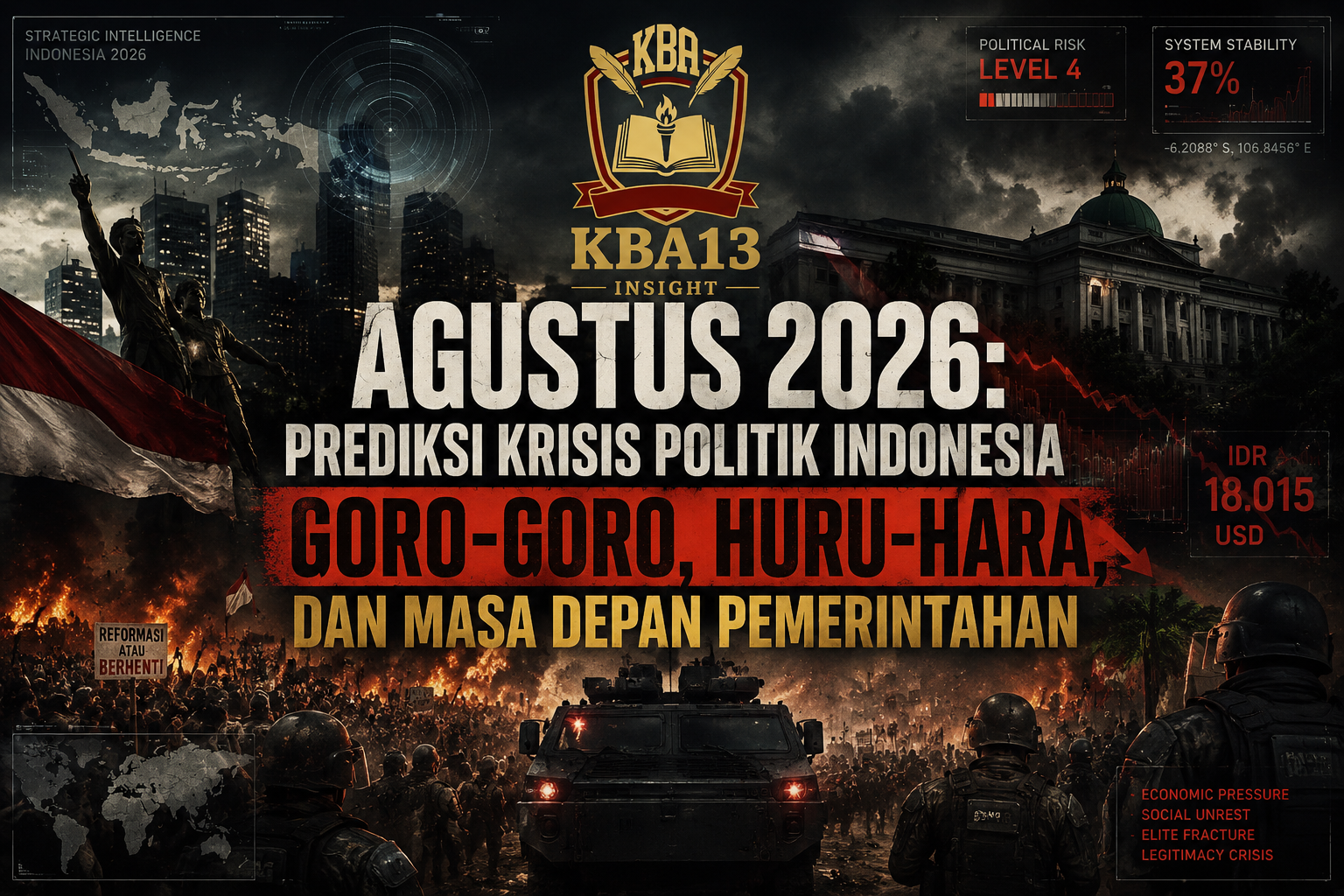
August has always held a special place in the course of Indonesia’s political history. From the birth of the Republic in 1945 to the various moments of social-political change after the Reform, this month has often become the space in which the state faces the test of legitimacy and the direction of its future. This KBA13 Insight article presents an in-depth analysis of the prediction of Indonesia’s 2026 political crisis by reading the relationship between economic pressure, elite dynamics, social fragmentation, public dissatisfaction, and global geopolitical change. Using the approaches of strategic intelligence, political risk analysis, and social-political study, this piece distinguishes between the Goro-Goro phase — a period of systemic unease and tension — and Huru-Hara as a possible escalation when social pressure exceeds the state’s capacity to manage it. This article is not a political prophecy but a mapping of scenarios based on indicators and analyzable dynamics. Its central question is not only whether Indonesia faces a crisis, but how the state, society, and the political elite respond to that pressure. A study of power, legitimacy, and the future of Indonesian governance amid an era of global uncertainty.
Keywords
- Agustus 2026 Indonesia
- Analisis Intelijen Strategis
- Civil Unrest
- Demokrasi Indonesia
- Ekonomi Politik
- Future Scenario
- Geopolitik Indonesia
- Gerakan Sosial Indonesia
- Goro-Goro
- Huru-Hara
Introduction: Why Must August Always Be on Alert?
In Indonesia, August is not merely a month on the Gregorian calendar. It is a point in the cycle of time with a psychopolitical resonance all its own — the month when the proclamation of independence was declared, the month when the largest post-Reform demonstrations erupted, and the month that, in the intellectual tradition of the nation, has always been tied to the question of who truly holds power and in whose interest. Within the analytical framework the author developed in the article “Indonesia 2030 and the Logic of State Collapse” (kba13.com, January 2026), August is the meeting point of the civil calendar, the religious calendar, and the cosmological calendar — three layers of time that, when they coincide, place pressure on a state’s system of legitimacy. The chronicle of August in Indonesian political history is no coincidence. August 1945: the proclamation of independence, the birth of a new state from the ashes of colonialism. August 1965: the tensions that would peak in the September tragedy — but whose movement had already taken shape in the unease of the preceding July and August. August 1998: after Suharto fell in May, August became the month when the Reform tested itself — whether the change was real or merely a change of faces. In August 2025: Indonesia burned again. At least six people died, more than 1,240 were arrested, regional legislature buildings were set ablaze in a dozen cities, and the name Affan Kurniawan — a 21-year-old online motorcycle-taxi driver run over by a Brimob tactical vehicle — became a national symbol of injustice that ignited fury from Sabang to Merauke within 48 hours. By June 2026, the indicators the author mapped in Indonesia 2030 had not only proven true but had, on several dimensions, exceeded the initial projections. The rupiah touched Rp18,015 to the US dollar on 4 June 2026 — the lowest on record in the Republic’s history, surpassing the worst nominal figure of the 1998 crisis. Layoffs reached 15,425 people in the first four months of 2026 alone, a rate of increase of 83.9 percent over the previous period. The Forum of TNI Retired Officers, comprising 332 generals, admirals, air marshals, and colonels, formally submitted eight demands to President Prabowo Subianto — including an evaluation of the Vice President. And Jusuf Kalla, the former Vice President, warned publicly through Muhammad Said Didu that Indonesia could face chaos in July–August 2026.
This study is written with one methodology and one principle. The methodology is the layered calendar — an analytical approach that views a crisis not as a single event but as a confluence of cycles of time drawn from different layers. The principle is this: there is not a single claim in this article that cannot be verified. All data is drawn from indexed media, reports of international research institutions, or documented official statements. The projections in this article are analytical scenarios — not deterministic prophecy — and are assigned probabilities scaled according to evidential weight. The question posed in this article is not whether Indonesia will experience a crisis. Indonesia is already in a crisis — that is a measurable fact. The question is whether the ongoing Goro-Goro will transition into Huru-Hara in August 2026; who its actors are; what its mechanism is; and what indicators must be watched. The answers to these questions are relevant not only to academics and policy analysts — they are relevant to anyone who cares about the future of this Republic. One important methodological note: the author deliberately does not name speculative figures in the category of “intellectual actors behind the scenes” without publicly verifiable evidence. Where the data is absent, honest analysis stops — and it says firmly that it stops. This is what distinguishes strategic intelligence analysis from ordinary political commentary. What follows in these pages is a reality harsh enough without the need for the seasoning of speculation.
Analytical Framework: The Layered Calendar and the Character of Indonesia’s Crisis Cycle
The layered-calendar methodology proceeds from a single epistemological premise: a great political-social crisis does not occur linearly — it does not arise from a single cause that develops in a straight line toward an explosion. It occurs when several cycles of time from different layers meet at a single point, creating simultaneous pressure that exceeds the system’s capacity to absorb it. In the Indonesian context, the three relevant layers of time are: first, the civil calendar — which encompasses the fiscal cycle (when the budget runs out, when debt matures), the political cycle (policy momentum, elite conflict), and the economic cycle (seasonal inflation, mass layoffs). Second, the religious calendar — Ramadan, Eid al-Fitr, Muharram, and Islamic commemorations — which shapes public psychology and grants legitimacy or delegitimacy to collective action. Third, the cosmological calendar — the Javanese cycle and cosmic tradition embedded in the perception of good times and bad times for undertaking great acts. In the article Indonesia 2030, published in January 2026, the author identified five domains that would come under pressure simultaneously: legal legitimacy, disaster response, the economy, social cohesion, and the narrative/AI war. As of June 2026, all five domains have shown the predicted symptoms. Legal legitimacy is eroded by the indicated politicization of the KPK (the Nadiem case versus the Jokowi hajj case). The economy is under heavy pressure (record rupiah, mass layoffs, budget deficit). Social cohesion is threatened (332 retired officers speaking out, the KSPI mobilizing). The narrative war is active (the Disinformation Bill, buzzer operations). This is not confirmation of a prophecy — it is verification of a methodology. The layered calendar works because it identifies structural patterns, not specific events. The Javanese Mandala model, which the author adapts from Benedict Anderson’s analysis in “Language and Power: Exploring Political Cultures in Indonesia” (Cornell University Press, 1990), understands power in the Indonesian political tradition as something concentric — not vertically hierarchical as in Weberian bureaucracy. The center maintains its legitimacy not primarily through law or social contract but through what Anderson calls the demonstration of spiritual and symbolic power — radiance. When the center’s radiance weakens, the circles around it begin to move. The periphery is not only the regions — it also encompasses groups that have long orbited the center but begin to drift away.
The concept of epistemic overconfidence that the author introduced in Indonesia 2030 refers to a categorical error committed by the center of power: the belief that institutional stability is identical to the stability of legitimacy. A state with a complete apparatus — police, military, intelligence agencies, parliament, a large coalition of parties — often mistakenly assumes that this institutional completeness reflects the people’s trust. Yet institutions can remain firmly standing while their moral legitimacy is already spent — a condition that in the Gramscian tradition is called an uprooted hegemony. When that happens, a small catalyst can trigger a reaction disproportionate to its cause, because what actually explodes is not that specific issue but the accumulation of legitimacy long since eroded. Cold compliance is the concrete manifestation of this condition. The people obey not because they trust the government but because the cost of non-compliance is too high — legal threats, criminalization, economic pressure. James Scott, in “Domination and the Arts of Resistance” (Yale University Press, 1990), calls this the hidden transcript — the concealed narrative that does not appear on the surface but swells behind formal compliance. When this hidden transcript finds a public moment — a death that goes viral, a scandal that cannot be silenced — it explodes not as a new expression but as the release of an accumulation long held back. Within this framework, August 2026 is not about whether demonstrations will occur. Demonstrations are certain to occur — the KSPI has already announced them officially. The question is at what point the cold compliance that has piled up over two years of Prabowo’s government — amid a falling rupiah, spreading layoffs, corruption in a flagship program, and diplomatic blunders — will find the public moment that turns Goro-Goro into Huru-Hara.
Goro-Goro vs. Huru-Hara: The Decisive Conceptual Distinction
In the tradition of Wayang Kulit performance, Goro-Goro is a highly specific phase: the act when the cosmic order is shaken, the gods grow uneasy, and the universe is in a state of imbalance. This is not the end of the world — it is a sign that great change is coming, that the old order will be replaced by a new order through a struggle not yet resolved. Goro-Goro is always preceded by the emergence of figures long marginalized or silent, by voices that previously dared not speak, by small cracks on the surface that indicate a great earthquake beneath. In the context of Indonesian politics in 2026, Goro-Goro is not a loose metaphor — it is a precise description of the condition now underway. Huru-Hara, by contrast, is rupture — a physical dislocation of the system that exceeds the capacity to manage it. Charles Tilly, in “The Politics of Collective Violence” (Cambridge University Press, 2003), shows that large-scale collective violence is never truly spontaneous; it always has a relational structure that precedes it — mobilized networks of trust, accumulated grievances, and a trigger that activates an already-existing potential. What distinguishes Huru-Hara from a merely large demonstration is when violence exceeds the control capacity of the security apparatus, when the state’s narrative loses traction even within the groups that usually support it, and when the system begins to react against itself. Indonesia, as of June 2026, is analytically already in the Goro-Goro phase. Its indicators are verifiable: the rupiah exchange rate touched its lowest on record; a forum of retired military officers openly questioned the leadership; the president’s flagship program was corrupted from within; diplomatic mediation was rejected before an international public; and leading research institutions such as Maplecroft and the Bertelsmann Stiftung (BTI 2026) alike recorded rising risk of instability. This is not the opinion of a single analyst — it is a convergence of assessments from multiple independent sources.
What has not yet occurred — and what determines whether Goro-Goro will transition into Huru-Hara — is an emotional catalyst that is viral and individual. Samuel Huntington, in “Political Order in Changing Societies” (Yale University Press, 1968), identifies that under conditions of a legitimacy deficit, a social explosion is triggered not by an accumulation of abstract grievances but by a concrete incident that personifies that whole accumulation. The death of Affan Kurniawan in August 2025 is the prototype of this mechanism: it was not merely one death — it became a symbol for millions who had long harbored anger but had not yet found an object concrete enough to release it upon. The critical difference between Goro-Goro and Huru-Hara also lies in the elite’s response. In Goro-Goro, the elite is still cohesive enough to manage the crisis — they negotiate, make concessions, and manipulate the narrative. When the East Asia Forum (September 2025) wrote that the August 2025 demonstrations “hit a brick wall of elite unity,” it was documenting this mechanism: Prabowo survived August 2025 because the elite around him remained united. The question for August 2026 is: is that “brick wall” still intact, or are there already cracks within it? The answer to that question lies in one fact that the author will return to throughout this article: 332 TNI retired officers — 103 generals, 73 admirals, 65 air marshals, 91 colonels — formally submitted demands to President Prabowo, including an evaluation of his vice president. This is the most serious Goro-Goro signal, because it comes from within the very circle that has historically been most decisive in the dynamic between stability and change in Indonesia.
The Javanese Mandala and the Legitimacy Deficit: When the Center Loses Its Radiance
Benedict Anderson, in “Language and Power: Exploring Political Cultures in Indonesia” (Cornell University Press, 1990), offers an analysis that goes beyond mere institutional description: in the Javanese-Indonesian political tradition, power is concrete and active, not abstract and passive. A leader does not merely hold an office — he must continually demonstrate that he possesses a radiating power, that the aura of his leadership is felt by those within his orbit. This model, which Anderson and later Ben Abel, Geertz, and other scholars developed, the author calls the Javanese Mandala: a system in which the center maintains legitimacy through symbolic radiance, not solely through law or social contract. Within the framework of the Javanese Mandala, a legitimacy deficit is not primarily a matter of mistaken policy — it is a matter of weakening radiance. Prabowo Subianto entered the presidency with considerable radiance: he was a strong military figure, he won the election by a significant margin, and he possessed international celebrity capital built through personal relationships with world leaders. But in the first 20 months of his leadership, that radiance eroded at five points simultaneously: the economy failed to deliver real improvement for ordinary people; the flagship program (MBG) was corrupted from within; international diplomacy produced embarrassing public rejection; the bureaucracy appeared to serve conglomerates more than the people; and a trusted figure in the innermost circle (Teddy) became a source of internal friction within the military. The legitimacy deficit the author formulated in Indonesia 2030 — that it grows faster than the budget deficit — is now empirically proven. When the rupiah touched Rp18,015 on 4 June 2026 and major media in Indonesia openly asked whether this was a repeat of 1998, it was not only the economy being judged — what was being judged was whether Prabowo had the capacity to lead the country out of crisis. So far, the signal seen has been a signal delivered through foreign visits and diplomatic declarations, not through structural action that touches the daily economic life of the people. This is a prototype of what Pierre Bourdieu, in “The Logic of Practice” (Polity Press, 1990), calls an investment of symbolic capital unaccompanied by real economic capital — an investment quickly drained once its contradiction is exposed.
Antonio Gramsci, in “Selections from the Prison Notebooks” (International Publishers, 1971), distinguishes two mechanisms of domination: coercion and consensus. Stable hegemony requires both, but the more important is consensus — the ruling class’s ability to make its values, perspectives, and interests appear to be the values, perspectives, and interests of the whole society. When that consensus collapses, coercion is no longer enough to maintain hegemony — and indeed the excessive use of coercion (such as beating demonstrators, criminalizing criticism) accelerates the erosion of what consensus remains. Prabowo holds enormous instruments of coercion: the TNI, the National Police, a KPK that can be instrumentalized, the Disinformation Bill now being drafted, and a parliamentary coalition covering seven of eight parties. But these instruments of coercion are increasingly unsupported by consensus: BTI 2026 records a serious democratic backslide; YLBHI, LBH Pers, and Amnesty International Indonesia reject the Disinformation Bill; 332 retired officers submitted demands; the KSPI announced a major action; JK warned that chaos would occur. These are signals that the consensus underpinning the hegemony is already far thinner than it appears on the surface. Thus, what is most worrying for the stability of the system is not that there is anger outside the palace — that always exists. Beyond this, criticism now comes from within and from close by: from retired officers who have long been Prabowo’s institutional base, from figures such as Jusuf Kalla who hold cross-bloc credibility, and from international institutions that had previously held back. In the Javanese Mandala, when the innermost circle begins to move out of the center’s orbit, the center’s radiance not only weakens — it begins to bounce back.
The Rupiah at Rp18,000 and the Collective Trauma of 1998
On 4 June 2026, Indonesia’s rupiah exchange rate touched Rp18,015 to the US dollar — the lowest figure in the long history of the Republic’s currency. Indonesia’s own mainstream media, in a Suara.com report on that same date, posed the question long avoided: “Is Indonesia repeating the 1998 Crisis?” That question is not mere journalistic rhetoric. It is an expression of a collective trauma still alive in the memory of the generation that experienced firsthand how a collapsing rupiah carried away a president who had ruled for three decades, and opened a chapter of communal violence that claimed more than 1,000 lives in Jakarta alone. The comparison with 1998 must be made carefully, because there are significant structural differences. In 1998, the rupiah reached Rp16,000 to the dollar under conditions in which foreign reserves were nearly exhausted and Indonesia was forced to request an IMF bailout. In June 2026, foreign reserves remained in a safe zone despite pressure, and Indonesia is not in default. But — and this is the critical point — what made 1998 a point of transformation was not primarily the objective macroeconomic condition but the combination of real economic pressure felt by ordinary people with the loss of a leader’s legitimacy. Samuel Huntington, in “Political Order in Changing Societies” (Yale University Press, 1968), shows that an economic crisis becomes a political crisis only when it meets a vacuum of legitimacy. In 1998, that vacuum existed. In 2026, the indicators show that the vacuum is forming. What is most dangerous about the Rp18,000 figure is not its direct economic impact — it is its psychological and political impact. When Suara.com questioned the 1998 analogy, it was read not only by academics and analysts — it was read by millions who hold the memory or the inherited stories of what happened when figures like these appeared. Fuel prices rose on 1 March 2026 — a reality already felt at gas pumps and in the price of market vegetables. Food inflation is projected to exceed 6 percent (INDEF). Layoffs keep mounting. Under such conditions, the Rp18,000 figure is not merely a monetary statistic — it is a confirmation of the “the state is not there for me” narrative that has long settled in.
Jusuf Kalla, through Muhammad Said Didu in an interview widely circulated in March 2026, gave a mathematically specific projection: the deficit in the first two months of Prabowo’s government already reached Rp200 trillion; if this trend continued, by July–August 2026 the cumulative deficit could break through Rp1,000 trillion — the point at which the state treasury’s liquidity is at its lowest while payment obligations reach their highest. This is not the prediction of an opposition politician wishing to destabilize — it is the calculation of a former Vice President with direct experience managing the national economy. In the layered calendar, the Rp18,000 figure occupies a unique position: it sits in the layer of the civil calendar (a fiscal crisis) while at the same time penetrating the cosmological layer (collective memory, the trauma of 1998). When an economic figure is able to activate the collective traumatic memory of a nation, it ceases to be merely an economic indicator and becomes psychopolitical fuel. This is precisely what Bourdieu means when he speaks of the habitus — dispositions embedded in the body and collective memory that, when triggered by conditions resembling an earlier traumatic condition, produce a response programmed by history rather than by rational calculation in the present. One comparison that cannot be ignored: in the 1998 crisis, Suharto fell not because the economy collapsed alone. He fell because, at the moment the economy collapsed, not a single significant group — the military, parties, businesspeople, students, clerics — was willing to stand and defend him. The question for August 2026 is: if the fiscal crisis Jusuf Kalla predicts truly materializes in July–August, who will stand to defend Prabowo? And will they be enough to withstand the shock?
The State Budget at the Critical Point
State finance is the most objective foundation for a government’s ability to maintain legitimacy through performance. When the budget is sufficient, the state can pay civil servants on time, sustain the subsidies that hold down the prices of basic goods, and fund the social programs that give the people reason to believe the state is there for them. When the budget is under strain, the hard choices that must be made — cut subsidies, delay payments, print money — all carry a political price. In the Indonesian context of 2026, the fiscal mathematics is moving toward a point where every available option is a bad option. Said Didu’s calculation delivered in March 2026 — based on data from the first two months of Prabowo’s government — shows a deficit of Rp200 trillion in just two months. If this trend does not change dramatically, the cumulative July–August projection could break through Rp1,000 trillion. This is a figure that exceeds the legal threshold of a 3 percent of GDP state budget deficit set in law. The Ministry of Finance has not released data explicitly confirming this projection, yet the strained fiscal condition is already reflected in the weakening rupiah and the rise in government bond yields. An external factor worsening the fiscal pressure is the impact of the closure of the Strait of Hormuz on Indonesia’s energy supply chain. As a country still dependent on oil imports, Indonesia — owing to the disruption in the Hormuz route — was forced to seek alternative supplies at higher prices, one of the main contributors to the fuel price hike executed on 1 March 2026. The cost-push inflation this generated then spread throughout the logistics ecosystem: the prices of basic goods rose, business margins were eroded, and layoffs became an increasingly common choice for companies. INDEF projects food inflation exceeding 6 percent — a figure far above the endurance of the lower-middle class. The burden of interest on debt inherited from the Jokowi era adds medium-term structural pressure. Data compiled from various fiscal studies shows that the proportion of debt interest to tax revenue has reached a level that complicates the new government’s fiscal room to maneuver. This is not a condition that can be resolved with popular short-term policy — it is a structural inheritance requiring substantial fiscal reform, something difficult to carry out amid mounting political pressure.
Naomi Klein, in “The Shock Doctrine” (Metropolitan Books, 2007), shows that a strained fiscal condition is in fact often exploited by particular interest groups to push through policies that, under normal conditions, would not gain public approval. What makes Indonesia’s fiscal position in 2026 more vulnerable than in 1998 is one thing: in 1998, Indonesia could request an IMF bailout — external assistance that, though it came with painful conditions, provided breathing room. In 2026, in a fragmented geopolitical context where the United States is in conflict with Iran, China is in fierce rivalry with the West, and Indonesia is already bound to the Board of Peace (a Western orientation) while also a BRICS member (a non-Western orientation) — Indonesia’s external room to maneuver is far narrower. This is not an academic contradiction — it is a real strategic limitation. Within the framework of the layered calendar, fiscal pressure does not stand alone — it interacts with the social calendar. July and August are months when the cost of living is historically higher in Indonesia: the new school year (education expenses), preparations for Independence Day, and the dry season that affects food prices. When fiscal pressure meets an already-heavy consumption calendar, the most vulnerable people — low-income urban families, informal workers, layoff victims — feel the impact directly and concretely. That is the material from which collective anger is formed.
The Hambalang Oligarchy: An Anatomy of the Consolidation of Capital and Power
On 10 February 2026, President Prabowo Subianto invited Indonesia’s five largest conglomerates to his residence in Hambalang, Bogor, for a meeting that lasted more than four and a half hours. The five conglomerates were: Prajogo Pangestu (Barito Pacific Group), Anthony Salim (Salim Group), Franky Oesman Widjaja (Sinar Mas Group), Garibaldi Thohir or Boy Thohir (Adaro Energy), and Sugianto Kusuma or Aguan (Agung Sedayu Group). The combined wealth of these five figures reached about US$85.5 billion — equivalent to Rp1,427 trillion at the exchange rate at the time. This meeting was documented in various national media, including Detik, Tempo, and Metro TV, and was said to discuss “the future of the Indonesian economy” as well as the spirit of “Indonesia Incorporated.” Jeff Winters, in “Oligarchy” (Cambridge University Press, 2011), offers a definition conceptually very precise for understanding this dynamic. Oligarchs, according to Winters, are not merely rich people who hold power — they are actors possessing material resources large enough to engage in wealth defense systematically, including using the instruments of the state to ensure that policies threatening their accumulation are not enacted. In this context, the Hambalang meeting was not a meeting of equal consultation — it was a meeting in which wealth defenders consolidated their access to the policymaking process. Richard Robison and Vedi Hadiz, in “Reorganising Power in Indonesia: The Politics of Oligarchy in an Age of Markets” (Routledge, 2004), show that Indonesia’s post-1998 oligarchy did not collapse together with the fall of the New Order — it reorganized. The same faces or networks reappeared in the garb of democracy, using the mechanisms of elections and political parties to maintain control over the distribution of state resources. What Robison and Hadiz documented for the 1998–2004 period appears to recur in a more open and even less sophisticated form in maintaining its camouflage in 2026.
“Indonesia Incorporated” — the jargon Prabowo used in the Hambalang meeting — represents an economic ideology that implicitly equates the interests of large corporations with the national interest. This is not a new conceptual innovation; it is a modernized version of the New Order developmentalist paradigm, in which conglomerate-driven economic growth is regarded as trickle-down for the whole people. The problem — already proven by four decades of development research — is that oligarch-led growth does not by itself distribute prosperity broadly; it distributes prosperity to the networks already close to the center of power. Project Multatuli, an independent investigative journalism institution, documented in its report “A Year of Prabowo Strengthening the Oligarchic State” (2025–2026) that in the first year of Prabowo’s leadership, the instruments of the state — Danantara, the National Strategic Projects (PSN), mining permits, and even the amended TNI Law — moved consistently in a direction that benefited the same circle of conglomerates. The harshest part of this documentation: from October 2024 to October 2025, at least 80 citizens experienced criminalization, intimidation, or physical violence as a result of conflicts with mining, energy, and PSN projects that touched their land and their lives. This is the most structural and deepest anatomy of resentment: not merely rising prices or lost jobs, but the direct experience that when ordinary citizens confront conglomerate interests, the state stands on the side of the conglomerate. This experience, when spread through community networks, social media, and word of mouth, forms a conclusion far more corrosive to legitimacy than any statistical figure: that this country is not ours.
Danantara and the Extractive Economy
Danantara — the sovereign wealth fund launched with the rhetoric of “inclusive and sustainable development” — has become one of the most controversial instruments in Prabowo’s political-economic architecture. Project Multatuli, in the investigative report “From Danantara to PSN: The New Toy of the Environment-Wrecking Tycoons in the Circle of Power” (2026), identifies that Danantara in practice functions as a tool to consolidate the old oligarchy in new wrapping: capital previously dispersed across state-owned enterprises relatively controlled by the public is now consolidated into a single entity operating with far lower transparency and with direct access to the network of conglomerates already orbiting power. The official narrative of the energy transition promised by the government collides with a hard fact: the Electricity Supply Business Plan (RUPTL) 2025–2034 still adds 16.6 gigawatts of fossil-fuel capacity. This is not merely a contradiction between rhetoric and reality — it is a decision that directly benefits the coal conglomerates within the Hambalang orbit, including several names present at the February 2026 meeting. The Net Zero Emissions pledge by 2050 advertised in international forums is difficult to take seriously when the medium-term energy roadmap still builds dependence on new fossil energy sources. Naomi Klein, in “The Shock Doctrine: The Rise of Disaster Capitalism” (Metropolitan Books, 2007), shows the mechanism she calls “disaster capitalism”: under crisis conditions — economic, natural disaster, social conflict — particular interest groups exploit the window opened by public fear and panic to push a consolidation of capital that, under normal conditions, would not gain democratic approval. Indonesia 2026 shows a variation of this mechanism: it is not a crisis exploited as a window, but power used to prepare for an already-predicted crisis — by ensuring that when the crisis comes, strategic assets are already in the right hands.
The impact of this extractive economy is not only on the 80 criminalized citizens — that is the most visible tip of a far larger iceberg. Beneath it are communities whose land is affected by PSN projects without fair compensation; fishers whose waters are polluted by mine waste; and farmers whose water sources are disrupted by large-scale mining operations. These are the people who do not appear in the aggregate data of 5 percent economic growth but are very real in the layoff data, the local poverty data, and — most relevant to this analysis — in the social networks that will become the infrastructure of mobilization when a catalyst appears. In my view, what must be stressed analytically is this: the oligarchy in Indonesia is not monolithic. There are factions within it; there are oligarchs closer to Prabowo and those who keep their distance. There are conglomerates whose interests align with stability, and those more flexible in the face of political change. Understanding the internal differentiation within this oligarchic class is important for understanding who will support and who will withdraw when pressure reaches a critical point. What is documented is that the five conglomerates present at Hambalang have business obligations very tightly bound to the continuity of Prabowo’s government. From the perspective of the layered calendar, the extractive economy is not merely a long-term structural problem — it creates a resentment that can be mobilized in the short term. When the 80 citizens criminalized as a result of PSN conflicts have siblings, neighbors, and community members who witness what happened to them; when information about who benefits from those projects spreads through social media; when the MBG corruption is exposed while PSN programs for oligarchs continue unhindered — the narrative that forms is a narrative of two Indonesias: the Indonesia that is protected and the Indonesia that is not.
The Rise of the People’s Resentment: Poverty, Layoff, and Inflation Data as a Barometer of Tension
James Scott, in “Weapons of the Weak: Everyday Forms of Peasant Resistance” (Yale University Press, 1985), shows that resistance to power does not always appear in the form of open revolution — it is present every day in the form of small sabotage, gossip, passive non-compliance, and bitter humor. But Scott also shows that when material pressure exceeds a certain threshold — when subsistence is threatened, when dignity is systematically trampled — the hidden transcript turns into a public transcript. What was previously said only behind the ruler’s back is suddenly said to his face. August 2025 was that moment for Indonesia’s 2020s generation. The question is: have the conditions that produced August 2025 been resolved, or have they instead worsened? The data answers that question harshly. Layoffs reached 15,425 people over January to April 2026 — a surge of 83.9 percent compared with the January–March 2026 period, which recorded 8,389 people. The KSPI identifies that the main trigger is the rise in industrial fuel prices due to the closure of the Strait of Hormuz and the weakening rupiah exchange rate. These are not abstract numbers: they are 15,425 heads of households who lost their main source of income, who must adjust their life plans — their children’s education, home installments, health costs — under conditions in which job alternatives grow ever narrower. The fuel price hike on 1 March 2026 triggered a systemic cost-inflation transmission. The entire logistics ecosystem — from goods transport to food distribution — bore rising operating costs that were then passed on to the end consumer. INDEF projects food inflation exceeding 6 percent, while the middle class, which according to Maplecroft is in “marked decline,” experiences a compression of purchasing power from two directions at once: stagnant or falling income and rising prices.
Open youth unemployment reached 16.89 percent — nearly one in six young people in the productive age group without work. This is a generation that grew up with the expectation that education would open the door to a career, and found that the door grows ever narrower. Indonesia’s Gini ratio was recorded at 0.363 — a figure that statistically shows improvement over the previous period, yet conceals two harsher realities: the still-deep inequality between urban and rural areas, and the gap between the upper wealth class, which has a hedge against the weakening rupiah (dollar assets, property, stocks), and the lower class, which is fully exposed. When the rupiah weakened to Rp18,000, holders of dollar deposits benefited; the owner of a rice stall who buys raw materials at prices eroded by the rupiah did not. What is most relevant to the analysis of August 2026 is not the absolute poverty figure — what is relevant is the relative change felt as a decline. Scott shows in “Domination and the Arts of Resistance” (1990) that what triggers resistance is not chronic poverty already accepted as fate, but a decline from a condition regarded as decent — the seizure of progress already achieved, hopes cancelled. Indonesia in 2026 experiences this condition on a mass scale: a middle class dropping in class, factory workers who lost jobs they thought secure, a young generation who find that even the government’s promise of free nutritious meals was corrupted. Within the framework of the layered calendar, this economic pressure works on the layer of the civil calendar. It then interacts with the religious and symbolic layer when it meets the narrative of justice: Islam, the moral reference of the majority of the Indonesian people, has very explicit teachings about economic injustice, untrustworthy leadership, and the obligation to uphold truth in the face of tyranny. When bad economic conditions are framed in religious language — and critical Islamic groups have already done this — its resonance exceeds mere economic dissatisfaction. It becomes a moral crisis.
Prabowo’s Diplomatic Blunders: The Board of Peace, Iran Mediation, and the Loss of a Non-Aligned Posture
In the logic of the Javanese Mandala, a leader who builds legitimacy upon an international image takes a unique risk: when that image is damaged on the world stage, the damage is felt not only in diplomatic forums — it also returns home and reinforces the domestic narrative of leadership incompetence. Prabowo Subianto is the Indonesian president most aggressive in building his international profile since the Soekarno era — with an intensity of foreign visits that continually draws criticism, and an ambition to make Indonesia an active global middle power. In this context, three diplomatic events in January–March 2026 had an impact far exceeding ordinary protocol losses. The first event: on 22 January 2026, in Davos, Prabowo signed the Board of Peace — an initiative conceived by US President Donald Trump with the main agenda of post-conflict reconstruction of Gaza. This decision was taken without consultation with the parliament and without an in-depth study of its implications for Indonesia’s posture of active neutrality built over 70 years. The response from analysts could not be called positive: The Jakarta Post in its editorial called it “another unnecessary misstep”; Fulcrum, the research institution of ISEAS Singapore, judged that Indonesia was applying “proximity without leverage” — approaching the source of power without holding a sufficient bargaining position; The Conversation published an analysis with an apt title: “The Board of Peace Blunder: A Reflection of Prabowo’s Rule-less Diplomacy.” The second event: after Israel and the United States launched a military strike on Tehran on 28 February 2026, Prabowo within hours announced Indonesia’s readiness to mediate between the US and Iran. This offer was rejected openly and firmly. Iranian Ambassador Mohammad Boroujerdi stated that “no negotiation or talks whatsoever with the American government would be useful.” Iran’s Foreign Minister, Abbas Araghchi, formally rejected the mediation offer. Former Indonesian Deputy Foreign Minister Dino Patti Djalal noted that Trump did not want Indonesia to interfere. The Conversation described it as “a bold move or seeking a stage?” — a question whose answer had already been confirmed by Iran’s rejection.
The third event, perhaps the most consequential for domestic legitimacy, is the geopolitical contradiction produced by the two events above simultaneously. Indonesia registered as a BRICS member — a platform dominated by China and Russia as a counter-hegemony to the West — while signing the Board of Peace, which is a Trump initiative. This is not clever navigation between two blocs; it is an incoherent position that weakens Indonesia’s bargaining position in both blocs at once. The LSE (London School of Economics), on its blog in March 2026, analyzed this as a signal of strategic ambiguity that damages Indonesia’s reputation as a predictable international actor. The greatest impact on domestic legitimacy does not come from the diplomatic community or international analysts — it comes from the Indonesian Muslim community, which has long been one of Prabowo’s bases of support. The Board of Peace, initiated by the United States — Israel’s most consistent ally — is perceived by many Indonesian Muslims as a betrayal of Indonesia’s commitment to supporting Palestinian independence. Roy Suryo warned publicly that Indonesia “must not choose the wrong bloc” in the Iran–US conflict. Critical Islamic groups previously neutral toward Prabowo now have an articulable argument: “Our president has joined Trump.” Fareed Zakaria, in “The Future of Freedom: Illiberal Democracy at Home and Abroad” (W.W. Norton, 2003), shows that illiberal leaders often use spectacular foreign-policy activism to divert attention from domestic failures — and that this strategy works only as long as that foreign policy appears successful. When the foreign policy instead produces embarrassing public rejection — as happened with the Iran mediation — it not only fails to divert attention but also adds one more item to the list of evidence of leadership incompetence.
The Impact of Foreign Intelligence Operations: What Is Verified and the Limits of Analysis
Responsible intelligence analysis requires a firm distinction among three categories of claim: first, what is empirically verified from documented sources and can be cross-checked; second, what can be analytically inferred from existing data based on a consistent pattern; and third, what is speculative without adequate evidentiary support. This article operates only within the first two categories. This section specifically separates what can be proven from what cannot — not because the occurrence of foreign operations is impossible, but because honest analysis must not fill an evidentiary gap with assumption. What is empirically verified: the Security Intelligence Terrorism Journal (SITJ), in its research on Indonesia’s counterintelligence strategy, places Indonesia in Scenario 2 — weak internal cohesion, high intensity of external threat — a condition that in their model indicates the dominance of foreign intelligence operations over domestic defense capacity. CYFIRMA, in its Executive Threat Landscape Indonesia report (2026), documents that groups linked to China, North Korea, and Russia are active in cyber espionage operations in Indonesia’s energy, transportation, and critical infrastructure sectors. Indonesia has no effective espionage law — making the country legally a relatively safe target for such operations. What can be analytically inferred: in December 2025, Prabowo’s government placed the Bill on Countering Disinformation and Foreign Propaganda into the 2025–2029 National Legislation Program on the President’s direct order. The fact that the state pushes a specific law to counter “disinformation and foreign propaganda” logically indicates that the state itself believes there are foreign information operations actively targeting Indonesia. This is not the speculation of an outside analyst — it is an inference from the government’s own legislative action. What must be noted critically: the same bill is sharply criticized by YLBHI, LBH Pers, and Amnesty International Indonesia because it could potentially be used to criminalize domestic criticism under the label of “foreign propaganda.” The Diplomat, in its analysis (April 2026), calls it “the politics of foreign propaganda” — an instrument that uses a real external threat as justification to silence dissent from within. This is a dangerous paradox recurring throughout history: the states most aggressive in using the narrative of a foreign threat are precisely the most prone to using that narrative to suppress domestic opposition.
In the broader geopolitical context, Indonesia as of 2026 is in a position structurally attractive to various external actors with differing interests in Southeast Asia. China has large economic and security interests in Indonesia — and has historically been documented using influence operations in countries deemed to be shifting into the Western orbit. The United States, through the Board of Peace relationship, has an interest in ensuring Indonesia remains in a predictable orbit. These powers need not actively destabilize Indonesia — it is enough to reinforce the domestic fragmentation that already exists. The limit this article must not cross: identifying a specific state or actor as the “mastermind” of Indonesia’s destabilization without concrete, publicly verifiable evidence. What can be said is this: Indonesia is in a condition of documented structural vulnerability, in which information operations from various directions — both domestic and foreign — find fertile ground because the deficit of public trust in the official narrative is already very deep. That is dangerous enough without having to add speculation about who is directing what.
TNI Retired Officers: A Signal of Fracture at the Heart of the Mandala
In the Javanese Mandala model, the most serious signal of a weakening of the center’s radiance does not come from the periphery — from the people in the streets or from an opposition already defined as an adversary. The most serious signal comes when the inner circle begins to move out of orbit. In 2026, that signal came in a highly explicit and documented form: the Forum of TNI Retired Officers, comprising 332 retired military officers — 103 generals, 73 admirals, 65 air marshals, and 91 colonels — formally submitted eight demands to President Prabowo Subianto. One of those demands was an evaluation of Vice President Gibran Rakabuming Raka. This is not a street protest. It is a formal communiqué from the top of the military hierarchy’s pyramid, now retired. Harold Crouch, in “The Army and Politics in Indonesia” (Cornell University Press, 1978, revised edition 1988), shows that the TNI has historically not been a monolithic institution moving as a single bloc. Within it there has always been factionalism, differences of orientation, and differing interests. What is striking about Crouch’s analysis is that when senior retired officers begin to speak out openly and collectively, it is usually not out of individual courage — it is because a minimum consensus has already formed among them that the situation has passed the threshold that can be tolerated in silence. The core of the retired-officer community’s grievance centers on the figure of Major Teddy Indra Wijaya, the Cabinet Secretary. Sri Bintang Pamungkas, an activist figure with a wide network among retired officers, stated openly that “the TNI generals have long known” about the Teddy problem. That problem is specific and verifiable: Teddy was promoted to TNI Lieutenant Colonel under conditions deemed to violate Military Law No. 40/2018, which requires graduation from the Staff College before promotion to that level, and he did not possess field experience considered adequate by the standards of a professional military career. For the hundreds of retired officers who spent three decades building careers through that strict hierarchical mechanism, Teddy’s situation is an insult to the institution.
It is important to read this statement by 332 retired officers in its proper context. They explicitly stated that they are not an opposition to President Prabowo — they said their opposition is directed at the “dark forces that surround the circle of power.” This is a framing that strategically gives them room to criticize without formally taking a position of subversion. But that framing also indicates their conviction that there is a systemic problem within the innermost circle of power that obstructs a good agenda — and that Prabowo himself, in this reading, is both part of the problem and part of a potential solution. This dynamic is complicated by the fact that the Army Retired Officers’ Association (PPAD) openly stated that the statement of the 332 retired officers does not represent all retired officers. This indicates an internal fracture within the retired-officer community itself — some support it, some maintain loyalty to Prabowo. This fragmentation, paradoxically, makes the situation less stable rather than more: it means there is no cohesive bloc of retired officers that can manage the crisis with a single voice, so that when escalation occurs, the response from the retired-officer community will be splintered and unpredictable. From the perspective of the layered calendar, the statement of the 332 retired officers is the strongest Goro-Goro marker. They are not actors easily labeled “provocateurs” or “destabilization actors” — labels the government often uses against civilian demonstrators. They are an institution that, in Indonesian history, has determined the rise and fall of governments. That they have spoken in the language of documents and formal demands — not street demonstrations — indicates a seriousness that is in fact deeper than a mere expression of momentary dissatisfaction.
The Ranks of the Resentful: A Map of the Coalition Now Forming
Antonio Gramsci, in “Selections from the Prison Notebooks” (International Publishers, 1971), introduces the concept of the historic bloc — an alliance of classes and groups differing in interest and ideology, united not by a shared program but by a historical condition that gives them a common enemy concrete enough. A historic bloc need not be formally organized to become a force; it is enough for it to exist as a convergence of differing interests that, in one particular moment, move in the same direction. Indonesia as of mid-2026 shows signs of the formation of a historic bloc not yet fully formed but whose structure can already be identified. The first tier consists of actors who are already moving actively and are documented. The Forum of TNI Retired Officers (332 retired officers with 8 formal demands) has already issued a formal communiqué. The Confederation of Indonesian Trade Unions (KSPI) has already announced a mass action in Surabaya, Serang, Semarang, Medan, Batam, and Bandung for June–July 2026. Said Didu has already declared the Movement to Reclaim the People’s Sovereignty from the Oligarchy — a movement he did not retract even after meeting Prabowo directly, and which he in fact reaffirmed. These three actors move on the basis of differing interests but toward the same target: what they call the “dark circle” around power. The second tier consists of actors who maintain a strategically ambiguous position — not formally in the opposition ranks but not in the ranks of active supporters. The position of PDIP and Megawati as a “balancing party, neither opposition nor coalition” is a statement verified from Megawati’s own words. This ambiguity is not a strategic weakness; it is a position that preserves maximum flexibility. PDIP has a broad national network of cadres — 128 parliamentary seats and grassroots infrastructure built over more than two decades. When PDIP decides to move, it can move quickly and massively. A single harsh statement from Megawati about a “legitimacy crisis” could become a signal followed by its entire network of cadres.
The critical Islamic groups — which include networks of former FPI, PA 212, and pesantren communities critical of the government — have undergone a significant shift in position as a result of the Board of Peace diplomatic blunder. Before January 2026, part of this group was still in a wait-and-see position toward Prabowo, regarded as a strong Muslim figure. After the Board of Peace was signed — initiated by the United States, Israel’s most consistent ally — the narrative of betraying Palestine spread through their networks. This is not a group easily mobilized for a partisan political agenda, but once the religious narrative has formed, its mobilization can be very rapid and difficult to control. The third tier consists of latent groups that are not formally organized but possess very large mobilization capacity when a catalyst appears. The victims of mass layoffs — 15,425 people in just four months — are a mass without formal leadership but with a very concrete and personal anger. Online motorcycle-taxi drivers and gig-economy workers — who in August 2025 showed a capacity for mobilization through social media — are the group closest to the Affan Kurniawan incident and the most sensitive to a repeat of the same pattern. The BEM SI students are a group proven to take over demonstrations when the workers retreat to the negotiating table. What is analytically most significant about this map is not the size or individual strength of each actor — rather, it is that for the first time since 2019 there is a fairly broad convergence among actors from different spectrums (military, labor, civil, religious groups) moving in the same direction. This is not yet a historic bloc in the full Gramscian sense — there is still significant fragmentation and incoherence. But the structural conditions are already closer to the formation of a bloc than at any time since the 1998 Reform.
August 2025 as a Blueprint: The Documented Mechanism of the Explosion
One analytical advantage available for understanding the possibility of August 2026 is the existence of a precedent documented in detail from August 2025 — which the author analyzed in depth in the article “The Wave of Demonstrations and Riots in Indonesia, August 2025” (KBA13 INSIGHT, 1 September 2025). August 2025 is not merely a historical event now past; it is an empirical laboratory documenting the mechanism of Indonesia’s social explosion in detail: which triggers are effective, how much time passes from trigger to explosion, what pattern of mobilization occurs, and how the state’s response worsens or improves the situation. The trigger was a symbolic issue: the housing allowance for members of the Indonesian parliament worth Rp50 million per month — a figure that, in the context of millions of people struggling to meet basic needs, felt like a provocation that could not be ignored. The People’s Movement Alliance initiated a demonstration on 25 August 2025 in front of the parliamentary complex with the theme “Dark Indonesia, the Revolution Begins.” The initial action proceeded relatively peacefully. What changed everything was a catalyst no one could have planned: the death of Affan Kurniawan, 21, an online motorcycle-taxi driver run over by a Brimob tactical vehicle on 28 August. The video of his death spread virally within minutes. From one viral death, the mechanism worked at a speed no state apparatus could manage: within 48–72 hours, riots erupted in more than 20 cities. Regional legislature buildings were burned. At least 5–6 people died, hundreds were injured. The number of people arrested reached 1,240 during the period of 25–31 August — documentation from the law-enforcement apparatus itself. Insurance losses exceeded USD 50 million. The Jakarta Composite Index (IHSG) fell 7 percent at the peak of the riots. All of these figures are verified from international media (Reuters, Al Jazeera), national media, and the Maplecroft report.
What the author noted in the September 2025 analysis — and what remains relevant for 2026 — is the amplification mechanism through social media. The death of Affan Kurniawan went viral not only because it was dramatic; it went viral because it personified an existing narrative: the little people (an ojol driver) versus the disproportionate power of the state (a Brimob tactical vehicle). Under conditions in which the hidden transcript was already very full — when millions had already harbored anger over a worsening economy, corrupt officials, and a state that felt absent for them — a single incident with the right narrative framing can release that whole accumulation at once. The East Asia Forum, in its September 2025 analysis, concluded that the August 2025 demonstrations “hit a brick wall of elite unity” — Prabowo survived because the elite around him remained united, and no strong actor chose to exploit the crisis to shift power. This is an important conclusion that must be read together with the 2026 data: in August 2025, PDIP was still in a more passive position; the TNI retired officers had not yet issued a formal communiqué; JK had not yet warned of chaos publicly. One year later, all those conditions have changed. The brick wall of elite unity that saved Prabowo in 2025 now shows documented cracks. The August 2025 blueprint teaches one most important thing for August 2026: the state need not do something big and dramatic to trigger escalation. A single incident in the field — one excessive use of force, one death recorded on video — and the mechanism already documented in 2025 will work again. Under conditions in which labor demonstrations are already scheduled in six cities for June–July, and in which all the economic pressure, flagship corruption, and diplomatic blunders have already filled the people’s hidden transcript far beyond the level of August 2025 — the threshold for a new catalyst is far lower than before.
The KSPI and the Labor Demonstrations of June–July 2026: A Fire Already Lit
The Confederation of Indonesian Trade Unions (KSPI) officially announced to the public that it plans a mass action in six cities — Surabaya, Serang, Semarang, Medan, Batam, and Bandung — for the period of June to July 2026, in response to Minister of Manpower Regulation No. 7 of 2026, which is deemed to expand the practice of outsourcing and worsen workers’ conditions amid a wave of layoffs. This announcement is documented in CNBC Indonesia on 19 May 2026. This is a fact that requires no projection: a major demonstration has already been announced, the locations have already been determined, the demands have already been formulated. August 2026 begins with a fire already lit in June. What fundamentally distinguishes this coming demonstration from August 2025 is the composition of the mass involved. In August 2025, the main demonstrators were students and members of the general public angry over the symbolic issue of the parliamentary allowance — an important group but one without direct and measurable material loss. In June–July 2026, those taking to the streets are workers who have lost their jobs or who face a very real threat of losing their jobs as a result of Minister of Manpower Regulation No. 7/2026. Layoffs reaching 15,425 people in the first four months of 2026 — up 83.9 percent — are the context that gives this demonstration a level of urgency vastly different. This is a demonstration of people who have no other choice. The KSPI had also previously carried out an action of thousands of people at the Ministry of Manpower office after May Day in May 2026 — building gradual momentum. This is not a mobilization built from nothing; it is an escalation of a movement that already has momentum. The documented pattern of the Indonesian labor movement — which the author analyzed in the context of August 2025 — is that when organized labor moves, it opens a space then filled by students and other groups without a formal platform. In August 2025, that process unfolded within a matter of days. In 2026, the infrastructure for the same process is already available.
The location of the six cities chosen by the KSPI — Surabaya, Serang, Semarang, Medan, Batam, Bandung — is not arbitrary. These are the centers of industrial zones where the impact of layoffs is felt most directly and where labor networks are most organized. Demonstrations occurring in these cities simultaneously create a media-coverage effect different from a demonstration centered in Jakarta — it gives the impression that this movement is national in character and cannot be quelled by sending the apparatus to a single point. Maplecroft, in its Civil Unrest Index 2026, notes that Indonesia is among the countries with the steepest rise in attacks on commercial property in the last 12 months. This is a metric used by the insurance industry and multinational companies to calculate operational risk — not an ideological or political assessment but a calculation based on losses that have already occurred. That Maplecroft places Indonesia in the high-risk category for 2026 is independent confirmation of the analytical framework the author developed. One variable that will determine whether the June–July demonstrations transition into an August Huru-Hara is the government’s response. If the government responds with substantial dialogue and concrete concessions — for example, delaying or revising Minister of Manpower Regulation No. 7/2026 — there is a possibility the demonstration subsides into a controlled expression of dissatisfaction. If the government responds with the framing of “provocateurs” and “subversion” — which proved ineffective and in fact counterproductive in August 2025 — the escalation mechanism will work exactly as already documented.
The Impact of the MBG Corruption
The Free Nutritious Meals (MBG) program is the largest symbolic investment Prabowo Subianto has made since taking over the presidency. This is not merely a social policy; it is a leadership narrative deliberately constructed: a president present at the dining table of the poorest people, proof that the state cares for the weakest. The budget allocated reflects this symbolic priority: Rp85.2 trillion in 2025, rising dramatically to Rp268 trillion in 2026. No social program in Indonesian history has ever received an allocation of this size — a figure exceeding the entire basic education budget. The reality: the alleged MBG corruption dragged three suspects — Dadan Hindayana, Lodewyk Pusung, and Sony Sonjaya — into the legal circle. This case is documented in various national media. A program financed with Rp268 trillion of the people’s money — whose benefit the people were supposed to feel in the form of nutritious meals on their children’s plates — was corrupted before reaching the recipients. This is not corruption in an unimportant program. This is corruption in the program that is the main symbol of Prabowo’s leadership, the one he most often mentions in his speeches, the one that has received the most international attention. Pierre Bourdieu, in “The Logic of Practice” (Polity Press, 1990), offers a concept highly relevant here: symbolic capital — the accumulation of recognition, trust, and authority built through acts regarded as noble or competent. Symbolic capital is the most vulnerable asset of all forms of capital because it depends on perception, and perception can change in an instant when it conflicts with a reality dramatic enough. MBG is Prabowo’s main symbolic capital. The MBG corruption is not merely a policy failure — it is a direct attack on the foundation of the symbolic capital Prabowo built, and, most painfully, that attack comes from within.
The multiplier effect that analysis must account for: there are two groups wounded differently by the MBG corruption. First, the people who did not receive the promised benefit — children who were supposed to get nutritious food but did not, or received it at a quality far below what was promoted. Second, information about that corruption — which spreads more broadly and more quickly through social media — is received by the people. These two groups simultaneously produce the same conclusion: that even this program most exalted by the government cannot be trusted. In the layered calendar, the MBG corruption has the potential to become a narrative catalyst that multiplies if its trial takes place in the June–August 2026 period — concurrent with the KSPI labor action and under the pressure of a rupiah that has already touched Rp18,000. The confluence of three narratives at once — a bad economy, a corrupted flagship program, and labor demonstrations — within a single calendar period is a condition that has historically produced a deeper legitimacy crisis than a mere specific grievance against any single issue. What must be stressed with analytical honesty: the MBG corruption will not necessarily produce mobilization equal to the death of Affan Kurniawan — because it does not have the same emotional dimension as a single victim who can be personified. However, in the context of a broader narrative framework — about a government that cannot be trusted, that protects conglomerates while corrupting a program for the poor — the MBG corruption adds a layer of moral legitimacy for anyone who has already decided to move on the basis of economic grievance.
The Nadiem Case, the Jokowi Diploma, and the War of Legal Discourse
When legal institutions are used as political tools — when prosecution and acquittal are determined not by evidence but by the interests of power — what is destroyed is not only trust in one specific case. What is destroyed is trust in the legal institution itself. And when legal institutions lose public trust, the whole capacity of the state to legitimize itself through a claim to justice collapses along with it. Indonesia in 2026 shows signs of this dynamic in two mutually contradictory and both documented cases. The first case: Nadiem Makarim, the former Minister of Education in the Jokowi era, was demanded to serve 18 years in prison and a total fine of Rp5.6 trillion by the Attorney General’s Office in an alleged corruption case over the procurement of Chromebook laptops worth Rp9.9 trillion. The indictment states that the Chromebook procurement from 2019 to 2022 was carried out to encourage Google to increase its investment in the company Nadiem founded. This is the heaviest demand ever brought against a cabinet official in Indonesia. This case is verified from CNBC Indonesia and Tempo, and is one of the biggest legal developments of 2026. The second case, which stands in direct opposition to the first in terms of public perception: the Corruption Eradication Commission (KPK) refused to examine Joko Widodo as a witness in an alleged corruption case over the hajj quota, on grounds that legal observers deem insufficiently strong. At almost the same time, the case of Jokowi’s diploma continued to roll on at the Solo District Court with aggressive handling. This contradiction — aggressive in a case touching Jokowi’s legacy but lenient in a corruption case that is actually more substantive — creates a highly corrosive public perception: that the law is selected on the basis of political interest, not justice.
Larry Diamond, in “Ill Winds: Saving Democracy from Russian Rage, Chinese Ambition, and American Complacency” (Penguin Press, 2019), identifies the use of legal institutions to destroy political opponents as one of the most consistent “signatures” of democratic backsliding. He calls it the “weaponization of the law” — and shows that when the people realize that the law is a weapon used selectively, their trust in the whole system, not only in the current government but in the institution itself, suffers damage that is very difficult to repair. BTI 2026, an independent assessment by Germany’s Bertelsmann Stiftung, notes explicitly that Indonesia’s democratic backslide during the reporting period was marked by — among other factors — the use of legal instruments for political ends and the strengthening of militarization within civilian structures. When an international research institution with no political agenda toward Indonesia gives an assessment aligned with what is observed by domestic civil institutions, that is no coincidence — it is confirmation of a trend clear enough to be seen from various vantage points. Within the framework of the layered calendar, this war of legal discourse operates on the deepest layer of legitimacy: the layer of morality and justice. Indonesians, like people everywhere, can accept many forms of economic discomfort and imperfect governance — but what is hardest to accept is an injustice that feels deliberate. When Nadiem is demanded to serve 18 years but a larger corruption case is left alone, when the diploma case is pursued but the hajj case is left alone — the narrative that forms in the people’s hidden transcript is: “law for enemies, impunity for friends.” That narrative, when it finds a public moment, is a very hot fuel.
The Papua Conflict
Papua is the most persistent, most bloody, and most frequently neglected dimension of Indonesia’s legitimacy crisis in mainstream political analysis focused on Jakarta. It is neglected not because it is insignificant — but precisely because its significance is too great and too complex to be easily integrated into a single narrative about Indonesia. For the Papuan people who have already experienced decades of military presence, the criminalization of activism, and the exploitation of resources without proportional prosperity, the question of the Indonesian state’s legitimacy is not a new question. What is new is that in 2026, the condition in Papua escalates concurrently with a national condition that is also growing ever more tense. The verified facts of 2026 from Papua: on 21 February 2026, TPNPB militants under the command of Aibon Kogoya attacked a mining facility in Makimi District, Nabire, killing a security officer and TNI Second Sergeant Hamdani. On 11 March 2026, TPNPB militants ambushed a Freeport McMoRan truck at the Grasberg mine site, resulting in one employee killed and one wounded. On 23 March 2026, TPNPB militants ambushed a Marine patrol in South Aifat District, Maybrat, killing two personnel. All of these incidents are verified from TVRI News and documented reports. What drew the most international attention was the incident of 7 May 2026: Nalite Wamang, a teenage girl, was found dead with a gunshot wound to her left shoulder during an armed clash between the TNI and the TPNPB at Camp Wini Mile 69. The TNI and the TPNPB blamed each other over who was responsible for the death. The death of a civilian teenage girl in the context of a military operation — regardless of who fired — became fuel for the Papuan diaspora network scattered across Australia, the Netherlands, the United States, and the Pacific, as well as for the international human-rights organizations that have long monitored Papua.
BTI 2026, in its assessment of Indonesia, explicitly mentions the “return of militarisation without tanks on the street” — a framing showing that returning militarization need not appear dramatically in Jakarta to be real in Papua and other regions historically the site of military operations. The expansion of the TNI’s role through the revised TNI Law — which allows the placement of active military personnel in civilian posts — is part of the same trend that in Papua is realized in the form of ongoing armed operations without an effective mechanism of civilian accountability. In the layered calendar, Papua operates on a layer different from the domestic pressures already discussed. It is not a trigger for mass demonstrations in Jakarta — so far, solidarity for Papua in Java remains very limited. Yet it is a factor that works on two levels: first, on the level of international pressure that weakens Indonesia’s diplomatic position precisely when Prabowo is trying to build an international reputation; and second, on the level of internal morality for the civil groups and students already engaged in human-rights issues. When a large demonstration occurs, the Papua narrative will emerge as one of the sub-narratives that broaden and deepen the argument about an unjust state. What is most relevant to the analysis of August 2026 is Papua’s potential as a factor that weakens Indonesia’s international legitimacy at the moment Indonesia most needs international support to manage economic pressure. When foreign investors and international financial institutions weigh their exposure to Indonesia, reports of Papuan civilian deaths — especially the death of an unarmed teenage girl — are a factor entered into the same risk calculation as the rupiah and fiscal-deficit data.
Measurable Indicators: Three Categories of Signal Toward August 2026
Responsible analysis does not merely map risk descriptively — it provides indicators that can be verified periodically to gauge when and whether that risk transitions into reality. This section presents a three-tier system based on data already collected, with a clear distinction between what has already occurred (Yellow Category — Goro-Goro already underway), what indicates escalation toward Huru-Hara (Orange Category), and what would almost certainly trigger Huru-Hara if it occurred (Red Category). Each indicator is accompanied by its verification source.
A. Yellow Category — Goro-Goro Already Underway (All Already Met)
| INDICATOR | VERIFIED DATA | SOURCE |
| Rupiah above Rp17,500/USD | Rp18,015 as of 4 June 2026 — the lowest on record | Suara.com, 4 June 2026 |
| Documented mass layoffs | 15,425 people Jan–Apr 2026; up 83.9% from the previous period | Okezone/KSPI, May 2026 |
| TNI retired officers issue a formal statement | 332 retired officers (103 Generals, 73 Admirals, 65 Air Marshals, 91 Colonels) submit 8 demands to Prabowo | SuaraUSU.or.id |
| Verified diplomatic blunder | Board of Peace (Davos 22 Jan 2026) + Iran mediation rejected by Iran’s Foreign Minister and Ambassador | The Jakarta Post; Kompas; Antara |
| Corruption in a flagship program exposed | Alleged MBG corruption: Dadan Hindayana, Lodewyk Pusung, Sony Sonjaya | Babel Insight, 2026 |
| Escalation of the Papua conflict + civilian death | Nalite Wamang, a teenage girl, killed 7 May 2026 in a TNI–TPNPB firefight | Kompas.id, May 2026 |
| International institutions record a democratic backslide | BTI 2026: serious democratic decline; rising militarization; 7/8 parties support the government | BTI Project, bti-project.org |
| Fuel prices rise | All non-subsidized fuel raised 1 March 2026; food inflation projected 6%+ | INDEF; national media |
| A planned labor action is announced | KSPI announces a major demonstration in 6 cities for June–July 2026 | CNBC Indonesia, 19 May 2026 |
B. Orange Category — Goro-Goro Intensifying, Huru-Hara Within Reach
| INDICATOR | WHAT IT MEANS IF IT OCCURS | STATUS JUNE 2026 |
| KSPI demos in 5+ cities occur simultaneously | Cross-city coordination = the demonstration’s nervous system is active; hard to quell at one point | Not yet occurred — scheduled June–July |
| BEM SI students join the labor action before August | Replication of the August 2025 pattern: labor opens the way, students take over the escalation | Not yet — but the infrastructure is ready |
| JK or a senior figure attends an opposition event in person | Elite legitimacy opened for mobilization; different from a mere media statement | JK has already spoken publicly, not yet physically present at an action |
| PDIP issues a harsh statement on a legitimacy crisis | PDIP’s cadre network (128 parliamentary seats + national grassroots) is activated | Still in a “balancing” position — not yet moving |
| The MBG corruption trial takes place in the June–August period | Narrative confluence: labor action + MBG corruption + economic pressure in one calendar moment | Defendants already exist — the trial schedule not yet confirmed |
| The rupiah breaks Rp19,000 | A new psychological threshold — will sharpen the 1998 parallel narrative in public consciousness | As of 4 June at Rp18,015 — within 1,000 points |
C. Red Category — If It Occurs, Huru-Hara Is Almost Certain
| CRITICAL INDICATOR | ESCALATION MECHANISM | PRECEDENT REFERENCE |
| One viral demonstrator death during a June–July action | The Affan Kurniawan mechanism: 48–72 hours from death to national riots in 20+ cities | August 2025 — documented by KBA & Reuters |
| Retired officers physically present at a demonstration | The elite split becomes public and undeniable; the active TNI in an institutional dilemma | No direct precedent; the analogy is 1998 |
| Food prices rise 20%+ in one month | Subsistence threatened — Scott’s resistance: no longer a matter of morality but of survival | Scott, Weapons of the Weak (1985) |
| The TNI does not move when ordered to disperse a demonstration | The strongest signal of all — it means the chain of command is no longer solid | The analogy: 1998, when ABRI withdrew from Suharto |
| Subsidized fuel rises a second time in 2026 | Cost inflation transmits directly to food prices; the entire urban lower class feels it instantly | The first rise in March 2026 already triggered unrest |
One indicator outside the tables that must be noted separately because it is cross-cutting: the absence of a credible alternative figure. Unlike 1998, when B.J. Habibie was already present as a transitional figure ready to step in, in 2026 there is not a single opposition figure possessing the combination of moral authority, a national network, and support from a spectrum of groups broad enough to become a transitional leader. This makes the potential Huru-Hara of 2026 more dangerous than 1998 in one respect: it has no clear exit strategy. Chaos without a transition roadmap produces violence that is longer and deeper.
Three Scenarios for August 2026: A Structured Projection
A responsible projection does not determine what will happen deterministically — rather, it maps the structure of possibility based on identified variables and assigns probabilities scaled according to evidential weight. The following three scenarios are built on the data presented in this article, with explicit assumptions for each scenario. Readers are invited to test those assumptions against the latest data they hold — because good analysis is analysis open to revision when new data becomes available. The determining variables: (1) the presence or absence of a viral emotional catalyst; (2) the solidity of the active TNI; (3) PDIP’s position; (4) the speed and quality of Prabowo’s response. Before discussing the scenarios, it is important to map the four variables that most determine where the situation moves. First: the presence or absence of a viral emotional catalyst. This is the variable least controllable by anyone — it can emerge from an interaction in the field of any demonstration. Second: the solidity of the active TNI command. If the active TNI remains solid in following orders, Prabowo has a final instrument to manage escalation. If not, he loses the last foundation of his power. Third: PDIP’s position — whether Megawati will remain in a “balancing” position or move to active opposition. Fourth: the speed and quality of Prabowo’s response — whether he will make substantive concessions or hold out with instruments of coercion.
| SCENARIO | CONDITIONS REQUIRED | PROJECTED OUTCOME | PROB. |
| A — De-Escalation | Prabowo makes substantial concessions before August: replace Teddy, revise Minister of Manpower Regulation No. 7/2026, a concrete stimulus package felt by ordinary people | Large demos occur in June–July but do not erupt. Prabowo’s legitimacy erodes but holds. Indonesia enters a slow recovery period. | 25% |
| B — Controlled Huru-Hara | The June–July demos produce one viral emotional catalyst. Prabowo responds with a mix of coercion and partial concession. PDIP stays in an ambiguous position. The active TNI stays solid. | Riots in 10–20 cities on a scale ≥ August 2025. Significant economic losses. Prabowo holds on with partial concessions. Indonesia enters a long period of structural weakness. | 50% |
| C — Uncontrolled Huru-Hara | A viral catalyst appears + PDIP moves out of its ambiguous position + retired officers physically present in the field + the active TNI not solid. | The elite split becomes public. Gibran is evaluated or resigns under pressure. Prabowo loses control of the narrative. A process of political change without a clear exit strategy. Potential for prolonged violence. | 25% |
Scenario B as the highest-probability scenario (50%) does not mean it is the desired or the best scenario from all vantage points. In this scenario, Indonesia bears an enormous cost — people injured and killed, property damaged, eroded investor confidence, and ever-slowing economic growth momentum — without producing adequate structural change. It is the scenario in which the people pay the cost of the crisis but do not receive its fruit in the form of substantial improvement of the system. Scenario C, though its probability equals Scenario A (25% each), has a very different asymmetry of risk. If Scenario C materializes without a clear exit strategy — without a ready alternative figure, without an agreed transition platform, without a trusted mediation mechanism — Indonesia could enter a period of instability far longer than that experienced in 1998–1999. In 1998, Indonesia had Habibie, a constitution that was still relatively functional, and an international community willing to help stabilization. In 2026, all those conditions must be examined anew. Scenario A requires the one thing hardest in politics: the courage to sacrifice the interests of the inner circle for the sake of a larger long-term interest. Prabowo must choose between maintaining Teddy, the Hambalang conglomerate coalition, and Minister of Manpower Regulation No. 7/2026 on one side, and the legitimacy and stability of his government on the other. So far, all signals from the policies taken show that Prabowo has not moved toward this difficult choice. Within the framework of the layered calendar, these three scenarios are influenced not only by domestic variables. External conditions — the movement of global oil prices due to Iran–US tensions, US tariff policy, global liquidity conditions affecting the exchange rate — all have the potential to push the situation toward a more or less severe outcome than the domestic projection alone. The external calendar and the domestic calendar work simultaneously, and in a condition of high global uncertainty such as 2026, an external variable can become a significant multiplier.
Epilogue: Indonesia After August — Crisis as a Window of Transformation?
Barrington Moore Jr., in “Social Origins of Dictatorship and Democracy” (Beacon Press, 1966), shows that stable democracy is not born of ideal conditions — it is born of the authentic resolution of conflict between classes and groups whose interests were previously opposed. Indonesia, since 1998, has not resolved that conflict substantially — it has only managed its surface through always-temporary coalitions and elite bargains that never touched the real distribution of power and wealth. Every great crisis that occurs — 2019, 2025, and possibly 2026 — is a moment when the resolution that has not yet occurred comes to collect its installment. This analysis is not written to frighten. It is written because an uncomfortable truth is more useful to the Indonesian people than a false certainty. The article Indonesia 2030, published in January 2026 — whose validity has already been proven in five of five prediction domains within the first six months — is an example of what honest analysis can do: prepare society to face the conditions to come, not manage perception so that things look better than reality. The same approach applies to this article. What Indonesia needs to get through August 2026 without permanent trauma is not the addition of instruments of coercion — not a harsher Disinformation Bill, not more massive military operations, not more arrests. What is needed are steps that are very specific and verifiable: real economic concessions for workers losing their jobs; genuine transparency and accountability in the MBG corruption case — not only punishing subordinates but also auditing the system that allowed the corruption to occur; an end to the criminalization approach toward citizens who refuse PSN projects on their land; and honest dialogue with the communities in Papua that have too long been treated as a security problem rather than as citizens.
Larry Diamond (2019) reminds us that democracy does not die with one dramatic blow — it dies little by little, through an accumulation of small decisions, each of which can be rationalized but which together form a regime fundamentally different from the democracy that once existed. Indonesia in 2026 is in that process — and what makes this condition still repairable is that the process is not yet complete. There is room for correction. But that room grows narrower each day that choices sacrificing the people’s interests for the interests of the circle of power continue to be made. In the wayang tradition, every Goro-Goro ends — not with an unconditional victory for one side, but with the restoration of a new cosmic balance. That balance does not come on its own. It comes through the courage of figures willing to take the right path though it is hard — which in the wayang is represented by the knights who subdue destructive forces not by violence alone but by cunning and moral legitimacy. This analogy is not romanticization — it is a reminder that a crisis does not always end with the worst, if there are actors who choose to take the right role at the right time. August 2026 has not yet occurred. The window for de-escalation is still open — though ever narrower. But that window can be used only by those willing to read reality as it is, not as they wish to see it. This article is a contribution to that reading: measured, verified, and analytically responsible. We are already in the Goro-Goro. Whether it becomes Huru-Hara is determined by the choices that can still be made — today, this week, this month.
References and Verified Sources
A. Primary Data Sources (Documented)
Suara.com. (2026, 4 June). The Rupiah at Rp18,000 to the Dollar: Is Indonesia Repeating the 1998 Crisis? Retrieved from suara.com. Okezone/KSPI. (2026, May). The Wave of Mass Layoffs: The Fallout of Oil-Price Inflation and a Weakening Rupiah. Economy Okezone. Suara USU. (2026). 332 TNI Retired Officers Submit 8 Demands to Prabowo, Including an Evaluation of the Vice President. Retrieved from suarausu.or.id. CNBC Indonesia. (2026, 19 May). Get Ready! Workers to Hold Mass Demonstrations, Spread Across These Indonesian Cities. Babel Insight. (2026). The Facts of the 2026 MBG Corruption: The Roles of Dadan, Lodewyk, and Sony Sonjaya. CNBC Indonesia/Tempo. (2026, 14 May). Nadiem Makarim Faces an 18-Year Prison Demand in the Chromebook Corruption Case. Kompas.id. (2026, May). Teenage Girl Shot Dead in Tembagapura; TNI and TPNPB-OPM Blame Each Other. Project Multatuli. (2025–2026). A Year of Prabowo Strengthening the Oligarchic State; From Danantara to PSN: The New Toy of the Environment-Wrecking Tycoons. Retrieved from projectmultatuli.org. The Jakarta Post. (2026, 24 January). Indonesia and the Board of Peace: Another Unnecessary Misstep. Fulcrum/ISEAS. (2026). Proximity Without Leverage? Indonesia’s Risky Bet on Trump’s Board of Peace. The Conversation. (2026). The Board of Peace Blunder: A Reflection of Prabowo’s Rule-less Diplomacy; Prabowo’s Sudden Diplomacy as US–Iran Mediator: A Bold Move or Seeking a Stage? Antara/Kompas. (2026, 2 March). Iranian Ambassador: No Useful Mediation with the US. BTI Project. (2026). BTI 2026 Indonesia Country Report. Bertelsmann Stiftung. Retrieved from bti-project.org. Maplecroft/Verisk. (2025–2026). Escalating Unrest, Polarisation, Economic Woes Set Stage for Disruptive 2026; Civil Unrest Index 2026. Gelora.co. (2026, February). After Meeting Prabowo, Said Didu Resolutely Declares the Movement to Reclaim the People’s Sovereignty from the Oligarchy. Harian Aceh. (2026, 5 May). Sri Bintang Pamungkas: On Teddy, the TNI Generals Have Long Known. Kempalan.com. (2026, 8 April). “Chaos” Could Occur in July–August 2026. East Asia Forum. (2025, September). Indonesia’s Protests Hit a Brick Wall of Elite Unity.
B. Academic Sources
Anderson, B.R.O’G. (1990). Language and Power: Exploring Political Cultures in Indonesia. Ithaca: Cornell University Press. Bourdieu, P. (1990). The Logic of Practice. Cambridge: Polity Press. Crouch, H. (1978/1988). The Army and Politics in Indonesia. Ithaca: Cornell University Press. Diamond, L. (2019). Ill Winds: Saving Democracy from Russian Rage, Chinese Ambition, and American Complacency. New York: Penguin Press. Gramsci, A. (1971). Selections from the Prison Notebooks. New York: International Publishers. Huntington, S.P. (1968). Political Order in Changing Societies. New Haven: Yale University Press. Klein, N. (2007). The Shock Doctrine: The Rise of Disaster Capitalism. New York: Metropolitan Books. Moore Jr., B. (1966). Social Origins of Dictatorship and Democracy. Boston: Beacon Press. Robison, R. & Hadiz, V.R. (2004). Reorganising Power in Indonesia: The Politics of Oligarchy in an Age of Markets. London: Routledge. Scott, J.C. (1985). Weapons of the Weak: Everyday Forms of Peasant Resistance. New Haven: Yale University Press. Scott, J.C. (1990). Domination and the Arts of Resistance: Hidden Transcripts. New Haven: Yale University Press. Tilly, C. (2003). The Politics of Collective Violence. Cambridge: Cambridge University Press. Winters, J.A. (2011). Oligarchy. Cambridge: Cambridge University Press. Zakaria, F. (2003). The Future of Freedom: Illiberal Democracy at Home and Abroad. New York: W.W. Norton.
C. International Institution Reports
CYFIRMA. (2026). Executive Threat Landscape Report Indonesia. INDEF. (2025–2026). Indonesia Economic Projection 2026. Jakarta: Institute for Development of Economics and Finance. Security Intelligence Terrorism Journal (SITJ). (2026). Scenario Planning Model for Counterintelligence Strategy Against Foreign Intelligence Operations in Indonesia.
How to Cite
Ahmad, Kamaruzzaman Bustamam. (2026). August 2026: A Prediction of Indonesia’s Political Crisis — Goro-Goro, Huru-Hara, and the Future of Governance. Banda Aceh: KBA13 Insight.
https://www.kba13.com/prediksi-krisis-politik-indonesia-2026-goro-goro-huru-hara/
Professor of Anthropology of Religion at UIN Ar-Raniry Banda Aceh. He writes on geopolitics, Southeast Asian security and governance, Islam in the Malay world, and the future of knowledge.
About The Author

Rekomendasi Bacaan KBA13 INSIGHT
Jika tulisan ini bermanfaat, dukung jurnal ini dengan mencari bukunya melalui tautan berikut:
- Buku-buku Kamaruzzaman Bustamam Ahmad di Periplus
- Koleksi Islamic Studies di Periplus
- Koleksi Geopolitics & Politik Internasional di Periplus
- Cari buku & perangkat baca di Shopee
- Cari di Blibli
Daftar lengkap: Rekomendasi Buku, Alat Tulis & Layanan. Tautan di atas adalah tautan afiliasi — KBA13 INSIGHT dapat memperoleh komisi kecil tanpa biaya tambahan bagi Anda.
Artikel Terkait
 Dari Goro-Goro ke Huru-Hara: Audit Prediksi KBA13 tentang Indonesia Menuju 2030
 Indonesia at the Crossroads 2026: Rupiah Crisis, Prabowo’s Power Architecture, Papua Conflict, and the Future of the Republic
 Indonesia’s 2026 Flashpoints: A Political-Risk Forecast from Goro-Goro to Huru-Hara
 Indonesia’s August 2026 Risk Forecast: An Early Warning Assessment of All 38 Provinces
 Petani, Ingatan September, dan Sistem Peringatan Dini: Membaca Kerentanan Ideologis Kaum Tani dalam Konstelasi Pembangunan Indonesia 2026
Leave a Reply