KBA13 Insight · Analysis & Opinion
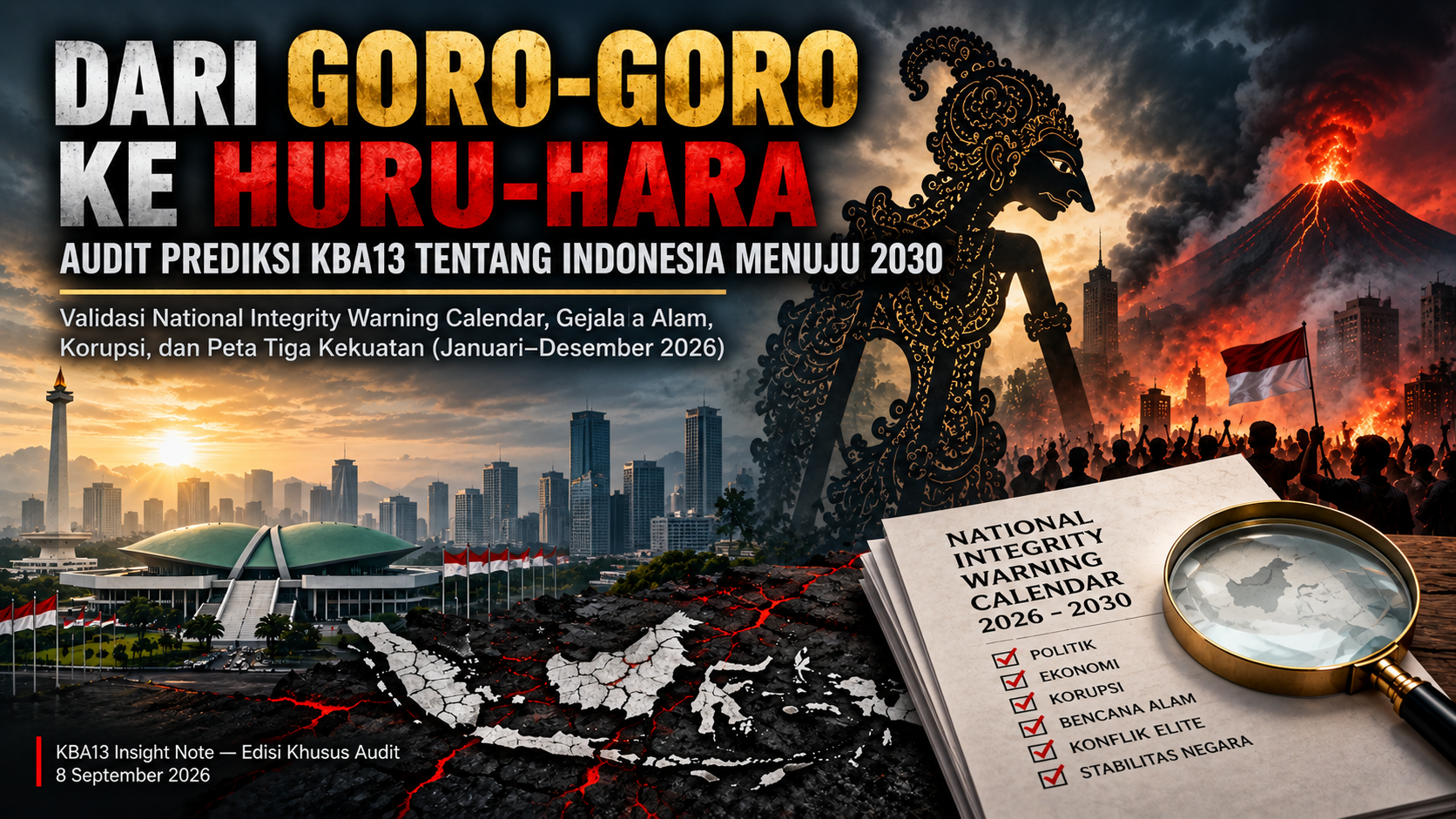
Dari Goro-Goro ke Huru-Hara:Audit Prediksi KBA13 tentang Indonesia Menuju 2030
KBA13 Insight mengaudit prediksi strategis tentang Indonesia menuju 2030 dengan membandingkan National Integrity Warning Calendar terhadap peristiwa aktual sepanjang Januari–September 2026. Kajian ini menilai Goro-Goro dan risiko Huru-Hara melalui dinamika politik, korupsi, konflik elite, tekanan ekonomi, bencana alam, mobilisasi sosial, serta perubahan arsitektur kekuasaan. Dari 26 prediksi yang…
Ringkasan
KBA13 Insight mengaudit prediksi strategis tentang Indonesia menuju 2030 dengan membandingkan National Integrity Warning Calendar terhadap peristiwa aktual sepanjang Januari–September 2026. Kajian ini menilai Goro-Goro dan risiko Huru-Hara melalui dinamika politik, korupsi, konflik elite, tekanan ekonomi, bencana alam, mobilisasi sosial, serta perubahan arsitektur kekuasaan. Dari 26 prediksi yang diuji, sebagian terbukti kuat, sebagian terbukti secara parsial, dan beberapa meleset. Audit ini sekaligus memperbarui proyeksi risiko Indonesia untuk Oktober–Desember 2026 dan horizon menuju 2030.
Kata Kunci
- Bencana Indonesia 2026
- Early Warning Indonesia
- Ekonomi Indonesia 2026
- geng solo
- Geopolitik Indonesia
- Gibran Rakabuming Raka
- Goro-Goro
- Huru-Hara
- Indonesia 2030
- Indonesia political risk
Catatan Metodologis: Mengapa Kajian Ini Ditulis
Ada satu kebiasaan buruk dalam dunia peramalan politik: para peramal hanya mengingat prediksi yang tepat. Kajian ini ditulis untuk melakukan hal sebaliknya. Ia adalah audit terhadap tulisan kami sendiri, sebuah pemeriksaan yang sengaja dirancang untuk menemukan di mana kami tepat, di mana kami meleset, dan yang paling penting, mengapa kami meleset. Sumber utama audit ini adalah dokumen induk yang kami terbitkan pada 1 Januari 2026: Indonesia 2030 dan Logika Keruntuhan Negara | National Integrity Warning Calendar kajian lebih dari lima belas ribu kata yang memetakan enam puluh bulan ke depan, dari Januari 2026 hingga Desember 2030, tanpa satu pun bulan yang dilewatkan. Di sekelilingnya berdiri delapan belas kajian pendukung, dari Peta Konflik Elite Indonesia 2026–2035 dan Indonesia 2030 dan Politik Klenik sampai Indonesia’s August 2026 Risk Forecast untuk seluruh tiga puluh delapan provinsi, Sejarah Korupsi di Indonesia, Kajian Strategis Geng Solo, dan From Goro-Goro to Huru-Hara (8 Agustus 2026). Terhadap korpus itu, kami hadapkan catatan peristiwa nyata sepanjang Januari sampai 8 September 2026: data BNPB, PVMBG, kurs JISDOR Bank Indonesia, siaran Kejaksaan Agung dan Polri, rilis Amnesty International Indonesia, YLBHI, Transparency International Indonesia, serta pemberitaan yang dapat diverifikasi tanggalnya. Hasilnya tersusun dalam dua puluh enam butir prediksi terukur: tiga belas terbukti atau terbukti kuat, empat terbukti sebagian, satu terbukti sejauh ini (skenario dasar turbulensi terkendali), satu terbukti tanpa eskalasi, satu sedang berjalan dengan sinyal awal yang sesuai, dua meleset, satu tidak terjadi, dan tiga belum memasuki jendela uji. Angka itu bukan nilai rapor, melainkan bahan baku untuk mengoreksi model. Satu disiplin kami pegang: istilah yang tidak pernah kami gunakan dalam korpus tidak akan kami klaim sebagai temuan lama. Frasa “kekuatan ketiga”, misalnya, tidak pernah muncul sebagai kategori resmi dalam arsip KBA13. Yang ada hanyalah bahan-bahannya, dan sintesis atas bahan itu akan kami nyatakan sebagai sintesis, bukan sebagai kutipan.
I. Premis dan Anatomi Dokumen Induk
Dokumen induk kami dibuka dengan premis yang jarang masuk dalam perencanaan strategis negara: waktu politik tidak pernah netral. Ia bekerja sebagai mesin akumulasi, ekspektasi publik, beban fiskal, kelelahan institusional, memori krisis, dan ketidakpercayaan. Karena itu, “2030” bukan tanggal mistik, melainkan titik konvergensi tekanan: momen ketika siklus politik-elektoral, ekonomi, ekologi-bencana, dan perang informasi berbasis kecerdasan buatan berpotensi saling mengunci. Keruntuhan negara, bila terjadi, hampir selalu tampak seperti kejutan; secara struktural, ia lebih mirip serangkaian kegagalan kecil yang makin rapat jaraknya hingga negara kehilangan daya pulih. Metodenya adalah kalender berlapis, empat lapisan waktu yang dibaca bersamaan: lapisan sipil (siklus fiskal, kebijakan, elektoral); lapisan budaya-keagamaan (musim mudik, belanja, ritual, filantropi, audit moral publik); lapisan siklus dua belas dan enam puluh tahunan tradisi Asia sebagai alat baca makro perubahan mood kolektif; dan lapisan kalender non-Asia seperti kalender Ibrani, dipakai bukan untuk spiritualisasi angka melainkan untuk disiplin lintas-kerangka. Kata “kosmologis” di sini bukan klaim supranatural, melainkan istilah operasional: cara masyarakat memberi makna pada waktu, dan bagaimana makna itu mengubah perilaku kolektif. Kesadaran kalender bukan takhayul, melainkan pengakuan bahwa emosi publik memiliki ritme, kebijakan yang lewat tanpa riak pada satu waktu bisa diterima sangat berbeda ketika warga sedang terfokus pada janji kebangsaan, luka sejarah, atau martabat sipil. Kerangka diagnosisnya mengambil dua kata dari khazanah pewayangan Jawa, dan keduanya sering dicampuradukkan. Goro-Goro adalah medan yang terganggu: kecemasan menumpuk, kepercayaan menipis, institusi masih berfungsi tetapi tidak lagi memerintah keyakinan tanpa pertanyaan, dan berbagai keluhan mulai saling bergema. Justru karena ia belum babak final, di situlah kebijaksanaan masih mungkin: punakawan bukan sekadar penghibur, mereka menyuarakan apa yang tidak mudah didengar istana. Huru-Hara menamai kondisi yang jauh lebih parah, saat gangguan memperoleh momentumnya sendiri, konflik bergerak lebih cepat daripada penjelasan, dan kapasitas negara untuk menahan akibat tertinggal dari kecepatan di mana itu diproduksi. Mencampur keduanya berbahaya; tetapi kesalahan sebaliknya sama seriusnya, karena sebuah negeri tidak berpindah dari tenang ke kacau tanpa melewati periode ketika tanda peringatan terlihat namun dijelaskan satu per satu secara terpisah. Pertanyaan yang benar bukan “apakah Indonesia akan runtuh”melainkan: apakah mekanisme yang biasanya menyerap tekanan sosial masih bekerja dengan kredibilitas, keadilan, dan pengendalian diri yang memadai. Bentuk dokumennya sendiri perlu diketahui oleh pembaca. National Integrity Warning Calendar memuat lima puluh delapan entri bulanan, Januari 2026 sampai Desember 2030, dengan Mei dan Juni 2026 diperlakukan sebagai kelanjutan dari fase April. Setiap entri dibangun dengan struktur yang sama: pembacaan Mandala Jawa (sejauh mana daya pancar pusat sampai ke periferi), pembacaan model Wayang (posisi kita dalam spektrum goro-goro–huru-hara), pembacaan lintas kalender, indikator terukur, dan satu paragraf tentang kesalahan strategis negara pada bulan tersebut. Arsitektur tahunannya berulang dan pengulangan itu disengaja: Januari pembukaan daur; Februari percepatan; Maret penilaian struktural; April uji daya tahan koreksi; Mei akuntabilitas publik; Juni peralihan dari pemulihan ke pencegahan; Juli akumulasi tekanan nondramatis; Agustus disparitas simbol–kinerja; September penarikan ekspektasi; Oktober tekanan simultan; November kelelahan sistemik; Desember penguncian kesimpulan nasional. Pengulangan itu adalah tesisnya: negara yang tidak melakukan koreksi akan mengalami tahun yang sama berulang kali, dengan defisit legitimasi bertambah satu takik setiap putaran. Yang berubah bukan bentuk siklusnya, melainkan kedalaman sinismenya. Januari 2027 dibuka “dalam kondisi warisan kelelahan legitimasi dari tahun sebelumnya”; Januari 2028 “dengan defisit kepercayaan yang terbawa dari penilaian akhir 2027”; Desember 2028 disebut “bulan penguncian kesimpulan dua tahun berturut-turut”. Tahun 2029 menonjol karena memuat kosakata pemilu yang tidak muncul di tahun lain”penguncian persepsi awal terhadap integritas proses politik nasional””polarisasi terbuka yang terinstitusionalisasi””uji penerimaan hasil dan disiplin pasca-keputusan”sejalan dengan penegasan dokumen bahwa Indonesia memasuki horizon pemilu berikutnya pada awal 2029, dengan pemilu nasional dan lokal yang tidak lagi serentak sesuai putusan Mahkamah Konstitusi. Dan 2030 adalah tahun ambang: bukan tahun kiamat, melainkan tahun ketika kapasitas koreksi negara diuji pada titik ketika ia tidak lagi punya cadangan waktu. Kesimpulan dokumen induk sengaja dibuat pendek: negara yang bertahan bukan yang paling kuat secara koersif, tetapi yang paling cepat belajar dari sinyal dini. Dalam konteks Indonesia, belajar berarti berhenti menganggap ketenangan sebagai stabilitas, dan mulai memperlakukan waktu sebagai variabel keamanan nasional yang paling menentukan. Itulah kalimat yang, sembilan bulan kemudian, diuji oleh peristiwa.
II. Audit Januari–September 2026: Bulan demi Bulan
Januari: ketenangan yang menipu, terbukti
Kami menulis bahwa Januari 2026 tidak akan menghadirkan guncangan besar, tetapi akan memunculkan ketidaksinkronan halus antara bahasa negara dan pengalaman sosial warga, fase Goro-Goro awal: dunia tampak normal, punakawan bercanda, tetapi tatanan bergeser tanpa disadari para ksatria; hukum lama masih berlaku, namun tidak lagi sepenuhnya diyakini. Yang terjadi persis demikian. Tidak ada rupture nasional. Tetapi BNPB mencatat 175 kejadian bencana per 23 Januari 2026, dengan banjir sebagai jenis terbanyak; pada 14 Januari, awan panas Semeru turun sampai ke kaki gunung; dan di Aceh, penanganan banjir bandang serta longsor di Bener Meriah, yang menelan korban jiwa besar dan merusak ratusan ruas jalan, masih berlangsung, terbawa dari pergantian tahun. Kesalahan strategis yang kami peringatkan untuk Januari adalah overconfidence epistemik: keyakinan bahwa stabilitas institusional secara otomatis berarti stabilitas legitimasi.
Februari–April: pola yang mengeras, terbukti
Tiga entri ini kami baca sebagai satu gerakan. Februari diprediksi sebagai bulan percepatan, ketika getaran dari pusat diuji oleh lapisan menengah, birokrasi, aparat lapangan, komunitas penghubung. Maret sebagai transisi dari Goro-Goro menuju bayang-bayang Huru-Hara: tatanan belum runtuh, tetapi ketegangan tidak lagi lucu; sindiran berubah menjadi keluhan, keluhan menjadi jarak. April adalah bulan ketika legitimasi diuji bukan oleh kegagalan spektakuler melainkan oleh akumulasi ketidakselarasan kecil, dengan indikator berupa keluhan layanan berulang dan meluasnya persepsi bahwa negara “hadir tetapi jauh”. Verifikasinya berlapis. Per Februari 2026, empat gunung berstatus Level IV sekaligus, Semeru, Lewotobi Laki-Laki, Sinabung, Marapi, dengan zona eksklusi hingga 20 kilometer. Di sinilah “lapisan menengah” berwujud konkret: BPBD kabupaten, petugas pos pengamatan, kepala desa yang harus menerjemahkan kata “zona eksklusi” kepada warga yang kebunnya berada di dalamnya. Pada Maret, Pengadilan Negeri Jakarta Pusat membebaskan Delpedro Marhaen dan tiga terdakwa lain dari seluruh dakwaan; majelis menilai jaksa tidak dapat membuktikan unsur penghasutan. Sebagai putusan, ia menunjukkan bahwa pengadilan masih bekerja. Sebagai tanda, ia menegaskan apa yang kami tulis: publik tidak lagi menilai satu kebijakan, melainkan menarik kesimpulan tentang karakter negara. Penuntutan yang gugur tidak dibaca sebagai kemenangan hukum, melainkan sebagai bukti bahwa penuntutan itu seharusnya tidak diajukan. Catatan BNPB April membaca seperti daftar indikator itu: banjir Klaten, puting beliung Banjarnegara, cuaca ekstrem Sukabumi, banjir Citeureup dan Semarang, serta banjir Kalimantan Selatan 15–16 April dengan 1 korban jiwa dan 29.445 jiwa terdampak. Tidak satu pun menjadi berita nasional lebih dari sehari, dan justru itulah maksud entri April. Dalam bahasa Mandala Jawa: mandala yang retak tidak runtuh sekaligus, tetapi kehilangan keseimbangan internalnya.
Juli: bulan ketika prediksi kami paling tepat, terbukti kuat
Entri Juli 2026 menyebut satu hal spesifik: distorsi dalam penerjemahan kebijakan dari pusat ke lapangan. Instruksi yang sah akan menimbulkan tafsir yang berbeda, menciptakan ketidakseragaman respons, dan publik akan membaca ketidaksinkronan itu sebagai kelemahan kendali makna negara, bukan sekadar kendala teknis. Kesalahan strategisnya, kami tulis, adalah salah diagnosis, membaca friksi administratif sebagai ancaman ketertiban. Adapun yang terjadi melampaui rumusan itu, dan terjadi bukan antara pusat dan daerah melainkan antar-lembaga penegak hukum di jantung pusat itu sendiri. Pada 8 Juli 2026, tim gabungan Korps Pemberantasan Tindak Pidana Korupsi Polri dan Polda Metro Jaya menggeledah belasan lokasi di Jakarta, Tangerang Selatan, dan Kabupaten Bogor terkait tiga perkara dugaan korupsi yang melibatkan Jaksa Agung Muda Tindak Pidana Khusus. Di sebuah gerai penukaran valuta asing di Cipete ditemukan brankas berisi uang tunai lintas mata uang senilai hampir Rp60 miliar. Di sebuah rumah mewah di kawasan Parahyangan Golf, Sentul, penyidik menyita 74 kilogram emas batangan beserta uang tunai valuta asing, dengan nilai gabungan sekitar Rp476 miliar, skala barang bukti terbesar dalam sejarah penangkapan pejabat hukum Indonesia. Pada dini hari 9 Juli, puluhan personel TNI dikerahkan ke Polda Metro Jaya dengan dalih pengamanan. Pada 11 Juli, Febrie Adriansyah mengundurkan diri dan pada hari yang sama ditetapkan sebagai tersangka korupsi dan pencucian uang. Pada 13 Juli, YLBHI mempersoalkan pelimpahan perkara dari Polri ke Kejaksaan Agung sebagai tindakan yang tidak berlandaskan dasar hukum. Pada 17 Juli, Polri menyerahkan tersangka Don Ritto beserta emas dan uang tunai tersebut kepada Kejaksaan Agung di Gedung Bundar. Di tengah semua itu, pada 14 Juli, rupiah dibuka pada Rp18.129 per dolar AS, level yang tidak pernah diasumsikan dalam postur APBN 2026 yang mematok kurs Rp16.200–Rp16.800. Inilah bulan ketika model kalender berlapis bekerja paling efektif. Tiga lapisan bertemu dalam satu pekan: lapisan sipil-fiskal (kurs melampaui asumsi anggaran), lapisan institusional (dua lembaga penegak hukum berhadapan, dengan militer hadir di halaman salah satunya), dan lapisan makna (publik menyaksikan 74 kilogram emas sebagai simbol tunggal yang tidak memerlukan penjelasan).
Agustus: puncak simbolik yang tidak menutup defisit kinerja, terbukti
Entri Agustus 2026 kami tulis delapan bulan sebelumnya dengan kalimat ini: negara akan tampil penuh dalam ritual, pernyataan, dan penegasan identitas kolektif, namun publik menilai bukan dari kelengkapan seremoni melainkan dari apakah simbol itu terhubung dengan perlindungan dan keadilan yang dirasakan sehari-hari. Kesalahan strategisnya, kami tulis, adalah mengandalkan puncak simbolik untuk menutup defisit kinerja. Pada pertengahan Agustus 2026, Presiden Prabowo Subianto menyampaikan pidato kenegaraan tahunan: pertumbuhan semester pertama 5,45 persen, yang terkuat dalam tiga belas tahun, dengan target enam persen setahun penuh; investasi terealisasi sekitar 108 miliar dolar AS pada 2025 dan 56 miliar dolar AS pada paruh pertama 2026, sehingga menghasilkan lebih dari 1,4 juta lapangan kerja tambahan. Pidato yang sama, selama hampir dua jam, berubah menjadi serangan terhadap pemborosan birokrasi dan korupsi, dengan kritik tajam terhadap BUMN, kepolisian, dan militer, serta wacana pengadilan khusus antikorupsi. Dua belas hari kemudian, 27 Agustus 2026, Amnesty International Indonesia menerbitkan penilaian yang berlawanan arah: akar masalah kebijakan yang menyulut protes massal Agustus 2025, yang merenggut tiga belas nyawa, belum banyak berubah. Proyek strategis nasional berlanjut, peran militer di ruang sipil tetap bertahan, persoalan pekerjaan dan kesejahteraan buruh belum terselesaikan, legislasi perampasan aset koruptor belum tuntas, dan biaya hidup terus memberat. Hampir seluruh kebijakan itu, catat Amnesty, kembali disorot oleh mahasiswa lintas kampus di Jakarta dan masyarakat Pati yang turun ke jalan pada pertengahan Agustus. Inilah disparitas simbol–kinerja dalam bentuknya yang paling murni: dua pernyataan tentang negeri yang sama, dalam bulan yang sama, yang tidak dapat direkonsiliasi bukan karena salah satunya berbohong, melainkan karena keduanya mengukur hal yang berbeda. Yang satu mengukur agregat. Yang lain mengukur pengalaman.
Pekan terakhir Agustus: jendela paling sensitif, terbukti, tanpa eskalasi
Dalam Indonesia’s August 2026 Risk Forecast yang terbit pada 23 Juli 2026, kami memecah bulan Agustus menjadi lima jendela siaga. Kami menyebut satu di antaranya sebagai interval paling sensitif dalam bulan itu: pekan terakhir, kira-kira tanggal dua puluh lima sampai dua puluh sembilan, karena menandai satu tahun kerusuhan Agustus 2025 dan kematian Affan Kurniawan, sebuah peringatan dengan muatan emosional yang sudah jadi, repertoar yang telah mapan, dan sekumpulan keluhan yang belum terselesaikan. Prediksi itu tepat pada tanggalnya. Pada 26 Agustus, Kedutaan Besar Amerika Serikat menerbitkan peringatan demonstrasi untuk keesokan harinya di kompleks DPR/MPR Senayan. Pada 27 Agustus, demonstrasi berlangsung di depan Gedung DPR RI; pada malam yang sama, seratusan pengemudi ojek daring se-Soloraya menggelar renungan satu tahun kematian Affan Kurniawan di Dalem Joyokusuman, Solo. Pada 28 Agustus, peringatan serupa diterbitkan kembali untuk beberapa titik di Jakarta. Namun, eskalasi yang kami sebut sebagai skenario konvergensi tidak terjadi. Pada Jumat sore 28 Agustus, tidak ada lagi massa di ruas jalan menuju Gedung DPR RI; arus kendaraan normal, pembatas lalu lintas masih terpasang, dan personel TNI-Polri tetap bersiaga. Keluarga Affan sendiri, melalui rekaman video pada 13 Agustus, telah meminta agar tidak ada peringatan berlebihan. Ini salah satu temuan terpenting audit ini: kami benar tentang kapan, dan benar tentang mengapa, tetapi peristiwa berhenti satu tingkat di bawah proyeksi puncak kami.
September: adaptasi pasif, bukan stabilisasi, sedang berjalan, sinyal awal sesuai
Entri September memuat peringatan yang paling mudah disalahpahami sebagai kabar baik: masyarakat akan menurunkan harapan terhadap koreksi cepat dan menyesuaikan diri dengan asumsi bahwa negara tidak akan berubah secara signifikan dalam waktu dekat. Ini bukan stabilitas, melainkan adaptasi pasif, dan kesalahan strategis utamanya adalah menganggap penurunan tekanan sebagai keberhasilan stabilisasi. Sinyal awalnya sesuai sampai ke detail yang tidak nyaman. Rasa tenang relatif kembali setelah rentang awal tahun yang bergejolak. Pasar obligasi Indonesia mengungguli kawasan, dengan imbal hasil turun setidaknya 10 basis poin, bahkan ketika imbal hasil Malaysia naik tajam. Rupiah stabil di kisaran Rp17.630–Rp17.653. Koalisi Gerindra tetap utuh dan memberi presiden kendali yang efektif atas parlemen. Semua indikator itu benar, dan tidak satu pun mengukur legitimasi. Yang diukur pasar obligasi adalah keyakinan akan kemampuan bayar; yang diukur soliditas koalisi adalah distribusi akses. Keduanya bisa membaik persis ketika kepercayaan publik memburuk, dan itulah definisi adaptasi pasif: negara kehilangan posisi sebagai aktor utama pemecah masalah, sementara peran itu diambil alih oleh mekanisme informal, komunitas lokal, atau solusi sementara di luar sistem negara.
III. Gejala Alam sebagai Bahasa Politik: Gunung, Banjir, dan Api
Di sinilah kajian kami paling sering disalahpahami. Ketika KBA13 menulis tentang gunung meletus dan banjir dalam satu dokumen yang sama dengan korupsi dan suksesi elit, sebagian pembaca menyimpulkan bahwa kami sedang melakukan mistifikasi, seolah letusan adalah pertanda politik. Bukan itu tesisnya. Tesisnya adalah: bencana bukan penyebab krisis politik; bencana adalah alat ukur kapasitas negara yang paling jujur, karena ia tidak bisa dinegosiasikan, tidak bisa ditunda, dan tidak bisa dijelaskan lewat siaran pers. Dalam entri Oktober 2026, kami menulis kalimat yang menjadi kunci seluruh bab ini: bencana alam berubah menjadi bencana politik ketika kepercayaan runtuh lebih cepat daripada infrastruktur. Dan dalam Indonesia’s August 2026 Risk Forecast, di antara wildcard yang kami sebut, ada satu yang dirumuskan persis begitu, sebuah letusan destruktif di Lewotobi, Merapi, atau Semeru yang menjadi, dalam frasa kerangka kerja kami, bencana politik karena responsnya dinilai dan didapati kurang memadai.
Cincin Api yang bekerja sesuai jadwal
Prediksi vulkanik kami dalam Risk Forecast bukan ramalan, melainkan pembacaan status yang sudah berjalan: aktivitas di Lewotobi, Merapi, Semeru, Marapi, dan Dukono akan bertahan sepanjang Agustus sebagai tekanan latar yang meningkat, bukan sebagai peristiwa bertanggal. Catatannya: sepanjang Juli 2026, tujuh gunung api erupsi secara simultan, Semeru, Lewotobi Laki-Laki, Marapi, Dukono, Ibu, Merapi, dan Anak Krakatau. Pada 18 Agustus 2026, tiga gunung meletus dalam hitungan jam (Ibu, Lewotobi Laki-Laki, Semeru). Sinabung memuntahkan lava pada 31 Agustus. Anak Krakatau kembali erupsi pada 4 September dengan kolom abu ratusan meter. Sebelumnya, per Februari 2026, ada 4 gunung berstatus Level IV sekaligus. Angka-angka ini penting bukan karena luar biasa, Indonesia memiliki gunung api aktif terbanyak di dunia, dan letusan adalah kondisi normal. Ia penting karena menetapkan beban dasar yang harus dipikul oleh kapasitas administratif negara, bersamaan dengan konflik antarlembaga penegak hukum, tekanan kurs, dan kalender protes. Setiap zona eksklusi adalah wilayah yang harus direlokasi; setiap bandara yang tutup akibat abu, berulang kali di Nusa Tenggara Timur, merusak rantai logistik yang putus.
Banjir dan api: keluhan yang tidak pernah selesai
Laporan BNPB dari 31 Desember 2025 sampai Mei 2026 secara konsisten dibuka dengan kalimat yang sama: bencana hidrometeorologi basah mendominasi peristiwa di sejumlah daerah. Banjir di Kalimantan Selatan pada April menyentuh 29.445 jiwa; banjir di Magelang dilaporkan awal Maret; rangkaian banjir di Klaten, Banjarnegara, Sukabumi, Bogor, dan Semarang menutup April. Di atas semuanya berdiri kasus Aceh, yang kami tulis terpisah dalam BBM, Bukit Barisan Marah (9 Desember 2025), satu-satunya bagian korpus kami yang ditulis bukan dalam register intelijen melainkan dalam register kemarahan. Tulisan itu menolak menyebut banjir bandang Aceh sebagai musibah alam semata. Ia menunjuk lubang-lubang tambang emas yang digali seperti liang kubur, hutan yang dipancung tanpa nurani, dan gelondongan kayu yang meluncur bersama air seperti tombak perang, dengan satu kalimat yang tidak bisa dibantah: setiap batang kayu yang tersangkut di tiang jembatan adalah bukti kriminalitas yang berumur panjang. Argumennya bukan puitis melainkan kausal: banjir bandang bermuatan gelondongan adalah tanda tangan deforestasi, bukan tanda tangan curah hujan. Sembilan bulan kemudian, laporan intelijen kami sendiri pada 7 September 2026 mencatat Aceh masih mengelola dampak musim bencana 2025–2026, dan sembilan bulan untuk pemulihan yang belum selesai adalah definisi operasional dari “negara hadir tetapi jauh”. Untuk Agustus, kami juga memprediksi kurva kebakaran dan asap naik di Riau, Sumatera Selatan, dan Kalimantan Barat, dengan hampir delapan ribu titik panas tercatat di Kalimantan Barat hingga akhir Maret. Verifikasinya datang dari sumber yang tidak kami duga: dalam pernyataan 27 Agustus 2026, Amnesty International Indonesia mencantumkan pembakaran hutan berskala besar yang memicu krisis kesehatan warga sebagai salah satu keluhan yang kembali disuarakan para pendemo. Api telah berpindah kategori, dari isu lingkungan menjadi isu legitimasi. Itulah seluruh maksud memasukkan gejala alam ke dalam kalender integritas nasional. Bukan karena gunung meramalkan politik, melainkan karena cara negara merespons gunung, air, dan api merupakan ujian kapasitas yang tidak bisa dimenangkan dengan retorika.
IV. Korupsi sebagai Mesin Delegitimasi
Dalam Sejarah Korupsi di Indonesia: Dari Reformasi 1998 hingga Era Prabowo Subianto yang terbit 27 Juli 2026, tesis kami dinyatakan dalam kalimat pembuka: korupsi di Indonesia bukan patologi administratif yang muncul dan hilang mengikuti pergantian rezim, melainkan struktur relasi kekuasaan yang terus beradaptasi terhadap setiap generasi reformasi kelembagaan yang dirancang untuk membasminya. Tahun 2026 memberi tiga bukti untuk tesis itu, dan ketiganya sudah kami tandai sebelum atau tepat pada saat terjadinya.
Bukti pertama: Makan Bergizi Gratis
Pada 6 Juni 2026, dalam August 2026: A Prediction of Indonesia’s Political Crisis, kami menulis bahwa skandal MBG berpotensi menjadi katalis naratif yang berlipat ganda apabila persidangannya jatuh pada periode Juni–Agustus 2026, bersamaan dengan aksi buruh dan di bawah tekanan rupiah yang telah menyentuh Rp18.000. Tiga hari sebelum kalimat itu terbit, pada 3 Juni 2026, Kejaksaan Agung telah menetapkan mantan Kepala Badan Gizi Nasional Dadan Hindayana bersama dua wakilnya, Sony Sonjaya dan Lodewyk Pusung, sebagai tersangka dugaan korupsi tata kelola MBG tahun anggaran 2025–2026. Modusnya: penunjukan yayasan mitra pengelola Satuan Pelayanan Pemenuhan Gizi yang tidak memenuhi syarat kelayakan, namun diloloskan melalui intervensi langsung terhadap sistem verifikasi portal mitra BGN. Skalanya menentukan bobot politiknya. Anggaran MBG melonjak dari sekitar Rp85,27 triliun pada 2025 menjadi kisaran Rp258–298 triliun pada 2026, mendekati sembilan persen dari total APBN, dengan 30.231 unit SPPG dan penerima manfaat lebih dari 48 juta peserta didik, 6,7 juta balita, 2,1 juta ibu menyusui, dan 901 ribu ibu hamil. Sebuah program yang dibiayai ratusan triliun uang rakyat, yang manfaatnya seharusnya dirasakan sebagai makanan bergizi di piring anak-anak mereka, dikorupsi sebelum sampai ke penerimanya. Reaksi publik atas penetapan tersangka justru cenderung positif, dengan pengiriman karangan bunga ke kantor BGN. Ini detail yang sering luput: kemarahan publik terhadap korupsi belum berubah menjadi kemarahan terhadap negara. Selama karangan bunga masih dikirim ke kantor lembaga yang pejabatnya ditersangkakan, publik masih percaya bahwa negara dapat menghukum dirinya sendiri. Hari ketika karangan bunga berhenti dikirim adalah hari ketika goro-goro bergerak satu takik lebih dekat ke arah huru-hara.
Bukti kedua: Kejaksaan Agung dan Polri
Peristiwa Juli bukan sekadar kasus korupsi individual, melainkan konflik antarlembaga penegak hukum. Dalam Peta Konflik Elite, penegakan hukum dan tata kelola adalah medan konflik ketiga dari sepuluh yang kami petakan, arena di mana generasi lama menyukai kontrol melalui prosedur, sementara generasi muda menuntut transparansi selektif, dengan konflik yang muncul sebagai perang narasi “penertiban” versus “kriminalisasi”. Tiga penanda menegaskan sifat institusionalnya: pengerahan personel TNI ke Polda Metro Jaya dini hari 9 Juli; keberatan formal YLBHI atas pelimpahan perkara dari Polri ke Kejaksaan Agung; dan mundurnya KPK dari perkara MBG dengan menyerahkannya kepada Kejaksaan Agung, lembaga yang pada saat yang sama sedang kehilangan Jampidsus-nya karena kasus korupsi. Dalam Sejarah Korupsi, pola ini punya sejarah: kami melacaknya sampai episode “Cicak versus Buaya” 2009–2011. Yang berubah pada 2026 bukan polanya, melainkan jumlah pemainnya. Pada 2009 ada dua lembaga; pada 2026 ada tiga, dengan militer sebagai kehadiran keempat di halaman.
Bukti ketiga: kontradiksi retorika dan preseden
Retorika antikorupsi Presiden Prabowo konsisten keras, permintaan agar hakim tidak menjatuhkan vonis ringan ketika kerugian negara mencapai triliunan, dan pada Agustus 2026, wacana pengadilan khusus antikorupsi. Tetapi kami mencatat kontradiksinya: amnesti kepada Hasto Kristiyanto yang telah divonis bersalah dalam kasus suap PAW Harun Masiku, dengan persetujuan DPR. Ironinya kami rumuskan begini, menuntut vonis berat bagi pelaku korupsi ekonomi berskala besar sembari memberikan pengampunan politik bagi pelaku suap pemilu. Ditambah satu pola lagi: penunjukan seorang Mayor Jenderal TNI aktif sebagai Wakil Kepala BGN pengganti, sebagai indikasi kecenderungan untuk mengandalkan personel militer guna memulihkan kepercayaan pada lembaga sipil yang dilanda skandal. Ketiganya bergerak ke arah yang sama, dan arah itu adalah tesis kami: struktur beradaptasi. Ia tidak dikalahkan oleh retorika; ia menyerap retorika dan melanjutkan operasinya.
V. Geng Solo: Anatomi Jaringan yang Tidak Pernah Dibubarkan
Bagian ini menuntut kehati-hatian ekstra, karena di sinilah jarak antara analisis dan tuduhan paling tipis. Definisi yang kami tetapkan dalam Kajian Strategis Geng Solo (3 Oktober 2025) sengaja dibatasi: istilah Geng Solo tidak merujuk pada organisasi formal, melainkan pada pola promosi dan penempatan orang kepercayaan.
Asal-usul dan struktur
Fenomena ini muncul ketika sejumlah perwira polisi dan tentara yang pernah bertugas di Surakarta selama Joko Widodo menjabat Wali Kota (2005–2012) memperoleh promosi ke posisi strategis setelah ia menjadi presiden. Istilah ini populer sejak 2019, ketika Neta Pane dari Indonesia Police Watch menyoroti penunjukan Nana Sudjana, mantan Kapolresta Solo, sebagai Kapolda Metro Jaya. Simpul lain yang kami catat: Listyo Sigit Prabowo, mantan Kapolres Surakarta, menjadi Kapolri pada 2021; Ahmad Luthfi naik menjadi Kapolda Jawa Tengah; di lingkungan militer, Agus Subiyanto (eks Danrem 074/Warastratama Solo) menjadi Kepala Staf TNI Angkatan Darat dan Widi Prasetijono (Komandan Kodim 0735/Surakarta) menjadi Panglima Kodam IV/Diponegoro. Kami menekankan dalam kajian itu, dan mengulanginya di sini, bahwa promosi jabatan juga dipengaruhi oleh faktor profesional, rotasi rutin, dan kebutuhan organisasi. Lapisan kedua jaringan ini bersifat sipil dan lebih terbuka: ekosistem relawan yang berevolusi menjadi ormas formal, Projo dengan jaringan hingga tingkat desa, Bara JP dengan struktur hingga tingkat internasional dan slogan “Satu Sikap, Satu Komando, Membara”Seknas Jokowi yang menunggu arahan langsung sebelum mendeklarasikan dukungan, dan Relawan Buruh Sahabat Jokowi di bawah Andi Gani Nena Wea. Yang menentukan bukan keberadaan mereka, melainkan kemampuan berpindah tuan tanpa kehilangan kendali. Bara JP, yang memenangkan Jokowi pada 2014 dan 2019, beralih mendukung Prabowo–Gibran pada 2024; Projo melakukan hal yang sama atas arahan langsung. Mesin elektoral yang dapat dialihkan sasarannya sambil mempertahankan disiplin internal lebih berharga daripada partai, karena ia tidak terikat anggaran dasar, tidak wajib berkongres, dan tidak dapat dibubarkan melalui mekanisme hukum kepartaian.
Perubahan sejak Agustus 2025
Di sinilah audit menjadi penting, karena data kami menunjukkan bahwa jaringan ini telah kehilangan sebagian besar simpul kabinet. Pasca 25 Agustus 2025, kami mendokumentasikan reshuffle kedua dalam setahun masa jabatan yang mencopot Budi Gunawan dari Menko Polhukam, Sri Mulyani Indrawati dari Menteri Keuangan, Abdul Kadir Karding, Budi Arie Setiadi, dan Dito Ariotedjo. Purbaya Yudhi Sadewa dilantik menggantikan Sri Mulyani pada 8 September 2025; Djamari Chaniago menggantikan Budi Gunawan pada 17 September 2025. Kami mencatat saat itu bahwa yang tersingkir umumnya figur terkait pemerintahan sebelumnya, sekaligus mencatat, demi kejujuran analitis, bahwa beredar pula narasi berlawanan bahwa jaringan itulah yang justru berada di balik demonstrasi untuk melemahkan Prabowo. “Geng Solo”kami simpulkan waktu itu, telah menjadi kata kunci dalam perang opini yang dipakai kedua kubu sekaligus. Setahun kemudian, penilaian itu harus diperbarui. Tesis “Geng Solo mengontrol Prabowo” tidak didukung oleh data yang kami kumpulkan sepanjang 2026. Tiga temuan menggantikannya. Pertama, kontrol atas aparat keamanan tidak sama dengan kontrol atas presiden. Jaringan Solo dibangun di institusi Polri dan TNI, dan institusi bertahan lebih lama daripada kabinet. Tetapi laporan intelijen kami 7 September 2026 mencatat Prabowo justru melancarkan kritik tajam kepada BUMN, kepolisian, dan militer atas korupsi dalam pidato kenegaraan, gaya pemerintahan yang digambarkan makin personalis, dengan presiden memposisikan diri sebagai penjamin langsung alih-alih bekerja melalui saluran institusional yang ada. Kedua, simpul fiskal telah berpindah tangan dan tidak kembali. Investor terus mengawasi penggantian menteri keuangan teknokratik oleh figur yang lebih selaras dengan naluri ekonomi populis presiden, dan mundurnya gubernur bank sentral yang lama menjabat di tengah ketegangan soal independensi lembaga. Kemenkeu, yang dalam Peta Konflik Elite kami sebut simpul yang selalu diperebutkan karena menentukan ruang gerak fiskal, kini berada di luar orbit lama. Ketiga, yang tersisa dan paling kuat adalah simpul simbolik, bukan operasional. Gibran Rakabuming Raka, dalam pembacaan kami, bukan operator kebijakan teknis melainkan gravitasi kekuasaan: kehadirannya di puncak eksekutif menciptakan efek berantai di mana siapa yang dekat dengannya dibaca sebagai masa depan dan siapa yang jauh dibaca sebagai masa lalu. Dalam birokrasi patrimonial, persepsi semacam itu menggerakkan aparatur lebih cepat daripada regulasi. Laporan September 2026 kami menegaskan peran Wakil Presiden, bersama komposisi DPR di bawah Ketua Puan Maharani dari PDI-P, terus mendefinisikan batas keleluasaan memerintah Prabowo. Kesimpulan bagian ini harus dinyatakan tanpa hiasan: yang tersisa dari jaringan Solo bukan kendali, melainkan batas. Ia tidak lagi menentukan apa yang dilakukan presiden. Ia menentukan apa yang tidak dapat dilakukan presiden tanpa biaya politik, terutama menyangkut suksesi 2029 dan zona-zona yang, dalam bahasa Peta Konflik Elite, dijaga oleh kalimat tak tertulis Generasi I: kalian boleh berkuasa, tapi jangan ganggu warisan.
VI. Lingkar Prabowo: Generasi II dan Politik Pengaturan Tempo
Perlu satu klarifikasi terminologis. Frasa “Geng Prabowo” tidak pernah kami pakai dalam korpus KBA13, dan tidak akan kami pakai di sini. Alasannya presisi, bukan kesopanan: lingkar kekuasaan presiden dalam kerangka analisis kami tidak berbentuk geng, melainkan blok generasional dengan fungsi struktural yang berbeda-beda. Dalam Peta Konflik Elite Indonesia 2026–2035, Prabowo Subianto adalah figur sentral Generasi II, lapisan usia 65 sampai 75 tahun yang kami sebut Elite Pengendali Stabilitas, Pemegang Kendali Operasional, dan Penentu Tempo Transisi. Berbeda dari Generasi I yang bekerja melalui veto historis dan simbolik, Generasi II masih memegang kendali langsung atas tuas eksekutif, keamanan, dan arsitektur ekonomi negara. Dalam konfigurasi ini, Prabowo bukan hanya presiden melainkan penentu gaya kekuasaan: negara dibaca sebagai entitas strategis yang harus dikendalikan secara terpusat agar tidak terfragmentasi, dan stabilitas ditempatkan sebagai nilai utama bahkan ketika harus mengorbankan fleksibilitas politik jangka pendek. Di sekelilingnya kami memetakan Luhut Binsar Pandjaitan sebagai pengatur orkestrasi lintas sektor, kekuatannya bukan pada satu jabatan formal melainkan pada kemampuan menghubungkan keamanan, teknologi, investasi, dan birokrasi, dan Sjafrie Sjamsoeddin sebagai penjaga logika state-first di sektor pertahanan. Ciri utama Generasi II adalah politik pengaturan tempo: mereka tidak menolak regenerasi tetapi mengaturnya ketat, memberi ruang kepada elite muda hanya pada posisi yang tidak mengganggu pusat kendali. Ketakutan terbesar mereka bukan kekalahan elektoral, melainkan kehilangan kendali atas proses transisi, karena itu posisi kunci dipertahankan sampai mereka yakin sistem aman untuk dilepas. Audit 2026 mendukung pembacaan ini pada tiga titik. Pertama, koalisi tetap utuh: laporan 7 September 2026 mencatat koalisi besar pimpinan Gerindra memberi presiden kendali efektif atas parlemen, menyediakan ruang politik untuk menjalankan agenda antikorupsi dan program ekonomi populis tanpa friksi legislatif langsung. Ini stabilitas dalam arti Generasi II: bukan absennya konflik, melainkan absennya konflik yang tidak terkelola. Kedua, konflik bergeser ke ruang yang kami prediksi. Dalam kesimpulan Peta Konflik Elite kami menulis bahwa ketika lembaga seperti Danantara dan restrukturisasi BUMN dijadikan kanal baru distribusi kekuasaan, konflik elite akan bergeser dari parlemen ke ruang rapat korporasi negara. Sepanjang Mei–Juli 2026, Danantara muncul berulang dalam laporan risiko kami sebagai simpul yang diawasi, belum krisis terbuka, tetapi arena. Ketiga, dan paling menentukan, konflik terbesar 2026 terjadi di dalam aparat penegak hukum, bukan antara pemerintah dan oposisi, persis bentuk yang kami prediksi untuk 2026–2035: bukan konflik ideologis, melainkan konflik distributif dan temporal, tentang siapa mendapat apa dan kapan. Yang perlu diawasi ke depan bukan soliditas koalisi, melainkan satu variabel yang kami sebut dalam From Goro-Goro to Huru-Hara: momen berbahaya muncul ketika masyarakat merasakan bahwa pusat tidak pasti, ketika institusi tampak bersaing alih-alih berkoordinasi, dan ketika figur-figur yang dulu terkait dengan tatanan yang memerintah mulai mengomunikasikan keresahan di depan publik. Sejauh 8 September 2026, sinyal ketiga itu belum menyala. Sinyal kedua telah menyala terang sepanjang Juli.
VII. Kekuatan Ketiga: Empat Kandidat yang Menunggu Momen
Di sini kami harus paling berhati-hati, dan pembaca berhak tahu alasannya. Frasa “kekuatan ketiga” tidak pernah muncul sebagai kategori analitis dalam arsip KBA13. Kami tidak pernah menulis “poros ketiga””faksi ketiga”atau “aktor ketiga” sebagai konsep. Karena itu, apa pun yang kami tulis di bagian ini adalah sintesis baru atas kategori-kategori yang memang ada dalam korpus, bukan kutipan dari ramalan lama, dan tidak boleh dibaca sebagai prediksi yang sudah terbukti. Dengan disiplin itu, korpus kami menyediakan empat kandidat, masing-masing dengan bentuk kekuatan yang sama sekali berbeda.
Kandidat pertama: Generasi IV dan V, akselerator yang tidak sabar
Ini kandidat dengan dasar terkuat dalam korpus, karena kami menulisnya eksplisit. Generasi IV, usia matang, energi tinggi, risiko pribadi rendah, kami gambarkan sebagai generasi akselerator: bukan arsitek, bukan penjaga gerbang, melainkan yang mempercepat dan menggeser sistem yang sudah ada. Kekuatan sejati mereka sering bukan di kursi menteri, melainkan di staf inti istana, kepala badan baru, komisaris BUMN, direktur holding, dan simpul penghubung negara–pasar–media. Yang membuat mereka berbahaya adalah ketidakterikatan ideologis: tanpa beban sejarah Orde Baru atau Reformasi, loyalitas mereka cair dan pragmatis, dan mereka berpindah faksi dengan cepat selama ada jaminan karier serta perlindungan. Kalimat kunci yang kami tulis pada 2 Januari 2026 layak dibaca ulang hari ini: jika Generasi I melemah dan Generasi II gagal mengelola transisi, Generasi IV akan meloncat, bukan menunggu. Generasi V melengkapinya dari sisi lain: masuk lewat akses cepat bukan antrean institusional, bukan pemimpin ideologis melainkan pemimpin atensi, menguasai algoritma dan ritme viral. Pada 2026–2035 mereka akan menjadi pemicu konflik, bukan pengelola konflik, jarang menyelesaikan masalah, tetapi sering menciptakan situasi yang memaksa elite lama bereaksi. Ini bukan kekuatan ketiga dalam arti blok terorganisasi, melainkan dalam arti kelas sosial-politik yang akan mengisi kekosongan mendadak, dan yang, karena tidak terikat, tidak dapat diprediksi keberpihakannya.
Kandidat kedua: blok modal
Dalam Peta Konflik Elite, kami menempatkan yang lazim disebut “9 Naga” sebagai blok modal yang memotong lintas generasi: Robert Budi Hartono, Rusdi Kirana, Sofjan Wanandi, Edwin Soeryadjaya, Jacob Soetoyo, James Riady, Tommy Winata, Anthony Salim, dan Dato’ Sri Tahir. Mereka bukan sekadar orang kaya, melainkan infrastruktur ekonomi-politik, bank, ritel, properti, logistik, agribisnis, manufaktur, media, jaringan internasional, yang bisa menjadi stabilizer ketika rezim butuh kepercayaan pasar dan sponsor ketika elite butuh mesin pembiayaan. Prediksi spesifik kami tentang bentuk konfliknya: yang paling mungkin bukan blok modal melawan negara, melainkan sesama blok modal, kapital lama melawan kapital baru, atau konglomerasi berebut sektor strategis di energi, pangan, dan infrastruktur digital. Dalam skenario itu, negara menjadi arena, bukan wasit netral. Sebagai kekuatan ketiga, blok modal punya kelemahan struktural yang menentukan: ia tidak dapat memerintah, hanya dapat memilih siapa yang memerintah. Kekuatannya adalah veto pembiayaan, bukan mandat.
Kandidat ketiga: koalisi yang dirugikan
Kandidat ini kami rumuskan dalam From Goro-Goro to Huru-Hara sebagai the coalition of the aggrieved satu-satunya kandidat yang bersifat massa, bukan elite. Huru-hara tidak pernah dihasilkan satu kelompok sosial saja. Buruh, mahasiswa, warga kota, petani, komunitas keagamaan, kelas profesional, kreator digital, dan gerakan lokal biasanya tidak bergerak sebagai satu tubuh, dan fragmentasi itu justru sering menjadi sumber ketahanan nasional. Tetapi fragmentasi bisa diatasi ketika kelompok-kelompok terpisah menemukan kerangka moral bersama. Isunya tidak perlu identik, satu peduli upah, yang lain tanah, yang lain korupsi, yang lain perilaku polisi. Yang menentukan adalah ditemukannya satu narasi yang menampung semuanya: keyakinan bahwa sistem telah menjadi tuli, tidak adil, atau tidak mampu memperbaiki diri. Agustus 2026 menunjukkan koalisi ini ada tetapi belum menyatu. Amnesty mencatat mahasiswa lintas kampus di Jakarta dan warga Pati mempersoalkan hampir seluruh daftar keluhan yang sama; pengemudi ojek daring Soloraya menggelar aksi terpisah pada 27 Agustus. Tuntutan mereka bertumpang tindih. Momen mereka tidak.
Kandidat keempat: institusi peringatan dini
Kandidat terakhir jarang dihitung sebagai kekuatan politik, dan justru karena itu layak dihitung. Universitas kadang hanya dipandang sebagai lokasi protes. Dipahami dengan benar, mereka adalah institusi peringatan dini: mahasiswa, peneliti, dan dosen sering mendeteksi pergeseran perasaan sosial sebelum laporan resmi mampu mencatatnya. Bersama pers independen, asosiasi profesi, organisasi buruh, pemimpin agama, pengadilan kredibel, dan mekanisme pengaduan yang berfungsi, mereka membentuk katup pengaman demokrasi: ketika saluran ini bekerja, kemarahan dapat dinyatakan, diperdebatkan, dan dikonversi menjadi koreksi; ketika ia dilemahkan atau dibuat seremonial, tekanan bergerak keluar sampai menemukan saluran yang kurang tertib.
Penilaian: kekuatan mana yang paling siap?
Yang paling siap secara struktural adalah Generasi IV dan V, karena mereka sudah di dalam sistem dan hanya menunggu kekosongan. Yang paling siap secara finansial adalah blok modal, tetapi mereka tidak berkepentingan pada perubahan mendadak karena stabilitas adalah kondisi kerja mereka. Yang paling besar secara jumlah adalah koalisi yang dirugikan, tetapi mereka belum menemukan narasi tunggal dan, sebagaimana ditunjukkan 28 Agustus, belum menemukan momen tunggal. Yang paling sehat bagi republik adalah institusi peringatan dini, dan justru merekalah yang paling mudah dilemahkan karena pelemahan mereka tidak menghasilkan berita. Satu peringatan metodologis menutup bagian ini. Pada fase krisis, negara cenderung mengamankan simbol dan narasi sementara akar masalah bersifat operasional, dan dalam kondisi itu, pencarian “kekuatan ketiga” mudah berubah menjadi pencarian kambing hitam. Dalam Indonesia 2030 dan Politik Klenik kami merumuskannya begini: karena masalah tidak diselesaikan, negara mencari penjelasan di luar sistem berupa pihak tertentu, gangguan tertentu, ancaman tertentu, dan itu mengalihkan perhatian dari reformasi struktural. Kekuatan ketiga yang paling berbahaya bagi Indonesia, dengan kata lain, mungkin bukan kekuatan yang muncul, melainkan kekuatan yang dibayangkan oleh negara yang panik, lalu dijadikan alasan untuk tidak memperbaiki apa pun.
VIII. Yang Meleset, dan Mengapa Itu Penting
Audit tanpa kegagalan adalah propaganda. Berikut tiga kesalahan kami, disusun dari yang paling teknis ke yang paling mendasar.
Kesalahan pertama: pita kurs
Dalam Indonesia’s August 2026 Risk Forecast, base case kami menyatakan rupiah akan bertahan di pita di atas delapan belas ribu tanpa patah tak terkendali, dan menjadikannya indikator utama. Yang terjadi adalah kebalikannya, dalam arah yang menguntungkan: setelah puncak Rp18.129 pada 14 Juli, rupiah terkoreksi ke bawah pita itu, Rp17.775 pada 27 Agustus, Rp17.717 pada 1 September, Rp17.608 pada 4 September, dan JISDOR Rp17.653 pada 8 September. Inflasi tahunan Agustus 3,19 persen, masih dalam sasaran, dan neraca perdagangan Juli kembali surplus. Prediksi kami dalam Strategic Intelligence Report 18 Juli, pesimistis menembus Rp18.500, optimistis kembali ke Rp17.000–17.500, juga meleset di kedua ujungnya; realitasnya mendarat di tengah. Ini penting karena kami menjadikan kurs sebagai variabel pemicu, dan variabel itu bergerak ke arah yang salah dari model kami. Ia menjelaskan sebagian besar mengapa skenario konvergensi Agustus tidak terjadi.
Kesalahan kedua: skenario C
Dalam August 2026: A Prediction of Indonesia’s Political Crisis kami menetapkan tiga skenario dengan probabilitas eksplisit: Skenario A (konsesi substantif sebelum tekanan memuncak) 25 persen, Skenario B (turbulensi terkendali dengan konsesi terlambat) 50 persen, Skenario C (retakan sistemik dengan pecahnya soliditas aparat) 25 persen. Skenario B terjadi. Skenario C tidak. Tidak ada indikasi fraktur aparat; koalisi tetap utuh; elite tidak terbelah secara publik. Penetapan probabilitas itu wajar pada saat ditulis, 6 Juni 2026, dua hari setelah rupiah mencetak rekor terlemah sepanjang sejarah Republik. Tetapi ada kelemahan model yang harus diperbaiki: kami memberi bobot terlalu rendah pada kemampuan pemulihan diri pasar dan terlalu tinggi pada efek akumulatif peristiwa simbolik.
Kesalahan ketiga, dan yang paling mendasar: keluarga korban
Kesalahan ini tidak muncul dalam angka mana pun, dan justru itu yang membuatnya penting. Kami memproyeksikan pekan terakhir Agustus sebagai interval paling sensitif karena peringatan satu tahun kematian Affan Kurniawan memiliki muatan emosional yang sudah jadi dan repertoar yang mapan. Analisis itu benar secara struktural. Tetapi pada 13 Agustus 2026, orang tua Affan menyampaikan permohonan melalui rekaman video agar tidak diadakan peringatan setahun kematian putra mereka, demi ketenangan almarhum. Tidak ada model risiko yang memuat variabel ini. Tidak ada kalender berlapis yang dapat memperhitungkan bahwa sebuah keluarga akan memilih ketenangan di atas mobilisasi, dan bahwa pilihan itu akan dihormati. Ini pelajaran paling berharga dari seluruh audit, dan ia mengoreksi model kami di tingkat asumsi: masyarakat Indonesia memiliki mekanisme peredaman moral yang tidak terbaca oleh indikator struktural. Kesantunan terhadap keluarga korban, otoritas kultural orang tua, keengganan mengubah duka menjadi alat, semuanya bekerja sebagai katup pengaman yang tidak tercatat di neraca mana pun. Dalam From Goro-Goro to Huru-Hara kami sudah menuliskannya dalam bentuk umum: sejarah Indonesia memuat rupture, tetapi juga memuat kapasitas adaptasi yang luar biasa, komunitas yang mengorganisasi bantuan, institusi yang belajar perlahan tetapi sungguh-sungguh, tradisi keagamaan dan kewargaan yang menolak kekerasan. Pada Agustus 2026, kapasitas itu bekerja, dan model kami tidak memberinya tempat yang cukup.
IX. Proyeksi Oktober–Desember 2026: Tiga Bulan yang Belum Diuji
Tiga entri terakhir kalender 2026 belum memasuki jendela ujinya. Kami mempertahankannya tanpa revisi struktural, dengan dua penyesuaian yang dijelaskan di bawah.
Oktober 2026, bulan audit keras
Entri asli menyebut Oktober sebagai bulan ketika tekanan alam, layanan publik, dan legitimasi bertemu pada titik yang sama. Risiko utama yang kami tandai bukan bencananya, melainkan konflik distribusi yang mengikutinya: ketika akses bantuan, air bersih, listrik, atau transportasi terganggu, konflik horizontal kecil muncul di tingkat lokal, antarwarga, antara warga dan aparat, atau antarwilayah administratif, bukan karena ideologi melainkan karena kelangkaan. Indikatornya: meningkatnya aduan distribusi, sengketa lokasi pengungsian, dan eskalasi emosi pada titik layanan. Peringatan keamanan nasionalnya adalah risiko misinterpretasi ancaman. Ketika aparat dikerahkan tanpa diimbangi koordinasi sipil yang empatik, legitimasi lapangan terkikis, dan satu insiden kecil, kesalahan prosedur, komunikasi yang keliru, dapat memicu eskalasi naratif nasional. Penyesuaian pasca-audit: basis risiko Oktober kini lebih tinggi dari perkiraan awal, bukan karena kurs melainkan karena beban vulkanik. Dengan Sinabung memuntahkan lava sejak akhir Agustus, Anak Krakatau aktif sejak awal Juli, dan Semeru, Lewotobi, Ibu, Marapi, serta Dukono dalam fase erupsi berulang, transisi ke musim penghujan akan bertemu populasi terdampak yang sudah lelah. Kombinasi lahar dingin dengan curah hujan tinggi di kaki gunung-gunung itu adalah risiko spesifik yang kurang ditekankan dalam entri asli.
November 2026, bulan kelelahan sistemik
November kami tulis sebagai kombinasi berbahaya antara naiknya risiko hidrometeorologi dan menurunnya kapasitas respons institusional. Yang diuji bukan rencana, melainkan daya tahan operasional: apakah rantai komando masih cepat, logistik masih bergerak, dan data lapangan masih dipercaya. Konsep kuncinya adalah kepatuhan dingin: aturan ditaati, tetapi kepercayaan menipis. Publik menerima bahwa negara “akan seperti ini”lalu berpindah ke solusi di luar sistem formal. Indikatornya adalah menguatnya peran jejaring non-negara dalam distribusi bantuan dan pemulihan lokal. Negara tidak diserang, tetapi ditinggalkan secara fungsional, kondisi yang jauh lebih sulit dipulihkan daripada konflik terbuka. Kesalahan strategis yang kami peringatkan: menutup informasi demi menjaga citra. Penyesuaian pasca-audit: entri ini kami pertahankan penuh. Bukti Aceh, pemulihan yang masih berjalan sembilan bulan setelah kejadian, menunjukkan “ditinggalkan secara fungsional” bukan proyeksi melainkan kondisi yang sudah berlangsung di sebagian wilayah. November akan menguji apakah pola itu meluas.
Desember 2026, bulan penguncian kesimpulan
Desember adalah bulan ketika publik merangkum satu tahun penuh menjadi satu penilaian menyeluruh tentang kapasitas dan watak negara, sementara negara diuji menjaga kesinambungan layanan di tengah penutupan anggaran, rotasi personel, dan kelelahan aparat. Dari sisi legitimasi, ia adalah fase pembekuan kepercayaan: kepatuhan formal bertahan, loyalitas moral berubah menjadi kalkulasi pragmatis. Kesalahan strategisnya: menganggap penutupan administratif sebagai penutupan politik. Justru Desember menentukan nada awal 2027. Koreksi yang masih mungkin adalah transparansi belanja akhir tahun, pengakuan keterbatasan respons, dan pengumuman tindakan 90 hari pertama tahun berikutnya yang spesifik dan dapat diaudit. Tanpa itu, Desember 2026 akan dikenang sebagai bulan ketika negara tidak runtuh, tetapi kehilangan kesempatan terakhir memulihkan kepercayaan sebelum memasuki fase tekanan struktural yang lebih berat.
Empat indikator yang akan merevisi proyeksi ini
Proyeksi hanya berguna sejauh ia menyebutkan sinyal yang membatalkannya. Empat sinyal berikut, bila menyala, akan memaksa kami menaikkan proyeksi dari Skenario B ke Skenario C. Pertama, pergerakan kurs yang tidak tertib, patahnya kembali pita delapan belas ribu dengan kecepatan, atau percepatan tajam penarikan cadangan devisa. Kali ini, tidak seperti Juli, ia akan mendarat di atas publik yang sudah melewati satu siklus penuh kekecewaan. Kedua, satu bencana besar dengan respons yang dinilai gagal, gempa di megathrust Sumatra atau sesar Sulawesi Tengah, atau erupsi destruktif di salah satu gunung yang kini aktif. Ketiga, keluarnya aktor penyeimbang dari posisi penyeimbang. Dalam Peta Konflik Elite kami menempatkan Jusuf Kalla sebagai katup pengaman yang mempertemukan kepentingan berseberangan dan mencegah konflik elite menjadi krisis terbuka; hilangnya fungsi mediasi semacam itu menghapus lapisan peredam yang tidak mudah digantikan. Keempat, dan paling menentukan: figur yang pernah menjadi bagian tatanan pemerintah mulai mengomunikasikan keresahan di depan publik, penanda, dalam kerangka From Goro-Goro to Huru-Hara, bahwa masyarakat mulai merasakan pusat tidak lagi pasti. Sampai 8 September 2026, sinyal ini belum menyala.
X. Kesimpulan: Peringatan yang Masih Berupa Peringatan
Sembilan bulan setelah National Integrity Warning Calendar diterbitkan, penilaian paling jujur adalah ini: Indonesia berada persis di tempat yang kami perkirakan, tetapi sampai di sana melalui jalan yang sebagian tidak kami duga. Kami benar bahwa 2026 tidak akan menghasilkan satu pun rupture menentukan, melainkan akumulasi tekanan yang simultan dan luas, pada kurs, aparat keamanan, ekonomi rumah tangga, frontier sumber daya, dan medan makna publik. Kami benar tentang Juli sebagai bulan distorsi antar-lembaga, tentang Agustus sebagai bulan disparitas simbol dan kinerja, dan benar sampai ke tanggalnya tentang pekan terakhir Agustus. Kami benar bahwa gunung, air, dan api bekerja sebagai penguji kapasitas, bukan sebagai pertanda gaib. Kami benar bahwa korupsi bergerak dari isu tata kelola menjadi isu legitimasi, dengan medan pertempuran antar-lembaga penegak hukum. Kami keliru tentang arah kurs. Kami keliru memberi bobot pada kemampuan sistem menyerap guncangan. Dan kami keliru, dengan cara paling instruktif, dalam mengabaikan bahwa sebuah keluarga yang berduka dapat menjadi katup pengaman nasional. Yang paling penting dinyatakan dengan jelas, karena mudah disalahpahami dari kedua arah: Goro-goro belum berubah menjadi huru-hara. Dan goro-goro belum berakhir. Yang kita saksikan pada September 2026 bukan pemulihan, melainkan adaptasi pasif, masyarakat menurunkan harapan terhadap koreksi cepat dan menyesuaikan diri dengan asumsi bahwa negara tidak akan berubah signifikan. Ini stabilitas tanpa kehangatan: aturan masih ditaati, tetapi orang tidak lagi percaya pada kualitas moral sistemnya. Di permukaan ia tampak seperti ketertiban; pada kenyataannya ia rapuh, karena bertumpu bukan pada persetujuan melainkan pada kebiasaan, kekhawatiran, dan ketiadaan alternatif kredibel. Begitu katalis muncul, kesunyian yang tampak mengonfirmasi ketertiban justru bisa menjadi cadangan bagi reaksi yang tak terduga luasnya. Karena itu peringatan 2030 tetap berdiri, tidak diturunkan satu takik pun oleh audit ini. Tetapi maknanya perlu ditegaskan ulang: dalam kerangka KBA13, 2030 bukan ramalan melainkan batas kesabaran, batas ketika dunia tidak lagi menunggu harmoni dan menuntut hasil. Negara yang menunda koreksi demi menjaga harmoni akan kalah oleh waktu, bukan oleh musuh. Bahasa huru-hara tidak boleh dipakai untuk menakut-nakuti warga atau membuat penulisnya tampak dalam. Ia harus dipakai dengan hemat, karena kekacauan pertama-tama melukai mereka yang paling tidak terlindungi: pekerja harian, pedagang kecil, mahasiswa, keluarga, kelompok minoritas, dan penduduk wilayah rapuh. Tujuan etis sebuah peringatan adalah menjaga ruang di mana sebuah negeri masih dapat memperbaiki dirinya sebelum konfliknya menjadi lebih sulit diperintah. Indonesia tidak ditakdirkan mengulang momen terburuknya. Huru-hara bukan takdir yang menunggu di ujung jalan. Ia risiko yang tumbuh ketika peringatan diabaikan, martabat ditahan, dan koreksi ditunda. Tugas republik adalah memastikan peringatan itu tetap hanya berupa peringatan.
Catatan Sumber
Korpus KBA13 yang diaudit (kba13.com): National Integrity Warning Calendar (1 Jan 2026); Peta Konflik Elite Indonesia 2026–2035 (2 Jan 2026); Indonesia 2030 dan Politik Klenik (3 Jan 2026); Aceh dalam Logika Keruntuhan Negara dan Indonesia dalam Siklus Peradaban (31 Des 2025); BBM, Bukit Barisan Marah (9 Des 2025); Kajian Strategis Geng Solo (3 Okt 2025); Pasca 25 Agustus 2025 (12 Sep 2025); Great Reckoning in 2026 (5 Jun 2026); August 2026: A Prediction of Indonesia’s Political Crisis dan Indonesia at the Crossroads 2026 (6 Jun 2026); Indonesia’s 2026 Flashpoints (6 Jul 2026); Strategic Intelligence Report (12 dan 18 Jul 2026); August 2026 Risk Forecast: All 38 Provinces (23 Jul 2026); Sejarah Korupsi di Indonesia dan Jokowi’s Political Network After the Presidency (27 Jul 2026); From Goro-Goro to Huru-Hara (8 Ags 2026); Southeast Asia Intelligence Brief (7 Sep 2026). Verifikasi eksternal: BNPB (laporan situasi harian 31 Des 2025 – Mei 2026; 175 kejadian bencana per 23 Jan 2026); PVMBG dan Global Volcanism Program (Level IV Feb 2026; erupsi simultan 18 Ags; Sinabung 31 Ags; Anak Krakatau 4 Sep); Bank Indonesia (kurs JISDOR); Kejaksaan Agung dan Polri (perkara MBG dan Jampidsus); YLBHI (13 Jul 2026); Transparency International Indonesia; Amnesty International Indonesia (27 Ags 2026); U.S. Embassy Jakarta (demonstration alerts 27–28 Ags 2026); serta pemberitaan Kompas, Tempo, Antara, IDN Times, dan Liputan6 yang tanggalnya dapat diverifikasi. Disiplin penulisan: setiap pernyataan yang diatribusikan kepada KBA13 berasal dari teks yang terbit di kba13.com dan dapat ditelusuri tanggalnya. Frasa “kekuatan ketiga”, “poros ketiga”, dan “Geng Prabowo” tidak terdapat dalam korpus KBA13 dan dinyatakan secara eksplisit sebagai sintesis penulis, bukan prediksi yang telah diterbitkan sebelumnya.
Lampiran: Matriks Validasi 26 Butir Prediksi KBA13
Dihitung dari kolom Status: terbukti/terbukti kuat 13, terbukti sebagian 4, terbukti sejauh ini 1, terbukti tanpa eskalasi 1, sedang berjalan 1, meleset/meleset sebagian 2, tidak terjadi 1, belum diuji 3.
| Kluster | Prediksi KBA13 | Sumber KBA13 (tanggal terbit) | Status | Bukti empiris s.d. 8 September 2026 |
| Kalender Bulanan | Januari 2026: fase Goro-Goro awal; tidak ada guncangan besar, tetapi muncul ketidaksinkronan halus antara bahasa negara dan pengalaman warga | National Integrity Warning Calendar (1 Jan 2026) | TERBUKTI | Tidak ada rupture nasional. BNPB mencatat 175 kejadian bencana per 23 Jan 2026, banjir terbanyak; awan panas Semeru mencapai kaki gunung 14 Jan 2026 |
| Kalender Bulanan | Februari 2026: percepatan dinamika laten; sindiran digital melampaui klarifikasi resmi | National Integrity Warning Calendar (1 Jan 2026) | TERBUKTI SEBAGIAN | Empat gunung berstatus Level IV (Semeru, Lewotobi Laki-Laki, Sinabung, Marapi) per Feb 2026; Khariq kembali didakwa Feb 2026 (Amnesty) |
| Kalender Bulanan | Maret 2026: pola mulai terbaca; transisi Goro-Goro menuju bayang-bayang Huru-Hara | National Integrity Warning Calendar (1 Jan 2026) | TERBUKTI | PN Jakarta Pusat membebaskan Delpedro Marhaen dkk dari seluruh dakwaan penghasutan, Maret 2026, proses hukum dibaca publik sebagai pola, bukan insiden |
| Kalender Bulanan | April 2026: akumulasi ketidakselarasan kecil; negara ‘hadir tetapi jauh’ | National Integrity Warning Calendar (1 Jan 2026) | TERBUKTI | Rangkaian banjir & cuaca ekstrem Klaten, Banjarnegara, Sukabumi, Bogor, Semarang (BNPB, 27 Apr–1 Mei 2026); banjir Kalsel 15–16 Apr, 1 meninggal, 29.445 jiwa terdampak |
| Kalender Bulanan | Juli 2026: distorsi penerjemahan kebijakan pusat–lapangan; friksi administratif naik ke permukaan | National Integrity Warning Calendar (1 Jan 2026) | TERBUKTI KUAT | Penggeledahan Kortastipidkor Polri atas Jampidsus 8 Jul 2026; pengerahan puluhan personel TNI di Polda Metro Jaya 9 Jul 2026; Febrie Adriansyah mundur & jadi tersangka 11 Jul 2026; rupiah dibuka Rp18.129 pada 14 Jul 2026 |
| Kalender Bulanan | Agustus 2026: simbol berhadapan dengan pengalaman nyata; puncak simbolik gagal menutup defisit kinerja | National Integrity Warning Calendar (1 Jan 2026) | TERBUKTI | Pidato kenegaraan Prabowo pertengahan Agustus mengklaim pertumbuhan 5,45% semester I; Amnesty (27 Ags 2026) menyatakan akar kebijakan pemicu protes 2025 belum berubah; aksi mahasiswa & warga Pati pertengahan Agustus |
| Kalender Bulanan | September 2026: penarikan ekspektasi; adaptasi pasif yang keliru dibaca sebagai stabilisasi | National Integrity Warning Calendar (1 Jan 2026) | SEDANG BERJALAN, SINYAL AWAL SESUAI | 28 Ags 2026 tidak ada massa di DPR, situasi kondusif, TNI-Polri tetap siaga; rupiah stabil Rp17.630–17.653; obligasi Indonesia outperform kawasan |
| Kalender Bulanan | Oktober 2026: audit keras, bencana hidrometeorologi bertemu konflik distribusi bantuan | National Integrity Warning Calendar (1 Jan 2026) | BELUM DIUJI | Jendela prediksi belum tiba; basis risiko: transisi musim & puncak penutupan anggaran |
| Kalender Bulanan | November 2026: kelelahan sistemik; ‘kepatuhan dingin’; negara ditinggalkan secara fungsional | National Integrity Warning Calendar (1 Jan 2026) | BELUM DIUJI | Jendela prediksi belum tiba |
| Kalender Bulanan | Desember 2026: penguncian kesimpulan kolektif; pembekuan kepercayaan | National Integrity Warning Calendar (1 Jan 2026) | BELUM DIUJI | Jendela prediksi belum tiba |
| Ekonomi | Rupiah sebagai penanda psikologis-politik, bukan sekadar statistik moneter | Great Reckoning (5 Jun 2026); August 2026 Prediction (6 Jun 2026) | TERBUKTI | Rupiah menyentuh Rp18.015/USD pada 4 Jun 2026, terlemah sepanjang sejarah Republik, melampaui angka nominal 1998 |
| Ekonomi | Skenario pesimistis: rupiah tembus Rp18.500 bila defisit melebar; skenario optimistis Rp17.000–17.500 | Strategic Intelligence Report (18 Jul 2026) | MELESET SEBAGIAN, KOREKSI KE TENGAH | Puncak Rp18.129 (14 Jul), lalu terkoreksi. JISDOR 8 Sep 2026: Rp17.653. Tidak menembus 18.500, juga belum mencapai 17.500 |
| Ekonomi | Base case Agustus: rupiah bertahan di pita di atas Rp18.000 tanpa patah tak terkendali | 38-Province Risk Forecast (23 Jul 2026) | MELESET | Rupiah justru terkoreksi ke bawah Rp18.000 sepanjang Jul–Ags; 27 Ags 2026 di Rp17.775; 1 Sep Rp17.717. Arah benar (tanpa disorderly break), level salah |
| Ekonomi | Inflasi pangan dan kompresi kelas menengah menjadi bahan bakar sosial | August 2026 Prediction (6 Jun 2026) | TERBUKTI SEBAGIAN | Inflasi tahunan Agustus 2026 3,19%, masih dalam target BI, sedikit naik; surplus dagang Juli kembali setelah defisit |
| Korupsi | Skandal MBG berpotensi menjadi katalis naratif bila persidangannya jatuh pada Jun–Ags 2026 | August 2026 Prediction (6 Jun 2026) | TERBUKTI | Kejagung menetapkan eks Kepala BGN Dadan Hindayana + Sony Sonjaya + Lodewyk Pusung sebagai tersangka 3 Jun 2026; anggaran MBG Rp85,27 T (2025) → sekitar Rp268 T (2026) |
| Korupsi | Konflik antar-lembaga penegak hukum sebagai medan konflik elite | Peta Konflik Elite (2 Jan 2026); Sejarah Korupsi (27 Jul 2026) | TERBUKTI KUAT | Polri menyita 74 kg emas + uang lintas mata uang senilai sekitar Rp476 miliar dari Jampidsus; pelimpahan perkara ke Kejagung dipersoalkan YLBHI 13 Jul 2026; KPK memilih mundur dari perkara MBG |
| Korupsi | Retorika antikorupsi keras berjalan bersama pola kelembagaan yang kontradiktif | Sejarah Korupsi (27 Jul 2026) | TERBUKTI | Amnesti Hasto Kristiyanto; penunjukan Mayjen TNI sebagai Wakil Kepala BGN; Prabowo mewacanakan pengadilan khusus antikorupsi dalam pidato Agustus |
| Gejala Alam | Aktivitas vulkanik Lewotobi, Merapi, Semeru, Marapi, Dukono bertahan sepanjang Agustus | 38-Province Risk Forecast (23 Jul 2026) | TERBUKTI | Tiga gunung meletus dalam hitungan jam pada 18 Ags 2026 (Ibu, Lewotobi Laki-laki, Semeru); Sinabung memuntahkan lava sejak 31 Ags; Anak Krakatau erupsi 4–6 Sep 2026; Juli 2026 tujuh gunung erupsi simultan |
| Gejala Alam | Bencana hidrometeorologi sebagai penguji kapasitas negara, bukan sekadar peristiwa alam | National Calendar (1 Jan 2026); BBM Bukit Barisan Marah (9 Des 2025) | TERBUKTI | Banjir bandang & longsor Bener Meriah dan Sumut dengan korban jiwa besar (BNPB, 31 Des 2025–1 Jan 2026); bencana hidrometeorologi basah mendominasi laporan BNPB sepanjang Jan–Mei 2026 |
| Gejala Alam | Kebakaran hutan & asap memuncak Agustus–September di Riau, Sumsel, Kalbar | 38-Province Risk Forecast (23 Jul 2026) | TERBUKTI SEBAGIAN | Amnesty (27 Ags 2026) menyebut pembakaran hutan berskala besar memicu krisis kesehatan warga; hampir delapan ribu titik panas di Kalbar sampai akhir Maret |
| Mobilisasi | Jendela paling sensitif: pekan terakhir Agustus (25–29), peringatan setahun kerusuhan 2025 | 38-Province Risk Forecast (23 Jul 2026) | TERBUKTI, TANPA ESKALASI | Demonstrasi di DPR RI 27 Ags 2026; peringatan ojol Soloraya 27 Ags; alert Kedubes AS 27 & 28 Ags; namun 28 Ags tidak ada massa di DPR dan situasi kondusif |
| Mobilisasi | Skenario B, turbulensi terkendali dengan konsesi terlambat, probabilitas tertinggi (50%) | August 2026 Prediction (6 Jun 2026) | TERBUKTI SEJAUH INI | Protes berulang (12 Jun, Juli, pertengahan & akhir Agustus) tanpa fusi nasional; negara menahan dengan kombinasi pengamanan dan klaim kinerja |
| Mobilisasi | Skenario C, retakan sistemik, solidaritas aparat pecah (25%) | August 2026 Prediction (6 Jun 2026) | TIDAK TERJADI | Tidak ada indikasi fraktur aparat; koalisi Gerindra tetap utuh dan menguasai parlemen (KBA13 Insight, 7 Sep 2026) |
| Arsitektur Kekuasaan | Kemenkeu sebagai simpul konflik Generasi III; Purbaya Yudhi Sadewa menggantikan Sri Mulyani | Peta Konflik Elite (2 Jan 2026) | TERBUKTI | Pergantian Menkeu 8 Sep 2025; KBA13 Insight 7 Sep 2026 mencatat investor masih mengawasi penggantian menkeu teknokratik oleh figur yang lebih selaras dengan naluri populis presiden |
| Arsitektur Kekuasaan | Konflik bergeser dari parlemen ke ruang rapat korporasi negara (Danantara, restrukturisasi BUMN) | Peta Konflik Elite (2 Jan 2026) | TERBUKTI SEBAGIAN | Danantara berulang muncul sebagai simpul risiko dalam laporan KBA13 Mei–Juli 2026; belum ada rupture terbuka |
| Arsitektur Kekuasaan | Independensi lembaga moneter menjadi titik gesek | Strategic Intelligence Report (18 Jul 2026) | TERBUKTI | Gubernur BI lama mundur di tengah ketegangan soal independensi lembaga; Destry Damayanti dikukuhkan sebagai Gubernur BI (September 2026) |
Cara Mengutip
Ahmad, Kamaruzzaman Bustamam. (2026). Dari Goro-Goro ke Huru-Hara: Audit Prediksi KBA13 tentang Indonesia Menuju 2030. Banda Aceh: KBA13 Insight.
https://www.kba13.com/goro-goro-huru-hara-prediksi-indonesia-2030/
Guru Besar Antropologi Agama di UIN Ar-Raniry Banda Aceh. Menulis tentang geopolitik, keamanan dan tata kelola Asia Tenggara, Islam di Dunia Melayu, serta masa depan ilmu pengetahuan.
KBA13 Insight · Analysis & Opinion
From Goro-Goro to Huru-Hara:An Audit of KBA13’s Predictions on Indonesia towards 2030
KBA13 Insight audits its strategic predictions on Indonesia towards 2030 by comparing the National Integrity Warning Calendar against actual events from January to September 2026. The study assesses the Goro-Goro phase and the risk of Huru-Hara through political dynamics, corruption, elite conflict, economic pressure, natural disasters, social mobilisation and changes in the architecture of power. Of the 26 predictions…
Summary
KBA13 Insight audits its strategic predictions on Indonesia towards 2030 by comparing the National Integrity Warning Calendar against actual events from January to September 2026. The study assesses the Goro-Goro phase and the risk of Huru-Hara through political dynamics, corruption, elite conflict, economic pressure, natural disasters, social mobilisation and changes in the architecture of power. Of the 26 predictions tested, some were strongly borne out, some partially, and several missed. The audit also updates Indonesia’s risk projections for October–December 2026 and the horizon to 2030.
Keywords
- Indonesia Disasters 2026
- Early Warning Indonesia
- Indonesian Economy 2026
- Solo gang
- Indonesian Geopolitics
- Gibran Rakabuming Raka
- Goro-Goro
- Huru-Hara
- Indonesia 2030
- Indonesia political risk
Methodological Note: Why This Study Was Written
There is a bad habit in the world of political forecasting: forecasters remember only the predictions they got right. This study was written to do the opposite. It is an audit of our own writing, an examination deliberately designed to find where we were right, where we missed, and most importantly, why we missed. The main source for this audit is the parent document we published on 1 January 2026: Indonesia 2030 dan Logika Keruntuhan Negara | National Integrity Warning Calendar [Indonesia 2030 and the Logic of State Collapse] a study of more than fifteen thousand words mapping the next sixty months, from January 2026 to December 2030, without skipping a single month. Around it stand eighteen supporting studies, from Peta Konflik Elite Indonesia 2026–2035 [Map of Elite Conflict in Indonesia 2026–2035] and Indonesia 2030 dan Politik Klenik [Indonesia 2030 and the Politics of Mysticism] to Indonesia’s August 2026 Risk Forecast for all thirty-eight provinces, Sejarah Korupsi di Indonesia [A History of Corruption in Indonesia], Kajian Strategis Geng Solo [Strategic Study of the Solo Gang], and From Goro-Goro to Huru-Hara (8 August 2026). Against that corpus we set the record of actual events from January to 8 September 2026: data from the National Disaster Management Agency (BNPB), the Centre for Volcanology and Geological Hazard Mitigation (PVMBG), Bank Indonesia’s JISDOR exchange rate, statements from the Attorney General’s Office and the National Police, releases from Amnesty International Indonesia, YLBHI and Transparency International Indonesia, and news reports with verifiable dates. The results are organised into twenty-six measurable predictions: thirteen borne out or strongly borne out, four partially borne out, one borne out so far (the baseline scenario of controlled turbulence), one borne out without escalation, one under way with early signals consistent, two missed, one that did not happen, and three that have not yet entered their testing window. These figures are not a report card but raw material for correcting the model. We hold to one discipline: terms we never used in the corpus will not be claimed as old findings. The phrase “third force”, for example, never appeared as an official category in the KBA13 archive. Only its ingredients exist, and our synthesis of those ingredients will be stated as synthesis, not as quotation.
I. The Premise and Anatomy of the Parent Document
Our parent document opens with a premise that rarely enters state strategic planning: political time is never neutral. It works as an engine of accumulation, of public expectation, fiscal burden, institutional fatigue, the memory of crises, and distrust. “2030” is therefore not a mystical date but a point of convergence of pressures: the moment when the political-electoral, economic, ecological-disaster and AI-driven information-war cycles may lock into one another. State collapse, when it happens, almost always looks like a surprise; structurally, it more closely resembles a series of small failures at ever shorter intervals until the state loses its capacity to recover. The method is a layered calendar, four layers of time read together: the civic layer (fiscal, policy and electoral cycles); the cultural-religious layer (the homecoming season, spending, rituals, philanthropy, public moral audit); the layer of Asian twelve- and sixty-year cycles as a macro tool for reading shifts in collective mood; and a layer of non-Asian calendars such as the Hebrew calendar, used not to spiritualise numbers but for cross-framework discipline. The word “cosmological” here is not a supernatural claim but an operational term: the way a society gives meaning to time, and how that meaning changes collective behaviour. Calendar awareness is not superstition but the recognition that public emotion has rhythm; a policy that passes without a ripple at one time may be received very differently when citizens are focused on national promises, historical wounds or civic dignity. The diagnostic framework borrows two words from the Javanese wayang tradition, and the two are often confused. Goro-Goro is a disturbed field: anxiety builds, trust thins, institutions still function but no longer command belief without question, and various grievances begin to echo one another. Precisely because it is not yet the final act, wisdom is still possible there: the punakawan are not mere entertainers, they voice what the palace does not easily hear. Huru-Hara names a far more severe condition, when disturbance gains its own momentum, conflict moves faster than explanation, and the state’s capacity to contain consequences falls behind the speed at which they are produced. Confusing the two is dangerous; but the opposite error is just as serious, because a country does not move from calm to chaos without passing through a period when warning signs are visible but explained away one by one in isolation. The right question is not “will Indonesia collapse” but whether the mechanisms that normally absorb social pressure are still working with adequate credibility, fairness and restraint. The form of the document itself should be known to the reader. National Integrity Warning Calendar contains fifty-eight monthly entries, from January 2026 to December 2030, with May and June 2026 treated as a continuation of the April phase. Each entry is built on the same structure: a Javanese Mandala reading (how far the centre’s radiance reaches the periphery), a Wayang model reading (our position on the goro-goro–huru-hara spectrum), a cross-calendar reading, measurable indicators, and a paragraph on the state’s strategic error for that month. The annual architecture repeats, and the repetition is deliberate: January opens the cycle; February accelerates; March brings structural assessment; April tests the durability of correction; May public accountability; June the shift from recovery to prevention; July the accumulation of undramatic pressure; August the symbol-performance gap; September the withdrawal of expectations; October simultaneous pressure; November systemic fatigue; December the locking-in of national conclusions. That repetition is the thesis: a state that does not correct itself will live the same year over and over, with its legitimacy deficit growing by one notch each round. What changes is not the shape of the cycle but the depth of its cynicism. January 2027 opens “in a condition of inherited legitimacy fatigue from the previous year”; January 2028 “with a trust deficit carried over from the end-2027 assessment”; December 2028 is called “the month that locks in conclusions for two consecutive years”. The year 2029 stands out because it contains electoral vocabulary absent from other years, “the locking-in of early perceptions of the integrity of the national political process”, “institutionalised open polarisation”, “the test of accepting results and post-decision discipline”, consistent with the document’s assertion that Indonesia enters the next electoral horizon in early 2029, with national and local elections no longer held simultaneously following a Constitutional Court ruling. And 2030 is the threshold year: not the year of doom, but the year when the state’s corrective capacity is tested at the point where it no longer has any reserve of time. The parent document’s conclusion is deliberately brief: the state that survives is not the most coercively powerful, but the one that learns fastest from early signals. In the Indonesian context, learning means ceasing to mistake calm for stability, and beginning to treat time as the most decisive variable of national security. That is the sentence that, nine months later, was tested by events.
II. Audit of January–September 2026: Month by Month
January: deceptive calm, borne out
We wrote that January 2026 would bring no major shock but would surface a subtle mismatch between the language of the state and citizens’ social experience, the early Goro-Goro phase: the world looks normal, the punakawan joke, but the order shifts without the knights noticing; the old law still applies but is no longer fully believed. That is exactly what happened. There was no national rupture. But BNPB recorded 175 disaster events as of 23 January 2026, with floods the most frequent type; on 14 January, Semeru’s pyroclastic flows reached the foot of the mountain; and in Aceh, the handling of flash floods and landslides in Bener Meriah, which claimed many lives and damaged hundreds of road sections, was still under way, carried over from the turn of the year. The strategic error we warned of for January was epistemic overconfidence : the belief that institutional stability automatically means legitimacy stability.
February–April: a hardening pattern, borne out
We read these three entries as a single movement. February was predicted as a month of acceleration, when vibrations from the centre are tested by the middle layer, bureaucracy, field officers, intermediary communities. March as the transition from Goro-Goro towards the shadow of Huru-Hara: the order has not collapsed, but the tension is no longer funny; satire turns into complaint, complaint into distance. April as the month when legitimacy is tested not by spectacular failure but by the accumulation of small misalignments, with indicators such as recurring service complaints and a spreading perception that the state is “present but distant”. Verification came in layers. As of February 2026, four volcanoes were at Level IV at once, Semeru, Lewotobi Laki-Laki, Sinabung and Marapi, with exclusion zones of up to 20 kilometres. This is where the “middle layer” took concrete form: regency disaster agencies, observation post officers, village heads who had to translate the words “exclusion zone” to residents whose gardens lay within it. In March, the Central Jakarta District Court acquitted Delpedro Marhaen and three other defendants of all charges; the panel found that prosecutors could not prove the element of incitement. As a verdict, it showed that the courts still work. As a sign, it confirmed what we had written: the public no longer judges a single policy but draws conclusions about the character of the state. The collapsed prosecution was read not as a legal victory but as proof that it should never have been brought. BNPB’s April records read like that list of indicators: floods in Klaten, a whirlwind in Banjarnegara, extreme weather in Sukabumi, floods in Citeureup and Semarang, and floods in South Kalimantan on 15–16 April with 1 death and 29,445 people affected. None became national news for more than a day, and that was precisely the point of the April entry. In the language of the Javanese Mandala: a cracked mandala does not collapse all at once, but loses its internal balance.
July: the month our prediction was most accurate, strongly borne out
The July 2026 entry named one specific thing: distortion in the translation of policy from the centre to the field. Legitimate instructions would produce differing interpretations, creating inconsistent responses, and the public would read that mismatch as a weakness in the state’s control of meaning, not merely a technical hitch. The strategic error, we wrote, was misdiagnosis, reading administrative friction as a threat to public order. What happened went beyond that formulation, and it occurred not between centre and regions but between law enforcement agencies at the very heart of the centre. On 8 July 2026, a joint team from the National Police’s Anti-Corruption Corps and the Jakarta Metropolitan Police searched more than a dozen locations in Jakarta, South Tangerang and Bogor Regency in connection with three alleged corruption cases involving the Deputy Attorney General for Special Crimes. At a currency exchange outlet in Cipete, a safe was found containing cash in multiple currencies worth almost Rp60 billion. At a luxury house in the Parahyangan Golf area of Sentul, investigators seized 74 kilograms of gold bars along with foreign-currency cash, with a combined value of around Rp476 billion, the largest scale of evidence in the history of arrests of Indonesian legal officials. In the early hours of 9 July, dozens of TNI personnel were deployed to the Jakarta Metropolitan Police headquarters on the pretext of security. On 11 July, Febrie Adriansyah resigned and on the same day was named a suspect in corruption and money laundering. On 13 July, YLBHI challenged the transfer of the case from the Police to the Attorney General’s Office as lacking a legal basis. On 17 July, the Police handed over suspect Don Ritto along with the gold and cash to the Attorney General’s Office at the Gedung Bundar. Amid all this, on 14 July, the rupiah opened at Rp18,129 per US dollar, a level never assumed in the 2026 state budget, which set the exchange rate at Rp16,200–Rp16,800. This was the month in which the layered calendar model worked most effectively. Three layers met in a single week: the civic-fiscal layer (the exchange rate exceeding budget assumptions), the institutional layer (two law enforcement agencies facing off, with the military present in one of their courtyards), and the layer of meaning (the public watching 74 kilograms of gold as a single symbol requiring no explanation).
August: a symbolic peak that did not close the performance deficit, borne out
We wrote the August 2026 entry eight months earlier with this sentence: the state would appear in full in rituals, statements and affirmations of collective identity, but the public would judge not by the completeness of ceremony but by whether those symbols connected to the protection and justice felt in daily life. The strategic error, we wrote, was relying on a symbolic peak to cover a performance deficit. In mid-August 2026, President Prabowo Subianto delivered his annual State of the Nation address: first-half growth of 5.45 per cent, the strongest in thirteen years, with a full-year target of six per cent; realised investment of around 108 billion US dollars in 2025 and 56 billion US dollars in the first half of 2026, generating more than 1.4 million additional jobs. The same speech, nearly two hours long, turned into an attack on bureaucratic waste and corruption, with sharp criticism of state-owned enterprises, the police and the military, and the idea of a special anti-corruption court. Twelve days later, on 27 August 2026, Amnesty International Indonesia published an assessment pointing in the opposite direction: the policy roots that sparked the mass protests of August 2025, which claimed thirteen lives, had changed little. National strategic projects continued, the military’s role in civilian space persisted, problems of workers’ jobs and welfare remained unresolved, legislation on seizing corruptors’ assets was unfinished, and the cost of living kept rising. Almost all these policies, Amnesty noted, were again highlighted by students from various campuses in Jakarta and by the people of Pati who took to the streets in mid-August. This is the symbol-performance gap in its purest form: two statements about the same country, in the same month, that cannot be reconciled not because one of them is lying, but because they measure different things. One measures the aggregate. The other measures experience.
The last week of August: the most sensitive window, borne out, without escalation
In Indonesia’s August 2026 Risk Forecast published on 23 July 2026, we divided August into five alert windows. We named one of them the most sensitive interval of the month: the final week, roughly the twenty-fifth to the twenty-ninth, because it marked one year since the August 2025 riots and the death of Affan Kurniawan, an anniversary with ready-made emotional charge, an established repertoire, and a set of unresolved grievances. The prediction was right on the date. On 26 August, the US Embassy issued a demonstration alert for the following day at the DPR/MPR complex in Senayan. On 27 August, a demonstration took place in front of the DPR building; that same evening, around a hundred online motorcycle-taxi drivers from greater Solo held a vigil marking one year since Affan Kurniawan’s death at Dalem Joyokusuman, Solo. On 28 August, similar alerts were issued again for several locations in Jakarta. Yet the escalation we described as the convergence scenario did not happen. By Friday afternoon, 28 August, there were no more crowds on the roads leading to the DPR building; traffic was normal, barriers were still in place, and TNI and police personnel remained on standby. Affan’s family themselves, in a video recording on 13 August, had asked that there be no excessive commemoration. This is one of the most important findings of this audit: we were right about when, and right about why, but events stopped one level below our projected peak.
September: passive adaptation, not stabilisation, under way, early signals consistent
The September entry contains the warning most easily mistaken for good news: society would lower its expectations of rapid correction and adjust to the assumption that the state would not change significantly in the near term. This is not stability but passive adaptation, and the main strategic error is to mistake falling pressure for successful stabilisation. The early signals match down to uncomfortable detail. A relative calm returned after a turbulent stretch earlier in the year. Indonesia’s bond market outperformed the region, with yields falling at least 10 basis points even as Malaysian yields rose sharply. The rupiah stabilised in the Rp17,630–Rp17,653 range. The Gerindra coalition remained intact and gave the president effective control of parliament. All these indicators are true, and none of them measures legitimacy. What the bond market measures is confidence in the ability to pay; what coalition solidity measures is the distribution of access. Both can improve precisely as public trust deteriorates, and that is the definition of passive adaptation: the state loses its position as the main problem-solver, while that role is taken over by informal mechanisms, local communities or temporary solutions outside the state system.
III. Natural Phenomena as Political Language: Mountains, Floods and Fire
This is where our work is most often misunderstood. When KBA13 writes about erupting volcanoes and floods in the same document as corruption and elite succession, some readers conclude that we are mystifying, as though an eruption were a political omen. That is not the thesis. The thesis is this: disaster is not the cause of political crisis; disaster is the most honest measure of state capacity, because it cannot be negotiated, cannot be postponed, and cannot be explained away by press release. In the October 2026 entry, we wrote the sentence that is the key to this whole chapter: a natural disaster becomes a political disaster when trust collapses faster than infrastructure. And in Indonesia’s August 2026 Risk Forecast, among the wildcards we named, one was formulated exactly so, a destructive eruption at Lewotobi, Merapi or Semeru becoming, in our framework’s phrase, a political disaster because the response was judged and found wanting.
The Ring of Fire working on schedule
Our volcanic prediction in the Risk Forecast was not a prophecy but a reading of statuses already in motion: activity at Lewotobi, Merapi, Semeru, Marapi and Dukono would persist through August as rising background pressure, not as dated events. The record: throughout July 2026, seven volcanoes erupted simultaneously, Semeru, Lewotobi Laki-Laki, Marapi, Dukono, Ibu, Merapi and Anak Krakatau. On 18 August 2026, three volcanoes erupted within hours (Ibu, Lewotobi Laki-Laki, Semeru). Sinabung spewed lava on 31 August. Anak Krakatau erupted again on 4 September with an ash column hundreds of metres high. Earlier, as of February 2026, four volcanoes were at Level IV at once. These figures matter not because they are extraordinary, Indonesia has the most active volcanoes in the world and eruptions are a normal condition. They matter because they set the baseline load that the state’s administrative capacity must carry, at the same time as conflict between law enforcement agencies, exchange-rate pressure and the protest calendar. Every exclusion zone is an area that must be relocated; every airport closed by ash, repeatedly in East Nusa Tenggara, breaks logistics chains.
Floods and fire: grievances that never end
BNPB reports from 31 December 2025 to May 2026 consistently open with the same sentence: wet hydrometeorological disasters dominate events in a number of regions. Floods in South Kalimantan in April affected 29,445 people; floods in Magelang were reported in early March; a series of floods in Klaten, Banjarnegara, Sukabumi, Bogor and Semarang closed out April. Above all stands the case of Aceh, which we wrote about separately in BBM, Bukit Barisan Marah [BBM, The Bukit Barisan Is Angry] (9 December 2025), the only part of our corpus written not in the register of intelligence but in the register of anger. That piece refused to call the Aceh flash floods merely a natural calamity. It pointed to gold-mining pits dug like graves, forests beheaded without conscience, and logs hurtling down with the water like war spears, with one sentence that cannot be refuted: every log caught on a bridge pillar is long-lived evidence of criminality. The argument is not poetic but causal: flash floods laden with logs are the signature of deforestation, not the signature of rainfall. Nine months later, our own intelligence report of 7 September 2026 noted that Aceh was still managing the aftermath of the 2025–2026 disaster season, and nine months of unfinished recovery is the operational definition of a state that is “present but distant”. For August, we also predicted rising fire and haze curves in Riau, South Sumatra and West Kalimantan, with almost eight thousand hotspots recorded in West Kalimantan by the end of March. Verification came from a source we did not expect: in its statement of 27 August 2026, Amnesty International Indonesia listed large-scale forest burning that triggered a health crisis for residents as one of the grievances voiced again by protesters. Fire had changed category, from an environmental issue to a legitimacy issue. That is the whole point of including natural phenomena in a national integrity calendar. Not because mountains predict politics, but because the way the state responds to mountains, water and fire is a test of capacity that cannot be won with rhetoric.
IV. Corruption as an Engine of Delegitimation
In Sejarah Korupsi di Indonesia: Dari Reformasi 1998 hingga Era Prabowo Subianto [A History of Corruption in Indonesia: From the 1998 Reformasi to the Prabowo Subianto Era] published on 27 July 2026, our thesis is stated in the opening sentence: corruption in Indonesia is not an administrative pathology that appears and disappears with changes of regime, but a structure of power relations that keeps adapting to every generation of institutional reform designed to eradicate it. The year 2026 provided three proofs of that thesis, and we had flagged all three before or at the moment they occurred.
First proof: Free Nutritious Meals
On 6 June 2026, in August 2026: A Prediction of Indonesia’s Political Crisis, we wrote that the MBG scandal could become a multiplying narrative catalyst if its trial fell in the June–August 2026 period, coinciding with labour protests and under the pressure of a rupiah that had touched Rp18,000. Three days before that sentence was published, on 3 June 2026, the Attorney General’s Office had named the former Head of the National Nutrition Agency, Dadan Hindayana, together with his two deputies, Sony Sonjaya and Lodewyk Pusung, as suspects in alleged corruption in the governance of MBG for the 2025–2026 budget years. The modus: the appointment of partner foundations to run Nutrition Fulfilment Service Units that did not meet eligibility requirements, yet were passed through direct intervention in the verification system of the BGN partner portal. Its scale determines its political weight. The MBG budget jumped from around Rp85.27 trillion in 2025 to a range of Rp258–298 trillion in 2026, close to nine per cent of the total state budget, with 30,231 SPPG units and beneficiaries including more than 48 million schoolchildren, 6.7 million toddlers, 2.1 million breastfeeding mothers and 901 thousand pregnant women. A programme funded with hundreds of trillions of the people’s money, whose benefits were meant to be felt as nutritious food on their children’s plates, was corrupted before it reached its recipients. Public reaction to the naming of suspects was in fact rather positive, with flower boards sent to the BGN office. This is a detail often overlooked: public anger at corruption has not yet turned into anger at the state. As long as flower boards are still sent to the office of an agency whose officials are named suspects, the public still believes the state can punish itself. The day flower boards stop being sent is the day goro-goro moves one notch closer to huru-hara.
Second proof: the Attorney General’s Office and the Police
The July events were not merely an individual corruption case but a conflict between law enforcement agencies. In Peta Konflik Elite [Map of Elite Conflict], law enforcement and governance are the third of ten conflict arenas we mapped, an arena where the older generation prefers control through procedure while the younger generation demands selective transparency, with conflict emerging as a narrative war of “order” versus “criminalisation”. Three markers confirm its institutional nature: the deployment of TNI personnel to the Jakarta Metropolitan Police headquarters in the early hours of 9 July; YLBHI’s formal objection to the transfer of the case from the Police to the Attorney General’s Office; and the KPK’s withdrawal from the MBG case, handing it to the Attorney General’s Office, an institution that at the same moment was losing its Deputy Attorney General for Special Crimes to a corruption case. In Sejarah Korupsi [A History of Corruption], this pattern has a history: we traced it back to the “Gecko versus Crocodile” episode of 2009–2011. What changed in 2026 was not the pattern but the number of players. In 2009 there were two institutions; in 2026 there were three, with the military as a fourth presence in the courtyard.
Third proof: the contradiction between rhetoric and precedent
President Prabowo’s anti-corruption rhetoric has been consistently harsh, the demand that judges not hand down light sentences when state losses reach trillions, and in August 2026, the idea of a special anti-corruption court. But we noted the contradiction: the amnesty for Hasto Kristiyanto, who had been convicted in the Harun Masiku interim-replacement bribery case, with the approval of the DPR. We formulated the irony this way: demanding heavy sentences for perpetrators of large-scale economic corruption while granting political pardon to perpetrators of electoral bribery. Add one more pattern: the appointment of an active TNI Major General as replacement Deputy Head of BGN, an indication of the tendency to rely on military personnel to restore trust in scandal-hit civilian institutions. All three move in the same direction, and that direction is our thesis: the structure adapts. It is not defeated by rhetoric; it absorbs rhetoric and continues its operations.
V. The Solo Gang: Anatomy of a Network That Was Never Dissolved
This section demands extra care, because here the distance between analysis and accusation is thinnest. The definition we set in Kajian Strategis Geng Solo [Strategic Study of the Solo Gang] (3 October 2025) is deliberately limited: the term Solo Gang does not refer to a formal organisation but to a pattern of promoting and placing trusted people.
Origins and structure
The phenomenon emerged when a number of police and military officers who had served in Surakarta while Joko Widodo was mayor (2005–2012) were promoted to strategic positions after he became president. The term became popular from 2019, when Neta Pane of Indonesia Police Watch highlighted the appointment of Nana Sudjana, former Solo city police chief, as Jakarta Metropolitan Police chief. Other nodes we noted: Listyo Sigit Prabowo, former Surakarta police chief, became National Police Chief in 2021; Ahmad Luthfi rose to Central Java police chief; in the military, Agus Subiyanto (former commander of Korem 074/Warastratama Solo) became Army Chief of Staff and Widi Prasetijono (Commander of Kodim 0735/Surakarta) became Commander of Kodam IV/Diponegoro. We stressed in that study, and repeat here, that promotions are also shaped by professional factors, routine rotation and organisational needs. The second layer of the network is civilian and more open: an ecosystem of volunteers that evolved into formal mass organisations, Projo with networks down to village level, Bara JP with structures reaching the international level and the slogan “One Stance, One Command, Ablaze”, Seknas Jokowi, which awaits direct instructions before declaring support, and the Relawan Buruh Sahabat Jokowi under Andi Gani Nena Wea. What matters is not their existence but their ability to change masters without losing control. Bara JP, which won for Jokowi in 2014 and 2019, switched to backing Prabowo–Gibran in 2024; Projo did the same on direct instruction. An electoral machine that can be retargeted while maintaining internal discipline is more valuable than a party, because it is not bound by statutes, is not required to hold congresses, and cannot be dissolved through the legal mechanisms of party law.
Changes since August 2025
This is where the audit matters, because our data show that this network has lost most of its cabinet nodes. After 25 August 2025, we documented the second reshuffle within a year in office, which removed Budi Gunawan as Coordinating Minister for Political, Legal and Security Affairs, Sri Mulyani Indrawati as Finance Minister, Abdul Kadir Karding, Budi Arie Setiadi and Dito Ariotedjo. Purbaya Yudhi Sadewa was sworn in to replace Sri Mulyani on 8 September 2025; Djamari Chaniago replaced Budi Gunawan on 17 September 2025. We noted at the time that those removed were generally figures linked to the previous government, while also noting, for analytical honesty, that a counter-narrative circulated claiming that this very network was behind the demonstrations to weaken Prabowo. “Solo Gang”, we concluded then, had become a keyword in an opinion war used by both camps at once. A year later, that assessment must be updated. The thesis that “the Solo Gang controls Prabowo” is not supported by the data we gathered throughout 2026. Three findings replace it. First, control over the security apparatus is not the same as control over the president. The Solo network was built within the Police and the TNI, and institutions outlast cabinets. But our intelligence report of 7 September 2026 noted that Prabowo instead launched sharp criticism of state-owned enterprises, the police and the military over corruption in his State of the Nation address, a governing style described as increasingly personalist, with the president positioning himself as a direct guarantor rather than working through existing institutional channels. Second, the fiscal node has changed hands and will not return. Investors continue to watch the replacement of a technocratic finance minister by a figure more aligned with the president’s populist economic instincts, and the departure of a long-serving central bank governor amid tensions over the institution’s independence. The Finance Ministry, which in Peta Konflik Elite [Map of Elite Conflict] we called a node always contested because it determines fiscal room for manoeuvre, now lies outside the old orbit. Third, what remains, and is strongest, is the symbolic node, not the operational one. Gibran Rakabuming Raka, in our reading, is not an operator of technical policy but a gravity of power: his presence at the top of the executive creates a chain effect in which whoever is close to him is read as the future and whoever is distant is read as the past. In a patrimonial bureaucracy, such perceptions move the apparatus faster than regulations. Our September 2026 report affirmed that the role of the Vice President, together with the composition of the DPR under Speaker Puan Maharani of PDI-P, continues to define the limits of Prabowo’s governing latitude. The conclusion of this section must be stated without ornament: what remains of the Solo network is not control but limits. It no longer determines what the president does. It determines what the president cannot do without political cost, especially concerning the 2029 succession and the zones that, in the language of Peta Konflik Elite [Map of Elite Conflict], are guarded by Generation I’s unwritten sentence: you may hold power, but do not touch the legacy.
VI. Prabowo’s Circle: Generation II and the Politics of Setting the Tempo
A terminological clarification is needed. The phrase “Prabowo Gang” has never been used in the KBA13 corpus and will not be used here. The reason is precision, not politeness: the president’s circle of power in our analytical framework does not take the form of a gang but of a generational bloc with differing structural functions. In Peta Konflik Elite Indonesia 2026–2035 [Map of Elite Conflict in Indonesia 2026–2035], Prabowo Subianto is the central figure of Generation II, the 65-to-75 age layer we call the Stability-Controlling Elite, Holders of Operational Control, and Setters of the Tempo of Transition. Unlike Generation I, which works through historical and symbolic veto, Generation II still holds direct control over the levers of the executive, security and the state’s economic architecture. In this configuration, Prabowo is not only president but the setter of the style of power: the state is read as a strategic entity that must be centrally controlled lest it fragment, and stability is placed as the paramount value even at the cost of short-term political flexibility. Around him we mapped Luhut Binsar Pandjaitan as the orchestrator across sectors, his strength lying not in a single formal post but in his ability to connect security, technology, investment and bureaucracy, and Sjafrie Sjamsoeddin as guardian of the state-first logic in the defence sector. The defining feature of Generation II is the politics of setting the tempo: they do not reject regeneration but regulate it tightly, giving younger elites room only in positions that do not disturb the centre of control. Their greatest fear is not electoral defeat but losing control over the process of transition, which is why key positions are held until they are sure the system is safe to release. The 2026 audit supports this reading at three points. First, the coalition remains intact: the 7 September 2026 report noted that the large Gerindra-led coalition gives the president effective control of parliament, providing political space to pursue the anti-corruption agenda and populist economic programmes without direct legislative friction. This is stability in Generation II’s sense: not the absence of conflict, but the absence of unmanaged conflict. Second, conflict has shifted to the space we predicted. In the conclusion of Peta Konflik Elite [Map of Elite Conflict] we wrote that when institutions such as Danantara and the restructuring of state-owned enterprises become new channels for distributing power, elite conflict will shift from parliament to the boardrooms of state corporations. Throughout May–July 2026, Danantara appeared repeatedly in our risk reports as a node under watch, not yet an open crisis, but an arena. Third, and most decisive, the biggest conflict of 2026 occurred within the law enforcement apparatus, not between government and opposition, exactly the form we predicted for 2026–2035: not ideological conflict but distributive and temporal conflict, about who gets what and when. What needs watching ahead is not the solidity of the coalition but one variable we named in From Goro-Goro to Huru-Hara: the dangerous moment arises when society senses that the centre is uncertain, when institutions appear to compete rather than coordinate, and when figures once associated with the ruling order begin to communicate unease in public. As of 8 September 2026, the third signal had not yet lit up. The second had lit up brightly throughout July.
VII. A Third Force: Four Candidates Awaiting Their Moment
Here we must be most careful, and readers have a right to know why. The phrase “third force” has never appeared as an analytical category in the KBA13 archive. We have never written “third axis”, “third faction” or “third actor” as a concept. Whatever we write in this section is therefore a new synthesis of categories that do exist in the corpus, not a quotation from old forecasts, and must not be read as a prediction already borne out. With that discipline, our corpus provides four candidates, each with an entirely different form of strength.
First candidate: Generations IV and V, the impatient accelerators
This is the candidate with the strongest basis in the corpus, because we wrote about it explicitly. Generation IV, of mature age, high energy and low personal risk, we described as the accelerator generation: not architects, not gatekeepers, but those who speed up and shift the existing system. Their real power is often not in ministerial seats but in the core palace staff, heads of new agencies, commissioners of state-owned enterprises, directors of holding companies, and nodes connecting state, market and media. What makes them dangerous is their ideological detachment: without the historical baggage of the New Order or Reformasi, their loyalties are fluid and pragmatic, and they switch factions quickly as long as career guarantees and protection are on offer. The key sentence we wrote on 2 January 2026 is worth rereading today: if Generation I weakens and Generation II fails to manage the transition, Generation IV will leap, not wait. Generation V complements them from the other side: entering through fast access rather than the institutional queue, not ideological leaders but leaders of attention, mastering algorithms and viral rhythms. In 2026–2035 they will be triggers of conflict rather than managers of it, rarely solving problems but often creating situations that force the old elite to react. This is not a third force in the sense of an organised bloc, but in the sense of a socio-political class that will fill a sudden vacuum, and which, being unbound, cannot be predicted in its allegiances.
Second candidate: the capital bloc
In Peta Konflik Elite [Map of Elite Conflict], we placed what is commonly called the “9 Dragons” as a capital bloc cutting across generations: Robert Budi Hartono, Rusdi Kirana, Sofjan Wanandi, Edwin Soeryadjaya, Jacob Soetoyo, James Riady, Tommy Winata, Anthony Salim and Dato’ Sri Tahir. They are not merely wealthy individuals but politico-economic infrastructure, banking, retail, property, logistics, agribusiness, manufacturing, media, international networks, which can act as a stabiliser when the regime needs market confidence and as a sponsor when elites need a financing machine. Our specific prediction about the form of its conflict: the most likely is not the capital bloc against the state, but capital blocs against one another, old capital against new capital, or conglomerates fighting over strategic sectors in energy, food and digital infrastructure. In that scenario, the state becomes an arena, not a neutral referee. As a third force, the capital bloc has a decisive structural weakness: it cannot govern, only choose who governs. Its strength is a financing veto, not a mandate.
Third candidate: the coalition of the aggrieved
We formulated this candidate in From Goro-Goro to Huru-Hara as the coalition of the aggrieved the only candidate that is mass-based rather than elite. Huru-hara is never produced by a single social group. Workers, students, urban residents, farmers, religious communities, the professional class, digital creators and local movements usually do not move as one body, and that fragmentation is often a source of national resilience. But fragmentation can be overcome when separate groups find a shared moral framework. The issues need not be identical, one cares about wages, another about land, another about corruption, another about police conduct. What is decisive is finding one narrative that holds them all: the belief that the system has become deaf, unjust or incapable of correcting itself. August 2026 showed that this coalition exists but has not yet fused. Amnesty noted that students across Jakarta campuses and residents of Pati raised almost the same list of grievances; online motorcycle-taxi drivers in greater Solo held a separate action on 27 August. Their demands overlap. Their moments do not.
Fourth candidate: early warning institutions
The last candidate is rarely counted as a political force, and precisely for that reason it deserves to be counted. Universities are sometimes seen only as sites of protest. Properly understood, they are early warning institutions: students, researchers and lecturers often detect shifts in social feeling before official reports can record them. Together with an independent press, professional associations, labour organisations, religious leaders, credible courts and functioning complaint mechanisms, they form democracy’s safety valves: when these channels work, anger can be expressed, debated and converted into correction; when they are weakened or made ceremonial, pressure moves outward until it finds a less orderly channel.
Assessment: which force is most ready?
The most structurally ready are Generations IV and V, because they are already inside the system and are only waiting for a vacuum. The most financially ready is the capital bloc, but it has no interest in sudden change because stability is its working condition. The largest in numbers is the coalition of the aggrieved, but it has not yet found a single narrative and, as 28 August showed, has not yet found a single moment. The healthiest for the republic are the early warning institutions, and they are precisely the easiest to weaken because weakening them generates no news. One methodological warning closes this section. In crisis phases, the state tends to secure symbols and narratives while the root problems are operational, and in such conditions the search for a “third force” easily turns into a search for a scapegoat. In Indonesia 2030 dan Politik Klenik [Indonesia 2030 and the Politics of Mysticism] we formulated it this way: because problems are not solved, the state looks for explanations outside the system in the form of certain parties, certain disturbances, certain threats, and this diverts attention from structural reform. The most dangerous third force for Indonesia, in other words, may not be a force that emerges, but one imagined by a panicking state and then used as a reason to fix nothing.
VIII. What We Got Wrong, and Why It Matters
An audit without failures is propaganda. Below are our three errors, arranged from the most technical to the most fundamental.
First error: the exchange-rate band
In Indonesia’s August 2026 Risk Forecast, our base case stated that the rupiah would hold in a band above eighteen thousand without breaking uncontrollably, and we made this a main indicator. What happened was the reverse, in a favourable direction: after peaking at Rp18,129 on 14 July, the rupiah corrected below that band, to Rp17,775 on 27 August, Rp17,717 on 1 September, Rp17,608 on 4 September, and a JISDOR rate of Rp17,653 on 8 September. Annual inflation in August was 3.19 per cent, still within target, and the July trade balance returned to surplus. Our prediction in the Strategic Intelligence Report of 18 July, pessimistically breaking Rp18,500, optimistically returning to Rp17,000–17,500, also missed at both ends; reality landed in the middle. This matters because we made the exchange rate a trigger variable, and that variable moved in the wrong direction for our model. It explains much of why the August convergence scenario did not occur.
Second error: scenario C
In August 2026: A Prediction of Indonesia’s Political Crisis we set out three scenarios with explicit probabilities: Scenario A (substantive concessions before pressure peaks) 25 per cent, Scenario B (controlled turbulence with belated concessions) 50 per cent, Scenario C (systemic cracking with a break in the solidity of the security apparatus) 25 per cent. Scenario B occurred. Scenario C did not. There was no indication of fracture in the apparatus; the coalition remained intact; the elite did not split publicly. The probabilities were reasonable at the time of writing, 6 June 2026, two days after the rupiah hit its weakest level in the Republic’s history. But there is a weakness in the model that must be corrected: we gave too little weight to the market’s capacity for self-recovery and too much to the cumulative effect of symbolic events.
Third error, and the most fundamental: the victim’s family
This error does not appear in any figure, and that is precisely what makes it important. We projected the final week of August as the most sensitive interval because the first anniversary of Affan Kurniawan’s death carried a ready-made emotional charge and an established repertoire. That analysis was structurally right. But on 13 August 2026, Affan’s parents asked in a video recording that no first-anniversary commemoration be held for their son, for the sake of his peace. No risk model contained this variable. No layered calendar could account for a family choosing calm over mobilisation, and for that choice being respected. This is the most valuable lesson of the whole audit, and it corrects our model at the level of assumptions: Indonesian society has mechanisms of moral dampening that structural indicators cannot read. Courtesy towards victims’ families, the cultural authority of parents, the reluctance to turn grief into a tool, all work as safety valves recorded on no balance sheet. In From Goro-Goro to Huru-Hara we had already written it in general form: Indonesian history contains ruptures, but also an extraordinary capacity for adaptation, communities that organise relief, institutions that learn slowly but sincerely, religious and civic traditions that reject violence. In August 2026, that capacity worked, and our model did not give it enough room.
IX. Projections for October–December 2026: Three Months Not Yet Tested
The last three entries of the 2026 calendar have not yet entered their testing window. We maintain them without structural revision, with two adjustments explained below.
October 2026, the month of hard audit
The original entry named October as the month when natural pressure, public services and legitimacy meet at the same point. The main risk we flagged was not the disaster itself but the distributional conflict that follows: when access to aid, clean water, electricity or transport is disrupted, small horizontal conflicts arise at the local level, among residents, between residents and officials, or between administrative areas, not because of ideology but because of scarcity. Its indicators: rising complaints about distribution, disputes over evacuation sites, and escalating emotion at service points. The national security warning is the risk of misreading threats. When security forces are deployed without empathetic civilian coordination, field legitimacy erodes, and one small incident, a procedural error or a mistaken communication, can trigger national narrative escalation. Post-audit adjustment: the October risk baseline is now higher than originally estimated, not because of the exchange rate but because of the volcanic load. With Sinabung spewing lava since late August, Anak Krakatau active since early July, and Semeru, Lewotobi, Ibu, Marapi and Dukono in phases of repeated eruption, the transition to the rainy season will meet affected populations who are already exhausted. The combination of cold lahars with heavy rainfall at the foot of these mountains is a specific risk underemphasised in the original entry.
November 2026, the month of systemic fatigue
We wrote November as a dangerous combination of rising hydrometeorological risk and declining institutional response capacity. What is tested is not plans but operational endurance: whether the chain of command is still fast, logistics still moving, and field data still trusted. The key concept is cold compliance: rules are obeyed, but trust thins. The public accepts that the state “will be like this” and moves to solutions outside the formal system. Its indicator is the growing role of non-state networks in aid distribution and local recovery. The state is not attacked but functionally abandoned, a condition far harder to recover from than open conflict. The strategic error we warned of: closing off information to protect image. Post-audit adjustment: we retain this entry in full. The evidence from Aceh, recovery still under way nine months after the event, shows that “functional abandonment” is not a projection but a condition already present in parts of the country. November will test whether that pattern spreads.
December 2026, the month of locking in conclusions
December is the month when the public sums up a full year into a single overall judgement of the state’s capacity and character, while the state is tested to maintain continuity of services amid budget closing, personnel rotation and fatigue among officials. In terms of legitimacy, it is a phase of frozen trust: formal compliance holds, while moral loyalty turns into pragmatic calculation. The strategic error: treating administrative closure as political closure. December in fact sets the tone for early 2027. The corrections still possible are transparency in year-end spending, acknowledgement of the limits of the response, and the announcement of specific, auditable actions for the first 90 days of the following year. Without these, December 2026 will be remembered as the month when the state did not collapse, but lost its last chance to restore trust before entering a phase of heavier structural pressure.
Four indicators that would revise these projections
A projection is useful only insofar as it names the signals that would overturn it. The following four signals, if they light up, would force us to raise our projection from Scenario B to Scenario C. First, disorderly exchange-rate movement, a renewed and rapid break of the eighteen-thousand band, or a sharp acceleration in the drawdown of foreign-exchange reserves. This time, unlike July, it would land on a public that has already been through a full cycle of disappointment. Second, a major disaster with a response judged to have failed, an earthquake on the Sumatra megathrust or the Central Sulawesi fault, or a destructive eruption at one of the currently active volcanoes. Third, a balancing actor leaving the balancing position. In Peta Konflik Elite [Map of Elite Conflict] we placed Jusuf Kalla as a safety valve who brings opposing interests together and prevents elite conflict from becoming open crisis; the loss of such a mediating function removes a dampening layer that is not easily replaced. Fourth, and most decisive: figures once part of the governing order beginning to communicate unease in public, a marker, in the framework of From Goro-Goro to Huru-Hara, that society is beginning to sense the centre is no longer certain. As of 8 September 2026, this signal had not lit up.
X. Conclusion: A Warning That Is Still a Warning
Nine months after the National Integrity Warning Calendar was published, the most honest assessment is this: Indonesia is exactly where we expected, but it got there by a path we partly did not anticipate. We were right that 2026 would produce no single decisive rupture but rather a simultaneous and broad accumulation of pressures, on the exchange rate, the security apparatus, household economics, the resource frontier and the field of public meaning. We were right about July as the month of inter-institutional distortion, about August as the month of the symbol-performance gap, and right down to the date about the final week of August. We were right that mountains, water and fire work as tests of capacity, not as supernatural omens. We were right that corruption moved from a governance issue to a legitimacy issue, with a battlefield between law enforcement agencies. We were wrong about the direction of the exchange rate. We were wrong in the weight we gave to the system’s ability to absorb shocks. And we were wrong, in the most instructive way, in overlooking that a grieving family can become a national safety valve. What matters most must be stated clearly, because it is easily misunderstood from both directions: Goro-goro has not turned into huru-hara. And goro-goro has not ended. What we witnessed in September 2026 was not recovery but passive adaptation, society lowering its expectations of rapid correction and adjusting to the assumption that the state will not change significantly. This is stability without warmth: rules are still obeyed, but people no longer believe in the moral quality of the system. On the surface it looks like order; in reality it is fragile, because it rests not on consent but on habit, worry and the absence of credible alternatives. Once a catalyst appears, the silence that seems to confirm order can become a reserve for a reaction of unexpected breadth. The 2030 warning therefore stands, not lowered by a single notch by this audit. But its meaning needs restating: in the KBA13 framework, 2030 is not a prophecy but a limit of patience, the point at which the world no longer waits for harmony and demands results. A state that delays correction in order to preserve harmony will be defeated by time, not by enemies. The language of huru-hara must not be used to frighten citizens or to make its author seem profound. It must be used sparingly, because chaos first wounds those least protected: day labourers, small traders, students, families, minorities and residents of fragile regions. The ethical purpose of a warning is to preserve the space in which a country can still correct itself before its conflicts become harder to govern. Indonesia is not destined to repeat its worst moments. Huru-hara is not a fate waiting at the end of the road. It is a risk that grows when warnings are ignored, dignity is withheld and correction is postponed. The task of the republic is to ensure that the warning remains only a warning.
Note on Sources
The KBA13 corpus audited (kba13.com): National Integrity Warning Calendar (1 Jan 2026); Peta Konflik Elite Indonesia 2026–2035 (2 Jan 2026); Indonesia 2030 dan Politik Klenik (3 Jan 2026); Aceh dalam Logika Keruntuhan Negara and Indonesia dalam Siklus Peradaban (31 Dec 2025); BBM, Bukit Barisan Marah (9 Dec 2025); Kajian Strategis Geng Solo (3 Oct 2025); Pasca 25 Agustus 2025 (12 Sep 2025); Great Reckoning in 2026 (5 Jun 2026); August 2026: A Prediction of Indonesia’s Political Crisis and Indonesia at the Crossroads 2026 (6 Jun 2026); Indonesia’s 2026 Flashpoints (6 Jul 2026); Strategic Intelligence Report (12 and 18 Jul 2026); August 2026 Risk Forecast: All 38 Provinces (23 Jul 2026); Sejarah Korupsi di Indonesia and Jokowi’s Political Network After the Presidency (27 Jul 2026); From Goro-Goro to Huru-Hara (8 Aug 2026); Southeast Asia Intelligence Brief (7 Sep 2026). External verification: BNPB (daily situation reports 31 Dec 2025 – May 2026; 175 disaster events as of 23 Jan 2026); PVMBG and the Global Volcanism Program (Level IV in Feb 2026; simultaneous eruptions on 18 Aug; Sinabung on 31 Aug; Anak Krakatau on 4 Sep); Bank Indonesia (JISDOR exchange rate); the Attorney General’s Office and the National Police (the MBG and Deputy Attorney General cases); YLBHI (13 Jul 2026); Transparency International Indonesia; Amnesty International Indonesia (27 Aug 2026); the U.S. Embassy Jakarta (demonstration alerts 27–28 Aug 2026); and reporting by Kompas, Tempo, Antara, IDN Times and Liputan6 with verifiable dates. Writing discipline: every statement attributed to KBA13 comes from text published on kba13.com and can be traced by date. The phrases “third force”, “third axis” and “Prabowo Gang” do not appear in the KBA13 corpus and are explicitly stated as the author’s synthesis, not previously published predictions.
Appendix: Validation Matrix of KBA13’s 26 Predictions
Counted from the Status column: borne out/strongly borne out 13, partially borne out 4, borne out so far 1, borne out without escalation 1, under way 1, missed/partially missed 2, did not happen 1, not yet tested 3.
| Cluster | KBA13 Prediction | KBA13 Source (publication date) | Status | Empirical evidence up to 8 September 2026 |
| Monthly Calendar | January 2026: early Goro-Goro phase; no major shock, but a subtle mismatch emerges between the language of the state and citizens’ experience | National Integrity Warning Calendar (1 Jan 2026) | BORNE OUT | No national rupture. BNPB recorded 175 disaster events as of 23 Jan 2026, floods the most frequent; Semeru’s pyroclastic flows reached the foot of the mountain on 14 Jan 2026 |
| Monthly Calendar | February 2026: acceleration of latent dynamics; digital satire outpaces official clarification | National Integrity Warning Calendar (1 Jan 2026) | PARTIALLY BORNE OUT | Four volcanoes at Level IV (Semeru, Lewotobi Laki-Laki, Sinabung, Marapi) as of Feb 2026; Khariq charged again in Feb 2026 (Amnesty) |
| Monthly Calendar | March 2026: the pattern becomes legible; transition from Goro-Goro towards the shadow of Huru-Hara | National Integrity Warning Calendar (1 Jan 2026) | BORNE OUT | Central Jakarta District Court acquits Delpedro Marhaen et al. of all incitement charges, March 2026, the legal process read by the public as a pattern, not an incident |
| Monthly Calendar | April 2026: accumulation of small misalignments; the state ‘present but distant’ | National Integrity Warning Calendar (1 Jan 2026) | BORNE OUT | A series of floods & extreme weather in Klaten, Banjarnegara, Sukabumi, Bogor, Semarang (BNPB, 27 Apr–1 May 2026); South Kalimantan floods 15–16 Apr, 1 dead, 29,445 people affected |
| Monthly Calendar | July 2026: distortion in translating policy from centre to field; administrative friction rises to the surface | National Integrity Warning Calendar (1 Jan 2026) | STRONGLY BORNE OUT | Police Anti-Corruption Corps searches targeting the Deputy Attorney General for Special Crimes 8 Jul 2026; dozens of TNI personnel deployed at Jakarta Metropolitan Police HQ 9 Jul 2026; Febrie Adriansyah resigns & named suspect 11 Jul 2026; rupiah opens at Rp18,129 on 14 Jul 2026 |
| Monthly Calendar | August 2026: symbols confront real experience; the symbolic peak fails to cover the performance deficit | National Integrity Warning Calendar (1 Jan 2026) | BORNE OUT | Prabowo’s mid-August State of the Nation address claims 5.45% first-half growth; Amnesty (27 Aug 2026) states the policy roots of the 2025 protests are unchanged; actions by students & Pati residents in mid-August |
| Monthly Calendar | September 2026: withdrawal of expectations; passive adaptation misread as stabilisation | National Integrity Warning Calendar (1 Jan 2026) | UNDER WAY, EARLY SIGNALS CONSISTENT | 28 Aug 2026 no crowds at the DPR, situation calm, TNI-Police remain on standby; rupiah stable at Rp17,630–17,653; Indonesian bonds outperform the region |
| Monthly Calendar | October 2026: hard audit, hydrometeorological disasters meet conflict over aid distribution | National Integrity Warning Calendar (1 Jan 2026) | NOT YET TESTED | Prediction window not yet reached; risk baseline: seasonal transition & peak of budget closing |
| Monthly Calendar | November 2026: systemic fatigue; ‘cold compliance’; the state functionally abandoned | National Integrity Warning Calendar (1 Jan 2026) | NOT YET TESTED | Prediction window not yet reached |
| Monthly Calendar | December 2026: locking in collective conclusions; frozen trust | National Integrity Warning Calendar (1 Jan 2026) | NOT YET TESTED | Prediction window not yet reached |
| Economy | The rupiah as a psycho-political marker, not merely a monetary statistic | Great Reckoning (5 Jun 2026); August 2026 Prediction (6 Jun 2026) | BORNE OUT | The rupiah touched Rp18,015/USD on 4 Jun 2026, the weakest in the Republic’s history, surpassing the 1998 nominal figure |
| Economy | Pessimistic scenario: rupiah breaks Rp18,500 if the deficit widens; optimistic scenario Rp17,000–17,500 | Strategic Intelligence Report (18 Jul 2026) | PARTIALLY MISSED, CORRECTED TO THE MIDDLE | Peak of Rp18,129 (14 Jul), then corrected. JISDOR 8 Sep 2026: Rp17,653. Did not break 18,500, nor reach 17,500 |
| Economy | August base case: rupiah holds in a band above Rp18,000 without an uncontrolled break | 38-Province Risk Forecast (23 Jul 2026) | MISSED | The rupiah instead corrected below Rp18,000 throughout Jul–Aug; 27 Aug 2026 at Rp17,775; 1 Sep Rp17,717. Direction right (no disorderly break), level wrong |
| Economy | Food inflation and the squeeze on the middle class become social fuel | August 2026 Prediction (6 Jun 2026) | PARTIALLY BORNE OUT | Annual inflation in August 2026 at 3.19%, still within BI’s target, slightly up; July trade surplus returns after a deficit |
| Corruption | The MBG scandal could become a narrative catalyst if its trial falls in Jun–Aug 2026 | August 2026 Prediction (6 Jun 2026) | BORNE OUT | The Attorney General’s Office names former BGN Head Dadan Hindayana + Sony Sonjaya + Lodewyk Pusung as suspects on 3 Jun 2026; MBG budget Rp85.27 T (2025) → around Rp268 T (2026) |
| Corruption | Conflict between law enforcement agencies as an arena of elite conflict | Peta Konflik Elite (2 Jan 2026); Sejarah Korupsi (27 Jul 2026) | STRONGLY BORNE OUT | Police seize 74 kg of gold + multi-currency cash worth around Rp476 billion from the Deputy Attorney General for Special Crimes; transfer of the case to the AGO challenged by YLBHI 13 Jul 2026; KPK withdraws from the MBG case |
| Corruption | Harsh anti-corruption rhetoric runs alongside contradictory institutional patterns | Sejarah Korupsi (27 Jul 2026) | BORNE OUT | Amnesty for Hasto Kristiyanto; appointment of a TNI Major General as Deputy Head of BGN; Prabowo floats a special anti-corruption court in his August address |
| Natural Phenomena | Volcanic activity at Lewotobi, Merapi, Semeru, Marapi and Dukono persists through August | 38-Province Risk Forecast (23 Jul 2026) | BORNE OUT | Three volcanoes erupt within hours on 18 Aug 2026 (Ibu, Lewotobi Laki-laki, Semeru); Sinabung spews lava from 31 Aug; Anak Krakatau erupts 4–6 Sep 2026; seven volcanoes erupt simultaneously in July 2026 |
| Natural Phenomena | Hydrometeorological disasters as a test of state capacity, not merely natural events | National Calendar (1 Jan 2026); BBM Bukit Barisan Marah (9 Dec 2025) | BORNE OUT | Flash floods & landslides in Bener Meriah and North Sumatra with heavy loss of life (BNPB, 31 Dec 2025–1 Jan 2026); wet hydrometeorological disasters dominate BNPB reports throughout Jan–May 2026 |
| Natural Phenomena | Forest fires & haze peak in August–September in Riau, South Sumatra, West Kalimantan | 38-Province Risk Forecast (23 Jul 2026) | PARTIALLY BORNE OUT | Amnesty (27 Aug 2026) cites large-scale forest burning triggering a health crisis for residents; almost eight thousand hotspots in West Kalimantan by the end of March |
| Mobilisation | Most sensitive window: the last week of August (25–29), anniversary of the 2025 riots | 38-Province Risk Forecast (23 Jul 2026) | BORNE OUT, WITHOUT ESCALATION | Demonstration at the DPR 27 Aug 2026; online-taxi drivers’ commemoration in greater Solo 27 Aug; US Embassy alerts 27 & 28 Aug; but on 28 Aug no crowds at the DPR and the situation calm |
| Mobilisation | Scenario B, controlled turbulence with belated concessions, highest probability (50%) | August 2026 Prediction (6 Jun 2026) | BORNE OUT SO FAR | Repeated protests (12 Jun, July, mid & late August) without national fusion; the state holds with a combination of security measures and performance claims |
| Mobilisation | Scenario C, systemic cracking, solidarity of the apparatus breaks (25%) | August 2026 Prediction (6 Jun 2026) | DID NOT HAPPEN | No indication of fracture in the apparatus; the Gerindra coalition remains intact and controls parliament (KBA13 Insight, 7 Sep 2026) |
| Architecture of Power | The Finance Ministry as a Generation III conflict node; Purbaya Yudhi Sadewa replaces Sri Mulyani | Peta Konflik Elite (2 Jan 2026) | BORNE OUT | Finance Minister replaced 8 Sep 2025; KBA13 Insight 7 Sep 2026 notes investors still watching the replacement of a technocratic finance minister by a figure more aligned with the president’s populist instincts |
| Architecture of Power | Conflict shifts from parliament to the boardrooms of state corporations (Danantara, SOE restructuring) | Peta Konflik Elite (2 Jan 2026) | PARTIALLY BORNE OUT | Danantara repeatedly appears as a risk node in KBA13 reports May–July 2026; no open rupture yet |
| Architecture of Power | The independence of the monetary authority becomes a point of friction | Strategic Intelligence Report (18 Jul 2026) | BORNE OUT | The long-serving BI Governor departs amid tensions over the institution’s independence; Destry Damayanti confirmed as BI Governor (September 2026) |
How to Cite
Ahmad, Kamaruzzaman Bustamam. (2026). Dari Goro-Goro ke Huru-Hara: Audit Prediksi KBA13 tentang Indonesia Menuju 2030 [From Goro-Goro to Huru-Hara: An Audit of KBA13’s Predictions on Indonesia towards 2030]. Banda Aceh: KBA13 Insight.
https://www.kba13.com/goro-goro-huru-hara-prediksi-indonesia-2030/
Professor of Religious Anthropology at UIN Ar-Raniry Banda Aceh. He writes on geopolitics, security and governance in Southeast Asia, Islam in the Malay World, and the future of knowledge.
About The Author

- Series · Seri
- KBA13 Insight
- Volume · Number
- Vol. 6, No. 154 (September 2026)
- Cumulative issue · Edisi ke-
- 593
- Reference · Nomor rujukan
KBA13-KI-2026-06-154- Author · Penulis
- Kamaruzzaman Bustamam Ahmad
- Published · Terbit
- 9 September 2026 · updated 30 October 2026
- Section · Rubrik
- Analysis & Opinion
- Keywords · Kata kunci
- Bencana Indonesia 2026, Early Warning Indonesia, Ekonomi Indonesia 2026, geng solo, Geopolitik Indonesia, Gibran Rakabuming Raka, Goro-Goro, Huru-Hara, Indonesia 2030, Indonesia political risk
- Language · Bahasa
- Bahasa Indonesia
- Length · Panjang
- 18,901 words · ±86 min read
- Publisher · Penerbit
- KBA13 Insight, Banda Aceh, Indonesia
- Permalink
- www.kba13.com/goro-goro-huru-hara-prediksi-indonesia-2030/
- How to cite · Cara mengutip
- Kamaruzzaman Bustamam Ahmad. (2026, September 9). Dari Goro-Goro ke Huru-Hara: Audit Prediksi KBA13 tentang Indonesia Menuju 2030. KBA13 Insight, 6(154). https://www.kba13.com/goro-goro-huru-hara-prediksi-indonesia-2030/
- Rights · Hak cipta
- © 2026 KBA13 Insight. Quotation permitted with full attribution and link.
Artikel Terkait
 August 2026: A Prediction of Indonesia’s Political Crisis, Goro-Goro, Huru-Hara, and the Future of Governance
 Indonesia’s August 2026 Risk Forecast: An Early Warning Assessment of All 38 Provinces
 Indonesia 2030 dan Logika Keruntuhan Negara | National Integrity Warning Calendar
 The Purbaya Episode: Technocracy, Digital Visibility, and Indonesia’s Unsettled Road to 2029
 Petani, Ingatan September, dan Sistem Peringatan Dini: Membaca Kerentanan Ideologis Kaum Tani dalam Konstelasi Pembangunan Indonesia 2026
Leave a Reply