

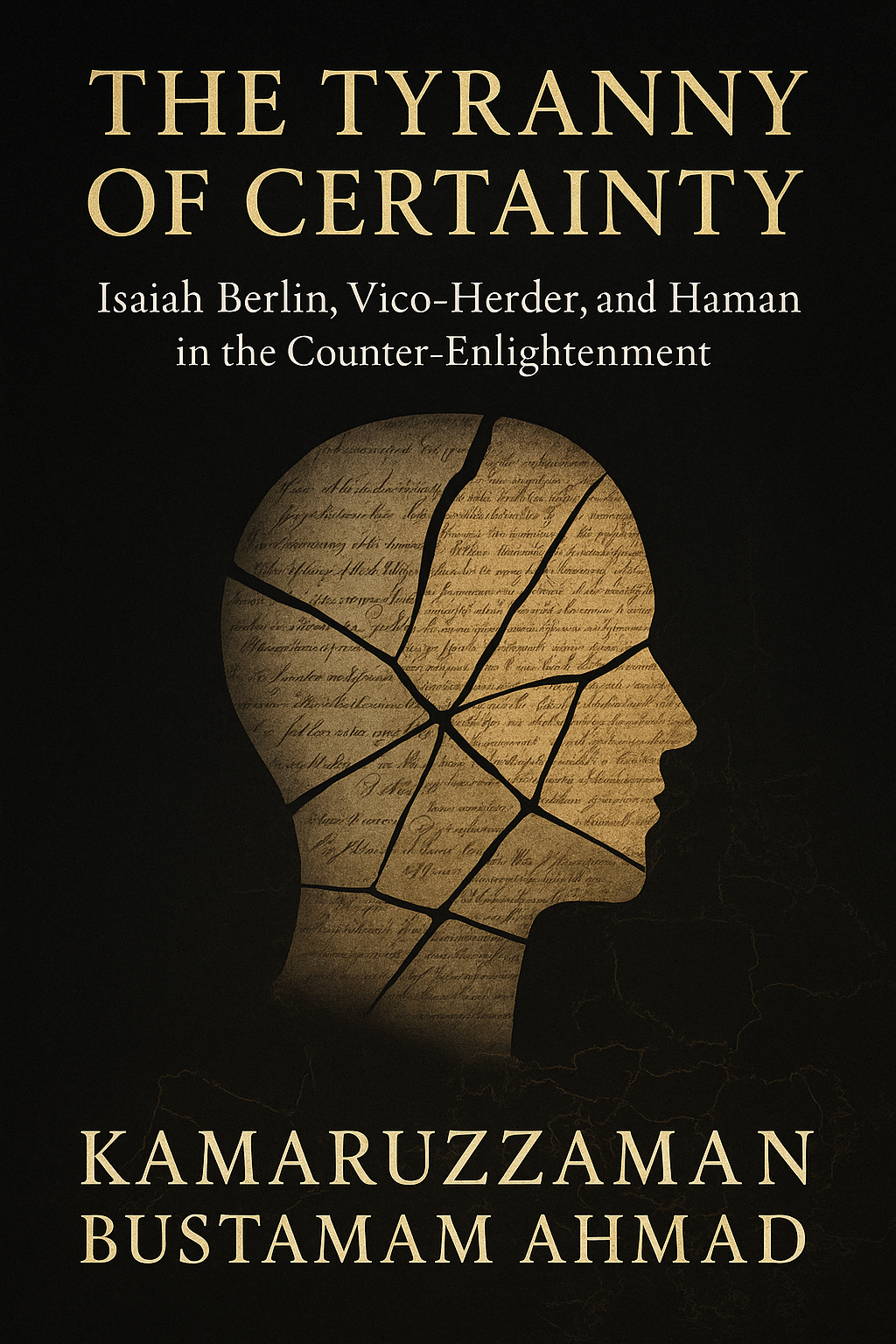
Why This Book Matters — and Why the World Needs It Now
Some books arrive quietly, and some books arrive like a force of history.
The Tyranny of Certainty: Isaiah Berlin, Vico, Herder, and Hamann in the Counter-Enlightenment belongs to the second category. It is not simply a philosophical text, nor a historical commentary, nor a biographical study. It is a map of human tragedy, a confrontation with the deepest illusions of modern civilization, and a powerful exploration of the dangerous longing for certainty that has shaped — and shattered — the destinies of nations and individuals alike.
The modern world stands again on the edge of catastrophe. Across continents, we witness escalating polarization, moral absolutism, ideological fanaticism, and the revival of utopian promises that demand total obedience. In the name of salvation, societies grow increasingly intolerant of disagreement. In the name of unity, diversity is sacrificed. In the name of progress, humanity is reduced to a blueprint.
This book argues that the root of these disasters is not ignorance — but the unyielding desire to eliminate uncertainty.
The Architecture of the Book
What makes this work uniquely powerful is its ability to construct a philosophical narrative from four distinct voices, each speaking across time, each resisting the tyranny of perfection, and each revealing a different dimension of the human struggle against absolute systems of thought.
Isaiah Berlin — The Tragic Vision of Pluralism
At the center stands Isaiah Berlin, whose reading of intellectual history transformed the way we understand freedom. Berlin insisted that human values are irreducibly plural, that conflict is inescapable, and that any attempt to impose harmony through force leads inevitably to oppression. Berlin’s thought is presented here not as commentary, but as a dramatic intellectual confrontation with the hope — and the horror — of certainty.
He becomes the interpreter, the mediator, the witness to a centuries-long rebellion.
Giambattista Vico — The Birth of Historical Imagination
From the ruins of rationalism, Vico declares a revolution: human beings cannot understand the world as if they were gods. Knowledge is born not from abstract logic, but from poetic imagination, culture, myth, and lived experience. In this book, Vico’s voice exposes one of the most profound errors of the Enlightenment: the belief that human society can be constructed like geometry.
Johann Gottfried Herder — The Dignity of Difference
Herder stands as a fierce defender of cultural particularity. His vision dismantles the arrogance of universal perfection. Here, he becomes the philosopher of diversity, language, identity, and the richness of human variation. Through him, the book shows how the dream of unity becomes violent whenever it attempts to erase difference.
Johann Georg Hamann — The Rebel Against Rational Idolatry
Hamann’s wild, mystical, fragmentary voice is the explosion that exposes the absurdity of rational absolutism. He argues that human life cannot be compressed into formulas. Through Hamann, this book reveals the irrational foundations of reason itself, the paradox at the heart of modernity.
Together, these thinkers reveal a terrifying insight:
When reason believes itself perfect, it becomes indistinguishable from tyranny.
The Contemporary Crisis
This book is not written to admire the past. It is written because the past has returned.
The forces that Berlin traced in the tragedies of the twentieth century are alive once again:
-
Ideologies that demand purity
-
Movements that promise salvation through elimination
-
Digital cultures obsessed with simplicity and outrage
-
Political systems that weaponize certainty
-
Societies terrified of ambiguity
In these conditions, The Tyranny of Certainty becomes both a warning and an intellectual instrument of survival. It invites readers to reclaim the courage to live without guarantees. It challenges us to embrace plurality and to resist the seductive brutality of perfect solutions.
The Uniqueness of This Book
What sets this work apart from other studies of Berlin or the Enlightenment is its narrative depth and emotional force:
-
It does not merely analyze — it dramatizes intellectual struggle.
-
It does not present isolated ideas — it weaves a philosophical epic.
-
It does not retreat into abstraction — it speaks to the crisis of our time.
-
It does not preach optimism — it confronts tragedy with dignity.
The book insists that to be human is to live among conflicts that cannot be resolved, and that peace is not the absence of struggle, but the willingness to coexist with difference.
This is a book for:
-
Scholars and thinkers seeking a deeper understanding of intellectual history
-
Students of philosophy, politics, and culture
-
Readers who refuse propaganda and fanaticism
-
Anyone searching for a more honest and humble vision of human life
A Call to Read
If you feel the exhaustion of a world screaming for simplicity,
if you long for a space where thought is not forced into obedience,
if you believe that complexity is not a weakness but a gift,
then this book is waiting for you.
Get Your Copy
Available worldwide:
📍 Amazon — Kindle & Paperback
📍 Google Play Books
📍 Draft2Digital (D2D) global distribution
👉 Read it. Share it. Think with it. Challenge the world that fears uncertainty.








Leave a Reply