KBA13 Insight · Digital Society & AI
2045 and a World Without Ignorance:When Everyone Knows That Everyone Knows
In 2045, AI and total transparency create a world where everyone knows that everyone knows. Drawing on Pinker’s common knowledge: the end of pretense, and a new psychological burden.
Summary
In 2045, AI and total transparency create a world where everyone knows that everyone knows. Drawing on Pinker’s common knowledge: the end of pretense, and a new psychological burden.
Keywords
- analysis
- commentary
- Future Studies
- KBA13 Insight
- technological forecasting
- year 2045
2045 and the Explosion of Common Knowledge
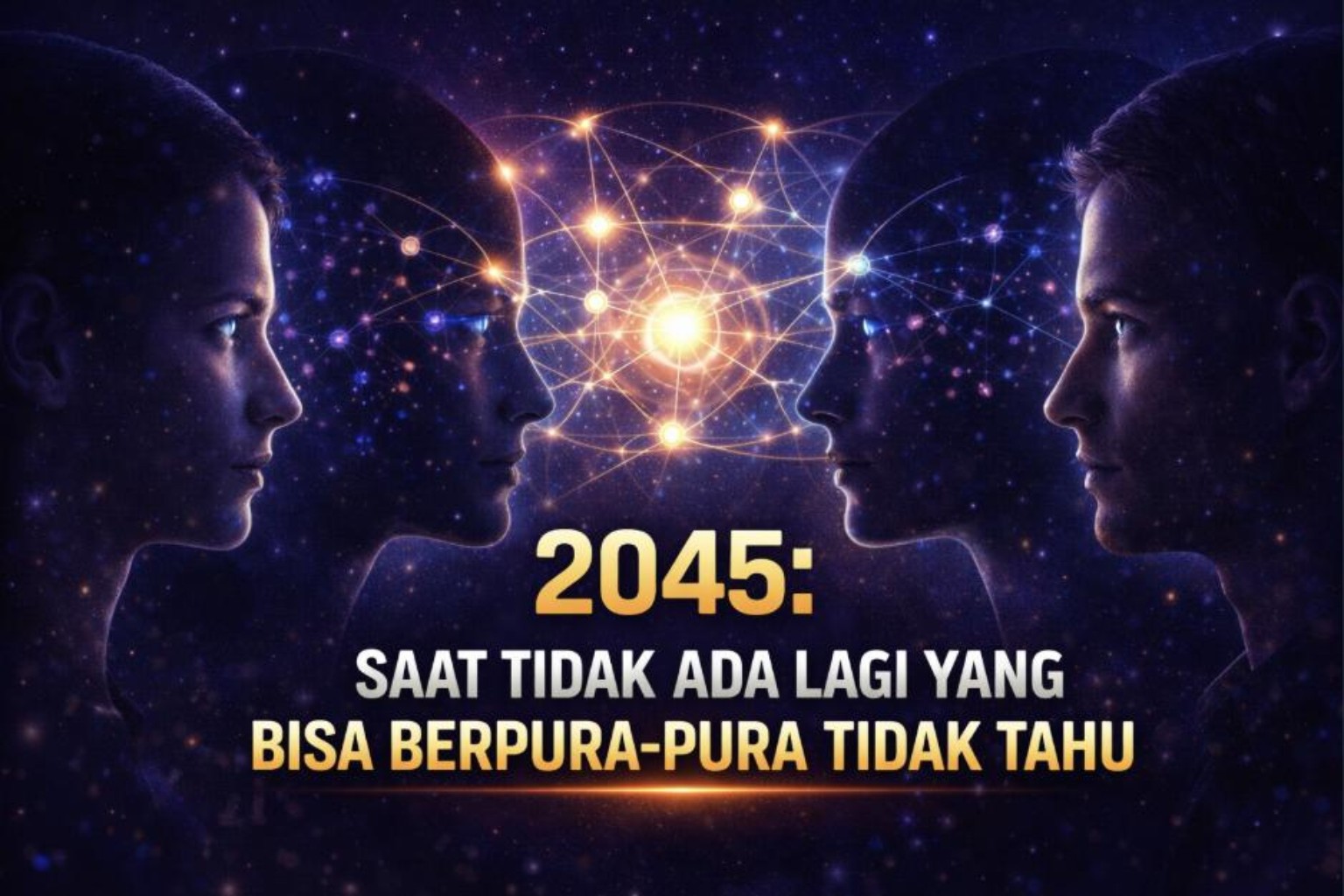
In the framework introduced by Steven Pinker, common knowledge is not merely a fact known by many people, but a fact known together, known to be known together, and known that the knowledge itself is known, without a clear reflective limit. In the past, this condition was rare. It required rituals, symbols, or powerful public events: a declaration of war, a proclamation of independence, or a great scandal.
But in 2045, this structure changes radically. Digital Consciousness, through AI, sensor networks, big data, and predictive systems, erases the lag of knowledge. Information no longer moves from one consciousness to another; it emerges simultaneously in the space of collective consciousness. Humans live in a situation where nearly everything significant instantly becomes known, known to be known, and known that it is known by others.
What changes is not only the speed of information but its epistemic status. Once everyone knows that everyone knows, the social space for silence and pretense collapses.
Total Transparency and the Collapse of Social Pretense
For much of human history, social order rested on a subtle form of shared not-knowing: people did not fully know what was actually known in common, which left room for tact, face-saving, and “staying silent for the sake of harmony.” On 2045, this mechanism breaks down. When everyone knows that everyone knows, the room to “stay silent for harmony” narrows drastically. Digital Consciousness does not merely open up information; it exposes the very structure of pretense. Collective lies become fragile, not because they are refuted, but because they can no longer be denied.
Yet this transparency does not automatically give birth to moral honesty. On the contrary, it gives birth to a new psychological pressure. Humans no longer confront the truth alone, but the awareness that the truth is witnessed by another consciousness that is also aware of being witnessed. Social relations become endlessly reflective, exhausting, and often defensive.
Layered Consciousness and a New Psychological Burden
When a person knows that others know that they know, consciousness is no longer linear but layered. Every action is accompanied by a meta-cognitive calculation: how will my action be understood, how will my understanding of their understanding be understood in turn, and so on. In 2045, Digital Consciousness accelerates and expands these layers.
AI does not merely read behavior; it models shared expectations. It predicts not only what people will do, but what they believe about the beliefs of others. In this condition, human spontaneity is threatened by over-reflection. Life becomes an arena of perpetual impression management, in which every gesture is anticipated before it is made.
Politics, Morality, and the End of Strategic Ambiguity
In politics and public ethics, total common knowledge ends what was once called plausible deniability. States, institutions, and actors of power can no longer rely on the asynchrony of knowledge. When a policy is designed, all parties know that all parties know the motive behind it.
Yet a paradox emerges: rather than subsiding, conflict merely changes form. Conflict no longer revolves around “what happened,” but around how the shared fact should be interpreted. The struggle shifts from the domain of information to the domain of interpretation.
In this condition, public morality becomes fragile. When everyone knows that everyone knows of a certain violation, yet the system keeps running, humans face an existential dilemma: does shared knowledge still mean anything if it produces no change? The year 2045 reveals that common knowledge is no guarantee of justice, but a test of collective courage.
Humanity in a World Without Shared Ignorance
In the end, the deepest impact of a world where everyone knows that everyone knows lies not in technology but in the loss of shared ignorance as a social space. Throughout human history, many relationships have survived precisely because certain things were left unsaid, unconfirmed, mercifully unknown. When that space vanishes, humans live in a world too aware of itself.
The question is no longer whether humans possess information, but whether humans still possess room to be not entirely transparent without being deemed guilty. Here lies the greatest challenge of Digital Consciousness: not how it makes humans know everything, but whether humans can still live meaningfully when there is no longer any place to pretend not to know.
How to Cite
Ahmad, Kamaruzzaman Bustamam. (2026). 2045 and a World Without Ignorance: When Everyone Knows That Everyone Knows. Banda Aceh: KBA13 Insight.
https://www.kba13.com/2045-world-without-ignorance-when-everyone-knows/
Professor of Anthropology of Religion at UIN Ar-Raniry Banda Aceh. He writes on geopolitics, Southeast Asian security and governance, Islam in the Malay world, and the future of knowledge.
About The Author

- Series · Seri
- KBA13 Insight
- Volume · Number
- Vol. 6, No. 125 (July 2026)
- Cumulative issue · Edisi ke-
- 564
- Reference · Nomor rujukan
KBA13-KI-2026-06-125- Author · Penulis
- Kamaruzzaman Bustamam Ahmad
- Published · Terbit
- 14 July 2026 · updated 20 October 2026
- Section · Rubrik
- Digital Society & AI, Premium
- Keywords · Kata kunci
- analysis, commentary, Future Studies, KBA13 Insight, technological forecasting, year 2045
- Language · Bahasa
- English
- Length · Panjang
- 964 words · ±4 min read
- Publisher · Penerbit
- KBA13 Insight, Banda Aceh, Indonesia
- Permalink
- www.kba13.com/2045-world-without-ignorance-when-everyone-knows/
- How to cite · Cara mengutip
- Kamaruzzaman Bustamam Ahmad. (2026, July 14). 2045 and a World Without Ignorance: When Everyone Knows That Everyone Knows. KBA13 Insight, 6(125). https://www.kba13.com/2045-world-without-ignorance-when-everyone-knows/
- Rights · Hak cipta
- © 2026 KBA13 Insight. Quotation permitted with full attribution and link.
Artikel Terkait
 2045 in Kurzweil’s Shadow: What Happens When the Singularity Truly Draws Near?
 Digital Consciousness 2045: Does Humanity Still Know Itself?
 Mind Control 2045: The Domination of AI and Humanoids Over the Human Mind
 Consciousness 2045: From Artificial Intelligence to Artificial Consciousness and the Future of Humanity
 Epistemology 2045: When AI and Humanoids Govern Knowledge and Determine Truth
Leave a Reply