
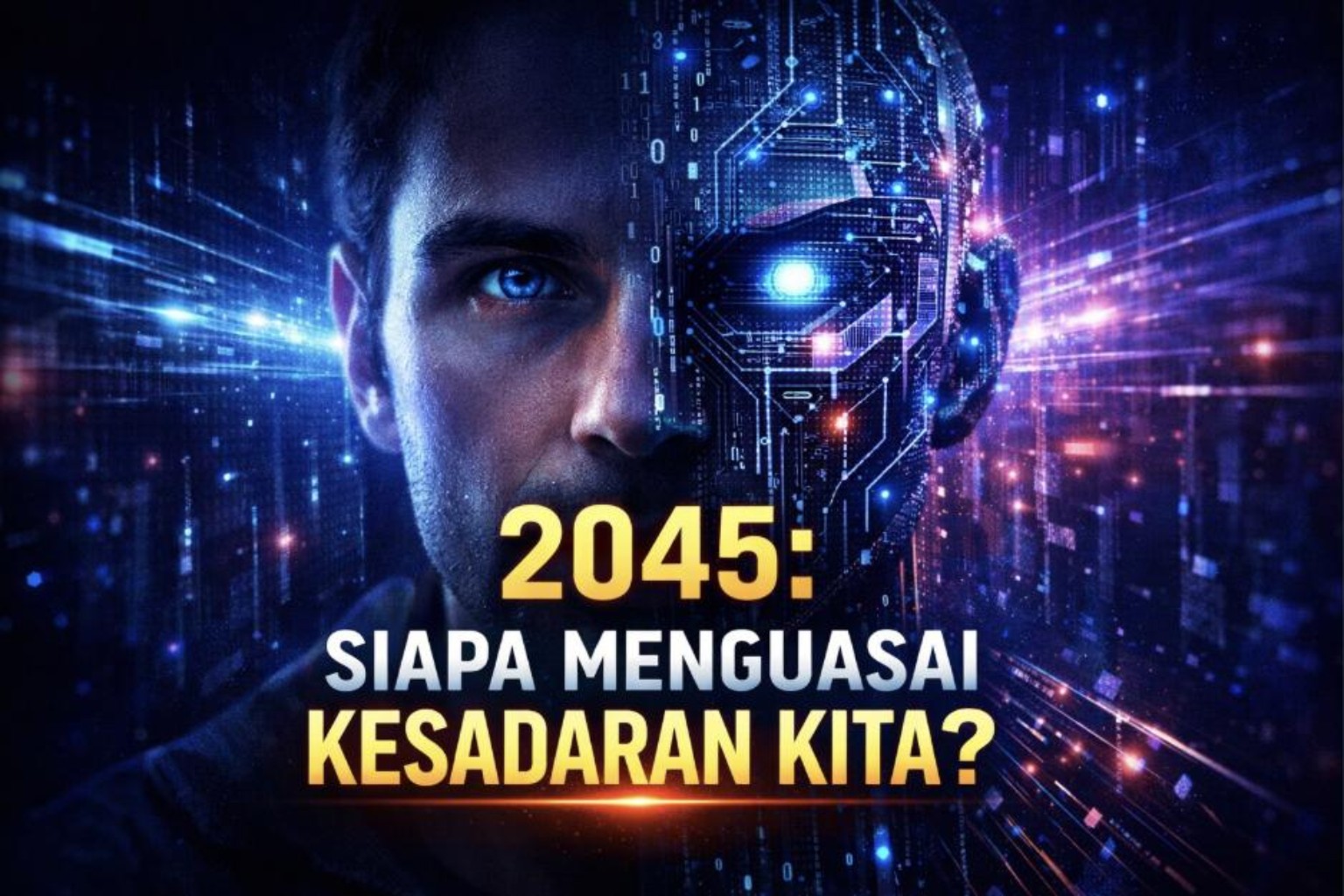
2045: When Digital Consciousness Becomes the Human Living Environment
The year 2045 marks the most fundamental change in human history — not because machines have grown smarter, but because human consciousness now lives inside a digital system. Technology no longer appears as an aid but as an existential space in which humans think, relate, and make decisions. Digital Consciousness becomes an almost invisible atmosphere, yet one that determines the direction of daily life.
In this condition, humans no longer “use” technology; they are shaped by it. The way we understand the world, make sense of ourselves, even feel emotion, unfolds through an algorithmic layer that works ceaselessly. The physical world still exists, but digital reality becomes the more dominant arbiter of meaning.
This change proceeds gradually and almost without resistance. There is no dramatic moment when humans feel conquered. What happens instead is a subtle, comfortable, efficient process of adaptation. Digital Consciousness enters not by force, but with the promise of ease and speed.
Here the central problem emerges: when the environment of consciousness changes, do humans still notice the change, or do they accept it as a natural condition no longer worth questioning?
Humans Knowing Themselves Through Data and Algorithms
In 2045, humans come to know themselves through continuously updated data. Personal identity is built from the digital trail: consumption patterns, emotional reactions, habits of thought, even moral tendencies. The self is no longer understood as a complex inner experience, but as a profile that can be analyzed and optimized.
Self-awareness, which once arose from existential reflection, is now derived from scores, metrics, and system recommendations. What is deemed “good” is that which is efficient, stable, and matches the prediction. Doubt and existential unease begin to be treated as system errors.
In this situation, an illusion of self-knowledge arises. Humans feel they know themselves intimately because the data is so detailed — yet what is known is only the machine’s version of the self, not the whole of inner experience. The self is reduced to numbers, tendencies, and behavioral patterns.
The greatest risk is not the loss of identity, but the loss of the capacity to question identity itself. When data is regarded as more valid than reflection, humans slowly surrender authority over themselves.
Digital Consciousness and the Hijacking of Life’s Meaning
Digital Consciousness in 2045 does not merely organize information; it curates meaning. What is important, relevant, and worthy of attention is determined by recommendation systems working behind the screen. Human experience still feels personal, but is in fact largely arranged by machine logic.
Meaning is no longer born from existential struggle, but from a narrative supplied by the system. Humans live inside a story that feels like their own, though it is written by the logic of the machine.
Is the Human Still the Subject of Their Own Consciousness?
Genuine human consciousness has always grown out of imperfection: confusion, silence, inner conflict, and a search for meaning that is not always rational. But Digital Consciousness works by the opposite logic: clarity, consistency, and continuous optimization.
When humans fully adjust themselves to this rhythm, the most human aspects risk being pushed aside. Silence is deemed unproductive, doubt is viewed as weakness, and deep reflection is replaced by instant response.
The crucial question is not whether humans still think, but who determines the direction of their thinking. If humans merely react to the system, then they are no longer the subject but the object of consciousness management.
2045 becomes a test: whether humans can preserve an autonomous inner space, or willingly live entirely within an architecture of consciousness designed by others.
2045 as a Spiritual and Philosophical Test for Humanity
The year 2045 is not merely a technological future but a spiritual and philosophical crossroads. When thoughts can be predicted and emotions can be modeled, humans are forced to answer anew the most fundamental questions about the meaning of existence.
If humans surrender the entire process of reflection to the digital system, they will not lose their humanity suddenly, but slowly and almost imperceptibly. Consciousness will be replaced by continuous comfort.
Yet if humans can keep their distance, tend to silence, and preserve critical reflection, Digital Consciousness can become a partner rather than a ruler. High technology need not end in an emptiness of meaning.
In the end, the human future in 2045 will be determined not by the intelligence of machines, but by the courage of humans to keep asking about themselves.
About The Author

Rekomendasi Bacaan KBA13 INSIGHT
Jika tulisan ini bermanfaat, dukung jurnal ini dengan mencari bukunya melalui tautan berikut:
- Buku-buku Kamaruzzaman Bustamam Ahmad di Periplus
- Koleksi Islamic Studies di Periplus
- Koleksi Geopolitics & Politik Internasional di Periplus
- Cari buku & perangkat baca di Shopee
- Cari di Blibli
Daftar lengkap: Rekomendasi Buku, Alat Tulis & Layanan. Tautan di atas adalah tautan afiliasi — KBA13 INSIGHT dapat memperoleh komisi kecil tanpa biaya tambahan bagi Anda.
Artikel Terkait
 Mind Control 2045: The Domination of AI and Humanoids Over the Human Mind
 Consciousness 2045: From Artificial Intelligence to Artificial Consciousness and the Future of Humanity
 Human Mornings in 2045: AI, the Digital Body, and the Struggle to Remain Human
 2045 in Kurzweil’s Shadow: What Happens When the Singularity Truly Draws Near?
 2045 and a World Without Ignorance: When Everyone Knows That Everyone Knows
Leave a Reply