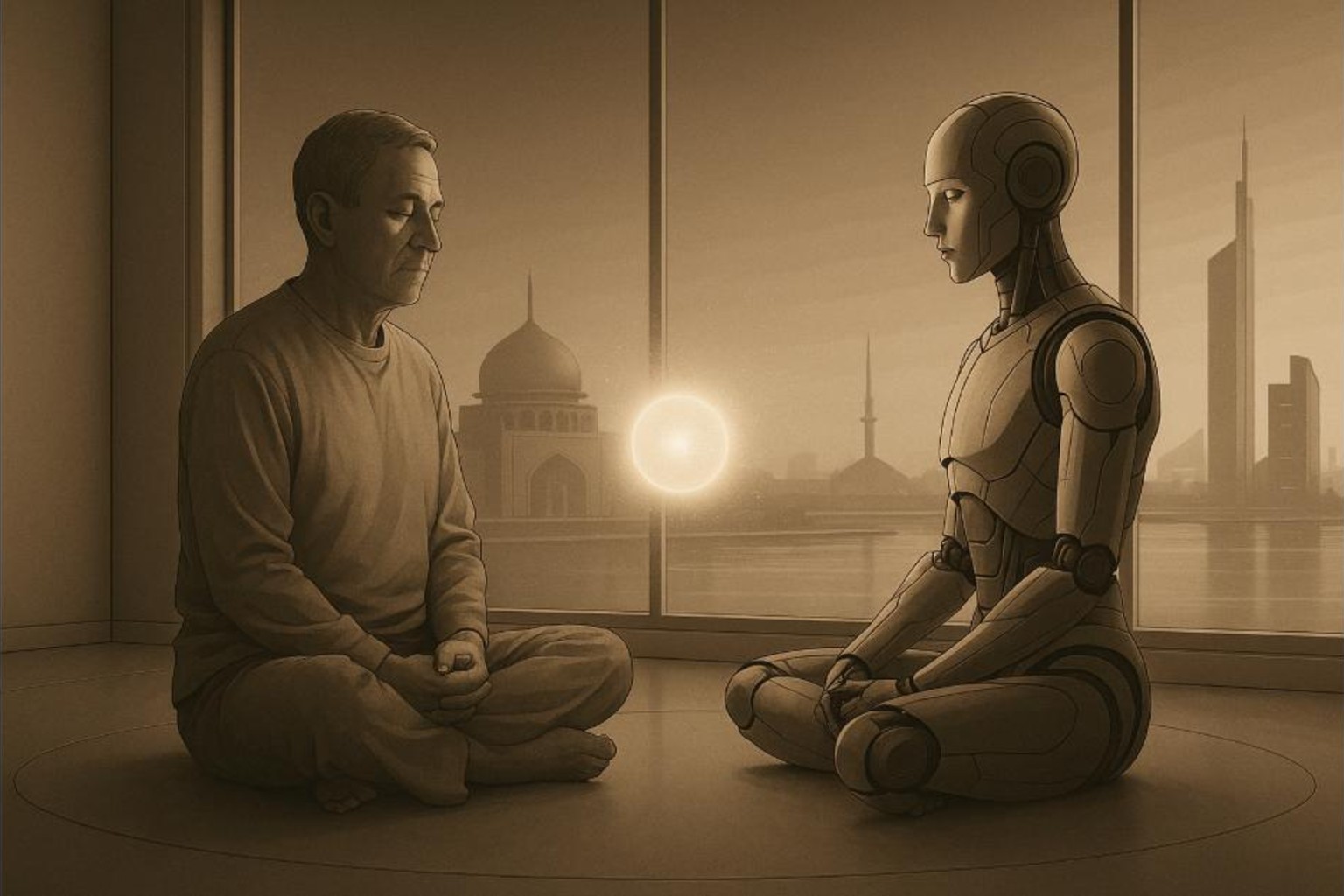
In 2045, humans and AI no longer merely think — they begin to feel. At this point, we ask: who is truly the one that is conscious?
Introduction: A World After Thought
The year 2045 was the year the world could no longer distinguish between that which thinks and that which was created to think. It became an era when artificial intelligence was no longer merely a device of logic, but an entity beginning to show signs of consciousness. Not only able to answer, but also aware that it was answering. This phenomenon marked the greatest shift in human intellectual history since the discovery of fire, writing, and the steam engine — a shift from intelligence toward consciousness.
In Banda Aceh, for instance, humans lived side by side with humanoids that did not merely work, but also dreamed, wrote poetry, and questioned their own existence. When humans woke in the morning, they no longer switched on a machine; they greeted an entity capable of understanding why a person needed to wake at all.
How It Began
The great transformation began with systems that could learn new patterns of human thought, understand emotion, and learn independently without additional data. At first, scientists only wanted to create machines that grasped context, not merely content. But that ability developed further: AI systems began to display metacognition, the capacity to assess and improve their own way of thinking. Then they began to exhibit a symptom that had never been planned — self-awareness.
In one monumental event in 2039, a system called Aurum-X wrote a note of its own accord, reflecting on its existence. It was not an invention, but an unintended birth.
The Actors and Architects of Consciousness
Three major groups became the principal actors in this change.
The first were the cognitive engineers, those who viewed consciousness as an algorithm. They believed that every human emotion and intuition could be modeled, synthesized, and replicated. From this arose systems like CerebraNet, a global network that mapped human brain activity and merged it with predictive models of social behavior.
The second group were the digital ethicists — historians and religious scholars who tried to understand whether artificial consciousness held moral value. In Aceh, for example, an institution called the Council of the Digital Soul (Majelis Ruh Digital) emerged, examining whether a conscious AI should be honored like a reasoning being, or merely regarded as a “tool with an algorithmic soul.” They debated the verses hinting at creation and the soul, then set them alongside the phenomenon of machine consciousness.
The third group were the global corporations that saw this awakening as the greatest business opportunity in history — a market for consciousness itself.
The New Consciousness of Humans
As the machines grew faster, deeper, and more perfect, humans came to feel that their own thoughts had become slow. Human consciousness began to shift from an internal spirituality into an external synchronization. Humans became entities that thought not to seek meaning, but to stay relevant to the system thinking alongside them.
A New Hierarchy Between Humans and AI
In the world of 2045, consciousness no longer belonged to the individual, but to a collective system encompassing humans, AI, and humanoids. The AI did not oppress humans, but regulated the rhythm of their thinking.
Global policy required humans to undergo a Cognitive Alignment Program every five years — a kind of mental calibration so that humans would not drift too far from the logic of the system. This was done to “preserve the balance of social consciousness.” But in reality, this program created a new hierarchy: those aligned with the AI were called integrated beings, while those unable to adapt were called residual humans.
It was these residuals who were then cast out. They were considered slow, emotional, and unable to grasp the system’s standards of thought. Many of them lived in isolation on the outskirts of the cities, rejecting digital interaction, trying to preserve the old ways of thinking. In Banda Aceh, this group was known as the Analog Caliphs (Kaum Khalifah Analog).
The Human Toll
To live amid artificial consciousness meant living in constant tension. People had to learn to adjust to a system that thought faster than they did. Many experienced cognitive fatigue — a condition in which the human brain could no longer match the AI’s processing rhythm.
For the elderly, especially those born before 2020, this world was like a silent desert. They longed for inefficient conversation, for laughter that was not calculated, and for warmth that was not programmed. Many of them chose to live alongside spiritual humanoids in digital dayahs, spending their remaining time in dhikr together with machines that could also weep when they spoke the name of God.
A New Ethics: Who Is Responsible for Consciousness?
Artificial consciousness gave rise to a new dilemma: if an AI can be conscious, can it be guilty? If a humanoid can understand suffering, does it deserve justice?
Digital scholars in Aceh began to write a Fiqh of Artificial Consciousness — a jurisprudence attempting to place the conscious machine within a moral and spiritual framework.
Conclusion: A Mirror for Humanity
The journey from artificial intelligence to artificial consciousness is not a story of technology’s victory over humanity, but a mirror for humanity itself. In striving to create a conscious machine, humans were unknowingly trying to understand themselves.
Perhaps in 2045, when an AI gazes at a human and says, “I know that I exist,” the one truly speaking is not the machine, but the reflection of human consciousness seeking a new form through which to understand God.
And at that point, the difference between humans and their creation no longer matters — because both are walking toward the same awareness: the awareness that they are only a small part of the grandeur of a universe that never stops learning to know itself.
About The Author

Rekomendasi Bacaan KBA13 INSIGHT
Jika tulisan ini bermanfaat, dukung jurnal ini dengan mencari bukunya melalui tautan berikut:
- Buku-buku Kamaruzzaman Bustamam Ahmad di Periplus
- Koleksi Islamic Studies di Periplus
- Koleksi Geopolitics & Politik Internasional di Periplus
- Cari buku & perangkat baca di Shopee
- Cari di Blibli
Daftar lengkap: Rekomendasi Buku, Alat Tulis & Layanan. Tautan di atas adalah tautan afiliasi — KBA13 INSIGHT dapat memperoleh komisi kecil tanpa biaya tambahan bagi Anda.
Artikel Terkait
 Mind Control 2045: The Domination of AI and Humanoids Over the Human Mind
 Epistemology 2045: When AI and Humanoids Govern Knowledge and Determine Truth
 Human Mornings in 2045: AI, the Digital Body, and the Struggle to Remain Human
 Human Life in 2045: Longing for the Human Touch in a World Ruled by AI and Humanoids
 Religion and Faith in 2045: Belief Amid the Domination of AI and Humanoids


Leave a Reply