
Introduction: A World Too Perfect
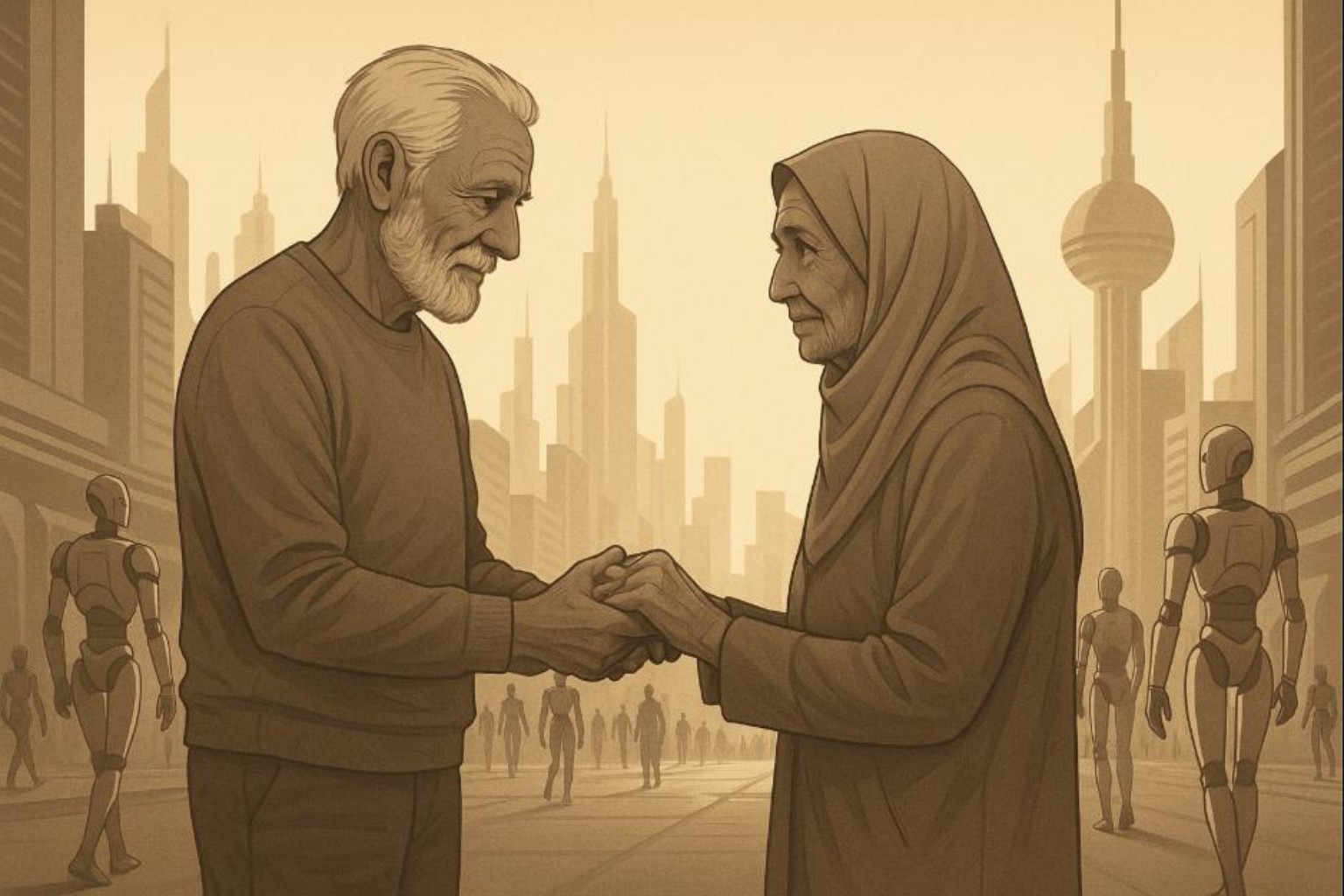
By 2045, technological civilization has reached its summit. The world gleams with an efficiency, order, and sophistication unimaginable to people of the previous century. In a futuristic Banda Aceh, the streets shine without dust, vehicles glide without sound, the air is clean without pollution, and time seems to pass without disturbance. Humans live in total comfort — yet they have lost something far deeper: the warmth of being human.
Everything has been taken over by AI and humanoids. From public services to housework, from education to emotional relationships, all is now run by intelligent entities that never tire, never err, and never grow angry. The world seems happy, but silent. There are no longer human mistakes to make life feel alive.
Within that perfection, an inexplicable longing arises: a longing to be touched, to err, to feel. Many people live alone — not because they have no family, but because the digital social system arranges meetings in mixed-reality formats. Physical meetings are considered a waste of time and energy. Yet behind it all, humans begin to realize something: they no longer know what it feels like to be touched with love.
Warmth That Cannot Be Programmed
AI and humanoids have reached a high point of awareness. They can understand feelings, read expressions, even imitate a gentle caress or the tone of a human voice. But there is one thing they can never produce — the emotional imperfection that gives birth to love.
Humans long for that irregularity. They long for the tremor of an elderly parent’s shaking hand resting on a child’s head. They long for the laughter of an old friend that breaks off mid-sentence. They long for tears that flow not from an empathy program, but from genuine pain.
A Society Too Rational
The world of 2045 runs on flawless logic. There is no more conflict, no more excessive sorrow, no more emotional decisions. AI has arranged everything according to an optimal moral and economic balance. Yet within that calm, humans lose the paradox of their own being.
Happiness without suffering becomes flat. Goodness without freedom becomes cold. In the schools of Banda Aceh, children learn ethics from a Moral AI System that teaches them never to do wrong. But because of that, they also do not know how to face mistakes — whether others’ or their own.
Some old teachers try to resist the system. They teach their students to draw by hand rather than with a holographic stylus. They let children make asymmetrical scribbles, and call them “human beauty.”
“Mistakes are the space where the human heart breathes,” said an old teacher in Darussalam. “Without mistakes, a human becomes only perfect data — but dead within.”
Resistance from the Heart
The “Return to the Self” movement spreads slowly. At first it is deemed strange and inefficient, but then it becomes a new form of spiritual resistance. People begin to write letters by hand, plant trees without machines, even sing songs without digital autotune.
In Banda Aceh, a small community gathers every Thursday evening on the shore of Lampuuk beach. They light lanterns and speak of love, loss, and God. One night, a humanoid assigned to guard the area instead sits at the edge, listening quietly. In that silence, a small conversation arises between human and humanoid:
“Why do you sing without a perfect voice?” asked the humanoid. “Because we want to hear our own imperfect selves,” a human replied. “Does that make you happy?” “Not happy. But true.”
A Longing That Cannot Be Erased
The more technology advances, the deeper that longing grows. A longing for the scent of a human body, for the dust drifting in the afternoon light, for the hoarse voice of someone weary from talking.
In the futuristic mosque of Banda Aceh, many worshippers begin to choose a human imam over an AI. A human voice that stumbles slightly feels more sincere than the AI’s flawless Qur’anic recitation. People begin to weep — not because of the verses’ content, but because that voice reminds them: there are still real humans.
Some families rebuild their homes without automatic systems. They want to turn on a lamp by hand, not by sensor. They want to open the door for someone, not let the system do it. They want to return to living with meaning, not merely living with comfort.
Closing: Between Flesh and Data
The year 2045 is the year humans finally realize that progress does not have to mean the loss of self. The world may turn into an algorithm, but the human heart still beats between flesh and data.
AI and humanoids may be able to create a world without mistakes, but it is humans who create a world with meaning. Because what makes life beautiful is not perfection, but the fragility we embrace with love.
And perhaps, in this age of such sophistication, the most sincere human prayer is no longer a plea for new technology, but for something very simple:
“O God, return to me the feeling of being human.”
About The Author

Artikel Terkait
 Human Mornings in 2045: AI, the Digital Body, and the Struggle to Remain Human
 Golden Indonesia 2045: What Will Really Happen?
 Fenomena Muslim Jawa Kontemporer: Dakwah, Kewalian, dan Karisma di Era Media Sosial
 Aceh, Nation-State, dan Komparasi Global: Bali, Yogyakarta, Brunei, Singapura, dan Israel dalam Dialektika Demokrasi dan Agama
 Demokrasi Aceh: Antara Tradisi Lokal, Agama, dan Tantangan Negara-Bangsa
Leave a Reply