2045 as a Turning Point in the History of Intelligence
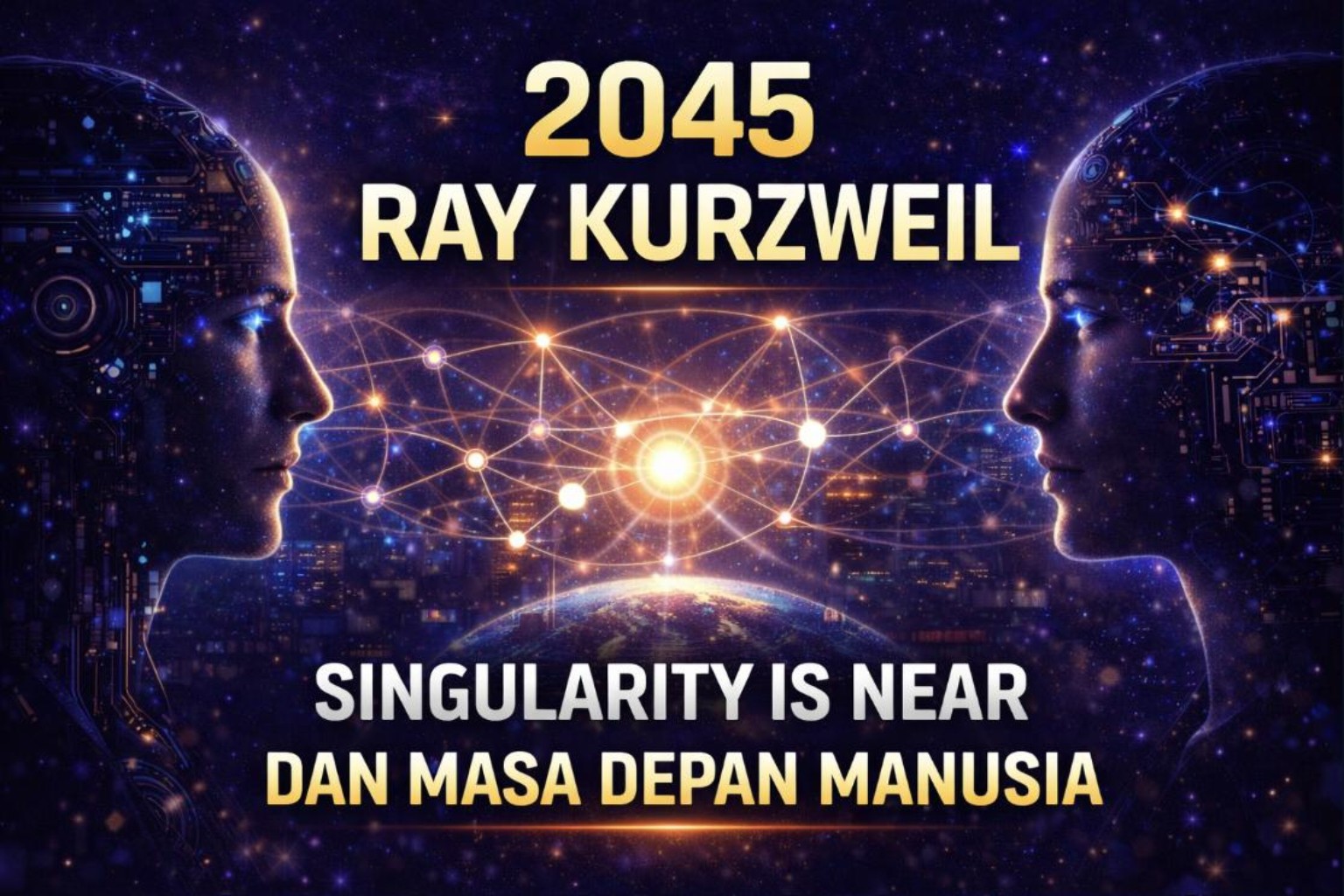
In Ray Kurzweil’s imagination, the year 2045 is not merely a futuristic number but an “epistemic boundary” marking a change in how humanity understands history. Kurzweil holds that the pattern of technological history follows the logic of exponential growth: small changes accumulate, then suddenly become a great leap. For this reason, 2045 is read as the moment when the accumulation of innovation — computing, AI, biotechnology, and global networks — no longer merely accelerates life but transforms the structure of social reality.
At this point, technology ceases to be a tool and becomes an ecology. Humans are no longer “outside” the system; they live inside an environment composed of algorithms, sensors, and computational intelligence. Daily life — from health, mobility, and household economics to social relationships — runs within an order that is predicted, recommended, and optimized. The future no longer arrives as a surprise, but as a continuously updated projection.
What changes is not only capacity but the standing of the human being as the center of knowledge. The year 2045 is the era in which that “center” shifts — not to a single machine, but to a network of intelligence that surpasses the individual.
Thus 2045 is not merely a technological summit but a great test for culture. It tests whether humanity can build a value system commensurate with this new power, or instead lets that power build its own values. Here the singularity becomes not merely a technical issue but a civilizational one.
Non-Biological Intelligence Surpassing Humans: What Does “Smarter” Mean?
Kurzweil is often read simply: AI will become “smarter” than humans. But in 2045, “smarter” must not be understood merely as winning at chess, writing fast, or analyzing data. What is meant is a change of scale and quality: non-biological intelligence able to integrate billions of information sources, learn continuously, and operate without the biological limits of fatigue, forgetting, or emotion.
The consequence is structural. When a system can make decisions faster and more accurately, institutions tend to adopt it without lengthy debate. What remains for humans is a symbolic role: to grant legitimacy, no longer to determine direction.
In 2045, the conflict that emerges is not between human and machine, but between the human and their own dependency. When AI becomes the standard of operational truth, the human who chooses differently is deemed irrational. Even morality can be pushed toward statistical morality: the good is that which produces the best outcome according to the model. At this point, values that are not easily calculated — dignity, meaning, loyalty, forgiveness — risk becoming inefficient “accessories.”
The long-term effect is a cultural shift from reflection toward optimization. Society becomes extremely intelligent yet increasingly poor in inner wisdom, because wisdom requires a space of uncertainty, not the certainty of the model. If everything can be predicted and recommended, the room for genuine deliberation shrinks.
Human–Machine Fusion: From Extension to Integration
Kurzweil envisions fusion: technology not merely used by humans but integrated into the body and mind. In 2045, prosthetics, neural interfaces, and cognitive implants are no longer science fiction. The human becomes a hybrid entity — a biological body with an upgradeable, updatable digital layer.
This fusion changes how humans know themselves. Identity is no longer built primarily through the retold narrative of a life, but through configuration: what is installed in the body, what models are connected to the mind, what access one has to the knowledge network. Cognitive advantage becomes something that can be “bought,” “upgraded,” and “customized.” Here a new moral dilemma emerges: are humans still equal as fellow beings when inner capacity can be altered by access to technology?
On the other hand, fusion promises liberation from much biological suffering: degenerative disease, sensory limits, memory disorders, even some aspects of aging. But that liberation simultaneously opens the door to control. The deeper technology enters the nervous system, the greater the opportunity for subtle manipulation: not merely changing what one sees, but influencing what one desires.
Kurzweil tends to see fusion as an advance — human intelligence accelerated without losing depth. Yet the same possibility can reduce the human to a “platform” compatible with the system. Thus human–machine fusion in 2045 is at once a promise and a risk. It could become an era of human expansion, or an era of human reduction. The key lies in the design of ethics, regulation, and — most difficult of all — the inner resilience of humans themselves.
The Post-Work Economy: Abundance, Inequality, and a Crisis of Meaning
Kurzweil often speaks of abundance: technology lowers costs, multiplies access, accelerates innovation. In 2045, intelligent automation makes many jobs disappear or change entirely. But the main problem is not the loss of jobs; it is the loss of work as a source of identity, which for centuries has been the backbone of social self-worth.
On one side, the world of 2045 may be materially richer: more efficient production, more precise logistics, cheaper healthcare, and basic needs more easily met. On the other side, material abundance does not automatically produce a sense of meaning. When the state or corporations provide a basic income, the human is guaranteed to survive — but not guaranteed to feel valued.
If a new distribution of meaning is not created, society will split in two: an “upgraded” group that controls the direction, and a “left-behind” group living in an economy of attention and cheap entertainment.
The crisis of meaning will appear in culture: rising addiction to distraction, the pursuit of sensation, and identity conflicts driven by the need to feel important. Ironically, as life becomes more comfortable, humans may grow more restless from losing the challenges that shape the soul. When AI closes off many spaces of uncertainty, humans seek artificial uncertainty — controversy, extremism, or social drama — merely to feel the intensity of life.
Thus the post-work economy of 2045 is a new field of human struggle: the struggle to find meaning beyond work. Kurzweil offers technological abundance, but society must create moral abundance: a way of life that keeps humans feeling valuable, not merely served.
Politics, Ethics, and the Struggle Over the Direction of Civilization
If the singularity is the point at which intelligence surpasses the individual, then the politics of 2045 is a struggle over who directs that intelligence. Kurzweil sees technology as a progressive force, but power always demands governance. In 2045, the political question is no longer the classic left–right ideology, but who controls the AI infrastructure, the data, and the architecture of public consciousness.
In a world increasingly transparent and predictive, propaganda no longer works through crude lies but through the curation of reality. What is contested is not facts, but attention and interpretation. A system can make society “agree” without debate, because they are given the same informational experience, arranged to produce the same emotion. This is not the old totalitarianism, but a subtle totalitarianism: humans feel free, yet their minds move along prepared tracks.
Ethics becomes central, but ethics too is vulnerable to being reduced to “system rules.” In 2045, many moral decisions are automated: driverless vehicles choose accident scenarios, health systems set therapy priorities, educational algorithms determine a child’s life path. Each such decision contains a philosophy, but is often disguised as a technical matter. Here lies the greatest danger: morality hidden inside code.
Kurzweil believes humans will merge with AI so that human–machine conflict diminishes. Yet history shows that conflict often arises not from a difference of species but from a difference of interests. If access to advanced AI is concentrated in a few actors — states, corporations, elites — then the singularity becomes an instrument of domination. Civilization does not collapse, but its direction is determined by a handful of parties.
For this reason, 2045 requires a new kind of literacy: understanding how algorithms work, how “choices” are shaped, and how to preserve an autonomous inner space. This is a subtler form of resilience than economic resilience: resilience against the colonization of the mind.
In the end, what happens in 2045, according to Kurzweil, is not a single event but a change in the very terrain of human life. The singularity is an explosion of capacity, but capacity without values gives birth only to a new emptiness. The future of 2045 will be determined by a simple yet weighty question: will this technology make humans more human, or make humans forget how to be human?
About The Author

Rekomendasi Bacaan KBA13 INSIGHT
Jika tulisan ini bermanfaat, dukung jurnal ini dengan mencari bukunya melalui tautan berikut:
- Buku-buku Kamaruzzaman Bustamam Ahmad di Periplus
- Koleksi Islamic Studies di Periplus
- Koleksi Geopolitics & Politik Internasional di Periplus
- Cari buku & perangkat baca di Shopee
- Cari di Blibli
Daftar lengkap: Rekomendasi Buku, Alat Tulis & Layanan. Tautan di atas adalah tautan afiliasi — KBA13 INSIGHT dapat memperoleh komisi kecil tanpa biaya tambahan bagi Anda.
Artikel Terkait
 2045 and a World Without Ignorance: When Everyone Knows That Everyone Knows
 Digital Consciousness 2045: Does Humanity Still Know Itself?
 Mind Control 2045: The Domination of AI and Humanoids Over the Human Mind
 Consciousness 2045: From Artificial Intelligence to Artificial Consciousness and the Future of Humanity
 Epistemology 2045: When AI and Humanoids Govern Knowledge and Determine Truth
Leave a Reply