
Bottom Line Up Front
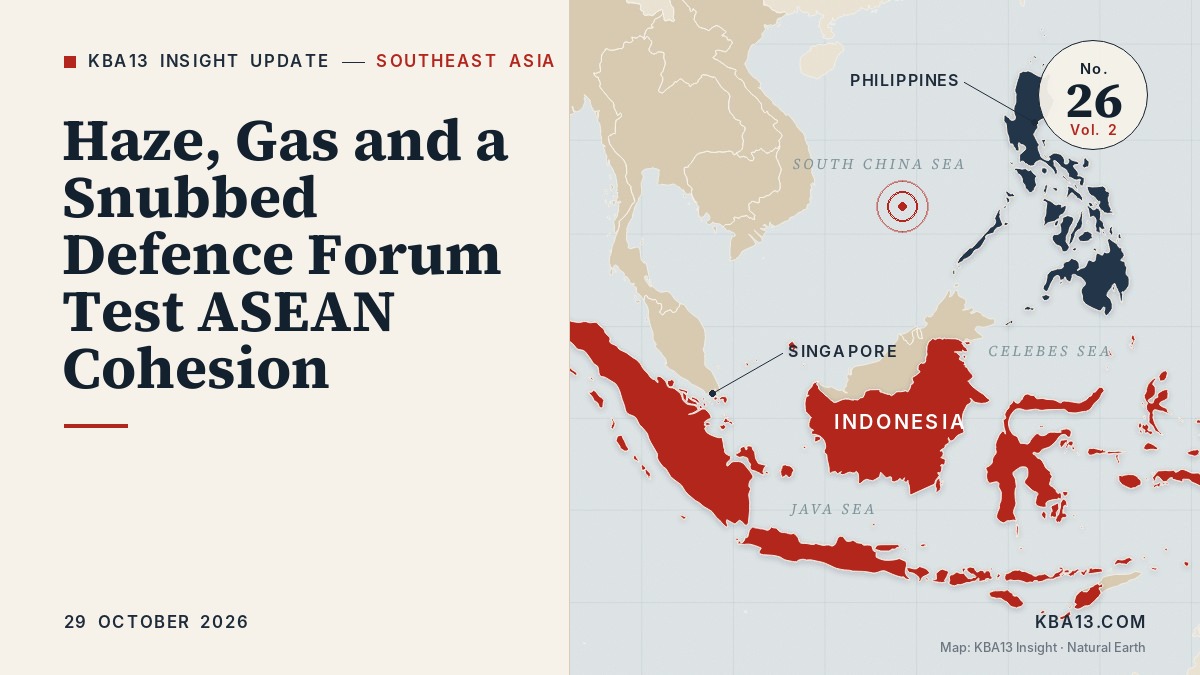
Southeast Asia closes October 2026 with its institutions working harder than at any point this year while the region’s cohesion is visibly thinning. Three developments dominated the 72 hours to 29 October. First, the 20th ASEAN Defence Ministers’ Meeting and the 13th ADMM-Plus in Cebu produced a respectable list of deliverables, but were overshadowed by China’s decision to send only its defence attaché, the lowest level of Chinese representation since the forum began in 2010, and by an open exchange of accusations between Beijing and Manila over the Philippine chairmanship. Second, the worst forest fires and haze in eleven years have turned into a bilateral crisis between Indonesia and Singapore, complicated by Jakarta’s reduction of pipeline gas exports, a three-day damage-control visit by Singapore’s foreign minister and street protests across Indonesian cities. Third, the Philippines, as ASEAN chair and holder of the special envoy portfolio, led a humanitarian mission into Myanmar a month before the leaders’ summit in Manila, testing a more transactional ASEAN approach to a regime now led by a president who was formerly its military commander.
Our central judgement is that ASEAN’s formal architecture will hold through the November summit, but that the substance of regional cooperation is shifting from consensus-building to damage control among members (moderate confidence). The common driver is external pressure: the eight-month war around Iran has pushed Brent crude above US$110, tightened energy supplies and raised the cost of everything from fuel to shipping, while great-power competition in the South China Sea is being carried into ASEAN’s own meeting rooms. In this environment, intra-ASEAN disputes that would once have been handled quietly, such as transboundary haze or gas contracts, are being politicised at home, and the region’s capacity to speak with one voice on Myanmar and the South China Sea is weakening. For Indonesia, the immediate priorities are restoring trust with Singapore without appearing to yield under pressure, containing the fires that are now a domestic political issue, and managing an energy bill inflated by a war it cannot influence.
ASEAN Architecture and Regional Diplomacy
The Cebu meetings were designed as a showcase of the Philippines’ 2026 chairmanship and of two decades of ASEAN defence cooperation. At the 20th ADMM on 28 October, chaired by Defence Secretary Gilberto Teodoro Jr., ministers adopted five initiatives: a young defence leaders’ exchange, closer coordination between the ADMM-Plus and ASEAN Regional Forum defence tracks, work on maritime security and emerging technologies, cooperation against chemical, biological and radiological threats including a proposed 2027 ADMM-Plus conference, and updated operational guidelines, according to the Daily Tribune. Ministers also adopted the Manila Joint Declaration on the ADMM’s 20th anniversary and a joint statement marking fifty years of the Treaty of Amity and Cooperation. These are meaningful, if incremental, outputs, and they show that the defence track remains one of ASEAN’s more productive institutional spaces.
The diplomatic signal from Beijing was the opposite of incremental. China sent Senior Captain Yang Lei, its defence attaché in Manila, instead of its defence minister, and the Philippines responded by having him received by an undersecretary rather than by Teodoro, according to The Philippine Star. China’s defence ministry spokesman Zhang Xiaogang accused the chair of allowing “a certain self-serving politician” to abuse the chairmanship to obstruct China’s participation, in violation of “consensus through consultation”, and claimed that “many ASEAN countries” had objected, without naming them. Teodoro replied that China’s position is not ASEAN’s position and that only member states can characterise ASEAN processes. Two features of this exchange matter more than its tone. China chose to signal displeasure through the level of its representation rather than by boycotting, preserving its ability to return when Singapore takes the ADMM chair next year. And Beijing explicitly sought to split ASEAN from its chair by claiming other members’ sympathy, a tactic that will be repeated at the leaders’ level if Manila uses its summit to press the South China Sea agenda.
The United States used the same meetings to deepen its offer. Secretary Pete Hegseth proposed a new US–ASEAN defence framework to coordinate cooperation over several years, focused on maritime domain awareness, military coordination and naval cooperation, and said Washington was ready to begin work as Singapore assumes the ADMM-Plus chair, according to The Epoch Times. He also praised ASEAN’s role in sustaining the Thailand–Cambodia ceasefire. India’s defence minister Rajnath Singh offered to share counter-terrorism expertise. The juxtaposition is striking: as China downgrades its presence, the United States, India, Japan and Australia upgrade theirs. We judge that most ASEAN members will welcome the practical capacity-building in this offer while avoiding any formal framework that could be portrayed as alignment against China, and that Singapore, as incoming chair, will work to restore a Chinese ministerial presence in 2027 (moderate confidence).
The wider pattern of external engagement in Cebu reinforces this reading. US Defense Secretary Hegseth held sideline meetings with his counterparts from the Philippines, Japan, India and South Korea, and said Washington is accelerating the modernisation of the Armed Forces of the Philippines; Australia’s Richard Marles also attended in person. The ADMM-Plus therefore functioned less as an inclusive forum of all eight dialogue partners than as a venue in which one partner signalled distance while the others thickened their networks with ASEAN members. That asymmetry carries a risk for ASEAN centrality. If the forum is perceived in Beijing as a stage for coalitions it opposes, China’s incentive is to shift its engagement to bilateral channels and to the ASEAN–China framework it controls more closely, such as negotiations on the South China Sea Code of Conduct. ASEAN’s interest is the opposite: to keep every major power inside its forums so that competition is mediated rather than imported.
The Myanmar file shows a parallel shift in ASEAN’s method. Philippine Foreign Secretary Theresa Lazaro, ASEAN’s special envoy, led an ASEAN Monitoring Team into Myanmar that ended on 29 October, delivering rice, family kits and hygiene kits in Southern Shan State and launching a month-long operation through the AHA Centre and the Myanmar Red Cross to reach more than 11,000 households in Kayin and northern Shan States, according to Arab News. The context is a regime that has re-clothed itself: Min Aung Hlaing was inaugurated as president in April 2026, Malaysia hosted him in Kuala Lumpur last month, and analysts describe a move towards “more limited engagements” rather than isolation. UN data cited in the same report put internal displacement at more than 4.1 million, compared with about 671,000 in 2021. The Five-Point Consensus remains ASEAN’s formal reference, but its practical meaning has shrunk to humanitarian access negotiated with the incumbent authority. We assess that the Manila summit in November will consolidate this pragmatic engagement rather than restore pressure on Naypyitaw (moderate confidence).
Indonesia and Singapore: Haze, Gas and the Politics of Respect
The most consequential intra-ASEAN development of the period is the deterioration in Indonesia–Singapore relations, because it combines an environmental emergency, an energy dispute and nationalist domestic politics. The deforestation monitor Nusantara Atlas estimates that fires burned more than 1.9 million hectares in the nine months to September, and pollution has reached dangerous levels in Indonesia, Malaysia, Singapore and Timor-Leste, according to Malay Mail. Indonesia is experiencing its worst fires and haze in eleven years, aggravated by El Niño. Singapore has promised legal action against companies responsible and summoned senior representatives of ten major agribusiness groups with Indonesian plantation operations, with Senior Minister K. Shanmugam stating that haze “is not a natural phenomenon” but the result of “irresponsible business practices”.
Jakarta’s response escalated the dispute into the energy domain. After President Prabowo Subianto criticised “countries that like to insult” Indonesia, and Energy Minister Bahlil Lahadalia warned that Jakarta could act against countries that “do not respect” it, Indonesia cut pipeline gas exports to Singapore by 31 million standard cubic feet per day from 24 October, 15 million from Natuna and 16 million from Sumatra, according to SKK Migas chief Djoko Siswanto. Singapore’s Energy Market Authority said the cut was below two per cent of daily demand and that importers would pursue contractual remedies. Bahlil denies any link to the haze dispute and says the reductions are within contractual limits. The economic impact is therefore modest; the political signal is not. Jakarta has shown that it is willing to use energy flows as an instrument of status politics within ASEAN, and the episode connects directly to a domestic narrative of resource sovereignty that the government has cultivated since the Iran war began to squeeze energy supplies. Three recent KBA13 Academy studies examine the structure of that dependence in detail.
Singapore moved quickly to contain the damage. Foreign Minister Vivian Balakrishnan made a three-day visit to Jakarta from 27 October, met President Prabowo at his residence in Hambalang on 28 October at Singapore’s request, and met Foreign Minister Arrmanatha Nasir, according to Malaysiakini. The two sides announced a joint task force to investigate errant companies through information sharing and cross-border evidence exchange, and a new hotline for bilateral differences. Balakrishnan said both governments are committed to the “sanctity of contract” on gas, and remarked that diplomacy cannot be conducted “just by the phone or through the media”. On the same day, Youth Pledge Day, thousands of protesters rallied at the Hotel Indonesia roundabout in Jakarta and in Bandung and Makassar under the banner #IndonesiaSadar, demanding stronger action against the fires. Arrmanatha described the haze as a “top national priority” for the President and said that “no border should shield those who profit from burning our forests.”
We judge it likely that the task force and hotline will stabilise the bilateral relationship in the short term and that gas volumes will be restored or compensated within contractual terms within weeks (moderate confidence). The deeper risk is domestic. The haze has become a vehicle for wider grievances about governance, and the government’s instinct has been to externalise blame. If fires persist into November, we expect sharper rhetoric towards Malaysian-linked plantation firms, which an Indonesian NGO has accused of involvement and which Malaysia says there is no conclusive evidence against (low to moderate confidence).
Security, Conflict and Transnational Threats
Myanmar’s war continues to move along two contradictory tracks. Reporting compiled by the monitor indicates that the military has regained ground in parts of the country, cutting resistance supply connections, while in Rakhine State the Arakan Army is pressing on the state capital Sittwe and claims to have sunk or disabled further naval vessels, reported by The Irrawaddy as the loss of three more ships. These claims could not be independently verified. A fall of Sittwe would give the Arakan Army control of almost the entire Rakhine coast, with implications for Chinese and Indian infrastructure projects, for the Rohingya who remain in the state and for Bangladesh. Myanmar’s authorities have also begun releasing Rakhine deportees after pressure from Malaysia, a small but notable example of bilateral leverage producing results where ASEAN collective pressure has not.
The region’s narcotics economy remains the most corrosive transnational threat. In the Philippines, investigators continue to pursue the 521-kilogram methamphetamine consignment, valued at about ₱3.54 billion, seized on 1 October aboard a chartered Learjet at Luang Prabang airport in Laos and destined for the Philippines, according to the Daily Tribune. The Philippine Drug Enforcement Agency links the suspects to the Samgor transnational syndicate and to front businesses in Davao City, and a former member of the Bangsamoro Transition Authority faces questioning on 5 November. Thai customs at Mae Sai reported seizing 2.74 million methamphetamine pills concealed in furniture during the period. The use of private aviation and the Mekong corridor illustrates how the Golden Triangle supply chain is adapting to maritime interdiction.
Cyber-enabled fraud is the third persistent threat. Amnesty International has documented slavery, torture and trafficking inside Cambodian scam compounds and accused the state of enabling the industry, as set out in its report on Cambodia’s scamming compounds; this week its leadership said the Cambodian state was “probably complicit”. Singaporean and Cambodian police separately announced the recovery of about US$12.8 million in scam proceeds, and Malaysian police dismantled a syndicate that had taken RM6 million in two months. Cooperation is improving at the operational level, but the political economy that protects compound operators remains largely intact. We assess that scam compounds will continue to relocate within and across Cambodia, Myanmar and Laos faster than enforcement can close them (high confidence).
South China Sea and Maritime Security
The maritime contest was carried into the conference hall. Teodoro used his chairmanship to call for the renunciation of the threat or use of force and for disputes to be settled “through peaceful and legal means”, and said ASEAN members had listened to the Philippine position on maritime security. China’s downgrade of its delegation, together with its accusation that the chair abused its role, indicates that Beijing intends to contest not only Manila’s claims at sea but also its authority to frame the agenda in ASEAN forums. The 2016 arbitral award, which China rejects, remains the legal reference point for the Philippines and is increasingly cited by external partners.
Two maritime dynamics deserve attention beyond the South China Sea itself. The first is the economic spillover of the Iran war into regional shipping. Fuel and freight costs have risen to levels that are reshaping commercial behaviour: the residential cruise ship Villa Vie Odyssey suspended operations in Cambodia, leaving about 200 residents to disembark, after its operator said monthly fuel costs per cabin had risen from about US$1,800 to between US$6,000 and US$8,000 in parts of Asia, according to Cruise Industry News. The episode is minor in strategic terms, but it is a vivid indicator of how energy prices are transmitting into the region’s tourism and logistics sectors. The second is maritime domain awareness. Hegseth’s proposed framework centres on shared monitoring, and several ASEAN navies are under-resourced for the surveillance burden created by both grey-zone activity and transnational crime. We judge that practical cooperation in maritime awareness will expand bilaterally even if ASEAN does not adopt a collective framework (moderate confidence).
Country Watch
Indonesia. The government faces a convergence of haze, an energy dispute with Singapore, nationwide protests and an inflated fuel subsidy bill. The IMF projects growth of 5.1 per cent in 2026 and 2027, below the government’s target of at least 5.4 per cent, according to the Jakarta Globe. Policy credibility will depend on whether fire enforcement produces visible prosecutions rather than rhetoric.
Philippines. Manila’s chairmanship is assertive on the South China Sea and active on Myanmar. Domestically, the Laos methamphetamine case is acquiring political overtones through questions about links to Mindanao networks. The November summit is the chairmanship’s decisive test.
Malaysia. Kuala Lumpur is pursuing pragmatic engagement with Myanmar’s leadership and secured the release of Rakhine deportees. Economically, it is weighing a temporary waiver of the crude palm oil export duty to reduce record inventories and compete with Indonesia, whose combined export tax and levy reached US$308 per tonne for October, according to The Edge Malaysia. It is also exposed to the haze and to accusations against Malaysian-linked plantation firms.
Singapore. The city-state is managing the gas cut and haze through legal pressure on companies and personal diplomacy in Jakarta, while preparing to chair the ADMM and ADMM-Plus in 2027. It is also moving with Malaysia to harmonise renewable energy certificates for cross-border power trade.
Thailand. The border with Cambodia remains quiet under the ceasefire arrangements praised by the United States, though the two sides continue to trade accusations over displacement and barriers. Domestic news was dominated by legal and regulatory decisions, including a Supreme Court ruling recognising bitcoin as property.
Vietnam. Vietnam remains the region’s growth leader, with the IMF projecting 8.4 per cent in 2026. Hanoi’s diplomacy at the ADMM emphasised a “united and resilient” ASEAN, consistent with its preference for hedging between Washington and Beijing.
Cambodia. Phnom Penh is expanding defence ties with Russia, launching its first military service intake and facing renewed scrutiny over scam compounds. The cruise ship episode has also given its tourism sector unwanted publicity.
Myanmar. The military-led government is gaining limited recognition through humanitarian engagement while losing ground in Rakhine. More than 4.1 million people are internally displaced.
Laos. Laos remains a transit hub for narcotics, as the Luang Prabang seizure demonstrates, and remains financially fragile, with the kip at about 22,400 to the US dollar.
Brunei. Brunei maintained a low profile in the period, with no significant security or political developments captured by the monitor.
Timor-Leste. The newest member is participating in ASEAN energy forums and is affected by the transboundary haze, a reminder that membership brings exposure to the region’s shared problems as well as its benefits.
Economy, Energy, Trade and Markets
The macroeconomic picture is resilient at the aggregate level but uneven and inflation-sensitive. The IMF’s October forecasts place Vietnam first in the region at 8.4 per cent growth in 2026, followed by Malaysia at 5.2 per cent and Indonesia at 5.1 per cent, with the Philippines at 3.4 per cent and Thailand at 2.1 per cent, according to the Jakarta Globe. The weakness of the Philippine and Thai figures reflects their exposure to imported energy and, in Thailand’s case, a longer-standing structural slowdown.
Energy is the transmission channel that links the region to the Middle East. Brent crude traded at about US$114 a barrel on 29 October after settling at US$115.32 the previous day, according to The National, with UBS warning that global inventories have fallen sharply and that strategic reserve releases are largely exhausted. The latest KBA13 Insight Update on the Middle East assesses that renewed US or Israeli strikes on Iran after the 3 November US midterms are more likely than not, which would push prices higher. For net oil importers with large fuel subsidies, notably Indonesia and Malaysia, every sustained move in crude adds directly to fiscal pressure; for the Philippines and Vietnam, the pass-through is to consumer prices.
Exchange rates collected by the monitor from ExchangeRate-API show the region’s currencies under steady pressure against the US dollar. Per US dollar on 29 October, the Indonesian rupiah stood at about 18,182, the Malaysian ringgit at 4.08, the Singapore dollar at 1.28, the Thai baht at 33.77, the Philippine peso at 64.0, the Vietnamese dong at about 25,834, the Cambodian riel at about 4,072, the Lao kip at about 22,408 and the Myanmar kyat at about 2,098 (official rate). The rupiah’s level above 18,000 is the most consequential figure for regional markets, because it amplifies the local-currency cost of Indonesia’s energy imports and subsidies.
Commodity markets show the other side of the region’s exposure. Malaysia’s record palm oil inventories and its consideration of an export duty waiver point to weak demand and fierce competition with Indonesia, while El Niño threatens future yields. The combination of high energy costs, soft commodity prices and currency weakness is squeezing the fiscal space of the region’s two largest commodity exporters at the moment when both face rising domestic expectations.
Regional energy cooperation is advancing in parallel with these tensions, which is an important corrective to the headlines. Singapore and Malaysia are moving to harmonise renewable energy certificates for cross-border power trade, and the 51st meeting of the ASEAN Council on Petroleum, with Timor-Leste taking part, discussed deeper cooperation on supply security. At the same time, Indonesia has formalised a policy of placing domestic gas demand ahead of exports, a principle that will shape its long-term contracts with Singapore and other buyers. The tension between national supply security and regional market integration is not new, but the Iran war has sharpened it: every ASEAN government now has a stronger political incentive to prioritise domestic consumers, and a weaker incentive to honour commitments that look generous in a crisis. We assess that the region’s energy interdependence will survive this period, but that future contracts will include more explicit provisions for domestic-priority curtailment, raising costs for importers such as Singapore (moderate confidence).
Disasters and Environmental Risk
The haze is the region’s dominant environmental emergency and is now a political and diplomatic crisis as well as a public-health one. The fires’ scale, more than 1.9 million hectares burned by September, and the El Niño conditions that aggravate them suggest that the haze season could extend into November unless rains arrive early. Health effects will be greatest among children and the elderly in Sumatra, Kalimantan, peninsular Malaysia and Singapore. ASEAN has convened a meeting on the crisis, but the ASEAN Agreement on Transboundary Haze Pollution has historically produced coordination rather than enforcement.
Seismic activity was elevated but not damaging in the period. The US Geological Survey recorded a magnitude 5.8 earthquake off Barcelona in Sorsogon province in the Philippines and a magnitude 5.7 earthquake near Tual in Maluku, Indonesia, on 29 October, among sixteen M4.5+ events in the region over the 72 hours, according to USGS data collected by the monitor. No significant damage was reported. Flooding and weather-related disruptions were recorded at lower levels than in previous weeks.
Implications for Indonesia
Indonesia’s position in the region is stronger in structural terms than in this week’s headlines. It remains the largest economy, a major energy and commodity supplier, and a voice that Singapore, Malaysia and the Philippines all need. But the past 72 hours show the risks of mixing resource leverage with grievance politics. Using gas exports, even within contractual limits, as an implicit response to criticism over haze risks reinforcing a perception among investors and neighbours that Indonesian supply contracts are subject to political calculation. The more effective strategy is the one now being tested through the joint task force: turning Singapore’s legal pressure on plantation companies into evidence-sharing that strengthens Indonesian enforcement, so that Jakarta is seen to lead the response rather than to defend against it.
On regional security, Jakarta’s interests lie in an ASEAN that keeps both China and the United States engaged without being captured by either. The Cebu episode suggests that this balance will be harder to maintain under a Philippine chair, and Indonesia’s quiet support for restoring Chinese ministerial participation under Singapore’s chairmanship would be consistent with its long-standing doctrine. On Myanmar, Indonesia’s experience in leading ASEAN’s 2023 engagement gives it standing to insist that humanitarian access is not traded for political recognition.
Indicators and Warnings for the Next 72 Hours
On the haze, the key indicators are hotspot counts in Sumatra and Kalimantan, air quality readings in Singapore and Kuala Lumpur, the first concrete actions of the Indonesia–Singapore joint task force, and whether further protests are organised beyond Jakarta, Bandung and Makassar. Any restoration of the reduced gas volumes, or conversely a further cut, would be a clear signal of the relationship’s direction.
On regional diplomacy, watch for China’s response to the Philippine agenda for the November summit, including any statement questioning the chair’s neutrality, and for preparatory meetings in Manila. On Myanmar, the indicators are reports on aid delivery under the AHA Centre operation and any announcement on the participation of Myanmar’s leadership at the Manila summit.
On security, watch for confirmation or denial of Arakan Army claims around Sittwe, further arrests in the Laos methamphetamine case ahead of the 5 November hearing, and new enforcement actions against scam compounds. In markets, a move in Brent above US$120 or a rupiah weakening beyond 18,500 per US dollar would indicate that the Middle East war is again transmitting stress into Southeast Asia; developments after the US midterm elections on 3 November are the most important external variable.
Method and Sources
This assessment covers the 72 hours from 26 October 2026, 22:22 WIB, to 29 October 2026, 22:22 WIB. It draws on 1,738 signals from 571 sources collected by the KBA13 ASEAN Intelligence Monitor, cross-checked against original reporting from the outlets linked in the text. Claims by governments and armed groups that could not be independently verified are attributed to their sources. Exchange rates are per US dollar from ExchangeRate-API as collected by the monitor.
About The Author

- Series · Seri
- KBA13 Insight Update, Southeast Asia Edition
- Volume · Number
- Vol. 2, No. 26 (October 2026)
- Cumulative issue · Edisi ke-
- 38
- Reference · Nomor rujukan
KBA13-IU-2026-02-026- Author · Penulis
- KBA13 Insight Research Team
- Published · Terbit
- 29 October 2026
- Section · Rubrik
- KBA13 Insight Update, KBA13 Insight Update Regional
- Keywords · Kata kunci
- ADMM-Plus, ASEAN, Energy, Haze, Myanmar, Philippines, Singapore, South China Sea, Southeast Asia
- Language · Bahasa
- English
- Length · Panjang
- 3,920 words · ±18 min read
- Publisher · Penerbit
- KBA13 Insight, Banda Aceh, Indonesia
- Permalink
- www.kba13.com/kba13-insight-update-2026-10-29-southeast-asia/
- How to cite · Cara mengutip
- KBA13 Insight Research Team. (2026, October 29). KBA13 Insight Update, 29 October 2026, Southeast Asia: Haze, Gas and a Snubbed Defence Forum Test ASEAN Cohesion. KBA13 Insight Update, 2(26). https://www.kba13.com/kba13-insight-update-2026-10-29-southeast-asia/
- Rights · Hak cipta
- © 2026 KBA13 Insight. Quotation permitted with full attribution and link.
Artikel Terkait
 Southeast Asia Strategic Outlook 2026: ASEAN, Indonesia, Myanmar, and South China Sea Tensions
 Southeast Asia Strategic Intelligence Update July 2026: Indonesia, Myanmar, South China Sea, and ASEAN Under Pressure
 KBA13 Insight Regional Update: Southeast Asia Under Pressure (Hormuz Shock, ASEAN Crisis, Myanmar, Indonesia, and the South China Sea in 2026)
 Southeast Asia Strategic Outlook 2026: Hormuz Crisis, ASEAN Security Shift, China-US Rivalry, and the Future of Regional Order
 Southeast Asia Intelligence Brief: ASEAN, Myanmar & South China Sea


Leave a Reply