
KBA13 Insight · KBA13 Insight Update Regional
Southeast Asia Strategic Outlook 2026:Hormuz Crisis, ASEAN Security Shift, China-US Rivalry, and the Future of Regional Order
Southeast Asia enters mid-2026 facing one of the most complex strategic environments in recent decades. The region is simultaneously managing the impact of the Strait of Hormuz energy crisis, intensifying US-China strategic competition, unresolved South China Sea tensions, and Myanmar’s prolonged internal conflict. This KBA13 Insight Update examines how ASEAN states are responding through a new…
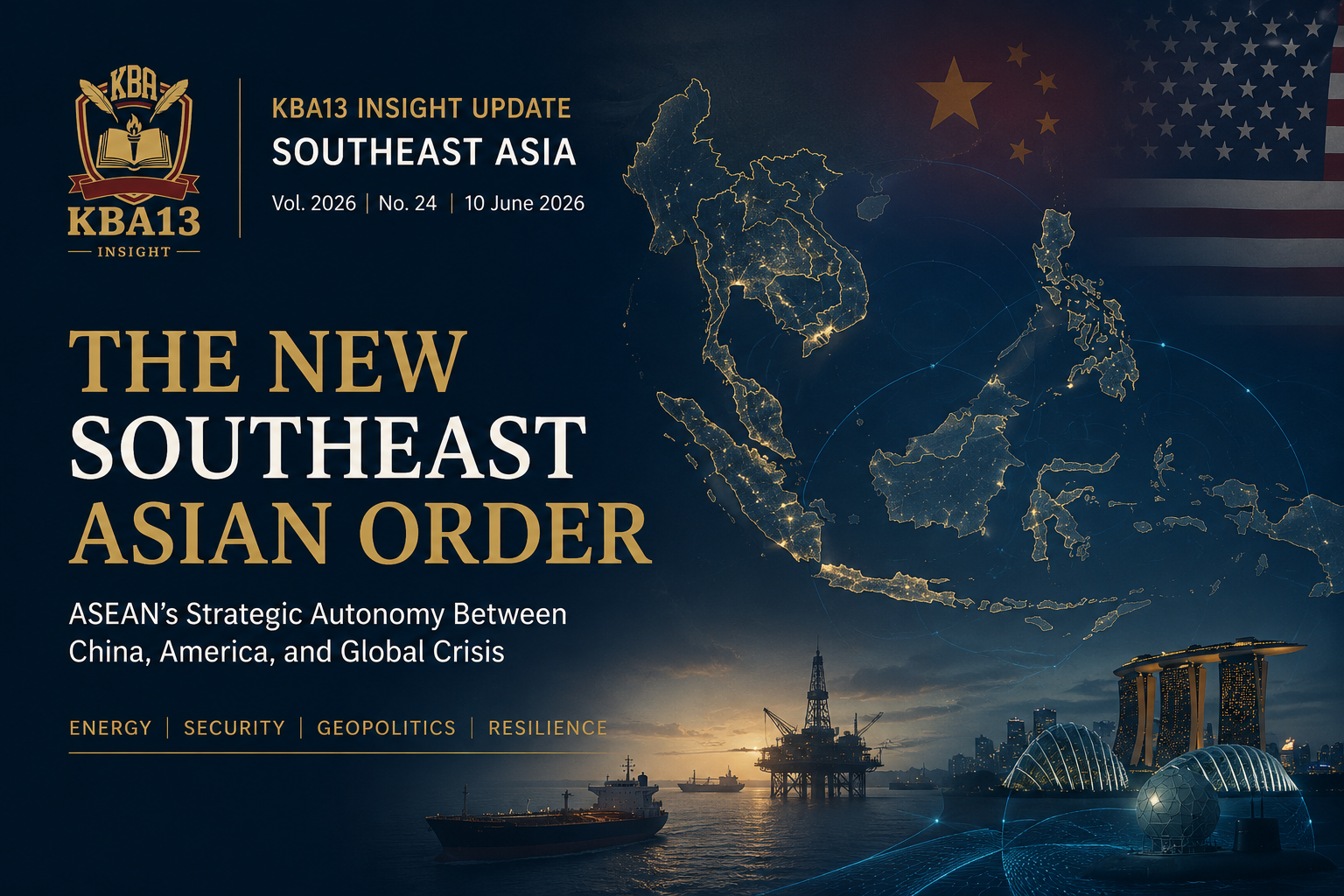
Summary
Southeast Asia enters mid-2026 facing one of the most complex strategic environments in recent decades. The region is simultaneously managing the impact of the Strait of Hormuz energy crisis, intensifying US-China strategic competition, unresolved South China Sea tensions, and Myanmar’s prolonged internal conflict. This KBA13 Insight Update examines how ASEAN states are responding through a new era of strategic hedging: avoiding dependency on any single great power while strengthening regional resilience, economic diversification, and security cooperation. The emergence of Singapore’s GUIDE initiative after the Shangri-La Dialogue reflects the rise of middle-power diplomacy beyond traditional US-China frameworks. Meanwhile, Indonesia under Prabowo Subianto, Malaysia under Anwar Ibrahim, Vietnam, Thailand, and the Philippines are navigating different combinations of economic pressure, maritime competition, and diplomatic recalibration. From energy security and digital infrastructure to military strategy and regional governance, Southeast Asia is no longer merely an arena of great-power competition. It is becoming an active architect of a more complex Indo-Pacific order. KBA13 Insight assesses that the future of ASEAN will depend not only on neutrality, but on its capacity to build independent strategic influence.
Keywords
- Anwar Ibrahim
- ASEAN 2026
- ASEAN security
- China-US Rivalry
- Energy Geopolitics
- Hormuz Crisis
- Indo-Pacific strategy
- Indonesia Foreign Policy
- intelligence analysis
- KBA13 Insight
I. Executive Summary
The week of 9–15 June 2026 finds Southeast Asia navigating a convergence of pressures that have no recent precedent: a prolonged energy supply shock driven by the Strait of Hormuz crisis; an accelerating realignment of regional security architecture following the 23rd IISS Shangri-La Dialogue; and a Myanmar conflict entering a contested new phase as the junta’s internationally unrecognized civilian administration struggles to consolidate post-election authority against a better-organized resistance coalition.
The Shangri-La Dialogue, concluded in Singapore on 29–31 May, produced its most consequential outcome in years: the launch of GUIDE — a 17-nation framework to protect undersea cable infrastructure—spearheaded by Singapore and endorsed without either US or Chinese participation, a signal that the region’s middle powers are increasingly willing to act on shared interests outside the gravitational pull of great-power rivalry.
The Hormuz crisis continues to dominate economic planning. With oil prices oscillating near USD 95 per barrel and LNG markets in persistent stress, ASEAN’s collective monthly import bill has risen by an estimated USD 3.36 billion above budgeted levels. The Philippines, which imports 98 percent of its oil from the Middle East, remains under a state of national energy emergency declared in late March. Emergency coal capacity and diversification toward Russian and Central Asian sources are reshaping energy diplomacy across the bloc.
The Philippines’ ASEAN chairmanship remains central to this week’s regional governance picture. Manila continues to push hard for a South China Sea Code of Conduct ahead of the July 2026 negotiation deadline, but structural obstacles — including fundamental legal-interpretive gaps between ASEAN claimants and Beijing—render a breakthrough unlikely. President Marcos’ phone call with US Secretary of State Marco Rubio on 1 June reaffirmed alliance commitments across maritime security and the Luzon Economic Corridor.
Indonesia under Prabowo Subianto is being tested on two fronts simultaneously. Externally, its ‘diplomacy of resilience’ doctrine is under stress as rising energy costs erode fiscal space and narrow room for the expansionary ‘Prabowonomics’ program. Domestically, the gap between the administration’s 8 percent growth target and an IMF-validated 5 percent trajectory is generating market anxiety, with MSCI flagging ‘fundamental investability issues’ as recently as January.
In mainland Southeast Asia, Vietnam and Thailand are deepening their bilateral strategic partnership, with Vietnamese Communist Party General Secretary and President To Lam visiting Bangkok in late May and the two premiers meeting again on 8 June on the margins of Hanoi’s third ASEAN Future Forum. Meanwhile, the Mekong subregion is bearing a compound burden: China’s hydropower-dam operations continue to suppress downstream water levels, Thailand’s economy is under fiscal strain from the Hormuz shock, and cross-border scam networks operating from Myanmar’s borderlands have emerged as a regional law-enforcement priority.
Singapore continues to leverage strategic ambiguity with skill. Its central role in the Shangri-La Dialogue, its authorship of the GUIDE initiative, and the Johor-Singapore Special Economic Zone’s expanding data-center ecosystem position the city-state as the region’s indispensable hub for institutional and digital infrastructure. Malaysia under Anwar Ibrahim is managing a parallel diplomatic balancing act, with Kuala Lumpur seeking to capitalize on its growing data-center market — projected at 2,100 MW by year-end — while managing a border-waters dispute with Indonesia and maintaining warm ties with both Washington and Beijing.
Myanmar’s crisis shows no path to resolution. The Tatmadaw’s recapture of Tagaung in the Mandalay Region in March 2026 after intensive aerial and artillery operations marked a tactical success, but the resistance’s SCEF coalition — uniting previously fragmented ethnic armed organizations — is the most politically coherent anti-junta alignment in decades. IISS data show airstrike incidents rising to more than 3,300 in 2025–2026, with total civilian airstrike deaths exceeding 3,800. The junta controls fewer than 40 percent of townships; resistance forces and ethnic armies hold roughly 42 percent.
The strategic outlook for the coming fortnight is defined by three overlapping uncertainties: whether the ASEAN-China COC round ahead of the July deadline will yield any substantive movement; how ASEAN member states calibrate their oil-diversification diplomacy in the continued absence of a durable Hormuz ceasefire; and whether the formation of Myanmar’s resistance SCEF alliance will translate into coordinated battlefield pressure sufficient to disrupt the junta’s post-election consolidation narrative.
KBA13 Insight’s assessment for this edition: Southeast Asia is not drifting toward China, nor seeking new dependency on Washington. It is executing what analysts at Geopolitical Monitor have aptly characterized as a movement away from US dependence — a structural hedging posture in which ASEAN states cultivate autonomous institutional capacity, bilateral security networks, and diverse economic partnerships as a hedge against great-power volatility from either direction.
II. ASEAN Architecture and Regional Governance
The 23rd IISS Shangri-La Dialogue, hosted in Singapore from 29 to 31 May, has reshuffled the regional security governance conversation in ways that will reverberate well beyond the conference itself. Forty-four countries were represented, including dozens of defense ministers and military chiefs, and the atmosphere running through all formal and corridor discussions was the same: the decades-old rules-based security architecture is under structural strain, and self-reliance rather than collective adherence to norms is becoming the operative logic.
The most consequential institutional output of the Dialogue was the launch of GUIDE — the Global Undersea Infrastructure Defense and Ecosystem — a Singapore-led initiative endorsed by 17 countries across multiple regions. GUIDE targets the protection of undersea fiber-optic cables and energy pipeline infrastructure from physical sabotage and cyber disruption. The initiative’s most revealing feature was its deliberate exclusion of both the United States and China, signaling that its architects intended it to function as a middle-power cooperation vehicle insulated from great-power politics.
More than 95 percent of global data traffic transits through submarine cable networks, and Southeast Asia sits astride some of the world’s most strategically exposed cable corridors. GUIDE addresses a vulnerability that has been long-acknowledged but chronically under-institutionalized. That Singapore chose the Shangri-La Dialogue as its launch platform — rather than an existing ASEAN framework — is instructive in itself about the limits of consensus-based bloc governance in addressing fast-moving security challenges.
The post-Shangri-La diplomatic signal from Beijing was carefully crafted. CGTN commentary on 1 June framed the Dialogue’s outcomes as reflecting ‘constructive strategic stability,’ building on the Xi-Trump bilateral summit in Beijing held a fortnight earlier. US Defense Secretary Pete Hegseth at the Dialogue described the Beijing summit outcomes as ‘a great framework’, and Chinese commentary used this framing to argue that US-China axis stability is the essential guarantor against the conflict in the Middle East spilling into Asia.
This framing is strategic rather than analytical. Beijing’s use of great-power stabilization language at Shangri-La is designed to discourage smaller ASEAN states from institutionalizing new security frameworks outside Chinese visibility — precisely the kind of initiative that GUIDE represents. Singapore’s move and its 17-nation endorsement suggest the effort succeeded in drawing a meaningful grouping before the argument could be preemptively neutralized.
The Philippines’ ASEAN chairmanship is approaching its most consequential phase. Manila has convened monthly working-group sessions throughout 2026 on the South China Sea Code of Conduct, and Foreign Secretary Maria Theresa Lazaro has publicly reiterated the ambition to conclude negotiations before the Philippines’ chairmanship ends. The July 2026 deadline — agreed by ASEAN and China in the July 2023 guidelines — is now weeks away. All substantive assessments, including those from Chatham House and CSIS, regard a breakthrough as unlikely given fundamental legal divergences.
Timor-Leste’s formal ASEAN membership, sealed in late 2025 as the bloc’s 11th member, has slightly altered the arithmetic of consensus formation. Dili’s accession brings an additional perspective sympathetic to humanitarian norms and international law, but its strategic weight in intra-ASEAN negotiations remains limited. The State of Southeast Asia 2026 survey by ISEAS-Yusof Ishak found that the bloc’s governance credibility rests disproportionately on three states: Singapore, Indonesia, and Malaysia, and that domestic distractions in any of those capitals risk opening a leadership vacuum.
Malaysia and Singapore are reinforcing bilateral structural ties through the Johor-Singapore Special Economic Zone. The JSCMC — Johor-Singapore Cooperation Ministerial Committee — met in January to reaffirm the SEZ as a long-term partnership grounded in policy continuity and shared benefit. Jones Lang LaSalle’s data project Malaysia’s data-center capacity hitting 2,100 MW by end-2026, roughly doubling current levels, driven in significant part by Singapore-directed investment overflow from its own capacity-constrained geography.
The ASEAN Digital Economy Framework Agreement remains the bloc’s most ambitious instrument of economic integration, with projections suggesting the regional digital economy could reach USD 2 trillion by 2030 if the DEFA is implemented coherently. Cross-border QR payment linkages among Malaysia, the Philippines, Singapore, and Thailand—now spanning nine jurisdictions—represent the most visible consumer-facing manifestation of regional financial integration and operate largely independently of the geopolitical noise surrounding the bloc.
The deeper structural question hanging over ASEAN architecture this week is whether the bloc’s institutional credibility is eroding faster than new frameworks can compensate. GUIDE, the DEFA, payment connectivity, and bilateral security partnerships all reflect ASEAN states acting outside or alongside, rather than through, the formal ASEAN consensus machinery. This is not a crisis of ASEAN’s existence but of its efficacy — and the pattern is accelerating as external shocks multiply faster than the ‘ASEAN Way’ can absorb them.
III. Energy, Economics & Trade
The Strait of Hormuz crisis, triggered by the US-Israel joint offensive against Iran that launched on 28 February 2026, has become the dominant macroeconomic variable shaping Southeast Asian economic policy in the first half of the year. By 4 March, maritime traffic through the strait had fallen to less than 10 percent of pre-crisis levels, pushing Brent crude to USD 95 per barrel and generating severe stress across Asian LNG markets. A temporary ceasefire enabled limited shipping to resume, but transit remains volatile and well below normal volumes.
The arithmetic of exposure is stark for Southeast Asia. In 2024, 84 percent of crude oil and 83 percent of LNG transiting the Strait of Hormuz were bound for Asian markets. ASEAN, as a bloc, is now incurring an additional USD 3.36 billion per month in import costs — a 3.4 percent premium over 2026 budgeted expectations — according to World Economic Forum calculations. The cascading effects touch pump prices, power costs, inflation, and fiscal headroom simultaneously.
The Philippines is the hardest-hit ASEAN economy in direct percentage terms, given that it imports 98 percent of its oil from the Middle East. President Marcos signed Executive Order No. 110 declaring a national energy emergency. Coal plants are operating at elevated capacity, and emergency measures to shield consumers from price transmission are producing secondary fiscal costs. The Philippines’ energy crisis is also interacting with the country’s maritime sovereignty concerns in the South China Sea, where joint energy development talks with China have been periodically revived as a potential diplomatic release valve.
Thailand’s response to the energy shock has been the most aggressive in fiscal terms. The Anutin Charnvirakul cabinet approved a 400-billion-baht emergency borrowing package on 5 May, one of the largest such measures in decades, to cover the June-to-September exposure window. The finance ministry has cut its 2026 GDP outlook to 1.6 percent from 2.4 percent, though Bank of Thailand Governor Vitai Ratanakorn revised his projection upward to 2.1 percent following the borrowing announcement. The divergence between ministry and central bank forecasts reflects genuine policy uncertainty.
For Malaysia and Indonesia, the Hormuz shock is accelerating energy-diplomacy pivots that were already in motion. With US sanctions on Russian oil lifted under the Trump administration, both countries are negotiating long-term oil supply deals with Russian suppliers and exploring Central Asian alternatives. Malaysia’s Petronas and Indonesia’s Pertamina are among the regional NOCs engaged in these discussions, and the shift carries both economic logic — lower price exposure — and geopolitical risk, as Washington-aligned partners may interpret it as strategic drift.
Indonesia’s broader macroeconomic picture contains conflicting signals. The IMF designated the country a ‘global bright spot’ on 21 January 2026, citing sustained 5 percent year-on-year growth, low debt-to-GDP ratios, and well-anchored inflation. One week later, two consecutive trading halts occurred as Indonesia’s stock market dipped 7 percent following MSCI’s flag of ‘fundamental investability issues’. The juxtaposition is not contradictory: it reflects a market view that Prabowo’s state-led capitalism model and the resource-intensive MBG school meals program are consuming fiscal space that could otherwise support growth-enabling structural reform.
Singapore’s economy is both exposed and adaptive. As the region’s financial hub and an oil-refining center, it absorbs energy-cost pass-throughs quickly—but it also benefits from the surge in financial and advisory activity that supply-chain restructuring generates. Singapore’s digital economy contributed S$128.1 billion to GDP in 2024, accounting for 18.6 percent of GDP, up from 14.9 percent in 2019, and the city-state hosts 87 percent of ASEAN’s fintech investment. The data-center sector is expanding capacity in Johor while managing domestic land constraints, making the JS-SEZ a genuine geoeconomic instrument.
Vietnam’s trade dynamics are worth tracking carefully this week. The country has positioned itself as a principal beneficiary of supply-chain diversification from China, and its export growth trajectory has remained robust relative to regional peers. Hanoi’s delay in approving low-emission zone plans and EV subsidies — reported by VietNamNet on 3 June — reflects fiscal caution rather than policy reversal, as rising energy import costs constrain the budgetary headroom available for transition spending. The Mekong Delta’s emergence as a major agro-fisheries trading hub, noted by Bernama on 6 June, points to a longer-term structural asset underpinning Vietnam’s economic resilience.
The ASEAN trade picture is further complicated by the continuing fallout from Trump-era tariff architecture. ASEAN economies with significant US export exposure — Vietnam, Malaysia, Thailand — are navigating carefully calibrated responses: accepting tariff differentiation in some sectors while using ASEAN frameworks and bilateral FTAs as partial insulation. The regional consensus, captured in the ISEAS 2026 survey and echoed in the Geopolitical Monitor assessment of 4 June, is that Southeast Asia is not shifting toward China so much as moving away from singular dependence on US-centric trade architecture.
Looking ahead, the critical near-term inflection point for the energy picture will be the outcome of US-Iran ceasefire negotiations. Any durable reopening of the Hormuz corridor would exert immediate downward pressure on Asian energy prices and ease fiscal stress across the region, potentially accelerating the renewable transition investments that the current crisis has simultaneously incentivized and financially constrained. In the absence of resolution, ASEAN energy ministers face a structural choice: accelerate diversification at higher cost or accept prolonged exposure to Middle East supply fragility.
IV. Myanmar Crisis Watch
Myanmar’s civil conflict has entered its sixth year since the February 2021 coup, and the landscape as of early June 2026 is defined by a paradox: a junta that has achieved symbolic political consolidation through sham elections while losing territorial and military initiative to a better-organized and more coherent resistance coalition than at any point since the coup. The interaction between these two contradictory trends will determine whether the conflict approaches any inflection point in the coming months.
The junta’s multi-phase elections, conducted between 28 December 2025 and 25 January 2026, returned a military-aligned parliament under conditions of systematic coercion. Human Rights Watch documented 170 civilian deaths from airstrikes during the election period and 400 arrests. International Crisis Group and other observers assess these elections as designed to create a civilian veneer for continued military rule, consistent with the pattern established by the 2008 constitution. A new military-aligned administration formally assumed office in April 2026.
The military’s tactical record over the past six months has been mixed. The recapture of Tagaung in the Mandalay Region on 10 March 2026—described by The Irrawaddy as the fall of the last resistance-held town in the region — was achieved after a month-long advance combining intensive air and artillery strikes. The junta also recaptured Thabeikkyin in July 2025 and Singu in December. These wins represent real battlefield gains in the Mandalay corridor but have not reversed the broader territorial calculus: resistance forces and ethnic armies still hold an estimated 42 percent of Myanmar’s territory against the junta’s fewer than 40 percent of townships.
The most strategically significant development on the resistance side is the emergence of the SCEF—the Solidarity and Cooperation of Ethnic Forces — described by analysts Dan Swift and Sean Turnell in April 2026 as the most politically aligned coalition in the war’s history. Unlike previous alliances among ethnic armed organizations, SCEF is built around a shared vision of federal democracy, uniting perennially divided groups under a single political framework. Its military significance lies not in immediate force multiplication, but in the coordination and legitimacy it provides to what has historically been a fragmented resistance.
The aerial campaign data from the IISS Myanmar Conflict Map is unambiguous about the junta’s operational doctrine: air and drone strikes rose from 134 incidents in the first year after the coup to more than 3,300 in 2025–2026, with approximately 9,400 incidents recorded in total. Civilian deaths from airstrikes alone have exceeded 3,800. This is not a proportionality failure at the margins but a systematic counter-civilian air campaign that has been adopted as the primary instrument of territorial control.
China’s role remains the most consequential external variable. Beijing brokered multiple ceasefires with mixed results, has consistently supported junta preservation as its preferred outcome, and has used economic leverage — particularly over ethnic armed organizations in Shan State — to shape resistance behavior. The Ta’ang National Liberation Army drew sharp criticism from pro-democracy activists for congratulating Min Aung Hlaing on his election to the presidency, widely interpreted as reflecting Beijing’s influence. China’s stakes in Myanmar include critical minerals, oil and gas pipelines, and BRI infrastructure, as well as the strategic prize of a Myanmar-linked alternative route to the Indian Ocean that bypasses the Strait of Malacca.
The humanitarian picture remains catastrophic. By February 2026, 5.2 million people were displaced internally and across borders. The junta’s post-coup atrocities continue to meet the threshold of war crimes and crimes against humanity under international legal standards, per Human Rights Watch’s 2026 World Report. Healthcare and education systems have been systematically dismantled. The 7.7-magnitude earthquake of March 2025, which struck as the military responded with airstrikes in its immediate aftermath, compounded what was already a multi-dimensional humanitarian emergency.
ASEAN’s continued failure to produce meaningful pressure on Naypyidaw reflects the limits of consensus-based diplomacy when a member government actively repudiates the bloc’s Five-Point Consensus. The Philippines, as 2026 ASEAN chair, has not elevated Myanmar’s crisis to a headline agenda item, with South China Sea and energy governance consuming the chairmanship’s political bandwidth. The junta’s announced ceasefire from 2–22 April — promptly violated with continued airstrikes — exemplifies its pattern of using ceasefire announcements for international optics while continuing military operations.
The US posture under the Trump administration has effectively downgraded Myanmar from a strategic priority. Secretary of State Rubio’s 2026 Thingyan New Year statement that the United States ‘remains committed to supporting an end to the crisis’ was assessed by analysts as a rhetorical downgrade from the previous year’s more explicit support, reflecting both Myanmar’s diminishing position in the US strategic hierarchy and Washington’s capacity constraints in a year defined by Iran, Taiwan, and Ukraine.
The coming weeks present one signal to watch closely: whether the SCEF alliance will translate its political coherence into coordinated battlefield pressure in Sagaing or Chin State, where resistance forces retain operational depth. A sustained multi-front offensive during the monsoon season — historically a period of reduced junta air effectiveness — could test the junta’s capacity to maintain both its Mandalay gains and its broader territorial posture simultaneously. The outcome would carry significant implications for whether Min Aung Hlaing’s military-political consolidation holds through the rest of 2026.
V. Philippines Political Dynamics
The Philippines enters the second week of June 2026, managing a trifecta of pressures that are each individually demanding: a national energy emergency triggered by the Hormuz crisis, the political weight of the ASEAN chairmanship in its most consequential phase, and a domestic political landscape shaped by the continuing fallout from the Marcos-Duterte rupture that defined Philippine politics in 2025.
President Marcos’ phone call with US Secretary of State Marco Rubio on 1 June was the most significant diplomatic signal of the past week. Rubio reaffirmed Washington’s commitment to peace and stability in the South China Sea and the Luzon Economic Corridor, and the US readout described 2026 as a year of dual commemoration — 80 years of US-Philippines diplomatic relations and 75 years as treaty allies. The framing is not incidental: it is a political investment by both governments in the alliance’s structural durability ahead of what may be a period of heightened maritime tension.
The South China Sea Code of Conduct negotiations are approaching the self-imposed July 2026 deadline without any credible prospect of a substantive conclusion. Foreign Secretary Lazaro has maintained public optimism, and the monthly ASEAN working-group cadence has been observed. But the structural obstacles documented by Chatham House, CSIS, and The Diplomat — fundamental differences in legal interpretations, asymmetric power, and China’s unwillingness to accept binding enforcement mechanisms — remain unresolved. Marcos’ earlier stated desire to invite Xi Jinping to Manila, contingent on the conclusion of the COC, is unlikely to be realized.
Manila’s simultaneous effort to manage bilateral tensions with Beijing while deepening the US alliance reflects a strategic arithmetic that is genuinely difficult to sustain. Marcos has personally signaled a desire for a bilateral reset with China, describing it as ‘inevitable’ given the scale of global geopolitical restructuring. Filipino diplomats have signaled intent to ease tensions through quiet diplomacy. Yet the oil crisis has reopened the possibility of joint energy exploration in contested South China Sea areas — a proposal Marcos’ own government previously rejected — as an economic pressure-release mechanism that could offer both governments a face-saving framework.
The Duterte legacy continues to cast a shadow. Rodrigo Duterte’s extradition to the International Criminal Court — arranged by the Marcos government in 2025 — closed a chapter but opened new political vulnerabilities. Duterte’s political network retains significant support in Davao and Mindanao, and the breakdown of the Marcos-Duterte alliance has fragmented the coalition that brought the current president to power. Approval rating erosion following the corruption scandal in late 2025 — when a senior official alleged that Marcos directed USD 1.76 billion in misappropriation of funds — has not fully recovered.
The energy emergency is reshaping economic and political calculations simultaneously. The Philippines imports 98 percent of its oil from the Middle East, making it uniquely exposed among ASEAN members to a disruption in the Strait of Hormuz. Executive Order No. 110 gave the government emergency powers to manage fuel supply, but the transmission of higher costs to consumers and industry is generating inflationary pressure that compounds existing fiscal vulnerabilities. The energy crisis is producing a policy appetite for South China Sea gas development that strategic considerations had previously suppressed.
The US-Philippines defense relationship has been materially deepened under Marcos’ Comprehensive Archipelagic Defense Concept, which expanded base access, joint exercise schedules, and weapons transfers. A formation exercise on 16 February 2026 — showing Philippine patrol vessel BRP Teresa Magbanua, Australian frigate HMAS Toowoomba, and US guided-missile destroyer USS Dewey operating in company — signalled the growing multilateralisation of the alliance’s operational posture. Australia’s inclusion is notable: it reflects Manila’s strategy of expanding deterrence partnerships beyond the bilateral US axis.
The near-collision between a Philippine and a Chinese naval vessel near Thitu Island on 27 March 2026 — just days before the 11th round of bilateral South China Sea negotiations — illustrated the continuing volatility of the maritime relationship. Both sides accused each other of dangerous maneuvers in statements that were themselves calibrated to serve domestic audiences. The 11th round of talks, held in China, discussed ‘strategic, political-security, and law enforcement issues’ but produced no publicly announced breakthrough.
The Luzon Economic Corridor remains the economic anchor of the US-Philippines relationship. The corridor, designed to integrate Manila’s economic geography with US and allied supply chains, represents Washington’s attempt to build an alternative to China’s industrial pathway through Southeast Asia’s most treaty-aligned democracy. The corridor’s progress is being watched closely in regional capitals as an indicator of US credibility in economic statecraft—particularly given the gap between Washington’s announced Indo-Pacific economic commitments and actual disbursements.
The Philippine domestic political calendar is relatively clear through year-end 2026, with the next major electoral test in the 2027 midterms. This gives Marcos space to manage the multiple crises currently converging without the immediacy of electoral pressure. The strategic priority for Manila over the next fortnight is to extract maximum diplomatic value from the ASEAN chairmanship in the closing window of the COC negotiations — even if a final conclusion is unachievable — while managing energy costs sufficiently to prevent the economic emergency from becoming a political one.
VI. Indonesia Strategic Affairs
Indonesia under Prabowo Subianto is at an inflection point where the ambitions of his presidency and the constraints of his economic inheritance are increasingly in direct tension. The 8 percent growth target that defined ‘Prabowonomics’ at its launch sits against an IMF-validated 5 percent trajectory, tightening fiscal space, and a market confidence signal from MSCI in January that flagged ‘fundamental investability issues’ — concerns that the administration’s command-and-control approach to economic management has not fully dispelled.
The Hormuz crisis has arrived at a particularly challenging moment. Indonesia, like its ASEAN neighbors, imports a significant share of its oil from Middle Eastern suppliers, and the combination of higher energy import costs and weaker investment inflows is narrowing the fiscal margin available for Prabowo’s flagship MBG school meals program, which already consumes a disproportionate share of the 2026 budget. The East Asia Forum noted that the MBG program leaves ‘limited scope to address other, more pressing, needs, such as disaster relief.’
Prabowo’s foreign policy, characterized by RSIS analysts as one that ‘continues Jokowi’s legacy of an economy-first foreign policy’ while adopting a more ‘personal and hands-on’ approach to international diplomacy, has brought Indonesia closer to Russia and China in ways that carry geopolitical risk. Both the Russian and Chinese bilateral agreements signed under Prabowo involve trade and investment dimensions, but their optics expose them to potential retaliatory measures from US-aligned partners amid sharpening great-power competition.
Foreign Minister Sugiono’s Annual Press Statement on 14 January 2026 opened with a ‘stark and sobering diagnosis’ of international fragmentation. His articulation of a ‘diplomacy of resilience’—emphasizing preparedness, autonomy, and security—reflects Prabowo’s instinct to securitize foreign policy in a way that risks ‘narrowing Indonesia’s foreign policy priorities’, according to an East Asia Forum assessment. The risk is that resilience becomes a language of caution rather than a foundation for active regional leadership.
The ISEAS 2026 State of Southeast Asia survey identified Indonesia as one of the three pillars of ASEAN governance credibility, alongside Singapore and Malaysia. This assessment places a specific leadership burden on Jakarta, making it harder for the current administration to fulfill because of its economic difficulties and governance distractions. Indonesia’s strategic weight in ASEAN is not in question; the question is whether it has the institutional and political bandwidth to exercise that weight constructively at a moment when the bloc most needs it.
Indonesia’s territorial and maritime disputes with Malaysia have resurfaced this week. A border-waters dispute between the two countries — described by the Lowy Institute as ‘reviving memories of older unresolved territorial fights’—has emerged as a bilateral irritant in an otherwise generally cooperative relationship. The specifics involve contested maritime demarcations that were incompletely resolved in earlier bilateral agreements and are now receiving renewed attention amid elevated energy-resource stakes.
On the domestic political front, Indonesia’s waste crisis is receiving unusual policy attention. CNA’s 3 June report characterized Indonesia’s near-full landfills as a ‘ticking time bomb,’ and the convergence of this with Prabowo’s populist governance model — which leans on military-adjacent command structures rather than technocratic regulation — raises questions about the administration’s capacity to address structural environmental challenges alongside its economic agenda.
Nusantara, the capital relocation project inherited from Jokowi, continues its slow progress. The geopolitical case for moving administrative functions away from Java-centric Jakarta to Borneo has not diminished, but fiscal constraints under Prabowo are limiting the pace of construction and infrastructure investment. The project remains a signal of the Indonesian state’s ambition but an imperfect vehicle for it in the current fiscal environment.
Indonesia’s critical minerals sector remains one of the country’s most strategically valuable assets and most complex governance challenges. Its nickel reserves are central to global battery supply chains, and the processing-before-export policy introduced under Jokowi has been maintained and extended under Prabowo. This positions Indonesia as a principal actor in the energy transition supply chain—but managing the environmental and labor dimensions of industrial-scale mining in the Sulawesi corridor remains a persistent governance stress point.
Looking ahead, the most significant indicator to track in Indonesia this week is the Rupiah’s trajectory. Currency weakness driven by the combination of higher import costs, tightened investment sentiment, and fiscal expansion will be the canary in the coal mine for whether Prabowo’s economic program retains market credibility or begins to require a recalibration toward the more orthodox reform agenda that the East Asia Forum and Lowy Institute analysts recommend as the foundation for durable growth.
VII. Malaysia & Singapore Affairs
Malaysia and Singapore enter the second week of June 2026 as the two most institutionally coherent and diplomatically active members of ASEAN—and as a bilateral pair whose deepening integration is producing one of the region’s most consequential economic geographies. The Johor-Singapore Special Economic Zone, the near-complete Johor Bahru-Singapore Rapid Transit System Link, and the digital economy corridor that these infrastructures anchor are reshaping the southern Malaysia-Singapore interface in ways that will outlast any single government in either capital.
Prime Minister Anwar Ibrahim visited Singapore on 31 May — the eve of the Shangri-La Dialogue — for a working bilateral with Prime Minister Lawrence Wong and a courtesy call on President Tharman Shanmugaratnam. The two leaders reviewed the JB-Singapore RTS Link, confirmed as on track for completion by late 2026, and reaffirmed the JS-SEZ as a shared growth engine. Anwar also delivered a special address at the Shangri-La Dialogue, where he received courtesy calls from US Defense Secretary Pete Hegseth and Boeing Global President Brendan Nelson—a signal that Washington is actively cultivating Malaysia’s diplomatic weight even as Kuala Lumpur maintains its studied equidistance from the great-power rivalry.
Singapore’s Budget 2026, delivered by Lawrence Wong on 12 February under the theme ‘Securing Our Future Together in a Changed World,’ frames the city-state’s strategic posture with clarity: total government spending projected at S$154.7 billion, structured around six pillars—economic strategy refresh, AI harnessing, workforce resilience, social uplift, security and sustainability, and national-spirit reinforcement. The budget’s security-and-sustainability pillar directly addresses Hormuz-driven energy vulnerability and the city-state’s dependence on open sea lanes for the 18.6 percent of GDP now generated by its digital economy.
Wong’s statement at the SGLaw200 Youth Forum on 13 May was unusually direct for Singapore’s traditionally understated diplomatic register: ‘As a trading nation, Singapore depends on open and secure sea lanes. International law, including the law of the sea, ensures that vital waterways remain open to all and are not subject to arbitrary control.’ The explicit framing of freedom of navigation as an existential condition for Singapore’s prosperity — not merely a normative preference — positions the city-state alongside the Philippines and Vietnam in the subset of ASEAN states with the most to lose from a deteriorating rules-based maritime order.
Singapore’s GUIDE initiative, launched at the Shangri-La Dialogue with 17-nation endorsement, is the clearest expression yet of PM Wong’s foreign policy instinct: build durable institutional frameworks that serve shared interests, exclude great-power rivalry as far as possible, and position Singapore as a convening authority rather than merely a venue. The cable-protection framework is consistent with Singapore’s digital economy architecture — contributing S$128.1 billion to GDP — and with the city-state’s role as the region’s primary data hub, where Microsoft, Google, Amazon, Meta, and ByteDance all maintain their regional headquarters.
Malaysia under Anwar is pursuing what RSIS has described as a foreign policy of ‘rhetorical shift, strategic continuity’ — core orientations of regional partnership, trade promotion, and engagement with the Islamic world maintained from previous administrations, but infused with sharper moral signaling and greater diplomatic ambition. Malaysia’s explicit condemnation of the US-Israel joint offensive against Iran in March 2026, described by Kuala Lumpur’s foreign ministry as ‘violations of international law and the UN Charter’, has created a bilateral tension with Washington that the new Trade and Industry Minister Johari Ghani is now tasked with carefully managing — particularly around the Malaysia-US Agreement on Reciprocal Tariffs.
The 13th Malaysia Plan under Anwar’s administration designates 2026 as a year of ‘execution and discipline’, with Economy Minister Akmal Nasrullah framing the objective as delivering RMK13’s infrastructure and investment pipeline ahead of general elections expected no later than February 2028. Nomura projected 5.2 percent growth for Malaysia in 2026. The semiconductor sector is central to Malaysia’s economic diversification strategy: Kuala Lumpur is positioning itself as a ‘Made by Malaysia’ technology manufacturing hub, seeking Section 232 exemptions from the US for its semiconductor exports while cultivating Chinese investment in the same sector — a dual-track approach that requires ongoing diplomatic calibration.
Malaysia’s data-centre sector is the most concrete near-term economic signal to watch. Jones Lang LaSalle projects 2,100 MW of capacity by year-end 2026, roughly doubling current levels, driven predominantly by Singapore-origin investment overflow into Johor. Malaysia has captured 32 percent of Southeast Asia’s AI funding, according to Digital in Asia, and its digital economy reached USD 31 billion GMV. The PayNow-DuitNow real-time payment linkage — cited by both Wong and Anwar at their December 2025 leaders’ retreat — is the most-used cross-border payment corridor in ASEAN and a practical demonstration of how deep bilateral integration has become.
The Malaysia-Indonesia border-waters dispute, resurfacing this week according to the Lowy Institute, introduces a new bilateral irritant into ASEAN’s southern governance picture. The dispute involves contested maritime demarcations left imprecisely resolved in earlier bilateral frameworks, and it is receiving renewed attention as elevated hydrocarbon resource stakes — sharpened by the Hormuz crisis — increase the economic value of every unresolved boundary. Malaysia’s management of this dispute will test Anwar’s ability to simultaneously maintain close ties with Jakarta, advance the JS-SEZ with Singapore, and credibly project a non-aligned posture.
The Singapore-Australia Joint Statement on Energy Security, issued on 23 March 2026 following a phone call between Wong and Albanese, signals that Singapore is building bilateral energy resilience partnerships outside the ASEAN framework. The two comprehensive strategic partners committed to accelerating negotiations on trade in essential supplies and exploring a legally binding consultation-and-notification arrangement for supply disruptions. The statement noted shared concern about Hormuz impacts on energy supply chains and committed to accelerating renewable energy deployment. This bilateral — Singapore-Australia — is quietly becoming one of the Indo-Pacific’s most substantive middle-power energy governance frameworks, operating largely below the threshold of geopolitical commentary.
VIII. South China Sea & Maritime Security
The South China Sea remains the most operationally volatile security environment in Southeast Asia, with three concurrent dynamics compressing simultaneously: the approaching July 2026 COC negotiation deadline; the near-collision incident near Thitu Island in late March that preceded the 11th round of bilateral Philippines-China talks, and the broader context of the Shangri-La Dialogue’s GUIDE initiative — which explicitly targets undersea infrastructure but frames a wider middle-power security architecture in waters where Chinese assertiveness is the defining variable.
The 11th round of Philippines-China bilateral negotiations, held in China in late March after the near-collision near Thitu Island, produced a standard communiqué covering ‘strategic, political-security, and law enforcement issues.’ ‘ The pattern is now familiar: bilateral diplomatic engagement proceeds in parallel with continued operational assertiveness by Chinese Coast Guard and PLAN vessels, with Beijing using the talks to signal its diplomatic engagement internationally while maintaining operational pressure in contested waters.
The August 2025 incident at Scarborough Shoal — in which a Chinese Coast Guard vessel and a PLAN warship collided while pursuing the Philippine Coast Guard vessel BRP Suluan — remains the most significant tactical reference point in the current maritime friction timeline. The BRP Suluan’s evasive manoeuvre caused the two Chinese vessels to collide with each other, with Philippine sources claiming three CCG personnel killed. The incident provided Manila with a transparency-diplomacy moment — releasing footage that documented Chinese aggression — while simultaneously creating a bilateral off-ramp, as both sides had incentive to de-escalate after Chinese casualties.
The IISS Asia-Pacific Regional Security Assessment 2026, launched at the Shangri-La Dialogue, explicitly noted that ‘the Asia-Pacific has seen major cross-border conflicts between Thailand and Cambodia, India and Pakistan, and Pakistan and Afghanistan just in the past year alone’ — contextualising South China Sea tensions within a broader pattern of regional militarisation. The report’s framing suggests that the SCS friction is not an isolated dyadic phenomenon but part of a wider deterioration of the security environment underpinning Asia’s growth model.
Malaysia’s posture in the South China Sea is worth tracking independently of the Philippines-China axis. Kuala Lumpur is a claimant state but has historically pursued a quieter diplomacy than Manila, preferring to manage SCS tensions bilaterally and within ASEAN frameworks. Under Anwar Ibrahim, Malaysia has maintained this posture while simultaneously expanding its economic relationship with China — a combination that ASEAN’s largest Sunni-majority democracy has so far managed without the confrontational costs that Manila has absorbed. The Malaysia-Indonesia border-waters dispute, however, adds a new intra-ASEAN maritime complication to the picture.
The Shangri-La Dialogue’s GUIDE initiative is directly relevant to South China Sea infrastructure security. Submarine cable networks crisscross the SCS basin, connecting Southeast Asia, East Asia, and the wider Indo-Pacific. Their vulnerability to deliberate sabotage — whether state-sanctioned or through plausibly deniable proxies — is a recognized but under-addressed strategic risk. GUIDE’s 17-nation endorsement, minus the US and China, creates a monitoring and response framework that may eventually intersect with SCS cable-route security.
Vietnam’s maritime security posture deserves attention in this reporting period. Hanoi is both an SCS claimant and a country with deep economic ties to China, which produces a characteristic balancing posture: asserting maritime rights through legal and diplomatic channels while managing bilateral economic ties with care. Vietnam’s 50-year diplomatic relationship with Thailand, deepened further by the To Lam-Anutin bilateral in early June, is also an indirect signal: Hanoi is reinforcing mainland Southeast Asian partnerships as part of a strategic depth-building exercise that does not put all eggs in either great-power basket.
The July 2026 COC deadline is the single most significant near-term SCS governance test. ASEAN and China committed in July 2023 to a three-year timeline for finalization, and the Philippines, as ASEAN chair, has personal and institutional stakes in demonstrating progress. The obstacles are structural: China insists on excluding non-claimant states from enforcement mechanisms, resists binding arbitration, and seeks language that implicitly acknowledges its nine-dash-line claims. ASEAN claimant states — particularly Vietnam and the Philippines — cannot accept such language without politically untenable domestic consequences.
The energy dimension is increasingly intersecting with South China Sea sovereignty politics. As the Hormuz crisis raises the economic stakes of developing undersea hydrocarbon deposits in the SCS basin, both Manila and Beijing have floated joint-exploration frameworks as a potential diplomatic bridge. The previous Duterte-era joint development discussions collapsed over sovereignty-recognition language. Whether the Marcos government — under intensified energy-cost pressure — will revisit this option is one of the most sensitive questions in Philippine strategic affairs this week.
KBA13 Insight’s maritime security assessment: The South China Sea is likely to remain at its current level of managed tension — below armed conflict, above genuine stability — for the foreseeable future. The structural drivers of Chinese assertiveness (resource extraction, strategic depth, domestic nationalism) have not diminished; the structural drivers of Philippine-US alliance cohesion (treaty obligations, domestic politics, deterrence architecture) have strengthened. The equilibrium is fragile, the COC unlikely to prove transformative even if concluded, and the next serious incident — when it occurs — will test whether the GUIDE framework and the Philippines’ broader multilateral deterrence architecture have genuinely shifted the escalation calculus.
IX. Mainland Southeast Asia (Thailand, Vietnam, and the Mekong)
Mainland Southeast Asia is this week defined by an unusually active bilateral diplomatic axis between Vietnam and Thailand, compressed against a backdrop of Mekong resource stress, Thailand’s fiscal strain from the energy crisis, and the continued degradation of the Mekong’s ecological function as upstream Chinese dam operations suppress downstream water levels and alter seasonal flood patterns on which 60 million people depend for their livelihoods.
The most significant diplomatic development this week was Vietnamese Communist Party General Secretary and President To Lam’s state visit to Bangkok, followed by a bilateral meeting between Vietnamese Prime Minister Le Minh Hung and Thai Prime Minister Anutin Charnvirakul in Hanoi on 8 June on the margins of the third ASEAN Future Forum. The ASEAN Future Forum, running 8–9 June in Hanoi, focused on the strategic role of the Mekong subregion and youth engagement with ASEAN’s Community Vision 2045.
The Bangkok Post’s assessment of Thailand-Vietnam relations, published in late May, described the bilateral as entering a ‘new era’ built on ‘high-level political trust’. The characterization is substantively accurate: over the past two decades, Vietnam has become one of Thailand’s closest strategic and economic neighbors despite the absence of a shared border. The comprehensive strategic partnership upgrades this relationship further, reflecting both countries’ shared interest in maintaining ASEAN’s center-of-gravity function against great-power gravitational pulls.
Thailand’s economic position heading into June 2026 is under visible strain. The 400-billion-baht emergency borrowing package passed on 5 May is the most decisive fiscal intervention in decades, and it comes at a moment when the Bank of Thailand’s own growth forecast of 2.1 percent is well below regional comparators. The EIRR and FIRR reviews of the long-debated Kra Canal project — which Prime Minister Anutin’s administration has revived with a new committee covering geopolitics, war-related shipping disruption, and environmental concerns — reflect the energy crisis’s catalytic effect on infrastructure thinking, even if the canal itself remains decades away from construction.
The Mekong water crisis is entering a particularly acute phase. Arsenic contamination at several times the WHO safe threshold has been detected in the Salween River Basin, traced to 127 suspected mines opened on the Myanmar side of the border. This is a new and disturbing vector: the Myanmar conflict’s material consequences are now literally flowing downstream into Thailand’s northern water supply. Combined with the cumulative suppression of Mekong flows by Chinese dam operations—documented by multiple academic sources through 2026—the river’s ecosystem is under compounded anthropogenic stress.
The Laos-China Railway continues to reshape the Mekong subregional trade architecture. First-quarter 2026 data show a 62 percent year-on-year increase in trade transit on the line, with photovoltaic products and agricultural exports prominent among the growing mix of commodities. More than 3,800 types of goods are now being transported across the corridor. This rail connectivity is integrating Laos more deeply into China’s economic orbit — a strategic consequence that Vientiane’s government has accepted as the price of the infrastructure access that landlocked geography would otherwise deny it.
Cambodia’s relationship with Thailand is experiencing unusual bilateral tension. A Kyoto Review of Southeast Asia analysis dated 1 June examines Cambodia’s withdrawal from the 2001 Thailand-Cambodia Memorandum of Understanding on overlapping maritime boundaries, describing the action as a ‘sovereignty straitjacket’ that has constrained Phnom Penh’s freedom of diplomatic maneuver. The MOU withdrawal — which Cambodia announced in late 2025 — complicates joint hydrocarbon development in disputed waters and introduces a new bilateral friction into the ASEAN machinery.
Vietnam’s economic resilience is being tested differently from Thailand’s. Hanoi’s policy posture reflects fiscal caution rather than structural weakness: the delay in approving EV subsidies and low-emission zones signals a government prioritizing macroeconomic stability over accelerating the climate transition in an uncertain energy-price environment. Vietnam’s forest-sector carbon-credit program — shifting from timber exploitation to a carbon economy — represents a more financially credible green-transition pathway for a country with significant forest-cover assets.
Drug trafficking and cross-border scam networks operating from Myanmar’s borderlands are the most intractable non-traditional security challenge facing mainland Southeast Asia this week. The Mekong River joint patrol mechanism — involving China, Thailand, Myanmar, Laos, Cambodia, and the Safe Mekong Coordination Center — continues to intercept trafficking flows, but the fragmentation of Myanmar’s governance structure under civil war conditions has created ungoverned border zones that serve as operational bases for Chinese-backed scam compound networks targeting victims across the region and globally.
The strategic dynamic running through mainland Southeast Asia in mid-2026 can be summarised as a region managing the cumulative weight of Chinese economic penetration — rail, dam, investment — against the backdrop of a Myanmar crisis that is deteriorating the security environment of every neighboring state while simultaneously creating ungoverned spaces that non-state criminal enterprises are rapidly filling. Vietnam’s and Thailand’s deepening of bilateral relations reflects a shared recognition that subregional states need institutional scaffolding beyond Chinese-dependent frameworks to manage what is becoming a structural security and ecological challenge of generational duration.
X. Strategic Outlook: Signals to Watch
The fourteen days ahead are likely to be defined by three overlapping strategic tests, each of which carries implications well beyond its immediate bilateral or sectoral context. The first is the approaching deadline for the South China Sea Code of Conduct, now less than four weeks away. The second is the trajectory of the Hormuz crisis and its cascading effects on ASEAN energy diplomacy and fiscal stability. The third is whether Myanmar’s resistance SCEF coalition will translate its new political coherence into operational pressure sufficient to test the junta’s post-election consolidation.
On the COC, KBA13 Insight’s assessment is that the July 2026 deadline will pass without a legally binding conclusion. The structural gaps between ASEAN claimant states and China on enforcement mechanisms, jurisdictional scope, and sovereignty language have not been bridged at the working-group level, and there is no political signal from Beijing that it is prepared to accept a framework that could be used to constrain its operational posture in the SCS basin. The Philippines will likely frame whatever emerges — even a partial framework or procedural agreement — as a ‘chairmanship achievement’, but the substantive ambition of a binding CoC will be deferred.
Watch for: whether Marcos makes a direct personal approach to Xi Jinping in the final weeks of June to either conclude or frame the COC outcome; whether the joint energy exploration option is floated bilaterally as a face-saving mechanism; and whether Beijing uses the COC process to extract any normative concessions — even implicit ones — on sovereignty language before the formal deadline passes. Any of these moves would signal important recalibrations in the strategic relationship between the Philippines and China.
Regarding the Hormuz crisis, the critical variable is the status of US-Iran ceasefire negotiations. The Trump administration’s imposition of a naval blockade and threats against vessels paying Iranian tolls has created a standoff that is sustained rather than resolved. ASEAN energy ministers are making diversification decisions — Russia, Central Asia, accelerated LNG contracting — that will outlast the crisis itself, regardless of its duration. Watch for joint statements from the ASEAN Energy Ministers Meeting if one is convened, and for any acceleration of bilateral energy security agreements between ASEAN states and non-Middle Eastern suppliers.
In Myanmar, the monsoon season beginning in late June will reduce the effectiveness of the junta’s air operations — the Tatmadaw’s primary instrument of territorial control. If the SCEF alliance uses this window to coordinate multi-front operations in Sagaing and Chin State, where resistance forces retain depth, it would represent a qualitatively new level of operational coordination. Watch for SCEF communiqués, any joint NUG-SCEF political statements, and the junta’s force-positioning signals ahead of the monsoon window. China’s reaction to any significant advance by resistance forces will be particularly revealing of Beijing’s willingness to intervene directly in Myanmar’s internal military balance.
The GUIDE undersea infrastructure initiative launched at the Shangri-La Dialogue will be worth tracking in the coming fortnight for its operational development. Singapore is expected to begin formal outreach to establish governance structures, and whether additional countries — particularly Japan, South Korea, and India — join the 17-nation founding group will signal the initiative’s strategic weight. Any indication that the US or China is attempting to either join or undermine GUIDE would itself be a significant strategic signal about how the major powers view middle-power institutional autonomy in the Indo-Pacific.
Indonesia’s currency and equity markets are a near-term analytical bellwether for the broader regional fiscal stability picture. A sustained Rupiah depreciation trajectory — driven by energy import costs, tightened investment sentiment, and the fiscal expansion of Prabowo’s economic policy — would have cascading effects on regional risk appetite and potentially accelerate the pressure on Jakarta to adopt the technocratic reform agenda that market analysts recommend but that Prabowo’s political economy makes difficult to embrace. Watch the Bank Indonesia policy rate decision if one falls within the fortnight.
Malaysia’s digital economy milestone—projected 2,100 MW of data-center capacity by year-end — represents one of the region’s most concrete economic infrastructure signals for the second half of 2026. Anwar Ibrahim’s government has positioned Malaysia as the default overflow destination for Singapore-origin AI and cloud investment, and the Johor corridor’s buildout is proceeding. Watch for any new hyperscaler announcements — Microsoft, Google, Amazon, Meta — for Johor facilities, as these would confirm the investment thesis underwriting Malaysia’s growth diversification strategy.
Vietnam’s hosting of the ASEAN Future Forum in Hanoi on 8–9 June, with Thai PM Anutin in attendance, points forward to Hanoi’s growing role as a mainland Southeast Asian diplomatic hub. Vietnam is not the ASEAN chair, but it is leveraging the Forum format — focused on Vision 2045 — to project strategic credibility beyond its economic story. The Mekong subregion focus of the Forum’s side events is also a signal: Hanoi recognizes that the river’s future is central to both its agricultural base and its diplomatic standing with upstream and downstream neighbors.
KBA13 Insight’s strategic synthesis for this edition: Southeast Asia in June 2026 is simultaneously more institutionally active and more structurally exposed than at any point in the current decade. The GUIDE initiative, the COC negotiations, the ASEAN Future Forum, the Johor SEZ, and the region’s energy diversification pivot all represent forward movement. But the Hormuz shock, the Myanmar catastrophe, the SCS’s managed-tension equilibrium, and the fiscal stress accumulating in Thailand, Indonesia, and the Philippines are compounding structural vulnerabilities that institutional activity alone cannot resolve. The region’s leaders know this. The question is whether their capacity to act—diplomatically, economically, and where necessary militarily—is commensurate with the convergence of challenges now confronting them.
Related analysis: Indonesia’s 2026 political-risk outlook.
How to Cite
Ahmad, Kamaruzzaman Bustamam. (2026). Southeast Asia Strategic Outlook 2026: Hormuz Crisis, ASEAN Security Shift, China-US Rivalry, and the Future of Regional Order. Banda Aceh: KBA13 Insight.
https://www.kba13.com/southeast-asia-strategic-outlook-2026-asean-security-hormuz-china-us-rivalry/
Professor of Anthropology of Religion at UIN Ar-Raniry Banda Aceh. He writes on geopolitics, Southeast Asian security and governance, Islam in the Malay world, and the future of knowledge.
About The Author

Rekomendasi Bacaan KBA13 INSIGHT
Jika tulisan ini bermanfaat, dukung jurnal ini dengan mencari bukunya melalui tautan berikut:
- Buku-buku Kamaruzzaman Bustamam Ahmad di Periplus
- Koleksi Islamic Studies di Periplus
- Koleksi Geopolitics & Politik Internasional di Periplus
- Cari buku & perangkat baca di Shopee
- Cari di Blibli
Daftar lengkap: Rekomendasi Buku, Alat Tulis & Layanan. Tautan di atas adalah tautan afiliasi — KBA13 INSIGHT dapat memperoleh komisi kecil tanpa biaya tambahan bagi Anda.
Artikel Terkait
 Southeast Asia Strategic Intelligence Update July 2026: Indonesia, Myanmar, South China Sea, and ASEAN Under Pressure
 Southeast Asia Strategic Outlook 2026: ASEAN, South China Sea Tensions, Prabowo’s Economic Doctrine, and the Future of Regional Order
 Southeast Asia Strategic Outlook 2026: ASEAN, Indonesia, Myanmar, and South China Sea Tensions
 Southeast Asia Intelligence Brief: ASEAN, Myanmar & South China Sea
 KBA13 Insight Regional Update: Southeast Asia Under Pressure (Hormuz Shock, ASEAN Crisis, Myanmar, Indonesia, and the South China Sea in 2026)

Leave a Reply