

KBA13 Insight · KBA13 Insight Update
Southeast Asia Strategic Update:ASEAN, South China Sea, Myanmar, Trade and Regional Risks, 14–21 July 2026
Southeast Asia enters the final week of July 2026 under simultaneous diplomatic, maritime, economic and political pressure. ASEAN foreign ministers are gathering in Manila as tensions intensify near Second Thomas Shoal, negotiations over the South China Sea Code of Conduct miss their expected deadline, and uncertainty surrounds the future of United States tariffs affecting regional exporters.…
Summary
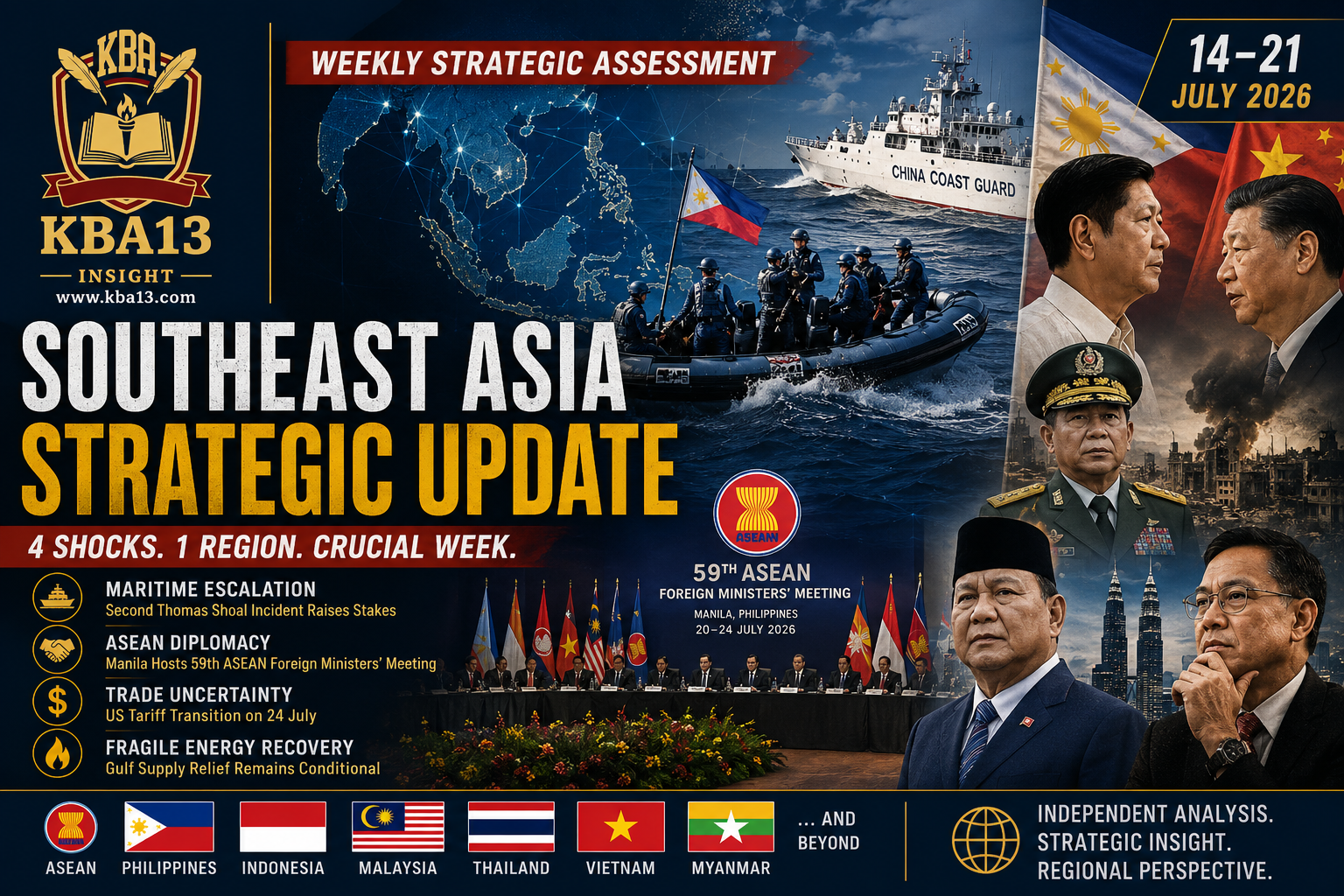
Southeast Asia enters the final week of July 2026 under simultaneous diplomatic, maritime, economic and political pressure. ASEAN foreign ministers are gathering in Manila as tensions intensify near Second Thomas Shoal, negotiations over the South China Sea Code of Conduct miss their expected deadline, and uncertainty surrounds the future of United States tariffs affecting regional exporters. This weekly strategic assessment examines the ASEAN diplomatic architecture, the Philippines–China maritime confrontation, Myanmar’s post-election conflict environment, Indonesia’s economic vulnerabilities, Vietnam’s rapid growth, political developments in Malaysia and Thailand, and the continuing effects of Gulf instability on Southeast Asian energy security. KBA13 Insight argues that the significance of this reporting period lies not in any single crisis, but in the convergence of several shocks during the same diplomatic week. The resulting pressure will test whether ASEAN can transform regional hedging into coordinated strategic capacity or remain a platform for national policies pursued in parallel.
Keywords
- ASEAN
- ASEAN 2026
- ASEAN Code of Conduct
- energy security
- geopolitical risk
- Indo-Pacific
- Indonesia Economy
- KBA13 Insight
- Malaysia Politics
- Maritime Security
1. EXECUTIVE SUMMARY
Southeast Asia enters the final week of July 2026 with its diplomatic centre of gravity fixed on Manila. The 59th ASEAN Foreign Ministers’ Meeting and its associated conferences opened at the Philippine International Convention Centre on 20 July and run through 24 July, drawing the foreign ministers of all ten dialogue partners alongside the bloc’s own membership. Foreign Affairs Secretary Ma. Theresa Lazaro chairs proceedings under the Philippine chairmanship theme “Navigating Our Future, Together.” The week’s program is unusually dense: the Post-Ministerial Conferences, the 27th ASEAN Plus Three meeting, the 16th East Asia Summit foreign ministers’ session, the 33rd ASEAN Regional Forum, a meeting of the Southeast Asia Nuclear Weapon-Free Zone Commission, and a commemorative activity marking the 50th anniversary of the Treaty of Amity and Cooperation on 24 July.
The gathering was overshadowed within twenty-four hours of its opening. On 20 July, a China Coast Guard boarding party operating from a rigid-hull inflatable struck a Philippine Navy sailor repeatedly about the head with a wooden baton near Second Thomas Shoal, inflicting a serious head injury and damaging a Philippine rubber boat. The Armed Forces of the Philippines released video footage. The Department of National Defense characterized the incident as part of a sustained pattern of hostile conduct; the China Coast Guard responded that Philippine craft had maneuvered dangerously against its patrol boat. The timing, with Secretary of State Marco Rubio and Foreign Minister Wang Yi both in Manila, converts a tactical encounter into a diplomatic event of considerable weight.
That collision lands directly on the week’s second major maritime question. The 2023 Guidelines for Accelerating the Early Conclusion of the Code of Conduct committed ASEAN and China to a final text within three years, that is, by July 2026. That deadline arrives without a document. Secretary Lazaro has recalibrated toward an end-of-year target and instituted a monthly negotiating rhythm, but the four structural obstacles identified at the outset, the Code’s relationship to the 2002 Declaration on Conduct, its legal status, its geographic scope, and the definition of self-restraint, remain where they were. Manila’s ability to close them while its own vessels are being struck at sea is the central test of the chairmanship.
The regional economic picture is bifurcating sharply. The Strait of Hormuz, effectively closed from late February, reopened following the United States–Iran memorandum of understanding signed on 18 June. Brent, which averaged $85 per barrel in June, fell below $70 on 1 July before renewed hostilities on 7–8 July pushed the North Sea marker back toward $77. The US Energy Information Administration now projects Brent averaging $74 in the third quarter. Relief on the energy front is real but conditional, and the damage already absorbed, including missile damage to Qatari liquefaction capacity that its owner has warned may take up to five years to repair, will shape Asian gas procurement for years.
Growth outcomes across the region diverge more widely than at any point in recent memory. Vietnam recorded 8.18 per cent expansion in the first half, the strongest in ASEAN, and was reclassified by the World Bank as an upper-middle-income economy effective 1 July. Malaysia’s advance estimate for the second quarter came in at 5.8 per cent, above consensus. Singapore grew 5.7 percent year-on-year, driven by a 12.2 percent surge in manufacturing tied to demand for artificial-intelligence semiconductors, even as its chemicals cluster contracted due to feedstock disruptions. Indonesia, alone among the major economies, is contending with capital flight, a currency at historic lows, and the world’s worst-performing equity market this year.
A trade shock of a different character is three days away. The 10 per cent Section 122 global import surcharge that the United States imposed on 24 February, after the Supreme Court struck down the earlier tariffs in Learning Resources, Inc. v. Trump expires by statute at 12:01 a.m. Eastern on 24 July. The President cannot extend it unilaterally and Congress has not acted. The US Trade Representative has proposed replacement duties of 10 to 12.5 per cent under Section 301 covering 46 economies, several of them ASEAN members, with a completion deadline of 20 July. Southeast Asian exporters face a fortnight of genuine legal uncertainty about the cost of entering the American market.
Domestic politics in the two largest archipelagic states are absorbing significant governing capacity. In Manila, the impeachment trial of Vice President Sara Duterte opened on 6 July and will run three days a week, with 62 trial dates allocated to the prosecution and 30 to the defence, a schedule that extends deep into the year. President Ferdinand Marcos Jr. delivers his fifth State of the Nation Address on 27 July, deliberately scaled down, against organised protest. In Jakarta, President Prabowo Subianto’s statist economic programme continues to generate market disquiet even as ratings agencies hold the line.
Malaysia’s federal coalition sustained a serious blow on 11 July when Barisan Nasional took 48 of 56 seats in the Johor state assembly, up from 40, while Prime Minister Anwar Ibrahim’s Pakatan Harapan fell from twelve seats to eight on turnout near 68 per cent. Anwar has since dismissed talk of a snap national poll and turned to the Negeri Sembilan state election on 1 August, where 36 seats are contested and a defeat would confirm a broader erosion. Rafizi Ramli’s newly formed Bersama party lost its deposit in all fifteen seats it contested, a result that closes one avenue of reformist realignment.
Myanmar’s trajectory has hardened rather than shifted. Min Aung Hlaing, installed as president by an electoral college on 3 April following a three-phase election that excluded dozens of townships, extended a dialogue offer on 20 April with a deadline of 31 July. The Democratic Voice of Burma has documented 274 verified civilian deaths and 579 injuries from airstrikes between 20 April and 19 July, a record that resistance formations cite as evidence that the offer is cover for an intensified air campaign. The Arakan Army, now assessed at roughly 40,000 regulars and in control of the entire Bangladesh border sector, has vowed retaliation for strikes on territory it administers. ASEAN’s informal consultation on the Five-Point Consensus proceeds in Manila with Naypyidaw again represented at the permanent-secretary level.
KBA13 Insight’s assessment for this reporting period: the region is being asked to absorb four shocks at once, a maritime incident that raises the floor of Sino-Philippine confrontation, a Code of Conduct deadline passing without a text, a tariff regime whose legal foundation dissolves on 24 July, and an energy market whose recovery remains hostage to a fragile Gulf arrangement. None of these is individually decisive. Their convergence in a single week, at the precise moment ASEAN’s foreign ministers are assembled, is what makes this period consequential. The bloc’s response will be measured less by the language of the chairman’s statement than by whether Manila can convert a week of maximum attention into any durable instrument at all.
2. ASEAN ARCHITECTURE AND REGIONAL GOVERNANCE
The 59th ASEAN Foreign Ministers’ Meeting convened in Manila on 20 July following preparatory sessions from 18 July, with the full programme extending to 24 July. Secretary-General Kao Kim Hourn is leading the Secretariat delegation at the invitation of Secretary Lazaro. The sequence begins with the foreign ministers’ interface with the ASEAN Intergovernmental Commission on Human Rights and an informal consultation on Myanmar, then moves through the Post-Ministerial Conferences with dialogue partners, ASEAN Plus Three, the East Asia Summit foreign ministers, and the ASEAN Regional Forum. Attendance is broad: the United States, China, Russia, Australia, New Zealand, India, Japan, Canada and the European Union are all represented at ministerial or senior level.
The commemorative activity on 24 July marking fifty years of the Treaty of Amity and Cooperation carries symbolic weight that the Philippine chair has chosen to emphasize. The Department of Foreign Affairs has framed the TAC as the foundational code governing inter-state relations in the region, reaffirming peaceful coexistence, mutual respect, non-interference, peaceful settlement of disputes and effective cooperation. The instrument now has twenty-seven high contracting parties beyond the ASEAN membership itself. Marking the anniversary while a member state’s navy is being assaulted at sea is an irony the chair cannot dispel, and one that a number of delegations will note privately.
Timor-Leste’s presence as the eleventh member is now routine rather than novel, and the bloc’s institutional arithmetic has adjusted accordingly. What has not adjusted is the consensus rule, which continues to determine the ceiling of what any chairmanship can deliver. The Philippine chairmanship has been more assertive than its immediate predecessors in setting deliverable targets, but the structure of decision-making means that a single member’s reservation can dilute any language on the South China Sea, on Myanmar, or on external partnerships. This is not a new constraint; it is simply more visible in a year when the substantive agenda is this crowded.
Myanmar’s representation follows the pattern established in 2021. Permanent Secretary Hau Khan Sum attends in place of a foreign minister, the junta’s senior leadership remaining barred from ministerial and leaders’ level meetings. That bar was a decision of ASEAN leaders and can be reversed by them; the November summit in Manila is the next occasion at which reversal could be tabled. Naypyidaw has argued since April that the completion of its electoral process and Min Aung Hlaing’s assumption of the presidency change the basis for exclusion. Most member states remain unpersuaded, but the coalition holding that position is not uniform, and the Philippine chair will be careful not to force a test it might lose.
The Quad foreign ministers convened on the margins of the ASEAN calendar, a pattern now established over several cycles. India, the United States, Japan and Australia use the ASEAN meeting week as a scheduling convenience, but the practice carries a cost for the host: it reinforces a perception among some members that ASEAN’s convening power is being used as venue rather than as substance. The Philippine chair has managed this reasonably well, insisting that dialogue-partner engagement flow through ASEAN-led mechanisms rather than around them, but the structural asymmetry is not something a chairmanship can resolve.
The ASEAN Regional Forum, in its thirty-third iteration, remains the bloc’s widest security platform and its least decisive. Its membership spans North Korea, Pakistan, Bangladesh, Sri Lanka, Mongolia and Papua New Guinea alongside the dialogue partners. The Forum’s value lies in convening parties who meet nowhere else; its limitation is that it produces no binding outcome. In a week dominated by a maritime incident and a lapsed Code of Conduct deadline, the ARF chairman’s statement will be scrutinised for its South China Sea language, and that language will be the product of negotiation among states with directly opposed positions.
The Southeast Asia Nuclear Weapon-Free Zone Commission meeting deserves more attention than it usually receives. The Treaty of Bangkok has never secured the signatures of the five nuclear-weapon states to its protocol, and the obstacle has consistently been the treaty’s application to exclusive economic zones and continental shelves, precisely the maritime zones now contested. Any progress on protocol accession would be a meaningful achievement of the chairmanship. There is little public indication that such movement is imminent, but the Commission’s convening in a year of heightened maritime friction gives the question renewed salience.
The Philippine chairmanship is now past its midpoint with its principal deliverables unresolved. The Code of Conduct has slipped from a July target to an end-of-year aspiration. The Myanmar file remains where it was. The economic agenda has been overtaken by external shocks that no chair can control. What Manila can still deliver is process: a more disciplined negotiating calendar, clearer documentation of positions, and an institutional handover to the 2027 chair that leaves the Code closer to closure than it found it. That is a modest measure of success, but it is an honest one.
The leaders’ summit in November will be the chairmanship’s final act, and its agenda is already being shaped by the ministerial week now underway. Anything not framed in Manila in July will be difficult to introduce in November. This gives the current meetings a significance beyond their formal outcomes: the chairman’s statement issued at the end of this week functions as a draft of the summit’s terms of reference. Delegations understand this, which is why the negotiation over its language is more contested than the document’s eventual readership would suggest.
The broader governance question facing ASEAN is whether its instruments retain the capacity to constrain behaviour. The Declaration on Conduct has not prevented incidents at Second Thomas Shoal. The Five-Point Consensus has not altered Myanmar’s trajectory. The Treaty of Amity and Cooperation, at fifty, commands wide adherence and little enforcement. This is not an argument that the architecture has failed, the absence of inter-state war in Southeast Asia over five decades is not nothing, and the Thailand–Cambodia ceasefire mechanism demonstrated that ASEAN convening can matter under pressure. It is an argument that the gap between declaratory commitment and operational effect is now wide enough to be a strategic fact in its own right, and that external actors are calibrating their conduct accordingly.
3. ENERGY, ECONOMICS & TRADE
The energy shock that defined the first half of 2026 has entered a recovery phase whose durability remains unproven. The Strait of Hormuz, effectively closed from late February when Iranian forces began interdicting transiting vessels, reopened following the United States–Iran memorandum of understanding signed on 18 June. Global oil supply rebounded 4.1 million barrels per day to 98.8 million in June as Gulf production partially recovered, though output remained some 9.4 million barrels per day below pre-war levels. The International Energy Agency’s July report noted North Sea Dated falling $31 per barrel over the course of the month to $68 by early July, below pre-war levels, before renewed hostilities on 7–8 July pushed the marker back toward $77.
Brent averaged $85 per barrel in June, down $22 from May and $32 from the April peak, and traded below $70 on 1 July. The EIA now forecasts Brent averaging $74 in the third quarter, a $27 downward revision from the prior month, and $65 for 2027, assuming continued inventory builds. These are substantial revisions, and they matter directly for Southeast Asia’s net oil importers. But the same agency’s assumptions rest on shut-in Gulf production returning to near pre-conflict levels only by year-end, with the remainder restored during the first quarter of 2027. Any renewed interruption resets that timeline.
The distributional consequences within the region have been uneven and are only partially reversing. Refined product cracks and margins reached four-year highs in early July as increased crude supply pushed prices down while product markets stayed tight, Middle East export refineries had yet to restart, Russian throughput remained curtailed, and Asian refiners were still running at reduced rates. For countries importing refined product rather than crude, this means the relief visible in headline oil prices has not fully passed through to the pump. Thailand and the Philippines, both significant importers of finished fuels, have felt this asymmetry most directly.
Liquefied natural gas presents a longer-horizon problem. Missile damage to parts of the world’s largest LNG complex prompted a warning from QatarEnergy that repairs could take up to five years. Southeast Asian buyers with Qatari term contracts, and the region’s growing gas-fired generation fleet more broadly, face a structurally tighter market through the balance of the decade. This is not a price spike that resolves; it is a capacity reduction that changes procurement strategy. Expect accelerated interest in intra-regional gas trade, in Australian and American supply, and in the deferred coal retirements that several regional utilities have quietly been considering.
Against this backdrop, the region’s growth outcomes have diverged more than at any point in recent history. Vietnam led ASEAN with 8.18 per cent expansion in the first half, comprising 7.94 per cent in the first quarter and 8.39 per cent in the second. Malaysia’s advance estimate for the second quarter reached 5.8 percent, up from 5.4 percent and above a consensus forecast of 5.2 percent, taking first-half growth to 5.6 percent against 4.5 percent a year earlier. Singapore recorded 5.7 per cent year-on-year in the second quarter, and China, the region’s principal external demand source, 4.3 per cent.
Singapore’s composition tells a more nuanced story than its headline. Manufacturing expanded 12.2 per cent, accelerating from 8 per cent, driven by electronics and precision engineering on artificial-intelligence-related semiconductor demand. The chemicals cluster contracted on Middle East feedstock disruption, and biomedical manufacturing shrank. This is an economy simultaneously benefiting from the global compute build-out and absorbing a petrochemical supply shock. The Ministry of Trade and Industry has maintained the 2026 growth forecast at 2 to 4 per cent, implying a considerably weaker second half. The Monetary Authority slightly steepened the slope of its policy band in April with core inflation projected at 1.5 to 2.5 per cent.
The trade policy environment is where the immediate risk concentrates. On 20 February the Supreme Court held in Learning Resources, Inc. v. Trump, by a 6-3 margin, that the International Emergency Economic Powers Act does not authorise the President to impose tariffs, invalidating the reciprocal duties in place since 2025 and opening a refund pool estimated at $166 billion. The administration invoked Section 122 of the Trade Act of 1974 four days later, imposing a flat 10 per cent global surcharge effective 24 February. Section 122 carries a hard 150-day statutory sunset. That sunset falls at 12:01 a.m. Eastern on 24 July.
The replacement mechanism is not yet settled. The US Trade Representative issued a determination on 2 June and held a public hearing on 7 July, proposing Section 301 duties of 10 to 12.5 per cent covering 46 economies, a list that includes Cambodia, Indonesia, Malaysia, Thailand and Vietnam. The completion deadline for those investigations was 20 July. If the new duties take effect at or near the handoff, the practical outcome for listed countries is a rate increase from 10 to 12.5 per cent. If they do not, imports revert to most-favored-nation rates plus existing Section 232 and pre-existing China-specific Section 301 duties. Capital Economics has estimated the average effective US tariff rate could fall from roughly 13 per cent to roughly 7.2 per cent in the latter scenario.
The Agreements on Reciprocal Trade concluded during 2025 with Cambodia, Malaysia and Indonesia, and the frameworks reached with Vietnam and Thailand, sit uneasily atop this legal reconstruction. Those instruments locked in headline rates of 19 per cent for Indonesia, Malaysia, the Philippines and Thailand and 20 per cent for Vietnam, with Singapore at 10 per cent, alongside commitments on rules of origin, transshipment enforcement, digital trade, critical minerals and forced labour. The tariff schedules that gave those commitments their consideration have since been struck down. What survives is the obligations. Several regional trade ministries are now examining whether the bargain remains balanced, though none has said so publicly.
For regional exporters the practical guidance is that elevated duties will persist in some form. Section 232 tariffs on steel, aluminium, copper, automobiles and semiconductors sit under separate authority and are unaffected by any of this. The Court of International Trade found on 7 May that the administration exceeded its Section 122 authority, but relief applies only to three named plaintiffs and collection continues nationwide pending appeal, meaning every dollar collected between 24 February and 24 July is a potential refund candidate. Southeast Asian manufacturers should be modelling both a clean reversion to roughly 7 per cent and a partial Section 301 replacement, and should not assume the lower figure holds.
4. MYANMAR CRISIS WATCH
Myanmar’s political architecture has been formally reconstituted without materially changing who governs or how. Following a three-phase general election held on 28 December, 11 January and 25 January, a parliament acting as an electoral college selected Min Aung Hlaing as president on 3 April. The International Crisis Group’s assessment, that this represents military consolidation rather than transition, has held up. The Union Solidarity and Development Party swept all three phases against a field of 57 registered parties, none positioned to compete. The National League for Democracy, which won landslides in 2015 and 2020, refused to register.
The election’s geography was its most revealing feature. The Union Election Commission acknowledged that voting could not be held in 65 townships, concentrated in Rakhine, Chin and Shan states, and excluded roughly 17 per cent of the country’s basic administrative units in addition. Polls proceeded in areas under central control while the process claimed national validity. The Law on the Protection of Multiparty Democratic General Elections from Obstruction, enacted in July 2025, criminalised criticism of the process, and pardons issued ahead of the phases were structured to maximise turnout for the governing party.
The armed conflict has not abated. Min Aung Hlaing extended a dialogue offer on 20 April carrying a deadline of 31 July, which falls ten days from now. The Democratic Voice of Burma has documented 274 verified civilian deaths and 579 injuries from airstrikes over the period from that offer to 19 July. Resistance formations read this record as confirming that the offer functions as diplomatic cover for an intensified air campaign rather than as a genuine opening. Recent strikes hit Taungup, Thandwe and Ponnagyun townships in Rakhine alongside targets in Mandalay and Sagaing, prompting the Arakan Army to vow retaliation for attacks on territory under its administration.
The Arakan Army has become the most consequential non-state armed actor in the country and arguably in the wider region. The Jamestown Foundation now assesses it at roughly 40,000 regular troops, making it the largest active non-state armed group in South and Southeast Asia. It controls the full 271 kilometres of Myanmar’s border with Bangladesh and most Chinese and Indian connectivity infrastructure within Rakhine State. Its commander-in-chief, Twan Mrat Naing, has built an ethno-nationalist programme around the concept of an Arakan state that has proved unusually effective at mobilising Rakhine youth, and the organisation has integrated women extensively into its law-enforcement, auxiliary and medical structures.
Rakhine’s humanitarian situation remains the country’s most severe. The Arakan Army administers an emerging proto-state across territory where fighting has displaced hundreds of thousands, and external humanitarian actors accustomed to working through national governments face an unresolved problem of counterpart legitimacy. Human Rights Watch has documented movement restrictions, pillage, arbitrary detention, forced labour and forced recruitment directed at the Rohingya population within Arakan Army-controlled areas, alongside earlier abuses by junta forces and allied Rohingya armed groups. Rohingya returns from Bangladesh under present conditions would be, in Amnesty International’s assessment, catastrophic.
China remains the only external actor whose roadmap actively shapes the conflict’s trajectory. The ISP-Myanmar strategic review has documented the mechanism plainly: Beijing’s mediation forced the return of Lashio to regime control in April 2025 after the Myanmar National Democratic Alliance Army had captured the Northeastern Command headquarters, and the same leverage compelled the Ta’ang National Liberation Army to hand back Mogok and Mongmit in late November 2025. The power asymmetry is such that Naypyidaw lacks the state capacity to hedge, and Western disengagement has removed the counterweight that might once have existed.
Beijing’s interests are concrete rather than ideological: critical minerals, oil and gas transit, Belt and Road infrastructure, and deep-water port access that offers an alternative to the Strait of Malacca. The revival of a controversial Chinese megadam project, reported this month, fits that pattern. So does the sustained pressure on ethnic armed organisations along the border to consolidate rather than expand. What China has not delivered, and has shown little interest in delivering, is a political settlement. Stability sufficient for commerce is the objective, and that is a lower bar than peace.
ASEAN’s Five-Point Consensus enters its sixth year without implementation. The informal consultation convened in Manila during the current ministerial week continues a practice that has produced no measurable change in Naypyidaw’s conduct. The bar on junta leadership attendance at ministerial and leaders’ meetings remains ASEAN’s only material instrument, and Myanmar’s representation this week by a permanent secretary confirms it is still applied. Whether it survives the November summit is a genuinely open question, with Naypyidaw arguing that the completion of the electoral process and Min Aung Hlaing’s presidency remove the original grounds for exclusion.
The scam compound economy anchored in Myanmar’s border regions continues to generate international pressure that Naypyidaw cannot fully absorb. American authorities, through the Scam Center Strike Force, brought charges in April against two Chinese nationals who managed a cryptocurrency fraud compound in Myanmar and attempted to establish another in Cambodia, both arrested in Thailand on immigration charges with assistance from the Royal Thai Police anti-cyber-scam task force. The Federal Bureau of Investigation’s complaint centre recorded roughly $7.2 billion in reported losses from investment fraud of this type in 2025. Enforcement is real but has not degraded the underlying industry.
KBA13 Insight’s assessment on Myanmar: the 31 July deadline attached to the April dialogue offer will pass without a negotiated opening. The offer’s function was legitimation of the post-election order rather than conflict resolution, and the airstrike record over the intervening three months is the clearest available evidence of intent. The strategic variables that will determine the next phase are the Arakan Army’s decisions in Rakhine, Beijing’s willingness to expend leverage on further territorial reversals, and whether any ASEAN member breaks ranks on the leadership bar at the November summit. None of these turns on what is said in Manila this week.
5. PHILIPPINES POLITICAL DYNAMICS
The impeachment trial of Vice President Sara Duterte opened before the Senate on 6 July and will structure Philippine politics for the remainder of the year. The House of Representatives voted 257 to 25 on 11 May to adopt the articles, which allege graft and corruption, bribery, culpable violation of the Constitution and betrayal of public trust, the last resting substantially on a 2024 statement in which Duterte said she had contracted an assassin to kill President Marcos, the First Lady and the Speaker in the event of her own death. She has denied all allegations and characterises the proceeding as politically motivated.
The trial’s arithmetic favours the defence. Conviction requires 16 votes in a 24-seat chamber, and of the sitting senators, roughly 14 are counted as Duterte allies. The schedule is unusually extended: three sitting days per week, with 62 trial dates allocated to the prosecution and 30 to the defence, a structure that carries proceedings well into the latter months of 2026 and possibly beyond. Senator-judges have moved to subpoena financial records relating to Duterte and to former Supreme Court Senior Associate Justice Antonio Carpio, an early indication that the corruption counts rather than the assassination remark will bear the evidentiary weight.
The Senate itself has been the site of extraordinary instability. Alan Peter Cayetano was installed as Senate President on 11 May with the decisive vote cast by Senator Ronald dela Rosa, who had been absent from public view since November and who left the chamber early on 14 May, hours after gunfire in the parliament building. Cayetano was removed on 3 June and Sherwin Gatchalian assumed the duties of the presidency, in which capacity he now presides over the impeachment court. Shortly before the trial opened, Duterte ally Senator Rodante Marcoleta was arrested on a plunder charge. The institutional authority of the chamber sitting in judgment is not what it was a year ago.
The political stakes extend to 2028. Duterte has declared her intention to seek the presidency and led a late-May survey with 51 per cent of respondents indicating an intent to vote for her. Conviction would remove her from office and permit permanent disqualification from public office. The proceeding is therefore, in substance, a contest over whether the leading candidate for the next presidential election can contest it, a framing that shapes how senators, the public and international observers read every procedural ruling.
The Marcos–Duterte rupture that produced this trial has already generated one irreversible outcome. Former President Rodrigo Duterte was arrested and transferred to the International Criminal Court last year in connection with the anti-drug campaign conducted during his administration. The two dynasties won the 2022 election on a joint ticket. The disintegration since has been comprehensive, and it now runs through the legislature, the courts, the security services and the diplomatic relationship with The Hague.
President Marcos delivers his fifth State of the Nation Address on 27 July at the Batasang Pambansa. Malacañang has signalled a deliberately restrained event, no celebrity directors, no high-profile performers, no red carpet, and guidance for simple attire on the invitations. The restraint is politically calculated. Last year’s address is best remembered for the President’s admonition to legislators and contractors implicated in what became the flood control projects scandal, a matter that has since produced charges and detentions. Ostentation this year would invite comparison.
The address will be met by organised protest. Bagong Alyansang Makabayan, the Makabayan coalition and allied organisations have projected around 10,000 participants in a People’s SONA on the same day, framing the administration’s alignment with Washington as the source of deteriorating economic conditions, human rights violations and militarisation. Malacañang has declined to discuss security arrangements. The convergence of the address, the protest, the impeachment trial and the closing of the ASEAN ministerial week compresses an extraordinary amount of political activity into a single fortnight.
The maritime file cuts across all of this. The 20 July incident at Second Thomas Shoal, in which a Philippine Navy sailor sustained a serious head injury from repeated baton strikes by China Coast Guard personnel, produced immediate and unified condemnation across the Philippine political spectrum. The Armed Forces emphasised that its personnel had asked the Chinese to withdraw in a non-confrontational manner and had taken no escalatory action. On this question, at least, the Marcos administration commands consensus that it lacks on virtually every domestic issue.
The Philippine chairmanship of ASEAN has become an instrument of that consensus. Manila has used the chair to internationalise the maritime dispute, to push the Code of Conduct toward closure, and to host the widest ministerial gathering of the year at the precise moment its own vessels are being harassed. Secretary Lazaro’s framing at the Center for Strategic and International Studies in June, that the South China Sea must not become another Strait of Hormuz, connects the maritime question to the energy shock the Philippines has absorbed as a major oil importer. It is an argument constructed for an audience beyond Southeast Asia.
KBA13 Insight’s assessment on the Philippines: the administration is running three high-intensity processes simultaneously, an impeachment trial it cannot control, an ASEAN chairmanship whose principal deliverable has slipped, and a maritime confrontation that escalates on Beijing’s timetable rather than Manila’s. Institutional capacity is finite. The most likely outcome of the impeachment trial, given the Senate’s composition, is acquittal after a proceeding long enough to damage all participants. The most consequential variable for the remainder of the chairmanship is whether the 20 July incident hardens ASEAN’s collective language on the South China Sea or, as has more often been the case, produces a chairman’s statement carefully drafted to avoid it.
6. INDONESIA STRATEGIC AFFAIRS
Indonesia’s macroeconomic position has deteriorated further and is now the principal strategic fact about the country. The rupiah trades above 18,000 to the dollar against roughly 15,500 at President Prabowo Subianto’s inauguration in October 2024, a depreciation of some 14 per cent over the term. The Jakarta Composite Index has been the world’s weakest major equity market this year. The balance of payments swung from a $7.8 billion deficit in 2025 to a $9.1 billion deficit, and credit default swap pricing has at times implied that Southeast Asia’s largest economy would lose its investment-grade rating.
Fiscal and monetary policy remain poorly sequenced. First-quarter 2026 spending rose 31.4 per cent year-on-year, driven substantially by energy subsidies responding to the Hormuz supply shock, while revenue grew only 10.5 per cent. The resulting quarterly deficit reached 0.93 per cent of GDP against a full-year budgeted figure of 2.86 per cent. Bank Indonesia has been pressured into rate decisions that run counter to the fiscal stance, and liquidity injections into an already well-supplied banking system have done more to unsettle investors than to stimulate credit. The analysis published by the East Asia Forum this month, that Indonesia is paying the price for out-of-sync economic policies, is difficult to dispute on the numbers.
The institutional picture compounds the policy one. Thomas Djiwandono, the President’s nephew, moved from deputy finance minister to deputy governor of Bank Indonesia in February. Purbaya Yudhi Sadewa holds the finance portfolio. The sovereign wealth vehicle Danantara has been restructured by Government Regulation 19 of 2026, amending the 2025 framework, and now centralises commodity export management while reporting directly to the President. Danantara raised $1.5 billion in a debut dollar bond in equal five- and ten-year tranches. The concentration of economic authority in institutions answerable to the presidency rather than to a technocratic process is the specific concern articulated by international investors.
Capital is responding accordingly. Bloomberg’s reporting this month documented high-net-worth Indonesians moving cash offshore at pace, driven by concern that the administration may adopt more forceful measures to access private wealth. The near-symbiotic relationship between political leadership and the business elite, which survived six decades and a transition from authoritarian rule to democracy, is under strain that participants describe as unprecedented. Foreign holdings in Indonesian bonds and equities sit at multi-year lows, and persistent outflows are now self-reinforcing: currency weakness drives selling, which drives further weakness.
There is a counter-case, and it deserves fair statement. S&P maintained Indonesia’s credit rating this month, citing solid economic fundamentals and prudent fiscal and monetary policy, and the government and central bank have presented that decision as evidence of continued international confidence. Growth has remained above 5 per cent. The 2025 budget deficit of 2.92 per cent, while the largest in two decades outside the pandemic, stayed within the statutory 3 per cent ceiling. MSCI has extended rather than concluded its review of Indonesia’s emerging-market classification, with a decision now due in November. Fears of uncontrolled spending have to some degree outrun the evidence.
The distributional politics are more dangerous than the aggregates suggest. Indonesia’s economy continues to expand above 5 per cent while layoffs mount, middle-class incomes contract and hiring remains weak, a widening jobs gap affecting precisely the segment of the population most politically articulate and most capable of organised mobilisation. The protests that erupted in major cities in August and September 2025 established the template. Whether they recur depends substantially on how far currency weakness and elevated energy prices feed into food inflation through imported foodstuffs and agricultural inputs.
The Makan Bergizi Gratis free nutrition programme remains the administration’s signature commitment and its most exposed. Corruption arrests among senior programme officials in late June added a leakage dimension that official budget figures do not capture, and the fall of Deputy Attorney General Febrie Adriansyah, following a police raid that recovered Rp476 billion in cash and 74 kilograms of gold, removed the official whose unit had been investigating the programme’s procurement agency. The sequence has been read domestically as evidence that anti-corruption enforcement is now itself contested terrain.
Foreign policy under Prabowo continues to operate at the global rather than regional level, and the Foreign Ministry’s institutional weight has diminished as diplomacy has become an extension of the President’s personal style. Prime Minister Narendra Modi’s state visit from 6 to 8 July produced a substantial joint statement, an address to the House of Representatives, and the launch of a restoration project at the Prambanan temple complex. The India relationship has been reinforced by a BrahMos missile and defence manufacturing agreement valued at approximately $630 million, alongside the commencement of Scorpène-class submarine construction at PT PAL in Surabaya.
Regional diplomacy has not been neglected but has been delegated. Vietnamese Foreign Minister Le Hoai Trung visited Jakarta on 14 July, co-chairing the sixth meeting of the bilateral joint commission and signing a 2026–2030 action plan to give effect to the comprehensive strategic partnership with Foreign Minister Sugiono. Indonesia’s representation at the Manila ministerial week is at director-general level for ASEAN cooperation. For the bloc’s largest member and its traditional convening power, that is a notable signal about where Jakarta places ASEAN in its diplomatic hierarchy.
Papua remains an unresolved security problem with international consequences. The killing of an American pilot by TPNPB fighters in Yahukimo earlier this month, and the subsequent helicopter operation to recover his body, brought renewed external attention to a conflict the government prefers to characterise as criminal rather than political. Prabowo’s declaration during the Meninting Dam inauguration that state defense industries would be protected from foreign takeover reflects the same sovereigntist impulse that shapes economic policy. KBA13 Insight’s assessment: Indonesia’s principal strategic vulnerability in the second half of 2026 is not external but the interaction between currency weakness, food inflation and middle-class employment, a sequence that has produced street mobilisation once already under this administration.
7. SOUTH CHINA SEA & MARITIME SECURITY
The incident of 20 July at Second Thomas Shoal represents an escalation in kind rather than merely in degree. A China Coast Guard rigid-hull inflatable carrying eight personnel deployed from a mother vessel and approached the grounded BRP Sierra Madre at close range, maneuvering around the outpost while its occupants photographed and filmed. Filipino sailors aboard two rubber boats asked the Chinese to withdraw in what the Armed Forces of the Philippines described as a non-confrontational manner. Chinese personnel then struck one Philippine Navy sailor repeatedly about the head with a wooden baton, causing a serious head injury requiring evacuation, and damaged the Philippine craft.
The evidentiary position is unusually clear. Other Filipino sailors captured the assault on video, and the footage has been released. The Department of National Defense described the episode as adding to a clear pattern of provocative and hostile behaviour that deepens what it called the People’s Republic of China’s deficit of trust and credibility. The Armed Forces stated that no act of coercion or aggression would deter it from exercising Philippine rights in the West Philippine Sea. The China Coast Guard responded that Manila had distorted the facts and that two rubber boats from an illegally stationed Philippine vessel had rammed its patrol boat dangerously.
Second Thomas Shoal has been the most consistent flashpoint in the dispute since 1999, when the Philippine Navy grounded the Sierra Madre to establish a permanent presence. The vessel is now severely degraded, and Beijing has repeatedly demanded its removal. Resupply and rotation missions to the marines aboard have generated water cannon incidents, blocking manoeuvres and boarding attempts across successive years, including the June 2024 encounter in which eight Filipino personnel were injured and Chinese personnel boarded Philippine boats. What distinguishes the current incident is the direct application of physical force to an individual sailor’s person, captured on video, at a moment of maximum diplomatic visibility.
The timing was almost certainly deliberate. Secretary of State Marco Rubio and Foreign Minister Wang Yi were both in Manila for the ASEAN ministerial week when the encounter occurred. An incident of this character during that week guarantees it enters the multilateral conversation regardless of the chair’s preferences, and it forces every dialogue partner to take a position. Whether the intended audience was ASEAN, Washington or a domestic Chinese constituency is not determinable from open sources. The effect, however, is to establish that Beijing is prepared to accept the diplomatic cost of an escalation during a week it knew would be closely observed.
The Code of Conduct negotiation is the process this incident most directly damages. The Guidelines for Accelerating the Early Conclusion adopted in July 2023 committed the parties to finalising the Code within three years, by July 2026, which is now. No text exists. Secretary Lazaro has moved the target to end-2026 and instituted monthly negotiating rounds, an intensification from the previous cadence in which the ASEAN-China Joint Working Group on Declaration implementation met at intervals measured in months, most recently at its fiftieth session in Kunming in late November 2025.
The four unresolved questions have not moved in two decades of negotiation. The first is the Code’s relationship to the non-binding 2002 Declaration on Conduct. The second is whether the final instrument is legally binding, ASEAN claimants generally prefer that it should be, and China has resisted. The third is geographic scope, specifically whether disputed features and exclusive economic zones fall within it. The fourth is definitional, including what self-restraint requires in practice. Beyond these sits the question of third-party activities: China seeks limits on joint exercises and external energy partnerships, while the Philippines and Vietnam regard external involvement as a necessary counterweight.
Informed scepticism about the 2026 timeline is not confined to Western analysts. Wu Shicun, founding president of China’s National Institute for South China Sea Studies, assessed in March that signature this year was entirely unlikely, arguing specifically that negotiation could not succeed under a Philippine chairmanship because Manila would inevitably invoke the 2016 arbitral award. That award, which rejected Beijing’s expansive historic-rights claims, remains the central legal asymmetry in the dispute: it is authoritative for the Philippines and non-existent for China. No form of words has yet been found that permits both positions to survive a shared text.
The broader legal framework retains its force even where enforcement fails. The United Nations Convention on the Law of the Sea establishes the entitlements that ASEAN claimants invoke, Vietnam, Malaysia, Brunei and Indonesia in respect of the waters around the Natuna Islands, alongside the Philippines. ASEAN’s consistent position emphasises freedom of navigation and overflight consistent with the Convention. China professes adherence to the same rules while resisting freedom-of-navigation operations by external powers and asserting jurisdiction across a maritime area defined by a line that has no basis in the Convention.
Secretary Lazaro’s analogy between the South China Sea and the Strait of Hormuz, offered in Washington in June, deserves attention as a framing device. The Hormuz closure between late February and mid-June removed a large fraction of global crude and liquefied natural gas transit and inflicted severe costs on Asian importers, the Philippines among them, as a major oil importer facing sharply higher fuel prices. The argument that a comparable interruption in the South China Sea would be catastrophic for the same economies is straightforward, and it reframes the dispute from a sovereignty question affecting claimants into an economic security question affecting everyone. Its persuasive value with Beijing is limited; its value with the wider ARF membership is not.
KBA13 Insight’s maritime assessment for this reporting period: the South China Sea remains in a condition of managed tension, but the management is deteriorating. The 20 July incident establishes a higher tolerance for direct physical force against personnel, and the passing of the Code of Conduct deadline removes the diplomatic timetable that had given both sides a reason to modulate behaviour. The realistic near-term outcome is a Code concluded, if at all, as a political declaration with weak enforcement provisions, an instrument that codifies the status quo rather than constraining it. Claimant states should plan accordingly, and should treat national and coalition maritime domain awareness as the operative deterrent rather than any forthcoming text.
8. MAINLAND SOUTHEAST ASIA (THAILAND, VIETNAM, MEKONG)
Thailand has entered its first period of governing stability in several years. Anutin Charnvirakul was returned as prime minister on 19 March following the general election of 8 February, in which his Bhumjaithai Party secured the largest share of seats against a People’s Party that had been widely expected to win. He comfortably defeated People’s Party leader Natthaphong Ruengpanyawut in the parliamentary vote, becoming the first Thai premier to return to office in two decades. His alliance controls approximately 292 of the current 499 seats, a working majority of substance.
The route to that majority was characteristically opportunistic. Anutin first took office in September 2025 as head of a minority government after the Constitutional Court removed Paetongtarn Shinawatra over her handling of the Cambodian border dispute, securing the People’s Party’s support in exchange for elections within four months and a referendum on constitutional amendment. Bhumjaithai subsequently voted against the amendment, and Anutin dissolved parliament on 12 December rather than face a no-confidence motion he would have lost. The manoeuvre worked: the December escalation on the Cambodian border allowed him to campaign on nationalist credentials and convert a minority position into a mandate.
The Thailand–Cambodia border question is quiescent but unresolved. The July 2025 ceasefire brokered by Malaysia as ASEAN chair collapsed in December, producing fighting along the full length of the land border involving artillery, rocket fire and Thai airstrikes, with at least 47 killed and around one million displaced. A further agreement signed on 27 December at a Chanthaburi border checkpoint by defence ministers Nattaphon Narkphanit and Tea Seiha committed both sides to sixteen de-escalation measures, a halt to military movement and airspace violations, and the repatriation of eighteen Cambodian prisoners. The underlying territorial claims around Preah Vihear remain exactly where the 1962 International Court of Justice ruling left them.
Vietnam is executing the most ambitious development program in the region and, so far, delivering on it. First-half GDP growth reached 8.18 percent, the highest in ASEAN, comprising 7.94 percent in the first quarter and 8.39 percent in the second. Industry and construction expanded 10.51 percent and contributed just over half of total value added. Services grew 7.87 per cent, agriculture 4.06 per cent. Fixed investment jumped 15.20 per cent. Exports of goods and services rose 20.18 per cent, with imports outpacing them at 26.44 per cent, a gap driven substantially by elevated oil import costs during the Hormuz closure.
The World Bank reclassified Vietnam as an upper-middle-income economy effective 1 July, a milestone that reflects 2025 growth of 8.02 per cent and an economy that reached $514 billion. The 14th National Party Congress, held in Hanoi from 19 to 23 January, ratified the most significant shift in the country’s political economy since Doi Moi began in 1986: a model that combines intensified party control over the state apparatus with an explicit embrace of the private sector and the sidelining of state-owned enterprises. To Lam was re-elected General Secretary and assumed the presidency in April, giving him unparalleled authority across the party-state.
The targets are aggressive. A National Assembly resolution in April set average annual GDP growth of 10 per cent through 2030, with the Congress resolution targeting per capita income of $8,500 within the period. The 2026 socio-economic plan specifies growth of at least 10 per cent, per capita GDP of $5,400 to $5,500, inflation around 4.5 per cent and labour productivity gains of roughly 8.5 per cent. June inflation eased to 4.69 per cent from 5.6 per cent in May, moving toward the target. The risks Hanoi itself acknowledges are the fallout from the Iran conflict, capacity shortfalls arising from its own bureaucratic restructuring, and the difficulty of building technological self-sufficiency amid US–China competition.
Vietnamese diplomacy has been correspondingly active. Foreign Minister Le Hoai Trung’s visit to Jakarta on 14 July produced a 2026–2030 action plan operationalising the comprehensive strategic partnership with Indonesia. Hanoi’s approach to the South China Sea remains distinct from Manila’s: it presses its Convention-based entitlements consistently while avoiding the public confrontation that characterises Philippine practice, and it has extracted a materially better working relationship with Beijing as a result. Whether that approach survives an intensification of Chinese activity in Vietnamese-claimed waters is untested.
Cambodia’s principal external exposure remains the online scam economy. The Commission for Combating Online Scams reported by February that 190 locations had been sealed, 173 people arrested and roughly 11,000 workers deported since the campaign began in late 2025, with a target of shutting all 250 identified sites. American authorities designated 29 targets in April, centred on Senator Kok An, whose business empire includes casinos and properties in Poipet and Sihanoukville that the Treasury alleges were retrofitted as scam compounds. Kok An is at least the second Cambodian senator sanctioned by Washington. Cambodia extradited Prince Group chairman Chen Zhi to China in January.
The Mekong basin’s structural problems have not improved and receive less attention than they warrant. Upstream dam operation, sediment starvation, saline intrusion in the Vietnamese delta and declining fisheries productivity continue to degrade the food security of tens of millions across Cambodia, Laos, Thailand and Vietnam. The revival of a major Chinese-backed dam project in Myanmar this month is a reminder that hydropower expansion in the wider basin remains driven by financing availability and bilateral politics rather than by basin-wide governance. The Mekong River Commission’s advisory role has not translated into constraint on upstream operators.
Laos remains the sub-region’s most exposed economy, carrying debt to Chinese lenders that constrains its policy autonomy and leaves it structurally aligned with Beijing within ASEAN deliberations. KBA13 Insight’s assessment on mainland Southeast Asia: Vietnam is the region’s clearest strategic success story and its growth model is now the reference point against which Indonesian and Philippine performance is measured, but the 10 per cent target through 2030 embeds an assumption of external demand stability that the events of the past six months should call into question. Thailand’s new-found political stability is real but rests on a coalition assembled through opportunism rather than programme, and its durability will be tested the first time the border question reignites.
9. STRATEGIC OUTLOOK: SIGNALS TO WATCH
The 24 July tariff transition. The single most consequential dated event in the coming week is the statutory expiry of the Section 122 surcharge at 12:01 a.m. Eastern on 24 July. Watch whether the US Trade Representative finalised its Section 301 determination by the 20 July completion deadline and, if so, whether the proposed 10 to 12.5 per cent duties on 46 economies take effect at or near the handoff. For Cambodia, Indonesia, Malaysia, Thailand and Vietnam the difference between a clean lapse and a Section 301 replacement is the difference between a materially lower effective rate and a modest increase. Regional trade ministries should have contingency positions prepared for both.
The ASEAN chairman’s statement. The language on the South China Sea in the documents issued at the close of the Manila ministerial week, and particularly in the ASEAN Regional Forum chairman’s statement, will indicate whether the 20 July incident has shifted the bloc’s collective position. The precedent is not encouraging: previous incidents of comparable severity have produced formulations expressing concern about developments without attributing responsibility. A statement that names the conduct would be a genuine departure and should be read as such.
The Code of Conduct after the deadline. With the July 2026 target passed, watch whether the monthly negotiating cadence Secretary Lazaro instituted actually convenes through the second half of the year, and whether any of the four structural questions, relationship to the 2002 Declaration, legal status, geographic scope, definition of self-restraint, shows movement in the negotiating text. Absent movement on legal status in particular, an end-2026 conclusion would necessarily produce a political declaration rather than a binding instrument.
Myanmar’s 31 July deadline. The dialogue offer Min Aung Hlaing extended on 20 April expires in ten days. The realistic expectation is that it passes without effect. What merits attention is what follows: whether the air campaign intensifies further, whether the Arakan Army executes the retaliation it has threatened for strikes on territory it administers, and whether Beijing applies the leverage it demonstrated at Lashio and Mogok to compel any further territorial reversals. The next ASEAN decision point on Myanmar’s representation is the November leaders’ summit.
Negeri Sembilan, 1 August. Malaysia’s next electoral test comes ten days after this report. Pakatan Harapan must hold 36 state assembly seats to arrest the narrative established at Johor, where Barisan Nasional took 48 of 56 and Pakatan fell from twelve seats to eight. A second defeat would confirm a nationwide decline in support and would strengthen Barisan’s inclination to contest the next general election against Anwar rather than alongside him, despite Ahmad Zahid Hamidi’s position as deputy prime minister. Anwar has ruled out an early national poll, but that position is contingent on the August result.
Indonesian food inflation. The transmission mechanism to watch in Indonesia is not the currency itself but its passage into food prices through imported foodstuffs and agricultural inputs. The August–September 2025 protests established that this is the variable connecting macroeconomic stress to street mobilisation. Secondary indicators include foreign holdings of Indonesian bonds and equities, which are at multi-year lows, and the MSCI emerging-market classification review now due in November.
Philippine institutional stress. Three processes converge in the last week of July: the close of the ASEAN ministerial week on 24 July, the State of the Nation Address and People’s SONA on 27 July, and the continuing impeachment trial. Watch the Senate’s handling of the subpoenas for financial records, which will indicate whether the corruption counts are being pursued seriously or procedurally. Watch also whether any Duterte-aligned senator signals movement, since conviction requires sixteen votes and roughly fourteen senators are currently counted as allies.
Gulf energy stability. The recovery in oil supply is contingent on the 18 June United States–Iran memorandum holding. The escalation on 7–8 July that pushed the North Sea marker from $68 back toward $77 demonstrates how thin the margin is. The EIA’s assumption that shut-in Gulf production returns to near-pre-conflict levels by year-end, with the balance restored in the first quarter of 2027, is the load-bearing element of every regional inflation forecast. Watch tanker transit volumes through Hormuz as the leading indicator, and watch Asian refined product cracks as the measure of pass-through to consumers.
The AI-semiconductor divergence. Singapore’s 12.2 percent manufacturing expansion, driven by electronics and precision engineering serving artificial-intelligence demand, sits alongside a contracting chemicals cluster and a shrinking biomedical sector. Malaysia and Vietnam are exposed to the same demand stream through their own semiconductor and electronics assembly bases. This is the region’s clearest growth vector, and it is also its clearest concentration risk: a correction in global compute investment would remove the single factor currently offsetting the energy shock in three of the region’s most trade-dependent economies.
The structural question beneath all of the above. Southeast Asia is not drifting toward China, nor is it seeking renewed dependency on Washington. What the events of this reporting period demonstrate is a region executing structural hedging amid simultaneous great-power volatility, building bilateral security networks, diversifying economic partnerships, and cultivating autonomous institutional capacity precisely because neither pole can be relied upon. The 20 July incident, the tariff transition of 24 July, and the passing of the Code of Conduct deadline are three faces of the same problem: the external frameworks that have organized Southeast Asian security and prosperity for a generation are being remade without the region’s participation. The question for the second half of 2026 is whether ASEAN’s institutions can convert that hedging instinct into collective capability, or whether hedging remains what it has largely been to date, a set of national strategies pursued in parallel, coordinated by nothing more than a shared assessment of the risks.
How to Cite
Ahmad, Kamaruzzaman Bustamam. (2026). Southeast Asia Strategic Update: ASEAN, South China Sea, Myanmar, Trade and Regional Risks, 14–21 July 2026. Banda Aceh: KBA13 Insight.
https://www.kba13.com/southeast-asia-strategic-update-14-21-july-2026/
Professor of Anthropology of Religion at UIN Ar-Raniry Banda Aceh. He writes on geopolitics, Southeast Asian security and governance, Islam in the Malay world, and the future of knowledge.
About The Author

- Series · Seri
- KBA13 Insight Update
- Volume · Number
- Vol. 2, No. 19 (July 2026)
- Cumulative issue · Edisi ke-
- 31
- Reference · Nomor rujukan
KBA13-IU-2026-02-019- Author · Penulis
- Kamaruzzaman Bustamam Ahmad
- Published · Terbit
- 21 July 2026 · updated 20 October 2026
- Section · Rubrik
- KBA13 Insight Update, Premium
- Keywords · Kata kunci
- ASEAN, ASEAN 2026, ASEAN Code of Conduct, energy security, geopolitical risk, Indo-Pacific, Indonesia Economy, KBA13 Insight, Malaysia Politics, Maritime Security
- Language · Bahasa
- English
- Length · Panjang
- 9,334 words · ±42 min read
- Publisher · Penerbit
- KBA13 Insight, Banda Aceh, Indonesia
- Permalink
- www.kba13.com/southeast-asia-strategic-update-14-21-july-2026/
- How to cite · Cara mengutip
- Kamaruzzaman Bustamam Ahmad. (2026, July 21). Southeast Asia Strategic Update: ASEAN, South China Sea, Myanmar, Trade and Regional Risks, 14–21 July 2026. KBA13 Insight Update, 2(19). https://www.kba13.com/southeast-asia-strategic-update-14-21-july-2026/
- Rights · Hak cipta
- © 2026 KBA13 Insight. Quotation permitted with full attribution and link.
Artikel Terkait
 Southeast Asia Strategic Outlook 2026: ASEAN, South China Sea Tensions, Prabowo’s Economic Doctrine, and the Future of Regional Order
 Southeast Asia Intelligence Brief: ASEAN, Myanmar & South China Sea
 Southeast Asia Strategic Outlook 2026: South China Sea, Indonesia’s Economy, Myanmar Crisis, and ASEAN Energy Security
 Southeast Asia Strategic Outlook 2026: ASEAN, Indonesia, Myanmar, and South China Sea Tensions
 Southeast Asia Strategic Intelligence Update July 2026: Indonesia, Myanmar, South China Sea, and ASEAN Under Pressure
Leave a Reply