EXECUTIVE SUMMARY
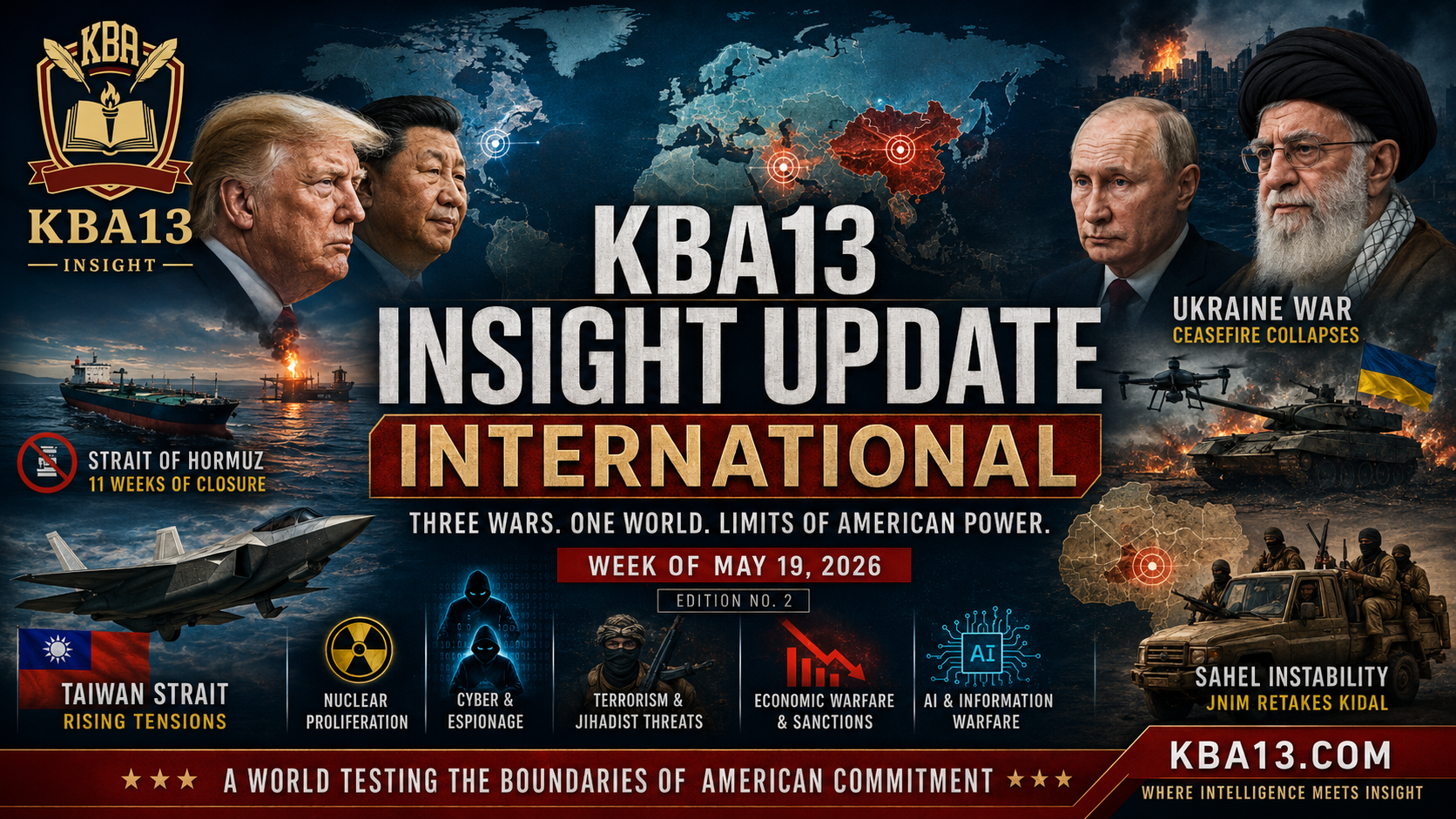
The KBA13 Global Intelligence Briefing for the week of May 19, 2026, examines a world entering a dangerous phase of simultaneous strategic pressure. The Iran-Hormuz crisis, the Trump-Xi Beijing summit, the collapse of the Ukraine ceasefire, Taiwan Strait ambiguity, nuclear proliferation, cyber espionage, Sahel instability, and economic warfare all point toward one central question: how far can American power stretch before adversaries, competitors, and non-state actors begin to redraw the limits of the global order?
The week of May 19, 2026, opens on a world straining under concurrent crises of a kind rarely seen outside wartime. The Strait of Hormuz, through which a fifth of global seaborne oil once flowed freely, remains effectively closed for the eleventh week. The US-Iran ceasefire—declared by Trump himself to be on “massive life support” — is held together by mutual reluctance rather than any agreed framework. In Beijing, a two-day summit between Trump and Xi Jinping produced a 200-jet Boeing order and little else; Xi left the meeting with his core position on Taiwan intact, and Wang Yi declared that Washington “understands China’s position.” In Ukraine, a Trump-brokered three-day ceasefire for Victory Day collapsed within hours of taking effect, with both sides trading drone strikes across a 745-mile front on day 1,543 of the war. The EU adopted its 20th sanctions package against Russia. The NPT Review Conference is fracturing under North Korean defiance and Iranian opacity. And the Malian state — having expelled French and UN forces in favor of Russian mercenaries — watched those same mercenaries accept an escorted withdrawal from Kidal after JNIM retook the city in coordinated attacks. What unites these crises is not chaos but logic: a world testing the boundaries of American commitment while Washington is overextended, and finding those boundaries closer than expected.
GREAT POWER COMPETITION
The Trump-Xi Beijing summit of May 14–15 will be remembered not for what it resolved but for what it revealed. Trump failed to fulfill his fondest hopes for the meeting, while Xi accomplished his bedrock goals, though not much more. The gap between those two outcomes is the most precise available measurement of where the balance of leverage currently sits between the world’s two largest powers. Trump arrived with a delegation of corporate chiefs—Apple, Nvidia, BlackRock, Goldman Sachs, and Boeing—as a signal that American business wants normalcy. Xi received them in the Great Hall of the People with a 21-gun salute, knowing that the economic desperation visible in the delegation was itself a concession. Slate
The single announced deliverable — 200 Boeing jets—collapsed its own symbolism. Boeing shares fell 4% on Wall Street because shareholders had anticipated 500 planes. China’s last big Boeing order, during Trump’s 2017 visit, was for 300 aircraft; relations soured, and orders dried up. This time, investors got less than two-thirds of the floor expectation. Neither Boeing nor the Chinese government formally confirmed even that figure by the time Air Force One left Beijing — a detail that transforms a headline deal into a diplomatic construct. If the aircraft order is the summit’s most concrete product, the summit produced almost nothing concrete. euronews
On Taiwan, the most consequential moments were linguistic. China’s Foreign Minister Wang Yi declared after the meeting that Beijing “sensed that the US side understands China’s position and attaches importance to China’s concerns” on Taiwan and that Washington, “like the international community, does not support or accept Taiwan moving toward independence.” Trump denied making any commitment. But Wang’s statement — made on the record in Beijing — now stands as a Chinese diplomatic claim that Washington has not forcefully repudiated. In the grammar of great-power signaling, silence is a position. CNN
Trump told Fox News that Taiwan was the “most important” issue for Xi during the talks, and added that he would like the situation “to stay the way it is,” describing Taiwan as “a very small island” 59 miles from “a very powerful, big country” while noting that America is “9,500 miles away.” The geographic observation, however casual in delivery, is a strategic framing that Beijing will quote for years. It is the language of a superpower reconsidering the cost of an implicit security guarantee — and it was said in Beijing, to Xi’s benefit, by the president of the United States. CNN
The structural backdrop to the summit is one of partial Chinese advantage. China’s exports grew 21.8% year-on-year in the first two months of 2026, reflecting a deliberate reorientation toward non-US markets that has cushioned the impact of the trade war. Washington designed tariffs to inflict economic pain that would force Beijing back to the table on American terms. Instead, China diversified its trade geography, held its position on Taiwan, and received the American president in its capital on a red carpet. The bargaining chip that produced the most concessions this week was China’s control of rare earth minerals — the quiet fulcrum of the entire bilateral relationship. World Economic Forum
The Japan dimension adds another layer of pressure. In the months before the summit, Beijing sought to pressure Japanese Prime Minister Sanae Takaichi to retract comments suggesting Japan might invoke collective self-defense in a Taiwan conflict, responding with diplomatic barbs, economic penalties, and military activities intended to intimidate Tokyo. Japan watched the Trump-Xi summit with the specific anxiety of an ally that has watched Washington repeatedly signal in 2026 that it will not spend political capital defending positions that complicate relations with China. The confidence of First Island Chain allies—Japan, the Philippines, and South Korea—depends on American credibility, which is now measurably diminished. ChinaPower Project
The Busan trade truce negotiated in October 2025 expires in November. The window for building guardrails is narrow, and with the truce’s expiry, much of the political space that makes even limited cooperation possible disappears. Trump’s invitation for Xi to visit Washington in the fall creates one more deadline — another summit that Xi can approach from a position of relative strength, having secured concessions in Beijing and watched the Hormuz crisis consume American bandwidth. The fall meeting will be harder for the United States than this one was. World Economic Forum
The biggest strategic risk from this week’s summit is not what was said but what was left unsaid: no agreement on Iran, no agreement on Ukraine, no agreement on the South China Sea, and a Taiwan position that Beijing can now characterize as movement in its direction. European observers noted that “China has the upper hand right now,” and that “you don’t get the sense that much has been accomplished” from Washington’s perspective. In the ledger of great-power competition, this was a week China ended ahead—without firing a missile, deploying a warship, or conceding a single core interest. euronews
Xi measured the distance between American rhetoric and American resolve this week, and found it wider than at any point in the post-Cold War era.
ACTIVE CONFLICT ZONES
Iran. The US-Iran war, now in its eleventh week, entered a phase defined less by kinetic exchange than by the structural collapse of the cease-fire architecture. Trump declared the ceasefire to be on “massive life support” after calling Iran’s latest counterproposal “unacceptable.” Some Trump aides said he is now more seriously considering a resumption of major combat operations than at any point since April. The diplomatic impasse stems from a sequencing dispute: Washington wants Iran to commit immediately on nuclear constraints; Tehran wants sanctions lifted and the naval blockade ended before any nuclear discussion begins. Neither position is irrational; they are simply incompatible. CNN
Iran’s counterproposal included recognition of its sovereignty over the Strait of Hormuz — a demand that, if accepted, would permanently institutionalise Iran’s right to restrict passage, converting a temporary crisis measure into an enforceable legal claim. Washington rejected it, as it had to. But Iran’s willingness to table such a maximalist position signals that Tehran’s hardliners — who have consolidated power since Khamenei’s assassination created a succession vacuum — are driving the negotiating posture. Moderate voices that might accept a phased deal are structurally weakened. Every week the strait stays closed, that weakness deepens. Wikipedia
By mid-May, 230 loaded oil tankers were waiting inside the Gulf, unable to transit. The IRGC redefined the strait as a “vast operational area” extending from Jask to Siri Island — far beyond the strait’s narrow physical corridor — effectively asserting sovereign-adjacent control over a major artery of international commerce. This definitional move is legally meaningless under UNCLOS but operationally significant: it widens the zone within which Iran claims the right to intercept vessels, and narrows the space within which US convoy operations can claim clear passage. Operation Project Freedom — the US Navy’s effort to escort merchant ships through — was paused on May 6 after Trump cited “great progress.” That progress has since evaporated. Wikipedia
Ukraine. The Trump-brokered three-day ceasefire for Russia’s Victory Day — May 9 to 11 — collapsed as a model even as it produced its headline exchange of 1,000 prisoners per side. Ukraine and Russia reported fighting along their front line despite the agreement, each accusing the other of launching drone and artillery strikes. Rubio had warned hours before the announcement that US mediation efforts had “not led to a fruitful outcome” and had “stagnated.” The ceasefire was less a diplomatic achievement than a performance: proof that Trump can produce a moment of apparent progress, not proof that either party is ready for a durable settlement. Military Times
Russia’s decision to hold its Victory Day parade without military equipment — the first such instance in years — was cited by Zelenskyy as evidence that Moscow “cannot afford military equipment and they fear drones may buzz over Red Square.” Ukraine issued a formal presidential decree “authorizing” Russia to hold the parade, deliberately asserting its claimed targeting reach over Moscow while packaging the restraint as magnanimity. This is strategic communication of a high order: Kyiv is publicly establishing that it can strike the Russian capital but chooses not to — a deterrence signal dressed in diplomatic clothing. Al Jazeera
The operational picture on the front remains intense at day 1,543: 263 combat engagements recorded in a single day, with Russia deploying 9,153 kamikaze drones and dropping 270 guided aerial bombs in 24 hours. Russian drone production has reached industrial scale — over 8,000 per month — creating an attrition problem for Ukrainian air defences that no quantity of Western-supplied interceptors has fully solved. The economics are asymmetric: Russia produces Shahed variants at approximately $20,000–50,000 per unit; each intercepting missile costs 40 to 100 times that figure. Empr
South Asia. The one-year anniversary of the May 2025 India-Pakistan four-day aerial war passed this week with Pakistan holding military ceremonies to mark what Islamabad calls its defensive victory. The Pakistan Air Force held formal proceedings celebrating its claimed achievements in downing Indian jets, while billboards across Pakistani cities honoured military leadership. India’s silence on the anniversary is not reconciliation — it is strategic patience before the next provocation. Pakistan’s military warned that “the much-vaunted guardrails which once prevented India-Pakistan crises from spiralling into full-scale war are off,” citing reduced US mediation capacity, hardened military doctrines, and great-power manoeuvring. Al JazeeraDawn
The simultaneous management of three active crisis zones — Iran, Ukraine, and the India-Pakistan fault line — has exceeded the bandwidth of US crisis diplomacy in ways that every adversary and competitor is measuring in real time. Rubio is shuttling between Tehran intermediaries, Kyiv, and Beijing. Vance is managing Hormuz talks through Pakistani channels. The National Security Council is stretched across simultaneous contingencies that individually would dominate a presidency. The reduced chances for US mediation in the next India-Pakistan crisis, combined with hardened military doctrines on both sides, mean that future South Asian conflicts could be deadlier and less predictable than 2025. The Interpreter
Every active conflict zone this week demonstrates the same underlying dynamic: adversaries have correctly calculated that Washington cannot fully attend to more than one crisis at a time, and are acting accordingly.
NUCLEAR & WMD WATCH
The UN NPT Review Conference, currently underway in New York, is becoming a document of the regime’s own decline. North Korea’s UN Ambassador Kim Song declared this week that “the Democratic People’s Republic of Korea will not be bound by the Non-Proliferation Treaty under any circumstances whatsoever,” delivering the statement directly to the conference floor as the United States and other members criticized Pyongyang’s program. What is significant is not the content — North Korea has said this before — but the venue and timing. Defying the NPT conference while it is in session is an act of deliberate institutional humiliation, designed to signal to threshold states that the regime’s enforcement mechanisms are inoperative. Al Jazeera
Iran has stockpiled 440.9 kg of uranium enriched to 60% — just below weapons-grade 90% — and could produce enough weapons-grade material for a single nuclear device in as little as one to two weeks using its IR-6 and IR-8 centrifuges. Coalition strikes on Natanz and Fordow damaged centrifuge capacity but did not eliminate breakout capability. Operation Epic Fury produced the paradox that drives all coercive non-proliferation strategy: the strikes that were meant to set Iran’s programme back have simultaneously strengthened the domestic political argument for acquiring a deterrent. The calculation Tehran’s decision-makers now face is not whether to build a bomb but whether doing so openly accelerates or deters further American attack. Missilestrikes
North Korea, meanwhile, maintains an estimated 50 nuclear weapons and is developing nuclear-capable submarines with Russian backing. The North Korea-Russia technology exchange — Pyongyang providing artillery shells and infantry to Russia’s front in Ukraine, Moscow providing advanced missile and submarine technology in return — is one of the most consequential proliferation transfers of the post-Cold War period. It is being executed in plain view, with no effective international mechanism capable of stopping it, because the only states with leverage over Pyongyang — China, and to a lesser extent Russia — have reasons to look away. Globalsecurityreview
New START, the last surviving bilateral US-Russia nuclear arms control treaty, expired in February 2026 without replacement. Its expiration is likely to accelerate the failure of the NPT Review Conference and further erode the nonproliferation architecture. The two states controlling 88% of the world’s nuclear warheads now operate without a single formal verification mechanism — no data exchanges, no on-site inspections, no agreed notification of exercises. The last time this was true, the Cold War was at its height and both sides understood the shared interest in managing the risk. That shared understanding is now structurally weakened. Globalsecurityreview
It is highly likely that South Korea and Saudi Arabia will move closer to developing the technical means and political motivation to acquire nuclear weapons in 2026. This is not speculation but a function of incentive structures. South Korea faces North Korea with 50 warheads and a growing delivery capability. Saudi Arabia faces an Iran that is weeks from weapons-grade material and has demonstrated, through the Hormuz closure, its willingness to weaponize geography. Both Riyadh and Seoul are US treaty partners or close security associates—which means that if they move toward acquiring nuclear weapons, Washington will face the precise dilemma it has historically managed to avoid: whether to sanction its own allies for proliferating. Just Security
The Iranian nuclear file has also acquired a new operational dimension: Trump revealed this week that Iran had agreed to allow the US to remove its enriched uranium stockpile, then reversed that agreement, telling him “you’re going to have to take it out” but declining to put it in writing. “They changed their mind,” Trump said. The episode reveals the depth of distrust in the negotiating channel and the difficulty of converting Iranian verbal commitments into verifiable concessions. It also raises an uncomfortable question: if Iran’s enriched uranium cannot be diplomatically removed, and military strikes cannot permanently eliminate it, what remaining options does Washington actually have? CNN
The conflict is accelerating proliferation pressures regionally: Saudi Arabia, Turkey, and Egypt have all signaled interest in matching any Iranian nuclear capability. This is the cascade scenario that non-proliferation scholars have warned of for twenty years — a Middle East in which multiple states pursue parallel nuclear programs, in which deterrence relationships are opaque, and in which crisis management depends on communication channels that do not yet exist. The 1970 NPT framework was not designed for a world in which the two nuclear superpowers have abandoned arms control, a third state is weeks from breakout, and a fourth is advertising its program’s irreversibility at the UN. Missilestrikes
The deepest strategic irony of the current moment is that Operation Epic Fury — launched partly to prevent Iran from acquiring a nuclear weapon — has created the conditions most likely to produce exactly that outcome, while simultaneously destroying the diplomatic architecture that might have managed the long-term risk. The growth in nuclear arsenals, including the qualitative development of hypersonic vehicles and MIRVs, has undermined the strategic balance established during the Cold War. Globalsecurityreview
The NPT regime is not in crisis — it is in managed collapse, and every threshold state is drawing the same conclusion from the same evidence.
INTELLIGENCE & ESPIONAGE
The Trump-Xi Beijing summit created one of the decade’s most intensive intelligence-collection opportunities — and it lasted 48 hours in the most technically sophisticated surveillance environment on earth. The Chinese security apparatus — from hotel-room acoustic penetration to the collection of signals from diplomatic communications — operates at a level that the Secret Service and the NSA are designed to counter but cannot fully neutralize. The presence of Elon Musk, whose Tesla and Starlink operations give Beijing substantial existing leverage, in the American delegation raised counterintelligence concerns that US officials declined to address publicly. The combination of corporate principals, senior Cabinet members, and a president who conducts diplomacy through personal conversation rather than prepared text creates an unusually rich collection environment.
Iranian cyber espionage disguised as Chaos Ransomware attacks has been documented this week, with threat actors targeting US critical infrastructure while using financially motivated malware as cover for state intelligence collection. This dual-use obfuscation — state espionage wrapped in criminal malware — is now Iran’s primary cyber doctrine. It provides deniability while generating economic damage as a secondary effect. The tactic is rational: a US attribution and public retaliation over a “ransomware attack” carries different escalation risks than a response to an acknowledged state cyber operation. Security Affairs
Security researchers documented 90 zero-day vulnerabilities exploited in 2025, nearly half of which targeted enterprise technology systems. One monitoring report tracked 1,782 vulnerabilities disclosed in a single week, including 282 public proof-of-concept exploits. The acceleration of the weaponization cycle—from vulnerability discovery to active exploitation — has compressed from months to days. Defenders operate on a timeline that systematically favors attackers, and no amount of patching speed closes a gap that is structural rather than operational. The Cyber Express
Russian cyber groups are focused intently in 2026 on European military programs, energy infrastructure, and supply chains for Western defense modernization projects. The objective is not disruption for its own sake but intelligence collection on Western weapons deliveries to Ukraine — precisely the information that allows Russian targeting of logistics routes, ammunition depots, and maintenance facilities before they become operational. Cyber espionage in this context is a force multiplier for kinetic operations, not an alternative to them. MedPressIT GbR
The information warfare dimension of the Hormuz crisis produced a significant data point this week: a warning attributed to Iran’s army chief that US aircraft carriers approaching the strait would be met with cruise missiles and combat drones was posted on X and moved markets before Iran’s semi-official Fars News Agency identified it as a fake account. The episode is not a curiosity — it is a demonstration of a new class of threat. A convincing social media impersonation of a senior military commander, posted during active conflict, can generate real-world economic effects — oil price movements, insurance premium shifts, shipping route decisions — before verification can occur. The attacker need not control the outcome; creating the uncertainty is sufficient. CNN
Cyber tools are being used to help nation-states pursue strategic aims without firing a shot — enabling espionage, information operations, and targeted infrastructure disruption while providing plausible deniability and avoiding the escalation thresholds that kinetic action triggers. Over 100 countries now maintain dedicated military cyber units, meaning the capability gap that once gave major powers a disproportionate advantage in this domain is narrowing. The democratization of offensive cyber — accelerated by AI tools that lower the technical barrier to effective intrusion — is the most underappreciated proliferation risk of the current decade. SecurityBrief
The AI-assisted hacking frontier moved this week from theoretical to operational. Large language models are now being used for reconnaissance automation — mapping corporate networks, identifying high-value targets, and drafting spear-phishing content calibrated to individual targets’ linguistic patterns and social connections. The speed advantage this provides is decisive: a human intelligence analyst who might spend two weeks preparing a targeting package can be replaced by an AI system that completes an equivalent analysis in hours. Human defenders, operating at human speed, are not equipped to match this cadence.
The convergence of multiple intelligence collection environments — the Beijing summit, active kinetic conflicts in three theatres, and a sanctions enforcement landscape generating large volumes of financial intelligence — means that 2026 is producing more raw intelligence than at any point since the immediate post-9/11 period. The challenge is not collection but analysis: distinguishing signal from noise when every adversary simultaneously has strong incentive to deceive, and when AI-generated synthetic content has made the verification of sources and documents structurally harder than at any prior moment in the intelligence cycle.
The most dangerous intelligence environment is not one in which adversaries know too little — it is one in which they know enough to act, and defenders cannot determine what they know.
TERRORISM & EXTREMISM
The Iran conflict has functioned as a jihadist propaganda windfall at the worst possible moment. The killing of Ali Khamenei on February 28 — a Shia Muslim cleric and the supreme leader of an Islamic republic — by American and Israeli forces has generated incitement material that ISIS and al-Qaeda affiliates are deploying across Arabic, Farsi, Urdu, and Indonesian-language channels with a sophistication that suggests pre-prepared media packages. The operational implication is not that jihadist groups support Iran — they do not — but that the imagery of American military action against Muslim populations and infrastructure serves as a universal recruitment narrative regardless of the sectarian identity of the victims.
The ISIS core in Syria and Iraq is operating at a suppressed but structurally persistent tempo, taking direct advantage of the reallocation of US and Coalition counterterrorism resources toward Hormuz convoy operations and Iranian nuclear negotiations. CENTCOM assets previously dedicated to anti-ISIS strike missions in northeastern Syria have been partially redirected. The intelligence collection architecture—signals, overhead imagery, human networks — that sustained pressure on ISIS leadership targets for eight years requires continuous maintenance; gaps in collection create spaces that resilient organizations exploit faster than analysts typically project.
In Europe, threat assessments at Germany’s BfV, France’s DGSI, and the UK’s MI5 have been elevated since late February. The specific concern is not a coordinated external attack — the capacity for that remains limited — but inspired domestic actors who consume ISIS and al-Qaeda propaganda in Western languages and act without operational contact with any external organization. The profile of this threat is well understood: male, 20s to 30s, recent radicalization, minimal digital footprint, weapon of opportunity. Understanding the profile has not enabled systematic prevention, as demonstrated by attacks in 2023, 2024, and early 2025.
Hezbollah’s operational posture in the Western Hemisphere deserves specific attention this week. Iran-linked groups have indicated they would “pause” cyber attacks against the US following the ceasefire — an admission that active cyber operations were ongoing and a signal that Tehran retains the ability to re-activate them. Hezbollah’s financial and logistics networks in the tri-border area of Argentina, Brazil, and Paraguay, and in Venezuela represent a latent operational capability that the organization activates selectively. With Hezbollah under severe pressure from Israeli strikes in Lebanon—ammunition depleted, command structure disrupted — the question of whether those Western Hemisphere cells are being tasked with revenue generation, intelligence collection, or contingency preparation for retaliatory operations is one that the FBI’s International Terrorism Operations Section and Argentina’s SIDE are treating as an active priority. Wikipedia
Far-right extremism in Europe has acquired a new dynamic from the migration pressures generated by the Sahel’s collapse and the Iran conflict’s displacement effects. Organized networks in Germany, France, Italy, and Sweden are recruiting on platforms that intelligence services monitor but cannot fully disrupt without encountering constraints on free expression. The material appeal of these networks — economic precarity, cultural anxiety, and a sense of institutional abandonment — is structural rather than ideological, rendering counterterrorism tools ill-suited to addressing root causes. Surveillance and disruption can decapitate specific cells; they do not change the conditions that produce new ones.
The Sahel’s jihadist expansion — covered in depth below — is generating a secondary terrorism risk that has not yet received adequate attention in Western capitals: the gradual establishment of JNIM as a governance provider across vast territories in Mali, Burkina Faso, and increasingly northern coastal states. JNIM operates governance structures in areas it controls, collecting taxes and enforcing sharia, with an estimated 6,000 fighters. The transition from insurgency to governance is the same trajectory ISIS followed between 2013 and 2014 — a transition that created the conditions for external attack planning that eventually produced Paris, Brussels, and Nice. World-on-fire
In Pakistan, the aftermath of the May 2025 India-Pakistan war has produced a paradox: Pakistan’s security services, formally engaged against Tehrik-i-Taliban Pakistan (TTP) on the Afghan frontier, simultaneously face internal pressure from the military’s use of irregular networks during the India conflict. States that mobilize non-state proxies for interstate war consistently find those proxies harder to demobilize than to arm. Pakistan’s history with this problem stretches across four decades, and every previous demobilization attempt has produced partial results at best.
Nigeria’s northeast remains a significant ISWAP operational theatre that receives insufficient attention relative to the scale of the threat. ISWAP — the Islamic State’s West Africa Province — controls territory around Lake Chad, conducts complex ambushes against Nigerian army convoys, and is expanding its administrative reach into civilian populations through a combination of coercion and welfare provision. The Nigerian military’s tactical capacity has improved since 2021, but ISWAP’s organizational resilience has matched it, demonstrating the structural limitation of security-first counterterrorism in environments where state absence is the primary driver of extremist appeal.
Jihadist organizations globally have learned the same lesson from 2026 that they learned from the 2003 Iraq invasion: American overextension in one theatre creates operational breathing room in every other.
ECONOMIC WARFARE & SANCTIONS
The Iran war has produced what the IMF’s April 2026 World Economic Outlook described explicitly as the greatest global energy security threat in history. The reference forecast — assuming a short-lived conflict and a moderate 19% increase in energy commodity prices — puts global growth at only 3.1% in 2026, against a pre-conflict projection of 3.4%. In an adverse scenario, assuming a sharper price increase and tighter financial conditions, growth falls to 2.5%, and inflation rises to 5.4%. The adverse scenario is not hypothetical; it describes conditions that have already partially materialized, with Brent crude reaching $166 per barrel in March before partial ceasefire news drove it back below $120. It has not stayed there. International Monetary Fund
On April 23, 2026, the EU adopted its 20th sanctions package against Russia — 120 new designations, 37 individuals and 83 entities, the highest number added in a single package in two years — alongside measures targeting Russia’s energy revenues, shadow fleet, and cryptocurrency circumvention networks. The package includes a structural first: a legal mechanism that, when activated, would enable a comprehensive ban on maritime services for Russian crude oil. The Council has not yet activated it, reflecting the political sensitivity of a measure that would further tighten an already strained European energy market. The mechanism’s existence is itself a signal — to Russia, to the shadow fleet operators, and to third countries facilitating circumvention. Herbert Smith Freehills Kramer
The US approach to Russia sanctions has diverged from the European framework: Washington has issued no new Russia designations, has not supported lowering the oil price cap, and disbanded Task Force KleptoCapture. It temporarily lifted certain restrictions on Russian oil transactions following the closure of the Strait of Hormuz in March 2026 to mitigate supply shortages. The temporary suspension of Russian oil restrictions — a remarkable reversal for an administration that campaigned on maximum pressure against Moscow — illustrates the internal contradiction at the heart of current American economic strategy. Sanctioning Russia while simultaneously needing Russian oil to compensate for Hormuz-driven supply disruptions is not a sustainable posture; it is crisis management that advantages Moscow’s financial position. Steptoe
With significant volumes of Gulf oil unable to transit, the US announced a temporary easing of certain oil-related sanctions to mitigate supply shortages, altering global supply dynamics and increasing the availability of Russian crude. Such measures could be a boon for the Russian economy, and shifts in energy pricing could, in turn, affect the broader geopolitical calculus surrounding Ukraine. The logic is direct: a Russia that earns windfall oil revenues despite the war is a Russia with greater capacity to sustain military operations in Ukraine. Economic warfare against Moscow is being partially self-defeated by the strategic necessity of managing the Iran energy crisis. World Economic Forum
The Hormuz closure became the largest disruption to the world energy supply since the 1970s energy crisis. The largest-ever monthly increase in oil prices occurred in March 2026. The IEA released 400 million barrels from emergency reserves — about four days of global consumption — in an attempt to stabilize markets. Four days of reserves against an eleven-week closure is not energy security; it is a gesture. The structural vulnerability exposed by the Hormuz crisis — that one country’s decision to restrict a 34-kilometer waterway can immediately affect food prices, fertilizer availability, shipping costs, and monetary policy across 190 countries — was already known in academic literature. Its real-world demonstration has concentrated minds in every energy ministry on earth. Wikipedia
Nearly 50% of global urea exports originate from countries west of the Strait of Hormuz and typically transit this route; Brazil accounts for nearly 60% of global soybean exports and is a major exporter to the Middle East. Fertilizer shortages and supply disruptions are now cascading through global food systems. Agricultural economies dependent on imported fertilizer—across South Asia, Sub-Saharan Africa, and Southeast Asia — face input cost increases that will compound into yield reductions in the 2026-27 growing season. Food insecurity in fragile states does not remain contained to food systems; it transmits directly into political instability, which in turn creates the conditions for the extremist recruitment discussed above. Wikipedia
China’s rare earth export controls remain the most underappreciated instrument of economic coercion in the current environment. China’s tight controls on valuable materials are what is ultimately driving the Trump administration’s eagerness to maintain a good relationship with Beijing, according to leading analysts. The dependency of American precision-guided munitions — the weapons being expended at scale against Iranian targets — on Chinese-processed rare earth elements is a supply chain vulnerability that the Pentagon’s industrial base review has documented but not resolved. The irony is precise: weapons used to fight one adversary depend on materials controlled by another. CNBC
The Suez-Red Sea corridor, which normally carries roughly 12–15% of global trade and 30% of global container traffic, has surged in strategic importance as the closure of the Strait of Hormuz has redirected shipping. Washington has moved to deepen engagement with Eritrea—lifting some sanctions—specifically to secure the Red Sea corridor via the Bab el-Mandeb strait. Eritrea’s cooperation comes at a price in democratic legitimacy that the Biden administration spent four years building. The Trump administration’s willingness to rehabilitate authoritarian partners in exchange for basing access and maritime cooperation is a pattern visible across its first eighteen months — pragmatic in the short term, corrosive of the normative framework that makes coalition-building possible in the medium term. Steptoe
Energy has become the clearest demonstration that economic warfare, when waged against a state controlling critical maritime geography, is a double-edged instrument that the attacker cannot fully control.
INDO-PACIFIC SECURITY
The aftermath of the Beijing summit lands hardest on Taiwan. Trump described Taiwan as “a very small island” and said he would like the situation to “stay the way it is,” while China’s Foreign Minister Wang Yi claimed Beijing sensed that Washington “understands China’s position and attaches importance to China’s concerns” on the Taiwan question. The strategic ambiguity that has deterred Chinese military action for five decades depends on Beijing’s uncertainty about American willingness to fight. Trump’s geographic framing — 9,500 miles from Washington, 59 miles from the Chinese coast — is an argument for disengagement, not deterrence. If Beijing’s military planners interpret it as such, the risk of miscalculation rises sharply. CNN
Trump explicitly held off signing a $14 billion arms sales package to Taiwan before the Beijing summit to avoid angering Xi — and possibly to use the package as leverage. In the end, he made no concessions on Taiwan — but he also made no commitment, leaving the package unsigned and Taiwan’s security architecture in an indeterminate state. The package’s continued suspension is itself a signal. Every day Taiwan’s arms request sits unsigned is a day Taipei’s defensive modernization is delayed and a day Beijing can read American hesitation as an opening. Arms sales to Taiwan are not merely transactions — they are deterrence signals. Their suspension is therefore a deterrent degradation. Slate
The South China Sea produced the week’s sharpest physical demonstration of Chinese opportunism. While US forces were conducting efforts to reopen the Strait of Hormuz, China moved to block the Scarborough Shoal in the South China Sea. The synchronization—asserting control over disputed maritime space precisely when American attention is consumed elsewhere — is not coincidental. It reflects a strategic doctrine of simultaneous pressure on multiple fronts, designed to exploit the finite bandwidth of American crisis management and establish facts on the water before Washington can respond coherently. Wikipedia
About 43% of China experts assess the South China Sea as the most likely hotspot for Chinese escalation in 2026, followed by 33% identifying the Taiwan Strait. The South China Sea preference reflects an important analytical distinction: China views the Philippines as less militarily capable than Taiwan, and a crisis there is unlikely to trigger the high-intensity kinetic conflict that a Taiwan contingency would risk. Scarborough Shoal is, therefore, an ideal testing ground—significant enough to exert meaningful pressure on the regional security order, yet limited enough to remain below the threshold for a direct US military response. ChinaPower Project
The Korean Peninsula’s quiet this week is deceptive. North Korea has been unusually restrained kinetically since February — no missile tests, no substantive nuclear provocation rhetoric beyond the NPT conference statement. Ambassador Kim Song’s statement — that North Korea’s status as a nuclear-armed state “will not change based on external rhetorical claims or unilateral desires” — is the political framing of a regime that is watching the Iran crisis and drawing conclusions. Pyongyang’s restraint likely reflects a calculation that maximum American distraction in the Gulf reduces the publicity value of provocations that require a Washington response to register as significant. The historical pattern is consistent: North Korea’s quiet periods precede strategic demonstrations designed to recapture leverage. Al Jazeera
The AUKUS submarine deal — Australia’s acquisition of Virginia-class nuclear-powered submarines with American and British assistance — continues its slow implementation timeline, buffeted by industrial base constraints on both sides of the Pacific. The Australian domestic debate about the deal has quietly intensified as the US demonstrates, through simultaneous developments in Iran and Ukraine, that its industrial base is under strain: submarine production delays in US shipyards now run into years, not months. A deal whose deterrence logic depends on delivered capability, not signed agreements, cannot fully mature until steel is in the water. That timeline, for the first hull, remains 2032 at the earliest.
The Quad — the security dialogue comprising the US, Australia, Japan, and India — is the week’s quietest major institutional story, which is itself significant. India’s relationships with Washington have cooled markedly since Trump’s renewed embrace of Pakistan’s military leadership following the May 2025 war. Trump is hosting Pakistan’s Army Chief Asim Munir at the White House, and the latter’s subsequent self-elevation to field marshal reinforced a Pakistani narrative of resilience and American backing that India reads as a strategic tilt. A Quad in which the India-US bilateral relationship is strained is not a functioning strategic architecture — it is a diplomatic label on an increasingly empty institutional box. The Interpreter
The Indo-Pacific this week is a region in which every American ally and partner is conducting its own private reassessment of whether Washington’s security guarantees can be relied upon under simultaneous pressure from multiple directions. That reassessment — quietly, in Tokyo, Seoul, Canberra, Manila, and Taipei — is the most consequential strategic process underway in the world’s most economically significant region, and it is happening largely outside public view.
The Indo-Pacific’s deterrence architecture has not collapsed—but the cracks that Trump’s summit in Beijing opened will require sustained, credible American presence to repair, and that presence is currently committed elsewhere.
AFRICA & THE SAHEL
The JNIM offensive that retook Kidal from Malian and Russian Africa Corps forces on April 25 represents the single most revealing security event in the Sahel in 2026. Africa Corps accepted an escorted withdrawal from Kidal, surrendering the gains made in November 2023 without a fight. According to ACLED, battles involving Russian fighters in Mali fell from 537 in 2024 to 402 in 2025, with Africa Corps averaging just 24 incidents per month by early 2026. The demands of the Ukraine conflict have drawn down the personnel available for African deployments. The Russian security guarantee that justified the coups in Mali, Burkina Faso, and Niger — and provided political cover for expelling French and UN forces — has been objectively tested and objectively failed. Just Security
Burkina Faso’s junta controls approximately 40% of its territory. JNIM has expanded deliberately — not by spillover — into Benin, Togo, the Ivory Coast, and Ghana. In late March 2026, Niger’s General Abdourahamane Tiani dissolved all political parties and began a five-year transition plan. The political consolidation underway in Niamey mirrors the trajectories in Bamako and Ouagadougou: authoritarian entrenchment in response to security failure, producing exactly the legitimacy deficit that jihadist recruitment exploits. These are not separate phenomena; they are a feedback loop. World-on-fire
Benin saw 70% more deaths from JNIM attacks between January and December 2025 compared to the first eleven months of 2024. The coastal West African states that border the Sahel — Benin, Togo, Ghana, Ivory Coast, and Senegal — are experiencing the southern advance of JNIM as a structural expansion rather than a collection of isolated incidents. JNIM’s targeting of these states reflects a deliberate strategic logic: access to ports, new revenue streams through coastal trade, and the establishment of permanent footholds in states whose security services lack the counterterrorism infrastructure of the northern tier. Vision of Humanity
The recent JNIM offensive sharpened dissent within the Malian officer corps, as many sought to cast blame for the intelligence failure that allowed coordinated nationwide attacks to penetrate the regime’s inner sanctum. The chances of a palace coup or junior officer mutiny — already elevated following JNIM’s fuel blockade last year—have increased following Kidal. The structural risk of a coup against a coup leadership is that it typically produces fragmentation rather than competence: the new junta faces the same insurgency with less institutional coherence than its predecessor and the same exhausted security forces. Just Security
Western nations have shifted to an “over-the-horizon” counterterrorism posture, maintaining partnerships with coastal West African states—Ivory Coast, Ghana, and Benin — to prevent jihadist expansion southward. The EU has redirected security assistance from Sahel junta states to their neighbors. This strategic pivot is sound in principle but structurally insufficient. Over-the-horizon counterterrorism without persistent presence, continuous intelligence sharing, and embedded advisory relationships has a consistent historical record of detecting problems after they become crises rather than preventing them. The capacity gap between what Western states can deliver remotely and what the threat requires for proximate engagement is substantial and growing. Defcon Level
China’s posture in the Sahel warrants the analytical attention it rarely receives. Beijing is not a security actor in the region — it has not deployed military trainers or weapons systems as Russia has — but it is an economic actor of increasing consequence. China has secured exploration licenses for gold, copper, and nickel in Burkina Faso and established relations with the new government. China and Russia are both significant uranium consumers, and both have been establishing agreements in Niger while French corporations had their operational permits canceled. China’s interest in Sahelian stability is therefore real but calibrated: stable enough to mine, not so stable that Western security frameworks return. Vision of Humanity
The humanitarian picture has reached a scale that receives insufficient policy attention relative to its strategic consequences. More than 3 million people are internally displaced across the central Sahel — Mali, Burkina Faso, and Niger — with Burkina Faso alone hosting over 2 million IDPs. Displacement at this scale does not remain contained: it generates refugee flows into coastal states, Mauritania, and across the Mediterranean, fuelling the European migration politics that in turn weakens the domestic consensus for sustained Sahel engagement in France, Germany, and Italy. The security and political crises are causally linked, but Western policy has yet to develop instruments that address both simultaneously. Defcon Level
The Sahel is the clearest available demonstration of what happens when a region’s security architecture is dismantled — French military departure, UN expulsion, and G5 Sahel dissolution — and replaced with a Russian security guarantee that proves inadequate within two years. The lesson is not specifically about Russia: it is about the structural difficulty of securing ungoverned space with external forces whose interests are contingent, whose commitment is finite, and whose local knowledge is shallow.
The Alliance of Sahel States bet sovereignty against security, and sovereignty is winning while security collapses around it.
LATIN AMERICA & NARCO-STATE DYNAMICS
The structural transformation of Latin American security this week is captured in a single statistic: in Mexico, the six largest cartels collectively govern more territory — in the sense of providing taxation, dispute resolution, and basic order — than the federal government reaches with effective state presence. The Sinaloa Cartel, internally fractured since the Chapitos-Mayos split of 2024, controls key fentanyl trafficking corridors from Sinaloa through Sonora to the US border despite sustained military operations. The Mexican government’s security strategy—deploying the army to perform law enforcement functions—addresses the symptom of cartel violence without altering the economic foundations of cartel power, which rest on demand in the United States and impunity in Mexico.
China has invested over $100 billion in oil-backed loans in Venezuela, making Caracas structurally dependent on Beijing in ways that significantly constrain US strategic options. The post-Maduro transition in Venezuela has produced a political environment in which the successor government must simultaneously balance Chinese creditors, US sanctions pressure, and domestic economic collapse. Washington’s leverage is limited by the fact that Caracas’s most important economic relationship is with a country that Washington is simultaneously trying to manage on Taiwan, Iran, and trade. Each pressure point on China constrains American options everywhere China has created dependency. Wikipedia
Hezbollah’s financial and logistics networks in the tri-border area of Argentina, Brazil, and Paraguay remain the most immediately concerning external-actor security issue in Latin America. With the organization under severe pressure from Israeli strikes in Lebanon—command structure disrupted, ammunition reserves depleted, operational tempo reduced—the possibility that Western Hemisphere cells are being tasked for contingency operations has elevated. The historical precedent is the 1992 Israeli Embassy bombing in Buenos Aires and the 1994 AMIA bombing—both attributed to Hezbollah and both executed during periods of Israeli-Hezbollah military pressure. The parallel is imperfect; the pattern is worth monitoring.
Ecuador’s collapse into criminal governance has been the decade’s most dramatic illustration of how quickly a state can be penetrated by organized crime when institutional capacity is weak, and port geography is advantageous. Guayaquil — Ecuador’s main port and South America’s Pacific gateway — has become a transshipment hub for cocaine flowing from Colombian and Peruvian production to European and North American markets. The criminal networks controlling this trade have demonstrated the capacity to assassinate presidential candidates, conduct prison massacres, and intimidate judicial systems. The Ecuadorian state is responding with military deployments that have reduced but not reversed the violence.
Chinese infrastructure investment in Latin American ports is the region’s most significant long-term strategic development and receives insufficient analytical attention in Western capitals. Chinese-built and partly operated facilities in Peru (Chancay), Chile, and the Bahamas are not merely commercial infrastructure — they are access points that can provide logistical support, intelligence collection opportunities, and, in crisis conditions, potential naval basing options. The Belt and Road Initiative’s Latin American footprint has advanced furthest in exactly the maritime geography most relevant to Pacific power projection. Washington’s counter-strategy — the Partnership for Global Infrastructure and Investment — remains underfunded and operationally slower than Chinese commercial deployment.
The Haiti crisis has entered its third year without a governance framework capable of challenging gang control over Port-au-Prince and the surrounding region. The Kenyan-led multinational security force, deployed with US support in late 2024, has achieved localized security improvements but has not dislodged the Grand Grif and Viv Ansanm coalition that controls an estimated 80% of the capital. The political vacuum left by the assassination of President Moïse in 2021 has never been filled; elections remain impossible while gangs control polling stations. Haiti’s proximity to the US — 700 miles from Miami — and its humanitarian catastrophe generate migration pressure that has directly influenced US domestic politics, yet the country has not received the sustained strategic attention its geography warrants.
Nicaragua, Cuba, and Venezuela collectively constitute a triangle of authoritarian governance in the Caribbean basin that has deepened its cooperation with Russia, China, and Iran over the past four years. Nicaragua has hosted Russian naval exercises and signed a military cooperation agreement with Moscow. Cuba continues to allow Russian intelligence facilities on its territory — the Lourdes signals intelligence station remains operational — while managing its own economic collapse through carefully rationed state control. Venezuela serves as the regional hub for Iranian financial networks and, through PDVSA, for the petroleum trade that sustains regime revenue despite sanctions. The triangle is not a military alliance; it is an arrangement for mutual survival among governments with no other strategic partners.
The narco-state dynamic — criminal organizations providing governance services in exchange for territorial control and population loyalty — is now visible across Colombia, Ecuador, Honduras, Guatemala, and Haiti simultaneously. This is not a security problem amenable to counternarcotics operations alone; it is a governance failure that security force deployments can contain but not cure. The structural causes—state absence, economic exclusion, corruption, and impunity — require sustained investment in institutions that the United States and its regional partners have consistently been unwilling to fund at the scale the problem demands.
Latin America is the clearest demonstration that criminal governance is not a temporary crisis to be managed but a structural alternative to state legitimacy that, once established, is extraordinarily difficult to reverse.
TECHNOLOGY & INFORMATION WARFARE
Russia deployed 9,153 kamikaze drones against Ukrainian positions in a single day this week. That number — which would have been considered science fiction as a daily operational figure in 2020 — is now a routine data point in the conflict-in-Ukraine reporting cycle. The industrialization of expendable aerial munitions has produced a battlefield dynamic with no historical precedent: mass attrition of air defense magazines through volume, rather than capability defeat through sophistication. Ukrainian air defenses consistently achieve high interception rates — 80% or better — and still face unsustainable attrition economics because the cost ratio so strongly favors the attacker. Empr
May 2026 marks a turning point in the convergence of artificial intelligence, cybersecurity, and conventional military power — a convergence that is no longer theoretical but operational. The US Department of Defense’s Replicator initiative — designed to deploy thousands of autonomous drones as an asymmetric counter to China’s mass — is producing results that are classified but widely assessed to be behind schedule. The conceptual insight behind Replicator is sound; the procurement and integration timelines are not. China, meanwhile, has demonstrated drone swarm capabilities in exercises that suggest substantially more advanced mass autonomous coordination than US assessments projected three years ago. Security Affairs
The deepfake and synthetic media threat moved from laboratory concern to operational reality in a documented incident this week. A fake X account impersonating Iran’s army chief posted a warning about US aircraft carriers being met with cruise missiles and combat drones, moving oil markets, and generating real-world commercial decisions before Iran’s own media agencies identified it as fabricated. The episode illustrates a new category of information warfare attack: one that does not require the target to believe the false content permanently, only long enough for market and operational reactions to generate irreversible effects. A 15-minute window of credible disinformation in an active conflict is now sufficient to produce measurable economic damage. CNN
AI-driven phishing, deepfakes, and adaptive malware are simultaneously accelerating cyberattack velocity and lowering the barrier to entry for criminal and state-sponsored operations. Defenders are deploying intelligent agents to automate detection, triage, and response — but the asymmetry remains fundamental: attackers need to succeed once; defenders must succeed every time. The deployment of AI in offensive cyber operations has not eliminated human judgment at the core of strategic targeting decisions, but it has dramatically accelerated the reconnaissance and exploitation phases that precede them. A state cyber program that once required 500 skilled personnel to sustain can now be delivered with 50, with AI handling the volume operations. Small Wars Journal
Satellite intelligence has become the most consequential open-source intelligence domain in the Iran conflict. Commercial satellite operators—Planet Labs, Maxar, Capella Space — are providing near-real-time imagery of Iranian port blockades, IRGC vessel movements, and US carrier strike group positioning that was previously available only to national intelligence agencies. This democratization of overhead imagery has changed the information environment in two ways: it constrains all parties’ ability to deny or conceal large-scale military movements, and it provides adversaries with targeting and damage-assessment intelligence that they would otherwise need years to develop. The military utility of commercial satellite intelligence is one of the period’s most significant and least examined strategic developments.
The drone technology transfer between Iran, Russia, and Houthi forces in Yemen is the period’s most consequential non-nuclear proliferation story. Iranian Shahed-136 design variants are now being produced in Russia, deployed in Ukraine, and used by Houthis in the Red Sea simultaneously—a single design architecture generating operational data across three theaters. Every interception, every countermeasure adaptation, every trajectory modification feeds back into an improvement cycle. The knowledge produced by mass drone operations in Ukraine is directly improving the platforms being deployed against Gulf shipping, and vice versa. Adversaries are running the world’s largest drone testing program, at the expense of Ukrainian civilians and global commerce.
Quantum computing’s security implications are moving from theoretical to practical. China’s National University of Defence Technology published results in March 2026 suggesting progress toward fault-tolerant quantum computation at scales sufficient to threaten RSA-2048 encryption — the standard protecting most government and financial communications — within a timeline that cryptographic risk analysts now measure in years rather than decades. The intelligence community is aware; the migration to post-quantum cryptographic standards is underway but nowhere near complete. The gap between the projected arrival of cryptographically relevant quantum computing and the completion of post-quantum migration in critical systems is a strategic vulnerability that neither the US nor its allies has publicly acknowledged in terms that convey the urgency the timeline demands.
Cyber warfare has undergone a profound transformation: what began as isolated acts of espionage has evolved into a continuous spectrum of operations blending intelligence gathering, disruption, and psychological manipulation. Over 100 countries now have dedicated military cyber units. Modern operations increasingly prioritize visibility and impact over stealth — demonstrating capability to deter, rather than concealing it to surprise. The shift from covert to demonstrative cyber operations tracks the broader shift in great-power competition from denial to signaling. The purpose of a cyber attack on critical infrastructure is increasingly not to destroy the infrastructure but to demonstrate the capacity to do so — a form of deterrence by punishment executed below the threshold of armed conflict. ECCU
The technology battlefield of 2026 has produced a single strategic lesson: speed matters more than sophistication, and the side that industrialises fastest — in drones, in AI-assisted operations, in quantum security — sets the terms of the next decade’s competition.
ANALYST ASSESSMENT: TOP 3 THREATS THIS WEEK
Threat One — Iran Ceasefire Collapse and Full-Scale Resumption of Combat
Probability: 55% of significant re-escalation.
The US-Iran ceasefire has now been violated by both parties in the Strait of Hormuz, described by Trump as on “massive life support,” and is structured around a fundamental sequencing incompatibility that no mediating party has resolved. Iran demands sanctions relief before nuclear concessions; Washington demands nuclear concessions before any relief. Neither position is a negotiating posture designed to converge — both reflect domestic political constraints that the respective leaderships cannot escape without appearing to capitulate. Iran’s hardliners, consolidated after Khamenei’s assassination, cannot accept a deal that looks like submission to American military pressure; Trump cannot accept a deal that defers the nuclear question to a later stage, as Iran has proposed. The specific escalation trigger to watch is Tehran’s promised toll mechanism for the Strait of Hormuz. If the terms are structured as Iranian sovereign control over international passage — a permanent institutionalization of the closure — the United States cannot accept them without abandoning freedom of navigation as a principle. The red line: any Iranian strike that produces American military fatalities in double digits, or any attack on a US carrier, would collapse the ceasefire architecture entirely and trigger a US military response that Trump’s advisers have privately described as disproportionate by design.
Threat Two — Taiwan Strait Gray-Zone Escalation Exploiting Summit Ambiguity
Probability: 50% of significant Chinese assertive action.
China left the Beijing summit with Wang Yi’s public claim that Washington “understands” Beijing’s position on Taiwan — a diplomatic formulation that, whether accurate or not, constrains Washington’s room to maneuver in the next crisis. The simultaneous Chinese move at Scarborough Shoal — during peak US attention on Hormuz — is the operational signal that Beijing has internalized the strategic logic of simultaneous pressure. The unsigned $14 billion US arms package to Taiwan is both a deterrence gap and a signal of American hesitation that Beijing’s military planners are reading. The most likely form of escalation is not invasion — which requires years of preparation China has not visibly completed — but a significant military exercise around Taiwan’s outlying islands, designed to test American response speed and diplomatic willingness, while keeping the kinetic threshold below the level that triggers the Taiwan Relations Act. The red line: any Chinese action that results in Taiwanese military or civilian casualties, or any blockade of Taiwan’s ports or airspace, would trigger a US response regardless of the administration’s private preference for stability.
Threat Three — Mali State Collapse Cascade
Probability: 40% of a capital-threatening jihadist advance or junta fragmentation.
The Kidal reversal has changed the strategic calculus in Bamako in ways that internal dissent within the Malian officer corps is likely to amplify. The chances of a palace coup or junior officer mutiny have increased following the intelligence failure that allowed JNIM’s coordinated nationwide attacks to penetrate the regime’s inner sanctum. A junta that cannot protect its security partners’ positions in the field will face questions about its own survival. If JNIM moves south toward Ségou or Mopti — the next logical operational objectives after Kidal — the psychological and military pressure on Bamako intensifies. A capital-threatening advance would likely fracture the security forces between those who fight and those who negotiate. The cascade risk is regional: Mali’s collapse would pour refugees into Mauritania, Senegal, and Guinea while providing JNIM with administrative control over a territory larger than Western Europe. The red line is simple but consequential: any JNIM advance on Ségou, 240 kilometres northeast of Bamako, should be treated as a precursor operation for a capital threat. Just Security
SIGNALS TO WATCH NEXT WEEK
Signal One — Iran’s Hormuz Toll Mechanism Announcement. Tehran has said it will imminently unveil the terms of its proposed toll mechanism for passage through the strait. The precise language of the announcement — whether it frames Iranian authority as temporary and negotiable or permanent and sovereign — will determine whether a diplomatic off-ramp exists. Terms that assert permanent Iranian sovereignty over the strait’s passage rules are not negotiable from Washington’s position and will likely trigger the resumption of major US military operations.
Signal Two — Status of the $14 Billion US Arms Package to Taiwan. Trump told Fox News in Beijing that the package’s fate “depends on China,” framing it explicitly as a bargaining chip. Any formal announcement — approval, suspension, or modification of the package’s terms — will be the clearest single indicator of whether Washington’s Taiwan policy has actually shifted or whether the summit’s diplomatic ambiguity was theatrical. Taiwan’s defense ministry and the Pentagon’s foreign military sales bureau are the institutional actors to watch.
Signal Three — JNIM Operational Movements South of Kidal. Following the recapture of Kidal, JNIM’s next operational objective is likely on the Bamako-Gao axis. Specific indicators: JNIM presence near Gossi and Hombori; IED activity on the RN16 highway between Gao and Douentza; and any JNIM political communication targeting the population of the Ségou region. These would constitute preparation signals for an advance toward central Mali.
Signal Four — NPT Review Conference Final Communiqué. The conference concludes its current phase in the coming days. Watch specifically whether Saudi Arabia, South Korea, or Turkey makes any declaratory statements regarding nuclear latency, enrichment rights, or the right to withdraw from the NPT. Silence from these states is reassuring; any formal statement asserting new interpretive rights under the treaty should be read as a signal of intent to proliferate.
Signal Five — Russian Drone Production Data for May. The April 2026 figure — over 8,000 kamikaze drones in a single month — set a wartime record. OSINT-derived production estimates for May, expected from Ukrainian military intelligence sources and organizations monitoring satellite imagery of Iranian and Russian drone production facilities, will indicate whether Russia has achieved a sustainable industrial production rate or whether April was a strategic surge before a logistics correction. The answer directly affects the trajectory of the front in Ukraine.
About The Author

Artikel Terkait
 The Beijing Variable: A Geopolitical Analysis of US-China Relations After the Trump-Xi Summit, May 2026
 Artificial Intelligence and the World Order of 2040: A Strategic Essay on AI, Extraterrestrial Intelligence, and the Future of Humanity
 Sovereign Shadows: The Architecture of Mossad’s Operation Inside Iran, from the Age of SAVAK to the Ruins of Natanz
 Five Books to Understand the Geopolitical System: Power, Empire, Diplomacy, Pandemic, and the Return of History
 Has China Won? Kishore Mahbubani on America’s Strategic Dilemma in the 21st Century
Leave a Reply