
Bottom Line Up Front
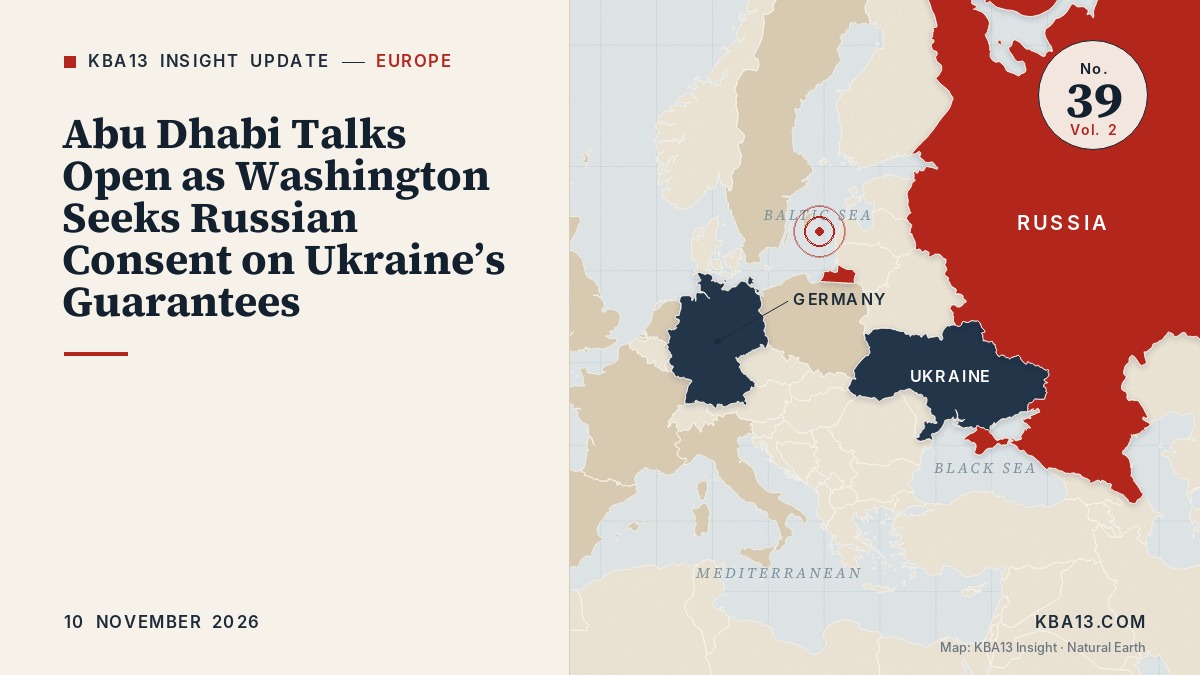
Europe enters the second week of November with its security agenda being negotiated largely by others. Trilateral talks between the United States, Ukraine and Russia opened in Abu Dhabi on 10 November, the first such round since February, with American envoys Steve Witkoff and Jared Kushner mediating, Russian and Ukrainian delegations led respectively by Vladimir Medinsky and Rustem Umerov, and European and NATO officials present in the building but not at the trilateral table (Meduza). Washington’s opening message was strikingly accommodating to Moscow: Secretary of State Marco Rubio said any post-war guarantee for Ukraine “has to be something that Russia agrees to as well in order for it to work” (The Kyiv Independent), while US officials spoke of “some flexibility” on territory from both belligerents (BBC News). Russia, for its part, publicly rejected any “freeze” of the conflict and claimed Kyiv would use a pause to rearm (The National). Our central judgement is that the Abu Dhabi round will yield procedural agreement on monitoring mechanisms and further meetings rather than a ceasefire, and that the principal risk for Europe is a sequencing in which Moscow obtains a voice over Ukraine’s guarantees before it accepts a verifiable halt to fighting (moderate confidence).
Three other developments shaped the 72 hours. France formally attributed the October sabotage of refrigeration systems in roughly 700 supermarkets to a cyber unit of Iran’s Islamic Revolutionary Guard Corps, summoned Iran’s ambassador, opened a judicial investigation and promised to seek European sanctions (AP via OPB; Al Jazeera); this is the clearest case yet of a state actor other than Russia conducting physically destructive cyber operations against an EU member (high confidence). Germany’s Chancellor Friedrich Merz escalated the EU’s budget fight by threatening to block the 2028–2034 multiannual framework unless all member states commit to long-term financing for Ukraine, a direct challenge to Hungary, Slovakia, Bulgaria and the Czech Republic (Meduza, citing the Financial Times). And Poland, mourning six people killed in the 7 November Kraków shooting, saw the attacker die in hospital while prosecutors continue to treat the case as a terrorist offence (The Guardian). Beneath these headlines, the energy war intensified on both sides: Russia struck Ukraine’s grid repeatedly, including the Trypillia thermal plant (Ukrainska Pravda), while Ukrainian drones set fire to the Kirishi refinery and forced Rosneft to ration fuel across several Russian regions (The Kyiv Independent).
The Russia–Ukraine War: Battlefield, Diplomacy and Escalation Risks
The structure of the Abu Dhabi meeting tells its own story. Russia sent not only Medinsky but Deputy Foreign Ministers Sergei Ryabkov and Mikhail Galuzin and the head of the General Staff’s Main Directorate, Igor Kostyukov, a composition that signals Moscow intends to discuss military arrangements and the wider European order rather than only the line of contact. Ukraine’s delegation, led by Umerov with presidential chief of staff Kyrylo Budanov, parliamentary faction leader Davyd Arakhamia and deputy military intelligence chief Vadym Skibitsky, is weighted toward security and intelligence professionals. Europe is represented by the chiefs of staff of the Commission and Council presidents and the national security advisers of Germany, France and the United Kingdom, with Geoffrey van Leeuwen representing NATO’s secretary general; according to Meduza, these officials attend alongside the talks rather than in them, and Kyiv will hold separate coordination meetings with them (Meduza). Sergei Lavrov said the first agenda item would be security for Russia, Ukraine and the region, while the Kremlin spokesman insisted the format remains “trilateral”. Reporting that Kostyukov made an unusual visit to Israel immediately beforehand (The Media Line) remains unconfirmed by official sources and should be treated cautiously.
The American position has shifted in ways that matter. Politico reported that Washington is asking Russia to accept NATO-like security backing for Ukraine, which would be a meaningful step if Moscow agreed; but Rubio’s insistence that guarantees must be acceptable to Russia, and his acknowledgement that a treaty would face difficulty in the Senate, suggest that the content of any guarantee will be negotiated downward to fit Russian tolerances (The Kyiv Independent). President Donald Trump said the United States was seeing a “strong inclination” to end the war (Reuters), and the Washington Post characterised a recent US decision as an “early win” handed to Russia before talks began (The Washington Post). Moscow is pairing its diplomacy with economic incentives: Lavrov said a US arrangement on Russian diesel was “working” and bringing prices down (Arab News). Zelensky, by contrast, told Ukrainians that Russia wants to divide the country along the Dnipro and pledged state resources to frontline regions (Kyiv Post), and EU foreign policy chief Kaja Kallas said she saw no Russian goodwill and demanded a ceasefire and concrete guarantees first (Informat.ro). German Foreign Minister Johann Wadephul rejected Russia’s call for a new European security architecture (Anadolu Agency).
We assess that the most likely outcome of this round is an agreed agenda for ceasefire monitoring, prisoner exchanges and a further meeting, with no general ceasefire (moderate confidence). We assign roughly 15 per cent to a signed ceasefire framework by the end of December, 50 per cent to continued talks producing partial measures such as localised or energy truces, and 35 per cent to a breakdown followed by renewed Russian escalation, unchanged from our previous assessment. The single most important variable is whether the United States makes guarantees conditional on Russian consent; if it does, Europe’s Coalition of the Willing becomes the only credible backstop, and its capacity is still being tested.
The battlefield and the air war both point to a Russian strategy of maximising pressure before and during talks. Ukrainian officials reported 128 Russian attacks on energy infrastructure in a single week (UA.News), and Zelensky said Russia used North Korean KN-23 ballistic missiles against the grid (SOFX Report). Centrenergo warned of “extremely serious” consequences after a strike on the Trypillia thermal plant, which supplies three regions (Ukrainska Pravda). In Odesa a strike on a food warehouse killed three people (Ukrainska Pravda). The European Union announced an emergency mechanism to support Ukraine’s energy system (The New Voice of Ukraine), and the IMF opened a loan review that could release 1.67 billion dollars (The Straits Times). On the ground, Ukraine’s General Staff claimed record daily Russian losses for the second time in a month (The Kyiv Independent), a claim that should be read as a belligerent’s figure. Leaked Rosstat data analysed by several outlets put Russian war-related deaths above 400,000 (The Guardian); these numbers remain unverified, though their convergence with independent counts makes the order of magnitude plausible (moderate confidence).
Ukraine’s deep-strike campaign is now the main lever it brings to the table. The Leningrad region’s governor confirmed that drones hit the Kirishi refinery, one of Russia’s largest, overnight on 8–9 November, and that a woman died from falling debris in Vsevolozhsk (Meduza; The Kyiv Independent). Rosneft then imposed purchase limits, typically 30 litres of petrol in cities and 50 on highways, with canister sales banned, in Krasnoyarsk, Karelia, Zabaykalsky, Buryatia and other regions (Meduza; The Kyiv Independent). Ukrainian forces also reported strikes on an Iskander fuel plant near St Petersburg, on an elite Rubicon drone unit in occupied territory and near an aircraft repair plant in Novgorod region (The Kyiv Independent). We judge with high confidence that the October “energy ceasefire” has collapsed in practice, and with moderate confidence that Kyiv’s refinery campaign has become sufficiently damaging to Russia’s domestic fuel market that Moscow will seek to trade a reciprocal energy truce for concessions elsewhere.
NATO, European Defence and Hybrid Threats
The French attribution of the supermarket sabotage is the most consequential hybrid-threat development of the window. According to the Associated Press, the attack in the early hours of 12 October drove refrigeration units in about 700 of France’s roughly 10,000 supermarkets to around 50°C for about six hours, forcing stores to discard fresh and frozen goods and, in some cases, causing fires; Intermarché reported losses of “tens of millions of euros” in a single day (AP via OPB). France’s cyber agency ANSSI attributed the operation to the Shahid Kaveh group, a cyber unit affiliated with the IRGC, citing the use of Farsi and Iran-linked infrastructure, and the Paris prosecutor is seeking international arrest warrants for the group’s leader and two deputies (France 24). Foreign Minister Jean-Noël Barrot called it “an attack of unprecedented scale and aggressiveness” and said it “will not go unanswered”. Similar refrigeration problems were reported the same week in Sweden, Belgium, Luxembourg, Ireland and Estonia, and an attempt against French blood banks was thwarted (AP via OPB). The Guardian placed the attack in the context of the wider confrontation with Iran (The Guardian).
The attribution matters for three reasons. It confirms that Iran, under pressure from the war in the Gulf, is willing to impose physical costs on European civilian infrastructure (high confidence). It expands the threat model that European governments have built around Russian sabotage to include a second state actor with different motives and target sets, which complicates attribution in every future incident (moderate confidence). And it tests whether the EU can agree sanctions on Iranian cyber actors quickly; we expect a listing proposal within weeks but not necessarily before the end of November (moderate confidence). Italy’s experience in the same period, with Prime Minister Giorgia Meloni blaming pro-Russian hackers for leaking the foreign minister’s personal data (SecurityWeek), an investigation into a possible breach at the anti-mafia directorate (Report.az), and a cyber incident reported against the Brenner Base Tunnel project (Odessa Journal), shows that the cyber front is now multi-actor and continuous.
In the conventional domain, the Coalition of the Willing’s first field exercise, Koalicja 2026, is under way in Poland until 22 November with about 2,800 troops from eleven countries, led by the United Kingdom and France, practising deployment, logistics, air policing for reopened Ukrainian airspace and sea-mine clearance (blue News/dpa; France 24). It is the first practical rehearsal of a post-war reassurance force, and Russian commentators have already framed it as preparation for deployment into Ukraine (Voennoe Delo). In the north, NATO’s anti-submarine exercise Dynamic Merlin 26 began in the Baltic (NATO Maritime Command), Ukrainian military media reported that the Russian corvette Stoykiy has begun escorting shadow-fleet convoys out of the Baltic through the Danish straits (Militarnyi), and Finland’s navy suggested Russia’s Baltic presence may have peaked (Anadolu Agency). Shipping analysis showed sanctioned tankers carried more than a quarter of Russia’s LNG exports (Shipping Telegraph). We judge that naval escort of the shadow fleet raises the risk of a direct confrontation during a boarding or inspection in the Baltic over the coming months (moderate confidence).
Industrial rearmament continued at pace. France, Cyprus and Sweden signed a framework to procure Akeron MP missiles using the EU’s SAFE instrument (Defence Industry Europe), Saab won a SEK 2 billion contract for Sweden’s new FDI frigates (Nordic Defence Sector), Hanwha broke ground on a missile plant in Poland (Janes), and France and Germany said they would deepen cooperation on early warning and long-range weapons (Anadolu Agency). Boris Pistorius, Germany’s defence minister, was cautious about joining the Japan–UK–Italy GCAP fighter programme (The Japan Times), a sign that Germany’s future-fighter choices remain unsettled. In the United Kingdom, protection of US forces at two air bases was reportedly strengthened (The War Zone).
The European Union: Politics, Policy and Cohesion
Merz’s letter to European Council President António Costa converts a Ukraine-financing problem into a constitutional one for the Union. According to the Financial Times, as reported by Meduza, the chancellor will not approve the 2028–2034 budget unless all member states commit to a “sound and multiannual financing perspective” for Ukraine; Kyiv needs about 70 billion euros of external financing in 2027, of which the EU has pledged roughly two-thirds, about 45 billion, while Hungary, Slovakia, Bulgaria and the Czech Republic say they will provide no further financial aid (Meduza). Germany, the largest net contributor, is effectively using its weight in the cohesion debate to discipline net beneficiaries (Kompas; Bloomberg). We assess that this tactic will produce a negotiated compromise, probably an off-budget or enhanced-cooperation vehicle for Ukraine, rather than a frozen MFF (moderate confidence), but it will deepen the east–west fault line inside the Union precisely as Europe seeks to speak with one voice in Abu Dhabi.
That voice remains fragmented. The Commission’s enlargement roadmap placed Moldova ahead of Ukraine and set no accession date for Kyiv (Euromaidan Press), and Commission President Ursula von der Leyen tied any discussion of a wider European security architecture to a prior ceasefire (MarketScreener). The EU’s own assessment of the French riots found that the Russian network known as Matryoshka or Operation Overload impersonated Western media to spread fabricated claims, while posts by MAGA-linked figures and Israeli officials drew far larger audiences, with no evidence that any foreign actor instigated the protests (Meduza, citing Reuters). That finding is important: Europe’s information vulnerability is no longer a single-adversary problem, and allied and partner actors are now amplifying narratives about migration and Islam that destabilise European governments (high confidence). The Commission also identified Greece, Cyprus, Italy and Spain as states facing migration pressure in 2027 (GreekReporter), and Brussels is preparing rules on influencer marketing (France 24).
Country Watch
Poland carries the heaviest burden of the window. The attacker in Kraków died in hospital, prosecutors said it was “too early” to determine whether political ideology drove the killings (The Guardian), though police had earlier described him as holding very radical far-right views (CTV News/AP). President Karol Nawrocki and Prime Minister Donald Tusk walked together in a silent march of thousands through Kraków (The Guardian; Euronews), a rare joint appearance by political rivals, and ministers floated tighter gun controls (Notes from Poland). The coincidence with Independence Day on 11 November, when nationalist marches traditionally draw large crowds in Warsaw, makes the next 48 hours sensitive. Poland’s fiscal position is also deteriorating: S&P moved its outlook to negative on rising debt and deficits (IntelliNews), even as the central bank reached its gold reserve target (FXStreet) and the Sejm passed a sanctions bill allowing asset freezes, including of crypto holdings, without prior court approval (The Defiant). We judge that the Kraków attack will accelerate firearms-licensing reform but will not end Polish polarisation (moderate confidence).
France remains the most politically fragile large state. Prime Minister Sébastien Lecornu brought forward a 1.6 per cent rise in the minimum wage after weeks of cost-of-living protests (France 24), and the Banque de France said the economy should avoid a year-end recession (Reuters). The 2027 race widened when judo champion Teddy Riner announced a presidential bid (The Guardian), while polls continue to show Marine Le Pen leading and Jean-Luc Mélenchon pledging NATO exit (The Irish Times). Paris also launched a network of ports to counter narcotics trafficking (Cyprus Mail). Germany offered stability by contrast: Merz backed Ilse Aigner, president of the Bavarian state parliament, to become the first woman federal president, and with CDU/CSU and SPD support she is expected to win the Federal Convention vote on 30 January (blue News/dpa). German exports rose more than expected in September (Reuters), and on the Kristallnacht anniversary Merz decried “horrifying” antisemitism (The Times of Israel).
In the United Kingdom, Prime Minister Andy Burnham’s government is advancing its European reset, with a draft UK–EU food and veterinary agreement reported (EU Today) and Downing Street recording a call with President Macron on 9 November (GOV.UK). Pro-Palestinian groups plan protests around Armistice Day (The Jerusalem Post), a recurring flashpoint. Italy’s government adopted measures to cut power bills from January, to the irritation of energy producers (Reuters), as Meloni backed a gas price cap ahead of the 2027 election (Bloomberg) and protesters burned utility bills in Turin (NDTV); Crédit Agricole’s proposal to merge with Banco BPM drew opposition accusations of government missteps (Reuters). Spain heads to a snap election on 29 November with most private polls giving the Partido Popular and Vox a combined majority of the 176 seats needed, though the latest 40dB survey shows the Socialists only two points behind the PP (Ara; France 24/AP); a general strike was set to disrupt flights on Wednesday (Travel Market Report).
The Netherlands saw one of its largest demonstrations in years, with media reporting some 200,000 people in Amsterdam protesting Dutch policy toward Israel and Gaza (The Jerusalem Post), while Prime Minister Rob Jetten defended staying away (DutchNews) and his government planned 25,000 public-sector job cuts and stricter rules for non-EU workers (HR Executive; IamExpat). Israel Weapon Industries announced a Dutch small-arms plant despite the tensions (Israel Defense). Sweden entered what Bloomberg called the decisive phase of government formation. Ukraine’s parliament backed the creation of Space Forces in a first reading, a response to Russia’s Rassvet satellite network (Euromaidan Press; Technology Org). In Russia, Novaya Gazeta closed its Moscow office after 33 years under pressure from the authorities, with editor Sergei Sokolov saying the paper “still exists as an idea” (Meduza), and a Moscow court jailed a young man after the mass roundup of youths in Kitay-Gorod that detainees linked to military recruitment (Meduza). We judge that the Kremlin is tightening domestic control in anticipation of a prolonged war regardless of the talks (moderate confidence).
Economy, Energy, Trade and Markets
Markets read the diplomatic calendar as mildly positive. European equities closed higher on 9 November, with Frankfurt up about 1.7 per cent and defence stocks and Infineon leading (BBN Times), and wheat traded near multi-month lows as traders awaited the Abu Dhabi talks (TradingView). Exchange-rate data from ExchangeRate-API, expressed per US dollar, showed the euro at 0.892 (down 0.50 per cent on the previous day, meaning a stronger euro), sterling at 0.745 (−0.49 per cent), the zloty at 3.914 (−0.75 per cent) and the krona at 9.812 (−0.81 per cent), while the hryvnia weakened slightly to 45.44 (+0.15 per cent) and the rouble to 82.24 (+0.38 per cent). The rupiah stood at 18,084 per dollar (−0.10 per cent). The pattern is consistent with a softer dollar and a modest risk-on mood in Europe, not with any systemic repricing of the war (moderate confidence).
Energy remains the transmission belt between war and economy. Russia’s domestic fuel rationing is the most visible cost of Ukraine’s campaign (Meduza), and Russia is reportedly using surging oil revenues to buy Chinese yuan (The New Voice of Ukraine), a sign of deepening financial dependence on Beijing. The Bank of Russia approved retail trading in major crypto assets from 17 November (Yahoo Finance), which we judge is partly designed to ease sanctions-constrained payments (low to moderate confidence); the decision of the Maldives’ largest bank to stop processing payments for Russian tourists shows how far secondary-sanctions caution now reaches into the Indian Ocean (Meduza). In the EU, Germany committed 1.3 billion euros to imported hydrogen (Cyprus Shipping News), Moldova said it buys no Russian gas and opened a new power link to the EU (The Kyiv Independent), and Italian and Indian bidders competed for the former Ilva steelworks (Reuters). Spain’s government ordered producers to hold back 12 per cent of olive oil output after a bumper harvest (ESM Magazine), a reminder that European agricultural market management has knock-on effects for edible-oil competitors.
Migration, Society and Extremism
The window confirmed that violent extremism in Europe is increasingly domestic and ideologically eclectic. Beyond Kraków, which analysts placed in a streak of far-right violence (Global Project Against Hate and Extremism), Spanish police arrested leaders of a neo-Nazi group for hate crimes and weapons possession (Olive Press), and German leaders used the Kristallnacht anniversary to warn of rising antisemitism (Algemeiner). In France, three police officers went on trial over the 2020 beating of a Black music producer (France 24), a case that touches the same nerves of policing and minority trust that the autumn protests exposed. The EU’s finding that foreign accounts sought to tie French unrest to Islamism and migration (Meduza) indicates that Muslim communities in Europe are a deliberate target of information operations from several directions (high confidence).
Migration flows themselves are easing in some corridors and politicised in others. Syrian arrivals in Germany reportedly fell 41 per cent in 2026 (Enab Baladi), UK net migration is projected to fall to a three-decade low (Vocal), and a German court upheld the revocation of a Somali influencer’s refugee status (InfoMigrants). Spain and Morocco traded positions over incitement of irregular crossings to Ceuta (Morocco World News). We assess that the forthcoming EU migration-pressure designations for 2027 will sharpen debates in Italy and Spain during election seasons, and that Spain’s 29 November vote will be the first test of whether a PP–Vox government shifts Madrid toward a harder line (moderate confidence).
Disasters, Climate and Environmental Risk
Hazard activity was limited but not trivial. Storm Charles was forecast to bring torrential rain and winds of up to 120 km/h to Portugal and Spain (AOL/PA), following earlier warnings for Storm Bruna, with footage of flash flooding in Spanish mountain areas (The Weekly Times). The USGS recorded a magnitude 4.7 earthquake at 10 km depth near İmamoğlu in southern Turkey at 19:28 WIB on 9 November (USGS), with no reported damage. COP31 continued in Türkiye; Australia’s climate minister argued the 1.5°C goal is still achievable (The Guardian), while Politico Europe questioned whether Macron has lost his appetite for climate leadership. In Germany, Pakistani farmers sued RWE and Heidelberg Materials over flood losses (UA.News), a climate-liability case that could matter to Asian plaintiffs. In Ukraine, the Zaporizhzhia nuclear plant again had to switch to diesel generators after losing its final power line (The Hill), and we judge the risk of a nuclear-safety incident from grid strikes to be low but persistent (moderate confidence).
Implications for Southeast Asia and Indonesia
Abu Dhabi matters to Southeast Asia less for its battlefield effects than for its precedent. A settlement in which a great power’s consent shapes a smaller state’s security guarantees would weaken the principle that sovereignty and alliance choices are not subject to a neighbour’s veto, a principle that ASEAN states invoke in the South China Sea. Jakarta’s free-and-active foreign policy should therefore welcome an end to the war while articulating publicly that guarantees must be determined by the guaranteed state (moderate confidence). The wheat market is a more immediate channel: prices near multi-month lows benefit Indonesia, one of the world’s largest wheat importers, and any agreement that reopens Black Sea shipping more fully, a theme India has now raised in its mediation offer (UNITED24 Media), would ease food-import costs further.
The European regulatory and political agenda also bears directly on Indonesian interests. A Union preoccupied with Ukraine financing and budget brinkmanship has less political bandwidth for revisiting the deforestation regulation or the carbon border adjustment mechanism, which raises the importance of the bilateral channel created by the Indonesia–EU CEPA for technical arrangements on palm oil, nickel and steel (low to moderate confidence). Spain’s olive-oil withdrawal and Italy’s fight over steel capacity are reminders that European market management can shift quickly. On defence, Europe’s industrial surge, from Saab and MBDA to Hanwha’s investment in Poland, will compete with Asian buyers for production slots, but it also creates co-production opportunities for countries that, like Indonesia, already operate French and Korean platforms. Finally, the French case against Iran’s cyber unit and the Maldives bank’s payment restrictions on Russian tourists show how quickly geopolitical risk now reaches commercial infrastructure in neutral states; Indonesian retailers, banks and tourism operators should treat cyber-physical sabotage and secondary-sanctions exposure as live risks (moderate confidence). The EU finding that foreign accounts exploited unrest by linking it to Islam and migration is relevant to Indonesian diplomacy on Islamophobia and to the welfare of Indonesian and Malaysian diaspora communities in Europe.
Indicators and Warnings for the Next 72 Hours
The first signpost is the Abu Dhabi readout on 11 November. A joint statement naming a monitoring mechanism, a date for a further round and a prisoner exchange would confirm our baseline; any language on European security architecture before a ceasefire would signal the sequencing risk identified above, while a Russian walkout or a major strike on Kyiv during the talks would point toward the breakdown scenario. The second is Ukraine’s grid: more than three large Russian strikes on generation in 72 hours, or nationwide emergency outage schedules, would indicate Moscow intends to negotiate under maximum pressure. The third is Russia’s fuel market, where expansion of Rosneft rationing to the Moscow or St Petersburg retail markets would mark a new level of domestic cost.
In Europe, watch Poland’s Independence Day marches on 11 November for violence or copycat threats after Kraków, and any government bill on firearms licensing. Watch for a formal EU sanctions proposal against Shahid Kaveh and for any Iranian retaliation or further refrigeration and industrial-control incidents in other member states. Watch responses from Budapest, Bratislava, Sofia and Prague to Merz’s budget threat ahead of the December European Council. In the Baltic, any boarding or inspection of a shadow-fleet tanker escorted by a Russian warship would be a significant escalation marker. In Spain, watch the general strike and the final weeks of polling, and in France, union responses to the minimum-wage concession and the weekend protest count.
Method and Sources
This update covers the 72 hours from 11:45 WIB on 7 November to 11:45 WIB on 10 November 2026. It draws on the KBA13 Europe Intelligence Monitor, whose digest returned 3,000 items from 1,092 sources (2,663 unique headlines across country and theme queries, most densely concentrated after 9 November), supplemented by original reporting from the publishers linked or named above and by our 9 November Europe update, global update and Central Asia update. Belligerents’ battlefield and casualty claims are attributed to their sources; items that could not be independently confirmed are labelled as reported.
About The Author

- Series · Seri
- KBA13 Insight Update, Europe Edition
- Volume · Number
- Vol. 2, No. 39 (November 2026)
- Cumulative issue · Edisi ke-
- 51
- Reference · Nomor rujukan
KBA13-IU-2026-02-039- Author · Penulis
- KBA13 Insight Research Team
- Published · Terbit
- 10 November 2026
- Section · Rubrik
- KBA13 Insight Update, KBA13 Insight Update International
- Keywords · Kata kunci
- cyber, Europe, Hybrid Warfare, Indonesia, Iran, KBA13 Insight Update, NATO, Russia, Strategic Intelligence, Ukraine
- Language · Bahasa
- English
- Length · Panjang
- 4,216 words · ±19 min read
- Publisher · Penerbit
- KBA13 Insight, Banda Aceh, Indonesia
- Permalink
- www.kba13.com/kba13-insight-update-2026-11-10-europe/
- How to cite · Cara mengutip
- KBA13 Insight Research Team. (2026, November 10). KBA13 Insight Update, 10 November 2026, Europe: Abu Dhabi Talks Open as Washington Seeks Russian Consent on Ukraine’s Guarantees. KBA13 Insight Update, 2(39). https://www.kba13.com/kba13-insight-update-2026-11-10-europe/
- Rights · Hak cipta
- © 2026 KBA13 Insight. Quotation permitted with full attribution and link.
Artikel Terkait
 Global Intelligence Briefing (7–12 July 2026): Iran War, US–China Rivalry, Ukraine, South China Sea, and Global Security Risks
 KBA13 Insight Update, 9 November 2026, Europe: Kraków Terror, Kyiv’s Dark Winter and the Price of a Deal
 Southeast Asia Strategic Outlook 2026: ASEAN, Indonesia, Myanmar, and South China Sea Tensions
 Global Intelligence Briefing : US–Iran Re-escalation, Ukraine’s Refinery War, Africa’s Security Collapse, and the Top Global Threats
 KBA13 Insight Update Internaional: Iran War, Trump-Xi Summit, Ukraine Ceasefire, Taiwan Risk, and the Collapse of Strategic Order

Leave a Reply