KBA13 Insight · KBA13 Insight Update National · Regional Security
Indonesia Strategic Intelligence Report:Institutional Crisis, the Rupiah at Rp18,129, and National Security Dynamics (13–18 July 2026)
A weekly KBA13 Insight report offering a strategic intelligence assessment of Indonesia’s political, economic, national-security, civil-liberties, Papua, defense, and geopolitical developments during 13–18 July 2026.
Summary
A weekly KBA13 Insight report offering a strategic intelligence assessment of Indonesia’s political, economic, national-security, civil-liberties, Papua, defense, and geopolitical developments during 13–18 July 2026.
Keywords
- analisis strategis
- ASEAN
- ekonomi Indonesia
- Febrie Adriansyah
- geopolitik
- Indonesia
- intelijen strategis
- KBA13 Insight
- keamanan nasional
- Kebebasan Sipil
EXECUTIVE SUMMARY
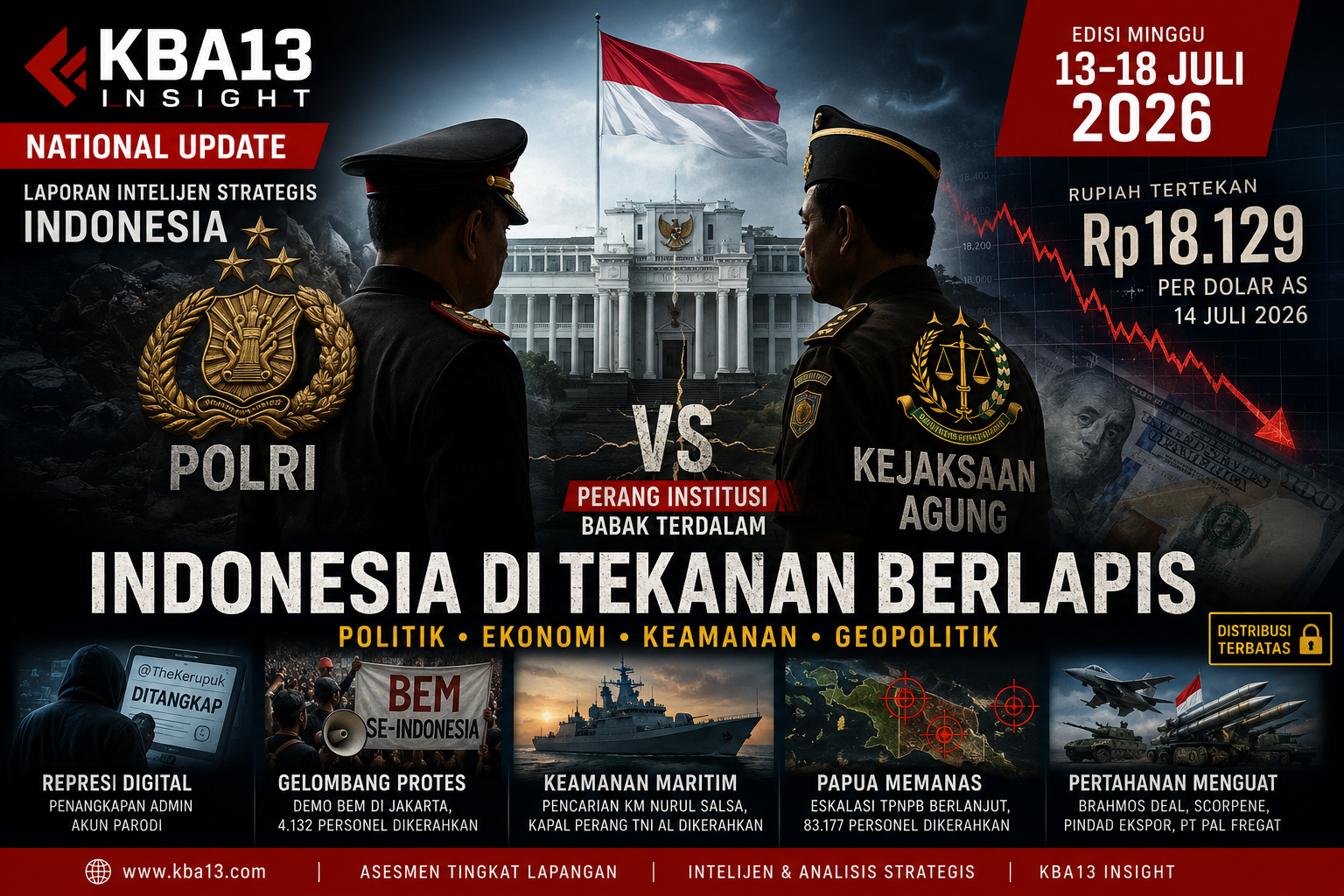
The third-week July 2026 edition of the KBA13 National Update records a dramatic convergence of institutional crisis, acute economic pressure, and repression of the digital civic space — a density unseen since the earliest days of the Reformasi era. Five principal events dominated the national strategic landscape this week: (1) the formal transfer of the case of former Deputy Attorney General for Special Crimes Febrie Adriansyah from the National Police (Polri) to the Attorney General’s Office (Kejaksaan Agung) on 17 July 2026 — a jurisdictional handover marking a new chapter in the most serious open institutional war in the history of post-Reformasi Indonesian law enforcement; (2) the arrest of the administrator of the parody account @TheKerupuk by ten police officers without an arrest warrant on 14 July, promptly condemned by Amnesty International as the criminalization of digital freedom of expression; (3) the rupiah breaking through Rp18,129 to the US dollar on 14 July 2026 — far beyond the 2026 state-budget macro assumption of Rp16,200–Rp16,800 — with CORE Economics calling the Rp17,500–Rp18,000 range the new “equilibrium”; (4) a joint nationwide student-executive-body (BEM) demonstration in Jakarta secured by 4,132 personnel; and (5) the search for victims of the vessel KM Nurul Salsa, which mobilized Indonesian Navy warships. This week confirms that pressure on the state comes not only from outside but is systematically generated from within the state apparatus itself. The most decisive narrative of the week remains the Polri-versus-Attorney General’s Office saga in the Febrie Adriansyah case. With the formal handover of suspect Don Ritto — along with 74 kilograms of gold and Rp6 billion in cash — to the AGO on 17 July, the Police’s operational chapter in this case formally ended, yet the institutional battlefield did not automatically close. While Febrie remained undetained and his whereabouts “mysterious” according to Tribunnews coverage, the AGO faces an existential dilemma: to prosecute the case against its own former official credibly and independently, or to submit to the logic of institutional protection that would only legitimize the public narrative that law enforcement in Indonesia is nothing more than an instrument of inter-agency warfare. KBA13 assesses that the resolution of the Febrie case will be the single greatest wager on the AGO’s credibility in the past two decades.
— ● —
NATIONAL RISK SCORECARD | Week of 13–18 July 2026
| DOMAIN | RISK (1-10) | TREND | ASSESSMENT NOTES |
| Political Stability | 7/10 | ↑ Rising | Institutional war Polri–AGO–TNI; Prabowo summons the National Police Chief & Attorney General |
| Legal & Corruption Crisis | 9/10 | ↑ Critical | Febrie case moves to the AGO; agency conflicts of interest intensify |
| Economic Pressure | 8/10 | ↑ Rising | Rupiah Rp18,129; state-budget deficit Rp196.5T; first trade deficit in 6 years |
| Civil & Digital Liberties | 7/10 | ↑ Rising | Arrest of @TheKerupuk admin; ITE Law used to repress memes/parody |
| Papua Security | 8/10 | → Persistent | TPNPB escalation continues; two new Kodam planned; 83,177 organic personnel |
| Maritime Security | 5/10 | → Stable | Persistent Natuna grey-zone; KM Nurul Salsa sank; fleet dispatched |
| Social Resilience | 6/10 | ↑ Rising | BEM demonstrations; tech layoffs; widening middle-class gap |
| National Defense | 4/10 | ↓ Improving | BrahMos deal; Scorpene on track; Pindad exports; PT PAL builds Philippine frigate |
— ● —
-
[LAW & INSTITUTIONS] POLICE HAND THE FEBRIE CASE TO THE AGO: THE END OF ACT I, THE BEGINNING OF THE DEEPEST CRISIS
Handover of Files and Suspect: A New Chapter in the Institutional War. On Friday, 17 July 2026, the National Police’s Corruption Crimes Eradication Corps (Kortastipidkor) formally handed over suspect Don Ritto together with all evidence — 74 kilograms of gold bullion and Rp6 billion in cash — to the Attorney General’s Office at the Gedung Bundar in South Jakarta. This handover continued the administrative transfer of the investigation on 11, 14, and 15 July 2026, during which a joint Kortastipidkor and Jakarta Metro Police investigation team carried suitcases of documents, two large framed photographs covered in cloth, and container boxes to the AGO. Deputy Head of Kortastipidkor Brig. Gen. Boro Windu Danandito stated: “With this handover complete, the subsequent investigation now falls entirely within the authority of the Attorney General’s Office.” This transfer created a legal situation unprecedented in Indonesian history: one law-enforcement institution (the AGO) is now investigating one of its own senior officials who had previously been named a suspect by another law-enforcement institution (the Police). The AGO claims it will form a “special team” to minimize conflicts of interest, but Commission III of the House of Representatives (DPR) firmly demanded the formation of an independent investigation team with no ties to Febrie. AGO Legal Information Center chief Anang Supriatna stated that three new investigation orders (Sprindik) had been issued since 13 July 2026 for the three cases in play: the PLN coal corruption case, the Asabri case, and Krakatau Steel. What most shocked the public was that, as of 17 July 2026, former Deputy AG Febrie Adriansyah had not been detained even though his status as a suspect was official. Unlike Don Ritto, who had been held at the Jakarta Metro Police detention center since 10 July, Febrie remained free and his exact location was “not known in detail” even by the AGO itself — an answer implying an extraordinary management of a suspect’s whereabouts. Immigration authorities had barred Febrie and Don Ritto from traveling abroad. Yet the absence of any detention of Febrie — despite the seizure of assets worth hundreds of billions of rupiah — raised profound questions about the double standard of Indonesian law enforcement.
“The President naturally has an interest in ensuring that all state institutions continue to operate within constitutional bounds and does not allow the dynamics of law enforcement to develop into an inter-agency conflict.” — State Intelligence Expert, quoted by RMOL, 14 July 2026
On the institutional side, President Prabowo summoned Attorney General ST Burhanuddin and National Police Chief Gen. Listyo Sigit Prabowo to a closed-door meeting at the Palace on the night of Saturday, 11 July 2026. State Secretary Prasetyo Hadi confirmed the summons and said Prabowo “was concerned that the Polri-versus-AGO commotion could worsen Indonesia’s economy.” This concern was not empty rhetoric — in political-economy terms, institutional uncertainty at the apex of the law-enforcement system directly lowers market confidence, weakens the rupiah, and complicates investment conditions. At the same time, Prabowo delivered a public message to the military (TNI), the Police, and the AGO: “Reflect on yourselves!” The Febrie case does not stand alone. It is the tip of the iceberg of a decades-long system of jurisdictional contest between the Police and the Attorney General’s Office. In the same week, the KPK revealed that its coordination with the Jakarta Metro Police was still at an “early stage,” while the case of Ma’ruf Cahyono (former Secretary-General of the MPR, arrested by the KPK) also formed part of the same landscape: a layered war among law-enforcement agencies with overlapping jurisdictions, mutual suspicion, and long-term institutional agendas that are not always aligned with the public interest in justice. From a governance perspective, the stakes of the Febrie case for the AGO cannot be overstated. If the AGO succeeds in resolving this case with adequate transparency, independence, and speed — placing Febrie in detention and proving the charges in court — it will be proof that the institution is capable of trying an offender from within its own body. But if this process drags on, is disrupted by internal protection, or ends with a verdict far from proportionate to the evidence, the AGO’s image will collapse permanently, and the narrative that Indonesian law enforcement is an elite game will gain its strongest empirical legitimacy in the history of Reformasi.
KBA13 Field Assessment: The transfer of the Febrie case to the AGO is not a “synergy” as Police officials claim — it is the product of political pressure from a President worried that an open Polri–AGO war would destroy market confidence and dwarf his economic-reform agenda. Yet even presidential pressure is not enough to resolve the structural problem: Indonesia has no truly independent mechanism to investigate senior prosecutorial officials. This pattern precisely repeats earlier institutional crises — and without fundamental structural reform, this cycle will recur in a different guise. Worth noting: the Police called Febrie’s naming as a suspect “valid” based on investigators’ conviction and two sufficient pieces of evidence, even without prior examination — a procedure that technically satisfies the Criminal Procedure Code (KUHAP) but substantively demonstrates the political urgency behind the designation. This is not the first time the Police have used the speed of naming suspects as an instrument of pressure in an institutional feud. This is precisely the pattern examined in depth in the historical flashback below. Today, Friday 17 July 2026, is also a symbolic date: precisely on International Justice Day (17 July), Indonesia witnessed the handover of suitcases of corruption evidence from one law-enforcement agency to another — both embroiled in the deepest institutional tension in two decades. That irony did not escape netizens and social media, who seized on it as cynicism toward the “synergy” narrative promoted by officials.
-
[HISTORICAL FLASHBACK] POLICE VS. AGO & KPK: AN ANATOMY OF THE INSTITUTIONAL WAR FROM “GECKO VS. CROCODILE” TO THE FEBRIE CASE
Part I: Gecko vs. Crocodile — 2009, the SBY Era. Conflict among Indonesia’s law-enforcement institutions is not a new phenomenon of the Prabowo era. It is a chronic structural disease that has gnawed at Indonesia’s legal system since the early days of Reformasi. The most iconic conflict erupted in July 2009 and quickly earned the nickname “Gecko vs. Crocodile” (Cicak vs. Buaya) — a phrase first coined by the head of the Criminal Investigation Agency, Comr. Gen. Susno Duadji himself. Susno cast the KPK as a gecko (small, weak) recklessly taking on the Police as a crocodile (large, ferocious). The root of the conflict: the KPK had wiretapped Susno’s phone in its investigation of the Bank Century case, which involved a Rp10 billion flow of funds into an account linked to Boedi Sampoerna. The Police response to that wiretapping did not take long. Two KPK deputy chairs, Bibit Samad Riyanto and Chandra Martha Hamzah, were arrested by the National Police’s Criminal Investigation Agency on charges of accepting bribes and abusing authority in the Anggoro Widjojo case. The arrests sparked a massive wave of public demonstrations. Civil coalitions formed a “human fence” around the KPK building. President SBY was forced to intervene two weeks after the detention, declaring that the Police, the AGO, and the KPK all had problems. The Team of 8 under Adnan Buyung Nasution was formed. Susno finally stepped down as head of the Criminal Investigation Agency in November 2009. Wiretap recordings later played at the Constitutional Court proved coordination between Anggodo Widjojo (Anggoro’s younger brother) and senior Police and AGO figures in an effort to ensnare the KPK leadership. This was the first confirmation, in the form of audio recordings, that the war among Indonesia’s law-enforcement agencies was not merely about law — but about protecting corruption networks.
Part II: Driving Simulator — 2012. The second episode unfolded in 2012 when the KPK investigated the corruption case in the procurement of driving-license simulators, which implicated former Traffic Corps chief Insp. Gen. Djoko Susilo. The Police again reacted defensively: issuing a search warrant against the KPK’s offices, attacking the legitimacy of the KPK’s leadership, and creating a dualism of investigation between the two institutions over the same suspect. President SBY was again asked to mediate the inter-agency conflict. The turmoil produced Government Regulation No. 63 of 2012, which tightened coordination mechanisms but did not resolve the root problem: overlapping jurisdiction and the absence of an independent institutional arbitration mechanism.
Part III: Budi Gunawan vs. Abraham Samad — 2015, the Jokowi Era. The most dramatic episode came in January 2015. Three days after President Jokowi nominated Comr. Gen. Budi Gunawan (BG) as his candidate for National Police Chief, the KPK named BG a corruption suspect in the “fat bank account” case. The Police swiftly launched a structured counterattack: eleven days later, KPK deputy chair Bambang Widjojanto (BW) was arrested by the Police in the morning while dropping his child at school — an intimidation gesture designed for maximum symbolic chilling effect. KPK chair Abraham Samad was ensnared in an ID-document forgery case. President Jokowi was held hostage between institutional solidarity with the Police and immense public pressure to defend the KPK. The KPK ultimately did not proceed with BG’s prosecution; BW and Samad were eventually released. BG was later cleared through a pretrial motion and now serves as head of the State Intelligence Agency (BIN).
“Every gecko-versus-crocodile problem, every friction, always begins with a corruption problem. The handling of corruption cases involving individuals from the Police.” — Novel Baswedan, Senior KPK Investigator
Part IV: Firli Bahuri and Endar Priantoro — 2023. In 2023 the dynamic shifted. The conflict was no longer between the KPK and the Police, but among factions within the KPK itself, penetrated by Police interests. KPK chair Firli Bahuri — a former senior Police officer — clashed with National Police Chief Listyo Sigit over the extension of Brig. Gen. Endar Priantoro’s assignment at the KPK. Firli rejected the Police Chief’s letter and instead dismissed Endar. Later, Firli himself was named a suspect by the Jakarta Metro Police for the alleged extortion of former Agriculture Minister Syahrul Yasin Limpo. KPK versus Police had become “crocodile versus crocodile,” as Kempalan.com analyzed: both were staffed by police officers, yet they destroyed one another through internal factionalism that transcended corps solidarity.
Part V: 2024 — The Cafe de’Clan Surveillance and the Origins of the Febrie Case. The seed of the Polri–AGO conflict that exploded in July 2026 was in fact planted back in 2024. In an episode that later became well known, personnel from the Police’s Densus 88 reportedly conducted surveillance on Febrie Adriansyah at the Cafe de’Clan Signature in Cipete, South Jakarta. That episode was settled internally between the AGO and the Police — but the investigation file was never truly closed. When Kortastipidkor conducted its raids on 8–9 July 2026, the same cafe once again became one of the search locations. In other words: the Police had been building an investigative file on Febrie for at least two years before launching a public operation. This was not a spontaneous response to coal corruption — it was a patiently prepared operation launched at a strategically chosen moment.
KBA13 Analysis: The Structural Pattern of Indonesia’s Inter-Agency Conflict. Why does conflict among the Police, the AGO, and the KPK keep recurring? KBA13 identifies four structural factors that Indonesian institutional reform has never resolved: First, overlapping investigative jurisdiction — Law No. 16 of 2004 on the Attorney General’s Office and the Police Law grant investigative authority to both institutions over the same offenses, creating inherent potential for jurisdictional conflict. Second, the absence of a genuinely neutral and authoritative arbitration body to settle disputes among law-enforcement institutions — the Supreme Court and Constitutional Court are accessible through pretrial motions, but this process has itself become an instrument of inter-agency legal warfare. Third, internal factionalism within each institution, mixed with political and business interests, so that inter-agency conflict often mirrors conflict among factions within each institution that then form cross-institutional alliances. Fourth, the absence of effective personal accountability for institutional leaders who abuse inter-agency conflict as an instrument of power. The pattern of “sudden counterattacks” in every episode of conflict — the KPK arrests a Police officer, then suddenly the KPK leadership is ensnared in another case; the AGO investigates the Police, then suddenly its senior prosecutor is raided — is no coincidence. It is a strategy of mutual deterrence used by institutional elites to ensure that no single institution can destroy another without risking an equivalent counterstrike. The result is an institutional stalemate comfortable for elites but devastating for the national anti-corruption agenda and for public trust in Indonesia’s legal system. The 2026 Febrie case introduces two novelties that distinguish it from earlier episodes: First, the involvement of the TNI as an active third actor — military guarding of a young deputy attorney general’s home against the threat of a police raid is a precedent unprecedented in the history of Indonesia’s inter-agency law-enforcement conflict. Second, the scale of evidence seized — Rp476 billion plus 74 kg of gold — is the largest in the history of arrests of Indonesian legal officials, exceeding even major KPK cases. This gives the Police far stronger material leverage than in earlier episodes, and explains why the AGO had to accept this transfer despite being deeply uncomfortable institutionally.
-
[CIVIL & DIGITAL LIBERTIES] THE @THEKERUPUK CASE: WHEN A MEME BECOMES A THREAT TO THE STATE
Chronology of the Arrest: No Warrant, No Proper Precedent. On Monday, 14 July 2026, at around 10:00 p.m. local time, eight to ten police officers came to the home of a resident named Icad (full name: Risyad) in the Tangerang area. They took him to the Tangerang City Metro Police station. According to a report by LBH Jakarta on its official Instagram account, the officers did not present an arrest warrant at the time — a fundamental procedural violation regulated under the Criminal Procedure Code (KUHAP). When taken in, Icad’s status was still that of a “witness,” not a suspect. But after less than 24 hours of questioning, on Tuesday 15 July 2026, police named him a suspect under Article 32(1) and Article 35 of the ITE Law — provisions governing the alteration, addition, and deletion of electronic information. Icad is alleged to be the administrator of the X (Twitter) account @TheKerupuk, a parody account that describes itself as “sometimes fake news, sometimes real news.” The account is widely known among Indonesian netizens as a platform for political satire and memes that turn current events into humorous content lampooning government policy and political dynamics. SAFEnet (the Southeast Asia Freedom of Expression Network), which first reported the arrest, stated that the action related to meme content posted through the @TheKerupuk account. During the arrest, Icad was also reportedly having difficulty meeting his legal counsel — a violation of the right to legal assistance guaranteed by Article 54 of the KUHAP. Amnesty International Indonesia, through its Executive Director Usman Hamid, sharply condemned the arrest. “We strongly condemn the arbitrary arrest of the administrator of the X account @TheKerupuk merely for posting a meme allegedly critical of the government. This is an unlawful legal action that violates the principle of fair trial, because the arrest was carried out without presenting an arrest warrant,” Usman said on 16 July 2026. Amnesty stated that applying the ITE Law to memes and parody contradicts Article 19 of the International Covenant on Civil and Political Rights (ICCPR), which Indonesia has ratified, as well as Article 28E(3) of the 1945 Constitution.
“Peaceful expression, however offensive, whether through art — including satire, political memes, and parody — is not a criminal act. This police response is clearly a form of criminalization of freedom of expression in the digital space.” — Usman Hamid, Executive Director of Amnesty International Indonesia, 16 July 2026
A positive development came within 72 hours: after massive public pressure from netizens, lawyers, and civil-society organizations, the non-detention-on-bail request filed by the LBH Jakarta team was granted by the Tangerang City Metro Police. Icad was released from detention. But his suspect status was not lifted — meaning the legal process is still ongoing and the threat of prosecution has not entirely disappeared. Ferry, who announced the release via social media, thanked “Taud and LBH,” who “were always on standby escorting Icad for three days.” The @TheKerupuk case is not an isolated incident. It is part of a pattern of using the ITE Law as an instrument to repress critical content, documented since the law was enacted in 2008 and revised in 2016 and 2024. SAFEnet routinely publishes reports on ITE Law criminalization, and meme-parody cases fall under the “expression content” category that should have received stronger protection after Constitutional Court Ruling No. 115/PUU-XXII/2024. Amnesty said Icad’s arrest contradicts the spirit of that ruling. What makes this case a strategic marker is its context: the arrest occurred amid the largest institutional crisis (the Febrie case) publicly embarrassing the Police. In that context, the use of force against a meme-maker — with ten officers to secure one ordinary citizen — was read by the public as a broader intimidation gesture: a warning to the digital-commentary ecosystem that criticism of the state apparatus, even in the form of humor, will not be tolerated. It is a message delivered through a single case yet designed to have a chilling effect on thousands of other accounts.
Strategic implication: Indonesia is entering a phase in which three pressures on digital civil liberties converge simultaneously — the criminalization of satirical expression through the ITE Law, the elimination of digital work platforms due to tech-sector layoffs (TikTok and others), and rising state surveillance of the digital space in the name of a “national security” that now includes classifying the “spread of LGBTQ culture” as a non-military threat. Indonesia’s digital ecosystem — long one of the most active in Southeast Asia, with more than 200 million internet users — now faces a structured and systematic narrowing of expressive space. KBA13 assesses: the Police response to the @TheKerupuk account reflects two mutually reinforcing pathologies. At the institutional level, a Police force bearing image pressure from the Febrie case has an incentive to demonstrate “boldness to act” in another domain as a proof of authority. At the systemic level, an ITE Law that has not been substantially reformed continues to provide an overly broad legal instrument that can be used selectively and politically. The removal of the ITE Law’s rubber-clause provisions — recommended repeatedly by civil-society coalitions — remains a reform agenda that never materializes.
-
[ECONOMY & FISCAL] RUPIAH AT RP18,129, STATE-BUDGET DEFICIT OF RP196.5 TRILLION: AN ANATOMY OF MACROECONOMIC PRESSURE
The Rupiah in the Danger Zone: Far from the Budget Target. The rupiah recorded worrying weakness throughout this week. On Tuesday, 14 July 2026, the rupiah opened at Rp18,129 to the US dollar — the highest (weakest) level never assumed in the 2026 state-budget posture, which set the exchange-rate benchmark in the Rp16,200–Rp16,800/US$ range. That means the rupiah currently sits at a level 7.3%–11.9% weaker than the baseline assumption the government used to formulate the national budget. The fiscal implication is direct and material: every Rp1,000 of weakening beyond the budget assumption adds to the burden of dollar-denominated debt payments and inflates imports of capital goods and industrial raw materials. The Center of Reform on Economics (CORE), in its July 2026 Monthly Review, explicitly stated that the Rp17,500–Rp18,000 range has now become the “new short-to-medium-term equilibrium level” — an analytical admission that the rupiah will not soon return to the budget assumption, even after Bank Indonesia raised the BI-Rate by a total of 50 basis points to 5.75% in two steps in June 2026. BI even took a step, the first in more than a decade, of raising interest rates outside the regular Board of Governors Meeting schedule on 9 June 2026. CORE recorded foreign investors net-selling Rp23.19 trillion in the Indonesian stock market in June 2026 — the largest monthly selling pressure of the year. Pressure on the rupiah comes from three directions simultaneously. Domestically: the first-half 2026 budget deficit reached Rp196.5 trillion (0.76% of GDP), with revenue realization of Rp1,459.4 trillion against Rp1,656 trillion in spending. Globally: the Fed held rates at 3.50%–3.75% with a hawkish tone, keeping the US dollar strong worldwide. Geopolitically: Middle East tensions triggered a rise in oil prices, adding pressure to Indonesia’s trade balance, which entered a deficit for the first time in six years during this reporting period. The rupiah “settling” above Rp18,000 prompted the DPR to hold Bank Indonesia to its promises — while CORE economists call this not an anomaly but a “new equilibrium” reflecting the structural vulnerability of Indonesia’s economy amid global shocks and domestic institutional turbulence. The 2027 state-budget posture became an important focus this week as the DPR and government agreed on baseline macro assumptions. In the context of a rupiah that has already far exceeded the 2026 assumption, negotiating the 2027 exchange-rate assumption will be decisive for the fiscal realism of the Prabowo administration going forward. Commission XI DPR member Misbakhun reminded BI that the central bank needs to “explain that BI has taken adequate steps to maintain stabilization” if the rupiah cannot return to its assumption zone.
Investment realization of Rp1,010 trillion, which absorbed 1.4 million workers in the first half of 2026, is good news, but it was dominated by capital-intensive rather than labor-intensive sectors, and so did not directly ease middle-class unemployment pressure. Prabowo set a new strategic target this week: Indonesia must be able to produce gasoline from crops within the next four years, as part of the national energy-self-sufficiency agenda. This target is linked to the Biosolar B50 program launched at the KM 57 rest area on the Jakarta–Cikampek toll road on 9 July 2026. Energy self-sufficiency through biofuel is a structural response to dependence on fuel imports that worsens the trade balance and drives administered-price inflation. But from a techno-economic perspective, an industrial-scale transition from fossil fuel to biofuel within four years is a highly ambitious target requiring infrastructure investment, research, and agricultural supply chains not yet available at the needed scale. At the regional level, Papua’s economy — linked to the national food-security program — received particular attention. HKTI stated that “Papua’s role is crucial” in strengthening national food security — a claim that positions Papua not only as a security zone but also as an agro-industrial node in Prabowo’s food-sovereignty agenda. Economic investment in Papua should be a strategy complementing the security approach; but coordination among Bappenas, the Ministry of Agriculture, and territorial military commands in Papua remains far from integrated. A six-day disruption of the water utility (PAM) in Cengkareng, West Jakarta, which forced residents to store water in buckets and jugs, is a microcosm of urban infrastructure failure layered atop macroeconomic pressure. When Jakarta’s middle class — already squeezed by a weak rupiah, tech layoffs, and inflation — must also endure a six-day clean-water crisis without adequate compensation, the accumulation of social frustration becomes not merely a statistic in economic-sentiment surveys but potential fuel for broader social mobilization — as reflected in this week’s BEM demonstrations.
-
[SOCIAL & POLITICAL SECURITY] BEM DEMONSTRATIONS, DIGITAL PROTEST, AND THE ACCUMULATION OF PUBLIC DISCONTENT
Joint BEM Demonstration: 4,132 Personnel Secure the Rally in Jakarta. On Friday, 17 July 2026 — coinciding with International Justice Day — a joint demonstration by student executive bodies (BEM) from across Indonesia was again held in Central Jakarta. The Police deployed 4,132 personnel to secure the rally — a figure reflecting a significant scale of security mobilization for a civic action. This demonstration was part of a series of student protests running since 2025, with BEM UI recorded as having been blockaded on its way to the National Police Headquarters and Senayan in earlier actions. The BEM’s demands in the latest action encompassed cumulative issues: criticism of anti-corruption performance, civil liberties, economic conditions, and government transparency. The demonstration symbolically coincided with two major events: the transfer of the Febrie case to the AGO (read by some students as an AGO attempt to “close” the case through internal investigation), and the release of the @TheKerupuk admin (arrested by the Police over a critical meme). The convergence of the two events lent additional energy to the student action, which some observers called a “test of the courage to speak out” — those who dared take to the streets after witnessing the arrest of a meme-maker. The pattern emerging in Indonesia’s 2025–2026 student-protest dynamics is a shift from specific demands to a broader expression of systemic distrust. This is a pattern harder for the government to manage than protests with single demands: when the masses protest “the system” rather than a particular policy, no technical policy can be offered as a solution that dampens the protest’s energy. A successful response must be institutional — structural reform that restores trust in state institutions.
Former President Joko Widodo’s (Jokowi) political safari to Lampung — which triggered a “political consolidation move” according to Liputan6 — also colored this week. Jokowi, who left office in October 2024, re-entered political coverage with consolidation activity. PDIP central-board chair Komarudin asserted that “Jokowi is merely a part of PDIP’s past” — a statement reflecting tensions not yet fully resolved between Jokowi and PDIP after the 2024 presidential election. Meanwhile, PDIP central-board chair Djarot Saiful Hidayat affirmed the party would impose sanctions on cadres proven to be involved in activities contrary to the party line. Jokowi’s out-of-office consolidation activity is viewed with suspicion by some analysts as an effort to build bargaining position in the political landscape heading toward 2029. With Gibran Rakabuming Raka serving as Vice President, the Jokowi family still has an institutional footprint at the apex of executive power. But the tension between Jokowi’s legacy and Prabowo’s agenda — especially on corruption involving the Jokowi administration, such as the coal and mining cases now under investigation — creates an unspoken but palpable tension in coalition dynamics. The Constitutional Court rejected the judicial-review petition in Case No. 195/PUU-XXIV/2026 — an institutional development marking the constitutional limits of certain challenges to legislation. Commission I of the DPR approved deliberation of the Cyber Security and Resilience Bill together with the government and formed a working committee — a legislative development relevant to the @TheKerupuk arrest: the new cyber law under discussion will determine the map of Indonesia’s digital-expression regulation for the next five years. Civil society has voiced concern that the bill could expand, rather than limit, the state’s authority to surveil and act against digital expression. Commission III of the DPR stated that “direct oversight is required to ensure the entire investigation process [in the Febrie case] runs transparently and accountably.” This signals that the legislature, usually inclined to remain silent in inter-executive-agency conflicts, now feels pressured enough by public opinion to take a more active oversight posture. Yet the effectiveness of DPR oversight over a case involving the Police and the AGO simultaneously — two institutions with strong connections to DPR factions — remains an open question. Golkar, through its chairman Bahlil Lahadalia, asserted that Golkar “is not the party of one group or one particular family” — a statement analysts read as a response to speculation about the consolidation of elite family business interests within Golkar. The Extraordinary General Assembly of the MKGR mass organization elected a new chairman by acclamation — a small dynamic, but one showing how active consolidation is at the level of mass organizations backing Prabowo’s coalition parties as the shadow of the 2029 electoral cycle begins to be felt.
-
[DEFENSE & MILITARY] TWO NEW PAPUA MILITARY COMMANDS, WARSHIPS FOR THE SEARCH, AND THE TNI AMID THE INSTITUTIONAL WAR
Papua Kodam Expansion: An Unanswered Military Logic. The government affirmed plans to establish two new Regional Military Commands (Kodam) in Papua in 2026: one in Nabire, Central Papua Province, and another in Sorong, Southwest Papua Province. Papua will thus have five Kodam, up from the three that previously existed: Kodam XVII/Cenderawasih (Jayapura), Kodam XVIII/Kasuari (Manokwari), and Kodam XXIV/Mandala Trikora (Merauke). From a military-territorial perspective, adding two Kodam strengthens command depth and shortens the instruction chain across a vast geographic area. But from a long-term strategic perspective, a fundamental question remains unanswered: does adding territorial command units resolve the problems in Papua? Field data show that Papua currently has 83,177 organic TNI-Polri personnel (56,517 TNI + 26,660 Police) — equivalent to one soldier per 103 Papuan residents. Compared with the national ratio of one soldier per 696 residents, Papua is militarized at an intensity more than six times the national average. The TPNPB war has not diminished in intensity as troops are added — a strong indication that the Papua conflict has dimensions that cannot be resolved through a military approach alone. Natural-resource wealth, the economic marginalization of indigenous communities, and the absence of historical justice over the dispute surrounding Papua’s integration into Indonesia are roots that cannot be resolved by the presence of a fourth and fifth Kodam.
The Navy deployed warships to search for victims of the sunken KM Nurul Salsa — a maritime accident requiring the mobilization of naval assets for a civilian SAR operation in Indonesian waters. Deploying warships for SAR operations is not new, but the event drew attention in the context of an event-laden week: warships used to rescue civilian victims, while the army was reportedly present at a corruption suspect’s home as a “guard.” This contrast of functions reflects the broad spectrum of the TNI’s role in Indonesian national life — from defending the state to protecting legal officials. The TNI’s involvement in the Febrie case — though never officially acknowledged by TNI Headquarters — has created a very dangerous precedent for Indonesia’s civil-military relations. If it is true that TNI officers were present at Febrie Adriansyah’s home to prevent a police search, then the TNI has placed itself as an actor in a conflict between two civilian law-enforcement institutions. This directly contradicts the dual-function (dwifungsi) doctrine abolished after Reformasi and a constitution that limits the TNI to a defense function. Prabowo, who delivered the message of “self-reflection” to the TNI, may have been referring directly to this episode. Kostrad promoted a healthy lifestyle through 5- and 10-kilometer running races — an internal development program that, though seemingly trivial, reflects Armed Forces Commander Agus Subiyanto’s agenda of maintaining internal cohesion and discipline amid intense external institutional pressure. MPR Deputy Speaker Eddy Soeparno proposed three short-term national energy-security priorities in a session relevant to the defense agenda — a reminder that energy security, especially after the blackout linked to PLN coal corruption, now falls within a broader national-resilience framework.
Defense investments confirmed this week include the continuation of the Scorpene-class submarine program at PT PAL in Surabaya — though specific news this week added no new update. More operationally relevant is confirmation that PT PAL is also completing a landing-dock ship project for the Philippines — an export contract affirming that Indonesia’s domestic defense industry now produces not only for TNI needs but has become a regional supplier with active international contracts. The Coordinating Ministry for Political and Security Affairs held a coordination meeting on strengthening pioneer-flight security in Papua on 8 July 2026 — a direct response to a series of TPNPB attacks on pilots and civilian aircraft, most dramatically marked by the killing of US pilot Nicholas F. Gosselin on 2 July 2026. The safety of pioneer flights in Papua is an issue with layered strategic dimensions: without guaranteed flight security, the delivery of medical personnel, teachers, and development logistics to Papua’s interior cannot proceed — making every TPNPB attack on an aircraft not merely physical violence but a blockade of development. A notable rotation of military and police officials this week: the Attorney General has not yet proposed a new Deputy AG for Special Crimes to replace Febrie Adriansyah to the President — indicating that the AGO is still waiting for the direction of internal consolidation before proposing a name who must bear the heaviest institutional burden in the history of the office. In this context, senior AGO officials with a clean record and technical capability have become very scarce, given Febrie’s network spread widely within the prosecutorial body over his four years in office.
-
[REGIONAL & LOCAL SECURITY] PAPUA, SUMATRA, AND THE SECURITY DYNAMICS OF THE ARCHIPELAGO
Papua: Escalation Continues After the US Pilot’s Death. The escalation of conflict in Papua showed no signs of slowing during this reporting week. After the killing of US pilot Nicholas Gosselin on 2 July 2026 in Yahukimo, and the military response of a body-recovery operation on 3 July, the TNI’s Habema task force intensified operations in vulnerable areas. The Coordinating Ministry for Political and Security Affairs held a coordination meeting on strengthening pioneer-flight security in Papua on 8 July — an indication that the government takes the TPNPB threat to air-logistics infrastructure, the lifeline of interior regions, seriously. Historically, escalation in the Papua conflict tends to follow a cyclical pattern: a major TPNPB attack followed by intensified military operations, followed by increased internal displacement of residents, followed by international pressure, and then a temporary loosening of military operations while awaiting international attention to subside. This cycle has recurred at least six times over the past five years. Human Rights Monitor data record more than 122,000 internally displaced persons in Papua as of June 2026 — a figure exceeding many other non-state armed conflicts in Southeast Asia yet rarely receiving proportionate attention on the ASEAN agenda.
Kalimantan: Coal Corruption and Energy-Security Implications. Kalimantan — Indonesia’s largest coal-producing region — is now under a double spotlight: from the investigation into PLN coal-procurement corruption that lies at the root of the Febrie case, and from the construction of a PT Pindad ammunition plant in South Kalimantan. The two create a complex security landscape: Kalimantan is a strategic industrial base (coal, nickel, the new capital IKN, an ammunition plant) now proven vulnerable to systemic corruption directly affecting national energy supply. The termination of coal contracts flagged for corruption as a consequence of the Febrie case could create short-term supply pressure that the Energy and Mineral Resources Ministry must anticipate.
Sumatra: Economic Pressure and Political Consolidation. In Sumatra, the week was marked by two developments: Jokowi’s political consolidation in Lampung, which triggered a defensive PDIP response, and BI’s energy-resilience program at the Entikong border (West Kalimantan) through the “Lentera Batas Negeri 2026” program. BI’s agenda of strengthening rupiah sovereignty in border regions reflects an awareness that the rupiah’s weakening — now past Rp18,000 — has uneven effects: in border areas where transactions are dominated by foreign currencies (the Malaysian ringgit in West Kalimantan, the Singapore dollar in Batam), the rupiah’s weakening creates an informal dollarization that erodes monetary sovereignty.
Java: Infrastructure, Water, and Transport Safety. The six-day PAM service disruption in Cengkareng reflects the fragility of Jakarta’s urban utility infrastructure, which bears the burden of population growth without a proportionate increase in capacity. In Central Java, the Jlantah Dam was confirmed operational, strengthening food security. But in transport safety, the East Bekasi train-accident tragedy on 27 April 2026, which killed 16 women (as it occurred in a women-only carriage), remains an ongoing investigation, with the first train-accident fatalities involving a VinFast electric vehicle creating a new legal jurisdiction without precedent in Indonesia. Bali is now in the spotlight as a candidate location for a new international financial center with tax incentives and a special legal framework to attract foreign capital. This is a strategic response to the rupiah’s weakening and the outflow of foreign investors from the Indonesian stock market. Yet Bali Governor Wayan Koster stressed his rejection of the narrative describing him as “not supporting the MBG program” — a narrative conflict showing how political Prabowo’s flagship program is at the regional level, where local interests and the national agenda are not always aligned. Sulawesi and Maluku: relatively calm but still monitored. Morowali continued nickel-smelting operations under tight supervision after a workplace-safety incident. Koarmada III in Sorong continues consolidating Indonesia’s naval posture in the Western Pacific. NTT and NTB, which received presidential visits (NTB, Meninting Dam) and agricultural attention (Subang), remain the regions most in need of socioeconomic investment yet most often neglected in a national narrative dominated by crises at the centers of power.
-
[GEOPOLITICS & DIPLOMACY] A FREE-AND-ACTIVE POSTURE AMID GLOBAL PRESSURE: FROM INDIA TO THE MIDDLE EAST
The continued diplomatic momentum between India and Indonesia after Modi’s visit was still felt this week. The most important impact was not only on the bilateral agenda but on the signal sent to Beijing regarding the strengthening of Indonesia’s military capabilities. China responded calmly in public but very attentively in strategic terms to the BrahMos acquisition — a weapon that significantly alters the deterrence calculus in the Natuna. On the other hand, the heating situation in the Middle East — the cause of this week’s rupiah weakening through the channel of rising oil prices — is a reminder that Indonesia, as an energy-import-dependent economy, is highly vulnerable to geopolitical shocks far from its own region. Singaporean PM Lawrence Wong visited Jakarta on 5 July 2026 to meet President Prabowo — a visit strengthening the strategic and simultaneously sensitive Indonesia–Singapore bilateral relationship. Singapore is Indonesia’s largest trade and investment partner as well as an exit point for foreign exchange and the holder of very significant assets in Indonesia. In the context of a weakening rupiah and rising institutional uncertainty, the Prabowo–Wong meeting likely included discussions of investment stability and market confidence beyond the formal diplomatic agenda made public. Indonesia and Iran agreed on the principle of respecting international law in the Middle East — a diplomatic signal positioning Indonesia as a moderate voice amid regional escalation. This is consistent with Prabowo’s free-and-active posture, which refuses to move toward either bloc in the Middle East conflict, even though domestically there is strong emotional pressure to support Palestine and criticize the Western bloc. The once-controversial Gaza Board of Peace issue now appears to have entered a calmer management phase after a heated initial discussion period.
The ongoing 2026 World Cup discourse — with the Final scheduled to involve Spain and Argentina — has a soft-diplomacy dimension often overlooked by strategic analysis. Indonesia sent its national team to the 2026 AFF Cup despite the lack of a charter flight, a detail reflecting the financial condition of the national football federation. Prabowo’s dream that Indonesia might qualify for the World Cup — expressed at the Biosolar B50 launch — is an aspiration reflecting the soft-power and national-cohesion interests well understood by a president with a military background who is nonetheless highly attentive to popular sentiment. Indonesia’s relations with ASEAN and multilateral bodies continued to operate in “business as usual” mode, though there was no transformative moment during this reporting period. What must be monitored is Indonesia’s position within ASEAN facing pressure from two directions: pressure from China, which continues to use investment and economic dependence to build leverage, and pressure from the United States, which uses market access, security meetings, and human-rights issues as instruments. The death of the US pilot in Papua adds new pressure to Indonesia–US bilateral relations that could complicate trade and defense negotiation channels. Indonesia’s active participation in BRICS — now in its second year of full membership since January 2025 — gives Indonesia a platform to voice Global South interests on the architecture of global finance, especially relevant amid the rupiah’s weakening and dependence on the US dollar. Indonesia’s QRIS program, being promoted as a cross-border digital-payment system with China, India, Thailand, and other countries, is a concrete instrument of gradual de-dollarization more realistic than the still-distant BRICS-wide currency discourse. The Coordinating Ministry for Political and Security Affairs mapped strategic political and security issues in the Americas and Europe — a routine coordination activity that, in the July 2026 context, gains a new nuance: how does Indonesia position itself before its American-European partners amid the largest corruption case in the history of its prosecution service, involving an institution that is supposed to be their partner in rule-of-law assistance programs? Indonesia’s image in the eyes of Western development partners is a mix of admiration for economic growth and concern over the regression of democracy and civil liberties — two narratives difficult to reconcile in a single diplomatic message.
KBA13 geopolitical assessment: Indonesia enters the second half of 2026 with an external posture collectively stronger than before — BrahMos in hand, Scorpene in production, a deepening partnership with India, BRICS for Global South leverage — but with domestic credibility at stake. Continually rising defense strength cannot fully offset the erosion of international trust arising from the weakening of legal institutions and the repression of civil liberties in the digital space. A nation’s long-term reputation is built by both simultaneously.
-
[ELITE DYNAMICS] THE PRABOWO COALITION UNDER PRESSURE: GOLKAR, PDIP, AND THE SHADOW OF 2029
This week offered several important signals about the dynamics of Indonesia’s political elite, moving slowly but consistently toward post-Prabowo 2029 positioning. Bahlil Lahadalia, as Golkar chairman, asserted that “Golkar is not the party of one group or one particular family” — a statement conventionally read as a response to internal and external criticism about the consolidation of influence within Golkar. Golkar remains Prabowo’s most important coalition pillar besides Gerindra, and Golkar’s internal stability directly affects the integrity of the executive coalition. PDIP continued to consolidate its post-Jokowi identity with increasingly hard resolve. Komarudin’s statement that Jokowi is “merely a part of PDIP’s past” is an effort at narrative demarginalization severing Jokowi from PDIP’s legitimacy before the consolidation of ex-Jokowi cadres outside PDIP becomes a serious electoral threat. Meanwhile, Djarot threatened sanctions for involved cadres — referring to the situation in the TTU (North Central Timor) regional legislature summoned by Golkar — showing that competition between PDIP and Golkar is still underway at the grassroots, even in areas far from Jakarta. Jokowi, who conducted a political safari to Lampung, still leverages his political network and popularity out of office. This creates an implicit tension with Prabowo: Jokowi is a predecessor and potential “king-maker” for 2029, while his family (Gibran) remains inside the executive power structure as Vice President. The relationship between Prabowo and Jokowi-Gibran is one of the most complex and least clearly analyzed publicly among all of Indonesia’s elite variables at present.
The MKGR mass organization held an Extraordinary Grand Deliberation (Mubeslub) at the Shangri-La Hotel Jakarta and elected a new chairman by acclamation. MKGR is a mass organization closely tied to Golkar — and restructuring activity at the level of supporting mass organizations in mid-2026 is an early signal of political-machine consolidation toward 2029. In Indonesia’s political calendar, party-supporting mass organizations begin consolidating leadership structures at least three years before an election. The National Nutrition Agency (BGN) corruption issue — now part of the list of cases previously overseen by Febrie — carries direct political implications for the Free Nutritious Meals (MBG) program, a Prabowo flagship. If the BGN corruption investigation reveals fund flows involving contractor networks tied to coalition parties, the impact on coalition cohesion could be highly significant. The MBG program, established as proof of Prabowo’s attention to the people, must not become a boomerang that embarrasses his administration through corruption scandals at the implementation level. State Secretary Prasetyo Hadi functioned as the de facto presidential spokesperson in this crisis-laden week. His statements about Prabowo’s concern over the economic impact of the Polri–AGO conflict, along with birthday greetings for the Indonesian Notaries Association, reflect the State Secretary’s function as a buffer between the president’s sensitivities and pressure from the public. Prasetyo, who is not from a legal background, manages communication of the most complex legal case in the Prabowo administration with messages that emphasize the political-economic dimension more than legal substance. The discourse on the parliamentary threshold re-emerged, with PPP chairman Muhammad Mardiono proposing changes. This is an issue with broad impact on the 2029 coalition map: a higher threshold benefits large parties (Gerindra, Golkar, PDIP) and makes it harder for mid-sized parties (PKB, Nasdem, Demokrat, PPP) to retain DPR seats. The threshold debate is always an elite issue managed through closed coalition negotiation more than open legislative process.
KBA13 elite-dynamics assessment: Prabowo’s coalition enters the second half of 2026 in a state of managed stress — not yet a crisis, but not in prime health. Three key factors to monitor: (1) whether the Febrie case expands to figures tied to coalition parties, (2) how Prabowo manages the expectations of Jokowi-Gibran, whose interests are not always aligned with a serious anti-corruption agenda, and (3) whether the rupiah’s decline and the middle-class squeeze in H2 2026 produce a larger wave of protests than has already occurred.
-
[STRATEGIC PROJECTION] BEYOND THE HORIZON: INDONESIA ENTERS Q3 2026 UNDER LAYERED PRESSURE
KBA13 identifies six strategic vectors that will determine Indonesia’s character in the third quarter of 2026 — a period running from July to September and coinciding with 2027 budget preparation, DPR plenary sessions, and the annual UN General Assembly cycle in September, which will be the stage for Prabowo’s multilateral diplomacy. These six vectors do not operate independently: they form a system — pressure at one point produces shocks at another, and the simultaneous management of all vectors will determine whether Prabowo enters his second year with strengthened or eroded authority.
Vector One: Resolution of the Febrie case. After the transfer to the AGO on 17 July, the crucial act is whether the AGO succeeds in forming a genuinely independent investigation team — as Commission III of the DPR demanded — and whether Febrie Adriansyah will be detained soon. Every delay in detaining Febrie will fuel the public narrative that the AGO is “protecting” a suspect from its own body. Conversely, swift detention followed by a transparent trial could be a “redemption moment” for the AGO. KBA13 estimates a 55% probability that Febrie will be detained within the next 30 days, with a 45% probability of a delay beyond 30 days.
Vector Two: Rupiah stabilization. With CORE calling Rp17,500–Rp18,000 the “new equilibrium,” Bank Indonesia faces a classic dilemma: raising rates further risks stifling growth and squeezing business credit; letting the rupiah stay weak risks pushing inflation higher and eroding purchasing power. Analyst predictions show the rupiah will remain under pressure as long as Middle East sentiment and the Fed’s hawkish stance persist. Optimistic scenario: the rupiah returns to the Rp17,000–Rp17,500 range if there is Middle East de-escalation and Indonesian fiscal policy shows consolidation. Pessimistic scenario: the rupiah breaks through Rp18,500 if the budget deficit widens further and coal corruption disrupts energy supply.
Vector Three: Digital freedom and the ITE Law. The @TheKerupuk case has reopened a public debate about the ITE Law that never truly closed. With the Cyber Security Bill under discussion in the DPR, there is an opportunity — if seized by an effective civil-society coalition — to integrate stronger protection of freedom of expression into the new digital-regulation regime. But the same opportunity also carries a threat: the Cyber Bill could instead expand, rather than narrow, state authority if the legislative process is dominated by security interests without a balancing rights perspective.
Indonesia enters Q3 2026 as a country “strong enough to endure, yet pressured enough to be watched closely.” The question is no longer whether Indonesia will get through this pressure — it will. The question is: what kind of institutions will emerge from that pressure? — KBA13 Strategic Assessment
Vector Four: Papua and the Internationalization of the Conflict. The death of US pilot Nicholas Gosselin has placed Papua on the international radar in a way different from before. If the US Congress adopts a resolution or sends an investigative delegation, Jakarta must be ready with a diplomatic response that balances sovereignty and transparency. The TPNPB will continue using tactics targeting civilians and aviation as a diplomatic “message” — a strategy proven effective at drawing international attention. The addition of two new Kodam in Papua will draw the scrutiny of Human Rights Watch, Amnesty International, and an increasingly vocal Pacific Islands Forum.
Vector Five: 2027 Budget Preparation. With the 2026 budget assumption already far from exchange-rate reality (Rp16,200–16,800 vs. an actual Rp17,500–18,000), the drafting of the 2027 budget must be more realistic and more fiscally prudent. The macro assumptions agreed this week between the DPR and the government will form the foundation of national planning for the coming year. If the government maintains optimistic assumptions unsupported by real data for political ends (preserving the “positive growth” narrative), the risk of disparity between actual and planned fiscal outcomes will widen and become a structural problem in H1 2027.
Vector Six: Elite consolidation toward 2029. Every event through the rest of 2026 and into 2027 will be read by political elites through the lens: “How does this affect my position in 2029?” The Febrie case, if poorly managed, could become a weapon for the opposition. A weakening rupiah creates anti-government sentiment that can be exploited. Arresting a meme-maker creates a repressive image. On the other hand, BrahMos and the food-security program can become success narratives. Managing the 2029 agenda begins now — and this week gave the opposition more fuel than the coalition would like.
KBA13 final projection for the third week of July 2026: Indonesia is in a condition of “managed tension” — tension that is being managed, not an uncontrolled crisis. Prabowo has institutional authority strong enough to withstand the simultaneous pressures under way. However, “managed tension” that lasts too long without structural resolution — especially on the Febrie case and digital freedom — risks turning managed pressure into a cumulative erosion of trust that is far harder to restore. Indonesia’s strategic republic remains solid; but its institutional foundations are bearing a far heavier burden than is visible on the surface.
— ● —
How to Cite
Ahmad, Kamaruzzaman Bustamam. (2026). Indonesia Strategic Intelligence Report: Institutional Crisis, the Rupiah at Rp18,129, and National Security Dynamics (13–18 July 2026). Banda Aceh: KBA13 Insight.
https://www.kba13.com/laporan-intelijen-strategis-indonesia-13-18-juli-2026/
Professor of Anthropology of Religion at UIN Ar-Raniry Banda Aceh. He writes on geopolitics, Southeast Asian security and governance, Islam in the Malay world, and the future of knowledge.
About The Author

Rekomendasi Bacaan KBA13 INSIGHT
Jika tulisan ini bermanfaat, dukung jurnal ini dengan mencari bukunya melalui tautan berikut:
- Buku-buku Kamaruzzaman Bustamam Ahmad di Periplus
- Koleksi Islamic Studies di Periplus
- Koleksi Geopolitics & Politik Internasional di Periplus
- Cari buku & perangkat baca di Shopee
- Cari di Blibli
Daftar lengkap: Rekomendasi Buku, Alat Tulis & Layanan. Tautan di atas adalah tautan afiliasi — KBA13 INSIGHT dapat memperoleh komisi kecil tanpa biaya tambahan bagi Anda.
Artikel Terkait
 KBA13 Insight National Update: Krisis Rupiah, Politik Prabowo, Papua, dan Geopolitik Indonesia 2026
 Indonesia Strategic Intelligence Report (7–12 July 2026): Political Crisis, Papua Conflict, BrahMos Deal, Economy, and National Security
 ASEAN di Bawah Tekanan Tarif Trump: Dari Perang Dagang ke Perang Pengaruh
 Transisi Demokrasi di Asia Tenggara: Ancaman dan Strategi Ketahanan Nasional
 Dunia Memasuki Era Perang Dagang Total: Amerika, China, Eropa, dan Pertaruhan Indonesia di Tengah Runtuhnya Globalisasi Lama
Leave a Reply