
KBA13 Insight · Intellectual Essays
Isaiah Berlin and the Politics of Pluralism:Liberty, Nationalism, and Political Judgment
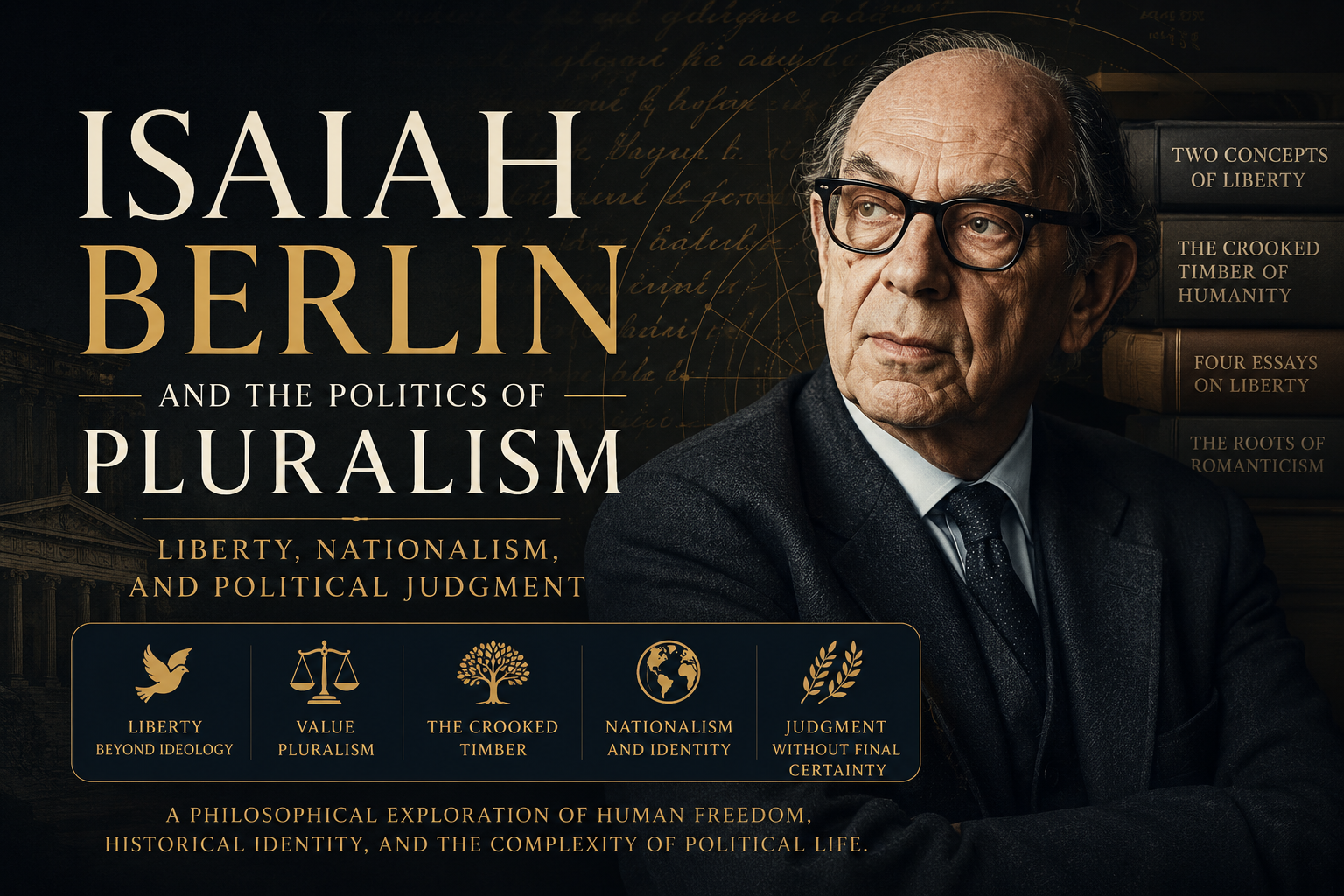
This essay offers a comprehensive philosophical interpretation of Isaiah Berlin by integrating liberty, value pluralism, nationalism, the Counter-Enlightenment, Zionism, and political judgment into a single intellectual framework. Drawing on years of research and major scholarly works, it argues that Berlin’s enduring contribution lies in explaining how political judgment operates in a world…
Summary
This essay offers a comprehensive philosophical interpretation of Isaiah Berlin by integrating liberty, value pluralism, nationalism, the Counter-Enlightenment, Zionism, and political judgment into a single intellectual framework. Drawing on years of research and major scholarly works, it argues that Berlin’s enduring contribution lies in explaining how political judgment operates in a world where certainty is impossible and legitimate values inevitably collide.
Keywords
- Counter-Enlightenment
- democracy
- freedom
- History of Ideas
- Human Freedom
- intellectual history
- Isaiah Berlin
- liberalism
- Liberty
- Michael Ignatieff
Introduction
Isaiah Berlin has accompanied my intellectual journey for far longer than it took to complete this manuscript. This book is not the product of a single research project, nor did it emerge from a brief engagement with Berlin’s writings. It represents the cumulative outcome of several years of reading, teaching, note-taking, comparison, and continuous reflection on one of the most influential political philosophers of the twentieth century. Throughout that period, Berlin repeatedly appeared in my work—not merely as an object of study but as an indispensable interlocutor in broader questions concerning freedom, pluralism, political judgment, nationalism, intellectual history, and the moral foundations of modern civilization.
The present volume forms part of my larger research program on Isaiah Berlin. Over the past several years, I have examined Berlin from multiple perspectives rather than through a single text or concept. Instead of concentrating exclusively on Two Concepts of Liberty or value pluralism, I gradually assembled a wider intellectual map by bringing together Berlin’s major writings with the growing body of scholarship devoted to his work. The purpose was never to produce another general introduction to Berlin. The purpose was to understand the internal architecture of his philosophy and the intellectual tensions that continue to shape its interpretation.
This study draws primarily upon five major sources that collectively frame the discussion presented in this volume: Michael Ignatieff’s Isaiah Berlin: A Life; Isaiah Berlin’s Liberty; Isaiah Berlin’s The Crooked Timber of Humanity; Isaiah Berlin and the Enlightenment, edited by Laurence Brockliss and Ritchie Robertson; and Seyla Benhabib’s Exile, Statelessness, and Migration: Playing Chess with History from Hannah Arendt to Isaiah Berlin. Each contributes a different layer of understanding. Ignatieff reconstructs Berlin’s intellectual formation through biography. Liberty presents the philosophical foundations of freedom and pluralism. The Crooked Timber of Humanity reveals Berlin’s engagement with the Counter-Enlightenment and the moral complexity of political life. The collection edited by Brockliss and Robertson offers important historical reassessments and critical revisions of Berlin’s interpretation of the Enlightenment. Benhabib extends the conversation into contemporary debates concerning migration, nationalism, political judgment, and democratic pluralism. Read separately, these works illuminate different dimensions of Berlin. Read together, they disclose a remarkably coherent philosophical landscape.
The decision to place these texts into sustained conversation arose from a simple observation. Much of the existing literature approaches Berlin through isolated themes. One group of scholars focuses on liberty, another on pluralism, others on nationalism, intellectual history, or liberalism. Such specialized studies have generated important scholarship, but they often leave Berlin’s larger philosophical project fragmented. The present book adopts a different strategy. Rather than treating these themes as independent discussions, it reconstructs their internal relationship. The argument developed throughout these chapters is that Berlin’s writings revolve around a single philosophical concern: how human beings exercise political judgment in a world where legitimate values are multiple, history refuses simplification, and certainty remains permanently incomplete.
This volume, therefore, should not be read as an attempt to systematize Berlin into a closed philosophical doctrine. Such an undertaking would contradict the spirit of Berlin’s own thought. Berlin consistently resisted intellectual systems claiming to possess final answers to political life. His writings are characterized by movement rather than closure, by historical sensitivity rather than conceptual rigidity, and by an enduring awareness that political decisions inevitably involve competing goods rather than perfect solutions. The task undertaken here is not to eliminate that openness but to demonstrate the philosophical coherence that nevertheless connects his diverse writings.
Although this book is grounded in established scholarship, the interpretation offered here remains my own. It reflects years of engagement with Berlin’s works, numerous comparative readings, and an ongoing effort to situate Berlin within wider debates concerning modern political philosophy and intellectual history. The conclusions reached in these pages should therefore be understood as an interpretive reconstruction rather than a definitive statement on Berlin. Like Berlin himself, I regard philosophical inquiry as an invitation to continue thinking rather than as the announcement of completed certainty.
Berlin once reminded readers that the human world is too complex to be governed by a single, universal formula. That insight has become increasingly relevant in an age marked by ideological polarization, resurgent nationalism, technological transformation, and the growing tension between universal principles and particular identities. If this book succeeds in any meaningful sense, it will not be because it settles the debates surrounding Isaiah Berlin. Its value will lie in encouraging readers to revisit those debates with greater philosophical seriousness, historical sensitivity, and intellectual humility.
Pluralism as the Architecture of Human Reality
Isaiah Berlin is frequently introduced as a historian of ideas, a liberal political philosopher, or one of the twentieth century’s most influential defenders of freedom. Each description captures only part of the intellectual landscape. Beneath the remarkable range of Berlin’s writings lies a single conviction that quietly governs every major argument he ever made. That conviction is value pluralism. Berlin did not begin with liberty, nationalism, Romanticism, or the Counter-Enlightenment. Each of those subjects emerged from a prior philosophical commitment: the belief that human beings pursue multiple goods that are equally genuine, objectively valuable, and often incapable of complete reconciliation. The architecture of Berlin’s thought cannot be understood by reading his works separately. It becomes visible only when each work is seen as a different expression of the same underlying principle.
Michael Ignatieff’s biography provides the crucial starting point because it reveals that pluralism did not arise as an abstract philosophical deduction. Berlin himself admitted that his deepest philosophical convictions emerged from personal experience rather than logical demonstration. Reflecting upon his own intellectual development, Berlin confessed that the unavoidable conflict among human ends was perhaps the only truth he had ever discovered for himself. Ignatieff captures this transformation with unusual precision when he observes that “the fox had discovered that he was a hedgehog after all.” The metaphor is striking because Berlin spent his career exploring hundreds of thinkers across several centuries, yet all those explorations gradually revolved around one permanent philosophical center. The diversity of his scholarship concealed the unity of his intellectual purpose.
The historical genealogy of this conviction occupies the second layer of Berlin’s intellectual construction. His pluralism did not emerge in isolation but developed through sustained engagement with thinkers whom the dominant Enlightenment tradition often regarded as marginal. Machiavelli revealed that different civilizations may embody fundamentally different moral worlds. Vico demonstrated that cultures possess their own internal rationalities which cannot be measured by a single universal standard. Herder expanded this insight by treating every historical community as the bearer of unique forms of human flourishing. Berlin synthesized these figures into a single historical narrative that challenged every philosophical tradition seeking one comprehensive answer to the human condition. Human history therefore appeared not as the progressive discovery of one universal truth but as the coexistence of several legitimate visions of life.
This historical reconstruction reached its clearest philosophical formulation in The Pursuit of the Ideal. Berlin rejected the assumption that all authentic values ultimately converge within a perfectly harmonious society. Such harmony was impossible not because human beings lacked sufficient intelligence or technological capacity but because certain values contradicted one another at the conceptual level. Justice may conflict with mercy. Equality may collide with excellence. Freedom may require sacrifices that security cannot tolerate. These conflicts are not temporary failures awaiting future solutions. They belong to the permanent structure of moral existence. Consequently, the dream of a final political settlement capable of satisfying every legitimate human aspiration becomes philosophically incoherent before it becomes politically unattainable.
Berlin’s theory of liberty derives directly from this philosophical premise. If multiple human goods are equally valid while remaining mutually incompatible, political freedom becomes indispensable because individuals must constantly choose among competing values. Liberty is therefore not an abstract moral ornament but the institutional condition that permits meaningful choice under conditions of unavoidable conflict. This explains why Berlin described pluralism as “a truer and more humane ideal.” Liberalism does not promise the disappearance of tragedy. Instead, liberal institutions acknowledge that tragic choices cannot be abolished without simultaneously abolishing human freedom itself. Political life becomes the management of unavoidable losses rather than the achievement of universal reconciliation.
Yet Berlin’s reconstruction immediately provoked criticism from historians of ideas. Contributors collected by Brockliss and Robertson argue that Berlin often projected his own pluralist commitments onto historical figures who neither expressed nor fully anticipated them. Herder, Montesquieu, and even Machiavelli sometimes appear in Berlin’s essays less as independent historical actors than as participants in an intellectual drama constructed retrospectively during the ideological conflicts of the Cold War. Hilliard’s criticism is particularly significant because it suggests that the pluralism Berlin attributed to Herder reflected Berlin’s own political concerns more than Herder’s historical intentions. This criticism does not necessarily invalidate Berlin’s philosophical conclusions, but it forces readers to distinguish historical interpretation from philosophical construction. A thinker may discover genuine philosophical insights through imperfect historical reconstruction.
The most profound challenge, however, arrives from Seyla Benhabib. Her question is neither historical nor textual but philosophical. Can value pluralism itself justify liberal democracy? If no hierarchy exists among objective values, on what basis can liberty receive priority over equality, order, solidarity, or authority? Benhabib positions Berlin between Weber’s existential pluralism and Rawls’s political liberalism, arguing that Berlin never fully resolves this problem. His pluralism establishes the permanence of moral conflict, yet the transition from moral diversity to liberal political institutions remains theoretically fragile. The relationship between pluralism and liberal democracy, therefore, appears less as a completed argument than as an unfinished philosophical task inherited by subsequent generations.
This unresolved tension explains why value pluralism remains the gravitational center of Berlin’s entire intellectual universe. It is simultaneously the source of his originality and the origin of every criticism directed against him. Once pluralism is accepted, negative liberty, the crooked timber, the Counter-Enlightenment, nationalism, and even Zionism become different expressions of one philosophical vision. Once pluralism is called into question, the coherence of Berlin’s entire system becomes immediately vulnerable. The real legacy of Isaiah Berlin, therefore, lies neither in a particular theory of liberty nor in a historical interpretation of Romanticism. His enduring contribution is the insistence that the deepest dilemmas of political life arise not because humanity has failed to discover the correct values, but because the highest human values themselves cannot always coexist. That insight transformed liberalism from a doctrine of certainty into a philosophy of permanent moral responsibility.
Freedom Beyond Ideology
Isaiah Berlin’s distinction between negative and positive liberty remains one of the most influential formulations in modern political thought because it does not treat freedom as a single and self-evident good. Berlin understood freedom as a field of tension. Human beings want to be left alone, but they also want to govern themselves. They want protection from interference, but they also want the capacity to become the authors of their own lives. These aspirations are both legitimate. The danger begins when one form of liberty claims moral supremacy over all others and transforms itself into a total explanation of human purpose. Berlin’s theory therefore does not celebrate one concept and simply discard the other. It reconstructs the internal logic of both, identifies the historical danger attached to each, and warns against every ideology that converts freedom into an instrument of domination.
The biographical foundation of this argument appears clearly in Michael Ignatieff’s Isaiah Berlin: A Life. Berlin’s moral concern was not merely that governments might obstruct individual action. The deeper crime was the destruction of the human capacity to choose. In his letter to George Kennan, Berlin described the deprivation of this capacity as “the real sin against the Holy Ghost.” The phrase reveals the seriousness with which Berlin treated choice. Choice was not simply one political right among others. It was the moral expression of human agency. A person deprived of the capacity to choose is no longer treated as a person but as material to be arranged according to purposes defined by someone else. Berlin’s liberalism began from resistance to this transformation of human beings into objects of political engineering.
The experience of Petrograd in 1917 remained part of this moral structure. Berlin witnessed a political environment in which human beings could be classified, mobilized, and sacrificed in the name of historical necessity. The language of emancipation was gradually fused with the language of coercion. Individuals were no longer approached as bearers of distinct purposes but as fragments of a collective process. This background explains why Berlin became so alert to theories that promised liberation by redefining individuals against their own expressed wishes. A government could claim to free people by forcing them to obey their “real” interests. A party could claim to represent the deeper will of the population while silencing actual citizens. The political vocabulary of freedom could therefore become the most effective disguise of despotism.
Berlin formulated this problem most directly in Liberty, especially in “Two Concepts of Liberty.” Negative liberty concerns the area within which a person may act without interference from others. Positive liberty concerns the desire to be one’s own master, to act according to reason, and to govern one’s life rather than remain subject to uncontrolled impulses or external powers. Berlin insisted that these were not merely two interpretations of the same idea. They were “two profoundly divergent and irreconcilable attitudes to the ends of life.” Negative liberty asks how far power may intrude. Positive liberty asks who governs. The first protects a domain of non-interference. The second seeks self-direction. Both respond to real human aspirations, but each opens a different political path.
The danger of positive liberty emerges when the self is divided into a higher and lower form. The higher self is described as rational, moral, universal, or historically conscious. The lower self is portrayed as ignorant, impulsive, immature, or enslaved by false desires. Once this division is accepted, another person, institution, or state can claim to speak on behalf of the higher self. Coercion is then presented not as domination but as liberation. The individual may resist, but resistance itself becomes evidence of false consciousness. Berlin saw this as a “monstrous impersonation” of freedom. The most complete triumph of despotism occurs when those who are coerced are forced to describe their condition as freedom.
The historical roots of this danger are traced in The Crooked Timber of Humanity. Berlin connected the distortion of positive liberty to the Romantic transformation of value, especially through Fichte and the doctrine that values are made rather than discovered. This transformation released immense human creativity, but it also opened a political danger. If collective identity creates value, then the state, nation, or historical movement can claim authority over individuals. Joseph de Maistre represented the darker consequence of this logic. In Berlin’s reconstruction, De Maistre exposed how monism could justify suffering and sacrifice in the name of order. Positive liberty became dangerous not because self-mastery was inherently oppressive, but because the language of self-mastery could be transferred from the individual to the collective and then enforced through political power.
Berlin nevertheless refused to turn negative liberty into an absolute doctrine. His famous statement that “liberty is liberty” was intended to preserve conceptual clarity, not to deny the importance of justice, equality, culture, or welfare. Freedom should not be confused with the conditions that make freedom usable. Poverty may render freedom empty, but poverty is not identical to coercion. Education may expand the capacity to choose, but education is not itself liberty. This distinction allowed Berlin to resist ideological inflation. Once every desirable social condition is called freedom, the concept loses analytical precision. Yet this same distinction generated a serious difficulty: a person may formally possess liberty while lacking any practical ability to exercise it.
This difficulty becomes central in Isaiah Berlin and the Enlightenment. Jeremy Waldron criticizes Berlin for paying insufficient attention to constitutionalism and the institutional mechanisms required to secure negative liberty. Berlin wrote extensively about the moral danger of coercion but far less about courts, legal limits, representative structures, and institutional design. Ignatieff’s defense is that Berlin did not reject these institutions; Berlin simply regarded them as already given. Alan Ryan pushes the argument further by showing that Berlin’s liberalism was more thoroughly negative than that of John Stuart Mill. Berlin did not construct a comprehensive theory of the good society. His concern was narrower and darker: preventing political systems from destroying the space in which individuals remain capable of choosing among incompatible goods.
Seyla Benhabib’s Exile, Statelessness, and Migration exposes the most difficult philosophical question. Why should negative liberty receive priority if value pluralism denies a final hierarchy among values? If freedom, equality, order, solidarity, and collective purpose are all objective goods, then the preference for non-interference cannot be derived from pluralism alone. The danger is that Berlin’s defense of negative liberty may become another decision rather than a fully grounded argument. Berlin may choose liberty because of historical experience, moral temperament, or fear of totalitarianism, but those reasons do not automatically establish a universal philosophical foundation. The relation between pluralism and liberalism therefore remains vulnerable.
This vulnerability does not destroy Berlin’s theory. It clarifies the kind of thinker Berlin was. Berlin was less interested in constructing a final system than in preventing political language from concealing moral violence. The distinction between negative and positive liberty was designed as an instrument of intellectual vigilance. It warns that noble concepts can become dangerous when separated from the plurality of human ends. Freedom becomes oppressive when it is defined as obedience to a supposedly higher self. Equality becomes oppressive when every difference is treated as injustice. Collective purpose becomes oppressive when individuals are reduced to instruments. Berlin’s contribution was to show that political concepts must be judged not only by their declared intentions but also by what they permit power to do.
Freedom, in Berlin’s thought, is therefore not the completion of human life. It is the protection of the space in which incomplete human beings continue to choose. Negative liberty matters because no authority can know in advance which combination of values must govern every life. Positive liberty matters because human beings do not want merely to avoid interference; they want to shape themselves. The tension between the two cannot be permanently resolved. That unresolved condition is not a defect in political thought. It is the political expression of value pluralism itself. Berlin’s theory of liberty remains powerful because it refuses the false comfort of unity. It recognizes that freedom must be defended precisely because human beings disagree, because values conflict, and because every political order is tempted to transform its own definition of emancipation into a command.
The Ethics of the Crooked Timber
The image of the crooked timber occupies a special place in Isaiah Berlin’s thought because it gathers his moral philosophy into a single sentence. Human beings cannot be fashioned into perfect forms because the material from which political life is made is already irregular. Desire, memory, loyalty, fear, reason, ambition, and attachment do not combine into a stable unity. They pull human beings in different directions. Political thought becomes dangerous when this irregularity is treated as a temporary defect that can be corrected by a sufficiently rational system. For Berlin, imperfection is not an accident at the margins of human existence. It belongs to the structure of humanity itself.
The phrase borrowed from Kant—“out of the crooked timber of humanity no straight thing was ever made”—became more than a description of moral weakness. Berlin turned it into a warning against political schemes that assume human beings can be redesigned to fit a single coherent image of the good. Such schemes do not begin with cruelty. They usually begin with a promise of order. They offer to remove contradiction, abolish conflict, and place each person within a rational arrangement. Violence begins when actual human beings fail to resemble the model. At that point, politics no longer adjusts the scheme to reality. It disciplines reality until reality submits to the scheme.
In The Crooked Timber of Humanity, Berlin presents this danger in moral rather than merely institutional terms. Forcing people into “neat uniforms” demanded by dogmatic visions is a road to inhumanity because uniformity requires suppressing the qualities that make human beings distinct. The problem is not only that utopian projects may fail. Failure is almost secondary. The deeper problem is that their success would require eliminating plurality. A perfectly ordered society would need to silence competing loyalties, subordinate incompatible purposes, and reduce moral judgment to obedience. Perfection becomes inhuman because humanity cannot remain plural within a political order that recognises only one legitimate form of life.
Berlin’s anti-utopianism therefore differs from ordinary pessimism. He does not argue that human beings should abandon moral aspiration because perfection is unattainable. His claim is sharper: the idea of a final political harmony misunderstands the nature of value. A society may become more just, less violent, and more humane, but every serious arrangement will still involve loss. Protecting liberty may permit inequality. Advancing equality may restrict choice. Preserving peace may require compromises that offend justice. These losses cannot always be removed through better calculation because they arise from collisions among legitimate goods. Political maturity begins when loss is recognised rather than hidden behind the language of final solutions.
This recognition gives Berlin’s ethics its tragic character. Tragedy does not mean that every choice is equally bad or that moral reasoning is futile. It means that a correct decision may still destroy something valuable. A statesman may defend public order and injure freedom. A citizen may honor loyalty and betray truth. A community may preserve its identity while narrowing the space available to outsiders. Moral conflict does not disappear once one side has been judged preferable. The rejected value remains real. Its loss continues to matter. Berlin’s ethics refuses to convert victory into innocence.
From this condition, Berlin derives an ethic of restraint. “The first public obligation is to avoid extremes of suffering.” This principle is modest, but its modesty is deliberate. Berlin distrusts political theories that begin by defining the highest destiny of humanity. He begins with the prevention of cruelty. Priorities must be established, but no priority should be treated as final and absolute. The task of politics is not to discover a permanent hierarchy of values. It is to make judgments under pressure while limiting the damage produced by those judgments. A humane order is not one that abolishes conflict. It is one that prevents conflict from being used as a justification for limitless suffering.
Yet the famous metaphor becomes more difficult when placed against Kant’s original argument. Jeremy Waldron and other contributors to Isaiah Berlin and the Enlightenment contend that Berlin misreads Kant. For Kant, the crookedness of humanity does not justify resignation. It creates the need for constitutional construction. Because human beings are unreliable, institutions must be designed to restrain the destructive use of freedom. Even a “race of devils,” if rational, would require laws capable of organizing coexistence. The crooked timber is therefore not a reason to distrust institutional ambition. It is the reason institutions become necessary.
This criticism reaches the center of Berlin’s political temperament. Berlin uses the metaphor to warn against schemes of perfection, while Kant uses it to defend the difficult work of political design. The contrast is not simply between optimism and pessimism. It concerns two responses to imperfection. The first response fears that institutions may become instruments of moral overreach. The second fear is that without institutions, private crookedness will become public domination. Berlin emphasizes the violence committed by those who seek to straighten humanity. Kant emphasizes the violence that crooked humanity commits when left without constitutional restraint. Both begin from imperfection, but they move toward different political conclusions.
Berlin’s reading may therefore be historically questionable without being philosophically empty. A misreading can still expose a genuine danger. Modern politics has repeatedly shown that the language of improvement can become a license for coercion. Berlin’s formulation preserves this insight by asking what happens when political power claims authority not only over conduct but over the inner purposes of human beings. The attempt to construct good institutions remains necessary, but the attempt to construct good persons through political force crosses a different boundary. The distinction between institutional restraint and human redesign is essential to the moral force of the crooked timber.
Seyla Benhabib’s discussion in Exile, Statelessness, and Migration reveals what remains incomplete in Berlin’s account. If every political arrangement involves loss, then judgment becomes unavoidable. The recognition of tragedy does not tell us how to decide among competing claims. Rawls’s statement that there is “no social world without loss” comes close to Berlin, but Rawls connects loss to the burdens of judgment and to institutional principles. Berlin describes the permanence of conflict with unusual clarity, yet does not fully explain the form of judgment required when values collide. His ethics identifies the condition of political choice more successfully than it establishes the standards of choice.
The crooked timber should therefore not be read as an excuse for passivity. It is a discipline imposed upon political reason. It demands ambition without fantasies of completion, reform without the desire to manufacture humanity, and judgment without moral self-purification. Political actors must choose, but they must also remember what their choices destroy. Institutions must be built, but they must remain open to correction. Values must be defended, but none should be permitted to erase the existence of rival goods. Berlin’s moral achievement lies in preserving this tension. The crookedness of humanity does not make politics impossible. It makes humility a condition of legitimate politics.
Defending Liberalism Through Its Enemies
Isaiah Berlin’s account of the Counter-Enlightenment cannot be separated from his method as a historian of ideas. Berlin did not defend liberalism by remaining inside the language of liberalism. Berlin approached liberalism indirectly, through thinkers who rejected rational universalism, distrusted abstract humanity, and placed culture, history, authority, or collective identity above individual autonomy. Michael Ignatieff identifies the pattern in Berlin’s early work on Marx: “he defended his own commitments by writing about those who were its sworn enemies.” This was not an incidental feature of Berlin’s scholarship. It became the defining movement of his intellectual life. Berlin entered the mental worlds of liberalism’s opponents because liberalism could not understand its own limits by listening only to its defenders.
This method gave Berlin’s history of ideas its unusual intensity. Berlin did not approach hostile thinkers merely to expose their errors. Berlin tried to understand why their ideas had attracted intelligent people and why those ideas continued to return after being declared obsolete. A political doctrine becomes truly dangerous when its emotional and moral sources remain invisible to its opponents. Condemnation alone leaves those sources untouched. Berlin therefore reconstructed the internal dignity of positions that threatened his own commitments. The aim was not reconciliation. The aim was comprehension without surrender. Liberalism had to know what its enemies understood about human beings that liberal rationalism had failed to see.
The Counter-Enlightenment emerged from this effort. In The Crooked Timber of Humanity, Berlin gathered Vico, Hamann, Herder, and De Maistre into a broad rebellion against the dominant assumptions of the Enlightenment. Those assumptions, in Berlin’s reconstruction, rested upon the belief that human questions possessed rational answers, that valid answers must be compatible, and that a sufficiently enlightened social order could eventually unite them. The Counter-Enlightenment rejected this confidence. Human beings did not inhabit one transparent moral universe. They lived through languages, inherited memories, religious symbols, and historical forms that could not be reduced to universal reason without losing their substance.
Vico mattered because Vico made historical worlds intelligible without making them identical. Civilizations could be understood from within because human beings had created them, yet the products of different ages could not be judged as failed approximations of one final model. Herder carried this resistance further by treating cultures as distinct forms of human expression. People did not become fully human by abandoning particularity for abstraction. Humanity appeared through particular languages, customs, songs, memories, and attachments. Berlin found in these thinkers an answer to what he called the Enlightenment’s “one-dimensional view of humanity.” Their importance lay in preserving forms of life that universal reason was tempted to classify as immature or irrational.
Hamann sharpened the attack by challenging reason at its presumed point of purity. Reason did not float above language, history, or embodiment. Thought itself depended upon inherited forms of expression. The dream of a universal rational vocabulary, therefore, concealed its own historical location. Berlin was drawn to this attack because it weakened every claim that one intellectual system could speak from nowhere and judge all forms of life from outside history. Yet the same critique carried danger. Once universality was rejected too completely, communication across cultures could become fragile, and criticism could be dismissed as the imposition of one world upon another.
De Maistre revealed the darkest consequence of the revolt against Enlightenment rationalism. Berlin described De Maistre as a “prophet of our day” because De Maistre understood the political power of obedience, sacrifice, fear, and sacred authority. De Maistre did not imagine society as a voluntary association of rational individuals. Society rested upon inherited institutions, punitive force, and submission to powers whose authority could not be reduced to consent. Berlin recognised in this vision an anticipation of modern totalitarianism. De Maistre exposed something liberal theory preferred not to admit: human beings could seek certainty, hierarchy, and collective submission as intensely as they sought freedom.
The Counter-Enlightenment therefore performed two functions in Berlin’s thought. It corrected liberal rationalism, but it also revealed the abyss beyond that correction. Vico and Herder disclosed the moral significance of cultural difference. Hamann exposed the historical body of reason. De Maistre showed how the rejection of universal reason could culminate in the worship of power. Berlin’s achievement was to hold these figures together without pretending that they led to the same destination. The revolt against the Enlightenment opened the path toward pluralism, but it also opened the path toward authoritarianism. The same intellectual rebellion could protect individuality or destroy it.
This ambiguity explains Berlin’s own declaration: “Fundamentally, I am a liberal rationalist.” Berlin accepted the emancipatory force of Enlightenment values. Reason, criticism, toleration, and individual freedom had liberated human beings from inherited forms of domination. Berlin’s objection was not that the Enlightenment had been wrong, but that its self-confidence had become dogmatic and too simple. Berlin studied the opposition because opposition could sharpen the vision of liberalism. Liberalism became more credible when it acknowledged that reason alone could not exhaust human identity and that abstract freedom could not replace belonging, memory, or culture.
The historical coherence of Berlin’s Counter-Enlightenment has nevertheless been seriously challenged. Isaiah Berlin and the Enlightenment argues that Berlin constructed a unified adversary by simplifying the Enlightenment itself. Avi Lifschitz states that the description of a coherent Counter-Enlightenment required the creation of an intellectual straw man called “the Enlightenment.” Berlin later admitted that his picture may have been “too much of an Aunt Sally.” The admission is important. Berlin knew that the historical map had been drawn too sharply. The Enlightenment was more internally diverse than his opposition between monism and pluralism allowed, while the supposed Counter-Enlighteners did not form a single intellectual camp.
The criticism becomes more precise in the cases of Vico and Herder. John Robertson questions whether Vico can properly be classified as a Counter-Enlightenment thinker. Vico’s historical imagination did not necessarily amount to a rejection of Enlightenment reason. Hilliard similarly argues that Herder was not the pluralist Berlin wanted him to be, but an ecumenical thinker whose conception of humanity retained forms of unity. Berlin may therefore have placed his own political pluralism into Herder’s work. The historical thinker becomes a philosophical ancestor through selective reconstruction.
This does not make Berlin’s interpretation worthless. Historical inaccuracy and philosophical sterility are not the same. Berlin’s categories may fail as exact descriptions while succeeding as instruments of intellectual discovery. By bringing Vico, Hamann, Herder, and De Maistre into the centre of modern political thought, Berlin rescued them from the status of irrational residues left behind by progress. Berlin forced liberal readers to recognise that the opposition to Enlightenment universalism contained genuine insight into history, language, identity, and belonging. The construction was imperfect, but it made neglected problems visible.
The genealogy of this construction also complicates Berlin’s originality. The framework did not descend primarily from standard histories of the Enlightenment associated with Cassirer or Gay. According to the critical reconstruction in Isaiah Berlin and the Enlightenment, Berlin inherited important elements from Plekhanov and Meinecke. The Counter-Enlightenment was therefore not simply discovered in the texts of eighteenth-century thinkers. It was assembled through earlier traditions of interpretation and then reshaped by the political pressures of the twentieth century. Berlin’s account belongs as much to the history of Cold War anti-monism as to the eighteenth century.
Seyla Benhabib makes this context decisive. Berlin stands within a broader anti-monist line that includes Popper, Aron, and Hayek. All resisted theories that claimed privileged access to the direction of history or the final structure of a rational society. Berlin differed, however, in the depth of his engagement with the enemies of liberalism. Berlin did not merely refute them. Berlin allowed their strongest insights to penetrate his own liberalism. This was the source of Berlin’s strength, but also of his ambivalence. A thinker who enters deeply into the world of the enemy may return with a more intelligent defence, but may also weaken the borders of the position being defended.
The central question is therefore not whether Berlin’s Counter-Enlightenment was historically exact. It was not. The more important question is whether the construction disclosed a real philosophical conflict. On this point, Berlin’s achievement remains substantial. Modern political thought continues to move between universal claims and particular attachments, rational emancipation and inherited identity, individual freedom and collective belonging. Berlin’s historical architecture may have exaggerated the division, but the division itself cannot be dismissed. The tension is not confined to two intellectual camps. It runs through modernity.
Berlin’s method ultimately reveals the character of his liberalism. His liberalism was not built upon innocence. Berlin understood that liberal values were neither self-evident nor sufficient for every human need. Freedom could become thin when detached from culture. Reason could become oppressive when treated as the sole judge of human purposes. Universalism could become blind when it refused to recognize the depth of historical belonging. Yet the correction of liberalism could not be allowed to destroy the individual in the name of community, authority, or destiny. Berlin defended liberalism by forcing it to absorb the truths of its enemies while refusing their final conclusions.
The Counter-Enlightenment was therefore less a historical period than a philosophical test. Berlin used its thinkers to ask whether liberalism could survive after abandoning the fantasy that reason would harmonize all human ends. His answer was cautious but firm. Liberalism could survive, but only after becoming more historically conscious, less doctrinaire, and more attentive to forms of life that could not be translated into a single language of progress. Berlin’s construction may have been an “Aunt Sally,” but it was a productive one. Through it, liberalism ceased to appear as the natural destination of reason and became a vulnerable moral choice made with full knowledge of the claims opposing it.
Nationalism and the Limits of Universal Humanity
Isaiah Berlin never dismissed nationalism as an intellectual mistake. Such a conclusion would have been impossible for someone who spent an entire career questioning every theory that reduced human existence to one universal formula. Nationalism interested Berlin because it emerged precisely where abstract conceptions of humanity ceased to satisfy lived experience. Human beings rarely begin political life by asking what humanity requires. They begin by asking where they belong. The distance between these two questions explains why nationalism has survived every prediction of its disappearance.
Modern political philosophy repeatedly assumed that economic development, constitutional government, and rational administration would gradually weaken collective identities inherited from history. Berlin considered this expectation profoundly misleading. Material prosperity may improve life, but prosperity cannot replace recognition. Institutions may distribute rights equally, yet equality before the law does not erase the desire to belong to a historical community. Political order may establish peace while leaving untouched the deeper question of cultural existence. Nationalism grows whenever this question remains unanswered.
Berlin found the philosophical roots of this problem in Johann Gottfried Herder. Herder did not begin from the individual detached from history. Human beings entered the world already surrounded by language, memory, custom, and inherited forms of life. None of these elements existed as decorative additions to an otherwise complete individual. They constituted the conditions through which individuals learned to understand themselves. A language was never merely an instrument of communication. It preserved an entire way of seeing reality. To lose a language, therefore, meant losing more than vocabulary. It meant losing a historical consciousness accumulated across generations.
Berlin regarded this insight as one of the decisive corrections to eighteenth-century universalism. The Enlightenment succeeded in defending humanity but often spoke as though humanity existed independently of historical communities. Herder reversed the order. Humanity appeared only through particular civilizations. There was no universal human voice floating above history. Every human voice spoke from somewhere. Every moral imagination developed within a concrete tradition. Universal humanity, therefore, remained real, but it could never become historically empty.
Yet Berlin refused to convert this insight into political absolutism. The recognition of historical communities did not imply that nations possessed unlimited moral authority. Once national identity claimed sacred status, it ceased to protect culture and began demanding submission. The nation no longer became the home within which individuals flourished. It became an end before which individuals disappeared. Berlin recognized this transformation because the twentieth century had already demonstrated how easily cultural attachment could be reorganized into political worship.
This distinction separates Berlin from both cosmopolitan universalism and ethnic nationalism. Cosmopolitanism often underestimates the emotional depth of historical belonging. Ethnic nationalism often transformed belonging into an exclusive destiny. Berlin occupied neither position. Historical communities deserved preservation because they embodied genuine forms of human life. Their legitimacy, however, depended upon recognizing that neighboring communities possessed the same claim. No nation could derive from its own history a right to deny the historical existence of another.
The importance of this argument extends beyond nationalism itself. Berlin’s discussion concerns the limits of abstraction in political philosophy. Every political theory eventually encounters realities that cannot be reduced to principles alone. Memory cannot be legislated. Historical humiliation cannot be dissolved through administrative reform. Collective dignity cannot always be measured by constitutional language. Political life, therefore, demands something more difficult than the application of universal rules. It requires historical judgment.
This is why Berlin remained suspicious of projects promising the final reconciliation of humanity. History had produced civilizations rather than one civilization, languages rather than one language, and loyalties rather than one loyalty. None of these differences automatically justified conflict. Yet neither could they be dissolved by appealing to a universal conception of mankind. Political wisdom begins when thought accepts that human plurality exists not only among individuals but also among civilizations themselves. That insight explains why nationalism, despite its dangers, remained, for Berlin, a permanent feature of the human condition rather than a historical accident destined to disappear.
Zionism Between Identity and Liberty
Isaiah Berlin’s reflections on Zionism occupy an unusual place within twentieth-century political thought because they were never written from the distance of a detached observer. Berlin belonged to the history he interpreted. The destruction of European Jewry, the experience of exile, and the establishment of Israel were not abstract events waiting for philosophical analysis. They formed part of the historical landscape within which Berlin himself lived. This proximity gives his writing an unusual moral texture. Berlin neither romanticised Zionism nor reduced it to a problem of international politics. Berlin approached it as a question about what happens to human dignity when an entire people loses the possibility of belonging anywhere.
Exile, in Berlin’s understanding, was never simply geographical displacement. A people may continue speaking its language, preserving its rituals, and maintaining its intellectual traditions while remaining politically homeless. Such a condition produces a peculiar contradiction. Individuals may participate successfully in the societies in which they reside, yet still know that the ultimate framework of collective existence depends on others’ tolerance. Political rights granted by another nation are never identical to political existence secured by one’s own historical community. Berlin regarded this distinction as one of the permanent lessons of Jewish history.
This concern explains why Berlin refused to interpret Zionism merely as nineteenth-century European nationalism in Jewish form. Ordinary nationalism generally seeks political independence for an already established historical community occupying a recognised territory. Jewish history followed a different trajectory. The Jewish people preserved an extraordinary continuity of religious memory and intellectual tradition without possessing a sovereign political home for centuries. Zionism therefore emerged less from imperial ambition than from the recognition that cultural continuity alone could not permanently protect collective existence. Identity required a political framework capable of securing its future.
The experience of statelessness profoundly shaped Berlin’s political imagination. A person deprived of citizenship loses more than legal protection. Statelessness weakens the relationship between individual freedom and public responsibility. Rights become fragile because they depend upon institutions that individuals cannot claim as their own. Berlin understood this reality long before Hannah Arendt transformed statelessness into one of the defining problems of modern political philosophy. Human beings require more than abstract declarations of universal rights. They require political communities capable of recognizing and defending those rights.
Yet Berlin never concluded that the existence of Israel resolved every moral question raised by Zionism. Precisely because Berlin rejected every form of political absolutism, the legitimacy of Jewish national self-determination could not become a license for unlimited national claims. The historical suffering of one people could not erase the historical existence of another. Berlin consistently resisted the transformation of legitimate attachment into sacred entitlement. Every nationalism becomes morally dangerous when history ceases to function as memory and begins functioning as ownership.
This restraint distinguished Berlin from ideological interpretations of Zionism. Berlin defended Israel because the Jewish people required political security, not because the nation represented the culmination of history. A homeland answered one historical problem, but it did not abolish the plurality of historical claims surrounding it. The existence of Israel, therefore, remained subject to the same ethical condition that governed every political community. National self-determination was legitimate precisely because no nation possessed a monopoly over history.
Seyla Benhabib identifies this tension as one of the most revealing aspects of Berlin’s political philosophy. Berlin defended collective identity while simultaneously refusing the metaphysical language often used to justify nationalism. Berlin’s Zionism never rested upon historical destiny, divine election, or civilisational superiority. Instead, it rested upon vulnerability. A people repeatedly exposed to persecution required institutions capable of protecting ordinary political existence. Security, rather than historical triumph, remained the central concern.
This position reflects Berlin’s broader understanding of political life. Communities are not formed because abstract reason commands their existence. Communities arise because human beings remember together, mourn together, and imagine their future together. Political philosophy often begins from rights. Berlin frequently began from memory. Without shared memory, rights lose the historical world within which they acquire meaning. Without rights, memory alone becomes incapable of protecting those who inherit it. Neither element can permanently replace the other.
The relationship between Zionism and liberalism therefore exposes the deepest structure of Berlin’s thought. Liberalism cannot demand that individuals abandon historical attachment. Nationalism cannot demand that individuals surrender moral autonomy. The first forgets that human beings always belong somewhere. The second forgets that belonging never exhausts human identity. Berlin refused both simplifications because each destroys part of human experience. A political order worthy of preservation must recognise that individuals simultaneously inhabit several moral worlds that cannot be collapsed into a single principle.
Benhabib’s reconstruction also reveals an unfinished question. Berlin defended the necessity of political belonging, yet left largely unexplored the institutional consequences of competing historical attachments within the same political space. The philosophical defence of plural identities does not automatically explain how rival memories, rival national narratives, and rival claims to justice can coexist within durable political institutions. Berlin recognized the problem with remarkable clarity but stopped before constructing a constitutional answer. His philosophy remained deliberately closer to judgment than to institutional design.
This limitation should not obscure Berlin’s larger contribution. Zionism became important within his philosophy because it demonstrated that universal humanity and historical particularity cannot simply replace one another. Human beings require principles that protect everyone, but they also require communities that give those principles historical substance. Political thought repeatedly fails whenever it sacrifices one side of this relationship for the other. Berlin’s reflections on Zionism continue to matter because they preserve the tension rather than pretend that history has already resolved it. In Berlin’s hands, Zionism becomes neither a triumphalist doctrine nor an apologetic narrative. It becomes evidence that political philosophy must continually negotiate the fragile boundary between the universal claims of humanity and the irreducible reality of historical belonging.
Judgment Without Final Certainty
Isaiah Berlin never produced a systematic theory of political judgment. No book bearing that title exists, and no essay offers a complete account of how public decisions ought to be made when legitimate values collide. Yet the absence of such a treatise should not obscure what emerges from the totality of his work. Once Liberty, The Crooked Timber of Humanity, the essays on the Counter-Enlightenment, the writings on nationalism; and the reflections on Zionism are read together, another Berlin gradually appears. Behind the historian of ideas stands a philosopher of judgment. The centre of his philosophy is neither liberty nor pluralism in isolation. The centre is the act of choosing under conditions where certainty has already disappeared.
Political philosophy has often sought principles capable of eliminating difficult choices. Plato entrusted reason with the authority to discover justice. Hobbes assigned peace to sovereign power. Rousseau appealed to the General Will. Marx expected history itself to resolve contradiction. Rawls designed procedures intended to generate fair principles of cooperation. Berlin moved in the opposite direction. Political life never reaches a point where judgment becomes unnecessary. Every institutional arrangement, every constitutional design, and every legal order eventually confronts circumstances that no prior rule can completely anticipate. Judgment survives because politics concerns living human beings rather than logical propositions.
This conclusion follows directly from value pluralism. If genuine values are sometimes incompatible, then no algorithm of morality can determine every correct answer. Justice may demand one course of action while mercy demands another. Security may require measures that diminish freedom. Equality may conflict with excellence. Loyalty may compete with truth. None of these values is imaginary. None can simply be dismissed as irrational. Political judgment begins precisely because every available decision preserves one value while diminishing another. The tragedy lies not in choosing badly but in the fact that every serious choice leaves something worthy behind.
Berlin therefore transforms the meaning of practical wisdom. Wisdom is not the possession of superior principles. Wisdom is the capacity to perceive reality before imposing theory upon it. Throughout his historical studies, Berlin admired thinkers whose judgments remained close to the complexity of experience. Vico refused to measure every civilization by one historical standard. Herder recognized that different peoples embodied different forms of life. Herzen distrusted every philosophy promising redemption through future perfection. These figures attracted Berlin because each resisted the temptation to substitute conceptual symmetry for historical reality. Judgment required intellectual discipline before it required intellectual confidence.
Michael Ignatieff repeatedly observes that Berlin distrusted political systems claiming to explain everything. That distrust did not arise from scepticism about knowledge itself. Berlin admired learning, historical scholarship, and philosophical argument throughout his life. The problem appeared when explanation claimed completion. Once a theory declared itself capable of resolving every major conflict, disagreement ceased to possess legitimate standing. Those who resisted could then be dismissed as irrational, immature, reactionary, or enemies of history. Judgment disappeared because conclusions had already been reached before political life began. Berlin regarded this as the characteristic pathology of ideological politics.
This explains why Berlin consistently preferred moderation without celebrating mediocrity. Moderation, in his vocabulary, did not mean compromise for its own sake. Some political moments require firm decisions, and some injustices demand decisive action. Moderation was instead referred to as a habit of mind. It required remembering that victory does not transform one’s own values into the only values that exist. Every political achievement remains partial because the moral world itself remains plural. Judgment, therefore, carries an obligation to remember the claims that one’s own decision has overridden.
Seyla Benhabib identifies the unfinished character of this position with considerable precision. Berlin successfully demonstrates why moral conflict cannot disappear, yet Berlin offers only limited guidance concerning the standards governing practical judgment. If values are objectively plural and often incompatible, how should political actors rank them in moments of crisis? Experience alone cannot become the answer, for experience may justify prejudice as easily as wisdom. Prudence cannot function as an independent criterion unless prudence itself receives philosophical clarification. Berlin brilliantly describes the condition within which judgment operates but leaves the structure of judgment itself comparatively undeveloped.
The criticism is important because it identifies the point where Berlin deliberately refused to become a systematic philosopher. Berlin feared that constructing a comprehensive theory of judgment might reproduce the very intellectual ambition his work sought to resist. Every universal method eventually risks becoming another instrument through which complexity is reduced to a formula. Berlin preferred incompleteness to false completion. His philosophy, therefore, retains an open texture. It demands responsibility without promising certainty. It asks political actors to decide without pretending that every decision can be justified by one final principle.
This intellectual restraint explains why Berlin remains relevant beyond the ideological struggles of the twentieth century. Contemporary societies continue to confront questions that resist complete resolution. Artificial intelligence challenges inherited understandings of agency and responsibility. Global migration forces constitutional democracies to negotiate between citizenship and universal human rights. Technological surveillance promises security while threatening privacy. Climate policy places obligations to future generations alongside present economic realities. None of these dilemmas yields to a single moral vocabulary. Each requires judgment under conditions where legitimate goods collide rather than align.
Berlin’s philosophy, therefore, should not be understood as a defense of uncertainty for its own sake. Uncertainty is not a virtue. It is a condition of political existence. The virtue lies elsewhere—in the refusal to convert provisional judgments into permanent certainties. Political authority remains necessary. Decisions cannot be postponed indefinitely. Laws must be enacted, governments must govern, and institutions must act. Yet every exercise of authority should remain conscious of its own fallibility. Such awareness is not a weakness. It is the ethical consequence of recognizing that reality exceeds every theory constructed to explain it.
Berlin’s intellectual legacy reaches beyond the individual concepts for which he is usually remembered. Negative liberty, value pluralism, the crooked timber, the Counter-Enlightenment, nationalism, and Zionism are not isolated doctrines arranged side by side. Together, they describe a single philosophical vision of political life. Human beings inhabit a world in which genuine values frequently diverge, historical identities endure, moral losses cannot always be avoided, and no theory possesses the authority to silence competing claims once and for all. The task of political philosophy is therefore neither to abolish conflict nor to discover a final architecture of harmony. Its more demanding task is to cultivate the judgment required to act responsibly in a world where certainty will always remain incomplete.
How to Cite
Ahmad, Kamaruzzaman Bustamam. (2026). Isaiah Berlin and the Politics of Pluralism: Liberty, Nationalism, and Political Judgment. Banda Aceh: KBA13 Insight.
https://www.kba13.com/isaiah-berlin-political-philosophy-liberty-pluralism/
Professor of Anthropology of Religion at UIN Ar-Raniry Banda Aceh. He writes on geopolitics, Southeast Asian security and governance, Islam in the Malay world, and the future of knowledge.
About The Author

Rekomendasi Bacaan KBA13 INSIGHT
Jika tulisan ini bermanfaat, dukung jurnal ini dengan mencari bukunya melalui tautan berikut:
- Buku-buku Kamaruzzaman Bustamam Ahmad di Periplus
- Koleksi Islamic Studies di Periplus
- Koleksi Geopolitics & Politik Internasional di Periplus
- Cari buku & perangkat baca di Shopee
- Cari di Blibli
Daftar lengkap: Rekomendasi Buku, Alat Tulis & Layanan. Tautan di atas adalah tautan afiliasi — KBA13 INSIGHT dapat memperoleh komisi kecil tanpa biaya tambahan bagi Anda.
Artikel Terkait
 The Tragedy of Certainty Isaiah Berlin Karl Marx
 Isaiah Berlin Through the Archive: Reconstructing an Intellectual Life from the Bodleian Papers
 Isaiah Berlin and the Defense of the Human World: Why His Ideas Matter Today
 How John Locke Explains the Origin of Simple Ideas: A Close Reading of An Essay Concerning Human Understanding
 Romantisisme Jerman dan Krisis Kesadaran Rusia: Memahami Russian Thinkers Karya Isaiah Berlin
Leave a Reply