
EXECUTIVE SUMMARY
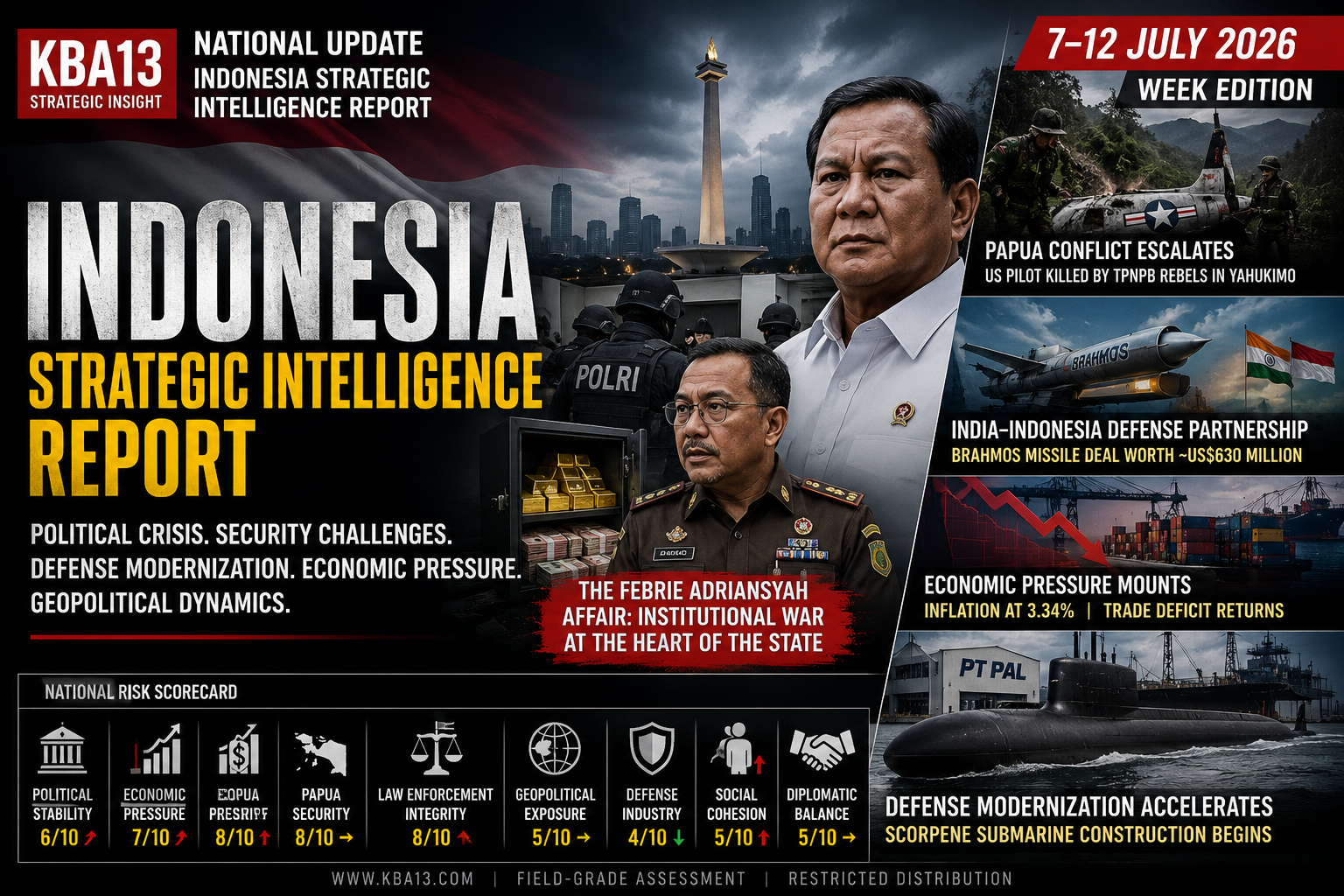
This week’s KBA13 National Update delivers a field-grade assessment of the most consequential strategic developments shaping Indonesia’s political, security, defense, geopolitical, and economic landscape during the 7–12 July 2026 reporting period. Seven major threat vectors converged in a single week: the dramatic fall of Deputy Attorney General Febrie Adriansyah amid a Polri raid netting Rp476 billion in cash and 74 kg of gold; the killing of a US pilot by TPNPB rebels in Yahukimo, Papua; the signing of an India–Indonesia BrahMos missile and defense manufacturing agreement worth approximately US$630 million; mounting economic pressure with inflation rising to 3.34% and the trade deficit returning for the first time in six years; the inauguration of the Meninting Dam by President Prabowo amid a declaration to protect state defense industries from foreign takeover; and the commencement of Scorpene-class submarine construction at PT PAL Surabaya. Taken together, this reporting period reveals an Indonesian state under simultaneous stress from within and without — its law enforcement apparatus fractured, its economy pressured, its periphery contested, and its defense ambitions accelerating.
The Febrie Adriansyah affair is not merely a law enforcement scandal. It is a strategic rupture within the Indonesian deep state, revealing an active and unprecedented institutional warfare between Polri’s Kortas Tipidkor and the Attorney General’s Office — with the TNI inserted as a third actor guarding Febrie’s residence before the raids. The Jakarta Post’s framing of a “new fragmentation” — from cabinet politics to institutional rivalries — captures the analytical gravity correctly. The Prabowo administration faces the most complex test of its governance durability to date: managing fragmentation of state coercive instruments while maintaining public confidence in rule of law.
— ● —
NATIONAL RISK SCORECARD | July 2026
| DOMAIN | RISK (1-10) | TREND | ASSESSMENT NOTE |
| Political Stability | 6/10 | ↑ Rising | Febrie scandal shakes institutional trust; elite rivalries intensify |
| Economic Pressure | 7/10 | ↑ Rising | Rupiah weakness, trade deficit, inflation at 3.34%; growth holds but gaps widen |
| Papua Security | 8/10 | → Persistent | US pilot killed Jul 2; TPNPB escalation; Habema/Cartenz ops ongoing |
| Law Enforcement Integrity | 8/10 | ↑ Rising | Polri-AGO institutional war; TNI-Polri tension; state apparatus fragmentation |
| Geopolitical Exposure | 5/10 | → Stable | India-RI defense deal strengthens posture; Natuna grey-zone persistent |
| Defense Industry | 4/10 | ↓ Improving | Scorpene subs in production; Pindad ammo factory; BrahMos deal secured |
| Diplomatic Balance | 5/10 | → Stable | Bebas-aktif holding; BRICS-OECD dual track; India-RI partnership elevated |
| Social Cohesion | 5/10 | ↑ Mild Stress | MBG scandal, job losses, shrinking middle class; social media discontent |
— ● —
[POLITICAL DYNAMICS] THE FEBRIE ADRIANSYAH AFFAIR: INSTITUTIONAL WAR AT THE HEART OF THE STATE
The week of 7–12 July 2026 will be remembered in Indonesian political history as the week the state turned against itself. On 8–9 July, the National Police’s Corruption Eradication Corps (Kortas Tipidkor) conducted simultaneous raids on 12 locations spanning Jakarta, South Tangerang, and Bogor — targeting properties linked to Deputy Attorney General for Special Crimes (Jampidsus) Febrie Adriansyah. Police recovered Rp476 billion (approximately US$29 million) in multiple currencies, including US$4.767 million and SGD14.08 million, packed into seven suitcases inside a locked safe at a house in Sentul, Bogor, along with 74 kilograms of gold bars — one of the largest single seizures in the history of Indonesian law enforcement operations.
The institutional geometry of the affair is as important as the evidentiary haul. Febrie was not a peripheral figure. As Jampidsus since 2022, he presided over Indonesia’s highest-profile corruption prosecutions: the Timah state mining scandal, Pertamina corruption, Garuda Indonesia graft, and — critically — the Asabri state insurance case that is now directly cited by Polri as a nexus for the bribery and extortion allegations. He was also overseeing the National Nutrition Agency (BGN) corruption investigation linked to President Prabowo’s flagship Makan Bergizi Gratis (MBG) free school meals program, and the Satgas PKH forestry enforcement operations under Presidential mandate. His removal creates a vacuum at the precise moment these cases require institutional momentum.
What electrified the already-charged atmosphere was the presence of TNI soldiers guarding Febrie’s Jakarta residence ahead of the police raids — a detail that surfaced in social media footage and was confirmed by multiple credible reports. The spectacle of Indonesian Army troops appearing to shield a senior prosecutor from the National Police’s own anti-corruption unit crystallized, for the first time in public view, the depth of institutional fault lines running through Indonesia’s security architecture. The Jakarta Post described this as emblematic of “overlapping intelligence mandates” and institutional rivalry now openly expressed through the deployment of coercive instruments against each other.
“As institutional rivalries and overlapping intelligence mandates intensify, President Prabowo faces a critical test: preventing the fragmentation of the Indonesian state itself.” — The Jakarta Post, 11 July 2026
Febrie made a public appearance on Friday, 10 July, categorically denying wrongdoing and refusing to confirm or deny whether he would step aside. He emphasized that the Special Crimes division continued to function normally and listed ongoing priority investigations including forestry enforcement, mining sector governance, and the MBG program probe. On Saturday, 11 July, Attorney General ST Burhanuddin accepted his resignation “to maintain integrity, objectivity, and neutrality of law enforcement.” Rudi Margono was named interim Jampidsus. The case is formally tied to allegations of coal-supply corruption linked to recent electricity blackouts across Sumatra, Kalimantan, and Java — an economic sabotage dimension that adds further gravity.
The political implication for Prabowo is acute. The Febrie affair lands on the desk of a president already navigating a crowded elite landscape, managing a coalition cabinet of overlapping loyalties, and attempting to sustain public confidence in anti-corruption programs while one of the chief anti-corruption enforcers becomes the subject of the largest cash seizure in Indonesian prosecutorial history. The broader question — who orchestrated the timing of these raids, and which factional interests benefit most from Febrie’s removal at this precise juncture — remains unanswered and warrants a field-grade investigation beyond the official narrative.
From a regional dimension, the Febrie fallout reverberates unevenly across Indonesia’s provinces. In Java, particularly in Jakarta’s legal and business community, the resignation has intensified anxieties about prosecutorial independence and the integrity of major ongoing corporate investigations. In Surabaya and Kalimantan, where the coal supply corruption nexus is most material, the blackouts already triggered public discontent, and the revelation that graft may have contributed to them is converting economic frustration into directed political anger. In Sulawesi and Maluku, where major resource governance investigations intersect with the Jampidsus portfolio, local civil society actors are warning that prosecutorial momentum on forestry and mining cases may now stall.
Beyond the immediate personnel question, the Febrie affair exposes a structural pathology in Indonesia’s post-Reformasi institutional design: the overlapping jurisdictions of Polri, the AGO, and the KPK create inherent competitive dynamics that, when combined with factional politics within the Prabowo coalition, generate precisely the kind of institutional combat now visible. The KPK’s parallel arrest of former MPR Secretary-General Ma’ruf Cahyono over alleged bribes and gratuities exceeding Rp30 billion during the same week reinforces the picture of a systemic anti-corruption environment in crisis. The question is not whether Indonesia has anti-corruption institutions — it has many — but whether those institutions can be insulated from being weaponized as instruments of elite factional warfare.
The most analytically significant data point in the entire affair is the connection between the coal supply corruption investigation and the recent multi-province electricity blackouts. If confirmed, this establishes a direct causal link between elite-level graft and catastrophic infrastructure failure affecting millions of Indonesian citizens. This is no longer merely a political scandal — it is a national security matter with direct implications for Indonesia’s economic productivity, public health, and industrial output. KBA13 assesses that the full institutional consequences of the Febrie affair will not resolve within the current reporting cycle and will continue to shape Indonesia’s political landscape through at least Q3 2026.
The replacement of Febrie with acting Jampidsus Rudi Margono introduces an interim leadership figure whose institutional loyalties and prosecutorial priorities will be closely watched by all factional actors. The three major graft cases transferred from the AGO to police custody represent a significant redistribution of legal power — a gain for Polri in the ongoing inter-institutional competition. Prabowo’s public statement urging “respect for due process” was notably calibrated: neither defending Febrie nor endorsing the raids. This studied neutrality reflects the president’s awareness that all major institutional actors in this drama — Polri, AGO, TNI — report ultimately to him, and that appearing to side with any one of them carries disproportionate costs.
[DEFENSE & MILITARY] PRABOWO’S INDUSTRIAL NATIONALISM: BRAHMOS, SCORPENE, AND THE BATTLE TO KEEP INDONESIA ARMED
On 10 July 2026, speaking at the inauguration of the Meninting Dam in West Lombok, West Nusa Tenggara, President Prabowo Subianto issued one of his most direct and politically charged statements to date on defense industrial sovereignty. Riding atop a PT Pindad-manufactured Maung Garuda presidential vehicle — itself a deliberate staging choice — Prabowo publicly revealed that he had personally blocked unidentified parties from selling Indonesia’s state-owned defense enterprises to foreign buyers, accusing unnamed actors of deliberately neglecting these companies to justify their liquidation. “There were so many companies that seemed to want to be sold to foreigners, I forbade them!” he declared. The statement, while theatrically delivered for a civilian audience, carries substantive strategic weight.
The timing of Prabowo’s declaration coincided with two developments of operational significance. First, PT PAL Indonesia in Surabaya formally commenced the physical fabrication phase — the first steel-cutting — for two Scorpene-class submarines ordered in partnership with France’s Naval Group. This marks a qualitative milestone in Indonesia’s submarine force development: the two boats will be constructed entirely at PT PAL’s Surabaya facilities, embedding advanced submarine manufacturing capability within Indonesia’s domestic defense industrial base for the first time at this scale. PT PAL has previously co-produced the KRI Alugoro-405 submarine with South Korea’s DSME, but the Scorpene program represents a step-change in capability complexity.
Second, the India–Indonesia defense relationship entered a new operational phase with Prime Minister Narendra Modi’s 6–8 July state visit to Jakarta. The visit resulted in defense agreements valued at approximately US$630 million, centered on the BrahMos supersonic cruise missiles and air-to-air missiles. The BrahMos deal is strategically significant beyond its kinetic value: it delivers to Indonesia a supersonic anti-ship and land-attack capability that directly enhances deterrence posture in the North Natuna Sea grey-zone context, upgrades maritime strike options against any hypothetical naval threat at stand-off ranges, and deepens India-Indonesia defense industrial linkage in ways that align with both nations’ “strategic autonomy” posture toward great power alignment pressure.
“The missile deals significantly boost Indonesia’s maritime defense capabilities, particularly in disputed areas like the South China Sea and Strait of Malacca, while helping both nations maintain independence from major powers.” — Eurasia Review, 12 July 2026
Indonesia’s defense industrial trajectory in mid-2026 reflects a coherent, if ambitious, multi-vector strategy. PT Pindad is producing Maung tactical vehicles for export markets and has begun construction of a NATO-standard ammunition factory in South Kalimantan capable of producing 85 million rounds annually — a production scale that transforms Indonesia from an ammunition importer to a potential regional supplier. PT DI (Dirgantara Indonesia) is marketing the NC-212i transport aircraft to Thailand. PT PAL is simultaneously constructing the Philippine landing dock warship and initiating the Scorpene submarine program. The aggregate picture is of a defense industry in the midst of a genuine capability surge, sustained by Prabowo’s personal political capital and protected from the privatization pressures Prabowo himself has now publicly identified.
The TNI force structure continues its institutional expansion in Papua, where the government has announced plans to establish two new Kodam (Military Regional Commands) — one in Nabire, Central Papua, and one in Sorong, Southwest Papua — adding to the existing three Kodam already operational across the six Papuan provinces. This expansion, combined with the deployment of approximately 83,177 organic security personnel (56,517 TNI and 26,660 Polri) representing one soldier per 103 Papuan residents, reflects a militarization trajectory that has no parallel in any other Indonesian province. The force density signals a state prepared for sustained, long-duration counterinsurgency operations, not a short-term security normalization effort.
The TNI-Polri institutional tension that surfaced visibly in the Febrie affair has a military dimension that deserves independent assessment. The deployment of Army personnel to guard a senior prosecutor’s residence against a police anti-corruption operation represents an extraordinary breach of inter-agency protocol. While officially unacknowledged, the episode suggests that factional alignment between the TNI’s senior officer corps and certain figures within the legal apparatus has reached an operational level — moving from political protection to physical protection. This escalation, if not addressed at the highest command level, risks normalizing the use of military force as a shield for civilian institutional actors, with deeply corrosive implications for civil-military relations.
The rotational dynamics of the TNI high command remain a subject of continuous monitoring. Panglima Agus Subiyanto’s tenure has been characterized by measured institutional consolidation and cautious engagement with the Prabowo administration’s expanded civil-military mandate. KSAD Maruli Simanjuntak continues to manage an Army institutional agenda that includes the Papua expansion, the territorial command restructuring in non-Papuan provinces, and the absorptive challenge of integrating the new defense procurement pipeline into operational readiness schedules. The Navy’s most pressing institutional challenge is managing the transition to the Scorpene-class submarine program while sustaining existing fleet readiness — a resource allocation tension that the defense budget’s current structure does not fully resolve.
Indonesia’s new defense policy classifying the spread of LGBTQ culture as a non-military national security threat — a classification that attracted international criticism from rights groups — reflects the ideological dimension of Prabowo’s defense posture: one that integrates conservative social values with territorial security frameworks in ways that will create ongoing friction with Western security partners even as hardware cooperation deepens. The BrahMos deal and the LGBTQ classification exist in the same policy universe, reflecting the internal contradictions of an Indonesian security doctrine that simultaneously deepens Western-aligned military hardware acquisition and pursues value-conservative domestic security framing that Western partners find problematic.
KBA13 field-grade assessment: Indonesia’s defense posture in July 2026 is simultaneously stronger and more internally contested than at any point since Prabowo’s inauguration. The defense industry is producing, procuring, and partnering at an accelerated pace. The Scorpene submarines, when operational, will constitute the most capable undersea warfare capability Indonesia has ever fielded. But the TNI’s insertion into the Febrie affair, the unresolved TNI-Polri tension, and the resource competition between operational readiness and new procurement programs represent structural stress factors that will not resolve through hardware acquisition alone. Strong weapons in a fractured institutional environment deliver less strategic deterrence than their specifications suggest.
[PAPUA CONFLICT] YAHUKIMO AND THE ESCALATION SPIRAL: TPNPB’S INTERNATIONAL MESSAGE
On 2 July 2026, TPNPB rebels shot dead US pilot Nicholas F. Gosselin and burned his plane after it landed in Yahukimo, Papua. The killing was immediately claimed by the TPNPB as a deliberate political message to both the Indonesian and US governments, with rebel spokesman Sebby Sambom asserting that civilian aircraft are used to transport Indonesian troops and military logistics into Papua’s interior. On 3 July, Brigadier General Riyanto, deputy commander of the TNI Habema Joint Operations Command, confirmed that a “rapid seizure special operation” was successfully conducted to recover Gosselin’s body. The episode — the killing of a US national by TPNPB forces — introduces an international diplomatic complication that Indonesia’s Papua policy has not previously had to manage at this level.
The Yahukimo killing is analytically significant for several reasons beyond its immediate humanitarian gravity. It demonstrates TPNPB’s operational confidence and willingness to escalate to actions that carry international diplomatic consequences. The targeting of aviation personnel reflects an evolved tactical doctrine: TPNPB has consistently identified civilian aviation as a dual-use logistics enabler for Indonesian security forces, and the February 2026 killing of Smart Air’s pilot and co-pilot in South Papua established a pattern that the Yahukimo incident confirms as deliberate policy rather than opportunistic violence. The TPNPB’s statement that the killing “sends a message” to Indonesia and the US is a strategic communication act, not merely a security incident.
The operational context is one of sustained escalation across multiple Papuan provinces. In February 2026, TPNPB militants under Aibon Kogoya attacked mining facilities in Makimi District, Nabire, killing two and forcing the evacuation of 240 workers, including 26 Chinese nationals. In March, militants ambushed a Freeport McMoRan truck at Grasberg, killing one employee. The April 2025 massacre of 16 illegal gold miners in Yahukimo established that TPNPB’s violence extends beyond security forces to civilians perceived as complicit in Indonesia’s economic extraction agenda. The cumulative operational picture is of a militarily limited but tactically adaptive insurgency capable of sustained disruption across a vast, topographically complex theater.
83,177 organic TNI-Polri personnel deployed across six Papuan provinces — yet the insurgency continues to escalate. More force has not produced more stability. — KBA13 Field Assessment
The Indonesian military and police response framework, centered on Operation Damai Cartenz and the Satgas Habema Joint Operations Command, has demonstrated tactical effectiveness in targeted neutralization of KKB commanders but has failed to reduce the operational tempo of TPNPB attacks. Brigadier General Thevi Zebua, chief of staff of Kodam XVII Cendrawasih, confirmed in March 2026 that combined TNI-Polri teams are targeting KKB in Nabire and Timika, and that operations are producing results. But the statistical reality is unambiguous: KKB violence killed 94 people in 2025 according to Liputan6 data, and the 2026 trajectory is on pace to match or exceed that toll.
The Papua force expansion plan — two new Kodam in Nabire and Sorong — represents the Indonesian state’s institutional response to persistent insecurity: more territorial command structure, more personnel, more infrastructure. The ratio of one soldier per 103 Papuan residents, versus one per 696 nationally, reflects a security logic that treats Papua as an occupied territory requiring saturation rather than a province requiring governance. Independent analysts and international human rights organizations, including the UN and Human Rights Watch, have characterized Indonesia’s approach as generating the very conditions — displacement, intimidation, detention — that fuel the insurgency’s recruitment and legitimacy narratives.
From a regional conflict geography perspective, the intensity of TPNPB activity is not uniform. Yahukimo, Puncak, Nduga, and Intan Jaya remain the primary high-intensity conflict districts in the Highland Papua and Central Papua provinces. The Grasberg-Timika corridor remains the most economically sensitive zone, given PT Freeport Indonesia’s operational significance to Indonesia’s export revenue and the US government’s corporate interests. The killing of a US pilot in a zone adjacent to the Freeport operational area creates a convergence of security and economic stakes that will require Jakarta to manage Washington’s expectations while maintaining operational sovereignty over its Papua counterinsurgency approach.
In coastal Papua, particularly in Sorong and Manokwari where the new Kodam is planned, the security picture is distinct from the Highland interior. Coastal Papua’s challenges are more directly connected to migration-driven demographic transformation, resource competition between indigenous Papuans and transmigrant communities, and governance failures in newly autonomous provinces. The rapid provincialization of Papua into six administrative units has created institutional capacity gaps that the security apparatus cannot fill through expansion of the military command structure alone. In Merauke, the Kodam XXIV/Mandala Trikora area of responsibility, the security environment is relatively more stable but increasingly complicated by large-scale food estate projects that have generated land conflict with indigenous communities.
The international dimension of Papua’s conflict is intensifying. The 28th anniversary of the Biak massacre on 6 July 2026 was marked by renewed international civil society and Pacific Island Forum attention, with the Australia-West Papua Association releasing statements condemning ongoing Indonesian military operations. Human Rights Monitor data records more than 122,000 internally displaced persons in Papua as of June 2026. The killing of US pilot Gosselin will draw US Congressional attention to a conflict that has largely remained below the threshold of bilateral diplomatic management. KBA13 assesses that Jakarta should anticipate structured US government inquiries — both at State Department and Congressional levels — regarding the circumstances of Gosselin’s death and the operational role of civilian aviation in Indonesian security operations.
The strategic trajectory of the Papua conflict in mid-2026 points toward continued escalation rather than resolution. The TPNPB has demonstrated the tactical capacity to strike targets across a vast theater, including aviation, mining, military, and healthcare workers. The Indonesian security apparatus is expanding its structural presence but has not demonstrated the capability to reduce TPNPB operational tempo through kinetic operations alone. The diplomatic costs of the conflict—international attention to displacement, US aviation casualties, and Pacific Island Forum pressure—are rising. KBA13 assesses that without a fundamental strategic reorientation toward political dialogue and accelerated governance investment in the Papuan provinces, the security-first approach will continue to yield operational short-term results while producing long-term strategic deterioration.
[GEOPOLITICS] INDIA-INDONESIA STRATEGIC ELEVATION: THE BRAHMOS MOMENT AND ITS REGIONAL IMPLICATIONS
Indian Prime Minister Narendra Modi’s state visit to Indonesia from 6–8 July 2026 constitutes the most significant bilateral strategic development in the Indonesia-India relationship since the Comprehensive Strategic Partnership was formalized in 2018. The visit, Modi’s first official visit to Indonesia since 2018 and a reciprocal engagement following President Prabowo’s attendance at India’s Republic Day in January 2025, produced a suite of agreements that operationalize the partnership across defense, economics, technology, and culture — with the defense component commanding the most immediate strategic significance.
The centerpiece defense agreement — the BrahMos supersonic cruise missile procurement, along with air-to-air missiles, valued at approximately US$630 million — delivers to Indonesia a capability that represents a qualitative leap in maritime and land-attack strike reach. The BrahMos, a joint India-Russia-developed supersonic missile system with terminal speeds exceeding Mach 2.8 and a range of up to 450km in its most advanced variants, provides Indonesia with a stand-off anti-ship and precision-strike tool that significantly complicates any adversary’s operational planning in the North Natuna Sea and adjacent maritime zones. The strategic coding of this acquisition is unambiguous: it is a deterrence signal directed at grey-zone coercive actors in Indonesia’s maritime periphery.
Beyond the missile procurement, the Modi-Prabowo meeting produced agreements on critical minerals and rare-earth supply chains — including a joint venture between India’s Steel Authority (SAIL) and PT Krakatau Steel for a stainless-steel slab manufacturing facility — as well as space cooperation between ISRO and Indonesia’s BRIN, the proposed establishment of an IIM Bangalore campus in Indonesia, and the inauguration of India-supported restoration work on the Prambanan Temple Compounds. The designation of 2026–27 as the “Tagore-Dewantara Year” of India-Indonesia Cultural and Educational Diplomacy adds a civilizational framing to what is fundamentally a strategic realignment being dressed in cultural garments.
“India and Indonesia have shown that it is possible to maintain excellent relations simultaneously with Russia and the United States — pursuing national interests without becoming subordinate to either side.” — Eurasia Review, 12 July 2026
The geopolitical architecture of the India-Indonesia partnership is defined by a shared structural interest: both nations are large, demographically young, resource-rich middle powers that explicitly resist formal alignment with either the US-led Western bloc or the China-Russia axis while deeply engaging both. Prabowo’s bebas aktif diplomacy and Modi’s “strategic autonomy” doctrine are functionally isomorphic — two different national expressions of the same middle-power logic. Their convergence creates a bilateral partnership that is strategically credible precisely because it is not driven by anti-China alignment optics, yet functionally serves as a counterweight to unilateral dominance in the Indo-Pacific maritime commons.
The Malacca Strait dimension of the India-Indonesia relationship is consistently underemphasized in public commentary but strategically decisive. India’s southernmost territory — the Andaman and Nicobar Islands — lies in close proximity to Indonesia’s Aceh Province at the northern approaches to the Malacca Strait. The straits carry roughly 40% of global seaborne trade and are the chokepoint through which the bulk of China’s energy imports transit. An India-Indonesia partnership that includes maritime domain awareness, naval interoperability, and now BrahMos missile systems in Indonesia’s inventory creates a combined deterrence posture at both the northern and southern approaches to the world’s most strategic waterway. This geometry is strategic in ways that no bilateral communiqué will state explicitly.
For Indonesia’s ASEAN neighbors, the Modi visit and BrahMos acquisition register as meaningful data points in the regional security calculus. Malaysia, which shares maritime boundaries with Indonesia and has its own exposure to the South China Sea, will note Indonesia’s deepening defense relationship with India as evidence of Jakarta’s willingness to build meaningful security partnerships outside ASEAN’s consensus constraints. Vietnam, which has pursued substantial defense acquisitions from multiple suppliers in response to pressure in the South China Sea, will see Indonesia’s BrahMos acquisition as validating a similar deterrence-through-procurement logic. Singapore, which is acutely sensitive to any shifts in power in the Strait of Malacca corridor, will conduct its own strategic assessment of what India-Indonesia’s defense depth means for the balance of influence in the strait’s approaches.
China’s response to the Modi visit has been officially restrained but strategically attentive. Beijing tracks Indonesian defense acquisitions with particular sensitivity given the North Natuna Sea dispute, and the BrahMos’s anti-ship variant directly complicates any scenario in which Chinese maritime forces might seek to escalate in Indonesia’s EEZ. The acquisition does not eliminate grey-zone coercion as a viable Chinese tool — indeed, grey-zone tactics, by definition, operate below the threshold at which strike missiles are relevant — but it raises the cost calculus of any escalatory move that might trigger a kinetic response. For China, the BrahMos deal is a signal that Indonesia’s “joint development” language in Natuna EEZ discussions has a harder military backstop than Beijing may have assumed.
At the bilateral trade level, India-Indonesia commerce reached US$28 billion, with new agreements on rare-earth magnets and critical minerals reinforcing the economic foundation of the partnership. The Reserve Bank of India and Bank Indonesia are progressing toward a local-currency transaction framework to facilitate trade without dollar intermediation — a modest but symbolically important step toward the financial sovereignty goals that both nations articulate in their BRICS engagement. The combination of defense hardware cooperation, critical minerals supply chain integration, currency trade facilitation, and space technology collaboration represents a level of partnership depth with no recent precedent in the India-Indonesia bilateral relationship.
KBA13 strategic assessment: The Modi-Prabowo summit of July 2026 marks the formal operationalization of a strategic partnership that had been nominally in place since 2018 but remained largely aspirational. The BrahMos acquisition is the headline capability deliverable, but the deeper strategic value lies in establishing India as Indonesia’s primary defense technology partner for non-Western platforms — complementing the Rafale (France), F-16 (USA), and Scorpene (France/PT PAL) in Indonesia’s diversified defense portfolio. Indonesia is deliberately building a defense posture that cannot be switched off by any single supplier-state relationship. That is sophisticated strategic hedging, executed at the level of military hardware.
[ECONOMIC SECURITY] THE JULY ECONOMIC STRESS TEST: INFLATION, TRADE DEFICIT, AND THE MIDDLE-CLASS EROSION
The first week of July 2026 delivered a cluster of adverse economic signals that, taken individually, would each warrant calibrated concern; taken together, they constitute a stress test of Indonesia’s macroeconomic resilience architecture. Indonesia’s Consumer Price Index (CPI) inflation accelerated to 3.34% year-on-year in June 2026, up from 3.08% in May and the highest reading since March. While still technically within Bank Indonesia’s target band of 2.5% ±1%, the velocity of the increase and its proximity to the upper boundary signal narrowing policy space. Core inflation, which strips out volatile food and administered prices, reached 2.76% — a 38-month high — driven by gold jewelry prices and palm oil, both of which are globally commodity-linked.
The administered price component of inflation rose sharply to 3.42% YoY, driven by non-subsidized fuel price adjustments, aviation tariffs, machine-rolled cigarettes (SKM), and household fuel costs. The June transportation sector — fuel, aviation, and lubricants — accounted for more than half of the monthly price acceleration in a single expenditure category. This concentration of inflationary pressure in transportation costs has distributional consequences that aggregate CPI data obscures: it imposes proportionally higher burdens on lower-income households in outer islands where supply chain logistics are longer and more fuel-intensive, and on small business operators whose margin structures are thinner and whose pricing power is weaker than large corporates.
Simultaneously, Indonesia’s manufacturing Purchasing Managers’ Index (PMI) fell into contraction territory — a reading below 50 — for the first time in several months, signaling that industrial output expansion has stalled. The trade balance returned to deficit after six consecutive years of surplus, with exports declining 5% year-on-year driven by weakened palm oil, iron and steel, and machinery shipments. Only nickel exports remained resilient, reflecting the downstream nickel processing investment that has been a central pillar of the Prabowo administration’s economic nationalism strategy. The simultaneous occurrence of rising inflation, manufacturing contraction, and trade deficit — what CNBC Indonesia described as “eight bad news” hitting the economy at the start of July — constitutes a genuinely concerning macroeconomic pattern.
Indonesia’s economy keeps growing above 5%, but layoffs, shrinking middle-class incomes, and weak hiring reveal a widening jobs gap — the paradox of growth without shared prosperity. — Jakarta Globe, July 2026
Bank Indonesia responded by raising its BI-Rate to 5.75% in June 2026, the latest in a series of rate adjustments aimed at defending rupiah stability and anchoring inflation expectations. The rupiah has been under sustained pressure, trading at approximately Rp17,000 against the US dollar — a level that, while not at the crisis threshold of Rp18,000 flagged in earlier analysis, nonetheless represents significant depreciation from the levels that underpinned investment-planning assumptions at the start of the administration. The Rupiah’s weakness reflects multiple pressures: the Federal Reserve’s continued hawkish stance (maintaining the Fed Funds Rate at 3.50%–3.75% following the 16–17 June FOMC meeting), portfolio outflows from Indonesian equities, and erosion of commodity export revenue.
The fiscal dimension of Indonesia’s economic stress is managed but not resolved. The government’s commitment to using SAL (Sisa Anggaran Lebih, budget surplus carry-forward) funds to stimulate credit growth — as noted by BCA Economic Research — has inflationary implications that the current BI-Rate adjustment attempts to offset. The Makan Bergizi Gratis (MBG) program, with its Rp17.8 trillion budget allocation for food assistance including eggs and chicken for 1.45 million beneficiaries, represents a counter-cyclical social spending commitment that must be sustained through a fiscal environment already under pressure from revenue shortfalls and rising debt service costs. The BGN corruption scandal — which Febrie’s unit was actively investigating before his resignation — adds a leakage dimension to the MBG’s fiscal cost that official budget figures do not capture.
The Middle Class Erosion dimension of Indonesia’s economic picture is the most politically sensitive. The Jakarta Globe’s characterization — “Indonesia’s economy keeps growing above 5%, but layoffs, shrinking middle-class incomes, and weak hiring reveal a widening jobs gap” — captures the structural paradox of Indonesia’s growth model: aggregate GDP expansion is occurring simultaneously with labor market deterioration for the segment of the population most politically articulate and most capable of mobilizing discontent. TikTok’s simultaneous layoffs in Indonesia, Malaysia, and Singapore on 1 July 2026 — part of a platform rationalization of Trust and Safety operations — is a microcosm of the digital economy’s vulnerability to global platform corporate decisions that override domestic employment considerations.
From an island-by-island economic intelligence perspective, the stress is differentially distributed. Java, particularly Greater Jakarta and Surabaya, absorbs the greatest concentration of middle-class employment pressure, financial market anxiety, and cost-of-living increases. Sumatra faces the twin pressures of declining palm oil export revenue and the operational fallout from electricity blackouts linked to coal supply corruption now under police investigation. Kalimantan’s coal mining economy has been directly implicated in the AGO-Polri scandal, creating investment uncertainty in a province where coal revenues underpin local government budgets. Sulawesi’s nickel processing corridor continues to perform well in export terms, but local grievances about Chinese-dominated industrial labor practices in Morowali and Weda Bay remain a persistent social friction point.
In NTT, NTB, and Maluku, the economic picture is dominated by the El Niño risk now assessed by FAO and WMO as having an 80% probability of materializing during June–August 2026. BMKG forecasts the peak of the dry season for most of Indonesia during July–August 2026, creating risks of suppressed rice and horticultural production that would further push food inflation higher in the second half of the year. Bapanas has confirmed national rice stock reserves of 5.17 million tons through Bulog — a comfortable buffer — but distribution logistics to eastern Indonesia’s island chains remain vulnerable to weather disruption. The Bali International Financial Centre initiative, announced this week with tax incentives and a special legal framework to attract foreign capital, represents one constructive economic policy instrument — but its timelines for institutional operationalization extend well beyond the immediate inflationary stress cycle.
[FOREIGN POLICY] BEBAS AKTIF AT SCALE: PRABOWO’S MULTI-VECTOR DIPLOMACY AND ITS TENSIONS
Indonesia’s foreign policy in the first half of 2026 under President Prabowo Subianto presents the most ambitious diplomatic posture Indonesia has projected since the Sukarno era — and, like that era, it combines genuine strategic vision with operational tensions arising from the gap between declared ambitions and the institutional capacity to execute them. The bebas aktif (“free and active”) doctrine that has defined Indonesian foreign policy since independence is being reinterpreted by Prabowo into a genuinely active middle-power strategy that seeks to position Jakarta not merely as a neutral party but as a diplomatic agenda-setter and Global South voice.
The contradictions of this posture are most visible in the multi-directional simultaneous engagements of July 2026. In the same week that Indonesia finalized BrahMos missile deals with India — a US-aligned partner — and received Modi for the most substantive bilateral visit in nearly a decade, Indonesian officials were also managing the country’s BRICS membership commitments (which include Russia and China), progressing OECD accession negotiations (a Western-led economic club), and defending the bebas aktif doctrine against critics who argue that the combination of BRICS entry and expressed openness to “joint development” in the North Natuna Sea represents a structural tilt toward Beijing. The fact that all of these vectors are simultaneously in play is either an impressive demonstration of diplomatic dexterity or a recipe for strategic inconsistency — and the answer differs depending on which quadrant of the bilateral relationship one inhabits.
The elevation of the India relationship this week crystallizes one of the most important structural features of Prabowo’s foreign policy: the deliberate diversification of strategic partnerships beyond the US-China binary. The addition of India as a primary defense technology provider — alongside France (Rafale, Scorpene), Russia (Su-27/30 legacy fleet, potential future cooperation), and Turkey (KHAN missile system) — constructs a deliberately fragmented defense technology supply chain that ensures no single partner can exercise supply-chain leverage over Indonesia’s security. This is sophisticated strategic hedging at the hardware procurement level, executed with more consistency and intentionality than the diplomatic commentary around individual bilateral visits would suggest.
The BRICS dimension of Indonesia’s foreign policy continues to generate analytical controversy. Indonesia’s Indonesia Business Post characterization of Prabowo’s approach as “pragmatic, flexible, occasionally impulsive, and above all focused on maximizing room for maneuver” captures both the doctrine’s strengths and its vulnerabilities. The strength is genuine: Indonesia has successfully leveraged its BRICS membership to enhance its Global South credentials without triggering the Western diplomatic rupture that Jokowi feared. The vulnerability is equally genuine: BRICS operates on China-Russia co-leadership dynamics that Indonesia has limited capacity to reshape, and Indonesia’s “bridge builder” aspiration within the bloc faces the structural obstacle that both China and India — themselves deeply competitive within BRICS — have stronger claims to Global South leadership than Jakarta.
President Prabowo reaffirmed Indonesia’s non-aligned foreign policy doctrine at the 18th National Conference of HIPMI (Indonesian Young Entrepreneurs Association) in Bandar Lampung on 10 June, explicitly framing it as a “good-neighbor policy” that avoids military pacts while pursuing economic partnerships across all blocs. His response to critics of his overseas travel schedule — that visits were at the invitation of friendly countries and served national interests — reflects both the genuine diplomatic productivity of his external engagement and the political vulnerability that comes from being perceived as more comfortable on the global stage than in managing domestic governance crises. The Febrie affair, erupting amid a week of intense diplomatic activity, underscores this asymmetry.
The Gaza Board of Peace dimension of Indonesia’s foreign policy carries particular domestic political salience given Indonesia’s 87% Muslim majority and the strong public identification with Palestinian cause. Prabowo’s participation in the US-initiated Board of Peace — signing its charter alongside Trump and other leaders at Davos in January 2026 — generated domestic debate that has not fully resolved. Indonesia’s largest Muslim organizations, including NU and Muhammadiyah, have been broadly supportive of Palestinian humanitarian advocacy but are attentive to whether the Board of Peace framework serves genuine Palestinian interests or functions as a US diplomatic normalization vehicle. The Iran-Indonesia meeting this week, in which both sides affirmed the importance of respecting international law in the Middle East, signals Jakarta’s effort to maintain credibility across the full spectrum of Islamic world diplomatic positioning.
In Southeast Asia, Indonesia’s regional posture is shaped by the tension between its commitment to ASEAN centrality and Prabowo’s instinct to lead at the global rather than regional level. Indonesia’s Indonesia Business Post analysis notes that the Foreign Ministry’s institutional influence has diminished as diplomacy has become an extension of Prabowo’s personal political style. This centralization of diplomatic agency in the presidential office carries both advantages — speed, flexibility, direct leader-to-leader bandwidth — and risks: reduced institutional depth, less policy continuity between high-profile visits, and vulnerability to diplomatic commitments made in the heat of bilateral summits that the Foreign Ministry must then manage without having been fully consulted in their formulation.
The week’s most symbolically rich diplomatic moment may be the inauguration of the Prambanan Temple restoration — Modi and Prabowo inaugurating India-supported cultural heritage work at one of Southeast Asia’s great Hindu-Buddhist monuments. The Prambanan gesture encodes a civilizational narrative: that India and Indonesia share a pre-Islamic historical depth that grounds their contemporary partnership in something older and more durable than any current geopolitical calculation. For Prabowo, who has shown a consistent appreciation for the symbolic dimensions of statecraft, this is diplomacy at its most sophisticated — using cultural heritage to frame a security and economic partnership in civilizational terms that resonate in both capitals and provide a foundation for long-term strategic trust that transactional agreements alone cannot build.
KBA13 strategic assessment: Indonesia’s foreign policy in July 2026 is operating at an unprecedented level of ambition and multi-directional engagement in the post-Reformasi period. The India-Indonesia BrahMos deal, maintenance of BRICS membership, OECD accession track, participation in the Gaza Board of Peace, and sustained Natuna diplomatic management — all simultaneously active — collectively represent a country that has genuinely stepped up its global diplomatic weight. The sustainability of this posture depends on whether the domestic institutional coherence required to back it up — stable governance, credible anti-corruption, economic management — can keep pace with the external projection. The Febrie affair, erupting in the same week as the Modi visit, is a reminder that diplomatic height requires domestic depth.
[NATIONAL SECURITY] INSTITUTIONAL FRAGMENTATION: POLRI-AGO-TNI AND THE ARCHITECTURE OF STATE COERCION
The week of 7–12 July 2026 has produced the most visible and analytically significant episode of inter-institutional conflict within Indonesia’s security architecture since the Reformasi-era KPK-Polri wars of the previous decade. The Febrie Adriansyah affair has layered three of Indonesia’s most powerful coercive institutions — the National Police (Polri), the Attorney General’s Office (AGO), and the Indonesian Military (TNI) — into a single contested event, each institution deploying its distinctive institutional power in ways that reveal both factional alignment and structural competition for dominance over Indonesia’s legal-security apparatus. Understanding the geometry of this conflict requires moving beyond the official narratives of each institution.
Polri’s Kortas Tipidkor — the National Police’s Corruption Eradication Task Force, a relatively recently empowered institutional actor — executed the Febrie raids with a precision and scale that signals significant advance preparation and institutional confidence. The simultaneous targeting of 12 locations, the recovery of extraordinary sums, and the naming of Febrie as a formal suspect within days of the raids all indicate a well-developed investigative file built over months, not weeks. The tactical timing — raids initiated while Febrie was actively overseeing the MBG program corruption investigation and the PLN coal supply probe — carries its own analytical significance: someone with detailed knowledge of the AGO’s investigative portfolio chose to move at this precise moment.
The AGO’s institutional posture in response has been carefully managed to minimize the appearance of institutional complicity while absorbing the political costs of Febrie’s departure. Attorney General ST Burhanuddin’s decision to accept the resignation “to maintain integrity, objectivity, and neutrality of law enforcement” is an institutional self-preservation measure that sacrifices one senior officer to protect the institution’s credibility. The transfer of three major graft cases to police custody — a significant jurisdictional redistribution — may have been a condition of Polri’s agreement to allow Febrie to resign rather than be publicly arrested, though this interpretation remains speculative. The appointment of Rudi Margono as interim Jampidsus is a caretaker solution that does not resolve the deeper questions about prosecutorial independence.
The raid on Café de’Clan Signature revived memories of the 2024 surveillance incident involving Febrie Adriansyah. The same café surfaced in the 2026 corruption probe — the threads of this conflict run deep. — The Jakarta Post
The TNI’s role is the most analytically provocative element of the entire episode. The deployment of Army personnel to guard Febrie’s Jakarta residence against potential police raids does not have an obvious legitimate institutional justification in Indonesia’s civil-military legal framework. The TNI is constitutionally prohibited from involvement in law enforcement operations. Its presence at Febrie’s residence — whether at the request of Febrie, at the direction of TNI senior officers with factional alignments, or as part of some broader elite protective arrangement — represents a militarization of what should be a civilian legal proceeding. President Prabowo’s “respect for due process” statement conspicuously did not address the TNI’s role, suggesting the president is managing the military dimension of this affair through private command channels rather than public directive.
The analytical reference point is the 2024 Café de’Clan Signature incident in which Densus 88 personnel conducted what was characterized as surveillance of Febrie — an episode that surfaced, and was then officially resolved between the AGO and Polri. The fact that the same café appeared in the 2026 Kortas Tipidkor raids suggests that the 2024 surveillance was the opening move in an investigative file that took two years to reach prosecutorial threshold. This timeline implies patient, long-horizon institutional strategy — not reactive scandal-politics — and raises the question of which factional interests within Polri’s leadership have been driving this investigation and what their ultimate institutional or political objectives are beyond the immediate corruption prosecution.
The KPK’s simultaneous detention of former MPR Secretary-General Ma’ruf Cahyono over Rp30 billion in alleged bribes and gratuities during the same week underscores that the institutional anti-corruption environment is experiencing what might be called a synchronized multi-front activation: Kortas Tipidkor raiding the AGO’s top criminal prosecutor, the KPK arresting the former parliamentary leadership secretary, and three coal-supply corruption investigations simultaneously active. Whether this multi-front activation represents a coordinated anti-corruption surge or a factional competition to claim high-profile scalps in advance of a coming political redistribution of institutional power is the central analytical question the KBA13 security team continues to evaluate.
The connection between the coal supply corruption investigation and the multi-province electricity blackouts deserves independent security framing. If graft in the PLN coal procurement system contributed materially to power outages affecting Sumatra, Kalimantan, and Java simultaneously, this constitutes infrastructure sabotage by corruption — a form of economic warfare against the Indonesian state’s own population that the security architecture should categorize differently from conventional corruption. The economic costs of the blackouts — production stoppages, supply chain disruptions, healthcare system strain, household hardship — represent systemic harm that estimates of aggregate corruption damage typically fail to capture.
The cybersecurity and digital sovereignty dimension of Indonesia’s national security picture has evolved in parallel with the institutional drama of the Febrie affair. Indonesia’s classification of the spread of LGBTQ culture as a non-military national security threat — articulated under the new defense policy framework — sits alongside growing awareness of digital influence operations, spurred by the documented use of AI-generated content in political persuasion during the 2024 election cycle. The “Mas Bahlil Ganteng” AI-generated viral political song episode of previous months demonstrated Indonesia’s vulnerability to synthetic media as a political mobilization tool. The digital security architecture’s capacity to monitor, attribute, and respond to such influence operations remains under-resourced relative to the vulnerability.
KBA13 national security assessment for the July 2026 period: Indonesia’s internal security architecture is experiencing stress at its institutional seams. The Polri-AGO-TNI triangular tension is not merely a governance scandal — it is evidence that the coercive apparatus of the state is experiencing factional fragmentation that, if not managed through strong presidential command authority and transparent institutional reform, risks creating a permanent competitive ecosystem among security institutions that serves factional elite interests at the expense of public security. The historical precedent — the pre-Reformasi era in which rivalry among the TNI, police, and prosecutors was a feature rather than a bug of the authoritarian system — is a cautionary reference that Indonesia’s democratic institutions should not be slow to invoke.
[REGIONAL CONFLICT DYNAMICS] BEYOND PAPUA: SULAWESI, KALIMANTAN, AND THE ARCHIPELAGO’S PERIPHERAL TENSIONS
Indonesia’s conflict and stability analysis cannot be confined to Papua without distorting the full security picture. While Papua commands the greatest operational intensity, several other regions of the archipelago contain structural tensions that, under the right trigger conditions, could generate security incidents requiring national-level response. Sulawesi’s Poso region — site of the last major inter-communal religious conflict in the early 2000s — has maintained relative calm under sustained Densus 88 counter-terrorism operations, but the residual social divisions between Protestant and Muslim communities in the Poso Valley remain structurally unresolved and periodically manifest in localized frictions that the security apparatus monitors continuously.
In Central Sulawesi more broadly, the industrial concentration of Chinese-linked nickel processing facilities in Morowali has created a labor dynamics landscape that represents a distinct security risk category: not separatism or terrorism, but industrial dispute with ethnic dimensions. The presence of large Chinese workforce contingents in labor-intensive smelting operations — under different wage, benefits, and accommodation arrangements than Indonesian workers — has generated periodic strikes, protests, and intercommunal frictions that local police forces have managed through a combination of riot control and labor mediation. The 2023 Morowali industrial complex fire, which killed multiple workers, remains a reference point for organized labor movements monitoring industrial safety under Chinese-managed operations.
Kalimantan’s security landscape is dominated by two intersecting dynamics: the security requirements of the IKN (Ibu Kota Nusantara) capital relocation project and the connection between the coal supply corruption investigation and Kalimantan’s mining sector. The IKN project, continuing under the Prabowo administration with a modified timeline and scope compared to the Jokowi-era ambitions, has concentrated significant infrastructure investment and construction labor in East Kalimantan’s Sepaku district. The displacement of local Dayak communities from IKN’s construction footprint has generated grievances that are expressed through land rights litigation and civil society advocacy rather than armed confrontation, but the underlying land tenure conflicts have not been resolved through the compensation and resettlement process.
The Kalimantan dimension of the coal supply corruption investigation is commercially consequential. If PLN coal procurement irregularities are traced to specific mining operations and coal middlemen in East and South Kalimantan — where the bulk of Indonesia’s coal production is concentrated — the prosecution of involved parties and the potential suspension of coal supply contracts could create temporary supply shortfalls that the power blackout crisis would be ill-positioned to absorb. South Kalimantan also hosts the new PT Pindad ammunition factory, now under construction, creating a secondary strategic infrastructure sensitivity in the province beyond energy supply.
Sumatra’s security picture in July 2026 is shaped by the convergence of economic pressure and infrastructure failure. The electricity blackouts that precipitated the Febrie affair’s coal supply corruption dimension hit Sumatra disproportionately, affecting industrial operations across North Sumatra, West Sumatra, Riau, and South Sumatra in ways that compound the province’s already difficult economic adjustment to declining palm oil export revenues. Aceh, at Sumatra’s northern tip, continues its post-GAM integration trajectory with relative political stability, though the implementation of Aceh’s special autonomy arrangements — including Islamic law enforcement jurisdiction — remains a source of ongoing legal uncertainty for civil society actors and investors.
Maluku and North Maluku represent a security geography that is structurally quiet but geopolitically significant. The Maluku Strait corridor lies between Indonesia’s Sulawesi and Maluku island chains and provides an alternative route for Indo-Pacific maritime traffic during Malacca Strait stress scenarios. Indonesian naval and coast guard presence in Maluku waters has been gradually increasing as part of the TNI’s Koarmada III (Eastern Fleet) force structure development, headquartered in Sorong, Southwest Papua. The combination of North Maluku’s proximity to the Philippine archipelago and the South China Sea’s eastern approaches gives the region a geopolitical sensitivity that its population size and economic profile would not otherwise suggest.
NTT (East Nusa Tenggara) and NTB (West Nusa Tenggara) represent Indonesia’s most economically vulnerable island provinces. Both provinces consistently rank at the bottom of the Indonesian Human Development Index rankings, with poverty rates, infant mortality, and malnutrition indicators that stand in sharp contrast to the national averages Indonesia presents in international development forums. The inauguration of the Meninting Dam by President Prabowo in West Lombok, NTB — the immediate context for his defense industry sovereignty declaration — reflects an understanding that infrastructure investment in these provinces serves both economic development and political legitimacy functions. NTT’s ongoing conflict over the Lamtoro Gung land concession in Sumba, involving pastoralist communities displaced by agribusiness encroachment, represents the kind of low-intensity agrarian conflict that does not reach national headlines but generates sustained community distress.
The human health security dimension of the July 2026 regional picture deserves explicit framing. UGM research documenting that indoor temperatures averaging 31°C are raising heat stress risks for Indonesia’s elderly, as hotter weather grips the country during the dry season peak, represents a public health security challenge that traditional security frameworks systematically underweight. With BMKG forecasting July-August as the peak dry season for most Indonesian provinces, and FAO/WMO projecting 80% probability of El Niño conditions through August, the compounding effect of heat stress, food production disruption, water scarcity in rain-dependent communities, and fire risk in Kalimantan’s and Sumatra’s peatlands creates a multi-province humanitarian security scenario that would stretch emergency response capacity if it materializes simultaneously.
The Tangerang Jatiwaringin landfill fire — burning for 10 days before being extinguished, with emergency status maintained until 14 July—exemplifies the urban environmental security risks that the Jakarta metropolitan area manages as background conditions. The landfill fire generates hazardous air quality impacts across Banten and DKI Jakarta, affecting millions of residents with respiratory and cardiovascular health consequences that cumulatively exceed those of any individual incident. The persistence of critical waste management infrastructure failures in the world’s fourth most populous country — failures that generate recurring public health emergencies — reflects a governance capacity gap in municipal and provincial environmental management that the national security framework rarely addresses with the seriousness it deserves.
[ELITE DYNAMICS] COALITION POLITICS, INSTITUTIONAL WARFARE, AND THE QUESTION OF PRABOWO’S AUTHORITY
Indonesia’s elite political landscape in mid-2026 is characterized by a tension that Prabowo’s coalition architecture was designed to prevent but has not succeeded in eliminating: the simultaneous management of coalition partner loyalty, bureaucratic institutional factions, military command dynamics, and public legitimacy in an environment where the president’s personal authority is stronger than any of his institutional counterparts individually, but not stronger than all of them collectively if they were to act in concert against his agenda. The Febrie affair is the most visible evidence of this tension: it involves Polri, AGO, and TNI simultaneously, in a confrontation that the presidency cannot resolve through public statement alone.
The political weight of Jokowi’s shadow over Indonesian elite dynamics has not diminished since the October 2024 power transfer. The ongoing legal case examining Jokowi’s academic credentials — a matter that periodically resurfaces in social media discourse and legal proceedings — serves as a cultural-political irritant, keeping the Jokowi legacy a live issue in ways that can be weaponized by factional actors seeking to delegitimize figures associated with the previous administration. More substantively, the network of political and business relationships built over Jokowi’s decade in power — from PDIP to Golkar to Gerindra-aligned business interests — continues to shape the factional geometry of the Prabowo coalition in ways not visible in the official party alliance map.
The Nadiem Makarim case — the former education minister and Gojek founder convicted to a 10-year sentence in June 2026 under Febrie’s supervisory umbrella — has attracted sustained criticism from international observers and rights groups as a misuse of anti-corruption prosecutorial power against a political figure whose entrepreneurial profile and reformist education agenda made him simultaneously respected in the startup ecosystem and vulnerable to institutional backlash. The international criticism of the Makarim verdict, combined with the subsequent revelation of Febrie’s own corruption exposure, has damaged the AGO’s credibility at the precise moment it is being asked to continue managing Indonesia’s highest-profile corporate corruption docket.
The question is not whether Prabowo’s authority is contested — it is which contests he can afford to lose and still govern effectively. — KBA13 Political Analysis
The Teddy Indra Wijaya dimension of palace politics — the Chief of Staff to the President, whose June public confrontation with former diplomat Dino Patti Djalal became a viral social media episode earlier in the reporting cycle — reflects the personalistic and occasionally erratic dynamics of Prabowo’s immediate presidential circle. Teddy, a retired Army general whose proximity to Prabowo predates the presidency, embodies the militarized informality of the Prabowo inner circle: direct, undiplomatic, and operating outside the conventional protocols of civilian presidential staffing. His confrontation with Djalal over a public event crossed institutional norms in ways that the KSP and State Secretariat must manage without appearing to constrain the president’s own trusted officer.
The Bahlil Lahadalia dimension of elite dynamics continues to generate its own political heat. The Energy and Mineral Resources Minister, whose AI-generated “Mas Bahlil Ganteng” viral song became a social media phenomenon earlier in 2026, has navigated the media attention with characteristic political resilience. Bahlil’s portfolio — energy transition, mineral downstream processing, nickel sector governance — places him at the intersection of Indonesia’s most strategically sensitive economic policy decisions and its most contentious China investment relationships. His ministerial tenure has been characterized by assertive nationalistic rhetoric on resource sovereignty combined with pragmatic management of Chinese mining investment, a combination that serves the administration’s political communication needs while creating ongoing regulatory uncertainty for investors.
The Ma’ruf Cahyono KPK arrest—the former MPR Secretary-General detained on charges of accepting Rp30 billion in alleged bribes — adds a legislative-branch dimension to the week’s anti-corruption landscape. The MPR, which under the current constitution’s design plays a ceremonial rather than legislative role, is nonetheless an important node in the formal elite architecture, and Cahyono’s arrest signals that the KPK is willing to pursue senior legislative branch figures even in the current politically charged environment. The question of whether the KPK’s independence—which has been subject to systematic erosion through legislative amendments and leadership appointment controversies in recent years — is sufficient to sustain such politically sensitive prosecutions against the gravitational pull of coalition protection interests is one the KBA13 political analysis team monitors continuously.
Indonesia’s political party landscape in July 2026 is shaped by the forward shadow of the 2029 presidential election — a cycle that is already shaping behavioral incentives within the Prabowo coalition. Parties that are nominally committed to the coalition’s current configuration are simultaneously building their own candidate preparation and positioning strategies. PDI-P, excluded from the Prabowo cabinet, has maintained a constructive opposition posture without generating the destabilizing confrontations that a more aggressive opposition might attempt. Megawati Sukarnoputri’s continuing party leadership provides PDI-P with institutional continuity but also generational succession questions that will become more urgent as 2029 approaches.
The Deddy Corbuzier media ecosystem continues to function as Indonesia’s most significant extra-institutional political communication platform, with Corbuzier’s podcast providing a venue for elite figures — ministers, military officers, public intellectuals — to communicate political positions in an informal register that bypasses traditional media gatekeeping. The platform’s reach and the caliber of its guest list make it a de facto public political forum whose influence on public opinion formation, particularly among younger urban Indonesians, is substantial and only partially captured by conventional political communication research. The Prabowo administration has generally engaged rather than avoided the Corbuzier platform, recognizing its reach in constituencies that are difficult to access through state media channels.
KBA13 elite dynamics assessment: The Prabowo coalition in July 2026 is experiencing internal stress that is managed rather than resolved. The Febrie affair has created a moment of power redistribution in which Polri has gained jurisdictional ground at the expense of the AGO, the TNI has demonstrated its extralegal protective capacity for affiliated actors, and the presidency has been positioned as a referee rather than a director of a conflict among its own institutional subordinates. This is a structurally awkward position for a president whose political style and background emphasize command authority. The sustainability of the current equilibrium depends on whether Prabowo can reassert the decisive institutional direction that the multi-front character of the current elite conflict demands — or whether he will manage each crisis individually, without addressing the structural fragmentation that generates them.
[STRATEGIC OUTLOOK] BEYOND THE HORIZON: INDONESIA’S THIRD QUARTER 2026 STRATEGIC ENVIRONMENT
KBA13’s field-grade assessment for Indonesia’s strategic environment through the end of Q3 2026 identifies five primary vectors that will determine whether the country’s current institutional stress represents a temporary disruption or a structural turning point in the Prabowo administration’s governance trajectory. These vectors — the Febrie affair’s legal and institutional resolution, the Papua conflict’s escalatory momentum, the macroeconomic inflation-growth tension, the India-Indonesia defense partnership’s implementation, and the elite coalition’s pre-2029 positioning dynamics — are not independent of each other. Their interactions will define the character of Indonesian politics, security, and economics through the remainder of 2026.
The trajectory of the Febrie Adriansyah affair’s resolution carries the highest immediate uncertainty. The formal police investigation into the coal supply corruption-bribery-money laundering nexus will proceed under Polri’s Kortas Tipidkor; the transfer of three major graft cases to police custody creates a new prosecutorial power configuration; and the interim Jampidsus appointment must eventually be formalized through a search and selection process that the Attorney General will need to manage without appearing to either capitulate to Polri or entrench AGO institutional resistance. The connection between coal supply corruption and the PLN power blackouts means the case has both political and economic energy — it will not quietly recede from public attention while electricity consumers are still experiencing the consequences of the alleged graft.
In Papua, the killing of US pilot Nicholas Gosselin creates a diplomatic timeline that Jakarta must manage carefully. The US government — both the State Department and congressional actors — will seek briefings, accountability commitments, and assurances regarding civilian aviation security in Papua, which Indonesia’s military will resist as intrusions on operational sovereignty. The TPNPB’s stated intent to use the attack as a “message” to both governments suggests further internationalization of the Papua conflict is the rebel group’s deliberate strategy — positioning international attention as a force multiplier for a militarily limited insurgency. Jakarta’s default response — information control, access restriction for foreign journalists, and emphasis on KKB/terrorist framing — is increasingly strained against a global information environment in which satellite imagery, diaspora networks, and international civil society organizations provide independent situational awareness.
The macroeconomic trajectory for Q3 2026 is shaped by two competing forces: the upside potential of the India-RI defense deal’s economic multiplier effects, nickel export resilience, and the Bali Financial Centre’s investor attraction potential; against the downside risks of El Niño-driven food price pressure, sustained rupiah weakness, the MSCI’s continued freeze on Indonesian stocks in its August 2026 review (due to market accessibility and transparency concerns), and the lingering investor uncertainty generated by the Febrie affair’s implications for prosecutorial independence in corporate governance cases. The net balance is one of moderate growth maintenance — above 5% GDP growth is likely to hold — with distributional deterioration continuing to erode middle-class living standards.
Indonesia in July 2026: strong enough to hold, stressed enough to watch. The question is not whether the state can endure the current pressures — it can. The question is what kind of state emerges from the endurance. — KBA13 Strategic Assessment
The defense partnership consolidation with India, the BrahMos acquisition, and the Scorpene submarine program collectively advance Indonesia’s defense deterrence posture over a 3–5-year operational timeline. These are not short-cycle developments — submarines take years to complete, missile systems require operator training and maintenance infrastructure, and defense industrial capacity requires sustained institutional investment to become operational depth rather than capability showcase. The strategic significance of this week’s defense developments will be more fully realized by 2028–2029 than in the immediate Q3 2026 window. But the political and diplomatic signals they send now — particularly to Beijing regarding North Natuna Sea deterrence calculations — are strategically material in the present.
The ASEAN strategic environment, in which Indonesia’s diplomatic posture is embedded, continues to be shaped by the US-China competition in ways that test bebas aktif’s operational limits. Malaysia’s Johor state election on 11 July 2026, occurring simultaneously with the KBA13 Southeast Asia Strategic Outlook’s coverage of the broader regional picture, reflects a regional political environment in which sub-national electoral dynamics, economic pressure from tariff uncertainty, and security architecture choices are in motion. Indonesia’s ability to sustain ASEAN centrality as the bloc’s largest state while simultaneously deepening bilateral partnerships with India, Russia, China, and Western powers requires institutional diplomatic capacity that the Prabowo-era personalization of foreign policy has partially compromised.
The digital and information environment dimension of Indonesia’s strategic outlook demands more systematic framing than it typically receives in conventional strategic assessments. Indonesia’s 200+ million internet users, massive social media penetration, and highly active political discourse ecosystem make it one of the world’s most consequential information battlespaces. The combination of AI-generated political content (as demonstrated by the Bahlil viral song episode), active platform corporate decisions affecting Indonesian digital labor (TikTok layoffs), cybersecurity vulnerabilities in critical infrastructure (coal supply corruption’s digital audit trail dimension), and the political mobilization capabilities of WhatsApp-based information networks creates an information security environment that state institutions are structurally equipped to monitor but not to govern.
Indonesia’s Q3 2026 strategic outlook, synthesized: the country enters the reporting period from a position of underlying resilience — its economic growth above 5%, its defense capability expanding, its diplomatic profile elevated, its population young and productive — but with institutional fault lines that the events of 7–12 July have made more visible and more operationally active than at any point in the Prabowo administration to date. The Febrie affair is not merely a corruption scandal. It is a stress test of whether Indonesia’s post-Reformasi institutional architecture — designed to distribute power and create checks on authoritarian consolidation — can manage the factional competition of a coalition presidency without generating the kind of institutional warfare that undermines the state’s capacity to govern in the public interest.
KBA13 final field-grade assessment for the week of 7–12 July 2026: Indonesia remains governable and its strategic trajectory remains positive over a 3–5 year horizon. The defense capability surge is real and consequential. The diplomatic elevation is substantive, not merely symbolic. The economic fundamentals, while stressed, retain the structural resilience of an economy with strong domestic consumption, a diversifying export base, and a young demographic dividend. But the immediate quarter presents the most complex simultaneous governance challenge the Prabowo administration has yet faced: managing institutional warfare within the state apparatus, a US diplomatic complication stemming from the Papua pilot killing, mounting economic pressure on the middle class, and an elite coalition showing the first signs of positioning for 2029. The Prabowo administration’s capacity to manage these simultaneous stresses — without sacrificing the institutional integrity that the Indonesia Strategic Outlook 2026 identified as the foundational condition for sustainable governance—is the defining strategic question of Indonesia’s second half of 2026.
— ● —
About The Author

Rekomendasi Bacaan KBA13 INSIGHT
Jika tulisan ini bermanfaat, dukung jurnal ini dengan mencari bukunya melalui tautan berikut:
- Buku-buku Kamaruzzaman Bustamam Ahmad di Periplus
- Koleksi Islamic Studies di Periplus
- Koleksi Geopolitics & Politik Internasional di Periplus
- Cari buku & perangkat baca di Shopee
- Cari di Blibli
Daftar lengkap: Rekomendasi Buku, Alat Tulis & Layanan. Tautan di atas adalah tautan afiliasi — KBA13 INSIGHT dapat memperoleh komisi kecil tanpa biaya tambahan bagi Anda.
Artikel Terkait
 Indonesia at the Crossroads 2026: Rupiah Crisis, Prabowo’s Power Architecture, Papua Conflict, and the Future of the Republic
 Indonesia Strategic Intelligence Report: Institutional Crisis, the Rupiah at Rp18,129, and National Security Dynamics (13–18 July 2026)
 Southeast Asia Strategic Outlook 2026: South China Sea, Indonesia’s Economy, Myanmar Crisis, and ASEAN Energy Security
 Southeast Asia Strategic Outlook 2026: ASEAN, South China Sea Tensions, Prabowo’s Economic Doctrine, and the Future of Regional Order
 Indonesia on the Brink of a Great Reckoning in 2026: The Rupiah Crisis, Power Consolidation, Papua, and the Geopolitical Contest over Natuna
Leave a Reply