
KBA13 Insight · Intellectual Essays
Pengalaman Sebagai Ground Staff bagi Universitas sejak 2022 hingga 2026:Antara Take-off, Runway, dan Jalur Belajar yang Baru
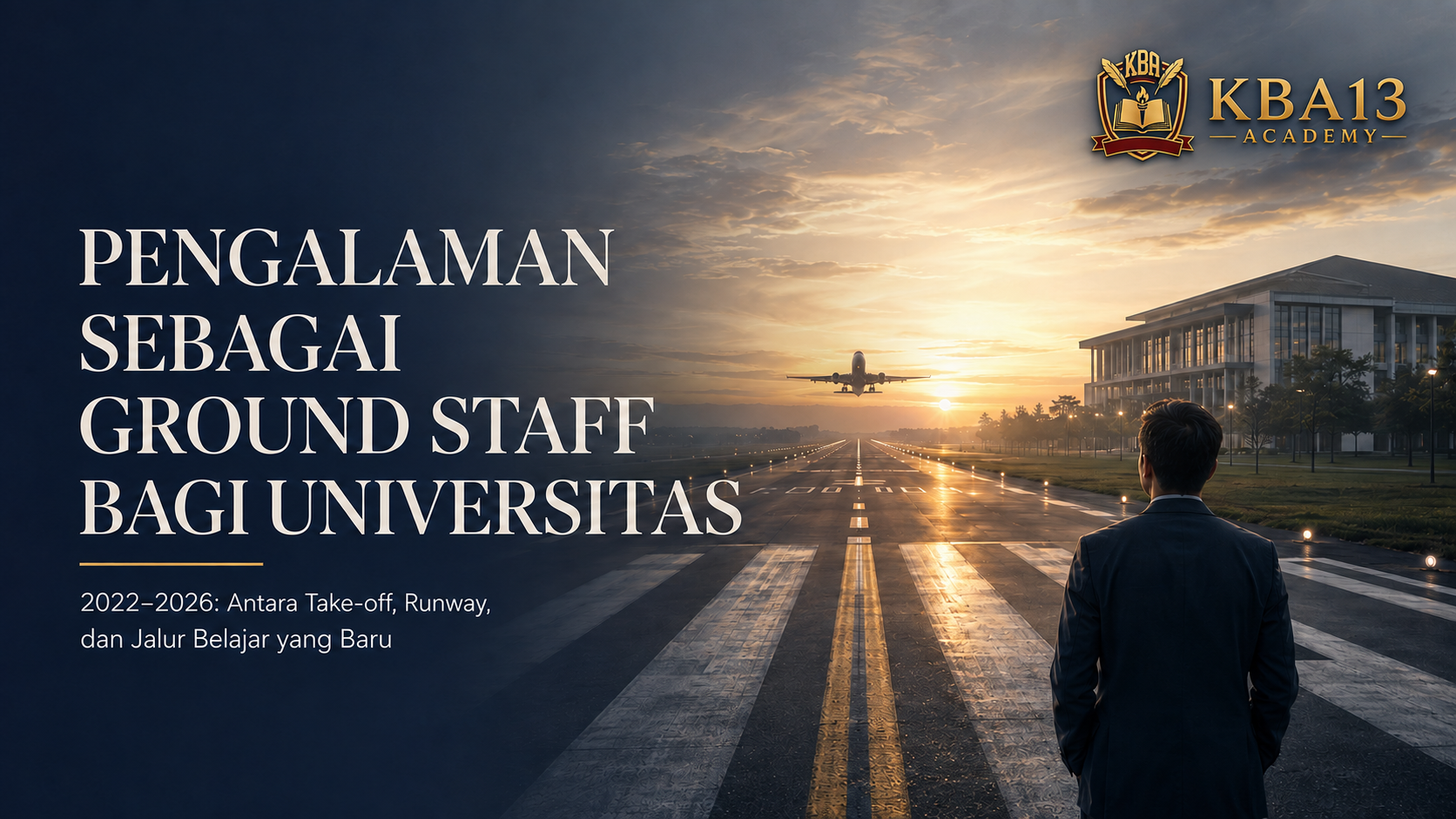
Empat tahun berada di dalam ruang kepemimpinan universitas mengajarkan bahwa tidak semua orang harus berada di kokpit. Sebagian bekerja sebagai ground staff: menyiapkan landasan, menjaga sistem tetap bergerak, dan memastikan institusi dapat melakukan take-off. Esai ini merefleksikan perjalanan tersebut sekaligus jalur belajar baru setelah 2026.
Ringkasan
Empat tahun berada di dalam ruang kepemimpinan universitas mengajarkan bahwa tidak semua orang harus berada di kokpit. Sebagian bekerja sebagai ground staff: menyiapkan landasan, menjaga sistem tetap bergerak, dan memastikan institusi dapat melakukan take-off. Esai ini merefleksikan perjalanan tersebut sekaligus jalur belajar baru setelah 2026.
Kata Kunci
- budaya organisasi
- ground staff universitas
- institusi pendidikan
- Kamaruzzaman Bustamam Ahmad
- karier akademik
- kepemimpinan akademik
- manajemen perguruan tinggi
- pendidikan tinggi
- pengabdian akademik
- pengalaman dekan
Saya memulai periode ini ketika saya memutuskan untuk memetakan ulang peran saya dalam ekosistem pendidikan tinggi. Sejak 2022 hingga 2026, saya berada dalam lingkup kerja yang jarang dipahami publik: menjadi Ground Staff dalam upaya pengembangan UIN Ar-Raniry menuju World Class University. Keputusan ini bukan sekadar ambisi profesional, melainkan pilihan metodologis untuk membaca dinamika institusi. Ketika sebuah universitas ingin bertumbuh ke kelas global, jalannya tidak pernah linier. Ia melewati fase kelelahan, kompromi, perbaikan teknis, koordinasi yang nyaris tak terlihat, dan kerja kolektif yang berulang tanpa jeda. Dalam fase itu, metafora penerbangan menjadi sangat tepat: tidak ada yang menolong institusi hanya dari ruang komando jika runway tidak terbangun dengan disiplin dan ritme.
Selama beberapa tahun terakhir, saya memegang prinsip yang saya pelajari dari praktik panjang sebagai musafir ilmu: ketika sebuah institusi sudah bergerak memasuki fase “take off”, kontribusi saya paling efektif justru berada di luar kokpit. Saya memilih menjadi Ground Staff, baik secara simbolik maupun secara operasional. Pilihan ini bukan karena menyingkir, melainkan karena fungsi ini menuntut kejelian terhadap detail, konsistensi, dan disiplin yang sering kali lebih berat daripada keputusan final di ruang pimpinan. Tugas seperti itu menuntut ketahanan: memastikan sistem berjalan, mengurangi risiko operasional, dan menjaga koordinasi agar energi kolektif tidak terbuang oleh hambatan teknis yang sebenarnya bisa dicegah.
Saya membawa pola kerja ini dari pengalaman di Walailak University, khususnya dalam kerangka kerja yang dipimpin oleh Prof. Dr. Uthai Dulyakassem dan Dr. Patrick Jory. Pengalaman tersebut menguatkan keyakinan bahwa institusi muda, sekalipun dinilai “baru” dalam skala persepsi eksternal, dapat membangun daya tarik akademik jika operasionalnya dirancang dengan cermat dan konsisten. Di situ, agenda internasional bukan sekadar acara seremonial, melainkan instrumen untuk memperkenalkan daya saing intelektual, memperluas jejaring, dan meyakinkan komunitas ilmiah bahwa suatu program memiliki bobot substansial. Regional Studies di Walailak pada masa itu tidak langsung menjadi sorotan karena reputasi nominal semata, tetapi karena kerja sistemik yang terus diulang: promosi yang tidak berhenti, standar layanan yang ditingkatkan, dan ketahanan tim saat menghadapi tekanan. Itulah pelajaran yang sangat konkret: pertumbuhan institusi bermula dari kesiapan dasar yang sering dianggap “administratif”, padahal di sinilah fondasi reputasi dibangun.
Ketika saya kembali masuk ke ranah UIN Ar-Raniry, konteksnya menuntut tingkat adaptasi yang berbeda. Visi World Class University sudah menjadi bagian penting dari arah gerak kampus. Di satu sisi, ini peluang; di sisi lain, ini risiko jika tidak diiringi tata kerja yang kokoh. Saya tidak menerima gagasan bahwa keberhasilan institusi dapat digantungkan pada satu figur saja. Dalam kerangka strategis, kepemimpinan tetap krusial, tetapi pemetaan eksekusi menentukan apakah arah itu benar-benar dipraktikkan. Di titik ini, saya melihat bagaimana Dream Team di UIN Ar-Raniry menciptakan ruang kerja yang relatif sehat untuk bergerak cepat: ada kemauan untuk menyelesaikan isu secara kolektif, ada kapasitas komunikasi internal yang relatif fleksibel, dan ada kemauan untuk tidak membiarkan persoalan menumpuk tanpa batas. Peringkat yang diraih tidak lahir dari kejutan, melainkan dari perhitungan operasional yang dilakukan berulang kali.
Di sisi pengamatan saya, keberhasilan semacam ini memiliki dua dimensi: dimensi struktural dan dimensi manusiawi. Strukturalnya, sistem perlu mengatur aliran tugas secara realistis dari satu titik ke titik lain. Kemuliaan kebijakan akademik banyak ditentukan oleh seberapa baik layanan dasar berjalan: data, jadwal, logistik, layanan akademik, dan kesiapan sumber daya manusia. Dimensi manusiawinya, keberhasilan lahir dari orang-orang yang mengendalikan detail emosi kerja: mereka yang menerima tekanan tinggi, menyelesaikan masalah jam-jam terakhir, dan tetap menjaga standar saat kondisi tidak ideal. Di lingkungan semacam ini, Ground Staff bukan sekadar jabatan, melainkan mekanisme etika kerja yang saling melengkapi.
Metafora pesawat kerap dianggap sekadar hiasan gaya, tetapi saya memanfaatkannya sebagai model untuk analisis manajemen. Saya pernah mengibaratkan diri sebagai Ground Staff yang tidak selalu melihat isi kabin setelah pesawat lepas landas. Sejumlah keputusan operasional memang tidak membutuhkan keterlibatan saya secara langsung di setiap aspek, dan itu menuntut kepercayaan pada sistem. Seperti pesawat yang tetap menghubungi menara hanya saat dibutuhkan untuk menyesuaikan kondisi cuaca, clearance, atau alur pendaratan, lembaga juga membutuhkan titik koordinasi yang tepat waktu: bukan berlebihan, tapi cukup untuk menjaga keselamatan strategis. Kecerdikan institusi tidak diukur dari banyaknya instruksi yang dikeluarkan, tetapi dari kemampuan menyesuaikan keputusan dengan data, kapasitas, dan konteks.
Dalam pengelolaan operasional, detail terlihat biasa tetapi berdampak besar. Ground Staff bekerja dari level paling awal hingga paling akhir: promosi, ticketing, check-in, pemeriksaan kesiapan layanan, dan pemetaan risiko awal. Saya pernah menyaksikan betapa ketenangan di “dapur” operasional justru bergantung pada jam-jam kelelahan yang dipenuhi presisi. Ada staf yang menyiapkan materi, ada staf layanan yang harus memproses kebutuhan dengan cepat, dan ada tim yang memastikan semuanya siap sebelum publik dan komunitas akademik menuntut kejelasan. Saat semuanya berjalan lancar, banyak yang menganggapnya normal. Saat ada yang gagal, dampaknya terasa langsung: ritme kacau, layanan terlambat, dan kepercayaan menurun. Jadi, Ground Staff berfungsi sebagai pengamanan awal terhadap disrupsi kecil yang berpotensi menjadi gangguan besar.
Saya juga ingin menekankan bahwa posisi ini menuntut pemahaman tentang psikologi kerja. Banyak orang menyukai metafora pilot karena terlihat heroik, tetapi jarang menyadari beban etis Ground Staff: menjaga agar sistem tidak melukai pengikutnya sendiri. Pilot masuk ke kokpit ketika pesawat sudah siap. Ia harus menjalankan waktunya dengan ketat karena ratusan nyawa bergantung pada ketepatan arah. Namun, kesiapan itu dibangun dari rantai belakang. Tim layanan tidak meminta pengakuan besar; yang mereka minta justru keteraturan. Ketika sistem sudah baik, banyak hal berjalan tanpa banyak kata. Saat sistem buruk, satu kalimat kecil bisa memicu gejolak. Dalam konteks ini, saya melihat pentingnya budaya yang menghargai orang-orang yang bekerja “di belakang layar” sebagai aktor utama dalam mutu.
Pagi hari di lingkungan kerja lembaga pendidikan tinggi punya cerita sendiri. Para staf layanan bergerak sejak awal jam kerja, menyiapkan ruang, kebersihan, akses, dan kelancaran ritme operasional. Tenaga kependidikan kemudian mengaktifkan sistem kerja, lalu unit pendukung memastikan kesinambungan layanan. Bahkan pekerjaan pendukung seperti kebersihan, keamanan, dan pengelolaan transportasi turut menentukan kualitas operasional harian. Banyak dari mereka menyampaikan satu kata sederhana namun padat makna: “SIAP!”. Kata itu bukan slogan kosong; ia mewakili pola kerja yang memprioritaskan kesiapan di atas klaim formal. Dalam banyak kasus, kerap terjadi paradoks: kontribusi terbesar justru datang dari mereka yang paling jarang disebut.
Pada beberapa kesempatan, saya ditanya bagaimana resep percepatan itu bisa terjadi. Saya menjawab tanpa dramatisasi: karena di sana ada alur tim yang berfungsi. Ada orang yang menyelesaikan masalah sampai larut malam, ada yang menunda urusan keluarga demi tenggat waktu, ada yang menahan liburan demi menyelesaikan agenda kampus. Narasi “siang dan malam” itu bukan puitika romantik, melainkan kenyataan operasional. Di titik ini, saya melihat bahwa capaian institusi memerlukan energi kolektif yang mampu menanggung beban. Ketika kelelahan hadir, keputusan organisasi diuji: apakah struktur kerja mampu menahan tekanan atau justru membiarkan kualitas menurun.
Konteks ini juga membuat saya menentukan batas peran saya sendiri. Saya memilih tetap berada pada posisi Ground Staff, tetapi dengan arah baru. Saya tidak lagi ingin berada dalam struktur Sinergitas yang sama karena saya melihat prioritas akademik dan pengembangan diri jangka panjang harus bergerak ke kanal lain. Perubahan ini lahir dari kehendak untuk tetap berkarya secara berkelanjutan, bukan karena menolak kerja institusional. Saya perlu ruang untuk mengembangkan gagasan secara penuh, sekaligus membangun model pembelajaran yang lebih luas jangkauannya.
Di sinilah KBA13 Academy menjadi langkah konkret. Setelah KBA13 Insight di www.kba13.com berkembang sebagai ruang kajian strategis, ide pendidikan berbasis AI yang lebih adaptif mulai saya bangun. KBA13 Academy saya rancang sebagai ruang belajar yang menempatkan pembelajar sebagai aktor utama, bukan sebagai objek administrasi formal. Konsep ini saya sebut sebagai Free Learning Process. Bukan berarti tanpa disiplin; justru sebaliknya, ia menuntut disiplin baru: pembelajar memilih jalur, mengatur ritme, dan memaksimalkan sumber daya belajar secara lebih mandiri. Sistem yang menuntut gelar, kelas wajib, dan struktur administratif berat tidak selalu menjadi ukuran satu-satunya dari mutu. Dalam banyak kasus, kerangka tersebut justru menutup akses. Saya ingin menghadirkan alternatif yang tetap serius secara intelektual tetapi lebih ringan dalam beban operasional, sehingga pendidikan benar-benar lebih terjangkau dan relevan untuk lebih banyak orang.
Tidak semua orang menyambut model seperti ini secara spontan. Ada respon positif, ada juga bentuk ketidakpastian. Itulah sebabnya saya menempatkan AI sebagai alat bantu yang memperjelas alur, bukan menggantikan nalar manusia. Dalam model KBA13 Academy, AI diposisikan untuk menolong proses akses, sintesis, dan pemetaan pengetahuan, sementara pembaca tetap bertanggung jawab pada penalaran kritis dan pengujian argumen. Di situ, saya tidak memandang AI sebagai otoritas akhir, melainkan instrumen untuk mempercepat pemahaman terhadap isu kompleks. Saya percaya pendekatan seperti ini lebih cocok untuk ekosistem pembelajar di era transformasi, ketika waktu, lokasi, dan sumber daya menjadi variabel utama.
Kawasan pembelajaran di KBA13 Academy juga saya susun berdasarkan ruang kajian yang saya geluti secara konsisten. Saya tampilkan 17 School dalam satu baris supaya pembaca langsung melihat cakupan dan arah pengetahuan yang dijembatani: School of Medical Sciences, School of Artificial Intelligence, School of Intelligence Studies, School of Geopolitics, School of Islamic Civilization, School of Anthropology, School of Public Policy, School of Leadership, School of Digital Civilization, School of Philosophy, Knowledge and Civilization, School of Southeast Asian Studies, School of Peace, Conflict and Security Studies, School of Higher Education, School of Publishing, School of Knowledge Systems, serta School of Futures Studies dan School of Research Methodology. Daftar ini bukan pajangan; ini peta kerja untuk membangun pola pikir lintas disiplin yang terhubung dan tidak berdiri sendiri.
Bentuk kurasi ini juga berkaitan dengan pengalaman saya sebelumnya di ranah akademik dan publikasi. Saya telah mengembangkan Indie Publishing dengan puluhan judul yang tersebar ke kanal pasar internasional dan toko buku internasional. Pengalaman ini menguatkan satu hal: kualitas karya bisa menemukan pembaca ketika ruang yang tepat dijembatani dengan bahasa yang tepat. Banyak karya berbahasa Inggris memperoleh respon dari pembaca di Amerika, Eropa, termasuk Prancis dan Jerman. Sebaliknya, beberapa karya kurang memperoleh ruang di negeri sendiri. Realitas ini bukan untuk mengeluh, melainkan untuk menegaskan bahwa distribusi gagasan tidak selalu sinkron antarwilayah. Kadang gagasan berjalan lebih cepat di satu tempat karena ekosistem penerima, ekosistem literasi, dan pola dialog yang sedang cocok.
Ada aspek lain yang tidak saya ingin tutup. Dalam perjalanan ini saya juga menghadapi bentuk respons yang dingin terhadap beberapa gagasan strategis saya, termasuk karya yang saya rancang sebagai sumbangan intelektual. Namun, saya mengolahnya sebagai pelajaran organisasi dan komunikasi. Jika gagasan baik, kritik bukan ancaman pertama; yang penting adalah bagaimana gagasan itu diuji, disusun ulang, dan dihidupkan dengan bukti serta konteks. Dari situ saya semakin percaya bahwa kerja akademik harus punya ketahanan tidak hanya intelektual, tetapi juga kelembagaan dan publik. Karya yang baik perlu ruang, dan ruang itu kadang lebih lama dibangun dari yang kita perkirakan.
Dalam konteks ini, saya mengambil jarak dari posisi struktural agar kontribusi saya bisa lebih fokus dan konsisten. Bukan berarti menarik diri dari komunitas ilmu, tetapi mengalihkan medan kerja ke jalur yang memberi dampak lebih langsung terhadap pembelajaran. Saya lebih memilih menjadi agen yang menjaga jalur intelektual dalam jangka panjang dibanding menjadi bagian dari satu struktur operasional saja. Dengan demikian, saya bisa menyambung pengalaman di kampus dengan kebutuhan pembelajar luas, baik di dalam negeri maupun internasional, tanpa terkurung pada bentuk kerja yang seragam.
Bagi saya, keputusan ini juga menyentuh aspek etika profesional. Setiap orang punya titik di mana kontribusi terbesar terjadi. Ada waktu untuk berada di dalam struktur, ada waktu untuk menempuh landasan lain. Ketika saya menilai model pengembangan ini paling efektif di tahap ini, saya tidak melihatnya sebagai kegagalan menyesuaikan diri, tetapi sebagai pilihan strategis yang konsisten dengan kapasitas dan aspirasi akademik yang saya bawa. Pada akhirnya, setiap karya dan platform yang saya kembangkan, baik KBA13 Insight maupun KBA13 Academy, lahir dari niat yang sama: memperluas perbincangan keilmuan, memperkokoh daya analitis, dan memperluas akses pendidikan yang bermakna.
Saya tidak menutup mata terhadap fakta bahwa perjalanan institusi tidak pernah berhenti. Seperti penerbangan yang terus bergerak, akan ada turbulensi, perubahan cuaca, dan kendala mesin yang tak terduga. Namun, dalam kerja institusi yang matang, itu semua ditangani melalui kesiapan sistem, bukan sekadar keberanian sesaat. Keteraturan Ground Staff merupakan bentuk etika tersebut. Ketika sistem komunikasi berjalan, ketika keputusan didukung data dan bukan improvisasi semata, ketika tiap unit memahami perannya dalam jaring besar, peluang untuk mencapai sesuatu menjadi lebih terukur dan lebih berkelanjutan.
Momen-momen yang telah saya jalani memberi satu pemahaman yang saya kira penting untuk dibawa oleh para pembelajar dan pengelola pendidikan tinggi: jangan terjebak pada kebanggaan simbolik. Dunia akademik butuh kerja keras di balik layar sama seriusnya dengan visi di depan layar. Bukan orang-orang dengan peran paling terlihat yang selalu menentukan arah; kadang orang-orang yang menjaga runway adalah yang membuat arah itu tetap aman. Saya memilih untuk berdiri di sisi itu.
Bagi saya pribadi, ground staff bukan posisi marjinal. Ia adalah posisi strategis yang menuntut integritas dan ketahanan. Dalam konteks 2022–2026, ini menjadi pengalaman yang amat berharga karena membuka mata terhadap hubungan antara niat baik, tata kerja, dan kapasitas eksekusi. Setelah itu, saya tetap membawa pelajaran ini ke arah baru: membangun sistem pembelajaran yang lebih manusiawi di kancah digital, dan mengawal ekosistem ilmu yang tidak berhenti pada simbol formal.
Dengan demikian, keputusan untuk mengalihkan fokus ke KBA13 Academy dan penguatan ekosistem pengetahuan melalui www.kba13.com dan www.kba13academy.com bukan sekadar langkah karier. Ia adalah lanjutan dari keyakinan yang sama: pendidikan harus tetap bisa direngkuh, tidak menambah beban yang tidak perlu, dan tidak kehilangan daya. Model “berbentuk universitas” tidak harus selalu berarti kelas tatap muka penuh, gelar, atau birokrasi yang panjang. Ia juga bisa berarti jaringan pembelajaran yang menumbuhkan ketajaman, keberanian berpikir, dan kesiapan intelektual lintas isu.
Artikel ini bukan akhir dari perjalanan. Ini adalah penyesuaian posisi. Saya tetap membawa semangat kerja kolektif, tetap menghargai ritme institusi, dan tetap belajar dari setiap fase. Dari runway sekolah ke ruang digital, dari proses operasional ke model pembelajaran terbuka, benang merahnya tetap sama: menjaga kualitas dengan cara yang membuat orang lain bisa bergerak.
Cara Mengutip
Ahmad, Kamaruzzaman Bustamam. (2026). Pengalaman Sebagai Ground Staff bagi Universitas sejak 2022 hingga 2026: Antara Take-off, Runway, dan Jalur Belajar yang Baru. Banda Aceh: KBA13 Insight.
https://www.kba13.com/pengalaman-sebagai-ground-staff-bagi-universitas-sejak-2022-hingga-2026-antara-take-off-runway-dan-jalur-belajar-yang-baru/
Guru Besar Antropologi Agama di UIN Ar-Raniry Banda Aceh. Menulis tentang geopolitik, keamanan dan tata kelola Asia Tenggara, Islam di Dunia Melayu, serta masa depan ilmu pengetahuan.
KBA13 Insight · Intellectual Essays
Serving as Ground Staff for the University, 2022 to 2026:Between Take-off, Runway, and a New Path of Learning
Four years inside the university’s leadership taught me that not everyone has to be in the cockpit. Some work as ground staff: preparing the runway, keeping the system moving, and making sure the institution can take off. This essay reflects on that journey and on a new path of learning after 2026.
Summary
Four years inside the university’s leadership taught me that not everyone has to be in the cockpit. Some work as ground staff: preparing the runway, keeping the system moving, and making sure the institution can take off. This essay reflects on that journey and on a new path of learning after 2026.
Keywords
- organisational culture
- university ground staff
- educational institutions
- Kamaruzzaman Bustamam Ahmad
- academic career
- academic leadership
- higher education management
- higher education
- academic service
- experience as dean
I began this period when I decided to remap my role in the higher education ecosystem. From 2022 to 2026, I worked in a sphere the public rarely understands: serving as Ground Staff in the effort to develop UIN Ar-Raniry into a World Class University. The decision was not merely professional ambition but a methodological choice for reading institutional dynamics. When a university wants to grow to global standing, the path is never linear. It passes through phases of fatigue, compromise, technical repair, almost invisible coordination, and collective work repeated without pause. In that phase, the aviation metaphor is especially apt: no one can help an institution from the command room alone if the runway has not been built with discipline and rhythm.
Over the past few years, I have held to a principle learned from a long practice as a traveller in search of knowledge: when an institution has entered the “take-off” phase, my contribution is most effective outside the cockpit. I chose to become Ground Staff, both symbolically and operationally. The choice was not a stepping aside, but a function that demands attention to detail, consistency and discipline that are often heavier than the final decisions in the leadership room. Such work demands endurance: making sure systems run, reducing operational risk, and keeping coordination intact so that collective energy is not wasted on technical obstacles that could have been prevented.
I brought this way of working from my experience at Walailak University, especially within the framework led by Prof. Dr. Uthai Dulyakassem and Dr. Patrick Jory. That experience strengthened my conviction that a young institution, even one judged “new” in the scale of external perception, can build academic appeal if its operations are designed carefully and consistently. There, international agendas were not mere ceremony but instruments for showcasing intellectual competitiveness, widening networks, and convincing the scholarly community that a programme carried substantive weight. Regional Studies at Walailak at that time did not come into the spotlight because of nominal reputation alone, but because of systemic work repeated over and over: promotion that never stopped, rising service standards, and a team’s resilience under pressure. That is a very concrete lesson: institutional growth begins with basic readiness often dismissed as “administrative”, when in fact this is where the foundation of reputation is laid.
When I returned to UIN Ar-Raniry, the context required a different level of adaptation. The vision of a World Class University had already become an important part of the campus’s direction. On one hand this was an opportunity; on the other, a risk if not accompanied by solid working arrangements. I do not accept the idea that an institution’s success can hang on a single figure. Within a strategic framework, leadership remains crucial, but the mapping of execution determines whether that direction is actually put into practice. At this point, I saw how the Dream Team at UIN Ar-Raniry created a relatively healthy working space for moving quickly: there was a willingness to resolve issues collectively, a relatively flexible capacity for internal communication, and a determination not to let problems pile up indefinitely. The rankings achieved did not arise from surprise, but from operational calculations made again and again.
From where I stood, success of this kind has two dimensions: the structural and the human. Structurally, the system needs to organise the flow of tasks realistically from one point to the next. The merit of academic policy is largely determined by how well basic services run: data, schedules, logistics, academic services, and the readiness of human resources. On the human side, success comes from the people who manage the emotional detail of work: those who absorb heavy pressure, solve problems in the final hours, and maintain standards when conditions are not ideal. In such an environment, Ground Staff is not merely a position but a mechanism of mutually reinforcing work ethics.
The aircraft metaphor is often taken as mere stylistic ornament, but I use it as a model for management analysis. I have likened myself to Ground Staff who do not always see inside the cabin once the plane has taken off. Some operational decisions do not require my direct involvement in every aspect, and that demands trust in the system. Just as an aircraft contacts the tower only when needed to adjust for weather, clearance or landing path, an institution also needs timely points of coordination: not excessive, but enough to maintain strategic safety. An institution’s ingenuity is measured not by the number of instructions issued but by the ability to fit decisions to data, capacity and context.
In operational management, details look ordinary but have great impact. Ground Staff work from the very first stage to the very last: promotion, ticketing, check-in, checking service readiness, and mapping early risks. I have seen how calm in the operational “kitchen” depends on hours of fatigue filled with precision. There are staff who prepare materials, service staff who must process needs quickly, and teams who make sure everything is ready before the public and the academic community demand clarity. When everything runs smoothly, many take it as normal. When something fails, the impact is immediate: rhythm breaks down, services are delayed, and trust declines. Ground Staff thus serve as an early safeguard against small disruptions that could become major disturbances.
I also want to stress that this position demands an understanding of work psychology. Many people like the pilot metaphor because it looks heroic, but rarely recognise the ethical burden of Ground Staff: ensuring the system does not harm its own followers. The pilot enters the cockpit when the aircraft is ready. He must keep strict time because hundreds of lives depend on the accuracy of the course. Yet that readiness is built by the chain behind him. Service teams do not ask for great recognition; what they ask for is order. When the system is good, much runs without many words. When the system is bad, one small sentence can trigger turmoil. In this context, I see the importance of a culture that values those who work “behind the scenes” as key actors in quality.
Mornings in a higher education workplace have their own story. Service staff move from the start of working hours, preparing rooms, cleanliness, access and a smooth operational rhythm. Administrative staff then activate work systems, and support units ensure continuity of service. Even support work such as cleaning, security and transport management helps determine the quality of daily operations. Many of them express one simple but meaningful word: “READY!” That word is not an empty slogan; it represents a way of working that puts readiness above formal claims. In many cases there is a paradox: the greatest contributions come from those least often mentioned.
On several occasions I have been asked what the recipe for that acceleration was. I answer without drama: because there was a team flow that worked. There were people who solved problems late into the night, who postponed family matters for deadlines, who held off holidays to complete campus agendas. The narrative of “day and night” is not romantic poetics but operational reality. At this point, I see that institutional achievement requires collective energy capable of bearing the load. When fatigue arrives, organisational decisions are tested: does the work structure hold under pressure or let quality decline?
This context also led me to define the limits of my own role. I chose to remain in the position of Ground Staff, but with a new direction. I no longer wish to be in the same Synergy structure, because I see that academic priorities and long-term self-development must move to another channel. This change comes from a desire to keep working sustainably, not from a rejection of institutional work. I need space to develop ideas fully, and at the same time to build a model of learning with a wider reach.
This is where KBA13 Academy becomes a concrete step. After KBA13 Insight at www.kba13.com grew into a space for strategic study, I began to build the idea of a more adaptive, AI-based education. I designed KBA13 Academy as a learning space that places learners as the main actors, not as objects of formal administration. I call this concept the Free Learning Process. It does not mean an absence of discipline; on the contrary, it demands a new discipline: learners choose their path, set their rhythm, and make the most of learning resources more independently. Systems that require degrees, compulsory classes and heavy administrative structures are not always the only measure of quality. In many cases, such frameworks actually close off access. I want to offer an alternative that remains intellectually serious but lighter in operational burden, so that education is genuinely more affordable and relevant for more people.
Not everyone welcomes such a model spontaneously. There are positive responses, and there are also forms of uncertainty. That is why I place AI as an aid that clarifies the path, not as a replacement for human reasoning. In the KBA13 Academy model, AI is positioned to help with access, synthesis and the mapping of knowledge, while the reader remains responsible for critical reasoning and the testing of arguments. I do not see AI as the final authority, but as an instrument for accelerating understanding of complex issues. I believe this approach suits the learning ecosystem of an era of transformation, when time, location and resources are the main variables.
The learning areas at KBA13 Academy are also arranged according to the fields of study I have consistently pursued. I present the 17 Schools in a single line so that readers can see at once the scope and direction of the knowledge being bridged: School of Medical Sciences, School of Artificial Intelligence, School of Intelligence Studies, School of Geopolitics, School of Islamic Civilization, School of Anthropology, School of Public Policy, School of Leadership, School of Digital Civilization, School of Philosophy, Knowledge and Civilization, School of Southeast Asian Studies, School of Peace, Conflict and Security Studies, School of Higher Education, School of Publishing, School of Knowledge Systems, as well as School of Futures Studies and School of Research Methodology. This list is not decoration; it is a working map for building interdisciplinary ways of thinking that are connected and do not stand alone.
This form of curation is also connected to my earlier experience in academia and publishing. I have developed Indie Publishing with dozens of titles distributed through international market channels and international bookstores. That experience reinforced one thing: quality work can find readers when the right space is bridged with the right language. Many English-language works have drawn responses from readers in America and Europe, including France and Germany. Conversely, some works have found less room in their own country. This reality is not a cause for complaint but a reminder that the distribution of ideas is not always synchronised across regions. Sometimes ideas travel faster in one place because the receiving ecosystem, the literacy ecosystem and the patterns of dialogue happen to fit.
There is another aspect I do not wish to conceal. On this journey I have also faced cold responses to some of my strategic ideas, including works I designed as intellectual contributions. But I have treated them as lessons in organisation and communication. If an idea is good, criticism is not the first threat; what matters is how the idea is tested, restructured and brought to life with evidence and context. From this I have come to believe ever more firmly that academic work must have resilience that is not only intellectual but also institutional and public. Good work needs space, and that space sometimes takes longer to build than we expect.
In this context, I have taken some distance from structural positions so that my contribution can be more focused and consistent. This does not mean withdrawing from the community of scholarship, but shifting my field of work to a path with a more direct impact on learning. I prefer to be an agent who safeguards an intellectual path over the long term rather than part of a single operational structure. In this way, I can connect my campus experience with the needs of a broad community of learners, both at home and internationally, without being confined to a uniform form of work.
For me, this decision also touches on professional ethics. Everyone has a point at which their greatest contribution occurs. There is a time to be within the structure, and a time to take another runway. When I judge this model of development to be the most effective at this stage, I do not see it as a failure to adapt but as a strategic choice consistent with the capacity and academic aspirations I bring. In the end, every work and platform I have developed, whether KBA13 Insight or KBA13 Academy, is born of the same intention: to broaden scholarly conversation, strengthen analytical power, and widen access to meaningful education.
I do not close my eyes to the fact that an institution’s journey never stops. Like a flight that keeps moving, there will be turbulence, changes in weather and unexpected engine trouble. But in mature institutional work, all of these are handled through system readiness, not mere momentary courage. The orderliness of Ground Staff is a form of that ethic. When communication systems work, when decisions are backed by data rather than improvisation alone, when each unit understands its role in the larger network, the chances of achieving something become more measurable and more sustainable.
The moments I have lived through have given me one understanding that I think is important for learners and managers of higher education to carry: do not be trapped by symbolic pride. The academic world needs hard work behind the scenes as seriously as vision in front of them. It is not always those in the most visible roles who set the direction; sometimes those who keep the runway are the ones who keep that direction safe. I choose to stand on that side.
For me personally, ground staff is not a marginal position. It is a strategic position that demands integrity and resilience. In the context of 2022–2026, it was an extremely valuable experience because it opened my eyes to the relationship between good intentions, working arrangements and the capacity to execute. After that, I carry this lesson in a new direction: building a more humane learning system in the digital arena, and safeguarding an ecosystem of knowledge that does not stop at formal symbols.
Thus, the decision to shift my focus to KBA13 Academy and to strengthening the knowledge ecosystem through www.kba13.com and www.kba13academy.com is not merely a career move. It continues the same conviction: education must remain within reach, must not add unnecessary burdens, and must not lose its power. A “university-shaped” model need not always mean full face-to-face classes, degrees or lengthy bureaucracy. It can also mean a learning network that cultivates sharpness, intellectual courage and readiness across issues.
This article is not the end of the journey. It is an adjustment of position. I still carry the spirit of collective work, still respect the rhythm of institutions, and still learn from every phase. From the campus runway to digital space, from operational processes to open learning models, the common thread remains the same: maintaining quality in a way that enables others to move.
How to Cite
Ahmad, Kamaruzzaman Bustamam. (2026). Pengalaman Sebagai Ground Staff bagi Universitas sejak 2022 hingga 2026: Antara Take-off, Runway, dan Jalur Belajar yang Baru [Serving as Ground Staff for the University, 2022 to 2026: Between Take-off, Runway, and a New Path of Learning]. Banda Aceh: KBA13 Insight.
https://www.kba13.com/pengalaman-sebagai-ground-staff-bagi-universitas-sejak-2022-hingga-2026-antara-take-off-runway-dan-jalur-belajar-yang-baru/
Professor of Religious Anthropology at UIN Ar-Raniry Banda Aceh. He writes on geopolitics, security and governance in Southeast Asia, Islam in the Malay World, and the future of knowledge.
About The Author

- Series · Seri
- KBA13 Insight
- Volume · Number
- Vol. 6, No. 152 (August 2026)
- Cumulative issue · Edisi ke-
- 591
- Reference · Nomor rujukan
KBA13-KI-2026-06-152- Author · Penulis
- Kamaruzzaman Bustamam Ahmad
- Published · Terbit
- 11 August 2026 · updated 30 October 2026
- Section · Rubrik
- Intellectual Essays
- Keywords · Kata kunci
- budaya organisasi, ground staff universitas, institusi pendidikan, Kamaruzzaman Bustamam Ahmad, karier akademik, kepemimpinan akademik, manajemen perguruan tinggi, pendidikan tinggi, pengabdian akademik, pengalaman dekan
- Language · Bahasa
- Bahasa Indonesia
- Length · Panjang
- 5,377 words · ±24 min read
- Publisher · Penerbit
- KBA13 Insight, Banda Aceh, Indonesia
- Permalink
- www.kba13.com/pengalaman-sebagai-ground-staff-bagi-universitas-sejak-2022-hingga-2026-antara-take-off-runway-dan-jalur-belajar-yang-baru/
- How to cite · Cara mengutip
- Kamaruzzaman Bustamam Ahmad. (2026, August 11). Pengalaman Sebagai Ground Staff bagi Universitas sejak 2022 hingga 2026: Antara Take-off, Runway, dan Jalur Belajar yang Baru. KBA13 Insight, 6(152). https://www.kba13.com/pengalaman-sebagai-ground-staff-bagi-universitas-sejak-2022-hingga-2026-antara-take-off-runway-dan-jalur-belajar-yang-baru/
- Rights · Hak cipta
- © 2026 KBA13 Insight. Quotation permitted with full attribution and link.
Artikel Terkait
 Acehnology: Menyelami Kembali Kosmos Pengetahuan dari Tanah Aceh
 Perkembangan Fiqh, Kekuasaan, dan Produksi Pemikiran Hukum Islam
 Modernisasi di Dunia Melayu/Asia Tenggara: Identitas, Agama, dan Arah Masa Depan
 Istanbul: Masyarakat Stress, Eropanisasi, De-Sekularisasi, dan Re-Islamisasi
 Keluarga Post-Modern di Era Digital: Pergeseran Peran, Privasi, dan Implikasi Hukum
Leave a Reply