Introduction
Since their establishment, Indonesia’s State Islamic Higher Education Institutions (PTKIN) have undergone a pronounced evolution in their paradigms of knowledge. By a paradigm of knowledge, I mean the fundamental framework of thought and inquiry through which learning is pursued within PTKIN—above all, the manner in which the Islamic religious sciences engage the modern disciplines. Over the past several decades, a discernible shift has taken place: away from a traditional normative-theological posture and towards the integration of the religious sciences with the modern natural sciences and with the social sciences and humanities. This movement has been marked by the emergence of a succession of new formulations—among them the Islamisation of Knowledge, the Integration of Knowledge, the Interconnection of Knowledge, and, most recently, the Fricativisation of Knowledge. Each arose in response to the pressures of intellectual change and the needs of the ummah, and each advances a distinct conception of the relationship between Islam and science.
The scholarly trajectory of Indonesia’s State Islamic Higher Education Institutions (PTKIN) is inseparable from their institutional metamorphosis from the State Institute for Islamic Studies (IAIN) into the State Islamic University (UIN)[1]. Far from a mere change of nomenclature, this transformation registered a deeper reorientation of vision: what had once been an institution devoted to the traditional study of religion was recast as a comprehensive university embracing the full spectrum of disciplines within an Islamic horizon[2]. Such a reorientation demanded a thoroughgoing reconstruction of the conceptual architecture of knowledge: the religious sciences could no longer be pursued dogmatically in isolation but were obliged to enter into dialogue with the social sciences, the humanities, the natural sciences, and technology. It is for precisely this reason that mapping and analysing the scholarly paradigms now emerging across PTKIN becomes essential to discerning the future course of Islamic higher education.
This essay offers a comprehensive account of the four principal paradigms of knowledge now operative within PTKIN as I have set out elsewhere (2025)[3], namely the paradigms of the Islamization, Integration, Interconnection, and Fricativization of Knowledge. It begins by reconstructing the historical background and theoretical foundations from which these paradigms emerged. Each paradigm is then examined in depth across its ontology (its account of reality), its epistemology (the sources and methods by which knowledge is obtained), its axiology (the ends and value of knowledge), and the symbolism of knowledge it espouses. The discussion further incorporates a critical appraisal of the strengths and weaknesses of each approach, with reference to the thought of the key figures associated with it. A comparison across the paradigms then brings into relief their affinities, their divergences, and their potential complementarities. It closes, finally, with a reflection on the future direction of scholarly development within PTKIN, weighing the practical and philosophical implications of each paradigm for Islamic higher education in the contemporary era.
Theoretical Foundations and Background
The Traditional Paradigm of Knowledge at the Islamic Higher Education Institutions
In the formative years of the Islamic Higher Education Institutions (PTKI)—then constituted as the State Institutes for Islamic Studies (IAIN)—the dominant approach to knowledge was normative-theological. Islamic study was confined to the classical religious sciences (al-ʿulūm al-naqliyyah)—fiqh, tafsīr, ḥadīth, and kalām—with an emphasis on close reading of scripture and doctrine to fortify creed (ʿaqīdah) and the sharīʿah. The principal aims of Islamic higher education in this period were, among others, (1) to prepare religious teachers for the madrasah, (2) to emulate the educational traditions of the Middle East, and (3) to furnish graduates capable of filling posts within the Ministry of Religious Affairs[4]. This pragmatic orientation meant that the classical PTKI curriculum was designed to produce religious specialists ready to teach or to serve as religious functionaries, rather than to cultivate research scholars.
This normative-theological approach bore an unmistakably doctrinal cast: knowledge was treated as a body of sacred truths to be affirmed rather than as something open to critical scrutiny. The production of knowledge tended to revolve around the exegesis of revealed texts and tradition, with little in the way of cross-disciplinary dialogue [5]. Engagement with non-religious disciplines was severely circumscribed; the methods of the social sciences and of modern science scarcely entered the classical PTKI curriculum [6]. The methodological framework in play was wholly internal to religion—uṣūl al-fiqh for law, or the science of tafsīr for Qurʾānic study—drawing on no social theory, anthropology, sociology, or other empirical approach. The specter of “Orientalism”—the study of Islam by Western scholars—was frequently viewed with suspicion, as something liable to compromise the sanctity of the Islamic sciences [7]. The resulting paradigm was accordingly closed and defensive; its central preoccupation was to reinforce religious values and guard the purity of the tradition against outside influence, rather than address contemporary problems through interdisciplinary means.
One consequence of this early paradigm was a pronounced sacralization of knowledge. The religious sciences were regarded as sacred and self-sufficient, detached from any social context. On the credit side, the approach instilled in its graduates a firm grounding in creed and character (ʿaqīdah and akhlāq) and preserved the classical Islamic intellectual tradition. On the debit side, however, a gulf opened between Islamic study and the dynamic realities of society. Religious responses to social problems were often context-specific and insufficiently grounded in empirical research [8]. In other words, the knowledge it produced was largely inward-looking—turned toward the community itself—and offered little by way of solutions to the sociocultural challenges unfolding beyond it.
Transformation: The Advent of the Social Sciences and Humanities
By the 1970s, and even more so in the 1980s, an awareness had begun to crystallize among Indonesian Muslim scholars of the need to transform Islamic study within the PTKI. Several forces propelled this shift: intensifying intellectual contact with the West, the imperative of addressing the nation’s complex problems, and an internal impulse to modernize Islamic education. Many of the new generation of Indonesian Muslim scholars had studied at Western universities or had grown conversant with the literature of the modern social sciences. They began to interrogate the older, purely normative-doctrinal approach and to press for a reading of Islam in its social context. A significant milestone was the founding of progressive scholarly journals such as Ulumul Qurʾan in the late 1980s, which sought to wed textual study to social analysis[9]. Networks of teachers and students widened accordingly, no longer bound to the pesantren and the Middle East but now encompassing mentors and colleagues from secular disciplines, both at home and abroad [10]. This development marked a more intensive encounter between Islamic study and the social sciences.
The Indonesianists, moreover—Western scholars enamored of Indonesian studies—began to take an interest in the intellectual heritage of Islam in the Nusantara[11]. Their scholarship opened fresh perspectives on Indonesian Islam as a rich object of inquiry—in the anthropology of religion, in Islamic politics, and in social history. The effect ran in two directions. On the one hand, their publications lent the study of Indonesian Islam an international lustre (the influence of the West, a transformation in scholarly publishing, and a paradigmatic impact on the field[12]); on the other, local Muslim intellectuals felt challenged to examine their own Nusantara Muslim societies with modern analytical instruments, lest they be left behind. The approach of the social sciences and humanities thus began to take hold. The study of tafsīr and ḥadīth, for instance, was set in historical context and subjected to textual criticism; fiqh came within reach of sociological analysis; and the study of creed and Islamic thought ventured into contemporary philosophy and hermeneutics.
Pioneers such as Harun Nasution, Nurcholish Madjid, and Azyumardi Azra, among others, pressed for a “dialogue” between the religious and the general sciences. The upshot was a genuine rapprochement—a silaturahmi—between Islamic and Western scholarship within the Islamic higher education institutions [13]. The IAIN curriculum was revised to admit general subjects and the methods of empirical research. Students were encouraged to write theses that were not merely normative but analytical and critical. This trend continued and gathered momentum as the IAIN were reconstituted as UIN in the early 2000s. The integration of knowledge became something of a watchword at the various new universities. Each vied to advance its own model for integrating Islam and science, albeit under a diverse array of concepts and labels[14][15].
This transformation, however, did not proceed unopposed. Some traditionalist quarters feared a “secularisation” of knowledge within the PTKI. The accusation that the Islamic campuses had become “nests of Orientalists” surfaced for a time[16] —the fear being that the Islamic campuses were themselves incubating thought too pro-Western and too critical of tradition, much as the Orientalists had once been charged with doing. Even so, the tide of change proved irresistible, driven by the demands of the age: Muslims needed solutions to concrete problems—poverty, injustice, moral crisis, and the like—that mere normative doctrine could not provide. An interdisciplinary approach binding the teachings of Islam to modern science came to seem indispensable if Islam were to be rendered, in concrete terms, a raḥmatan lil-ʿālamīn—a mercy to all the worlds.
It was in this setting that a succession of new paradigms of knowledge arose, each seeking to formulate an ideal relationship between the religious and the modern sciences. The four most prominent—the Islamisation, Integration, Interconnection, and Fricativisation of Knowledge—may be read as a spectrum of approaches running from the most emphatically Islam-centric to the most spirit-centric. The Islamisation of knowledge insists on making Islam the core and the filter of all learning. The Integration of knowledge seeks to fuse the religious and the general sciences within a coherent framework of tawḥīd. The Interconnection of knowledge stresses multidisciplinary and multicultural linkage, guided by a religious ethics. The Fricativisation of knowledge, for its part, is the most recent proposal, one that regards knowledge not as a merely academic construct but as a spiritual resonance that radiates outward and quickens the soul. Each of these paradigms is elaborated in detail below.
The Paradigm of the Islamisation of Knowledge
Concept and Background
The paradigm of the Islamisation of Knowledge is an intellectual movement that emerged in the late 1970s, pioneered among others by Syed Muhammad Naquib al-Attas and Ismāʿīl Rājī al-Fārūqī[17]. At its heart lies the ambition to restore the whole of knowledge to the framework of tawḥīd and Islamic values, purging it of the secular Western elements deemed corrosive. Its proponents hold that the modern sciences developed in the West are saturated with the philosophical prejudices of secularism, materialism, and dualism, all of them at odds with the Islamic worldview. The task of the Muslim scholar, accordingly, is to reformulate every branch of knowledge—social, natural, humanistic, and technological—so as to bring it into accord with creed and the sharīʿah.
In its most concise formulation, the Islamisation of knowledge means integrating the teachings of Islam with the modern disciplines, so that all knowledge and scientific method accord with Islamic principles[18]. The approach insists that ultimate truth issues from divine revelation; any science, then, must be rooted in revelation or, at the very least, must not run counter to it. In Islamization of Knowledge: General Principles and Work Plan (1982), al-Fārūqī laid out a systematic sequence of steps for Islamising the several fields[19][20]. He stressed the need to master the modern disciplines critically, to command the classical Islamic heritage, and then to effect a creative synthesis: sifting Western theories, discarding whatever was judged un-Islamic, and infusing into each discipline such Islamic concepts as tawḥīd, khilāfah, and justice[20]. Al-Fārūqī diagnosed the secularisation of knowledge in the Muslim world as a “malaise of the ummah,” faulting Muslims’ reliance on Western methodologies that so often transgress Islamic ethics[21]. He urged a revitalisation of ijtihād and the practice of scientific method within the bounds of Islamic values, so that Muslims might excel in the sciences without forfeiting their identity[22].
Syed M. Naquib al-Attas of Malaysia furnished the Islamisation of Knowledge with a robust philosophical foundation. Al-Attas held the concepts of tawḥīd and adab—the ethics of knowledge—to be decisive. For him, Islamisation was in essence a de-Westernisation of knowledge: prising it free of the secular Western worldview and re-implanting within it Islamic values and concepts[23]. He described this as a clarification of knowledge—cleansing it of whatever was foreign to Islam and replenishing it with Qurʾānic elements. On al-Attas’s account, the foundational notions—one’s understanding of reality, of truth, of the purpose of life—must all be reoriented in conformity with the teachings of Islam. Darwinian evolution, positivist philosophy, and historical materialism, for instance, call for re-examination insofar as they conflict with Islamic creed. The hoped-for outcome is an “Islamic version” of each discipline—an Islamic psychology, an Islamic sociology, an Islamic economics—purged of Western ideological bias and animated by the values of revelation[24].
The Ontology, Epistemology, and Axiology of the Islamisation Paradigm
Ontologically, the Islamisation paradigm rests upon the oneness of God (tawḥīd) as the foundation of reality. The universe is apprehended as the ordered and meaningful creation of God. No division obtains between the secular and the sacred, since all existence falls within the compass of tawḥīd[25]. Islamic ontology repudiates the Western dichotomy of fact and value; the material world and social phenomena alike are to be read as signs (āyāt) of God’s majesty. The empirical and the spiritual worlds, in other words, compose a single unity subject to the divine will. From this follows the premise that knowledge is not value-neutral but must be bound to the purpose of creation.
Epistemologically, the primary source of knowledge in the Islamization paradigm is revelation—the Qurʾān and the Sunnah—together with a reason that submits to revelation. Knowledge is won through close study of the sacred texts by proper method—the ʿulūm al-Qurʾān, the ʿulūm al-ḥadīth, fiqh, and the rest—and through a disciplined, adab-bound rational inquiry[26]. Reason remains indispensable, yet it must be guided by Islamic adab and the ethics of tawḥīd. On this view God is the source of all knowledge; the revealed sciences (naqliyyah) and the empirical sciences (ʿaqliyyah) are ultimately integrated within a single whole that issues from Him[27]. Whatever is true will in the end concur with revelation, for scientific truth cannot contradict divine truth. The Islamisation epistemology tends to regard modern Western methodology with suspicion, discerning in it a severance of knowledge from religious value. Its advocates fault the positivist and secular epistemology of the West for banishing God from the work of inquiry. They call instead for a reconstruction of epistemology upon the framework of tawḥīd and the classical Islamic intellectual heritage[28]. The work of “Islamisation” often consists in testing modern theories in any field—economics, sociology, physics—against the Qurʾān and ḥadīth: what accords is retained, what conflicts is rejected or revised.
In its axiology—the value and end of knowledge—the Islamization of Knowledge is oriented towards the ummah and the hereafter. Knowledge serves the formation of the Islamic person and the Qurʾānic society [29]. It must, that is, contribute to the cultivation of individual character and faith and to the establishment of a social order faithful to Islamic principles. The end of scholarship is neither knowledge for its own sake nor material gain, but a means of worship and devotion. Within this frame, true knowledge draws humanity nearer to God and fortifies Islamic civilization. The measure of knowledge’s success is accordingly its conformity to Islamic principle and to noble character (akhlāq karīmah)[30]. The paradigm firmly refuses any dichotomy between knowledge and religion; knowledge is not to be practiced apart from faith but precisely to realize faith in action (ʿamal ṣāliḥ). In practical terms, Islamised knowledge at PTKIN is expected to produce scholars of the ulū al-albāb cast—intellectually acute and spiritually devout at once.
Symbolism and the Model of Knowledge
The Islamization paradigm is often figured through the metaphor of the tree of knowledge. Its roots are creed (ʿaqīdah), its trunk the sharīʿah—law and order—and its fruit both character and the applied sciences[31]. The image bespeaks a structure of knowledge firmly rooted in faith (tawḥīd) and the sharīʿah, one that bears the fruit of progress while remaining within ethical bounds. Syed Naquib al-Attas advanced a comparable schema for an integrative ontology of knowledge: ontology takes root in creed (tawḥīd), epistemology rests on the sharīʿah (the method of Islamic scholarship), and axiology aims at the formation of character[32]. Tawḥīd, in short, is the ground; the sharīʿah and sound reason the instrument, and character the ultimate end of knowledge. The tree likewise embodies the notion of “from tawḥīd back to tawḥīd”: the whole course of learning begins in the acknowledgment of God’s oneness and ends in gratitude and a deeper apprehension of Him[33].
An instance of the tree metaphor in practice may be seen at UIN Maulana Malik Ibrahim Malang, which has adopted it as its paradigm of integration. The roots stand for the foundations of the Islamic sciences (creed, Arabic, and the like), the trunk for the general disciplines fortified by religious value, and the fruit for graduates of good character who benefit society[34][35]. Although UIN Malang calls this a paradigm of integration, the conception is in keeping with the spirit of Islamisation: it affirms that every branch of knowledge rests upon the root of tawḥīd.
The Role of the Educator and Implementation
In the Islamisation paradigm, the role of the educator—the lecturer, the ustādh—is central: he is at once guardian and heir of Islamic values. The educator is regarded as the custodian of orthodoxy and the conduit of the revealed sciences to his students[36]. He is no mere purveyor of subject matter but an agent who transmits the Islamic scholarly tradition from one generation to the next. Lecturers at PTKIN must therefore possess a high Islamic integrity, a deep command of the religious sciences, and moral authority. The transmission of knowledge is held inseparable from the transmission of value: what is taught must always be framed in adab and wisdom, so that students imbibe the Islamic spirit along with scholarly content.
The educational orientation here is to render the Islamic university a vessel of total Islamisation. The campus, that is, is not merely a place to study the general sciences patched over with a handful of religious courses, but an environment that instils an Islamic vision of life in its students through and through[37]. The curriculum is so designed that every discipline is Islamised, and academic life—library, laboratory, seminar—is suffused with an Islamic culture.
In practice, the Islamisation of knowledge across the various Islamic campuses has typically involved devising an integrative curriculum (each general course, for instance, given an Islamic perspective), founding centres for the study of Islamisation, publishing “Islamic” textbooks, and adopting campus policies of a sharīʿah cast (a Muslim dress code, a regular calendar of religious observance, and the like). The approach is considered successful when PTKIN graduates command modern disciplines without being uprooted from their Islamic identity and, in the midst of society, become agents of knowledge in the service of daʿwah.
A Critical Assessment of the Islamisation Paradigm
The paradigm of the Islamisation of Knowledge has rendered an important service in recalling the axis of tawḥīd to the pursuit of learning. The idea guards against the ummah losing its identity amid the currents of modern science [38]. Many Islamic institutions worldwide—in Malaysia above all, and several in Indonesia—have been moved to redesign their academic vision in line with an Islamic mission. Yet the approach has drawn a number of criticisms:
- Excessively normative and idealistic, and thus difficult to operationalize within a highly specialized contemporary science. The complaint is that the language of Islamisation often halts at the level of rhetoric, its application in the laboratory or in empirical research remaining obscure. To Islamise quantum physics or molecular biology, for instance, is no simple matter—the effort tends to lapse into appending Qurʾānic verses to existing theories rather than generating new ones[39]. The concrete yield of Islamization in the hard sciences has consequently remained slight.
- The risk of bias and insularity: some critics, Muslims among them, fear that Islamisation may in fact narrow the intellectual horizon. By filtering Western knowledge so severely, the ummah risks closing itself off from the benefits of modern science. A veiled anti-intellectualism may arise—rejecting a well-attested scientific theory merely because it is deemed “Western.” Unchecked, this could impede the advance of knowledge in the Muslim world[38].
- Blurring the boundary between religion and science: other critics observe that conflating the scientific method with religious doctrine can create philosophical difficulties. Science advances by a verifiable empirical method, whereas religion rests on faith in revelation. If not formulated with care, the programme of Islamisation may be charged with politicising religion within science or with over-sacralising knowledge[38]. This may constrain academic freedom and innovation, as scholars grow reluctant to pursue ideas that are “religiously unpopular.”
- The plurality of Islamic interpretation: the Islamisation paradigm tends to presuppose a single, monolithic Islamic order. The interpretation of Islamic principle, however, admits of considerable variety. It has been objected that the discourse of Islamisation is at times dominated by particular groups and may be turned to hegemonise the discourse of knowledge according to their own reading[40][41]. The question of discrimination against non-Muslims or intellectual minorities, for instance, has been tied to an over-zealous implementation of Islamisation in Malaysia[42]. This lay, to be sure, well beyond the founders’ original intent, yet the potential for such distortion is worth recording.
Taken as a whole, the Islamisation of Knowledge represents an important first step in the effort to reconcile faith and knowledge. The paradigm supplies a firm philosophical foundation in adab and tawḥīd[43]. Though its execution still calls for considerable refinement, its intellectual legacy continues to shape the discourse on knowledge integration at PTKIN.
The Paradigm of the Integration of Knowledge
Concept and Background
The paradigm of the Integration of Knowledge at PTKIN arose alongside the reconstitution of the IAIN as UIN from the early 2000s. Where Islamisation lays stress on reconstructing knowledge along Islamic lines, the Integration of Knowledge emphasises the reunion of the religious and the general sciences, long sundered in the history of modern Islamic education. In Indonesia the paradigm was championed by scholars such as Azyumardi Azra and M. Amin Abdullah, who gave it practical form in the development of UIN Syarif Hidayatullah Jakarta and UIN Sunan Kalijaga Yogyakarta[44]. The idea surfaced at other universities under differing metaphors—the “Twin Towers” at UIN Jakarta, the “Tree of Knowledge” at UIN Malang, the “Spider’s Web” at UIN Yogyakarta, the “Wheel of Knowledge” at UIN Bandung, and the like— yet the essence was the same: to bridge the dichotomy between the transmitted (naqlī) and the rational (ʿaqlī) sciences.
Put simply, the integration of knowledge means uniting religious knowledge and science within a single, coherent epistemological framework[45]. Unlike Islamisation, which holds that modern knowledge must be strictly filtered, the integrative approach is more capacious: it grants that the religious and the general sciences draw on different sources of truth while proceeding from one and the same God. The Qurʾān distinguishes the āyāt qawliyyah (the verses of revelation, the divine word) from the āyāt kawniyyah (the signs of the created universe)[46]. The integrative paradigm proceeds from the premise that these two orders of “signs” must be read together if understanding is to be whole. Religious knowledge without science is barren and bereft of context; science without religious value is morally blind. Integration therefore offers a “middle way”: the Muslim scholar must master the modern disciplines and steep himself in the classical Islamic heritage alike, and then wed the two in his academic work.
- Amin Abdullah termed this an “integrative-interconnective approach.” In his Islamic Studies di Perguruan Tinggi: Pendekatan Integratif-Interkonektif (2006), he urged that Islamic study within the university marry contemporary social theory to the values of tawḥīd[47][48]. He faulted the older, dichotomous and atomistic approach and conceived an integrative edifice of knowledge figured as a spider’s web[49]. In this scholarly web the religious sciences occupy a node linked to the social sciences, the natural sciences, and the humanities by threads of ethical and humane connection. Amin Abdullah’s conception is often called integrative theo-anthropocentrism: a fusion of theocentrism, centred on God, and anthropocentrism, centred on the human[49]. Knowledge, that is, is cultivated with a consciousness of the divine and a sensitivity to the human at once. Religion furnishes an ethical and transcendent orientation, while worldly science furnishes empirical data and analysis; the two must interact constructively.
Azyumardi Azra, for his part, stressed the importance of tawāsuṭ—moderation—in integration. As rector of UIN Jakarta he held that the transformation of the IAIN into a UIN must be attended by a new paradigm of knowledge: “the integration of science and religion—interpretation and action”[47]. UIN Jakarta elaborated the concept under the emblem of twin towers: one tower for the religious sciences, the other for the general sciences, both rising side by side upon a shared foundation of tawḥīd. Its central message is that no inherent conflict divides revelation from reason. Conflict between science and religion arises only from a misapprehension of both. Integration is meant to bring forth scientists who command modern science without forfeiting faith, and ʿulamāʾ conversant with science.
The integrative paradigm was also driven by PTKIN’s practical need to broaden its mandate. As the IAIN became UIN, faculties in the general disciplines—the sciences, medicine, economics, and the rest—were opened. To preserve their Islamic identity, the universities had to infuse Islamic values into the teaching of those general subjects. Here lay the field of application for the integrative idea: a biology class at a UIN would also treat the Qurʾānic verses on living creatures; a UIN faculty of economics would likewise teach the principles of the sharīʿah economy, and so forth.
In the spirit of integration, all knowledge is seen to issue from God—the āyāt kawniyyah no less than the āyāt qawliyyah—so that the scholar’s task is to bridge God’s “two books”: the book of scripture and the book of nature[50]. Integration does not mean dissolving everything into a single discipline but achieving an epistemic synchrony: the religious sciences may theorise from empirical data, while the general sciences are given an ethical and spiritual grounding.
The Ontology, Epistemology, and Axiology of the Integration Paradigm
Ontologically, the integrative paradigm recognizes reality in two dimensions: revelation and nature. Both are manifestations of a single, integral divine truth. Reality is understood to divide into the āyāt qawliyyah—the textual reality of the divine, as in the Qurʾān—and the āyāt kawniyyah, the reality of created nature[51]. This division, however, is no absolute dualism but two faces of a single coin, each completing the other. The integrative ontology rejects the Western view that admits only measurable empirical reality, yet equally disowns the denial of empirical reality, as in the ultra-scripturalist stance that repudiates science. In integration, tawḥīd remains the foundational vision: God is the origin of all things[32], so that all reality, physical and metaphysical alike, moves within a harmonious divine orchestra. The universe is studied as a sign pointing to the Transcendent, while revelation is read to lend meaning to natural phenomena. For the integrative paradigm, reality is open and ordered, yet requires the guidance of revelation to be understood in full.
In epistemology, the integrative paradigm adopts a plural approach, conjoining the naqlī (textual) and the ʿaqlī (empirical) methods side by side. Knowledge is drawn from the Qurʾān and the ḥadīth, but also from scientific observation and experiment[52]. Revelation and scientific reason, in other words, serve jointly as sources in the pursuit of truth. In social study, for instance, integration means that the analysis of sociological data rests on Islamic values; in medical fiqh, the scriptural proofs are enriched by the latest medical findings. The paradigm opens itself to Western scientific theory so long as it does not contradict creed[53]. Rather than reject Western concepts out of hand, integration inclines to adapt them: the theory of evolution, for example, may be treated in class with the emphasis that it is God who ordains the evolutionary process, where this is judged not to conflict with the text. The advocates of integration hold that much modern knowledge is in fact neutral and can be quickened with an Islamic spirit. The integrative epistemology is thus complementary: the religious sciences supply vision and purpose, science the ways and means.
An official statement of UIN Maulana Malik Ibrahim Malang describes the integrative epistemology as “eclectic: not merely rational-empirical, but also intuitive, grounded in revelation as the first and foremost source”[54]. This underscores that integration acknowledges the validity of spiritual intuition—inspiration, religious insight—alongside scientific method. This aligns with M. Amin Abdullah’s view, which admits the burhānī (rational-empirical), the bayānī (textual), and the ʿirfānī (spiritual-intuitive) approaches together within Islamic study[55][56]. Integration means the “triangulation” of these three epistemologies within scholarly inquiry.
In its axiology, the integrative paradigm seeks to build a harmony between faith and modern progress[57]. Knowledge is oriented to the welfare of humankind—humane in cast—yet grounded throughout in the values of tawḥīd. Integration is expected to yield scientific innovations that are ethical and disposed towards the social justice enjoined by Islam. Technology, for instance, is developed with regard to Islamic ethics; economic policy follows the Islamic principle of justice. The advancement of the ummah becomes the watchword[58] —that is, knowledge must advance Islamic civilisation so that it can meet the challenges of the age, without sacrificing faith. Values such as honesty, justice, and balance (tawāzun) are infused into the development of knowledge. The criterion of success in integration is balance: knowledge must not estrange one from faith, nor may faith impede the pursuit of knowledge to its utmost. The paradigm seeks a “two-way street” between religion and science, in which each enriches the other rather than subjugating it[59].
Symbolism and the Model of Knowledge
As noted, the several universities each devised their own symbol for the integrative paradigm. Three are especially familiar: the Tree of Knowledge, the Spider’s Web, and the Twin Towers.
- The Tree of Knowledge: UIN Maulana Malik Ibrahim Malang adopted the metaphor of the tree of knowledge as a representation of integration[34][60]. The tree—its roots (the foundations of religion and the language of the Qurʾān), its trunk (integrated knowledge), and its fruit (graduates of good character and competence)—depicts the architecture of an integrative knowledge. The metaphor also stresses organic growth: the religious and the general sciences intertwine like a great and sturdy tree that bears fruit without ceasing. A strong root of tawḥīd, a sturdy trunk of knowledge, and fruit of benefit to the ummah—this is the philosophical core of integration at UIN Malang[61][60]. The image of the tree of knowledge is often displayed in campus documents as a reminder of the integrative vision.
- The Spider’s Web: this metaphor was introduced by M. Amin Abdullah at UIN Sunan Kalijaga Yogyakarta. The web schema depicts a broad and interconnected network of knowledge[62]. In this schema the nodes of the web represent the several disciplines (Islamic studies, the natural sciences, the social sciences, the humanities), while the connecting threads represent ethical value, the principle of tawḥīd, and an integrative methodology. The theo-anthropocentric, integralist horizon of knowledge is visualised as a web in which religion forms the ethical centre binding the other sciences together[49]. The model affirms the multicultural and transdisciplinary character of the integrative-interconnective paradigm[63]. Knowledge from many fields can interact within a “shared space” without any of them losing its own identity, so long as all are bound by a consciousness of God and of humanity.
- The Twin Towers: though it appears on none of Kamaruzzaman’s slides, this model is well known at UIN Syarif Hidayatullah Jakarta. The two towers stand for the two poles of knowledge—the religious and the general sciences—raised side by side. Their foundation is one (tawḥīd), and their summits meet in a single end: welfare and the good pleasure of God. The conception shows the religious and the general sciences to be pursued in parallel and in mutual support. A student may take the general sciences as high as they will go, as high as the tower itself, yet in the other tower continues to deepen the religious sciences. Neither may be left to limp: double excellence.
For all their differences of image, these metaphors convey the same essential message: integration means harmonising the two sources of knowledge, revelation and nature[64]. The paired representation of the āyāt qawliyyah and the āyāt kawniyyah stands at the very centre of this paradigm.
The Role of the Educator and Implementation
In the integrative paradigm the lecturer’s role shifts from mere purveyor of dogma to a bridge between two realms of knowledge. The lecturer is expected to serve as the link between two sources of knowledge—revelation and empirical evidence[65]. He must be able to follow modern developments and command scientific method while possessing a firm grounding in Islamic theology. He functions as a kind of integrative mediator: teaching sociology, he ties sociological concepts to Qurʾānic values; expounding the social verses of scripture, he draws on current research data.
The integrative paradigm also encourages team teaching and cross-disciplinary collaboration. Aware that no single person can readily master every field, the integrative method sometimes proceeds by team: a specialist in religion in dialogue with a specialist in science, whether in teaching or in research. Educators are likewise required to go on learning—lifelong learning—so as not to fall behind in either domain.
On the pedagogical side, the integrative approach is evident in a curriculum that unites the religious and general sciences. In practice: at a UIN, a general program such as Biology will ordinarily require additional religious courses (the thematic study of the Qurʾān and ḥadīth), while a religious program such as Qurʾānic Exegesis and ḥadīth is required to allot a share to supporting general subjects (the methodology of social research, statistics). The aim is that UIN graduates should command two competences at once: professional competence in their field and a sound understanding of religion.
Beyond this, integration at PTKIN is realised through integrative research. Many campuses encourage undergraduate, master’s, and doctoral topics that examine current problems through a religious lens. A thesis on the concept of gender justice, for example, is studied from the perspectives of fiqh and sociology together. Centres for the study of integration have also been founded—the Centre for the Study of the Integration of Science and Islam, for instance. Some universities even maintain a dedicated unit to keep the vision alive (the Integration Support Unit at UIN Malang, say, embracing the maʿhad, the campus mosque, and the like, to sustain an integrative atmosphere[66]).
The orientation of an integrative education may be formulated as an Islamic education integrated with modern science[67]. Graduates, that is, are expected to live in two worlds—the world of global science and the world of Islamic faith—without inner conflict. On the macro scale, the integrative paradigm aims to “advance the ummah”—to close the gap in science and technology while preserving religious identity. This accords with the UIN Malang motto, “Begin with the Basmalah, end with the Ḥamdalah”[68][69], signifying that every academic act begins with a sacred intention (the basmalah) and ends in gratitude (the ḥamdalah), as Islam enjoins.
A Critical Assessment of the Integration Paradigm
The paradigm of the integration of knowledge has met with relatively wide acceptance across PTKIN, being regarded as a moderate solution. It answers the old dichotomy of “religious versus secular knowledge” by offering a productive synthesis. Many judge that integration has succeeded in remaking the face of the Islamic campus, making it more inclusive and progressive [2][70]. Several criticisms and challenges, nonetheless, deserve notice:
- Conceptual versus practical implementation: one criticism holds that integration often halts at the level of slogan. Every UIN claims an integrative paradigm, yet at the faculty level, its implementation is often a source of confusion. A 2019 study at UIN Ar-Raniry in Aceh and UIN Sumatera Utara found that, although both campuses espoused a model of integration (UIN Ar-Raniry even used the term “Fricativisation of Knowledge” for its integrative model), many lecturers had no definite grasp of the concept, so that the integrative model had yet to play an effective part in the educational process[71][72]. This points to the need for a more tangible dissemination and operationalization of the integrative concept.
- Too pragmatic: the integrative paradigm is sometimes faulted as overly compromising and pragmatic [73]. In the pursuit of parity between religious and scientific knowledge, there is a fear that transcendent values are shorn of their depth. To teach tawḥīd, for instance, merely by inserting it in passing into a physics lecture leaves religious understanding shallow. Integration may thus slide into a mere “appending of verses” to science, devoid of substance. This is dangerous, for it diminishes both religion and science alike.
- Insufficiently critical of Western epistemology: unlike Islamisation, with its sharp critical edge, integration inclines to accommodate Western theory. Critics contend that the integration of knowledge is too blunt in its challenge to the ideology of modern science[74]. It may, for example, accept capitalist economic theory and simply affix a sharīʿah label, without dismantling the structural inequities of capitalism itself. Integration is thus deemed insufficiently radical in confronting Western epistemic hegemony, its product liable to be no more than an “Islamic version of the status quo,” without fundamental change.
- Methodological challenges: to apply integration often requires an intricate interdisciplinary methodology. Collaboration across fields does not always run smoothly, given divergences of terminology, approach, and scholarly tradition. It demands extra labour of lecturer and student alike genuinely to master two domains of knowledge. Many UIN students are burdened with religious and general credits at once and are expected to excel in both, while lecturers too must widen their competence. Here lies a challenge of human resources and of time. Without support, integration can amount to no more than an added burden, yielding no new scholarly quality.
- Evaluating success: how is the success of integration to be measured? By the emergence of new sciences? By better graduates? The matter remains in dispute. Some successes are visible—the emergence of distinctive programmes (Islamic Banking, the Law of the Sharīʿah Economy, Science and the Qurʾān, and the like), or integrative journals. Their quality, however, remains uneven. It is objected that the operationalization of integration is often vague, and that its broad vision has yet to answer the technical particulars of the laboratory or the classroom [75].
It should be noted that the integrative paradigm, though more concrete than Islamisation, remains a “work in progress” at PTKIN. Philosophically, integration has succeeded in affirming the unity of the source of knowledge in God and in opening the door to Western theory[53][76]. Practically, it calls for sustained development. The findings of various studies indicate a need to strengthen the strategy and integration model, lest it remain mere jargon. In any event, the integration of knowledge has brought positive change: PTKIN graduates are now more adaptable to the movement of the age without abandoning religious value[77].
The Paradigm of the Interconnection of Knowledge
Concept and Background
The paradigm of the interconnection of knowledge is, at bottom, an extension of the integrative paradigm, with a firmer accent on the multidisciplinary, the contextual, and the humanistic. The term “interconnection” was popularised by M. Amin Abdullah in his attempt to articulate the model of scholarly integration at UIN Sunan Kalijaga Yogyakarta. Where integration stresses the union of the religious and the general sciences, interconnection stresses a comprehensive network among all the sciences—not only between religion and science, but also among all fields in mutual dialogue. The paradigm holds that, in the present age of knowledge, a siloed approach—each discipline sealed in its own compartment—will no longer serve; real problems are complex, and demand interconnected, cross-disciplinary perspectives.
Interconnection is also frequently bound up with the spirit of multiculturalism and with the theo-anthropocentrism already noted. M. Amin Abdullah underscored that knowledge at PTKIN must embrace the plural dimensions of society and culture. To study Islam, for instance, is necessarily to draw on anthropology, sociology, history, and other disciplines, for the practice of Islam in society is richly various. Conversely, the social sciences themselves require interconnection with religious value if they are not to prove reductionist. The interconnection paradigm thus seeks to integrate religious, human, and natural insight within a single, whole network[78].
The paradigm is distinguished by its use of a hermeneutic and transdisciplinary approach. Amin Abdullah invited Muslim scholars to adopt a “socio-cultural hermeneutics” in the study of Islam[79]. That is, to understand religious text and tradition with due regard for social context (by way of social theory), and in dialogue with other disciplines. Religion is placed at the ethical heart of the dialogue among the sciences[80], not as the sole source of knowledge, as in Islamisation, but as the giver of moral orientation.
The interconnection paradigm likewise emphasises an interdisciplinary approach and a plurality of sources. Beyond revelation and reason, cultural and local experience is treated as a valuable source of knowledge[81]. In the formulation of knowledge, then, local wisdom, interreligious dialogue, and universal transcendent values are all accorded their worth. Interconnection opens a wider space than integration: not only the integration of Islam with Western science, but the integration of Islam with the local cultures of the Nusantara, with the scholarly traditions of other religions, and so forth.
Ontologically, the paradigm regards reality as plural and interrelational[82]. No single discipline may claim to command reality in full. Human reality in particular is understood as profoundly complex—material, social, and spiritual at once. A “scholarly spider’s web,” accordingly, is required to address it. Each discipline holds a particular node of explanation, and all must be linked to one another if the larger reality is to be mapped.
The interconnection of knowledge arose, too, as a response to the fragmentation of knowledge in the modern world. Many scholars have come to sense the danger of a narrow specialisation that neglects moral and social implication. The paradigm asks that scholars across fields learn from one another: the technologist must study religious ethics, and the religious scholar must become literate in science and technology. Within PTKIN, the interconnection paradigm seeks to ensure that graduates are neither adept in religion yet lost before reality, nor accomplished in science yet hollow of conscience.
A key figure besides Amin Abdullah is another Indonesian scholar, Kuntowijoyo—who, though not of PTKIN, formulated the concept of a “Prophetic Social Science” consonant with the spirit of interconnection: joining the social sciences to prophetic value. At the global level, moreover, the paradigm accords with the trend towards “integrative knowledge,” or “consilience,” the effort to stitch the branches of learning back into a whole. The difference is that at PTKIN the infusion of spiritual value remains the central agenda.
The Ontology, Epistemology, and Axiology of the Interconnection Paradigm
Ontologically, the interconnection paradigm sees reality as multicultural, complex, and interrelational[82]. Multicultural, in that social reality comprises a range of cultural and religious backgrounds, each of which bears meaning. Complex, in that it cannot be reduced to any single point of view. Interrelational, in that every facet of reality bears upon every other—economy with culture, science with morality, and so forth. This ontology refuses the simplistic view. Poverty, for instance, is no mere matter of economics but is bound up with culture, ethics, and political policy. Religiosity, likewise, is not solely a matter of worship but is tied to social conditions and education. To understand reality, therefore, requires many lenses at once. Ontologically, too, the paradigm is theo-anthropocentric, placing God and the human at the centre of existence[63]. That is, reality is viewed through the God–human relation: God as the creator of all that is, and the human as the subject who confers meaning and value. What interconnection studies, in other words, is not an inert, neutral object but reality as it is lived by human beings within a divine frame.
In epistemology, the paradigm emphasises a networking of knowledge that is hermeneutic and contextual[83]. Knowledge, that is, is won through interdisciplinary dialogue attentive to context. The hermeneutic method of interpretation is given pride of place in bridging text and context, theory and field data. The qualitative-critical approach is prized no less than the quantitative-positivist. The sources of knowledge in interconnection are not scripture and reason alone but also empirical experience, cross-disciplinary dialogue, and local values[81]. In research, for example, an interconnective scholar might marshal anthropological data, interviews with religious figures, the exegesis of scripture, and modern sociological theory at once to arrive at a whole picture. There is no rigid hierarchy of “higher” and “lower” knowledge; all enrich one another.
This epistemology also fosters critical reflection: knowledge is continually re-examined within its social context. Unlike Islamisation, which tends to the normative, or integration, which is often content merely to describe, interconnection would have knowledge lay bare the relations of power that lie behind it. In studying the fiqh of polygamy, for instance, the interconnective approach would attend to historical context, the patriarchal structure of society, and the interpretations of the ʿulamāʾ—textual proof alone will not suffice. A more critical and comprehensive understanding is the result.
The axiology of the interconnection paradigm lays heavy stress on humanity and social harmony. Knowledge is directed towards a plural society that is harmonious, just, and dignified[84]. The value of tawḥīd remains the moral ground, yet is now articulated in an inclusive spirit and a universal ethics. Knowledge at PTKIN, for instance, must be able to sustain interreligious dialogue, peace, and sustainable development. Diversity is held to be a sunnat Allāh, to be served by knowledge rather than effaced. The success of knowledge is measured, in part, by its social relevance: how far research and teaching at PTKIN answer to questions of multiculturalism, human rights, and the environment, in keeping with a religious ethics[85].
Axiologically, the paradigm also espouses the values of justice and liberation. There is an affinity here with the epistemology of Latin American liberation theology, however different the context. In essence, knowledge must side with the weak and challenge the structures of oppression. Interconnection, accordingly, does not shrink from critical theory—a Marxian approach in social study, say—provided it is tempered by the ethics of tawḥīd, lest it turn purely secularist[47]. The theo-anthropocentric value demands that the transcendent—God and faith—be actualised in the immanent: the welfare of humankind in this world.
Symbolism and the Model of Knowledge
The spider’s web already described is in truth the principal symbol of the interconnection paradigm. As we have seen, the web schema embodies a broad horizon of knowledge, one that is anything but myopic[86]. At the heart of the web idea is that there is no single centre but many—it is polycentric. Yet every node is joined by threads, figuring a spirit of de-differentiation—the dissolving of the boundaries between disciplines[87].
Besides the spider’s web, Kamaruzzaman B. Ahmad speaks of “the spider’s web: the mutual networking of the social, natural, and religious sciences” as a representational model of interconnection[88]. This underscores that no science stands in isolation.
Other universities have their own icons: UIN Antasari Banjarmasin, for instance, introduced the metaphor of a “river of knowledge,” in which the several streams of learning empty into the ocean of tawḥīd—an image, again, close to the idea of interconnection. All, in the end, illustrate connectedness.
The central symbol of interconnection, one might say, is the network and the dialogue. There is no single symbol as potent as the tree or the tower; the symbol, rather, is connectedness itself. This accords with the philosophy that “knowledge is a network, interconnected across disciplines and values”[89]. Concrete representations on campus include a great painted web upon a wall at UIN Yogyakarta and, at UIN Bandung, a sculpted “Wheel” signifying the interconnection of the parts, and so on.
The Role of the Educator and Implementation
In the interconnection paradigm the teacher’s role grows more complex: not merely a guardian of value or a link between two sources, but a kind of facilitator of cross-disciplinary dialogue. The lecturer should ideally be an integrative mediator, able to orchestrate a range of perspectives in the classroom[65]. He is expected to spur his students to think holistically: in addressing a social problem, the interconnective lecturer leads them to weigh its religious, economic, and cultural facets at once.
The lecturer also has a part in grounding religion in contemporary discourse—linking the ethical teachings of Islam to the global concept of human rights, say, or the Islamic idea of social justice to modern theories of economic development. The lecturer of this paradigm is no enemy of Western theory; on the contrary, he is adept at bringing it into dialogue with the Islamic heritage. He is, in a sense, a boundary spanner between domains of knowledge.
An education framed by the interconnective paradigm is marked by a transdisciplinary curriculum. Some programmes have begun to be designed as area or thematic studies drawing on several disciplines at once. Middle Eastern Studies at a UIN, for instance, brings together history, politics, economics, and religion. There are integrative courses too—“Islam and Science,” or “The Methodology of Interdisciplinary Study” at the postgraduate level.
Interconnection shows itself, further, in the proliferation of collaborative research across faculties. A project on religious moderation, for example, brings an exegete together with a sociologist. The paradigm encourages research that crosses sectors: a sharīʿah lecturer may join a science lecturer to investigate halal food, and so on.
The orientation of an interconnective education is multicultural as well: the campus is urged to open itself to varied backgrounds, to cultivate tolerance, and the like.[90]. This is evident in PTKIN’s effort to mainstream religious moderation in the curriculum and in student activities that embrace diversity.
A Critical Assessment of the Interconnection Paradigm
As an approach, the interconnection of knowledge is decidedly progressive and in step with the temper of twenty-first-century science. It promises breadth of vision and a capacity for synthesis. Even so, several criticisms and limitations deserve notice:
- Abstract and hard to measure: because its scope is broad and its cast philosophical, the interconnection paradigm is regarded as a grand idea whose operationalisation is often obscure[75]. It is no easy matter to judge when the “interconnective” has succeeded. Does an interdisciplinary timbre suffice? Or must there be tangible policy outcomes? The indicators remain unclear. Moreover, preparing a curriculum and a faculty for genuine interconnection demands fundamental change in the long-standing compartmentalized structure of faculties and departments. Bureaucratic resistance may impede the full realisation of interconnection.
- A need for Renaissance minds: interconnection calls for scholars of many parts—at home in diverse fields and steeped in spiritual value besides. This approaches the ideal of the Renaissance polymath. In reality, the prevailing system of education produces specialists. To train lecturers and students to range across disciplines is therefore a formidable undertaking. It requires a collaborative learning environment, a research infrastructure, and perhaps a change in the recruitment of lecturers, no longer drawn from a single disciplinary background. Without these, interconnection may run only along the surface—the rhetoric of “let us converse,” while in practice each still goes his own way.
- Epistemological challenges: to join different methodologies requires a new epistemological framework. Amin Abdullah offers an integrative theo-anthropocentrism, but the development of its concrete methodology remains a matter of exploration. Does a mixed-method approach suffice, for instance? Or a transdisciplinary hermeneutics? Many interdisciplinary methodologies are still being developed—Islamic indigenisation, ethnographic theology, and the like. Critics observe that interconnection has yet to dissect the relations of epistemic and symbolic power with sufficient edge[91]. That is, for all its critical spirit, the analysis of the power of knowledge—Western dominance, say—is often left unexcavated, perhaps because its aim is to unite rather than to confront.
- A need for institutional support: for the interconnection paradigm to be truly realised, PTKIN must reform its compartmentalised structures. It must facilitate team teaching across faculties, funding schemes for collaborative research, and career assessment that rewards interdisciplinary publication, among other measures. Otherwise the impulse to interconnection will rest on a mere handful of thinkers, without institutionalisation. The paradigm remains relatively new and symbolic, and calls for further methodological and institutional exploration if it is to be proved in practice[92].
Taken as a whole, the interconnection of knowledge widens the horizon of integration into a transdisciplinary and inclusively humane dimension[93]. The paradigm answers to the needs of modern education, which demand collaboration and innovation across fields. If integration is a bridge between two hills—religion and science—interconnection is a network of highways joining the many cities of knowledge. The paradigm’s success will depend greatly on the creativity and openness of PTKIN’s own academic community in innovating.
The Paradigm of the Fricativisation of Knowledge
Concept and Background
The paradigm of the Fricativisation of Knowledge is a recent proposal of my own [94]. It may be called a “radical leap” in the scholarly discourse of PTKIN, for it offers a vantage that is methodologically and ontologically distinct. The term “fricativisation” derives from fricative—in linguistics, a sound produced by the friction of breath forced through a narrow aperture (the sounds “s” and “f,” for example). I apply this metaphor to knowledge, drawing on an Acehnese tradition: the sua (the torch) and the breath that stirs it. Knowledge, in essence, is seen as something breathed forth, not merely transmitted or constructed.
The fricativisation paradigm was born of a disquiet: that for all the efforts at integration and interconnection, a spiritual dimension had gone insufficiently addressed[95]. I observe that, amid the collision of paradigms—Islamisation, integration, interconnection—the scholarly climate of PTKIN remains predominantly intellectualist, wanting in living spiritual breath[96]. I therefore propose a fourth path, one that conceives knowledge as a cosmic radiance that may flare or gutter according to the “epistemic breath” of its recipient[97].
Knowledge, that is, is no mere assemblage of theory or text but an inward resonance. The acquisition of knowledge is not reading or observation alone but a kind of apprehension of the divine vibration through silence, intuition, and spiritual experience[98]. The conception owes much to the tradition of taṣawwuf, in which knowledge may be attained through kashf—an inward unveiling—as well as through outward study. One might say that the fricativisation paradigm is not merely a method but a maqām—a spiritual station[99]. The approach, that is, demands a certain spiritual condition: knowledge is breathed into the one who is spiritually ready, as the angel Gabriel breathed forth revelation, or as the torch (sua) takes flame when blown upon with the right intention and spirit[100].
The paradigm was born, too, of an Acehnese Sufi reflection. The sua, the distinctive Acehnese torch, becomes its symbol: the torch gives light, yet it may be quenched by an ill wind or made to blaze when blown upon aright. So it is with knowledge: knowledge is a light within the soul, able to illumine and guide or to extinguish and mislead, according to the intention, the adab, and the spiritual quality of the one who receives it[101][102]. One may call this the “epistemic breath”: the manner in which one approaches knowledge, the inward disposition one brings to it, determines whether it proves a blessing or a bane[103].
The fricativisation paradigm does not reject integration or interconnection but completes them with a spiritual depth. It serves as a reminder: knowledge that has been Islamised, integrated, and interconnected may yet remain arid if it fails to quicken the soul. Fricativisation therefore calls for a return to spiritual practice: dhikr, tafakkur, and deep contemplation as integral to the work of inquiry[104]. This may be linked to the tradition of ʿilm ladunī—knowledge bestowed directly by God—within the Islamic heritage, or to the notion of an ʿirfānī epistemology, the spiritually gnostic, acknowledged in Islamic philosophy.
As I have written, the paradigm was born “of a profound spiritual experience, of emotional engagement, and of an awareness of silence as the place where knowledge discloses itself”[105]. It is thus no merely theoretical construct but the fruit of the author’s Sufi meditation on the present condition of knowledge.
The Ontology, Epistemology, and Axiology of the Fricativisation Paradigm
Ontologically, the fricativisation paradigm apprehends reality as an emanation of the divine Light, forever in motion and in vibration[106]. Reality is no static entity but a ceaseless process of radiation from God. All existence is in essence the Nūr, the light, of God, after the manner of the doctrine of waḥdat al-wujūd, the unity of being in Sufism. This ontology refuses any rigid division between the āyāt qawliyyah and the āyāt kawniyyah; both are seen as the resonance of a single divine frequency pervading the whole of creation[107]. Nature and revelation alike, that is, are manifestations of the divine Light, differing only in their medium. More radically still, reality is a divine vibration—the cosmos trembles with the kun fayakūn, the divine command “Be!” that reverberates without end. On this view, knowledge is not the human effort to comprehend an external reality but to catch the divine vibration within it.
The fricative ontology is plainly indebted to the Sufi vision that God is the light of the heavens and the earth (the Verse of Light, al-Nūr), and that the believer’s heart may catch a spark of that light. Knowledge is thus held to be a spiritual radiance—not data and theory alone, but a nūr that illumines the heart[108]. The conception draws the spiritual dimension into the very centre of the definition of reality.
The epistemology of the fricative paradigm may be summed up as “from silence towards light”[109]. Knowledge is born of an inward silence, where divine inspiration arrives as a breath. Silence, then, is the foundational epistemic ground[110]. Before learning from books, that is, one would do well to prepare the soul through meditation, dhikr, or prayer. It is in that silence that tajallī occurs—a spiritual manifestation within consciousness[111]. Fricativisation refuses the dichotomy of text and context, for the two are but a single voice that the soul must apprehend[112]. Knowledge grows not from data alone but from a contemplation that awakens[111]. The fricative method, in the end, is not mere quantification or deductive logic but tajallī, a kind of spiritual illumination within the inquirer[111].
This epistemology is, to be sure, unusual in modern science; yet I would have the scientific paradigm enlarged. The lecturer should be not a mere filler of blackboards but a “breather of consciousness”[113]. The student, too, is not a mere recipient of information but a receiver of light who actively illumines himself and those around him[113]. This is a lofty idealism: learning is conceived as a shared session of dhikr, in which knowledge passes through the vibration of spirit and the inward example of the teacher, and not through content alone.
Axiologically, fricativisation locates the end of knowledge in the awakening of cosmic consciousness and in inward transformation[114]. Knowledge must be able to kindle the spirit and draw the soul nearer to God[114]. The measure of knowledge’s success is thus not publication or technological product alone, but whether the human heart grows more enlightened, its morality elevated, its spirituality deepened. This redefines the usefulness of knowledge by an inward criterion. True knowledge brings forth a person who is wise, serene, and full of love—for such a one is joined to the Source. False knowledge, by contrast—or knowledge misused—can quench the inner light, breeding arrogance or ruin. The orientation of education shifts accordingly: the classroom is no longer a mere transmission of knowledge but a maqām, a space of dhikr, and a process of tajallī[115].
This axiology, to be sure, does not forsake social value. Fricativisation still supposes that inner resonance will bear fruit in a social ethics: one whose soul is enlightened will care for his environment and act justly. Only, the point of departure runs from within outward—mend the inner life, and outward works will follow. It is a kind of inside-out approach to the advancement of civilisation.
Symbolism and the Model of Knowledge
The fricativisation paradigm has a symbol of its own, fusing a cosmic element with the local tradition of Aceh. I take “the Torch (sua) and the Breath” as my metaphor[102]. The torch figures knowledge as light. the breath, the spiritual force that may kindle that light or quench it[102]. The torch, it is said, may flare or die by intention, by spirit, or by inward will[102]. The image captures the idea exactly: knowledge depends utterly on the quality of the seeker’s intention and inner life.
Besides the torch, there is the notion of the fricative sound and of dhikr. “Knowledge as spiritual vibration—dhikr, the fricative sound, a light that illumines the soul or is blown out”[116]. The fricative sound here is, for instance, the “hsss” or “fff” which in the tradition of dhikr is reflected in the utterance of “Allāh,” breathed out as an “hh.” This sound figures the living breath of knowledge—that knowledge lives in the pulse of dhikr and of spirituality. When one learns in a state of remembrance of God, knowledge comes attended by a divine breath (the rūḥ al-qudus) that quickens meaning. Learn with a wrong intention, by contrast, and dhikr departs: knowledge dies, and is snuffed out.
In Acehnese culture the sua is bound up, too, with traditional ceremonies in which a torch is lit as a symbol of enlightenment. I take it up as a symbol of a spiritual cosmology: the angel Gabriel breathed revelation into the Prophet, and Isrāfīl will blow the trumpet at the end of days—all by the agency of a breath. This betokens the power of the divine vibration to bestow life or to end it. So it is figured with knowledge: it may be a cosmic breath that illumines the human interior or destroys it, according to the epistemic breath that underlies its use[117].
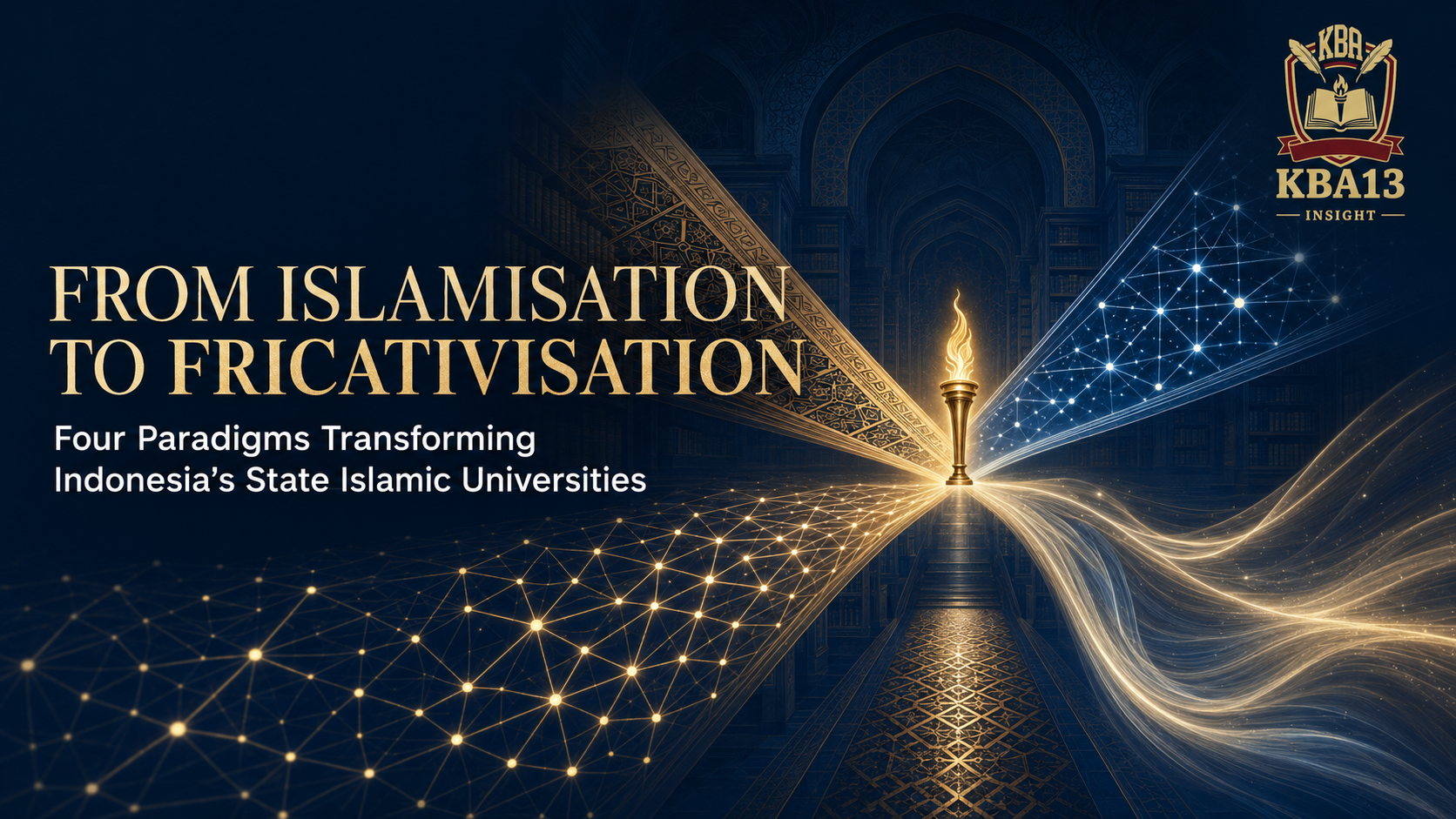
The illustration above renders, in artistic form, the essence of fricativisation: knowledge as a spiritual light within the Islamic scholarly tradition[118]. The cosmic torch, set among moon and stars, shows the integration of heaven (revelation) and earth (human endeavour) in the flame of knowledge.
The Role of the Educator and Implementation
In the fricative paradigm the teacher’s role comes to resemble that of a murshid, a spiritual guide. The teacher, it is said, is a “spiritual murshid, who breathes knowledge forth rather than conveying information”[65]. The lecturer, ideally, is like a Sufi master who transmits the barakah of knowledge through a bond of hearts, not through the transfer of content alone. This, of course, demands a spiritual qualification: the lecturer must himself undertake spiritual practice if he is to become a conduit of knowledge with a meaningful breath. The figure of the educator here unites the intellectual and the Sufi.
In practice this may take the form of a changed pedagogy: beginning a class, say, with meditation or a brief dhikr so that the inner atmosphere is opened. The lecturer cultivates an emotional engagement with the students, so that a spiritual chemistry arises. He may also gauge their understanding not through cognitive examination alone but by their character and by the vibration of spirit that shows itself in them.
The educational orientation of this paradigm is highly distinctive: the classroom is seen as a place for the illumination of the soul through spiritual resonance[119]. It is no mere transfer of knowledge. Education is thus approached like a majlis of dhikr or the ḥalaqah of a Sufi order, where knowledge seeps in through example and a sacred atmosphere. The measure of educational success is not the grade-point average alone but personal transformation: whether the student undergoes an illumination of his vision of life, a deepening of faith, and the like. To measure this academically is, to be sure, a formidable challenge; yet such is the aspiration.
Formal implementation may be limited, but a beginning can be made by building an essential religious campus culture—one of substance, not formality. It might, for instance, foster communities of dhikr, spiritual retreats for students, and the mentoring of character by lecturers. Some PTKIN already run programmes of this kind—a religious ḥalaqah in the student dormitories, say—and these accord with the spirit of fricativisation.
A Critical Assessment of the Fricative Paradigm
The paradigm of the fricativisation of knowledge offers a profoundly deep and transformative perspective on scholarship; it invites, nonetheless, a critical discussion:
- Abstract and elitist? Because it rests on a personal spiritual experience, the paradigm may be thought insufficiently measurable and difficult of general access. Not everyone possesses the profound spiritual experience of its author. There is a risk that the idea will be grasped only by a like-minded few, while to the ordinary lecturer or student it sounds mystical and perplexing. For it to be widely adopted, the concept must be explained within a more operational framework—specific teaching methods, for instance, that give spirituality its due.
- Integration with the empirical sciences: fricativisation meets the criticism of whether it can be applied to the pure sciences at all. What, for instance, would a fricative physics or a fricative biology be? The approach is difficult to apply within the strictly empirical sciences[120], for the language of the spirit does not register in a laboratory experiment. It may be, however, that I do not intend it for the natural sciences at all, but rather for the Islamic study of society and the humanities. Even so, the challenge of bridging to standard scientific method remains—how, for instance, is an element of dhikr to be introduced into historical research? Can silence become a method in a research report? This calls for a methodological daring not yet common in the academic world.
- The continuity of the idea: the fricativisation paradigm is still new and untested. It has been set out in lectures and opinion pieces [121], but little scholarly literature has yet examined or applied it. Further exploration is needed to make of it a concrete framework[92]. Unless it is soon taken up, the idea may remain mere discourse without successors. A systematic effort is therefore required—seminars, research into models of a fricative education, a handbook for a fricative-based curriculum, and the like—if it is not to evaporate.
- An anti-technocratic potential: strikingly, I mount a sharp critique of the technocratic view of knowledge. I reject the reduction of knowledge to a technocratic instrument and insist on inward meaning, on silence, and on spirit as its core[122]. The critique holds against the commercialisation of modern education. Its side effect, however, is that the fricative paradigm may be thought to stand too far from pragmatic reality. While the world is busy with talk of the Fourth Industrial Revolution, big data, and the like, this paradigm speaks of dhikr and the spiritual torch. There is a gap to be bridged if it is not to be dismissed as utopian. Perhaps through a synergy—a spiritual ethics, for instance, in the use of AI: an ethics of AI in religion.
In short, the paradigm of the fricativisation of knowledge proposes a spiritual leap towards a spiritual cosmology—knowledge as a cosmic vibration that illumines the human interior[123]. It is a way of thinking that restores sanctity and a depth of meaning to the heart of knowledge. If it can be implemented, it may prove an antidote to the moral emptiness of the academy. The challenge, however, is to render this esoteric conception inclusive and applicable without loss of its essence.
A Comparison of the Paradigms of Knowledge
Having surveyed the four paradigms—Islamization, Integration, Interconnection, and Fricativisation—we may now set them side by side across several key aspects, to see where they agree, where they diverge, and where they may complete one another.
Philosophical Foundations and Ontology
- The Islamisation of Knowledge rests on an ontology of tawḥīd: reality is God’s creation, and truth issues from revelation. It inclines to read reality strictly through the lens of religion. Its ontology is monolithic: whatever fails to accord with tawḥīd is deemed a deviation.
- The Integration of Knowledge likewise rests on tawḥīd, but acknowledges explicitly a duality of manifestation—revelation and nature. Its ontology accommodates two domains of reality that spring from a single source and is thus more inclusive than Islamisation. It is a moderate monism: one God, creator of a manifold reality that may be approached by the path of religion and by that of science alike.
- The Interconnection of Knowledge has a pluralistic ontology: reality is seen as complex and multidimensional, yet still within a framework of tawḥīd (theo-anthropocentric). It grants the diversity of phenomena, the multicultural. Unlike the two preceding paradigms, which are somewhat essentialist, interconnection regards reality as thoroughly contextual and relational.
- The Fricativisation of Knowledge has the most Sufi ontology of all: reality as an emanation of the divine light in vibration. It is a kind of pantheistic monism, though the term pantheism is nowhere used directly. Reality is understood not through structure or category but through the metaphor of vibration—all is one divine frequency. What elsewhere stands apart, then—revelation and nature—is here not separate but a single spectrum of light.
Epistemology and Method
- Islamisation: an epistemology grounded in revelation and an Islamised reason. Its primary sources are the Qurʾān and the ḥadīth, supported by reason within the bounds of adab. Its method: the Islamisation of the disciplines, a critique of Western ideology, and the reconstruction of knowledge from Islamic principles[28]. There is, then, a critical engagement with modern knowledge and the making of a new framework out of tawḥīd.
- Integration: a combinative epistemology—scripture and the empirical together. Its source: God, through scripture and nature[52]. Its method: the exegesis of texts in synergy with scientific research and the synthesis of knowledge[124]. There is an openness to Western theory so long as it fits. The approach tends towards a creative syncretism.
- Interconnection: a hermeneutic-contextual epistemology. Its sources are manifold—revelation, reason, experience, and cross-disciplinary dialogue[81]. Its methods: hermeneutics, critical reflection, and a transdisciplinary approach [125]. It is dialogical in essence: knowledge is won through the interplay of discourse and deep reflection, not through rote. A faint critical note of liberation runs through it.
- Fricativisation: an epistemology of intuition and dhikr. Its sources: silence, intuition, the inward vibration[126]. Its method: Sufi contemplation, dialogue in silence, meaning within vibration[127]. This is a method untraditional in the academy: a kind of meditative inquiry. The process of knowing is a becoming—one grows luminous by the touch of light[128]. It is deeply personal and transrational.
Axiology (The Ends of Knowledge)
- Islamisation: to establish Islamic disciplines free of Western influence, and to raise up a Qurʾānic society[29]. Its principal aim turns inward, upon the Muslim community: the purity of knowledge and fidelity to revelation. A spirit of Islamic triumph animates it (the victory of Islam through knowledge[129]).
- Integration: to strike a balance between faith and modernity for the advancement of the ummah[58]. A twofold aim: to advance the ummah in the world (in science, technology, and economy) while preserving faith. Its object is a renewal of Islamic education so that the ummah may be competitive yet moral.
- Interconnection: social harmony, humanity, and diversity grounded in tawḥīd[84]. Its aim turns outward: to take part in solving the problems of humanity at large from an Islamic perspective. Here lives the ideal of raḥmatan lil-ʿālamīn: knowledge for social justice, for intercultural dialogue, and the like.
- Fricativisation: the awakening of cosmic consciousness, the illumination of the soul, and a drawing-near to God[114]. Its aim is deeply esoteric: the spiritual transformation of the individual through knowledge. Its hoped-for effect reaches society too (an enlightened society), but the weight falls on inner transformation.
The Relation of Knowledge and Religion
- Islamisation: religion is the primary source and the guide of all knowledge[130]. Knowledge is subordinate to religion. Should knowledge conflict with religion, it must be altered. The relation is hierarchical: revelation above, the knowledge wrought by reason below.
- Integration: knowledge and religion are united in source and in orientation[131]. There is no conflict. Religion and knowledge complete each other: knowledge seeks the truth in its particulars, religion supplies the larger moral picture. The relation is harmonious, perhaps even equal—yet religion remains the moral heart[132].
- Interconnection: religion is the ethical and moral heart of the dialogue among the sciences[133]. Religion, that is, does not dictate the content of every science but serves as the conscience that guides discussion across fields. The relation is cooperative: the several sciences draw value from religion as a counterweight.
- Fricativisation: knowledge and religion fuse in the space of dhikr and spiritual vibration[134]. The relation is one of deep union, indistinguishable even: to seek knowledge is to worship, and to worship is to seek knowledge, on this view. Religion is seen as the path of divine tajallī, and knowledge as its effect. The two are thus a single process.
The Sources of Scholarly Authority
- Islamisation: the Qurʾān, the ḥadīth, the classical ʿulamāʾ, and universal Islamic values[135] are its highest references. The classical Islamic intellectual tradition is held in the highest honour. Western sources are admitted if they have been Islamised or lend support to revelation.
- Integration: revelation, nature, and sound reason within a normative Islamic framework[136]. The authoritative sources are combined: scripture, nature, and reason. Yet reason and nature must be read within an Islamic frame—the norms of Islam.
- Interconnection: cultural experience, the dialogue of the sciences, and values both transcendent and local[137]. The authority of knowledge is widened: not the formal text alone but also cultural wisdom, a global consensus consonant with noble values, and the like. This affirms a plurality of sources of wisdom (wisdom may come from anywhere, so long as it accords with tawḥīd).
- Fricativisation: the spirituality of the ʿulamāʾ, the spiritual maqām, and inward experience as the source of the vibration of knowledge[138]. This is singular: authority rests with those who have attained a certain maqām, and spiritual experience—dreams, inspiration—is acknowledged. Not, to be sure, in the technical matters of science, but in wisdom and orientation. The counsel of a saint (walī), for instance, carries more weight than psychological theory in the guidance of the soul.
Scholarly Method
- Islamisation: the Islamisation of the disciplines, a critique of Western ideology, a reconstruction upon tawḥīd[139]. Its method is thus normative-critical. It proceeds by stages: master the science, criticise it, implant Islamic values, and reformat its structure. One might call it a top-down approach—the framework descending from above into the particulars.
- Integration: integrative—the exegesis of scripture, plus scientific research, plus synthesis[140]. A mixed method. Top-down and bottom-up are joined: the text is interpreted, the facts are gathered, and the two are then synthesised. A creative process is needed to find the correspondences between concepts, and so on.
- Interconnection: hermeneutic, critically reflective, contextual, transdisciplinary[125]. A discursive method, often qualitative and participatory. It may take up the integrative method too, with the addition of critical analysis, seeking the hidden structures. It stresses the relevance of context, not shrinking from a revision of religious interpretation to suit the context—through a fresh ijtihād, for example.
- Fricativisation: contemplative, Sufi, a dialogue in silence, meaning through vibration[127]. A non-linear method. One learns through riyāḍah (spiritual exercise) and ḥāl (inward experience), not through verbal discussion alone. It comes near, perhaps, to the method of art or of meditation, far from the classical scientific tradition. To the unaccustomed it is scarcely a “method” in the usual sense, but a personal experience that cannot be reduced to a scheme.
Weaknesses and Criticisms (in brief)
- Islamisation: normative, hard to apply empirically[120]; at times too utopian in wishing Islam to answer everything, though scientific practice is limited, and at risk of closing itself off from what is useful yet non-Islamic.
- Integration: at risk of pragmatism, its operationalisation often vague[75]; dependent on the quality of those who carry it out—liable to be a mere overlay without substance, and insufficiently deep in its critique of the ideology of science.
- Interconnection: very broad, and complex to implement; it requires a change of mindset and of structure; it may be less incisive against hegemony, being occupied with the weaving of relations (though this is debatable—interconnection can also be turned against domination, by amplifying marginal voices).
- Fricativisation: new and symbolic[92]; apt to be thought unscientific; in need of support if it is not to vanish; and facing great methodological challenges.
A summary table of the comparison might well be drawn up, but for the present essay the narrative exposition above will suffice to convey the position of each paradigm.
In general, Islamisation and Fricativisation tend to be Islam-centric—the one at the level of the sharīʿah, the other at the level of spiritual reality (ḥaqīqah)—whereas Integration and Interconnection are more dialogic-centric, the one a dialogue of Islam and science, the other a dialogue across many fields. Islamisation and Integration still labour within the frame of consolidating the formal disciplines, while Interconnection and Fricativisation seek to break through the formal bounds—interconnection towards the multidisciplinary, fricativisation towards the spiritual.
Strikingly, for all their apparent divergence of direction, the four may be seen as stages, or as a continuous spectrum. It may be that a PTKIN need not choose one and forsake the rest, but may gather the best of each: Islamisation secures a firm foundation of tawḥīd; integration ensures a command of science; interconnection guarantees an openness to dialogue and a care for society; and fricativisation makes certain that the spirit is not lost.
Conclusion: Reflections on the Future Direction of Knowledge at PTKIN
This retrospective on the evolution of knowledge paradigms at PTKIN reveals a dynamic shift from a normative tradition towards the search for synthesis and new depth. Each paradigm arose as an answer to a specific challenge of its age: the Islamisation of Knowledge met the challenge of the secularisation of knowledge with a return to tawḥīd[23]; the Integration of Knowledge answered the Muslim need to master modern science without forfeiting faith[2]; the Interconnection of Knowledge emerged so that scholarship at PTKIN might answer more fully to sociocultural complexity and overcome the fragmentation of the disciplines[141]; and the Fricativisation of Knowledge was proposed to fill the spiritual void amid the density of academic discourse, bringing the dimension of the spirit to centre stage[95].
The future direction of knowledge at PTKIN is unlikely to be bound exclusively to any one paradigm; it will rather be a creative synthesis. Experience shows that each paradigm brings a valuable contribution and a limitation alike. The Islamisation paradigm gives us a pride of identity and a firm filter of creed, but it must be tempered by the breadth of an integrative vision if it is not to fall into exclusivism. The Integration paradigm has opened the gate to scientific progress on the Islamic campus, yet it must be guarded lest it lose its religious spirit—and here lies the importance of admitting the fricative element, spirituality. The Interconnection paradigm teaches an intellectual humility, that truth has many sides; this spares us both scientific and religious fanaticism. And finally, the Fricativisation paradigm reminds us that knowledge without conscience is but empty data—it offers a vision of knowledge that quickens the soul rather than merely filling the mind.
Ideally, the future of PTKIN will unite the strengths of all these approaches into an integral, holistic paradigm of knowledge. One may imagine a framework at once tawḥīdic-spiritual and empirical-rational, contextual-humane, and transformative. The PTKIN curriculum of the future, for instance, might incorporate a spiritual curriculum (riyāḍah) for students of the sciences, just as students of the sharīʿah are required to study modern research methodology. Research collaboration would run not only across disciplines but across dimensions—joining the analysis of data to contemplation (tafakkur) and ethics. Scholarly publication, too, might reckon with the dimension of inward benefit, and not with worldly novelty alone.
Global challenges—digitalisation, artificial intelligence, and other disruptions—will, to be sure, put these paradigms to the test. PTKIN must keep innovating. New paradigms may yet arise to suit the age—an Islamisation 2.0 for the era of AI, say, or an eco-theology integration to confront the climate crisis. Yet the common thread remains: to keep knowledge at PTKIN rooted in Islamic values and fruitful for humanity. As Muqowim (2021) has noted, all the UIN concur in the importance of building a new tradition upon an integrative paradigm that advances from philosophical concept to practical application[141].
In the end, this reflection shows that a paradigm of knowledge is nothing static. It grows without ceasing, like a tree of knowledge that puts forth new shoots[142]. PTKIN, as a laboratory of Islamic intellect, should not shrink from experimenting in the composition of paradigms. So long as it holds fast to tawḥīd and to the intention of seeking God’s good pleasure, the several approaches may complete one another. The paradigm of knowledge at the PTKIN of the future will likely be hybrid, uniting the strengths of Islamisation, Integration, Interconnection, and Fricativisation—and perhaps others besides— within a scholarly ecosystem academically excellent, spiritually rich, and socially relevant. So equipped, PTKIN may hope to bring forth scholar-ʿulamāʾ and scientist-mystics who become, in truth, the engine of the ummah‘s advancement in the modern age, without losing their bearing on the divine light as guide.
So concludes this study. May it contribute to the continuing conversation on the direction of scholarly development within PTKIN and in the Muslim world at large.
References:
- Kamaruzzaman Bustamam Ahmad (2025). PKDP 2025: Kilas Balik Paradigma Keilmuan PTKIN. Materi presentasi, 24 Juli 2025[3][31].
- Abdullah, M. Amin (2006). Islamic Studies di Perguruan Tinggi: Pendekatan Integratif-Interkonektif. Yogyakarta: Pustaka Pelajar[48].
- Al-Attas, Syed M. Naquib (1978). Islam and Secularism. Kuala Lumpur: ABIM[23].
- Al-Faruqi, Ismail Raji (1982). Islamization of Knowledge: General Principles and Work Plan. Herndon, VA: IIIT[22][143].
- Muqowim (2021). “Revisiting Islamic Studies: Cementing Bases for Integrating Science and Religion in Islamic Higher Educational Institutions.” Jurnal Pendidikan Agama Islam, 18(1), 1–20[2][141].
- Tarmizi M. Jakfar et al. (2019). “Model Integrasi Ilmu dan Pengembangannya di Fakultas Syari’ah dan Hukum UIN Ar-Raniry dan UIN Sumatera Utara.” Jurnal Islam Futura, 18(2)[71][72].
- Situs UIN Maulana Malik Ibrahim Malang – Filosofi Pendidikan Ulul Albab (diakses 2025)[32][54].
- Kamaruzzaman Bustamam Ahmad (2025). “Paradigma Frikatifisasi Ilmu: Hembusan Kosmik dalam Arsitektur Keilmuan Islam.” KBA Official Website, July 28, 2025[95][106].
- Wikipedia (2025). “Islamization of Knowledge.” Wikipedia (accessed Aug 2025)[18][22].
- Parluhutan Siregar (2020). “Integrasi Ilmu-ilmu Keislaman dalam Perspektif M. Amin Abdullah.” Jurnal Al-Aqidah, 10(2)[49][86].
[1] [2] [14] [15] [48] [70] [141] Revisiting Islamic Studies: Cementing Bases for Integrating Science and Religion in Islamic Higher Educational Institutions | Jurnal Pendidikan Agama Islam
https://ejournal.uin-suka.ac.id/tarbiyah/jpai/article/view/2021.181-01
[3] [4] [5] [6] [7] [8] [9] [10] [11] [12] [13] [16] [17] [24] [25] [26] [27] [28] [29] [30] [31] [36] [37] [39] [43] [44] [45] [46] [50] [51] [52] [53] [57] [58] [59] [62] [63] [64] [65] [67] [73] [74] [75] [76] [78] [80] [81] [82] [83] [84] [85] [88] [89] [90] [91] [92] [93] [94] [98] [101] [102] [103] [108] [114] [115] [116] [117] [119] [120] [122] [123] [124] [125] [126] [127] [130] [131] [132] [133] [134] [135] [136] [137] [138] [139] [140] PKDP 2025.pdf
file://file-5mS7evepAphr6zWxyxaBjb
[18] [19] [20] [21] [22] [38] [129] [143] Islamization of knowledge – Wikipedia
https://en.wikipedia.org/wiki/Islamization_of_knowledge
[23] [40] [41] [42] iseas.edu.sg
https://www.iseas.edu.sg/wp-content/uploads/2021/06/TRS16_21.pdf
[32] [33] [34] [35] [54] [60] [61] [66] [68] [69] [142] Filosofi Pendidikan – Program Studi Sastra Inggris
https://bsi.uin-malang.ac.id/filosofi-pendidikan/
[47] [71] [72] MODEL INTEGRASI ILMU DAN PENGEMBANGANNYA DI FAKULTAS SYARI’AH DAN HUKUM UIN AR-RANIRY BANDA ACEH DAN UIN SUMATERA UTARA | Jakfar | Jurnal Ilmiah Islam Futura
https://jurnal.ar-raniry.ac.id/index.php/islamfutura/article/view/3765
[49] Pemikiran Amin Abdullah Seputar Integrasi Keilmuan | Fathir
https://jurnal.fanshurinstitute.org/index.php/fathir/article/view/13
[55] [56] [79] [86] [87] ISI.pmd
https://media.neliti.com/media/publications/155451-ID-integrasi-ilmu-ilmu-keislaman-dalam-pers.pdf
[77] Gambar 3. Integrasi Keilmuan Pohon Ilmu – ResearchGate
https://www.researchgate.net/figure/Gambar-3-Integrasi-Keilmuan-Pohon-Ilmu_fig1_379239658
[95] [96] [97] [99] [100] [104] [105] [106] [107] [109] [110] [111] [112] [113] [118] [121] [128] Paradigma Frikatifisasi Ilmu: Hembusan Kosmik dalam Arsitektur Keilmuan Islam – Kamaruzzaman Bustamam Ahmad
https://www.kba13.com/paradigma-frikatifisasi-ilmu-hembusan-kosmik-dalam-arsitektur-keilmuan-islam/
About The Author

Rekomendasi Bacaan KBA13 INSIGHT
Jika tulisan ini bermanfaat, dukung jurnal ini dengan mencari bukunya melalui tautan berikut:
- Buku-buku Kamaruzzaman Bustamam Ahmad di Periplus
- Koleksi Islamic Studies di Periplus
- Koleksi Geopolitics & Politik Internasional di Periplus
- Cari buku & perangkat baca di Shopee
- Cari di Blibli
Daftar lengkap: Rekomendasi Buku, Alat Tulis & Layanan. Tautan di atas adalah tautan afiliasi — KBA13 INSIGHT dapat memperoleh komisi kecil tanpa biaya tambahan bagi Anda.
Artikel Terkait
 Acehnology: Menyelami Kembali Kosmos Pengetahuan dari Tanah Aceh
 Religio-Anthropological Approach: Membaca Ulang Agama, Antropologi, dan Sejarah dalam Pemikiran Ugo Bianchi
 The Search for Digital Anthropology: A Case of What Were Doing
 The Future of Digital Culture: What Comes Next?
 The Evolution of Islamic Thought in the Malay World: Adaptation, Reform, and Political Awakening
Leave a Reply